Category Archives: Fishing Tackle

Rods and reels to live bait

Why Should I Use Planers To Get My Bait Down Deep?

Use a planer board to get a small bait down deep

Use a planer board to get a small bait down deep

Get Down With Planers

Trolling Deep Made Easy
From The Fishing Wire

On a recent trip to North Carolina, Yamaha caught up with the charter captain brothers Brant and Barrett McMullan, highly-ranked professional kingfish tournament anglers and Yamaha Pro Team members. The McMullan family owns and operates the Ocean Isle Fishing Center in Ocean Isle Beach, home to the Jolly Mon King Mackerel Tournament. The initial plan was to run offshore to fish for tuna and wahoo, but Mother Nature was not cooperating so the brothers took the heavy tackle off their Yamaha-powered 32′ Yellowfin center console and replaced it with some light gear to fish for Spanish mackerel, bonito and gray trout inshore.

During the switch, we noticed the McMullan’s had heavy outfits with large planers coming off the boat and light outfits equipped with little tiny planers going on. So we asked them, “Why do you guys always seem to have planers on the boat?”

“It doesn’t matter what kind of fishing we are doing, or whether it’s inshore or offshore,” said Capt. Brant. “You can be sure that there are a lot more fish holding down in the water column than there are feeding on the surface. Trolling planers are the easiest way I know to get a lure or rigged bait down there to catch those fish.”

For those unfamiliar with trolling planers, they are basically weighted, stainless steel wings with a ring and wire trip mechanism. When armed, the forward motion of the boat forces the planer to dive to a predetermined depth pulling whatever lure or bait is attached along with it. As demonstrated by the McMullan’s, trolling planers come in a wide variety of sizes for covering almost any trolling situation.

“We use the smallest planers (#1 and #2) for fish like Spanish mackerel and bonito inshore, and the larger sizes (#16 and above) offshore for fish like tuna and wahoo,” Capt. Brant explained. “In recent years, the hot setup for catching big bluefin tuna around here in the winter has been using the large planers to troll rigged ballyhoo 50-to-60 feet down and about a hundred yards behind the boat. With all the different sizes available, you can find a planer that will work in almost any fishing situation.”

Planers can be used a couple of different ways depending on the size and application. The small ones are attached directly to the end of the running line on a light trolling outfit. Then a long leader is run between the planer and the lure. That day, the McMullan’s used #1 planers on light trolling outfits with a 12-foot leader running back to a tiny Clark spoon that matched the size of the baitfish the Spanish mackerel were chasing. It would be impossible to get those nearly weightless spoons down at trolling speed any other way.

The planers pulled them along at 15-to-20 feet below the surface. When a fish strikes and gets hooked, the pressure trips the ring mechanism, which allows the wing to change from a diving angle to a flat position (see figure 2) This allows the angler to play the fish back to the boat.
Once the planer is reeled to the rod tip, simply pull the fish in by hand using the leader.

“Larger planers are rigged differently,” McMullan told us. “At speed, they create so much resistance that you would have to attach them to an extremely heavy outfit just to handle the pressure. When you hooked a fish, the outfit would be so heavy you would have to fight the fish with the rod still in the rod holder, and that’s not much fun. So we attach the big planers to the line from a downrigger, and the lures or baits are fished from a separate outfit using a simple release system made up of a double snap swivel and a rubber band to link it to the planer line.”

The downrigger is loaded with 250-lb. test braided line to handle the pressure the planer generates as it digs to run deep. It is attached to the downrigger line with a 400-lb. test snap swivel replacing the downrigger ball that would normally be there. When it’s time to deploy the planer, the boat should be in gear and at trolling speed. Drop the planer in the water armed so it will dive, and lower it under pressure from the drag on the downrigger to its maximum depth, then lock it up. Next grab the outfit you’re going to fish with and release the lure or rigged bait as far back behind the boat as you want it. For some gamefish like wahoo, running it 20 or 30 feet behind the planer is fine. The planer is shiny stainless steel and can actually help attract some fish to the hook bait. For others species that tend to shy away from boats, like bluefin tuna, you will want to get the bait way back behind the boat, 50-to-100 yards or more.

To link the bait line to the downrigger line so the planer can pull it down, wrap a #64 rubber band around the line (see figure 3) and attach it to one side of a double snap swivel. The other snap is closed around the braided line between the downrigger and the planer. With your thumb on the spool of the reel, slowly let line out. The pressure of the water at trolling speed will push the swivel release down the line to the top of the planer along with the line running to the bait behind the boat. Once it reaches the planer, tighten up the line a little to take as much belly out of the length between the rod tip and the rubber band release as possible. When a fish hits, the rubber band breaks releasing the line from its connection to the planer, and you can fight the fish free and clear.

If you don’t have downriggers, you can make a simple planer line that will accomplish the same goal. Use a 75-foot length of 200-lb. test monofilament line and crimp on a 400-lb. test swivel to the end you will use to attach to the planer. Tie a large loop that will fit over the stern clean of the boat to the other end. Clip it to the planer and let it out by hand. (see figure 4)
Figure 4. These skilled North Carolina captains never leave the docks without planers in a number of sizes on board.
Once the planer is at running depth, use the same rubber band release procedure as Capt. Brant described for the downrigger and you’ll be fishing deep for cheap! When you want to retrieve the planer, slow the boat to a stop and pull it up or pull the line hard and release it quickly to trip the mechanism.

If you’re going to be in the coastal area of North Carolina be sure to check out the McMullan’s new cable television show – OIFC No Limits Fishing, which will be broadcast daily on ATNC Cable’s local access channel with support from Yamaha Marine, Yellowfin® Boats and Pelagic® clothing. It will feature Captains Brant and Barrett providing fishing reports and forecasts, phone interviews with local captains, and an action segment with on-the-water tips and techniques to help you catch more fish. You can also access the show by going to www.oifc.com and clicking the link.

Fishing Snakes and Floating Bass

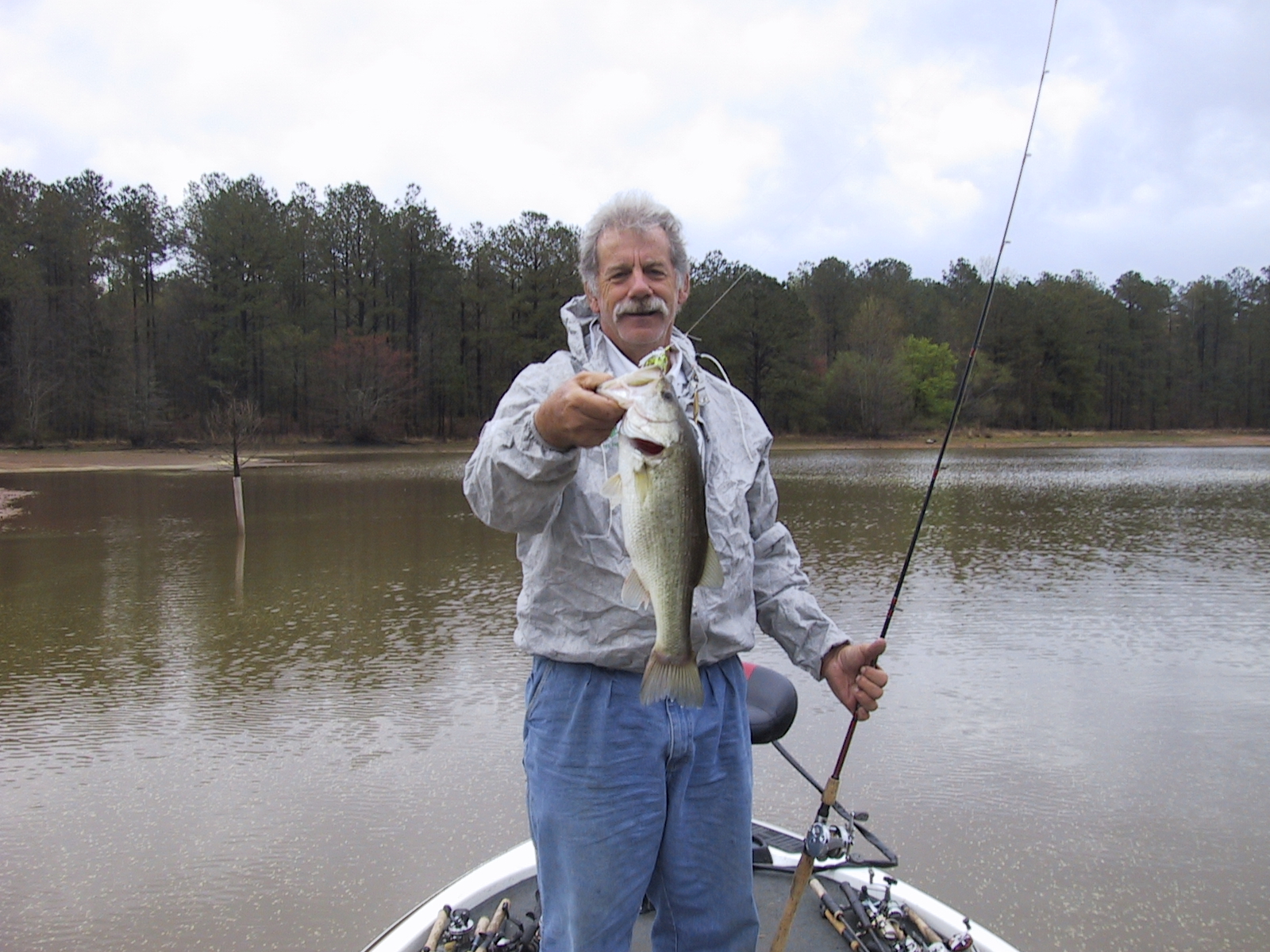
Largemouth from Bartletts Ferry

Largemouth from Bartletts Ferry

Last Sunday there were a couple of unusual things that happened to Al and me at and after the Flint River Bass Club tournament at Bartlett’s Ferry. As we left the ramp headed home a rattlesnake was in the middle of the road. And a bass did something I have never seen happen before.

The snake was about three feet long and was right in the middle of the road. I didn’t try to run over it because I see no reason to kill a snake that is not threatening anyone. The guys in the vehicle behind us saw it too and didn’t run over it, but confirmed it was a rattlesnake.

One reason I don’t want to run over a poisonous snake is something, probably what we now call an “Urban Legend,” that I grew up hearing. The story goes that a guy had a flat and got out to check it. He ran his hand around the tire and got scratched by what flattened the tire.

Supposedly it was a rattlesnake’s fangs that stuck in the tire, and when they scratched him he got enough venom to kill him. I guess that could happen. Either way, I don’t take chances!

Rattlesnakes are pretty uncommon around here. I grew up near Augusta and the sandy terrain over there, rather than the clay around here, is more to their liking. We killed rattlesnakes on the farm several times while I was growing up. I still have the rattles from one, and many of us boys carried rattles in our pockets, bragging about how many rattles and buttons they had.

Snakes normally won’t hurt you. They will try to get away from you. After all, you are too big for them to eat. Leave them alone and they will leave you alone.

The other strange thing happened while we were fishing. Al and I were fishing a deep brush pile and Al had caught a couple of nice bass, and I broke off two and missed a couple. Then Al set the hook on a bass that wrapped him up in the brush. After trying to get it loose he had to break his line.

About ten minutes later a bass floated to the top and we picked it up. The 2.5 pound largemouth had Al’s hook in its throat! Apparently it swallowed the hook deeply before or while getting hung up and it killed it. I have broken off a lot of fish like that but have never had one float up like that one did.

At the tournament 13 members and guests landed 41 keeper bas weighing about 52 pounds. There were three five-fish limits and one member didn’t have a keeper. It was a surprise only ten of the bass were spots – usually we catch a lot more spots than largemouth there.

Al Rosser won with four weighing 6.37 pounds. We were real worried the one that broke off would make the difference but he still won without it. Niles Murray was second with a limit weighing 6.26 pounds and Chuck Croft placed third with five at 5.96 pounds. Roger Morrow’s four weighing 5.69 pounds was fourth and his 2.91 pound largemouth was big fish.

Fish were caught on a little of everything, from fish head spins to jigs and worms. There was a lot of muddy water coming down the river but the main lake and lower creeks were clear, and that is where most of the fish were caught.

Al and I started up the river a little ways and I missed two on spinner baits around grass. Niles had run about a mile above us and where he stopped was real muddy at 6:00 AM. Where Al and I fished the water was still ok at that time, but by 2:00 PM when we ran in the mud had come down the river past the ramp, several more miles downstream. Bass seem to hate fresh muddy water and stop biting when it first gets muddy.

Al and I fished a lot of different places and I got my first keeper at about 8:00 on a jig and pig off a seawall. Then Al got two on a jig head worm. Around 10:00 we went over a deep brush pile and Al got a nice 2.3 pound bass from it. I could see a lot of fish around the brush on my depth finder, but they would not hit.

After several hours of running around the lake trying to catch bass without any luck we went back to the brush pile for the last hour. Often bass will hold off brush then, for some unknown reason, move in to feed. And they had. Al got two more good keepers from it and I got one the last hour, and that is when we missed several bites and broke off three fish.

Deep brush is worth checking out several times during a day, especially if you see fish around it on a good depth finder!

How To Catch Shallow Water Walleye In the Spring

This walleye came from shallow water in the spring

This walleye came from shallow water in the spring

What Are Shallow Water Walleyes and How Can I Catch Them?

By Bob Jensen
from The Fishing Wire

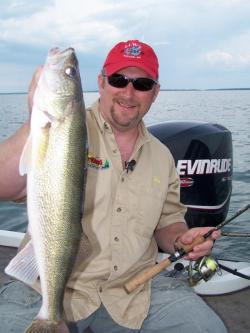
Big walleyes like this one prowl the shallows for some time after the spawn–a live minnow on a jig often fools them.

The standup jig has special appeal when tipped with a live minnow.

Plastic tails can also be effective, particularly in late spring as water warms a bit.

Walleyes sometimes prowl water as shallow as a foot deep, particularly in low light periods.

Walleyes are often thought of as a fish that inhabits the depths, and there are times when most of them will be found in deep water. However, there are other times, more than you may think, when you can catch walleyes shallow, often eight feet or less. Here are some ideas for taking walleyes in shallow water.

Walleyes spawn so shallow sometimes their dorsal fin will be above the surface of the water. After the spawn they move into the mid-depths to recover from the rigors of spawning, or maybe they stay in the shallows and just don’t eat much. But a few days after spawning has ended, walleyes will get active in the shallows. This is when they get easy to catch.

Look for shallow walleyes wherever the shiners or other baitfish are spawning. Shorelines with small rocks, areas with vegetation starting to come up, points related to shorelines, these areas will all hold shallow walleyes early in the summer, and there are lots of ways to catch ’em when they’re in these locations.

Crankbaits, slip-bobber rigs and live bait rigs will all catch shallow walleyes. But the folks who catch walleyes most regularly are probably throwing a jig tipped with either a minnow or plastic.

When the walleyes have just recovered from the spawn, they’ll be most susceptible to a jig and minnow combination. In some bodies of water the walleyes will eat a jig tipped with a fathead minnow: Elsewhere a shiner on the back of a jig will be far more productive. I almost always have both shiners and fatheads in the boat. Shiners can be tough to keep lively, so I put them in a Frabill 1404 aerated container. This unit keeps shiners in a fish-catching attitude.

I’m hooking the minnow to an eighth ounce stand-up Fire-Ball jig almost all of the time. The stand-up design of this jig enables me to pause my retrieve, but the jig stands up, remaining in full view of the fish. A round head jig lies flat on the bottom at rest, making it harder for the fish to see.

As the water warms, the walleyes become more susceptible to a jig/plastic presentation. Where a couple of days earlier we were crawling the jig/minnow along the bottom, with the plastic we’ll be snapping it pretty aggressively. Walleyes in warmer water will eagerly whack a jig/plastic combo that is moving quickly along the bottom. Many of the strikes will come as the jig is gliding back to the bottom after it has been snapped. A Rock-It jig tipped with something like an Impulse Paddle Minnow is tough to beat. Fish the jig/plastic with eight or ten pound test Bionic Walleye Braid. The braid works better with the snapping retrieve. Fish the jig/minnow on six, seven, or eight pound test Bionic Walleye monofilament.

Walleyes can be found in shallow water year ’round in most lakes, rivers, and reservoirs wherever walleyes swim, particularly after dark, but look for them in the shallows especially in late spring and early summer. Make long casts, keep a low profile, and be quiet. If you do these things, you’ll find yourself catching walleyes shallower than you might have imagined.

To see all the newest episodes of Fishing the Midwest television, visit fishingthemidwest.com Join us at Facebook.com/fishingthemidwest

Are Very Expensive Fishing Rods Worth the Cost

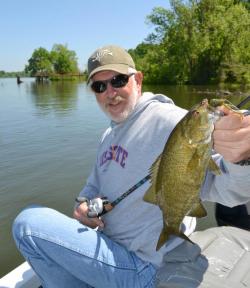
Smallmouth Caught  On A GLoomis Rod

Smallmouth Caught On A GLoomis Rod

from The Fishing Wire
By Frank Sargeant, Editor

A G. Loomis GLX 853C-JWR baitcasting rod is priced at $455.

Yep, yikes!

Not many of us would dare to buy a rod at that price, never mind telling our wives what we paid for it.

It’s a bit like owning a Ming vase when you have cats in the house -fishing rods, particularly ultra-light, high-tech graphite rods, are highly frangible, and we tend to use them around truck doors and boat hatches. To say nothing of prying reluctant largemouths out of hundred-pound wads of hydrilla.

On braid, yet.

But Loomis offers “insurance”.

“We call it our ‘expediter’ program,” says Bruce Holt, communications director for the West Coast Company, who recently spent a few days here testing his gear on Pickwick smallmouths in the company of Captain Steve Hacker. “If you break one of our GLX or higher series rods, in any way, we’ll replace it for a hundred bucks.”

Loomis GLX line is expensive, but an “insurance policy” assures anglers that a broken rod is not the end of their investment.
That’s added to the lifetime full-price warranty against defects in workmanship and materials, notes Holt, so in all there’s a whole lot less risk in buying one of these top-line rods than it might first appear.

And, for those who have the expendable income and the compulsion to own the best there is for their leisure pursuits, it would be hard to argue that the upper-level G. Loomis rods are not about as good as it gets.

“Most of the cost of a rod is in the graphite and the guides,” notes Holt. “The lighter and stiffer the fibers that go into the blank, the lighter the rod is going to be at a given power and action, and the better it’s going to feel in your hand after six or eight hours of casting. The GLX material has a very high “modulus”, that is resistance to bending, and that makes it possible for us to build rods that are amazingly light and fast.”

Holt said the GLX series also uses Fuji Titanium SIC guides, much tougher and more resistant to bending than steel, which feature a ceramic liner that’s much smoother, lower in friction and more durable than conventional guide liners. The guides are positioned on the blank via computer programs that designate the best locations as the blank tapers, preventing line slap on the blank, and the rods also use several more guides than lower cost sticks-there are 11 plus the tip-top on the 7-foot, 1-inch 853C, compared to as few as seven on low to mid-range rods of the same length.

“We couldn’t find exactly what we wanted so we had this mount built for us,” says Holt. “It’s extremely light but very strong and dependable.”

The mount is “skeletonized” to reduce weight, and also features a larger area of exposed blank directly below the reel, where the index finger naturally rests, to increase sensitivity when fishing jigs and soft plastics where the bite is often light.

The cork handle is also top of the line.

“Quality cork is a lot more expensive than the black foam handles on mid-range rods, but it’s lighter, it’s smoother on the hand and most anglers like the feel of it better-it’s firm and yet it’s got enough ‘give’ so that you can keep a good grip even when it’s wet,” says Holt. “It also looks good, year after year, if you just scrub it now and then with a light detergent and water.”

The 853C is designated a medium-heavy power rod with an extra-fast action-this means lots of power in the butt, melded to a stiff and very quick tip section that allows quick, powerful hooksets. The rod is designed for lures of 3/16 to 5/8 ounce, and for lines of 12 to 16 pounds.

G. Loomis makes a full stable of GLX bassing rods in both casting and spinning versions. The company also markets several lower-priced models.

“The maximum line test is something that anglers should keep an eye on,” says Holt. “We test rods to destruction to determine how much they can lift, so that’s sort of a safety device-if you put line no heavier than 16-pound-test on a rod rated for that line and put slow, steady pressure on it, it will either lift 16 pounds of fish and weeds, or the line will break first. Beyond that, if you overline it with heavy braid, for example, it may break.”

The exceptionally light weight of Loomis sticks makes them incredibly easy on the arms and wrists, a big plus for anglers who fish daylight till dark. Matched with a lightweight reel like a Shimano Chronarch or similar, these rigs seem like old friends the moment you pick them up the first time.

And odds are, they will become that for the fortunate few who can afford them.

“These are legacy rods,” says Bruce Holt. “You can fish them for a lifetime, and then hand them down to your kids and they can fish them for another lifetime.”

Provided they avoid car doors and hatch lids, of course.

What Is Lyme Disease and How Does It Affect Me?

Prespawn largemouth

Prespawn largemouth

A few years ago I got Lyme Disease and learned what it isIf you spend much time outdoors you are familiar with many dangers that you might face. Snakes are scary, wasps and other stinging insects can hurt you, and falling out of a boat or a deer stand can be life-threatening. But most of us don’t think much about ticks and Lyme Disease, something that can make you deathly sick and even kill you.

Back in the early 1980s I was in a deer club where we had a terrible problem with “seed ticks” every fall. One day after hunting I saw my pants legs were covered with tiny moving dots. I had some Scotch Tape in the truck and stuck a bunch of them under a strip and took them to an entomologists at the University of Georgia Agricultural Experiment Station in Griffin.

He identified the ticks and gave me some background on the tick life cycle. I reviewed information on the internet to check my memory of this information. One good site on tick life cycle is: http://animals.howstuffworks.com/arachnids/tick2.htm
And on Lyme Disease at: http://en.wikipedia.org/wiki/Lyme_disease

Lyme Disease is a bacterial infection transferred to people by tick bites. The bacterium that causes the infection is Borrelia burgdorferi. When a tick bites you, it actually attaches with its mouth parts and feeds on blood. To keep your blood from clotting and ending its meal, the tick injects anti-clotting agents into its host. That is when the bacteria are injected into your body, where they grow and multiply.

Ticks are related to spiders and adult ticks have eight legs, making them arthropods, not insects. We have four kinds of ticks in this area that you are likely to encounter. American Dog Ticks, Black Legged Ticks, Lone Star Ticks and Brown Dog Ticks are all common in Alabama.

Their life cycle is complex. An adult female tick feeds on a host and fills with blood. After breeding, she drops to the ground and digs in. She will lay hundreds to thousands of eggs and, when they hatch, the tiny ticks climb onto grass stalks or bushes and wait on a warm-blooded host to come by. They get onto the host and get a meal of blood then drop off.

At the first stage of their life, the ticks are tiny, about the size of a pin head. Often called “Seed Ticks,” these young ticks can actually be any of the kinds of ticks that live around here. You aren’t likely to see them attached to you at this stage since they don’t feed long, but they leave an itching sore where they bite that shows up a day or two after they are gone. Since hundreds hatch in the same small area, you can get dozens on you at the same time.

The tiny ticks go back into the ground, molt and grow, then climb back up onto something to wait on a host again. At this stage the ticks are bigger and easier to see, but are usually still called seed ticks. They bite and attach a little longer before filling with blood and dropping off again. You sometimes start to itch while they are still attached at this stage.

After dropping off, the ticks will go through another molt then try to find a host a third time. They are mature at this point and will be bigger. You often feel them crawling on you and can spot them easier, and can even identify the type of tick. And they will stay attached much longer while feeding. This is the stage where the tick will be a big gray ball after filling with blood. At some point during this stage the tick will breed. The females then drop off, lay their eggs and start the cycle all over again.

Different kinds of ticks carry different diseases. The Brown Dog Tick mainly carries infections that affect dogs but Lone Star Ticks carry Tularemia and Lyme disease, the American Dog Tick carries Rocky Mountain Spotted Fever and Tularemia, and the Black Legged Ticks are the primary carriers of Lyme Disease and also carry human granulocytic ehrlichiosis. Since the different kinds of ticks are very hard to identify at different stages, all ticks should be considered dangers.

Growing up back in the 1950s, we seldom saw ticks except on our dogs, and almost never got them on us. They were just not that common. But something happened to make ticks much more widespread. Whitetail deer are favorite hosts of ticks and, as the deer population boomed, so did the tick population. By the late 1970s, it was hard to walk in the woods in warm weather without getting a tick on you.

I spend a lot of time outdoors and get bit by ticks way too often now. From April to October, if I go out to my ponds and walk around them, I will get ticks on me if I don’t spray carefully with repellant. Just playing with my dog can transfer ticks from him to me. Sitting on the ground turkey hunting is a very good way to get ticks too.

One of the most unusual ways I got ticks on me happened in April a few years ago. While practicing for a tournament at West Point Lake I answered a call of nature. When I got out of the boat, I commented to my partner about all the deer tracks on the bank in that area. That night I found three ticks on me, two crawling and one attached, when I took a shower.

In July I started to feel run down and tired all the time. Sometimes at night I felt like I was having a slight chill and running a low fever. By late August I did not want to do anything. I had to force myself to go fishing, and a club tournament was an ordeal I suffered through. Walking out to the mail box exhausted me.

In early September I made my annual fishing trip to northern Wisconsin. Even though the fish bit great, I could not fish longer than five or six hours each day, and felt miserable after that short a time. When I got home, I went to the doctor and told them to find out what was wrong with me.

A wide ranging variety of blood tests for all kinds of things came back positive for only one thing – Lyme Disease. The doctor said I could have been infected for months or even a year and the symptoms were just showing up. I never saw a rash or “bulls-eye” swelling around a tick bite that is supposed to be seen in 90 percent of the cases of an infection. I never found a tick on me that had been attached for more than a few hours, although it is claimed they need to be attached for 24 hours to transfer the infection.

The doctor put me on 200 milligrams of Tetracycline daily for 20 days and I started feeling better near the end of that treatment. Unfortunately, within a week after ending the antibiotic, I felt terrible again and was given ten more day of Tetracycline. It had no effect and another 20 days of it was prescribed.

I did a lot of reading and found out 20 days of Tetracycline was the accepted course of treatment, and was supposed to cure you. It was scary reading how Lyme Disease left untreated could affect your nervous system, heart and other organs and even cause death. I found articles saying there was a chronic form that was much harder to get rid of, often taking years of antibiotic treatments.

I also found out the Centers for Disease Control (CDC) had a map on their web site showing a low risk of Lyme Disease for most of Alabama and no or minimal risk in some far north areas. That really surprised me since everyone I talked with seemed to know someone who had tested positive for Lyme Disease.

At this point I had taken antibiotics for 50 days and still had the same symptoms. I was worried and went back to my doctor. He ran every test he could think of, taking eight vials of blood for them. All came back normal and he said there was really nothing he could do since the test said everything was ok.

One point was a little scary. He told me my Lyme Disease test was still positive, but it would always be positive. Once you get Lyme Disease your blood will always have the antigen that shows up positive in a blood test, so it really does not tell the doctor anything. You can still be infected or the infection can be gone, there is no way to tell.

For several weeks I managed to get by, feeling run down and tired all the time. It felt like someone had unplugged me and all my energy was gone. I could be sitting at my desk or lying in bed and just felt drained and did not want to do anything.

While talking to a local forester, I told him my experiences, and he said his son and gotten very sick with Lyme Disease and had gone through the same things without being cured. Then he found a doctor in Mobile that specialized in Lyme Disease and went to him. After a long struggle and months of antibiotics, he started getting better.

I contacted the doctor and got an appointment. He told me my experiences were common. He had been treating Lyme Disease for over 20 years, studying it and had come up with a course of treatment that helped about 95 percent of his patients. He ran several tests on me and said I was lucky that so far I didn’t have any neurological effects. He also said the approved course of antibiotics I had taken were not nearly strong or long enough.

He started me on 30 days of 500 milligrams of azithromycin a day plus a daily dose of Flagyl, a kind of antibiotic that will kill bacteria in the cyst stage. After three weeks of the dual antibiotics I started feeling better and actually wanted to get out and do things like cut wood and work around the house, something I had not felt like doing for almost six months.

That was the first stage of his four month treatment. The second stage is 250 milligrams of azithromycin daily for sixty days, then a fourth month of biaxin twice daily.

I still do not feel as good as I did last spring, but I no longer have the feeling of being exhausted all the time. I can actually enjoy fishing a club tournament for eight hours and the idea of turkey hunting doesn’t wear me out just thinking about it.

There are several things you can do to avoid ticks, but if you love hunting and fishing, it is much more difficult. Avoid grass and bushes where ticks may be waiting on you. Stay away from deer and dog trails in fields and woods. Wear light colored clothing so you can see ticks. Tuck your pant legs into boots or socks. And apply strong repellants. Some are made without smell so they won’t interfere with hunting, but use something anytime you are outside.

Watch out for pets that may bring ticks to you. If you have a dog, make sure you treat it for ticks and check yourself after playing with them. And remember, ticks can be anywhere, so always be careful when outside.

Avoid getting bit by ticks! If you do find a tick bite, be aware of any symptoms like fever, being tired all the time, weakness, confusion, headache or rashes. Watch for the bullseye swelling or rash. If you find a tick on you, stick it to some tape or put it in a small bottle of alcohol and show it to the doctor if you develop symptoms.

The blood test for Lyme Disease will not work for several weeks after the infection starts but let you doctor know if you have symptoms and have been bitten by a tick. And the test sometimes has false negatives, meaning you may have Lyme Disease and the test still show you do not have it.

It is best to seek a specialists in infectious diseases or, if you can find one, a doctor specializing in Lyme Disease treatment. I have heard stories of doctors that are skeptical of Lyme Disease infections or don’t know much about it and don’t even run the tests until it is too late.

Don’t let your symptoms go untreated – the sooner you get treatment the better your chances of getting over it. Left untreated, you could have serious health problems.

Abu-Garcia Orra SXHS Reel Review

At an outdoor writers meeting over a year ago I bought a Abu-Garcia Orra SXHS reel and teemed it with a Abu-Garcia Veritas medium action rod I got at the same time. The reel lists for about $100 but I got it way below list price. This is a great reel and it still works well even though I have not cleaned it. I spooled it with 12 pound P-Line monofilament since that is strong enough for fishing topwater in open water and the lighter line gives me more casting distance.

I can cast a Lucky Craft Sammy a very long way with this outfit, and the high speed reel helps a lot when taking up slack when a fish hits. Bass often run toward you when they hit and it is hard to set the hook effectively if you can’t catch up with them, especially with a lot of line out after a long cast.

The reel is very smooth but my only complaint with it is very minor. The antiblacklash system is hard to access, you have to loosen the thumb screw located on the top right of the reel then turn the cover on the left side to get to the adjustment. You may have to use a screwdriver to get the screw loose enough to turn with your thumb. And the antibacklash is not magnetic, it is centrifugal. There are tabs you move to increase amount of spin on the reel. They are labled to help you adjust to how you are using the reel. The Pflueger Purist reel is much easier to access and adjust.

In all honesty, I had to figure this out when I started this review since I have never adjusted the reel. With nothing set, all tabs off, I have never had a problem with blacklash on this reel or the Revos I use. They have the same kind of antibacklash. So this is a very minor problem.

Even at list price this reel is a great one, about as good as the Revo. And you could buy three Orras for the price of two Revos!

Abu-Garcia Veritas Medium Action Rod Review

Veritas Rods Picture

Veritas Rods Picture

I purchased a Abu-Garcia Veritos medium action rod at an outdoor writers auction and teamed it with an Abu-Garcia Orra SXHS reel that I got at the same auction. Both were bought for well below the list price. I have had this rod for over a year and I like it so much and it has held up so well I bought another one this year. The reel was spooled with 12 pound P-Line monofilament line. The outfit is my favorite for casting big topwater plugs like a Lucky Craft Sammy. The Orra is a good match for this rod.

The rod lists for about $100 and has micro guides. I had not tried these guides until I got this reel fearing they would not hold up and might be bad when using older line that had curled. But I have had no problems and those guides may help with casting distance. I can cast a Sammy a very long way, a big help when trying to reach schooling fish or fishing clear water when you want to stay well back from the area you are fishing.

At a recent tournament a school of fish came up about 150 yards from the boat. I put the trolling motor on high and headed toward them as I picked up this outfit. I could reach them long before my partner could. I caught a two pound striper from the school before they went down, and it hit before my partner could reach them.

The medium action on this rod is just right for casting a topwater plug and fighting a fish. It has good backbone but a light tip. The six foot, six inch length works well but you could get more distance with a longer rod.

After over a year of heavy use and many fish caught I have not had any problems with the rod or guides. I did put a piece of pipe insulation in front of the reel and taped it since I hold a rod there when fishing, and it is much more comfortable with a cushioned grip. The open rod blank where the reel seats helps with feel and by gripping the rod in front of the reel, rather than palming it, I can easily pinch the line between my thumb and finger to have even better feel.

This rod is a great addition to any fisherman’s arsenal and the price is low enough that it won’t break the bank, even if you buy several.

Fishing Lures Are Made To Catch Fishermen

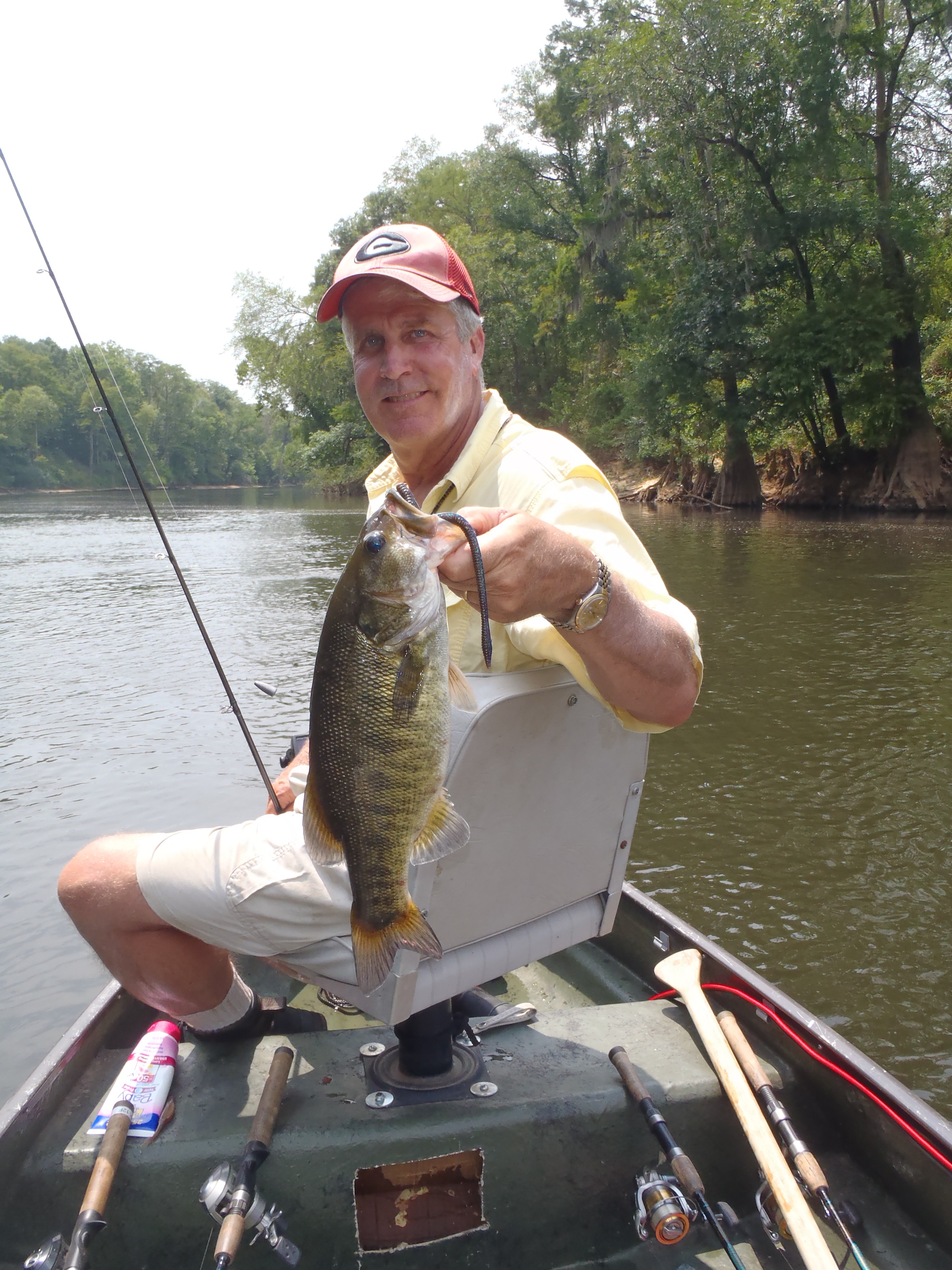
Niles Murray and Flint River Shoal Bass

Niles Murray and Flint River Shoal Bass

In last Sunday’s comic strip “The Lockhorns,” the wife and husband are getting out of a boat with fishing equipment in their hands. He has a very disgusted look on his face and his wife says “The fish weren’t dumb enough to go for that lure … but you were.” I know how he feels!

I have said many times that fishing lures are made to catch fishermen, not fish. Walk into Berrys Sporting Goods and there is a bewildering array of plugs, spinnerbaits and worms in any color you can imagine, in many shapes and sizes. And I have a couple of most of them in my boat.

Any lure will catch a fish. But does a fisherman really need all those different combinations? And why is a lime green plug better on any given day than a chartreuse one? It probably isn’t. But us fishermen keep hoping for some magic lure that will make us catch fish, no matter how or where we use it.

Professional fishermen hype their favorite lures and colors constantly, and many have plug series and colors named for them. They have a vested interest in those lures selling. After all, the companies making them pay the pros a good salary or stipend. And every lure company is competing with others for the fisherman’s dollar.

Don’t get me wrong. I have my favorites. And I keep trying new stuff that seems to come out every week. Some day that magic lure or worm color may be invented, but I doubt it. The place you use a lure and how you fish it is much more important than other factors.

Other members of the bass clubs make fun of me since I normally have about 20 rods and reels on the deck of my boat, all rigged with different lures. It is much easier to pick up a different rod to try a different lure than to cut the one you are using off and tie on another one. That is, it is easier and quicker if you don’t have to untangle six rods to get to the one you want.

I could probably have four rods and reels out to use in a tournament since I seldom fish more than four or five baits during a tournament. But I want to be ready just in case. In the last tournament I fished I used a spinner bait most of the day. I also fished a buzz bait, topwater popper, jig head worm and crankbait. But I had at least 15 more outfits ready just in case I wanted to try something else.

A jig head worm, or shaky head, is pretty much my “goto” bait when fishing is tough. And I use one color of worm 90 percent of the time, switching to a different color only in real clear water. But I have over 100 bags of worms in different colors in my boat. Some day I may find one of those weird colors, like Tequila Sunrise, is just what the fish want.

Bass eat a lot of kinds of food, but most are basic, subdued colors. I have never seen a bright red shad but I have bright red shad plugs. No orange worms exist in our lakes but I have bags of worms ranging from a dull, drab orange to bright, fluorescent orange. Sometimes when fishing a floating worm it helps me to see the bait if it is a bright color, and the bass will eat it, but why do they eat it? They don’t seem to care about the color at all.

I often hear after a tournament that the bass would hit only a purple worm with a pink tail and gold flakes, or some such combination. But then you can talk with other fishermen that caught just as many, or even more, fish on a completely different color. And as often as not I have been fishing the purple pink gold worm all day without a bite on it!

In any big tournament the pros do well with a wide variety of baits fished in a lot of different ways. I fished at Hartwell on Wednesday with a fisherman that had won a tournament on Clark’s Hill the previous Sunday. He and his partner had five bass weighing 22.99 pounds and had big fish with a 7.8 pounder. He told me they caught them on a small crankbait and a white jerk bait.

On Thursday I was at my boat club on Clark’s Hill and talked to a bass fishermen while we took our boats out. He said he was having a tough time catching bass but he heard about a tournament won on Sunday. The two guys were using a big crankbait and a chartreuse jerk bait and had 28 pounds, with a 7.8 pounder for big fish. After a little discussion we realized we were talking about the same tournament, but the weight had gotten heavier with the retelling.

Funny thing, he had been using a big crankbait and chartreuse jerk bait all day without a bite. But he was fishing way up Little River where the water was stained while the tournament was won further down the lake in much clearer water. But he thought the winning fishermen had discovered what the bass wanted so he fished it all day. It was a little funny that he had heard almost the right info about the baits but was convinced enough to use those baits, even if they were the wrong ones.

Us fishermen are crazy. So when you go to the store, be sure to pick up some of the newest, hottest lures and colors. The manufacturers and retailers will appreciate it. And the fish may even hit it!

Abu-Garcia Revo SX Reel Review

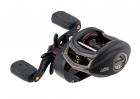
Revo SX Reel

Revo SX Reel

The Abu-Garcia Revo series of reels is one of the best on the market right now. The SX lists for $160 but I got mine for much less than that at an outdoor writers auction. I teamed the reel with an Abu-Garcia Veritas rod I love the outfit.

I have six Revo reels and all have held up well to heavy use. The SX is extremely smooth and the drag system handles big fish. You can set the reel anti-backlash with an easy dial adjustment. With mine set at about half way, I can cast a 3/8ths ounce jig and pig on 15 pound Sun Line a very long way without any backlash problems. I can also pitch a jig easily at this setting. If I want to skip the jig I turn the magnetic anti backlash setting up a couple of notches to avoid the backlash.

The reel is very light weight and low profile. Although I don’t palm my reels, I hold the rod in front of the reel for better control and hook set power, I like the low profile reel. And the black reel with red highlights is pretty on my white Veritas rod!

Although the reel is fairly expensive, it is well worth the price. Abu-Garcia has a reputation for producing quality, durable reels and the Revo SX follows that tradition.

Abu-Garcia Veritas Medium Heavy Action Rod Review

Veritas Rods Picture

Veritas Rods Picture

I bought a Abu-Garcia seven foot medium heavy action Veritas rod at an outdoor writers auction at a greatly reduced price. The rods list for about $100. I have been using the rod to cast a jig and pig and it does a great job with a 3/8ths ounce jig with a twin tail trailer. I can cast the jig and pig about as far as I want to with the Revo SX reel I put on the rod and spooled with 15 pound Sun Line

The rod is sensitive and has good feel for the jig bumping rocks and wood. I can also detect strikes easily. The medium heavy rod has great hook setting power and the seven foot length helps get a good hook set.

The one op piece rod is light enough that I can fish with it for hours without fatigue. The one drawback for me is that there is no comfort cushion in front of the reel. I hold my casting rods and reels by gripping the rod in front of the reel. I do not palm the reel since I think I get more control holding the rod, and I can let the line run between my fingers while fishing. Without a cushion of some kind it is very uncomfortable so I sipped a six inch piece of pipe insulation on the rod, got it in place and taped it with electrical tape. That works well for me.

Since the rod has the rod blank exposed just below the reel, my palm rests against it and that increases the feel.

This is a good mid-range price rod and the two I have are some of my favorites.