Bucktail Pro Road Runners feature original Road Runner head design, more bucktail than most, holographic eyes, nickel over brass smooth willow blades, ball bearing swivels and high carbon premium needle-point hooks.
These are great for bass, walleye, striper, snook, redfish, tarpon, amberjack and much more!
Available in eight fish catching colors.
The 1/8 has a 2/0 hook, ¼ has a 4/0 hook, 3/8 has a 4/0 hook and the ½ has a 5/0 hook.
They can be cast, jigged or trolled.
MSRP $7.68 – $8.62
IP remember having a Horse Head spin in my tacklebox when i was still riding my bicycle to farm ponds to fish.
Courts Trying To Control Fishing – ASA And CCA Respond To Court Decision Blocking South Atlantic Red Snapper Pilot Programs
May 25, 2026
By The Fishing Wire
The American Sportfishing Association (ASA) and Coastal Conservation Association (CCA) are deeply disappointed by the decision issued by the U.S. District Court for the District of Columbia granting a preliminary injunction against the 2026 South Atlantic red snapper Exempted Fishing Permit (EFP) pilot programs approved by NOAA Fisheries for Florida, Georgia, South Carolina and North Carolina. This preliminary injunction was issued just hours before Florida’s Atlantic red snapper season under their EFP was set to begin, leading to immediate confusion, frustration and economic disruption for anglers, for-hire operators, marinas, tackle shops and coastal communities that had prepared for the opening of the 2026 season.
The Court’s decision temporarily blocks implementation of the state-led pilot programs, which were designed to test key recreational data collection improvements and a state-led management approach while providing expanded recreational access to the South Atlantic red snapper stock, similar to previous efforts in the Gulf.
South Atlantic red snapper is not a stock in jeopardy. Anglers and managers have worked for years to rebuild this fishery, and those efforts have been wildly successful. The latest stock assessment confirms what anglers see on the water – the Atlantic red snapper stock is as abundant now as ever. Despite this success, the recreational fishery in recent years has been limited to one- or two-day federal harvest seasons, which has led to excessive discard mortality estimates and a derby-style fishery that results in foregone yield, poses safety risks, and erodes public confidence in South Atlantic federal fisheries management. The EFP pilot programs were specifically designed to collect the science necessary to move beyond these management challenges through partnership with anglers and for-hire businesses.
Economic consequences of this decision will be substantial throughout the South Atlantic region. ASA and CCA are currently working with partners and stakeholders to gather information that demonstrates the full scope of these impacts.
ASA and CCA continue to stand with NOAA Fisheries and the participating states as they evaluate all available options moving forward. We remain committed to advancing science-based recreational fisheries management that supports conservation, improves data collection and provides reasonable public access to healthy fisheries.
The American Sportfishing Association (ASA)
The American Sportfishing Association is the sportfishing industry’s trade association committed to representing the interests of the sportfishing and boating industries as well as the entire sportfishing community. We give the industry and anglers a unified voice when emerging laws and policies could significantly affect sportfishing business or sportfishing itself. ASA invests in long-term ventures to ensure the industry will remain strong and prosperous, as well as safeguard and promote the enduring economic, conservation and social values of sportfishing in America. ASA also gives America’s 57.7 million anglers a voice in policy decisions that affect their ability to sustainably fish on our nation’s waterways through Keep America Fishing, our national angler advocacy campaign. America’s anglers generate more than $50 billion in retail sales with a $230.5 billion impact on the nation’s economy creating employment for 1.1 million people.
Walleye And Musky Season To Open On Wisconsin’s Lakes
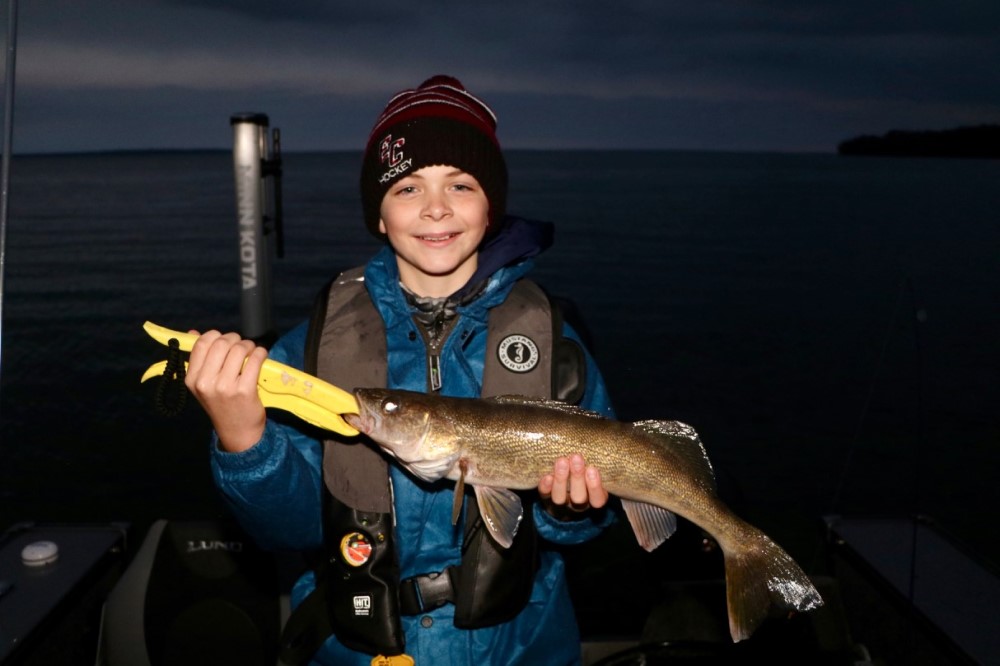
nice fall nighttime walleye
May 3, 2026
By The Fishing Wire
Madison, WI – The Wisconsin Department of Natural Resources (DNR) today indicated the walleye and musky season will proceed as normal on Wisconsin’s lakes.
The federal Western District of Wisconsin today issued a temporary restraining order that prevents the enforcement of recent attempts from the Lac du Flambeau Band of Lake Superior Chippewa Indians to restrict fishing of walleye and musky on certain lakes. Over the past month, the Lac du Flambeau Band of Lake Superior Chippewa Indians has passed resolutions and made public statements that attempt to prohibit non-tribal members from fishing walleye and musky on nineteen lakes within the external boundaries of the Band’s reservation and from using forward trolling and forward-facing sonar on all lakes within the external boundaries of the Band’s reservation.
The State of Wisconsin filed a federal complaint in the Western District of Wisconsin to prevent the Lac du Flambeau Band of Lake Superior Chippewa Indians from enforcing these resolutions against Wisconsin-licensed anglers.
Today, the federal court issued a restraining order against the tribe, which means that non-tribal anglers may cast their lines as normal in Big Crawling Stone Lake, Big Crooked Lake, Bolton Lake, Fat Lake, Fence Lake, Flambeau Lake, Ike Walton Lake, Little Crawling Stone Lake, Little Sand Lake, Long Lake, Pokegama Lake, Poupart Lake, Signal Lake, Stearns Lake, Sugarbush Chain (Upper, Middle and Lower), White Sand Lake and Whitefish Lake.
The State of Wisconsin remains committed to collaborating with the Lac du Flambeau Band of Lake Superior Chippewa Indians on important conservation work to protect the walleye and musky fisheries.
The State reminds all anglers to follow all fishing regulations and bag limits for lakes across Wisconsin, and encourages everyone to be respectful of all Tribal harvesters and other anglers and recreators.
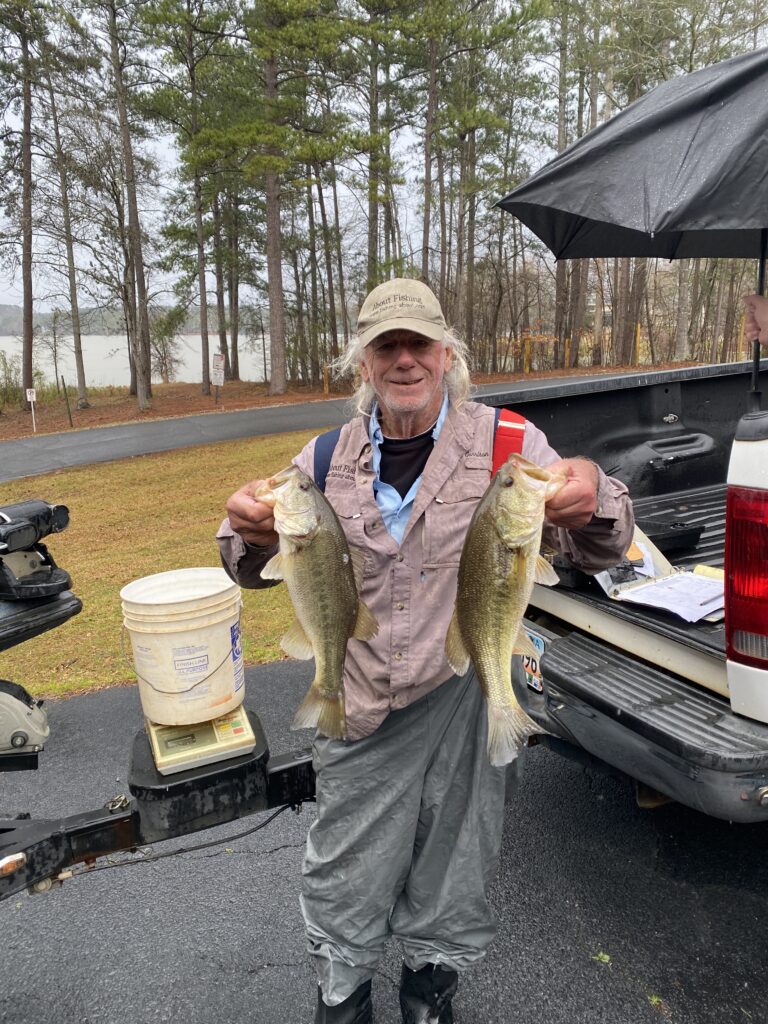
On a June Saturday 18 members of the Potato Creek Bassmasters fished our June tournament at Lake Oconee. After casting from 5:30 AM to 2:00 PM we brought 21 14-inch-long keeper largemouth weighing about 36 pounds to the scales. Nobody had more than three keepers and 9 fishermen didn’t weigh in a fish.
Lee Hancock won with three weighing 6.19 pounds, beating Raymond English’s three weighing 6.18 pounds after Raymond had a .02-pound penalty for a dead fish. Raymond did win the big fish pot with a 2.67 pound largemouth. Caleb Delay had three weighing 4.66 pounds for third and my three at 3.79 pound was fourth.
Robert Howell fished with me and we had high hopes as we ran to a grassy point near the dam. It was barely light enough to see so I picked up a spinnerbait and started casting to the edge of the water willow grass bed that ran around it. Robert was following me with a topwater popper.
On about my tenth cast a fish grabbed my spinnerbait and I landed a 15-inch keeper. That made me feel pretty good. A 13.5-inch fish quickly followed, fun but too short to keep. After we rounded that point we idled across to the next one with grass running around it.
Since it was getting light enough to see a little better I started casting a buzzbait. I like to wait until it is light enough for the bass to home in on a moving topwater bait and make sure they don’t miss it.
I caught my second keeper before 6:00 AM on the buzzbait. It was just over the 14-inch line on my keeper board. Then I got another 13-inch fish on the buzzbait. Two keepers and two throw backs in 30 minutes seemed like a good start.
When the sun came over the horizon we ran to a deep rocky bank back in a creek. As we fished down it we made some casts to the bank, working our baits from a couple feet deep to almost 20 feet deep at the boat. And we would make some casts parallel to the bank. I had found a line of boulders in about 20 feet deep running parallel to the bank here last fall and caught some fish off it, but they did not produce anything this time.
About halfway down the bank Robert set the hook and his rod bowed up. The strong fish stayed deep pulling straight down, often a bad sign, and sure enough when he got it where we could see it was a ten-pound flathead catfish. Fun to catch and a good fight, but no help in a tournament.
For the next five hours we fished a variety of places, casting to grass beds, skipping baits under docks, working brush and rock piles from shallow to 20 feet deep and any other places we could think to try. We caught a couple of short fish but no more keepers.
Just before noon we fished into a small creek, casting to docks and the seawall. I told Robert there was a little trash on a secondary point ahead of us where I had caught some fish in the past. When I hit the trash with my shaky head, I got a bite and landed a barely 14-inch-long keeper, giving me three with two hours left to fish.
A little after noon we stopped on a rocky main lake point and something thumped my worm. When I set the hook a strong fish ran a few feet to the right and I thought I felt my line rub something, then it broke. When I reeled in to re-tie, the last six inches or so of my line was frayed.
It may have been a big catfish or a gar. Both are strong and a gar’s teeth will fray and cut your line. And catfish will try to run under rocks and fray your line. Whatever it was I will never know.
With thirty minutes left to fish we stopped on a brush pile in front of a dock and Robert and I both landed short bass. That was it, we had to go in to a surprising weigh-in. I was shocked to come in fourth.
While we fished there was an ABA tournament on Oconee. It took 16.57 pounds to win and 16.39 pounds to place second and 6.64 pounds came in 18th!
President Trump Announces Approval Of South Atlantic Red Snapper Exempted Fishing Permits
May 3, 2026
By The Fishing Wire
America’s anglers celebrate as state-led management advances
Washington, DC – Anglers along the South Atlantic coast are celebrating as President Trump announced the issuance of exempted fishing permits to Florida, Georgia, South Carolina and North Carolina. The permits advance state-led efforts to improve red snapper management and expand recreational access and will now be used to manage recreational seasons in 2026. These state-led pilot programs will test improved recreational data collection and management strategies providing better information and enhancing public access to the fishery.
South Atlantic red snapper has been a source of intense frustration among anglers for years. After being closed to harvest in 2010, public adherence to severe conservation measures succeeded in putting the stock on track to rebuild nearly 20 years ahead of schedule. However, extensive flaws in the federal recreational data system led to the continuation of harsh restrictions on recreational seasons, which have been limited to a handful of days at most for 15 years. A groundswell of support for state-led alternatives from governors; attorneys general; Members of Congress; state legislators, and state fisheries experts began when federal managers indicated that those restrictions on recreational harvest would not only remain in effect in perpetuity but could also be expanded to closures to all bottom fishing.
“The Administration’s visionary embrace of cooperative federalism wins the day — and the summer. Their willing partnership with willing South Atlantic states brings the region hope for calm waters and exciting catches of a plentiful fishery resource,” said Jeff Angers, president of the Center for Sportfishing Policy. “The state agencies are willing and anxious to do the hard work. It’s a win-win for the fish, the anglers and coastal communities. We thank President Trump for his leadership in advancing a path forward for South Atlantic anglers.”
To test their systems and begin gaining valuable insight into recreational fishing activity and harvest, the states filed for the exempted fishing permits to allow for different seasons and lengths. The State of Florida, which will implement the same system it already uses to manage red snapper recreational anglers on its Gulf Coast, will open for a 39-day season running from May 22 through June 20, with additional three-day weekends in October. Georgia, South Carolina and North Carolina coordinated on a data system in which anglers will utilize an app funded by Yamaha to report their catches. Those three states will monitor a 62-day red snapper season that will run from July 1 to August 31.
“The Administration’s decision to approve these exempted fishing permits marks a pivotal step toward modernizing red snapper management in the South Atlantic. For years, CSF and the recreational fishing community have advocated for proven, state-led data collection efforts that deliver more timely and accurate harvest information,” said Jeff Crane, president and CEO of the Congressional Sportsmen’s Foundation. “This commonsense, science-driven approach better aligns management with on-the-water realities and the appropriate public access to abundant red snapper in the South Atlantic.”
“The EFPs have broad support not just from anglers but also from leadership across the four states including Governors, members of Congress, Attorneys General, and state legislators,” said Pat Murray, president of Coastal Conservation Association. “We greatly appreciate all the work put into this effort by the state agencies to improve management of this fishery and applaud the Administration for this far-sighted decision to make the South Atlantic red snapper fishery a model for cooperative federal-state management under the Magnuson-Stevens Act.”
“The approval of these exempted fishing permits represents meaningful progress toward ensuring South Atlantic red snapper management decisions are based on accurate information that better reflects the experiences of anglers on the water,” said Glenn Hughes, president and CEO of the American Sportfishing Association. “We appreciate the states for their bold vision to improve this fishery and are grateful for the leadership of the Trump Administration and the countless others involved in advancing a framework that supports both sustainable fisheries and reasonable public access to this important resource.”
“Today’s announcement from President Trump is a tremendous step towards restoring access and improving the long-term management of the South Atlantic red snapper fishery, which has been a top priority of the recreational boating and fishing community,” said Frank Hugelmeyer, president and CEO at the National Marine Manufacturers Association. “We value the Administration’s efforts to drive better, state-led data collection that can deliver longer, more stable seasons while maintaining strong conservation outcomes. We appreciate the administration’s continued efforts to empower states, modernize fisheries management, and protect access to public waters – a cornerstone of an industry that supports 812,000 American jobs and generates $230 billion in annual economic impact.”
I camped at the Georgia Power campground Blanton Creek at Bartletts Ferry from Thursday to Monday. Blanton Creek is a nice shady campground on the upper end of Bartletts Ferry and it has a great bath house with hot showers, a requirement for me this time of year after a hot sweaty day on the water.
I tend to sleep late on “practice days” before a tournament so I did not get on the water until about 9:00 AM Friday. Bartletts Ferry is on the Chattahoochee River and downstream of the campground the lake is like most of our lakes, with open water, deep points and banks lined with docks and houses. There are also many creeks on the lower end, from short ones to some that run for miles.
I decided to go up the river and scout around Friday. Near the campground the lake turns into a river channel with a few small creeks but mostly banks lined with trees and bushes. Fishing can be very good up there, especially if the Corps of Engineers are generating power at the West Point dam 20 or so miles up the river.
Current moving can make the fish bite better, up to a point. A couple years ago I went up the river and the current was so strong I had a hard time fishing. At one point my boat drifting with the current with no motor running was moving 3.5 miles per hour on my GPS. A bait cast to a stump in the water would sweep by it way too fast to hit the bottom.
Friday there was barely any current and the fish did not bite for me. I hooked two small keeper bass that got off before I could land them. One wrapped me up in a limb and another jumped and came off. I did land one 13-inch keeper bass.
Saturday I got on the water about 9:00 again and decided to go exploring. The road going to the ramp crosses Mountain Oak Creek four times, the last one about five miles by water from the ramp. I like the way it looks, about 50 feet wide with trees and overhanging bushes.
I idled for about 30 minutes, the water was only two to five feet deep in most areas, and started pitching a jig and pig to all the cover on the bank on an outside bend in the creek. I was about a half mile above the bridge and the water was a little deeper, with a little current moving. I thought it would be great but I never got a bite.
When I gave up and idled back to the lake I stopped on a big mud flat where I had seen some brush in the water when the lake was low. It is just a few hundred yards from the ramp we use and there is a danger marker on it since the water is only two feet deep.
I tried to fish a jig but it came back with black moss on it, so I picked up a spinnerbait. My first cast produced a solid thump and I worked the bass to the boat, trying to hide it from other fishermen. Doing that I let it get around the trolling motor and the four-pound bass broke my line. But it gave me hope.
I looked around the rest of the day but never got another bite.
When I got to the ramp Sunday morning there was another club putting in with us. At takeoff I went to the flat and started casting, but when the other club took off at 6:15 about half the guys in the other club ran right by me, some within feet of the danger marker. I don’t know if they didn’t know what they were doing, or if they didn’t care, but it ruined my fishing.
I finally caught a keeper spot on a bluff bank 30 feet deep on a jig at 9:00 then got my second keeper at 2:30 on a shaky head on a seawall by a dock in only a foot of water.
2026 FWC Lionfish Challenge expands With New Categories And Prize Opportunities
April 23, 2026
By The Fishing Wire
2026 FWC Lionfish Challenge expands With New Categories And Prize Opportunities 2
The Florida Fish and Wildlife Conservation Commission’s (FWC) 2026 Lionfish Challenge will kick off May 22 and run through Sept. 14. The challenge will feature several exciting new competition categories designed to recognize a wider range of participants and prize packages.
The previous Recreational and Commercial Champion titles have been replaced with the following awards:
Lionfish King: Top male participant in the recreational division.
Lionfish Queen: Top female participant in the recreational division.
Commercial Champion: Top participant in the commercial division.
Junior Harvester: Top recreational participant younger than age 18.
Veteran Champion: Top active-duty service member or military veteran in the recreational division.
The FWC Lionfish Challenge will also recognize its Top Supporter and Top FWC Lionfish Checkpoint Participant.
“Lionfish derbies and the FWC Lionfish Challenge are a great way to help reduce lionfish numbers on coral reefs,” said Tony Hart, FWC Lionfish Outreach Coordinator. “Divers who participate are supporting conservation and doing their part to protect the vital marine resources in and around Florida’s waters.”
Lionfish are an invasive species with the potential to negatively impact native wildlife and habitats. A single female lionfish can release as many as 30,000 eggs every four days, enabling lionfish populations to grow rapidly, and outcompete native species for food and habitat. FWC encourages divers, anglers and commercial harvesters to remove lionfish in Florida waters to limit negative impacts to native marine life and ecosystems. To learn more about lionfish, visit MyFWC.com /Lionfish.
Cookie Consent
We use cookies to improve your experience on our site. By using our site, you consent to cookies.
ID used to identify users for 24 hours after last activity
24 hours
_gat
Used to monitor number of Google Analytics server requests when using Google Tag Manager
1 minute
__utma
ID used to identify users and sessions
2 years after last activity
__utmt
Used to monitor number of Google Analytics server requests
10 minutes
__utmb
Used to distinguish new sessions and visits. This cookie is set when the GA.js javascript library is loaded and there is no existing __utmb cookie. The cookie is updated every time data is sent to the Google Analytics server.
30 minutes after last activity
__utmc
Used only with old Urchin versions of Google Analytics and not with GA.js. Was used to distinguish between new sessions and visits at the end of a session.
End of session (browser)
__utmz
Contains information about the traffic source or campaign that directed user to the website. The cookie is set when the GA.js javascript is loaded and updated when data is sent to the Google Anaytics server
6 months after last activity
__utmv
Contains custom information set by the web developer via the _setCustomVar method in Google Analytics. This cookie is updated every time new data is sent to the Google Analytics server.
2 years after last activity
__utmx
Used to determine whether a user is included in an A / B or Multivariate test.
18 months
_ga
ID used to identify users
2 years
_gali
Used by Google Analytics to determine which links on a page are being clicked
30 seconds
_ga_
ID used to identify users
2 years
_gac_
Contains information related to marketing campaigns of the user. These are shared with Google AdWords / Google Ads when the Google Ads and Google Analytics accounts are linked together.