How Should I Fish an Umbrella Rig?

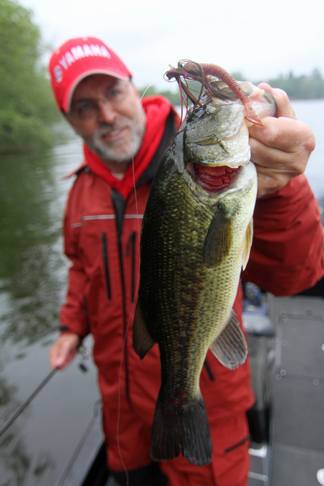
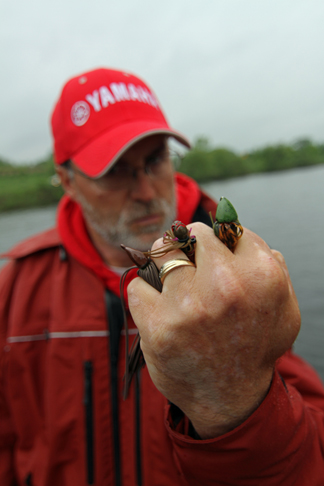
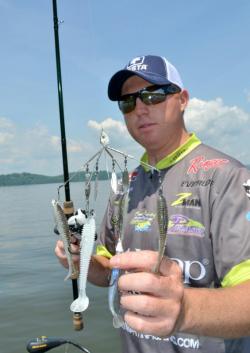
Casey Martin shows the umbrella rig

Casey Martin shows the umbrella rig

Casey Martin On The Umbrella Rig

Alabama pro offers tips on multi-hook devices called “Umbrella Rigs.”

By Frank Sargeant
frank@thefishingwire.com

It ain’t as easy as it looks.

Though he wins plenty of money with the umbrella rig, he says he’d prefer not to throw it any more than he has to. That’s the message from FLW pro Casey Martin about flinging the notorious umbrella rig, AKA the “Alabama Rig”, on the waters of the southeastern U.S. in pursuit of tournament-winning largemouth bass.

“It can be really effective and catch fish that other lures won’t, but you’ve still got to get in the right places for it to work,” says Martin, who lives south of Huntsville, AL, near his favorite lake, Guntersville. “It’s no miracle rig, for sure.”

Martin said that, contrary to popular belief, he doesn’t consider the A-Rig to be primarily a winter rig, either.

The five-armed wire rig allows creating the illusion of a baitfish school running through the water. It has proven amazingly effective on big fish in deep water.

“I throw it pretty much year around, except during the peak of the spawn,” says Martin. “If you’re fishing tournaments you pretty much have to have 5 pound fish to be in the money, and the umbrella rig gives you the best shot at those fish in most lakes most of the time.”

The big chore in success with the multi-lure rigs, says Martin, is studying charts and then idling along and watching your sonar. If you don’t put in your time finding the offshore areas likely to hold schools of fish, the A-Rig won’t bring you much success.

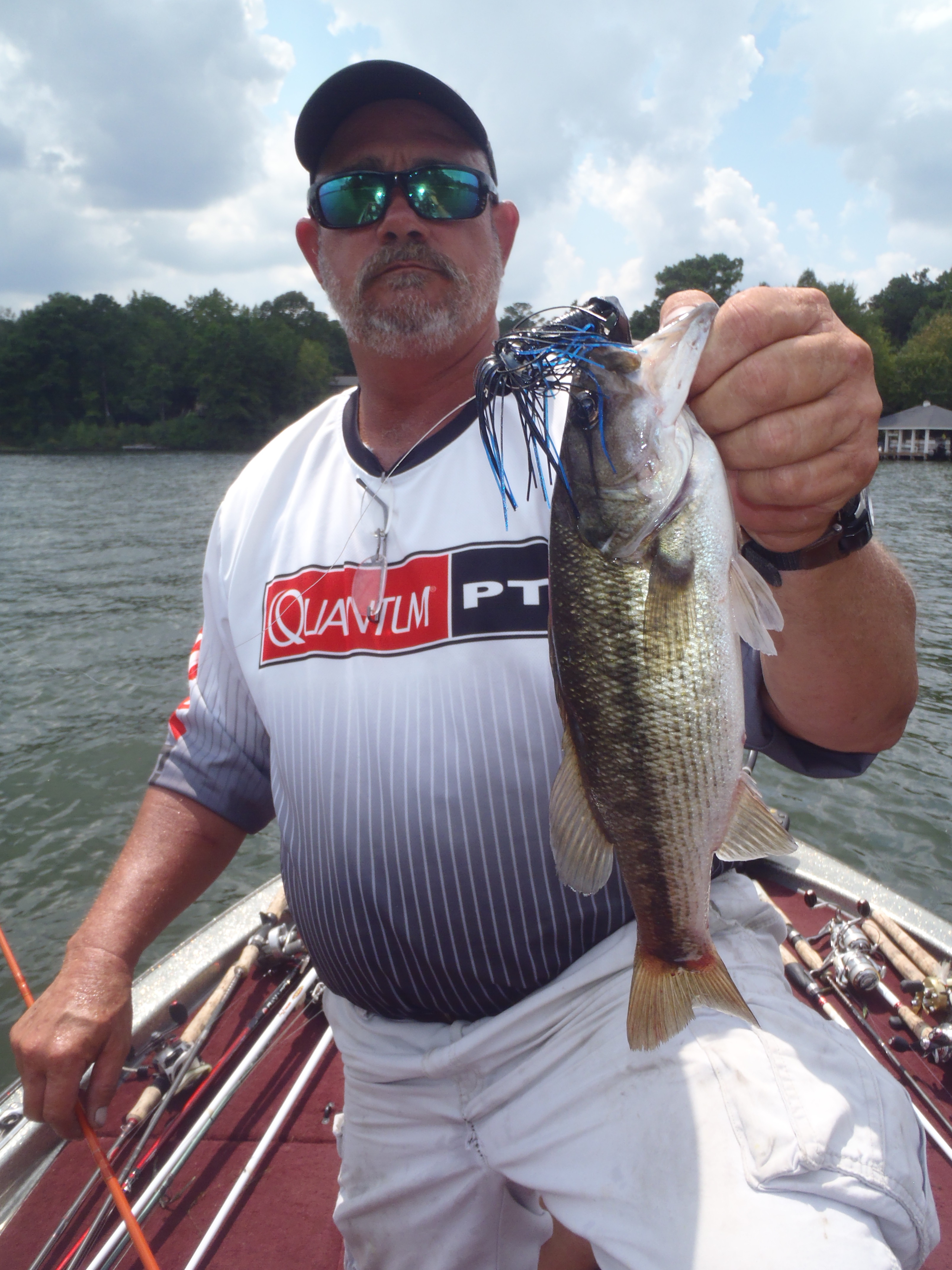
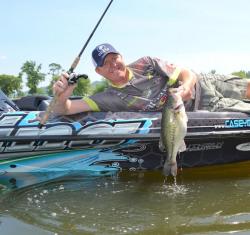
Casey Martin lands a nice bass on the umbrella rig

Casey Martin lands a nice bass on the umbrella rig

“There have been tournament days when I’d go all day long without putting one fish in the boat, and then find a school on a main river ledge and catch a limit in five casts-in fact I once caught a limit of five-pounders in two casts, three on the first cast and two on the second.”

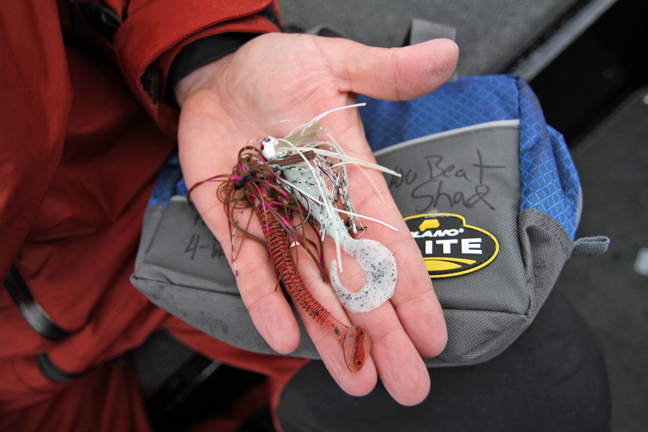
Martin primarily throws the Picasso School-E-Rig Bait Ball, a five wire rig with added spinners, to which he adds jig heads from 1/8 to 3/8 ounce and shad tails 3 to 6 inches long.

He fishes this where he finds a set of conditions that usually spell success.

“I want to be on a hump that’s near the main channel or a deep creek drop-off, I want to see a lot of shad on the sonar, and I want some trash on the bottom, rocks or stumps or mussel shell. If you hit enough spots that look like that in 15 to 25 feet of water, you’re going to find a school of big fish sometime during the day,” says Martin.

Martin says that fish of this size are a must to place well in large tournaments, and the umbrella rig is one of the easiest ways to connect with them.
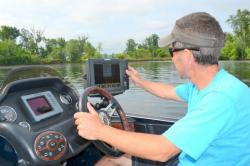
He said his side-scanning sonar/GPS units, two on the console and one up front, are an important part of his strategy.

“A lot of times you’ll see bait or cover out to the side that you’d miss completely if you’re just looking straight down with conventional sonar,” says Martin. “You really have to have the structure-scanning electronics to be competitive in tournaments these days.”

Martin said he lets the umbrella rig do most of the work once he heaves it out to where the fish should be.

“I let it sink to bottom, and then I crank it back steadily just fast enough to make the tails on the soft plastics swim,” says Martin. “You don’t have to add any extra action-there’s enough going on with all the spinners and shad tails.”

Unlike many anglers, he fishes the rigs on 25-pound-test fluorocarbon rather than on 65-pound-test braid.

“I just don’t like the way braid casts, so I stay away from it unless I’m fishing where there’s a lot of wood cover,” says Martin. “I lose a few rigs, but I think I get more hits than I would with braid.”

PROS AND CONS OF UMBRELLA RIGS

Casey Martin readily admits he’d rather not throw the umbrella rig ever again-but he has to if he’s going to make a living as a pro angler.

“If you’re fishing a tournament where it’s legal, 90 percent of the time you have to fish it or you don’t finish in the money,” says Martin. “I’d just as soon see it banned for all competition, but as long as it’s legal I’m going to throw it.”

He said he does not agree with some anglers who say the extra hooks on the rig cause lasting injuries to fish, however.

“It does stick them sometimes and you’ll see some fish with sores, but they’re minor and they heal up fast,” says Martin. “The reason I don’t like the rig is that it’s murder to cast all day, and it takes some of the interest out of trying to figure out a pattern that you’d be fishing otherwise.”

To learn more from Casey Martin, visit his website www.caseymartinfishing.com.

My Favorite Outdoor Books

The Quest and the Quarry
by Gordon Hutchinson

“The Quest and The Quarry” written by Gordon Hutchinson shares with those fortunate enough to read it a feel for growing up in the south and how important family and traditions are to southerners. Well written and easy to read, the book leaves you wishing it was longer. It is more about hunting than it is about fishing but it is an excellent book for anyone that loves the outdoors. The Quest and The Quarry was selected for an “Excellence In Craft” award from the Southeast Outdoor Press Association in 2006.

Fishing For Catfish
by Keith Sutton

Keith Sutton knows catfish and his book will help you understand them and how to catch flatheads, blues and channel cats.

Fishing Georgia
by Kevin Dallmier

Kevin Dallmier was a Georgia fisheries biologist when he wrote this book. It has excellent tips on where to fish in Georgia to catch all freshwater and saltwater species in the state. It also includes profiles of fish found in Georgia.


The Everything Fishing Book
by Ronnie Garrison

Yep, I wrote it in 2002. Lots of what I think is good information for the beginner fisherman, from tying knots to finding places to fish.

Can I Catch Saltwater Fish By Fly Fishing?

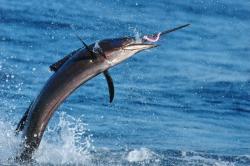
Sailfish can be caught fly fishing

Sailfish can be caught fly fishing

Step Up to Saltwater Fly Fishing

A World-Renowned Angler and Teacher Talks About Getting Started
from The Fishing Wire

Only a handful of fishermen have attained the reputation and status of Capt. Jake Jordan in the world of saltwater fly fishing. He attained his incredible bank of knowledge by catching almost every oceanic gamefish that swims on the fly. How many people can you name who have caught salmon sharks in Alaska on a fly rod?

Sailfish are a perfect target for the saltwater flyrod. Fast and acrobatic, they readily take a fly when lured into range with teaser lures.

Jordan has over 40 years of experience as one of the top flats and tarpon guides in the Florida Keys. He pioneered a series of exclusive saltwater fly fishing schools for bonefish and billfish, taking small groups of anglers to exotic locales like Guatemala, the Dominican Republic and Exuma where he instructs them on how to fish for, and successfully catch, the world’s premiere gamefish with fly tackle. The remainder of the year he splits between his home in North Carolina, where he charters for red drum and false albacore during the fall, and Marathon, Fla. in the spring, where he takes charters for his first love-tarpon. His clientele fish exclusively with fly tackle and they include some of the most accomplished anglers in the world as well as newcomers who want to learn at the hands of one of the true masters of the sport. During the winter months, he is a featured speaker and presenter at the top fly fishing shows around the nation.

“When I started taking charters fly fishing in the Keys the 1960s, there were probably not more than 20 fly fishing guides in the world,” Capt. Jordan recounted. “And they were ALL in the Keys!”

Jordan has developed cutting edge techniques for casting, hooking and fighting big fish of every stripe, and has personally released blue marlin that would have crushed the current fly rod 20-lb. tippet world record except for his personal conservation ethic-he will not kill a billfish anywhere for any reason. In recent years, he developed a night fly fishery for Florida Keys tarpon that produces more hookups and releases in a three-month period than most guides can account for in a year. He has revolutionized the techniques for fighting big fish on fly tackle, and the technique is slowly catching on with other types of light tackle fishing.

The Yamaha team recently had a chance to sit down and talk with Jordan about what stepping up to saltwater fly fishing entails for a newcomer. When we arrived, he had just finished washing his favorite skiff, a Yamaha-powered 20′ Jones Brothers built just a few miles away from his home. The boat is aptly called the Fly Reel.

Captain Jake Jordan is one of the nation’s top saltwater fly fishing guides, with venues in North Carolina and the Florida Keys and travels worldwide.

“I spend a lot of time at fly fishing shows and fishing clubs giving presentations on topics from tarpon to sailfish to blue marlin,” said Capt. Jordan. “Interest in the saltwater aspect of the sport is growing, especially interest in catching big fish with fly tackle. Most of the anglers I come into contact with are either accomplished saltwater anglers with spinning and conventional gear who want to try something more challenging, or anglers who use fly tackle in freshwater and want to make the move to salt. Anglers in both categories have some learning to do, but it has never been easier to access the information you need or obtain personal instruction.”

Jordan is not only an International Federation of Fly FishersTM certified instructor, he was a member of the organization’s original board of directors back in the 60s. He said that any angler new to the sport will benefit from casting lessons.

“Learning to cast the right way from the beginning is much preferred to picking up bad habits that have to be unlearned later,” said Capt. Jordan.

“There is a major difference between casting with fly tackle and spinning or conventional,” said Jordan. “With spinning and conventional, you are casting a weighted lure that pulls light line, monofilament or braid, off the reel. It’s the complete opposite with fly gear where you are casting a light, often wind-resistant lure called a fly with a line that has a forward section weighted to pull the fly behind it. You’re casting the line instead of the lure, and the dynamics are very different.

“The front 30 feet of most fly lines is weighted and tapered,” Jordan explained. “Fly lines are rated (10-WT, 12-WT, etc.) for a specific rod designed to cast that weight line. You wouldn’t use the same rod and reel for sailfish as you would for bonefish any more than you would use an 80-lb. class standup tuna outfit for casting poppers to striped bass. While the rating system might sound confusing at first, it’s actually quite simple. The first thing you should do before you run out to buy fly tackle is identify what your main target species will be, and then get some good advice on the appropriate rod, reel and lines you will need to fish for it. You can do this at a fly fishing show, a local fly shop or in the fly tackle departments of big box stores where they have experienced and educated fishermen on staff.

Sails are capable of lightning runs and greyhounding leaps, making line handling a real challenge with fly fishing gear.

“You don’t have to spend an arm and a leg to get quality tackle anymore,” he continued. “High performance fly rods are available for a fraction of what they used to be, and there are a host of very affordable fly reels to mate with them. I’ve worked with Temple Fork Outfitters to develop rods of a quality level that would have cost well over $500 a few years back, but now can be purchased for less than half the price.”

Where can a neophyte go for casting instructions? There are hundreds of books and videos for sale from great fly fishermen like Joe Brooks, Lefty Kreh and Stu Apte. You can do a keyword search on YouTube® and pull up hundreds of free videos on all phases of fly fishing in saltwater. Do a search for fly fishing shows and you’ll probably find one or two good ones in your area where you can meet casting instructors, fly tiers and compare rods, reels, lines and flies from dozens of manufacturers and pick up some great deals, too.

“Probably one of the best resources you can find is the International Federation of Fly FishersTM website www.fedflyfishers.org,” Jordan suggested. “They have videos, seminars, libraries, lists of casting classes held all over the country by FFF-certified instructors, youth classes, fly tying how-to and much, much more. It’s the ultimate information source and a great place to start.

“Fly fishing is a challenging and highly rewarding way to fish for almost any gamefish. Once you get bitten by the bug, you’ll be hard pressed to put down your fly rod for any other type of tackle,” Jordan advised. “With the right gear, knowledge and practice, you can catch pretty much any fish that swims.”

For more information about Capt. Jake Jordan, visit www.jakejordan.com and be sure to sign up for his regular fishing reports blog – it’s fascinating!

Review Of Book “Backcountry Lawman”

Cover of Backcountry Lawman

Cover of Backcountry Lawman

from The Fishing Wire

The book “Backcountry Lawman-A Unique Look Into Florida’s Wild History” is a good read.

“Backcountry Lawman” recounts the adventures of Florida game warden Bob Lee during the rough-and-ready years when the state was loaded with fish and wildlife poachers.

Bob Lee’s Backcountry Lawman is a fast, fun read that anyone who has spent much time in the Florida outdoors will thoroughly enjoy. Lee was a game warden with what’s now the Florida Fish & Wildlife Conservation Commission for some 30 years, at a time when the state was going from pretty much anything goes in the woods to the modern conservation ethic.

Not surprisingly, as a “woods cop” he butted heads with a variety of colorful and sometimes dangerous characters including all sorts of fish and wildlife poachers along the St. Johns River, and also was challenged occasionally by the elements and the animals in a state that was still very wild. It’s an interesting look at Florida’s history from a unique perspective.

The book is 250 pages long, but you may read it in one sitting if you know and love the Florida woods; there’s a confrontation and a climax in just about every chapter as Lee recalls midnight chases by boat, truck and on foot.

Lee is a natural story-teller and has a novelist’s eye for the telling detail, the smells and sounds and sights of the woods, rivers and lakes of northeast Florida. An interesting affection for some of the law-breakers shows through, as well-Lee obviously respects truly good woodsmen, which ever side of the law they happen to be on.

And when he goes on a trail, it’s a real education for anyone who ever wants to track a deer, a hog-or a man-through the woods. Lee was so good at it he eventually became the FWC’s man-tracking instructor. The book is a nicely illustrated hard-back with black & white photos from Lee’s working era, beginning in 1977. It’s $24.95 from University Press of Florida, www.upf.com . It can also be ordered as an eBook and found in print at most brick and mortar bookstores.

To learn more visit the author’s website at http://bobhlee.com/

Dogs Really Are Man’s Best Friend

Rip loved to hunt - I really miss him

Rip loved to hunt – I really miss him

One of my all time favorite outdoor writers, Gene Hill, said “I can’t think of anything that brings me closer to tears than when my old dog – completely exhausted after a hard day in the field – limps away from her nice spot in front of the fire and comes over to where I’m sitting and puts her head in my lap, a paw over my knee, and closes her eyes, and goes back to sleep. I don’t know what I’ve done to deserve that kind of friend.”

Dogs are special. I know of no other creature that will give you unconditional love no matter how you treat them. They will protect you, be a comfort when you feel bad and make you even happier when you are in a good mood. They are loyal to you.

I have been lucky enough to have five such friends in my adult life. The only problem with dogs is they have such a short life span. You always lose them way too soon. They seem to be youthful and happy for years then suddenly they start getting old. In no time it is up to you to make sure they don’t suffer any longer.

Rip was special. He showed up at my farm uninvited and stayed around the barn. I had not had a dog in my life for about ten years and really didn’t want another one since it still hurt from having to put my first two down.

But Rip would run out and greet me, tail wagging and mouth smiling, every time I drove up. I tried to ignore him for a couple of weeks but he won my heart so I stopped and got food and water bowls, some dog food and a collar and headed to the farm.

As always he ran out to greet me but somehow slipped and fell. I felt the back tire of my truck bump over him before I could stop. When I got out of the truck he was standing there, looking at me like “uh o -I didn’t mean for that to happen.” Then he walked a few feet and blood came out with his urine when he went to the bathroom.

I was sure he would die so I didn’t even put the collar on him, but did put out some food and water. The next day I drove up and he ran out to greet me, wagging and smiling like nothing every happened. He surely didn’t blame me.

After putting on his collar I drove him to Memorial Drive Vet Clinic and had him examined. We could see the tire track across his lower stomach and hip. The vet said that was about the only place you could run over a dog and not kill it, but he might still have problems.

For the next ten years Rip lived at my house. He was rambunctious – I had to fence in the back yard to keep him from running off and getting in the highway, but he seemed perfectly happy. He was a mixture of lab and hound, and loved to chase and retrieve a ball. I had to hit a tennis ball with a racquet to make sure it went far enough so he would not get to it before it hit the ground.

Rip never barked. He also never met a stranger. I often took him to town in the back of my truck and usually someone would be petting him when I came out of the store. You could tell he was a happy, friendly dog.

The first time I got out my shotgun to kill a squirrel in the yard I was not sure what Rip would do. When I shot the gun he got excited and soon found the squirrel. In no time, if I walked out the door with a gun Rip started looking in the trees for my target. He seemed to learn to go around to the other side of a tree where I was looking for a tree rat so it would come around so I could shoot it.

Although gunfire didn’t bother him at all, he was terrified of thunder. In June during a late night thunder storm on Thursday night he dug under the fence and got out. Saturday afternoon we got a call that he had been hit by a car on Highway 19 not far from our house.

We took him to the emergency vet clinic in Fayetteville. We were real worried since he did not seem to know us and looked dazed. The vet treated him and said he was in shock.

A few hours later we called and they said he seemed to be resting comfortably but they were worried about him since he still seemed to be dazed, but they were hopeful. Then, at about 11:00 PM, they called and said he had gone into convulsions. They felt he had brain damage and said there was less than a 25 percent chance of recovery. I could barely get the words out of my mouth to put him down.

We picked up Rip’s body and brought him home. I wet the ground as I buried him under the pear tree beside Merlin and Squirt.

Watch A Salmon Cam

Sockeye salmon from the salmon cam

Sockeye salmon from the salmon cam

Web cam catches sockeye salmon returning to Tongass spawning grounds

EDITOR’S NOTE: The following was provided to The Outdoor Wire by the U.S. Forest Service

Through the end of August, you will get the chance to be entertained as sockeye salmon swim along Alaska’s Steep Creek as the adults spawn before swimming to their deaths.

The Forest Service has placed the salmon cam in the creek on the Tongass National Forest so viewers world-wide have the opportunity to view fish in their natural setting. The ability to watch salmon in the wild is a treat for many people, but the underwater camera gives you a more intimate, unique look.

“The overall escapement, or numbers of fish that reach the spawning grounds, for Steep Creek sockeye varies from year to year,” said Pete Schneider, a fisheries biologist on the Tongass. “An average run would be considered 1,000 fish. We have seen it as low as 350 and as high as 4,000. So many factors can contribute to run size. It’s difficult to predict. So keep watching.”

Early in the spring sockeye fry emerge from the gravels and move into Mendenhall Lake and Mendenhall River sloughs and ponds, where they feed for 1-3 years before migrating to the ocean. After spending several years at sea, the adult sockeye return to Steep Creek to spawn, their last act before they die.

But all is not lost. The dead sockeye are still good meals for a variety of forest critters, including their own fry and as their nitrogen-rich carcasses decompose they provide valuable nutrients into the ecosystem.

If you see the view clouded, it could be because a female salmon is building her redd (gravel nest) by agitating the bottom of the creek bed with her fins and tail. She then bends her body back and forth to make a depression where she deposits her eggs. A male then moves in and deposits his milt, or sperm, over the eggs after an often lengthy courtship. The female uses her tail fin to cover the redd then moves upstream to do it again. Female salmon will often build multiple redds in the same general vicinity and then guard them as long as they can before eventually dying.

Sockeye salmon are held in high regard in Alaska. They are known for the high quality of their meat, bold spawning colors, unique habitat requirements and the fact that they can be tough to catch because they rarely bite on sport gear in salt water. Add all these factors together and sockeye rival king, or Chinook, salmon for the most attention.

“I typically leave the camera in place until the end of September. Often the water quality becomes too poor by October due to the amount of rainfall,” Schneider said. “The sockeye run will dwindle by the end of August. After a short lull for a week or two the coho salmon will arrive.”

Schneider said the coho run will not be as large as the sockeye. However, more Dolly Varden char enter the stream, too. Many Dollies arrive “early” to feed on loose eggs during sockeye spawning, but many more arrive in early fall to spawn. They spawn about the same time as the coho in different locations along the creek so they do not overlap with the coho, a process refined over years of evolution.

As the fish are making their way along the creek, Schneider and other Forest Service employees make daily counts. The third week of July they counted about 30 sockeye milling about in the beaver pond downstream from the camera.

“They are in full spawning colors, but are likely waiting until a rain event occurs. This lowers water temps and raises water levels, which often will trigger the movement of fish upstream to the actual spawning grounds and into camera view,” he said. “Unfortunately, I can’t move the camera downstream any further than I have to see them.”

Surprise guests for the fish and viewers could be a black bear or two. Bears that feed on salmon are larger because they eat. A lot. And salmon provide the high calorie diets they need to gear up for the winter hibernation.

“Bears will often target the female salmon for their eggs. Their keen sense of smell can detect the eggs, and I have seen them actually release a male and return to fishing for females,” Schneider said. “When salmon are plentiful, it is normal to see a carcass along the bank with only the belly eaten. The brains are also a high-calorie hotspot, even though they are smaller than a walnut.

“Make no mistake, however, as absolutely none of the salmon go to waste. There is a plethora of mammals, birds, insects, fungi, and plants waiting to make full use of the remaining nutrients.”

https://www.youtube.com/watch?feature=player_embedded&v=iAYSF1h05HM

How Can I Follow Bass From Shallow to Deep Water in the Summer?

Kelly Jordan follows summer bass from shallow to deep water.

Kelly Jordan follows summer bass from shallow to deep water.

Yamaha Pro Kelly Jordon Offers Summer Bassing Tips

There’s a good reason tournament angler Kelly Jordon describes the hot months of summer as one of his favorite bass fishing seasons. The Yamaha Pro follows fish from shallow water to deep during the day, a technique he learned during years of guiding at Lake Fork in Texas.

Jordan advises starting around brushy cover at daybreak in depths as shallow as two feet–but says fish move deeper as the sun rises.

“The key to following bass in summer is fishing an area that has some type of route like an old roadbed, a tree line, or a creek channel leading from the shallows to deep water nearby,” Jordon emphasizes. “The bass move back and forth between shallow water and deep, so finding a shallow flat, a long point, or a cove that gradually falls into deeper depths is always worth trying.

“This movement may not be more than a hundred yards, or it may be 300 to 400 yards. It depends on what the deeper water offers the bass. At the same time, if there is abundant shallow cover, particularly hydrilla or some other thick vegetation, the bass will usually stay shallow longer, too.”

Jordon strongly recommends starting a July or August day of bass fishing 30 to 45 minutes before daylight because that is when fish are most likely to be in very shallow water. He believes these bass may be the same fish that moved shallow to feed during the night, and they’re extremely susceptible to topwater lures like buzz baits and frogs.

Jordan throws a buzzbait at dawn, but often switches to a crankbait as the morning draws on.

“This shallow bite does not last long after the sun rises,” the Yamaha Pro continues, “so I really like a buzz bait because I can make long casts and cover a lot of water. I try to key on cover like logs and laydowns, lily pads, and rocks, and generally in just two feet of water or less. I work the cover thoroughly, too, usually making two or three casts to the same object with a slow, steady retrieve to give a fish plenty of time to hit it.”

When this early, shallow water action ends, the Yamaha Pro changes to a shallow running crankbait, often a square bill model, and begins fishing slightly deeper water down to five or six feet. He may also try flipping soft plastics if the cover is thick enough, but his primary choice is the crankbait.

“What I’m trying to do is take advantage of all my options in relatively shallow water before the fish move,” Jordon continues. “Frequently, I’ll fish the same cover with the crankbait that I fished with the buzz bait, simply because it has such a different action. Buzz baits bring reaction strikes, while the crankbait may entice more of a feeding strike.”

When this bite does end, Jordon moves further out to 12- to 20-foot depths, studying his electronics to locate both steeper depth changes as well as possible schools of baitfish. If he has found a creek channel or even a ditch leading from the shallow water toward deeper water, this is where he concentrates his search. If he’s been fishing a point, he just keeps following it further and further out in the deeper water.

The Yamaha pro says fish may move up to 400 yards seeking deeper water as the sun rises, but smart anglers can learn to follow them and continue the action.

“I’ll really cover this water thoroughly with a deep diving crankbait, grinding it along the bottom across any breaklines from shallow water to deep,” he explains. “Places I really look for are bends in a channel, and cover like rocks, stumps, and flooded timber. I just keep working further out into the deeper water because I know eventually I will find the fish again.

Jordon emphasizes the importance of looking for baitfish, especially shad, as he moves into this deeper zone. Baitfish make this same movement, and the bass follow them. They show up on electronics because they’ll gather in large schools, and the bass will hover just below them.

“Summer bass fishing doesn’t need to be a long, hot exercise in deep water crankbaiting or dragging plastic worms along the bottom,” concludes the Yamaha Pro. “As long as a fisherman is willing to start fishing early, he will nearly always find some bass in shallow water, and this can be a truly magical time to be on the water.

“Then all you need to do is change your lures and gradually work out into deeper water. You really can follow the bass as they make this movement.”

Keys To Catching Georgia Bass E Book Series

The Ebooks below are each about one lake in Georgia. Each one contains twelve chapters, one for each month of the year. For each month there will be a map of the lake with ten bass fishing spots on it, GPS coordinates for each and a description of how to fish it and what to use.

There is also an introductory section with a little information about the fisherman that gave the ten spots and how to fish them. The fishermen include area guides, professional bass fishermen from the area and local fishermen that fish the lake often. Their tips on lures and fishing methods will help you catch bass any month of the year.

You can read the books on your computer, ebook reader and smart phone. You can also print out the whole book or a chapter to take with you on a fishing trip – click the link below the list for instructions.

Book 1 – Clark’s Hill Lake – ISBN# 978-1-940263-00-7

Book 2 – Lake Lanier

Book 3 – West Point Lake

Book 4 –

Losing Rods and Sunglasses

I caught this bass at Lake Seminole  on one of my St.. Croix rods

I caught this bass at Lake Seminole on one of my St.. Croix rods

My luck with one pair of sunglasses is really good or really bad. The Monday after the snowstorm I was sitting on my dock fishing. When I caught a small bluegill it fell off and landed on the dock and I reached down to pick it up. My sunglasses fell off my face, hit the dock and bounced into the water. This was the same pair of prescription bifocal sunglasses I lost a few weeks ago and found in the edge of the pond.

The water was cold and about six feet deep so I didn’t try to get them back. On Tuesday I started a siphon to pull the water down. I use a four inch pipe and it drops the water about an inch an hour at first, dropping faster as the size of the pond decreases.

By Friday morning the water had dropped about seven feet and I could see the ears of the glasses sticking straight up. When I picked them up there was about an inch of mud on the lens but there was no damage. I washed them off and they are fine.

The pond will take several weeks to fill back up since the stream coming in is much smaller than the amount of water the four inch pipe could pull out. I don’t think it will bother the fish since the water is still cool and can hold more oxygen.

I wonder what will happen next with those sunglasses!

I learned another expensive lesson after the Bartlett’s Ferry tournament three weeks ago. In that tournament I hung my bait on a shallow brush pile and while trying to get it loose I reeled down and pulled – and pulled the tip off the rod. No problem, Berry’s will replace rod tips.

I decided I wanted to keep using that reel and the line on it so I took it off, slipped the tipless rod under the strap that holds them down and put the reel on another rod. I caught several bass on that outfit.

When I got home that afternoon I went to the boat to get the rod so I could take it to town the next day. It was gone. I guess it worked out from under the strap since there was no reel to hold it down and then blew out of the boat on the way home.

It was one of my favorite rods, a St. Croix that lists for $170. That is an expensive lesson to learn. Make sure your rods are secure before transporting them!

Protect Yourself from the Sun While Fishing

Protect yourself while catching fish

Protect yourself while catching fish

Protect Yourself from the Sun – Be a Sun-Savvy Boater
Protection is Key to Preventing Sun Damage

For millions of Americans, there is no place they would rather be than on the water enjoying the boating experience. Whether you are water skiing, fishing or just enjoying time with friends on a beautiful sunny day, being on the water is an extremely popular form of recreation. As with any outdoor activity, there are precautions that should be considered, and not all of them revolve around the safety equipment or the safe operation of your vessel. Everyone who spends a lot of time on the water shares a concern about exposure to the sun and, without taking the proper precautions, there is potential of falling victim to a number of health problems that can arise as a result.

The sun contains beneficial rays that enhance the body’s natural production of vitamin D, but it also bombards us with potentially harmful ultraviolet rays. The sun is a huge nuclear furnace, 840,000 miles in diameter, that the earth orbits at what would seem a safe distance of 90 million miles. However, the fusion reaction that powers the sun and provides life-giving light and warmth to our water planet also emits UVA and UVB rays that take a mere eight minutes to reach earth. In excess, these rays can be damaging to your skin and eyes.

How prevalent are sun-related health risks? According to the American Cancer Society, between 800,000 and 1 million new cases of skin cancer will be diagnosed in the United States alone this year, and more than 80 percent are directly related to sun exposure. That means that the overwhelming majority of skin cancer cases could have been prevented by taking simple precautions to reduce excessive exposure. And, as you will see, a good deal of sun-related skin damage is done at an early age, but shows up later in life, so children and teenagers should take these precautions very seriously.

Your Skin, Eyes and the Sun

The largest organ in your body isn’t your brain, your liver or stomach-it’s your skin. It is comprised of three layers, billions of cells, and accounts for about 16 percent of your total body weight. If you scratch your leg, you probably brushed off a hundred thousand skin cells, yet there are plenty in reserve as new skin cells are constantly generated by your body as old ones are lost. UVA and UVB radiation from the sun penetrates the outer layer of skin and can disrupt this natural cycle by damaging the cell producing collagen beneath. It can change cellular DNA, potentially causing it to mutate into cancer cells. It is estimated that just two severe sunburns before the age of 18 can dramatically increase a person’s chance of developing skin cancer later in life. There are three forms of skin cancer: basal and squamous cell carcinomas and melanoma, the most serious form. All three forms have been increasing over the last 50 years, which could be an indication of better screening practices as more people become aware of minor changes to their skin like the appearance of dry patches, moles or freckling. But prevention trumps treatment.

It’s not just your skin that can suffer negative effects of over-exposure to UV radiation. Studies have shown that sun exposure greatly increases the chance of developing cataracts in your eyes. More recent studies link summer sun exposure at an early age to an increased incidence of macular degeneration in adults. Much like skin cancer, eye damage can be averted by taking simple precautions, in this case wearing sunglasses that prevent UVA and UVB radiation from passing through the lenses and into your eyes. This precaution is important for everyone, but especially for children and teenagers. Undetected sun damage early in life leads to vision degeneration at later ages.

Advice from a Pro Fisherman

Mark Krowka is a legendary Florida Keys flats fishing guide who has spent thousands of days on the water with charters and in tournaments over the last 30 years. He lives and fishes in the southernmost latitudes of the United States where the sun is intense year round. He started his career at a time when little was known about sun exposure and its relationship to skin cancer, and has suffered the consequences.

“Through my childhood and my early years of fishing, before I became a professional, no one talked about sun exposure or skin cancer. So long days were spent in the sun unprotected,” said Krowka. “I can remember getting sun poisoning after a bad sunburn with the equivalent of first degree burns on my feet. I started fishing professionally in 1977, and that only increased my time on the flats where the sun is even more intense because it reflects off the water and hits you from above and below.

“Over the years, I have had about 30 squamous cell carcinomas burned off my body by doctors, but it was a basal cell carcinoma on my nose that really got my attention. I noticed just the tiniest bit of blood on my towel after showering and decided to have it checked out. It turned out that the tumor had grown down into my nose and it had to be removed, which required reconstructive surgery and a lot of pain. After that I changed the way I approached being in the sun.”

Mark started wearing long-sleeve, hooded tee shirts and used paper clips to cinch them tight above his glasses. He wore long hats and bandanas over his nose, long pants, socks and shoes.

“In a sun intensive place like the Keys, I wouldn’t trust just sun screen for as much as I am out there,” he advised.

A T-Top can also help keep skin away from the sun, at least during the runs in and out to fishing spots.
Today, covering up is a little easier with a host of new clothing products. For head protection there are buffs, a balaclava head covering of light material treated to block UVA and UVB rays that covers your head, face, ears and neck. There are gloves made of the same fabric to keep the backs of your hands protected. Tropical shirts and pants are available in breathable, sun-blocking fabrics.

For more casual sun worshippers, boaters and anglers or those who live and play in slightly more northern latitudes, there are all types of sunscreen products, but you should use one that has an adequate SPF-rating for the region. Make sure the bottle clearly states it reduces or blocks both UVA and UVB rays. Clothing remains the ultimate protection, and don’t forget good polarized sunglasses that blocks ultraviolet sunlight.

Boating and being in the sun go hand-in-hand, but you should know the facts about over-exposure and protect yourself accordingly. In this case, the old adage about an ounce of prevention has never been more true.

Capt. Mark Krowka is still at the top of his game with hundreds of tournament wins and records set by his clients and can be reached at marseas2@aol.com or by calling (305) 664-5437.