Category Archives: Saltwater Fishing

Everything saltwater fishing

Shark Facts


12 Shark Facts That May Surprise You
From NOAA Fisheries
from The Fishing Wire

1. Sharks do not have bones. Sharks use their gills to filter oxygen from the water. They are a special type of fish known “elasmobranch”, which translates into fish made of catilaginous tissues—the clear gristly stuff that your ears and nose tip are made of. This category also includes rays, sawfish, and skates. Their cartilaginous skeletons are much lighter than true bone and their large livers are full of low-density oils, both helping them to be buoyant. Even though sharks don’t have bones, they still can fossilize. As most sharks age, they deposit calcium salts in their skeletal cartilage to strengthen it. The dried jaws of a shark appear and feel heavy and solid; much like bone. These same minerals allow most shark skeletal systems to fossilize quite nicely. The teeth have enamel so they show up in the fossil record too.Scalloped hammerhead shark.

2. Most sharks have good eyesight. Most sharks can see well in dark lighted areas, have fantastic night vision, and can see colors. The back of sharks’ eyeballs have a reflective layer of tissue called a tapetum. This helps sharks see extremely well with little light.A night shark’s green eye.3. Sharks have special electroreceptor organs.Sharks have small black spots near the nose, eyes, and mouth. These spots are the ampullae of Lorenzini – special electroreceptor organs that allow the shark to sense electromagnetic fields and temperature shifts in the ocean.4. Shark skin feels similar to sandpaper.Shark skin feels exactly like sandpaper because it is made up of tiny teeth-like structures called placoid scales, also known as dermal denticles. These scales point towards the tail and help reduce friction from surrounding water when the shark swims.Sandbar shark skin.

5. Sharks can go into a trance.  When you flip a shark upside down they go into a trance like state called tonic immobility. This is the reason why you often see sawfish flipped over when our scientists are working on them in the water.Tagging smalltooth sawfish Florida Everglades6. Sharks have been around a very long time.Based on fossil scales found in Australia and the United States, scientists hypothesize sharks first appeared in the ocean around 455 million years ago.Grey reef shark.

7. Scientists age sharks by counting the rings on their vertebrae. Vertebrae contain concentric pairs of opaque and translucent bands. Band pairs are counted like rings on a tree and then scientists assign an age to the shark based on the count. Thus, if the vertebrae has 10 band pairs, it is assumed to be 10 years old. Recent studies, however, have shown that this assumption is not always correct. Researchers must therefore study each species and size class to determine how often the band pairs are deposited because the deposition rate may change over time. Determining the actual rate that the bands are deposited is called “validation”.

8. Blue sharks are really blue. The blue shark displays a brilliant blue color on the upper portion of its body and is normally snowy white beneath. The mako and porbeagle sharks also exhibit a blue coloration, but it is not nearly as brilliant as that of a blue shark. In life, most sharks are brown, olive, or grayish.Blue shark.

9. Each whale shark’s spot pattern is unique as a fingerprint.  Whale sharks are the biggest fish in the ocean. They can grow to 12.2 meters and weigh as much as 40 tons by some estimates! Basking sharks are the world’s second largest fish, growing as long as 32 feet and weighing more than five tons.Whale shark.

10. Some species of sharks have a spiracle that allows them to pull water into their respiratory system while at rest. Most sharks have to keep swimming to pump water over their gills.A shark’s spiracle is located just behind the eyes which supplies oxygen directly to the shark’s eyes and brain. Bottom dwelling sharks, like angel sharks and nurse sharks, use this extra respiratory organ to breathe while at rest on the seafloor. It is also used for respiration when the shark’s mouth is used for eating.Nurse shark.

11. Not all sharks have the same teeth. Mako sharks have very pointed teeth, while white sharks have triangular, serrated teeth. Each leave a unique, tell-tale mark on their prey. A sandbar shark will have around 35,000 teeth over the course of its lifetime! Shortfin mako shark.12. Different shark species reproduce in different ways. Sharks exhibit a great diversity in their reproductive modes. There are oviparous (egg-laying) species and viviparous (live-bearing) species. Oviparous species lay eggs that develop and hatch outside the mother’s body with no parental care after the eggs are laid.

Shortfin mako shark.

Tagging Bonefish


Bonefish Tagging in the Florida Keys with Bonefish & Tarpon Trust
By Nick Roberts, BTT
from The Fishing Wire

A subtle, V-shaped wake appeared on a sun-drenched flat near Big Pine Key. As it approached the skiff, poled by Dr. Ross Boucek, Bonefish & Tarpon Trust’s Florida Keys Initiative Manager, its source was revealed: a pair of bonefish foraging on crustaceans hiding in the sand and seagrass. When the ghostly silhouettes came within range, I cast a couple feet ahead of them.

One of the fish tracked the spawning shrimp fly and suddenly pounced. I set the hook and the gray blur tore across the flat, peeling line from my reel as it headed for deeper water. Within seconds, I was down to my backing. The pressure to land the bonefish was much greater than usual; a pulled hook would mean losing not only a prized catch, but the opportunity for Dr. Boucek to tag the fish and collect important tracking data.Anglers from around the world have pursued bonefish in the Florida Keys, the birthplace of saltwater fly-fishing, since the 1940s and ‘50s, when legends like Joe Brooks and Ted Williams pioneered the sport in the now hallowed waters of Islamorada and Florida Bay.

In the sport’s early years and through its glory days of the 1960s to the mid-1980s, the Keys’ bonefish population seemed as boundless as the pristine flats and mangrove shorelines the fish inhabited. But in the late ‘80s, the population began to decline, prompting a group of concerned anglers to found Bonefish & Tarpon Trust (BTT), a science-based nonprofit organization, in 1998. Not only did BTT seek to determine the causes of the decline, it endeavored to fill in critical knowledge gaps; at that time, only a handful of research studies on bonefish existed, leaving many basic questions to be answered.

Since its founding, BTT has directed research on the life cycle of bonefish, their habitat use, movement patterns, and spawning behavior, and worked with the state of Florida to protect the species under catch-and-release regulations. BTT has also uncovered a number of causes of the decline, including: reduced water quality throughout the Everglades, Florida Bay, and the Florida Keys; habitat destruction (the number of Keys flats classified as “severely degraded” due to propeller scarring has increased 90% in the last 20 years); poor fish handling practices; and diminished numbers of bonefish larvae coming from spawning at “upstream” locations, such as Belize, Mexico, and southwest Cuba. Reduced spawning and reproduction within the severely reduced Keys’ bonefish population has also played a major role in the decline, and the record cold snap in January 2010 likely killed a substantial number of fish.

Dr. Boucek and Nick in search of bonefish in the Lower Keys.Yet there is good reason to be hopeful. Over the past few years, the population has begun to rebound, with guides and anglers reporting increasing numbers of sightings and catches.”There are a lot of bonefish around in three different sizes, all born a year apart from one another,” said Dr. Boucek. “Starting in 2014, a new wave of babies came in, followed by two more new generations in 2015 and 2016. The size classes are approximately 15 to 18 inches (2016 fish), 18 to 20 inches (2015 fish), and 22 to 25 inches (2014 fish).

”Although these new fish are encouraging, we don’t know where they came from, why they are doing so well after years of decline, or if more new fish will continue to enter the Keys population. So it is still critically important that we understand and address the causes of the historic decline, to ensure that a similar downturn does not occur in the future.“The Keys went about 20 years without a good new generation of bonefish coming into the population,” said Dr. Boucek. “That’s a sign of stress on the habitats and the fishery. When habitat gets degraded, fish reproduction is impacted, juvenile fish struggle to survive, and adults don’t grow as fast. And new generations of fish become fewer and farther between.

”Dr. Ross Boucek poles a flat.Among the most important habitats to protect are bonefish spawning sites. If bonefish cannot reproduce successfully, there will be no fishery. From its work in the Bahamas, BTT knows how bonefish reproduce. During full and new moon cycles from fall through early spring, fish from as far away as 70 miles instinctively gather at nearshore sites, where they prepare to spawn by porpoising at the surface and gulping air to fill their swim bladders. At night, they go offshore and dive hundreds of feet before surging back up to the surface. The sudden change in pressure makes their swim bladders expand, causing them to release their eggs and sperm. After fertilization takes places, the hatched larvae drift in the ocean’s currents for over a month before settling in shallow sand- or mud-bottom bays, where they develop into juvenile bonefish.With the help of guides and partners, BTT has identified spawning sites in the Bahamas and along the Belize-Mexico border, yet the locations of the spawning sites in the Florida Keys remain a mystery, one that must be solved if we are to ensure the future health of the Keys’ bonefish fishery and help it reclaim its former glory.“There are a couple possible reasons that might explain the lack of known spawning sites in the Keys,” said Dr. Boucek.

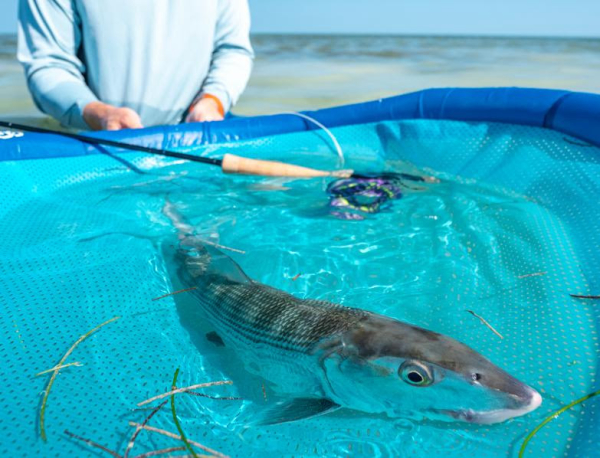
“First, nobody knew what bonefish spawning sites looked like until we discovered one in the Bahamas in 2011. Maybe by then the size of the spawning school in the Keys had shrunk to the point that it wasn’t noticeable to us. Or maybe the size of the Keys population became so small that the fish completely stopped spawning for a period of time. Fish won’t spawn if there aren’t a critical number of spawning fish.”Over the past couple years, several Keys guides have reported seeing schools of bonefish in nearshore waters. Now, Dr. Boucek is counting on the fish he tags to lead him to their spawning sites.As soon as I land the bonefish, Dr. Boucek places it in a submerged inflatable pen. While I hold the fish upside down in the water to keep it calm, he makes an incision in its abdomen. Right away, he notices that the fish is female—ovaries are evident and filled with developing eggs. He inserts a small acoustic transmitter into the abdominal cavity and skillfully stiches the incision closed. The transmitter emits an ultrasonic ping with a unique ID code every couple of minutes. Whenever this tagged bonefish swims past one of the several thousand acoustic receivers, belonging to BTT and other research groups, moored to the ocean floor throughout the Keys, the receiver records the date and time of the transmitter’s ping.

The tracking data will allow Dr. Boucek to chart the fish’s habitat use and, hopefully, locate its spawning site this winter.With the Nick’s assistance, Dr. Boucek (right) tags a bonefish with an acoustic transmitter.An acoustic transmitter.I release the bonefish and we watch as it glides away across the flat and vanishes into the glare.Dr. Boucek (left) and Nick celebrate the successful tagging of a Florida Keys bonefish.  

Nick Roberts is the Director of Marketing & Communications at Bonefish & Tarpon Trust (www.BTT.org) and the editor of the Bonefish & Tarpon Journal.

All photos by: Ian Wilson
Learn more about the work of Bonefish & Tarpon Trust at www.bonefishtarpontrust.org.
Tagging a bonefish

St. Croix’s Avid Surf Rod Series

Versatile New Surf Sticks Deliver Serious Power, Performance and Value
St. Croix’s new Avid® Surf provides custom-level performance without compromise
Press Release: Park Falls, WI (October 25, 2019) – Fishing should always be fun, even when it’s serious business. Booming the perfect cast is fun, hooking up is fun, and winning the battle is fun – as long as that battle is with the fish, not your equipment.Whether casting to bluegills in a farm pond, stripers in the surf or anything – or anywhere – in between, St. Croix Rod owns the mission of building the Best Rods on Earth®. That means making rods that perform dutifully and beautifully so anglers can focus on the joys and rewards of fishing.

Fresh from its debut at ICAST 2019, St. Croix’s new Avid Surf series includes ten, powerful, American-made spinning and casting rods designed for serious surfcasters looking to beach serious fish. Whether heaving heavy baits from the beaches of Cape Hatteras, casting 3-ounce bottle plugs for Montauk stripers, or trying to steer a crazed tarpon away from bridge pilings in the Florida Keys, these super strong, extremely versatile sticks can handle any challenge surf fishing presents.
Avid Surf rods combine St. Croix’s Integrated Poly Curve® (IPC®) mandrel technology with premium, high-modulus SCIII carbon for exceptional strength, smooth power and increased sensitivity. They also sport Fuji® K-Series KW tangle-free guides with Alconite® rings and Corrosion Control™ frame treatment for superior casting distance and improved corrosion protection. The Fuji® DPS Deluxe reel seat with Back Stop™ lock nut and matte grey hoods ensures a rock-solid connection between rod and reel, while a custom cork tape handle with machined trim pieces provides a sure, comfortable and resilient grip.

When St. Croix engineers set out to design the new Avid Surf series, they polled elite surfcasters to see what they valued most. One such surf fishing expert was St. Croix pro-staff member, “Crazy Alberto” Knie. “The new charcoal gray color instantly marks these rods as stealthy and serious,” he says. “When I’m out in the surf – often on the graveyard shift – I want to disappear, not stand out. And I want a rod that will put up with the elements as well as I do. These new Avids pass the test in every way, shape and form. The two lightest spinning rods are one-piece construction. The rest are two-piece rods that give one-piece performance – and they all have a 15-year transferrable warranty. That’s crazy for a rod which will see nothing but abuse!”
Knie is especially impressed by the combination of smooth casting ability and outright power these rods possess. “In a lot of places, you need to deliver heavy payloads far off the beach, and after testing these rods for over a year, there’s no doubt they’re up to task,” he states. “They have the length, strength and leverage to overpower a cow striper, ‘snookzilla’ or even the silver king itself when these trophies plow for structure or make a last-ditch run right in the wash. These new Avids have the look, feel and ability of a high-end custom-designed rod at a great price for surf rats looking to jump to the next level,” he says.

Gavin Falk, Engineering Supervisor at St. Croix’s Park Falls, WI factory, notes that new Avid surf rods are built with corrosion-control guide frames and a new and improved ART (advanced reinforcing technology) that yields increased tensile strength, allows the use of slim profile rod ferrules, and gives added strength to the entire butt section of the rod.
“That’s a real advantage when it comes to hauling back on a trophy fish in need of a direction change,” says Falk. “These rods have impressive power from butt to tip. With their combination of strength, versatility and casting ability, these new Avid Surf models are going to become unique and valuable commodities all surf anglers will want to explore.”Designed and handcrafted at the St. Croix Rod factory in Park Falls, U.S.A., Avid Surf series rods are available in seven spinning and three casting models to handle any surf fishing duty. Spinning rods range in length from 7’ to 12’, while casting choices run 10’ to 12’. Each rod carries a 15-year transferable warranty backed by St. Croix Superstar Service. 
ST. CROIX AVID SURF SPINNING MODELS7’ one-piece, medium power, fast action (VSS70MF)8’ one-piece, medium power, moderate-fast action (VSS80MMF)9’ two-piece, medium power, moderate-fast action (VSS90MMF2)9’6” two-piece, medium-heavy power, fast action (VSS96MHF2)10’ two-piece, medium power, fast action (VSS10MF2)11’ two-piece, medium-heavy power, fast action (VSS110MHF2)12’ two-piece, heavy power, moderate-fast action (VSS12HMF2)ST. CROIX AVID SURF CASTING MODELS10’ two-piece, medium power, fast action (VSC100MF2)11’ two-piece, medium-heavy power, fast action (VSC110MHF2)12’ two-piece, heavy power, moderate-fast action (VSC120HMF2)From bass and blues in the Northeast to big drum in the Mid-Atlantic and the outright bruisers of the Southern Coast, St. Croix’s new Avid Surf rods offer hard-fishing surf rats the unique opportunity to step up to custom-level performance at a reasonable price that comes without compromise. Available now, new Avid Surf rods retail from $250 to $420.

Fishing for Red Snapper


The Long Road to Recovery for Red Snapper


A new method for managing the fish will allow more flexible fishing seasons across the Gulf. 
Joe Richards, Seafavorites.com
from The Fishing Wire

A new method for managing red snapper fishing in the Gulf of Mexico is under way, capping off decades of fighting over one of the Gulf of Mexico’s most famous fish.The approach gives each Gulf state the authority to set red snapper fishing rules for anglers in federal waters—a system that provides flexibility but also requires states to shorten future seasons if the Gulf-wide catch limit is exceeded.

Federal authorities, who previously managed recreational red snapper fishing in federal waters and still regulate commercial and charter-boat fishing of the species, will work with state officials to monitor, study, and collect data on red snapper.The new system began two years ago as a pilot program, and federal officials must give final approval for it to become permanent.

The National Oceanic and Atmospheric Administration is taking public comments through Oct. 7 here. Reduced catch limits have helped the red snapper population steadily recover from decades of overfishing. Joe Richards, Seafavorites.comHere’s a look back at key moments in the Gulf of Mexico red snapper story and a glimpse of what’s to come.

1950-1980s: Commercial and recreational catch skyrockets, rapidly depleting the red snapper population.

Late 1980s: Fishery managers implement regulations, including bag and size limits, but these are not enough to help the species recover.

 1990: Gulf red snapper hit a dangerously low level—just 2 percent of the population’s spawning potential—due to decades of overfishing (removing fish faster than they can be replaced through reproduction) and unintended catch in shrimp trawls. Fishery managers set a target of at least 26 percent for a stable population.  

1997-1998: Fishery managers require shrimp fishermen to install devices in trawl nets to reduce incidental catch of juvenile red snapper. 

2005: A federal recovery plan for red snapper begins after conservation groups sue over lack of progress in rebuilding the population.

2006: Regulators begin setting science-based catch limits for Gulf red snapper as Congress works to strengthen its federal fishery law, the Magnuson-Stevens Fishery Conservation and Management Act.

2007-2008: Managers significantly reduce catch limits for commercial, charter, and recreational fishermen and implement a quota system that reserves a certain amount of red snapper for a limited number of commercial fishermen—a program that successfully keeps commercial catch at sustainable amounts.

2009: Federal fishery managers announce overfishing is projected to end and begin raising annual catch limits. However, the population still has not fully recovered, partly because there aren’t enough older fish, which are the most productive spawners. Scientists project full recovery will take until 2032.

2013: A new federal stock assessment of the red snapper population shows overfishing has ended.

Mid-to-late 2010s: As Gulf red snapper show signs of recovery—a population increase, expanded range, and larger, older individuals—debate heats up over how to divide still-limited catch among recreational, charter, and commercial fishermen. As a group, recreational fishermen exceed their quotas nearly every year.

2014: A court rules the recreational catch excesses must end. Federal regulators begin setting progressively shorter seasons to account for higher catches in state-controlled waters and associated overages. 

2015: As anger grows over catch allocation and to better control catch, fishery managers—in a contentious vote—adopt distinct catch limits for recreational anglers and charter captains, setting the stage to allow different types of management.  

2016: Managers approve revising the amount of red snapper allocated to the recreational and commercial fisheries. However, a lawsuit by the commercial fishermen overturns that change. “Re-allocation” continues to be a tense issue.

2017: Federal managers set a three-day red snapper season, saying longer state seasons are using up allowable Gulf quota. This infuriates and confuses fishermen. Ultimately, the U.S. Secretary of Commerce creates a 39-day federal season. Also, fishery managers vote to require charter captains to keep electronic logbooks documenting amounts of catch.

2018: Federal managers launch a pilot program granting states the right to set recreational seasons in U.S. waters but say states must continue to meet Magnuson-Stevens act requirements for science-based catch limits. States participate using their own data collection programs.  The Gulf of Mexico Fishery Management Council, after changing the threshold for Gulf red snapper and other reef fish, determines it is no longer overfished but keeps a rebuilding plan in place, with a goal of returning the population to full health by 2032.

The Future: Red snapper’s long history is rife with hard decisions and sacrifice, but this once-dwindling species is on the road to recovery. If the rebuilding plan stays on track, anglers can expect a healthier population, bigger fish, higher catch limits, and more fishing days. Managers and fishermen have overcome some of the most difficult hurdles and have ideas about how to resolve those that remain.

With each state using its own method to collect data, NOAA Fisheries will need to standardize information to monitor fishing rates and catch and to assess the population Gulf-wide. Fishery managers likely will continue to struggle with allocating catch between commercial and recreational fishermen.

And one major cause of red snapper mortality remains a problem: Even though anglers and commercial fishermen must release red snapper under certain conditions, the fish often don’t survive being brought to the surface from deeper than 100 feet. Descending tools can help alleviate this problem if used widely and properly.   It’s been a long saga for red snapper, but the future for fishing and this iconic species is promising.

Holly Binns directs The Pew Charitable Trusts’ efforts to protect ocean life in the Gulf of Mexico and the U.S. Caribbean
Catching red snapper

A group of recreational anglers fish for red snapper.

Snooking Tactics

Snooking Tactics with Pro Guide Mike Holliday
Lessons from a Snook Pro Captain will Up Your Linesider Success
from The Fishing Wire
Snook fishing


Mike Holliday is not your typical sportfishing captain. Sure, he has more than 30 years of experience guiding in Florida waters, but he is also a noted outdoor writer, with two published books on inshore fishing topics and countless magazine articles to his credit. He’s the former editor of two regional sportfishing magazines, and he’s often featured on the Florida Insider Fishing Reports Show, which airs weekly in primetime on the Fox Sports® Network.

Mike is also a dedicated conservationist. He’s a lifetime member of the Coastal Conservation Association® and International Game Fish Association®. He never shies away from a fight and is currently working with Captains for Clean Water®, pushing hard for responsible action on the water discharges from Lake Okeechobee that have been creating toxic algae blooms fouling Florida’s coastal rivers and beaches. The group, along with others, is working with newly elected Florida Governor Ron DeSantis to make headway on the issue.

Mike is a longtime member of Team Pathfinder, and all his boats have had Yamaha power. He currently runs a Pathfinder 23 HPS bayboat powered by a V MAX SHO® 250 outboard; the eighth V MAX SHO he’s owned. During a recent fishing trip with Mike on the St. Lucie river, the experienced captain had this to say about Yamaha.

“I love these engines. They are powerful, super dependable, get great fuel economy and are very stealthy. I couldn’t ask for anything more from an outboard, especially with the hours I rack up each season.”

Scott Deal, co-founder and president of Maverick Boat Works, also joined the group for the fishing expedition. A Florida native and perennial skinny-water tournament winner, Scott’s knowledge of fishing has been instrumental in helping him design and build some of the most popular fishing boats in the country today. The company brands include Maverick and Hewes flats skiffs, Pathfinder bay boats and the wildly popular Cobia® center console line.

While Mike loves fishing and guiding his clients for tarpon, trout and redfish on the inshore grounds of Florida’s Treasure Coast, it’s snook that gets his engine revving the most and with good reason. Snook are structure-oriented ambush predators. They’re powerful and fast, which makes for a great fight on light-to-medium tackle. They have a large mouth for engulfing prey, and will partake of most any baitfish, including big ones. Snook also prey on eel and shrimp, and can be caught during the day or night. Capt. Mike will take clients fishing any time of day, depending on the prevailing conditions.

There are four species of snook in Florida waters. The common snook is the most wide-spread and encompasses the largest component of the total population. It’s also the largest, reaching lengths in excess of 50-inches. They are impressive fish to see and fighting machines when hooked. If you hook a large one near docks or bridge structure, your chances of winning the fight are reduced dramatically, which we found out later in the day.

The second most commonly encountered species is the Cuban snook, which is considerably smaller (rarely reaching eight pounds), followed by the sword spine and tarpon snook, which are even smaller.

“Snook are something of a cult fish,” said Mike. “Once you catch a few of them, you are hooked for life. Pound for pound there isn’t a better fighting fish on the inshore grounds, and they can be lured into striking a wide range of live baits and artificial lures.

“They’re ambush predators that can be found hanging in the shadows of docks during the day and at night,” he continued. “That’s one of the things that make them so challenging and so much fun to hunt. During daylight hours, live bait will get the most attention because snook have keen eyesight. This is especially true if the water is clear, such as during a strong incoming tide. Snook can easily identify an artificial lure under these conditions. Take the same fish in the same conditions, toss them a live baitfish, and their inhibitions disappear.”

Since the group was fishing on a clear day with moderate water clarity, Mike opted to make a run out the inlet to hunt for a school of live bait. It didn’t take long to find several schools of herring, some being harassed by jack crevalle. Scott did the honors of tossing the castnet to fill both live wells aboard the Pathfinder. The anglers also spent a little time chasing the jacks, catching a few in the offing. Then it was back to the St. Lucie River where Mike did a little hunting to find some willing snook to take the bait.

“Snook are not too particular about live bait,” Mike continued. “Herring, sardines, pilchards, menhaden, mullet, even live shrimp, can illicit a positive response. Massive schools of finger mullet migrate through this area, usually from early August to the end of September, and the snook go absolutely nuts. Fishing around inlets and along the beaches can be a blowout. They also become quite susceptible to certain lures cast around mullet schools, and my favorites are the Yo-Zuri® Pencil and Mag Minnow. Both are just deadly during the mullet run.”

After checking out a couple of docks and coves for snook with little to show for it, Mike decided to make a run to another area of the river. Modern electronics with the latest side-imaging capabilities have made finding snook around structure less time consuming. Mike uses a large-screen Humminbird® unit with a sonar feature that can scan horizontally out both sides of the boat to reveal structure and fish up to 50 feet or more away.

“I can cruise along quietly with my trolling motor and see fish sitting alongside pilings, under docks or holding tight to bulkheads or shorelines without spooking them,” said Mike. “I can even tell how big the fish are from the return image on the LCD, which saves a lot of time. Finding fish has always been the hardest part of this kind of fishing because it used to involve a lot of casting to spots when you had no idea if there were fish present. These systems make the hunting a lot easier for pros and novice anglers alike.”

Using his depthfinder and trolling motor, Mike found a bunch of snook along an area of shoreline where a bulkhead ended abruptly, and natural shoreline with rocks and a sand point began. A long dock extended out into the cove another twenty yards down the shoreline with a perpendicular T dock at the end. This great structure created a corral for the snook to use as a feeding station. He pointed out the spots to concentrate our efforts, and the anglers started placing the live baits in the strike zone with accurate casts. Scott hooked up almost immediately, a small snook running some line off his spinning outfit. A few minutes later, Mike slipped the net under the first snook of the day, which was followed with another and another in successive casts to the same point.

While the action remained constant, Mike explained the ins and outs of snook conservation.

“These fish are tightly regulated in Florida waters with restrictive seasons and bag limits,” he said. “There is a one-fish-per-person daily bag limit, and you can only keep fish between 28 and 32 inches (fish that are typically between eight and 13 pounds). Anything smaller or larger must be released. With regulations that force the release of all the larger spawning-size fish, the stocks have remained incredibly abundant in recent years. Anglers must have a Florida saltwater fishing license and purchase a snook stamp to go with it. If you are fishing with a licensed guide like me, we purchase a blanket permit that covers any customers aboard our vessel.”

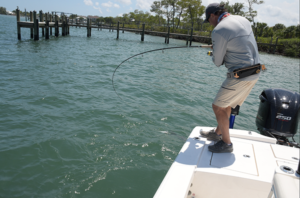
About that time, one of the anglers placed a cast next to one of the dock pilings about midway between the shore and the T dock. The herring was immediately inhaled by a snook that took off for parts unknown. This was a considerably larger fish and even though it was hooked on the heaviest spinning outfit on the boat, it was impossible to tighten the drag enough to stop it from running in and out of the pilings. The power of the fish was surprising, and it became obvious that this tug of war was a losing battle for the angler as the fish zigzagged between the pilings, eventually breaking the line.

Mike smiled as he watched the outcome of the fight. “That was a really good one,” he said. “Your chances of getting him out of those pilings was slim, and there was little that you could’ve done to change the outcome, which is one of the reasons I really love these fish. They are just so strong that once a big one gets going it’s almost impossible to turn them around.”

Mike fishes snook from Vero Beach to Palm Beach, but feels the very best fishing for linesiders is in the St. Lucie River and along the beaches in this area. His biggest fish to date was a 42-pound monster that tested his tackle, but his favorite place to find them is when they move up onto the grass beds on inside flats in less than three feet of water. This can happen any time between April and November, but the entire coast has seen a drastic reduction in natural grass beds due to run-off pollution. The excessive use of fertilizers in both agriculture as well as residential and business lawns causes water clarity to decrease as turbidity increases due to unnaturally high algae levels exacerbated by the discharge of toxic outflows from Lake Okeechobee the last few years.

“When the snook are on the flats, the fishing can be spectacular,” Mike said. “It’s mostly smaller fish, a lot under the slot-size and some keepers, but the bites are explosive on plastics and topwater lures.”

Mike’s lure selection is small. He uses some other plugs in addition to the Yo-Zuri® Pencil and Mag Minnow, and jigs sporting plastic bodies make up the rest of the tackle box. Bass Assassin®Sea Shad bodies in the four- and five-inch size are productive. In dirty water he prefers dark colors, and in clear water his favorite color is green/silver. Jig head weight varies from one-fourth to one ounce depending on water depth and tide flow.

There are specific seasons during which you can keep a snook for the table and rest assured, they are excellent eating fish with firm, white, mild tasting fillets. The closed seasons are from December 15 through January 31 and again from June 1 through August 31. The summer closure protects the fish during spawning season, and much of the spawning takes place in and around inlets like the mouth of the St. Lucie River. Catch and release fishing for snook is allowed during the closed seasons. Current regulations for Gulf Coast snook are strictly catch and release year-round to protect the remaining stock after the stress of successive years of various toxic algae blooms.

“Since very few of my customers want to kill a snook, I take charters any time during the year,” Mike said. “That said, during the spawning season I avoid fishing in or near the inlets, where spawning activity is highest, and fish along the beaches where post spawn fish tend to hang out. Regardless, the fish are all released, and that’s the way I like it.”

Snook are truly a great gamefish, one that every angler should tangle with at one time or another. Florida’s Treasure Coast is the best place to encounter them, and Capt. Mike Holliday of Fish Tales Guide Service can show you the ropes. You can reach him at (772) 341-6105 or by email at mikeholliday60@ymail.com.

Fall Reds On the Beach

Red is the Color of Fall at the Beach
By Frank Sargeant
from The Fishing Wire

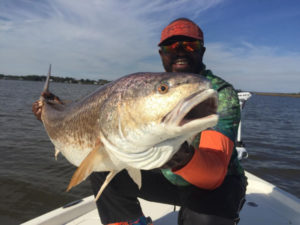
Catch redfish like this from the beach in the fall


For those who like to take their vacations on the Gulf Coast after the crowds are gone, now is the time to head south.

Though the weekends are still busy, the weekdays have a shadow of the numbers of vacationers pre-Labor Day, and that’s nothing but good for anglers.

Fall is prime time for redfish, which move from the beaches into the lower bays to spawn as fall nears. Particularly on the northern gulf, roughly from Cape San Blas all the way to Dauphin Island in Alabama, the fish show up in schools that sometimes number in the hundreds, literally turning the water red.

The “bull” reds—which are actually mostly females—settle on the edges of the bars, jetties, passes and bridges, and provide amazing sport for those who know where to find them. The average fish weighs 15 to 25 pounds, and some are much larger.

Harvest of any red over 28 inches long is illegal in Florida waters, while anglers are allowed one redfish over 26 inches daily in Alabama waters, but these jumbo reds are not nearly so tasty as the smaller fish and most anglers release them to spawn and make more reds. They make great catch and release action, and will hit just about anything when the feed is on.

Topwaters are particularly interesting because big reds really stir things up when several of them start chasing one of these lures at once. You may want to clip off several of the trebles, though—getting a big red untangled from a multi-hook lure it has swallowed can be a big problem. A single-hook swimbait works just as well and is much easier to get out of the fish—use one about 6 to 8 inches long and weighing 1 to 2 ounces.

The prime spot for big reds in Florida is the south tip of Cape San Blas, but they’re also found at every inlet and pass at this time of year, as well as cruising along just outside the first sandbar off the beach. They also linger around the many big piers found along the Panhandle coast.

The most famed spot in Alabama waters is Dixey Bar, a shallow ridge of sand just off Fort Morgan. This is a big piece of shoal water just off the edge of the ship channel, and it’s a natural feeding area, averaging 5 to 10 feet deep. It’s 3 miles long and up to 2 miles wide, providing lots of fishing room for a number of boats. And in fall it nearly always has plenty of jumbo reds.

While artificial lures are the most fun way to connect, sometimes a more sure way is natural bait— pinfish, grunts, small mullet, pretty much any fish in the 6 to 10 inch range won’t last long—put enough weight on them to hold bottom, and fish the outgoing tide. If live bait is hard to get, a chunk of cut mullet fished on bottom will do just fine—reds quickly home in on the scent, if a shark or catfish doesn’t beat them to it.

If reds are not your thing, trout fishing will quickly improve with the shorter days and cooler nights, with steady action around the shrimp and menhaden schools in the large bays and sounds here. Best bet is live shrimp under a big noisy popping cork which you “baloop” about twice a minute to attract attention. Some anglers catch much larger trout, big “yellow mouths” over 6 pounds, by wading the surf at dawn and throwing big Spooks and other topwaters.

Just off the beaches, Spanish and king mackerel will continue to cooperate until about mid-October, when the bait schools start to migrate south, taking these speedsters with them. Trolling a Clark spoon behind a number 2 planer gets the Spanish anywhere from 100 yards on out, while the kings usually like a larger Drone-type single hook spoon with a small strip of mullet or bonito, also fished on a planer. Kings hang around artificial reefs, navigation buoys and the major passes.

In short, there’s a lot of great fall fishing action waiting at the northern Gulf Coast right now, and it’s a great time to visit.

What Is A Fishing Hideaway on Tampa Bay?

A Fishing Hideaway on Tampa Bay
By Frank Sargeant, Editor
from The Fishing Wire

Fishing Tampa Bay


The vast estuaries and tidal creeks near Little Harbor and the Little Manatee River, in Tampa Bay’s South Shore area, provide endless spots where kayakers and flats boat anglers can easily find sea trout, redfish and snook. (Photo Credit Power-Pole)

It’s no secret that Florida is being overwhelmed by new residents—the population now approaches 22 million—as well as by the 124 million who visit there annually. Roads are jammed, housing developments are gobbling up thousands of acres of natural habitat each year and finding locations where you can “get away from it all” is growing way more difficult.

As the song goes, we have paved paradise and put up a parking lot.

But there are still a few hideaways left that reflect a time when this state truly was a natural paradise and the weather, let’s face it, is unbeatable, especially when the snow flies up north. I was reminded of that by a visit back to Tampa Bay’s South Shore region not too long ago.

The South Shore, stretching down the southeast side of Tampa Bay roughly from the town of Apollo Beach to Terra Ceia, has no white sand beaches and no emerald green sea, and that is essentially what has saved it so far.

It’s a land of coastal creeks and estuaries, mangrove and saltmarsh shores, and through the heart of it runs the appropriately-named Little Manatee River, a designated “Outstanding Florida Water” that is home not only to lots of manatees, but also plenty of snook, redfish, tarpon, largemouth bass, alligators, otters, bald eagles and a bit of everything else that used to make Florida, Florida. There are three state aquatic preserves here—the wild lands and estuaries will remain that way, permanently.

As with most areas where there’s good habitat, the fish and wildlife thrive here; the South Shore is one of the premiere fishing areas on all of Florida’s west coast. It’s home to the “big four” of Florida inshore fishing, snook, tarpon, trout and redfish, sometimes in amazing numbers. And it’s far enough inland that it was minimally affected by the long-lasting red tide that devastated many coastal areas last year.

Because it’s Florida, there’s good fishing every month of the year, though the mix of species and their locations change with the seasons. Tarpon and snook are primarily tropical fish and action for them is best April through October, while trout and redfish like cooler water—best times are typically October to March, though spawning reds sometimes make a push in late August and September.

This is all inshore action, which means you can get at the fish in a skiff, a bassboat, even a kayak if you keep an eye on the weather. And if you don’t have your own boat, there are rentals available.

At Little Harbor Watersports in Ruskin, for example, you can rent a center console for $225 for a half day, $325 for a full day, and head out on the bay with a very good shot at catching plenty of spotted sea trout, simply by drifting over grass flats at depths of 4 to 10 feet and bouncing a quarter-ounce shrimp-tail jig on bottom or drifting along with a DOA Shrimp (or a live shrimp) suspended 3 feet under a popping cork that you give an occasional “chug” to stir up interest. You’ll catch plenty of ladyfish, black sea bass and assorted other critters to keep up your interest, as well.

Another alternative is to rent a kayak at Little Harbor and explore the canals that lead back into the development. In winter, these canals are sometimes loaded with redfish, trout and the occasional snook, while in summer they are home to baby tarpon anywhere from 1 to 3 feet long. (It can be buggy back here on a calm summer morning, though—load up with high-DEET repellent.)

Snook can be a challenge to locate and catch, but there are lots of them in the South Shore area and those who fish live sardines regularly connect with big ones.

If you’re more serious about fishing, you can hire a guide—rates around $500 for two–who will put you on the area’s premier gamefish, the snook. These fish have been described as “largemouth bass on steroids” (by me, among others) and they really put on a show in the mangrove creeks and oystery potholes where they’re often found. Size ranges from 3 pounds upward . . . way upward. It’s not uncommon to hook up with a fish weighing 10 to 15 pounds while fishing with a guide who uses live sardines to fool the lunkers, and trying to control one of these beasts in the confines of a narrow creek overhung with mangrove trees and surrounded by sharp oyster shells is the angling experience of a lifetime.

Or, if you’re into big game fishing, you can also enjoy that experience without ever leaving sight of shore here—from late April through October, South Shore waters are loaded with tarpon ranging in weight from 50 to 150 pounds. You might get lucky and connect with one on your own by fishing deep bends in the river or in the canals around Little Harbor (fish where you see them rolling with live pinfish or sardines) but best bet is to hire a guide, who will know where the schools are hanging out, usually south of the river.

Jumbo tarpon are abundant in Tampa Bay from April through October, including lots of fish weighing 100 pounds and up. Best way to connect is to hire a guide, who has the right gear and knows where to find them. (Frank Sargeant Photo)
You can catch the juvenile tarpon on heavy bass tackle in the rivers, but for the adults, heavy spinning gear and 50-pound-test braid is the minimum—your guide will have the appropriate gear, and will also take the worry out of handling one of these silver giants at boatside. (Tarpon are a catch-and-release species, but you’ll have a chance for plenty of photos with your trophy before she swims away free to fight again.) One of my favorite guides for this pursuit is Captain Chet Jennings, who has been at it for decades. His website also has some interesting video showing the backcountry here; www.fishintampa.com.

About Little Harbor

Accommodations on the river are understandably scarce—the terrain and environmental regulations limit development beyond basic residential properties—but one first-class location is Harborside Suites, at Little Harbor just north of where the Little Manatee runs into Tampa Bay.

Little Harbor is a good home base for a South Shore visit not only because it’s in the heart of some of Tampa Bay’s best fishing, but also because it’s got all the amenities to keep the rest of the family happy while you fish. Tennis courts, swimming pools, fitness centers, several waterfront restaurants, hiking areas, SUP, kayak and jet ski rentals plus a half-mile of sand beach should keep the crew well entertained.

The live music at the Tiki Bar overlooking the bay is a big draw at sundown every evening, and if you’re so inclined they even have karaoke nights on occasion. There’s also a waterfront firepit for after-sundown partying. And the waterfront rooms all have full kitchenettes, equipped right down to that all important coffee maker.

Sundowns at Little Harbor are not only beautiful, but they mark a good time to slip out on the water for a few casts — there’s always a bite at sunrise and sunset. (Frank Sargeant Photo)
It’s not uncommon for manatees to swim right into the harbor in front of the resort and nibble at moss on the boat fenders, and on my last visit a mother bottle-nosed dolphin was training her offspring to catch mullet among the docked yachts, as well. If you’re into bird watching, there’s a large preserve less than a mile down the shore where you’ll see just about every shorebird Florida has to offer, including the strikingly pink roseate spoonbills, sometimes by the dozens, plus lots of ospreys, egrets, great blue herons and in winter the occasional bald eagle.

For details, visit www.staylittleharbor.com or call 800-327-2773.

Saltwater Kayak

How to Pick a Saltwater Kayak
By Kyle Manak
from The Fishing Wire

Choose the right saltwater kayak


When choosing a good saltwater kayak, there are many things that come to mind. First and foremost, consider what your intentions are regarding that saltwater kayak.

Where Will You Be Using Your Kayak?

Your personal fishing habits will come into play when choosing a kayak. After all, not all kayaks are made the same. Will you be fishing? Will you be in marshy waters or bays, or will you venture offshore? Marshes call for a kayak that does well in “skinny” water. Do you choose a paddling kayak or a pedal style? In waters eight inches deep or less, for instance, although your kayak will float, your pedal drive might not be usable. Knowing that you can paddle your kayak is still important. Pedal drives are great options for deeper waters of 14 inches or more, and of course, they keep your hands free when going distances or trolling. A paddle kayak can be used in all waters, but are you comfortable paddling three to six hours or more? Additionally, are you using your saltwater kayak for recreational fishing or tournament fishing? A you just searching for a good kayak you can be in all day? Make sure to ask yourself these questions while you’re shopping around.

What Size Kayak is Best for You?

This goes back to where you will be using your saltwater kayak. Most anglers like a kayak that is 12 feet or longer. This is because the longer the kayak is, the easier it is to keep on a straight path, with or without a rudder. Will you be standing for some of your fishing, or always sitting? Offshore, of course, you will be sitting, while you may decide to stand inshore sometimes. Having a kayak measuring 14 feet or longer, and with a seat in the lowest possible position, is a wise choice for offshore ventures. It allows you to breach the waves in launching or your return through the surf. YakGear’s Sting Ray and Manta Ray seats are both great options for a comfortable low, four-point seat. For occasional standing, you may want to look for a kayak measuring 36 inches wide or wider, and which has a pontoon-style keel, rather than a single sharper keel. This creates more stability, but it is not foolproof. You must always be careful. Longer and narrower kayaks are typically faster and less susceptible to cross winds. Sitting higher in a wider kayak will catch more wind, and you will have to put in a lot more effort. If you do choose to stand aboard your kayak, consider adding a YakGear StandNCast Bar to aid in balance.

Should You Sit Inside or on Top?

Many years ago, sit-inside kayaks were the only option out there. In the last 15 to 20 years, however, sit-on-top kayaks have become more popular for saltwater. A sit-inside kayak does not allow you the flexibility of standing, and if you want to get out and do a little wade fishing, it is much harder in a sit-inside than a sit-on-top.

What Should the Capacity of Your Kayak Be?

Your own size and the gear you will bring with you plays an important role in kayak selection, as well. If a kayak has a weight capacity of 300 pounds, that is the amount of weight it will hold while still allowing it to float. If you weigh 200 pounds, for example, and bring 50 pounds of gear, you are using more than 80% of the weight capacity, which will reflect in the kayak’s speed and maneuverability. Kayak Angler Magazine’s Chris Payne notes that a good rule of thumb is not to exceed 75% of your saltwater kayak’s weight capacity.

How Will You Transport Your Kayak?

Speaking of weight, make sure the size and weight of your saltwater kayak fits your transportation. Will you be hauling your kayak on top of your car? In the bed of your truck? In a trailer? All important things to keep in mind when deciding on a kayak. Also, when you get close to your launch spot, how will you get your kayak down to the water? The C-Tug cart offers two helpful options — a hard wheel for asphalt and such, and the newer Sandtrakz wheels for beach sands and other all-terrain scenarios.

I asked myself these questions and more before purchasing my kayak. A wide kayak will offer stability and comfort, but the tracking ability is diminished a bit. A longer, narrower kayak will increase your speed and tracking, but you might lose some stability. One way to pick a good saltwater kayak is to test out several options. Go to kayak demo days hosted by retailers across the United States, and test as many out as possible. Maybe borrow a friend’s kayak or rent one for the day. I promise you will know the minute you get in if it feels right. Until then, happy kayak hunting and tight lines.

About the Author:

YakGear Brand Ambassador Kyle Manak learned most of his fishing techniques — and developed a love of the water — in his hometown of Corpus Christi, Texas. Although he enjoyed boat fishing, bank fishing and wade fishing through the years, it was when Kyle ventured into kayak fishing that he found his stride and never looked back. For him, the simplicity and beauty of being on a kayak and catching a fish was something special. He was hooked by the beauty and peacefulness he experienced out on the water.

Kyle has been kayak fishing for many years now, and has extended his passion to social media. A few years ago, he created Kayak Fishing Texas, an online community which started small but today has more than 6,700 members who share the same passion. He continues to spread his passion for fishing to his own children and other children whenever he can.

Columbia River/Buoy 10 Tide Strategies

Columbia River/Buoy 10 Tide Strategies
By Buzz Ramsey
from The Fishing Wire

Where to catch salmon


With a combined run of nearly a million chinook and coho salmon returning to the Columbia River mouth this August and September: forecast by state agencies to include 340,000 chinook and 600,000 coho, it might be time for you to plan a trip. And although the number of chinook returning will restrain fisheries targeting them, the giant coho return should be enough to keep the boat ramps and fish cleaning stations, at this popular sport fishery, busy.

When it comes to catching salmon, like many near saltwater fisheries, it’s all about the tides at Buoy 10. You see, each successive tide pushes more and more salmon into the estuary, which is the first place you can ambush fall salmon as they enter the Columbia River.

The salmon ride the incoming tide into the river like a surf boarder might a big wave, which means each tide, especially a big one, will carry with it large numbers of salmon all the way to and above the Astoria-Megler Bridge. To be successful is about understanding where this wave full of fish can be found and being there when they bite. It’s all about understanding the ever-changing push and pull of water.

During times when tides are less dramatic (it’s true) the tides push fewer salmon not as far into the estuary. But if the lesser tides occur for a week or more the lean daily numbers can add up to big ones and offer quick limits fairly close to the mid-estuary access points like Hammond, Warrenton, Chinook and Ilwaco.

Because the area extending from Buoy 10 (the red channel marker that describes this fishery) to Tongue Point is 14 miles long and four to five miles wide most anglers locate the salmon by trolling. And the best time to troll, especially when tides are big, is mostly during the last half of the incoming and first half of the outgoing tide.

The fishing rods used at Buoy 10 are fairly stout and stiff enough to handle cannon-ball style sinkers that might vary in weight from four to 16 ounces. What most angers do is run heavier sinkers on their front rods, say 12 to 16 ounces, and lighter sinkers, 8 to 10 ounces, on lines trailing out the back of the boat. How much weight you use depends on how deep the salmon are running and whether or not you are trying to keep your gear at or near bottom. Keep in mind though that not all salmon are on the bottom as many will suspend at mid depth, especially when tides are flooding.

What many anglers do is run their front rods out 20 to 25 feet on their line counters and their back rods out far enough to occasionally hit bottom when trolling over water less than 30 feet in depth.

A popular rod series for fishing “Buoy 10” are the Berkley Air rod series that I helped the company design. Actions that work at Buoy 10 include the 7’9” HB (Heavy Bounce), 9’ XH (Extra Heavy), and 9’6” and 10’6” HH (Heavy Herring) models. The 7’9” HB is easier to stow than longer rods and perfect for fishing straight out behind your boat. The 9’XH is an overall favorite among many for its ability to handle big sinkers, while the 9’6” and 10’6” HH actions are handy when wanting to spread lines out to achieve a wider trolling swath. The HB and HH will handle weights to 12 ounces; while XH can easily handle 16-ounce sinkers. If you want the ultimate in stiffness with a land-them-quick action, it’s the rod action I use, consider the 8’ XHB (Extra Heavy Bounce) which will handle sinkers of 20 ounces or more.

Levelwind reels equipped with line counters are what everyone uses at Buoy 10, since you really need to know what depth you are trolling and be able to return to it reliably. And while I’ve used the Abu Garcia 5500/6500 line counter models for Buoy 10 salmon, I’m mostly using them when chasing spring chinook these days. For Buoy 10, it’s the Penn Warefare or Fathom II Line Counter reels in the 15 size that works best for me. And yes, these Penn models are available in right- or left-hand versions.

When it comes to fishing line, the majority of anglers employ high-tech braid. Most guides and anglers I know spool 50- or 65-pound test braid, which is way thinner than even 25-pound test monofilament and totally eliminates the thought of an unexpected break off. This is something that can happen when using monofilament fishing line, especially if it is been heavily used and on the reel for more than a year. However, if you prefer mono, some anglers do, I would suggest picking a tough one like Berkley Big Game in at least 25-pound test.

Like many having boats, I’ve usually got four friends with me when trolling Buoy 10, meaning we have five rods in the water. Although it varies depending on what the fish are biting, I generally run spinners on the two rods near the bow of the boat and herring or anchovy on the rods positioned out the stern. Make no mistake, spinners work at Buoy 10 and what you might discover, as we have, that the majority of big chinook seem to come on the spinners. The idea behind running bait on the back rods is to encourage salmon that passed up on the spinners or arrived late to all the attraction produced by our flashers to bite.

As for my rod, I once ran it between the two stern rods and rigged with the same amount of weigh as the other back rods. Doing this meant my rod was mostly in-line with the others and as such rarely got bit as fish attracted to all the flash produced by our Fish Flash got to the side rods first. What changed the success of my center rod was when I started trailing my outfit, often rigged with a Mulkey spinner in combination with a four-ounce sinker, behind the boat 70 to 100 feet or more. What this often means is that my sinker might bounce bottom when trolling over 20 feet of water or less but otherwise my outfit is suspended somewhere at mid-depth. There is just something about having a lure trailing out behind the other gear that the fish sometimes respond to in a big way.

Angling Action in Florida’s Northernmost Keys

Angling Action in Florida’s Northernmost Keys
from the Fishing Wire

The Florida Keys are famous for many things, from pirates and sunken Spanish treasure galleons to Ernest Hemingway’s Key West home with its pride of polydactyl cats. But for anglers, it’s best known for fishing. While the middle and southernmost Keys garner most of the good press, the upper Keys offer some of the most diverse fishing opportunities in the entire island chain. The winter sailfish season provides the opportunity to catch a billfish a scant few miles off shore, while the ocean reefs are home to tarpon, jacks, blackfin tuna and a variety of grouper and snapper species. On the other side, the backcountry of Florida Bay is a shallow water playground where bonefish and permit hunt the skinny water, and a variety of mackerel, snapper, grouper, jacks and ladyfish are found in the slightly deeper holes.

Whether you’re a diehard angler looking for hot action, or an occasional fisherman in the area on a family vacation, the often-bypassed upper Keys has a lot to offer in piscatorial pursuits. The region stretches from Key Largo, the northmost Key, to Islamorada. Team Yamaha spent a day and a half with Captain Tim Arce of Native Conch Charters exploring the area. To add to the fun, the team fished aboard Regulator Marine’s hot new 26 XO powered by a Yamaha F300 outboard. The model represents a new direction for a company renowned for building offshore center console fish boats. The difference is denoted by the “XO” branding in its name. It stands for crossover, and this nimble 26-footer combines the shallow water accessibility of a bay boat with a slightly deeper hull design and a bit more freeboard to make it flexible enough to fish the ocean beaches and reefs further offshore. For the purposes of this outing, the boat was a perfect fit.

During the first trip, Captain Tim loaded on some light tackle and bait, did a quick systems check. Once we were out of the marina, he ran the boat south paralleling the Overseas Highway, winding through several miles of narrow channels, through mangrove-lined cuts between small islands and across shallow flats headed toward Snake Cut, where we left Florida Bay and made our way out onto the Atlantic side of the island chain. Captain Tim is a fifth generation Keys native, and has been addicted to fishing since he was old enough to walk to the end of the street with a fishing rod in his hand. He was a deckhand on charter boats by the age of 14, working for some of the most famous Keys charter captains sailing out of the legendary Buddy & Mary’s Marina in Islamorada. He got his license at 18, and split his time between running charters and a commercial tow boat. He has run offshore and back country boats for more than 25 years, and knows the vast and varied waters of the Keys like most people know their commute to work every day.

Once through the Cut, he followed the channel markers to deeper water, the Regulator making quick and comfortable work of some rather large swells and waves, until the team reached Davis Reef about six miles offshore. Tim tied off to one of the mooring floats, and started a chum slick in hopes of catching some tasty yellowtail snappers for dinner.

“The fishing in the upper Keys varies with the seasons,” Tim explained, “So here’s a little of what a visiting angler can expect. The bluewater fishing is best in fall and winter when sailfish, wahoo, kingfish and blackfin tuna are available as close as the edge of the reefs – often right where we are sitting now.”

Just to punctuate his narrative, a large school of ballyhoo shot into the air roughly 150 feet away, with a sailfish in hot pursuit. Sailfish chased bait schools, the bait sheeting from the surface sounding like rain, their sides reflecting the bright sunlight like mirrors, only to disappear below the surface as fast as they appeared. Unfortunately the team had neither the right tackle nor the live bait to tempt a sail. They were after the bottom species.

“In the spring, the bluewater action moves a bit further offshore, where the Gulf Stream is filled with migrating gamefish,” Tim continued. “Early spring is the best time for limiting out on mahi, there are still good numbers of sailfish around, bluefin tuna are heading north, and you can catch swordfish deep dropping during the day or fishing shallower at night. Summer is the slowest offshore fishing, but there is a major spawning migration of yellowtail and mangrove snappers on the reefs along with a variety of other species.”

The team continued to fish, catching a few mangrove and yellowtail on light tackle but with so little current, the conditions were not conducive for a good bite, though they did manage to put together enough of a catch to make for a great dinner back at the dock. Along the way Tim took a sightseeing detour, which only reinforced that the Upper Keys is one of the most beautiful places on earth.

The next morning, the team met early at Yacht Works to set out on the second trip. This time Captain Tim brought along 23-year old college student and friend, Lexi Hang. A native of Rhinelander, Wisconsin, Lexi was along on a family vacation. As luck would have it, the family rented the house next to Tim’s on Islamorada. Tim’s plan was to head west well out into Florida Bay to search out some shallow water spots to try some of the specialized equipment adorning the XO, specifically the remote control operated Minn-Kota® electric trolling motor on the bow and the Power Pole® shallow water anchoring system on the transom. Tim took an hour run through miles of shallow flats and winding channels, past small uninhabited islands and finally out into open expanses of the bay. He used the GPS to guide the boat to some spots where he had good fishing earlier in the week.

When we arrived, he deployed the trolling motor and quietly moved the boat up onto a bank in about five feet of water. Putting the motor into “auto anchor” mode, it used the GPS and a computer brain to keep the boat in position in the ten-knot breeze. We started casting live shrimp on light jig heads using seven-foot light actionspinning rods. Lexi was quick to hook up, the first fish taking line off the reel before it jumped several times revealing itself to be a bright silver ladyfish. Long, sleek and fast, ladyfish are common throughout the upper Keys, they fight well and jump like a baby tarpon. After a spirited battle, the fish was unhooked and released.

Tim pinned another live shrimp on the jig, and Lexi made a long cast back into the slick that was developing nicely from the chum bag Tim had secured from the springline cleat. Her offering didn’t hit the bottom before something grabbed it and headed toward the Marquesas at speeds faster than the ladyfish, but this scrapper didn’t jump or show itself until it was much closer to the boat. It turned out to be a bonnet shark, a small member of the hammerhead family that only grows to 15 pounds or so. Great fighters, Tim grabbed it behind the head and lifted it for a picture before gently releasing it.

As the chum slick continued to do its job, more species came looking for the source of the fishy smell and the team started to hook up with regularity. For the next few hours there was barely more than a few minutes lull between hook ups, frequently with two fish on at once. They caught a variety of snappers including mangroves, lanes and grays, some incredibly fast and hard fighting cero mackerel, a small king mackerel (the big ones are found on the ocean side) and a variety of jacks. The weather was typical Florida Keys, hot, sunny with beautiful fluffy clouds drifting by overhead to break up the blue of the water from the blue of the sky. Even though it was late winter, the temperature was hovering in the low 80s by midmorning.

Florida Bay is a huge expanse of shallow water, most rarely exceeding 10-feet deep, with areas of sandy flats that, at certain tide stages, have barely a foot of water on them. Those truly skinny spots are where bonefish and permit prowl, but the team was on a short leash and had to get back to the marina in time for Mike to show the new Regulator to a prospective buyer early that afternoon. The big Yamaha outboard quietly pushed the XO over the areas of sand and bay grass for the hour ride back to Yacht World and the marina. On the way back, Captain Tim explained he was sure the team could catch sailfish from the skiff with nothing more than some live bait and 20-pound class spinning rods. He also knew where some early tarpon would be held up that might be tempted by a well-placed live mullet. With a little more current out on the reef, he felt confident the team could also limit out on yellowtail snappers.

The Upper Keys are every bit as magical as the middle and lower Keys, and a whole lot closer to Miami or Fort Lauderdale airport. If you’ve got a day or two to kill and would like to get out on the water to fish, sightsee or just soak it all in, contact Captain Tim Arce. You can find him at www.nativeconch.com
or call (305) 395-1691.