Category Archives: Saltwater Fishing

Everything saltwater fishing

Why Would Alabama Anglers Go To Florida To Catch Red Snapper?

Tight Red Snapper Season May Send Some Alabama Anglers to Florida Waters

How can an Alabama angler legally catch red snapper in Florida waters? It gets a little tricky, especially for the boat captain.

By David Rainer
Alabama Department of Conservation and Natural Resources
From The Fishing Wire

With all the fishing friends I have, it’s not surprising my Facebook page is awash with red right now, as in red snapper.
Why go to Florida from Alabama for Red Snapper?

Why go to Florida from Alabama for Red Snapper?

Any red snapper landed in Alabama, no matter where or when the fish was caught, should be reported through the new red snapper data collection program. The federal red snapper season starts at 12:01 a.m. June 1 and ends at 12:01 a.m. on June 10, however Florida, Louisiana and Texas allow red snapper fishing in their respective state waters outside of the federal season.

But red snapper season isn’t open yet, you say. Oh, but that’s the red snapper season in federal waters that opens on June 1 and ends at 12:01 a.m. on June 10, the shortest red snapper season ever at only nine days.

The red snapper season in Florida, which has a 9-mile territorial waters boundary, opened on May 24, and plenty of anglers took advantage of that opening. Alabama’s territorial waters extend only 3 miles into the Gulf of Mexico.

So how can an Alabama angler legally catch red snapper in Florida waters? It gets a little tricky, especially for the boat captain.

Chris Blankenship, Director of the Alabama Marine Resources Division, said there are specific regulations that Alabama fishermen must follow to be in compliance with state and federal regulations.

“If people from Alabama are going to fish in Florida and catch red snapper and bring them back to Alabama, they need to stay in Florida waters until they get to 3 miles off the beach,” Blankenship said. “Then they can cut over into Alabama waters. We will allow them to possess fish in Alabama as long as they have an Alabama saltwater fishing license and a Florida saltwater fishing license.”

Therefore, if an Alabama boat is 9 miles south of, say, Gulf Breeze, Fla., the boat cannot take a course that is a straight line back to the Alabama port or boat ramp, because that course would take them into federal waters. And it doesn’t matter where the fish was caught. Possession is the key.

“If you get caught in federal waters with red snapper, that is a violation,” Blankenship said. “You’ve got to stay in Florida waters until you get to Alabama waters.”

Blankenship said there will be a variety of enforcement personnel out to ensure compliance with state and federal regulations.

“We’ll have patrols in the Gulf, as will other states, the Coast Guard and National Marine Fisheries Service (NMFS),” he said.

Anyone who lands red snapper in Alabama, whether or not the fish is caught in states with seasons outside the federal regulations like Florida, Louisiana and Texas, is required to report the catch to Alabama Marine Resources through the new red snapper data collection program. The new system requires only one report per vessel trip, which can be filled out via smartphone app, online, by telephone, or by paper form. Data collection drop-boxes have been erected at boat ramps at Boggy Point, Cotton Bayou and Fort Morgan in Baldwin County, Billy Goat Hole on Dauphin Island and Bayou La Batre in south Mobile County.

N. Gunter Guy Jr., Commissioner of the Alabama Department of Conservation and Natural Resources, enacted the red snapper data collection program through emergency regulation to ensure its quick implementation because of the impact snapper fishing has on Alabama’s estimated $690 million recreational fishery.

The new regulation requires the captain or owner of a charter or private vessel with red snapper on board to report all red snapper kept and discarded dead prior to landing in Alabama.

Anglers will be required to report red snapper catches this year when they return to the docks throughout Alabama.
When the red snapper catch is reported, additional information required includes: vessel registration number, type of vessel (private or charter), county where the fish was landed and number of anglers.

Anglers can report red snapper catches via the Outdoor Alabama smartphone app available in the iTunes or Google Play app stores, online at outdooralabama.com, by telephone at 1-844-REDSNAP (1-844-733-7627), or by paper forms available at the aforementioned boat ramps. The proper smartphone app is powered by Pocket Ranger.

Blankenship said red snapper anglers have expressed their intent to comply with the red snapper data collection program because they want accurate information to be used when seasons and bag limits are set.

“NMFS changed its data collection program in 2013,” Blankenship said. “We don’t feel that program is accurately reflecting the red snapper that are being landed on the Gulf Coast. So in order to get a true picture of what’s actually being landed in Alabama, we’ve implemented the red snapper reporting system. Once we have the information for what’s truly being landed, we will have a much higher confidence in the results as we move forward to show we are ready and able to manage this fishery on a state level.

“But more importantly, there’s a buffer that comes off the top of the quota for management uncertainty under NMFS. If we have a true picture of what’s being landed, that 20- to 25-percent buffer can be added back into the quota in future years.”

When it comes to discarded red snapper, Blankenship said anglers should use their best judgment as to whether they think the fish will survive after being released.

“The reason we ask for the number of dead discards is because NMFS uses dead discards when they figure the quota,” he said. “NMFS has been determining dead discards through an observer program on different vessels. But the number of observers is small. We want to collect that information so we can have a different number and see how it compares with what the observers are collecting.”

Blankenship said most of the feedback he’s received from anglers about the reporting system is for more information, not complaints.

Red Snapper season is just nine days long this year in Alabama waters, but neighboring Florida has a longer opening inside state waters less than 9 NM from shore.
“People want to comply, but they want to know all the details before they go out,” he said. “I don’t blame them. They don’t want to be sitting at the dock, trying to figure this out. But we did make it very user friendly, so it shouldn’t be much of an inconvenience to the fishermen at all.”

Blankenship said the data collection system is designed to get quick results from the reports.

“We’ll be able to compile the data all along,” he said. “Our biggest concern, obviously, is what’s being landed during the federal season. The day after the federal season is over, we’ll be able to give a good estimate of what was landed in Alabama during those nine days. And we will continue to collect reports while the Florida season (May 24-July14) is still open.

“It is a fineable violation if people don’t comply. We’re really working hard to educate people that they need to report red snapper catches.”

Unfortunately, anglers who love bottom fishing are going to have limited options this summer. Gray triggerfish season is closed. Amberjack season is closed until Aug. 1, but gag grouper season opens July 1.

Also, the vermilion snapper bag limit has been reduced to 10 per person as part of the 20-fish reef fish aggregate.

Blankenship hopes that the results from the red snapper data collection system will allow Marine Resources some leeway with snapper fishing, possibly this year.

“We’ll be monitoring the reporting and use the information to consider a supplemental season in state waters later in the year,” he said.

Blankenship accompanied U.S. Congressman Bradley Byrne of Montrose, Ala., and U.S. Congressman Steve Scalise from Louisiana on a short fishing trip off Alabama last week on Capt. Randy Boggs’ Reel Surprise charter boat.

“We went out with Congressman Byrne and Congressman Scalise for a few hours and we talked about our request for a 9-mile state boundary for fisheries management,” Blankenship said. “We’re still waiting on Congress to take action, but Congressman Byrne sounded confident that he could get it done.”

PHOTO: (By David Rainer)

Alabama Red Snapper Season

Red Snapper Season–Short but Sweet

America’s favorite snapper is again legal as of June 1-but the season will be a scant 9 days long.

By Frank Sargeant

Greast Red Snapper Catch

Great Red Snapper Catch

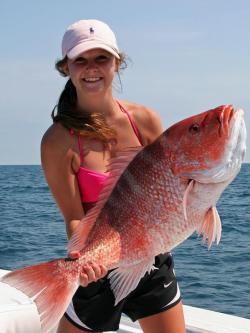
If there’s a shortage of red snapper in the Gulf, you can’t prove it by talking to anglers from Florida to Texas-these Alabama anglers loaded up. (Photo Credit David Rainer, ADCNR)

Don’t blink or you’ll miss the red snapper season in federal waters of the Gulf of Mexico this year. It opens June 1, slams shut again just nine days later on June 10 thanks to a Byzantine federal management system that tightens the regulations ever more as the fishery gets better and better. (If we get a tropical storm on or about June 1, say goodbye to the entire season.)

Federal regulators say the rules are for the good of the fish-and ultimately of the fishermen.

But in fact, most experienced reef anglers say red snapper fishing is now better than it has been in at least 40 years thanks to an extended period of tight harvest regulations, and also perhaps due to the success of fish excluder devices on shrimp nets, allowing millions of juvenile snapper to escape these days when in the past they would have wound up as by-catch, dead on the deck.

The snapper are both much larger than they have been in decades, and much more numerous, according to hundreds of reports from fishermen all around the northern Gulf. It’s universal: anglers in Florida, Alabama, Mississippi, Louisiana and Texas all report booming snapper populations.

So why don’t the feds want to pony up longer seasons and more generous bag limits? Because of a bizarre twist in the way they calculate the harvest-they measure it in pounds, and when their best estimate of a conservation-smart harvest is achieved, they call for closure. Snapper grow fast and live a long time, and consequently anglers are now catching tons of whoppers-which means that they can catch a lot fewer before they reach those limits set by the feds.

To be sure, these restrictions are not arbitrarily contrived by the fish managers–they are mandated by the Magnuson-Stevens act, and more recently by a court decision–but the triggers on both these directives are based on badly-designed harvest surveys, which are the direct responsibility of the federal scientists.

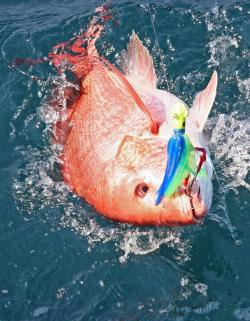
Red Snapper On Jig

Red Snapper On Jig

Snapper take a variety of cut baits, live baits and sometimes heavy jigs, typically at depths of 60 feet and greater. (Photo Credit David Rainer, ADCNR)

It is much like the paradoxical Catch 22, and it’s causing a furious reaction among fishermen and state fishery managers from Florida to Texas–most Gulf states are now moving rapidly toward putting their own harvest surveys in place for the species, tapping the capabilities of smart phones so that anglers can record their catches conveniently the minute they hit the docks.

In an unprecedented rebellion against the federal management system, all five Gulf states have all but quit cooperating with the NOAA system on this species. These days, state management is really starting to make sense, while it didn’t 30 years back. In the bad old days, only commercial fishermen had lobbyists and power to control the rules, and many fisheries suffered as a result.

But these days, the checks and balances of local recreational anglers and conservationists weigh in for keeping the maximum number of quality-sized fish in the water-and even the saltiest old commercial harvesters have finally come to realize that it just simply makes sense to guard the resource, so that they can not only make money fishing today, but also tomorrow, next month and next year. It should be noted that thanks goes to not only state agencies but also federal biologists for much of the research on offshore species that has made this awakening happen.

Florida has set a much longer red snapper season in state waters, up to 9 nautical miles offshore, extending from May 25 to July 14 this year, and other Gulf states are extending their seasons similarly and also working toward expanding the limit of state waters. How this all plays out remains to be seen–hopefully, better fishery stock analysis will put an end to the foolishness and restore some measure of cooperation between state and federal management agencies. In the meantime, whether you fish state or federal waters, here are some tactics that consistently produce results on red snapper.

HOW TO GET EM

Anglers who regularly target red snapper say they are not exactly “bottom fish”, even though they are nearly always found around hard structure. They’re usually found over structure, but not as often down in the structure like grouper.

Experts seek out what they call a snapper “Christmas tree” show on their sonar screens before dropping a line. The pyramid or “tree” is the shape made by a school of snapper, with most deep, fewer at the top. In 200 feet of water the stack may extend as much as 50 feet off bottom.

Big Red Snapper

Big Red Snapper

Many of the red snapper being caught these days are whoppers, the result of tight regulations including short seasons-but many anglers say there are enough fish now to loosen the reins a bit. (Photo Credit David Rainer, ADCNR)

Gulf red snapper are typically found in 60 foot depths and more, on out to the edge of the continental shelf at around 250 to 280 feet-beyond this zone, the bottom drops away to a mile deep and more, and common reef fish are not found in those depths.

The Panhandle has a unique fishery in that there are hundreds and perhaps thousands of “private” reefs, that is junk that skippers have dropped on otherwise barren sand bottom to attract snapper-old washing machines, steel drums, all sorts of bulky trash. It’s not legal any more, but there are still many of these reefs around, and smart skippers have dozens of them in their GPS machines-all very carefully protected from other skippers who might want to pirate “their” fish.

There are also numerous legally-placed artificial reefs, including tugboats, barges and ships as well as demolition rubble, which attract lots of fish; these can be found on any good offshore chart. Most states also list them on their marine fisheries websites.

In general, the procedure is for the skipper to head for his favorite GPS number, drop anchor uptide when he gets there, and then let the anglers lower an assortment of frozen threadfins, cigar minnows or squid down on 60-pound-tackle. Using braided line makes it easier to feel the bite and get a good hookset, but you’ll need at least five feet of 60 to 80-pound-test mono leader to fool the fish and keep their teeth clear of the braid. (In extremely clear water or where the fish are being fished hard, it’s sometimes necessary to go to lighter tackle to fool snapper–you lose many but you get bit more often.)

Weights of 4 ounces and more are needed to get the bait deep, and hook sizes are typically 6/0 and larger circle hooks, extra-strong. (Circle hooks are required by law, as are hook removers, both aimed at improving survival of released reef fish. Venting devices, required formerly, are no longer on the must have list.)

The angler drops the bait to bottom, then takes up several turns of the reel to suspend the bait in the snapper zone–keeping an eye on the sonar will help you put the bait where the fish are. The snappers take it from there. When you feel a bite, you reel like mad and hopefully the circle hook digs in. Jerking on the rod to set the hook rarely works when using circle hooks; just keep tension on the line and reel very fast and the fish will usually set the hook itself.

Red snapper these days typically average 5 to 8 pounds, but there are many, many of 10 pounds and more, and 20-pounders are not unheard of. The limit is two per angler per day, minimum size 16 inches. Red snapper are among the tastiest of all fish, and are great broiled, fried or baked.

RELEASING SNAPPER

Fish caught from deep water frequently have issues with the rapid pressure change as they are brought aboard–they blow up like a balloon, and are unable to swim when put back over the side. Since the limit on red snapper is just two fish daily, it’s common for anglers to release much of their catch these days, and improving survival of these fish makes good conservation sense–as well as being required by state and federal law.

Improving survival depends on several steps.

1. Use circle hooks so that the hook is unlikely to be swallowed.
2. Get the hooks out promptly with an efficient hook-removing tool or long-nose pliers.
3. Don’t let the fish fall on the deck.
4. If you want a photo, make it quickly.
5. Use either a deflating tool or a deep-release “descender” device like the Seaqualizer (www.seaqualizer.com) to help the fish get back down to bottom safely. Descender devices include large weights to which the fish is hooked and lowered back to a comfortable depth, then released.
6. Which ever device you use, do it promptly–minutes out of water are the biggest enemy to survival.

Are Clams Good Bait for Spring Stripers?

Big Apple Stripers and the Manhattan Cup

New York City. Just the name conjures up images of the Empire State Building, Lincoln Center, Central Park, the Statue of Liberty– and great fishing for striped bass. Well, maybe the fishing reference is a little strange to some. The Big Apple might be the city that never sleeps, but it is also surrounded by water that comprises one of the major spawning and nursery areas for the equally iconic Atlantic striped bass. The Hudson River, East River, Harlem River, Western Long Island Sound, Raritan Bay, Jamaica Bay and the New York Bight make up a lot of water, and no one knows it better than Capt. Frank Crescitelli of Finchaser Charters, based out of Mansion Marina on Staten Island. We caught up with Crescitelli for a little early-season striped bass fishing in Raritan Bay aboard his Yamaha-powered 32-foot Regulator® in late April.

Menhaden

Menhaden

Menhaden are a favorite baitfish for New York stripers throughout warm weather, but this year exceptionally cold water has slowed the baitfish bite and made clams a better offering.

“It’s been a long, cold winter,” Crescitelli commented, “and the bay waters are still a bit cold so we’re going to be ready to do whatever it takes to catch a few bass. I’ve got fresh clams, and there are pods of menhaden right here in Great Kills Harbor. We’ll stop and catch some live bait before we go looking for stripers.”

In a more typical year, stripers would have already been in residence in big numbers because they come to this area to stage for a 75-mile run up the Hudson River to spawn in fresh water. Unfortunately, this has been anything but a typical year. The winter was very cold with lots of snow, and March and April have been much cooler and wetter than usual. Once the water temperature rises into the mid-50s, the bite will be on with good striper fishing straight through the end of June.

In the meantime, Crescitelli demonstrated some techniques that work well in the spring, and promised to share a little about the Fisherman’s Conservation Association, an organization he helped found and now helps run. He also told us about his pride and joy, the Manhattan Cup, a prestigious charity striper tournament now entering its sixteenth year.

We left Great Kills Harbor and headed west back toward the headwaters of Raritan Bay. “When the water is cold, shallow areas with dark mud bottom warm up quicker,” Crescitelli advised. “That’s if the sun decides to make an appearance. When you get a little outgoing tide after a sunny day and the water temperature jumps a degree or two, the fish turn on.”

He worked flats adjacent to channel edges where the tide creates rips, and also fished around some rock structure using the live menhaden as bait. He marked a few fish and had a couple of run offs on the big baitfish, but it became apparent the cold water had the fish playing with the bait, but not eating it.

“There’s a fine line between bass slurping down a live menhaden or just picking it up, running a little, maybe scaling it, and then dropping it,” Crescitelli said. “The deciding factor is usually water temperature. If it’s just a couple degrees too cold, you may want to take a shot with clams.”

Striper caught on a clam  bait

Striper caught on a clam bait

This striper grabbed a clam bait fished on bottom in the Raritan Reach area.

He moved to a different flat near the edge of Raritan Reach Channel and settled back on the anchor. Crescitelli recommended light outfits rigged with fish-finder rigs, sinkers and smaller circle hooks. We baited them with whole, fresh-shucked surf clams. He also started chumming, tossing cut up clams into the water to get a good scent trail going to lead the bass in to the baits. He said serious clam fishermen will put a bunch of broken up clams, shell and all, in a large chum pot and suspend it under the boat.

“Clam fishing isn’t my favorite,” he said. “I’d rather fish with live baits, plugs or fly rods, but sometimes you have to do what you have to do to catch fish and when the water is cold, bass eat clams when pretty much all else fails.”

While we waited for the bass to make an appearance, Frank told us about the FCA (Fishermen’s Conservation Association), an organization he helped to start. It’s a 501(c) 3 non-profit organization whose mission is to promote the “Conservation Triad” access, habitat, and smart fisheries management. Financial support provided by FCA directly benefits the marine waters of New York, New Jersey and Connecticut, with a special emphasis on introducing inner city kids to fishing through a program called “Hooked for a Lifetime.” FCA is also working to attain gamefish status for striped bass in New York State waters.

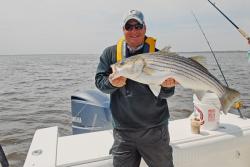
22 pound Spring Striper

22 pound Spring Striper

This spring bass went about 22 pounds-and soon went back over the side to head for the spawning areas upriver.

“The FCA was started by a small group of former CCA members who wanted an organization that could take on local projects without having to deal with the national bureaucracy,” Crescitelli said. “The kind of stuff we could point at and say, ‘we did that.’ Besides purely conservation and fisheries-based initiatives, we take great pride in our ‘Hooked for a Lifetime’ program. Last year we took 200 kids out for a day of fishing. Each one was given a rod, reel and tackle box, plus a basic fishing instruction manual at the end of the day. We took them to local fishing piers that they can return to on their own, and hopefully instilled in them the wonder we have for the sport and the environment. Last year there were two groups, one comprised of low-income inner city kids. The other group was all kids with autism who have a harder time getting involved in sports that require a lot of interaction with other people. Fishing is something they can learn and enjoy in small groups or individually, and it seems to be quite beneficial for many of them.”

“FISH ON!” Crescitelli shouted as one of the rods bent over under the pull of a nice striper. His friend Tom was on it in a flash working the fish expertly as it took off a good bit of line on the first run. A few minutes later, Crescitelli was netting a fat 22-pound bass. He removed the circle hook from the corner of its mouth, held it up for a few quick pictures, held it in the water to revive, and away it swam. No doubt it would be heading up the Hudson in a few short weeks to spawn.

Cuba Tarpon Fishing Report

Fishing Report for Cuba Tarpon Fly Fishing On the Run

Catch tarpon like this fly fishing in Cuba

Catch tarpon like this fly fishing in Cuba

Fishing Report, Cuba Tarpon 5/22/14

TWO HEAVENS IN ONE PLACE
Tarpon-Cuba

For all the fly fisher globetrotters is a quest every year to choose the right place and the exact moment. We are always looking for tides, moon phases, fish run and operations that can meet the expectation of a highly anticipated week, that we could schedule between family holidays, birthdays and others obligations. Finally we have the clue between high-end exclusive services and tarpon fishing that can blow your head off.

During the last week of April and the first days of May 2014 we booked the very first operation week with fishermen of the impressive Avalon 2 Yacht, that fish out from Jucaro Port, 350 miles south from Habana in Cuba to Gardens of the Queen. There, you’ll find a live aboard where you could stay days, weeks or months, with all the ammenities you could imagine, from the skyline jacuzzi in the last floor to the freestyle slide of the second floor. So, having the right place to stay inside an amazing marine park like Gardens of the Queen, we only have to peak the fishing zone of the area and the season.

After been working for several years at Cuba, we heard about the new fishing area at the end of the Gardens, near fifty marine miles south from Tortuga, yes sir, that far south. The Gardens are huge and you could fish a month without repeat the same area. Just two years ago they start fishing this southernmost point, where the tarpon run appears during the first full moon of April in an amazing run of “sabalos”, if you have already fished “boca grande” in the Gardens, this is even better, so well, just imagine. Been there, I can only say that this is one of the few places left in the world where you could fish schools of tarpon from one or two to hundreds of them, in sizes from 20 pounds to over 120 pounds and it is not uncommon to see female tarpons with ten males around her daisy chain, in strings or just moving in a spawning ritual. Just 1 mile away from these channels flats, you have runs of big size tarpon rolling just like Holbox and also other places in deep waters, but that´s another story. Just to give you a “screenshot”, one day our 5 skiffs where “in line” waiting for the daily “run”, moment after a big string of more that 60 tarpon roll in front of us, right away we were all jumping or hooking on tarpons, it was really awesome and I couldn’t believe it. You could see long strings at other locations but this tarpon eat flies with madness, in the same cast you could jump two or three tarpons just keep retrieving the line and you will see.

Long story short “Two Heavens in One Place”, this new area in Gardens of the Queen is a tarpon madness and Avalon 2 yacht is beyond any expectations, just try to be there in the exact moment, we can help you to be in ” heaven”, you´ll not be disappointed. If you want to come with us on 2015 Hosted Trips, send us a email BOOKING HERE or visit us on WWW.FLYFISHINGTHERUN.COM

Fly Fishing Chile
Season 2014-2015
Like you know, our agency is based in Santiago de Chile, so we can say with total confidence, that this are our home waters. If we constructed a worldwide network of the best destinations for travel and angling round the globe, imagine what to expect from our Country. So, if your looking for your next Patagonian Retreat, please drop us line. We´ll be here waiting for you with Pisco Sour and Chilean wine, once you arrive.

FLY FISHING THE RUN
Travel & Angling
Profesor Porter #8 OF. 201, Santiago Centro
Santiago, Chile
PRO OUTDOORS SPA

“The right place, at the exact moment”

Can I Catch Saltwater Fish On Artificial Lures?

The Lure of Artificials

Florida charter captain avoids the hassle of live-baiting.

By Frank Sargeant, Editor
from The Fishing Wire

Catch big redfish like this on artificials

Catch big redfish like this on artificials

There aren’t many charterboat skippers around Florida’s central west coast that specialize in tossing artificial lures these days. The ease of catching fish with live sardines, particularly for anglers without a lot of experience, has made live bait the go-to standard for dozens of guides, and there’s no question the silvery baitfish are deadly on every inshore gamefish.

But Captain Ray Markham of Terra Ceia has taken another route.

“I just don’t like fishing live bait,” says Markham. “I like the idea of fooling the fish with a lure, and I like the process of casting, working the lure just right, setting the hook at the right moment–the whole thing is just more interesting.”

Of course, it’s a whole lot more challenging, too.

Unlike guides who use live ‘dines both as bait and as magic chum, Markham does not get that nice string of explosions along the shoreline to tip him off as to where the snook and reds are hanging out.

And since artificials don’t feed the fish and keep them in one spot, it’s not common to sit in one location and catch a dozen or more, as is sometimes the case with sardine skippers.

“It’s basically just a different clientele I cater to,” says Markham. “Anglers who have done enough fishing to know how to cast reasonably well, and who appreciate getting to see a lot of backcountry and picking out the spots for each cast are the ones who really prefer fishing lures to fishing sardines. For people who can’t cast at all, of course, live baiting is a lot easier, and that might be the better route for them.”

Markham says that if he had only one lure to fish year around, it would be a DOA CAL jig head in quarter-ounce weight, with a 4 to 5 inch soft plastic shad tail in white or pearl color.

“Just about everything from snook to reds to trout to flounder will hit that lure,” says Markham,” and it’s very easy to work–just pop it up off bottom, let it sink, and then repeat.”

He also likes the DOA shrimp, most often fished under a popping cork–an easy system for those new to fishing artificials to learn because it’s very similar to live baiting–and tossing an assortment of MirrOlure hard baits, including the MirrOdine in shallow grass flats.

He typically arms his anglers with spinning tackle, with 2500-size reels and 10-pound-test braid, tipped with a length of 20 to 30 pound test fluorocarbon leader. His lures are tied on with a loop knot to allow them extra action.

I’ve fished with Markham many times, and he consistently outfishes me, even though I consider myself a reasonably good lure angler. The difference, he thinks, might be the power he puts into the retrieve.

“I really snap that lure up off the bottom–it’s a quick, violent action, and that seems to trigger the strikes a lot more often than just a pull and drop retrieve,” says Markham.

He uses the same tactic when fishing a popping cork–the violent jerks he uses makes the cork chug and pop loudly, and the noise seems particularly attractive to trout.

Of course, the other thing that makes Markham effective is his bone-deep knowledge of the terrain–with more than 20 years of guiding the area, he knows every pothole, cut and mangrove point intimately.

On the half-day I joined him, we fished the string of bays and mangrove islands that stretch south from the Skyway, and caught a steady assortment of big redfish, trout and flounder, along with an occasional snook. It was rare to go 5 minutes between bites–for those who get impatient waiting for something to find their sardine, there’s something to be said for run-and-gun lure tossing.

The other major advantage of fishing artificials, Markham points out, is that you can start casting at first light; prime time for low-light feeders like snook.

“I just hate the idea of spending that best hour of the morning throwing a castnet for bait instead of fishing,” says Markham. “And the other nice thing about lures is that they’re always there in my tacklebox–there are no days when I have a hard time getting bait.”

For more, visit www.captainraymarkham.com

Can Offshore Habitats Be Protected while Rebuilding New Jersey Beaches?

Protecting Offshore Habitats while Rebuilding New Jersey Beaches

By Karen Greene, Sandy Hook Habitat Conservation Division Field Office, NOAA
from The Fishing Wire

The State of New Jersey has 130 miles of sandy beaches along the Atlantic Ocean. These beaches are constantly eroding, as waves and wind move the sand around. To protect local communities from storm and flood damage and to provide recreational opportunities for visitors to the Jersey shore, the Federal, State and local governments must regularly replenish the supply of sand.

For decades, the US Army Corps of Engineers has been dredging sand from “borrow areas” in the Atlantic Ocean and placing it on beaches. Local communities also shore up beaches by trucking in sand or dredging sand from back bays. NOAA Fisheries’ Habitat Conservation Division has a role in these projects. We provide advice on the best ways to rebuild depleted coastal beaches while conserving important living marine resources. We recommend ways to minimize impacts to important offshore habitats that might be impacted by sand mining to restore these coastal areas.

We’ve been working with the Corps and the State of New Jersey on beach re-nourishment and shore protection since the 1980s. We’ve consulted on various projects in northern Monmouth County, on Long Beach Island and in Ocean City. Since Superstorm Sandy, we’ve been providing suggestions for ecologically responsible ways to replenish decimated beaches and bayshores along the entire New Jersey coast, Delaware Bay and Raritan, and Sandy Hook Bay.

With demand high, the Corps and the state have stepped up efforts to find more sources of suitable sand offshore in State waters and on the Outer Continental Shelf. Offshore shoals and ridges provide good sources of sand. They also happen to be valuable habitat for fish and other species. Shoals are dynamic features that attract a diversity of marine life. They produce a variety of bottom types and foraging opportunities for finfish, like summer flounder, bluefish, bonito and false albacore and bottom dwelling organisms. Finfish tend to congregate around shoals and ridges. They also provide guiding features for coastal migratory species such as whales, dolphins, sea turtles and tuna. Many of these areas are also important habitat for surf clams. However, sand mining can alter the bathymetric contours (depths and gradients) of shoals and ridges.

Our staff works with the Corps to help identify and evaluate options for reducing impacts to these ecologically rich habitats. Some options may include simply maintaining the vertical relief (elevation) of shoals and ridges, avoiding areas of high quality surf clam habitat and conducting ongoing monitoring to assess changes to ocean bottom conditions due to the dredging activity. Where we can, we also support the research of other agencies and academic institutions. Through further study, we can learn more about the functions and habitat values of offshore shoals and ridges and the effects of sand mining on these special areas.

Are Snook Florida’s Poster Child Fish?

Florida’s Poster-Child Fish

Florida Snook

Florida Snook

The uncommon Common Snook

By Frank Sargeant, Editor
from The Fishing Wire

Florida’s spring snook season is upon us, and odds are that after the winter closure, Sunshine State anglers are going to find a lot of dumb, happy snook eager to take their baits and lures.

Snook have a special attraction both for resident anglers and for visitors from all over the world. Someone aptly noted they behave like “largemouth bass on angel dust” when hooked–they truly go berserk, and many of them have awesome size to add to their unique speed and jumping ability–fish of 8 to 10 pounds are common, and 20 pounders are always a possibility.

Whether you decide to kill your legal fish-one per day between 28 and 33 inches on the west side of the state, one per day between 28 and 32 inches on the east side-or release it is between you and the conservation gods, but if you choose to release it, FFWCC biologists say there’s a great chance it will survive. In tests where captured snook were held for several days after being hooked, transported in a livewell and then released into a mesh pen, 98 percent survived long term.

Of course, that’s assuming the next angler to come along and hook it does not decide he’d rather have the fillets than a chance at catching a bigger fish later on.

Though tens of thousands of snook died in the 2010 freeze, the Fish & Wildlife Commission noted the species has staged a strong comeback in the intervening years, and determined there are now enough “spare” fish in the keeper slot to allow harvest.

Whether you agree or disagree with this-and some guides and expert anglers would just as soon see snook closed permanently, to become a catch-and-release species-if you want to tangle with snook this spring, a few basics will help you get hooked up.

First, though there are some straggler populations as far north as Crystal River on the West Coast, and up to Daytona Beach on the East Coast, the best fishing is a bit farther south on either side–roughly from Holmes Beach on the west side, and from Fort Pierce on the east.

On either shore, snook feed best when and where currents are strongest. While the strong flows around the new and full moons make good fishing most everywhere in the back country, the intermediate moon periods mean best fishing is limited to the deeper passes, sloughs, cuts, holes and mangrove points on peak tidal periods.

And of course those peak flows change progressively as you move from the beaches to far up in the black-water areas and tidal rivers. Learning to gauge the difference from the published tide tables to your chosen fishing area is key to catching snook.

If you are not an expert lure fisherman, forget artificials and invest in a cast net and a big live well. Live scaled sardines make these very smart fish stupid. Use the sardines both as live chum, pitching a few out to drift down deep shorelines and through cuts until one gets blasted, and as live bait, nose-hooked on short-shank 1/0 livebait hooks.

The season continues until May 1 on the West Coast, June 1 on the East Coast, then is closed until September 1 on both shores to allow the fish to spawn in relative peace. The spawn continues into September most years, and you’re likely to find concentrations of catch-and-release fish behind the first breakwater or the first side bay off major passes from the gulf, as well as from the larger bays. The spawn occurs around the new and full moons.

Most of the snook you catch in Florida these days will not be in the slot-it’s just 5 inches wide on the west side, 4 inches on the east side. So use single hook rigs or lures and have a dehooker at hand, ready to get the barbs out quickly and get the fish back over the side after a quick photo; that way, we can be sure the return of the snook population continues, and hopefully there won’t be another extended closure any time soon.

What Is the Story of A Drift Bottle Found On Martha’s Vineyard?

Drift Bottle Found on Martha’s Vineyard Has Quite a Story to Tell

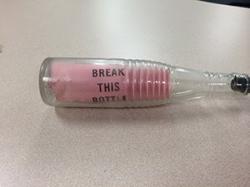
Keith Moreis likes to walk the beaches of Martha’s Vineyard, often finding pieces of sea glass. Occasionally he finds other treasures. On December 22, 2013, during a routine walk on Long Point Reservation in West Tisbury, he found a glass bottle resting in the sand next to some seagrass. After brushing aside the sand, he was surprised to see that the bottle was intact.

Drift bottle found on Martha's Vineyard

Drift bottle found on Martha’s Vineyard

The drift bottle found on Martha’s Vineyard in December 2013. Photo credit: Shelley Dawicki, NEFSC/NOAA.

The clear glass soda bottle, about 8 inches tall, had a black stopper on top and contained some papers. Inside the bottle, a pink sheet printed with the words “Break This Bottle” caught his attention. He took the bottle home.

Intrigued by the message and not wanting to break the bottle, Moreis managed to get the black top off with a corkscrew. It was not easy. With a wire, he pulled out the pink sheet and a postcard with printing on both sides. One side of the postcard had an address; the other side had instructions to the finder and some stamped and handwritten information.

Moreis, who was born and raised on Martha’s Vineyard, remained curious about the bottle and its contents and showed it to friends, who suggested he bring it to Woods Hole to see if anyone knew about it. On February 20 he went to the Woods Hole Oceanographic Institution (WHOI), which had reported finding another drift bottle a few weeks earlier. Since the postcard had Coast and Geodetic Survey, Department of Commerce in the return address, WHOI staff suggested that Moreis contact oceanographer Jim Manning at the Woods Hole Laboratory of NOAA’s Northeast Fisheries Science Center (NEFSC). He did, and brought the bottle to the Center later that day.

Both sides of a sample postcard placed inside Coast and Geodetic Survey drift bottles. When released, the ship’s name, location and date of release, and the bottle number were stamped or handwritten on the card. Photo credit: NOAA.
The postcard had both stamped and handwritten information on the top: U.S.C.&G.S. HYDROGRAPHER was stamped on the left corner, and Sep 19, 1959 on the right corner, with the day handwritten. In the middle, just above the printed words “FINDER OF THIS BOTTLE” and instructions below, was the handwritten number 279B, written twice.

USCGS refers to the U.S. Coast and Geodetic Survey. The U.S. Coast Survey, created by President Thomas Jefferson in 1807 as the Survey of the Coast, expanded as the nation grew westward to include surveys of the interior of the country. The agency was renamed the U.S. Coast and Geodetic Survey in 1878. Today it is known as the National Geodetic Survey and has been part of the National Oceanic and Atmospheric Administration (NOAA) since NOAA was created in 1970 in the Department of Commerce.

Manning reviewed copies of drift bottle records through 1958 published by the Fish and Wildlife Service and compiled by Dean Bumpus of WHOI. However, the release date for this bottle was 1959 and therefore was not in these records. A trip by Manning to the WHOI Data Library and Archive a few days later uncovered more information about drift bottles released by the ship Hydrographer during Coast and Geodetic Survey (USC&GS) surveys. Bumpus had asked other agencies, including the Coast and Geodetic Survey in late 1959, to provide him with copies of their drift bottle data.

This sheet was also inside the drift bottles. A faded sheet is visible in the bottle pictured above found in December 2013. Photo credit: NOAA.
In February 2014, Albert “Skip” Theberge at the NOAA Central Library had also contacted the NEFSC regarding another drift bottle story. After sharing news of this latest bottle find with him, the NEFSC asked Theberge about drift bottle releases by USC&GS ships. Drift bottles had been in use by the Coast and Geodetic Survey to track ocean currents since 1846. The last drift bottles used by the survey were released between 1958 and 1966.

It did not take long to locate information from the Coast and Geodetic Ship Explorer in the Pacific Ocean in the 1950s, and about Explorer cruises in the Atlantic Ocean. However, there were no images related to drift bottles releases from the Hydrographer. But there was something else of interest: An image of a postcard from drift bottle 17465, found 25 miles south of Nelson Lagoon in southwest Alaska on February 8, 2011.

The image caption read: “Perhaps the last drift bottle that will ever be found. All drift bottle records have been closed for years so the exact location and even ship that launched Drift Bottle 17465 is unknown. It is probable that it was launched from either the EXPLORER or PATHFINDER in the 1950’s or 1960’s. It is remarkable that the bottle survived for close to fifty years.”

As for the last drift bottle from Coast and Geodetic Surveys to be found, the bottle found by Keith Moreis on Martha’s Vineyard may now hold the record.

In the meantime, archive documents revealed that in September and October of 1959 the USC&GS Ship Hydrographer conducted environmental studies in three areas off the New England Coast: 16 miles northeast of Cape Cod Light, just south of Nomans Land, and 36 miles south of Gay Head on Martha’s Vineyard.

A detailed hydrographic survey had been conducted in each area. In addition to collecting bottom sediment samples and biological dredge hauls, the Hydrographer had obtained 100 hours of current meter measurements made at the surface, mid-depth and near the bottom with current meters suspended from anchored buoys. Drift bottles were released at each buoy station at the rate of six per hour, all six with the same bottle number, for the 100 hours of current measurements.

The bottle releases were part of a study of ocean currents and the drift of floating objects off the New England coast. They were also part of a study to determine currents in the vicinity of proposed offshore atomic waste dumping sites.

As of February 8, 1960, only two drift bottle cards had been returned from the area 36 miles south of Gay Head (now known as Aquinnah), but nearly 60 percent from the area just south of Nomans Land. Approximately 5 percent of bottle card returns came from the area 16 miles northeast of Cape Cod Light, now known as Highland Light, in Truro.

Records as of March 1960 indicate that four of the six bottles numbered 279B released south of Nomans Land were recovered within two months of their September 19, 1959 release: one after 2 days, another after 4 days, and a third after 7 days. All three were found on Martha’s Vineyard. The fourth was found after 55 days on Nantucket.

The December 2013 bottle is one of the last two bottles released in that group. Like the others, it was recovered just miles away from where it began its journey, but in this case more than 54 years later.

For Keith Moreis, that December beach walk on a cold winter day yielded a treasure indeed.

“Finding the bottle was exciting,” said Moreis. “Learning more about it and its history has been a rewarding experience, to say the least. I never expected to find something like this, but then again, you never know what you will find on the beach.”

How Can I Catch Backwater Stripers?

Plugging Backwater Stripers
from The Fishing Wire

Light Tackle and Small Plugs Catch Early Season Linesiders

While the Mid-Atlantic states are still dealing with a long, cold winter, there are signs of spring showing up every day – like the robins seen pecking away on the front lawn this morning or the tiny buds of new leaves sprouting on bushes and trees. Even though it’s still cold, we are only a few weeks away from some early season striper fishing. Time to get your gear ready for action.

Early striped bass won’t be giants but they’re often abundant and eager to strike.
From North Carolina’s Roanoke to New Jersey’s Nevasink and north to the Connecticut, numerous tidal rivers will see the early influx of schooling striped bass. This time of year they are very hungry after surviving a winter of cold water and scarce forage. Their targets will be the small baitfish that will begin moving around the shallows as the days get longer and sun warms the flats enough to increase their activity.

Don’t expect these early fish to be monsters. Most will be measured in inches rather than pounds but if you put in your time, you could catch bass in the teens. The fishing is best accomplished with light spinning tackle, seven-foot medium/light action rods with matching reels loaded with light line, six-to-ten pound test low-visibility monofilament. Since you will encounter many of these fish in water that is just a few feet deep, long casts will often be rewarded with hits, and lighter line will cast the small plugs further. Also keep in mind that the water in tidal rivers in the spring can vary dramatically in color depending on tide stage and fresh water flow from up river. It can range from turbid with silt from runoff to clear, especially on the incoming and high tides, so two to three feet of 12-to-15 pound fluorocarbon used as a leader is recommended because it disappears under the water and makes for a much more natural presentation of the lures.

Swimming plugs are the go-to lure for many light tackle guides, like Capt. Terry Sullivan of Flats Rat Charters in New Jersey. He spends much of the early season fishing from his bay skiff in the Nevasink and Shrewsbury Rivers, which feed into Sandy Hook Bay only ten miles from the entrance to New York Harbor. He favors small swimming plugs, most four or five inches in length and minnow-shaped to resemble the prevalent baitfish. He uses a variety of models that run at different depths, from just under the surface to four feet, so he can cover water from very shallow to flats near channel drop-offs. Color selection varies, too. The determining factor is frequently water clarity. If the water is clean, he tends to use natural colors like metallic silver, gold and pale olive green with darker backs. When the water is more turbid, switching to fluorescent colors like chartreuse can get more hits. And if you’re fishing low light conditions that can occur early and late in the day or under heavy overcast skies, colors like yellows and whites can be more easily seen.

An assortment of minnow-shaped diving lures usually do the job on spring stripers in coastal rivers.
Lure speed is an important consideration and can vary with water temperature or activity level of the baitfish present. Bait and bass will tend to congregate in the areas of the river where the water is warmer. Frequently these are found in coves and along shallow banks on the north side of the river. With the sun still low in the southern sky, the north side will get more sunshine and tends to warm more quickly. Early in the spring, the incoming tide will push baitfish upstream with the tide line. As the tide slows the water warms with the sun, and usually all it takes is a degree or two in temperature to get the bait moving and the bass feeding. So be sure to pay close attention to tides and pick your fishing time to coincide with the top of the incoming, slack high and the beginning of the outgoing tide. In some rivers the feeding will continue throughout the outgoing tide.

Keep your eyes open and be aware of what is happening around you. If you don’t see baitfish along the shorelines or in the shallows, work the deep edge of flats or along channel edges. Try working the lures slowly at first. If the bass are not actively feeding they will be more attracted to a slower moving lure, which represents an easier meal. If you start to see bait showering on the surface or moving fast along the shorelines, pick up your retrieve a little. School bass can be very aggressive predators when they are actively feeding and will nail a lure fished at a more brisk pace. Bright, sunny days that warm the water more quickly tend to ignite more active feeding, while on overcast days you will often find the bass holding deeper and a little more difficult to get to respond to the plugs. If that should occur, switching to small plastic shad-type lures with paddle tails, and working them a little slower and deeper, can save the day.

A quiet four-stroke outboard can allow anglers to get close to the fish without spooking them.
When fishing tight spots and narrow, shallow river areas a stealth approach can mean the difference between catching fish or spooking them and putting them off the feed. Quiet four-stroke outboards like Yamaha’s F115, F150, F200 and even the larger V6 models make entering quiet backwaters less intrusive. Using an electric trolling motor to move around them while you stalk stripers can put you within easy casting range without scaring the fish or taking their attention away from the baitfish on which they are feeding.

Paying close attention to all these factors can make catching early season stripers in tidal rivers more productive. As always, when you’re catching fish you’re having a lot more fun. There are hundreds of coastal rivers that will play host to early season striped bass in North Carolina, Virginia, Maryland, Delaware, New Jersey and Connecticut. So get the boat prepped and the light tackle ready for some fishing fun – spring is right around the corner.

Are Anglers Satisfied with New Red Snapper Allocations?

Anglers applaud progress of red snapper reallocation

Today’s feature comes to us from Ted Venker of the CCA. It reviews progress on dividing the Gulf red snapper fishery equitably between recreational and commercial anglers–as always both sides would like a bigger slice of the pie. Fortunately, there’s a whole lot bigger pie to work with these days as snapper stocks have come roaring back–hopefully both sides will go away winners. –Frank Sargeant
from The Fishing Wire

Gulf Council moves forward with amendment to modernize allocation

By Ted Venker, Coastal Conservation Association

A nice red snapper

A nice red snapper

During its recent meeting in Houston, the Gulf of Mexico Fishery Management Council approved moving ahead with an amendment to update the allocation of Gulf red snapper between the commercial and recreational sectors, a welcome development hailed by the Coastal Conservation Association as long overdue. The Council approved the action by a vote of 9-6, with the representatives of all five of the Gulf state fishery management agencies voting for the measure to proceed.

“The current allocation of 51 percent commercial, 49 percent recreational was set using data from when Ronald Reagan was president. There is a strong case for reallocation based simply on the tremendous changes that have taken place along the Gulf Coast since then,” said Richen Brame, CCA’s Regional Fisheries Director. “Nonetheless, allocation decisions are always contentious and we applaud the Council for continuing its efforts to set the allocation based on modern criteria.”

The Gulf Council voted to send Amendment 28 – Red Snapper Reallocation out to a series of public hearings in the Gulf states and set a special meeting for May in New Orleans to take final action. Amendment 28 contains seven alternatives for reallocating red snapper that range from status quo to shifting up to 10 percent to the recreational sector. The Council selected Alternative 5, which directs 75 percent of any quota over 9.12 million pounds to the recreational sector and 25 percent to the commercial sector, as its preferred alternative. With the current Gulf-wide quota set at 11 million pounds, Alternative 5 would shift roughly 1.4 million pounds to the recreational sector in time for the 2014 season if approved.

“When the original allocation was set red snapper stocks were in far worse condition, and there are questions about the quality of harvest data even today, which makes the accuracy of an allocation set in the mid-1980s extremely suspect. It is quite possible that the allocation of this fishery has never been correct and that may explain some of the issues anglers are grappling with today,” said Brame. “We know that this is not a cure for all the problems in recreational management, but if Alternative 5 is approved it will do a lot to fix the foundation of this fishery and give us something solid on which to build. We would strongly encourage that the allocation be reviewed regularly from now on.”

Efforts to keep Amendment 28 on track were aided greatly by Sen. David Vitter (R-La.), who highlighted the issue during the nomination process for Dr. Kathryn Sullivan to be the Undersecretary for Oceans and Atmosphere, and Administrator of the U.S. National Oceanic and Atmospheric Administration (NOAA).

“This is huge news for Gulf Coast recreational anglers. After months of urging NOAA and the Gulf of Mexico Fishery Management Council to take action on Amendment 28, they have finally started moving on it,” said Sen. Vitter. “We intend to follow it through to completion. Proactively managing Gulf fisheries based on the best science and economics should always be the ultimate goal, and this is a positive step in the meantime that could lead to an economic boost for Gulf economies, something we can all support.”

Visit www.joincca.org for more information.