Category Archives: Saltwater Fishing

Everything saltwater fishing

Controlling Lionfish by Eating Them

Chow Down on Lionfish
from The Fishing Wire

To beat ’em, eat ’em suggests Florida Sea Grant regarding invasive lionfish. They’re tasty–but toxic if you’re not careful where you get them.

Lionfish is not a traditional or likely seafood selection, but growing interest in response to its invasive and increasing abundance has stirred recreational and commercial interest. Seafood specialist Steve Otwell offers this perspective.

Handling

Eating lionfish, Pterois miles or Pterois volitans, is being encouraged as one of the best options to mitigate the harmful impact of this prolific, invasive fish threatening reefs and coastal fisheries in ocean waters throughout the Caribbean Sea and neighboring regions in the Gulf of Mexico and southeastern United States.

The venom in lionfish spines remains active, so fisherman are urged to clean their catch with an abundance of caution. Photo by John Stevely
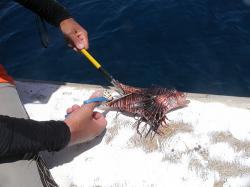
Be careful of spines when cleaning lionfish

Be careful of spines when cleaning lionfish


The success of these efforts, in terms of reduction, is debated, but at this time harvest remains a better-than-nothing control. A number of organizations and government agencies have encouraged recreational and commercial harvest of lionfish, emphasizing its favorable culinary attributes.

All prudent advice has included statements of caution regarding product handling and preparation, to avoid the notorious, venomous stings that can be inflicted by the unique array of body fins and spines. Although attractive and distinguishing for the lionfish, the fins and spines can inflict a severe sting resulting in localized pain, redness and swelling. More advanced cases can involve neurological problems such as headaches, nausea, numbness, dizziness, and possible convulsions and paralysis. Fortunately, proper handling procedures, including use of gloves and scissors, can remove the potential harm.

Consumption

It is always reasonable to question the quality and safety of all new food selections. In the case of lionfish, additional safety concerns can involve certain natural toxins that could be encountered when you eat it. As with other predatory fish species found in or near certain tropical and reef-associated marine waters, the lionfish may contain ciguatoxins. This risk was recently confirmed by the U.S. Food and Drug Administration, or FDA, following studies in the Virgin Islands, where the waters are known to support the production of potentially ciguatoxic fish. The ciguatoxins are not caused by contamination, and they differ from the toxins associated with the lionfish fins and spines. The ciguatoxins are acquired from the food eaten by the lionfish.

Ciguatoxins are produced in certain waters that favor the growth of a particular kind of plankton, the dinoflagellates known as Gambierdiscus. These plankton introduce the potential toxins that can be transmitted through the local food chain, eventually accumulating in some top-order predator fish. The toxins can be concentrated to potentially harmful levels that will persist in the edible portions of the fish and cannot be reduced or eliminated by cooking. Potential toxic levels in certain predators from Atlantic waters can be as low as 0.10 ppb (parts per billion). Indeed the toxins are very potent and the resulting illness is known as ciguatoxic fish poisoning, or CFP.

CFP is distinguished primarily by symptoms that can begin to occur within 6 hours after consumption. This rapid onset is a primary reason for the close association people have after eating a meal involving a particular predatory fish. Initial symptoms are gastrointestinal in nature – nausea, cramping, vomiting followed by neurological discomforts – headache, flushing, muscular aching, pain in joints, and weakness, tingling and numb sensation of the lips, tongue and mouth that can be accompanied with dizziness and imbalance. More severe cases have reported sensitivity to reoccurrence and prolonged discomfort for months and years.

Avoiding Risk

Confirming a particular ciguatoxic fish poisoning case can be difficult. Many of the symptoms for CFP can be associated with other foodborne illnesses. The identity of the fish involved can be confused by differences in names and unreliable information regarding where the fish was harvested. Analytical tests to confirm the presence and level of ciguatoxins are specialized and complicated, and not routinely available. They also require a sample of the actual meal involved. So far, attempts to develop more convenient and rapid analytical test kits that are reliable have not been successful enough to warrant recommended use in confirming toxins present in fish, harvest areas or meals. Confirmations are further complicated by variation between fish. Meals from two separate fish of the same type from the same source may not present the same CFP risk.

Likewise, the occurrence of potential ciguatoxic fish poisoning is difficult to predict. Current advice from food safety professionals is to avoid certain fish species, larger sized fish or fish from certain harvest areas. In 2013, lionfish were added to the list of species that could cause CFP. This existing list is maintained in regulatory guidance for seafood safety issued by the FDA. Lionfish join the list for species of concern, such as jacks, snappers, groupers and other related reef species relative to certain harvest areas.

As top-order predators, barracuda are well-known candidates for ciguatoxins. The FDA and certain Caribbean authorities have actually cautioned against consuming it. Florida Sea Grant stock photo.
The list already contains some more well-known CFP candidates like amberjacks and barracuda. The FDA and certain Caribbean authorities have actually cautioned against consumption of the larger predators, like barracuda.

Avoidance of larger fish in certain areas can be helpful, but not always reliable for all species. This recommendation lacks a definition for large fish, and questions how restaurant goers can distinguish a particular fish’s size from the serving portion size. Young fish of larger species can also accumulate toxins, depending on their exposure to particular food chains. The barracuda, for example, is a well-known, top-order predator that can feed in a variety of regional food chains, perhaps accumulating ciguatoxins when they are smaller. Mindful of the voracious and diverse appetite that supports their rapid growth rate, the lionfish could be distinguished as a top-order predator in certain harvest areas.

Overall, the primary way to avoid CFP is to avoid fish harvested from known or suspect ciguatoxic areas. Unfortunately, knowing about suspect areas depends on knowing how many illnesses have occurred in those areas, rather than confirmation through routine testing. Advice from pertinent regulatory authorities and health-based programs has cautioned against harvests in certain areas, but there are no actual prohibitions restricting harvest of lionfish or other potential ciguatoxic fish from any waters.

Obviously, because we have little history of eating lionfish, and no reported CFP cases associated with eating lionfish, there is no evidence to guide our harvest of lionfish. Some evidence for CFP associated with other fish species has resulted in historical attempts to prohibit markets and restaurant from selling certain potential ciguatoxic fish, such as barracuda in Puerto Rico or Dade County, Florida, but there are no prevalent or enforced restrictions at this time.

What may appear to be hesitation by authorities and confused debates among public advisories are due to the lack of distinct and confident confirmations for CFP occurrence in certain harvest areas. Potential CFP risk per area is unpredictable and lacking analytical verifications that are consistent through time. Likewise, the potential risk for ciguatoxins in the food chain is also difficult to confirm, because it is subject to changes in the distribution of fish species and their feeding regimes, which are in turn influenced by seasons and shifting thermal conditions.

‘Official’ designations for risk areas or prohibited harvest and market restrictions of a particular species are difficult to enforce and can have unintended consequences for other fishing, tourism and related commerce in the region. Unofficial designations, available through a variety of publications and public advisories, have ranged in geographic extent from small, individual islands to coastal and reef perimeters involving the entire Caribbean, Gulf of Mexico and South Atlantic waters. These designations are often compiled without documented confirmations. In general, many experts identify ciguatoxic regions as the tropical and subtropical waters of the world between 35° N and 35° S latitudes. This designation encompasses areas with a preponderance of reef environments.

To further confound the situation, legal interests focused on concerns for food safety can view the questionable risk and conflicting advice regarding lionfish as potential liability across all sectors of commerce. At present, the commercial harvest, processing and distribution of seafood in retail establishment and restaurants is subject to a multitude of food safety regulations. One system of mandated food safety control is known as HACCP, which is a preventative approach to food safety practiced industry-wide. All seafood processed for commerce in the United States, regardless of the means or location of harvest, must comply with mandatory HACCP guidelines. Seafood is also subject to food codes and state-based health requirements that include general guidelines to reduce or eliminate potential exposure to any toxins in any food.

The ciguatera issue is specifically addressed for a variety of specified fish in the FDA’s Fish and Fishery Products Hazards and Controls Guidance, which represents FDA’s current thinking on appropriate risk prevention. In addition to a list of species of concern, the FDA has specifically mentioned concerns for harvest of potential ciguatoxic fish from the Flower Gardens area, one of the most northern regions for reefs found in the Gulf of Mexico. The FDA has likewise included advice against consumption of barracuda. FDA advice is based on actual product analysis or occurrence of illnesses associated with particular fish species. The agency’s advice is not a legal prohibition, but it carries the same essential message because of the legal consequences that could result when a complaint occurs for any associated illnesses.

In addition, in 2013, the FDA proposed amendments to its Hazards Guide specifically citing lionfish as a potential ciguatoxic species relative to the area where it is harvested. This recommendation was deemed necessary based only on product analysis in suspect waters about the Virgin Islands. The FDA amendment added wording that suggested ciguatera was “emerging” in areas not previously noted and occurrence could be influenced but thermal trends. Again, potential lawsuits arising from foodborne illnesses could reference this advice and heighten liability, regardless of whether there were existing prohibitions for harvest or consumption.

Recommendations

The majority of lionfish based on their current distribution in waters about the United States should be safe for consumption, but the voracious eating habits and diversity of prey suggests lionfish is a candidate species more prone to accumulation of ciguatoxins if present in areas that harbor the potentially hazardous food chain. Based on occurrence with other CFP-related species, the more problematic harvest areas have involved warmer tropical waters and imported sources.

Cooking lionfish does not kill ciguatoxins; the best way for recreational fishermen to avoid CFP is to avoid areas known to have a CFP history. Florida Sea Grant stock photo.
Recreational harvesters should be aware and informed about potential ciguatoxic areas and concerns. This will be complicated by lack of designated areas, as previously discussed, and limited use of analytical verifications to distinguish risk areas for recreational harvest. Mindful of this situation, some recreational harvest events have resorted to participant signatures on statements to insulate the event promoters from possible liabilities. Attempts to use rapid ciguatera test kits for detection of toxins in the edible portions of lionfish meat is not advisable due to complications with the application and errors that can occur in interpretation.

The best advice is to rely on prior experience with other CFP-related species in that area. Traditional commercial and recreational harvests of fish that are more permanent residents in waters about Florida and the South Atlantic region have not been typically implicated in ciguatera. In contrast, some of the waters and reefs within more tropical areas like the southern Caribbean have reputations for certain ciguatoxic fish and areas. This reputation is stronger for some of the larger and more migratory predators, like barracuda that feed at the top of the food chains.

The sources of advice encouraging lionfish harvest and consumption should be scrutinized relative to the area of harvest. Well-intended articles, such as the cookbook by the Reef Environmental Education Foundation that specifically introduces the lionfish as “The Caribbean’s New Delicacy” could be questionable advice without evidence for the harvest area.

Illegal use of fish sold from a recreational catch could also impose risk for the buyers and introduce liability for an uninformed restaurant or retail market. The vulnerability is lack of knowledge for harvest waters and sale of potentially hazardous seafood without scrutiny through established regulations for food safety.

Commercial harvest remains subject to mandated HACCP controls for product safety. These require written plans and records as evidence for avoidance of any potential ciguatoxic fish. Avoidance involves controls to assure no harvest from known or designated problematic waters. This requirement is difficult to evidence because of a lack of formal designations and reliance on hearsay information, but it is a real and enforceable requirement that has involved many companies being implicated in inspection and liability cases.

Illegal representation of a commercial harvest, either by improper identification of the source or species is a strict violation of prevailing food safety regulations, and can increase the liability for the processors, wholesaler, or retail operations. Likewise, harvest and importation from areas more suspect for potential ciguatoxic lionfish should be discouraged. Persistent publicity about illegal fish substitution and mislabeling of species or product origin suggest less scrupulous commerce could be tempted to seek and market lionfish without proper identification. Buyers are cautioned to purchase lionfish from reputable suppliers and sources with food safety programs and evidence for harvest area. It would be prudent to document product suppliers and respective sources as done for other commercial species and harvest areas of concern.

What Are the Best Lures for Wintertime Snook?

Best Lures For Wintertime Snook

By David A. Brown
from The Fishing Wire

Jason Stock is a Florida fishing guide, not an economist. Nevertheless, he understands the law of supply and demand, so when late fall drives out the remaining parcels of the baitfish schools that were so prevalent during the warm season, he knows that his favorite lures will quickly become a more valued commodity.

For several months, massive schools of scaled sardines (aka “pilchards” or “whitebait”) have provided steady food supplies for snook and all the other inshore predators roaming the beaches, bays and backwaters of west-central Florida.

During summer, gamefish with even basic hunting skills could count on filling their bellies with little difficulty, but as fall’s declining temperatures and shortening days signal the forthcoming cold season, Florida’s snook go on a feeding binge that nearly decimates the forage. Add increasingly frequent cold snaps and before the fish even know it, their tasty buffet has vanished.

But don’t feel bad for the linesiders. These savvy sportfish know how to survive, and adaptability is an essential part of the plan. What does this mean for anglers? It means a notable increase in the snook’s willingness to take artificial baits.

Not that the fish necessarily avoid lures during the warm season; rather, it’s a case of availability. When loads of natural food exists, snook can make a living on an easy food source that requires little discernment. Once that gravy train leaves town, it becomes an eat-what-you-can deal.

“When you have to compete with live bait, it’s hard to get the snook interested in artificials,” Stock said. “But if you can get them fired up on lures (during the colder months) when they’re already looking for something, they’re gonna go for it, especially if it mimics natural forage.”

Here’s a quick look at some of the artificial baits that tempt cold-season snook:

Topwaters: Stock said that one of the best ways to attract a big-time winter snook strike is with a mullet-imitating surface bait. A straightforward walk-the-dog retrieve is usually most effective, but Stock likes to vary the sound of his topwater attack.

“I like the Heddon Spook Jr. and the One Knocker Spook,” Stock said.

Bomber Mullet Lure

Bomber Mullet Lure

The Bomber Mullet is a slow-sinking lure that often fools lethargic winter snook throughout South Florida.

The new Bomber Saltwater Grade Mullet was made for this application and has an advantage over the Spook. The Mullet is a slow-sinking lure that anglers can work slowly under the surface if the fish aren’t willing to take a bait off the top. One time when this sub-surface walk really shines is on those post-cold-front days with blue skies and no wind. The fish are there and looking up, but in a neutral or negative feeding mode. Let the Mullet sashay right in front of its nose, however, and it can’t help but strike.

Jigs: Lead heads in 1/8- to 3/16-ounce size and dressed with curly or paddletail soft plastics are a good winter lure choice for those days when the topwater action isn’t panning out. Stock said that he spends most of his time with paddletails for their natural vibration that helps attract fish in the cold winter water.

Jigs with paddletail or shad-type tail that mimic any remaining pilchards in color are effective, but darker colors that imitate shrimp and crabs are a can’t-miss as well. The key to an effective presentation, Stock said, is to keep it low and slow to mimic a crustacean slowly skittering along the bottom.

“When you’re working that jig, pull the rod back nice and smooth and feel that shad tail vibrate – I call it the ‘flutter technique,'” Stock said. “If the jig’s not fluttering and making contact with the bottom, a lot of times you’re not going to get bit in the winter time. You have to get that puff of sand when the jig hits bottom and let the fish feel the vibration to get an impulse bite.”

Other Options: Subsurface baits will also produce this time of year. In shallow water, floater/divers are great. But when tide’s up, go with a slow sinker or suspending bait like the aforementioned Bomber Saltwater Grade Mullet or Badonk-A-Donk SS.

WHERE TO LOOK

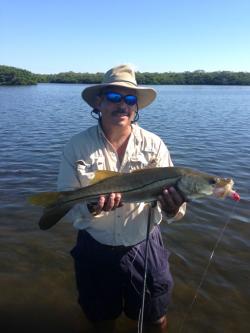
Catch snook like this one on lures

Catch snook like this one on lures

Snook are one of Florida’s premiere gamefish; they strike hard and fast, run strongly and deliver some spectacular jumps.

Once winter locks the region in its icy grip, snook retreat to the deepest water they can find in coastal rivers, canals and marina/port basins. Here, they’ll pass the coldest season in a lethargic state with minimal movement and even less feeding. Warm days may find some fish rising to shallow edges to sun their backs and chase whatever prey is available.

Until this winter lockdown, however, look for snook to feed around the mouths of coastal creeks and canals and within the protected waters of bays. Potholes amid lush sea grass, mangrove points and oyster bar drop-offs are the likely haunts.

“They can slide in and out with the weather,” Stock said of these transitional areas. “If the water gets colder, they’ll pull back inside.”

Whatever you do during the fall and winter, keep watch for mullet schools, which provide what Stock calls “a buffer for fish.” Snook know that running alongside and within mullet schools provide shelter from dolphins and ospreys while affording them feeding opportunities, as their vegetarian hosts kick up loads of crustaceans.

Savvy snook know to pick off these mullet-jostled freebies. Savvy anglers know that making their topwaters, jigs and swimbaits resemble these freebies yields a bent rod.

Florida’s snook season remains closed through the end of January on the Atlantic Coast and through the end of February on the Gulf Coast, but it’s legal to catch and release this great gamefish throughout the closed season.

Louisiana Delta Fishing

Delta Delights in Louisiana
from The Fishing Wire

Pack up your tackle and hook up the trailer for a world-class fishing vacation

Fish from the delta

Fish from the delta

While most tourists consider a visit to New Orleans the highlight of any trip to Louisiana, if fishing is your passion aim your sights a little further south to the famed Mississippi Delta and the town of Venice. The quality and variety of the fishing opportunities available from Venice are quite simply unsurpassed by any place in the United States, or many of the heralded fishing destinations around the world.

The little town is the southernmost outpost in the state, but from a base at Venice Marina you will have access to a variety of passes leading into the open waters of the Gulf of Mexico, where the variety and abundance of gamefish is truly mind-boggling. Bull redfish, red snapper, grouper, kingfish, blackfin and yellowfin tuna, wahoo and marlin, to name a few, are available seasonally and some are in residence year round.

If you’d rather fish inshore or on more sheltered waters, you can explore the endless miles of channels, bays and bayous where you can sight cast to redfish, catch a limit of beautiful sea trout, stalk massive tarpon and encounter drum, flounder and even largemouth bass. The fishing for redfish and tuna out of Venice is so incredible, the marina has earned two enviable nicknames: “Tunatown, U.S.A.” and the “Redfish Capital of the World.” Bottom line-it doesn’t matter if you trailer a boat that is offshore capable, a simple aluminum skiff or pretty much anything in between-the Delta has you covered, and so do Mike and Bill Butler, your hosts at Venice Marina.

Venice Marina was already a well-known fishing destination when the Butler brothers purchased it about 12 years ago and began making renovations to the tired facility. A few years later, it was flooded by Hurricane Katrina’s massive tidal surge, but Bill and Mike, both natives of the Delta, were not going to let a hurricane smash their dreams. They rolled up their sleeves and set to work undertaking a massive cleanup and rebuilding project.

The result is a totally new facility from the ground up that offers visiting anglers pretty much everything they need to enjoy the amazing fishing the surrounding waters have to offer. The new complex includes 120 slips; parking for trucks and boat trailers; two concrete launch ramps; fuel, ice, bait, a huge fish cleaning facility, fish cleaning, packing and shipping service; a marine supply and tackle store; Crawgator’s Bar and Grill; and multi-room cabins that can house a group of fishermen or your family available for rent.

The marina is also home to dozens of the finest professional guides and charter boat operations on the Gulf, and there is even a condominium complex for fishermen who wanted to own a summer place close to the action. This coming June, the marina will have camper pads and hookups available for sportsmen who like to travel in more self-sustained luxury.

“Down here it’s all about the fishing,” said Bill Butler. And he should know. In addition to being the operations manager of the facility, he also competes on the SKA® Professional Kingfish Tour. His tournament boat is a Yamaha-powered 42-foot Invincible center console, which also happens to be an ideal boat for fishing the nearby Gulf waters. On a recent fishing trip with Bill, yellowfin tuna were the target but each day on the way back to the marina the crew took advantage of the open season for red snapper, catching limits of these tasty and abundant fish in a matter of minutes.

The fishing in this area of the Delta truly knows no season. There are gamefish to be found year round. Yellowfin tuna are abundant twelve months out of the year; the hotspots just change along with the prevailing size of the fish being caught. During spring, summer and fall the best tuna action takes place around the many oil production platforms, with live bait and surface lures the prevalent technique. The tuna will range from 20-pound blackfin to yellowfin breaking the 100-pound mark. Summertime is also your best bet for billfish, including blue marlin and sailfish. It’s also a great time of year for incredible dolphin fishing. In the fall, even bigger yellowfin invade the area with many exceeding 200 pounds, and most years they can be caught all winter long. At that time, chunking with dead bait becomes a primary tactic. The tuna fishing is so good that Sportfishing Magazine® ranked Venice in the top five places in the world to fish for these great gamefish.

Catch fish like these from the Louisiana Delta

Catch fish like these from the Louisiana Delta

Fall also sees an influx of big wahoo that can be caught along the many rip lines that develop offshore. Depending on weather, wahoo might be around though the winter, but prime time for big bruisers is during March and April. The region also plays host to abundant schools of king mackerel that consistently include the largest found anywhere in the fish’s range. And if that’s not enough, try deep dropping for a variety of species of grouper.

Speckled trout and redfish abound in the weather-protected backcountry waters pretty much year round, and the area is also home to massive tarpon that gather here to feed on the abundant baitfish that swarm in and out of the vast, nutrient-rich marshlands that make up the Delta. When you need a break from the fishing, the entire region is a naturalist’s playground. Flocks of exotic birds including roseate spoonbills can be found foraging through the marshes and during fall and winter the waters are filled with ducks on the southern leg of their migratory path. There are endless miles of scenic beauty to explore.

Venice is truly a sportsman’s paradise and an ideal place to spend an incredible fishing vacation. Venice Marina, www.venicemarina.com, with hosts Bill and Mike Butler, is at the epicenter of the action. Bring your own boat or take advantage of the fleet of charter boats and backcountry guides that call Venice home.

Red Snapper Anglers Get Lowered Amount of Allowed Catch

Amendment 40 – Anglers Get Dumped

Today’s feature comes to us from Ted Venker, CCA’s Conservation Director, who notes that anglers who want their share of the red snapper fishery had better step forward, now, before it’s too late.
from The Fishing Wire

By Ted Venker, CCA Conservation Director/TIDE Magazine Editor

It’s called the “Friday news dump.”

The White House, other federal agencies and even public corporations have often set the release of bad news and unflattering documents to late Friday afternoon in the hopes that whatever is being released will be ignored or missed or forgotten over the course of the weekend.

Got a scandal? Dump it on Friday.

Got a controversy? Dump it on Friday.

Got a federal policy disaster? Dump it on Friday.

The concept has lost effectiveness with the demise of traditional media. You could get away with it when all you had to avoid was the newspaper on Saturday morning (which no one read because they all had better things to do on the weekend), but the internet never sleeps and so the Friday news dump has become a sad cliché. There is even a website dedicated to it – fridaynewsdump.com. Nonetheless, old habits are hard to break.

So if the jig is up on Friday news dumps, what are you left to do? Well, you up your game and go for the holiday news dump.

Got something wildly unpopular that has been soundly rejected time after time, but you’re going to advance it anyway because it makes your job easier? Dump it on….Christmas Eve!

And so it was that the Gulf of Mexico Fishery Management Council announced on Dec. 24 that it is proceeding with an extremely controversial amendment for sector separation. That followed on the heels of an announcement about an equally controversial pilot program to let a handpicked set of 17 headboats fish year-round for red snapper using their own personal allocation of fish beginning January 1. Releasing information like this on the afternoon of Dec. 24 brings the art of hiding controversial news to a new low.

CCA members have been asked to comment against these schemes many times. The public has already sent literally thousands of comments against concepts that attempt to funnel access to marine resources through a very few select businesses. The response to these concepts has been wildly skewed in opposition, as it is commonly realized that the only people to benefit from them are the businesses that will use those public resources for their own financial gain.

However, just like when you played football as a kid in the field by your house, somebody didn’t like the results and called “Do-over.” None of those previous comments apparently counted. Not even the ones from Texas Governor Rick Perry. Nope, sorry Congressional Sportsmen’s Caucus, yours didn’t count either.

The Council let it be known with its stealth release on the afternoon of Christmas Eve that this time, for sure, they really want to know how you feel about Amendment 40 – Sector Separation. And, at the same time, they announced that they don’t really care what you think about sector separation because they went ahead and launched the Headboat sector separation pilot program already.

What’s the purpose of this public comment thing again?

The only thing more disingenuous than the Christmas Eve News Dump is the charade of public comment in federal fisheries management on this issue. There is nothing in the glorious history of sector separation that indicates the general public matters in this arena. If it did, then these plans to give away fish to private businesses would have been dead and buried long ago.

Why should we care if yet another comment period is open on plans to divide up the recreational sector and give another small group of business-owners an insurmountable advantage over the general public in the red snapper fishery? The uncomfortable truth is that if we flooded the Council website with comments in opposition to this nine times in the past and washed our hands of it on the 10th time, that 10th time would forever be held up as evidence that this is what the public wants.

As sorry as this whole episode is, we can’t let that happen.

We must fight this all the way to the end. You have done your part repeatedly and you’ve done it well. This is a battle in which we are struggling not because we are wrong or apathetic, but because the system doesn’t work the way it is supposed to. We are up against a system that does not understand recreational angling and often acts like it doesn’t want to. You need look no further than the fairly insulting decision to release an announcement of the most controversial federal fisheries amendment in recent history on Christmas Eve.

This comment period is a chance to oppose sector separation one more time, and we should take it. But more significantly, it is an opportunity to send the message that millions of recreational anglers cannot be oh-so-casually dismissed. We deserve far better treatment than this.

The comment period on Amendment 40 – Sector Separation is open until Jan. 23. Click HERE to submit comments electronically or submit written comments to:

Peter Hood
Southeast Regional Office, NMFS
263 13th Avenue South
St. Petersburg, FL 33701

The next meeting of the Gulf of Mexico Fishery Management Council will take place February 3-6, at the Westin Galleria Hotel, 5060 W. Alabama Street in Houston, Texas.

CCA Louisiana is the largest marine resource conservation group of its kind in the state. Entering its 31st year with more than 30,000 members and volunteers in 26 local chapters, CCA has been active in state, national and international fisheries management issues since 1977. Visit www.CCALouisiana.com for more information.

Fishing In Lower Alabama

Fishing’s Good in L.A.

Today, our friend David Rainer for the Alabama Department of Conservation and Natural Resources takes us fishing in L.A. (That’s Lower Alabama) where the late fall and early winter produces great fishing opportunities.
from The Fishing Wire

When the first real cold front of the fall sweeps through Alabama, my attention starts to focus on the many hunting opportunities that our great state offers. However, that doesn’t mean I disregard a fishing invitation when it comes my way this time of year.

In fact, fall and winter fishing in L.A. (Lower Alabama), can be some of the best of the year along the Gulf Coast.

When my buddy, Jay Gunn, sent a text and asked if I wanted to go fishing in Magnolia River recently, I sent a one-word text back – “certainly.”

Gunn guides on the Eastern Shore of Mobile Bay, mostly in the Gulf Shores-Fort Morgan area. He wanted to check out Magnolia River and Fish River to see what we could find in terms of speckled trout, redfish and white trout.

After fishing Magnolia for a while with little luck, we made the short run down Weeks Bay to Fish River, where the river channel is deeper.

“I always start shallow and work my way deep,” Gunn said. “Most of the time, it seems the shallow fish are the most aggressive. In the fall and winter, when it warms, that’s when the specks seem not to bite as well for whatever reason. When it gets cold again, they seem to bite again. You would think it would be just the opposite. You would think their metabolism would pick up when it’s warm and they would feed more.

“Normally the fish follow the shrimp around, but this has been a year when there weren’t a lot of shrimp in the rivers. Actually, there haven’t been a lot of shrimp in the bays, either.”

I talked to shrimper Doug Plash in October about shrimp, and he said the shrimp numbers were so low he couldn’t cover his fuel costs at the time.

Speculation about the poor shrimp crop centers around the unusually wet spring and summer, which kept the salinity in Mobile Bay and the estuaries low, which kills the larval shrimp.

“During the late summer and fall, the fish were a lot more scattered than in the past because of the poor shrimp crop,” Gunn said. “Now the fish have to feed on menhaden and threadfin shad, which most people call alewives. Those fish seem to move a lot more than the shrimp do, so that’s why the fish seem to be more scattered.”

While Gunn had already secured plenty of live bait fish with his cast net, we decided to try plastic minnow imitations in Fish River.

Fishing the river ledge, I cast the ¼-ounce jig up on the shelf and hopped it a couple of times. I thought for a flash that I had hooked one of the numerous snags on the ledge, until the snag started moving at a rapid pace.

When I set the hook, the drag started to whine on the spinning reel spooled with 10-pound fluorocarbon line.

“Aha, they’re still here,” Gunn said within seconds of the hookset.

I wasn’t sure what “they” meant, but the fish was certainly powerful and wasn’t about to be horsed to the boat. A few minutes later, that familiar bright bronze flash appeared as the fish neared the surface. I reached up and loosened the drag a bit more to ensure this brute of a redfish didn’t have a chance to break the line when he made his numerous runs.

Slowly, the fish began to tire and eventually ended up in the net.

“Boy, these redfish in Fish River sure are pretty,” Gunn said. “They just shine.”

Pretty bull redfish

Pretty bull redfish

The bright bronze color of this bull redfish is evident as Capt. Jay Gunn shows off this Fish River catch (Above) before he slips the fish back into the water , where it quickly disappeared into the depths of the river channel. The second bull red of the day, which was almost identical to the first, (below) came on the same minnow-imitation lure bounced along the river ledge.

After measuring the fish at 38 inches and taking photos, Gunn slipped the big red back into the water, and it quickly swam back to another ambush point.

“It happens about every five to eight years,” Gunn said of the influx of bull redfish into Fish River. “For some reason a bunch of bull reds show up in Fish River and Magnolia River. I guess they follow the menhaden up there. They get up there until we have a real cold front. A few stragglers will stay there all winter. Sometimes a lucky dog will catch one of them. If he’s real lucky, he’ll catch two.”

Not more than 15 minutes after the bull red disappeared into the tannin-colored water of Fish River, another fateful cast was made. This time, there was no doubt a big fish had slammed the bait. Another fight was on with similar results. Thank goodness for quality drag systems on small spinning reels.

“The thing about fishing this time of year is you’ve gotta be patient,” Gunn said. “The fish may not bite at daylight. A lot of times they don’t bite until on up in the day. Winter tides are such that low tides are early in the morning, say 3 a.m. to 10 a.m. When the tide starts moving, they bite a lot better.”

Although we fished Magnolia and Fish rivers, Gunn spends a lot of his winter fishing time in the Intracoastal Waterway and Little Lagoon.

“The water temperature stays a little steadier in the canal and lagoon,” he said. “The salinity stays pretty steady, too. There’s not a lot of freshwater influx. The fishing is just steady and dependable. In the canal, you may end up with a variety of fish – redfish, speckled trout, white trout, puppy drum and sheepshead.”

During the fall and winter, the Mobile-Tensaw Delta is known for its fishing for inshore saltwater species like specks and redfish. Traditionally, the Delta fishing is prime because of the migration of white shrimp out of the multiple rivers at the head of Mobile Bay.

Capt. Bobby Abruscato has made a living fishing around Dauphin Island and Bayou La Batre, but six years ago he started exploring the Mobile-Tensaw Delta. Now, he seldom leaves that area during the fall and winter because of the abundance of speckled trout.

“Earlier in the fall, when the water temperature was still above 62 degrees, I was fishing the shallow flats around Del Van Bay, Grand Bay and the Spanish, Raft and Appalachee rivers,” Abruscato said. “Those rivers are shaped all the same. There’s a shallow dropoff on one side of the channel, and there’s a steep dropoff on the other side of the channel. I was catching trout mainly with shrimp-imitations under corks.

“Then when we had these cooler snaps, I started catching them on the edges of where it drops down into the main river channel. Lately, since we had that last cold front, I’m catching them all on jigs in the river channels. They do that every year when it cools off like this.”

Abruscato also noticed a lack of shrimp during his fishing trips, and he said shrimpers have told him it was the slowest year they could remember in Mobile Bay.

“When the shrimp move out of the Delta, you’ll get the birds following the shrimp,” he said. “The trout will push the shrimp to the surface where the birds can reach them. This year the bird activity has been almost nil.”

But the fish, especially speckled trout, are still there. Although Abruscato said the fishing isn’t as good as it was last year, he’s been catching a limit of 10 specks per person consistently.

“And in the last two weeks, the quality of the fish has gone up,” he said. “We may only have five throwbacks all day. We’re catching quite a few fish from 18 to 23 inches.

“We’re catching some slot (16 to 26 inches) reds, but no bull reds. Everybody’s got trout on the brain right now. I’ve got trips later this month where customers want to catch redfish, so I’m going to have to find some. I’m sure some are up there. They always are.”

What Is A Great Goliath Grouper?

The Great Goliath

Today’s feature on Goliath Grouper comes to us from the Gulf of Mexico Fishery Management Council. One of it’s most interesting findings is that Goliath’s, contrary to popular angler opinion, eat very few snappers and other grouper species.
from The Fishing Wire

Goliath Grouper

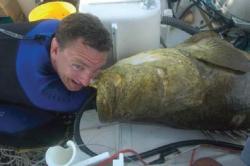
Goliath Grouper

The goliath grouper population is showing signs of recovery in the Southeastern United States. This should be fantastic news, since goliath are considered critically endangered throughout most of the world, but many Gulf fishermen don’t see it that way.

That’s because goliath grouper have a bad habit of eating fish that are struggling at the end of fishing lines and spears.

Understandably, this opportunistic behavior has led many fishermen to believe that goliath are a nuisance – directly competing with them and decimating game fish populations.

However, scientific studies have concluded that goliath grouper are not the reef fish gobbling, top predators they appear to be, and they don’t seem to harm the snapper or grouper populations on reefs where they live and eat.

How do we know this?

A very straightforward way to figure out what something is eating is to check out what’s in it’s stomach. When scientists capture goliath their stomachs are emptied and the contents are classified.

What Does A Goliath Grouper Eat?

What Does A Goliath Grouper Eat?


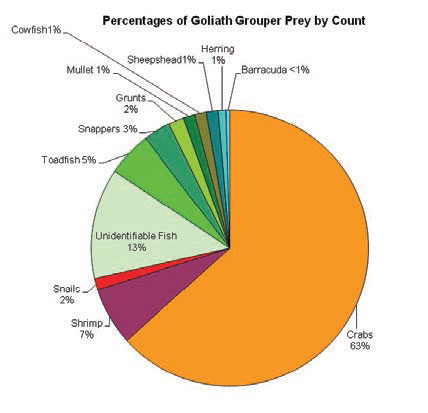
Using gut content analysis, scientists Chris Koenig and Felicia Coleman (2009) found that, rather than eating all the game fish in sight, 72% of a goliath groupers diet is invertebrates – 62% of which is crabs. The figure below shows how many of each prey type were present in the stomachs of the 226 adult and juvenile goliath grouper studied.

The only downside to gut content analysis is that it only shows a snapshot of what’s been eaten recently. Since we are what we eat, stable isotope analysis can determine what a marine organism has eaten over a long period of time.

Chemical signatures found in the muscles of fish can indicate what food source was used to build that tissue. The more nitrogen in the muscle, the higher up on the food chain an animal feeds. Koenig and Coleman (2009) found that goliath grouper holds a relatively low position on the food chain and actually about even with pin fish.

Finally, in reef fish surveys conducted in southwest Florida, Koenig and Coleman (2009) found that there was no significant relationship between the number of adult goliath and the number of other groupers on a site. Interestingly, the number of snapper actually increased along with the number of goliath grouper on a reef.

So what do we do when the science says something that seemingly contradicts what fishermen are experiencing?

Fishery managers do their best to balance the views and needs of fishermen with the requirements of the law and the science. In 2012 the Gulf and South Atlantic Councils joined up to consider how to move the goliath grouper fishery beyond moratorium. The Ad Hoc Goliath Grouper Steering Committee was formed as a direct result of public input suggesting we consider allowing for a limited fishery as the goliath population recovers.

At the initial meeting, the group recognized the importance of both scientific and public viewpoints for future management of goliath by initiating a science workshop to gather all the research that has been done on goliath since the last stock assessment, and asking for a stakeholder survey and workshop to be conducted.

In January, the Goliath Grouper Steering Committee will hear the results of the science workshop and stakeholder survey.

They are expected to consider how to move forward with potential management actions for the future. More information about this meeting can be found on page 4.

Koenig, C.C., and F.C. Coleman. 2009. Population density, demographics, and predation effects of adult goliath grouper (Epinephelus itajara). Final Report to NOAA MARFIN for Project NA05NMF4540045

Are Metal Jigs Good For Fall Stripers and Blues?

Try Metal Jigs for Fall Stripers & Blues
from The Fishing Wire

Diamond jigs are the hot ticket for fast Mid-Atlantic action from now through year-end

Fishing along the Mid-Atlantic coast isn’t over so keep the boat in the water, break out the cold weather gear and enjoy some of the best inshore fishing of the year.

One of the most productive techniques available from fall into early winter is vertical jigging using the simplest of lures, the venerable diamond jig. It’s just a long, shiny, four-sided piece of metal with a swinging tail hook, but this gem of a lure has been catching gamefish for a hundred years, and it is still one of the most productive you can fish with in saltwater. Talk about staying power; the diamond jig has it.

You can make a diamond jig dance in a number of different ways to imitate a variety of baitfish and in the process attract the attention of pretty much any gamefish you come across. This time of year the primary baitfish on the inshore grounds is a slender silver and olive-colored fish called a sand eel. They are found in enormous schools from a few miles offshore to right in the wash, and are feasted upon by striped bass, weakfish, bluefish and bottom species like sea bass and codfish. Even whales can be found swimming through the schools devouring them by the ton.

Sand eels get their name because of their eel-like shape and because they will frequently dive into sandy sections of ocean bottom in a bid to escape the jaws of hungry predators trying to eat them. Diamond and a variety of similar metal jigs are among the best imitation of the look and swimming motion of sand eels. They come in a variety of weights, but for stripers and bluefish, which will rarely be found in water deeper than 70 feet at this time of year, the two- and four-ounce models are ideal. Most jigs are chrome with a plain or tube tail hook, but painted diamond jigs are also becoming popular. They can be fished using spinning or light conventional outfits. The most popular are saltwater size baitcasting reels on medium action trigger stick rods loaded with braided line for extra sensitivity. Top that off with a 3- or 4-foot length of fluorocarbon leader material and a clip to make it easy to change lures quickly, and you’re ready to go.

Vertical jigging is a simple and effective technique, but it relies on more than just rods, reels and lures. Unlike trolling, you have to find schools of bait and gamefish and position the boat on top of them before you start fishing. That means you have to be adept at using your fishfinder to identify the right targets and position the boat above or close by. When schools of bait are thick and the gamefish are mixing it up, that’s pretty easy to accomplish. But when the bait is scattered and the gamefish are in smaller pods, it takes a bit more concentration and search time. Vertical jigging over empty ocean bottom is not very productive, so there’s no sense wasting time and energy when you don’t have fish showing on the sonar screen. It’s best to hunt until you find them.

Identifying where fish are holding in the water column is also important. If the bait and gamefish are holding right on the bottom, then you want to keep you jigs near the bottom. If they are holding mid water, you’ll want to work them up higher in the water column so your lures spend the maximum time in the strike zone.

Bringing a jig to life is pretty easy. Drop it with the reel in free spool, but watch the line as it sinks. If you see the line slow or jump, get in gear, tighten up and set the hook. If it reaches the desired depth or strikes bottom, then start a moderate retrieve that incorporates a lift and drop motion. If the fish are holding near the bottom, don’t reel at all. With the reel in gear, lift the jig until the rod tip is high, then drop it so the jig flutters back down. When the jig is dropping, try to follow its descent with the rod tip so the line doesn’t have too much slack. Gamefish frequently grab the lure while it’s sinking, and you want to be able to feel any subtle strikes. When you do, set the hook.

Remember that sand eels sometimes dive into the bottom to get away from predators. When they emerge they leave a little puff of sand behind. You can imitate this behavior by allowing the jig to strike the bottom before each lift. If you’re not getting bites while actively working the jig, try dropping it all the way to the bottom and reeling it back up at a slow to moderate pace. There are days when stripers will follow a jig almost to the surface and grab it just before you’re ready to lift it out of the water for the next drop or cast.

Speaking of casting, you can reach out with jigs by casting them well away from the boat and letting them sink to the bottom. Then start a lift-and-drop motion with a turn or two of the reel handle after each lift. This will walk the jig back to the boat with an up-and-down action that can be extremely effective and covers more area than just dropping the jig straight down.

Fishing jigs is a favorite technique for catching striped bass and bluefish, and the bonus is you can do it on very light tackle, which makes battling these able fighters all the more fun. Give it a try; it doesn’t take long to get the hang of it, and you will have a technique to add to your arsenal that you can rely on year after year – because diamond jigs are forever.

Are There Any Sturgeon In the Chesapeake Bay?

Look Who’s Back: Sturgeon are Spawning Again in the Chesapeake Bay
from The Fishing Wire

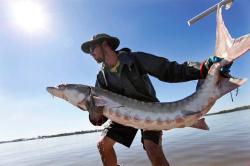
Matt Balazik with Sturgeon

Matt Balazik with Sturgeon

Matt Balazik, the sturgeon surgeon. Photo courtesy of Matt Balazik

Atlantic sturgeon are spawning again in the Chesapeake Bay. But they’ve been gone so long that we’ve forgotten the basic life history information that scientists need to boost their recovery. A species recovery grant from NOAA Fisheries should help.

In 1997, Dave Secor was a young fisheries biologist just starting his career at the University of Maryland. Like almost everyone else, he believed that Atlantic sturgeon, a species that has survived since the age of the dinosaurs, had been long gone from the Chesapeake Bay. But that year a small number of juvenile sturgeon turned up, and they were too small to have immigrated from elsewhere.

“That was a major surprise,” Secor said.

Though sightings were rare back then and still are today, the population of sturgeon that spawn in the Chesapeake Bay has grown. In 2012 that population was added to the endangered species list. Usually a listing is bad news, but in this case it was cause for celebration.

Now scientists are racing to find out what’s driving the recovery so they can reinforce it. Their efforts recently got a big boost when NOAA Fisheries awarded a three-year, $1.75 million species recovery grant to the Maryland Department of Natural Resources and the Virginia Department of Game and Inland Fisheries.

Atlantic sturgeon were prized for their flesh and for the caviar made from their roe. But fishing for them in the Chesapeake peaked in the 1890’s, and no one alive today has seen a healthy run of sturgeon in the Bay. Even basic information about their life history was forgotten long ago, and this is a problem for the scientists working to protect them.

“We need to find out where they’re spawning so we can protect that habitat,” Secor said. Scientists also hope to locate their nursery grounds and to identify the biggest threats to their recovery. Ship strikes and poor water quality are among the top suspects.

“This recovery may be part of a cycle,” said Secor. “If we don’t pursue this now, we may not see it again for another 20 or 30 years.”

A Fish That’s Hard to Follow

But finding their spawning grounds is difficult, not least because there are so few of them out there. To solve that problem, scientists will use the new funding to tag about 240 sturgeon with acoustic transmitters. That will allow scientists to track their movements in the Bay.

Atlantic sturgeon spend most of their time at sea, travelling up and down the shelf break where they plow the bottom with their snouts, eating worms and crustaceans. Like salmon, they return to their natal streams to spawn.

Unlike most salmon, however, which spawn once and die, sturgeon make the spawning run repeatedly. They can live up to 60 years and can grow up to 14 feet (4.3 meters) and 800 pounds (370 kg).

Matt Balazik, a postdoc at Virginia Commonwealth University, is doing most of the tagging. The acoustic tag, about the size of a Sharpie marker, is inserted into the belly of the fish through a small incision. The minor surgery takes less than five minutes, and the unharmed fish are quickly sent on their way.

The tag emits a coded sound roughly once a minute, a signal that’s recorded whenever the fish passes within range of a receiver. Each tag has a unique acoustic signature, allowing scientists to track individual fish.

“You can think of the tag as like an EZPass,” said Matt Balazik, referring to the device that motorists in the Northeast attach to their windshields, “and of the receivers as toll booths.”

An acoustic signal is used because sound waves travel well underwater. Radio waves would dissipate quickly in the murky Bay.

Collaboration is Key

Scientists have tagged sturgeon all along the Eastern seaboard, but the Chesapeake is uniquely difficult because it’s a meta-estuary-an estuary comprised of many smaller estuaries-and it’s the largest one in the nation.

“In the Hudson it’s a piece of cake,” said Dave Secor. “A few receivers bank to bank and you’ve got the river covered at that point.” The mouth of the Chesapeake, on the other hand, is 20 miles wide.

But the tagging project got a big boost from the Navy, which recently installed an array of 58 receivers, most attached to Coast Guard buoys, throughout the mouth of the Chesapeake Bay.

The Naval Base at Norfolk, Virginia is the largest in the nation, and it’s one of several naval installations in the lower Chesapeake Bay. As a federal agency, the Navy is required to minimize interactions with endangered species.

“We want to know where and when sturgeon are utilizing the Bay,” said Carter Watterson, a Navy biologist. “Once we know that, we can work to minimize any impact we have on the species.”

The Navy will benefit from the tags that Maryland and Virginia researchers deploy because they increase the value of the receiver array. And the state researchers will benefit every time Watterson sends them tracking data on their fish.

The buoys the receivers are attached to also record environmental data, allowing scientists to correlate sturgeon activity with ocean conditions. This will be key to understanding how those conditions affect the fish, and in particular how sensitive the fish are to the low oxygen levels that plague the Bay every summer.

A Living Fossil

Sturgeon have existed in pretty much the same form for at least 85 million years. A living fossil, they survived the meteors that killed off the dinosaurs and many other catastrophes since. “They’re designed to handle anything,” Matt Balazik said. “Except humans.”

But don’t write them off just yet. “The fact that they’re still hanging in there makes me a bit more optimistic than I was earlier in my career,” said Dave Secor, the biologist who was surprised to see juvenile sturgeon in the Chesapeake Bay in 1997.

“What sturgeon have taught me as a scientist,” he said, “is that sometimes it can be delightful when you’re wrong.”

Do Many Gulf Fish Species Rely On Decommissioned Oil Rigs?

Research Finds More than 50 Fish Species in Gulf Rely on Decommissioned Rigs
Species include fish that are key to fisheries economy
from The Fishing Wire

School of fish around a rig

School of fish around a rig

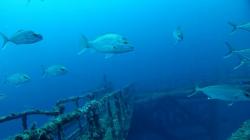
Divers capture a school of amberjack and red snapper above MI-A-7, a cut-off oil and gas platform located approximately 50 miles east of Port Aransas, Texas.(Credit: Dr. Matt Ajemian)

CORPUS CHRISTI, Texas – Early research from Texas A&M University-Corpus Christi’s artificial reefs monitoring program shows that decommissioned oil and gas structures converted to artificial reefs are supporting a high abundance and diverse fish assemblages within the Gulf of Mexico.

The new data from the western Gulf shows a high abundance of red snapper living around these structures for years at a time. Researchers in the Harte Research Institute for Gulf of Mexico Studies (HRI) at Texas A&M-Corpus Christi say 52 fish species from 18 families have been identified at 13 surveyed sites near Port O’Connor, Port Aransas, and Port Mansfield, Texas (http://tamucc.edu/news/2013/10/images/artreef_allsitemap.jpg).

“There’s a lot of evidence that the red snapper populations we see today wouldn’t be here if we didn’t have all of these converted oil and gas platforms,” said Dr. Greg Stunz, Director of the Center for Sportfish Science and Conservation. “Red snapper is the most economically important fish in the Gulf of Mexico.”

Stunz, who is the Principal Investigator for a recently awarded grant, says that in addition to supporting a variety of fish populations, artificial reefs lure commercial fishermen, recreational fishermen, and divers; benefiting many Gulf Coast economies.

Fish around an oil rig

Fish around an oil rig

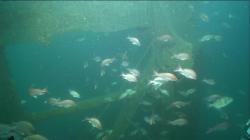
Schools of gray and red snapper congregate around the deck of a toppled oil and gas platform. This is a structure located 70 miles southeast of Port Aransas. (Credit: Schmidt Ocean Institute).

This new evidence is the reason the HRI’s newly-formed Center for Sportish Science and Conservation was recently awarded $600,000 by Texas Parks and Wildlife and $50,000 from the Fondren Foundation to expand their studies on artificial reefs. Researchers will monitor sites around the western Gulf and log the amount and types of marine life that create homes around the reefs. They will use these data to determine how to sustain these new “fish homes” including finding what characteristics are best suited to become habitats for each type of fish and to find the long-term effects of keeping rigs in the Gulf after they stop functioning.

“There are about 4,000 of these rigs in the Gulf of Mexico,” said Stunz. “About 75 percent of those will be gone in the next 20 years, so we are very concerned that we get these rigs into reef programs so that they continue producing fish.”

Data collected as part of the HRI’s “South Texas Artificial Reef Monitoring – Fish Community Assessment along the Coastal Bend” grant over the next four years will help maximize the benefits from artificial reef structures and assist scientists in better understanding how to continue sustaining fisheries for generations to come.

Red Snapper caught around an oil rig

Red Snapper caught around an oil rig

A scientist removes large red snapper captured from vertical longline gear set on an artificial reef, and collects tissue samples from the red snapper.

“Up until now, there has been very little evidence for what’s happening on artificial reefs on this side of the Gulf,” said Dr. Matt Ajemian, Assistant Research Scientist and Co-Principal Investigator. “One of our major upcoming projects will be to set up an array of acoustic receivers at different artificial reefs and track fish movements among them to determine the types of reefs these animals prefer to live on.”

The “South Texas Artificial Reef Monitoring” program works to enhance the effectiveness of current conservation and management initiatives in Texas, which has one of the largest rigs-to-reef programs, and throughout the Gulf of Mexico. The project is also set to serve as an educational tool, providing research experience for students at Texas A&M-Corpus Christi.

About the HRI: The Harte Research Institute, an endowed research component of Texas A&M University-Corpus Christi, is dedicated to advancing the long-term sustainable use and conservation of the Gulf of Mexico. Expertise at the Harte Research Institute (HRI) includes the consequences and long-term effects of the Deepwater Horizon oil spill. The Harte Research Institute is made possible by an endowment from the Ed Harte family. For more information, go to http://www.harteresearchinstitute.org/.

About Texas A&M University-Corpus Christi: Offering more than 60 of the most popular degree programs in the state, Texas A&M-Corpus Christi has proudly provided a solid academic reputation, renowned faculty, and highly-rated degree programs since 1947. The Island University has earned its spot as a premier doctoral-granting institution, supporting two research institutes and 10 research centers and labs. Discover your island at www.tamucc.edu.

Rockfish Poachers Indicted After Two-Year Investigation

Suspected Rockfish Poachers Indicted After Two-Year Investigation

by kking
Maryland Natural Resources Department
from The Fishing Wire

Poachers gill net

Poachers gill net

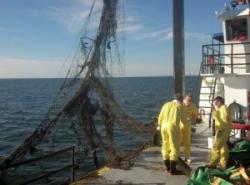
AV Sandusky pulls up a massive, old gill net found at Bloody Point from the poaching operation.

Conservationists, watermen and anglers are applauding efforts by the Maryland Natural Resources Police and its federal law enforcement partners in obtaining indictments of four Talbot County watermen accused of running a striped bass poaching ring that spanned four years and was worth nearly a half million dollars on the wholesale market.

The 26-count indictment handed down Thursday provides the link between the actions of the four men and the discovery of illegal gill nets filled with fish found off Kent Island in February 2011. The incident triggered a massive police enforcement effort, generated a series of tough laws from the General Assembly and closed the commercial striped bass season three weeks early to prevent overfishing.

“Marylanders can be proud of these officers, whose hard work, long nights and nonstop investigative efforts have paid off,” said Governor Martin O’Malley. “Poachers steal from honest anglers, watermen, and all of us who responsibly enjoy our State’s natural riches and respect the livelihoods of the hardworking men and women who rely on this fishery.”

The indictments by a federal grand jury in Baltimore came after a more than two-year joint investigation by NRP officers, the U.S. Fish and Wildlife Service and the Justice Department, who painstakingly shifted through thousands of documents and reports to construct a paper trail of the crimes.

“We hope that Maryland citizens are beginning to realize that these are crimes against the State,” said Tony Friedrich, executive director of Coastal Conservation Association Maryland. “All of our best science is based on reliable catch reports. By falsifying data and poaching Maryland’s State fish, they are not only putting the entire stock at risk but making a mockery of our combined efforts to conserve the striped bass population.”

Beginning in January 2007, Michael D. Hayden, Jr. and William J. Lednum, both of Tilghman Island, and unnamed others conspired to overharvest striped bass and falsify records submitted to the Maryland Department of Natural Resources. Their illegal catch was sold to wholesalers in Maryland, New York, Delaware and Pennsylvania.

In addition, the grand jury found that in 2011, Hayden, Lednum and two other watermen – Kent Sadler, of Tilghman Island, and Lawrence “Daniel” Murphy, of St. Michaels – attempted to catch about 20,000 pounds of striped bass before the start of the 2011 commercial season using gill nets illegally set and left unattended in the Chesapeake Bay.

Hayden also was indicted on one count of witness retaliation and two counts of witness tampering in connection with the grand jury probe.

Billy Rice, chairman of the Tidal Fisheries Advisory Commission, expressed his gratitude on behalf of the commercial fishing industry for law enforcement efforts.

Illegally caught rockfish in gill net

Illegally caught rockfish in gill net

Officers discover illegal attempts to harvest fish using a gill net as part of this poaching ring.

“Poaching does not reflect a majority of our industry,” Rice said. “It hurts our livelihood and our image. We hope these indictments send a strong message.”

Bill Goldsborough, chairman of the Sport Fisheries Advisory Commission, praised the State and federal partnership that led to the indictments.

“Egregious fishing violations are major challenges for fisheries management,” said Goldsborough, also a senior scientist with the Chesapeake Bay Foundation. “Effective enforcement like this is essential to healthy fisheries.”

As part of any sentence should the watermen be convicted, the federal government will seek to seize Hayden’s 38-foot work boat, his 2009 pick-up truck and all his fishing gear and Lednum’s 46-foot work boat and his fishing gear.

If these watermen are found guilty they could permanently lose their Maryland commercial fishing privileges.

As part of its continued effort to better protect Maryland’s public fishery, DNR most recently introduced the Maritime Law Enforcement Information Network – MLEIN, a network of radar units and cameras that scans the Chesapeake Bay for law breakers.