Category Archives: Saltwater Fishing

Everything saltwater fishing

Why Tag Bonefish?

Collecting bonefish for tagging

Collecting bonefish for tagging

BTT Bonefish Tagging Efforts Expand to South Andros

by Zack Jud
Bonefish & Tarpon Trust
from The Fishing Wire

Last month, Bonefish and Tarpon Trust’s Bahamas Initiative waded into the fabled waters of South Andros. While a handful of bonefish had previously been tagged by guides in South Andros, this was the first large-scale tagging effort on the island. As most anglers probably know, catching a tagged bonefish (or any tagged fish for that matter!) is a once in a lifetime experience. From a research perspective, the more fish we have tagged in a given locale, the more likely we are to get valuable data from recaptures – data that we will use to identify growth rates, movement patterns, habitat use, and overall health of the area’s bonefish population.

Bonefish being tagged

Bonefish being tagged

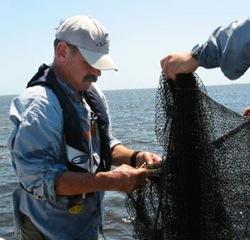
Despite a lingering cold front and 25 knot winds, the BTT-led research team managed to tag more than 650 bonefish in four long days on the water. To even their odds in the face of ugly weather, the team reluctantly set down their fly rods (well, for the most part), and instead relied on a 250′ long soft mesh seine net to capture bonefish for tagging. Working closely with guides from Deneki’s Andros South Lodge, the researchers used the net to quietly encircle large, and oftentimes fast-moving, schools of bonefish. Unfortunately, herding bonefish into a net is a bit like herding cats…they rarely go where you want them to. All too often, a school will make a last-minute U-turn, slipping right back out of the closing net. To put the odds in their favor, the BTT team asked the guides to try to find the largest schools of bonefish possible, figuring that with enough fish in the water, they’d be bound to get a few to swim into the net. Well, the guides clearly know their fishery intimately, putting the researchers onto many huge schools of bonefish, some containing more than 1,000 fish. Worries about catching enough fish during the trip were quickly replaced by worries about running out of tags!

In the first day of tagging, a single net haul resulted in the capture of more than 400 fish (not counting several hundred more fish that managed to stay out of the net as the big school split in half). On day two, in the midst of a raging lightning storm, the team again managed to capture a huge school of bonefish, probably numbering close to 500 fish. Facing fading light and a long, rainy run back to the dock, the crew made the tough decision to call it a day before they had tagged the entire school. They ended up releasing several hundred untagged fish so they could make it home before dark. There’s just that many bonefish in South Andros! Rapidly deteriorating weather reduced the number of fish caught on the last two days of the trip, but the crew still managed to tag fish in all of the popular South Andros fishing spots – Grassy and Little Creeks, the west side, and the southern cays. We don’t want to tell a fish story, but there are some awfully big fish swimming around South Andros wearing a new piece of numbered jewelry, courtesy of BTT.

On BTT research trips, the work doesn’t stop when the boats are parked and the nets are out of the water. An important part of these trips is explaining BTT’s conservation efforts to local guides and lodge owners. Without the continued support of these folks, our work wouldn’t be possible. I am happy to report that our efforts to protect Andros’ bonefish into the future were very well received, and all of the guides and lodges in South Andros seem eager to report recaptures back to BTT. With the busy season cranking up, it’s only a matter of time before clients begin catching our tagged fish. Despite the economic value of the bonefish fishery on Andros, we still have many unanswered questions about the fish that call the island home. How big of an area do these fish use during their life? How quickly do they grow? Where do they spawn? What habitats are most important for the conservation of the species? What do we need to do to assure that the incredible South Andros fishery is protected for years to come? Although it will still be some time before significant numbers of recaptures start rolling in, the work we began last month is the first step in coming up with answers to these important conservation questions. To become a member or support our efforts in the Bahamas or support any of our other great projects, visit: www.bonefishtarpontrust.org

Plan To Keep Biscayne National Park Open To Boating and Fishing

National Park Service Offers Plan to Keep Biscayne National Park Open to Boating and Fishing
EDITOR’S NOTE: Today’s feature comes to us from the American Sportfishing Association (ASA).
from The Outdoor Wire

Preferred plan addresses many of the concerns expressed by the boating and fishing communities

Alexandria, VA – Last week, the National Park Service announced a supplemental General Management Plan (GMP) for Biscayne National Park that marks an important step towards balancing the need for public access while addressing resource concerns. The park’s new preferred plan addresses many of the concerns from the recreational boating and fishing communities contained in the original 2011 GMP proposals.

Located adjacent to Miami, Fla., Biscayne National Park is the largest marine park in the National Park system and one of the country’s largest urban recreational fishing areas. The park’s updated plan is the result of lengthy discussions among the Florida Fish and Wildlife Conservation Commission, the Park Service and the National Oceanic and Atmospheric Administration along with significant input by the boating and fishing communities.

The new preferred alternative eliminates a 10,000 acre marine reserve which was a significant point of contention for the boating and fishing communities. The new preferred plan instead establishes a 14,585 acre special recreation zone along a portion of the park’s reef tract in which fishing would be allowed year round with a special permit. The plan also includes a long-term research and monitoring program to inform adaptive management of the zone. Recreational fishing and boating is still permitted in nearly all of the remainder of the park under state and federal rules and regulations.

Previous proposals would also have established significant non-combustion engine zones along the coastline which would have unnecessarily restricted boating access. The preferred plan removes those zones and instead, includes slow-speed and no-wake zones.

The National Marine Manufacturers Association (NMMA), the American Sportfishing Association (ASA) and the broader boating and fishing communities, have worked to bolster awareness surrounding the Park Service’s proposed GMP which initially set out to close up to 20 percent of boating and fishing access in Biscayne National Park. The boating and fishing communities were joined last year by Florida Senators Bill Nelson and Marco Rubio who signed a joint letter expressing concern to then Secretary of the Interior Ken Salazar. NMMA and ASA will participate in the public comment period for the supplemental GMP.

NMMA President Thom Dammrich notes, “NMMA is optimistic that this plan properly balances the need for resource conservation and robust boating and angling access. We look forward to working with NPS to protect the access granted to boaters and anglers and are pleased to see progress. NMMA will remain an active participant in this ongoing discussion, and will be vigilant in ensuring that the steps we’ve taken forward are not lost as the plan continues to take shape.”

ASA President and CEO Mike Nussman said, “The recreational fishing industry is pleased that all the agencies involved in the Biscayne National Park debate were able to come together and identify productive management solutions that still allow for public access while addressing resource concerns. We look forward to working with the Park Service to ensure that the public is allowed reasonable and sustainable access to these public waters.”

A copy of Biscayne National Park’s General Management Plan/Supplemental Draft Environmental Impact Statement is available here (http://parkplanning.nps.gov/parkHome.cfm?parkID=353&CFID=1733569&CFTOKEN=2a2287402d23c433-3EAA1517-E05E-83C3-96F6470AD3697DDE&). A series of public hearings are planned for December 2013.

The National Marine Manufacturers Association (NMMA) is the leading association representing the recreational boating industry in North America. NMMA member companies produce more than 80 percent of the boats, engines, trailers, accessories and gear used by boaters and anglers throughout the U.S. and Canada. The association is dedicated to industry growth through programs in public policy advocacy, market statistics and research, product quality assurance and promotion of the boating lifestyle.

There Is A Balance In Nature

Nature’s Balance

By Frank Sargeant, Editor
from The Fishing Wire

It’s a common refrain anywhere anglers want to harvest more of a given species but the regulators won’t let them.’

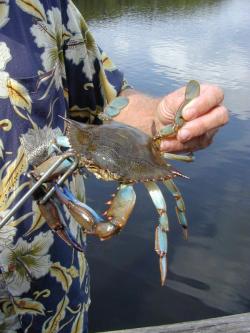
Blue crabs taste good - to people and fish

Blue crabs taste good – to people and fish

Biologists say blue crab populations go up and down depending on water quality and habitat conditions, rather than on predatory fish like stripers.

“There are too many of these (insert your favorite species) and they’re eating up all the crabs and shrimp-we’ve got to harvest more of them in the name of conservation.”

Yeah we do.

Saltwater anglers in Florida make the charge about Goliath grouper, which they say are eating up all the gags as well as spawning permit-despite the fact that there are now more big gags than there have been in decades and permit are also doing very, very well. Commercial fishermen used to say they had to cut down on redfish numbers or all the blue crabs would soon be consumed. Didn’t happen-today the state is loaded with reds, and crabs numbers come and go, as they always have.

Sharks . . . don’t even get me started.

And presently, Chesapeake Bay commercial fishers are saying that the striped bass are eating up all the blue crabs in soft-shell stage, and that they’d be happy to step in and knock back the numbers of those predatory stripes.

This train of logic has one great failing; it is that somehow, all these species survived in balance before man came along to “help” the predators stay in balance with the prey. The problem, researchers nearly always find, is that habitat issues-sometimes caused by Man but more often by natural variation in temperature, rainfall or other conditions-are depressing the species of concern.

Blue crabs are food for many species

Blue crabs are food for many species

Blues are a delicacy both in their hard-shell form, and as soft-shells eaten whole when moulting.

And that seems to be the issue in Chesapeake Bay with the crabs at present. Crabbers there are having a down year, and they say it’s because the striped bass, on a comeback thanks to tight harvest regulations, are eating up all the crabs. They want to see regs relaxed so the stripers can be harvested big, “saving” the crabs-for the crabbers.

But here’s what Brenda Davis, director of Maryland DNR’s blue crab program, says:

“There are no scientific data to support a supposition that striped bass predation is causing a significant depletion of the Chesapeake Bay blue crab population. In fact, studies performed in Maryland and Virginia to assess the diets of striped bass indicated that blue crabs make up a small percentage of the average striped bass diet. According to an intensive study in 2000, fish, particularly menhaden, account for 94 percent by weight of the striped bass diet.

“In fact, other studies have shown that cannibalism by large crabs was a major cause of juvenile crab mortality, accounting for 75 percent to 97 percent of the loss of juvenile crabs in certain locations. Juvenile crabs find protection in grass beds, which is also where striped bass and other predators find the best opportunities for catching them. Nonetheless, crab survival is best in vegetated habitats, where they can hide. Any effort to boost crab survival needs to look toward improving habitat and the protection of sea grass beds.

“There was a combination of environmental factors contributing to the high mortality of juvenile crabs in 2012 including Tropical Storm Sandy, abnormally warm and salty water, decreases in submerged aquatic vegetation coverage, a large influx of red drum into the Maryland portion of the bay, density-dependant mortality, and a large 2011 year class of striped bass.

Stripers do eat crab

Stripers do eat crab

Striped bass readily eat crabs, but food studies have shown by far the bulk of their diet is baitfish. (Photo Credit Yamaha Marine.)

“We don’t have a lot of data on impact of most of the factors on that list. However, we do have solid data that the Bay-wide harvest of spawning age female blue crabs has been at or below the 25.5 percent harvest target for five consecutive years. The ability to keep harvest in the safe range puts us in a much better position than we’ve been in the past (specifically 1992 and 1997) with similar abundance declines,” Davis said.

To be sure, there’s more than a little evidence that terrestrial prey species with a low reproduction rate and slow rates of reaching maturity can definitely be severely impacted by predators-that’s the reason that elk herds are declining in many areas where grey wolves have been reintroduced in recent years.

But for most saltwater fish, crustaceans and shellfish, where the survival strategy is to produce millions of young that grow up fast, biologists have thus far found it pretty much unheard of for a single type of predator to wipe out a prey species.

Bottom line is that if we do our best to maintain a healthy environment for all ocean species-and don’t overharvest any of them ourselves-nature will find a balance that creates a livable abundance for all.

What Is A Megamouth Shark?

The Megamouth Shark Specialist: Dr. Jose Castro Discusses his Rare Expertise

Dr Jose Castro

Dr Jose Castro

Dr. Jose Castro. Photo Credit: Mote Marine Laboratory

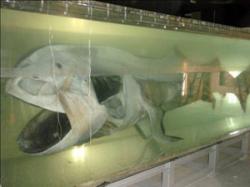
Megamlouth shark specimen being studied

Megamlouth shark specimen being studied

Dr. Castro (L) and his Japanese colleagues pose in front of the Megamouth shark specimen Photo Credit: Okinawa Charaumi Aquarium

Megamouth Shatk internal structure

Megamouth Shatk internal structure

Left side of megamouth shark Left side of megamouth shark showing organs and cartilaginous skeleton Photo Credit: Okinawa Charaumi Aquarium

Megamouth sharks are one of the most elusive shark species in the world. Since their discovery in 1976, megamouths have been documented between 50 and 60 times; yet only a handful of specimens are on diplay at aquariums. Exceeded in size only by whale sharks and basking sharks, the large megamouth shark uses its wide jaws to filter for plankton in the deep-sea. Recently, biologist Dr. Jose Castro of NOAA Fisheries had a unique opportunity to help dissect a rare megamouth shark on display at the Okinawa Churaumi Aquarium in Japan.

They don’t call Castro a specialist for nothing. In 1994 he was part of the first ever female megamouth shark dissection at Fukuokka, Japan, and has dissected the only specimen caught in the Atlantic. We met with Castro to ask about the recent dissection and to learn more about the elusive megamouth.

How did you first get involved with megamouth shark research and dissections?

In 1994, a female megamouth was stranded in Fukuokka, Japan, and I was invited by Senzo Uchida of the Okinawa Churaumi Aquarium, to help with the dissection. Everyone was particularly excited that the shark was a female because we had the opportunity to investigate reproduction questions. For years that was the only dissection of a megamouth, and to this day the majority of information known about the species comes from that one shark. Later, the Brazilians invited me to document a megamouth caught off the coast of Brazil. Of course there are more megamouths in the Atlantic, but just one confirmed specimen has been found there.

What is it like dissecting a megamouth shark?

I dissect big animals all the time. But when I was working in Japan with the dissection team led by Dr. Keiichi Sato, it was a different and fantastic experience. We were not just examining the megamouth, we were preparing an exhibit for the aquarium. On one side of the creature we removed the muscle to expose the organs and skeleton, which was made of cartilage and connective issue. Visitors could actually see the animal’s anatomy. The dissection was a difficult and time-consuming process, and it didn’t help that the animal was preserved before we started, so the smell was horrible.

What do you hope people will learn from the megamouth display at the Okinawa Churami Aquarium?

The Okinawa Aquarium is one of the greatest in the world. The previous director, Senzo Uchida, was the first person to successfully keep whale sharks and manta rays in captivity. The research and curiosity behind the scenes give the public a chance to see what these creatures are really like. The megamouth specimen will be a part of a very unique filter-feeder exhibit along with the head of a 27-foot basking shark. I hope this will spark interest in the visitors the way it has for the scientists.

How does your work make a difference in shark management?

We have done a good job managing shark fisheries in this country, but not on an international scale. Sharks are among the last group of large vertebrates being destroyed by humans, and it has taken us a long time to realize we need new methods. Shark finning and other practices threaten the future of sharks, and we need international cooperation to make a difference. Luckily, the pursuit of science bridges countries and connects people to our oceans.

What is the one thing you want the public to know about megamouth sharks?

We hardly know anything about this shark. Through tagging we know that it goes up and down in different depths at night, but tags cannot tell us the bigger picture of what the shark is doing and why. The most we have learned about these creatures is through necropsies, or looking at them after they’ve died. We have yet to discover everything about these mystifying creatures: their behavior, reproduction, physiology, and some anatomical features. The first one was discovered in 1976, but didn’t become known outside the science community until 1983. I think the megamouth shark shows how little we know about the oceans. A lot remains to be discovered, even about these large animals.

What Are Permit and Where Can I Catch Them?

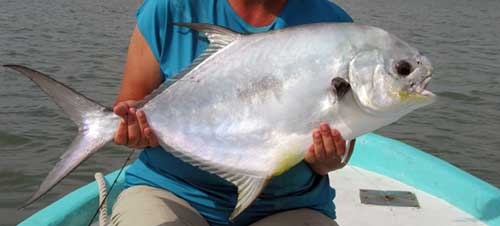
Permit are fun to catch

Permit are fun to catch

Florida’s Permit Fishery: An Update from the FFWCC
from The Fishing Wire

Permit is a species on the bucket-list of many anglers world-wide. Here’s a review of the fishery in Florida, where they’re found both on the flats and over deep water reefs.

Permit is a highly sought-after fish in Florida. Learn about the current and historical status of this fishery.

Permit (Trachinotus falcatus) have long been sought after by commercial and recreational fishers on Florida’s Atlantic and Gulf coasts. Though this species is a prized catch, little is known about the status of the permit fishery. Commercial landings are relatively low; however, recreational landings data are scarce and there is still much to learn about the permit’s basic biology. That’s why Fish and Wildlife Research Institute (FWRI) biologists, in collaboration with Bonefish and Tarpon Trust and Costa Del Mar, are conducting a multi-year study on permit biology, life history and movement patterns.

The study relies on anglers tagging and fin-clipping, which is collecting a tissue sample, permit they catch and release. Biologists can then track movement patterns (e.g., reefs to shore, reef to reef, inshore to offshore, south to north) when anglers recapture and report catches of tagged permit. In addition, FWRI scientists are conducting genetic analysis of fin clips to assess permit population structure and determine whether permit throughout Florida’s coastal and inshore waters share a single genetic stock. This valuable data can help Florida’s fishery managers determine the best management methods for permit. To learn more about how anglers can contribute to this research, read the article Tag a Permit for Research Gains.

This permit is fitted with a tag that will allow researchers to track when and where the fish is caught again if it is recaptured in the future.

History of the Fishery

Commercial landings accounted for the majority of the statewide permit landings before the net limitation amendment (Amendment Three to the Florida Constitution) went into effect July 1, 1995, making use of entangling nets (e.g., gill nets, trammel nets) illegal. Since then, the majority of permit has been taken by the recreational sector, which accounted for 82 percent of permit landings from 2001 to 2007 on average.

Commercial landings have been declining since 1998, which can be partially attributed to changes in commercial regulations. Fishers target permit in the 1.5- to 3-pound range, which is characteristic of permit of legal harvest size. Most commercial fishers along the Gulf Coast (where most of the landings come from) land less than 500 pounds of permit annually. This equates to approximately 250 fish or less, which is a relatively small number of fish compared to other commercial fisheries. In fact, the monthly average weight of permit landed per trip from 2006 to 2010 was less than 55 pounds for all months but August, when it was 75 pounds.

In 2011, the FWC eliminated all directed commercial harvest of permit in state and federal waters off Florida. Since then, only 100 permit may be kept as bycatch by commercial fishers who hold a saltwater products license and a restricted species license and who are legally fishing for other species with gill or entangling nets in federal waters outside a Special Permit Zone, so landings remain low. The Special Permit Zone, an area in south Florida that includes all state and federal waters south of Cape Florida and south of Cape Sable, was created by the FWC in 2011 to provide additional protection to the species. There is no direct or indirect commercial harvest of permit inside the Special Permit Zone.

The recreational fishing sector accounts for the majority of statewide permit landings and most are taken along the Gulf Coast. However, recreational permit landings have increased along the Atlantic coast since 1997. The most productive months for recreational permit fishing appear to be March through June with a peak in April, based on estimates using Marine Recreational Fisheries Statistics Survey data (1982-2009). This coincides with the start of permit spawning season. There is a secondary peak in catches from November through January when permit aggregate at warm-water areas such as around power plants, allowing recreational anglers to more easily find them.

Permit are targeted by some anglers for catch-and-release sport fishing, but they are also commonly harvested and eaten. Data from 2004 to 2007 show anglers harvested an average of 59 percent of the recreationally caught permit. Since permit form large schools that will gather by reefs and wrecks for days at a time, they can be easily targeted by spear-fishers and hook-and-line anglers once the schools are located, especially during spawning season. In 2011, the FWC implemented regulations to protect adult permit aggregations found along Florida’s wrecks and reefs from too much fishing pressure. Managers also changed size and bag limits and established a closed harvest from May through July inside the Special Permit Zone. The closed season equates to catch-and-release fishing only during spawning. Both of these changes help to protect both juvenile and adult permit.

For a map of the Special Permit Zone, visit the Permit, Florida pompano and African pompano regulations page. For up-to-date permit fishing regulations, always check the FWC Saltwater Fishing Regulations.

Kingfish Fishing

Saltwater Fishing’s Fall Classic for Kingfish
from The Fishing Wire

The SKA® National Championship and Yamaha Professional Kingfish Championship in Biloxi this November are the offshore equivalent of the Bassmaster Classic® and more

Big King Fish Mackerel

Big King Fish Mackerel

Monster king mackerel like this one are the target in the Southern Kingfish Association’s National Championship, which gets underway Nov. 4 in Biloxi, Mississippi.

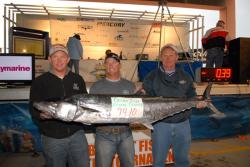
Winning Kingfish at Tournament

Winning Kingfish at Tournament

Big payouts await the winners in these tournaments, but the competition is tough–and sometimes, so are the seas.

If you want to see hundreds of the most exotic, high-performance center console fishing boats on the water today, fielded by the top competition saltwater fishing teams in the nation going head-to-head for big cash purses and glory, then you better head to the Golden Nugget Casino and Marina in Biloxi, Miss. for the week of November 4th. It promises to be an amazing display of fishing prowess and the newest, hottest boats and gear.

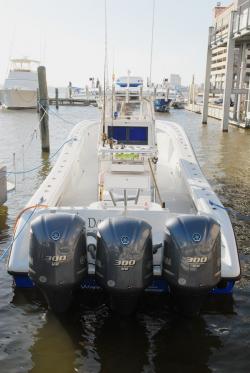
Kingfish boat powered by three Yamaha Outboards

Kingfish boat powered by three Yamaha Outboards

Triple power like these big Yamaha’s is favored for dependability and speed during top-tier tournaments.

The Southern Kingfish Association (SKA®) is the largest saltwater fishing tournament organization in the nation. Structured somewhat like the Bass Angler Sportsmans Society (B.A.S.S.®), it has ten regional divisions that stretch from N.C. to La., pretty much everywhere king mackerel are found in U.S. waters in abundance. Each division has at least three SKA® sanctioned kingfish tournaments per year that are open to members from within or outside of that division, for a total of 45 events in 2013. By entering and placing in divisional tournaments, teams earn points in addition to cash and prizes offered in each event. At the end of the season the top teams, as determined by the points earned in those events, are invited to compete in the National Championship in Biloxi.

There are two levels of divisional competition, the “open class,” dedicated to the biggest, baddest most powerful boats you can bring to the tournaments; and the “small boat class,” which limits boat size to no larger than 23-feet 11-inches at the water line. While large boats can only compete in the open class, small boats are permitted to compete in either class, but the team must declare which class it will fish at registration before a tournament begins.

In addition to the divisional competition, the most consistently successful teams are invited to step up to the SKA® Professional Kingfish Tour, which culminates with the highly anticipated Yamaha Professional Kingfish Championship. The money and prizes offered to the top-tier competitors makes for top-flight competition. Every division tournament has a pro class, which leads up to the final pro event of the year held in Biloxi the same week as the SKA® National Championship.

Like B.A.S.S.®, the SKA® is devoted to fishing for a single species-king mackerel. These missile-shaped pelagic gamefish are long, strong, very fast and sport a mouth full of teeth that can slice and dice pretty much anything they want to eat. Kings are found throughout the Gulf of Mexico, around the horn of the Florida peninsula and northwards as far as Virginia. Their range pretty much sets the range of the sanctioned tournaments. Unlike B.A.S.S.®, where tournaments are individual angler events, SKA® sanctioned tournaments are team efforts. Each boat can be “manned” by two to six people.

In an effort to make their tournaments more family-oriented, SKA® has offered special awards, trophies and even scholarships for female and junior anglers for more than 20 years. There are teams made up of fathers, mothers and their children. A great example is Team Ocean Isle Fishing Center from N.C., fielded by the McMullan family. At any given tournament there can be three generations aboard; Grandfather Rube, fathers Brant and Barrett, mother Amy and one or more of the family’s children including daughter Caroline.

The McMullan’s compete in a Yamaha-powered 32-foot Yellowfin center console in both divisional and pro events. Two years ago they weighed the largest kingfish ever brought to the scales in 25 years of SKA® tournaments, breaking the Mississippi state record in the process. The fish weighed an amazing 74 pounds. There is usually a large and very vocal audience filling the bleachers at tournament weigh-in time, and this fish brought them to their feet. Many more spectators walk the docks discussing the boats, talking to teams to learn more about the fish and fishing, and just drinking in the festive atmosphere that is the SKA® Nationals.

What makes the SKA® unique is the level of competition and the unbelievably harsh demands tournament teams put on their boats, motors and tackle. They fish in rough weather, think nothing of making runs of up to 100 miles in a day to find that one big king, and then racing back to the scales in time for weigh-in. It has made SKA® competitors a driving force in the development of bigger, stronger, better-handling boats and larger, stronger, more powerful and dependable outboards. So it stands to reason that when you get to the Championships in Biloxi in November, you will be seeing the best-of-the-best in fishing boats, engines and fishing tackle being used by the best tournament teams in the nation.

Here’s how the week shapes up. Registration for the Yamaha Professional Kingfish Championship takes place at the Golden Nugget on November 4th, but many teams will have arrived a day or two early to scout out bait and pre-fish the area. Tuesday and Wednesday are fishing days, and Thursday is registration for the National Championship and awards presentation for the Pros. Friday and Saturday are the fishing days for the Nationals, and Sunday is the awards presentation. There are numerous parties, gatherings, sponsor displays and more during the week. This year, Garmin Marine Electronics will be sponsoring a live simulcast of both events. To learn more, go to www.fishska.com and click on the banner for the Nationals. It’s one of the biggest events hosted by the city of Biloxi each year, and this one promises to be bigger and better than ever.

Do Red Snapper Provide Protein For America?

Protein for America?

By Ted Venker

Early in October, news came that more than 130 chefs, restaurant owners, fishermen and seafood industry leaders had partnered with the Environmental Defense Fund to launch a new propaganda campaign called “Share the Gulf.” The goal of this benignly labeled effort is to maintain 51 percent of the red snapper harvest for commercial fishermen and 49 percent to recreational fishermen – an allocation that was set using harvest data from the mid-1980s.
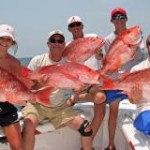
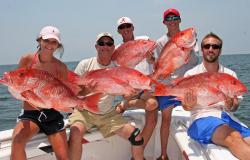
Red Snapper

Red Snapper

Sportfishermen say there are more big red snapper in the Gulf of Mexico today than there have been in decades, maybe in generations–but they’re not happy about a commercial fishing campaign to take away a portion of the share allocated to recreational anglers. (Photo Credit David Rainer, Alabama DCNR)

Coalition members maintain that any change to allocation could be a blow to commercial fishermen that could take red snapper off restaurant menus and out of grocery stores. Keep in mind, this is an allocation literally set about 30 years ago in a very different time with a very different stock.

“We need to draw a line in the sand,” John Schmidt, a Florida-based commercial fisherman and co-chairman of the coalition, said in a recent article. “Recreation groups need to stop taking away America’s fish and start managing their fish better.”

Just chew on that thought for a moment: Recreational angling groups are taking away America’s fish. Then consider that the commercial red snapper sector is currently comprised of less than 400 “shareholders” who personally own 51 percent of all the red snapper in the Gulf of Mexico.

A bit infuriating, isn’t it?

Those 400 shareholders didn’t pay a dime when they were gifted that public resource through the federal catch share program in 2007, a gift recently valued by one Gulf of Mexico Fishery Management Council member at more than $79 million. Those shareholders to this day don’t pay enough in administrative fees to cover the cost of monitoring their own program. Many of them don’t even fish anymore and instead lease their shares to others to fish for them.

Yet those 400 shareholders are demanding America’s recreational anglers – me, you, my kids, your friends and family – stop taking away “America’s fish.” Who exactly would we taking those fish away from? Why, the people making money from the capture and sale of a public marine resource, of course – those few shareholders, some chefs, and a few seafood dealers.

Red snapper are a long-lived species and take some time to reach maximum sizes, but tight harvest rules seem to have worked very well in the Gulf over the last decade.

The commercial sector does offer a different view of the situation. The snapper barons who own 51 percent of the red snapper resource are quick to tell anyone who listens that they are feeding America with those snapper. It is not uncommon at a Gulf Council meeting to hear several of them state the importance of their work providing protein for America. Providing fresh red snapper for the millions of people who don’t live near the coast and don’t go fishing.

That’s a noble sentiment until you start to do the math on exactly how many Americans are turning to red snapper fillets that often run as high as $18 to $20 per pound for their daily protein. How many families of six on a budget pass by the hamburger and choose a $100 snapper dinner instead? How many Americans depend on that weekly visit to a five-star New Orleans restaurant with white tablecloths to feed their family vital protein?

Let’s be real here. These folks are not providing protein for America. They’re providing protein for a very few Americans. And they’ve gotten very wealthy doing it.

Given that, it is easy to understand the very real influence of greed on the part of the snapper barons in this coalition, but less clear is the motivation of the chefs and restaurant owners. I would assume that they don’t have the full picture here. As business owners and professionals removed from the front lines of fisheries management, I would be willing to bet they aren’t completely tuned in to the politics of the Gulf red snapper fishery.

Those chefs and restaurant owners who depend on the good will of the public may not realize that there are far fewer commercial red snapper fishermen today than there have ever been, and yet they are currently harvesting more red snapper than the commercial sector ever has. No one is close to getting run out of business – far from it. Through consolidation and the gift of a public resource, the remaining snapper barons have a degree of job security that most in this country would envy.

And like good business owners, the shareholders are looking to diversify. One of the primary motivations behind their efforts in this coalition to prevent reallocation is not to provide more protein for America (at $20 per pound), but to have the ability to lease some of their red snapper shares to recreational charter/for-hire boats and headboats.

One of the tastiest fish in the sea, the red snapper is a favorite with reef fishermen from Key West to Brownsville, Texas.

Ironically, the shareholders who are chastising recreational anglers to stop taking away America’s fish are banking on schemes under discussion at the Gulf Council to allow them to lease their red snapper shares to … recreational anglers. If the Gulf Council reallocates, it may dampen the market for leasing their red snapper shares to the recreational sector.

Perhaps the chefs and restaurant owners weren’t made fully aware of that little detail.

Lastly, there is the Environmental Defense Fund which is often found lurking somewhere in the background of any plan that may result in fewer people on the water catching red snapper. EDF has poured millions into threatening the sportsmen’s ethic of wildlife management in the marine environment in pursuit of its distorted view of conservation.

The latest result is a coalition of 400 wealthy shareholders who are in it for the money, a few chefs and restaurant owners who are risking the wrath of the sporting public because they may not be aware of the real game here, and an environmental group that made the bizarre decision to champion the industrial gear of the commercial fishing sector against America’s sportsmen.

No wonder Gulf red snapper is such a mess.

The next Gulf of Mexico Fishery Management Council meeting is in New Orleans Oct. 28- Nov. 1. Many local supporters of the “Share the Gulf” campaign are expected to be on hand to make sure “America’s recreational anglers stop taking away America’s fish.” If you are an American angler, perhaps you should be there, too…so that the Council hears a slightly different point of view.
Black Sea Bass Restoraiton

Black Sea Bass

Black Sea Bass

Back in Black: Black Sea Bass Stock is Rebuilt
from The Fishing Wire

Today’s feature from NOAA not only gives insight into the restoration of black sea bass, but into how the Magnuson-Stevens Act is designed to work–and sometimes does work.

The southern stock of black sea bass has been successfully rebuilt and annual catch limits will now more than double.

The wait wasn’t easy but it’s over. In May of this year, NOAA scientists declared the southern stock of black sea bass successfully rebuilt. The short seasons and low catch limits that fishermen have endured in recent years are about to pay off-the catch limit for this popular fish will more than double this fall.

The southern stock of black sea bass, which ranges from Cape Hatteras, North Carolina, to the Florida Keys, was declared overfished in 2005. The following year, the South Atlantic Fishery Management Council implemented the rebuilding plan, which ended successfully this past spring.

The rebuilding plan was required by the Magnuson-Stevens Fishery Conservation and Management Act, the law that governs the nation’s marine fisheries. The Act requires that overfishing end immediately, that overfished stocks be rebuilt, and that stocks be subject to annual catch limits.

“This shows that catch limits work,” said Jack McGovern, the South Atlantic Branch Chief for NOAA Fisheries. “People are seeing more black sea bass than they have since the 1970s.” The fish are also larger on average and are showing up in places where they haven’t been seen in decades.

The southern stock of black sea bass is only the latest to cross the rebuilding finish line. A total of 34 stocks have now been rebuilt since 2000.

Increased Opportunity for Fishermen

For Robert Johnson, a charter boat captain out of St. Augustine, Florida, this will mean a longer fishing season and more customers. “We’re a tourist-driven economy here in Florida,” Johnson said, noting that hotels and restaurants in his area are also looking forward to a longer fishing season.

Black sea bass is a popular species among recreational anglers throughout its range. That’s because in addition to being a particularly tasty fish, black sea bass are relatively accessible. “The nice thing about black sea bass is you don’t need a million-dollar boat to catch them,” Johnson said.

Tom Burgess is a commercial fisherman out of Sneed’s Ferry, North Carolina. Like most commercial black sea bass fishermen, he catches the fish in baited pots. “What we’re experiencing now was worth the wait,” said Burgess, who expects his income to rise with the catch limit.

Catch Limits and Accountability Measures Make Rebuilding Possible

In 2005, the South Atlantic Fishery Management Council considered two alternative rebuilding strategies. One cut catch limits steeply up front but allowed them to rise steadily as the stock rebuilt. The other involved less pain initially but held catch limits constant for the duration of the plan. The Council chose the constant catch plan.

As the black sea bass stock was rebuilding, there was pressure to let up on the catch limits. People were seeing more fish, and they wanted to catch them.

“There were a lot of frustrated fishermen out there,” Robert Johnson said.

But the 2006 reauthorization of the Magnuson-Stevens Act requires that catch limits be set at a level that prevents overfishing and that the limits include accountability measures. These measures ensure that, if the annual catch limit is met early or exceeded, then any overages are balanced out with in-season closures, a reduced catch the following year, or other corrective measures.

It is this combination of annual catch limits and accountability measures that give the rebuilding requirements of the Magnuson-Stevens Act their force. Without them, the black sea bass stock might have followed what was once a more common trajectory, with any increase in numbers being quickly fished down.

Instead, the stock was rebuilt, which means that the population is now large enough to produce its maximum sustainable yield-the largest annual catch that won’t cause the population to diminish over time. Managing stocks at or near this level allows fishermen to extract the greatest value from fish populations today while also maintaining a healthy stock for future generations.

For the fishermen who had to live with low catch limits so that black sea bass could rebuild, the new catch limits will be an extra-large dose of good news. Because they were held constant during the rebuilding years, catch limits are now set to more than double. Last year both the recreational and commercial seasons were over by early fall. This year fishermen should still be having at it into late fall or early winter.

What Eats What In the Gullf of Mexico

Fish were collected and studied to see what eats what

Fish were collected and studied to see what eats what

University Researcher Calls New Database the “Who Eats Who” of the Gulf of Mexico

Editor’s Note: Today’s feature is courtesy of Texas A&M University-Corpus Christi.
from The Fishing Wire

CORPUS CHRISTI, TEXAS- About 1,500 marine fishes make the Gulf of Mexico their home. From birds, to fish, and marine mammals to crustaceans, the Gulf of Mexico Species Interaction database (gomexsi.tamucc.edu, created by a researcher at Texas A&M University-Corpus Christi, currently has diet data on over 600 of the marine fishes. It is the first and only database of its kind for the Gulf of Mexico that shows how the cataloged animals interact with each other in the food web.

“Unless you’re a scientist or grad student, you may have never wondered what preys on porcelain crabs,” said Dr. James Simons with the University’s Center for Coastal Studies. “But if you’re a fisherman, you would probably like to know what type of critters your favorite game fish likes to eat.”

Simons started collecting data on how the different species of the Gulf interact in 1987, but it wasn’t until 2002 that he got the idea to put all of the information he had collected into one, easily-accessible place: the worldwide web.

“In any ecosystem, it is important to know the food web, or who eats who,” said Simons. “This food web is the biostructure that shows us the pathways by which energy flows through the ecosystem.”

The scope of data in GoMexSI (gomexsi.tamucc.edu) includes the estuaries and coastal waters of Cuba, Mexico, and the United States and all of the Gulf waters to the deepest realms. Simons says the database has already proven valuable to various research projects including the National Oceanic and Atmospheric Administration’s Integrated Ecosystem Assessment program that is using the data for diet information on fish that will aid in the construction of fishery ecosystem models. The effort has also enabled the detection of data gaps that will help to direct future data gathering efforts.

Recently the data were used for a Gulf of Mexico Alliance project that seeks to understand the movement of mercury through Gulf food webs. The data that Simons has collected was used to construct food webs for the king mackerel in six locations around the Gulf.

Dr. James Simons “if you’re a fisherman, you would probably like to know what type of critters your favorite game fish likes to eat.” Photo from Texas A&M – Corpus Christi.

“Fisheries are especially important in the Gulf as a source of employment, income, recreation, and food,” said Simons. “The detailed data provided by this project will hopefully improve the accuracy of the fishery models that are used, in part, to make management decisions.”

Simons also hopes to work with the Texas State Aquarium to develop a GoMexSI app that would show people, at any given display, where the fish they are seeing fit in the food web.

“For example, at the Aquarium, you may see ten fish in a tank, but the fish that eat those fish are not in the same tank, for obvious reasons, so you are only seeing half of the ecosystem,” said Simons. “Seeing the other half of the picture would be invaluable to young students.”

The GoMexSI project already has over 45,000 digital records of species interactions, and Simons hopes that is just the beginning. The data comes from a wide variety of sources including abstracts, contributed datasets, proceedings, unpublished manuscripts, peer-reviewed literature, theses, and government reports. Simons and his team are currently extracting and standardizing the data to make it easier to explore and use.

“The most commonly used data are the data that are easy to find,” said Simons. “So, for example, while information from an unpublished manuscript or a thesis may have the best data for a given species, it isn’t used because it’s nearly impossible to locate.”

About Texas A&M University-Corpus Christi: Offering more than 60 of the most popular degree programs in the state, Texas A&M-Corpus Christi has proudly provided a solid academic reputation, renowned faculty, and highly-rated degree programs since 1947. The Island University has earned its spot as a premier doctoral-granting institution, supporting two institutes and 13 research centers and labs. Discover your island at http://www.tamucc.edu/.

Restoring Morro Bay’s Eel Grass

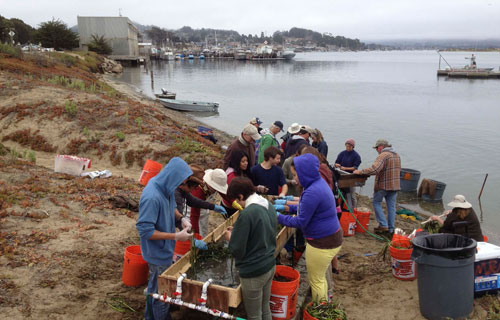
Working to restore eel grass in Morro Bay

Working to restore eel grass in Morro Bay

Community comes together to restore Morro Bay’s eelgrass beds

Today’s feature on restoration of California’s Morro Bay eelgrass comes to us courtesy of N.O.A.A.
from The Fishing Wire

Morro Bay is a small fishing port situated halfway between San Francisco and Los Angeles on California’s Central Coast. The town is often referred to as the “Gibraltar of the Pacific” because of a volcanic peak that rises nearly 600 feet above the harbor. It is an iconic coastal village closely connected to the sea and the environment that sustains it.

So it was no surprise when local community members, as well as state and federal agencies, responded to a request from the Morro Bay National Estuary Program to help restore the bay’s rapidly declining eelgrass beds.

“Eelgrass is a cornerstone of Morro Bay’s ecosystem,” said Bryant Chesney of NOAA Fisheries. “But over the last several years we have seen eelgrass beds in Morro Bay shrink from about 350 acres to less than 20.”

The exact cause of the decline is unknown, but since the 1850s, eelgrass beds along California’s entire coastline may have declined by as much as 90 percent. Human stressors, such as dredging, nutrient pollution, and sedimentation, are possible causes. However, warming temperatures may also be diminishing the plants’ overall ability to survive.

In Morro Bay eel grass is essential to halibut, juvenile rockfish, leopard sharks, pipefish, and numerous other fish and crustaceans. It also provides habitat for sea birds. Black Brant, for instance, use Morro Bay as one of a few migratory feeding grounds between Alaska and Baja California.

Eelgrass also supports the marine environment by converting sunlight into oxygen. Some studies indicate eelgrass beds may also be capable of absorbing carbon dioxide, an atmospheric gas linked to climate change that can negatively impact the health of our oceans and marine life.

With all of this at stake, it’s no wonder volunteers of all ages and organizations gathered along the shore of Morro Bay to harvest, prepare, and transplant eelgrass back into the upper reaches of the waterway where it has significantly declined.

The restoration process for eelgrass is labor intensive, and this effort was no exception. First divers harvested no more than ten percent from a healthy eelgrass bed and brought it to shore.

Volunteers then washed the leaves and roots, bound several plants together into a single “unit,” and attached a biodegradable “popsicle stick” to act as an anchor. The volunteers prepared nearly 10,000 units to transplant. The plants were then assembled into bundles. From here, a team transported the bundles by boat to the upper portions of the bay where they were transplanted. The shallow water allowed divers to stand up in most places, but they needed scuba equipment to follow a previously positioned underwater line. The divers pushed the roots, or rhizomes, into the sediment every meter along the line. The plants are held fast with the previously installed “popsicle anchor.”

“We are hopeful our efforts will be successful and with this kind of community support, I’m sure it will be,” said Chesney. “The Morro Bay National Estuary Program is a great partnership with federal, state, and local constituencies that care about Morro Bay and its watershed.”

Learn more about eelgrass: http://www.habitat.noaa.gov/abouthabitat/eelgrass.html