Have You Ever Got A Hook Stuck In You While Fishing?

Fact of life – if you fish much you will get hooks stuck in you. From little pin-pricks on fingertips to hooks buried in ears, arms and even bellies, hooks end up in all the wrong places. It will happen.

One experience was funny, to everyone except my Uncle Mayhue. Three of us were fishing from a 12 foot jon boat at Usury’s Pond in McDuffie County. That is a prescription for disaster, especially if one of the fishermen is only eight years old. Uncle Adron was in the middle of the boat and I was in the back. Uncle Mayhue was in the front sculling the boat along while all three of us cast plastic worms with three hooks in them.

I have no doubt both uncles were watching me and trying to make sure I didn’t do anything to cause a problem, but Uncle Adron should have been looking forward more. On one cast he somehow hooked Uncle Mayhue in the ear with his plastic worm – with all three hooks.

I tried not to laugh but it was funny. The red Crème worm outlined the ear while a few drops of blood trickled out. Not one to let such a small thing stop him from fishing, Uncle Mayhue just kept on casting, saying he would get it out later. Uncle Adron had to cut his line and rig up another bait.

When I was about 15 years old I was fishing at Clark’s Hill by myself in our big ski boat. It was a hot day and I had my shirt off. I cast a Little Cleo spoon toward the bank and got hung in a bush. When I snatched it to pull it out of the bush my plan worked too well. I suddenly felt a sting on my stomach, looked down and saw one of the hooks on the treble was out of sight with the other two pressed tight against my stomach.

I did not have a protective coating over my stomach back then like I do now, and I knew from my little memory of biology that there were some pretty important things not too far under the skin in that area. I cut the line off and drove the boat back to the dock.

My mom was fishing under the dock and when I tied the boat up and pointed to the spoon I almost passed out. It did not hit me till then. She took me to the emergency room and they cut the hook out and it took only two stitches to close the cut up. The doctor told me I was not really in any danger, the layer of muscle – back then, anyway – was much thicker than the hook was long.

That and other experiences taught me to get the hooks out of myself. One beautiful fall day while fishing at Lake Martin I was casting a big DBIII crankbait to shallow cover. When the lure bumped a log I thought I got a strike and set the hook. The plug came flying through the air and ended up hanging from my upper arm, just below my shirt sleeve.

It didn’t really hurt, just felt like someone had punched me in the arm. I told my partner to grab the visible hooks with a pair of pliers and jerk the hook out. I warned him to do it fast, to please not pull slowly because that hurt a lot more.

He took the pliers, looked at the plug and all the color drained from his face. He couldn’t do it. So I did. I took the pliers, jerked the lure loose and went back to casting it. It never bled or hurt. I have found that often works best. Just jerk the hook out quickly and get back to fishing.

If you are fishing saltwater on the Gulf of Mexico you had better be careful of any injury like that, though. Especially this time of year there is a bacterium that lives in the water that can be deadly. It is more common late in the summer and will enter your body through any hole like those made by hooks, fish fins and knife cuts. It can even get in through a scrape.

A few years ago a friend of mine, Kevin Dallmier, who was a fisheries biologist from north Georgia, got one of these infections. The bacterium, Vibrio vulnificus, can lead to amputations and even death. Kevin was in the hospital for several weeks recovering from his infection.

You are more likely to get an infection if your immune system is weak. But be careful anyway. There are about 40 confirmed cases each year on the US Gulf Coast, not many unless you happen to be one of them. A high percentage of confirmed cases, 35, require hospitalization and almost one third, or 12 per year, result in death.

Be careful when fishing. And if you get an injury from a hook or anything else, get medical attention if you start running a fever. Don’t wait to hope it will go away.
What Is Figuring Out A Bass Pattern?

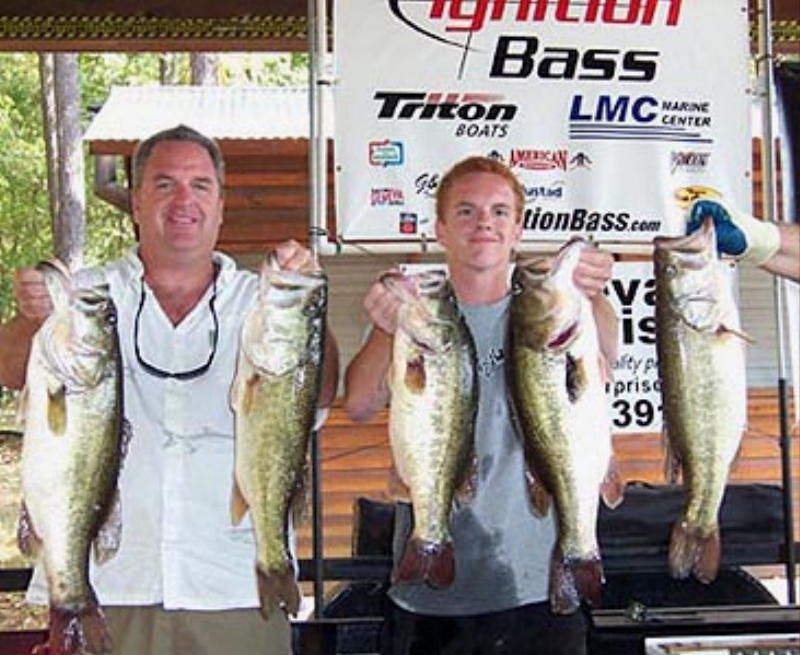
You need to pattern bass to have a catch like this in a tournament

You need to pattern bass to have a catch like this in a tournament

Good bass fishermen can pattern bass. That means they can catch a few bass and figure out what the bass are doing at that time on a lake. They can then go catch other bass in similar places with similar baits. For example, if a good bass fisherman catches three bass off blowdown trees on three different points, he will start running from point to point casting only to blowdown trees, using the same bait the first three hit.

Several years ago Fritz, a friend from Des Moines, visited the last week of February for some fishing. We hit Sinclair twice, Jackson once and spent our last day on West Point. A pattern gradually emerged that worked on all four lakes and helped us put bass in the boat.

Fritz goes by the name “Learning To Fish At 40” on my internet site since he took up fishing when he turned 40. I call it his mid life crisis. He is very smart and has read a lot on fishing, and has taught me some things! He looks at fishing in a different way than I do, with a fresh perspective.

We started fishing “places” at Sinclair that February, places I remember catching bass at that time of year. We tried lots of places with a variety of baits including crankbaits, spinner baits, jig and pig and worms.

After about half the first day was gone Fritz said “Do you realize every bass we have caught hit a jig and pig on rocks near deep water. So we started concentrating on those types of places using a jig and pig and caught a good many bass the rest of that day and the next day on Sinclair. We tried some other stuff, like fishing into the coves behind the points, but the bass just were not there.

It had been unusually warm and by Monday it was almost like spring. We went to Jackson and started on the same pattern from the day before, and caught fish. Buy that afternoon we saw the water had warmed so we started fishing into the pockets behind the points, too, and catching a few bass off wood cover. That had not worked the day before or that morning.

We had a good day at Jackson and decided to go to West Point the next day. A hard cold front came through and temperatures were dropping fast. But the pattern held, and we hooked some nice bass on rocky points and the wood cover behind them. We ended the day with me catching a 7.5 pound largemouth on a jig and pig out of a blowdown and Fritz catching a four pound bass, his best to that point, out of another blowdown.

Last Saturday night at Jackson Niles Murray and I fished the Sportsman Club tournament. We started on my favorite point near the dam but all we got was a spot that was too short to keep. At about 6:45 we ran up to the mouth of Tussahaw Creek where Niles has caught some fish the weekend before and started working the area.

At 7:20 I landed a good two pound keeper spot on a main lake point with some rocks on it. It his a jig head worm. Niles caught a short bass and some bluegill on his crankbait. About an hour later we had worked up the bank to another point with some rocks on it and I got another keeper spot, then Niles got one on his crankbait.

It was almost dark so we kept fishing up the bank, fishing around the coves and working all the cover we came to. At about 9:10 we had worked out onto another main lake point with rocks and, guess what. I got another keeper spot! At that point we decided to concentrate on that pattern but did not catch any more fish.

I wish I had caught on to that pattern quicker. We wasted a lot of time fishing in coves and other places where there were no bass. If we had started jumping from point to point earlier I think we could have caught more fish. By full dark the fish had stopped hitting on points, it seems.

The bass may have started hitting on that pattern again later in the night but we stopped at 12:30 AM. I have seen this type pattern in the past, where bass hit pretty good from 6:00 PM until about 9:00 PM then a lull with no bites until after midnight. It seems to me the fish need to adjust to full dark before they start hitting again.

In the tournament 15 members and guests fished for seven hours to land 17 bass weighing about 24 pounds. It was a very tough night and no limits were caught. Six people did not have a keeper bass.

Tom Tanner won it all with two bass weighing 4.66 pounds and his 3.14 pound spot was big fish in the tournament. My three weighed 4.36 and gave me second place, third went to David Fryer with three keepers weighing 3.70 pounds and Brent Terry got one keeper weighing 2.64 pounds for fourth place.

A word or warning. If you go to Jackson late in the afternoon, use some good sense and stop skiing and tubing when the sun sets. And turn on your running lights. It is dangerous and illegal to be out there after sunset without your lights on. Last Saturday official sunset was at 8:14 PM and it gets earlier each day, and the game wardens know the exact minute each day. We saw several boats get tickets and they even warned us because we had covered the back running light with a cap to keep it from blinding us while fishing. You could still see it but it was not bright enough and the game wardens stopped and “talked” to us.

Follow the law or take a chance of getting a ticket.

Finesse Fishing for Summer Smalmouth

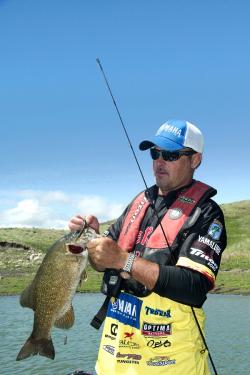
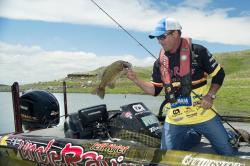
Jeff Kreit with a smallmouth caught finesse fishing

Jeff Kreit with a smallmouth caught finesse fishing

Finesse Tactics Often Best for Summer Smallmouths

Yamaha Pro Jeff Kriet shows a nice smallmouth that grabbed a drop-shot rig on South Dakota’s Lake Oahe. The finesse approach is just the ticket for clear water smallmouths.

On a recent trip to South Dakota’s Lake Oahe, often described as one of the nation’s premier smallmouth bass fisheries, Yamaha Pro Jeff Kriet left most of his fishing tackle in his truck. He didn’t forget it; he knew he wouldn’t need anything except two spinning rods and a box full of small soft plastic lures. By day’s end, he’d caught and released more than 30 smallmouths.

“For me, summertime smallmouth fishing in clear water means using finesse tactics, not heavy tackle,” explains Kriet, a veteran Bassmaster® Elite angler known for his expertise with light lines and small lures. “Once the water begins warming, the fish normally move a little deeper and for some reason also become a little more choosy about the lures they’ll hit.

“My own favorite presentation is a drop shot, in which the lure is located about a foot above the sinker, because it allows me to keep that lure in the strike zone as long as I want to, and it looks completely natural in the water.”

Among tournament pros like Kriet, the drop shot has become an extremely popular bass fishing technique because it also works in both shallow and deep water and brings strikes when other presentations fail. Kriet, in fact, admits he always has a drop shot outfit on his boat deck wherever he’s competing.

Slow is the way to go

Slow is the way to go

Kriet says that a slow retrieve with gentle movements usually works better for smallmouths in clear water.

“I start with six pound test fluorocarbon line on a medium action spinning reel,” explains the Yamaha Pro, “and generally tie either a 3/8 or 1/4 ounce sinker at the end of my line. Then, about 12 inches above the sinker, I tie a small No. 1 hook and thread on either a thin four inch plastic worm or some other lure that looks like a small shad.

“After I make a cast, I let the sinker reach bottom and then slowly drag it along until I reach some type of cover, like rocks, or logs. Then I just let it sit there and barely shake my rod to make the lure move. I really think the key to drop shotting is not over-working the lure with a lot of hops and jumps. The lure is not intrusive and the bass aren’t frightened by it the way they may be by larger, noisier lures.”

At times, summer smallmouth may also be suspended, and when Kriet sees them this way on his depthfinder, he usually fishes the drop shot vertically by simply dropping the lure straight down to them. Frequently, smallmouth either hit the lure as it falls, or they follow it to the bottom and then strike.

“One of the common misconceptions about a drop shot is that it is strictly a deep water technique,” Kriet continues, “but I frequently fish a drop shot in water less than five feet deep, and I know some pros who tie their hooks just three or four inches above the sinker and fish in water only a foot deep. Even rigging this way keeps the lure above the bottom, which allows bass to see it clearly.”

The drop shot rig uses a weight of 3/8 to 1/4 ounce about 12 inches below a number 1 hook, rigged with a 4-inch plastic worm or small plastic shad.

Another misconception about drop shotting, he adds, is that constantly shaking the lure will make it appear more natural to smallmouth, but in reality, just the opposite is true. In most instances, just barely moving the lure is more effective.

“I always shake my rod with a slack line so the sinker stays in place on the bottom and only the lure moves,” concludes the Yamaha Pro, “and I just barely twitch the rod instead of really shaking it like I sometimes do with a larger jig. The lure is going to be moving even when I’m not shaking the rod, due to water currents, and that’s the way a real minnow or shad behaves.

“When you fish a drop shot this way, just dragging the sinker slowly along the bottom and barely shaking your rod tip, it really becomes an easy way to fish for summer smallmouth, and best of all, it’s also one of the most effective ways to fish that I know.

“That’s why, when I see clear water in the summer, I know I can leave the rest of my tackle in the truck.”

What Can I Do If I Get A Spider In My Ear While Fishing?

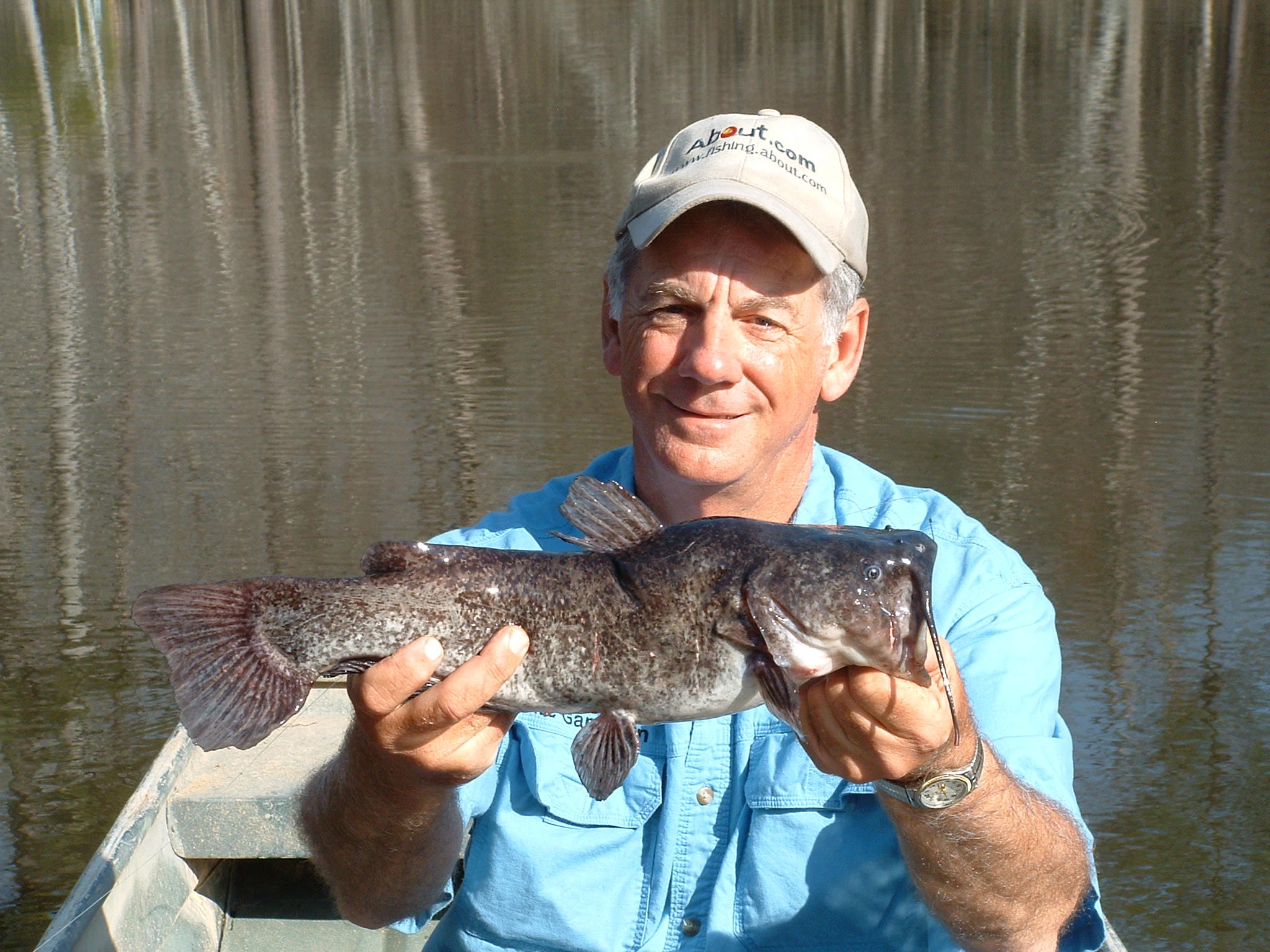
Catching bullheads and cats at night can be dangerous!

Catching bullheads and cats at night can be dangerous!

Watching a hospital show on TV last week brought back bad memories for me. On this show a guy came into the emergency room complaining about something in his ear. When the nurse looked into his ear with a flashlight he was horrified. One of his nightmares, a spider, was in the guy’s ear.

When running bank hooks at night at Clark’s Hill we usually checked them a couple of times after dark. Willow trees overhanging the water were good places to tie hooks but presented some problems. Lots of critters liked to hang out in those trees.

One night Linda was holding the flashlight while I baited a hook. When I stood up my head brushed one of the higher branches and I felt something on my ear. I brushed at it and told Linda to shine the light to see what was there.

Big mistake. It was a spider. Spiders don’t like light, so it went into the nearest dark hole it could find – my ear! I could feel it scrabbling around down in there on my eardrum, as far in as it would go.

Somehow I managed to get back to the trailer at the boat club and went inside. Mom and dad and Linda all tried to help, shining a light in my ear to see if they could do something but that just made the spider try to get away from the light, going deeper into my ear. I was about to go crazy feeling that thing moving around in there.

Finally mom poured some baby oil into my ear and the spider, not wanting to drown, popped out. It fell on the table and I hit it so hard with my fist the table jumped and made everything on it turn over. But that spider didn’t get back into my ear!

Another night I had just checked a hook and baited it up. When I stood up I grabbed a limb to steady myself and caught a glimpse of something that made my heart stop. There was a huge wasp nest about two inches from my hand and a foot from my face.

Luckily, wasps don’t fly at night and none came off the nest. But it was one of the worst scares I had running hooks.

Once while frog gigging with two friends I had a close encounter of the snakey kind. Bobby was in the back of the boat paddling, I was in the middle with the spotlight and Harold was in the front with the gig. We spotted a big frog under a willow tree and eased in toward it. I stood up so I could get a good angle with the light while Harold lay in the front of the boat with the gig.

As the front of the boat eased under the tree I grabbed a limb to steady myself and something made me shine my light on the limb. A few inches from my hand a water snake was lying on the limb, probably asleep. I didn’t scream or anything, I just told Bobby to back us out – in a very squeaky voice.

Harold figured out what was going on and later said he was afraid to move, he was expecting something to fall on his back any second. We all had a good laugh about it but went to the truck, got a .410 and sent that snake to reptile heaven.

If you fish at night you will have some exciting memories – if you survive them!

What Is Electrofishing To Catch Fish for Study?

Biologists study fish caught electrofishing

Biologists study fish caught electrofishing

A “Shocking Way to View Fish”

Editor’s Note: The following is from The Florida Fish Busters Bulletin, a service of The Florida Fish & Wildlife Commission written monthly by Bob Wattendorf.

An electrifying way to study fish

Not everyone can step up to the bow of a boat, lean against the railing, step on a pedal and start netting fish as they float up to the surface. However, biologists use various styles of electrofishing boats or backpack shockers to collect fish for scientific analyses and to help manage the fishery.

Florida Fish and Wildlife Conservation Commission (FWC) fishery biologists have college educations and special training to operate this equipment safely. For some professionals, it is one of the more enjoyable perquisites of the job. Just to be clear, it is illegal for any angler to fish with electricity. Only fishery biologists can use this method when conducting scientific sampling.

Electrofishing boats use a generator to create an electric current to shock fish in a way that temporarily stuns them. The current flows out in an electrical field between booms that hang off the front of the boat and the metal hull of the boat itself. The electric field does not kill the fish but can actually attract them toward the booms, before temporarily stunning those that swim within 6 to 8 feet. Biologists then scoop up the fish in knotless nets and place them in an aerated live well to recover.

The electricity’s effects on the fish are typically minimal. Several factors contribute to how long the fish remains stunned, including the size of the fish, the species, water temperature and conductivity, how close the fish is to the booms and how long the current is applied. In most cases, stunning occurs within a few seconds of the fish entering the electric field and lasts less than a couple minutes once the fish is removed from the electric field.

Biologists typically identify the fish by species, count and measure them, including their length and weight. Depending on the study, blood samples may be taken, stomach contents examined and tissue samples collected to determine mercury and pesticide levels, or the fish’s genetic makeup. Occasionally biologists transport some specimens to the lab or hatchery for further examination or for breeding purposes. Scientists may also harvest a few to examine their otoliths, or earbones, which, once cut and ground into thin slices, show growth rings that reveal their age.

In the field, biologists also collect data that can be used in conjunction with the fish data to evaluate the fishery and determine how best to manage the resource. For instance, they record water clarity, conductivity, dissolved oxygen and temperature, along with other information about the type of plants, specific location and substrate (for example, mud, gravel or sand). This is useful to determine why certain fish may be present or absent and to compare samples from year to year or with different water bodies.

Electrofishing can be much less damaging than methods that entangle or trap fish, such as seines, gillnets, wire traps or trawls, which may injure or kill them. It is an urban myth that electrofishing harms the eggs of female fish. In fact, biologists use electrofishing to collect brood fish to take to hatcheries to use as parent fish.

Electrofishing is one of the main tools that Florida’s fish biologists use to determine how healthy the fish population is in a particular pond, lake, river or canal. They then use that information to try to ensure the fish and their habitats are taken care of and to make fishing more enjoyable. For instance, it can help determine if specific habitat restoration efforts, stocking programs or conservation measures were successful or if measures are needed to enhance angler enjoyment.

Information from electrofishing and other sampling methods, including angler creel surveys – where we talk to anglers to determine what they caught – provide much of the information that we use in writing our quarterly fishing sites and forecast reports. Those reports, along with interviews with fishing guides and annual predictions for anglers of top fishing destinations for bass, bream, striper and catfish, are available at MyFWC.com/Fishing; select “Freshwater Fishing” then “Sites & Forecasts.”

Students at the Florida Youth Conservation Network learning about electrofishing.
Fisheries biology is a fun possibility for a career, for those who like science, nature and the outdoors. As part of the FWC effort to create the Next Generation that cares and to help sustain fisheries resources for the public, the FWC has created the Florida Youth Conservation Center Network (FYCCN.org).

A major part of the FYCCN effort goes toward hosting fish camps each summer around the state. The goal of Fishing and Basic Boating Skills Camps is to create life-long anglers and stewards of aquatic and fisheries resources. Licensed anglers and hunters, who choose to donate for youth fishing and hunting education programs when they buy their licenses, help fund these camps. Over the past four years, these camps have expanded from two to 15 locations across the state with a potential to reach 900 children. Besides being fun and informative camps help teach kids angling and boating skills, and introduce them to conservation stewardship and the possibilities of a future career.

A recently produced video highlights for camp participants how scientists use electrofishing. It provides information about common freshwater fishes and angler recognition programs. To see the video yourself, check out “A shocking way to view fish” on the FWC video channel at YouTube.com (http://bit.ly/YT-shock).

Growing Up Fishing A Branch

I miss Dearing Branch. That small branch ran across one of the property lines of the farm I grew up on and it was my summertime home. My friends and I spent many happy hours there during hot weather.

Every summer we would dam the branch trying to make a swimming hole. There was one fairly deep hole where the branch widened then narrowed down, running between two big sweet gum trees growing on either bank. That made the perfect place to dam it up.

We did things that would have made us rebel if our parents had made up work so hard. We would take croaker sacks and fill them with sand to stop the water flow. Have you ever tried to move a big sack of wet sand? We soon learned to fill them very near where we wanted to place them.

One summer dad got some cross ties to use around the farm and we managed to drag one across the field, into the woods and to the branch. It gave our dam the backbone needed to hold the sacks and that summer we got a swimming hole with enough water to come up to our chins while standing up. We could actually swim some in it a little, but the hole was only about 15 feet wide and 20 feet long at most. It was still huge to us boys.

The cool water was great and a welcome relief after the hard work building the dam. We never bothered with bathing suits, we just stripped down and went skinny dipping. But the first heavy rainstorm would wash our dam away and we would have to start all over again. We never gave up, though.

Most summers near the end of August the branch would almost dry up and we would try to rescue the fish. We had a good supply of water at the house so we would carry the small catfish and bream up to the back yard in buckets and put them in wash tubs. A hose kept water running into the tubs and we learned to place them so the water cascaded from one to another, keeping several full.

The fish never lived more than a few days. And we never thought about the conflict between trying to rescue fish one day then going to a local pond, catching fish and cleaning them to eat the next day. Such were the ideals of youth.

I loved fishing in the branch, too. My greatest thrill was getting small bream and branch minnows to hit a “fly” made out of chicken feathers that I tied on a small bream hook with some of mom’s sewing thread. I would spend hours dangling the small bait near a stump in a hole in the bank of the branch trying to lure the skittish fish out. They were great trophies but I always let them go.

I guess what I really miss are the long, seemingly endless summer days of my youth, where a small bream was a trophy, we thought we could control our world with dams and dreams, and the responsibilities of adult life were still far in the future.

Soft Shell Turtles

The snapping turtle has not shown itself in my pond again. I guess being pulled out of the water by the tail gave it the idea my dock is not a great place to hang out. I have seen some little one swimming around. They look to be about a year old and I can’t tell yet if they are common snappers or Alligator Snappers. When they get older their characteristics will develop.

Back in May when we fished a tournament at West Point I saw more soft shell turtles than I had seen in years. They seemed to be in every cove, probably getting ready to lay eggs. They ranged in size from a few inches across the shell to one that looked to be about two feet wide.

Soft shell turtles are very shy, probably because of their soft shell. The shell is not really soft, it feels like leather, but it is not near the protection a hard shell would be. The soft shell makes them much easier to clean so they are prized for those wanting fried turtle or turtle stew.

These turtles look very different, even in the water. The first thing you notice is how flat they are. They look like a pancake! And their shell is usually a light brown, contrasting with the dark brown to black of most other turtles. Since they don’t come out of the water except to lay eggs I guess the color blends in better with the lake bottom. They spend most of their lives buried in the sand or mud of a lake or pond bottom, often shallow enough to stick their long neck up to breath without moving.

Their heads look very different, too. The nose is very extended, almost like a snorkel. Since it is so long they can stay deeper in the water with more of their head hidden and still breathe. They usually come up for air then disappear for a long time if you see them swimming around.

Last Sunday in the Flint River tournament I saw two soft shells swimming around. They were huge. One looked like it was well over two feet across its back. That means it was probably a female since they get much bigger then males.

Keep your eyes open while on area lakes. You might sight one of these strange turtles, especially if you are at West Point.

Turtles and Fishing

Turtle stew, anyone?

A few days ago I was fishing from my dock and noticed a light brown shape under the water several yards from me. It gradually got bigger then a head about the size of my fist came near the surface. A big snapping turtle had taken up residence in the pond.

Snapping turtles are usually very cautious but this one got a gulp of air, gradually sank and eased off. I could follow its progress across the pond since its light brown color showed up in the sun. It would slowly swim about 20 feet then come to the top for air again. It worked all the way across the pond like this until I lost sight of it.

Thursday I was on the dock again and the cloud of bluegill around me waiting on a handout suddenly started acting strange. They would open up and move away from something. Then I saw the light brown shape down deep under them. Slowly the snapper came to the top. I stayed perfectly still and it did not see me although it was only about five feet away.

It got a breath of air then its front end sank down while its rear stayed right on the surface. It floated in this position, looking for all the world like a floating chunk of wood. Its head was pulled back near its shell.

When a bluegill got near its head it would strike out at it. Anyone who has ever held a snapper up by its tail knows they have very long necks and can almost reach around to their tail. This one could strike out about a foot. I saw it try for three different bluegill but it never got one that I saw.

Friday it was back. When it came up a few feet from the dock and went into its hunting position I threw some food past it. The bluegill splashing around made small waves that pushed the floating turtle to the dock. I was able to reach down and grab its tail. When I lifted it out of the water it looked around at me like it wondered what was going on.

The turtle felt like it weighed about 15 pounds and its shell is about 20 inches long and 16 inches wide. I dropped it back into the water and it quickly swam off. I started to kill it then decided there were plenty of bluegill for both of us. Also, I thought I remembered they are a protected species.

We have two kind of snapping turtles around here. The one in my pond was an alligator snapping turtle, often called a loggerhead. They have huge heads and ridges that are almost spikes on their shell. They get big. The one in my pond looked pretty big until I remembered the picture I was shown several years ago. It showed a man standing by a turtle hanging from a tree by its tail, and it was taller than him.

I was told, if I remember right, that the turtle was caught in Lake Blackshear back in the 1960s and weighed 115 pounds. The biggest alligator snapper known is a 236 pounder living at the Brookfield Zoo near Chicago. There are unverified reports of a 403 pound snapper caught in the Neosho River in Kansas in 1937.

The common snapping turtle is smaller and has a smooth shell. Its head is big but not nearly as big as the alligator snapper. It too has a long tail but it is not as thick as the alligator snapper. The biggest one recorded was 18 ½ inches long.

I found a dead alligator snapper on the dam of my lower pond a few years ago. When stretched out on the tailgate of my truck, with the head and tail fully extended, it came within a few inches of spanning the whole width of the tailgate. The shell was about one third of its length with the head, neck and tail making up the rest.

Another alligator snapping turtle somehow got into a beaver trap I had set out a few years ago. The trap grabbed its head and drowned it. A third one got on a baited hook I had put out for catfish in my lower pond. I caught it soon after some baby geese, the first to every hatch on the pond, disappeared. I thought it may have eaten them but found out it is more likely the parents walked them off.

I have eaten turtle a few times. The first was when I was doing yard work in Athens when I was in college. The lady I worked for usually gave me lunch and one day she had turtle stew. It was pretty good.

Turtles are interesting and our world is full of many kinds, if you just happen to be in the right place at the right time to see them.

What Are Some Postspawn Topwater Tactics?

Mike Murphy caught this nice largemouth on topwater baits

Mike Murphy caught this nice largemouth on topwater baits

Michael Murphy’s Postspawn Topwater Tactics:

(Today’s feature comes to us from Scott Estes at Denali Rods)

It’s almost like clockwork each year. You’re on fish all through the spring, spend a few weeks having a blast fishing the spawn, then they simply disappear. Call it a post-spawn funk, recovery period, or whatever; but it can be downright difficult to put any kind of consistent pattern together in the period immediately following the spawn.

Former FLW pro Michael Murphy thinks a lot of anglers make this time more difficult than they have to, saying “That immediate post-spawn period is hard for a lot of guys and there are a number of reasons for that. I think the biggest is that guys spend too much time thinking about where the fish are going, and not enough time covering water with a topwater, something that I have consistently caught them doing when the fish come off the bed.”

Early Spawners

The secret to Murphy’s topwater confidence is his observation that there is almost always a group of fish that spawns before the “official spawn” brings anglers up shallow. Those fish are often already recovered by the time the bulk of the spawn winds down, and he begins targeting them while other anglers are still looking for fish on beds.

“I know that most bass spawn in that 66-70 degree range, but I’ve personally seen lots of fish up well before that, so often those fish are already done and recovered by the time most guys think the spawn is in full swing. As soon as the water starts to get to about 65 degrees, I begin targeting those fish that are already done and a topwater is a huge focus in my approach.”

Revenge?

Murphy thinks the driving force behind post-spawners propensity for devouring topwater offerings is that they are turning the tables on the bluegills that were predominant nest predators during the bass spawn, saying “Those bass had to put up with pesky bluegills raiding their nests the whole time they were trying to get their business done; as soon as those bass come off the bed, it’s on and you don’t want to be a bluegill near an angry post-spawn five pounder.”

It’s for this reason that the South Carolina angler relies on a lot of bluegill imitating baits during the post-spawn. “You can get a wide variety of topwater baits today that do a phenomenal job of imitating bluegill. Anything from a prop bait to a frog can work wonders at imitating a crippled bluegill when targeting shallow water post spawn fish, you just need to keep that in mind and stay in areas that bluegill frequent.”

Where to look

On reservoirs, the bass often spawn a little earlier in the upper ends due to increased color and shallow water causing it to warm up faster, so it makes sense that Murphy usually starts up there when looking for recovering post spawners.

“I like to pay attention to spawning areas up the rivers, places like the backs of major creeks and pockets off the channel. Once there, I try to find flats and stretches of bank near the last 6-10 foot deep water in the area. They’re usually gonna be on some type of cover close by. Things like docks, laydowns, stumps, and rocks are all dynamite for holding post spawn fish that you can dupe with a topwater.”

The Gear

Because he uses a target oriented approach, Murphy dotes on his Denali signature series 6’8″ topwater/jerkbait rod for most of his postspawn topwater fishing because its shorter length allows for extremely accurate casting.

He pairs the rod with a high-speed Lews BB-1 casting reel spooled exclusively with monofilament, saying “you need that stretch with treble hooks, and I’ve found that I land many more fish in close quarters with mono than any other type of line. I use 20 lb Toray Bawo Polyamide Plus almost exclusively and am extremely confident with that setup.”

Murphy’s bait choices depend a lot on water clarity. In clear water he likes prop baits like the Deps Buzzjet, Ima Skimmer, and the floating Ima Flit 120, which he works like a wakebait. In stained water, Murphy throws a popper like the Deps Pulsecod or a Kahara hollow bodied Frog, saying “It’s really a tight quarters, commotion deal so I utilize several baits and let the fish tell me what they prefer. The dirtier the water, the larger commotion I like to cause.”

One of the things Murphy likes most about fishing the immediate post-spawn with topwaters is that it gets you fishing in the right water depth and around the same types of cover that become boat-loading spots once the next phase of the season unfolds, the shad spawn. “If you are already up shallow fishing topwater, you’ll be right there to get the most out of it once the shad start spawning, something that anglers chasing their tails out on the main lake won’t find nearly as quickly.”

This early topwater pattern isn’t necessarily a recipe for having big numbers days, but Murphy believes that as a tournament pattern it still shines because the fish you do catch are going to be the right ones. “Another reason a lot of guys don’t devote a ton of time to fishing topwater during the immediate post spawn is because you may not get a ton of bites. They are missing out, as I can guarantee you that almost every fish you do catch doing it will be one that gets brought to the stage.”

How Can I Keep Cool While Fishing In the Summer?

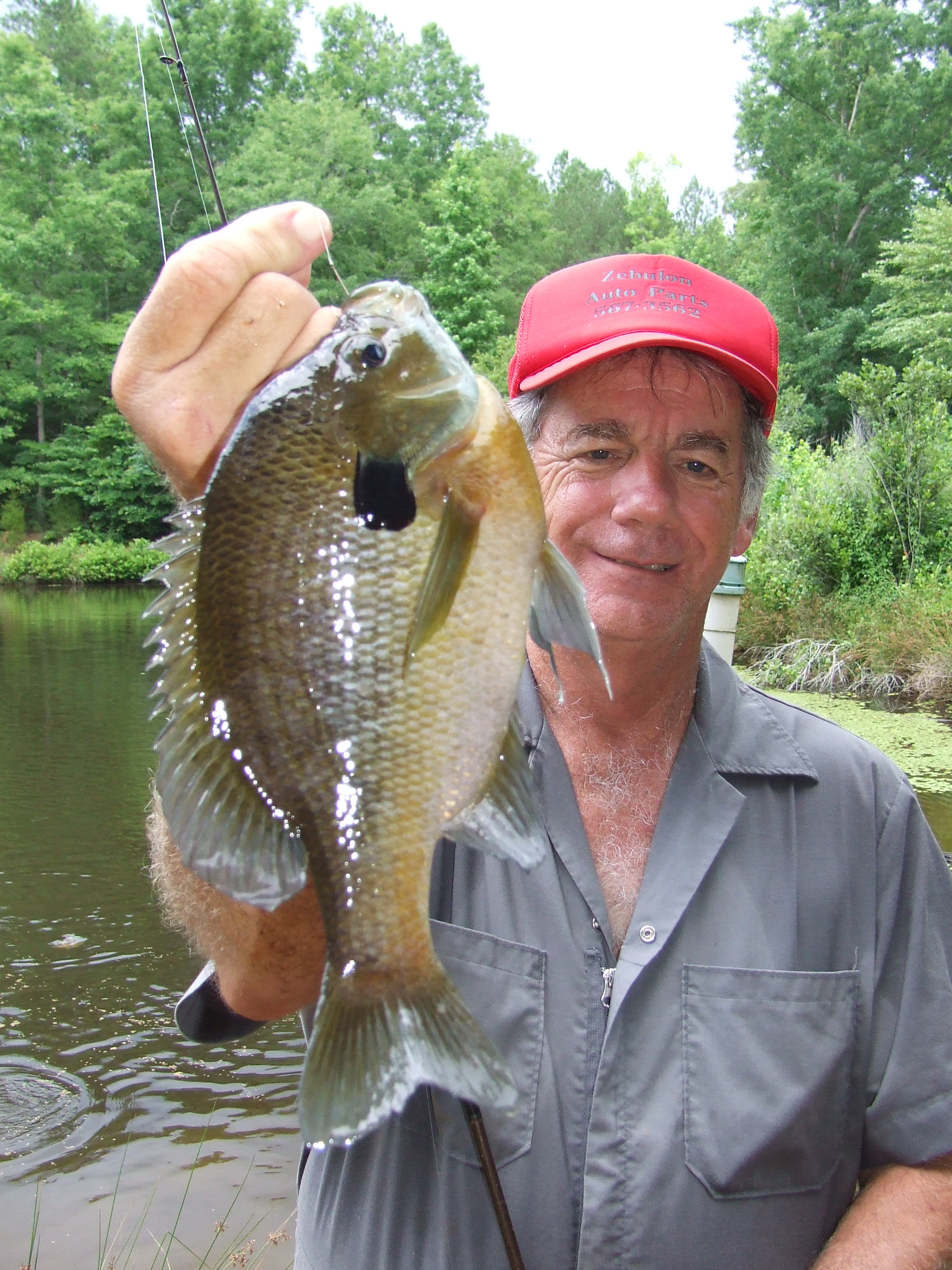
Its hot, yes I am wet with sweat, but this bluegill put a smile on my face

Its hot, yes I am wet with sweat, but this bluegill put a smile on my face

Its so hot I saw a dog chasing a cat and both were walking. Its so hot I dug a potato from my garden and it was already baked. Its so hot my chickens are laying boiled eggs. Its so hot robins are using pot holders to pull worms out of the ground. Its so hot I saw two trees fighting over a dog.

Its so hot the global warming true believers are having field day claiming our record setting temperatures prove they are right. But when I ask them what caused the previous records we are breaking, those only one degree cooler set back in the 1930s, they can only reply with a blank stare. Must have been all those depression era SUVs everyone was driving.

Its so hot I almost don’t want to go fishing!

Last Sunday I spent the morning on Millers Ferry Lake in Alabama getting information and pictures for an Alabama Outdoor News article. It was miserable by 9:00 AM and unbearable by noon when we quit. I thought about jumping in to cool off but realized I could not get any wetter. I sweated so much the money in my wallet was wet.

There are many ways to keep fishing and beat the heat. Fishing at night is my favorite. Not only is it cooler, you avoid sun problems and the fish bite better. The Flint River Bass Club scheduled our July tournament this Sunday at Sinclair from 4:00 AM to Noon. And the Spalding County Sportsman Club always fishes night tournaments in July and August because of the heat.

Jumping in the water does usually help since the water is normally cooler than the air. Dipping your cap in the water helps keep your head and the rest of you cool, too. I carry a change of clothes in my boat since I don’t want to drive home in wet clothes, but wet clothes sure do feel good while fishing.

Riding around in the boat creates a breeze that helps so I usually don’t stay in one place a long time. That can help you catch fish, too. Last Sunday we fished over a dozen different places in five hours and caught fish on only one of them. Finding some feeding fish is easier if you keep moving. At least that is my excuse.

Finding any place on the water with breeze helps a lot and bass seem to feed better with some wind, too. So fish anywhere you can stay where the air is moving, like out on a point on the main lake, if you can fight the boat traffic and waves.

Drinking lots of cold drinks helps cool you off a little but more importantly keeps you hydrated. That is very important when you are sweating a lot. Water is probably best but I like Diet Rite Cola. It quenches my thirst better and has no sodium, sugar or caffeine. You do need salt when sweating a lot but I would get too much if I drank colas with salt in them. But I do crave salt and vinegar potato chips driving home after every fishing trip this time of year.

If you fish during the day sunscreen is critical. I put on 100 SPF before leaving the house and carry a spray on sunscreen in the boat to refresh it during the day. I like a baby sunscreen since it doesn’t burn my eyes, and it is going to get in your eyes during the day from sweating, no matter what you do.

Fishing in the shade helps, too. I often try to find a shady bank or get under a bridge to avoid the sun. And the bass like shad as much as I do.

The right clothes can help. Light colored shirts and pants are not as hot as darker colors. I have several kinds of shoes that are well ventilated. And a cap or hat with a big brim can shade your eyes and ears. I don’t like to wear shorts or sandals. Keeping the sun off my skin seems to keep me cooler.

Even as hot as it is, I still prefer fishing to sitting at home with the AC at full blast. So go fishing but try to beat the heat any way you can.