What Are Coast Guard Safety Inspections?

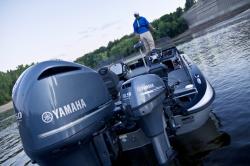
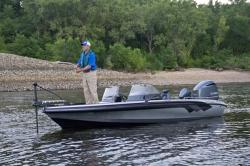
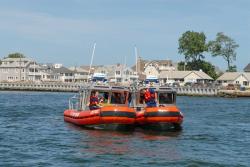
Boats like these may check your boat.

Boats like these may check your boat.

Coast Guard Safety Inspections
from The Fishing Wire

Is your boat equipped and ready to pass one? It should be.

Coast Guard safety inspections can be performed any time you’re boating in an area supervised by the Coast Guard–have your boat ready for them.

It was a hot Saturday afternoon in July, and the river was busy with boats returning from the ocean waiting to pass through a narrow railroad bridge a quarter mile from the inlet. There were recreational boats of all sizes-large sportfish and cruiser types, personal watercraft and outboards of very description. While waiting to make the passage, a familiar orange vessel appeared off our starboard side with its blue revolving light shining brightly. It was a Coast Guard RIB, short for rigid inflatable boat, and a guardsman was standing on the bow motioning to our boat.

“Good afternoon, Captain,” he said. “We would like to conduct a safety inspection of your vessel. May we board, please?”

Coast Guard inspections of this type are mandatory so the question was a courtesy. A boater can either be pleasant or confrontational, but there is never a good reason for not complying. This is especially true when you think about the difficult job these hard-working men and women undertake, and that they put their lives on the line when called on to make hazardous rescues at sea.

So my appropriate response was a pleasant greeting and a simple welcome aboard. The coxswain, the guardsman at the helm of the RIB, brought the boat alongside and two others, wearing dark blue uniforms and bright orange PFDs, stepped aboard. The boarding officer announced his intention: to identify the vessel, the owner and the operator, check the paperwork and conduct an inspection to be sure it had all the safety equipment required by Federal Regulation for that classification of recreational vessel.

“You may continue through the bridge,” the officer said, “and proceed to your destination while we conduct the inspection so we don’t slow your progress.”

A “ditch bag” you’ll take with you if you ever have to abandon ship is always a good idea. Including an EPIRB, VHF and handheld GPS is a good idea if you boat on large bodies of water.

He told us that the crew in the RIB would follow along and pick them up when the inspection was finished. He then asked for our vessel registration, which is mandatory, and the operator’s driver’s license, social security number and date of birth, which is voluntary. Since we were in a state that requires a vessel operator to have a safe boating course certification, that certificate was also provided with the other documents. The documents were passed from the boarding officer to the other guardsman, who entered the data into a hand-held electronic touch-pad device with a built-in printer.

The next step was a check of the mandatory safety equipment on board. Since we were wearing inflatable PFDs at the time, they were checked to assure both were Coast Guard-approved and properly armed. An approved PFD is required for every person on board a recreational vessel, so we keep a valise stowed in the console with four additional Type III units. A throwable floatation device is also required, which can consist of an approved life ring or a flotation cushion. That was also checked to be sure it was in good condition.

During the inspection, an interesting discussion with the boarding officer ensued about the whole procedure. He explained that it was the Coast Guard’s policy to do safety inspections as a method of outreach to the boating public to impress upon them the importance of carrying the necessary safety equipment in case of an emergency.

Next, he asked to see and test our audible signaling device, a horn, which can be an electric horn mounted on the vessel or a hand-held device powered by a compressed air canister. Then he requested we show him the boat’s emergency flares to make sure we had them aboard and that they were not expired. All flares have expiration dates stamped on them and should be properly disposed of and replaced when that date is exceeded. The flares are kept in a “ditch bag” stowed in the console and when we took it out, the boarding officer was duly impressed. He asked if he could look inside and was surprised to see a PLB (personal locator beacon), a waterproof hand-held VHF radio, additional signaling devices and flares.

Inflatable PFD’s are cool and comfortable, but be sure the CO2 cartridge is fully-charged and functional.

When the inspection was complete, the boarding officer gave the vessel a once over, complimented us on the fact that our safety equipment went above and beyond regulations, noted the vessel was well maintained and organized, and thanked us for our cooperation. The guardsman recording the results of the inspection asked our captain to sign the touch-pad on his device, and it printed out a boarding report indicating that the vessel had no violations or warnings. If the inspection had uncovered any flagrant violations, a summons that can include civil penalties would have been issued. If the violations were minor in the judgment of the boarding officer, a warning can be issued and a follow-up inspection could be required to make sure it was satisfied. It’s important to keep any completed boarding reports aboard your vessel. These reports can be shown to Coast Guard officials in the future and can help you avoid a repeat inspection within a specified time period.

The entire experience lasted about 15 minutes, and at all times the boarding officer was courteous, friendly, knowledgeable and professional, willing to answer any questions and provide additional information on the procedure and the equipment requirements.

The question is, “Are you ready to pass a Coast Guard Safety Inspection?” If you would like to find out more about recreational vessel safety regulations, go to the Coast Guard Boating Safety Resource Center at
www.uscgboating.org.

You can even find a local provider that will conduct a comprehensive safety survey of your vessel to make sure it is in top operating condition and equipped with all the necessary equipment.
Fishing Muddy Water

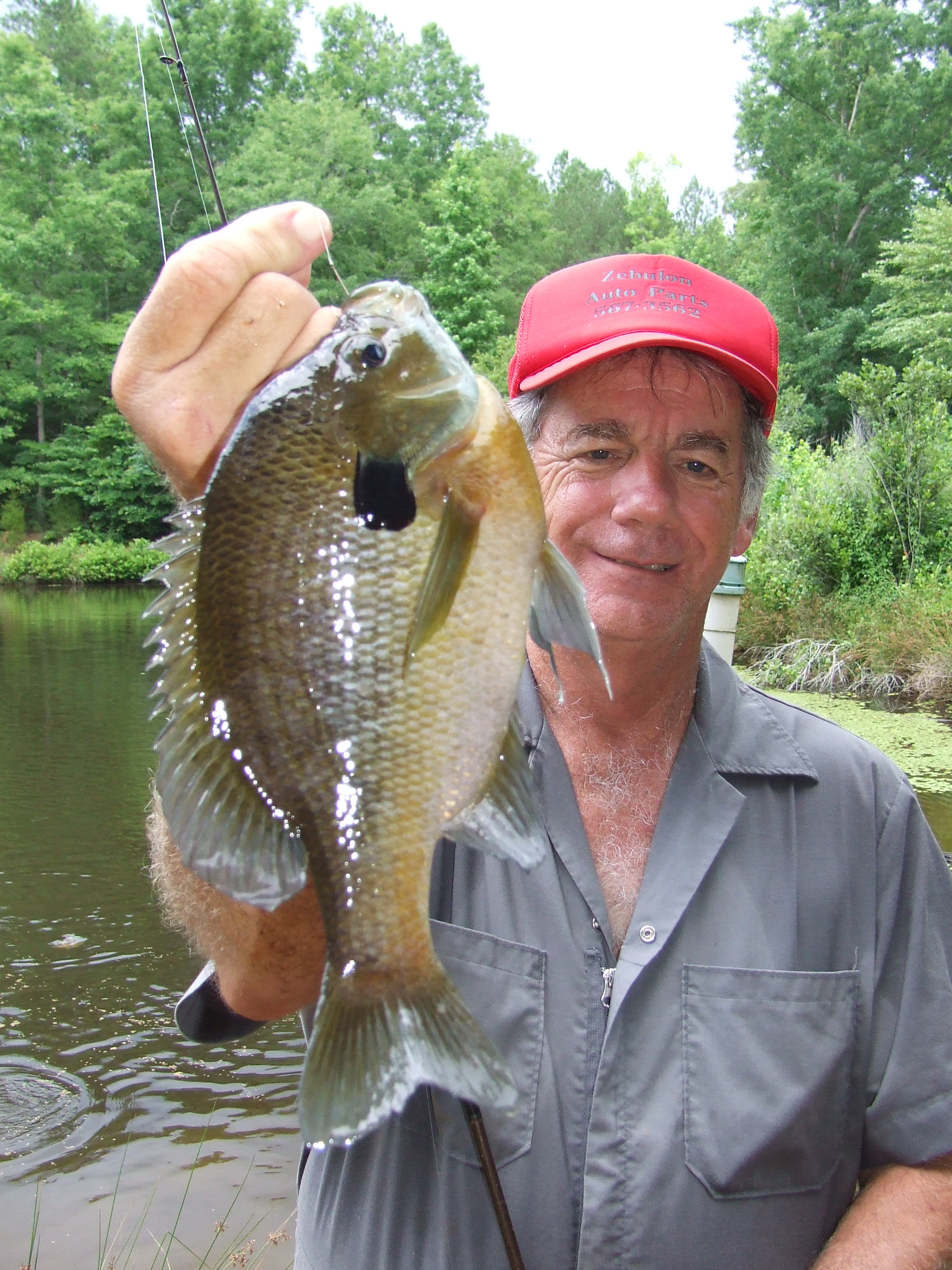
Its hot, yes I am wet with sweat, but this bluegill put a smile on my face

Its hot, yes I am wet with sweat, but this bluegill put a smile on my face

All the rain the past few weeks has made fishing interesting in my ponds. Both ponds got pretty muddy and that made the bream bite better. Since I fish out there most days and let most of the bream go that I catch, I have taught the danger of a hook. I often see a bream, especially the bigger ones, swim up to a piece of food on the #6 hook and stop. It is like they are thinking “I know there is a catch to this, I have seen something like this before.”

Muddy water makes it harder for them to see the hook as does other low light conditions. Late in the afternoon and early in the morning the bream bite better. Some wind rippling the surface of the water also breaks up the light and makes it harder for them to see the hook.

Bass fishermen should take note. If bream can learn to avoid hooks, I am sure bass can, too. And bass get fished hard on our big lakes. One nice weekends you often have to take a number and get in line to fish a good point on many of our lakes.

There is an old joke that the bass at Jackson Lake know the Bass Pro Shops catalog number of each plug they see. That is one reason a new bait can be hot for a time when it first comes out then the fish seem to stop hitting it. They learn what it looks like and how it moves in the water.

Fishing for bass under low light conditions works. Early morning and late afternoon, as well as after dark, is more comfortable and the bass bite better. Wind blowing onto a point is a classic type situation to catch bass and the disturbed surface and water makes it harder for the bass to see the bait and more likely they are going to hit.

There is no bad time to go fishing but some times are better than others for catching. Go any time you can but take advantage of anything that makes it harder for fish to see your bait. Under those conditions fishing is more likely to also be catching.

Can I Catch More Walleye On Artificials Or On Live Bait?

Use Artificials To Catch More Walleyes? Leave the Live Bait at Home.

You can catch walleye like this on artificial baits

You can catch walleye like this on artificial baits

Meatless Walleyes
from The Fishing Wire

Like a lot anglers in the heart of walleye country, Steve Pennaz finds himself using live bait less often when pursuing ol’ marble eyes.

“Ten years ago live bait was my go-to offering when fishing walleyes,” said Pennaz. “Today, I use it only occasionally, maybe 10 percent of the time.”

Flavored artificials work just as well as live baits for walleyes, and stay on the hook much better.

Across the walleye belt, regulations on the transportation of live bait have been significantly tightened to slow the spread of invasive species like zebra mussels. In states like Wisconsin and Minnesota, anglers are now required drain their bilge, livewell and baitwell prior to exiting the lake access area. They must also empty all live bait containers of lake water and replace it with tap or bottled water if they want to transport their minnows elsewhere.

Even the use of dead bait is highly regulated. But these regulations are not the reason Pennaz usually bypasses live bait these days.

“It’s simple,” says the long-time Yamaha pro. “There are better options, even when you leave crankbaits out of the equation.

“It used to be I would automatically reach for a minnow, nightcrawler or leech when fishing walleyes,” says Pennaz. “Then, I fished with one of country’s most successful river walleye anglers. I was shocked when he told me he never used live bait. His bait of choice was a soft plastic shad. I soon learned what he already knew…not only do soft plastics work for walleyes, they are often the best choice.

You can cast artifiicals for walleye

You can cast artifiicals for walleye

Whether casting or slow-trolling, a jig or spinner trimmed with a flavored soft bait can turn on the walleye bite.

“Look at the advantages: You can fish them fast, making it easier to cover water quickly. They hold up better than live bait in waters where panfish are a problem. And they come in a wide variety of colors, shapes and sizes, which makes it really easy to fine-tune your presentation.

“My favorite soft bait for walleyes is the 3-inch swimming grub, though it soon may be replaced by the 4-inch ring worm. Both baits fish well on light jigs; I generally use 1/16- and 1/8-ounce most often.

“The third option includes minnow imitators like the 3- and 4-inch Gulp!® and PowerBait® minnows. I also fish these baits on a jig, hooking them like a live minnow (hook running from bottom to top through the head).

“I fish Gulp!® and PowerBait® minnows exactly the same way I fish live minnows. However, I am not afraid to work them more aggressively when fish are active.

“Years back, I was fishing Rainy Lake with a friend from the South. We located an offshore hump that topped out at 23 feet, with 75 feet of water surrounding it. The place was crawling with walleyes, but after an hour of dragging live leeches and nightcrawlers through them we had caught just six fish.

“My buddy finally threw up his hands and said, ‘I can’t fish like this; give me another option.’ So I switched him to a 3/8-ounce jig, tipped it with a 4-inch PowerBait® minnow and told him to snap jig. His jig strokes started looking like hook-sets. Just seconds later he was into his first fish. We landed 42 more in the next hour.”

Meatless Spinner Rigs

Dragging a bait works well

Dragging a bait works well

Dragging a soft plastic down a gravel bar or over an offshore hump is a sure way to find fish.

As deadly as spinners are on walleye, there is still much to be learned about this combination of blade, beads and bait. Traditional walleye anglers still tip their spinner rig with a lively nightcrawler, but Pennaz has found artificials offer definite advantages over the real thing.

“The challenge with using real crawlers is simple…every freshwater fish on the planet likes to eat them. So when your spinner flashes by a school of perch or bluegill they almost always attack the ‘crawler and you are left with a mess or two bare hooks.
“To combat this problem, I started experimenting with the use of plastic worms on spinner rigs. The problem is, none I tried ever worked well. That changed when Berkley® came out with the Gulp!® Crawler. Unlike the worms I had tried before, this one was only four inches long and featured a small paddle that swims back-and-forth, even at a slow retrieve of a spinner rig.

“I’ve found that real nightcrawlers and the Gulp!® Crawler produce about the same number of fish when fished on spinners, and there is no mess with the Gulp!.®

“On Green Bay once I tipped a spinner with a chartreuse/pepper Gulp!® Crawler. The thing was so bright I laughed when letting out the planer board. A half-hour later a 9-pound stud inhaled that bait. Yes, I was stunned.”

Going meatless for walleye? Sounds like an idea whose time has come.
(P

Alaska Wildlife

Whales were everywhere!

Whales were everywhere!

Some of my best memories of the Alaska trip three years ago are of critters I can’t hunt or catch. Whales, sea lions, seals, orcas and dolphins all accompanied us on our cruise and we saw some of them most every day. And the day we visited a glacier and watch it calve, hearing the thunderous roar as huge chunks of ice fell into the bay, was amazing.

The first day out of Juneau we cruised into an arm of a fiord formed by glaciers over the past thousands of years and started seeing icebergs. The further up the fiord we traveled the thicker the ice got. While standing on the bridge beside the captain an watching the beautiful floating ice cubes I spotted movement.

Through binoculars I could see a spout and thought it might be dolphins, then saw something bigger, black and white, surface for a second. I asked the captain if there were killer whales in this area and he said yes, they came in there to hunt the harbor seals that had pups on the ice floes. I pointed out the movement to him and soon we spotted a pod of orcas surfacing as they moved up the fiord.

We were able to follow them for many minutes, watching as one big male with a huge dorsal fin kept to himself. Females, a couple with smaller versions of themselves, were closer together. The calves kept close to mama, following her every move.

A few days later we were halibut fishing and a big pod of orcas came by. Some would breech, jumping completely out of the water. A couple of the skiffs followed them but we kept fishing, trying to get our limit of halibut. Our boat got five that day for four fishermen, better than any of the others, but we missed most of the orca show.

For all one afternoon we cruised among humpback whales. At first when we saw the big spouts as they blew before diving everyone got excited. Several hours late they had to do something spectacular to draw an “ooh” or “ah,” like a breech by jumping out of the water or tail or fin slap. One whale slapped its long pectoral fin over and over. Later one slapped its tail repeatedly.

We were not allowed to approach them but several times they swam right up toward the ship. We watched one dive and blow a bubble ring, then come up in it to eat the small fish trapped by its “net.” At times we could see a dozen or more whales at one time.

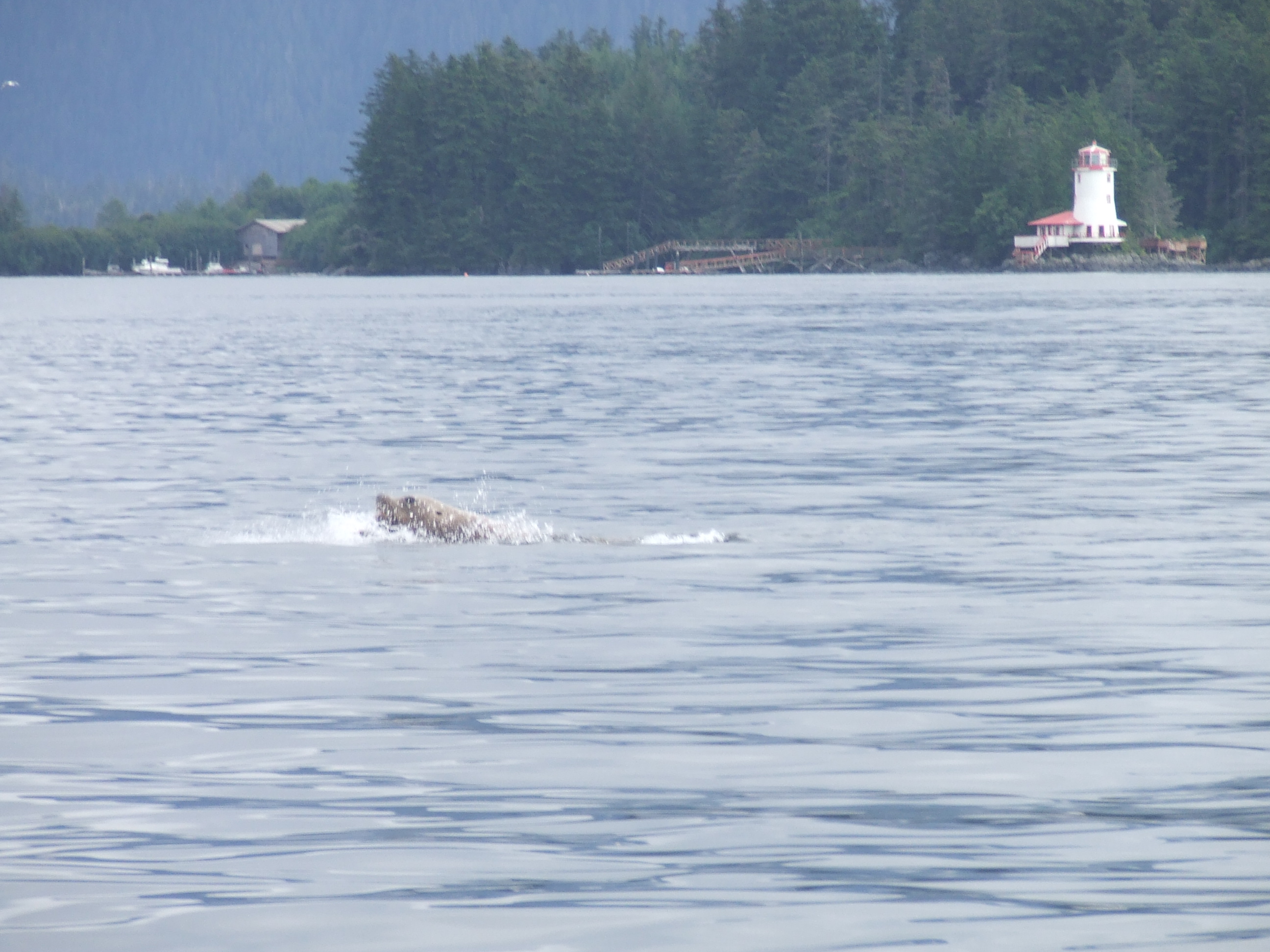
A huge colony of Stella Sea Lions made lots of noise and smelled horrible, even from a couple of hundred yards out from where they fought on the beach. It was amazing, the sand and rocks were solid with their huge bodies and every time one moved several around it seemed to get mad and make noise, so the whole time there was constant movement and fussing.

The day we visited the glacier we got within a quarter mile of its face in the 18 foot skiffs and drank hot chocolate, braced with a little Bailey’s Irish Cream, while chunks of ice the size of our bigger ship fell into the water. The waves they created made big swells that made us hold on, even a quarter mile away, and ice bergs that fell earlier floated all around the skiff.

We watched harbor seals swim around us and lay on ice bergs near the glacier. Some of the bergs were an unbelievable blue, a color you just don’t normally see. And small dolphins often swam near the ship in their constant hunt for food.

A trip like this makes me realize how much wildlife there is left in places man has not destroyed – yet.

Fishing and Boating with Dogs

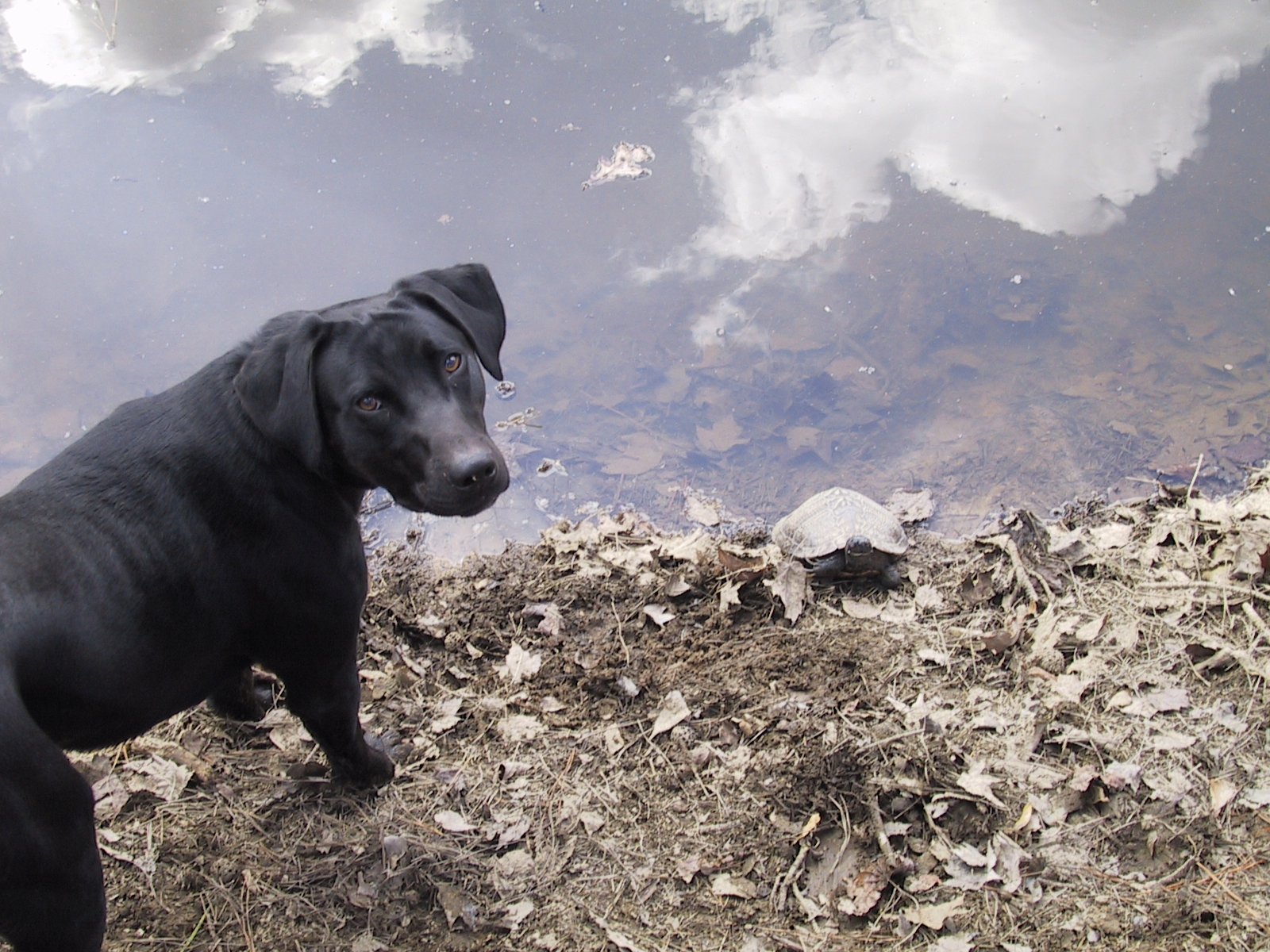
My dog Rip loved to go fishing with me

My dog Rip loved to go fishing with me

The Boating Dog’s Days of Summer

BoatUS: Tips on Boating with Dogs
from The Fishing Wire

ALEXANDRIA, Va.,- Some dogs were born for the water, others less so. The key to boating with dogs, says Boat Owners Association of The United States (BoatUS), is taking it slow and making safety #1. Here are eight tips to get you started:

Before you go:

Get a good fitting life jacket and have the dog wear it a few times around the home before they get on a boat. Any pet life jacket should have a handle to easily lift the animal out of the water. Here’s a buying guide for dogs of all sizes: www.BoatUS.com/doglifejacket.

Have a special ID tag with the name of the boat, marina, slip number and cellphone number on it just in case. If the dog gets lost, it’s a lot easier for the person who finds them to get them back to you quickly.

If there is any chance you’ll be going to Canada and Mexico, make sure you have current rabies vaccine and other shot documentation with you as dog tags are not acceptable proof of immunizations. It is also a good idea to check with customs because the rules and requirements often change.

Getting started:

Familiarize the dog with the boat slowly – don’t just get on the boat and leave the dock right away. Ideally, bring the dog to the boat for the first time without leaving the dock, and let give them a chance to sniff around and get their sea legs. It may help to start the engine so they are used the sound.

Plan for falls overboard, either from the boat or dock. If the dog falls overboard underway – or jumps in – you may be able to circle back and retrieve Fido just like a fallen water skiier, pulling up slowly, cutting the engine and luring the dog to the swim platform with a treat. If you don’t have swim platform, smaller dogs may be lifted over the side by their life jacket handle, but bigger dogs may require a different solution. If a dog falls off a dock, know that seawall bulkheads may prevent the animal from a self-rescue.

Bring plenty of water and make sure there’s some place the dog can get out of the sun and stay as cool as possible. Know the symptoms of dog heat stroke. While seasick dogs may vomit, that’s also one sign of heat stroke. Rapid, loud or difficulty breathing, extreme thirst, thick saliva, disorientation and a bright red tongue and pale gums are a few of the others.

If you’re going to be out on the boat for more than a few hours, plan on how your dog will relieve themselves, and pick up after your dog, no matter where they go. If you see where someone else didn’t pick up after their dog, pick it up for them. You don’t want to give any opportunity to show why dogs shouldn’t be allowed in your marina, and your boating friends will love you for it.

Does your boat’s insurance policy cover pets? All BoatUS policies do. For more information go to BoatUS.com/insurance/pets.

About BoatUS:

Boat Owners Association of The United States (BoatUS) is the nation’s leading advocate for recreational boaters providing its over half-million members with government representation, services such as 24-hour on the water boat towing as well as roadside assistance for boat trailers and tow vehicles, feature-packed boat insurance programs, money-saving benefits that include marina and West Marine shopping discounts, and vital information that improves the boating, fishing and sailing lifestyle. Its member-funded BoatUS Foundation is a national leader promoting safe, clean and responsible boating.

Shakespeare Ugly Stik GX2 Spinning Outfit Review

Shakespeare makes good products

Shakespeare makes good products

I recently received a Ugly Stick GX2 rod paired with a Shakespeare 5.2 to 1 ratio spinning reel to test. I spooled the reel with ten pound test Trilene line and tied on a Norman’s DD22N to see if it would work for deep cranking.

Ugly Sticks are tough rods and mostly used for fishing for catfish and stripers in freshwater. They are also great in saltwater. These rods are made to take the abuse big fish, and fishermen, can give them. Since I mostly fish for bass and am trying to get better at deep cranking, I wanted an alternative to a casting outfit. As I have gotten older it is harder for me to deep crank for hours and I thought being able to switch between a spinning out fit and a casting outfit would ease the pain I get in my hands and arms when fishing this way.

With this outfit I could cast the big crankbait a long way. Chris Jackson even commented on how far I could cast the lure while I tested it at Lay Lake fishing with him. I also used it in a club tournament at Lake Sinclair. The rod is a six foot six inch medium action two piece rod. I could cast even further with a longer rod.

The outfit worked well for this application. It allowed me to switch hands holding the rod since I hold a casting rod in my left hand and reel with my right, and hold the spinning rod in my right hand and reel with my left. It took a few casts to get used to the outfit and learn the right angle to hold it to get good depth on the lure and keep it at an angle to absorb the shock of a strike.

The ratio of the reel was fine for deep cranking and the rod action was just right for that type fishing. I will keep it rigged and ready when I want to deep crank for bass.

The outfit would be excellent for many kinds of fishing. It is fairly heavy so it tires you more than a very expensive rod and reel that is lighter, but at $49.99 for the outfit, the cost helps ease the pain. When fishing for hybrids, cats, stripers and other similar fish in freshwater the weight of the outfit would not be a problem since you often put the rod and reel in some kind of holder rather than holding it in your hands while fishing for them. the same is true in many saltwater applications.

The reel did make noise while reeling it and the drag system is not as smooth as I would like it to be.

Disclaimer – I was sent this outfit free to test.

What Are the Best Places To Catch Crappie From the Bank?

Best Areas For Bank Crappie Fishing

by Ray Rudolph
from The Fishing Wire

You don’t need a boat to catch early fall crappies, just a good plan of action. It can be as relaxing or adventurous as you want it to be. Here are the three best areas to focus on to catch a stringer of crappies from the bank.

Way Up The Creek

This jig will catch crappie

This jig will catch crappie

The odd-looking “Watsit” soft plastic on a jighead makes an ideal late summer and early fall offering for crappies.

“I grew up walking creeks,” says crappie guide Barry Morrow. “I’m talking about the uppermost areas of creeks. Most have access within a short walking distance. Access will often be from a backroad or where a bridge crosses the creek. Some have parks or picnic areas that provide easy access. Public lands are best because you must have permission if you walk private land.”

He moves along in search of laydowns, old stumps or other cover where fish might hide. His weapon of choice is an 11-foot pole, 12-pound test Silver Thread line and a 1/4-ounce jighead with a Lindy Fat Watsit body. He agrees that most fishermen are more comfortable with a lighter-weight jighead, but that extra weight allows better sensitivity to feel the bottom, brush and bites.

“Start at the outside edges of brush or laydowns and work toward the inside,” says Morrow. “The best bite is usually in the heart of the cover, but you can pick off aggressive fish from the edges without disturbing those deep in the thick stuff. Every piece of cover has a sweet spot and you’ll soon learn a pattern where most of these are located.”

Barry Morrow will guide you to crappie like these

Barry Morrow will guide you to crappie like these

Guide Barry Morrow says whopper crappies like these can be dredged from brush in creeks with a long crappie pole.

His technique requires both hands. Hold the pole in one hand and the line in the other. Pull the jig up to the tip, push the bait where you want it and then drop the jig by slowly moving your free hand toward the pole. Keep dropping it until you feel bottom or reach the strike zone. Controlling the line with your free hand is very important to this style of fishing. Because the rod is often confined within the branches of a laydown tree or bush, use that free hand to set the hook, pull the crappie almost to the tip then back it out.

Spillways for Crappie and More

Spillways damming man-made reservoirs are crappie guide Todd Huckabee’s favorite spots for summertime shore fishing.

“Late summer is the perfect time,” he said. “The lake becomes a little stagnate in late summer with the thermocline, low oxygen levels and water temperature all being stressful on the fish. But in the spillway the water will be cooler and dissolved oxygen levels are great. The fish feel better and are more active.”

He says with fairly uniform oxygen levels throughout the water column of a spillway, crappie can be at any depth. Every spillway is different so there are no ‘cookie cutter’ spots that work everywhere. However, he says two important features, current and eddies, are present at all spillways.

Todd Huckabee likes this jig

Todd Huckabee likes this jig

Guide Todd Hucakbee likes a Yum F2 Wooly Beavertail jig in dam spillways in summer.

“Many fishermen use a cast and retrieve tactic, but their baits don’t stay in the strike zone long enough. I use a float like the Wobble Bobber to stay above the rocks and to find the eddies. Once a float gets in an eddy it will circle around, which is perfect because the eddy is where baitfish and predator fish are holding. The bite usually happens quickly.”

Equipment includes his signature series 10-foot spinning rod, a float and a YUM F2 Wooly Beavertail jig. He prefers using one jig but says a tandem jig rig is fine if you prefer.

“My best tip: Don’t overlook shallow water,” he said. “Since oxygen levels are the same everywhere, spillway crappie may be very shallow where it is easier for them to ambush food.

“Another great thing about a spillway is you might catch a pound crappie, and on the next cast a white bass, then a 3-pound walleye, a northern or one of the many other species there. Spillway fishing is a lot of fun.”

Surprising Docks

The float and jig is a good choice for crapipe

The float and jig is a good choice for crapipe

A float and a jig can be a good combo around docks, especially those with brush close by.

Boat docks are well known crappie magnets, but most boating crappie anglers hit the fronts and maybe halfway down the sides. During summer, especially early and late in the day, the bank-side of docks can be more productive.

“Fish can be at many different locations on a dock but the backside can have the right depths and cover for this time of year,” said Morrow. “Fishing from the bank will put you in the action.”

Morrow casts and pitches using 7- or 10-foot poles spooled with 6- or 8-pound test Silver Thread line. The shorter pole is good for casting and flipping while the 10-foot Huckabee spinning rod is good for vertical dipping, pitching and casting.

Rigs can vary based upon your favorite baits. Morrow says his choice easy.

“I use a Lindy Crappie Cork because I can fish any depth by adjusting it up or down and I can cast it for distance and accuracy. Under the float I like a 1/16-ounce Fuzzy Grub or 1/8-ounce Watsit jig in a natural color. Green pumpkin has always worked well for me in late summer. If the water is super-clear or the fish run on the small side, use a smaller jig.

“I target brushpiles and cover near the backsides of the docks. Sometimes you can see them but most of the time you’ll have to find them by retrieving your bait between the dock and bank. Keep raising the slip float to put the bait deeper until you find cover.”

Fishing In Alaska

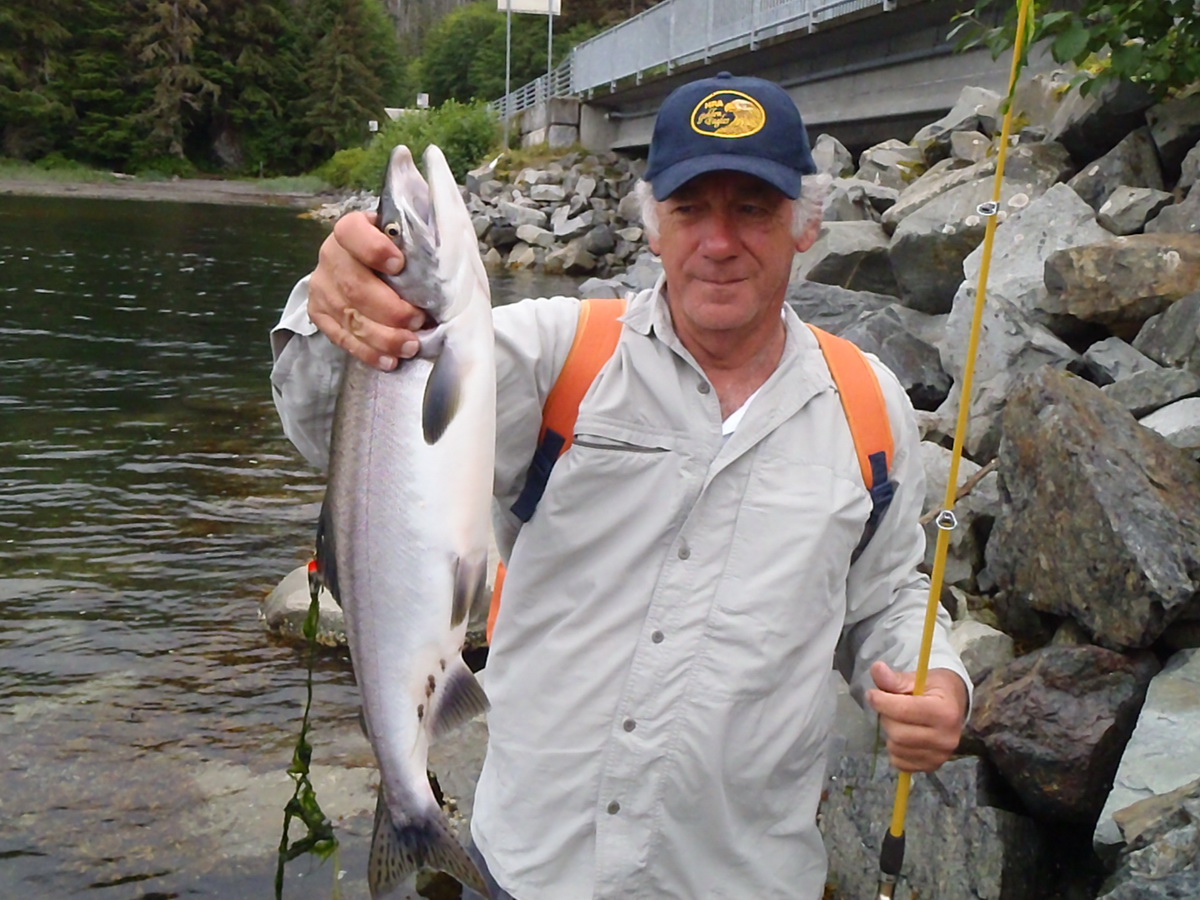
I caught this salmon in Sitka not long before getting on the plane

I caught this salmon in Sitka not long before getting on the plane

I hate flying! Unfortunately, airplanes are by far the best way to get to Alaska. This small-town Georgia boy grew up reading outdoor magazines about the fantastic fishing and hunting in Alaska but could never really imagine experiencing it first-hand.

My wife Linda has a second career as a travel writer and I have been many places I could only imagine growing up. I have kneeled on the ice in Antarctica with penguins waddling by a few feet away, fished for piranha 700 miles up the Amazon River, snorkeled in Tahiti and spent the night in a five-star hotel in Marrakesh, Morocco. All those were beyond my wildest dreams as a kid in Dearing, Georgia!

Linda and I left July 26 three years ago and flew to Anchorage, Alaska. We spent a week driving up to Denali National Park, over to Valdez then back to Alaska. The vastness of Alaska is amazing. I drove 1150 miles during that week. At dinner back in Anchorage the placemat had a map of the state about the size of my palm. The area we covered in a week was about the size of my thumb tip placed on the very corner of my palm! The same distance here would have taken us all the way around the state – with some overlap!

On that drive we passed many beautiful mountain ranges and terrain varying from damp forest to tundra. Rivers that were hard to get to looked inviting but I didn’t get to fish until we got to Valdez. There we stood on the shore of the bay and hooked salmon after salmon, landing about ten each but losing twice that many each.

We flew to Juneau and got on a small cruise ship, the Mist Cove, and spent a week with 14 other passengers and 12 crew cruising the Inner Passage, anchoring each night in secluded bays. Each day we had the option of taking out kayaks, going on hikes on shore, or taking the skiffs to fish for halibut or to streams to catch salmon.

The limit on halibut is one per day and two in possession. We brought back 46 pounds of filets from the four we kept. The salmon we caught were already in the creeks and not good to eat, but were a ball to catch on light tackle.

On my 60th birthday I was standing in a stream in Alaska catching salmon. I landed my first salmon ever on a fly rod that day, hooking and landing four after landing nine on a spinning rod and losing about 15. The screaming runs across riffles and the way they jumped were just like in my dreams!

Wildlife was amazing. Eagles were everywhere. We watched one young eagle eat a salmon on a gravel bar about 100 feet from us. One day two couples were fishing the mouth of a stream and another couple had hiked up the stream to fly-fish. Each group had a guide. Ours had a 12 gauge shotgun loaded with slugs on his back and the other guide had a 30-06 on his.

The three that went up stream came walking back pretty fast and we heard the radio crackle. Their guide was calling for a skiff to pick us up immediately. About that time, less than 100 yards behind them, a brown bear stood up. The grass was about chest high on me in the area. It came up to her waist. Beside her a cub poked his head above the grass, too.

The grizzly had followed them back down the creek after they walked up on her. She disappeared then popped up a little closer to us. About that time the skiff picked us up and we left her to fish with her cubs all by themselves!

On the trip we saw moose, caribou, mountain goats and many other critters. It was exciting.

That Sunday we loaded on an Air Alaska 737 in Sitka to come home. The plane was packed, not an empty seat. And we were amazed at the number of boxes of fish loaded on it. The luggage belt would have five or six boxes of fish, then a suitcase. The cargo hold was full.

We started down the runway and just as I felt the plane get light, mostly from me holding it up by the arm rests, there was a loud “BANG,” the left side of the plane dropped a little and the whole thing shuddered and shook. The pilot got us stopped about 100 yards from the end of the runway where it dropped into the bay.

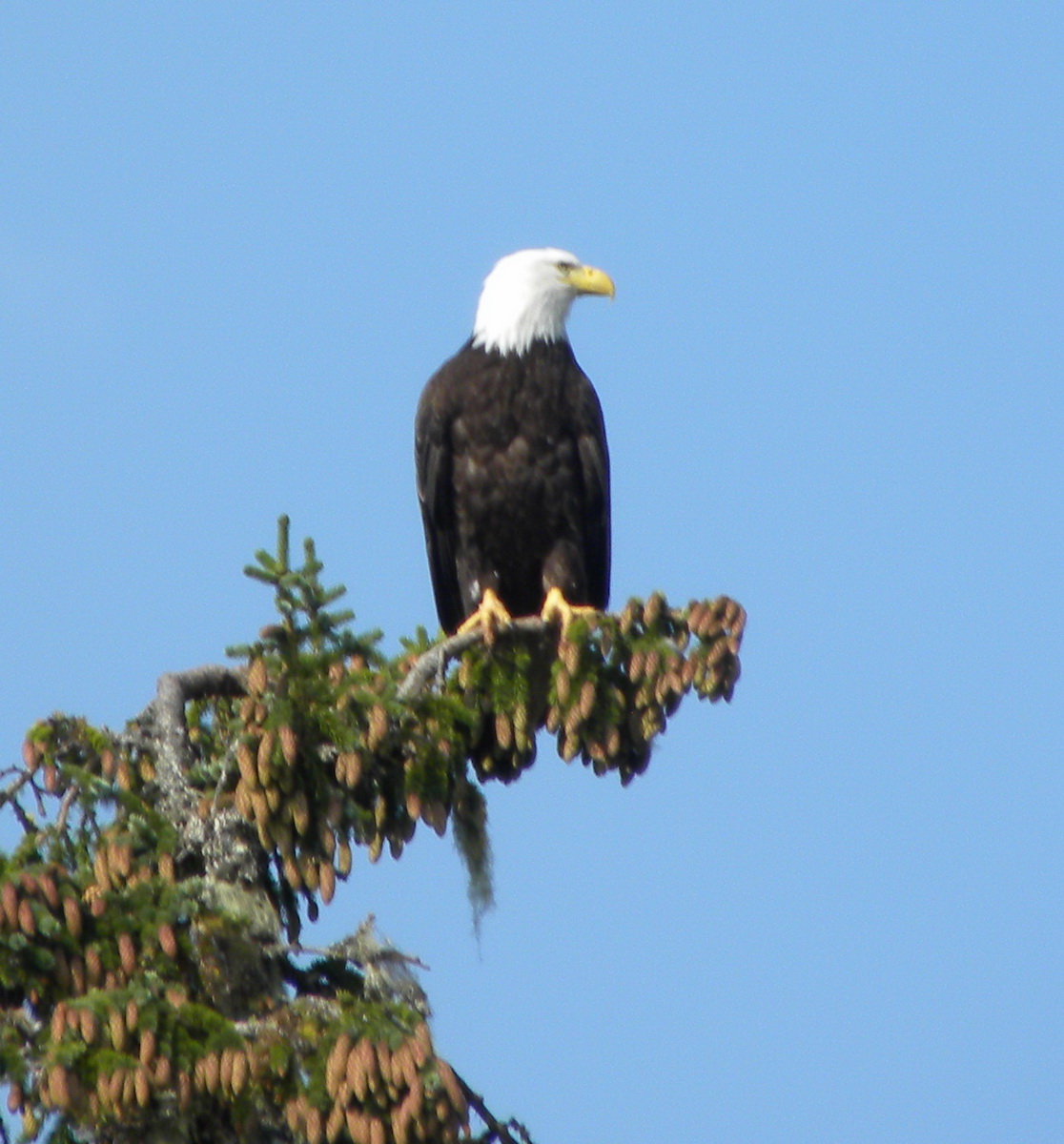
Is this the eagle that almost caused our plane to crash?

Is this the eagle that almost caused our plane to crash?

He came on the PA an said we had hit an eagle. It tore up the engine I was sitting over and just in front of. The co-pilot and flight attendants were looking out the windows at the engine, looking for smoke and flames, I guess. They said we had been running down the runway at 110 MPH, 10 MPH under lift off speed, when we sucked in the eagle. That is 160 feet per second, if my calculations are right. If the pilot had hesitated even for two seconds before slamming on brakes and reverse thrusters I don’t think we would have stopped in time.

Six hours later they got another plane to Sitka to take us to Seattle and we caught the red-eye to Atlanta, the only flight left that night. We landed in Atlanta as the sun came up. I am still shaking from the experience.

Did I mention I HATE TO FLY?

Linda has details of our trip on her web site at http://cruises.about.com

How Do I Choose the Right Deptfinder and GPS

Choosing the Right Sonar/GPS

Sound Advice on Finding the Best Fishfinder For Your Needs, From the Experts at The GPS Store, Inc.
from The Fishing Wire

Depthfinders have become very complicated

Depthfinders have become very complicated

Sonar has become increasingly sophisticated in recent years, and choosing the right model for your type of fishing takes a bit of study–or some good advice from a dealer.

When it comes to echosounder technology, there are as many choices out there as there are fish in the sea. Echosounders, or fishfinders as they are commonly called, range from simple monochrome LCD machines to professional-grade, multi-frequency units with large color displays. Recently, side-scanning and structure-scanning technology has gained traction with more and more boaters, providing picture-like detail of the world around the boat.

At its heart, all sounder technology is designed to do the same thing – provide information about the depth of water, the composition and contour of the bottom, and indicate the presence of bait and/or gamefish in the water column. Marine electronics manufacturers have developed some exciting technologies to help fishermen understand what’s going on below the surface. But with so many options and products ranging from compact $199 fishfinders to combination sounder/navigation systems approaching five-figure price tags, how can boaters decide what best meet their needs?

Brass thru-hull transducers are the usual choice for big inboard boats, while thru-hull or transom mounts are more common in outboard boats.

Sounder Basics

Understanding how sounders work is a good first step in narrowing down what best fits your needs/budget. Like echolocation in the animal world, the unit’s “transceiver” emits a sonic pulse through a transducer (think speaker to a stereo) into the water, then “listens” for echoes that bounce off the bottom, structure or fish between the sea floor and the hull. The sounder displays these signals on the display, based on the strength of the return.

How Do You Fish Most?

“I begin the selection process by asking customers what type of fishing they do most,” said Brian Rock, an NMEA-Certified sales manager at The GPS Store. “A customer may sometimes fish in water up to 1,000 feet deep, but 95% of the time they’re in less than 100 feet. In this case, 600W output power will be sufficient the vast majority of the time. But it isn’t enough power for 1,000 feet of water. If the customer wants to have that power available anyways, then the price jump (which can be up to three times more) can be justified. A good dealer won’t try to push you into a more expensive, feature-packed unit if that’s isn’t what you need.”

What Type of Boat?

To a certain extent, the type and size of boat you have dictates what type of sounder system you can install, particularly when it comes to the type of transducer you can use. For example, while bronze through-hull transducers are a very popular option for fiberglass boats, they won’t work on aluminum boats. Electrolytic corrosion occurs when the two metals come in contact in a wet environment, so fishermen with “tin boats” must use stainless steel or plastic transducers. Transom-mounted transducers are an affordable, popular choice for trailerable outboard and I/O-powered fishing boats. However, inboard-powered boats can’t use these because of prop wash and aerated water. Go-fast offshore fishing boats are a good match for powerful sounders with in-hull transducers that shoot through the fiberglass, provided there is adequate room for installation of the transducer. Larger sportfishing vessels often use a bronze thru-hull transducer with a fairing block . Your dealer should ask about your vessel and let you know if there are restrictions that might limit your options.

Multi-Function Displays combine sonar, GPS and even radar in a single machine.

What Are You Looking For?

What you want to “see” on your fishfinder will help you decide on the best technology for your needs. If you’re primarily looking for change in bottom composition (from soft mud to shale, for example) bait and fish over the bottom or deep-water schools, a powerful straight-down sounder should fit the bill. If you spend a lot of time “searching” for structure and fish in waters less than 300 feet, some of the innovative side-scanning technology on the market could be ideal. For applications where you need to dial in specific frequencies to differentiate fish species and discriminate between closely spaced fish and bottom, the new Broadband Sounders and Chirp technology might be a worthwhile investment.

What Does This Mean/Do?

Sounder and transducer technology has rapidly evolved, offering boaters options that didn’t exist even a couple of years ago. For example, Chirp transducer technology constantly scans different frequencies (as opposed to traditional one- or two-frequency sounders), delivering excellent clarity and target separation in all depths. New Structure Scan wide-beam technology can save fuel and time searching for previously unexplored wrecks and reefs. A split screen with Structure Scan and traditional sounder side-by-side helps the boaters tell structure-hugging fish and structure itself. DownScan Sonar works similarly to structure scan, but with a much narrower beam.

MFD or Dedicated Sounder?

The answer depends on your perspective, and your needs. Excellent sounder performance is found in today’s advanced Multi-Function Display (MFD) systems, usually combining a sounder with a chartplotter and radar in one “box.” Still, many opt for stand-alone sounders, and for good reasons. Commercial fishermen, professional guides and serious tournament anglers, for example, know that without a sounder, they’re dead in the water. The downside of all-in-one is systems is that if it goes down, you lose everything. “I’ll recommend a stand-alone fishfinder, together with an MFD for customers with the space and the budget. Surprisingly, in many cases, a single 12-inch unit will cost more than twin smaller displays,” said Rock. “A stand-alone sounder means you’ll always have fishfinding, while the separate MFD makes sure you can navigate to waypoints – and provides a backup sounder.”

Need Pinpoint Position Accuracy?

Pinpoint boat positioning over structure is a compelling feature of today’s Multi-Function Systems. For example, the Trackback feature on Lowrance HDS system lets boaters zoom in on structure, mark four corners of the structure and overlay these points directly on the electronic chart. Positioning the boat between these points ensures accurate presentation of baits and lures over wrecks and reefs. This technology is far more accurate and repeatable than using a chartplotter’s Man Overboard (MOB) key.

“Today’s boaters have so many great choices when it comes to fishfinder technology,” said Rock, “it’s an exciting time to be an angler. The key is figuring out which features and functions will enhance your time on the water most and improve your individual style of fishing. Your dealer should help you do this – guiding you through these questions and others – until you narrow down the choices to those that best fit your needs, boat and overall electronics budget.”

This is precisely the type of assistance Rock and the other staff at The GPS Store provides consumers in its store, on the phone and through its website. Contact The GPS Store at (800) 477-2611 or visit www.TheGPSStore.com to learn more about sounder technology or ask any marine electronics questions.

Bass Baits To Use On The Red River for the FLW Cup

Texans’ Top Red River Lures For The FLW Cup

By Abe Smith
from The Fishing Wire

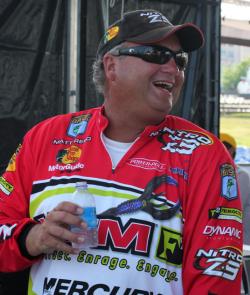
Matt Reed is a bass pro on the Red River

Matt Reed is a bass pro on the Red River

Matt Reed says shad and bluegill imitations are likely to score on the Red in summer–crawfish patterns are less effective in the hotter months.

ARE THESE PREDICTIONS PROVING TO BE RIGHT????
Ronnie

The 2013 Forrest Wood Cup blasts off Aug. 15 on the Red River out of Shreveport, La. While the Red River is a popular bass tournament destination, most of those events are held in early spring when temperatures range from the 30s to 60s instead of 90s and 100s. Does this mean the anglers will be throwing different lures and fishing different areas than during those late-winter/springtime tournaments?

We asked three professional anglers from Texas who have a lot of experience on the Red River what they thought about the winning tactics and the challenges the FLW competitors will face. Here’s what B.A.S.S. anglers Alton Jones and Matt Reed, and B.A.S.S./FLW angler Zell Rowland (who will be fishing the Cup) had to say about winning on the Red in the summertime.

BACKWATER BAITS

In previous tournaments, backwaters always came into play as perfect areas for flipping jigs, pitching Dingers or creature baits and casting spinnerbaits, however, in spring, water quality is good and bass are positioning in those backwaters for the spawn.

During the doldrums of summer, though, water quality and temperatures can be questionable in some backwater spots. According to the pros, the presence of some current in those backwaters will be one of the keys to victory.

Zell Rowland knows the Red River well.

Zell Rowland knows the Red River well.

Zell Rowland is one of the contenders for the FLW cup, which gets underway Aug 15 on the Red River out of Shreveport, La.
“If we don’t have rain north of the river to get it to rise before the Cup we won’t have much current, and that will take a chunk of the river out of play simply because water levels will prohibit access or the water will be stagnant,” said Rowland.

Rowland visited the river in July with the heat index at 105 degrees and river running slow. He found that he couldn’t get into some of the backwaters he’s fished in the past because of silting with mud and sand. Water levels and the always-changing topography of the river make it difficult to fish on history.

In the backwaters available to FLW Cup anglers, Rowland said the presence of vegetation also plays a big part in success. Aquatic vegetation improves the water quality and holds better bass than those sloughs and pockets that only have wood cover.

“The Booyah Pad Crasher and Poppin’ Pad Crasher will be good for those areas with vegetation,” he said. “For flipping, I’ll be throwing a YUM Wooly Bug or Mighty Craw.”

Reed agrees with Rowland on his choice of flippin’ baits and said that smaller plastics are best. He said that lure color is as important as bait style on the Red in summer.

“Shad and smaller bluegills are the main forage during summer,” said Reed. “The fish don’t seem to have much to do with crawfish this time of year. Chartreuse patterns have always done best.”

MAIN RIVER CRANKS

Alton Jones, with two Classics on the Red River, knows it well–but he won’t be fishing in the FLW championship. He says small oxbows could be key with enough water to allow access.

B.A.S.S. Elite pro Alton Jones has plenty of experience on the Red River, including two Bassmaster Classics, but never in August. He says it’s the presence of current on the main river that makes it more productive.

“The tournament could be won in either a backwater or on the main river,” he said. “The main channel is 20 to 30 feet deep in some places and dredged for barge traffic, but in the backwaters, 8-feet is as deep and you’ll find. Either way, it will be won shallow – less than 5-feet of water.”

On the main river, Jones says that the XCalibur Xcs100 or Bomber 2A are top picks. If an angler wins the Cup on the main river, Jones says that running those crankbaits along a milk run of wing dams will likely be the pattern. Reed likes to work Red River wing dams with cranks that run a little deeper, something like the Bomber 4A or a Fat Free Shad BD5F, which dives to about 9 feet compared to Jones’ Xcs100 that dives to just 3 feet.

The FLW anglers can fish three pools of the Red River, but running to the third pool will leave only about 3 hours of fishing time. All of these pools feature main-river wing dams, wood cover and rocks, and if the water level or stagnancy eliminates many of the backwaters, each of these pools will get “small” due to the number of anglers pounding them.

Reed scored a top-10 finish in a tournament on the Red back in the late 1990s by cranking rocks on the main river. He once made a big, slow run to a distant backwater he thought would put him away from the crowd, and the pocket had everything a bass fisherman would want – vegetation, wood and a little current flow.

“It took me a while to get there,” he said, “and when I finally got there I found 15 other boats already in this little area about the as wide as three boats. We destroyed each other.”

PREDICTIONS

The three Texans agree that bigger bass will come from the backwaters on a hollow body frog or by flippin’ small plastics, but a more-consistent bite will be cranking the main river. If an angler can locate the right backwater without many other anglers horning in on it, he stands a good shot of taking the Cup.

“Those ‘Hidey Holes’ can really pay off for you,” Jones said. “One of my best days on the Red was the final day of the 2009 Bassmaster Classic when I brought in 21 pounds. That was from a secret backwater area that was hard to find and hard to access, and I had it all to myself.

“I also had one of my worst days ever on the Red River when I tried to get into a backwater and couldn’t. I got stuck for two hours on a sand bar.”