800 Pound Marlin

Hand-to-Hand Combat Puts 800 Pound Marlin in the Boat
from The Fishing Wire

800 Pound Marlin


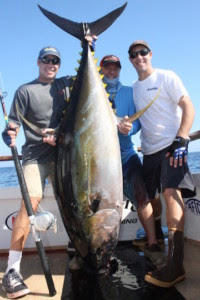
Team Silver-Rod-O poses with its potential IGFA line-class world record blue marlin.

Destin, FL – Trackers of trophy blue marlin call it “wiring,” wrapping lengths of wire or monofilament leader round and round your hands in hopes of finally bringing the big fish aboard. You’re just praying the furious bluewater giant doesn’t dismember your digits, or worse, pull you overboard with a single thrash of its weaponized skull.

Consider for a moment the primeval power of an 800-pound pelagic sportfish, amped up and attached to a hook on one end and your hands on the other. Imagine what can happen when a fish that big decides to sprint 50-miles an hour, and the potential for destruction to your hands—or your life. Now realize that the only thing protecting you is the right pair of gloves.

Some say luck is what happens when preparation meets opportunity—an apt description of actually landing a giant blue marlin. For Gary and Sherrell Carter and their expert crew, locating, battling, wiring and finally boating a record-class marlin only happens when a thousand different possibilities fall perfectly in to place. Give or take a few tense moments, that’s exactly what unfolded on Monday, August 13, off the coast of Madeira Island, Portugal.

The Carters, a husband-and-wife team who began chasing dreams of colossal marlin in 2000, had just about wrapped their 35th day on the water when a silver-blue leviathan emerged behind their boat, the Silver-Rod-O. “In the nine long days leading up to August 13, we had only seen a single blue marlin,” recalls Gary Carter, holder of numerous IGFA line-class records. “It was 4:20pm and we were about to call it a day when all of a sudden a big fish came up in hot pursuit of our right long teaser.”

Special ‘wiring gloves’ protect hands from wraps of heavy leader while also freeing fingertips for essential tasks with tackle.
For the Carters and the four other members of the Silver-Rod-O team, the game is to pull a large, hookless, squid-like teaser behind the boat in hopes of enticing a blue marlin to the surface. That day, when Yoan Alcala, the Venezuelan captain of the Silver-Rod-O, spotted and called out the astonishing size of the pursuing fish, the crew flew into immediate action. The Carters quickly decided Gary would wield the “bait-and-switch” rod, rigged with 20-pound test and a squid. “Andy continued teasing the fish toward the boat, I made the pitch and when the bait intersected the track of the marlin, Andy quickly jerked the teaser away and the marlin pilled on the hooked squid. We were in the battle.

“The fish stayed within 300 yards of the boat throughout the fight—actually fairly close— giving us several really nice jumps. One hour and ten minutes in, the blue made a mistake and Andy Dow, our great wire man from Australia, was able to get a solid grip on the leader with his Fish Monkey Wiring Gloves. With only a 15-foot leader to work with, in order to do this properly, you have to be right on top of the fish. You need the exact perfect angle, and Andy pulled it off impeccably; got a great wrap and then another. At that point, Yefry Garcia made an excellent gaff shot followed by Brad Batterton with another.”

Back at the harbor, Carter and crew watched as the certified scale rolled to 366.0 kg (807 pounds). This now-pending IGFA World Record, if approved, will eclipse the current IGFA 20-pound test record Atlantic blue marlin by a substantial margin. (The current record, according to Carter— an IGFA trustee and active member of The Billfish Foundation— sits at 714-pounds, a fish caught off the Ivory Coast of West Africa in 1990.) After filing all necessary paperwork, photography and a line sample, Carter says IGFA certification typically requires a minimum of 90 days.

Interestingly, all the way back in May 1999, Carter achieved his first the Royal Slam, catching all nine billfish species in less than a year. Additionally, the IGFA recognized the Silver-Rod-O with an Outstanding Achievement Award; it was the first time all of the Atlantic and Pacific species of marlin were caught by one angler from the same vessel. In addition to the 807-pound blue, the angling couple has broken records with fish on 16, 12, 8, 6, 4, and even 2-pound test.

Reflecting on his recent catch and all that unfolded those 35 days at sea, Carter quickly praises his team. “This is a team accomplishment, not an individual one. Nearly every member of my crew is highly skilled and focused on the task—even after countless hours on the water. Most all of us rely on Fish Monkey gloves to perform our assigned task. Both my gaff men—Yefry Garcia and Brad Batterton—don a pair of Fish Monkey Crusher gloves for protection from the sun, the fish and the elements. We do the same while fighting fish.

Fish Monkey’s Crusher has proven itself as an exceptionally versatile fishing glove, endowed with UPF 50 sun protection and Kevlar-reinforcements that prevent cuts from leader, wire and fish.
“The wiring gloves Andy wears have a special Kevlar fabric, which keeps line from cutting and puncturing the skin. Underneath, layers of hard and soft EVA padding keep heavy leader material from crushing down. And the fabric itself offers minimal friction, so leader can slip off the glove quickly and easily—an absolute key to successful wiring. The gloves also have exposed fingertips for dexterity and handling rods and tackle.”

In quantifying the role of Fish Monkey Wiring Gloves, Carter gives credit to another legendary marlin man. “My friend Tim Mossberg, founder of Fish Monkey Gloves, worked closely with Captain Charles Perry—the most accomplished wire man in the history of the sport—to develop these specialized gloves. They’re simply the best and only ones we’ll use when a big fish is on the line.”

For more information, visit www.fishmonkeygloves.com or call (888) 659-8864.

View Online Version

FULL 2018-19 CATALOG

The Fish Monkey Story

No one is sure where the Fish Monkey first appeared. Some said it was in the mountainous jungles of Guatemala near the old Mayan ruins at Tikal, or at the foot of the volcano they call Fuego. Others said it was on the beaches of Isla Mujeres, Mexico’s famed Isle of Women. Still others reported seeing the mysterious creature in other places around the world: Hawaii, Australia, Costa Rica.

But all the reports had one thing in common: wherever there was good fishing, the Fish Monkey was there as well. It was reported to have a phenomenal grip, stronger and more secure than any human could ever have. No matter how slick or slimy, the Fish Monkey could handle the situation with ease.

With those legends in mind, the founders of Fish Monkey Performance Gloves set about to replicate that world-famous grip. Fish Monkey is the world’s premier manufacturer of gloves designed specifically for the water. Whether you’re on the deck of a sport-fishing boat wiring a thousand-pound blue marlin off Bermuda, casting jigs and poppers to giant trevally in the Pacific or poling a flats skiff in less than a foot of water off the Bahamas, Fish Monkey has a glove that’s designed just to fit your needs. Extremely durable, with padding in just the right places, and a fit like a second skin. Protection from sharp teeth and the sun. And all with that legendary Fish Monkey grip.

So when you demand the very best protection for your hands, reach for Fish Monkey Performance Gloves. Become part of the legend.

Shooting Doves

Dove season opens at noon today. That brings back many great memories of my youth, and a very bad one after I moved to Griffin.

Daddy was the shop and agriculture teacher at Dearing High School in the early 1950s and his degree in agriculture meant he had a lot of skills useful to local farmers. We often spent Saturdays “cutting” boar shoats for them, as well as other jobs. For these services he was invited to many dove shoots.

I started going to dove shoots with him when I was about five, acting as his retriever. We seldom missed a Saturday during season. I prided myself on finding even the most difficult doves, no matter how thick the briars and brush. And I loved the camaraderie of the men at the shoot. But I longed for the day I could actually shoot at doves.

I got a single shot .410 when I was ten, but daddy made me hunt for squirrels with it, learning safety skills, for a couple of years before I could join the men on a dove field. And even then, I went only to family shoots with just a few folks on the field for a couple of years.

I was not a good shot. Darting, diving doves are much harder to hit than a squirrel on a limb. In my first shoot I was sure I had hit one, but Uncle Adron had also shot at it. He was deadly with his “Sweet 16” but he graciously let me claim it.

My best day with that .410 was on a big field with many shooters that kept the birds flying. I killed five that day and shot only a box of shells doing it. But what stands out in my mind even more from that day was trying to cross a fence to get a bird. I did not notice the top strand of barbed wire was electric. But that is another story.

Daddy had two shotguns, both 12-gauge semiautomatics. The short barreled one was for quail and the long barreled one was for doves. And we shot quail with #9 shot and doves with #8 shot. I learned to shoot both by using them for squirrels, just like the .410, but they were overkill for tree rats.

I had real good luck using it, killing my limit most shoots when I could use the long barreled 12 gauge. It throws out a lot more shot than the .410 and has more powder for a better pattern. I went to many shoots with my uncles and used it when daddy could not go.

I still have both those shotguns, I just wish I could use them more!

My bad experience was in 1972, my first fall in Griffin. I wanted to shoot doves and found a pay shoot out near Senoia. A week before the shoot I went out to pay my fee and look at the field. I should have been suspicious since it looked like a hay field, but birds were on it.

That Saturday I got in a blind on a fence row. There were not many birds, but I killed two the first hour or so. Then two men in green uniforms drove up, got out and started going to shooters on the opposite side of the field. I thought about easing into the nearby woods but was sure I was doing nothing wrong, I had my license and my gun was plugged.

As they walked up to me I saw they were federal game wardens. When asked, I gave them my license and they put it in a stack of others one of them was carrying. They then told me to come to the farmer’s house.

There they told us the field was baited and showed us photos taken from an airplane, plainly showing strips of wheat put out on the field. They informed us we would all have to go to court. After they left with our licenses the farmer assured us there was no problem, he knew the judge, and we would not be fined. He also provided cases of beer to ease our minds and calms us down.

A few weeks later I got a federal court summons and my license. It said come to court in Atlanta or pay a $75 fine. I paid it rather than go to court since I knew I was guilty. That was a lot of money back then, three times what I had paid for a day of shooting. I also heard the farmer was fined $1000!

That is the only time in my life I have ever gotten a fine for breaking game and fish laws. I am always careful to follow the law but that was a costly mistake. And I never went to another pay shoot.

Help Snook and Reds in Florida’s Red Tide Areas

How Anglers Can Help Snook and Reds in Florida’s Red Tide Areas
By Brett Fitzgerald, Snook and Gamefish Association
from the Fishing Wire

(Hint: log more, log now – it’s never been more important!)

Red tide map of Florida


The Florida Fish and Wildlife Conservation Commission (FWC) has temporarily mandated that snook and red drum are ‘catch and release only’ in the areas most impacted by the 2018 red tide bloom. The closure runs from the northernmost point of Anna Maria Island in Manatee County, and runs along the coast down through Collier County to Gordon Pass.

The change of status to “catch and release only” is set to expire at midnight on Oct. 12, which will allow commissioners time to hear an update the next FWC Commission meeting, (September 26-27 in Havana/Tallahassee).

An executive order has not been used to shut down the harvest of any “fin-fishery” to harvest in Florida since the historic 2010 cold-kill, which had massive impacts on the snook population. (Scallop seasons have been closed or delayed due to red tide in the past, most recently in 2016 and 2017.)

Similar to the situation in 2010, FWC felt compelled to take action to protect these fisheries without the benefit of hard supporting science. In circumstances such as these, it is understandable that the decision was difficult, but made with the best intentions. “We have no idea how much these fisheries have been impacted,” said Jim Estes, Deputy Director of Marine Fisheries Management. “We did see issues with recruitment after the 2005 red tide bloom for certain species,” Estes added. This, combined with other factors such as interviews with stakeholders throughout Florida, prompted the temporary change of fishery status.

Back in 2010, snook anglers were called to action – FWC and their research arm the Florida Fish and Wildlife Research Institute (FWRI) worked with the Snook Foundation to develop a self-reporting system called the Angler Action Program, which led to the development of the iAngler smart phone app. “The information gathered by iAngler was very helpful after the 2010 cold event, and it played a significant role as the snook fishery recovered,” noted Dr. Luiz Barbieri, Program Administrator, Marine Fisheries Research at FWRI.

Once again, we are asking anglers to contribute valuable information through Angler Action. “I encourage anglers to report their catch in iAngler,” Jim Estes said. He has been a direct point of contact between FWC and Angler Action, and says this information can only help them understand the health of the fishery.

Over the next week, we at SGF/Angler Action will be working directly with FWC and FWRI staff to ensure that recreational anglers are dialed in. “Right now, our focus here is to help FWC get a handle on what is really going on with fish populations throughout Florida,” said SGF Chairman Mike Readling. “iAngler continues to be the best way anglers can communicate what they are catching – and not catching,” pointing out that ‘zero-catch’ trips are extremely valuable.

“We want to remind all anglers that using iAngler doesn’t mean that you must handle fish any more than a typical release,” Readling points out. Anglers do not need to include a photo with their report. While length information is very important, anglers can leave that box blank too.

For now, we ask that you stay tuned. Understand that the rule change means you CAN fish in the areas within the map above, you just must release any and all redfish and snook. If you are fishing anywhere in the state, these are our two asks of you: Log your trip in iAngler, and emphasize best-release practices.

Angler Action’s Best Practices for Catch & Release Fishing
Access to fisheries is an important part of conservation in America, and for many of us that access includes ‘catch and release’ fishing. In such cases, we want every fish we let go to survive so they can continue to thrive and contribute to the future of their species.

With that in mind, here’s a refresher on some pointers that will significantly increase the chance of survival of those fish you let to. If you wish to have something added to this list, let us know!

Fish Handling

Try to keep the fish in the water at all times.
Minimize handling, since this can remove protective slime from the fish.
If you handle a fish, use clean, wet hands.
If you do remove the fish from the water, support the fish beneath the head and belly.
Minimize exposure to air, maximum 15 seconds.
Avoid using mechanical lip-gripping devices on active fish, since this can cause jaw injury.
If a fish’s weight is desired, attach a cradle to the scale to support the fish’s weight.
Keep fingers away from the gills, damaged gills make it harder for the fish to breathe.
Hooks

Use barbless hooks, since this reduces the amount of handling needed to remove the hook.
When fishing with bait, use circle hooks.
If a hook is deep within the throat, cut the line as close to the hook as possible.
This causes less damage than removing a deeply-set hook; most fish are able to reject the hook or the hook dissolves over time.
Fight Time

Keep the fight short, but not too short.
Long fight times result in an exhausted fish, which is more vulnerable to predators.
A fish reeled in too quickly may thrash about, increasing it’s chances of injury.
Use tackle that matches the fish and conditions.
If a fish looses equilibrium (it rolls over or goes nose down on the bottom), retrieve it until it can swim upright, then shorten the fight time on future fish.
When retrieving a fish, be sure that water passes over the gills from front to back.
Move the fish forward or hold it upright in the water allowing it to pump water through it’s gills.
High water temperatures may negatively impact survival after release for many species. In warmer water, reduce fight and handling time.
Predators

Since predators can decrease survival of fish after release, when predators become abundant and appear to become attracted to your fishing activity, consider moving to another fishing location.
If you have caught a fish and potential predators are near, consider using a circulating live-well to hold your fish for a short time to allow releasing it some distance away from them, unless that fish is not legal to possess.

Count Your Catch

Use AnglerAction.org or the iAngler phone app to record your catch info while fishing or soon after. (Remember to record all sizes and 0 catch as well).
If you are fishing in areas where the fish population is stressed, remember that you don’t need to photograph each fish in iAngler.
If you are unable to obtain an accurate length without excessive handling, it is better to leave that box empty. However, provided lengths are immensely helpful when using this data to better understand the health of a given fishery.

West Point Club Tournament

Sunday, August 26. 14 member, guests and youth fished our August tournament at West Point. After 8.5 hours of casting, we brought in 26 keeper bass weighing about 39 pounds. There were only 6 keeper largemouth 14 or more inches long, the rest were spots. Two members had five-fish limits and there were four zeroes.

Kwong Yu won with five weighing 9.17 pounds and had big fish with a 4.05 pound largemouth. Raymond
English placed second with five at 8.19 pounds, Jay Gerson placed third with three weighing 5.01 pounds and Chris Davies was fourth with tree at 3.71. Jackson Terry won the youth division.

I had a very frustrating day, catching a keeper largemouth on a shaky head about 7:30, then a spot on the same bait at about noon. I got my third fish, a keeper spot, on a drop shot a few minutes later. Those three gave me fifth place,.02 pounds out of fourth and getting a check!

Mullet Run

Southeast Florida’s Amazing Mullet Run
By Frank Sargeant, Editor
from The Fishing Wire

Hutchinson Island on Florida’s southeast coast is a bit of a secret spot in a state where there are hardly any secret spots left. This 23-mile-long spit of sand and sea has so far evaded the high-rise madness to the south, while still providing enough of the comforts of civilization to make it a great vacation spot.

With Fort Pierce Inlet at one end, St. Lucie Inlet at the other, it’s surrounded by water, with the blue-green Atlantic and all its gamefish on one side, the shallow Indian River Lagoon on the other.

And while the south end of the lagoon has had its woes due to algae blooms and sea grass die-offs in recent years, the waters along the beach still provide top quality angling as well as white sand beaches that are not nearly so crowded as those in many other parts of Florida these days. In fact, there are stretches where, even on weekends, you may have a mile or two solely to yourself, especially if you’re a sunrise surfcaster as I tend to be.

Mullet Run Madness

Prime time to go is coming up, with the mullet run usually getting underway along the beaches in late August and continuing until Halloween. When the mullet flow past in their annual migration toward South Florida, just about everything that swims in the ocean here shows up right on the beach to feed on them.

Finger mullet make great bait


The finger mullet show up first in the fall run along Florida’s east coast, followed later by much larger baits–both sizes are great for gamefish that swarm along the beaches to feed on them. (Frank Sargeant Photo)It’s common to see 100-pound tarpon, 40-pound kingfish and 20-pound snook all feeding right on the surface within casting distance of the shoreline–sometimes the water literally boils there are so many thousands of baitfish being harassed by the gamefish. The fleeing bait occasionally jumps right out on the beach, particularly when a horde of bluefish or jack crevalle gets in on the chase.

The fishing is dead simple when the run is on–you cast a large weighted treble into the balls of mullet, give it a snatch and hook a couple, haul them ashore, drop one into a bucket of sea water and put the other on a 4/0 to 6/0 extra-strong live bait hook, either hooked through the nose or behind the anal fin, and put it back out into the melee. The bite is often instantaneous–a wounded bait is immediately picked out by the prowling gamefish. (If you can handle a castnet, you can usually net several dozen on a short throw as they swarm in the surf.)

If you’re a devout plug flinger, you can also catch plenty on big topwater plugs worked with a fast zig-zag motion, and also with large, 8-inch swimmer-type soft plastics on a 1/2 to 3/4 ounce jig head with heavy duty hook in the 3/0 size or larger. (Don’t use freshwater jigheads for this–the hooks are likely to get straightened.) The DOA Swimmin’ Mullet and the DOA BFL in 8-inch size are killers for this–they’re made right in the area specifically for this fishing. The LIVETARGET Finger Mullet wakebait is also a good choice.

You need stout spinning gear to handle the fish here–40-pound braid is the minimum, 65 better. Medium-heavy action spinning rods 8 feet or longer and 5000-sized reels can handle most of what you’re likely to stick, though if you want snook and only snook you can downsize the tackle a bit–expect to get spooled by a tarpon on any given cast, though. If you’re looking for a king mackerel to put on the grill, a foot of number 6 wire ahead of the hook is a must to prevent cutoffs.

Surf casting often gets the job done, but there are many days when the fish are too far off the sand to reach–that’s when a kayak launched off the beach can put you in the action. Or, if you have a powerboat, you can run out St. Lucie Inlet and quickly be on top of the fish either north or south. In calm weather with moderate swell, the inlet is a pussy cat and even a 16-foot flats rig can get you to the fish. When wind and tide oppose, however, it can get very gnarly very quickly–keep an eye on the weather and the tide chart anytime you go outside the pass in a small rig.

The inlet itself is a prime spot for snook to ambush the bait–cast around the rocks and jetties, particularly on outgoing tides early and late. (The snook season is open Sept. 1 to Dec. 15 here, but the slot is 28-32 inches–many you will catch will be over that size during the run.)

Other than Fishing, What?

If mom and the kids are more into swimming, snorkeling and sunbathing than fishing, Bathtub Reef Beach is the place to go. A near-shore reef protects a clear water lagoon, taming the surf and fears of sharks for those new to ocean swimming and snorkeling. The beach has adequate parking except on weekends. There’s a bathhouse with showers to wash off salt and sand. On the inland side of the park, there’s a fishing pier on the Indian River. It’s located off the south end of A1A–Google 1585 SE MacArthur Boulevard in Stuart.

There are also numerous beach front parks north on A1A, and these are frequently super spots to fish, with little competition–you not only get a shot at the mullet run madness by hopping from one to the next along the entire 23-mile stretch, but can also find pompano, whiting and sometimes Spanish and blues in the cooler months.

Where to Hang Your Hat

Hutchinson Island Marriott Beach Resort and Marina is my favorite spot to stay here because it has a marina on the lagoon as well as a great stretch of beach for surfcasting. It’s just across the A1A bridge from the swank village of Sewall’s Point. It sprawls over 200 manicured acres including an 18-hole golf course and lots of tennis courts, which I don’t use, with winding lagoons loaded with mullet and sometimes snook and baby tarpon, which I do use as often as possible. (A number 5 flyrod and a white bucktail catches these little guys when they’re active.)

It’s an easy walk to the beach from anywhere on the property, but there are also regular trams to get you where you want to go. The 77-slip marina can handle anything up to 50 footers, and it’s in a protected location where your flats skiff will be happy in the water overnight. It’s about a 3-mile run down to the inlet. The resort restaurants are great, though pricey; get resort details here.

If you can’t bring your own boat, there are numerous good light-tackle charter guys working in this area–Captain Mike Holliday is one of the best, and an expert in timing the mullet run to perfection. He stays busy when the run is on–book early. (You may recognize the name–Mike is also a regular writer for Florida Sportsman Magazine.)

Fishing One Day of a Two Day Tournament at Lake Weiss

We lucked out at Weiss last week with the weather, but not with the fish. Clouds and breezes kept it bearable since it was a little cooler. But the fish did not seem to care that we were more comfortable.

I thought the turnout for the Flint River tournament at Clarks Hill was bad, but the Potato Creek turnout was worse. Only three of us showed up to fish a two-day tournament at Weiss! We landed eight keepers weighing about 15 pounds and nobody had a limit.

I won with four weighing 8.69 pounds. Raymond English was second with two at 4.68 pounds and had big fish with a 3.20 pound largemouth. Kwong Yu fished with Raymond and had two at 1.74 for third.

My trip started badly. I had a blow-out on a trailer tired about two miles from where I was staying at Crossroads Campground Wednesday afternoon. George and Shelia, the campground managers that helped make my stay very nice, suggested OK Tires in Centre.

I spent last Thursday morning riding ledges and humps, looking for deep fish. There were some beautiful drops with brush, stumps and rocks on them, with what looked like fish holding on the cover, but the only bites I got were taps and I never hooked a fish. I think they were either crappie or bream pecking at my worms with the tails dipped in chartreuse JJs Magic.

Thursday afternoon when it got hot I took my tire to the tire store and Tim was great. He got a tire on my rim and balanced in just a few minutes even though they were very busy. I also found out he was a tournament fisherman and gave me some tips. He said some of the ledges I ran that morning looked good to him, too, but he had never hooked a fish on them, either.

Friday morning was cloudy, so I decided to fish shallow. The first rocky bank I tried I caught a good keeper largemouth on a buzzbait. Then on a deep bank with docks on it I got two good spots about 2.5 pounds each on the buzzbait. That told me where to start the next morning and gave me hope.

I got a call Friday afternoon that I had a doctor’s appointment Monday morning. I had planned to stay

Sunday night and rest up before the drive home, but the appointment was too early to do that. I thought about driving home tired and sleepy and decided I might just fish one day of the two and drive home Sunday.

Saturday morning, I started on the deep bank, throwing a spinnerbait since it was still dark.
After fishing about 300 yards down it with no bites
I was disgusted, but then a 2.5-pound spot hit my spinnerbait right at the boat and I landed it.

I went back over that bank with a buzzbait but got no more bites. I then went to another bank I like and finally caught a keeper largemouth on a crankbait at about 10:00. Two hours later I went to another deep bank and caught a keeper spot on a shaky head. I was happy with three keepers with three hours left to fish.

With an hour left to fish I was back on the deep bank where I started. I cast a shaky head worm behind a dock, got a tap and set the hook. Then I realized my line was over the corner of the dock.

I pulled a 2.97 pound largemouth out of the water. It was hanging in the air, thrashing around. I grabbed my net and went to it but as I reached out with the net the line came off the dock and the fish took off. Somehow, I got it back to the boat and netted it.

It was my biggest fish and a miracle since my line was badly frayed for a foot about two feet above the hook. Some fish are just meant to get caught.

I decided to sleep in Sunday morning and drive home. I later found out Raymond and Kwong gave up at noon rather than fish until 2:00, as planned.

If you go to Weiss I highly recommend Crossroads Campground if you camp. A good ramp at the Spring Creek bridge is only half a mile away. And if you have tire problems, OK Tires will treat you right and you may even get some fishing tips!

Sea Lamprey Control

Sea Lamprey Control in the Great Lakes

Fish with sea lamprey injury


By Craig Springer, USFWS
from The Fishing Wire

Gauzy morning light leaks through dense mature oaks and maples in a square woodlot next to an Indiana farm road. It’s only a few miles from the Michigan state line, lying just below the bottom end of Lake Michigan.

Right angles predominate in this place from artificial lines laid on the land. It is well-settled here, the artifices of people everywhere. Roads run over section lines straight as ribbons over low hills in near-perfect square-mile blocks. They make the checkerboard you can see from the air. On the ground, you can hear the distant drone of a brush hog, and the comings and goings of occasional cars and farm implements as people live out their day along the rim of the Great Lakes.

The backlighting of the morning sun illuminates the bugs that float aloft on the yellow beams. They remind you of dust defying gravity, caught in light bending through dirty widows. A spattering of left-over sunlight hits a tiny stream barely big enough to name. The rill, no bigger than a groove in the glacial till, gets much attention from fish biologists. This manicured site belies what’s below. Swimming in this pleasant little purl of water is an alien invader that’s become naturalized—and entirely by accident. Its existence here is as incongruous as finding ice cream in an oven.

The sea lamprey as its name implies is naturally at home in the salty waters of the Atlantic. But the unintended consequences of connecting the Great Lakes more directly to the seaboard for commerce via the Welland Canal essentially put the invasive lamprey in this otherwise bucolic scene. Their invasion into the Great Lakes dates to 1829, and by the late 1930s, they populated all of the Great Lakes. A saltwater fish swims in the tiniest of freshwater upland farm creeks ringing much of the Great Lakes basin.

It’s had a real down side.

The lamprey is a fish. On the evolutionary scale, it’s primitive–without scales and without bones. Its slightly cone-shaped circular mouth is loaded with rings of sharp raspy teeth. It’s a parasitic pest that makes a living by grating onto its host, sucking blood and body fluids as it clings along for the ride.

Mouth of Sea Lampray


As you might guess that’s hard on a host fish. And fish species native to the Great Lakes such as the lake trout have suffered for it.

The sea lamprey will spend 12 to 20 months in its parasitic phase in open water, killing up to 40 pounds of fish. Lake trout are not the only fish to host the invasive lamprey; steelhead, whitefish, lake sturgeon, salmons, walleye, and yellow perch often get the parasite. But lake trout populations have taken a measurable toll: prior to the lamprey explosion in the 1950s, about 15 million pounds of lake trout a year were harvested from Lakes Superior and Huron. Ten years later, only 300,000 pounds were pulled from nets. In Lake Michigan alone, lake trout harvest went from 5.5 million pounds in 1946, to a mere 402 pounds seven years later.

With Great Lakes fisheries devastated by invasive sea lamprey, the Great Lakes Fishery Commission directed the scientific testing of some 6,000 substances to determine what might control the damaging parasite. In 1958, the compound commonly called “TFM” proved its worth. This selective lampricide could suppress the invasive parasite while still in streams. Registered for permitted use by the EPA and Agriculture Canada, TFM has met all safety criteria for use in Great Lakes streams. Under the auspices of the Commission, U.S. Fish and Wildlife Service biologists now apply TFM in roughly 250 streams tributary to the Great Lakes, such as the unassuming rill on the Indiana-Michigan state line.

It’s not the adult lamprey sought by biologists applying TFM to streams. The adult lampreys swim into the tributaries in the spring of the year to spawn and then die. Their eggs hatch in gravels, and the worm-like larvae move into muck to live out the next several years before turning to parasitism and moving into open lake water. The compound TFM kills sea lampreys in the larval stage.

While TFM is the primary means of suppressing sea lamprey populations, it is not the only one. Barriers built across several streams block sea lamprey from moving upstream to spawn. Sea lampreys lack an ability to leap; hundreds of low-head barriers on streams across the Great Lakes basin create impassable heights and prevent sea lampreys from migrating, thus reducing the necessity of applying TFM above barriers.

The ancient Greek adage, “make haste, slowly,” applies here. A great deal of experience and much scientific experimentation has brought sea lamprey control a long way from the nadir of the 1950s. Well-trained and dedicated biologists go after sea lamprey in a measured, deliberate way. On any application of TFM, the U.S. Fish and Wildlife Service will have deployed staff with an impressive array of expertise: chemistry, limnology, fisheries science, and hydrology. The field work is physically demanding.

That work is paying off. Desirable sport and commercial fisheries valuable to people are on the rebound. But we can’t let up: a single female sea lamprey may lay up to 100,000 eggs.

The past can’t be undone, but with science and technology, fisheries professionals can rewind it a bit. And it starts upstream, in the smallest of rills in the uplands that pour into the Great Lakes.

To learn more, visit www.fws.gov/midwes

Strange Fishing Bait

What is the strangest bait you have ever used to try to catch a fish? I have tried some weird things, and some of them even worked!

When we used to run trotlines, jugs and limb lines at Clarks Hill for catfish, little bream were our best baits. But one time I heard little chunks of Ivory Soap would work, so I cut up a couple of bars and tried it. Never caught a fish on it though.

One summer Uncle Slaton and his family camped with us at the lake. We fished for bass during the day and ran hooks at night for cats. He came in for lunch one day with a nice channel cat and said he got it off a trotline that was baited with black plastic worms.

Since I had some old ones we cut them in half and baited up a line with them. Nothing on the line the next day. Then he told me he was kidding; the line was baited with cut fish. The joke was on me and I will never forget it.

We used a lot of other baits than live bream, too. I heard catfish really loved cut mullet since they are oily, so we would buy one at the grocery store, cut it into one-inch chunks and bait hooks. It worked, but not as good as live bream in my opinion.

We dug bait, too. Big swamp wigglers worked well but for some reason catfish did not seem to like the white grub worms we sometimes dug up and tried. And mole crickets never worked well. Maybe they had a bad taste.

If you run lines, stick with what works for you.

Lake Michigan’s Smallmouth Bass

Learning about the habits of smallmouth bass in northern Lake Michigan
Here’s an interesting update from Michigan’s DNR on a study of Lake Michigan’s smallmouth bass populations and their growth and migration.
from The Fishing Wire

Nice Smallmouth


For so long it was believed that smallmouth bass didn’t travel that far or intermix their populations – especially in a large waterbody like Lake Michigan. But early studies, originating in the

mid-1950s by Dr. Carl Latta, hinted that smallmouth bass just may travel much farther than researchers initially understood.

Historical data on the northern Lake Michigan smallmouth bass population was collected via very limited surveys from the mid-1950s, through the late 1990s. Then in 2005, an ongoing smallmouth bass survey was launched jointly with Central Michigan University (CMU) to look at population trends in the species.

When the study was initiated, the Beaver Island Archipelago area was chosen as the main study area. It was the location of CMU’s biological station and more importantly the residents of Beaver Island were concerned about the local bass population believing increasing numbers of cormorants locally were the direct cause of the decline in the local bass population. In 2009, the study area was expanded to include the Waugoshance point area, then again in 2014 to include Grand Traverse Bay.

“Historically the local bass fishery was considered world-class and drew in a lot of anglers,” explained a DNR fisheries research technician out of Charlevoix, John Clevenger. “All of a sudden the fishery was low – the cormorant populations were high – and we wanted to try to see what truly caused the bass to decline.”

The initial study started to unravel some of the mysteries of these local bass – not limited by cormorants but rather these fish traveling to other areas of the lake. Researchers use small trap nets to capture smallmouth bass, place metal jaw tags on them and then return them to the water. In the first couple of years of the study, a select few bass were also surgically implanted with an acoustic tag. These fish were then tracked almost daily throughout the summer months to determine their whereabouts.

“We very quickly started finding fish – courtesy of jaw tag returns from anglers – outside of the Beaver Island archipelago area,” said Clevenger. “We started to realize these fish do move great distances. This study is now helping us understand how and why.”

The “why” is still a big question that has yet to be answered through the course of this 60-plus year study. Researchers have some good guesses, but specifics are hard to pinpoint.

“At some point in their life these fish are wandering,” said the DNR fisheries biologist out of Traverse City, Heather Hettinger. “They might be looking for food or for better habitat.”

That wandering is part of the reason the study expanded to other areas, with the potential for Lake Charlevoix to be added in the future. And while the “why” continues to go unanswered, lots of other great information is gleaned.

Hettinger explains between the fish captured or recaptured through this study each year – plus the jaw tags reported by anglers – they’ve developed this immense spread of data that gives a pretty clear picture of how the fish are growing and how the pattern of the population lays itself out. That information becomes critical when working on potential regulation decisions – particularly when concerned members of the public report a lack of big fish in the area.

“We have these great graphs that allow us to look over time and watch how these fish grow and where the patterns are,” she said. “If we hear concerns we can refer to these graphs and point out where we’ve seen drop-offs in larger fish or where we can refute their claims.”

The area currently has two different sets of bass regulations – Waugoshance and Grand Traverse Bay are the same but the harvest opener at Beaver Island opens later in the year. All three points are very popular with bass anglers – further proving the value of this study as the department manages the fishery for future (and current generations).

See below for graphs showing length distribution of smallmouth bass in the three areas this study covers.

Length Distribution

length distribution

Another distribution

Secrets About Bass Populations

Electrofishing At Night Reveals Secrets About Bass Populations
by Mark Latti, Maine Inland Fisheries & Wildlife
from The Fishing Wire

Boat for electrofishing


The electrofishing boat has two booms which deliver an electric current into the water.
Each year during late May and early June, the regional office gets a phone call or two about some strange things happening during the wee hours of the morning on some local lake or pond. I even had one caller exclaim once that a UFO had landed on the pond! If you see such a thing, rest assured it is probably not a UFO, but rather your regional fisheries staff working late nights to collect fishery resource information.

Each year about this time, the regional fisheries staff of the Sebago Lakes Region sample 2-4 different waters to collect baseline information on the bass population(s), as well as determine the relative abundance of other fish species. Sampling is done at this time of year during the night, because the fish are more likely to be in shallower water spawning and are less likely to be spooked by the approach of a boat.

Each bass is measured and weighed, so biologists get a clearer picture of the bass population in the lake.
This sampling is performed with an electrofishing boat. A what? An electrofishing boat has an onboard generator that delivers an electric current into the water, which temporarily stuns the fish so they can be collected with nets. Because the work is done in pitch black conditions, there are lots and lots of lights, beepers, and motor sounds…no wonder we get mistaken for aliens!

Prior to sampling, we survey the shoreline habitat of each lake (in daylight) and categorize the shoreline habitat into different habitat types (i.e. sand, cobble/rubble, muck with weeds, etc.) and mark the start and end of each with a GPS unit. Since most lakes are too large to sample the entire shoreline in a night. We then take the habitat data for the entire lake and develop partial sampling transects of each habitat type relative to their proportion in the lake. Once determined, coordinates for these sampling transects are entered back into the GPS, so we can navigate in the dark.

The boat hugs the shoreline and biologists are ready to net any fish that are temporarily stunned.
The boat is operated by a crew of three, one boat driver and two netters. Fish are stunned, netted, and placed into a live well for each transect. After one or two transects are sampled, the bass are anesthetized then each is measured, weighed, and returned to the lake or pond to recover. This work is repeated for each transect until completed, which is typically sometime between 2:00 and 3:00 a.m.

Sometimes the night drags into early morning, but the onboard work lights allow biologists to accurately measure and record the data they need.
To date, we have collected baseline data on about 50 regional bass waters. This baseline length, weight, size class structure and catch per unit of effort data (abundance) on bass gives us a basis for categorizing waters by fishery quality, comparing populations or performance among other regional waters, and for evaluating changes in population characteristics over time due to varying regulations, environmental conditions, or other variables.

The next time your “upta camp”, beware of those nocturnal biologists. Hopefully, we will not be interrupting your peaceful evening, but if we do…it’s all to evaluate, protect, and enhance our important fishery resources.

The controls at the helm of the electrofishing boat are a little more complex than most center consoles.

Once the fish are measured, they are released back into the water, so lunkers like this one can be caught again.