Category Archives: Saltwater Fishing

Everything saltwater fishing

How Can Red Snapper Management Be Improved?

Answer to Red Snapper Issue Already Exists
Chris Horton
from The Fishing Wire

I recently read an editorial that suggested recreational anglers should look to the North American Wildlife Conservation Model (North American Model) for answers to the red snapper management debacle in the Gulf of Mexico. While I’m grateful to see this highly successful and epochal model referenced in this unfortunately contentious debate over one of the South’s most iconic saltwater fish species, it became clear that the author, and probably most Americans, are not familiar with the “model” he referenced. Ironically, suggesting recreational anglers look to this model is perhaps the best argument yet for state-based management of our nation’s red snapper fishery, as well as all of our important marine recreational fisheries. States, in cooperation and with the support of recreational anglers and the sport fishing industry, have used this model to successfully manage our nation’s inland fish and wildlife resources for the benefit of all American’s for the last century.

The whole concept of the North American Model is built on the premise that all fish and wildlife are held in public trust and belong to the people – not designated individuals for personal gain. That is actually the first tenant in the North American Model, which has seven principal tenants in all.

However, it is in the second tenant where we find the most defining disparity between federal fisheries management and the North American Model. It states, “Prohibition on Commerce of Dead Wildlife – Commercial hunting and the sale of wildlife is prohibited to ensure the sustainability of wildlife populations.” Of course, that suggests that there be no commercial fishing, period. The model realizes that all you need to do to decimate fish and wildlife populations is provide an open market on what you can harvest from the wild, which is why market hunting was rendered illegal more than 100 years ago. Incidentally, inland game fish, with very few exceptions in certain waterbodies of the country, are prohibited from commercial sale as well. Perhaps that is why you never hear of an inland fishery being “overfished” as defined in the Magnuson-Stevens Act, and lends credence to Theodore Roosevelt’s quote, “In a civilized and cultivated country wild animals only continue to exist at all when preserved by sportsmen.”

Although ending commercial fishing would do more for the sustainability of our marine fisheries resources than the Magnuson-Stevens Act has ever done, the majority of recreational anglers are not advocating for the elimination of commercial fishing, despite many in that industry attempting to muddy the water with claims to the contrary. We simply want a system of management that provides appropriate access to the resource.

Finally, in the same article, habitat restoration was also advised as something recreational anglers should pursue for the long-term sustainability of marine fish stocks. Fortunately, recreational anglers stepped up to carry that burden long ago, not the commercial fishermen or the environmental community. In addition to the license we buy just to go fishing, every time we purchase a package of hooks, a fishing rod, reel, lure, tackle box, depth finder, trolling motor, fuel for our fishing boat, etc., we gladly pay an excise tax that goes into a fund called the Sport Fishing and Boating Trust Fund. The majority of those funds go back to the states for fisheries conservation, angling and boating access and boating safety. However, 18.5% of that fund is dedicated to a program called the Coastal Wetlands Program. In 2015 alone, that 18.5% equates to around $112 million going to on the ground projects to conserve and restore coastal habitats. It’s part of the American System of Conservation Funding – paid for solely by anglers and boaters – and it’s the lifeblood of the North American Model.

Recreational anglers have indeed looked to the North American Model for answers. We helped develop it, we vigorously defend it and we gladly fund it – not just for today, but for generations of American’s to come. It is not recreational anglers who need to look to the North American Model for direction, but our federal fisheries managers.

Chris Horton
Midwestern States Director
Congressional Sportsmen’s Foundation

Is It Time for State Management Of Red Snapper Fisheries?

Time for State Management of Red Snapper Fisheries in the Gulf of Mexico

Bob Shipp, PhD
from The Fishing Wire

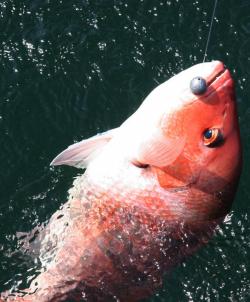
Nice red snapper

Nice red snapper

Editor’s Note: Bob Shipp, PhD, is one of the most respected fishery experts in the nation, with special expertise in reef fishes of the Gulf of Mexico. A professor emeritus of marine sciences at the University of South Alabama, Shipp’s also author of the book, Dr. Bob Shipp’s Guide to Fishes of the Gulf of Mexico, one of the best illustrated fishery guides on the market, available at www.bobshipp.com. His letter to the editor recently appeared on AL.com and like our companion service The Fishing Wire (www.thefishingwire.com), we believe his observations are not only on-target, they’re worth sharing.

In all likelihood there have never been as many Gulf Red Snapper in recorded history as there are today. In spite of these soaring populations, a broken system of federal management is precluding what would otherwise be a robust and sustainable economic driver to a regional economy in desperate need of a break.

Last year the recreational season was limited to 9 days in federal waters and this year’s season is 10 days. Just 10 days – with only a single weekend — for anglers in their own boats to catch perhaps the most popular offshore fish in the Gulf.

Conversely, the commercial sector can fish year-round and, under a similar plan approved by the Gulf of Mexico Fishery Management Council this year, the charter/for-hire sector will have a 44-day season in 2015.

The glaring inequity of those regulations has rankled everyone from regular anglers to congressmen, yet a solution has remained elusive. The road to this point is roughly 30 years in the making, and there is now virtually no escape from it under federal management.

I served on the Gulf Council for 18 years and encountered countless elected officials in Washington, D.C., and in the Gulf states wrestling mightily over the red snapper conundrum, but all ran into insurmountable roadblocks under the federal system. This year, recognizing that a system that produces results like what we are seeing today is unacceptable, the state fishery management agencies from all five Gulf states did something extraordinary – they came together to produce a viable way out of this mess.

Under a plan unveiled in March, the states have offered to take over management of the red snapper fishery and have outlined exactly how such management would be carried out. Their plan recognizes that there are regional populations of snapper that are fished differently according to local tradition and practice, and would have the flexibility to manage them in different ways.

For example, off Alabama our research indicates we could have a six-month season with a two-snapper bag limit without making a dent in the population. This is due to our extensive artificial reef program. Such flexibility is impossible under federal management, which tends to treat red snapper as one stock, fished one way.

The state fishery management agencies all have seats on the Gulf Council and know that snapper management is at a dead-end under the current system. Responsible for commercial and recreational fisheries in their state waters, they know there are far more efficient and equitable ways to manage this fishery. The system has the same goals as federal management, but the means to reach those ends recognize that one size does not fit all.

The individual Gulf states all know how to provide access to their citizens while managing for conservation of wildlife resources, but rarely do they all agree on anything. The significance of their cooperation here cannot be over-estimated.

Faced with an untenable situation, they have come together to offer the one path out of the manufactured mess of federal management. I encourage Congress to take it.

How Do Science and Politics Affect West Coast Sardine Decline?

West Coast Sardine Decline: Science vs. Politics

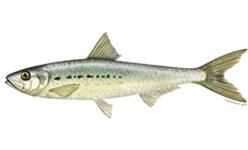
Sardine baitfish and food fish

Sardine baitfish and food fish

Diane Pleschner is E.D. of a California group representing baitfish/forage fish producers on the Pacific Coast. Her take on scientific management of fisheries, versus emotionally and politically-driven management, is worth a read for all anglers and outdoorsmen, whether we’re looking at forage fish or gamefish. FS

By D.B. Pleschner, Guest commentary
from The Fishing Wire

The federal Pacific Fishery Management Council has shut down the remainder of the current sardine season and has canceled the 2015-16 fishing season altogether. Fishermen supported this action.

Why the closure? According to environmental groups like Oceana, it was to stop overfishing and save starving sea lions deprived of essential sardines.

Neither reason is true, but many in the media have trumpeted this hyperbole put forth by groups whose political agenda is to shut down fishing completely.

The scientific facts present a different picture: the sardine population is not overfished. And sea lion mortality has not been caused by overfishing sardines.

As Dr. Ray Hilborn, professor in the School of Aquatic and Fishery Sciences at the University of Washington and one of the most respected experts on marine fishery population dynamics in the world, recently noted, “Even if there had been no fishing, the decline in California’s sardines would have been almost exactly the same.” Dr. Richard Parrish, another esteemed scientist with deep knowledge of sardines and ocean cycles, outlined how natural mortality and predation consume five times more sardines than the fishery harvests.

The truth is that the marine environment plays the major role in determining the size of the sardine stock and its effect on the ecosystem.

Dr. Kevin Hill, a fisheries scientist with the Southwest Fisheries Science Center who leads West Coast sardine stock assessments noted that, “Pacific sardines are known for wide swings in their population: the small, highly productive species multiplies quickly in good conditions and can decline sharply at other times, even in the absence of fishing. You can have the best harvest controls in the world, but you’re not going to prevent the population from declining when ocean conditions change in an unfavorable way.”

That’s why the sardine harvest control rule — developed in part by Parrish for the management plan in place since 2000 — automatically regulates the sardine fishery both by reducing the fishing quota and reducing the harvest rate as the stock declines. And it shuts down the fishery if the biomass falls below 150,000 metric tons.

The 2015 sardine population is estimated to be 97,000 metric tons, a worst-case projection, and the control rule did exactly what it was designed to do — it closed the fishery after a series of poor recruitment years.

The sardine fishery would have been shut down regardless of the frenetic lobbying of groups like Oceana. The goal of the policy is to keep at least 75 percent of the sardine population in the ocean.

Regarding the sea lion problem, the El Niño cycle that we’re experiencing is a major reason for increased pup mortality, not the lack of sardines. Sardines comprise a minor portion of sea lions’ diet. According to NMFS scientist Mark Lowry, who has studied sea lion scat for 30 years, sardines number eighth on the list of typical sea lion dietary preferences.

The sea lion population has increased 5 percent a year even without sardines.

Pup counts dipped during the 2003 El Niño also, and we’re experiencing another El Niño event now. Yet the sea lion population has grown by 600 percent since the mid-1970s; they now hog docks and sink boats from Southern California to the Pacific Northwest.

Hardworking fishermen take pride in the precautionary fishery management that’s been in place for more than a decade, and they resent groups who demonize them for “overfishing.” It’s an unjust and erroneous accusation leveled at people trying to make an honest living, provide a service to the public and do the right thing for the environment.

The fact is that sardines are critically important to California’s historic fishing industry as well as to the Golden State. The “wetfish” industry fishes on a complex of coastal pelagic species also including mackerels, anchovy and market squid, but sardines are an important part of this complex. The industry produces on average 80 percent of total fishery landings statewide and close to 40 percent of dockside value.

Thankfully the Pacific Fishery Management Council recognized the need to maintain a small harvest of sardines caught incidentally in other CPS fisheries. A total prohibition on sardine fishing would curtail California’s wetfish industry and seriously harm numerous harbors, including Monterey, as well as the state’s fishing economy.

D.B. Pleschner is executive director of the California Wetfish Producers Association, a nonprofit dedicated to research and to promote sustainable Wetfish resources.

Do I Have Access To Red Snapper Fishing?

Alabama Concerned with Minimal Access to Rebounding Red Snapper Fishery

Red Snapper

Red Snapper

By David Rainer
Alabama Department of Conservation and Natural Resources
from The Fishing Wire

Despite an increase in the red snapper quotas for 2015, private recreational anglers will only see a one-day increase in the snapper season in the federal waters of the Gulf of Mexico.

There are several factors involved in the setting of the private recreational season at 10 days. The private recreational red snapper season starts June 1 and ends at 12:01 a.m. on June 11.

First, the U.S. Department of Commerce recently approved the Gulf of Mexico Fishery Management Council vote for “sector separation” in the recreational fishery. The charter boat vessels with reef fish permits have been separated from the private recreational fishermen.

Another factor is the 20-percent buffer built into the recreational catch, which practically nullifies the increase in the recreational quota to 7.01 million pounds. The total allowable catch for both commercial and recreational sectors increased from 11 million pounds to 14.3 million pounds.

Probably the most contentious factor involved is the way the red snapper harvest is counted. The federal data collected through MRIP (Marine Recreational Information Program) indicated anglers caught 1.2 million pounds off the Alabama Gulf Coast. That’s almost two-and-a-half times the number of snapper compared to the Alabama Marine Resources Division’s Red Snapper Reporting Program’s estimate of 455,000 pounds of red snapper landed.

Chris Blankenship, Director of Marine Resources, said the sector separation allocated 42 percent of the recreational quota to the charter boat industry and 58 percent to private recreational anglers.

Under that allotment, the charter industry will be allowed 44 days of fishing from June 1 to 12:01 a.m. on July 15.

“We feel 10 days are totally unacceptable for the private recreational anglers,” Blankenship said.

“We are still working with Congress on changes to the Magnuson-Stevens Act that would give more control to the states,” he said. “Congressman (Bradley) Byrne is working on legislation that would give us more flexibility on the quotas, extend state waters out to 9 miles and assign the red snapper stock assessment to the Gulf States Marine Fisheries Commission instead of the National Marine Fisheries Service (NMFS). That legislation passed out of the Natural Resources Committee last week. So there is some movement in Washington on issues that would help us. Like I’ve said before, that’s what it’s going to take to get changes in red snapper management. The incremental changes through the National Marine Fisheries Service are not working.”

One action that could derail the current season dates is a lawsuit filed by the Coastal Conservation Association (CCA) in Louisiana that disputes the legality of the sector separation rules.

Blankenship said that may not be resolved until after the 2015 season unless the CCA can convince a judge to grant a temporary injunction against sector separation.

The one thing Alabama can do to offer a bit of relief to frustrated red snapper anglers is to open state waters to additional fishing.

Blankenship and Conservation Commissioner N. Gunter Guy Jr. have decided to open Alabama state waters to red snapper fishing from July 1 through July 31. Alabama enforcement officers will recognize a 9-mile boundary during the state snapper season, although federal enforcement officers may only recognize a 3-mile state boundary.

“I talked at length with Commissioner Guy, and we both feel like NMFS is being ultraconservative on a fishery that has rebuilt,” Blankenship said. “We don’t want to pack people into 10 days of fishing. It’s not fair with the good fishery we have out there.

“The 20-percent buffer that was put in last year for the 2014 season is part of the problem, and that has been continued for 2015. If we could add 20 percent back, it would add a couple of days to the season. It’s not much, but it’s better than nothing.”

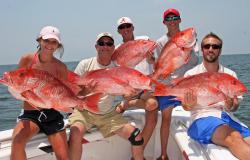
Good red snapper catch

Good red snapper catch

One of the main complaints for many years has been that the federal catch data is flawed and vastly overestimates the number of pounds of fish landed. Another problem encountered is that the fishery has rebounded so well that the average size of the fish caught has increased dramatically over the last few years.

Blankenship said the way NMFS calculated the 10-day private recreational season based on landings data from a revamped MRIP system.

“We just feel those landings were overinflated,” he said. “That’s what they used to determine the catch rate per day, and that is used to set the season length. If we can get regional control, we will be able to use our Snapper Check landings data to set the season and monitor the harvest. That should really benefit the people and give us a longer season.”

Alabama’s Red Snapper Reporting Program will again be mandatory for the 2015 season. The reporting system requires only one report per vessel trip, which can be filled out via smartphone app, online, by telephone, or by paper form. The toll-free telephone number is 1-844-REDSNAP (1-844-733-7627). Data collection drop-boxes have been erected at boat ramps at Boggy Point, Cotton Bayou and Fort Morgan in Baldwin County, Billy Goat Hole on Dauphin Island and Bayou La Batre in south Mobile County. And remember, regardless of where the red snapper are caught, a vessel landing report will be required if the fish are off-loaded in Alabama. Landing is defined as when seafood is transferred from a vessel to land or to a pier, dock, or bulkhead attached to land, or when a vessel is hauled onto land via a trailer.

“We need everybody to participate in the Snapper Check again this season so we will have two years of comparable data,” Blankenship said. “It’s going to take at least that before NMFS will make a change to the way they do data collection.”

While legislation winds its way through Washington, the Gulf Council will also discuss Amendment 39, which deals with regional management, at its meeting in Key West, Fla., in June. Under that plan, states would be allocated quotas according to historical landings. Alabama lands about 30 percent of the red snapper caught in the Gulf.

Blankenship said he understands the frustration expressed by recreational anglers like George Jordan of Daphne, Ala.

“We went (snapper fishing) one time last year,” Jordan said. “There’s only one weekend in the 10 days this year. People with businesses like us can only go on weekends. We may not even go this year. It’s just not worth it.”

Troy Frady, captain of the Distraction charter boat out of Orange Beach, Ala., said he hopes the system will be equitable to all segments of the fishing community, but he is glad to have a chance for a profitable season.

“I’m grateful to have something stable and have something for the American public to take home, that they’re able to have access to that natural resource,” Frady said. “It gives the charter boats an opportunity to make a living. It gives us something to catch while other species are closed during the summer months. Amberjack is closed in June and July. Triggerfish is closed for the entire year, so it’s more important to have snapper open to have access to fresh fish.”

Blankenship said every captain he has talked to in the charter industry seems to be happy with a 44-day season.

“I am glad for the charter industry,” Blankenship said. “That’s good for them and the economy of south Alabama, but I still think the charter boats would get more than 44 days to fish if we had state control of this fishery.”

How Can Eyes In the Sky Help You Catch Fish?

Yamaha Skipper Offers Fish-Finding Tips via “Eyes in the Sky”
from The Fishing Wire

Satellite Data that Helps You Find Fish

Ready to go fishing

Ready to go fishing

Captain George Mitchell’s Yamaha powered Yellowfin has a full complement of “eyes in the sky” navigation aids to help him find fish.

Offshore fishing is as popular as ever and with the advent of larger, more seaworthy outboard-powered boats, the desire to catch tuna, billfish, sharks, kingfish and other pelagic species of gamefish will likely continue to grow. More reasonable fuel prices will no doubt add to the affordability of chasing big fish offshore, and there are certainly plenty of opportunities along the U.S. coastline.

As is the case with any kind of fishing, the most difficult part of putting together a successful day on the water is figuring out where the fish are most likely to be, but the problem is compounded when you’re dealing with open ocean species that are frequently found many miles offshore.

“There’s a lot of water out there,” said Captain George Mitchell, “but there are resources available to offshore fishermen that can help put them in the right place at the right time.”

Mitchell is a tournament fisherman and a professional charter captain with a large and loyal clientele. His home port is Jupiter, Florida, but he also charters from Venice Marina in Venice, Louisiana at various times of the year in addition to competing in professional kingfish tournaments with his son, Eddie. His latest ride is a Yamaha-powered 36-foot Yellowfin® center console, rigged to the nines for offshore fishing. Pushed by three Yamaha F300 outboards, the boat can get him pretty much anywhere the fish are quickly and safely. But how does he determine where “anywhere” is each day?

Tuna

Tuna

Tuna and other pelagic species seek out currents and temperatures revealed by services like Roff’s.

“There are tools available that take a lot of the guesswork out of finding the most likely places for the gamefish I’m after,” said Mitchell. “Some of these tools come right out of the sky. I’m talking about satellite-generated sea surface temperature (SST), chlorophyll and altimetry charts. They sound high-tech, and they really are, but getting this quality fishing data has never been easier. Spending a little time viewing online tutorials coupled with some on-the-water practice, these tools are worth their weight in fuel savings.”

Large bodies of saltwater, like the Atlantic Ocean and Gulf of Mexico, are not vast tracts of static water. They are living ecosystems with currents, counter currents, areas of deep-water upwelling and gyres (eddies) that are constantly moving. While locating physical structure is important when fishing for inshore species, ocean features can also become structures that attract fish. What makes the ocean features harder to locate is the fact that they are dynamic, as opposed to static like bottom structures. Identifying how ocean features can impact the location of pelagic fish requires a whole different set of tools from bottom charts. That means researching current data so you can identify areas where the conditions are most conducive to concentrating forage and gamefish.

“I use SST, chlorophyll and altimetry charts to help me nail down where I am going to fish, regardless of whether I have a charter right here in Jupiter and I’m looking for dolphin, sailfish or tuna, or if I’m fishing a kingfish tournament out of a port in the Gulf,” said Mitchell. “It’s critically important to have access to real-time data and charts developed from the most current satellite passes for decision-making. When putting together a game plan, I start by identifying the catchable species in the area and then look at the developing trends in water movement, surface temperature, chlorophyll concentrations and areas of water upwelling. If, for example, I am fishing my home waters, I figure in the movement of the Gulf Stream and also factor in wind direction and speed.

Currents help find fish

Currents help find fish

This Roff’s image of the Florida Current and Gulf Stream can be a big help to offshore anglers.

“If I see an area where conditions conducive to my target species converged over the past few days, it will be high on my list of spots,” Mitchell continued. “But I will try and pick out several locations that look promising so I have a Plan A, B and C. With the mobility of high-speed fish boats like my Yellowfin,® I can easily hit a number of likely spots should one or two not pan out.”

So what is it you should be looking for on these wonders of satellite technology? You’re trying to find areas where contact between two water mass boundaries occurs; where upwelling of nutrient-rich deep water is being pushed to the surface; and where phytoplankton blooms occur.

SST charts depict ocean surface temperature to locate water mass boundaries and can help indicate where current edges and upwelling might be taking place. SST charts are generated from data provided by numerous earth-orbiting satellites. There can be numerous images available daily or, if cloud cover is persistent, none. Temperature sensing is impeded by clouds, but such areas will be marked on SST charts by the provider.

Chlorophyll data is available from just a few satellites, so one chart per day under optimal conditions might be available. What chlorophyll data provides is a look at where phytoplankton blooms are occurring. Phytoplankton is the bottom of the food chain, which will attract baitfish that feed on these micro organisms. They, in turn, should attract the predators you seek.

Altimetry is a radar image of the surface of the ocean that shows minute differences in the height of the water in colors similar to chlorophyll and temperature charts. Minor depressions in the ocean surface tend to indicate where a deep water upwelling is occurring. This brings nutrient-rich water to the surface, which kicks off a phytoplankton bloom.

Temperature and water movement patterns help catch fish

Temperature and water movement patterns help catch fish

The temperature and water movement patterns around islands are all revealed in satellite imagery today.

Offshore of the Mid-Atlantic States there is a wide Continental Shelf, and the eastern edge is pockmarked with submarine canyons. The Gulf Stream runs up the coast, but for most of the region it is well offshore of the canyons. However, the Stream creates gyres— great spinning bodies of warm, dark blue water also called warm-core eddies—which break off from the main current and migrate inshore to the canyons along the Shelf. Think of them as huge bowls of Gulf Stream water spinning in a clockwise direction that do not readily mix with the inshore water in its path. Such eddies create upwelling of deep ocean water where they encounter the steep walls of a canyon. SST charts clearly mark the location of eddies or fingers of warm water extending inshore from the Stream. Altimetry charts can help pinpoint where upwelling is taking place, and chlorophyll charts indicate where they are generating plankton blooms. These are the building blocks of a hot bite of pelagic fish that can include a variety of tuna and billfish species. With information like this, coastal anglers heading offshore can narrow down the vastness of the ocean to a few places that have the right conditions to be holding forage and the gamefish they seek.

Services that provide satellite-generated charts for recreational anglers are in hot demand because these ocean features are often located 60-to-100+ miles offshore, certainly well within the range of today’s high speed fishing boats. Without these charts, this is a long way to go to troll around blind with no idea whether you’re within five or 50 miles of the action. The charts used in this article were provided by Roffers Ocean Fishing Forecasting Service which, under the direction of Fisheries Biologist/Ph.D. and owner, Mitchell Roffer, has been providing these services for three decades. However, there are numerous companies that offer subscriptions to accurate fishing charts prepared from satellite data. There are also a number of free government and university websites that offer raw SST charts.

Hilton’s Realtime Navigator
www.realtime-navigator.com

Terrafin Satellite Imaging
www.terrafin.com

OceanTemp
www.oceantemp.com

Offshore Satellite Services
www.offshoresatelliteservice.com

Roffers Ocean Fishing Forecasting Service
www.roffs.com

How Can I Locate Fish In the Surf?

Locating Fish in the Surf

by Captain Rodney Smith
from The Fishing Wire

Taking the time to learn the intricacies of surf fishing can help to expand and improve on one’s overall knowledge of fishing because of its many facets.

Catch snook in the surf

Catch snook in the surf

At the right time of year, snook can be a prime target for surf anglers along Florida’s east coast, particularly from Cape Canaveral southward. (Rodney Smith Photo)

The first tip for anglers searching new waters for fishy places is to go buy a chart, study it and highlight the suspicious areas, particularity points, pockets and passes. But when it comes to surf fishing from the beach, especially the areas I fish most often along Florida’s central east coast, this may not be your best starting point. The beach is such a dynamic and changeable place that charts will not give you the foundation needed to get a grasp on where to get started and what to look for while surf fishing.

The exception to this is charts that are geared strictly for sharing surf fishing information. In my first book, Catching Made Easy, I included several chapters that should help you locate more fish. In these chapters I focus on how to develop a successful game plan, touch on the importance of listening to your intuition, and dive into where you can find the hotspots. I’ve published a couple of Catching Made Easy Surf Fishing Maps for a portion of the Indian River Coast, which should help you locate the places where fish might be hanging out.

Scout the beaches; take a walk with or without your fishing rod and reel, but don’t forget your binoculars. A good pair is a helpful tool when surveying new waters or when searching for diving birds and bait pods. Ask other anglers questions. Go to the local bait and tackle shop, get to know the folks working and hanging out there at the shop. Ask questions, and be grateful when anglers share their knowledge and experience with you.

It’s been my experience that this one tactic will help you locate the most desirable places to start. In most cases ninety percent of the fish are found in ten percent of the water. In the surf you need to establish the location of sandbars, the trough between the shore and sandbar, and the swash and run-outs, aka rip currents.

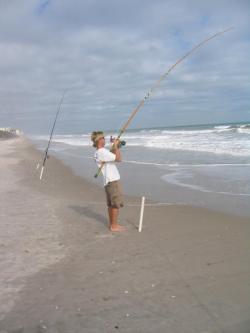
And read the surf

And read the surf

A long surf rod and a good eye for the right spots are keys to success in surf fishing. (Rodney Smith Photo)

It’s important to remember fishy surf spots can and will vary for a number of reasons, including changes in water temperature, time of day, seasons, bait availability, rainfall, wind direction, tides, etc. And don’t forget that in the surf one storm or big ground swell can completely transform the playing field.

Quite often, fishy spots will stand out like a crooked nose. Other times, it might be a very subtle hint that gives these places away. For instance; when surf fishing a flat, long stretch of beach the run-outs and feeding areas are probably not going to be obvious to the inexperienced eye, but over time and much observation things like recognizing a steady flow of water traveling out a certain cut through a sandbar or break in a reef will become more easily spotted.

Keep an eye out for bait. Seeing ghost crabs on the beach, sand fleas (mole crab) down in the swash, and finger mullet or glass minnows (a number of different species of baitfish are called glass minnows, including Spanish and bay anchovies) holding near shore is a good sign. Feeding birds is another good indicator that game fish are close. Remember, gulls are scavengers and terns and pelicans prefer live baits.

While finding fish is a very important part of catching, it’s only a portion of successful fishing. Other factors, like reading the water, understanding fish habits, making your cast count and being prepared can often be equally important to catching more fish.

Take it from me, the task of finding fish hasn’t changed much during the 50- plus years I’ve been hunting for them. If you locate healthy habitat, those places that provide food, shelter or both, you will find fish. Word of mouth can be very important; the information you can get from someone more experienced or an angler with local knowledge will go a long ways down the road toward success.

Talk to anglers fishing the waters where you’re scouting. Instead of asking them if they’re catching fish, ask them if they are fishing or catching. This usually loosens them up and they’re more willing to share their fishing stories. Remember to make friends with the guy or gal at your local bait and tackle shop, too. They work hard providing services you need, and they are also purveyors of very useful and up-to-date information. Surf fishing venues are some of the fastest changing places in the world to fish, so it is particularity nice to get to know someone who keeps their finger on the pulse.

Catch redfish surf fishing

Catch redfish surf fishing

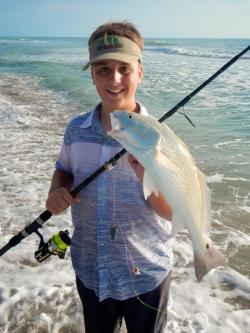
Redfish are another favorite species for Florida surf anglers, and they come in all sizes from “keepers” like this one to giants of 30 pounds and more. (Rodney Smith Photo)

Sidebar: When exploring the surf by foot looking for game fish crashing bait pods, try to keep it simple. For example, bring along a seven-to-nine foot, medium-weight spinning rod with you (depending on the size of the lures you will be casting and fish you are targeting). Wearing a vest with multiple pockets to stowaway poppers, diving lures (crank baits) and D.O.A. plastic baits plus leaders, dehooker and binoculars is best. I’ll usually bring along an assortment of smaller white or pink bucktails and a handful of silver or gold spoons. These work well when encountering Spanish mackerel, bluefish, snook, pompano and other fishes cruising the surf.

This changes when it comes to fishing baits in the surf, like live sand fleas, cut clams or shrimp in the cooler months for pompano, whiting and drum. In this case, a twelve-foot rod is most manageable and works best at keeping the line above the pull of the surf when using a bottom rig and heavier weight. Your binoculars can still come in handy when you want to see what the other surf anglers are catching down the beach.

Once you get serious about improving your ability to locating productive surf fishing spots you will also develop your own personal tactics and techniques leading you down the road to success.

Learn more about Florida’s fishing and natural resources by reading or listening to Captain Rodney Smith’s books Catching Made Easy and Enjoying Life on the Indian River Lagoon Coast. To contact Capt. Smith about a private fishing lesson, call him at 321-750-3374, or send an email to irlcoast@gmail.com. And don’t forget to check out www.rodneysmithmedia.com.

What Are Florida Shark Migrations?

Florida Shark Migrations
from The Fishing Wire

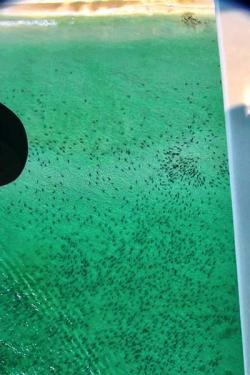
The sharks are swarming off the east coast of Florida again, providing the usual titillating footage for news helicopters who delight in showing this “dangerous” phenomenon of literally thousands of the big predators massed in an annual migration.

Huge numbers of sharks

Huge numbers of sharks

Though it looks like a swarm of insects, this is actually an aerial shot of thousands of sharks migrating off the beaches of Florida’s East Coast in spring. (Photo Credit Stephen Kajiura, Florida Atlantic University)

To experienced coastal anglers, the migration is of interest not because it means the sharks are on the hunt for human flesh, but because when the sharks come, that means the gamefish have come as well. The whole migration goes north in spring, typically late March through mid-April, and south in fall, spanning late October and early November. The movement depends on water temperature, and on the baitfish that follow the temperature curves.

The baitfish–mullet, menhaden, sardines, cigar minnows, thread herring and more–come in unimaginable numbers, absolute masses that can cover the ocean for hundreds of acres at times, and close on their heels will be bonito, Spanish mackerel, king mackerel, cobia and an assortment of other camp followers, and weaving in and out of the gamefish are the pods of sharks, which eat both the larger bait and the gamefish.

Snook and tarpon, not so often thought of as migratory species, also migrate with the bait, though the snook apparently remain within a few miles of their home inlet and the tarpon rarely get anywhere north of the Carolinas.

All of this migrating and eating suggests two things to seasoned observers–first, right now is a VERY good time to go fishing on the east coast of Florida. And second, this is not a great time to be surfing or swimming there, particularly where the bait and the sharks are thickest.

Florida’s east coast, particularly the slightly murky waters north of Cape Canaveral, often have the highest number of shark “attacks” in the nation, though these attacks are usually no more than a quick bite that, though assuredly traumatic, is not life threatening. (Not to make light–Even an accidental shark bite can be gruesome, requiring many stitches.)

There are two reasons for this–first, the sharks that prowl close inshore are usually are spinners and blacktips, not the bigger species like the bulls and hammerheads, and secondly, all of the sharks that are in the surf zone are there to eat baitfish, not people. The murky water can make it difficult to tell bait from a flashing hand or foot, and most experts think this is the cause of most bites.

Incredibly, some tourists have been recorded standing in chest deep water with hundreds of mullet showering around them as sharks attack the bait. The wonder is not that some humans are bitten, but that more are not. (Sharks are not the only biters in the surf–a few years back a school of jumbo bluefish chased bait in among the swimmers along a South Florida beach and chomped two of them in the legs during the feeding frenzy.)

Surfers have a similarly cavalier attitude–if the waves turn up strong, they go paddling outside the break line–right where the majority of the larger sharks are chasing the gamefish and the larger bait. Not surprisingly, surfers here get bitten with some frequency relative to their small numbers compared to the number of swimmers just off the beaches.

Even at that, the number of shark bites is very low, and as the researchers frequently tell us, the odds of being struck by lightning on the beach are actually considerably greater than of being bitten by a shark. But clearly, during these few weeks when the parade of bait, gamefish and shark is at its spring peak, it’s not a great idea to go plunging deep into Florida’s east coast surf.

Reevaluation of Red Snapper Stock

Alabama Anglers, Fishery Managers Optimistic at Reevaluation of Red Snapper Stock

David Rainer
Alabama Department of Conservation and Natural Resources
from The Fishing Wire

Editor’s Note: Today’s report on the implications of a new stock assessment of red snapper in the Gulf of Mexico from our friend and contributor, David Rainer of the Alabama Department of Conservation and Natural Resources.

Red snapper on lure

Red snapper on lure

Thankfully, a new red snapper stock assessment has confirmed what Alabama anglers and fisheries managers have said for a long time: There are a lot more red snapper in the Gulf of Mexico than previous assessments indicated.

Whether that changes the parameters of the 2015 red snapper recreational season has yet to be determined.

At the Gulf of Mexico Fishery Management Council meeting held last week at the Grand Hotel in Point Clear, Ala., the new red snapper stock assessment was discussed, as well as a number of other items that could impact anglers off the Alabama Gulf Coast.

“With the stock assessment they just completed, it looks like there could be up to a 2.9-million pound increase in the annual catch limit,” said Chris Blankenship, Alabama Marine Resources Director. “Council members asked for some clarification from the Scientific and Statistical Committee about the stock assessment. What happened was the committee didn’t have the complete landings data from 2014, so they used 2013 data like it was the same exact data as 2014. But the landings were less in 2014, so they’re waiting on the final landings numbers to put into the assessment and have that at the March Council meeting. The March meeting in Biloxi (Miss.) is when they will set the 2015 season.”

One of the reasons the stock assessment indicated higher numbers of red snapper is because of the new survey system MRIP (Marine Recreational Information Program), which was implemented for the 2013 season. When NOAA Fisheries (aka National Marine Fisheries Service) looked at the new MRIP data compared to previous years’ data, it decided to adjust the older data.

In an ironic twist, because the previous data underestimated the red snapper catch, the adjusted data was justification for raising the annual catch limit.

“When they recalibrated the landings from previous years, it showed that more fish were caught than they had previously estimated,” Blankenship said. “It’s interesting how the model works. When it showed more fish were caught in the past, they looked at how the stock is still doing with those increased removals, which shows that the stock is healthier.”

That was one reason the allowable catch limit was raised; the other had to do with fishing choices, mainly the size of the fish anglers landed.

“They also added selectivity into the model,” Blankenship said. “Essentially that means that people are purposely choosing to bring in larger fish. Instead of a 16-inch fish, people are bringing in 8-, 10- or 15-pound fish. When you only get two fish in not many days, people are choosing larger fish. When you add that selectivity in, it caused the increase in the limit.”

To more accurately assess the number of red snapper landed in Alabama, Marine Resources implemented the Red Snapper Reporting System, which required that anglers who landed red snapper in Alabama fill out a form available at the boat landing or report the catches via Smartphone app or online at www.outdooralabama.com. NOAA estimated Alabama’s 2014 red snapper catch at just over 1 million pounds. The Alabama Red Snapper Reporting System indicated Alabama anglers landed about 418,000 pounds.

“It was not used in the stock assessment they just completed,” he said of Alabama’s reporting program. “We’re still working with NOAA to figure out how they can use that data, like for quota monitoring or something like that.

“One of the biggest things we were able to accomplish at this meeting, we are looking to change the spawning potential ratio (SPR) they use to manage this fishery. The lower that number, the more fish you can catch now. We’re arguing that this stock is rebuilding much faster than anticipated, so we should be able to catch more fish now instead of waiting until 2032 to increase the quota and the length of the season. What we were able to do at this meeting was to get NOAA to start working on analyzing the spawning potential ratios so by later in the year we could select a different spawning potential ratio, which could theoretically give us a large increase in the number of pounds for 2016 and the next few years.”

Red snapper school

Red snapper school

There was also discussion of Amendment 39 (aka regional management), which would give management of the red snapper fishery to the five Gulf States, based on historical catches. Blankenship said the sector separation amendment had changed the dynamics of Amendment 39, which would be discussed in length at the next meeting. Blankenship added the recalibration of the MRIP data does benefit Alabama significantly, raising its potential allocation several percentage points above the 27 percent previously discussed.

Blankenship said Alabama Conservation Commissioner N. Gunter Guy Jr. attended the reef fish committee meetings last week and had productive meetings with the Coastal Conservation Association, the charter boat industry and fisheries representatives from the other four Gulf states. The Commissioner also met with Dr. Roy Crabtree, Southeast Regional Manager for NOAA Fisheries, and Sam Rauch, Acting Assistant Administrator for NOAA Fisheries, about regional management.

One discussion at the Council meeting centered on changing the minimum size on amberjack from the current 30 inches to 34 or 36 inches, which would increase the length of the season considerably, according to Blankenship.

“What they would like to do is increase the minimum size and keep the closure for June and July (during red snapper season) and theoretically open it up for the rest of the year,” he said. The Council asked for more analysis and no action was taken. Final action on this issue should be taken at the March meeting.

There was also no action taken on Amendment 40, which separates the charter boat industry from the private recreational anglers. Amendment 40 was passed at the previous Council meeting, but the details of how that separation would work have not been decided.

“The Secretary of Commerce still has not signed off on Amendment 40,” Blankenship said. “If the Secretary signs it, it would go into effect this year. The charter industry has asked for a split season, where they take two-thirds of their quota when the season starts in June. Then they would analyze the catch and if there was any quota left, they would have a fall season.”

On a sour note, the 2015 quota for gray triggerfish in the Gulf has already been reached, prompting the closure of the fishery until the end of the year. The reason for such a quick closure is because catch overruns in previous years left only a little more than 30,000 pounds for the 2015 quota.

“There is a lot of frustration with triggerfish closing,” Blankenship said. “That has to do with recalibration as well. They set the quota using the old landings data, and they managed the quota using the MRIP data. Therefore, the quota is lower than it should be, and it’s being filled faster every year. They have the payback provision, so when they overran the quota in 2013 and 2014, that’s why the season was so short this year. There’s not much we can do until we get another triggerfish assessment, which is next year, I think.

“Like I’ve talked about before, we have so many issues with red snapper, the Gulf Council doesn’t have time to work on other species. If we could get regional management and get red snapper settled, we’d have more time to devote to other fish, like triggerfish.”

Can I Catch Blackfish On Crabs?

Yamaha Tips: Fish Crabs for Blackfish

White, green or blue will do and hermits catch ’em, too
from The Fishing Wire

Nice blackfish

Nice blackfish

It takes a tough fish to make its living eating critters encased in hard shells, but the pugnacious blackfish fits the bill. Blackfish are also known as tautog or tog, shortened versions of the name given to them hundreds of years ago by the Narragansett Indians who called the fish tautauog. Whatever you call them, they are a popular fish for saltwater anglers in the Mid-Atlantic and New England states in fall, winter and spring, and with very good reason.

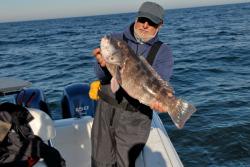
Blackfish are capable of growing to over 20 pounds and can live to the ripe old age of 30 years. The current world record of 25 pounds was caught off Atlantic City in 1998, but word of a potential new record catch is now pending approval by the International Game Fish Association. If approved, Kenneth Westerfield, an avid tog fisherman from Bayside, New York, will crush the standing record with a monster 28.8-pound tog caught aboard Capt. Kane Bounds’ charter boat, the Fish Bound, out of Ocean City, Maryland on January 3, 2015.

In recent years, there has been a profusion of tog caught weighing more than 20 pounds. Anything over ten pounds is a handful even on heavy tackle, which is why there is a fraternity of anglers who consider these pugilists of the bottom fishing realm their favorite.

Tog are one of the largest members of the wrasse (Labridae) family, of which there are over 500 species found in tropical and temperate oceans around the world. Most are small, colorful reef-type fish, while others, like the parrot fish and queen triggerfish, grow larger. Most of these colorful fish are rarely associated with recreational fishing, but the blackfish is a horse of a different color.

Stocky, heavily-muscled with a rounded head and a powerful, massive tail fin, blackfish lack the fancy coloration of some of their cousins. The females have mottled markings in shades of brown, while mature males are dark gray to black on the back and sides with a white under belly. Large males have a distinctive jutting lower jaw, and both sexes have large mouths and fat, rubbery lips that hide the prominent teeth used for gnawing mollusks off the hard bottom they live around. While the teeth appear intimidating, anglers familiar with them have no fear of putting a finger or thumb in the fish’s mouth while removing hooks or handling them prior to release. Once a finger touches the inner mouth, they relax.

Further back in the mouth of the blackfish, just forward of the throat, are pads armed with hard, rounded tooth-like bumps used for crushing the shells of the crabs and mollusks they like to eat. This makes them ideally suited for the lifestyle, and explains why crabs are the number one bait used for catching blackfish.

Anglers find blackfish around naturally occurring and manmade underwater structure, most frequently in water less than 100 feet deep. However, they can venture into depths in excess of 150 feet if bottom water temperatures get too cold during the winter. While not migratory, tog do move from shallow to deep water and back again with the seasons. Smaller ones can be found in bays, inlets and around jetties, while even the larger fish will move shallow along oceanfront hard bottom during the warm months of the year and to spawn in the spring.

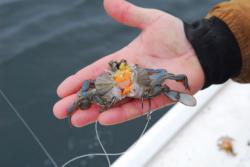
As mentioned, the most popular and productive bait for blackfish found in ocean waters are live crabs. Green crabs, a shoreside species found in tidal rivers, are easy to catch or purchase at bait shops, and they catch tog quite well. White crabs, the species found around the offshore structure tog inhabit, are harder to come by but can be purchased at bait shops that cater to tog fishermen during the season. Even blue claw crabs, which are more popular for human consumption (think crab cakes and fried soft shell), are used in some areas as are hermit crabs. As far as tog are concerned, if it crunches they’ll eat it.

Finding blackfish is no harder than heading to one of the many near-shore artificial reefs off the coast. They relate to structure, live in and around it, and so do the animals they eat. Artificial reefs are constructed using all manner of hard structure. This can include concrete of all kinds – dredge rock, subway cars, ships, barges, and decommissioned military vehicles – and it can all be inhabited by blackfish. You just have to figure out which spots tend to hold the most and biggest tog. To do this, you need to spend some time exploring the reef structure and trying different spots.

One thing that is critical to tog fishing success is understanding the basics of anchoring your boat accurately. There are times when you can be ten feet away from a structure and you won’t get a single bite. Shift the boat closer to or over the structure, and the bites can come fast and furious.

Use crab for bait

Use crab for bait

The next, and some say the hardest part, of fishing for blackfish is hooking them. Most anglers use a simple bottom rig with a six-to-10-ounce sinker at the lowest point on the line, and a single 4/0 or 5/0 live bait hook on a 12-inch leader slightly above it. For using larger whole crabs, there is a two-hook rig called a “snafu” that you can reference on fishing websites. Both rigs are designed to help you keep a tight line between your rod tip and the sinker, but the baited hook is resting on the bottom alongside the sinker. That makes it easier to feel subtle bites, but still is far from foolproof. Small live crabs can be fished whole with the legs on, but you want the scent to escape the shell. You can do this by popping off the carapace (the top shell of the crab), or by tapping it a few times with the sinker to crush it. Cut off the claws and a couple legs, and insert the hook into the claw hole and out one of the leg holes. Larger crabs can be cut in half or quarters.

When a tog bites, you feel it relayed through the line back to the rod. This is where tog fishing gets interesting. Blackfish are notorious bait stealers. They can mouth a crab so gently you might feel nothing more than a scratching sensation in the rod. They will sometimes push the bait with their nose or take exploratory nips at it with their teeth. There are many schools of thought on just when to set the hook, but the best time is when the fish passes the bait back to the crushers in its mouth. It sounds easy, but chances are you will go through a lot of crabs to get the knack of it.

When you set the hook, lift the rod high and start reeling immediately to lift the fish a few feet out of the structure. Heavy braided line and a stout drag setting make this a lot easier. Once you sink the hook into a substantial blackfish, you will experience what many consider to be the best fight there is from a midsize bottom fish. For a lot of anglers, it becomes an obsession. They prize the big fish so much that they rarely keep fish over six or seven pounds to eat, releasing the bigger fish to grow older, larger and make more little ones.

Blackfish are delicious table fare with white, moist fillets that can be baked, sautéed or fried into an epicurean delight. Add it all up and you just might become addicted to matching wits and reflexes with the mighty tog. Blackfish are regulated by every state, so seasons, size limits and bag limits vary from place to place. Before you head out to hunt for tog, make sure to check the local regulations.

Can I Catch Stripers In Cold Water?

Stripers–Cold Water Angling Option

By Frank Sargeant, Editor
from The Fishing Wire

If you’re brave enough to get out on the water anywhere north of Florida this month, you may have a bit of Inuit in your ancestry–or perhaps you fished from an ice shanty.

Stripers in cold water

Stripers in cold water

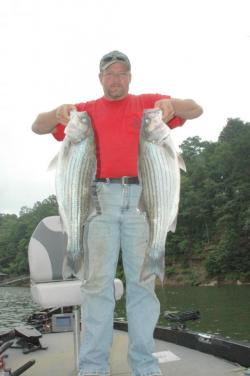
These landlocked stripers were caught next to bridge pilings in Lewis Smith Lake, an impoundment in North Alabama, an swimbaits. (Frank Sargeant photo)

Cold weather not only makes it almost impossible to endure sitting in a bass boat, it shocks the fish into a state that resembles suspended animation; they simply hang in the water near bottom, nose down, moving only enough to stay upright. They’ll come back to some semblance of normalcy after a few days of more temperate weather–but it will be the end of February before bassing returns to normal, even in Mid-South states like Tennessee and the Carolinas.

However, there are some species less affected by the cold. Top among them is striped bass, which actually thrive on cold water, and these may be the best target for the next month in many lakes around the country.

Stripers feed almost entirely on shad in open water and can be tough to find, but fortunately many lakes in winter have some “bird dogs” that make it easier. Sea gulls that winter from the Mason-Dixon Line southward keep a sharp eye out for shad being driven to the surface by stripers, and anywhere you see a flock of gulls diving–or even sitting on the water–it’s likely there are stripers below.

Striped bass are native to the TVA lakes that stretch across Tennessee, Alabama, Mississippi and Kentucky, but numbers were strongest when they were heavily stocked years ago. Now, most found here are native-spawned; the long flow-way of the TVA rivers allows the eggs to hatch in years when there’s good rain. Tennessee is also continuing to stock upstream TVA lakes, and some of these fish, as well as their eggs, arrive in North Alabama’s TVA lakes as a result.

Striper caught in cold water

Striper caught in cold water

Stripers can sometimes be located on sonar in winter hanging close to bait schools: Lower a heavy jig down to them and this can be the result. (Frank Sargeant photo)

Stripers, as distinguished from white bass, have a longer and more streamlined body shape, and grow to much larger sizes–over 50 pounds on occasion, and the world record for the landlocked strain, caught from the Black Warrior River last February, is a stunning 69 pounds, 9 ounces! Caught by James Bramlett, that 45.5 inch fish is unlikely ever to be bested; it appears to have lived in the warm water outflow of the Gorgas Steam Plant where it was able to stuff itself on swarms of shad and other baitfish prowling there to keep warm. It was built like a basketball with fins.

Stripers of 15 to 20 pounds are not that uncommon, and the average size is 7 to 10 pounds, big enough to give most freshwater anglers the fight of their lives.

Fishing live shad or shad-type lures under the sea gulls is one of the best ways to locate these fish in winter. You may have to visit several gull flocks before you find one with active stripers below, but running main channels near dams or in larger bays will eventually put you on the fish. A check of the sonar can confirm bait and stripers below–these large fish have a very obvious signature on the screen.

Stripers are great eating if cleaned properly, far better than largemouths, which most conservation-minded anglers release anyway these days.

Stripers have snow-white flesh that’s much like that of a saltwater grouper–just peel away the skin, cut out the red line and the rib cage and the boneless fillet is ready to be grilled, baked or broiled.

(A side-note–the largest stripers have higher concentrations of mercury than recommended for consumption, as with most long-lived fish. Those under 10 pounds have no issues in most lakes, however.)