Category Archives: How To

Can I Catch Bass On An Ice Fishing Jig In the Summer?

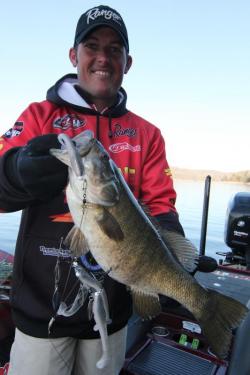
Ice-Fishing Bait Helps Palaniuk To Top-10 Finish In Bassmaster Tourney
from The Fishing Wire

Brandon Palaniuk

Brandon Palaniuk

After grabbing an early lead in a Bassmaster tournament last month, Brandon Palaniuk told the media he was keeping details of his tackle and tactics “locked down for now.” It’s time to bust out the key and set his secret free. In the heat of the summer he caught ’em on an ice-fishing bait – a Rapala Jigging Rap®.

“It’s a little trick up my sleeve that I’ve kept secret for a long time,” says Palaniuk, the only Bassmaster Elite Series pro from Idaho. “Before I made the Elites, I had thrown them a little at home. I’ve caught open-water fish on them all the way down to 70, 80 feet.”

When fished through the ice as they were designed for, Jigging Raps work best with a vertical pump-and-swim action. A successful open-water presentation, however, requires aggressive rod snaps throughout a horizontal retrieve.

“When you snap the rod, it will dart a foot or two off to the right, and then it falls super fast,” Palaniuk explains. “And then you snap it again and it might dart two feet back over to the left – or forwards, or backwards. It’s a constant change of direction.”

After weighing a 20-pound-plus five-fish limit to lead the first day of the Bassmaster Elite Series tournament on New York’s Lake Cayuga in late August, Palaniuk told Bassmaster.com he was fishing a pattern he had all to himself. It’s likely those Empire State bass hadn’t seen anything like a Jigging Rap before – at least not in the summer.

Lead weighted and balanced to perfection, Jigging Raps inimitably simulate the erratic characteristics of a wounded baitfish. “The big thing is how erratic it is,” Palaniuk says. “For fish that are in a negative, inactive mood, it triggers a feeding response.”

The Jigging Rap’s unmistakable minnow profile features single reversed hooks on the nose and rear – so regardless of how a fish attacks, it’s running smack-dab into a hook. A center treble hook – hung from a belly eyelet – further increases your hook-up ratio.

Fishing much deeper than most other competitors on Cayuga, Palaniuk saw only one other angler during the tournament. Targeting smallmouth, he ended up catching both brown and green bass off of two small rock piles in about 25 feet of water. A shell bed extended from the rock pile area down to about 40 feet. “The fish would stay anywhere from that 25-foot to that 40-foot zone,” he says.

Palaniuk found fish in those spots in the two-and-a-half days of practice before the four-day tournament began. Despite being able to see them clearly on his depthfinder, however, he couldn’t get them to bite at first.

“There were schools of these fish, so I’d drop on them with a drop shot and they’d follow it down,” he recalls. “But I wouldn’t be able to get them to eat.”

But on the last day of practice, inspiration struck.

“I pulled out the Jigging Rap to try to get a reaction strike,” he says. “The first drop with it, I had one eat it.”

It was a No. 7 size Jigging Rap in the Glow color pattern – white with a chartreuse head. He threw it on a 7-foot, medium-action spinning rod spooled up with 8-pound-test braided line attached to an 8-foot, 8-pound-test fluorocarbon leader.

“That first drop of the Jigging Rap, a couple followed it down, and the first few snaps of the rod, I got one to eat it,” Palaniuk says. “So then I kind of got excited. I was like, ‘Man, I’ve got something figured out that they’re going to eat!”

After dropping the Jigging Rap a few more times and shaking off a few more bites, he determined he’d found a school of 4-pounders.

“So, I just always had one tied up and on the deck throughout the tournament,” he says. “And when I would see fish on my electronics I would drop on them. If there were two or more fish, I’d drop on them like that and see if I could get bit.”

Ultimately, the Jigging Rap bite did not yield enough big fish for Palaniuk to win the tournament – he ended up placing eighth – but it did account for several of the fish he weighed and helped clue him into a couple other ways to get bites. Based on the way bass had been biting the Jigging Rap in practice, Palaniuk decided on the first day of the tournament to stroke a 1-ounce Terminator Football Jig, rather than crawl it across the bottom, a more traditional presentation. That decision led to a 20-pound, 1-ounce limit and the Day 1 lead.

“The reason I started stroking it was because of the fact that I got on the Jigging Rap bite,” he explains. “I just started ripping it off the bottom, like you would a Jigging Rap, and that’s pretty much how I caught 20 pounds pretty quick.”

Most of the bass Palaniuk caught on the Terminator Football Jig hit on the fall immediately after a vertical stroke. “You’d rip it up and I think you’d catch their attention, and they’d follow it up, and then instantly, if you’d let off at all, they ate it,” Palaniuk explains. “It’s almost like you’re fishing a spoon. Once you rip it up off the bottom, they eat it as soon as it changes direction – starts to fall.”

Although many believed, going into the tournament, that shallow-grass largemouth would be the ticket to success on Cayuga, Palaniuk – true to form – opted to target deep-weedline smallies.

“I always like doing something different,” he explains. “I feel like that’s how you put yourself in contention to win and how you can separate yourself from everyone else – if you can find the quality fish doing something different, that not every else is doing. The reason I found those fish is because I was looking for smallmouth.”

As it turned out, however, he caught both smallmouth and largemouth from his deep spots. Brown and green bass were “pretty evenly mixed in the school,” he says.

Fishing Apps for Smart Phones That I Like and Use

There are many fishing apps for smart phones on the market. I don’t play games so I am not really interested in the games available – I use apps that actually help while fishing.

Weather plays an important past in fishing, and I always check the hour by hour forecast, even if it is often wrong. But while on the water rain or a thunderstorm can change things fast, and lightening can endanger you. I like to know if a storm is headed my way, and how intense it is. So I have a weather radar app, MyRadar, shows real time radar. You can see the intensity of a storm and the direction it is moving. I can either put on a rain suit or head for cover, depending on what is coming.

I like the Solunar Tables, which predict feeding times based on moon and sun position. They don’t always work, but do give me an idea of what to expect. I have seen them most accurate when fishing riprap, one of my favorite places to fish, so I like to know predicted times the fish should bite best. One on my phone, ISolunar, not only shows major and minor feeding periods, but sunrise, sun set, moon rise, moon set and other information. You can set it for the area you are fishing and look ahead to the day you will be fishing.

Two eBooks that I wrote are also on my phone. Key to “Catching Clarks Hill Bass” and “Keys to Catching Lake Lanier Bass” are lake specific, with lake maps, GPS Coordinates and descriptions of ten spots to catch bass each month of the year. But the books also tell the baits the local expert uses on each hole, how they rig and fish them, and other information that gives you general tips on bait rigging and use.

Do you have fishing apps on your phone? If so, share them in the comments section below.

You Tube Video On Using the Book Keys To Catching Lake Lanier Bass

My eBooks “Keys to Catching Lake Lanier Bass” and “Keys To Catching Clarks Hill Bass” help me catch bass so I made a video showing how to use them.

Lake Lanier is a tough lake to fish for many, including me. The fish live deep in the clear water and a drop shot rig is one of the best ways to catch them. I seldom fish a drop shot.

I went to Lake Lanier in July, took one of the chapters of the book for hot weather fishing and put the GPS Coordinates from that chapter in my Lowrance HDS 10. When I got to the waypoint there was a brush pile right on the coordinates.

After rigging a drop shot just like described in the book, with eight pound line, quarter ounce round sinker, eight inch leader and Wackem worm in the color suggested I caught three spotted bass. They were not big, two were throwbacks and one was a 14.5 inch keeper, but I did catch fish. A thunderstorm ran me off the lake early or I could have tried more of the spots in the article.

Check out the video and let me know what you think.

How To Avoid Summer Headaches

A Pain In the…Head – Summer Headaches

Editor’s Note: While battling a skull-cracking headache over the weekend, one of our friends wondered what might cause him to have more headaches in the summer. We did some checking around, and guess what? Summertime is one of those times when there’s an increased chance of headaches. There are a number of reasons- and we thought you’d like to know them. The information is courtesy of the National Headache Foundation, and comes along with a reminder that June is Migraine and Headache Awareness Month (who knew).

During the summer, there is an increased chance of exposure to the triggers and other precipitating factors of headache. Vacations, air travel, the beach, picnics, and partying are not always fun times – especially if you are laid low with a migraine or other headache. The National Headache Foundation offers these helpful tips on avoiding these summer spoilers:

1. The sun can be especially bothersome if you have migraine. Looking directly or indirectly at the sun can trigger a migraine attack. Don’t forget your shades – sunglasses, visors, or sun hat when you are out and enjoying the sunshine at the beach, tennis court, golf course, or a baseball game.

2. Changes in barometric pressure are well-known headache triggers. Watch out for those sudden thunderstorms and windy days – even in July.

3. Watch your fluids when you are at the beach or some other outdoor activity. Drinking plenty of water – not soda – will help prevent those “dehydration” headaches. You don’t want to drink too many soft drinks containing caffeine which can also contribute to your headaches.

4. Backyard barbecues and picnics may provide you with food items that you wouldn’t normally eat. The sauces and dry rubs on those tasty ribs may contain monosodium glutamate (MSG) to which many headache sufferers are sensitive. The spread at a picnic may include aged cheeses, hot dogs and other meats with nitrates, and pickles – all items found on headache diets. And let’s not forget the beer and cocktails served at those summer parties – watch your intake!!!

5. You’ve invited 50 friends to your July 4th celebration – and the stress is getting to you. Plan ahead and be organized – you don’t want to spend the day or the day after, in a dark, quiet room as you try to get rid of that migraine.

6. The joy of a long weekend or vacation can be quickly ruined by a headache. Try to stay on your normal sleep schedule. Oversleeping, not getting adequate sleep, or missing a meal can all contribute to a headache.

7. Everyone says “travel is no longer fun.” Traveling by plane is particularly stressful. Who can tolerate the airport inconveniences, the long delays, and the lack of food service on these flights? Purchasing a healthy snack and a bottle of water prior to boarding may help you avoid a travel headache. Try to avoid alcoholic beverages before and during your flight – those cocktails will dehydrate you. Also, the oxygen on planes, although the cabins are pressurized, is never at normal levels. If you are burdened by “altitude headaches,” your physician may offer some remedies to help prevent the headaches associated with air travel.

Hopefully, these recommendations will help you truly enjoy your summer and make the most of the great weather and sunshine.

Can Electronics Help Me Catch Fish?

Angling with Electronics: Five Techno-Tips for Fishing Success

Editor’s Note: Today’s feature comes to us courtesy of Traditions Media.
from The Fishing Wire

One of the real joys of fishing occurs when warm spring weather draws fish of all species into skinny water. Anglers don polarized sunglasses and scan the shallows for emerging signs of life. The “sight fishing” that results can be positively thrilling. It’s high-level sensory stuff that combines stalking, hunting and casting into a singular stimulating experience.

But before you know it, spring gives way to summer. Waters warm; the shallow bite shifts deeper. And if you’re not careful, you can quickly lose track of the fish you’d been catching earlier.

Summer and fall certainly yield terrific fishing, but they’re also the seasons during which great anglers often separate themselves from the pack. The difference usually resides in their ability to find fish. It’s a talent to be sure, and one that often begins with intuition. But the fact is, nearly every successful angler makes wise use of electronics; fish-finding sunglasses segue to sonar, GPS mapping, and underwater cameras. In a sense, each of these tools become our underwater eyes, solving mysteries and piercing the watery veil that otherwise separates us from big fish below.

Before you launch the boat this summer, consider these simple high-tech shortcuts to success.

#1 – Ditch the Paper Maps

Use Electronics

Use Electronics

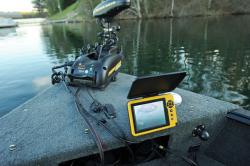
Armed with a simple sonar unit or an entire armada of fish-finding weaponry, it’s hard to discount the value of today’s technology. Photo by Bill Lindner Photography
We’ve all got ’em. Stored in the glovebox, stuffed into a bulging Ziploc bag; those old paper lake maps provide basic navigation and occasional fishing spot info. But try to unfurl one in the wind, or break one out in a downpour. Not good.

By now, most of us know about or have used a digital contour map displayed on a modern sonar/GPS unit. The advantages of a dynamic, interactive lakemap on your sonar screen is pretty profound. Products from LakeMaster (compatible with Humminbird sonar units) and Navionics (compatible with Humminbird and Lowrance) display lake, river and reservoir depth contours right on the screen, plus show your boat’s position as you move along and over various depths. When you catch a fish or see something that looks promising, you hit a button and drop an icon right on the map, so you can return and fish it anytime. You can even sit in your boat in the driveway, call up the map and drop waypoints on likely spots for later.

Most products also allow for specific depth shading and water level offsets. The latest mapping technology, called AutoChart, allows you to create your own 100-percent accurate depth maps of previously uncharted lakes, ponds, rivers or coastal areas. Simply turn on the unit, drive around the lake, and the map begins to magically take shape.

#2 – Spend an Afternoon “Just Looking”

If you haven’t yet experienced ultra-realistic side-looking sonar, such as Humminbird’s original “Side Imaging,” it may be time to upgrade the old electronics. This progressive sonar technology shoots its fish finding beams both left and right of the boat, showing you a photo-quality image of the real estate way up in the shallows, along drop-offs, under boat docks and more. While traditional 2-D sonar shows what’s below the boat, side-looking units can reveal fish that are off to the sides and unaware of your presence, making them prime targets for casting or trolling.

Want to discover those coveted hot spots that are unknown and untouched by other anglers? Spend a day on your favorite lake or river just cruising around and studying the side-looking sonar screen. When you mark an interesting object or location, simply drop a GPS waypoint on it. Boom, spot saved forever.

Scattered and hidden across the floors of most waterways lie a treasure trove of hidden fishing locations-scattered rockpiles, discarded Christmas trees, isolated clam beds, bridge foundations and old roadbeds. All of these can be angling goldmines, and side-looking sonar is an awesome tool for finding them.

#3 – Probe Cover with a Camera

Catch Big Fish With Electronics

Catch Big Fish With Electronics

The endgame of any high-tech approach: big fish in the boat. Photo by Bill Lindner Photography

So you’ve found that hidden heap of old Christmas trees, but how to know if anyone’s home? Sonar might show generic fish “arches.” But without knowing the species, size or position of the fish, you might use the wrong lure and fail to get bit. Worse, you could end up spending valuable time angling for carp that you thought were bass. It’s why some of the sharpest anglers today deploy an underwater camera, which shows you in real-time video exactly what’s happening below.

While sonar might display a beautiful brushpile, the camera reveals what’s living there. It shows that some brushpiles are void of fish life. But it also shows you the good ones, those that hold heavyweight largemouths, pods of crappies or big catfish. Armed with this all-important intel, you’re now ready to tie on the right lure or bait and experience some fantastic fishing.

Increasingly popular among anglers today are Aqua-Vu’s Micro systems. These self-contained underwater viewers sport tiny camera optics the size of an acorn, which easily slide into all those nooks and crannies in cover, and show you a real-life picture of every crappie, crawdad and clamshell in the vicinity. The LCD monitor is as small and compact as a smart phone, too, and the whole system stores easily inside a tackle box or even a coat pocket. If you’re not using a fishing cam, you’re could be missing out on some amazing and overlooked opportunities.

#4 – Deploy a New Wave Anchor

While this tip might not help you locate fish, it will certainly help you catch a few more once you do. Two new forms of boat control now allow you to hold the boat in a specific position without repeatedly heaving a 20-pound chunk of lead.

“Spot Lock,” a GPS driven function built in to several trolling motors, including Minn Kota’s Terrova, holds your boat continuously on an exact waypoint, simply by pushing a button on a remote control. Anytime the boat drifts 5 or more feet off course, the motor quickly propels you back to your position.

Performing a similar task in shallow water, hydraulic pole-style anchors drive a spike into the lake floor, by again, simply pushing a button. The Talon shallow water anchoring system from Minn Kota allows for automatic, effort-free anchoring in water from 2 to 12 feet deep. In wind, waves or for when you just want to stay put, these new wave anchor systems are almost priceless.

#5 – Sight Fishing On the Screen

Underwater Camera

Underwater Camera

Modern underwater cameras provide unprecedented clarity and convenience, plus a nearly innate ability to find and identify fish.

If you’re a fan of sight fishing in shallow water, you’ll love the visual aspects of doing the same on a sonar screen. When fish such as bass, crappies, walleyes, stripers and catfish drop deeper or suspend, you can position your boat right above them, drop a lure and watch them react on screen. Not only is sonar sight fishing entertaining and exciting, it’s also a very effective way to catch fish.

Using Minn Kota’s Spot-Lock function or an anchor, position directly above fish in 15- to 30-or-more-feet of water. Next, tune your sonar unit so the transducer is using the narrowest beam (cone angle) possible. This can be done by switching from a wider beam to a narrower 18 or 12 degrees. Narrower beams provide more detailed information, and will allow you to watch your lure drop in the water column, as well as fish, as they swim over and bite.

On screen, your lure will read as a continuous solid line. When you jig, you’ll note immediate wavy lines corresponding to your movements. Tune the unit’s sensitivity so you can see your bait clearly, but without additional clutter on the screen.

When a fish approaches, try various jigging moves until you get a positive response. As fish get closer, they’ll appear as a darker, thicker signal. With practice, it’s often possible to detect a bite by watching the fish’s response on screen, even before you feel your line jump. Some compare it to a video game. But can a video game tug back, leap out of the lake or slap water in your face?

–Ted Pilgrim

What Is the Best All Purpose Fishing Knot?

The All-Purpose Fishing Knot
Just One That Can Do It All
from The Fishing Wire

If you want to be a successful fisherman, you have to know how to tie knots. Specifically, you have to know how to tie a variety of knots for different connections. You’ll need one you can count on for tying on swivels, snaps and lures; another for adding a shock leader, and still another for tying fluorocarbon or monofilament leaders to braided line. It’s also a good idea to know how to snell a hook.

There are dozens of books on the subject of tying knots and hundreds of knot variations – some basic and some for special purposes. Some are easy to tie. Others are so complex you could go through a spool of line just trying to get it right sitting at a table; and then you have to duplicate it when you’re on the water. Trying to memorize techniques for tying a bunch of different knots is confusing. That confusion can lead to mistakes and ultimately knot failure.

Any knot that is poorly tied can slip or cut into the line causing a failure under considerably less pressure than the breaking strength of the line. When a knot fails, fish get away and all that’s left is a curl at the end of the line and a sinking feeling that the fish was lost due to angler error.

There’s a simple knot that typically tests out to 90 percent or better than the breaking strength of the line and is capable of handling a wide variety of connections. It’s actually more then just a knot; it’s a knot system, and once you get a little practice, it’s easy enough to tie in the dark. It is appropriately called the Uni-Knot.

Basic Uni-Knot

In its most basic form, the Uni-knot is excellent for connecting snaps, swivels and lures, and pretty much any kind of terminal tackle, using monofilament, fluorocarbon and even most braided lines of any pound test. The drawing shows how the knot is wrapped, but here’s how to tie it in detail.

UniKnot Step 1

UniKnot Step 1

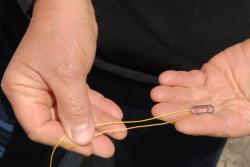
Picture 1: Start by running about 12 inches of line through whatever you’re tying on and put it in your hand like this.

Uniknot Step 2

Uniknot Step 2

Picture 2: Bring the two segments of the line parallel and create a loop around your pointer and middle fingers.

Uniknot Step 3

Uniknot Step 3

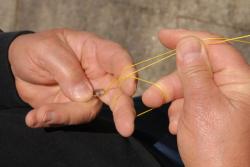
Picture 3: Wrap the tag end of the line through the loop and around both standing lines at least five times. When using braid, increase the number of wraps to six or seven.

Uniknot Step 4

Uniknot Step 4

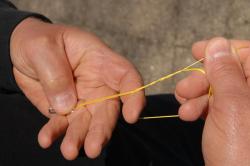
Picture 4: Slowly pull on the tag end until the knot cinches up, but don’t pull it tight.

Uniknot Step 5

Uniknot Step 5

Picture 5: Wet the knot and pull firmly on the standing line until the knot slides into place and tightens around the eye. Then clip off the excess tag.

Practice it at home and you will be able to tie it in 15 seconds or less, even on a rocking boat. This knot is the foundation for several other knots, making it the most versatile fishing knot you can learn.

Uni-Loop Knot

Some lures, like jigs, work better when attached using a loop knot. The loose connection allows the lure to swing more freely at the end of the line. Nothing could be easier than using a Uni-Knot for this purpose. Tie the knot exactly the same way, but do not cinch it down to the eye of the lure. Leave it an inch or two away and using a pair of pliers, pull the tag end of the knot very tight to lock it in place.

Uni-Snell

Bait hooks with offset eyes are designed to be attached using a snell. This type of attachment allows for a straight pull from the line to set the hook. The Uni-knot can be used for this purpose and doesn’t require you to learn a totally new knot. Simply pass the line through the eye of the hook, make a loop with the tag end, and make the five wraps around the line and the shank of the hook. Then pull the tag end, wet the knot, and complete the knot by pulling on the standing line.

Uni-to-Uni Connection

There are many occasions where an angler has to join two pieces of line together. Adding a heavier shock leader to your running line and connecting a length of fluorocarbon or monofilament to the end of braided line ensure the fish won’t see the line connected to your bait or lure. With a Uni-to-Uni connection, it doesn’t matter if the lines are of different types or vastly different diameters. All you do is place the two lines alongside each other, and tie a basic Uni-Knot in one, cinching it up lightly, then turn them around and tie another Uni-Knot in the other exactly the same way. Wet both knots and pull firmly on both standing lines until the two knots come together. A final hard pull seats them together for a strong connection.

How To Set Up An Umbrella Rig

Tips on Setting up Castable Umbrella Rigs

By Brad Wiegmann
from The Fishing Wire

Fishing is complicated. There are thousands of lures and hundreds of jig heads to rig them on. It’s frustrating.

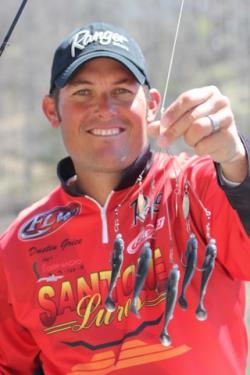
Dustin Grice and A-Rig

Dustin Grice and A-Rig

Pro Angler Dustin Grice likes A-Rigs for targeting suspended fish, as well as those around structure.

Selecting the best lure and jig head for the right technique can be overwhelming, in addition to figuring out the right weight of the jig head along with hook size and style.

Jig heads don’t look complicated, but they are all different and made for specific techniques. Those designed for swimbaits are commonly used on castable, multi-lure rigs or combined with a soft plastic lure. FLW Tour angler Dustin Grice has put a lot of thought into what works best where and when.

“Prime time to fish with the Alabama Rig, A-rig or castable umbrella rig is during the prespawn. Once the water temperature gets 50 degrees in the early spring it’s hard not to cast because of how many big fish it catches. The next best time is later on in October when the water temperatures begin to fall, however, you can still catch bass on it during the summertime offshore fishing ledges,” said Grice.

When selecting lures to rig on his castable umbrella rigs, Grice matches the bait size. During the spring, he uses small-bodied swimbaits and changes to a larger profile as the bait grows during the year. Once Grice finds the right size, he will rig all of the jig heads with it.

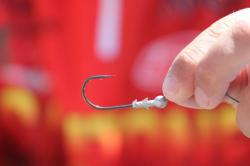
Double Barb Jig

Double Barb Jig

The double barb on this type of jig helps to keep the soft plastic tail in place during repeated casting.

“Really, jig heads may be more important than lure size when it comes to catching fish on castable multi-lure rigs. The weight of the jig heads determine how deep the lure will run. Hook size will determine what size lure to use. A castable umbrella rig has to be down in the strike zone to get a bite,” said Grice.

Right speed and presentation can also make a difference with the number of fish you catch when fishing a castable multi-lure rig. “It’s great for catching suspending bass. I just count it down to where the bass are and then start a slow retrieve. Sometimes, I will pause it when its coming back in and that will trigger a strike,” said Grice.

“I think bass like to bust up a school of baitfish then come back and eat them. I call that a “swim through.” It’s great because you know that any second after that happens you’re going to get a bite,” said Grice.

Grice acknowledged a large percentage of the time he uses 1/8-ounce Th’ Rig Head by Santone Lures on all five of the wire arms. Other times he will put 1/16-ounce jig heads on the top two wire arm and three 1/8-ounce heads on the remaining wire arms. He believes this keeps the castable multi-lure rig running true.

“95 percent of all the hits on a multi-lure rig are on the bottom three jig heads,” said Grice.

For Grice the gap between the hook point and hook eyelet is the key to catching fish when using a castable multi-lure rig. He also wants a jig head that lets the water move around it better creating a lifelike swimming action.

Another FLW Tour pro, Jim Tutt, also fishes castable multi-lure rigs. “It’s a lure just like any other lure, but when that bite is on you had better be throwing it as long as it’s legal in the tournament and state you are fishing in,” said Tutt. The Kellogg’s Rice Krispies pro is no stranger to the castable multi-lure rig having caught his biggest bass on it weighing over 11 pounds.

A large percentage of the time, Tutt will rig 1/8-ounce jigs with 4/0 hooks on all the wire arms. “I really don’t think hook size matters when a bass is going after a castable multi-lure rig. A bass is just trying to bust up the school,” said Tutt.

His favorite presentation is just casting out and letting the castable multi-lure rig fall to the bottom then slow rolling it back in. If the bass are suspended, Tutt will count down to where the fish are suspended then start reeling in slowly.

What’s important to Tutt when fishing a castable multi-lure rig is his jig heads.

“I use the Santone Lures Th’ Rig Head. These jig heads feature a drop weight system that keeps the jig heads from wrapping up or tangling, round ball head giving the lure great side to side motion and a double-barbed model or over-sided screw lock model for keeping the lure in place,” said Tutt.

Tutt added on solid bodied swimbaits the double-barbed model lures will stay on even without using super glue. On hollow bodied swimbaits, Tutt will put a drop of super glue to keep it in place.

Smallmouth On Umbrella Rig

Smallmouth On Umbrella Rig

Both smallmouths like this one and largemouths are susceptible to the swimming “school” of bait represented by A-Rigs.

“I use these heads because they have heavy duty hooks and when you are fishing with a castable multi-lure rig it’s not little fish you’re catching on it,” said Tutt.

Th’ Rig Head double-barbed model is available in 1/16-ounce with 3/0 Mustad hook, 1/8-ounce with 4/0 Mustad hook, or 1/8-ounce with 5/0 Mustad hook and over-sized screw lock model in 1/8-ounce with 4/0 or 1/4-ounce with a 5/0 Mustad hook.

As for gear, Grice uses a 7 foot, 6 inch flipping stick with 65 pound braid on a 6.3:1 reel. Tutt uses 65 pound braid, 7 foot, 2 inch heavy action rod with a 6.3:1 Shimano Calais reel.

In addition to using these heads on castable multi-lure rigs, Grice uses swimbaits rigged with them almost year round. His favorite targets with this combination are rocky areas and points.

“On reservoirs like Beaver Lake and Table Rock, I will put on a 1/8-ounce head rigged with a swimming fluke Jr. and fish it everywhere there’s rock. I will tie on 6- to 8-pound test and fish it on a spinning rod. The spotted bass and smallmouth just love it when it’s reeled back in slowly,” said Grice.

He changes to baitcasting equipment and heavier 15 pound test fluorocarbon fishing line when fishing Lake Sam Rayburn, Kentucky Lake, or Toledo Bend. Grice will also switch to a full sized swimbait. Again, Grice likes to reel it back in slowly after it falls to the bottom.

Are You Thinking About A Career In the Outdoors?

This is mostly for young people thinking about their future.

Ever thought about working outdoors? Would you like to have a job that would let you stay outside, working in the woods and on the water? There are many that allow that, and you can probably get one if you really want it – if you are young enough to plan for it!

I almost became a game warden in 1974. Back then a college degree was about all that was required, and a good family friend was head of enforcement. Also back then a lot depended on who you knew, and he told my dad if I wanted a job as a game warden I would have one.

In my second year of teaching, working outdoors seemed like a wonderful change! Then I really compared things. As a teacher I worked 190 days a year and made about $7000 per year. Game wardens worked at least 250 days a year and were on call 365 days each year. They often worked nights, weekends and any time they were needed, in all kinds of weather. And they made about $9000 to start.

In teaching, my time off was mine, except for the time I spent working on higher degrees. And I had every weekend off. When on the lake or in the woods I decided I wanted to be able to hunt game and catch fish, not try to hunt game violators and catch people breaking the fishing laws!

I stuck with education. I often wonder how my life would be different if I had become a game warden, though!

If you are still in school and want to work with the state, either as a game warden, fisheries biologists or technician, stay in school. Go to college and major in a field related to what you want – biology if you want that kind of job or something related to law if you want to become a game warden!

I have some suggestions for kids if you want to be a professional fisherman, too. Stay in school! Get a college degree, preferably one that will help you learn about fish – fisheries biology would be good.

Learn all you can about fish. Read all you can about fish and fishing. Read magazines, books and the Internet to learn what others know. Go fishing every chance you get and go to learn. Keep up with every fish you catch, noting all you can about catching it.

Start out fishing with clubs as soon as you can. Go to learn. Try to fish with good fishermen and learn from them. And think while fishing. Exercise regularly so you will have the stamina to stand on one foot in a rocking boat for 8 hours a day, day after day.

Mainly, have rich parents that can support you, or get a good job with lots of time off. That way you can support an expensive hobby. Most pro fishermen just barely make enough money to pay expenses.

I fished with a man from South Carolina a few years ago while working on a magazine article. He had to quit the pro circuits. He had dedicated two years to fishing the pro circuit and in 1998 he won 41,000, but had expenses of 40,000 above what sponsors paid. “Take home” pay of $1000 a year is not enough, even if you do get to fish every day!

Not long after that trip I fished with a pro fisherman from Alabama. He told me he won $60,000 during the year but said his contracting business is what kept him going. He could not win enough or get enough sponsors to really make it worthwhile, even winning that much in one year!

Trying to be a professional fisherman is tough – as tough as being a professional ball player – maybe even tougher. Being a game warden is not quite as tough, but those jobs are very competitive. You need to get a degree and make good grades. Talk to local game wardens and find how they go their jobs. Contact some of your fishing heroes and see what they suggest. If you want either of these kinds of careers, go for it. But be prepared for hard work, lots of study, and a long time getting to where you want to be!

Getting Your Fishing Equipment Ready For Winter

Is your fishing equipment ready for winter weather?

A sign at my lawnmower shop reads “Man who leaves lawnmower outside all winter will not mow grass in the spring.” That not so subtle hint should be a warning to fishermen, too. If you don’t prepare your equipment for winter storage, you won’t be a happy fisherman when the weather gets right for that first trip next spring.

Make a checklist so you are sure you take care of all the important things you need to do. These will cover most of them but you should add any others that work for you.

Where you store your boat for the winter is important. If you can store it inside you will be far ahead of game. If not there are many more things you must attend to for the coming harsh weather.

Your motor is the most likely problem after sitting up all winter. Gas deteriorates with time and can foul your engine. The newer blends of gas with Ethanol in them are bad for outboard motors, too. If possible, buy gas with no Ethanol added the last two times you fill up each season so no alcohol is left in the system. It is best to store your boat with a full tank of gas, too.

Lower your motor till it is straight up and down and store in that position so water runs out and does not collect in it. Add a gas stabilizer like Sea Foam to your last two tanks of gas so it works through the motor as you run your boat. It will clean your motor and you are ready to store after the last use.

You can also disconnect your gas line and let the motor run until all the gas in the system is burned up, but this also removes the oil. Once the motor is running stabilized gas, or after it stops if you run it dry, spray an engine fogging oil into the air intake until the motor stops running. If it is already stopped keep turning the motor over until you see the fog coming from the exhaust port.

Remove spark plugs and spray more fogging oil into the cylinders. Turn the flywheel to spread the oil inside. Have a new set of spark plugs ready for the spring, but it is best to wait to install them until you can run your motor one time to burn off the fogging oil. New plugs installed now will be fouled by that first trip.

Drain your lower unit oil and refill with new oil. If you see water in the oil or if there are metal filings in it, you will need to have it checked for new seals or repair work. Put in a new water pump. Water pumps in outboard motors wear quickly and it is a good idea to replace them often.

Spray all linkages and connectors in your motor with a good oil spray like WD-40. Disconnect manual steering cables and make sure no water is in them, and force grease into them if they don’t have a grease fitting. Grease all fittings for steering and motor mount bearings. Put a light coating of grease on the starter bendix and shaft.

Park your boat and raise the front. Pull the drain plug and leave it out. This lets all water drain from it and will keep water from collecting in it during the winter. Disconnect your batteries, make sure they are filled with water, clean the terminals and connectors and put a light coating of grease on them, and charge the batteries. Keep a trickle charge on them or check often to keep fully charged all winter long.

Take all equipment out of the boat and disconnect and store all electronics inside after cleaning them. Spray all connectors with an oil spray. Clean and store life jackets where vermin won’t chew on them. Check and store expendable equipment like fire extinguishers and flares, making sure they are still good. Put fishing equipment aside for later work.

Take off your prop and grease the prop shaft. Check for damage to the prop and get it serviced if necessary. Be sure to use the correct kind of cotter pin to hold your prop nut on if it requires one. Replace prop and tighten to specifications for your motor.

Check trolling motor bolts and fittings and tighten. Remove the prop and make sure no line is under it, and the seal is still good. Grease all moving parts of the mounting system and the cable.

Wash and wax your boat and trailer, including the motor cover. This removes dirt and stains that may set over the winter and be almost impossible to remove later, and the wax protects the finish.

If you have power steering on your boat, check the fluid level. Check the fluid level in your power trim. Disconnect the speedometer tube and blow the water out of it. Check all cleats and other fittings and tighten all bolts and screws, especially on seats. Spray all seats and other similar surfaces with a good vinyl spray to protect them.

When the boat is clean and dry, put a cover on it if it stays outside. Make sure the cover keeps rain, snow and ice out of the boat but has some air circulation so moisture won’t build up inside from condensation. Secure and support the cover so it won’t blow off and ice and snow won’t collapse it.

Jack up your trailer and block it so the tires are off the ground, and leave it that way. Pump up tires to recommended inflation, and if you can store tires inside, do so. Repack wheel bearings and check surge brakes for wear. Check tires for uneven wear and get them balanced or aligned as needed. Cover your tires to protect them from the sun if they are outside. Grease your tongue jack and hitch connector, and spray oil spray into both male and female light connectors.

Make sure all lights are working and sealed, with no water inside. If you see water inside, take the cover off, dry them out and spray with a oil spray. Replace bad bulbs and cracked lenses, and secure all wires to the trailer that may have worked loose.

This is a good time to sort all your tackle, making a list of what you need to replace. Sharpen hooks, replace rusty hooks, repair any damaged plugs and replace stiff spinnerbait skirts. Store plastic worms in bags that will not deteriorate. Clean tackle boxes and refill with your favorite baits.

Rods should be wiped down with a oil spray and the reel seat cleaned and oiled. Check all guides for rough spots. Visually inspect them but a cotton Q-Tip or piece of woman’s hose run through them will show tiny cracks that can cut your line.

Reels should be taken apart, cleaned and oiled, reassembled and stored. This is a good time to send a reel off to a good repair shop. Many will clean your reels for a small fee and replace damaged or worn parts for an additional fee.

Remove all monofilament type lines. They don’t hold up well during the winter, so wait until spring to fill your spools with new line. Put a small sticker on your reel to remind you of the type and test line if you need to. Check braided lines for wear and replace as needed.

Some of us are fortunate and can fish all winter, using our boat and tackle often enough to keep it in good working order. But even for those fishing year round, an annual “winter cleaning” will keep everything in top condition. Do it on those days you really don’t want to be on the water even if you can, so you will be ready for the good days when they come.

Two products will make winterizing your boat easier and take care of many problems. An oil spray like WD-40 will clean surfaces, protect against rust and dry moisture when sprayed into couplings, moving parts and sockets. A light coating will protect all winter long and not cause problems in the spring.

Adding a gas stabilizer and engine cleaner like Sea Foam to your fuel on a regular basis will help keep your engine running smooth and keep gas from gumming up your engine over the winter. Most important, it helps control the build up of moisture in your fuel tank and motor, a major problem since most brands of gas now contain Ethanol. Sea Foam is available gallon cans to keep cost down.

How To Catch Fall Bass On The Alabama Rig

How To Catch Shallow Fall Bass On Castable Umbrella Rigs Like the Alabama Rig

Fall brings many changes to a bass’s world. Cooling water temperatures prompts them to move to shallow water again, and concentrates the baitfish in big schools that move from the main lake to tributaries and coves. Bass follow these buffet lines, and there’s no better way to catch them than with a downsized castable umbrella rig (CUR).

Houston likes the Alabama Rig

Houston likes the Alabama Rig

Though umbrella rigs are usually thought of as deep water baits, some old pros like Jimmy Houston–and young ones like Jason Christie–have learned the right umbrella rig can be deadly in shallow water.
The bait-school look is a natural in the fall as shad and other forage come together. Schooling baitfish are what bass are feeding on. Mimicking a school is easy, but fishing shallow with a CUR is a new technique for bass anglers. Most rigs are big, heavy and nearly impossible to fish in water less than 6 feet deep without snagging on bottom, but several downsized, lightweight versions stack up shallow water bass.

Several factors affect the depth any given CUR will run: overall weight, the resistance it creates when retrieved, and external factors like line size and type, retrieve speed, and the angle you hold the rod. In general, the lighter the overall package, the shallower it is capable of running. Resistance refers to how easily the rig cuts through the water, and the pull created by any spinning blades and the swimming motion of multiple swimbaits. The more resistance from blades and baits, the higher in the water column the rig will run.

When external factors are considered, a braided superline is thin-diameter and prompts the lure to run deep. Heavy monofilament or copolymer line keeps it higher in the water column. To keep a rig as shallow as possible, use heavy monofilament, engage the reel immediately when the rig hits the water and hold the rod at the 12 o’clock or 1 o’clock position.

The YUM Flash Mob Jr. (FMJ) was the first version to see success on the bass tournament trail when fished in shallow water. Oklahoma’s Jason Christie used the FMJ to catch the winning bags in the FLW Tour event on Beaver Lake April 11-15, and said most of his fish came out of just 4- to 7-feet of water.

The FMJ features four willowleaf blades positioned halfway down each of the outer arms, and they aid in providing water resistance that keeps the rig shallower than others. When rigged with 1/8-ounce jigheads and swimbaits, it’s easy to keep it working the top portion of the water column.

Bass feeding on baitfish during fall may be holding in 20 feet of water, but when they’ve got the baitfish pinned against the surface the bass are only a few feet under the surface. Run a lure under the fish and you might as well be fishing on the moon. Any time you see schooling activity you can catch those fish with a lightweight CUR fished just below the surface.

Soft-plastic bait selection for the FMJ includes curly tail grubs and swimbaits up to 5 inches in length. When fishing for schooling bass in open water during fall, most pros suggest using swimbaits that match the size of the forage, but larger swimbaits slow the sink rate and allow anglers to fish the rig higher in the water column.

BOOYAH Bait Company’s new Boo Series of rigs are available in ¼-, 3/8- and ½-ounce weights, and feature a flexible lure arm that gives anglers something no other CUR can – the ability to use any lure they want on the business end. The flexible wire allows crankbaits and other lures with built-in swimming action the freedom to move as designed. A buoyant shallow-running crankbait keeps the rig closer to the surface than when used with a sinking lure such as a jig and swimbait.

The Boo Rig features four stiff outer arms with willowleaf blades attached surrounding the longer lure arm. The Boo Teaser is the same basic design, but with bait-keeper screws and teaser curly tail grubs instead of blades on the outer arms. The Boo Spin is a flexible spinnerbait that you customize with any lure as the body.

Rowland uses the Alabama Rig

Rowland uses the Alabama Rig

Zell Rowland likes rigging a single lure weedless on a castable umbrella rig for fishing around weeds and other snaggy cover.
B.A.S.S. Elite pro Zell Rowland was one of the first anglers to test the new rigs prior to introduction. On the small lake he was on, the fish were in shallow shoreline weeds, which posed several problems. In addition to needing to keep the rig just a foot or so deep, the shoreline vegetation meant the rig could not feature any open hooks.

“A lot of times in this situation I’ll go to a YUM Money Minnow on an unweighted or very slightly weighted Texas rig,” he said, “especially if there’s any ‘gunk’ up there with the weeds. If it was just clean weeds I’d throw a spinnerbait, but any moss fouls the bait.”

Rowland decided to combine the best characteristics of a spinnerbait and a weedless Money Minnow on the Boo Spin. He first Texas rigged the swimbait on an unweighted wide-gap hook before adding it to a ¼-ounce double willow Boo Spin. This lightweight combo fishes as shallow as a small spinnerbait.

Because the Boo Series features flexible wire, it’s possible to fish a buoyant crankbait behind one of the lighter Boo Rig or Boo Teaser Rig and get that effective bait school look while keeping it in the top portion of the water column. A square lip bait like the original Cordell Big O or XCalibur Xcs100 series keeps the rig up and allows anglers to slow down retrieves.

The rig/square-lip combo really shines when fishing for schooling bass in the fall. With the buoyancy of the bait fighting the natural sinking action of the rig, it’s possible to slowly work the school while keeping the rig in the upper portion of the water column.