Category Archives: How To Fish

How To Catch Winter Clarks Hill Crappie

Many crappie fishermen are getting tackle ready, planning and looking forward to March when the slabs start to move into the shallows to spawn, but they are making a mistake. If you aren’t fishing for crappie in February you are missing out on some of the best fishing of the year, especially for big fish.

Clark’s Hill is our biggest lake and offers great crappie fishing. There are many creeks and smaller rivers entering the lake that run in different directions, so you can find a place to fish that does not get the brunt of the winter wind. And you can find just about any water clarity you want to fish.

two big crappie

two big crappie

Rod Wall grew up and still lives near the lake in 96 South Carolina. He has a place on the South Carolina Little River arm of the lake and builds docks and seawalls on Lake Greenwood and Clark’s Hill. All his life he has been fishing Clark’s Hill for crappie.

About six years ago Rod started fishing crappie tournaments. He set small goals, first trying to catch a limit in each tournament, then to place and now to win. He does well on the Crappiemasters, Crappie USA and Georgia Slabmasters trails. He guides for crappie on both Lake Greenwood and Clark’s Hill.

Rod has done well enough on the trails to be sponsored by B ‘n M crappie rods, Vicious Line, and Hummingbird Electronics. He likes Southern Pro jigs and Midsouth Tackle jigs and trailers for his fishing and carries about 400 color combinations of jig heads and trailers with him in his boat.

Rod’s usual partner in tournaments is his 15 year old son Braxton and he has learned well. He has won two youth national championships, the 2010 Crappie USA Pickwick tournament and the 2011 Crappiemasters Alabama River tournament.

Nice winter crappie

Nice winter crappie

“You can catch some of the biggest crappie of the year right now,” Rod told me. The fish are moving into the creeks toward spawning areas and are feeding actively. There are several ways to catch them that work from right now through March.

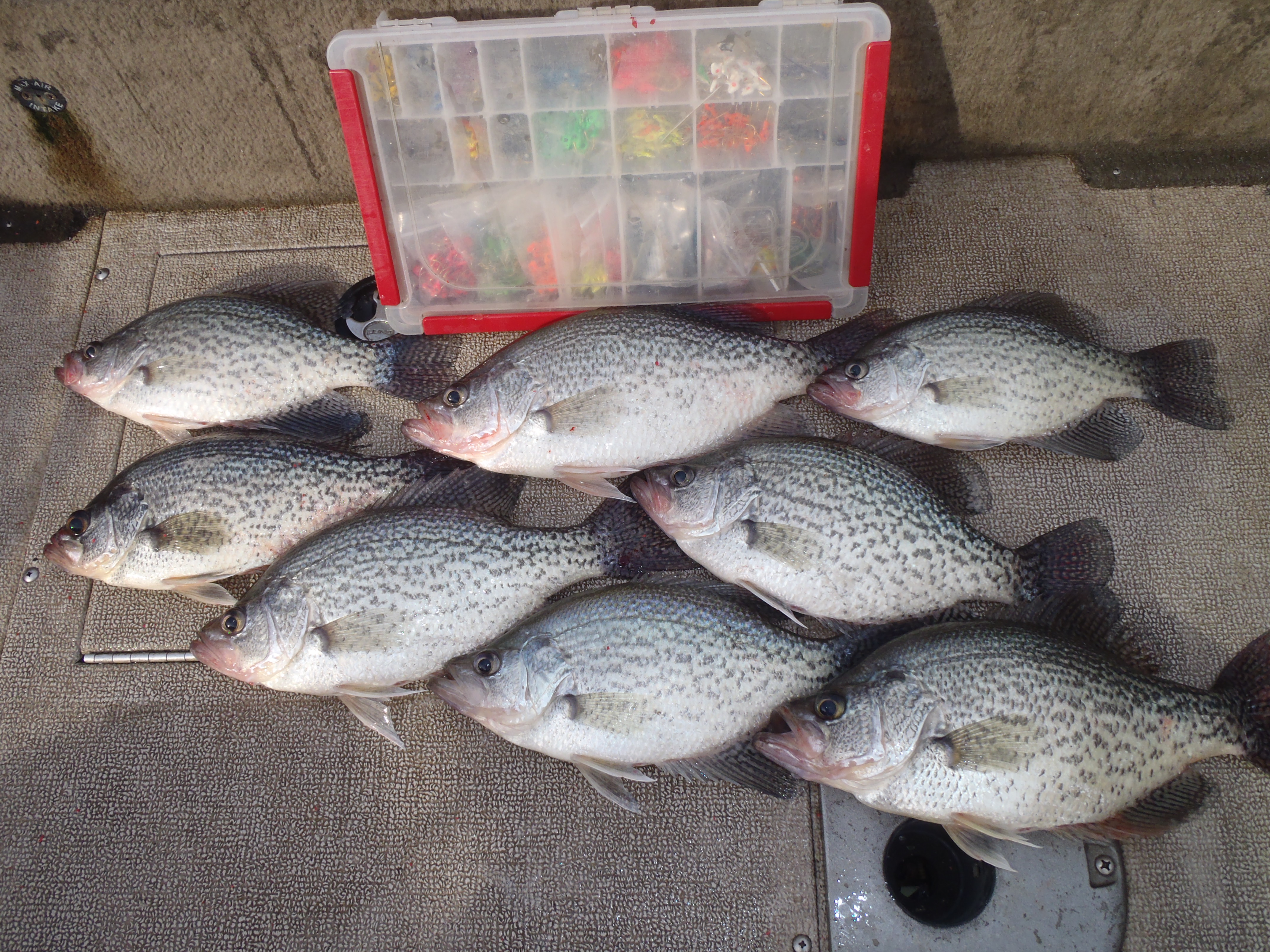
To prove his point, he took me fishing in mid-January and we landed about ten crappie. The biggest seven went from 1.40 to 1.91 pounds – on his tournament scales. Those are big crappie. But he catches even bigger. His best seven fish
Winter crappie

Winter crappie

tournament limit weighed 17.5 pounds and he has landed three pound crappie on Clarks Hill this time of year.

Rod likes to longline, also called pulling or trolling, for crappie. His Lund boat is set up with Driftmaster rod holders allowing him to fish 14 B n M rods out the back. This setup lets him cover a lot of water quickly, finding the schools of fish and catching them.

To start the day Rod will look for stained water since he says crappie hit better on a reaction bite when the fish can’t get as good a look at the bait. He will watch his depthfinder for baitfish and schools of crappie to determine the depth he wants to run his jigs and use either four or six pound test Vicious line and vary the weight of jig heads to keep them at that depth.

“One of the biggest mistakes a beginner crappie troller makes is to not know the depth he is fishing,” Rod says. The best way to learn is to put out some one sixteenths ounce jigs and troll them over a flat of a consistent depth. Vary the speed of your boat until the jigs start to bump the bottom. If it is 12 feet deep that will tell you that size jig will run at that depth at the set speed.

Speed and line size is as critical as the size of the jig. The length behind the boat you troll is also important. Rod has made a chart so he knows exactly how fast to troll a jig size and line size combination to fish a set depth.

Normal trolling speed is from .6 to 1.2 MPH. A good GPS will tell you exactly how fast you are trolling and Rod keeps a constant eye on his speed. His boat is rigged with a Minkota remote control trolling motor and he can work it from the back of the boat near the rods to keep his boat on an exact course and speed.

Crappie relate to the channels as they move toward the spawning areas so he starts near the channel, fishing points and flats along them. We caught most of our fish in January off the end of a big flat that ran out to the Little River channel and dropped off on one end into a small feeder creek. They were stacked up on the drop.

Another mistake beginners make is to try to start with too many rods. Although Rod uses 14 B ‘N Rod rigs, you should start with just six to eight rods until you learn to control them and not get tangled.

It is also important to keep your rod tips down at the surface of the water, especially if there is any wind. Wind will catch the line and make it change depths and speeds, making control difficult if the rod tip is up off the water.

On his boat Rod will have four eight foot B ‘n N rods across the back beside the motor. Three more rod holders on each side have a 12, then 14 and finally a 16 foot rod. This allows you to cover 32 feet plus the width of the boat on each troll, a swath almost 40 feet wide.

In more clear water or if you want to run your jigs deeper, use four pound test line. In stained water or if you want to keep your jigs higher you can use six pound test line. First thing in the morning Rod will try several different colors but will switch most of his jigs to the color the crappie prefer.

Rod warns that the color choice can change rapidly during the day so if the fish slow down hitting one color try others. Also vary your speed if the bite slows on one that has been working. Watch your depthfinder so you stay at the depth the fish are holding and keep your bait there by changing jig size or line size for the speed you need to go.

A loop knot used to attach your jig head to the line definitely gives it more action and Rod always ties them on that way. With the light line a good know is critical. You need to tie one that will not cut the light line.

Some of Rod’s favorite places to fish on Clark’s Hill are the South Carolina Little River arm above the Highway 378 Bridge, Soap Creek above the Highway 220 Bridge, Haw and Wells Creeks on the Savannah River arm and Germany, Rousseau and Kemp Creeks on the Georgia Little River arm. He also fishes up Big Hart Creek and Little River around Kemp Creek.

Start toward the backs of these creeks in the mornings in February and pull out toward the mouth until you find the fish. On Clark’s Hill you can find space away from other boats giving you room to troll and make the wide turns necessary to be successful. Once you find an area holding crappie, either when you start catching them or seeing a lot of bait and crappie on your depthfinder, stay in that area.

Rod likes curly tail jigs and will tip them with a live minnow to see if that helps. He often puts jigs out on one side with minnows and jigs without minnows on the other side of the boat to see what the fish prefer. If they are hitting the jigs without minnows there is no need to use them.

Crappie often are just barely hooked on the jig so you should not set the hook or fight them too fast. Just pick up the rod and start reeling. Keep the fish in the lane that rod is in so they don’t tangle other lines and let them run when they want to. You have to keep the boat moving so reel very slowly.
You will need a long handle net for bigger fish. Rod says you should never get the fish closer to the boat than the length of line equal to the rod length. When the fish is about a rod lengths line away, slowly lift your rod tip to bring it to the net.

No matter how tempting it is to try to land a big striper, hybrid or largemouth when you hook one, they will make a mess of all your lines. In tournaments Rod will instantly break them off. The day we fished he hooked a nice striper and tried to land it. It tangled 12 of our 14 lines. If you want to try to land a big fish be prepared to untangle lines. Jut be sure it is not a really big crappie before you break it off!

Another trick when trying to find out exactly what the fish want is to run a zigzag pattern with your boat. That will speed up jigs on one side and slow them down on the other. This not only changes speed, it will change depth, so you can find out what they want.

On sunny days Rod will use translucent jigs and more colorful jigs on cloudy days. A little breeze often helps but stronger wind makes boat control difficult. To control his speed when trolling with the wind Rod keeps a drift sock in his boat and puts it out to slow him down. He will also put his motor in gear and he says that will slow your speed up to a tenth of a mile and hour by itself.

Some current definitely positions the fish deeper on cover so it makes trolling more difficult. No mater what, make sure your jigs stay clean. Any small piece of grass or other trash on the jig will guarantee the fish won’t hit it.

Don’t hesitate to change speed, color and depth when you are not catching anything. As Rod says, if you aren’t catching any fish it certainly doesn’t hurt to change.

The trolling season for crappie extends a long time. Warming water even for a few days can turn the fish on and anytime the water is over 50 degrees the fishing is good. There are both black and white crappie in Clark’s Hill and the blacks move in earlier, followed a couple of weeks later by the whites, so that extends the good fishing time.

Rod says black crappie will spawn at 60 degree water temperature and whites a couple of weeks later, so keep up with the water temperature. Fish move in waves of schools so you can keep up with them and catch them over a longer time than you might expect.

Smaller fish are often more aggressive and hit more shallow, so drop your jigs a little deeper if you are catching small fish but seeing others a little deeper. But be sure to always keep your jigs above the fish. Rod says crappie will sometimes come up six feet to hit a jig but will never go down to take one.

There are other ways to catch crappie this time of year. Rod has rod holders on the front of his boat for pushing bush piles and standing timber. This method involves putting the rods out in front of the boat, moving up close to the brush or tree, and letting the jigs or minnows drop straight down.

Depth is critical when pushing, too, so try different depths until you find what they want. Standing trees in the mouths of spawning creeks and pockets often hold large numbers of crappie and you can catch a lot while pushing them.

Clark’s Hill used to be known for its crappie fishing during the spawn in the button or buck bushes but the lake has been low for so long that has not happened in years. Fish will spawn just about anywhere along the bank and even out in deeper water on brush and standing timber.

The lake was 16 feet low the day we fished, just before all the rain in the middle of the month. The lake had come up about a foot since Christmas and should still be rising. The rain will give more color to the creeks and that should improve the trolling.

Rod’s depthfinder has a barometer indicator on it and he likes to see a rising or falling barometric pressure. He says a steady barometer is not good but movement in either direction will help make the bite better. An approaching front, with changing pressure, definitely helps.

If you want to catch some big crappie, head to Clark’s Hill this month. Try Rod’s methods or fish the way you like best. There are other good creeks on the lake, too so don’t get stuck on one pattern on place.

To book a guide trip with Rod on Greenwood or Clark’s Hill call him at 864-993-8868 or visit his web sites at http://slabmasterguideservice.com for more information and to book a trip.
Can I Catch Winter Smallmouth On Spoons?

Casting Metal for Late-Season Smallmouth
from The Fishing Wire

Rethink Spoons as a Deadly Bait for Cold-Water Smallies

As dissolved oxygen and water temperatures become more evenly distributed in water bodies in late fall, smallmouth bass can hold just about anywhere. Finding them is the key, which means presentations that cover water fast are best…and nothing covers water better than spoons.

Catch smallmouth on spoonsw

Catch smallmouth on spoonsw

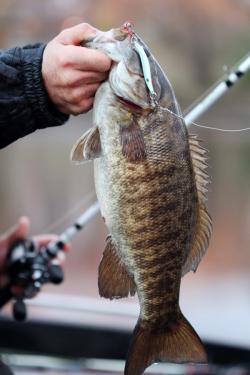
Big smallmouths like these are an ideal target for “heavy metal” in winter when th efish feed mostly on shad.

The notion of casting metal to fall smallmouth may seem strange at first, even for those who vertically jig winter-chilled largemouth. But as late-season smallmouth move toward wintering areas where they feed heavily on baitfish, there’s nothing like a spoon to reach deep water quickly and mimic what they’re eating.

In terms of fall locations, key on isolated rock piles, gravel flats, points and secondary points, especially those that plunge into deep water.

Bait Selection

Not all spoons are created equal. Hall of fame angler Doug Stange divides them into three main categories: slab spoons, horizontal spoons and “big butt” spoons, which are heavily-cupped and bottom heavy, like Johnson’s popular Sprite.

Spoons work for smallmouth

Spoons work for smallmouth

Choose the right type of spoon for the job and this can be the result.

Slab spoons are typically short, thick, heavier spoons that drop quickly. Some offer little action on the fall, while others flutter significantly.

Horizontal spoons, like the Johnson Thinfish, are longer, with a narrow profile, and often built thin; “flutter” spoons fall relatively slowly with a pronounced side-to-side fluttering motion.

Stange’s so-called “big butt” spoons are typically fished on a straight retrieve, but can be counted down to deeper structure and fished with aggressive jig strokes.

These spoons fall with a pronounced, almost zigzag wobble.

The main thing to remember when selecting spoons for fall smallmouth is to select baits that effectively target fish at the depth they are holding, and still allow you to fish at speeds that both cover water and trigger strikes. In most cases during late season that means concentrating on slab spoons, but not always, which is why it makes sense to bring a selection of spoons and let the fish tell you what they like best.

Fishing spoons is about depth, fall rate and jig stroke; get these things right and everything else will follow. Sticking with a small selection of colors will shorten your search as these other considerations are more important.

Personally, I am a fan of the Johnson Splinter Spoon, a slab spoon that casts easily, falls fast, and offers an erratic darting action on the retrieve thanks to its asymmetric, flat profile. The slender Slimfish offers a tight, erratic action on a straight retrieve thanks to built-in fins. When jigged or allowed to fall on slack line, the lighter spoons flutter slowly and horizontally.

As a general rule of thumb, I fish the Slimfish in waters 3 to 10 feet deep, but anything deeper than that I turn to the Splinter spoon. Both the ¼- and ½-ounce models are deadly, with the ½-ounce getting the nod most often, especially when working water deeper than 15 feet.

For smallmouth, it’s tough to beat FireTiger or Gold, while Chrome or Perch get the nod in clear natural lakes. The most important factor of color selection is simple: Match it to what they’re eating.

The Retrieve

Spoons come in at least three varieties, plus many variations in weight, shape and color.
Fish a spoon in the same manner that you do a standard leadhead jig. After the cast, allow the spoon to sink to the bottom on a slack line before starting with a standard rip-drop retrieve. To avoid tangles with the spoon, add a short leader of fluorocarbon to your choice of superline. An Invisaswivel tied between the leader and main line will absorb line twist, an important consideration when fishing spoons.

Experiment with both the speed and length of the lift. There are times when smallmouth respond well to aggressive jig strokes. Most strikes come on the drop. You feel the typical “tick” or simply the weight on the jig stroke.

Last fall on the Great Lakes, we caught several smallmouth to over 6 pounds on Splinter spoons by working rocks in 15-30 feet. We also caught walleye, whitefish and lake suckers (yes, caught in the mouth). The experience reiterated the triggering power of spoons when fished this way.
Recommended Gear

I prefer throwing spoons on spinning gear for longer casts. A medium-heavy 7’3″ to 7’6″ Abu Garcia® Veritas fast-action rod with a soft tip is perfect. A larger spinning reel like an Abu Garcia® Revo SX 30, which takes in a full 33 inches of line per turn, is perfect for giant smallmouths.

It’s really tough to beat a superline like FireLine® for this technique. It casts well, and with its thin diameter it works well in deeper water. In situations where I’ve used a baitcaster to fish spoons, fluorocarbon has proven the best choice.

Final Word

Spoons are a class of baits that are hard to fish if you’ve never fished them before. My advice? Take a selection of them in different weights and colors out on the water and fish nothing else that day. Spend enough time with them and you’ll discover there’s really no mystery to these old-school baits. They are very much an overlooked producer of both quality and quantities of late-season smallmouth.

Can I Use Ice Fishing Jigs to Win Open Water Walleye Tourneys?

Anglers use Ice Fishing Jigs to Win Open Water Walleye Tourneys
from The Fishing Wire

Use ice jigs for walleye

Use ice jigs for walleye

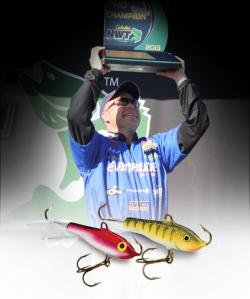
When Al Lindner spilled the beans on a hush-hush tactic for boating open-water walleyes with an ice-fishing lure, the Rapala Jigging Rap, he noted that a Canadian walleye pro had already won two tournaments with it.

Two years later, the hardwater hardbait brought tournament hardware to an American open-water angler, Rapala pro Chris Gilman. In September, Gilman hoisted a Cabela’s National Walleye Tour Championship trophy after enjoying an epic Jigging Rap bite on North Dakota’s Devils Lake.

“It was almost magical,” says Gilman, an FLW Walleye Championship winner and FLW Walleye Angler of the Year. “As fast as my partner and I could get the Jigging Raps down, we had one on.”

Sounds like the success Lindner predicted for the open-water Jigging Rap pattern in 2011.

“You land a fish, you get it off, you drop that bait down again and you can go bam, bam, bam! – Get two, three, four fish as fast as you can drop it,” Lindner says in this “Angling Edge” TV episode, [http://www.lindnermedia.com/angling-edge/video/rapala-Jigging-rap-deep-open-water-walleye-0] in which he and Gary “Mac” McEnelly demonstrate how to effectively fish the pattern. “You can’t do that with a live-bait rig.”

So fast and furious were big walleyes crushing Gilman’s Jigging Raps on the final day of the NWT championship, he and his partner fished for less than 20 minutes on their magic spot before heading back to the dock with a 22.26-pound limit that would win the tournament.

“We got there around 8:00 and had a limit by about 8:20,” Gilman recalls.

He found the winning school of fish in about 16 feet of water in a channel in East Devils lake. “We dropped right onto of a school of big ones,” he says.

On the first day of the tournament, Gilman caught most of his fish casting Rapala Glass Shad Raps. “But when the wind slowed down and my shallow fish turned finicky, the Jigging Raps were the answer,” he says.

A Masters Walleye Circuit tournament was won on Jigging Raps at Devils Lake about a month before the NWT, and “most guys heard the news and came prepared to try Jigging raps,” Gilman says. “I have had a lot of success with them in the past, but this is really the first time I fished a tournament with them.”

He started the third and final day of the tournament in second place, after catching a 16.10-pound limit on Day 2, mostly on Jigging Raps that he vertically jigged around a rock hump that topped out at about 25 feet.

“I could troll around the hump and pick off the active fish,” Gilman explains. He snaps the Jigging Rap off the bottom “pretty aggressively,” about a foot and a half up and down, he says. “It draws the fishes’ attention and they are triggered to bite.”

Gilman favors bigger Jigging Raps, which are available in four sizes. As he does most often, he was fishing 7/8th oz. No. 9’s in the NWT championship.

“The fish are not afraid of the size and the heavier weight allowed me to move around while still staying relatively vertical,” he says. He could troll as quickly as half a mile an hour “without much of a problem,” he says.

In Gilman’s experience, a Jigging Rap’s weight and action is more important than its color pattern. “Color does not seem to matter as much with the Jigging Raps, as with crankbaits,” he says. “It is the action that triggers the strike, not the color.”

Gilman throws Jigging Raps on 20-pound-test Sufix 832 braid attached by a barrel swivel to a 12-inch, 20-pound-test Sufix fluorocarbon leader. He uses a 6-foot, 3-inch medium-action spinning rod with an extra-fast tip.

Gilman weighed 55.91 pounds of walleye to win the NWT championship by a 0.05-pound margin over an angler fishing a similar pattern – his roommate, Josh Vanderweide.

“He was also fishing Jigging’ Raps, but his spot was 25 miles from mine,” Gilman says.

Open-Water Jigging Rap How-To’s

In the 2011 open-water Jigging Rap demonstration, Lindner positions his boat on the deep edge of a contour line and followed it. Using a foot-operated bow-mounted electric motor, he trolls forward at 7/10 to 1 mph, casting from the bow to a deep weed edge in about 15 to 16 feet and worked his bait over a gravel-sand bottom to about 21 to 22 feet. In the back of the boat, McEnelly drags his bait a short distance behind the boat, the line descending at a 60-degree angle to the water surface.

“We’re covering a lot of depth patterns at one time,” Lindner explains. “You cover so much water so fast with this bait, way more than you could ever, ever do with a live-bait rig.”

When fished through the ice as they were designed, Jigging Raps require a vertical pump-and-swim motion. An open-water presentation, however, requires a horizontal triggering action.

“You sweep the rod tip, and the heavy lure shoots forward like a panicked baitfish before plunging back to the bottom,” McEnelly explains. The action elicits an aggressive reaction from walleyes.

“They see it jump off the bottom, dart to the side, fall in front of their face, and they go ‘Gulp!’ They eat it!” Lindner says. “Whether you’re casting, vertical Jigging, or dragging, it is a triggering bite.”

Do not let the Jigging Rap pause very long on the bottom, McEnelly says. “As soon as you feel that bait hit the bottom, pick up again and keep it moving.”

When And Where?

On the spring day Lindner and McEnelly demonstrate the Jigging Rap bite in the video, water temps are about 63 degrees and the bite is fantastic for both size and numbers. The bite is effective all summer as well and into the late fall. “There’s a large window of time when this technique is very effective,” McEnelly says

It’s not effective, though, over soft, silty bottoms or big boulders fields. Fished over sand and gravel bottoms, however, 40- to 60-fish days can be expected, even “in the middle of summer when everyone else is dragging live-bait rigs with leeches and night crawlers and red-tailed chubs and sitting on schools of fish and catching two, three four fish,” Lindner says. “And you come through the exact same school and catch 12, 15, 20.

“It’s an amazing thing when that bite is on – how effective this bait is. …” Lindner says. “Jigging Raps in open water – it isn’t only for ice fishing.”

New Converts?

Although it was two years ago that Lindner said “the secret is out” about the open-water Jigging Rap walleye bite, not much about it was mentioned in the media until Gilman’s NWT win this fall. But as word of the win spreads – and word of the Jigging Rap bite behind it – perhaps Al’s 2011 assessment of his fishing partner, McEnelly, will soon extend to the larger walleye world: “I have a new convert to the Jigging’ Rap Brigade!” Count Chris Gilman among the converted.

Cold Front Bass Fishing Tactics

I caught this bass after a bad cold front

I caught this bass after a bad cold front

It never fails. All week the weather has been unusually warm for this time of year so you plan a trip to your favorite bass lake for Saturday. Everybody you talk to say the bass are tearing it up, hitting spinnerbaits, topwater lures and crankbaits in shallow water just about anywhere you want to fish.

Friday night the winds howl and the temperature drops. You are on the lake the next morning at daylight and the brightening sky shows completely clear with no haze or clouds at all. And it is cold, the coldest weather of the year so far. Water temperatures have dropped several degrees overnight.

Yep, the dreaded high pressure cold front has hit. Is it going to ruin your trip? You know bass seem to hate high pressure and dropping temperatures. So what do you do?

Bass respond to cold fronts in several ways. Why do they respond? There are a lot of theories, from higher pressure to brighter sunlight. But some of them just don’t hold up.

Even with a drastic increase in barometric pressure a bass has to move only a foot or so up or down to equal the pressure from the day before. Bass don’t seem to like bright sun but feed even on the brightest days. A change of a few degrees in temperature is more important in the spring than in the fall. And the wind that accompanies cold fronts can actually make them feed better.

No matter what the reasons, bass do change. We may never know exactly why. But there are some proven tactics that help you catch bass after a cold front blows through. Try them and catch some bass after a cold front.

In simple terms you go small, go tight, go slow, go deep, go to the wind or go to current. Go to the spotted bass if they are in the lake you fish. The baits you choose will probably change after a cold front and the places you fish varies some, but bass can still be caught if you plan to adapt.

Bass usually slow down after a cold front and won’t chase a fast moving bait. But the big exception to this is when the wind blows across a point or hits a steep bank. The wave action stirs up the baitfish, making them easier prey. The moving water pushes algae to the wind blown banks and baitfish follow, and so do the bass. And the bass can’t see your bait as well due to the broken water surface and more murky water from stirred up sediment.

One of the best ways to catch bass under these conditions is to fish the wind blown banks and points with a spinnerbait. As long as you can control your boat in the wind and waves you can find and catch bass. Find a point or steep bank where the channel swings near and fish it.

Depending on water color, a white spinnerbait with two silver willowleaf blades is best. If the water is stained try a skirt with some chartreuse in it and one or two gold blades. A heavier spinnerbait helps you cast in the wind and fish faster to cover water until you find the fish feeding. A half ounce bait works well. When you catch one you can usually catch a lot more from the same place.

Keep your boat a long cast off the bank and cast with the wind, working water from a foot deep right on the bank back to about ten feet deep. Run the spinnerbait about a foot under the surface like a confused baitfish trying to head back to deeper water.

If reeling your spinnerbait fast doesn’t work try slow rolling it a foot off the bottom, keeping it moving steadily with a slight pause every two or three feet to make the skirt flare. Don’t spend a lot of time on one place, make ten or so casts with a fast retrieve and the same number slow then move on if you don’t catch a fish. Bass school up and are concentrated on some structure but not others so keep looking until you find them.

If the wind is too strong to control your boat or you don’t find the fish or just don’t like fishing the wind, go small. Downsize your baits. If bass have been hitting a big crankbait or spinnerbait try a small one-quarter ounce bait. You have to fish the smaller spinnerbait more slowly and that is good. Slow down with the crankbait, too, if that is your choice of baits.

Also drop down to a three sixteenths ounce jig and pig or one eighth ounce jig head worm with a short finesse worm on it. These baits fall more slowly and you have to move them more slowly to keep contact with the bottom, and that is good, too. Fish around cover near where the bass have been feeding.

Work any cover you find carefully. Many bass won’t move far. If they have been feeding around stumps or rocks in six feet of water they may still be holding there and a little deeper. They may also move closer to deeper water.

Bass move often move very tight to cover after a cold front. They may still be in the exact same depths and locations but are harder to catch since they are buried in the thickest cover and won’t chase a bait very far. Take advantage of this.

Find a dock and fish it. Docks always hold bass if they have water deeper than a couple of feet under them in the fall, and they are even better if they are near deep water. But the bass get way back under them after a cold front.

One of the best ways to fish a dock after a cold front is to skip a bait as far back under it as possible. A weightless four inch Senko rigged whacky style on a weedless hook gives you small and slow and you can get them into places it is hard to get other baits.

Rig your Senko on a spinning rod with eight pound test fluorocarbon line. It takes a little practice but you can skip that bait on the lighter line all the way to the back of a dock sitting a few inches off the water. Let the bait settle to the bottom without moving your rod tip or reeling in your line.

A Senko or similar bait falls with a slow, enticing wiggling action rigged whacky style. When it hits bottom let it sit still for several seconds. Watch your line carefully for any small tick or movement. Set the hook fast and get the bass out from under the dock as quickly as possible.

Also try the posts and any brush under the dock with a small jig and pig. Pitch or skip a three-sixteenths ounce jig with a twin curly tail trailer right to the posts or to the middle of the brush. The light jig and the twin tails make the bait fall slowly and the bass often find this irresistible.

Fish other cover the same way. Find stumps and pitch a small jig and pig to them, letting the bait fall right beside them. Pitch your jig and pig into the thickest parts of a blowdown, paying careful attention to where limbs join the trunk of the fallen tree. Work all the way to the end of the tree top.

Brush piles hold bass but they bury down in the very middle of them after a cold front and not move out to feed. But a small jig and pig or Texas rigged worm dropped through the brush and jiggled in their face will get them to hit. Use heavy line, 15 to 20 pound test fluorocarbon, so you can get the fish out of the cover.

In all this cover don’t expect the bass to pick up the bait and move off. They often suck it in and not move at all. So watch for that tick when they eat your bait. Also raise your rod slowly when you move the bait. If your line is tight set the hook if there is any doubt if it is a fish.

No matter how you are fishing the cover, fish slowly. Using small baits helps but let them fall and sit as long as you can stand it. Jiggle them a little in one place as long as you can. You want to make a bass hit that is not really in a feeding mode.

Out of the wind, small spinnerbaits and crankbaits work if you move them as slowly as possible and bump them into the cover. With a spinnerbait if you hit a limb pull it up and let it fall back without coming over the limb. With a crankbait hit the cover and let it float up to drive the bass crazy.

Bass live deep and there are always deep bass but a cold front may push shallow bass deeper. Find deep structure with cover on it and the resident bass are there as well as any that have moved deeper. Small, slow moving baits work best after a cold front even in deep water.

A dropshot rig is one of the best outfits to get these bass to bite. Deep is relative on different lakes. On a clear highland type lake you may need to fish 30 plus feet of water. On more shallow lake with more stained water deep may mean 15 to 18 feet deep.

Good electronics are critical for this type fishing. Ride creek channels and drops watching for brush and stumps. When you find the cover examine it carefully for the telltale marks of fish holding in it. Even if you don’t see fish, try the deeper cover since they may be buried in the cover.

Baitfish near the cover makes it even better. If you see balls of baitfish find the closest cover and fish it hard. Shad tend to move deeper after a cold front and bass will be nearby, so take advantage of this bass attracting food.

Rig a finesse four inch worm about 18 inches above a sinker heavy enough to allow you to fish the worm in one place. If the wind is strong you may have to go to a fairly heavy drop shot weight.

Drop the rig to the bottom in the cover and tighten up your line, making the worm hover off the bottom. Barely twitch your rod tip to make the bait wiggle in place. Nose hooking the worm gives you more action but you may need to Texas rig it since you want to get the worm into thick cover.

A small jigging spoon works well, too. Try a silver one half ounce spoon if the water is clear or a gold spoon if it is stained. Spoons seem to work better if the water is fairly clear. Jig the spoon up and down in one place over and over, pulling it up a foot and letting it fall back in the same place.

With drop shot and spoons get the front of your boat right over the cover and fish and hold there, fishing both baits straight down. Sometimes you can see the bass suspended off the bottom. If you do, drop your bait down to the level they are holding and keep it in front of them.

One trick with a drop shot is to tie your hook as far above the sinker as the bass are holding off the bottom. If they are suspended five feet off the bottom, have your leader five feet long to keep the worm right in their face. This works no matter how far off the bottom they hold since you reel the fish in before getting to the lead, and it gives you exact control.

Bass in current are more active and have to feed more. Run up the river or feeder creeks in the lake until you find moving water. Rains often precede a cold front and runoff may make the current stronger, or power generation at the dam above or below the lake does the same thing.

Find eddies and pitch a small jig and pig or Texas rigged worm to those spots. Look for rocks, logs, brush and pockets where the current breaks. The bass usually hold in the lower current and feed as baitfish and other things they like, like worms or crayfish, wash to them.

Fish up the current. This gives you more boat control and allows you to fish your bait with the current in a natural movement. Pitch ahead of the boat and let your bait fall with the current into the eddy. And if you don’t like wind, you are more likely to find protected areas in the more narrow river than on the lake.

Spotted bass don’t seem to respond to cold fronts as badly as largemouth do. Florida strain largemouth that have been widely stocked out of their native range grow fast but are notorious for not feeding after a cold front. Northern and southern strain largemouth also get lock jaw after a cold front. But fish for spots and you are more likely to catch some bass.

Spots love rocks so fish rocky points and steep banks. Smaller baits are usually best for them even without a cold front, so try the same small crankbaits, spinnerbaits, worms and jig and pigs. Spots are more aggressive than largemouth all the time so you can usually fish faster, too.

For some reason spots are turned on by chartreuse. Try chartreuse spinnerbaits and crankbaits. Dip your plastic worm or jig trailer in a dip and dye like JJ’s Magic. Spots tear up a jig and pig with a curly twin tail trailer with the tips of the tails dipped to turn them chartreuse.

Don’t let a cold front get you down. Be prepared for it and catch some bass. Try these ideas and they should work for you. But no matter, it is better to go fishing than work around the house!

Tip

Dip and dye like JJ’s Magic works all the time when you are fishing, but the added colors and scent may make even more difference when fishing after a cold front. JJ’s has a strong garlic scent and comes in four colors to allow you to vary your bait color quickly, and to add highlights to your plastic baits.

Dip the tails of a green pumpkin curly tail worm or jig trailer into chartreuse JJ’s and it instantly changes color and smells strongly of garlic. The wiggling chartreuse tails look exactly like the fins of a bream and makes the bass more likely to eat it. That can make the difference between a bite and getting ignored after a cold front.

How Can I Catch First Freeze Walleye?

First-Freeze Walleyes On Featureless Lakes

by Daniel Quade
from The Fishing Wire

A shout echoes unanswered across the barren icepack of Minnesota’s massive Upper Red Lake. It’s hardly a call for help, much less a greeting. It’s veteran walleye guide Jonny Petrowske, proving a point about getting away from the crowd to corral first-ice ‘eyes.

“If I yell at the top of my lungs and no one hears me, I’m far enough away from other anglers,” he grins.

Catch big walleye

Catch big walleye

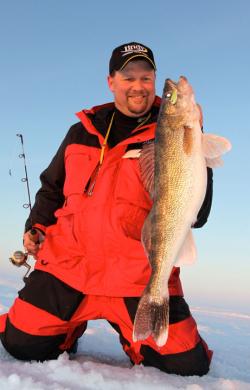
Guide Jonny Petrowske says the trick is to find the fish, then not spook them, to produce whoppers like this.

Petrowske says that even aggressive walleyes get skittish when clamorous hordes of winter warriors overrun the ice. Since the only reply to his thunderous vociferations was the raspy, disapproving cackle of a raven drifting overhead, it appears we’re good to go.

We’re targeting early winter walleyes shortly after the mighty lake’s surface has solidified. Shallow and relatively featureless, Upper Red is typical of many fisheries that are first to freeze, and first to offer a chance at hardwater walleyes.

“It’s largely devoid of structure,” Petrowske said, “so the walleyes are nomadic, wandering vast flats looking for food.”

Catching them calls for two things, he says, finding the fish, and then not spooking them once we do.

“Since there’s nothing tying them to small area, they won’t tolerate the sound of your feet shuffling around above their heads.”

With nearly 50,000 acres at our disposal on the state-managed section of Upper Red, we have an intimidating amount of territory to cover. Petrowske quickly narrows it down to forage-rich shallows within a mile of shore.

“Depending on the lake, such areas offer walleyes everything from emerald shiners and young-of-the-year yellow perch to frogs and other forage,” he says. “Water depths of 4- to 8-feet are ideal. On lakes with slow-tapering bottoms, the search area may stretch a mile or more from the bank.”

Beginning far from shore over the deepest part of our chosen hunting grounds, Petrowske punches a string of holes spaced at 1/8-mile intervals all the way back to the shallows. At each stop, he augers a pair of portals to the underwater world 6- to 7-feet apart to allow for fishing two presentations simultaneously. Since silence is golden, he drills all of the holes in one fell swoop, which gives all spots except the last drop zone time to quiet down.

After deftly skimming away the slush from our first hole, Petrowske pulls out a 28-inch ice rod spooled with 6-lb-test, high-visibility monofilament. A study in compromise, the blank is medium-action.

“If the rod is too stiff, your jigging motions can get herky-jerky,” he says. “If it’s too soft and you exert a lot of energy bending the rod, the bait barely moves.”

Use small lures for big walleye

Use small lures for big walleye

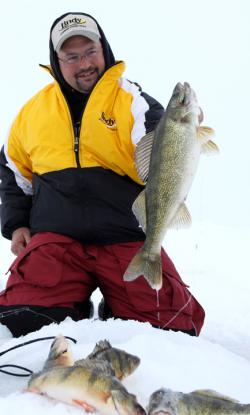
Lindy Darters and other small lures do the job on walleyes under the ice.

A small ant swivel links the mainline to an 18-inch, 6-lb fluorocarbon leader. The swivel fights twist, while the fluoro battles abrasion and is less visible to the fish. At the end of the line he ties a Lindy Darter, a hard-bodied rattler that’s raucous on the uptake and swims on the fall.

“Not all noise is bad,” admits Petrowske. “Walleyes are curious and often check out something that sounds like a meal. And, since we’re focused on scattered fish, the ability to call them in is key when fishing a vast, featureless lake like this.”

Although the fertile water is decidedly less than gin clear, he opts for natural lure colors that mimic the lake’s forage base. Natural Perch is his favorite, but Yellow Perch and various shiner patterns are good, too. On cloudy or snowy days, brighter patterns with a touch of chartreuse get the nod.

With a plop Petrowske’s Darter drops into the ice water and quickly swims to bottom on a slack line. After tightening the tether, he twitches the rodtip several times to tap-dance the bait on bottom, generating slight puffs of sediment. Next, he raises the lure 6 inches and pauses. He says that this pause often triggers a strike.

If it doesn’t, he begins phase two. Gently swim the lure up a foot, just fast enough to lightly engage the rattles, let it fall, then lift again.

If you’ve never fished a Darter before, he recommends practicing various lifts and drops within sight of the surface. Such swimming lessons are invaluable for learning how different jig-strokes affect the lure.

Petrowske’s final performance before pulling up stakes starts off wildly animated.

“I rip the heck out of it,” he laughs, explaining that the routine includes three or four sharp lifts of 12 to 18 inches, followed by a pause. “If that fails, but I think there are fish around, I slowly jiggle the lure upward until I can see it in the hole, then open the bail so it swims off to the side and crashes like a B-52.”

After the lure touches down, he reels slowly, crawling it along bottom.

“When it gets directly beneath the hole, I raise it 6 inches and pause,” he says. He credits this “reset” maneuver to fellow guide Jon Thelen, who developed it to turn watchful ‘eyes into biters. “If that doesn’t do it, I head to the next pair of holes.”

When Petrowske pinpoints a pod of active fish, he deploys a set-line in the second pre-drilled hole. The rig consists of a lively minnow tail-hooked on a jig or jigging spoon and suspended 8 to 12 inches off bottom beneath a bobber.

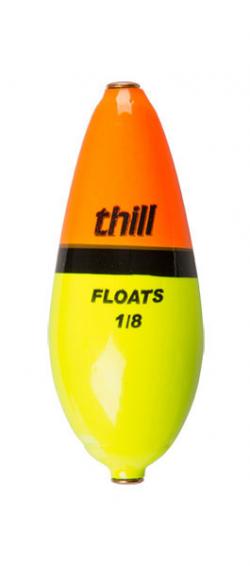
“Lindy’s Rattl’n Flyer Spoon, Frostee and Frostee Spoon are my favorite lures,” he says, noting that slip-floats with large metal grommets, such as members of Thill’s Pro Series lineup, limit ice buildup.

Strung with 4-pound Silver Thread Trout Line or AN40, the bobber rod tempts hungry ‘eyes that were lured in by Petrowske’s jigging theatrics, but not tempted enough to strike. It’s one more ploy in his bag of tricks for taking first-freeze walleyes in shallow, featureless lakes.

How To Catch Fall Bass On The Alabama Rig

How To Catch Shallow Fall Bass On Castable Umbrella Rigs Like the Alabama Rig

Fall brings many changes to a bass’s world. Cooling water temperatures prompts them to move to shallow water again, and concentrates the baitfish in big schools that move from the main lake to tributaries and coves. Bass follow these buffet lines, and there’s no better way to catch them than with a downsized castable umbrella rig (CUR).

Houston likes the Alabama Rig

Houston likes the Alabama Rig

Though umbrella rigs are usually thought of as deep water baits, some old pros like Jimmy Houston–and young ones like Jason Christie–have learned the right umbrella rig can be deadly in shallow water.
The bait-school look is a natural in the fall as shad and other forage come together. Schooling baitfish are what bass are feeding on. Mimicking a school is easy, but fishing shallow with a CUR is a new technique for bass anglers. Most rigs are big, heavy and nearly impossible to fish in water less than 6 feet deep without snagging on bottom, but several downsized, lightweight versions stack up shallow water bass.

Several factors affect the depth any given CUR will run: overall weight, the resistance it creates when retrieved, and external factors like line size and type, retrieve speed, and the angle you hold the rod. In general, the lighter the overall package, the shallower it is capable of running. Resistance refers to how easily the rig cuts through the water, and the pull created by any spinning blades and the swimming motion of multiple swimbaits. The more resistance from blades and baits, the higher in the water column the rig will run.

When external factors are considered, a braided superline is thin-diameter and prompts the lure to run deep. Heavy monofilament or copolymer line keeps it higher in the water column. To keep a rig as shallow as possible, use heavy monofilament, engage the reel immediately when the rig hits the water and hold the rod at the 12 o’clock or 1 o’clock position.

The YUM Flash Mob Jr. (FMJ) was the first version to see success on the bass tournament trail when fished in shallow water. Oklahoma’s Jason Christie used the FMJ to catch the winning bags in the FLW Tour event on Beaver Lake April 11-15, and said most of his fish came out of just 4- to 7-feet of water.

The FMJ features four willowleaf blades positioned halfway down each of the outer arms, and they aid in providing water resistance that keeps the rig shallower than others. When rigged with 1/8-ounce jigheads and swimbaits, it’s easy to keep it working the top portion of the water column.

Bass feeding on baitfish during fall may be holding in 20 feet of water, but when they’ve got the baitfish pinned against the surface the bass are only a few feet under the surface. Run a lure under the fish and you might as well be fishing on the moon. Any time you see schooling activity you can catch those fish with a lightweight CUR fished just below the surface.

Soft-plastic bait selection for the FMJ includes curly tail grubs and swimbaits up to 5 inches in length. When fishing for schooling bass in open water during fall, most pros suggest using swimbaits that match the size of the forage, but larger swimbaits slow the sink rate and allow anglers to fish the rig higher in the water column.

BOOYAH Bait Company’s new Boo Series of rigs are available in ¼-, 3/8- and ½-ounce weights, and feature a flexible lure arm that gives anglers something no other CUR can – the ability to use any lure they want on the business end. The flexible wire allows crankbaits and other lures with built-in swimming action the freedom to move as designed. A buoyant shallow-running crankbait keeps the rig closer to the surface than when used with a sinking lure such as a jig and swimbait.

The Boo Rig features four stiff outer arms with willowleaf blades attached surrounding the longer lure arm. The Boo Teaser is the same basic design, but with bait-keeper screws and teaser curly tail grubs instead of blades on the outer arms. The Boo Spin is a flexible spinnerbait that you customize with any lure as the body.

Rowland uses the Alabama Rig

Rowland uses the Alabama Rig

Zell Rowland likes rigging a single lure weedless on a castable umbrella rig for fishing around weeds and other snaggy cover.
B.A.S.S. Elite pro Zell Rowland was one of the first anglers to test the new rigs prior to introduction. On the small lake he was on, the fish were in shallow shoreline weeds, which posed several problems. In addition to needing to keep the rig just a foot or so deep, the shoreline vegetation meant the rig could not feature any open hooks.

“A lot of times in this situation I’ll go to a YUM Money Minnow on an unweighted or very slightly weighted Texas rig,” he said, “especially if there’s any ‘gunk’ up there with the weeds. If it was just clean weeds I’d throw a spinnerbait, but any moss fouls the bait.”

Rowland decided to combine the best characteristics of a spinnerbait and a weedless Money Minnow on the Boo Spin. He first Texas rigged the swimbait on an unweighted wide-gap hook before adding it to a ¼-ounce double willow Boo Spin. This lightweight combo fishes as shallow as a small spinnerbait.

Because the Boo Series features flexible wire, it’s possible to fish a buoyant crankbait behind one of the lighter Boo Rig or Boo Teaser Rig and get that effective bait school look while keeping it in the top portion of the water column. A square lip bait like the original Cordell Big O or XCalibur Xcs100 series keeps the rig up and allows anglers to slow down retrieves.

The rig/square-lip combo really shines when fishing for schooling bass in the fall. With the buoyancy of the bait fighting the natural sinking action of the rig, it’s possible to slowly work the school while keeping the rig in the upper portion of the water column.

Fishing A Winter Tournament At Lake Jackson

At Jackson last winter fishing was as tough as expected in the Spalding County Sportsman Club January tournament. Many members let the weather guessers scare them off with the terrible weather they told us to expect but which never arrived. Only nine of us braved the chance of bad weather to fish for eight hours and land a total of seven bass weighing just under 17 pounds. Five of the nine didn’t land a keeper all day.

Niles Murray wore us all out and caught more than the rest of us put together. His four keepers weighing 9.93 pounds ran away with first place. I got one bite but it was a good one and my keeper largemouth weighing 4.09 pounds was good for second place and big fish. Third went to Billy Roberts with a keeper weighing 1.42 pounds and Brent Terry was fourth with one spotted bass weighing .98 pounds.

Niles said he caught his bass on a crankbait and most were on rocky banks and points. My one keeper hit a jig and pig on a rocky point. Brent said his fish hit a crankbait, too.

Although it did rain some, I kept my rain suit hood down most of the day. And it was much warmer than expected. I dressed for very cold weather but had to keep my heavy rain suit bibs and jacket unzipped and open most of the day. And, although thunderstorms were predicted, we never heard any thunder all day.

I started fishing my favorite area of the lake with crankbaits but did not get a hit the first hour. Out on the main lake the water was 48 degrees and very muddy, with a chartreuse crankbait disappearing about 3 inches under the water. After the first hour I went into Tussahaw Creek,and the further up it I went the clearer the water got but the colder it got, too.

Clearer did not mean much clearer! At the best I could see a crankbait down about six inches. And the water was only 45 degrees. I went all the way to the Highway 36 Bridge and thought I had one hit up there but was never sure.

I used all my skill to catch the one I got. I was throwing a crankbait around the bridge in Tussahaw and decided to crank up and run up to some docks further up the creek. But it started raining hard so I just kept fishing up the bank and caught the bass in a place I had never fished before, and would not have fished if the rain had not started.

I cast a black and blue jig and pig up on a rocky point and worked it slowly down the slope under the water. Somewhere around 12 to 15 feet deep my bait felt mushy and I set the hook on a heavy fish. I almost had a heart attack when it came to the surface and I saw how big it was. It did not fight very hard in the ice water, which was good since I was fishing by myself and had to net it while fighting it.

What Is Slip Bobber Fishing For Walleye?

Wobble Bobbin’ Slip Bobber Fishing for Walleyes

by Daniel Quade
from The Fishing Wire

Complex presentations get plenty of press these days, but few walleye tactics are as deadly-or as easy to fish-as the simple slip-bobber rig. With a well-balanced float, you can efficiently and precisely suspend mouthwatering live bait in front of hungry ‘eyes. Plus, you know exactly when a fish has inhaled your bait.

Guide Mike Christensen

Guide Mike Christensen

Guide Mike Christensen at Minnesota’s Mille Lacs knows where the big walleyes live.

Veteran guide Mike Christensen is a believer. Big time. From his home base out of historic Hunter Winfield’s Resort on the scenic south shores of Minnesota’s mighty Mille Lacs Lake, the jovial yet dead-serious walleye hunter launches literally hundreds of missions onto the fabled fishery with one goal in mind: connect clients with the big lake’s walleye bounty.

His success rate is epic, and one of his favorite presentations throughout much of the season is, you guessed it, a slip-float rig.

When wind whips the surface, a Thill Pro Series Slip Float rules the waves. He favors the size XXL version, a 1-incher that’s easy to see bobbing amidst the whitecaps. But when the wind dies and surface flattens, he deploys a new secret weapon that livens up his bait in spite of the lull-Thill’s Wobble Bobber.

Fresh on the walleye scene this season, the pear-shaped float rocks back and forth with the slightest ripple or twitch of the rodtip. “It’s ideal for calmer conditions,” he says. “If it’s absolutely dead flat, you can impart action to your bait just by shaking the rod.”

Thanks to an aerodynamic profile and slick internal weighting system, the Wobble Bobber also grabs serious air when slung from standard spinning tackle. Such long-casting properties are perfect for keeping your distance when targeting nervous ‘eyes roaming the shallows. Long casts also make it easy to thoroughly cover a reef or other structure from an anchored position-without moving the boat-and are a huge plus for the shore patrol.

Wobble Bobber

Wobble Bobber

When wind dies and bait action is minimal, a Wobble Bobber can liven up the bite.

Christensen says the Wobble Bobber is lethal for skinny water walleyes that are patrolling weeds, shallow rockpiles and boulders, or holding on the edge of steep breaks. “I use it in deep water situations as well,” he adds.

When it comes to the deep game, one of the classics is a pattern Christensen and fellow Mille Lacs guide Jon Thelen fondly call “road hunting.” At its core, the tactic involves cruising the tops and slow-tapering edges of promising reefs, mud flats, gravel bars and other promising areas at slow speeds, watching the sonar for signs of active fish hovering a foot or so off bottom.

“These are the biters,” says Christensen. “Bottom-huggers may eat if you park on top of them and wait it out, but we’d rather catch five aggressive walleyes in the time it takes to coax one less-active fish into eating.”

Proper sonar settings are crucial to distinguishing walleyes from clouds of baitfish or insects, as well as smaller fish such as perch. “I set the chart speed, sensitivity and color on my Humminbird sonar so suspended walleyes are identified by yellow highlights inside the arc,” Thelen explains. “On bottom, low-riding fish will have a bluish halo on the sides, while rocks won’t.”

Whether it’s calm or windy, Christensen likes the Wobble Bobber for road hunting because of its ability to deploy 20 to 30 feet of line more quickly than many conventional floats. “It has brass grommets at both ends, so line slides through it fast,” he says. “This is important with this presentation, because you want the bait in the strike zone before an aggressive fish moves off or settles back to bottom.”

His standard road-hunting rig includes a 7½- to 8½-foot spinning outfit. “A rod with a long, sensitive tip is key to good hooksets,” he says, explaining that when a fish pulls the float under water, the limber tip lets you reel up slack until you feel the weight of the fish on the line. “Otherwise, anglers have a tendency to set too soon. And when you try setting the hook before getting all the slack out of the line, you miss the fish.”

Christensen spools with 8-pound green monofilament mainline. After threading on an adjustable bobber stop, he slides on the Wobble Bobber and then ties a swivel to the business end, followed by a four-foot length of the same line. (Note: Christensen says that doubling the line makes it easier to thread through the Wobble Bobber.) A split shot large enough to balance the bobber is pinched on a foot or so beneath the swivel. “This reduces the chances of the rig tangling on the cast or the drop,” he notes.

Leeches are great walleye bait

Leeches are great walleye bait

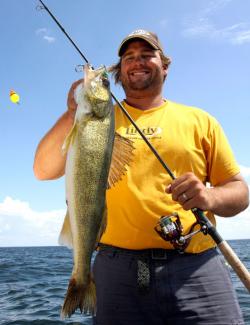
Live leeches, hard to handle, are among walleyes’ favorite foods.

Another 24 to 30 inches below the shot, he adds a 1/32-ounce Lindy Jig. The leadhead sports a sturdy hook that’s large enough to hold a jumbo leech or half ‘crawler, yet is light enough to rise and fall seductively with the waves, or action imparted by the bobber.

Jigs also offer a more lifelike profile than plain hooks, he adds. “Hooks hang vertical, but I want a horizontal profile, which mimics the natural look of swimming prey,” he explains. While leeches are Christensen’s go-to bait, nightcrawlers often get the nod during bug hatches. “Hook them through the nose and pinch the crawler off halfway down,” he says.

To set the stop, he clips a Thill depth finder to the jig and drops it to bottom. “Set the bobber stop so the jig rides a foot above the fish-not a foot above the bottom,” he continues. “This is important, because active fish are looking up, and they’re far more likely to move up to hit the bait than they are to move down.”

Rigged and ready, Christensen idles over flat-topped feeding structures and gradually tapering edges along their sides. “Steep drops are tough to road hunt, because you have to change the depth of the jig,” he says.

Once a fish is marked, he flips the float directly behind the boat’s transom and pays out line so the jig can quickly reach the fish. “Let the boat drift away, to avoid spooking the fish,” he adds. “If it’s calm, twitch the cork to give the jig a little action.”

If nothing happens within a few minutes, Christensen reels in and moves on. “If they’re going to hit, they do it pretty fast,” he says. “On a good day, about one out of two to three drops results in a fish, so don’t waste time if the fish moves away or decides it’s not in the mood.”

How To Catch Deep South Bass After A Cold Front

How Deep-South Bass Deal With Fall Cold Fronts

(And How To Still Catch Them)

By William Redmond
from The Fishing Wire

Technically, it’s not “cold” just yet, but Mother Nature likes to fiddle with fishermen on the front and backside of winter with minor fronts that rattle the bass fishing cage just enough to push anglers outside their comfort zone. Adjustments may range from minor tweaks to major overhauls, and experienced fishermen keep all options open.

We asked a couple of top-shelf southern bass pros, Terry Scroggins and Zell Rowland, for their insight into making the right moves for fall’s post-front days. Scroggins knows Florida bass fishing as well as anyone in the country, and Zell’s been a South-Texas legend for many years. Each contributes advice on catching cold-front bass in their home states.

FLORIDA FUNK

Fish thick cover after a cold front

Fish thick cover after a cold front

Elite Pro Terry Scroggins likes flippin’ with a heavy weight in thick cover after the first cold front of fall.

Scroggins said specific movements depend on the body of water. In rivers like the St. Johns, he looks for fish to stack around shell bars. You’ll keep the rods bent in this scenario, but he says that it’s definitely quantity over quality.

“A lot of times in the fall they’ll gang up on shell bars,” he said. “Typically, they’re not very big but you can still catch the numbers. That’s typically a fallback pattern that you can go to if you need it.

“Most of that is current-related (activity). The bait gets schooled up and the fish just sit there on ambush points, current breaks and things like that and wait for something to wash over them.”

When post-frontal bass hug tight to the shell bars, it’s hard to beat a Carolina rig. Just consider the scene: A pack of fish are holding on the structure’s down-current side with high hopes of nabbing an easy meal, when all of a sudden this noisy little egg-shaped deal comes clickity-clacking across that mound of bivalves. The intruder doesn’t look edible, but hold on just a second. What’s this tasty little morsel strolling along back there all by its lonesome?

No doubt, waking up the gang with a tungsten weight positioned 3- or 4-feet in front of a Yum Mighty Worm in Junebug or Red Bug is an easy sell. That being said, Scroggins knows that if the bite slows on the shell bar, he often can trigger a few more fish by changing the way he retrieves the rig.

Fish offshore after a cold front

Fish offshore after a cold front

Scroggins also finds fish on offshore shell bars, where a Carolina rig is hard to beat.

By switching from the standard Carolina rig lateral sweep to more of a sharp upstroke action, Scroggins maximizes the noise potential of his Carolina rig. The usual retrieve is certainly no stealthy approach – the weight rattles and rumbles in steady cadence — but when the weight jumps several inches off the bottom and belly flops back into the shell bed below, the resulting “crack” is a sure enough attention-getter.

At grassy Florida lakes like Okeechobee, there are more opportunities to target big bass as the season’s initial cold snaps trigger the fish to head for the safety of thick vegetation. The thicker the better, Scroggins said of this straight-up flip-fest.

“Anytime I encounter these conditions — which I like — I find the heaviest, densest cover and start flippin’,” he said. “Most of the time, the fish will be in 3 to 5 feet of water.”

In the weed mats, Scroggins keeps it simple – just a Texas-rigged Yum Wooly Bug, a stout 5/0 flipping hook and enough weight to drive the whole deal through the salad. Typical range is 1 ¼- to 1 ½-ounce, but Scroggins said he rarely pegs his weight when flipping and punching Florida lakes. He says that the thick layer of detritus (decaying organic matter) can stand several inches off the bottom and when a bait makes it through cover without drawing a bite, a pegged rig will take the bait beneath the muck where bass can’t see it. An unpegged weight will continue to the bottom, but the bait will stay on top of the gunk.

LONE STAR LOW DOWN

In weedy Texas Lakes like Sam Rayburn and Toledo Bend, Zell Rowland expects early cold fronts to push bass up from their summer haunts to the shallow hydrilla beds. In Texas lakes featuring little or no grass (example: Conroe), the fronts usher bass up to shallow drops. These post-frontal zones are easy to spot with polarized glasses, as the light sandy bottom distinctly darkens with the falling depth.

You can catch fish after a cold front on topwater

You can catch fish after a cold front on topwater

Zell Rowland turns on Texas bass after a front with his namesake Zell Pop, among other lures

“Anytime that water temp starts to drop 6- to 10-degrees, those bass go crazy,” Rowland said. “It moves them up shallow. It almost gets them into a feeding frenzy like they do in the spring after they spawn.”

In grass-free lakes, Rowland finds that swimming a Texas-rigged Yum Money Minnow along those drop-off edges delivers plenty of action. Around grass, he favors a splashy surface display with his namesake XCalibur Zell Pop, a Rebel Pop-R or even a Zara Spook. If he thinks the fish require a really boisterous display, he’ll pull the old reliable Smithwick Devil’s Horse and get to sputtering.

For optimal grass-friendly presentations, Rowland also keeps a Booyah Pad Crasher frog handy – in walking and popping styles. And when the fish are really being stubborn, he’ll dress up his amphibian with No. 1 willow blades – one on each side of the double hook, attached with a swivel and split ring.

“This gives the bait flash and vibration, while those blades are also hitting each other and creating noise,” Rowland said.

Whatever he throws, Rowland said he reminds himself that these post-frontal fish may still feed, but they’re not nearly as rambunctious as they were before the chill. Therefore, casting accuracy is paramount.

“It’s really critical where you throw the bait – it has to be on the edge (of the grass or a drop-off),” Rowland said. “Your casts have to be pretty precise and then you have to experiment to see what speed they want the bait moving.”

How To Fish Muddy Water

Rain, rain go away. A year ago, who would have thought we would have such an excess of rain and be ready for it to stop. Lakes that are overflowing again were very low a year ago and there were dire predictions Lanier and others would never fill again. So much for such doomsayers.

My ponds are both overflowing and are muddy, as are most area ponds and lakes. Friday morning they could have filmed “A River Runs Through It” in my back yard, and I live near the top of a hill. My wife says she keeps expecting to look out the window and see water buffalo working there, getting it ready to plant rice.

Fish are amazingly adaptive. They can survive in very clear water when the lakes are low and in very muddy water when the lakes are high. I always wonder how bass find food when the water is so muddy a chartreuse crankbait disappears as soon as it goes under, but then I remember they can find a black plastic worm on the bottom on a pitch black night.

For a while the bluegill in my pond just quit feeding and I thought the muddy water had something to do with it, but Thursday and Friday they fed real good. I caught at least 15 bream each of those days in just a few minutes. A catfish even took my bait on Thursday, and I always think of them as warm weather feeders.

I asked on a bass fishing internet forum how people there respond to muddy, cold water and got several responses. The one I try to remember most came from a well known outdoor writer and bass tournament fisherman that lives in the Northeast. He said he is sure the muddy, cold water affects the fisherman’s attitude more than it affects the fish.

He says he has caught bass on smoke colored grubs in extremely muddy water. Those baits are usually best in very clear water. Bu the did say his go-to bait was a big heavy black jig and pig that he drug along the bottom, moving it very slowly. That bait has caught a lot of big bass for him.

The Flint River Bass Club is at Lake Sinclair today and I guess I will have a big black jig and pig tied on. But I will also try my lighter black and blue jig and pig as well as chartreuse crankbaits. I also plan on trying a slider rig – a 1/16 ounce jig head with a four inch curly tail worm on it. There is a big tournament going on while we are fishing so the bass will be under a lot of pressure, so I will try to “finesse” one or two.

Sinclair is a popular lake this time of year since the warm water discharge from the power plant there warms some of the lake a few degrees. The warmer water attracts baitfish and bass follow, and are slightly more active than in colder water. I will be watching my temperature gauge and trying to stay in the warmest water I can find.