Category Archives: How To Fish

Fishing Spinnerbaits

Spin Up Some Fall Bass Fast in Northern Lakes

Spinnerbait secrets for late-season success

By Dan Johnson
from The Fishing Wire

Use a big spinnerbait

Use a big spinnerbait

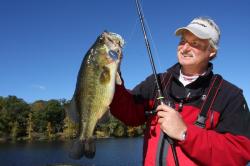
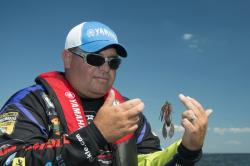
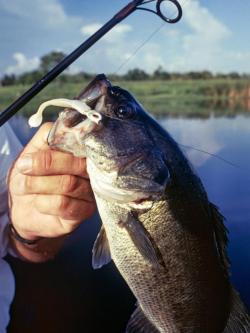
Beefy spinnerbaits like Terminator’s T-1 Original are great options for tackling deep fall bass other anglers miss.

Duck hunters’ jonboats may outnumber bass boats on many lakes in mid to late fall, but that doesn’t mean there isn’t fine fishing to be found. Both largemouths and smallmouths offer great opportunities for bass fans faithful enough to pursue their favorite fish deep into autumn.

One of the most effective and easiest to fish patterns hinges on the simple but deadly spinnerbait. Just ask bassin’ ace Scott Bonnema, who slings blades for burly bass virtually until first ice ushers in the hard-water season. “From the time water temperatures hit the low to upper 50-degree range, right through ice-up, is some of the best fishing of the year on North-country lakes,” he says.

While shoreline reed beds, docks and other skinny water cover and structure may be tempting targets, the action actually heats up farther from the bank, in depths of 12 to 14 feet or more, depending on the lake. “As shallow weed growth dies off, bass slide out into deeper vegetation that’s still green and healthy, such as clumps of coontail and cabbage,” he explains.

Structurally speaking, one of his favorite finds is a weed-crowned underwater hump, although points, inside turns and other irregularities have potential as well. Access to deeper water is a plus, but bass have no problem wintering on flats in the 20-foot range, so don’t limit your search to areas adjacent to extreme depths.

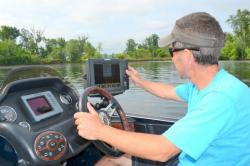
To find fish fast, Bonnema idles his boat over likely lies, keenly eyeing the split-screen display on his Humminbird 1198c electronics. As GPS mapping guides him along key contours and across prime flats, sonar returns-both in traditional and picture-like Down Imaging mode-highlight promising weed patches and fish lurking in or near the greenery.

Big fish like spinnerbaits

Big fish like spinnerbaits

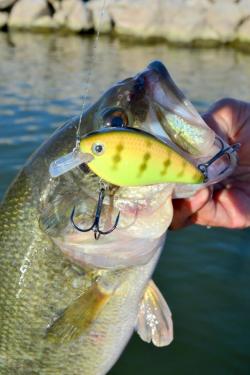
Make long casts and allow the bait to settle on bottom before beginning your retrieve.

On the presentational front, he favors hefty spinnerbaits in the ¾- to 1½-ounce class for their ability to cover deep water in search of fish, as well as trigger strikes. One of his favorite designs is Terminator’s T-1 Original Titanium Spinnerbait. It stands up to abuse from bass and bonus northern pike, and has beveled blades and an easy-to-swap, QuickChange silicone skirt.

“Experiment with skirt color, along with blade finish and style, to find what the fish prefer,” he says. “I typically start with a white skirt and chrome, double willow-leaf blades for largemouths. Smallmouths love chartreuse, so adding a touch of that to the pattern can make a big difference.”

Colors that mimic baitfish are also hot. “For the most part, bass are feeding on young of the year sunfish-we call them bass potato chips-as well as various minnows and juvenile yellow perch,” he adds. “So darker colors, along with golds and blues, have their place, too.”

A variety of middleweight spinning and casting tackle works for this tactic. Bonnema prefers a medium to medium-heavy, 7-foot Lew’s Tournament Speed Stick, which offers ample length for long casts, and plenty of backbone for solid hooksets. A tractor-geared casting reel like the 5.1:1 model in Lew’s BB1 Pro Speed Spool lineup is a plus for pulling big baits slowly along bottom. He typically spools up with 14-pound Sufix Castable Invisiline fluorocarbon, but bumps up to 17-pound test in dirty water.

After firing out a cast, Bonnema lets the spinnerbait settle. “One of the most common mistakes I see people make this time of year is to throw way out there and instantly start to reel it in,” he says. “It’s important to let it hit bottom.” When the bait lands, he tightens the line and gives it a sharp snap to start the blades spinning.

The ensuing retrieve is unhurried and relatively inanimate. “It’s natural to want to fish fast and cover water, but you need to keep the bait moving slow and steady over the weed clumps-not making the bass chase it too hard,” he says. “When you tick grass, snap the spinnerbait out and let it flutter back down.”

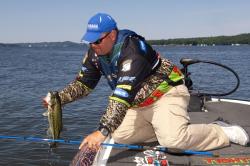
Slowly ticking a spinnerbait across deep weed clumps is key to consistent catches once bass abandon shoreline cover.

Getting the first strike is often key to a flurry of action. “Bass are a little more lethargic right now, but once you trigger one, the rest of the group gets excited and you can usually catch a few more from the same area,” he says. “In fact, anytime you catch a fish, mark the spot with a waypoint or marker buoy, or make a good mental note of the location, and target it with multiple casts.”

Bonnema believes time of day is also a factor in the pattern. “The morning bite is good, but you don’t need to be out at first light like earlier in the season,” he says. “As the day warms, the fish move higher in the weeds, and you can be a little more aggressive with your presentation.”

One word of caution is in order for northern anglers, however. When fall turnover occurs, it can shut down the fishing in a hurry. “It’s like flipping a switch,” says Bonnema. “You know right away what happened. Weeds and bottom debris are floating everywhere, the water looks dingy, and the bass aren’t biting.”

When turnover strikes, he suggests switching to a lake that’s not undergoing this annual process, or waiting at least a week to fish the affected lake again.

In the end, the deep game can be intimidating to anglers accustomed to flipping and pitching close to shore, but it’s a simple and stellar tactic for tapping the fine fall fishing overlooked by all but a few die-hard bass fans.

Fishing During the Full Moon

Middle Georgia Full Moon Fishing

“I got another one,” Hal said to me, but I was too busy reeling in my own bream to pay any attention to him. We already had full stringers of nice bluegill at our feet but we continued to catch one on almost every cast.

Hal and I had dug some red wigglers behind the chicken house on my family’s farm then rode our bicycles to Black’s pond to fish for bass and bream. We were very happy since school would be out in just two more weeks and the long summer filled with fishing trips would start.

When we got to the McDuffie County pond owned by the family of a teacher at Dearing Elementary School we tried for bass for several hours without much luck. Then we went to our favorite place to catch bream in the upper end of the pond. There were two boards on the bank so we could stand side by side and cast without sinking into the soft bottom.

Most days we would catch a few bluegill near the scattered stumps in this spot then move one when they quit biting. Our tackle was simple, both of us had Mitchell 300 reels on Conlon six-foot spinning rods. The ten pound test line was good for all kinds of fishing. On the end of the line was a #6 hook, a small split shot and a cork.

We stood on those boards and caught fish until it started to get dark. We had to hurry back to our bikes and head home fast to beat the night. As we rode home we commented that the full moon would keep it from getting completely dark and that could be our excuse for being so late.

All week we talked about going back and catching a pile of bream again. The next Saturday we went back to the pond and caught one or two small bluegill from the same area that had been so good the weekend before. We had no idea what happened to change the fishing, and did not realize that full moon had anything to do with our good luck. We had hit a bedding area without knowing it.

Bluegill are common in all Georgia waters and are always cooperative. You can catch them on just about any bait and they are great fish to start kids with since they can enjoy the thrill of catching something. But the full moon in May is a special time for Georgia bream fishermen.

The full moon is the time bream bed. Although bluegill will start bedding as early as late March in middle Georgia and some will bed every month from then until fall, May is the height of the bedding for them. Add in the spawn of shellcracker that bed just on the full moon in May and you have a bonanza of great fishing this month.

May 2 is a full moon so fishing should be good the first week of the month. There is almost a blue moon in May, with another full moon on June 1, so the end of the month will also be good.

Starting about a week before the full moon bluegill move into the shallow bedding areas and fan out a depression on a hard bottom. The female will lay her eggs in the depression and the male fertilizes them. Both fish will stay and guard the nest until the eggs hatch several days later. They will hit anything that looks like a threat to their eggs, as well as anything that looks like food, for about a week.

Many bream fishermen claim they can smell out bluegill beds, and you will often notice a distinctive odor near them. It is described as smelling like watermelon but not exactly. It is a musty smell that you will recognize once you experience it, and will remember it. If you hit that smell, look for beds nearby.

To find beds, go to the upper ends of coves and look for them in shallow water, from two to six feet deep. If the water is not muddy you will see the beds as light spots against a dark background. This is the depression fanned out by the male to make the bed.

Bream like to bed in large groups so you are not looking for one or two scattered beds. A good sandy spot protected from the wind in the back of a cove will often look like a waffle on the bottom, with beds almost touching each other. In muddy water the beds will be more shallow, in real clear water a little deeper.

If you find beds one year they are likely to be in the same place the next year. Any hard bottom will do but sand seems to be preferred, and some scattered stumps make it even better.

You can find beds from the bank but a boat makes it easier. Cruise the shallows very slowly until you spot them. You will probably spook the fish but if you back off and wait about 15 minutes the fish will be back. It is a good idea to anchor your boat a long cast from the beds so you don’t get too close and spook them while fishing.

From the bank ease around until you spot the beds. Wear dark or camouflage clothing and don’t make fast movements. Stay low, too. Try to keep any bushes on the bank between you and the beds. While fishing stay low and don’t approach too close. Long casts are best to keep from scaring fish away.

You can find bluegill beds on any of Georgia’s waters from rivers to big reservoirs, but smaller public ponds are your best bet. Scattered all across middle Georgia are small public lakes and ponds you can fish. The following list should contain some within a short drive of you.

Indian Springs State Park Lake is a 105 acre lake in Butts County four miles southeast of Jackson on Georgia Highway 42. There is a good paved boat ramp and you can rent a boat there, too. Camping and cabins are available for longer stays. A $2.00 parking fee gives you access to bank fishing or boat launching.

Boat motors are limited to 10 horsepower or smaller and you can fish from sunrise to sunset year round. The lake has many protected coves where the bream bed and the upper end has good shallow spawning flats.

Contact the park at 678 Lake Clark Road Flovilla, GA 30216, phone(770) 504-2277

John Tanner State Park has two lakes, one 15 acres and one 12 acres in size. They are located in Carroll County six miles west of Carrollton off Georgia Highway 16. You can camp there if you want to stay but a $2.00 daily parking fee gives you access to both lakes for fishing from the bank. You can rent a boat but you can launch your private boat only on the smaller lake.

Boats are limited to electric power only. You can fish from 7:00 AM to 10:00 PM daily all year long. The lakes are small enough to cover easily to find the bedding areas. If you have a boat look for beds in areas not easily accessible to the bank fishermen.

Contact them at 354 Tanner Beach Road Carrollton, GA 30117, Phone (770) 830-2222

Blalock Reservoir is a 260 acre lake in Clayton County south of Jonesboro near US Highway 19/41. A boat ramp allows you to launch and there is bank fishing allowed for a small access fee.

Boats area limited to 16 feet or shorter with electric motors only. You can fish from dawn to dusk Wednesday through Sunday year round. Many shallow areas are good for bedding bream and a boat will cover this lake better than fishing from the bank.

Contact them at 2755 Freeman Road Hampton, GA 30228, phone (770) 603-5605.

J. W. Smith Reservoir is a 250 acre lake in Clayton County 10 miles south of Jonesboro on Panhandle Road. There is a boat ramp on the lake and you need a season pass or pay a daily fee.

Boats are limited to electric only and the lake is open

Wednesday through Sunday, April 1 through September 30 from sunup to sundown. There are many areas of this lake you need a boat to fish effectively.

Contact the Clayton County Water Authority at 2755 Freeman Road Hampton, GA 30228, phone (770) 603-5605.

Shamrock Reservoir is a 68 acre lake in Clayton County south of Jonesboro near US. Highway 19/41. There is a boat ramp and this lake is designated a “Kids Lake” so no adults may fish the lake unless they have a kid 12 years old or younger with them. There is a user fee.

Boats are limited to 16 feet or less and electric motors only. Open from dawn to dusk Wednesday through Sunday year round. Since access is limit to those with kids, this lake is a great choice to take your kids fishing.

Contact the Clayton County Water Authority listed above.

Lake Horton is a 780 acre lake in Fayette County south of Fayetteville near Georgia Highway 92. There are two boat ramps and the daily fee is $10 for non-Fayette County residents.

Boats are limited to electric only and the lake is open 6;30 AM to 6:30 PM daily. This lake is known for big bass but its sunfish population is good and spawning area are scattered all over the lake.

Horton is owned and operated by Fayette County P.O. Box 190 Fayetteville, GA 30214, phone (770) 461-1146.

Lake Kedron has 235 acres with a boat ramp. It is in Fayette County off Georgia Highway 54 near Peachtree Parkway. There are no special fees.

Boats are limited to electric only and the lake is open daily from 6:30 AM to 6:30 PM. It is owned and operated by

Fayette County, see contact above.
\Franklin D. Roosevelt State Park has two lakes, Franklin at 23 acres and Delano at 18 acres. They are located in Harris County east of Pine Mountain on Georgia Highways No private boats but boat rental is available. . Camping and cabins are available.

You can fish Delano year round and Franklin with a permit from September through May. There is a $2.00 parking fee.

Contact them at 2970 Hwy 190 Pine Mountain, GA 31822, phone(706) 663-4858.

Barnsville Reservoir in Lamar County has 160 acres and is located off Highway 36 near Barnsville. There is a boat ramp and yearly permits are required for fishing and for boat use.

Boats are limited to electric motors only and the lake is open year round.

Contact the City of Barnesville at 109 Forsyth Street, Barnesville, GA 30204, phone (770) 358-3431.

McDuffie Public Fishing Area has 13 ponds from 1 to 28 acres and is located in McDuffie County four miles southwest of Dearing off U. S. Highway 278. There are boat ramps on some of the lakes and camping is available. Boats are limited to electric only and a state fishing license as well s a WMA stamp is required. Lakes are open from sunrise to sunset daily year round.

I grew up less than two miles from these lakes. They were private until I was a teenager. My mother loved these lakes and I have the mount of a 2 pound, 6 ounce bluegill she caught there. The lakes are managed for fishing and all lakes are excellent for panfish.
Contact them at 4695 Fish Hatchery Road Dearing, GA 30808, phone(706) 595-1684.

Lake Meriwether in Meriwether County has 144 acres and is located one mile southwest of Woodbury on Georgia Highway 85 Alt. Camping is available and there is a daily fee for fishing. Boats are allowed but restricted to electric motors.

Owned the County Commissioners Office, P. O. Box 428 Greenville, GA 30222, phone (706) 672-1314.
High Falls State Park has a 650 acre lake and is in Monroe County 10 miles east of Forsyth near I-75. There are two boat tramps and boat rental as well as camping available. There is some bank fishing but most of the lake shore is private.

Motors are limited to 10 horsepower, a $2.00 parking fee is required and the lake is open from sunrise to sunset daily. This lake is very fertile and has good populations of bluegill. The back ends of most creeks are sandy and offer good bedding areas.

Contact the park at 76 High Falls Park Drive Jackson, GA 30233 at phone (912) 994-5080

Lake Olmstead in Richmond County is an 87 acre lake in northeast Augusta near Georgia Highway 28. There is a public boat ramp but no camping. There are no fees to fish here and there is good bank access.

Motors are limited to 9.9 horsepower except on Tuesdays, Thursdays and Saturdays when there is no limit. The lake is open 24 hours a day all year. This lake gets a lot of pleasure boat traffic on days big motors are allowed, so plan your fishing trips on the days motor restrictions apply.

Contact Augusta Parks and Recreation, 2027 Lumpkin road Augusta, GA 30906, phone (706) 796-5025

Hamburg State Park Lake is 225 acres located in Washington County north of Sandersville off Georgia Highway 102. There is a boat ramp and you can rent boats as well as camp. A $2.00 parking fee is charged.

Motors are limited to 10 horsepower and the lake is open all year from sunrise to sunset. There is excellent bluegill fishing in the pockets and coves.

Contact them at 6071 Hamburg State Park Road Mitchell, GA 30820, phone (912) 552-2393

Big Lazer Creek Public Fishing Area has a 200 acre lake and is located in Talbot County northeast of Talbotton near Pobiddy Road. A boat ramp is available as is primitive camping and you are required to have a Wildlife Management Area stamp a well as a fishing license.

There is no motor limit size but all must be operated at idle speed only. The lake is open from sunrise to sunset daily all year. It is managed for good fishing and the lake has excellent populations of bluegill and shellcracker.

Contact Manchester Fisheries Office, 601 Third Avenue Manchester GA 31816, phone: (706) 846-8448

Houston Lake is 180 acres in Houston County east of Perry on Georgia Highway 127. There is a boat ramp and good bank fishing access. No fees are charged at this lake.

Motors of any size can be used but at idle speed only. The lake is open during daylight hours year round and offers good bluegill fishing from boats or the bank.

Contact Region 4 Fisheries Office, phone (912) 987-4280

This is just a partial list of lakes open to the public in middle Georgia. For a complete list, go to http://georgiawildlife.dnr.state.ga.us/content/displaysmalllakes.asp to find lakes by name or by county. Find one near you, hit it on the full moon this month and enjoy some fast panfish action.

Mid Georgia Winter Bass

How and where to catch middle Georgia Winter Bass

A Chinese proverb says it is better to light a candle than curse the darkness. It is also better to put on warm clothes and go fishing than curse the cold weather. If you sit around and complain about the weather you will miss some good fishing.

You don’t have to be cold while fishing, no matter what the weather. A good snowmobile suit, insulated underwear, snow boots, a stocking cap and a hood will help keep you warm. Add some chemical handwarmers in strategic places and even a propane heater and you can be comfortable.

The best thing to keep you warm this time of year is catching bass. Hook a hog and you will forget the weather. Limit out on three pounders and it might as well be a spring day. And even if you don’t catch much, who would rather sit around in the house than be out fishing?

Cold weather does affect bass but they still have to eat, so you can catch them. Since bass are cold blooded they slow down and don’t eat as much, but they do eat. If you adjust your methods and use the right lures, you can get them to bite.

There are just as many ways to catch bass in January as there are in June, but one thing you must do is slow down. Bass are less likely to chase a fast moving lure this time of year. And they often prefer a small bait over something big in cold water. But you can catch them from the shallows out to the deepest structure if you fish it right.

In the middle of our state three lakes offer excellent bass fishing right now. Jackson, Oconee and Sinclair all have some things in common for catching bass this time of year but each has its own special qualities, too.

Bobby Ferris grew up in Monticello and went to college in Milledgeville, fishing with the Baldwin Backlashers Bass Club during those years. That club fished Jackson, Oconee and Sinclair regularly. After college Bobby has worked in the middle Georgia area for two EMCs and continues to fish this part of the state a lot.

Now Bobby fishes with two Griffin bass clubs, the Flint River Bass Club, where he won seven of 12 tournaments year before last, and the Spalding County Sportsman Club. He also fishes some pot tournaments on middle Georgia lakes and knows them well.

Bobby sold boats at Piedmont Outdoors part time and his affiliation with them and The Sports Center in Perry, as well as his ability to catch bass, got him on Team Triton. He was willing to share some of his tactics for winter bass on the three lakes highlighted here.

I joined the Spalding County Sportsman Club in 1974 and the second tournament I fished was at Sinclair. The third tournament I fished was at Jackson. Four years later I joined the Flint River bass club. Oconee was not even around back then but I watched it being built and both clubs I fish go to those three lakes often. We almost always fish them in the winter.

Last year I won the point standings in both clubs. I have learned some good patterns on these lakes for winter fishing, too, and usually fish in different places than Bobby fishes.

Jackson Lake

Jackson is one of our oldest lakes and has changed over the years. The illegal stocking of spotted bass in the lake means you are likely to catch more but smaller bass there now. Its days of being known for numbers of big largemouth seem to be over. But you can still catch some quality largemouth there and the aggressive spots mean you can catch more fish.

By January the bass have pulled out of coves and set up on main lake points. Rocky points are Bobby’s favorite places to find them now since the rocks hold heat and give the bass a place to hide. Rocks can range from chunk to boulder size, can be found all over the lake and all hold bass. Jackson is small enough that most of the lake is the same in January.

Bobby’s best points are those in the outside bends of the old creek and river channels. He looks for bass holding on them in about six feet of water and feeding at that depth. The colder the weather the better the fishing is on these points for Bobby. A sunny day warming the rocks, with some current moving, is the best.

Tie on a crankbait and a jig and pig and you have what you need to catch winter bass at Jackson. Bobby likes crankbaits like the Rapala DT6, the small Fat Free Shad and a #5 Shadrap for point fishing at Jackson. He will fish one of those crankbaits on the points for more active fish, making several casts across them from different angles.

For clear water choose a shad colored bait and in stained to muddy water go with a bright color. Tennessee shad, natural shad and silver and black are good clear water colors. Chartreuse plugs with orange bellies and blue or black backs, the firetiger color, or crawfish colors are all good when the water is not clear.

If the bass don’t hit a crankbait Bobby will throw an Ol Nelle jig with a Zoom Super Chunk on it. It can be worked slowly in the rocks for the inactive bass. In clear water he picks a green pumpkin jig and trailer and in stained water he goes with a black jig and trailer. He also dips all his jigs in JJ’s Magic clear dip to give them a garlic scent.

At Jackson Bobby fishes crankbaits on 12 to 15 pound Big Game line and his jigs are tied to 25 pound Big Game line. There is always a possibility of a big largemouth or spot at Jackson, and the water is usually stained enough to get away with heavier line.

I like to fish deeper water in the winter and will often jig a spoon or Little George on long points at Jackson. Ride the points from the bridge in Tussahaw Creek to the dam and up the Alcovy River to the Highway 212 Bridge and watch for schools of shad.

The shad are often out over 16 to 20 feet of water, suspended about half way down. If you see fish on the bottom under them, stop and fish. Even if you don’t see the bass they are likely there if the shad are present. Drop a spoon like a Hopkins Shorty or a Little George down, hop it a foot off the bottom repeatedly, and you will find out if the bass are there.
If you see the bass and they won’t hit try deadsticking the spoon or George on the bottom. Let it lay there and barely slide it on the bottom. Don’t raise it off the bottom. That pattern has paid off several times over the years.

I like a short 5.5 foot rod with a fairly light tip but lots of backbone. A fast taper rod allows you to jig the spoon and George easily and feel it but you need the backbone to set the hook and control the fish. I spool up an Ambassadeur 5500c with 15 pound PLine for most of my jigging.

Lake Sinclair

Sinclair has two characteristics that together set it off from all other Georgia lakes. The power plant on the lake dumps warm water into Beaverdam Creek, warming the lake water in that area. And the pumpback at Lake Oconee makes current flow both ways in the lake most days. Both those factors affect bass fishing.

The warm water is so important that Bobby says he always fishes within about a mile of the mouth of Beaverdam Creek in the winter at Sinclair. If he is not in Beaverdam itself he will be on the river near it or just inside the mouth of Rooty Creek, and he fishes Little River up to the bridge. All this area is warmed by the discharge.

On Sinclair Bobby will fish crankbaits on seawalls and docks in shallow water. He stays on the main creek and river runs and does not go way back into coves, sticking with main and secondary points. He is looking for the active bait and bass feeding on it.

Favorite crankbaits are small and Bobby likes a #5 Shadrap, 100 Series Bandit or a DT6. In clear water he goes with Gable Green or natural shad and likes the firetiger color if the water is more stained. He will stick with 12 pound Big Game spooled on a Shimano Calcutta reel on a six foot rod unless throwing the #5 Shadrap under docks, when he will switch to a spinning outfit and lighter line.

If there is some current moving in either direction fishing is better and the moving water will position the bass on the docks and seawalls. Bobby looks for eddies where the bass can hold out of the current and ambush baitfish moving with the current. He says if you run your crankbait by a holding spot, moving it slowly with the current, you should get bit.

If there are several warm days in a row like we sometimes get in January but are more likely in February, Bobby will fish the old dead grass beds. The dead grass holds heat and draws shad to it, and the bass will follow. A spinnerbait run through the grass will draw strikes from those bass.

Jigging spoons work well at Sinclair, too. They tend to be better in clearer water so I will often head to Island or Rocky Creeks at the dam and ride points in them. Long tapering points are best. Watch for the shad down in 15 to 18 feet of water and jig under them for bass.

If there is any brush near the shad, try it, too. You will hang up some but you can usually get a spoon loose by shaking it up and down, working it free. A Little George will not come free so easily. Bass holding in the brush will eat the spoon when it is right in their face even if they won’t move far to chase a moving bait.

On clean bottoms it is hard to beat the Little George. I like a 1/2 ounce George in silver with a silver blade. I drop it to the bottom, tighten my line with my rod tip about a foot over the surface then jig it up and down a foot to two feet.

Move it steadily, not in a jerking motion, and you can feel the blade spin and it rises and falls. Set the hook if the blade stops turning. Most bites will come as the bait falls, so set the hook if the bait does not go back down as far as it should. Keeping your rod tip down near the water allows you to set the hook better when a fish hits.

Lake Oconee m

Oconee is one of our newer lakes and it was dammed in the 1980s. It has become one of our most popular bass fishing lakes, too, with lots of quality bass. The 14 inch size limit with the slot allowing anglers to keep six to 11 inch fish has helped and would be even better for bigger fish if anglers would keep more of the smaller fish.

Since the upper end of Oconee can muddy up fast and the lower lake gets colder water when the pumpback system is running, Bobby concentrates his winter fishing near Brantley’s Marina in the mouth of Lick Creek and the river around it. That area is the most stable on the lake and the bass are easier to pattern and catch consistently.

Most of this area of the lake is lined with nice houses and they all have seawalls. If you look you will see rocks at the water line of many of the sea walls and there are rocks on most others that you can not see. Those rocks are Bobby’s targets at Oconee this time of year. They hold heat and are good cover, too.
Seawalls with deeper water around them, like on main and secondary points, are Bobby’s favorites. He will throw a #7 Shadrap and really likes the jointed version since it is plastic and runs a little deeper, and has a rattle in it. He fishes the crawfish pattern since crawfish call the riprap home and are just about the favorite food of bass.

Throw the Shadrap on 12 pound Big Game line, a six foot rod and Shimano Calcutta reel. Try to bump the rocks as you work the bait across the rocks. If you consistently catch bass very shallow on the rocks, concentrate on making casts right to the bank. If the fish seem to be hitting out on the base of the rocks, make parallel casts to keep your plug in that area longer.

A warming trend at Oconee will pull bass shallow faster than at Sinclair. If you have a few warm days, especially toward the end of the month, shad will move to the very backs of short main lake pockets. Check the pockets if it has been warm and if you see shad activity fish it. Afternoons are usually best, after the sun has had all day to warm the water.

Throw a spinnerbait on the sandy flats in the backs of coves. You will catch bass, hybrids, crappie and even catfish that are back in there eating the shad. You can catch some big bass on this pattern. Bobby likes an Ol Nelle white and chartreuse spinnerbait with one silver and one gold blade for most water conditions. If the water temperature is 55 degrees or warmer in these pockets the shad will be there.

At Oconee I usually head for the dam area this time of year and look for shad on main lake points. Many of them have brush piles on them and the current will move shad across the points. Bass wait in the brush and on clean bottoms to ambush them.

Get right on top of the brush or fish and jig straight up and down. Sometimes bass want a spoon that moves in one place repeatedly. Don’t give up until you have jigged it up and down dozens of times. Try to hit the same place on the bottom, holding your boat in one place and watching your depthfinder. With a transducer on the trolling motor you can often see the fish straight under you and stay on them.

Give these three lakes a try. Fish the patterns in the areas mentioned here and you will catch bass. It it much more fun feeling the fight of a bass on your line than it is sitting at home watching somebody else catch them on TV!

Top Fishing Trips In Georgia for Each Month of the Year

Georgia fishing trips for each month of the year

JAN,- Rating: GOOD Species: Crappie Place: Lake Sinclair

Tips: The warm water in Beaverdam Creek makes crappie feed in January. Troll jigs and live minnows from the mouth of the creek to the upper end for a mess of good eating fish.

No. 2 Rating: Good Species: Largemouths Place: Lake Seminole

No. 3 Rating: Excellent Species: Yellow Perch Place: Savannah River

FEB,- Rating: Good Species: Walleye Place: Carters Lake

Tips: Fish live earthworms, shad and leaches on bait rigs off rocky points on the main lake in deep water. The best fishing will be at night.

No. 2 Rating: Good Species: Red Drum Place: Coast

No. 3 Rating: Excellent Species: Hybrids Place: Lake Thurmond

MAR,- Rating: Excellent Species: Spotted Bass Place: Lake Lanier

Tips: Big spots move shallow in March and can be caught on a variety of baits. Try spinnerbaits and jerkbaits on rocky points on the main lake. Wind blowing on them helps.

No. 2 Rating: Good Species: Channel Cats Place: Walter George

No. 3 Rating: Excellent Species: Crappie Place: Lake Thurmond

APR,- Rating: Excellent Species: Largemouths Place: Lake West Point

Tips: Largemouth spawn in April and you can sight fish for some of the biggest bass on the lake. Try the clearer water on the lower lake. Also throw a buzzbait around cover.

No. 2 Rating: Excellent Species: Bluegill Place: Lake Seminole

No. 3 Rating: Good Species: Smallmouth Place: Lake Blue Ridge

MAY,- Rating: Excellent Species: Shellcracker Place: Lake Thurmond

Tips: Fish red wigglers on the bottom around shellbeds from Little River Marina to Raysville Bridge. Anchor in six feet of water and cast out several rods all around the boat.

No. 2 Rating: Good Species: Dolphin Place: Offshore

No. 3 Rating: Excellent Species: Largemouths Place: Lake Harding

JUNE,- Rating: Excellent Species: Largemouths Place: Lake Weiss

Tips: Head up the Coosa River and pitch a jig to the abundant wood cover along the old river channel. Use heavy tackle, you will hook some quality fish in rough places.

No. 2 Rating: Good Species: Redbreast Place: Ogeechee River

No. 3 Rating: Fair Species: Rainbows Place: Waters Creek

JUL,- Rating: Excellent Species: Flatheads Place: Altamaha River

Tips: Huge flatheads are caught in deep water in the bends of the river. Anchor your boat upstream of a hole in an outside bend and fish live bream on the bottom.

No. 2 Rating: Good Species: Spotted Bass Place: Carters Lake

No. 3 Rating: Excellent Species: Shoal Bass Place: Flint River

AUG,- Rating: Good Species: Tarpon Place: Coast

Tips: Tarpon move into coastal rivers and sounds to spawn in the summer. You can spot them surfacing and cast big plugs or live menhaden to them to catch 100 pound plus fish.

No. 2 Rating: Good Species: Largemouths Place: High Falls

No. 3 Rating: Good Species: Bluegill Place: McDuffie PFA

SEP,- Rating: Fair Species: Redeye Bass Place: Hartwell

Tips: Redeye school up on the big water on the lower lake and this is your best bet for catching one. Look for action over deep open water and work your bait fast.

No. 2 Rating: Good Species: Spotted Bass Place: Allatoona

No. 3 Rating: Excellent Species: Gar Place: Lake Thurmond

OCT,- Rating: Excellent Species: Red Drum Place: Coast

Tips: Mullet migrate to the Georgia surf in October and big reds follow. This one of the best times for surf fishing with live finger mullet from the beach for bull drum.

No. 2 Rating: Good Species: Spotted Bass Place: Lake Burton

No. 3 Rating: Good Species: Largemouths Place: Goat Rock

NOV,- Rating: Excellent Species: Crappie Place: Lake Oconee

Tips: Fish the standing timber plots and troll channel breaks with jigs and live shiner minnows for fall crappie. They are plentiful and big at Oconee this month.

No. 2 Rating: Good Species: Largemouths Place: Lake Blackshear

No. 3 Rating: Excellent Species: Brown Trout Place: Chattahoochee River

DEC,- Rating: Excellent Species: Stripped Bass Place: Lake Thurmond

Tips: Big stripers move shallow in the cooler water. Trolling live blueback herring in very shallow water will produce some trophy size stripers.

No. 2 Rating: Excellent Species: Spotted Bass Place: Jackson Lake

No. 3 Rating: Good Species: Hybrids Place: West Point

Few states offer the variety of salt and freshwater fish that Georgia waters hold. The Georgia Department of Natural Resources lists state records for 40 species of freshwater fish, some as old as 1932 and some as recent as 2005. Add to that the 53 record saltwater fish and you get a good idea of the variety of fish in Georgia waters.

And Georgia has lots of water for you to fish. From tiny streams in north Georgia holding native brook trout to reservoirs and rivers with trophy catfish, all Georgians are within a short drive of good freshwater fishing. If it is saltwater you like you can choose small creeks in the marshes or go offshore to troll for huge billfish.

JANUARY

Crappie:

Lake Sinclair

What to Expect: Crappie school up and move into Beaverdam Creek following the shad and warmer water. You can catch good numbers of fish as well as some slabs. Sinclair is in the middle of the state and is easily accessible for many fishermen.

How To: Troll small jigs and live minnows at different depths until you find where the fish are holding, then concentrate all your baits at that depth. Put out several rods to cover as much area as possible. Watch for baitfish and bigger fish suspended under them if you have a depthfinder and work the area they are in carefully.

Contacts: Little River Marina – 478-452-1605

Options: Seminole is far enough south that some largemouth bed in January in warmer winters. Most of the fish will be pre spawn so throw Rattletraps around hydrilla on lower lake flats. Fish fast and cover a lot of area until you find the fish.

Yellow perch run up the Savannah River in the winter and concentrate below the Thurmond Dam. Fish small jigs and live minnows from a boat or the fishing piers to fill your freezer with these tasty fish, there is no limit.

FEBRUARY

Walleye:

Carters Lake

What to Expect: Walleye are a favorite food fish in northern states and they like cold, deep water here. Carters has it in February and is one of the few Georgia lakes where you can catch good numbers of them.

How To: Walleye school up on deep rocky points and will hit live earthworms, leaches and jigs. The best fishing for them is at night. Drop your bait down to the bottom in 20 to 35 feet of water on main lake points and fish it slowly. Walleye bite very gently so be ready to set the hook at any resistance.

Contacts: Bart’s Bait and Tackle – 706-253-2248

Options: Red drum are in coastal waters year round and can be caught during the winter. Fish the black mud flats near shell beds in coastal rivers and marshes for big bull drum with live shrimp and jigs.

Hybrids feed good all winter long and Thurmond is and excellent lake for them. Use live blueback herring or spoons on main lake points.

MARCH

Spotted Bass:

Lake Lanier

What to Expect: Magnum spots move shallow getting ready to spawn at Lanier this month. They are active and chasing bait, and it is early enough that the boat traffic is not quite as bad as it gets later. Some say the next record spotted bass is swimming in Lanier right now and March is a good time to catch it.

How To: Throw white spinnerbaits and chrome jerk baits on main lake rocky points and humps at the mouths of spawning creeks. Fish a lot of different places to find the bigger fish. Wind blowing in on the points and humps makes them much better.

Contacts: Guide Ryan Coleman – 770-356-4136

Options: Warmer waters in Lake Walter George means channel cats are feeding and getting ready to spawn. Fish at night along river and channel edges with live or cut bait.

The button bushes at Thurmond are full of big crappie in late March. Dabble live minnows or jigs in them to catch a limit.

APRIL

Largemouths:

West Point Lake

What to Expect: Warming water in April moves largemouth to the banks to spawn at West Point. The flats on the lower lake will hold large numbers of bass all month long. They will hit many different baits, making this one of the easiest months of the year to catch them.
How To: Run flats and secondary points back in coves with Rattle Traps and Carolina rigs to find fish, then slow down and fish the same baits to catch numbers. Don’t hesitate to throw a topwater lure. West Point Largemouth love a buzzbait in April.
Contacts: Robbie Nichols – Southern Harbor Marina –

334-644-3881

Options: Bream are bedding on Seminole and big bluegill fill the shallows. Look for beds on sandy flats and fish crickets and Mepps #2 spinners around them.

Your best bet to catch a Georgia smallmouth is on Lake Blue Ridge. Try small crankbaits, spinnerbaits and plastic worms around shoreline cover on rocky banks.

MAY

Shellcracker:

Lake Thurmond

What to Expect: Thurmond, known as Clarks Hill to most Georgians, is full of big shellcracker. They feed year round on the mussel beds but are easiest to catch in May during the spawning cycle. Most of your catch will be in the 1/2 to 3/4 pound range but bigger fish are caught regularly.

How To: Anchor your boat in about six feet of water on a shellbed anywhere in the Georgia Little River arm of the lake. Cast several lines with a #6 hook tied 6 inches below a split shot and baited with a gob of red wigglers. Let your bait sit on the bottom with a tight line to watch for bites. When you catch a good fish, cast other lines to that area.

Contacts: Raysville Marina – 706-595-5582

Options: Catch your own mahi-mahi, also called dolphin, off the Georgia coast. Charter a boat or take your own if it is seaworthy.

Lake Harding, also known as Bartlett’s Ferry, offers good largemouth fishing around shoreline cover with weightless worms this month.

JUNE

Largemouths:

Lake Weiss

What to Expect: Weiss offers some of the best shallow water fishing in the area this month. The Coosa River has miles of shallow flats just off the channel and the edge of the channel is covered with wood. Largemouth move into this cover and feed all month long.

How To: Run up the river to channel marker 84 and start pitching jigs to all the logs in the water. Keep you boat in the river channel and cast to the logs on the edge. Also run a spinnerbait beside all the logs. Use heavy tackle, when a five pound largemouth hits a jig and runs under a log you will need a stiff rod and strong line to pull it out.

Contacts: Guide Tony Hill – 706-517-5082

Options: Put in at any of the public ramps on the Ogeechee River and fish with crickets and earthworms for one of our prettiest sunfish. Redbreast are still abundant along shoreline wood cover on this river.

If you want to fish for a trophy Georgia rainbow trout, go to Waters Creek. You will see some huge trout, but seeing is not catching these smart, wary fish. Trophy water restrictions apply.

JULY

Flatheads:

Altamaha River

What to Expect: Every few years a new state record catfish is pulled from the Altamaha River. Since they were introduced they have grown very fast. The current rod and reel record 83 pounder was caught last year but bigger ones have been taken on limb lines. You can catch a lot of these flavorful fish and might get a new record.

How To: Fish live bream on heavy tackle in the deep holes in river bends. Anchor your boat upstream of a hole and drift a live bream down into it. Use enough lead to hold it on the bottom. For bigger cats use big bait, a three finger bream will catch eating size but you need a big bream for a record cat.

Contacts: Wayne County Tourism Board – 888-224-5983

Options: Fish at night for big spots at Carters. Join the night pot tournaments or go alone. Fish spinnerbaits and crankbaits on main lake rocky points.

Put a boat in at the Marine Ditch ramp south of Albany and fish the shoals with a topwater lure late in the day for a five pound shoal bass.

AUGUST

Tarpon:

Coast

What to Expect: Tarpon move into sounds and rivers to spawn in the summer and you can see them rolling on the surface. You have a good chance to hook one of these 100 pound plus fish this month in any of the sounds and river mouths from Savannah to Kings Bay.

How To: Catch some live menhaden, locally called pogies, with a cast net then drift them either under a big cork or free lined where you see tarpon. You need a needle sharp hook to stick in the bony mouth. For even more excitement cast a big topwater plug to visible fish. Use a heavy rod and a reel that will spool at least 200 yards of 20 pound line to have any chance of landing one.

Contacts: Miss Judy Charters – 912-897-4921

Options: Motors at High Falls are restricted to 10 horse power and boats are not allowed on the water from sunset to sunrise, but you can catch some quality bass shallow on topwater baits and worms in this 650 acre state park lake.

Bluegill bed on the full moon again this month so take some crickets and earthworms to the McDuffie PFA. Find the beds on any of the open ponds for fast action.

SEPTEMBER

Redeye Bass:

Lake Hartwell

What to Expect: This subspecies of bass is somewhat rare and you best for catching one is on Lake Hartwell. They are plentiful there and school up on top a lot this month. They are small but put up a good fight and you can add them to your list of bass species you have landed.

How To: Watch for topwater action all day long in the mouth of Lightwood Log Creek and near Portman Shoals Marina in Twenty and Six Mile Creek. Throw a Sammy, Spook or Fluke to them and work the bait fast. When one hits on a plug with two sets of hooks, fight it slowly to the boat and you can often hook a second fish. You will usually see fish following the one you hook.

Contacts: Guide Tony Moran – 706-779-2234

Options: Although some call it the Dead Sea, Georgia bass clubs report Altoona as the lake with the best catch rate in the state. Fish topwater early around rock walls then try a Spotsticker Jig and four inch worm in the same places.

For a change of pace, fray a 8 inch piece of white nylon string and tie it on a silver spoon. Cast to gar on the surface in Germany Creek for an interesting fight.

OCTOBER

Red Drum:

Georgia Coast

What to Expect: Bull red drum, also known as redfish, move into the surf in the fall as the water cools, following the mullet. You can catch them from the shore this time of year and some of the biggest fish of the year are within reach of fishermen without boats.

How To: Use surf casting rods to launch small live mullet or cut bait as far into the surf as possible. Try to find rips and current breaks and put on a sinker heavy enough to hold your bait on the bottom. Keep your line tight and be ready for a screaming run. Check your bait often and replace it as the crabs pick at it.

Contacts: Golden Isles Charter Fishing – 912-638-7673

Options: The state record spotted bass was caught in Lake Burton and the big spots are moving to the shallows to feed as the lake cools. Try a jig and pig in any wood cover and around rocks on the main lake.

Goat Rock is a small lake north of Columbus and has some quality largemouth in it. Fish the blowdowns on the river channel with a 10 inch worm or a jig and pig.

NOVEMBER

Crappie:

Lake Oconee

What to Expect: Cooling water means crappie move more shallow and bite better than they have in months. Oconee as an excellent population of slab size crappie and you can catch them all over the lake.

How To: Fish the standing timber plots with live shiner minnows and jigs. Night fishing is best early in the month but crappie hit during the day better later in the month. Tie up to a stump sticking out of the water, drop a jig or live shiner down and try different depths until you start catching fish. Start down 10 feet and go down to 20 before moving and hitting another spot. If the timber is topped out below the surface drift or troll your bait at those depths.

Contacts: Guide Al Bassett – 706-485-1280

Options: Lake Blackshear looks like largemouth heaven with all the cypress trees. Drop a Texas rigged worm or jig and pig around the bases of the trees all over the lake this month.

Big brown trout can be caught in the Chattahoochee River downstream of the Lanier Dam. Use big wet flies or small spinners in the deeper holes.

DECEMBER

Stripped Bass:

Lake Thurmond

What to Expect: Big stripers move shallow in the cold water to feed on blueback herring. Fish weighing forty pounds and more are caught each year at Thurmond. The population of big stripers is good and winter is the best time to catch them.

How To: Use planer boards to take live blueback herring in close to the rocks on main lake points. At the same time freeline live herring behind the boat in deeper water to cover a range of depths.

Contacts: Captain Dave Willard – 803-637-6379

Options: Jackson spots like the cold water in December and feed on the rocky points on the main lake. Fish small crankbaits and a jig and pig on steep rocky points from the dam to the Highway 212 bridge.

Look for gulls to point the way to hybrids schooling up on West Point. Cast bucktail jigs to them while they are on top then troll live shad or jigs in the area after they go down.

These are just a few of the trips you can take to enjoy Georgia fishing at its best this year.
What Are Four Good Bass Baits for September In Georgia?

Four Bass Baits For September Georgia Bass

September can be the cruelest month for Southern bass fishermen. Some mornings have a slight coolness to the air, something missing since last April. That gives promise to active bass feeding shallow and good fall fishing, but it is only a promise.

The reality is the water in our lakes is hot, and has been hot for months. The oxygen content is about as low as it gets all year. Bass are hard to catch since most are still holding in deep water and they have been looking at so many lures all summer long that they know the catalog numbers of them. At least they have gotten used to the constant buzzing of pleasure boats and skidoos.

Even if it is tough fishing, bass can be caught right now. A variety of baits will help you catch September bass from the top to the deepest holes where they hang out. Tie on these four baits, follow the tactics using them and you might start to like September fishing a little better.

Zara Spook

No kind of strike in bass fishing is more exciting than seeing a slashing topwater hit. Many of us put away topwater baits when the water got hot, bringing them out for a few minutes early in the morning but mostly leaving them in the tackle box. That can be a mistake.

Years ago on a miserably hot Labor Day weekend trip I had fished all day on Saturday without a keeper bass. Early Sunday morning I headed to a bridge to fish the riprap before the sun came up. Repeating the day before, I could not draw a strike on any bait I tried for several hours.

Remembering a bait I had bought but not tried, I dug out a big Zara Spook and tied it on. Since everything I heard said this bait took some learning to work right, this seemed like a good time to play around with it and try to learn to “walk the dog” with it.

After a long cast parallel to the riprap I started twitching the rod tip and found out it was not hard to make it walk. The lure had gone about 25 feet when a four pound largemouth smashed it. I could not believe it, first cast with a Spook and a good keeper bass, the first of the trip.

It would be nice to say I loaded the boat all day on that trip, but it didn’t work out that way. I did catch another three pound bass and missed two more that looked like good fish, but that was far better than any other bait I used that trip.

A Spook is a great bait for drawing up individual fish and making them hit. It moves slowly but makes a lot of commotion in the water. That makes big bass think it is an easy meal, or makes them come to the action to take an easy meal away from a smaller brethren. It is a great bait for schooling fish, too.

Throw a spook on a fairly heavy rod with a light tip. You need the backbone to control big bass but the light tip helps work the bait. I prefer a short 5.5 foot rod but many fishermen use longer rods. Heavy line on a baitcasting reel also helps so spool up with 15 pound test or higher.

Make long casts and let the bait settle. With some slack in the line, jerk the rod tip and then move it back toward the bait, giving it some slack. The bait with jump to one side then turn back. After a little practice you can make the bait jump from side to side without moving forward much, called “walking the dog.”

Any vertical structure is a good place to throw a Spook this month. Bridge riprap and pilings, docks, standing timber and bluff walls all offer bass a place to hold and move up to the surface to feed. Work the Spook parallel to the cover and try different speeds, from a very slow enticing walk to a fast action that will draw a reaction strike.

Spooks will also draw bass up from surprisingly deep cover, especially in clear water. If blueback herring or other baitfish that stay near the surface on bright days are present, it is even better. Cast across humps, deep timber and underwater ridges to pull bass from the depths to hit your bait. Bass will come from 30 feet deep at times to smash a Spook on top.

Thermoclines often form on our southern lakes this time of year and the bass suspend just above it, holding in the coolest water with enough oxygen to support them. These bass are often inactive but a Spook worked over them can interest them. If you see a lot of fish on your depthfinder suspended out over deep water, walk the dog right on top of them.

Always keep a Spook ready for schooling fish, too. When you see fish feeding on top cast to them, even if it is an individual fish. You can cast a Spook a long way so you don’t have to get too close to the feeding fish, and the action looks just like a fish hitting bait on the surface.

Spooks will catch bass all day long, even on the brightest, hottest September days. It is even better early and late in the day when bass are more active, and they will smash it at night, too.

Big Crankbaits

Bass eat crankbaits and for several years baits that will reach the fish holding in deep water have been available. With the right tackle you can dredge the deep holding spots all day without wearing yourself out too much, too.

Roger McKee loves big crankbaits in September. He has been successful in many tournaments on Southern lakes and says he if he had to choose one bait to use in September it would be a crankbait. Several baits will hit the deep cover and structure he fishing this month and make the bass try to eat them.

One of Rogers favorite crankbaits is no longer made but he finds them for sale on E-Bay at times. The Rapala Down Deep crankbait in both size five and seven work well for him. He also uses the Poe’s LR 4500, Norman DD22-N, Fat Free Shad and other baits that will dig deep. Natural shad colored baits are his favorites and some have a slash of red or orange on them to add to the attraction. He hand paints some of his baits to customize them.

A Falcon composite glass and graphite rod is Roger’s choice and he now prefers it over the older glass rods he used for cranking. Team it up with a Lews or Ambassadeur 3.8 ratio reel that allows you to dredge the depths without wearing out your hands and you have the right equipment. Spool the reel with PLine CX 10 or 12 pound test line and you can get the bait down deep.

Start at 14 feet and then go deeper for September bass, Roger advises. He looks for brush, stumps, rocks and other cover on deep structure like humps, roadbeds and drops. And if the crankbait is not bouncing off something, Roger feels like he is wasting a cast. Bump the cover to make the bass bite.

Baitfish on the cover and structure is a key clue to the bass being nearby, too. Roger says he does not fish a place if there is no baitfish around it. He sometimes sees bass on his depthfinder, holding under bait, but the bass may be so tight to cover they don’t show up. If the baitfish are there the bass are probably there, too.
Current definitely helps. Roger says current moving across cover and structure improves it by 75 percent. He can draw reaction strikes from bass when no current is moving but they are more likely to be active and feeding if the current is moving.

Locate cover at least 14 feet deep on structure with baitfish present and mark it with a buoy. Back off and make long casts past the cover, reeling your crankbait down until it hits something. Bounce it off the bottom or brush and be ready for a bite.

Roger advises you to carry a good plug knocker when fishing like this or it gets too expensive. He likes the Hound Dog retriever, a lead cylinder with a wire arm that goes over your fishing line. When lowered down your fishing line with its heavier line attached, it will bump your plug loose or hang it and you can pull it loose. If you aren’t getting hung up you aren’t fishing crankbaits right.

Big Worm

If the bass are holding too deep to reach with a crankbait or if they are not active, a big plastic worm will often get them to bite. Rig them either Texas style with the sinker against the head of the worm or Carolina style with the worm trailing the weight on a leader and you can hit the deepest cover and work it slowly.

If there is no current the bass may be very inactive and sometimes they bury down in the brush and won’t come out for a moving bait. Drag a worm into their home and let it sit and you may get them to eat it. And the bigger baits seem to make them more likely to hit, as well as drawing strikes from bigger bass.

The Zoom Old Monster is a 10.5 inch worm made in many different colors and works this time of year. Strike King makes the 11 inch Sneaky Snake and the 10 inch Baby Huey Worm. You can get 10 inch long Berkley Power Worms. Most companies make big worms for this kind of fishing.

Worm colors are probably more important to the fisherman than the bass, especially when fishing deep water. Dark colors like Junebug, green pumpkin, redbug and black are always good. Try different colors until you find one you like and the bass will most likely like it, too.

Rig up with 15 pound test line or heavier and use a stout rod to pull big bass away from cover. To get deep use up to a half ounce sinker on the Texas rig and a one ounce lead on the Carolina rig. If the bass are real spooky you can use a lighter leader on the Carolina rig, but don’t go so light that you break off on a big fish.

You need a big hook for these big worms. A 4/0 to 6/0 wide gap hook gives you the space in the bend for the worm to bunch up on the strike but still get some steel in the mouth of the bass. Make sure the hooks are extremely sharp, too.

Find deep cover and get down current of it if there is current. If there is no current sit on the shallow side and bring your bait up from the deeper side of the cover. Drag it along until you hit the cover the fish are in then shake your worm and make it stay in one place with some movement.

Look for cover on deep structure like roadbeds, creek channels, humps and ridges. Many fishermen build brush piles in deep water and many lakes have natural cover, so spend some time riding likely structure with your depthfinder. And keep a marker buoy handy to help you hit cover you find when you back off to cast to it.

Tubes

Small finesse baits like tubes can be a lot of fun this time of year and can get you bites when everything else fails. You will get more bites on them and catch more bass but they are likely to be smaller so you can use light equipment and have more fun fighting them.

For this kind of fishing you need a light action spinning rod and reel loaded with six to eight pound test line. A clear or fluorocarbon line works best. Rig a three or four inch tube on a one-sixteenths ounce jig head so it will sink slowly and use a light wire hook.

Bass often hold shallow this time of year if they can find some shade. This is especially true if the lake you fish had a shallow thermocline with poor oxygen content in the deeper water. Look for shade under docks, bridges and when trees and brush overhang steep banks.

A tube is easy to skip with the light jig head and light line on a spinning reel. Skip it far back under docks and overhanging limbs and let is sink slowly. You have to be careful if there is brush on the bottom because the exposed hook will hang up easily, so watch your line and try to retrieve your tube before it gets to the brush.

If you are having problems hanging up a lot, try Texas rigging the tube. You can use a small #1 or 1/0 hook and keep it inside the tube. Peg a one-sixteenths bullet weight to the head of the tube to make it skip better.

After the tube falls twitch it back. It will jump and dart like a confused, hurt baitfish. You can move it slowly and keep it in the shade for a long time when using a light jig head, so take advantage of all the shade you can.

Bridge pilings are especially good places to find bass right now. They will hang around the piling in the shade watching for shad and other baitfish feeding on the algae growing on the pilings. If you watch you will see shad nose up to the piling and bump it as they feed.

You can make your tube do the same thing. A tube on a light jig head will spiral down as it falls. Cast it right beside the piling and it will bump the piling then fall away, then bump it again as it spirals down, looking just like a feeding shad.

Since you are fishing fairly shallow lighter colors are usually best for tubes. Try watermelon, smoke and even clear to attract the bass. For some reason chartreuse also works good, even in very clear water.

If spotted bass are in the lake you are fishing this tactic is even better. They hang around vertical cover like pilings and are often more aggressive than largemouth. And they tend to like bright colors. A two pound spot will give you a fantastic fight on a light action outfit.

Don’t let the hot days of September get you down. Tie on these four baits, head to your favorite lake and find the bass. You can catch them from top to bottom with the right baits and these four give you the option to fish wherever you locate the bass.

How Should I Fish New Waters?

How to Fish New Waters
from The Fishing Wire

Searching for fish

Searching for fish

Yamaha Pro Steve Pennaz makes his living finding fish on new waters. Here’s how he does it.

Yamaha Pro Steve Pennaz says finding fish on new lakes is fishing’s greatest challenge, despite today’s great sonar and GPS systems.

The challenge for most anglers today is not catching fish, it’s finding them.

“As the old adage goes you can’t catch a fish that isn’t there,” said Steve Pennaz. “Fishing’s greatest challenge has always been locating fish. That’s true even with today’s superb sonar units and mapping software.”

Pennaz is in a unique position when it comes to locating fish. For the past two decades this Yamaha pro has traveled extensively in search of multi-species fishing action, both as a television host and magazine editor. He has developed an uncanny ability to find fish, a skill he shares each week on Lake Commandos television series.

“It all starts with the fish,” said Pennaz. “The more you know about your target species the better you become at predicting their behavior. Guys like Berkley’s® Dr. Keith Jones have written extensively on fish and fish behavior, and I thank them.

“All fish exhibit behaviors common to their species, yet there are members in a given population that behave uniquely. With bass, you have fish that tend to orientate to shallow cover, but there are also fish that roam open water.

You gotta find them to land them.

You gotta find them to land them.

Pennaz says larger fish of a given species often live in different areas and prefer different water temperatures than the juveniles.

“In some cases, larger adult fish act much differently than juvenile fish of the same species. Northern pike are the perfect example. Those weighing 10 pounds or more seek out much colder water (55-60 degrees) than smaller pike (65-70 degrees), which is the reason anglers fishing shallow weeds in mid-summer may catch a lot of pike but may fish a lifetime without ever landing a trophy.

“The second piece of the puzzle is understanding the seasonal movement of fish,” said Pennaz. “The spawn dominates fish behavior either spring (bass, walleye, crappie, etc.) or fall (certain trout, char and salmon). Knowing a fish’s preferred spawning temp and habitat are important clues; they provide clues on where the fish will be prior to, during and after the spawn.

“Water clarity is also a factor in determining fish location. In extremely turbid waters, low light penetration limits weed growth to shallow water. This typically means you find weed-relating fish like bass and bluegills will be shallow as well. In very clear waters, finding fish deep is often the norm.

Predicting fish behavior is a matter of understanding how they migrate with the seasons, and how they relate to cover and water clarity, Pennaz says.
“I’ve come to rely on water clarity on almost a weekly basis when trying to break a lake down quickly on Lake Commandos. The lower the water clarity the shallower I start my search, and rarely has this approach let me down. The deep weed line, when available, is usually the key to determining just how deep you’ll find most active fish.

“Forage is another piece to the puzzle,” said Pennaz. “Every gamefish is a predator, at times they will key on specific forage; other times they feed opportunistically or eating whatever they catch. Knowing what the fish are eating will help you not only narrow your search, but also help you select presentations.

“Trout anglers know better than most the importance of matching the hatch. To a lesser extent, the same can be true with other species, but typically not to that extent. However, if bass are keying on shad, give them shad imitators.”

Pennaz offers one last tip. “Whenever you are fishing with another angler or a group of anglers,” said Pennaz, “I suggest each of you fish a different presentation until you hone in on what the fish want that day. It’s stunning how even little things can impact success.

A smooth, quiet Yamaha is part of the package of many successful anglers whether they’re chasing southern largemouths or northern pike and walleyes.
“Last winter I fished bass on a Texas reservoir. My fishing partner and I were both throwing black/blue Berkley® Chigger Craws on a Carolina rig, yet he quickly went up on me five fish to zero! I was dumbfounded. Our casts were landing just inches apart. He would get bit and I’d get nothing.

“We compared rigs after he released his fifth bass. His featured a fluorocarbon main line, a ¾-ounce sinker, bead, and 15-pound fluorocarbon leader running nearly two feet. My rig featured a braid for a main line, ½-ounce sinker, no bead and 16-inch leader of 15-pound fluorocarbon. I don’t know what made the difference, the weight difference, leader or mainline, all I can say is when I switch up to what he was using the bites started to come immediately.

“Whenever I am fishing with someone else I ask what bait they are throwing and then select something else – a different color, size, whatever. I also play with speed, line type and weight – anything to see if the fish display a preference. I found this approach helps with not only locating fish as quickly as possible, but also helps create a base pattern that can be tweaked as needed.”

How Can I Catch Fall Georgia Largemouth?

October tactics for catching Georgia fall largemouths

October is an outstanding month to fish for bass in Georgia. The air has a crisp coolness not felt since early last spring, the leaves are turning beautiful colors, the water is nice and clear and it is a joy to be outdoors. But best of all Georgia largemouth are on a feeding rampage and you can catch them in lots of different ways.

Cooling water in Georgia lakes in October makes bass become more active for several reasons. It stimulates both male and female bass to feed up and store fat reserves for the coming cold months. Female bass have the added need to feed because of developing eggs that must be mature as soon as the water warms next spring. And the food bass eat is more active in cooler water.

As the water cools on big lakes the shad begin to migrate into the creeks and more shallow arms of the lake, drawing bass with them. Bream become more active, feeding up for winter and the bass take advantage of this activity. And one of their most favorite foods, crayfish, are at the peak of their numbers and are also feeding and getting ready for winter.

Any bait you like to throw will catch bass in the fall. Since bass are so active, a fast moving bait that covers a lot of water will help you find them and catch them. Once you locate schools of bass you can change baits and keep catching them in different ways. And the bass will fight hard in the cooler water no matter what they hit.

Crankbaits are an excellent bait in October. Since the shad and other baitfish are active you can fish them fast and use them as a search bait. A variety of colors work well in different situations this time of year.

Shad colored crankbaits are excellent around open water structure like points, humps and drops. Crawfish colors are good on clay banks and around rocks. And bream colored crankbaits work well around brush, blowdowns and weeds where bream hide.

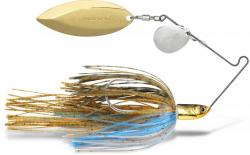
Spinnerbaits are a good choice to cover water and catch quality fish, and bass hooked on spinnerbaits tend to stay buttoned up better then they do on crankbaits. Use white spinnerbaits with silver blades in clear water or white and chartreuse skirted baits with gold and silver combinations blades if the water has some stain to it.

Fish spinnerbaits around shallow cover like blowdowns, brush and grass in the water, but don’t hesitate to throw them on rocky or clay banks, too. Start by running them just under the surface for the most active bass but also slow roll them down deeper if the bass are not coming to the top to hit.

Topwater baits are the most fun baits to fish and bass eat them readily this time of year. Buzzbaits are great and bass will often explode on one run across shallow cover. White buzzbaits with silver blades in 3/8ths to 1/2 ounce sizes are excellent since bass are feeding on bigger baitfish and like a big meal.

Poppers can be fished slowly and will draw bass from many feet away, and bass will often come completely out of the water when they hit them. But be ready for a gentle bite when the bait just disappears without a ripple. That might be the biggest bass of the day. Try silver bottom baits and remember that bass see the bait from the bottom when choosing one.

Fish all topwater over any cover you can find, but don’t hesitate to throw them over open water, too. Bass will often come up from several feet down to hit topwater on points and off drops. Bass often suspend this time of year in open water and will come up for a topwater bait, so throw them anywhere you see baitfish activity in open water, too.

If you want to concentrate on big bass, a jig and pig is hard to beat. Bass love crayfish and this bait imitates that slow moving feast. Brown colors in clear water and black with blue or chartreuse in stained water are the usual choices, and they should be fished slowly around all kinds of cover.

Crayfish like to burrow into clay banks to survive the winter, so concentrate on those areas with a jig and pig. They also like rocks, so riprap and rocky banks are another good place to fish them. Crawl your jig and pig along the bottom then make it hop, imitating a crayfish feeding along then jumping away when frightened.

Structure and cover to concentrate on this time of year includes rocky and clay points, rock and clay banks, wood cover like brushpiles, stumps and blowdowns and any kind of grass from hydrilla to water willow. Fish them all until you find what the bass are holding on that day and you can usually duplicate it on other areas of the lake.

The following lakes all offer great bass fishing in October. Pick one near you and give it a try.

High Falls

Located just off I-75 between Macon and Atlanta north of Forsyth, High Falls is a 660 acre lake in a state park. There are two boat ramps, one at the dam and another in Buck Creek, but motors are limited to 10 horsepower or less. You can put in a bass boat with a bigger motor as long as you don’t crank it, using only your trolling motor.

State creel limits of 10 bass per day a minimum of 12 inches long apply at High Falls. You are not allowed to fish at night, you can fish from 30 minutes before sunrise to 30 minutes after sunset.

High Falls is known locally for its big bass, and it has a good population of bass in different year classes. Drop by Berry’s Sporting Goods in Griffin on your way to the lake and admire the 11 pound, 4 ounce bass hanging on the wall for an example of why it has that reputation. Jim caught it at High Falls a few years ago and you can probably pick up some current tips for bass fishing there.

Since High Falls is one of the oldest lakes in Georgia, most of the channels have been silted in over the years. It is ringed by docks and many of them have brush piles. Backs of creeks like Buck Creek, Watkins Bottom and Brushy Creek are filled with stumps, many with bushes growing on them. There are also numerous blowdowns along the bank.

You can fish points at the mouths of the major creeks and wood cover on most areas of the lake. Rocks are hard to find but there are a few, especially in the river above the area where Buck Creek enters. Plan on fishing slowly and working all cover carefully since the motor limit will probably keep you from running all over the lake, anyway.

Juliette

Juliette is about 15 miles east of I-75 and Forsyth, Georgia. This Georgia Power lake was built for cooling the steam plant there and its 3600 acres are surrounded by a wildlife management area, so the only development is the power plant and two parks with boat ramps.

Motors are limited to 25 horsepower and you can use a bass boat with a bigger motor if you don’t crank it, but you will be very limited on a lake this size. You can keep 10 bass a day at Juliette and there is no minimum size. There are no restrictions on times you can fish Juliette and a campground allows you to stay and fish at night if you like.

Juliette produces excellent numbers of big bass but can be difficult to fish. A monthly tournament there usually has several six pound plus bass weighed in, and it often takes five weighing over 15 pounds to win. The lake is not very fertile and that is why there are no size limits on bass.

The water at Juliette is extremely clear and water weeds grow from the shallows to 20 feet deep or more in some areas of the lake. Water for Juliette is pumped in from the Ocmulgee River and there is very little inflow from runoff, hence the clear water and low fertility. Standing trees were left all over the lake when it was filled. The lower lake is covered with trees under the water and the upper lake is almost solid trees above the water.

The grass and trees are the key to Juliette. Locate some of the numerous humps and channels with trees or grass on them and you can catch bass on crankbaits. Use big baits and make long casts in the clear water. Spinnerbaits also work well when fished over the tops of the grass from shallow to deep. Topwater baits are also excellent over and around the grass.

Tobesofkee

Tobesofkee is one of our most urban lakes. Located just west of Macon, it’s 1750 acres of water get very crowded on nice days. There are two parks with ramps run by Bibb County and it is expensive to launch in them, with a cost of about $9 per trip. There are no motor restrictions and you will encounter many ski boats and skidoos.

State creel limits of 10 bass at least 12 inches long apply at Tobesofkee. Night fishing is often good since most of the pleasure boats are off the water after dark. The many lighted boat docks offer bass attractions after dark as well as during the day.

There are good numbers of keeper bass in Tobesofkee and four pound bass are fairly common. A night tournament during the summer, switching to a morning weekend tournament after the weather cools, often produces five bass weighing 15 to 20 pounds for the winner.

In addition to the docks, the lower lake has several bridges with riprap to fish. Long points have rocks on some and brush on others. The upper lake is less developed and you can fish points and drops on it, as well as a few docks and some grassbeds.

Goat Rock

Goat Rock is a river with dams at both ends. Located just north of Columbus, this old lake on the Chattahoochee River has 940 acres of water to fish. There is one small ramp near the dam on the Georgia side of the lake and another public ramp on the upper end on the Alabama side but access is not good. You can launch a bass boat there and there are no motor restrictions.

State creel limits and length limits of 10 bass a minimum of 12 inches long each day apply, and you can use either a Georgia or Alabama fishing license. You can fish at night but this lake can be dangerous with unmarked shallows, so be very careful. Since it is not developed, there will be no lights on docks to help you see.

The population of largemouth is good at Goat Rock and some big fish are caught there each year. You can fish the rocky shoreline of the old river channel and the humps and stump fields in it. There are a good many blowdowns along the steep banks to fish. A couple of small creeks enter and the mouths of them can be good in the fall.

Current plays a big part in the activity of bass at Goat Rock. Bartlett’s Ferry dam is located on the upstream end of the lake, and any time power is being generated there is a good current all through the lake. This makes the largemouth move to cover that breaks the current and they feed there, so use a crankbait or spinnerbait moving with the current past ambush points to catch them.

Banks Lake

Banks Lake is part of a National Wildlife Refuge located just west of Lakeland, about 20 miles north of Valdosta. This lake is actually a Carolina Bay, a natural depression found in south Georgia, with a dam to make it bigger and deeper. There are about 1000 acres of open water to fish but it is surrounded by 1500 acres of marsh and another 1500 acres of cypress swamp.

State creel and size limits apply and there is a free public boat ramp. Although no motor restrictions apply on Banks Lake, its average depth of 5 feet and numerous stumps and logs means you must be very careful in a big boat. The Refuge folks recommend idle speed only.

During the summer Banks Lake is hard to fish because of all the weeds in the water, but by October they are starting to die back and you can find open water to fish. The whole lake looks “fishy” and its waters are full of big largemouth. This is a good place to catch a personal record largemouth.

Fish spinnerbaits over the grass and drop a jig and pig into holes in it. You can find some deeper holes in the open water, up to 15 feet deep, and the bass often hold in the grass around them. Also try pitching a jig and pig to the base of cypress trees. A good tactic is to let it hit the tree trunk and drop straight down into the root ball. You will need heavy tackle for fishing Banks Lake.

Ponds on Fort Stewart

Fort Stewart Army Base near Richmond Hill just west of I-95 has about 20 ponds on it that are open to public fishing. They total about 500 acres although not all are open all the time. You can use a boat in all of them but not all ponds have boat ramps.

The creel and length limits vary for different ponds and can change. Generally there is a 15 inch limit on largemouth but some ponds, like #26, Big Metz, is managed for trophy largemouth and has a 24 inch minimum length. A bass that size will weigh between 8 and 10 pounds! You must check in and get a daily permit to fish, so check current regulations when you go.

Fort Stewart is known for its big largemouth. Since 1992, six of the top 30 largemouth taken in Georgia came from Fort Stewart. All ponds have them and your chance of catching a wall hanger are good. Some ponds are managed for trophy largemouth so concentrate on them if that is your goal.

The ponds at Fort Stewart vary a lot but all of them are full of grass. Fish spinnerbaits and topwater plugs over and around this grass. Pitch a jig and pig into holes in the grass, especially near the deeper water in the pond, for big bass. Use heavy tackle, when a lunker goes into the grass you need heavy rods and strong line to get them out.

All of these waters offer great October fishing in Georgia. All you have to do is decide where to head this month to take advantage of the good fishing.

How Can I Catch Lunker Lake Trout On Lake Superior?

Huge Lake Trout caught on Lake Superior

Huge Lake Trout caught on Lake Superior

For Lunker Lake Trout, You Don’t Need a Bigger Boat, you Need a Better Line
from The Fishing Wire

When you see the giant lake trout that Grant Sorensen and James Holst have been catching on Lake Superior, that line from Jaws might enter your mind – “We need a bigger boat.” But you don’t. Rather, you need a better line.

You need Sufix 832 Advanced Lead Core line.

“That stuff has truly changed the way we fish lake trout,” says Sorensen, a young-gun Rapala pro-staffer and personality on In-Depth Outdoors TV on Fox Sports North. “It’s just incredible how productive it is. It’s outfished downriggers for me, almost 15 to one.”

Sorensen began experimenting with Sufix 832 Advanced Lead Core two years ago with Holst, a fellow Rapala pro-staffer and In-Depth Outdoors TV’s host. Last fall, they caught several 30-plus-pound lake trout on Lake Superior while filming this In-Depth Outdoors TV show. In mid-August this year, Sorensen reeled in (and Holst netted) a fat, 44-inch Lake Superior laker. Holst documented that catch in this cell phone video.

“We’re doing things that nobody else that we’ve talked to is doing with any kind of regularity,” Holst says. “We’re fishing completely differently thanks to this 832 Advanced Leadcore. And we’re catching more fish because of it, including a ton of 20-plus pounders and a handful of 30-plus pounders.”

In addition to the lead core line, Holst and Sorensen’s lake trout set-up comprises multiple long rods, big spoons, planer boards and snap sinkers. It does not require cost-prohibitive equipment.

“You certainly don’t need a big, 30-foot boat with a cabin and downriggers everywhere and outriggers and this and that,” Sorensen says. “The past two years, the biggest fish we caught out of Lake Superior, we haven’t even had downriggers on the boat.”

Superior trends are “evolving away from the giant charter boats, monster ocean rods and reels and super heavy tackle,” Holst says. “People who don’t have – or don’t enjoy using – super-heavy equipment can use Sufix 832 Advanced Lead Core to catch trophy-size lake trout out of their walleye boats, on their walleye gear.

“Catching giants is now less intimidating, more affordable, more enjoyable,” Holst says.

Sorensen caught his 44-inch laker out of Holst’s 20-foot, 4-inch Skeeter MX 2025. But you don’t need a 20-plus-foot boat to get on this bite.

“I’ve been fishing the North Shore since I was five years old,” Sorensen says. “I used to fish out of my grandpa’s 17-foot Lund. … My friends have 17-, 18-foot boats. I fish out of those a lot. A 17- 18-foot boat is plenty for out there, as long as you’ve got a couple of rod holders and keep an eye on the weather before and during your trip.”

In the summer and fall, avoid east or south winds, Sorensen advises. In the spring, watch out for west winds. He relies on web-published weather information from The National Oceanic and Atmospheric Administration (NOAA) and the Coast Guard.

“They all put out good, reliable weather reports, so you can take a look at the winds and map your plan for the day,” Sorensen says.

Many good lake trout spots on Lake Superior are close to shore.

“You don’t need to run out 15, 20 miles,” Sorensen says. “You’ll be fine along the North Shore where we fish. It’s somewhat protected and safe – you can get back to land quick if need be.”

Anglers can enjoy much stable water and many calm days most of the summer and into early September. Late September and much of October is pretty stable too, but chillier. “You’ll definitely be able to fish in those conditions,” Sorensen says.

How (and how deep) to catch the giants

Sorensen and Holst’s giant lake trout program will look familiar to many anglers across the Upper Midwest.

“If you troll for suspended walleyes on big water, you already have the rods, reels, planer boards and rod holders,” Sorensen says. “You can just take that same approach on these huge Lake Superior lakers. A guy pretty good at catching walleyes can easily come up here and catch plenty of fish too.”

Sorensen and Holst troll in a gradual zig zag pattern, covering 10 to 80 feet of water. “That’s really hard to do with downriggers,” Sorensen notes. “That’s what makes Sufix 832 Advanced Lead Core so productive.” Lake Superior’s biggest lake trout seem to prefer the top 40 feet of the water column.

“With the 832 Advanced, we’re able to fish shallow lines, which is where we’re finding the biggest fish,” Holst explains.

In the last three years, of all Sorensen and Holsts’ catches heavier than 18 pounds have come shallower than 40 feet. And several of those weighed 25 to 35 pounds.

“And not just in one spot either,” Holst says. “We’ve fished Duluth, we’ve fished Two Harbors, we’ve fished Grand Portage, we’ve been all over the place. And every place we go using this technique, we’re just pounding big lake trout. And other people out there – fishing in more traditional ways – just don’t seem to catch the really big ones.”

Both Holst and Sorensen are convinced that traditional lake trout tactics scare away the bigger fish, which often suspend less than 60 feet deep.

“Downriggers, which run right below the boat, are spooking fish,” Holst says. “They’re moving fish out to the sides of the boat. And before those fish ever filter back in behind the boat, the lures are long gone.”

Baits presented on fluorocarbon leaders tied to Sufix 832 Advanced Lead Core, however, pull right through the strike zone without the need for a bulky downrigger.

“It gives you the depth to present your baits to suspending fish,” Holst explains. “It’s a lot thinner, more sensitive and it dives a lot deeper with the same amount of line out. You get 30 percent more dive depth than traditional lead core. And, its 70 percent stronger!”

44-inch behemoth

Although both Sorensen and Holst have caught numerous 20-plus-pound lake trout and several heftier than 30 pounds, the 44-incher Holst netted for Sorensen this August impressed even these two seasoned anglers.

“When we first saw the initial glimpse of the fish, we both just freaked out,” Sorensen recalls, noting that he fought it for 40 minutes, drifting about 1 ½ miles in the process. “Like, ‘Is it a surfboard coming up? Or a piano? Or a lake sturgeon? What is that thing?”

And although Sorensen works out with weights four times a week and is in great shape at 23 years old, he struggled to hold up the beast for this snapshot.

“It was just a truly amazing fish, one that most people probably wouldn’t even believe exists in Lake Superior,” Holst says.

Although the fish appeared big enough to challenge Minnesota’s lake trout state record of 43 pounds, 8 ounces, neither Sorensen nor Holst wanted to undergo a weighing and certification process that would certainly lead to the fish’s demise.

“It didn’t really cross our minds to keep her,” Sorensen says. “A fish of that size and caliber on Lake Superior is something pretty special. That water is so cold and the fish grow so slow, that fish could easily be 35, 40 years old. She was a beautiful, healthy fish, in her prime. So it didn’t take me very long to know that I wanted to let her go.”

After measuring the fish (but not weighing her; they did not have a scale onboard), Sorensen and Holst teamed to revive it boatside, one supporting it head, the other its tail.

“After two or three minutes, she darted down to the bottom and from that point on, she was just a memory,” Sorensen recalls. “It was just incredible.”

How Should I Fish A Jig In the Summer?

Catch smallmouth like this on jigs in the summer

Catch smallmouth like this on jigs in the summer

Summer Jig Fishing Not the Same as in Winter

from The Fishing Wire

Summer or winter, pro-angler Bill Lowen prefers a jig for deep water fishing.

Jigs have long been acknowledged as some of the most effective lures for winter bass fishing, but Yamaha Pro Bill Lowen considers them just as effective during the hot summer months, too. The only thing Lowen changes is how he presents the lure.

“I believe the presentation you use is actually more important than your jig choice,” explains Lowen, “and the reason is because in winter you’re going after lethargic, inactive bass, while in summer those same bass are far more active and willing to chase a jig. In winter, you’re usually hoping for a feeding-type response, but now in July and August, you can also generate totally different reflex-type strikes.”

Thus, while his primary jig presentation in winter is slowly dragging the lure along the bottom, Lowen’s summer presentation also includes a lot of hopping and even a technique known as “stroking.”

Use a jig and trailer like this in the summer

Use a jig and trailer like this in the summer

A football jig with a creature trailer does the job for most of his tournaments, says Lowen.

“Stroking is a faster, stronger hopping presentation in which you literally rip the jig off the bottom with a hard upward sweep of your rod,” the Yamaha Pro explains. “The sudden change of direction and speed in the jig’s movement just triggers an instinctive strike. I may drag the jig on the bottom for a few feet, stroke it once and let it fall, then immediately rip it off the bottom again. I can do this three or four times during a single cast, too. It really depends on how the bass do react to it.

“During the summer, at least 75% of my jig bites come from hopping or stroking the lure like this.”

Lowen’s summer jig is the same as his winter one, a ½ or ¾-ounce football head style, and his preferred depth of 15 to 20 feet is also the same for both seasons. He also looks for breaklines where shallow water drops quickly to this depth.

“The major change for me in summer jig fishing is that I really want to have current consistently washing into that structure,” continues Lowen. “In the winter, I don’t want any current whatsoever, but it’s important this time of year. That water will be slightly cooler, it will have more oxygen, and it will be moving both forage and nutrients downstream with it.

Largemouth will hit a jig in the summer too

Largemouth will hit a jig in the summer too

Both largemouths and smallmouths like the “stroking” action that hops a jig off bottom in summer.

“The most productive places are often the outsides of channel bends, and frequently, these will also contain some type of logs and brush that current has washed in. In other lakes, rocks or shell beds may be present. If you can find anything different like this on that structure, that’s nearly always the spot that attracts bass.”

To find current, Lowen frequently motors to the upper end of a lake where more river-like conditions usually exist, or far up large tributary streams. Normally, however, he does not fish the actual tailrace waters immediately below dams, primarily because he doesn’t have to.

“Sometimes, if a lot of water is being released from an upstream dam, all you need to do is get behind an island or main lake point that breaks the main water flow and re-directs it, and you’ll be able to catch bass,” the Yamaha Pro adds.

“It’s always better to cast upstream and let the current wash your jig down naturally. As you guide the lure with your rod tip, you can add the hopping and stroking action you need. Current usually positions bass behind rocks, logs, and other obstructions, so it’s not difficult to determine just exactly where to guide your jig.

“The fun part of all this during the summer is that every place where the current does wash into the structure you can find one smaller spot along it that will be better than the rest. It might be an area just one or two feet long within the entire bend of the channel, or perhaps just a single stump along that bend, but whatever it is, more bass will be on that small spot than anywhere else.”

How Can I Catch Offshore Kentucky Bass?

Kentucky DFWR Biologist Suggests Targeting Offshore Largemouths
from The Fishing Wire

Fish offshore for post-spawn largemouth bass

Catch bass offshore on crankbaits in Kentucky

Catch bass offshore on crankbaits in Kentucky

Crankbaits are a favorite once bass go deep on big lake chains like those of the TVA system in Kentucky.

Frankfort, KY. – Chris Hickey, black bass research biologist for the Kentucky Department of Fish and Wildlife Resources, said the cool weather this spring delayed the largemouth bass spawn a couple of weeks, but now everything is on schedule as we head into the heat of summer.

He said anglers report largemouth bass gathering on the channel ledges on Kentucky and Barkley lakes.

Summer fishing for largemouth bass frustrates many anglers, although anglers themselves are usually the source of the problem. The anglers often don’t change the presentation or places they fish from the spring season, although their summer catch often consists of a few small male “buck” bass.

Forget fishing the visible cover along the bank and instead concentrate on off-shore structures such as channel ledges, submerged islands, humps and long points to catch bass during the day in July and August. Studying a map of the underwater features reveals these fish-holding structures. Anglers should plan on probing several during a day of fishing.

“I look for three things for deep ledge fishing,” said Ryan Oster, federal aid coordinator for the fisheries division of Kentucky Fish and Wildlife. “The first is the presence of bait, second is stumps and third is current. Mussel beds on the ledge are also a big help.”

Depthfinders are a great help in finding offshore Kentucky bass

Depthfinders are a great help in finding offshore Kentucky bass

Big-screen sonar is a huge help in locating summer bass on channel ledges and humps.

Oster, formerly western fisheries district biologist who helped manage Kentucky and Barkley lakes, prefers deep running crankbaits, 7- to 10-inch straight-tailed worms rigged on Shakey heads and heavy football jig and trailer combinations to fish ledges from 12 to 25 feet deep in these lakes.

“I like the Sexy Shad color for clear water and the chartreuse Sexy Shad for stained water in my deep crankbaits,” Oster said. “Typically, bass want it raking across the bottom. On some days, the fish want a slow and steady retrieve and on others, they want it fast. Mix it up until they hit.”

Boat positioning is important to keep these lures crawling on the bottom and across those underwater ledges and humps. Some anglers use marker buoys to visualize the ledge or hump.

Slowly crawl a Shakey head rig along the bottom, stop it every few feet and shake the rod tip to wiggle the worm and entice bass. Anglers fishing jigs may also work the bottom, but many “stroke” a heavy football jig by ripping it off the bottom with their rod tip and letting the lure fall on a slack line. Trophy largemouths often hit the jig on the fall.

Use a swimbait to catch Kentucky bass offshore

Use a swimbait to catch Kentucky bass offshore

Swimbaits can also produce when the head weight is keyed to the depth where the fish are holding.

Use at least 1/2-ounce of weight to get down on the deep structure. Many opt for 3/4-ounce or 1-ounce jigs. Shakey worms in green pumpkin, black or purple work well in deep water. Black jigs in combination with blue, purple, brown or chartreuse produce deep bass.

During the hottest times of the year, largemouth bass suspend over the ledge or hump and ignore lures worked on bottom. A swimbait works well for suspended bass.

Pearl-colored swimbaits with shades of gray, blue and light purple work well. Fish the swimbait just above bottom rigged on a 1/4-ounce or 3/8-ounce head as heavier heads deadens the lure’s action. Oster prefers 5-inch swimbaits.

Points that extend well out into the lake are high percentage spots for summer largemouth bass. Jigs slowly crawled across the point in water 15 to 25 feet deep draws strikes. Points with stumps or chunk rock on them hold the most fish.

The best ledge fishing is on Kentucky Lake, Lake Barkley and Barren River Lake. Most lakes across Kentucky have long extended points and many have underwater humps.

Get off the bank and catch huge bass on the hottest days.

Author Lee McClellan is an award-winning associate editor for Kentucky Afield magazine, the official publication of the Kentucky Department of Fish and Wildlife Resources. He is a life-long hunter and angler, with a passion for smallmouth bass fishing.

Media Contact: Lee McClellan 1-800-858-1549, ext. 4443