Category Archives: How To Fish

What Is A Hydro Glow Fishing Light and Why Do I Need One?

Hydro Glow Light

Hydro Glow Light

If you ever fish at night under a light you should have a Hydro Glow Light. They are fantastic for hanging over the side of your boat or mounting on your dock to attract baitfish that attract the fish you want to catch.

I first saw the lights in action a few years ago during a night tournament at Lake Sinclair. I had fish until almost dark without catching a bass then just as it got dark went into a cove to fish a brush pile I knew was there.
As it got darker I noticed a weird green glow in the water on a dock across the cove from me. I eased over to it and saw it was an underwater light so I started fishing around it. The cabin door opened and a guy came toward the dock. I just knew he was going to tell me not to fish around his dock and start casting so I would have to leave.

Instead, he started asking me about the fishing and told me the light was the Hydro Glow Light system he produced. He said the bass would move in a little later to eat the shad that were already swimming under the light and I could catch them.

As we talked Darrell Keith explained he owned the company and this cabin, and tested his lights here. The green one was new and it was working better than other colors they had tested. Then he said there was a bass at the dock. I could not see it from the boat but he told me to cast a crankbait to the light. I did, and caught my first keeper of the night.

I got a card from him and he told me to stay there, that more bass would move in, and he went back to his cabin.

I did not leave until the tournament ended and caught a limit of bass, winning the tournament. Every time I have gone back to Sinclair at night I have not been able to fish the dock. Too many other fishermen have found it and there is always a boat there.

Hydro Glow makes several lights and have just come out with a high intensity light that is compact. You can choose 12 volt lights for use from a boat or 120 volt for permanent mounting on a dock. Green works best in freshwater but there are different colors for use in salt water that work better there.

Check out their website and watch some of the videos. The lights are fairly expensive but you never have to buy fuel for a lantern like we used to, and they will last you a long time.

You Tube Video On Using the Book Keys To Catching Lake Lanier Bass

My eBooks “Keys to Catching Lake Lanier Bass” and “Keys To Catching Clarks Hill Bass” help me catch bass so I made a video showing how to use them.

Lake Lanier is a tough lake to fish for many, including me. The fish live deep in the clear water and a drop shot rig is one of the best ways to catch them. I seldom fish a drop shot.

I went to Lake Lanier in July, took one of the chapters of the book for hot weather fishing and put the GPS Coordinates from that chapter in my Lowrance HDS 10. When I got to the waypoint there was a brush pile right on the coordinates.

After rigging a drop shot just like described in the book, with eight pound line, quarter ounce round sinker, eight inch leader and Wackem worm in the color suggested I caught three spotted bass. They were not big, two were throwbacks and one was a 14.5 inch keeper, but I did catch fish. A thunderstorm ran me off the lake early or I could have tried more of the spots in the article.

Check out the video and let me know what you think.

Using Keys To Catching Lake Lanier Bass Book To Catch Bass

Keys To Catching Lake Lanier Bass works to help me catch bass.

The Outdoor Blast is next weekend, Friday through Sunday, at the Gwinnett Center in Duluth. I will be helping out at the Georgia Outdoor News booth where you can enter a drawing for a gun given away each hour of the show and pick up a free copy of the current magazine, so that booth should be very busy.

I will also have my two Map of the Month books for sale at the booth. I have put together books for Lake Lanier and Clarks Hill that have a Map of the Month article for each month of the year. Each article has a map showing ten good spots to fish for bass that month, tips on how to fish them, what baits to use and other information from a good fisherman on the lake.

Last week I went to Lanier to try to catch some fish and make a promo video for the book. The video will be running on a laptop on the counter at the Blast. The books are available as downloadable eBooks and I also sell them on CD in either Microsoft Word or PFD format. From the CD you can print out your own copy of the whole book, or print one chapter at a time to take to the lake with you.

I was happy to be able to put in a GPS waypoint from one of the articles for Lanier, go to it and find the brush pile there. I rigged a drop shot worm like suggested, with the color worm and weight sinker the article says works best. And I caught some fish off that hole and others in the book.

Lanier is a tough lake to fish if you don’t go regularly and keep up with what the fish are doing. The information in my book really helped me.

Summer Bass Fishing and Topwater Baits

Topwater baits are often the way to catch summer bass.

Sometimes I don’t think I know what I am doing when I am bass fishing, but most of the time I am sure I don’t know what I am doing. A trip to Sinclair a week ago Friday drove this home to me. The Sunday before that trip the Flint River Bass Club had fished the lake for nine hours and it took only 6.1 pounds to win and my five at 5.68 was fourth.

The following Friday I fished Sinclair with Bo Larkin, a UGA College Team fisherman. He lives in Watkinsville and fishes Sinclair a good bit, but I am three times as old as him and I started fishing Sinclair 20 years before he was born!

We started fishing at daylight and we both caught some keeper fish. He had one about 2.5 pounds, bigger than anything I caught the Sunday before. At 11:00 we were marking holes for the GON article and stopped on a small island. I pointed to a nearby cove and told him that is where I started in the tournament and landed a small keeper, but it was the only one I caught there.

Bo said he had never fished that cove and wanted to try it. I told him I didn’t think it was worth our time since the sun was bright and I had gotten only one bite there. But we went over to it and he started throwing a buzz bait, his favorite way to fish.

I thought he was wasting his time since the sun was high and bright and the water was only about three feet deep. But he caught a bass weighing over seven pounds from the shallow water on his buzz bait. Right where I had fished. Shows how much I know.

I fished a buzz bait right where Bo got the big one but didn’t get a bite. Maybe I was fishing too slow or too fast. Maybe I was fishing the wrong size or color buzz bait. Or maybe he knows something I don’t.

It always amazes me when my clubs fish the same lake the day a big tournament is going on there and we don’t do nearly as well as they do. And when I go fishing with really good fishermen, from college team members to established pros, they fish the same baits in the same places I fish but they catch more and bigger fish.

Maybe they have some special talent or sixth sense about catching bas I don’t have.

Last Saturday Raymond English had that special something at Oconee. The Potato Creek Bassmasters fished their June tournament with19 members landing 59 bass weighing 126 pounds. There were five five-fish limits in the tournament.

Raymond blew everyone away with five bass weighing 18.85 pounds and had the big fish of the tournament with 5.52 pounder. Bobby Ferris had fve at 13,01 for second, third was Ryan Edge with 12.32 pounds and Kwong Yu had 11.32 pounds for fourth.

Raymond said he caught his fish early on a topwater frog and had a second bass over five pounds but not quite as big as the other one. Several people got fish around five pounds each early in the morning. It was a great day on Oconee.

Fishing for bass can be tough this time of year but as the two trips above show, topwater baits can still catch good fish. One of the best area to fish topwater baits in the summer is where bream or bedding or feeding. Last week during the full moon lots of bream were bedding and that is always good.

But bream live shallow all the time, so fishing a topwater bait around grassbeds and wood cover in shallow water often works. That is the pattern Bo fishes at Sinclair and most of the spots we put on the map are like that. Details will be in the July issue of Georgia Outdoor News.

Also, Mayflies hatch and lay their eggs during the summer and bream feed like crazy on them. That almost always means you can catch bass on topwater baits. Bream are concentrated in a smaller area and are intent on feeding, so that makes them an easy meal for a hungry bass.

Work a buzz bait, popping plug or plug with spinners on the ends where the bass are feeding and you should catch some. The time before the sun gets on the water is usually best, but as Bo showed it is worth trying all day long.

What Is the Down and Out Technique for Walleye?

Down and Out Technique catcches walleye

Skarlis and Lahr give up their tournament-winning methods for finding “hidden” walleye

Press Release
By Mitch Eeagan
Nice tournament walleye

Nice tournament walleye

Professional fishing tournament twosome Tommy Skarlis and Jeff Lahr are no strangers to catching walleyes from fast-flowing waters, including the Mississippi River in Hastings, Minnesota. In fact, it was in this area—within the fish-laden Pools 2 and 3—that the band from Iowa took top honors at the Cabela’s Masters Walleye Circuit’s “Artificial Challenge” May 2-3, 2014.

But the bite did not come easy.

The fact was their 35-pound 8-ounce total two-day sack consisted of only six fish; with only two landed the second day.

Had it not been for the duo using high-quality electronics to locate specific-spots where the post-spawn females were laying, figuring out fish wanted lures pulled one way and one only, as well as using rods that aided in identify bites that would normally gone undetected, the tournament teammates would never have taken the podium.

Think outside the cone

Unable to pre-fish much before the derby, Skarlis and Lahr were depending on two choice areas where they had found fish a few years before with an Aqua-Vu underwater camera.

“After spawning, big hen walleyes tend to belly up to bottom right on the steep drop-offs leading to the main river channel. Unfortunately, it’s this type of area that a one-dimensional sonar’s “ping” often misses the mark (fish on bottom on sharp banks being just outside the cone-shaped signal),” says Skarlis. “Without an Aqua-Vu underwater camera, or Humminbird with two-dimensional Side Imaging, anglers would never realize those fish were there.”
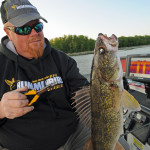
Use a good depthfinder to find walleye

Use a good depthfinder to find walleye

On this particular trip, Skarlis and Lahr were able to verify the walleyes were still there with Humminbird Side Imaging; the fish lying tight to bottom showing up clearly on the 1199’s unit’s large screen.

But confirming the location of the fish wasn’t enough; the lethargic post-spawners were still not willing to eat, but rather had to be coaxed into biting.

Slowly I pulled…

The pair discovered they had to employ very specific procedures to produce strikes. And then after all that, the bites were so subtle they could’ve been easily be missed.

The winning way? Pulling 7- to 12-MM long, slender-shaped stickbaits upstream at a crawl. However, only when the lures were swimming down the bank and out towards the main river bed, not up the break or along it, did walleyes respond.

Not wanting to waste time, Skarlis used his bow-mounted Minn Kota Fortrex to quickly pull the 3-ounce bottom-bouncer rigs with stickbaits up the steep breaks in 16- to 22-feet of water, and then reduce their speed to a creep at one-half-mile-per-hour. The slower speed was necessary to get the walleyes to commit.

Humminbird electronics are responsible for divulging the whereabouts of countless walleyes for tournament pros, guides and the everday angler. Photo by Bill Lindner Photography

A secondary technique took fish when the stickbait bite slowed. When the cranks quit, Skarlis and Lahr vertical jigged down and out along the same sharp breaks with 1/2-ounce jigs tipped with soft plastics.

“While most anglers use the lightest jigs they can get away with, Lahr and I often use heavier jigs, up to 3/4 ounce, as they displace more water and the fish are able to pick up the vibration through their lateral lines. Using larger jigs is doubly important in such stained water,” notes Skarlis.

Jig tied up and deployed, the anglers found the best technique was employing no action all, literally just holding the bait up off bottom a few inches and working it down the bank.

Feeling odd

No matter the technique, there were never any arm-jarring strikes. In fact, the bite was quite the contrary.

“Most anglers feel the spit, not the hit, and by that time it’s too late to set the hook,” states Skarlis.

“St. Croix’s LegendXtreme rods were one of the biggest factors in the win. The fish would bite light and swim along with the lure. If anything felt “odd”, anything at all, we’d set the hook and sure enough there was a fish.

Both anglers used St. Croix’s 7-foot medium, fast-action Legend Xtreme rods for jigging, and the medium-heavy, fast-action model for pulling stickbaits. However, when the technique called for heavier applications yet, the 7’1” medium-heavy, fast, Legend Tournament Bass rods were pulled from the rod locker.

“There are three reasons the Legend Xtreme is a superior rod,” claims Skarlis. “The blank is ultra-sensitive, of course, as well as light, so there’s no arm fatigue when fishing it all day. And the rods micro guides cut down on wind drag, keeping the tip from blowing around, creating even greater sensitivity. And because of its perfect backbone, they have the ability to hold fish on the hook once stuck.”

Down and out

Looking to land more post-spawn walleyes from rivers? Heed the down-and-out technique Skarlis and Lahr used to land a winning weight from the Mississippi. Use the newest electronics to locate fish hidden from standard sonar, and no matter the method employed, use sticks that telegraph even slight bites.
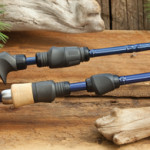
St Croix walleye rods

St Croix walleye rods

St. Croix Rod’s Legend Tournament Walleye (pictured) and Legend Tournament Bass are staple sticks in the boats of many professional anglers and guides.

Mitch Eeagan is an outdoor writer who lives and survives off the land within Michigan’s Upper Peninsula’s cedar swamps.

Should I Use A Big Worm for Post Spawn Bass?

Big Wormin’ During The Postspawn
from The Fishing Wire

Use a big worm for postspawn bass

Use a big worm for postspawn bass

“I always have a 10″ Power Worm tied on during the postspawn because it’s just one of those baits that the bass will eat.” – Scott Ashmore

Broken Arrow, OK – Elite Series pro Scott Ashmore lists a 10″ Berkley PowerBait Power Worm as his confidence bait when it comes to targeting postspawn largemouth.

“The big worm really starts to shine when the water temperature approaches 80-degrees, regardless of where you’re fishing across the country,” explains the Oklahoman, who has amassed over $120,000 in career earnings. “After spawning, the bass begin migrating to main lake points and ledges, and a 10″ Power Worm is the best bait that I’ve found to intercept bass during that transition period.”

Ashmore begins his search for schools of postspawn largemouth by looking at prime spawning areas in the backs of creeks or pockets. “Bass will use the same routes to leave the spawning areas that they used to enter the spawning areas earlier in the spring,” states Ashmore. “If you can identify where they spawned, you have a starting point where you can slowly begin working towards the main lake, combing classic postspawn areas like secondary points and subtle ledges.”

Another key underwater feature that Ashmore likes to target when searching for postspawners on manmade fisheries is ditches or creek beds running into pockets that were created before the lake was filled. “They’re natural migration routes that the bass use year after year,” he points out.

Covering water is a key component to success during the postspawn, and Ashmore believes that there’s not better tool for the job than a Carolina-rigged 10″ worm fished with a 2′ to 3′ leader and ¾ oz. tungsten weight. “In the heat of the summer, I’ll throw a Texas-rigged 10″ worm with a ½ oz. bullet weight and catch fish all day long out of isolated brushpiles,” he explains. “But during the postspawn when the fish are not as target oriented, a Carolina-rig allows me to cover more water and find those groups of cruising bass that are in transition.”

The majority of the time, Ashmore relies on 20-pound-test Berkley 100% Fluorocarbon line for both his main line and Carolina-rig leader. “I like 20-pound-test fluorocarbon because most of the time my line is dragging across rocks and the weight is bouncing on the line,” he states. “If I’m fishing in really clear water, I’ll drop down to 15-pound-test 100% Fluorocarbon for my leader.”

As a general rule, darker colors like Red Shad and Plumb get the nod. “Red Bug seems to work well on some of the southern fisheries like the St. Johns River, and Blue Fleck is probably my favorite color on Oklahoma lakes,” explains Ashmore.

When it comes to hook selection, he pairs the meaty 10″ worm with a light wire 5/0 or 6/0 wide gap worm hook. Ashmore believes that the light wire allows for easier hook penetration when setting the hook at long distances, and it also gives the worm a more realistic action and allows the bait to flow naturally through the water.

On the topic of a natural appearance, Ashmore has difficulty explaining exactly why bass have an affinity for 10″ worms. “All I can say is that I guess a 10″ worm puts a little mystery in the ballgame,” he states with a chuckle. “I don’t think the bass really know what they’re looking at when they see a big worm, so it generates a reaction bite. All I know is that they eat the bait and that I have a lot of confidence in it. Beyond that, I don’t try to over think it.”

Can I Catch Saltwater Fish On Artificial Lures?

The Lure of Artificials

Florida charter captain avoids the hassle of live-baiting.

By Frank Sargeant, Editor
from The Fishing Wire

Catch big redfish like this on artificials

Catch big redfish like this on artificials

There aren’t many charterboat skippers around Florida’s central west coast that specialize in tossing artificial lures these days. The ease of catching fish with live sardines, particularly for anglers without a lot of experience, has made live bait the go-to standard for dozens of guides, and there’s no question the silvery baitfish are deadly on every inshore gamefish.

But Captain Ray Markham of Terra Ceia has taken another route.

“I just don’t like fishing live bait,” says Markham. “I like the idea of fooling the fish with a lure, and I like the process of casting, working the lure just right, setting the hook at the right moment–the whole thing is just more interesting.”

Of course, it’s a whole lot more challenging, too.

Unlike guides who use live ‘dines both as bait and as magic chum, Markham does not get that nice string of explosions along the shoreline to tip him off as to where the snook and reds are hanging out.

And since artificials don’t feed the fish and keep them in one spot, it’s not common to sit in one location and catch a dozen or more, as is sometimes the case with sardine skippers.

“It’s basically just a different clientele I cater to,” says Markham. “Anglers who have done enough fishing to know how to cast reasonably well, and who appreciate getting to see a lot of backcountry and picking out the spots for each cast are the ones who really prefer fishing lures to fishing sardines. For people who can’t cast at all, of course, live baiting is a lot easier, and that might be the better route for them.”

Markham says that if he had only one lure to fish year around, it would be a DOA CAL jig head in quarter-ounce weight, with a 4 to 5 inch soft plastic shad tail in white or pearl color.

“Just about everything from snook to reds to trout to flounder will hit that lure,” says Markham,” and it’s very easy to work–just pop it up off bottom, let it sink, and then repeat.”

He also likes the DOA shrimp, most often fished under a popping cork–an easy system for those new to fishing artificials to learn because it’s very similar to live baiting–and tossing an assortment of MirrOlure hard baits, including the MirrOdine in shallow grass flats.

He typically arms his anglers with spinning tackle, with 2500-size reels and 10-pound-test braid, tipped with a length of 20 to 30 pound test fluorocarbon leader. His lures are tied on with a loop knot to allow them extra action.

I’ve fished with Markham many times, and he consistently outfishes me, even though I consider myself a reasonably good lure angler. The difference, he thinks, might be the power he puts into the retrieve.

“I really snap that lure up off the bottom–it’s a quick, violent action, and that seems to trigger the strikes a lot more often than just a pull and drop retrieve,” says Markham.

He uses the same tactic when fishing a popping cork–the violent jerks he uses makes the cork chug and pop loudly, and the noise seems particularly attractive to trout.

Of course, the other thing that makes Markham effective is his bone-deep knowledge of the terrain–with more than 20 years of guiding the area, he knows every pothole, cut and mangrove point intimately.

On the half-day I joined him, we fished the string of bays and mangrove islands that stretch south from the Skyway, and caught a steady assortment of big redfish, trout and flounder, along with an occasional snook. It was rare to go 5 minutes between bites–for those who get impatient waiting for something to find their sardine, there’s something to be said for run-and-gun lure tossing.

The other major advantage of fishing artificials, Markham points out, is that you can start casting at first light; prime time for low-light feeders like snook.

“I just hate the idea of spending that best hour of the morning throwing a castnet for bait instead of fishing,” says Markham. “And the other nice thing about lures is that they’re always there in my tacklebox–there are no days when I have a hard time getting bait.”

For more, visit www.captainraymarkham.com

Can I Catch Bass In the Late Spring Swimming A Jig?

Swimming the Jig for Bass In Late Spring

A great postspawn tactic.

By Frank Sargeant
from The Fishing Wire

Swim JIg

Swim JIg

Most of us think of jigs as deepwater baits designed for fishing bottom, but for a short time in spring, jigs become topwater baits that are hard to beat, and they often produce some huge fish that are hard to catch with other lures.

Swimming a jig is basically a postspawn tactic; the fish that have spawned in the pads, primrose vines and other emergent weeds remain in the shallows for days or sometimes weeks after leaving the beds, and they’re typically very hungry. The places they prowl may be anywhere from a foot to 4 feet deep, typically in the backs of the feeder creeks that make up the bays around the larger lakes across much of the southeast and west into Texas.

The jigs that work best are not the heavy, fat models that work so well on the ledges. Swim jigs are flat-bottomed to help them scoot across the weeds, and are typically lighter in weight than those used in deep water, from 3/16 to ½ ounce, with large hooks designed to hold large soft plastic crawfish or swimmer tails. A nylon weedguard is also standard, helping to keep the single-hook lures from catching the cover.

These lures are cast into cover near spawning areas-sometimes the shadows of the beds can still be seen in the cover. However, the fish may be some distance from the nests-they no longer guard them after the fry swim off on their own, but they do hang in the area to feed for a time.

The trick in working a swim jig is to put the reel in gear instantly at the end of the cast, keep the rod high, and start the lure moving, slowly but steadily, just fast enough to activate the soft plastic swimmer legs or tails. Most anglers use either heavy mono, 25 pound test, or braid of 30 pound test or heavier, to allow pulling the lure free when it snags-and also to give them a chance to derrick large bass out of the thick stuff.

The strikes tend to be sudden and explosive-it’s just short of the blow-ups inspired in fall by crawling a frog over the moss beds. The nice advantage of swimming the open hook jigs is that the fish more often than not actually get hooked, not the case with the weedless but sometimes also fishless frogs.

Once a fish strikes, the tactic that works best is to set the hook hard, then crank as fast as possible with the rod high-ideally, you pop the fish up on top of the weeds and scoot him across them to open water. Of course, this plan is not always effective-they often bog down, and then the only way to get them out is to ease in on the troller, follow the line down and get a liplock on them.

It’s also common for fish to blow up on the lures and miss them completely. When this happens, a second cast back to the same spot immediately often gets a second strike, but if not it can be useful to keep a Texas-rigged worm handy on the front deck. Cast the worm to the spot of the blow-up, bounce it up and down in the cover a few times, and you’ll often coerce the fish into taking.

All colors of swim jigs work, but the ones that are easiest to see are the brighter colors-white, pearl or chartreuse are easy for you and the bass to spot.

Fishing the swimjig is a short window in the fishing spectrum, but it’s one of the more interesting and productive tactics for big fish when the bite is on-give it a try this spring.

Should I Use Plastic Worms To Catch Spring Bass?

Plastic Worms Offer a Good Alternative Throughout the Spring Months

On heavily-pressured waters, Yamaha pro Russ Lane chooses plastic worms instead of jigs or crankbaits

Small, lightly weighted plastic worms are effective in hard-fished waters where power-fishing with fast-moving lures can be tough, says Yamaha pro Russ Lane.
When Russ Lane gave up a promising baseball career to become a fulltime professional bass fisherman, he quickly realized he had to change his normal fishing strategies if he wanted to compete successfully against the best bass anglers in the world. The Yamaha Pro’s initial decision-looking for alternative lures-turned out to be one of the most important he’s ever made.

“Not only was I fishing against excellent fishermen, but we were all competing on heavily-pressured lakes where the bass had apparently already seen all the lures in my tackle box so they ignored them,” laughs Lane, who has since qualified for four Bassmaster Classic® championships. “I had always enjoyed fishing small plastic worms, so that lure became my alternative bait, and it’s really effective now during the spring months because very few other anglers use them.”

Lane likes a little 4 ¾ inch worm that features a ringed body design but with a slightly larger tail. It has practically no action of its own, but the worm is still bulky enough he can rig with a larger 4/0 hook, quarter ounce slip sinker, and 22 pound fluorocarbon line.

He uses a worm under 5 inches long on a size 4/0 hook, with a quarter-ounce slip sinker for casting weight.
“It’s a finesse-type lure I can power fish with stronger tackle,” explains the Yamaha Pro, “and while it’s a great alternative lure throughout the spring months, it’s actually a very good lure throughout the year. I can pitch and flip it to boat docks, brush, stumps, practically any form of cover in water less than five feet deep.

“I nearly always use the very same presentation, too, regardless of what I’m fishing. I like to pitch the worm to the cover, let it fall to the bottom, then just let it sit motionless there for several seconds. When I do move it, I barely raise my rod so the worm only glides a foot or two before settling back to the bottom. It’s during that slow, subtle glide that the bass hit it.”

Lane’s realization he needed to find an alternative lure to use when fishing “used water” behind other pros isn’t unique, but his lure choice is certainly unusual. Most of his contemporaries change to fast-moving crankbaits in hopes of generating reflex-type strikes, so his ultra-slow retrieve-he rarely even hops the worm-truly is something the bass don’t see that often.’

“I think it’s effective because the worm looks extremely natural in the water,” continues Lane. “Bass aren’t spooked by it because it’s not an intrusive or aggressive movement. I know bass hear the worm as it hits the water and then sinks to the bottom, but instead of darting away, I envision them swimming up to within a few inches of the worm while I’m letting it sit there motionless.

An assortment of dark colors can be effective for spring fishing around beds where fish have recently spawned.
“When I slowly lift my rod and move the worm, it just slowly rises off the bottom and glides a very short distance. For a bass, that type of movement represents a very easy target, and I think that’s why they hit it so well, even during the post-spawn season when fish typically are not very active.”

Lane also likes fishing the small worm because it catches all sizes of bass throughout the day. He’s caught numerous fish in the six pound range using his slow presentation, and he credits the worm with helping him qualify for the 2013 Bassmaster Classic.® He used his technique in all eight Elite Series qualifying tournaments, from Florida to Arkansas to Wisconsin, and ranked 28th in the B.A.S.S.® Angler of the
Year standings.

“I don’t believe there’s a lake or river system in the country where this little worm and my slow presentation won’t catch at least some bass,” concludes the Yamaha Pro. “I really started fishing this worm as an alternative bait, but now it’s become one of my favorite lures, and I use it wherever I go.”

Can I Catch Southern Smallmouth On Swimbaits?

Giant Southern Swimbait Smallies

By Jimmy Mason
from The Fishing Wire

Southern smallmouth bass can be tough to figure out. One day they’re here, the next they’re gone, but there’s one area where you can count on finding them almost year-round, the current-laden water that rushes through the dams of riverine impoundments.

Jimmy Mason with big smallmlouth

Jimmy Mason with big smallmlouth

Captain Jimmy Mason shows a pair of enormous smallmouths taken in fast water below a TVA dam this spring.Mason says a swimbait tapping bottom now and then is the prime lure for catching bass of this size.

I’ve been guiding on Tennessee River impoundments for quite a while now, and have seen new lures and techniques come and go. One that’s here to stay for this moving water is a swimbait. I’ve never caught so many trophy smallmouth bass like the ones in the accompanying pictures as I have on a soft plastic swimbait.

Specifically, I most often use a 5-inch Yum Money Minnow in Foxy Shad color. It perfectly imitates our native forage, the threadfin shad. It is a simple lure and technique, but really catches bass in the kind of current we have in the Tennessee River and the upper reaches of my home waters, Pickwick and Wilson Lakes.

I prefer fishing the swimbait on a ¾-ounce jighead with a weedguard to keep it from snagging. In fact, I’ve been using a Booyah Boo Jig and just removing the skirt. We’ve had abnormally cold water this winter and bass can’t fight heavy current in those temperatures, so they often sit in eddies behind boulders. I bring the swimbait right to the front of the boulder and pop it over, making it sink right on the fish’s nose.

Sure, soft plastic swimbaits have been around for five or six years, but you don’t hear anglers talk much about fishing them in current. Even though it sounds simple, there’s more to being successful than meets the eye.

Smallmouth on the Tennessee River or any big river or tailwaters often scatter out over broad boulder-laden riverbeds. When I’m fishing swimbaits over these areas, I’m not fishing a specific spot. I’m letting the current carry the boat downriver and fishing multiple boulders or the bottom of the run-of-the-river section of the lake. You are fishing multiple low spots, high spots…anything that breaks the current, anything that these fish can pull in behind and set up in a current break.

Current can undermine your presentation if you let it. I like to cast out and, much like I do when I am fishing an umbrella rig, let it “parachute” to the bottom. By that I mean I want to execute a controlled fall. To do this I turn my reel handle only slightly after the bait hits the water. I want that bait nose-down but under control as it falls to the bottom.

As soon as I make bottom contact, I speed up my retrieve. I want to keep it just off the bottom. During the retrieve itself, I want to feel the bait bump bottom three or four times. I don’t want to bang bottom constantly, but I don’t want my bait to swim too far up either, because the fish are using the boulders and pockets for protection from the strong current. Feeling the bait bump three or four times lets me know that I am within a foot of the bottom as we drift.

Boat control

When I’m fishing these areas, I point the boat directly into the current and let it drift while I cast straight out. Keeping the bait in the strike zone during the retrieve is very important, and by casting directly in front of the boat and drifting straight downstream I’m able to fish the swimbait more effectively.

Drifting in this manner, I can pretty much keep my foot off the trolling motor except to adjust the boat position. The objective is to keep the nose of the boat forward, pointed into the current.

I want my bait and my boat moving backwards at the same speed. My casts are all perpendicular to the boat – at a straight 90-degree angle with the craft. I am not throwing upstream. I am not throwing downstream. I want to cast straight out so that my retrieve brings the bait straight back to the boat.

High waters and weighty matters

Big smallmouith caught on a swimbait

Big smallmouith caught on a swimbait

The 5-inch Yum Money Minnow is large enough to whet the appetite of jumbo smallmouths like this one.

As I said, my go-to bait for fishing in the current is the 5-inch YUM Money Minnow, more often than not, in the Foxy Shad color on a ¾-ounce jighead. This past December, however, I fished in heavy current following three or four inches of rain, and conditions forced me to adjust.

Heavier-than-normal current calls for a heavier presentation. In situations like that, I will take a lead slip sinker – say a 5/16-ounce bullet-nose sinker, and put it ahead of the lure. The water is dirty after a heavy rain, and in that faster current the fish get just a quick glimpse of the bait as it rushes past them. The weight and extra bulk doesn’t hurt the presentation at all. It does, however, help me get that swimbait down and working in the fast current.

Gearing up

Fishing across large flats on big rivers and below dams calls for long casts. It requires equipment that not only enables you to make those casts but to set the hook successfully even with all that line and current between you and the fish.

I use a long rod with muscle, a 7′-4″ Dobyns DX in heavy action. It has a good flexible tip that helps you make long casts, but at the same time it has the backbone to drive the hook home even with the heavy diameter wire on my jigheads.

My line choice is 15- to 17-lb fluorocarbon. That fluorocarbon helps me get down in the current better because it sinks, and the low stretch helps me get a good hookset. My reel is a Lew’s Tournament Pro with a 6.4:1 gear ratio. It also aids in casting long distance and the high-speed gear ratio helps me stay in contact with the swimbait.

The Tennessee River and its fabled impoundments have a lot of challenging current areas that are loaded with big smallmouth. Try these tips for rigging and working the Yum Money Minnow for the fast water. When it comes to big smallmouth, I probably catch more 5- and 6-pounders on this bait than on anything else!