Category Archives: How To Fish

What Is Hop Drop and Troll Ice Fishing?

Hop, Drop and Troll
from The Fishing Wire

Planning, mobility and speed the keys to catching late-ice, big-water crappies

Big ice crappie

Big ice crappie

Crappies aren’t necessarily hard to catch, but they can be challenging to locate on vast waters like Minnesota’s Lake of the Woods. Dan Stefanich photo.

It’s no secret. Big water grows big crappies. Large, deep lakes have an abundance of forage and more places for crappies to hide, feed and grow. Find a big lake with relatively low angling pressure, and you’ve set the stage for potentially epic crappie fishing.

But you’ve got to find them before you can catch them. Anglers who do a little research, drill enough holes, stay mobile and fish speedy baits will be rewarded with success.

Seasonal Crappie Movements

In smaller, shallower lakes, crappies are typically located and caught throughout much of the winter season over main-lake basins. In large, deep lakes, however, they tend to avoid the deepest areas and use flats, humps and basins ranging from 20 to 40 feet deep. But crappies are also notorious for suspending. Depending upon conditions, they can be found anywhere in the water column, creating an additional variable in the angling equation.

As the ice-fishing season nears its end, crappies transition from their deepwater wintering areas towards shallow bays, channels and river mouths in preparation for spawning. Depending on where and when you fish, concentrations of crappies will be present along a relatively straight line between these distinct areas. During the late-ice period, take a stab at identifying some of these likely travel paths between wintering areas and spawning areas on a map of the lake you plan to fish. Look for potential staging locations where cover, structure or current variations are present along those paths.

Drill ‘Em Out

Crappie caught on a spoon

Crappie caught on a spoon

Jigging spoons are a great choice for targeting crappies in most situations. This one fell for a Custom Jigs and Spins Slender Spoon in Gold/Glow. Dan Stefanich Photo.

Once you’ve identified attractive areas, gas up the auger and get to work. Use your GPS to confirm your location on the ice, and pick a variety of sweet spots over the particular structure you plan to fish.

A larger fishing party is beneficial because you can share the work of drilling holes and checking them for fish with sonar. Once you mark fish, take the time to drill more holes. It’ll save you time in the long run as you’ll waste less time fishing an unproductive hole when an entire school may be located just 10 or 15 feet away.

Mobility is Key

Once the crappies are located, hole hopping is the key to keeping busy catching them.

“Here on Lake of the Woods, the guys who are willing to leave the comfort of their fish houses and use their electronics to fish from hole to hole are the ones who catch the most crappies,” says Lake of the Woods Minnesota Tourism director and avid angler, Joe Henry.

“The best crappie anglers won’t waste time fishing a hole that doesn’t produce a mark on their flasher. They’ll keep moving—drilling more holes if necessary—until they get a sonar return,” he continues. “Then they’ll drop down, catch a fish or two and move on once the action slows.”

Effective as it may be, hole hopping requires some specialized gear – especially at the very top of the continental United States on Lake of the Woods, where daytime temperatures can often remain below zero. Quality boots and outerwear are a must. A piece of gear like Frabill’s Tackle Pack-Hand Muff is also indispensable, keeping tackle organized and at the ready, while also serving as a vital and cozy refuge for off-duty hands.

Fish Fast

Crappies display a variety of moods, and their responsiveness to various presentations can change throughout the day – often rapidly. Late-ice crappie anglers should be prepared with a variety of offerings, from small tungsten jigs tipped with thin plastics to relatively large jigging spoons.
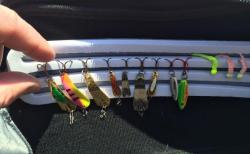
Frabill's Tackle Pack-Hand Muff

Frabill’s Tackle Pack-Hand Muff

Frabill’s Tackle Pack-Hand Muff is engineered for hole hopping, combining convenient and mobile tackle storage with hand- and core-warming technology.

“When crappies are aggressive, it’s hard to beat a Slender Spoon or a Buckshot Rattle Spoon tipped with a minnow head or tail,” says Henry, who prefers variations of gold and glow red for Lake of the Woods’ stained waters.

When a fish is showing on sonar, Henry advises stopping the spoon 4 to 5 feet above it and slowly working it down if necessary. “A lot of times you’ll see the fish begin drifting up towards your bait immediately,” Henry says. “If they do that, I’ll slowly raise the spoon while twitching it ever so slightly and make them chase it… Once you get them moving, they’ll usually charge it,” he continues.

Aside from a jigging spoon’s larger profile, Henry prefers them for another reason. “Spoons fish heavy,” he says, referring to their ability to punch through a slushy hole and get back down to other fish quickly once one has been caught. “If you’re marking a fish down there, a spoon is going to get down to it quickly… hopefully before it leaves,” he adds.

Crappies aren’t usually too difficult to catch. But they can be hard to locate, especially on a vast piece of water. Do your homework ahead of time, be willing to drill a lot of holes, fish fast and move if necessary. Some call it ice trolling because of the amount of water one can cover this way in a single day. Of course, if you really want to tip the odds in your favor, consider hiring a guide or consider fishing out of a full-service lodge.

Trophy Waters

At over one million acres, Lake of the Woods, Minnesota is a prolific fishery. Best known for its walleye, sauger, yellow perch and northern pike – all of which can be caught in great numbers all winter long from the comfort of countless heated ice houses placed and maintained by a number of full-service lodges – Lake of the Woods is also one of North America’s best trophy crappie fisheries.

Fishing Lake of the Woods

Fishing Lake of the Woods

With over one million acres and numerous full service lodges, Lake of the Woods, Minnesota is a premier angling destination. Walleye ice fishing season runs through the end of March on Lake of the Woods, while crappie fishing extends in to April. Dan Stefanich photo.

Crappie fishing at Lake of the Woods, however, takes a bit more work and planning. Some of the best crappie fishing on the lake takes place around the Northwest Angle, a thin strip of U.S. land and water extending north into Canada.

“Crappie anglers interested in coming to Lake of the Woods should consider staying at one of the lodges up at the Northwest Angle,” says Henry.

There are several lodges to choose from, and any of them will work with you to meet your specific angling objectives. Most use classic and reliable Bombardier track vehicles to transport their customers. It’s a unique experience that adds value to an already exceptional fishing trip. “They’ll get you comfortably to and from the best bites, which may be in Minnesota or Canadian waters,” continues Henry.

Sliding up into Canada is a relatively easy option for anyone traveling to the Northwest Angle. Canadian fishing licenses are easy to obtain at the lodge, and a simple phone call to Canadian authorities is all that’s needed to gain legal entry for fishing – for walleye, pike, muskie, perch or, of course, slab Canadian crappies.

Ice fishing for crappies extends into April at Lake of the Woods, providing yet another super reason to visit this outstanding angling destination. For more information, call Joe Henry at Lake of the Woods Tourism at 800-382-FISH (3474), email info@lakeofthewoodsmn.com, or visit www.lakeofthewoodsmn.com. Be sure to ask about walleye, sturgeon and other four-season angling opportunities, too.
Tips On Fishing for Bass In January

Tips for Bass Fishing in January from Denali Pro Michael Murphy
from The Fishing Wire

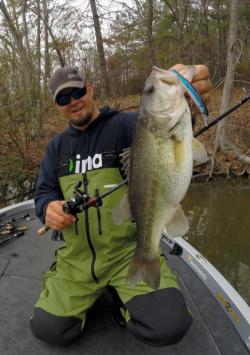
Catch bass like this in January

Catch bass like this in January

Unless you live in Florida or south Texas, the bass in your local lakes are likely swimming in some of the coldest water they see all year. Fishing for them can seem like an exercise in futility, not to mention a great way to expose yourself to some pretty unfriendly conditions.

As intimidating as the negatives of winter fishing can be, there are also some positives. The scenery can be amazing, there is little to no competition, and the fish you do catch are usually the right ones.

By focusing on those positives, FLW Tour veteran and Denali pro Michael Murphy has developed a healthy appreciation for winter bass fishing.

“We can talk all day about the cold, or how they don’t always bite well in the winter.” Murphy said. “But what I like to focus on is how refreshing it is to have the lake to yourself, see some beautiful scenery, and catch giant bass.”

Murphy has always been a jerkbait fisherman, a trait bred into anglers that fish the clear, blueback lakes around his Lexington, S.C. home.

“I spend a lot of time on lakes like Murray, Hartwell, Clarks Hill, and Wateree. All of them have clear water and have dynamite winter jerkbait bites. The bass are suspended in that cold, clear water. A jerkbait just hanging in their faces triggers strikes on even the worst weather days.”

Obviously, the first key to success with winter jerkbaits is to put on some cold weather gear and actually get out on the water. Once there, Murphy has the following tips to help you extend your bass catching season into the New Year.

1. Use the right rod

Murphy said that the number one thing anglers struggle with when fishing jerkbaits in cold water is getting the setup rod right. “Having a rod that is designed perfectly for your technique is more important in the winter than it is any other time of the year. It’s already cold, your hands may not work as well, and you’re likely wearing a bunch of gear. If you’re frustrated from fighting with backlashes or missing and losing fish (which are all things that happen with jerkbaits when you don’t have the right rod), you’re not going to be successful or have fun.”

Murphy uses the Denali Rosewood jerkbait rod (S802JBC) that he designed, and pairs it to a 6.4:1 Lews BB1 casting reel. As the primary designer of the rod, Murphy put a lot of time on the water testing to ensure that it has the absolute perfect flex and power for fishing jerkbaits in cold water.

“We built the Denali jerkbait rod as an alternative to the high dollar custom jerkbait rods lots of guys were using. We shortened the rod handle so it doesn’t get in the way of heavy clothes, gave it the right parabolic bend to keep fish hooked up, and kept a good tip for getting the proper action.”

Winter bass are lethargic and often just slash at jerkbaits, resulting in poorly hooked fish. If you’ve got a big bass hooked up with just a single hook or outside the mouth, having a parabolic action with some give is imperative to keep the hook buried.

In addition to the parabolic flex, Murphy also designed the rosewood jerkbait rod to have a fast tip to impart the perfect subtle flash required to draw strikes in cold water.

“A lot of crankbait rods have that good parabolic action we were after, but they are kind of dead in the tip which makes them less than ideal for jerkbaits. We kept the flex in the mid-section of our jerkbait rod but added a faster, more sensitive tip so that you don’t lose the ability to precisely control your bait.”

As far as baits go, Murphy has had experiences with a number of different baits over the years, and said that almost all of them can be successful if the conditions are right. The one he uses the most though is the Ima Flit, which he also had a hand in designing.

“I look at the Flit as one of the only jerkbaits out there that can be successful under any conditions.” Murphy said. “It dives 6-8 feet deep like a Lucky Craft Staysee , has the subtle darting action of a Megabass Vision 110, the high pitched bb sound of a Rogue, and lacks the internal weighting system like a Husky Jerk. It does it all and I have a ton of confidence that it will catch fish no matter what conditions you’re experiencing.”

2. Work slow, fast

This might sound confusing at first, but winter bass often group up and suspend over different types of structures, making it important to fish a variety of different locations in a day to locate bass.

“I have seen winter bass suspend around almost any type of steep cover available.” Murphy said. “Sometimes it’s bluff walls, other times chunk rock points or dock pilings. Whatever it is though, it’s important to hit a bunch of spots in a day to figure out where the bass are. That’s where the fast comes in. I like to hit a spot for 15-20 minutes tops, and if I don’t get a bite then I’m off to somewhere else.”

The slow part refers to the actual fishing, and Murphy doesn’t stray from convention. He recommended anglers move from a jerk to more of a slide as the water temperature drops, while increasing the length of pauses.

“In really cold water, I actually do more of a slide than a jerk. Baitfish don’t really dart in cold water, so you need to mute it down some. The important thing is to start with slack and end with slack, then experiment with your pauses depending on how the fish react.”

3. Listen to the fish

Remembering the circumstances surrounding a fish catch can be important at any time of the year, but Murphy said that it’s exceptionally important when throwing a jerkbait in the winter.

“Sometimes the bass will get really dialed in to a specific cadence or pause length. If you pay attention to what you were doing when a fish eats, you can often replicate it and score the rest of the trip. I’ve seen it before where they only eat a bait after a 5 second pause and won’t touch anything different.”

The same can be said for the type of cover or structure a bass is caught near. Even though winter bass are more lethargic, they will position on different structures depending on the weather, wind, or light penetration.

“You hear pros talk all the time about pattern fishing, and winter jerkbaiting is awesome pattern fishing.” Murphy said. “If I catch a couple off a 45 degree pea gravel point, there are likely to be bass on other 45 degree pea gravel points all around the lake. I can then focus on those the rest of the day.”

The Final Word

In addition to the pointers above, Murphy has one last one that he said may be the most important, and that’s to not let cold and winter stop you from getting on the water.

“I can’t believe how many fishermen put their rods and reels away when the calendar flips to January. It may be cold, but if you pick up a jerkbait and put some time on the water, you’re going to catch a lot more bass than you will from your couch.”

Try Different Strokes When Ice Fishing

Different Strokes For Different Folks-Or Fish when Ice Fishing

By Bob Jensen
from The Fishing Wire

Yellow perch ice fishing

Yellow perch ice fishing

A lot of factors can determine how many fish we’ll catch through the ice. Color is important: So is lure size. How the bait is attached to your line can be a consideration. A small jig attached to your line with a big, bulky snap/swivel probably won’t be as effective as that same jig tied directly to a low-vis monofilament or fluorocarbon.

A very important consideration any time you’re ice-fishing, but especially when the fish are being finicky, is the action you’re putting on the lure. Just as in open water fishing, how you move the lure will have a direct influence on how many fish you catch.

Different lures have different actions. Consider the difference in action of two really good walleye baits for ice fishing, the Northland Buck-Shot Rattle Spoon and their Puppet Minnow. The spoon has a very straight up and down motion. When you lift it up then let it fall, it flutters a little bit, but falls pretty much straight back to the bottom.

Try different actions

Try different actions

Using the lure with the action that the fish want will help you put more fish on the ice.

The Puppet Minnow has a different design that gives it a different action. When it’s jigged, it falls back to the bottom in a semi-circle. It falls slower, which appeals to fish in some situations. It also covers a larger area as it falls. This action might appeal to fish that are out to the side of your hole that don’t want to come in to eat the spoon that’s being fished straight up and down. Both styles of baits are good, but there are times when the fish will show a preference.

By the same token, sometimes the fish will prefer these baits being worked fast, other times they’ll prefer a slower presentation. Watch your sonar and see how they respond to different actions, then give them the action they want.

Perch and panfish can be very selective about lure action. Sometimes they want the lure moving quickly, much of the time they prefer a quiver, and there are times when they want it motionless.

We were on a lake in South Dakota a while back that had a reputation for producing lots of big perch. When we got there a weather front had gone through that had the perch very unaggressive. We could see them on the sonar, and we tried everything we could to get them to eat our baits, but they just didn’t seem interested.

Finally, one of the anglers in our group sat down in the shelter, rested the elbow of his rod hand on his knee, and sat as still as he could. He jigged the bait softly every now and then, but when a perch came in and looked at this bait, he held the bait as still as possible. Eventually the perch ate the bait. Sometimes it would survey the bait for maybe twenty seconds before eating it. Pretty soon everyone in our group started employing the “elbow on the knee” technique, and we started catching more fish. We didn’t catch every perch that looked at the bait, but we caught a lot more than we had been.

Catch crappie using different lure action

Catch crappie using different lure action

Whether you’re fishing open water or through the ice, if you pay attention to the action you’re putting on the bait, you’re going to catch more fish.

To see the newest episodes of Fishing the Midwest television, go to www.fishingthemidwest.com If you do Facebook, check us out for a variety of fishing related things.

Are Tail-Spinners Good for Cold Water Fishing?

Try a Tail-Spinner for Cold Water Angling

Today’s feature comes to us from Lee McClellan at Kentucky DFWR.
by Lee McClellan
from The Fishing Wire

This is the sixth and final installment of a series of articles titled “Fall Fishing Festival” profiling the productive fishing on Kentucky’s lakes, rivers and streams in fall.

FRANKFORT, Ky. – Some lures on the market have stood the test of time, catching fish decade after decade. The Dardevle spoon, the Panther Martin and Rooster Tail in-line spinners, the Jitterbug and the Hula Popper still catch fish today like they did when swing music topped the charts.

The tailspinner is another old-time lure that still catches fish consistently, and one of the best winter lures for black bass.

“The tailspinner is one of the only lures to catch a documented 10-pound smallmouth bass and a documented 10-pound largemouth bass,” said Chad Miles, administrative director for the Kentucky Fish and Wildlife Foundation.

They are not just bass lures, however. They also catch sauger and walleye below locks and dams during the winter months. Trout also hit tailspinners as do white bass during their spring spawning runs.

The lure is a simple design; a piece of lead impregnated with wire and a small Indiana or hammered Colorado spinner blade attached behind it with a treble hook underneath.

A Bowling Green businessman named Cecil Pedigo began tinkering with a tailspinner design in the 1960s. He employed a triangular-shaped piece of lead with a concave face to help the lure sink slower, along with a hooked dressed in marabou behind a small Indiana spinner blade.

He called it the Spinrite, still held in legendary regard among smallmouth anglers in Kentucky and Tennessee. The Uncle Josh Company purchased the Spinrite from Pedigo and discontinued the lure many years ago, but a Kentucky company is bringing the lure back, appearing in tackle stores in the state soon. Tailspinners are also found in tackle stores around major reservoirs in Kentucky and from most outdoor retailers.

The late Billy Westmoreland, considered by many the greatest reservoir smallmouth angler of all time, caught a 10-pound, 1-ounce monster smallmouth on a Spinrite in late winter while slicing points with one on Dale Hollow Lake. He also hooked a smallmouth on Christmas Day of 1970 that he believed weighed between 12 and 14 pounds, larger than the world record. The Spinrite popped out of the fish’s mouth during a long fight. The memory haunted him for many years.

Slicing points with a tailspinner is a highly effective and easy presentation for black bass in winter. Fire a tailspinner to a main lake or secondary point and let it flutter down to bass suspended near the point. Reel just enough to keep the line taut and watch intently. Set the hook if you see your line jump, go slack or you no longer feel the blade of the tailspinner thumping in your hand.

This presentation is deadly on difficult-to-fish steep points that grow in importance to bass when water temperatures drop to 50 degrees and below. Fish the front and both sides of the point.

A ½-ounce tailspinner is the most popular, but a ¾-ounce works well in windy conditions or on deep lakes. These weights work best for smallmouth and spotted bass on our clear, mountainous lakes such as Lake Cumberland or Laurel River Lake.

A ¼-ounce tailspinner works fantastic for sleepy, lethargic winter largemouth bass in shallower reservoirs such as Barren River Lake, Green River Lake, Yatesville Lake, Kentucky Lake and Lake Barkley. Largemouth bass are the toughest of the black bass to catch during winter.

The late Ted Crowell, former assistant director of fisheries for the Kentucky Department of Fish and Wildlife Resources, used to catch largemouth bass from Lake Barkley in winter on a Spinrite. He said many of the fish were so fat they weighed 5 pounds, but were only 18 or 19 inches long.

“You can cast it out and fish it like a spinnerbait over grass or mud flats,” Miles said. “The flats near deep water often hold big largemouths in winter.”

The compact design of a tailspinner makes it easy to throw one a country mile. Increased casting distance lends more stealth for the low, clear winter conditions on reservoirs.

Extra casting distance also comes in handy for walleye or sauger below locks and dams in winter as well as during the spring white bass runs. Sauger strike tailspinners fished just off the bottom below locks and dams on the Ohio and Kentucky rivers during the coldest days of the year.

Walleye in the tailwaters below Lake Cumberland, Green River, Carr Creek and Nolin River lakes strike tailspinners as well.

Smart anglers fishing below dams replace the treble hooks with a sharp single hook to reduce lures lost on the snag-prone bottom common in these areas. This is a good idea for those throwing tailspinners for trout in tailwaters as well.

White bass running in the headwaters of Nolin River, Taylorsville or Herrington lakes strike tailspinners with abandon, often soon after the lure splashes down.

Tie on a tailspinner this winter and let this old war horse work its magic.

Author Lee McClellan is a nationally award-winning associate editor for Kentucky Afield magazine, the official publication of the Kentucky Department of Fish and Wildlife Resources. He is a life-long hunter and angler, with a passion for smallmouth bass fishing.

What Is Swimbait Bassing?

Swimbait Bassing

By Frank Sargeant
from The Fishing Wire

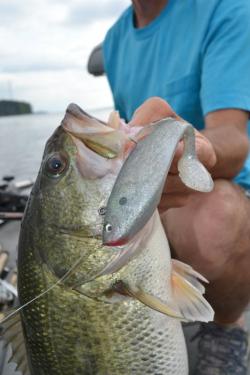
There’s not much that better imitates a shad than a swimbait; many of them are nearly an exact imitation of the favorite food of bass in most of North America in shape, and their swimming tail closely resembles the movement of a free-swimming shad. Add to this that the soft plastic body feels edible, and the single hook is much less likely to catch weeds than the trebles of crankbaits and lipless lures and you get an idea why the swimbait is a favorite nearly everywhere in bass country.

Use swimbaits for bass

Use swimbaits for bass

Big swimbaits often fool big fish, winter or summer, throughout shad country.

They can be particularly effective in early winter in the South and Southwest, where early freezes knock back the thickest weed stands, leaving tall but scattered springs of cover that’s prime country for swimbaiting.

Bass particularly like to prowl the scattered weed stands at the edge of deeper water; these are areas where shad congregate in winter, and anglers who motor these edges and watch their sonar will eventually find spots where there are lots of shad either on the edge or nearby. These are ideal areas to try swimbaits.

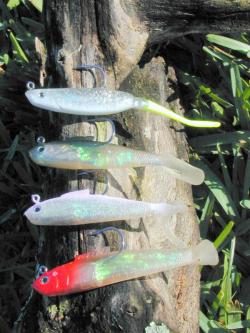
Swimbaits vary widely in size, from little 3/16 ounce models barely three inches long to big 8-inchers that would just about choke a striped bass. The best for all-around bassing are typically 4 to 6 inches long, in silver, white or steel gray colors.

Varying the weight of the jig head or the swimbait hook (some have sliding weights that pinch on the shaft) makes all the difference on the depth at which the lure runs and the speed at which you’ll want to fish it. With a light head, a big bait can only get deep if you fish it slowly, and many days in winter that’s exactly what the fish want.

Swimbaits come in a variety of colors

Swimbaits come in a variety of colors

Molded swimbaits like these from Bimini Bay/Tsunami are more durable than those that are designed to be fished on a bare jig head.

At other times, though, the fish may be more active and you’ll do better with a slightly heavier head, allowing you to fish the bait faster and still get it down to where the fish are. At times, the best speed is dead slow, literally crawling it along bottom.

One of the nice things about these baits is that you can fish the same lure at a wide variety of depths, from just below the surface to right along the bottom, just by varying the retrieve speed.

Good swimbaits will tell you when you’re in the sweet spot for cranking speed–many of them actually cause the rod to throb as the tail wobbles back and forth. It’s a much less pronounced feel than you get with a crankbait, but it’s clearly there when you get the speed right.

Bass typically just swim up and inhale the swimbait–you’ll feel a strong bump, and that tells you it’s time to set the hook. Unlike with crankbaits, there’s less danger of pulling the hooks free with a quick hookset of the large, single hook.

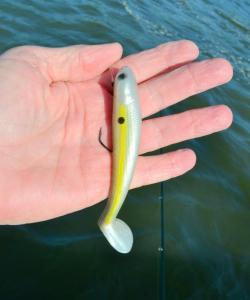
The Shadalicious from Strike King can be fished over a tube jig head, making the lead invisible.

Shadalicious from Strike King

Shadalicious from Strike King


While swimbaits often work best in scattered grass at this time of year, they can also be great open-water baits when anglers find bass suspended near shad schools over the main channel. This action often occurs near the upstream tips of shell bars, and blind casting in these areas with heavier swimbait heads sometimes connects, but the best bet is to ease along watching the sonar until you spot large schools of bait, then fish those areas hard.

In open water, the retrieve that works may be a bit more aggressive–a series of pull-and-drop actions can sometimes turn the fish on when they ignore a steady retrieve.

Storm, Strike King, YUM, Tsunami and many other companies make good swimbaits–buy a variety of colors and sizes, along with a good assortment of jig head weights, and you’ve got just about everything needed for successful winter angling through the month of December in much of largemouth bass country south of Mason-Dixon.

Can I Catch Fish At Night While Ice Fishing?

Scott Glorvigen’s “Happy Hours” for Ice Fishing Are At Night
from The Fishing Wire

Quick-trip tactics for after-work walleyes and crappies

When ice fans dream of upcoming escapades, many optimistically envision epic getaways spanning a weekend or more. Unfortunately, extended adventures can be tough to pull off, given the time constraints of daily life. Indeed, just carving out a full day on the ice can at times be a challenge.

Good news is, opportunities abound for enjoying quick trips offering great fishing for a variety of species. And some of the finest occur shortly after darkness falls.

“My favorites are early evening trips for walleyes or crappies,” says longtime guide, decorated tournament champion and avowed night owl Scott Glorvigen. “With a little planning, it’s easy to get away after work for a couple of hours and enjoy solid action, with a shot at trophy fish.”

Gearing Up

Pre-trip scouting and packing allows you to zip out to evening hotspots on a moment’s notice.

Scout for ice fishing

Scout for ice fishing


Organization is one of the keys to Glorvigen’s getaways. “Having everything you need ready and waiting makes it infinitely easier to hit the ice on short notice,” he says. “On the flip side, if it takes you three hours to wrangle gear, your window of opportunity will close before you ever leave home.”

To hasten your departure and boost on-ice efficiency, Glorvigen advises paring packing lists down to bare necessities. “Keep it simple,” he advises. “You’re not going to be running around, figuring it all out like you would during a day-long trip. Night bites are all about hitting high-percentage spots with one or two top techniques.”

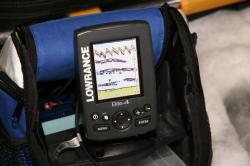
Typically, Glorvigen’s bug-out gear includes a small tackle bag stoked with a handful of key lures, components and tools; a minnow bucket for transporting either shiners for walleyes or small fatheads for crappies; two headlamps; an auger; and Lowrance sonar and GPS electronics.

A lantern is also critical equipment. “I’ve used gas and propane models for years, but last winter I started using Zippo’s battery-powered, LED Rugged Lantern and really like not having to worry about fuel or kicking the light over and burning down the house,” he says.

When chasing either walleyes or crappies, he packs just four rods. Two are rigged for jigging, and two are set up for bobbering or dead-sticking live bait. “For walleyes, I bring a pair of jigging spoon rods, which allow me to experiment with a few different spoon sizes and colors,” he explains. “Bobber rods are rigged identically. The second merely serves as backup in case the first gets hopelessly tangled or otherwise fouled up.”

Jigging rods are typically strung with 6-pound-test Northland Bionic Braid, with a foot-long, 6- to 8-pound monofilament leader, capped with a round-nosed snap. Bobber rods sport 6-pound mono mainline, a small swivel, and an 18-inch leader of similar material as the jigging setup. A size 4 single hook-either standard bronze or phosphorescent glow-and small split shot pinched six inches above it round out the rig.

“I like braid for spooning, because you get a better hooksets, especially with bigger fish,” he notes. “Mono works great for letting the walleyes run with live bait.”

Glorvigen favors 1/16- to 1/8-ounce Northland Buck-Shot Rattle Spoons, in phosphorescent shades of red and orange. “If it’s glow, it’s a go,” he quips. Spoons are tipped with a minnow head or tail. “Try them both to see what the fish want on a particular night,” he adds.

Crappies call for a bit lighter rods and line in the 2- to 4-pound class. Lures lean toward the horizontal orientation, and include favorites like the Northland Bro’s Mud Bug and Gill Getter. “I typically fish glow colors exclusively at night, including phosphorescent blue, red and white,” he says. Spikes and waxworms are top tippings. “You can fish glow plastics, but after dark I like the scent of live bait.” As with his walleye endeavors, two of Glorvigen’s four rods are rigged for live bait duties. Often, that entails deadsticking a small jig sweetened with a maggot.

Glorvigen houses his gear in a Frabill SideStep flip-over, which sports dual side entries perfect for two-person nighttime expeditions. “If one angler wants to head outside to check out a few different holes, he or she won’t have to flip up the entire shelter and stumble over gear on their way out.” He notes that a pair of Frabill light bars positioned strategically over the fore and aft sections of the shelter provide ample illumination for fish wrangling, knot tying and other nocturnal tasks.

Night Moves

Early evening is prime time for both walleyes and crappies.

Early evening is good for ice fishing

Early evening is good for ice fishing


For both species, active jigging attracts attention and triggers its fair share of strikes, while live bait seals the deal with curious ‘eyes that look but don’t bite.

Overall, jigging cadences are tailored to the mood of the fish, but Glorvigen generally avoids over-the-top antics that may work in daylight but fizzle after sunset. “Night-bite walleyes are focused on baitfish that are hunkered down for the evening, so they respond better to subtle jig strokes than aggressive lifts and snap-fall sequences,” he explains.

Instead, he relies on a series of twitch-twitch-twitch-pause maneuvers, letting the spoon’s rattles call fish in. “It’s almost like rattling antlers for whitetail deer,” he adds. “Rattle, pause. Rattle, pause. Waiting for a buck to move in.”

When set up over a school of crappies, steady jigging slightly above the fish often tempts hungry slabs to break ranks and rise to the occasion. “Keep jigging and slowly raise the bait,” Glorvigen says. “The higher you get the fish to move up in the water column, the more likely it is to bite.”

To further boost his odds of success, Glorvigen pinpoints potential hotspots by day, and plots their locations for easy return at night. “Do your homework ahead of time so you’re not hunting for fish after dark,” he says. “For walleyes, look for small shelves and stairsteps along breaklines fish follow from deep water up onto shallow feeding flats. High spots on humps can be good, too.

JIg just over the school of fish

JIg just over the school of fish

Steady jigging just above a pod of crappies tempts fish to rise for the kill.

Crappies typically roam deep basins, but often congregate along some type of structure, such as a steep wall at the edge of a deep hole. “Any kind of irregular break along that edge, like an inside turn or other collection point, can be particularly productive,” he notes. “Such areas gather and hold schools for longer periods of time, giving you more chances at fish from a stationary position. It’s like setting up in the corner of the corral, instead of along the fence line.”

Glorvigen notes that walleye action often peaks during the two-hour period surrounding sunset. “With crappies, the bite window is less intense but more spread out, and can continue later into the night,” he adds.

Along with offering a fine chance to ice numbers of eating-size ‘eyes and crappies, Glorvigen says early evening is a great time to connect with the walleye of your dreams. “Finding the right spot and hunkering down for a couple hours during prime time puts you in great position to hook a giant,” he says, providing yet another reason to enjoy happy hour on the ice as often as possible this winter.

Video link:
https://m.youtube.com/watch?feature=youtu.be&v=Q8OzRkkRbUI

Check out more of Scott’s night-bite tips.

Fishing West Point Lake with Ken Bearden

After fishing area lakes in two bass clubs for about 40 years, I often think I know them pretty well. But when I go to a lake with a guide who fishes one lake over 200 days every year, and has been doing that for 15 years, it amazes me how they know ever little detail of what is under the water.

Wednesday I fished West Point Lake with Ken Bearden, getting information for a Georgia Outdoor News January article. After some boat problems first thing that morning we got on the water at about ten. We tried several patterns and caught a few fish on one of them by noon so, for the next six hours, we fished that specific pattern from Yellowjacket Creek to the dam.

That morning while waiting on a friend to bring us a boat to borrow for the day to replace Ken’s disabled one, he explained there are three good patterns at West Point in the winter. One is jigging a spoon in deep water. One is swimming a bucktail through standing timber in deep water. And the third, the one we relied on, was fishing a crankbait on rocky points.

Ken told me you could catch large numbers of fish quickly on the first two patterns, but the third was a matter of run and gun, hitting as many points as possible. He didn’t expect to catch more than one or two bass on each spot, and many would not have any fish, but if you hit enough places you could get a good limit.

It worked. Ken landed six largemouth weighing between two and four pounds each and three spots weighing about 2.5 pounds each. The best five weighed about 14 pounds. I would love to have those fish in any tournament.

We also caught several striped bass and hybrids that morning casting an Alabama rig on roadbeds. They fought hard and the biggest weighed just under ten pounds. He said we could fish roadbeds and catch them like that all day right now.

We put ten places on a map, with GPS coordinates and details on how to fish them. That information will be in the magazine article. You can set up a guide trip with Ken by calling 706-884-0494 to get him to show you how well he knows the lake and how he fishes it.

Should I Change Fishing Lures When the Weather Changes?

Changes in Weather Often Mean Changes in Lures

Autumn’s Cooler Temperatures Can Affect How Certain Fish Feed

Although cold fronts and other weather changes in the autumn months are seldom as severe as those occurring later in the winter, they can still change bass behavior very quickly. That’s why Yamaha Pro Marty Robinson always has several rods with completely different types of lures rigged and ready to cast whenever he goes fishing this time of year.

jigs work well after a cold front

jigs work well after a cold front

Yamaha pro angler Marty Robinson switches to a jig when sustained north winds start to blow, slowing action on buzzbaits and spinnerbaits.

“The cold fronts in the autumn normally don’t change the water temperature that much,” notes Robinson, “but they often change the wind speed and direction, and that seems to be what changes the fish.

“I know from experience that whenever a front changes the wind direction from the south to the north, for example, the fishing is going to slow dramatically.”

One of Robinson’s favorite fall lures, and a favorite of bass fishermen everywhere, is a topwater buzz bait, a noisy lure with a rotating blade that churns and clatters through shallow cover and often attracts big bass. It seems to produce best when the wind is blowing from the south, but a change to a north wind all but eliminates the bite.

Robinson’s solution is to change to a lure he can fish close to the surface but not on top of the water. His favorite choice is a spinnerbait, which he retrieves fast, or “burns,” just below the surface. If the spinnerbait doesn’t produce, he then changes to jigs or soft plastic creature baits and worms.

“I’ve really caught a lot of fish burning the spinnerbait over submerged cover like stumps, laydowns, rocks, and vegetation,” continues the Yamaha Pro. “The bass still seem to be very active and they strike reactively, but they apparently don’t want to actually break the surface. Sometimes, just a simple presentation change like this is all that’s needed to start the fish biting again.

“Other times, slowing down and fishing specific targets more thoroughly may be what’s needed. This is when I start pitching and flipping a jig or some other bottom-bumping lure, and instead of just making one or two casts to a log or stump, I’ll make five or six and fish much slower and tighter to the cover.”

When fishing really slows, Robinson frequently changes his fishing targets as well as his lures. Instead of concentrating on stumps or laydowns, he looks for thick vegetation, such as milfoil, hydrilla, or other greenery in shallow water.

Weed mats are good targets for jigs

Weed mats are good targets for jigs

Robinson says he sometimes finds more fish under weed mats than in open water cover as the water cools, but the jig is a good weapon in the mats, as well.

“During the autumn months, vegetation will be the thickest it’s going to be all year,” he explains, “and it will attract both baitfish and bass and hold them well into the winter. In some lakes where the vegetation forms a mat at the surface, you can bring fish up with plastic frogs, but flipping jigs and soft plastics may produce even better results.

“I’ll work along the edge of the matted vegetation, and flip into little holes and to any irregular points, let the jig reach the bottom, and just hop it once or twice. If a bass is there, it will usually strike pretty quickly.”

The Yamaha Pro also pays attention to the late afternoon rain showers that often come with autumn weather changes. Immediately before the rain starts falling, the fishing can be excellent, but once the bass stop biting, it may take as long as 24 hours for them to really become active again.

“Part of this is caused by a changing barometer,” concludes the Yamaha Pro, “but you can fish your way through it. When the barometer is falling, as it usually is as a storm approaches, the bass are nearly always more active and will really hit spinnerbaits and crankbaits, but they stop biting once the barometer starts rising immediately after the front passes. When you know this is happening, you just have to slow down and fish more carefully with more target-specific lures until the barometer settles again.

“That’s why I think it’s important to have a variety of lures rigged and ready to use during the fall months. The bass can change their behavior very quickly, but you can still catch them.”

What Are Some Tricks To Catch Late Season Crappie?

Surefire tricks for late-season crappies

Scott Glorvigan – sglorvigen@wired2fish.com
from The Fishing Wire

For anglers across the Ice Belt, November’s arrival spurs thoughts of the hardwater season ahead. But plenty of fine open-water fishing remains for the faithful who see the season through to the end.

Take crappies, for example. One of the year’s best bites is still firing on all cylinders, and promises stellar slabbin’ right through freeze-up. “It’s undoubtedly worth getting your boat out a few more times to enjoy the late-fall crappie bite,” says veteran guide and noted fishing authority Scott Glorvigen. “The fish are ganged up in predictable places, and ready to hit baits with a vengeance.”

Here’s the deal. As autumn wanes and water temperatures fall into the 40s, crappies abandon withering weedbeds and shift away from near-shore structure. “The fish head for their winter haunts, which are typically deep, mid-lake basin holes,” Glorvigen explains.

Here, large schools of hulking, hump-backed slabs roam the abyss in search of sustenance. Much of the feeding focuses on zooplankton and other pint-sized prey, but crappies eagerly snap up larger meals such as minnows and other baitfish.

Glorvigen leans on cutting-edge electronics such as Lowrance’s Elite-5 CHIRP Gold sonar-chartplotter to pinpoint pods of wayward panfish. “The fish are constantly moving around, which makes sonar a must,” he notes. “Lowrance’s new CHIRP units give you incredible target resolution, so you can verify the fish you’re marking are crappies, and even pick out individual fish within a school.”

A plotter primed with detailed mapping is another key component. “This allows you to identify likely areas and then search them effectively,” he says. “Plus, if you lay down a trail of waypoints while following the fish, you can often predict where they’re headed next. For example, if you know a school of slabs is moving in a counter-clockwise rotation around a deep hole, it’s much easier to follow the herd.”

In search mode, Glorvigen scans potential hotspots, which include depths of 50 feet or more. “Don’t assume there are limits on how deep the fish will go,” he cautions. “Many anglers mentally set a boundary of 25 to 30 feet, but crappies often suspend much deeper.”

Once a school is spotted, Glorvigen takes an unusual tack for tricking the fish. “One of the hottest tactics for tapping the late-fall bite is hovering swimming jigs such as Rapala Jigging Raps and Northland Puppet Minnows within the school,” he says.

“Horizontal jigs tipped with flavored softbaits such as Berkley PowerBait and Gulp! bodies also work well. “You can use spoons, too, but vertical baits aren’t nearly as effective this time of year.”

While many anglers wield tiny tackle for crappies, Glorvigen favors swimming lures in the 2- to 2¾-inch class, along with 1/8-ounce jigheads. Colors aren’t as key as the bait’s water displacement when fishing deep water, he notes, though he has seen higher catch rates on UV patterns compared to standard color schemes.

Gearing up, Glorvigen spools a light-action Lew’s multi-species spinning rod with 10-pound Northland Bionic Braid mainline. The rod’s quick tip engenders strike detection and solid hooksets, while the superbraid boosts sensitivity, which is a huge asset when fishing deep water. He ties a small swivel on the end of the line, to limit twist, and adds a 12- to 18-inch leader of low-vis 6-pound fluorocarbon.

Unlike traditional snap-fall tactics used for walleyes and other larger predators, Glorvigen applies a slower hand for suspended cool-water crappies. “It’s not a standard jigging presentation where you’re really working the bait,” he says. “This situation calls for deadsticking. When the crappies see the lure’s profile, they think it’s a minnow mixed in with the zooplankton, and boy, do they smack it.”

Thanks to his CHIRP sonar’s target resolution, Glorvigen can watch his jig even as it descends into a crappie wolfpack. “This is really a breakthrough,” he says. “It’s not uncommon to run across massive schools 15 feet thick. With traditional sonar, there’s no seeing into a tight school. Once the bait gets into the fish, it’s off the radar. But with CHIRP, I can tell where my lure is and how fish react to it.”

He cautions that once you find a school, it’s important to keep moving to stay on top of it. By shadowing a deep-running gang of slabs, it’s possible to pluck multiple fish from a single group. “Keep in mind that when you pull crappies out of extreme depths, the fish are likely unreleasable,” he warns. “Plan on keeping what you catch for a late-fall fish fry. And if you get on a school of fish too small to keep, move along until you find larger ones.”

Depending on the individual lake, your latitude, and what kind of weather Mother Nature dishes out in the weeks ahead, you might have a month or more of crappie action before winter draws the curtain on open water. “Good news is, as soon as safe ice arrives, the same areas are still going to produce fish,” Glorvigen adds. Which is all the more reason to hit the water now to unlock the locational secrets of late-fall crappies on your favorite fisheries.

Can I Catch Spotted Bass In Kentucky?

Spotted Bass Time in Kentucky Waters
from The Fishing Wire

Kentucky spot

Kentucky spot

This is the third installment of a series of articles titled “Fall Fishing Festival” profiling the productive fishing on Kentucky’s lakes, rivers and streams in fall.

FRANKFORT, Ky. – They were not even recognized as a distinctive fish species until 1927. People for many years believed these fish only existed in Kentucky.

In 1956, the Kentucky legislature designated this species the “Kentucky bass” and made them the official state fish. Many anglers, especially in the south-central portion of the United States, still call the spotted bass a Kentucky bass.

They pale in reputation to their black bass cousins, the largemouth and smallmouth bass, but the spunk shown once hooked and their abundance should raise the profile of the overlooked spotted bass. They are also aggressive and readily strike lures.

It isn’t hard to tell when a spotted bass strikes. They shake their heads violently and dive bomb toward the bottom. The larger ones 15 inches and up usually grow a pronounced belly as they mature. Spotted bass use that girth along with a powerful tail against an angler while playing the fish, producing as good a fight as any comparable largemouth bass.

Medium-light spinning rods with reels spooled with 6-pound fluorocarbon line is all you need for catching spotted bass.

Once the fall winds blow, spotted bass begin to school up. They locate along rock bluffs or they suspend over points, submerged humps or channel drops.

“At this time of year, if you catch one spotted bass, keep fishing that same spot,” said Chad Miles, administrative director of the Kentucky Fish and Wildlife Foundation and dedicated spotted bass angler. “There might be 40 or 50 of them there. Spotted bass really school up in fall.”

Catch spots on topwater

Catch spots on topwater

In early to mid fall, these schools of spots often trap a cloud of shad against the surface and rip into them. Large, chrome topwater lures tossed into this melee draw vicious strikes. These same lures fished over points, humps and channel drops can draw spotted bass from a good distance below the lure, especially on our clear water lakes such as Lake Cumberland or Laurel River Lake.

John Williams, southeastern fisheries district program coordinator for the Kentucky Department of Fish and Wildlife Resources, reports Lake Cumberland holds a bountiful population of spotted bass with many fish in the 14- to 16-inch range. Spotted bass make up roughly half of the black bass found in the lake.

The main lake points from Harmon Creek down to Wolf Creek Dam hold spotted bass from fall through late spring. A 4-inch black finesse worm rigged on a 3/16-ounce Shakey head and slowly fished down those points is a deadly choice.

A hammered silver jigging spoon fished along the old Cumberland River bluffs in this section of the lake also produces spotted bass. Again, if you catch one spotted bass in fall, keep fishing the same area with the same technique. You might catch a dozen or more.

Large crappie minnows fished on size 1 circle hooks with two split shot lightly clamped on the line about 18 inches above the hook make a powerful choice for the large spotted bass in Laurel River Lake. The water of Laurel River Lake is as clear as the air and live bait works best.

The upper end of the Craigs Creek arm is a spotted bass hotspot on Laurel, as are the main lake points near the dam and in the lower section of Spruce Creek.

The mid-depth reservoirs in southern Kentucky hold excellent populations of larger spotted bass. Barren River Lake and Green River Lake hold some of the largest spotted bass in Kentucky.

The channel drops along the submerged Barren River adjacent to Barren River Lake State Park and the Narrows Access Area make excellent fall spots to try for spotted bass.

In Green River Lake, rock slides and points in the lower sections of the Robinson Creek arm and Green River arm are the best fall places. Green River Lake holds an impressive number of spotted bass longer than 15 inches.

Anglers fishing for largemouth bass in Kentucky Lake often stumble across a football-sized spotted bass. The secondary points in the major bays and creek arms in the middle section of the lake hold some impressive spotted bass in fall.

Smaller profile ¼-ounce football jigs in hues of green, brown and chartreuse attract these fish on Kentucky Lake.

Spotted bass make excellent table fare, by far the best tasting of the black bass species, similar to crappie in taste and texture. There is no minimum size limit on spotted bass statewide, but they still count toward the six fish aggregate black bass daily creel limit.

Hit the water and land some hard fighting and abundant spotted bass this fall. Keeping a few medium-sized spots for the table makes a delicious and nutritious meal.

Author Lee McClellan is a nationally award-winning associate editor for Kentucky Afield magazine, the official publication of the Kentucky Department of Fish and Wildlife Resources. He is a life-long hunter and angler, with a passion for smallmouth bass fishing.