Category Archives: How To Fish

Should I Use A Bait That Makes Noise to Catch Walleyes?

Make Some Noise to catch walleyes

Get loud, catch more walleyes

Anglers across the Walleye Belt keep commotion to a minimum to avoid spooking skittish walleyes. But there are times when silence isn’t so golden. In fact, making a little noise can often help you catch more fish, year-round.

“We’ve been taught that stealth is critical to success, but there are many situations where using sound to attract walleyes can increase your catch rates,” says veteran guide and tournament champion Scott Glorvigen.

Nice Walleye

Nice Walleye

To be clear, he doesn’t advocate creating a clamor of cataclysmic proportions. “Dropping an anchor on the bottom of an aluminum boat isn’t going to make the walleyes come charging in,” he laughs. “But the judicious use of rattles inside spoons, crankbaits and other presentations can call fish from a distance.”

Glorvigen likens the art of using fish-attracting rattles to calling game in other outdoor pursuits. “When I duck hunt, I use a call to bring the birds into my decoys,” he explains. “And a rattle bag or antlers are standard gear for serious whitetail hunters hoping to rattle up a big buck.”

 Rattling Spoons Walleye

Rattling Spoons Walleye

Rattling spoons attract a variety of gamefish including jumbo yellow perch, walleyes, pike and more.

In a similar manner, he says rattling lures pique a wandering walleye’s curiosity and encourage it to move in for a closer look.

Such tactics aren’t new, of course, but they’re still underutilized among the vast majority of walleye anglers. “Especially in the open-water period,” he notes. “But even in winter, people don’t take full advantage of how a rattling spoon or lipless rattlebait can bring in walleyes from the surrounding area.”

Besides luring fish within visual range of your wares, Glorvigen says rattling tends to attract the most aggressive ‘eyes in the neighborhood. “The ones that are most active and likely to strike,” he adds.

“And even if they don’t hit the noisy jigging presentation, incoming walleyes will often slam into a more sedentary bait positioned a few feet away, like a live minnow on a dead rod,” he continues.

Northland Buck-Shot Flutter Spoon

Northland Buck-Shot Flutter Spoon

Northland Buck-Shot Flutter Spoon

Glorvigen has been a firm believer in the power of sound ever since watching Northland Fishing Tackle founder John Peterson use a prototype of the Buck-Shot Rattle Jig during an In-Fisherman Professional Walleye Trail tournament years ago.

“We were up on Lake of the Woods, and John absolutely put on a clinic, catching fish after fish amidst a crowd of other anglers who were struggling to get bit with traditional silent jigs,” he recalls.

Following Peterson’s lead, Glorvigen used sound to win the 2004 PWT Championship on Houghton Lake, Michigan. “Using rattle beads on my nightcrawler rigs was key to catching enough fish in the lake’s turbid water to win the tournament,” he says.

The $100,000-plus payday confirmed the importance of sound under the right conditions. “Whenever visibility is compromised, due to low light levels, stained water, vegetation or other factors, rattling lures can be a huge factor,” he explains. “They can also help you call walleyes from a distance in clear-water conditions.”

For example, when pulling crankbaits in summer, Glorvigen relies on lures with internal rattle chambers like Rapala’s Down Deep Husky Jerk to widen his trolling spread’s sphere of attraction in the underwater world. “Same thing when pitching jigs into weedy cover,” he adds. “A rattle helps walleyes home in on the bait.”

Troll for Walleye

Troll for Walleye

Glorvigen trolls rattling crankbaits like the Deep Walleye Bandit to draw scattered walleyes within striking distance.

When jigging, Glorvigen recommends a slow, shake-rattle-and-roll approach that gives fish time to move in and locate the jig. “In more open water, you can move a little faster,” he notes.

He also encourages anglers to experiment with lure styles pigeonholed to a specific season or situation. “For example, we use lipless rattlebaits like Rippin’ Raps, Cordell Spots and Rat-L-Traps through the ice on big-water fisheries like Lake Winnipeg all winter long,” he begins.

“But come summer, how many fishermen would think of vertically fishing a rattlebait? Not very many. Same thing with a rattling jigging spoon like Northland’s Buck-Shot Rattle Spoon or the Buck-Shot Flutter Spoon. Yet these rattling lures are every bit as deadly during the soft-water season.”

Toward that end, Glorvigen advises anglers transitioning from late-ice to early open-water opportunities to keep their winter weapons handy.

“Next time you go out jigging in a river this spring, don’t keep the rattle spoons on the bottom of your tackle box,” he says. “Tie one on and give it a try. You might be pleasantly surprised at how well they work at the ‘wrong’ time of year.”

CONTACT INFORMATION
Glorvigen & Glorvigen LLC – 29 County Road 63, Grand Rapids, MN 55744
sglorvigen@wired2fish.com – 218-301-9072

Find O2 To Find Fish Under the Ice

Aim for the O2 to find fish under the ice

Move regularly, change offerings often: you’ll crack midwinter’s code

By Mitch Eeagan

locate and lands fish in the dead of winter.

locate and lands fish in the dead of winter.

Bro doesn’t save lives or build rockets, but it’s his own brand of deep-thinking that locates and lands fish in the dead of winter. Photo by Bill Lindner

Imagine your home growing darker by the day, to the point you haven’t seen sunlight in over a month. Moreover, your surroundings are growing colder by the day. In fact, it’s so frigid that your muscles have become rigid; to the point it’s all you can do to muster moving a few feet…even to eat. And you’re hungry.

Oxygen is diminishing, too. Some areas are completely void of oxygen, while other pockets have just enough to sustain life. So you migrate to where respiration is still an option.

To say life’s registering a zero on the fun-o-meter is an understatement.

And with that lowly scenario in place, you now know what it’s like to be a fish living in the Ice Belt during the dead of winter. It’s been a long time since light penetrated the surface and temperatures are at the coldest they will be all year. To boot, the lack of vegetation, rain and wave action have oxygen levels dwindling rapidly.

And it’s this combination of factors that make midwinter a difficult time to catch fish. But if you’re game to put in the time, find those oxygenated zones, rewards are paid in bites and fillets.

Heavy breathers

if oxygen levels are critical, crappies, bluegills and perch could be right under the ice

if oxygen levels are critical, crappies, bluegills and perch could be right under the ice

The safest place to avoid suffocation is sometimes right under the ice. In the bowels of winter, if oxygen levels are critical, crappies, bluegills and perch could be hanging right under your feet. Photo by Bill Lindner

Minnesota Ice-Fishing Guide Brian “Bro” Brosdahl is no stranger to fishing shallow, heavily snow-covered lakes. The Grand Rapids, Minnesota resident moves around a lot. And uses specialized electronics to find panfish other anglers often overlook.

“I drill a lot of holes and check every one for any signs of life,” said Bro. “If fish are right under me I’ll see ’em on the ‘Bird, and, because of the ultra-sensitivity settings on the Humminbird ICE HELIX 5, I can put my jig right in their faces.

“But I’ll also lower my Aqua-Vu Micro DT down every hole, as well; especially if I am not marking anything. Fish might be just inches under the ice during the heart of winter, following the oxygen. The camera is able to spy those fish.”

Custom Jigs & Spins' new Rotating Power Minnow (RPM)

Custom Jigs & Spins’ new Rotating Power Minnow (RPM)

Custom Jigs & Spins’ new Rotating Power Minnow (RPM) has been fully weaponized. In the dead of winter, the ballistic-bait is best aimed at active fish, especially ones in well oxygenated waters. Photo by Bill Lindner

Paying close attention to the underwater viewing system’s screen the moment its camera hits the water, Bro starts spinning the lens right the bottom of the hole. Oftentimes, panfish will be literally inches away, curiously inspecting the corded device. Once fish are revealed, Bro removes the camera, strips off a couple feet of line and lowers his jig—tipped with either spikes, wax worms or mousies.

“A lot of anglers have no idea those fish are even there,” Bro added. “These suspended fish get totally overlooked this time of year. It’s cool when you can see your jig and watch a fish swim over and gobble it up.”

If there are a lot of fish just under the surface, Bro will operate out of his Frabill flip-over. The darkness not only allows Bro to see the fish better, but also camouflages the fact he’s above by muting his silhouetted movements.

When oxygen levels are low, and fish lethargic, Bro uses tiny jigs with a slow fall. His preferences are Northland’s new Impulse Helium Mayfly, Stonefly and Waxyfly. Custom Jigs & Spins’ Nuclear Ant, Ratso and Shrimpo are another trio of lifelike lures that sink slowly.

Goin’ with the flow

Walleye Pro Mark Brumbaugh

Walleye Pro Mark Brumbaugh

Walleye Pro Mark Brumbaugh holds a hefty perch taken on a Custom Jigs & Spins’ Lightnin’ VertiGlo Spoon late in the winter season. Photo by the author

When Walleye Tournament Pro Mark Brumbaugh targets pike, walleye and jumbo perch late in the season, he searches out river and creek mouths.

“Anywhere water’s flowing into a lake there will be more dissolved oxygen,” the Brownstown, Ohio, resident said. “And because fish spawn in these same rivers, they’ll be here staging to reproduce, too.”

Because there’s more dissolved oxygen near inlets, fish will be spread throughout the water column. Subsequently, Brumbaugh likes larger, heavier jigs that can move up and down quickly.

Bladebaits are one of Brumbaugh’s go-to lures in stained water as they produce a lot of vibration. Reef Runner’s Cicada is one of his favorites. He also employs Custom Jigs & Spins’ B3 Blade Bait and new Rotating Power Minnow (RPM) swimming bait.

Take a deep breath

Aqua-Vu optics and fishes in real-time with an AV Micro DT in a Micro-Mobile Pro-Vu Case.

Aqua-Vu optics and fishes in real-time with an AV Micro DT in a Micro-Mobile Pro-Vu Case.

When fish are tucked tight to the ice, Bro employs Aqua-Vu optics and fishes in real-time with an AV Micro DT in a Micro-Mobile Pro-Vu Case. Photo by Bill Lindner

As avid anglers will tell you, late winter can be one of the toughest times of the year. But maybe that’s because they weren’t looking in the right places.

Some fish might be right under foot; literally, mere inches under the ice. If this is the case, use light lures with a slow flutter and fall. In waterways with inlets, search out the entire water column with lures that sink fast so you can get the lure to fish before they turn tail.

Mitch Eeagan is a writer and photographer who not only lives, but survives off the land and water in Michigan’s Upper Peninsula.

How Can I Catch Giant Winter Catfish?

Catch Giant Winter Catfish on the TVA Lake Chain

By Frank Sargeant
from The Fishing Wire

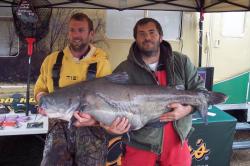
Big catfish from a TVA lake

Big catfish from a TVA lake

While a lot of folks were still recovering from their hangovers on New Year’s Day, 76 boats headed out on a chilly Lake Wheeler in pursuit of the giant blue catfish of the Tennessee River system in the annual “Winter Blues” catfish tournament put on by the Alabama Catfish Trail.

Fishing for these catfish is a whole different ballgame from going out to land a few pan-size cats for dinner. Blues reach enormous size–the International Game Fish Association (IGFA) all-tackle record now stands at 143 pounds–and there are few places where the big ones are more abundant than in the lakes of North Alabama.

Big winter catfish

Big winter catfish

The current Alabama state record, 120 pounds, came from Holt Reservoir not far from Tuscaloosa, and the former record, 111 pounds, came from Wheeler. Blues reach lengths of almost 5 feet, and the largest have girths approaching 4 feet, according to the IGFA. Several blues over 200 pounds and one over 300 pounds were reported in newspapers of the 1800’s from the Missouri River, but whether these weights were anywhere near accurate is anybody’s guess.

Biggest catfish in the Winter Blues event was not record class, but Team Magness from Mississippi did manage a 72.58 pounder, the heaviest fish for the event. The team with the heaviest total weight for the event, Tammy Strouth and Brian Lawson, had a fish that went 68.69 pounder as part of their three-fish total bag of 168.9 pounds, while the second place team of Nick Diminio, Adam Long and Doug Jolly brought in a 69.58 pounder as part of a total bag of 151.9 pounds.

These fish can live at least 20 years, and don’t reach sexual maturity or spawning age until they’re 4 to 5 years old. Since they’re valued more as trophy fish than as food fish in the larger sizes, Alabama has placed a limit of one fish daily over 34 inches on the species. The idea is to allow more fish more time to grow into the lunker class. (All trophy-class fish caught in the Alabama Catfish Trail events are released.)

You can catch big cats

You can catch big cats

While the giants are most often found in the deepest holes in the river or directly below the dams in summer, in winter they spread out to feed on river points, shell beds and sandbars, and the big ones are evidently most active in the colder weather.

Blues eat just about any type of fish, but they seem to have a special preference for a herring-like baitfish called the skipjack, which is found naturally throughout the Tennessee River system. Most expert catfish anglers here prefer cut skipjack over gizzard shad or other bait. A chunk about 6 inches long is typically used to lure the larger fish.

The baits are usually fished on bottom, or just off bottom via a small float between a heavy egg sinker and the bait.

Most anglers use 40-pound tackle and up, with heavy spinning reels loaded with braid a favorite with some. Hooks are 8/0 or larger circle hooks, which are said to hook the fish without a hook set, and which make it easier to release the fish alive since they usually lodge in the front of the jaw.

Big cats are strong adversaries, and battles of 15 minutes and more are not uncommon with a lunker. However, the biggest problem most anglers face when the fish finally rolls at boatside is how to get it aboard–even the largest landing nets are likely to buckle under a 60-pounder.Gaffing would work, but since the fish are to be released alive, it’s not a good strategy. Some anglers who fish the giants regularly use two nets, placing one over the head, the other over the tail for a combined lift.

For more on catfish tournaments, visit www.alabamacatfishtrail.com.

What Is Burbot Fishing at Utah’s Flaming Gorge Reservoir?

Cold Weather Means Hot Burbot Fishing at Utah’s Flaming Gorge Reservoir
from The Fishing Wire

November and December are great months to fish for burbot at Flaming Gorge Reservoir. These anglers caught 130 burbot in a single night.

Lots of burbot

Lots of burbot


Photo by Ryan Mosley

Interested in catching 25 to 50 fish in just a couple of hours? Believe it or not, those who fish for burbot at Flaming Gorge Reservoir often catch more than that.

Their secret? They fish from boats before the reservoir ices over in the winter. Even though fishing can be fast and furious before the reservoir freezes, few anglers take advantage of this great opportunity.

To catch burbot in open water, take a lesson from ice anglers, and then duplicate what you learn from the deck of a boat or from a good spot along the shore.

While the techniques are simple, timing is critical. The best burbot fishing of the year is starting now. The best time of day to fish starts at sunset.

“Anglers are already catching burbot as water temps drop into the low 50s,” says Ryan Mosley, Utah Division of Wildlife Resources project leader for Flaming Gorge and the Green River. “Fishing will get even better when temperatures drop into the 40s.”

Where to go

Mosley says anglers are catching burbot in both Utah and Wyoming right now. However, research has shown burbot generally move north, towards the area where water enters the reservoir, before the spawn.

“In our trend studies,” Mosley says, “the number of burbot usually increases in abundance in the Inflow Region, including the Green and Black’s Fork Rivers, in early November. We believe the burbot caught in these areas are moving north, towards the inflows, to spawn during November and December.”

Using tracking studies, researchers with Utah State University have substantiated this assumption. Researchers have tagged several burbot in November and then released the fish in the lower part of the reservoir. The researchers later found the fish, in December and January, in the Green River and Black’s Fork arms of Flaming Gorge.

“As November progresses,” Mosley says, “I suggest moving north. Try fishing between Lost Dog and Firehole on the Green River arm, or above Lost Dog on the Black’s Fork arm. During last fall’s netting, good numbers of burbot were found in both of these areas.”

To intercept the burbot as they move uplake, Mosley suggests fishing off rocky main channel points, in 20 to 40 feet of water.

Gear

Mosley says using the same type of fishing gear you use during the ice fishing season is the key to catching burbot in open water.

“Fishing for burbot in open water is the same as fishing through the ice,” he says, “you’re just fishing from a boat instead of on a bucket. Make sure you have equipment that’s stout enough to provide good hook penetration and that can handle fish that could weigh as much as eight pounds or more.”

Mosley says a good presentation to start with is a three-inch curly-tailed, glow-in-the-dark grub fished on a glow-in-the-dark 1/4 to 3/8 ounce jighead. Tip the jig with a small chunk of sucker or chub meat (make sure to leave some space in the hook gap, though). Some anglers also use Smelly-Jelly, in crayfish or another flavor, to add extra attraction to their offering.

After the presentation is ready, drop it within just a few inches of the bottom, and then jig it. When a burbot investigates the bait, hold still until the fish takes it, and then set the hook.

Nice catch of big Burbot

Nice catch of big Burbot

Timing and safety

Mosley says burbot fishing usually gets good right around sunset and then picks up and holds strong for the first few hours after dark. Before fishing at night, it’s a good idea to visit the area you’re going to fish during the day. That way, you can get familiar with it before the sun sets.

Mosley encourages you to watch the weather and to not take any unnecessary risks. “Wind and storms can come up quickly at the Gorge,” he says. “Take safety gear for everyone. And be sure they know how to use it.”

He says lights, both navigational and personal, are also essential.

“The lights you use should be bright enough to light up your boat while fishing and to spotlight the bank and boat ramps when returning after dark.”

Mosley says it’s also critical to wear warm, waterproof clothing in layers and to take some extra layers with you. “Also,” he says, “let someone know exactly where you’re going and when you’re coming back.

“Finally, if you’re not comfortable venturing out on your own, consider hiring a seasoned guide who is familiar with the lake and the fishery.”

Burbot contests

Right now is not only a good time to catch burbot, it’s also a great time to fish before the 2016 burbot contests start. The annual Burbot Bash will be held Jan. 22–24. That event will be followed by the Buckboard Burbot Classic on Feb. 4–6.

Both weekends will be similar to what the Burbot Bash has been in the past — each weekend, prizes will be awarded for the most, the biggest and the smallest burbot caught.

Tagged fish contests will also be held. All of the tagged fish will be worth a cash prize. The top prize is a fish worth $10,000.

For more details and other information, visit www.burbotbash.com or www.buckboardmarina.com.

Find the Birds, Find the Fish

For the Birds – Find the Birds, Find the Fish!

By Frank Sargeant, Editor
from The Fishing Wire

Searching for the birds may seem a roundabout way to go bass fishing, but from now through March, it’s a highly successful tactic on many lakes in the southern half of the nation.

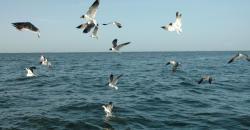
Diving gulls

Diving gulls

Diving gulls and leaping baits mean one thing—gamefish below!

An assortment of sea gulls migrate into this region each winter as cold drives them south, and many settle on the larger freshwater impoundments due to the large shad populations. The birds know how to take advantage of the feeding behavior of largemouths, white bass and stripers–they watch for striking fish from aloft, then swoop in and grab injured baits from the surface.

During a major flurry, they may form what some anglers call a “white tornado” of birds whirling over the school. Find one of these events and throw any sort of shad-imitating lure into the midst and it’s instant fish.

But even when there are only a few birds diving–or when there’s a flock sitting on the water–the birds are well worth checking out. Often they rest right above the school of bait, just waiting for the bass and other species to go to work and drive them to the top where they can get at them.

Anglers with sonar can ease up to areas where birds are resting and graph the depths below to see if there’s a large school of bait under them. If so, these spots are well worth fishing, because the birds don’t often hang around bait that does not have some predators close by to push them to the top now and then.

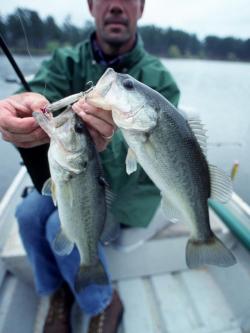
Two bass at a time

Two bass at a time

When bass are schooling tightly on bait under birds, it’s not uncommon to catch them two at a time on multiple-hook plugs.

Though topwater lures are usually not thought of as winter baits, they can be effective when fished around bass feeding on bait schools. Noisy lures like the One-Knocker Spook, Sexy Dawg and Pop-R can all be effective at times.

More often, though, sinking lures are a better choice, and suspending baits like the Rapala Shadow Rap can be ideal. Swimbaits–jig heads with long soft plastic swimmer tails, can also be effective, as are “rattlebaits” or lipless crankbaits.

And, if the fish are deep, heavy-weight lures like the Rapala Jigging Rap, the Hopkins Spoon and other lures that can be jigged vertically do the job.

The nice thing about finding fish under birds is that the bass may not be on the usual “community holes”, and so are more inclined to feed than those that see 30 or 40 lures a day.

Fishing around cormorants does not seem to work, it should be noted. Cormorants are able to dive below the surface and chase the bait like predatory fish, and this seems to run the gamefish off–maybe because the cormorants are not above latching on to smaller bass when they get the chance.

Fishing under gulls, however, is frequently productive–when nothing else is working, it’s often a great way to put fish in the boat.

How To Catch November Bass At Lake Juliette

We all yearn for a private lake where access is limited, the bass grow big and fat and there are no irritating pleasure boaters. That is a dream for almost all of us, but you can have most of those conditions at Lake Juliette. You can catch November bass at Lake Juliette.

Juliette is a 3000 acre Georgia Power Lake about 20 miles east of I-75 half-way between Atlanta and Macon. It is the cooling lake for Plant Scherer and built just for that purpose. It is on Rum Creek but the small flow from the creek does not keep it filled. Water is pumped from the Ocmulgee River to keep it full.

Fortunately, Georgia Power provides access to anglers and works with the Georgia Department of Natural Resources to manage the lake. The water is very clear since there is little inflow and natural cover from standing timber to huge grass beds is abundant.

There is good access to the lake from two boat ramps but there is a 25 horsepower limit on motors. You can put your bass boat in and fish, but you can not crank your gas motor. The size of the lake makes it difficult to fish it with just a trolling motor but if you have access to a smaller boat the fishing can be fantastic. And the horsepower limit means no skiers, jet skis and other pleasure boats on the lake.

Jack “Zero” Ridgeway has lived in Griffin all his life and owns Zero’s Garage there. He fishes with two local bass clubs, but Juliette is one of his favorite lakes. He has a boat with a legal motor for Juliette and fishes it a lot. For several years he entered the monthly bass tournament on Juliette and did well in them.

“Bass at Juliette don’t have to move as far as they do on bigger lakes in the fall migration,” Jack said. They do follow the shad into the creeks and coves, but the lake’s smaller size means it is easier to fish many creeks without burning a lot of gas.

Most baits will catch November bass on Juliette, but Jack’s favorites all work well for him and keep the number of rods you need manageable. He will have a rattling bait like a half-ounce XCalibur One Knocker, a rattling, suspending Shad Rap, a DT 6 or Norman Middle N crankbait, and a Carolina rigged worm ready to cover where he fishes. He may also throw a spinnerbait a little.

The lake has a lot of four to six pound bass, with a good chance of a bigger fish, too. While Jack and I fished his November holes to check them out the last Sunday in September, the last monthly tournament was taking place. At weigh-in it took five bass weighing 19.97 pounds to win and that stringer included two over six pounds. The top six teams all had over 16.5 pounds and there were six bass over five pounds.

Jack’s best bass on Juliette weighed over seven pounds and he has landed over 40 six pound plus bass there since he started fishing the lake in 1988. In one pot tournament he had five weighing just over 20 pounds, and came in second that day. He often camps at Juliette and fishes it every month of the year. November is one of his best months.

We fished the following ten spots and fish were on most of them, even in late September. More and bigger fish are on them now and they will get better all month long.

1. N 33 01.940 – W 83 47.027 – Going up the lake from the Dames Ferry Ramp, Davis Cove is a big creek on the left, just downstream of the long shallow island where the lake narrows. Go back into the cove to the first small cove on the left bank and start on the upstream point.

This point has some clay and rocks on it and bass live back in here year round, but more move into it in the fall. Fish crankbaits, rattle baits and a Carolina rig as you go from this point and the next one toward the back of the creek. Then jump across to the rocky point on the other side and fish it. The cove channel runs down this bank.

The rocky point on the right going in is the upstream side of a small feeder creek and has a blue pole with the number 8 on the bank. Fish it and the point on the other side of the creek, too. Jack says he has caught four bass over six pounds off the rocky point, one of them the day after Thanksgiving. We caught several bass here.

2. N 33 02.637 – W 83 47.041 – Out on the main lake go to the upstream side out on the end of the long, shallow point coming off the island where the lake narrows. This point and the pocket upstream of the island is covered with hydrilla and there is a patch of standing timber out in the middle of the cove. All hold bass.

Jack says more eight pound plus bass have been caught in this area than anywhere else on the lake. Start out on the end of the point and work toward the bank on the upstream side of the island. Stay on the outside of the hydrilla and cast a rattling bait to the edge of the visible grass, ripping it free when it hits underwater grass.

The half ounce silver and black One Knocker is Zero’s favorite bait for this area. He will also cast a suspending natural shad Shad Rap to the grass, ripping it free when it hits grass, too. We caught several keepers here and saw the tournament winners fishing the same way while we were there.

When you get to the back of the cove ease out to the timber and cast your Carolina rig around it. There is an old grave yard near the timber and bass hold around the trees and the holes where the graves were dug up for removal when the lake was built.

3. N 33 03.025 – W 83 47.768 – Across the lake in the last pocket on the right before you get to the intake cove for the power plant holds bass. Go back into the pocket and you will see an old beaver lodge on the bank. Near the lodge the bank is steep and a ditch runs along the bank. Jack says he thinks it is an old silage trench.

Start just outside the beaver lodge with your boat out a fairly long cast from the bank. Cast a Carolina rigged worm to the bank. Jack likes a three quarters ounce sinker, three foot leader and a ruby red or red shad Old Monster or Mag 2 worm. Work the rig from the bank down the slope. Fish slowly and carefully. Jack says bass often just suck in the worm and hold it without moving, so it is hard to tell if you have hit grass or have a fish on.

4. N 33 02.873 – W 83 49.876 – Go upstream past the power plant and the cove with the dam in it for the settling pond on the right. As you enter the standing timber be careful to follow the marked channel. There is an open field on the right. Across from it you will see a clay point. It is the point that sticks out the most on that side upstream of Billy’s Island.
Go to this point, being careful as you idle through the timber when you leave the channel.

This is the downstream point of a small cove with an old pond in the middle of it. There is standing timber all around the cove but the middle is open where the old pond was located. Stop on the point and fish back into and around the cove.

Fish a crankbait and rattle bait around this cove. For crankbaits, a chartreuse splatter back or sexy shad color works well. Jack fishes both kinds of baits on eight pound test line and makes fairly long casts from the middle of the cove toward the bank as he fishes around it.

Jack says this is an excellent cold weather cove and there were schooling fish here the day we fished. We caught several keepers and Jack had a five pounder that hit his One Knocker, jumped twice then got his line around the trolling motor and broke off.

5. N 33 02.382 – W 83 49.909 – Go back downstream to the next big cove on the same side. It is behind Billy’s island and called Fletcher Cove on the map. Stay to the left going back into it. This arm splits into three fingers in the back.

Stop on the point between the finger to the right and the one straight ahead and fish it with all your baits. Fish from the point down the right bank into the middle finger. The bank is steep and the clay and scattered rocks hold bass. Down this bank in a small indention there is an old beaver lodge that holds bass. Fish around it carefully with your crankbait and Carolina rig.

6. N 33 02.747 – W 83 48.877 – Go back out to the main lake and head downstream. Past the next big creek on the right the main lake point is called Treasure Point and is across from the cove at the power plant. Stop on the downstream side of this big round point where it goes into the next big creek.

There is timber off this point. Keep your boat near it in about ten feet of water and cast to the bank. There is some clay bottom and scattered rock. Upstream of the end of the point a blowdown is in the water. Fish from the end of the point past the blowdown.

Jack fishes a crankbait here. Some wind blowing on the point helps make fish move onto it to feed. Since there is no current in Juliette Jack says it fishes like a big pond, with wind making a difference. Try to bump the bottom from two to ten feet deep.

7. N 33 01.936 – W 83 47.916 – Go downstream past the big creek and around the point. The next creek is Fleming Cove. Go into it and keep to the right arm all the way to the back where this side splits into two small arms.

Stop on the point between the two arms. There is an old bridge in the back of the right arm. The point has rocks on it so fish it with crankbait and Carolina rig. Sit out in deep water a moderate cast off the bank and fish water from the bank to at least ten feet deep.

Fish down the right bank past the point and you will see another beaver lodge. The bank and beaver lodge hold bass. Jack likes to fish around the lodges with a crankbait and Carolina rig, and can usually catch bass on them.

8. N 33 03.146 – W 83 46.542 – Go across the lake to the left bank going downstream. There is a big three arm bay, named Buzzard Bay on the map, just downstream of the power plant. Downstream of the bay two small islands sit off the bank back in the next big cove. There is lots of grass all around them.

The back island has a saddle between it and the point on the bank. There are rocks on the point and grass in the saddle. Start on the end of the island toward the bank and fish from it across the saddle to the bank point.

Jack fishes a crankbait and Carolina rig in this area, and will throw a spinnerbait around the grass in the saddle. He usually keeps his boat on the downstream side of the saddle and fishes across the points and saddle in that direction.

9. N 33 02.852 – W 83 46.413 – The next cove downstream of the islands splits into two arms and both them split, too. The downstream point of this cove is called Quail Head because of its shape. The point sticking out pointing toward the power plant is a good rocky point.

Fish your crankbaits around the rocks on the point, keeping your boat in 20 plus feet of water, not too far off the bank. Also cast a spinnerbait around the scattered grass on this point. Wind helps lot here.

10. N 33 02.542 – W 83 46.173 – Go around Quail Head point to the downstream side. There is a shallow hump off the bank on the downstream side and behind it a point sticks out toward the dam. Stop out in ten feet of water off this point.

Fish the point with crankbait and rattlebait then work into the pocket on the downstream side. The left bank going into the pocket is good. There is 30 feet of water not far off this point and bank and Jack says sometime during the day fish will move into the shallows to feed, so it is worth hitting several times during the day.

Give these spots a try, they are some of Jack’s favorites. There are many others in the lake and this is good time to fish there. Enjoy the peace and quiet and catch some quality bass.
How Can I Catch Reservoir Smallmouth Bass?

Five things to consider for reservoir smallmouth bass season

Here are some tips on catching big winter smallmouths, provided to us by Lee McClellan of Kentucky Afield Magazine.
from The Fishing Wire

Nice bass

Nice bass

The recent spate of rainy and somewhat dismal days sends many minds toward the grim reality that winter is here to stay.

Sunless, dreary days with bouts of rain in December, January and February give most people the blues. However, desolate winter days bring joy to the heart of a reservoir smallmouth bass angler. These are the days to catch the big ones.

Kentucky is a blessed region for smallmouth bass as the 11-pound, 15-ounce all-tackle world record came to the net of Leitchfield’s David Hayes on a July morning in 1955 on Dale Hollow Lake. The genetics of the upper Cumberland drainage produce some of the largest specimens in the world and winter is arguably the best time to catch them.

Here are five simple tips that will help get more smallmouths in your hand this winter.

1. The uglier the weather, the better: Leaden skies that seem to scrape the tops of the tallest trees bring with them great wintertime smallmouth bass fishing. The falling barometric pressure that usually accompanies such conditions puts predator fish on the prowl. Dark clouds that obliterate the sun limit light penetration into the depths of Kentucky’s better smallmouth lakes such as Laurel River, Dale Hollow, Fishtrap, Green River and Barren River, as well as Lake Cumberland. This creates better conditions for predator fish to ambush prey. A light rain or snow makes this scenario even more conducive to catching large smallmouth bass. Bright, shining days just after a frontal passage often offer comfort, but are the worst days to fish.

2. Find the bait, find the smallmouth bass: Electronic sonar units, commonly called “fish finders,” improve each year. Users can manipulate the sensitivity of even inexpensive units to find schools of baitfish in reservoirs. These resemble cotton balls on the screen. However, astute anglers also look for gulls diving to the surface to discern the location of baitfish. If all else fails, fishing a point near the old river channel on the main lake presents a good chance of an angler intercepting a school of roving baitfish and the smallmouth bass following it. Fishing points, sloping banks or channel ledges near schools of baitfish greatly increases angling efficiency and boost the chances of a large smallmouth striking your lure. Dropping a jigging spoon or blade bait near the baitfish school often produces several fish.

3. Keep lure selection simple: One of the best things about winter smallmouth fishing is you can fit a day’s worth of productive lures in a cigar box. A selection of ½-ounce football jigs for bottom fishing, some 3/16-ounce hair jigs for a swimming retrieve, a few blade baits like the ½-ounce Silver Buddy, a couple of jigging spoons and a bag or two of swimbaits with some ¼-ounce ball heads are all you need. These lures consistently produce reservoir smallmouth bass all winter long. Concentrate on fishing slowly and thoroughly probing likely smallmouth structures instead of changing lures every half-hour. If all else fails, try live shiners or large crappie minnows rigged on a size 1 Octopus-style hook with a few split shots crimped about 18-inches above the hook.

4. Have the right mentality: Winter fishing for smallmouth bass is a big fish game, not a numbers game. You’ll have lulls in the fishing and a lot of empty casts. It is the nature of the game. Boredom and frustration can worm their way into the mind and you’ll find yourself going through the motions. Trophy smallmouth bass often bite when you aren’t mentally prepared. Keep concentration on the task at hand, so you won’t be flatfooted and consequently panicked when the 22-incher hits. This is especially important during that prime time of 3:30 p.m. to dark. Smallmouth anglers in winter often go fishless until this time of day, then land several before dark with the shortest one measuring 19 inches. Keep on your toes and mentally push through the lulls.

5. Big, deep water = big, fat smallmouth bass: Large smallmouth bass use acres and acres of deep water as their sanctuary much like white-tailed deer use heavy thickets. Anglers confused about where to prospect for winter smallmouth bass should stick to the main lake of the lower one-third of a reservoir nearest the dam. This is especially true on Kentucky’s mid-depth hill-land smallmouth reservoirs such as Barren River or Green River lakes. You can’t go wrong fishing main lake points or small covelets just off the main lake nearest the old river channel in winter for smallmouths. Anglers without boats can fish these areas from the bank in winter with just a few lures or some large crappie minnows and do just as well as those in expensive boats.

Texas, Florida and California offer largemouth bass anglers an authentic chance of catching several larger than 10 pounds. Trout anglers fishing the reservoir tailwaters of the Ozarks have an opportunity for the fish of a lifetime.

Kentucky is one of the few places in the world where anglers can routinely catch smallmouth bass heavier than 5 pounds with a chance at much larger fish. Its waters produced the largest smallmouth ever caught and documented and produces world class fish year after year.

Get out this winter and keep these simple tips in mind. A battle with a 5-pound smallmouth bass on a December day sure beats remodeling the basement.

Author Lee McClellan is a nationally award-winning associate editor for Kentucky Afield magazine, the official publication of the Kentucky Department of Fish and Wildlife Resources. He is a life-long hunter and angler, with a passion for smallmouth bass fishing.

What Does Find the Bait, Find the Bass Mean?

Find the Bait, Find the Bass!

By Livingston Lures Pro Joe Budzinski
from The Fishing Wire

“Lake Conroe on Fire right now, Break out your Deep Cranks”

Big Lake Conroe bass

Big Lake Conroe bass

It is the time of year where a sportsman has to decide to grab a rifle or a fishing rod. Chuck and I chose wisely. We grabbed our Power Tackle Cranking rods paired with our Ardent reels, and went to work.

Lake Conroe, Texas, is on fire right now. The big fish have begun to move up to feed for the upcoming winter months. We drove several areas until we found bait balls being FEASTED upon by feeding bass.

Bass feeding on baitfish

Bass feeding on baitfish

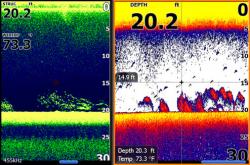
Bait balls are easily found this time of year, but you will need to find the ones being pummeled by bass on your graph. You can see this on your graph or side imaging by the bait balls sporadically broken up through the water column. Massive, uniform schools of bait tend to be the ones that are not bothered by predators.

Bass eats a crankbait

Bass eats a crankbait

Chuck and I discovered an area of approximately 50 yards of sporadic chunk rock bottom in 14-16 ft of water where the majority of feeding was found. The Livingston Deep Impact 18 with EBS MultiTouch was our weapon of choice. The bass this time of year have shad on the brain, so ensure you set your MultiTouch setting to the third biological Baitfish sound – Fleeting Shad. This was key. Our retrieve was a stop and go retrieve after our Livingston Lures began digging the bottom and/or bouncing off the chunk rock. This retrieve coupled by the EBS Sound on the pause was a great one-two punch.

Do not be afraid to bounce these Deep Impact’s off the bottom to generate strikes. Often I call this technique “planting corn”, meaning the bill of the lure digs into the bottom enough to create a corn row, worthy enough to begin to seed. Your color of choice depends upon water conditions, and lake forage. Get yourself a variety or colors and hang on. This is the time of year you can get your arm broke by a Green Monster!

Fish on!

— Joe Budzinski, Army Bass Angler

Conditions Recap:
Time: 2:30 pm to dusk
Skies: Sunny
Surface temp: 73
Water: Clear
Wind: 1-5 NE
Hooks Rating: 4 of 5

Why Does Burning’ Spinnerbaits Bring Reaction Strikes from Fall Bass?

Burning’ Spinnerbaits Bring Reaction Strikes from Fall Bass

Yamaha Pro Matt Herren Uses a Fast Retrieve to Trigger Bass Into Biting
from The Fishing Wire

November ranks as one of Matt Herren’s favorite months of the year, but not because he enjoys deer hunting and most whitetail seasons open this month. Rather, the Yamaha Pro knows November means it’s time to burn his spinnerbaits for autumn bass.

“Burning,” in this case, means reeling the blade baits as fast as he can turn his reel handle, keeping the lures just two to three inches below the surface. It’s a technique the Alabama-based angler has used successfully on lakes around the country for more than two decades, but one many of today’s fishermen frequently overlook.

“Burning a spinnerbait is purely about getting reaction strikes,” notes Herren, who will be competing in his sixth Bassmaster Classic® next March. “Throughout the autumn months, when water temperatures are still generally in the 60’s or high 50-degree range, bass are gorging themselves on baitfish, and a spinnerbait probably imitates a shad or herring as well as any lure made.

“There is a lot of feeding competition among the bass, and they go after a fast-moving spinnerbait without hesitation, just trying to get it before another bass does. It works in stained to clear water, and typically throughout the day, too.”

Spinnerbait for burning in the fall

Spinnerbait for burning in the fall

The Yamaha Pro chooses spinnerbaits featuring what is known as thin wire construction. A thinner wire increases the lure’s overall vibration and also makes it easier to retrieve. Herren’s color choices are simple, too; any color is fine as long as it matches a shad, such as white or white/chartreuse. For maximum vibration, he uses double willow leaf blades, and his weight choices range from ¼ to ¾-ounce.

“When I fish spinnerbaits this time of year, I usually have three different models tied on and ready to use, depending on how the fish act, and on the size of the baitfish,” Herren explains. “One will be a very compact spinnerbait between 3/8- and ½-ounce, but which looks small, in case the bass are feeding on smaller threadfin shad. I’ll also have two other spinnerbaits weighing ½-ounce and ¾-ounce, but with different blade colors, such as gold or even copper.

“White or nickel blades will usually produce on most lakes, but just in case the bass are finicky, I can offer them something different.”

Using a fast 7:1 reel and 15-pound fluorocarbon line, Herren concentrates in larger tributaries and upper-lake arms where baitfish migrations are often the strongest, targeting steep bluffs, rocky banks, submerged vegetation, standing timber, and even channel breaks. Depth is not that critical, because he’s caught bass suspended in water as deep as 50 feet.

Matt Herren with fall bass

Matt Herren with fall bass

“I really think one key to burning a spinnerbait over deeper water is slowing my fast retrieve just for a second to make the blades change their speed,” he continues. “This can be as simple as stopping my retrieve, shaking my rod tip, or slowing down so the spinnerbait sinks a few inches. It’s just for a split second to change the blade cadence. Then I start reeling fast again.

“Changing your retrieve like this is a pretty standard way to fish a spinnerbait anytime of year, but it’s important to remember to do it even when you’re reeling as fast as you can because it’s a major part of getting bass to react. In the fall, you’ll frequently have a bass following your spinnerbait, even though it’s moving fast, and just a simple change of cadence can be enough to bring a strike.”

In recent years as the spinnerbait’s popularity has lessened and other lures have taken its place, the technique of burning has practically become a lost art, concludes Herren. Nonetheless, it’s a technique the Yamaha Pro will continue to use wherever he fishes this time of year because he knows how effective it still is.

Targeting Bass During the Fall Turnover

Randy Howell Offers Tips on Targeting Bass During the Fall Turnover
from The Fishing Wire

Randy Howell catching fall bass

Randy Howell catching fall bass

Photo Credits: BASS/Wired2Fish

When the thermocline starts to break up and the cold water from the depths begin to mix with the warmer surface water it is called the turnover. The fish scatter and can be hard to locate. Many of the big fish will go very shallow and hold onto any piece of cover or structure they can find. Which is exactly why I like to fish super shallow and focus on targets.

I like to find shallow flats near deeper areas, especially areas where grass is or was present. I look for any sort of structure like logs, grass patches, and even a single stick up can be enough to hold a fish. I will move quickly from target to target and hit as many key spots as possible.

Missing the target by even a foot or two is enough to keep the fish from biting, that’s why it’s important to make multiple cast and intentionally bump the target with your bait. Casting accuracy is extremely important when fishing this way, which is why a finely tuned 7.3 Daiwa Tatula or Zillion reel with the T-Wing casting system is crucial. I like to use a Steez 7’2″ med/hvy rod for casting accuracy and control. I spool up with 16 lb.Gamma fluorocarbon line to haul em out of cover.

My three favorite baits for this time of year are; a 3/8 oz. double willow blade Hawg Caller spinnerbait, a Livingston Lures Walk-n-Pop 77 top water popping bait, and a 1/2 ounce Lunker Lure Flat Shad buzzbait. For sub-surface fishing I will use the Livingston Lures Howeller squarebill crankbait.

Photo Credits: BASS/Wired2Fish

Randy Howell Lands A Bass

Randy Howell Lands A Bass


When I pull into an area and locate a target I drop my Power-Poles and make several accurate casts at each target. If I am trying to cover a lot of water quickly I will utilize the buzzbait and the Howeller squarebill. If I want to slow down and really pick the area apart I will go with the Walk-n-Pop and the spinnerbait.

The one advantage to the squarebill is that I can bounce it off of the targets and generate a reaction strike. For the spinnerbait I can slow it down quite a bit and really keep it in the strike zone longer than the other baits.

As your water begins to turnover, and fishing gets slow, I suggest going shallower than ever before. Make an effort to slow down, make precise casts with a variety of baits, and you can make one on the toughest seasonal changes, very productive.
Until next time, Good luck and God bless!!

–Randy Howell

SIGN UP for Randy’s Newsletter