Category Archives: Conservation

Why Do Sport and Commercial Fishermen Differ On Striped Bass Management?

Sport, commercial fishermen differ over striped bass options

Decline in population raises concerns over how much and how quickly to reduce the harvest.

By Karl Blankenship, Editor
Bay Journal
www.bayjournal.com
from The Fishing Wire
Striped Bass

Striped Bass

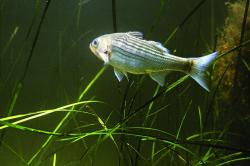
The striped bass population along the East Coast has been declining in the last decade. (Dave Harp)

For years, striped bass were a textbook example of successful fishery management.

After a dramatic population crash in the early 1980s, a painful harvest moratorium was put in place. As hoped, the population rebounded. By 1995, it was declared “recovered” – and even then the population continued to climb.

By the early 2000s, commercial fishermen and recreational anglers were seeing more large striped bass than at any time in recent memory.

Fast forward another decade, to 2014, and the picture is starkly different. The spawning population is at about the same level it was in 1995, when it was declared recovered, but instead of trending upward, it’s been declining for a decade.

It is expected to drop below the “recovered” threshold level next year.

The Atlantic States Marine Fisheries Commission, which regulates the management of migratory fish species and includes representatives from all East Coast states, is weighing options that range from a 25 percent harvest reduction next year to phasing in a smaller, 7 percent annual reduction over three years – or even doing nothing at all.

“This is the premier fisheries management success story,” said John M. R. Bull, commissioner of the Virginia Marine Resources Commission. “I don’t think anybody wants to jeopardize that success.”

But, views about what the ASMFC should do to maintain that success when it meets in late October – and even the seriousness of the current situation – vary widely.

Some groups representing recreational anglers are leading the charge for aggressive, and quick, action.

Tony Friedrich, executive director of the Coastal Conservation Association in Maryland, said he supports a 25 percent reduction, but only because the ASMFC’s options don’t include a greater cut.

The fish “are in a lot of trouble,” he said, citing angler surveys showing that interactions with fish – basically how often they catch a striped bass – have fallen 75 percent since 2006.

“If you talk to a lot of people on the East Coast, they are up in arms,” Friedrich said. “They want to go a step beyond 25 percent.”

In comments to the ASMFC, the group Stripers Forever contends “the signs of diminishing abundance have been ignored for years.” It calls for a 25 percent harvest reduction effective next year, but said even that is “too little too late.”

On the other hand, Billy Rice, a commercial fisherman who has worked 46 years on the Potomac River and Maryland tributaries, said striped bass will soon become more abundant in the Bay as a result of a strong reproduction in 2011. Fish born that year will soon reach legal size in the Chesapeake, and shortly thereafter along the coast.

“We need to keep a close eye on it, but I wouldn’t even come close to calling it a crisis,” said Rice, who is a member of both the Potomac River Fishery Commission and an advisory panel to the Maryland Department of Natural Resources.

Absorbing a 25 percent reduction in a single year, he said, “would virtually cripple our commercial fishing industry.”

Rice contends that, given time, striped bass will bounce back, and that it’s not realistic to think that any stock can be consistently maintained at record-high levels. “Fish naturally go through cycles, no matter how well you manage them,” he said. “We are not going to stop the natural cycle that has been going on since the beginning of time.”

The different perspectives reflect, in part, longstanding tension between recreational and commercial interests, which compete for the same fish.

Commercial fishermen, equipped with large boats, nets and often decades of individual and community knowledge, are efficient. They typically can catch their given quota despite competition from recreational anglers, as long as the stock is at a healthy level.

Recreational fishermen do best when fish are very abundant. The fish are more easily found, and the commercial quota typically takes a smaller portion of the available population. As the population declines, recreational anglers with fishing lines are less efficient than watermen with nets, and have a harder time finding fish – even if the stock is still considered to be at a sustainable level.

“When abundance is down, the recreational anglers are the ones whose catch is going to go down the most,” said Bill Goldsborough, director of fisheries for the Chesapeake Bay Foundation. “By the same token, when abundance is up, their catch goes up the most. The recreational catch is tied very closely to abundance.”

That’s reflected in ASMFC figures which show spikes in recreational harvests when the striped bass population hit its peak in the early 2000s. In fact, the estimated dead discards from the recreational fishery along the coast – those fish that are caught and released, but die anyway (about 9 percent of the released fish) – exceeded the entire commercial catch as recently as 2006.

As abundance has declined, though, the commercial catch – which is based on a quota and therefore fluctuates less from year to year – has overtaken the recreational catch in the Bay and in some other states that have a commercial striped bass fishery.

So, for recreational fisheries, the situation can look bleak – but the stock itself is not in peril, Goldsborough said.

“From a biology standpoint, I think we are OK,” he said. “We do need to tighten the belt and ensure that we turn that trajectory back up for the spawning stock biomass. I don’t think it is a crisis, but there definitely is a need to act..”

The more difficult question, said Goldsborough, who is also a member of the ASMFC, is weighing management impacts on commercial and recreational sectors.

“It is really the age-old issue for fisheries management, and that is resolving the difference between managing for commercial fishing objectives and managing for recreational fishing objectives in a shared stock,” he said.

The reason for the decline in striped bass abundance over the last decade, scientists say, has been a series of years with poor reproduction.

In the 13-year span from 1993 through 2005, reproduction was at or above the long-term average 10 times, including the three best years on record in 1993, 1996 and 2001, as measured by the Maryland Department of Natural Resources Young-of-Year index. The Chesapeake Bay is where the vast majority of striped bass found along the East Coast are spawned.

But reproduction has been below average in six of eight years since then, including some of the poorest years since the 1980s.

Successful reproduction typically requires two things: lots of eggs produced by females and weather conditions that promote the survival of their young.

Because they can’t control the weather, fishery managers try to keep the abundance of adult female fish high with the hope that when the spawning fish mesh with the right conditions, they will produce a large “year class” of young fish. With striped bass, above-average year classes have been particularly important for overall abundance.

The spawning stock biomass peaked at around 170 million pounds a decade ago, and dropped to an estimated 128 million pounds last year, just 1 million pounds above the minimum threshold of 127 million pounds set by ASMFC. It is on a trajectory to fall below that threshold next year.

But the significance of crossing that threshold is less clear. In fishery management, such thresholds are typically a biologically established minimum. Falling below that number risks a stock crash.

In the case of striped bass, the spawning stock biomass is not set at a danger level. Rather, it is set at its 1995 level, when the stock was declared recovered by ASMFC. It is about 12 times higher than the population’s low point in the early 1980s.

“We don’t feel the population is at a biological risk,” said Tom O’Connell, fisheries director with the Maryland DNR. “Yes, it is lower than stakeholders want, and lower than managers want. But it is not at a biological risk.”

The higher threshold, fishery managers say, reflects the fact that striped bass are considered a marquee species both in the Bay and along the coast.

As a result, O’Connell and some other fishery managers say, the question is not whether something should be done, but rather how much – and how quickly.

While reproduction in most recent years has been low, the 2011 year class was the fourth strongest since Maryland’s Young-of-Year index began in 1956. Those fish will soon reach catchable size – 18 inches – in the Bay, and will shortly thereafter migrate to coastal waters where they typically need to be larger before they can be caught.

“If we did nothing, but we kept fishing mortality at the current level, we would probably see that population come back up, but it may take three, four, five, six years,” O’Connell said.

“We should react, because the management plan and the stakeholders prefer that this species be at a higher abundance level,” he said. But, he added, “we don’t have to react in one year.”

Some recreational anglers, like Friedrich, worry that delaying or spreading out cuts only delays the potential comeback. Friedrich also contended that managers are putting too much stock on the 2011 year class which, he said “are about to go into the meat grinder” as they hit legal catch sizes in the Bay and along the coast.

“That 2011 class is where all the fishing pressure is going to fall,” he said. “It may be the most pressured year class in history.”

But sharp, single-year cutbacks would hit the commercial fishery hard, particularly in the Bay: Maryland and Virginia have the highest commercial quotas of East Coast states.

“In one year, that would be devastating,” said Bull, the VMRC commissioner. “I believe that it is very important, for the commercial fishery here in Virginia, to phase in the impact.”

Fishery managers from the Bay states also contend that new regulations could unfairly hit the Chesapeake.

After spawning, the Bay serves as a nursery for striped bass before they migrate to the coast. Fishery managers say females – which make up the spawning stock – leave the Bay earlier than males, so most of the Bay catch consists of male fish. Sharply reducing the catch on those males does little to boost spawning stock biomass, they say.

For years, harvest levels for striped bass in the Chesapeake were set separately from those along the coast. That was reflected in 2013, fishery managers said, when catch limits in the Bay were 14 percent below those in 2012, reflecting a decline in larger fish in the Bay.

But after a recent stock assessment, the ASMFC failed to set a Bay specific target, citing a lack of adequate information, even as it acknowledged differences between the Bay and coastal stocks.

If the Chesapeake is subjected to the same across-the-board reduction as the rest of the coast, managers say, it will not only hurt the fishing industry, but provide little benefit to the spawning stock.

“It is really misleading to the public to think that this level of reduction in the Chesapeake Bay is going to rebuild the female spawning stock biomass, because our fishery is predominantly males outside the spring trophy season,” O’Connell said.

Karl Blankenship

Karl Blankenship

About Karl Blankenship
Karl Blankenship is editor of the Bay Journal and Executive Director of Chesapeake Media Service. He has served as editor of the Bay Journal since its inception in 1991.

Where Do Tournament Caught Bass Go When Released?

After Lake Champlain Fish Tournaments: Study Finds Where the Fish Go
from The Fishing Wire

Today’s feature, an interesting study on where bass go after being released at weigh-ins, comes to us from Lake Champlain International; www.mychamplain.net.

By Daniel Kelly

The Crew

The Crew

The Lake Champlain bass dispersal project crew (Credit: Lake Champlain Research Institute, SUNY Plattsburgh)

Lake Champlain has been a popular bass fishing spot for some time, made so by its size, surrounding scenery and abundant fish habitat, especially in its northern end. The lake’s expansive tributaries also draw in anglers who like to rev up their fishing boats and make waves.

But with prized bass there getting more and more attention, scientists with the Lake Champlain Sea Grant wanted to know what impacts all the activity was having on the fishery.

“There are probably 75 tournaments on this lake each year,” said Mark Malchoff, aquatic resources specialist with the Sea Grant. “And about four to six of them are big ones with sometimes 100 boats.”

Malchoff, along with investigators from the Lake Champlain Research Institute at the State University of New York – Plattsburgh, wanted to quantify the impacts of catch-and-release policies at the competitions and how bass disperse after they’ve been released back into the water.

Their study began with tagging fish. Some were fitted with radio transmitters, but a vast majority were tagged with T-bars: tiny tags inserted between spines in dorsal fins. All of those had Malchoff’s phone number and email address on them.

“You sort of release them and hope someone finds one, but there’s no guarantee,” said Malchoff. “It’s a classic letter in a bottle.”

Inserting Tracklng Device

Inserting Tracklng Device

Surgery underway on a Lake Champlain bass (Credit: D. Garneau, SUNY Plattsburgh)

The approach was useful because two tag methods allowed researchers to find if one was more reliable for tracking and if there were any effects caused by the tags themselves. Malchoff says there was good agreement between the two, with both helping researchers track bass movement through Lake Champlain during and after tournaments.

Largemouth bass, researchers found, are especially affected during tournament time. They experience more stress than smallmouth, as judged by a series of indicators including bloody fins, hook wounds or fin damage. A lot of the stress comes from being housed in livewells, which takes its toll. They may also be targeted more as competition labors on.

“With tournaments – the big ones at least – by day three, only the Top 10 to 20 anglers are still fishing,” said Malchoff. “At that point, they’re targeting the biggest fish they can find.” And with live fish valued more at weigh-in time, fishermen try to keep fish swimming. “But the farther you move them (in livewells), the more likely it is they’ll get beat up,” said Malchoff.

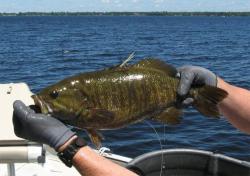
A post-op tagged smallmouth (Credit: Lake Champlain Research Institute, SUNY Plattsburgh)

Released Smallmouth

Released Smallmouth


Smallmouth bass also exhibited signs of stress, but not as much as largemouths. Both bass types appeared more prone to bloody fins as water temperatures increased. And after they had been released back into Lake Champlain, researchers found that bass swam toward the north side. There is plenty of high-quality habitat on that end, says Malchoff, and going north saves a trip over deep-water areas to reach the southern end.

All the findings boil down to a few things fishermen and tournament organizers can do to protect and conserve bass in Champlain. “Don’t transport them as far (in livewells), and lake temperature – in a lot of places, waters are warmest in late July or early August – avoid scheduling tournaments at those times if at all possible,” said Malchoff.

Researchers also provided evidence against a commonly held notion that many types of fish stress could be attributed to barotrauma, or damage caused to them by sudden pressure changes. Fish that don’t maintain equilibrium don’t always need to have their air bladders deflated, Malchoff says, something that tournament anglers often do.

“My real interest is looking at tournaments as a sustainable resource,” said Malchoff. “And like a lot of things, there’s always room for improvement.”

Funds for Gulf of Mexico Restoration

The BP Windfall–Funds for Gulf Restoration

By Frank Sargeant, Editor
from
The Fishing Wire

In one of the more bizarre turns of events in environmental history, the calamitous BP oil disaster in the Gulf of Mexico may turn out to have been historically a good thing for many portions of the shores of this American sea.

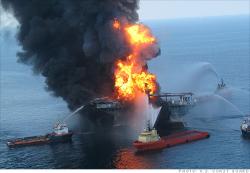
Deep Water Horizon on fire

Deep Water Horizon on fire

While the enormous outpouring of oil, variously estimated at up to 4.7 million barrels (about 200 million gallons over 87 days), was the greatest manmade environmental disaster in history, killing fish, marine mammals, bottom fauna and sea birds in untold numbers as well as fouling hundreds of miles of shoreline and virtually wiping out an entire tourist season in many communities surrounding the Gulf, it now appears that the enormous fines and lawsuit penalties levied against British Petroleum and associates may wind up giving a historic infusion of cash for environmental projects that stood no chance of being funded or even planned without the giant cash cow suddenly available.

Those of us who have spent time around the Gulf oil rigs fishing know that they are not the demonic towers of environmental destruction that some folks seem to think they are: In fact, there are more fish per square foot around these towers than anywhere else in the Gulf, with both reef species like snapper and grouper and pelagics like kingfish and yellowfin tuna swarming around many. On the other hand, the BP disaster shows the potential for great harm that’s inherent in pulling industrial quantities of petroleum out of the sea floor anywhere in the world, and hopefully has taught the entire civilized world a lesson in the need for careful control of this harvest. And the huge fines resulting have hopefully taught a lesson to the companies extracting the oil, as well.

On July 6, 2012, President Obama signed the RESTORE Act into law, establishing a trust fund within the Treasury Department, with 80 percent of the civil penalties to be paid by parties responsible for the Deepwater Horizon oil spill under the Federal Water Pollution Control Act. To date, civil penalties and interest deposited into the trust fund exceed $653 million.

That could be a drop in the bucket. The Justice Department has found “gross negligence” against BP, which means penalties under the Clean Water Act will swell to $4,300 per barrel, making the determination of how many barrels were released critical in settling what the ultimate civil fine will total. The fine reportedly could have been as low as $1,100 a barrel had BP not cut so many corners in regards to the safety of its workers and the health of the Gulf. If BP’s estimate for barrels spilled is accurate, the fine will be about $10 billion for its gross negligence. That total could be in excess of $18 billion if the Justice Department is right. Either way, it’s an enormous amount of money.

A total of 35 percent of the Gulf Coast Restoration Trust Fund is divided equally among the five states for ecological and economic restoration. The states of Alabama, Louisiana, Mississippi, and Texas each receive a share for projects and programs they select. In Florida, the state’s allocation goes to 23 coastal counties for projects they choose. A second Interim Final Rule finalizes an additional allocation for 20 parishes in Louisiana.

Treasury will also provide grants for centers of excellence research programs using 2.5 percent of the trust fund, divided equally among the five Gulf Coast States.

On Sept. 15, Treasury posted the funding opportunity announcement for these grants as well. The centers of excellence will focus on science, technology, and monitoring. In addition to these grant programs, the Interim Final Rule published in August describes requirements for RESTORE Act programs administered by other federal agencies. Treasury is just one of several federal entities working to implement the RESTORE Act.

The Gulf Coast Ecosystem Restoration Council, a federal council composed of the five Gulf Coast States and six federal agencies, will use 30 percent of the trust fund for projects selected by the council, and administer grants to the states pursuant to council-approved state expenditure plans using an additional 30 percent.

The National Oceanic and Atmospheric Administration will use the remaining 2.5 percent of the trust fund for a program focused on advancements in monitoring, observation, and technology. For more information on the Gulf Coast Ecosystem Restoration Council, visit http://www.restorethegulf.gov/.

In short, it’s by far the greatest infusion of money into an environmental restoration project in U.S. or world history, an unimaginable windfall that if spent wisely should bring tremendous benefits to the Gulf estuarine and beach areas for decades to come–and some very nice added benefits to the anglers who chase the millions of fish that will be produced in these restored areas.

To be sure, the Gulf is likely to face issues in coming decades if sea level rise continues as many scientists predict–while wetlands, mangroves and marshes like wet feet, too much water can kill out these nursery areas, which are absolutely essential to preserving the chain of life that ultimately results in everything from gamefish to porpoises and whales.

The public has an opportunity for input on projects that need funding from this money. This Wednesday, Oct. 22, a public webinar will run from 6 to 8 p.m. EST.

Advance registration is required. Go here: https://www2.gotomeeting.com/register/338981370

To be sure, the road to full recovery of the Gulf from the BP incident is still somewhere in the future, but the restoration projects already underway and those planned for the future may well bring the resource to a level that is even better than before the disaster, for the fish and marine life, for anglers and boaters, and for the general public which enjoys this uniquely American resource.

What Is Being Done To Restore the Gulf of Mexico

NOAA, Partners Announce Major Progress on Gulf of Mexico Restoration
from The Fishing Wire

More than $600 million in new projects will offset damage from Deepwater Horizon oil spill

NOAA and its fellow Natural Resource Damage Assessment trustees in the Deepwater Horizon oil spill have announced the signing of a formal Record of Decision to implement a Gulf restoration plan. The 44 projects, totaling an estimated $627 million, will restore barrier islands, shorelines, dunes, underwater grasses and oyster beds.

This announcement marks the largest suite of Gulf early restoration projects selected thus far in the wake of the 2010 oil spill. The projects aim to address a range of injuries to natural resources and the subsequent loss of recreational use.

“Preserving, protecting, and restoring natural resources is an integral part of our efforts to foster resilience in communities nationwide, including those affected by the Deepwater Horizon oil spill,” said Kathryn D. Sullivan, Ph.D., under secretary of commerce for oceans and atmosphere and NOAA administrator. “These projects reflect an earnest commitment to the Gulf and will enhance the region’s economic, social, and ecological resilience in the future.”

As outlined in the Final Programmatic and Phase III Early Restoration Plan and Early Restoration Programmatic Environmental Impact Statement, NOAA is supporting an overall Early Restoration plan that includes both ecological and human use projects. It is also fully supporting 44 specific projects to address injury across the Gulf. Of those, NOAA is directly involved in the implementation of four projects.

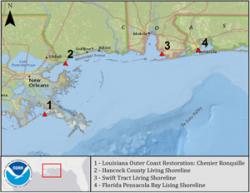
Map of Gulf of Mexico restoration

Map of Gulf of Mexico restoration

Locations of Phase III Deepwater Horizon early restoration projects in which NOAA is participating. (Photo: NOAA)

The largest NOAA project partnership will be with Louisiana to fund and execute restoration of beach, dune, and back-barrier marsh habitat on Chenier Ronquille, a barrier island off the state’s coast. Chenier Ronquille is one of four barrier islands proposed for restoration as part of the Louisiana Outer Coast Restoration Project that will be implemented by NOAA, the U.S. Department of Interior and Louisiana. The total cost to restore the four barrier islands is expected to be $318 million.

Alabama, Florida, Mississippi, and NOAA will partner to undertake three “living shorelines” projects. These projects involve a blend of restoration technologies used to stabilize shorelines and restore fish and wildlife habitat. The three projects are:

Alabama: NOAA will work with the state to fully implement the Swift Tract Living Shoreline Project. This project, costing $5 million, will construct approximately 1.6 miles of breakwaters covered with oyster shell to reduce shoreline erosion, protect salt marsh habitat, and restore ecosystem diversity and productivity in Mobile Bay. Restoration experts expect that over time, the breakwaters will develop into reefs, providing added reproductive and foraging habitat and shelter from predators. The 615-acre state-owned Swift Tract site is located in Bon Secour Bay and is part of the NOAA-supported Weeks Bay National Estuarine Research Reserve.

Florida: NOAA will partner with Florida for the Florida Pensacola Bay Living Shoreline Project to restore shoreline at two sites along the Pensacola waterfront. Project Greenshores Site II is located immediately west of Muscogee Wharf in downtown Pensacola. Restoration at PGS Site II has been planned in conjunction with the Sanders Beach site, three miles to the west. Both proposed sites feature breakwaters that will provide four acres of reef habitat and protect the 18.8 acres of salt marsh habitat that will be created through this project. The Pensacola project is expected to cost about $11 million.

Mississippi: NOAA will partner with the state to improve nearly six miles of shoreline as part of the proposed Hancock County Marsh Living Shoreline Project. The goal of the project is to reduce shoreline erosion by dampening wave energy and encouraging reestablishment of habitat in the region. The estimated cost is $50 million.

As the largest phase of early restoration efforts, Phase III sets a strategic approach for these and additional early restoration activities. The trustees received thousands of public comments that were instrumental in its development, and has issued a guide to the plan and projects.

These projects will be funded through the $1 billion provided to the trustees by BP, as part of the 2011 Framework Agreement on early restoration.

Ten early restoration projects already are in various stages of implementation as part of the first two phases of early restoration. Updates on these projects are available in an interactive atlas.

Early restoration provides an opportunity to implement restoration projects agreed upon by the trustees and BP prior to the completion of the full natural resource damage assessment and restoration plan. BP and other responsible parties are obligated to compensate the public for the full scope of the natural resource injury and lost use caused by the Deepwater Horizon oil spill, including the cost of assessing such injury and planning for restoration.

For more than 20 years, NOAA’s Damage Assessment, Remediation, and Restoration Program has worked cooperatively with federal and state agencies, tribes, industry, and communities to respond to oil spills, ship groundings, and toxic releases. During that period NOAA has protected natural resources at more than 500 waste sites and 160 oil spills, securing more than $2.3 billion from responsible parties.

NOAA’s mission is to understand and predict changes in the Earth’s environment, from the depths of the ocean to the surface of the sun, and to conserve and manage our coastal and marine resources. Join us on Twitter, Facebook, Instagram and our other social media channels.

Who Tracks Smalltooth Sawfish?

FFWCC Continues Sawfish Research

Today’s feature on smalltooth sawfish, comes to us from the Florida Fish & Wildlife Commission. Though sawfish are scarce these days in most parts of Florida, there’s a small continuing population along the southwest coast, with the muddy creeks of the lower Everglades often a good spot to see one of these unique creatures. They’re also found in the lower Caloosahatchee and Peace Rivers and in Charlotte Harbor.
from The Fishing Wire

Studying Sawfish

Studying Sawfish

The endangered smalltooth sawfish is the only sawfish species found in Florida waters. It is a type of ray.

Researchers are studying the ecology and life history of the endangered smalltooth sawfish to aid recovery efforts.

Considered by some to be a symbol of strength and spirituality, the sawfish is culturally important to many tribal societies around the world. Belonging to the family Pristidae, derived from a Greek term meaning saw, sawfish possess a characteristic long, flattened, toothed rostrum, often referred to as the “saw,” which is used for feeding and defense against sharks, their only known predators. There are five species of sawfish worldwide.

The only species found in Florida waters is the smalltooth sawfish (Pristis pectinata). It is part of a group of fishes called elasmobranchs that includes all other rays and sharks. This protected species is listed federally under the Endangered Species Act because its population experienced significant decline and range reduction over the last century due to unintentional overfishing and its limited reproductive potential.

To learn more about the ecology and life history of the smalltooth sawfish and monitor its recovery, staff from the Fish and Wildlife Research Institute’s Charlotte Harbor Field Laboratory have spent over a decade monitoring and sampling juveniles in the estuaries of the Caloosahatchee River, Peace River and Charlotte Harbor. The project, led by biologist Dr. Gregg Poulakis, began with researchers compiling reports of angler encounters (which is still ongoing) and has evolved into a sampling program that addresses many of the priorities identified in NOAA’s Smalltooth Sawfish Recovery Plan icon_pdf.gif.

Smalltooth sawfish

Smalltooth sawfish

Though most sawfish seen today are small ones, the species is known to exceed 15 feet including their lengthy bill or saw, at full maturity.

Researchers tag each sawfish, which allows them to document the fish’s movements and determine which habitats they use. Researchers also collect a fin clip from each sawfish captured. These small samples have the potential to help scientists answer a variety of questions about the biology and ecology of the smalltooth sawfish. Researchers have already gathered information from these samples on population health, stability, habitat use and feeding biology.

Public participation is an important component of this research project, as reports of sawfish encounters provide a primary data source for determining the historic and current distribution of the population. For example, data provided by the public were instrumental in designating official critical habitat areas for juvenile sawfish – an important step in the recovery process. Members of the public are encouraged to report sawfish captures or sightings by email at Sawfish@MyFWC.com or phone at 941-255-7403. It is important to note that captures or sightings of even one sawfish are useful to the research team.

Through their work so far, Dr. Poulakis and his team have discovered some interesting facts about smalltooth sawfish. They determined that juveniles double in size during their first year, growing from a birth length of 2.5 feet up to 5 feet, and continue to grow relatively fast in their second year. Researchers also determined that sawfish are affected by marine debris, such as discarded fishing line, but can heal quickly if freed from the debris. Data also show that juveniles sometimes occur near specific locations for months, are found in natural creeks and man-made canals, and respond to large increases in river flow by moving downriver.

Dr. Poulakis and his team receive funding from the National Marine Fisheries Service to conduct this research, which addresses the ongoing management needs of multiple agencies and stakeholder groups

Who Tracks Baby Tarpon In Florida?

BTT Tracks Baby Tarpon in Southwest Florida
from The Fishing Wire

Checking baby tarpon

Checking baby tarpon

The Bonefish & Tarpon Trust continues their efforts at improving Florida’s flats fisheries with efforts to map the nursery areas used by juvenile tarpon on Florida’s southwest coast.

Last week, scientists at Bonefish and Tarpon Trust broke ground at their newest Juvenile Tarpon Habitat Restoration site by setting up antenna arrays that will be used to track juvenile tarpon movements within a series of canals. This project, being done in conjunction with the Southwest Florida Water Management District, Charlotte Harbor National Estuary Program, Florida Department of Environmental Protection Charlotte Harbor Buffer Preserve, and the Florida Fish and Wildlife Conservation Commission, will turn what are now old canals from a long-abandoned development into juvenile tarpon habitats. The crew made their way into the new site early Tuesday morning and were able to assemble 4 antenna arrays at a number of strategic locations. “The first step is to see how the fish currently use the canal system,” said JoEllen Wilson, BTT’s Juvenile Tarpon Habitat Program Manager. “Then once the restoration is complete, we will continue to sample to see if the tarpon prefer one type of habitat over another.”

BTT scientists will return later this year to begin the sampling. Sampling includes capturing juvenile tarpon with cast nets and seine nets, taking measurements, and then tagging the individual fish with PIT tags. When a tagged fish passes through one of the antenna arrays the antenna will log the date, time, and the unique tag number.

Juvenile tarpon depend upon shallow, backwater habitats for at least the first 2 to 3 years of their lives. Common characteristics include:

Mangrove or other fringing vegetation that provides structure and protection from bird predators;
A mixture of depths – primarily shallow with some deeper pools for fish to congregate when water levels decrease;
Tidal exchange through narrow, shallow passages that keeps predatory fish away;
Freshwater inflow;
Calm backwaters.

As coastal human populations continue to increase, coastal ecosystems and the fisheries they support are becoming increasingly stressed due to factors such as habitat loss and degradation. Therefore, there is an
urgent need to protect and restore these critically important habitats.

BTT thanks its collaborators the Southwest Florida Water Management District, Charlotte Harbor National Estuary Program, Florida Department of Environmental Protection Charlotte Harbor Buffer Preserve (especially Mr. Jay Garner), and the Florida Fish and Wildlife Conservation Commission.

For more info on the Juvenile Tarpon Habitat Initiative, or to help out this initiative by becoming a member, please visit www.btt.org

Does Georgia Power Help Fishermen and the Environment?

I enjoyed fishing at Lake Juliette with Jack “Zero” Ridgeway last Sunday. We were checking out spots for a November Georgia Outdoor News article and caught a lot of bass. The biggest one hooked, a five pounder, jumped a couple of times then got Zero’s line around the trolling motor and broke off.

While we were fishing I kept looking at the smokestacks and cooling towers at the Georgia Power Plant Scherer on the shore. It is a huge facility, the fifth biggest coal fired power plant in the US. It provides electricity for many homes and businesses around here through the Georgia Power Company, Municipal Elect5ric Authority of Georgia, (MEAG) Oglethorpe Power and others.

When we think of Georgia Power we think of power. But when we flip a switch to turn on a light, do a load of clothes or warm food in the microwave it is automatic and we only notice when the power goes out and we don’t have this incredible resource that makes our lives so much easier.

Georgia Power is so much more than just a power company, though. Without them, Lake Juliette, Jackson Lake, Lake Sinclair, Lake Oconee and many others in our area and state would not exist. If you fish or hunt on and around those lakes you can thank Georgia Power.

Many of the boat ramps, picnic areas and campgrounds on Georgia Power lakes are either fully run by Georgia Power or are supported by them with money and facilities. Hunting areas are usually funded by a combination of funds from Georgia Power and the Georgia DNR. And many water fowl projects are a combined effort with Ducks, Unlimited and Georgia Power.

While Zero and I were fishing we heard several quick shotgun blasts early in the morning. Zero said someone must be hunting ducks and I responded there was an early teal season and also goose hunting was open.

All around Lake Juliette there are special waterfowl areas supported by Georgia Power where fields are planted with food ducks and geese like. With the lake right there it is excellent habitat for both. And some of the fields on Rum Creek WMA are managed for doves and are open to the public for shooting at those gray rockets.

Wildlife Management Areas around many lakes are open to the public for deer hunting and many of them are on Georgia Power land. Without them, a lot of deer hunters would have a tough time finding a place to hunt. And they are open small game hunting, too, and managed for all kinds of wildlife. Georgia Power helps fund these areas and provides the land for them.

Fishing is good on Georgia Power lakes and the shoreline on most is owned by the company. Folks with cabins and houses lease many of their lots from the company. Not only do these leases provide great places for the homeowner, the docks they build are great cover for bass, crappie and bream.
Other than the docks, Georgia Power works with the DNR to build fish habitat in the lakes from putting out marked brush piles to planting different kinds of native grasses around the lake. Water quality is monitored by Georgia Power, too.

Lake Sinclair is special to many area bass fishermen in the winter. The warm water discharged from Plant Branch, the coal fired power plant there, warms the lake a little and makes fish bite better in the winter. Due to Environmental Protection Agency regulations, the federal government seems to be trying to shut down such power plants.

Plant Branch is being closed to meet EPA regulations, at a great cost to the company, its employees and its customers. If the current federal government had it way all coal fired power plants would be shut down, and they don’t care how much doing that would raise power costs or the fact electricity might become less reliable due to lowered generating ability.

Some folks complain companies don’t pay enough taxes. They don’t pay any taxes. Their customers and stock owners pay them. So increasing taxes on companies just raise taxes on people like you and me. And you can own some of Georgia Power and get your share of their profits by buying stock. At less than $30 a share right now, it is a good way to build equity and get decent return on your investment.

Everyone complains about their power bill, and Georgia Power offers many ways to conserve electricity and keep it lower. But think what you get for your payment. Could you live around here without an air conditioner in August? Could you do without a refrigerator, microwave, TV, clothes washer or any of the other things you depend on daily?

When you flip a switch to light up a dark room, hunt on a Georgia Power facility or fish on one of their lakes, think about what the company does to make those things happen!

How Much Training Do Conservation Officers Receive?

New conservation officers put to the test with 18-week field training
from The Fishing Wire

Editor’s Note: We often underestimate the education and training officers that enforce fish and wildlife laws across the country receive. That’s why we thought you’d enjoy this look at a portion of the 18 week field training portion of Conservation Officers in Michigan- after they graduate from the law enforcement academy.

Standing high on a bluff overlooking the Muskegon River in late August, Michigan Department of Natural Resources conservation officers Jeff Ginn and Saykham Keophalychanh spotted an angler on the river below. Without saying a word, Keophalychanh immediately began making his way down the path to the river bank, hoping to make contact with the angler.New officer Keo with his field training officer Ginn

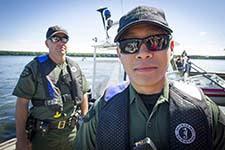
Natural Resources Conservation Officers Jeff Ginn and Saykham Keophalychanh

Natural Resources Conservation Officers Jeff Ginn and Saykham Keophalychanh

One of 23 graduates from the Department of Natural Resources’ most recent law enforcement academy, Keophalychanh is currently working under the supervision of Ginn, his field training officer (FTO). Like his classmates, Keophalychanh will spend 18 weeks afield with veteran conservation officers to learn the ropes before reporting to his assigned county.

“I want him to have a lot of contacts during the field training,” said Ginn, a CO in Newaygo County. “The more people he talks to that aren’t suspicious, the more someone who is suspicious will stand out to him.”

Keophalychanh, who is halfway through his second of three six-week sessions with an FTO, said he’s already learned 10 times as much about the job as he did at the academy.

“It’s kind of like doing lab work in a science class, to use an analogy,” Keophalychanh said. “Sometimes five minutes in the lab can teach you as much as five hours with a book. What we learned in the academy is 20 miles wide, but only an inch deep. The FTO process fine-tunes you, reinforces what you learned in the academy.”

Ginn, an eight-year veteran of the DNR’s Law Enforcement Division, said his job as a FTO is to make sure Keophalychanh understands what’s expected of him and to teach by example.

“The academy provides a great foundation for our officers,” he said, “but when they get in the field, that’s when they put their skills to the test.”

Keophalychanh said Ginn has really helped him learn what he should focus on in the field.

“I was a clean slate coming in,” Keophalychanh said. “It’s good to have direction. Just being able to see how it’s done is a good experience for me.”

Getting these 23 new officers through the training is crucial to the DNR’s mission to protect, manage and conserve Michigan’s natural resources. Prior to the academy this year, the DNR’s Law Enforcement Division was operating at an all-time low for the number of conservation officers in the field, with some counties not having the full-time presence of a CO.

The field training portion of a new officer’s overall training is an integral part of what prepares the officer for the job, said Sgt. Jay Person, commander of the DNR’s conservation officer recruit school.

“The field training is segmented so that the new officer moves from an observational role to an active role over the course of 18 weeks,” Person said. “When completed, the new officer has a very good idea what the job is really like, and pairing them with different FTOs throughout the field training maximizes their exposure to highly trained, experienced conservation officers who have a lot of knowledge to share about the job and the area where the new officer is assigned.”

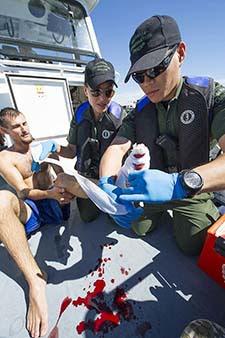
First Aid from Conservation Officers

First Aid from Conservation Officers

During the first six weeks of field training, the new officers were paired with a more experienced officer in or near their assigned county. In the second six-week segment, the new officers were moved to another region of Michigan, sometimes to an area completely different than their assigned county, allowing the new officers to be exposed to different areas of the state and the different activities encountered – an officer assigned to a more rural county may spend the next six weeks in a more urban area and vice versa.

In between the first and second sessions, there was a one-week training session at the DNR’s Ralph A. MacMullan Conference Center at Higgins Lake that focused on marine operations, boat handling and tribal awareness.

After the second six-week segment, another one-week training period focusing on waterfowl training and enforcement will be held just prior to the opening of most waterfowl hunting seasons in Michigan.

In the first six weeks, the new officers spend more time observing the more experienced officer handling contacts or assignments. In the second week, the new officers take the lead more on contacts. In the final segment, the new officers fully take the lead on contacts and investigations.

“The field training gradually ramps up as it moves along,” said Person. “At the end, the new officers will be completely ready to perform their duties as assigned.”

Keophalychanh’s view of the field training experience is echoed by his classmates.

“It’s an awesome way to learn,” said Tim Rosochacki, a 26-year-old former DNR park ranger who is a newly minted CO. “They’ve got a lot of tips and tricks that they’ve learned and they know what a fresh officer is going through.

“My training officers have been great – they’ve let me learn on my own, but they’ve also added to it. They’ll tell you their own experiences and that gives you a better mental picture of the routes or avenues you can take. Now you’re getting to put all the stuff you learned in the academy to use. You’re getting to see firsthand how it all fits together.

“They get you thinking one way and then you get out in the field and you begin to see why you were trained that way.”

As Ginn and Keophalychanh continue their patrol, they cruise past a launch ramp on Hardy Pond and spot another angler fishing in a boat not far from shore. Keophalychanh asks Ginn if they should wave him in to check him. Ginn’s response?

“Let’s talk about that a minute,” Ginn said. “Let’s say we see him catching fish hand-over-fist and then when you contact him, he just motors off. What are we going to do? What options are available to us?”

Keophalychanh said the first thing he would do is look for the boat’s registration numbers. He puts his field glasses to his eyes, notes the vessel’s MC numbers, and gets on the radio. Minutes later, he learns the boat is registered to someone who has a senior citizens’ fishing license. That seems to jibe with what Keophalychanh has seen.

As Ginn put it, the pair found out what they needed to know without disrupting the angler’s recreation.

“There are countless ways to do this job,” Ginn said. “It doesn’t matter which approach you take if you get the right outcome. After we have an interaction, we often talk about how we might have done it differently. I like to tell him about things I think I’ve done wrong. There are times when I say, ‘I should have done it this way …'”

Richard Cardenas, a 26-year-old recent academy graduate from Ionia County said working with an established CO has really helped him understand how to interact with the public.

“You’re working with a fellow officer who helps you get in your groove and develop your own style,” Cardenas said. “Each community is different and the academy can’t teach you that – how to interact with different cultures, different age groups, different types of sportsmen. The scenarios they give you at the academy are just that – scenarios. This is real life.”

Cardenas, who spent his first six-week session with an officer in Livingston County, said he spent a lot of time at Belle Isle, a far different atmosphere than rural Ionia County. He’s found a supportive community in Detroit.

“Most of the people we encounter are very happy we’re there,” he said. “They support what we’re doing and are enjoying the new atmosphere at Belle Isle.”

The new COs will begin their third six-week session of field training shortly. Then they’ll be hitting the ground on their own just when things really get busy for conservation officers – right before the firearms deer season. By all accounts, the officers can hardly wait.

“The job is what I thought it would be and then some,” Rosochacki said. “Every day I’m amazed at what I get to do and what I experience. You’re on the lake one day and the next day you’re out in the woods. The dynamics of the job and the variety are awesome.”

Ginn said his stint as an FTO has been a learning experience for him, too.

“I’ve learned things from Keo,” he said. “We’re both in the same boat. I’ve been in his shoes and I’m falling back on my experiences to learn what kind of an FTO I want to be. This is a new chapter in my career, too.”

For his part, Keophalychanh is looking forward to getting out on his own.

“It’s a point of pride to earn your badge and begin putting everything you’ve learned into action,” he said. “It’s exciting to know that day is just around the corner.”

Learn more about Michigan DNR’s conservation officer academy and the recruitment process at: www.michigan.gov/conservationofficers.

Global Warming and Fishing

Remember the Polar Vortex last winter that produced record cold weather around here and all over the US and the northern hemisphere? The extremely cold days and nights that lasted several days each time it hit? It was produced by a change in wind patterns that brought artic cold further south than normal. The terrible cold made hunting and fishing miserable.

A team of scientists from the US and Korea have come up with the reason, and I guess their conclusions should come as no surprise even if they don’t make sense. The reason? Global warming, of course.

You gotta wonder how scientists can “prove” or even theorize that warming produces record cold. That just shows you can “prove” anything you want to. Right now there is big money behind any efforts to prove global warming exists, and researchers know they won’t get funded unless they produce the desired results.

The whole theory of colder winters due to global warming is based on the Artic ice cap getting smaller. Strangely enough, the data does not show a shrinking ice cap for the past few years. Instead, according to the “National Snow and Ice Data Center,” the Artic ice melt this year has been lower than last year, and the extent of the ice cap size will set a record this winter and will continue to increase.

Some believe in global warming based on their past experiences. They might say this summer was the hottest they can remember, without looking at temperature records. Or for a while winters were claimed to be warmer, again not looking at temperature records.

My experiences make me think we have weather, not climate change. For years I spent Christmas holidays at Clarks Hill. One year, two days before Christmas, I had been fishing barefoot and shirtless for several days. But other years I had to wear a snowmobile suit during the same time period.

When I was working on my first Masters Degree in the mid 1970e at West Georgia College I had to write a report on the coming ice age. I used information from Time magazine the month the cover proclaimed scientists predicted a new ice age within 20 years or so, and articles explained how we would suffer from the extreme cold in coming years.

There is a lot at stake for us on how this debate turns out. One claimed way to lessen global warming is to reduce coal use. But even if we reduce it in the US, and we have been doing that for years with no new coal fired power plants approved for a long time, what other effects will it have?

Almost all of our electricity around here comes from coal even though we have a lot of hydroelectric power dams in Georgia. The coal fired plant in Forsyth is the biggest in the US, and uses an incredible amount of coal each day. If such plants are shut down expect your power rates to get much, much higher and less reliability of power supply.

I hate it when the power goes out, or even when it is reduced in a brown out due to storms. Electrical motors and appliances do not work right. Expect that to be the rule, rather than the exception, if we shut down coal fired power plants.

Georgia Power is already working on closing the coal fired power plant on Lake Sinclair. It has been reduced to one working boiler if my information is correct. Why are they shutting this plant? Because new EPA rules require them to make upgrades that cost so much it is not economically feasible to do them.

One effect of shutting that plant down will be no more warm water released into Beaverdam Creek. That warm water keeps most of the lake downstream a little warmer than other lakes around here. The warmer water makes bass bite better. Almost every bass club in middle Georgia schedule winter tournaments there for that reason.

The effect on fish and wildlife is another claim the true believers in global warming make is something else I find hard to take for true. Computer models predict about a four degree warming in the next one hundred years. Even though the computer models have been far off in their predictions for the past 20 years, assume they are right.

Game and fish undergo changes in water and air temperature of many degrees each day. For wildlife, last week is a good example. In the mornings we had temperatures in the low sixties that climbed into the eighties each afternoon. That is over 20 degree in a few hours. So how is a change of four degrees in one hundred years going to make a difference?

In August the surface water temperature on area lakes was in the upper eighties. By late October they will be in the seventies, and by February in the low forties. That is a fifty degree change in six months. So four degrees in one hundred years is going to kill off all our fish?

When global warming claims make more sense I will believe them.

Can Anglers Help Recover Puget Sound Rockfish?

Working with anglers to recover threatened Puget Sound rockfish
from The Fishing Wire

Today’s feature, on Pacific rockfish that live 75 to 100 years, comes to us from NOAA Fisheries.

Written by Ed Quimby with contributions by Kelly Andrews and Jennifer Sawchuck

Rockfish don’t put up a fight like Chinook salmon (Oncorhynchus tshawytscha), so what’s the allure of catching them? Quite simply, they’re tasty. Randy Jones, a charter boat captain from Bremerton, remembers being about 10-years old when his dad was a commercial fisherman off Westport on the Washington coast, where the catch included yelloweye rockfish.

“They taste really good,” he said. “I’d take a rockfish over salmon any day of the week.”;

For Ray Frederick, a recreational fisherman near Silverdale with more than 70 years of experience, rockfish were an incidental catch decades ago. “I considered myself lucky if I caught a rockfish and brought it home, because they’re really good eating,” he said. “I prefer salmon, but my wife likes rockfish better.”

A dramatic decline

But these tasty populations have been in decline in Puget Sound for decades, in large part due to the species’ late maturation. Yelloweye rockfish (Sebastes ruberrimus)-aka red snapper or rockco-can live for more than 100 years and canary rockfish (Sebastes pinniger) for more than 75 years. Both species take more than a decade to mature and reproduce. This means that mature individuals taken by fishermen reduce reproductive potential and juveniles don’t mature fast enough to replace them.

After decades of commercial and recreational fishing on these species, decreases in catch were observed in the 1980s and the state began to impose catch limits. Some species, however, continued a dramatic decline in numbers, and in 2010 Puget Sound/Georgia Basin yelloweye and canary rockfish were listed as threatened under the U.S. Endangered Species Act (ESA).

Scientists team up with anglers

Captain Jay Field  and NOAA biologist Kelly Andrews

Captain Jay Field and NOAA biologist Kelly Andrews

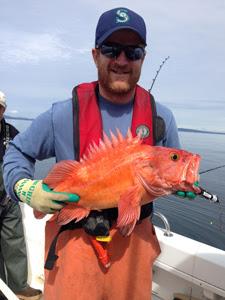
Captain Jay Field of Dash One Charters and NOAA biologist Kelly Andrews prepare to release a 37 cm subadult yelloweye rockfish in the San Juan Islands.

Now that these depleted populations are protected, NOAA is working to restore them. An important goal for managing recovery is to identify genetic differences between these rockfish populations in Puget Sound and those on the outer coast to better define the boundaries of the distinct population segment (DPS), which is the smallest division of a species that can be listed under the Endangered Species Act.

That task fell to biologist Kelly Andrews and fellow researchers at NOAA Fisheries’ Northwest Fisheries Science Center (NWFSC). They decided to partner with experienced recreational charter boat captains and expert anglers who used to catch these elusive bottomfish. Even if it won’t happen in their lifetime, many of these anglers want a sustainable fishery for their children, the next generation of anglers. That’s how the rockfish research voyages of several charter boat captains, including Randy Jones and anglers such as Ray Frederick, were born.

As Andrews explained, “The low abundance of these two rockfish species makes cooperation with experienced local anglers the key to successful sample collection. Teaming up with them allows us to fish historical hotspots with methods and gear that were successful in the past.”

Andrews believes this research will be of great interest to anglers, because genetic information can inform fisheries management and the recovery of the species over time, which can impact economic activities related to charter and recreational fishing. The sampling could also point to the key answers about the populations themselves. Genetic diversity is one of the keys of healthy populations, and understanding how closely related these fish are could help determine that.

Searching for rockfish

Fishing for Rockfish

Fishing for Rockfish

After obtaining NOAA research permits to catch members of a protected species, and several spring shake-down cruises off the San Juan Islands and Whidbey Island to test methods, the team is sampling selected locations this summer. “We have six to eight captains available for fishing days,” Andrews said. Most of the charter boats are in the 25 to 30 foot range and can hold six passengers, but he said most captains want three or four anglers fishing at a time. They are fishing mostly below 150 feet for adults of these species. Canary depth ranges vary, but yelloweye are typically deep, with most being caught below 250 feet.

Jay Field, a charter operator from Anacortes and an experienced fisherman, also signed up his boat to be part of the research. As captain, he enjoys “putting the puzzle together, looking for certain structure and depths, a certain period in the tide” at a given hotspot. “Rockfish need a softer tide set,” he observed. “Too much current doesn’t work.”

Kelly Andrews

Kelly Andrews

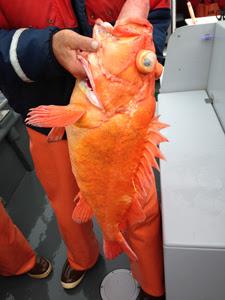
Kelly Andrews with a 56 cm yelloweye rockfish.

But he also couldn’t resist the chance to do a little “rockfishing” again when the opportunity arose. “I’m a tried and true Chinook salmon fisherman,” Field said, “but I caught plenty of rockfish in the past.” He said the bottom is “snaggy and grabby,” which runs the risk of losing some expensive gear, “but if you’re not fishing at the bottom, you’re not fishing where they live.” He also noted that “Everybody does things a bit different. I fish more bait than hardware.” Evidently his technique works for him, as he caught several yelloweye, one about 17 pounds, over two feet long, and potentially 100 years old.

“Reeling in” barotrauma

The sampling is designed to be nonlethal. Scientists note the gender, measure total length and weight, cut a small piece of caudal fin for a genetic sample, then release the fish. While fishing at these depths can cause physical stress due to rapid changes in barometric pressure while being reeled to the surface, rapid recompression to captured depths may alleviate external signs of barotrauma.

Rockfish with Popeye

Rockfish with Popeye

Bottom-dwelling rockfish are susceptible to barotrauma when they are quickly brought to the surface, with symptoms including “pop-eye” as shown here.

Immediately after data collection, the researchers clip the mouth of the fish to a pressure-activated descending device called a SeaQualizer, which quickly takes the specimen down to the appropriate depth for release. However, more research is currently being conducted to determine long-term survival after decompression. Even if fish do not resurface they may have injuries that later lead to death.

“The rockfish’s swim bladder expands like a balloon on the way up,” Andrews explained, “and it doesn’t have the strength to get back down. Bottomfish can’t adjust to pressure changes as quickly as fish that spend a lot of time going up and down, but as the individual goes down on the SeaQualizer, the air compresses again in its swim bladder. Once down at the depth of capture, the rockfish can self-regulate again.”

Collecting genetic data

The caudal fin samples are collected from the fish and sent to the NWFSC laboratory in Seattle for genetic analysis. By comparing the genetic profiles of rockfish caught in Puget Sound with those on the outer coast, we can better understand the level of difference between these populations. By collecting samples from several regions of Puget Sound and the surrounding areas, we can identify geographically where differences in these populations occur. Answers to these questions will better inform spatial management boundaries and recovery actions for these species.

Biologists record GPS location and depth of catch, length, weight and gender of fish, snip a small piece of the tail fin for a genetic sample on every fish collected and attach a Floy tag into listed rockfish. Each fish is on board for approximately one minute andthen released back to the water, either on their own or using a descending device. Approximately 30 – 50 fish are sampled per angling trip.

Toward rockfish recovery

While the NWFSC scientists and their community partners are out on the water, and the geneticists are running DNA sequences, Jennifer Sawchuk, a marine ecologist in the NOAA Fisheries Protected Resources Division, is working with an team of experts from various organizations to draft the rockfish recovery plan for canary and yelloweye rockfish, and a third ESA-listed species, bocaccio (S. paucispinis). Just as the scientists have been working with the recreational fishing community, such partnerships are integral to her recovery planning efforts.

Previously as a University of Washington graduate student she interviewed more than 500 anglers in Puget Sound to gain an understanding of their knowledge about rockfish, perceptions of threats to rockfish, fishing practices, and preferences for recovery measures. The results of her study have informed NOAA’s outreach and education efforts around rockfish, as well as understanding how to better utilize angler’s knowledge about marine resources.

“We’ve done several projects over the years that involve experts and the public in recovering yelloweye, canary, and bocaccio, and much of that work has been with the regional fishing community,” Sawchuk said.

“We recognize that fishers can offer a lot of experience and expertise, and their support is important. To recover threatened and endangered species, it’s just as important to understand stakeholders as it is to understand the species themselves. Our hope is to continue working with anglers and other groups in the future – recovering these rockfish species will take the dedication of a lot of people from all over Puget Sound and we need their help.”

After internal review, co-manager and scientific peer review, and subsequent public review, a final recovery plan for these species in Puget Sound is targeted for release in 2015.

Northwest Fisheries Science Center

2725 Montlake Boulevard East
Seattle, WA 98112

(206) 860-3200
nwfsc.info@noaa.gov