Category Archives: Conservation

What Is A Ripe Sturgeon?

Biologists Net ‘Ripe’ Sturgeon Pair on Nanticoke Tributary

By Karl Blankenship
from The Fishing Wire

Atlantic sturgeon

Atlantic sturgeon

Atlantic sturgeon (Dave Harp)

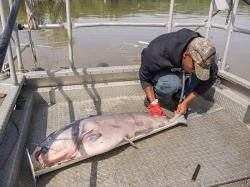
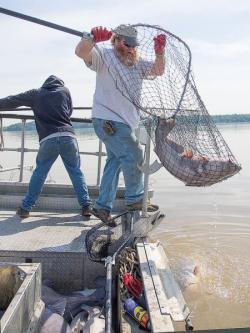
When a crew of biologists from the Maryland Department of Natural Resources hauled a gill net out of the Marshyhope Creek in late August, what they hauled in was more than the catch of the day: It may have been the catch of their careers.

One of the nets contained two “ripe” – ready to spawn – Atlantic sturgeon. One was a 7-foot 3-inch, 154-pound female. The other was a 5-foot 2-inch, 70-pound male. The female was filled with black eggs, and the male was leaking sperm.

“That was probably the most exciting and rewarding day in my career,” said Chuck Stence, head of the anadromous fish restoration unit of the DNR Fisheries Service, who was leading the survey crew. “We’re out there fishing – you’re not expecting to catch anything – and then all of sudden two fish like that get dropped into your lap.”

The recent catch ended more than two years of frustration for the biologists. Fishermen have reported seeing sturgeon jumping in the Marshyhope for several years. Last fall, one landed in the boat of two anglers.

But crews from the DNR and the U.S. Fish and Wildlife Service had – until Aug. 28 – failed to net any sturgeon. The previous week, in fact, Stence and his crew saw one jump only about 40 feet from their boat, but they were unable to net it.

“It’s so frustrating when you see them jumping right in front of the boat, and you still can’t catch them,” he said.

That frustration ended as they were pulling in the last of four 100-yard gill nets that had been deployed on the 28th.

“We got maybe a third of the way through the net, and all of a sudden the net started pulling back,” Stence said. “And the closer we got, you could see the big shadow in the water. It’s amazing how the adrenaline kicks in when you go out there for three years and catch nothing, and all of a sudden you can see a big one in the net – and then having another one right behind it.”

Atlantic sturgeon are the largest fish native to the Bay, where they historically reached lengths of up to 14 feet. Once common, they suffered from overfishing, habitat destruction and pollution, resulting is a dramatic population drop in the last century. Two years ago, the National Marine Fisheries Service listed them as an endangered species.

Like other anadromous fish, sturgeon live most of their lives in the ocean, but return to their native rivers to spawn. The James River is the only Bay tributary known to still have a spawning population.

But the catch by DNR biologists could change that. “I can’t imagine a fish that big going up in there for any other reason other than to spawn,” Stence said.
Still, he added, catching the fish is “just the first little piece of the puzzle.”

Actual proof of spawning would require finding recently spawned “young of year” fish in the river. Right now, Stence said, no surveys exist in the vicinity of the Marshyhope that would catch young of year sturgeon. Now, with evidence that suggests potential spawning activity, the fishery service will consider starting one, he said.

It’s also unknown where the sturgeon came from. They could be remnants of a native Maryland population that has gone undetected for decades. It is possible, some have suggested, that they are James River fish that have wandered up the Bay. Another possibility is that they stem from a small batch of juvenile Hudson River fish that were released in the Nanticoke in 1996.

Those questions could be answered in coming weeks. The biologists took DNA samples of both sturgeon for analysis.

Biologists would like to know what habitats the fish are using. So the captured sturgeon were briefly anesthetized and the biologists made minor incisions to insert a small transmitter and a tag so they can monitor the strugeons’ movements and identify them in the future.

After that procedure, the biologists jumped into the chest-deep water and cradled the fish, “like babies,” Stence said. After about 10 minutes, the sturgeon recovered and swam away.
But Stence said, the biologists are optimistic that they have not seen the last of sturgeon on the Marshyhope.

“We’re definitely optimistic that we will see some more up there,” he said. “I’m anxious to get back out there and see if there are any more out there. At least we know where to go now.”

Indeed. Last Friday, they caught another 97-pound male.

About Karl Blankenship
Karl Blankenship is editor of the Bay Journal and Executive Director of Chesapeake Media Service. He has served as editor of the Bay Journal since its inception in 1991.

Illegal Fishing In Gulf Make Fishermen Call for More Enforcement

Fishermen Call for Stronger Policies and Enforcement As Illegal Fishing in Gulf Grows

Today’s feature, on the growing issue with Mexican poachers in U.S. waters off Texas, comes to us from Chad Wilbanks with the Gulf Coast Leadership Conference.

by Chad Wilbanks, Gulf Coast Leadership Conference
from The Fishing Wire

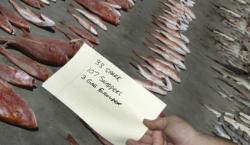
350 dead sharks

350 dead sharks

Approximate 350 dead sharks lay on the ground outside of Coast Guard Station South Padre Island after their boat crew located a 5-mile-long gill net floating 4 miles offshore. Photo: U.S. Coast Guard

It seems every week brings another story of U.S. Coast Guard or other Gulf Coast maritime law enforcement giving chase to foreign fishermen sneaking into U.S. waters to fish illegally. Foreign illegal fishing in the Gulf, mostly by Mexican crew in boats called lanchas, is a persistent and alarming problem according to authorities from Gulf Coast states, as well as the federal government.

At a recent leadership summit at the Texas A&M University in Galveston campus, the urgency of the issue brought together a diverse group of stakeholders; commercial and recreational fishermen, state and federal fisheries enforcers and elected officials. Participants focused on how best to combat illegal fishing, and was hosted by the Gulf Coast Leadership Conference.

Randy Weber

Randy Weber

“Foreign illegal fishing in the Gulf “is an extremely important topic,” said U.S. Representative Randy Weber. Photo: Facebook

“Foreign illegal fishing in the Gulf “is an extremely important topic,” said U.S. Representative Randy Weber (R-TX). “Those who don’t play by the rules take advantage of our fishing industry.” Weber added that more can, and should be done to “level that playing field and shut down all illegal activities.”

Both commercial and recreational fisheries are an economic engine in the Gulf of Mexico driving jobs, tourism, state revenue and sustainable seafood.

According to the National Marine Fisheries Service, the Gulf of Mexico’s commercial and recreational fishing industries support more than 168,000 jobs and contribute $13.7 billion annually to the region’s economy. That significant economic lift reverberates far inland.

A $23.5 Billion Industry

Illegal and unreported fishing accounts for up to $23.5 billion worth of wild-caught marine fish globally, or around one-in-five fish harvested worldwide. That equates to up to 1,800 pounds of fish stolen every second.

Seized Fish

Seized Fish

The Coast Guard Cutter Zephyr seized an estimated 400 pounds of fish from a suspected illegal fishing vessel. Photo: U.S. Coast Guard

Aside from the theft of the fish, so-called pirate fishers show stark disregard for the marine environment. Often they sets miles of nets or lines that indiscriminately kill marine life, including endangered turtles and other imperiled species.

“I have visited extensively with business owners, recreational and commercial fisherman, and concerned citizens in Florida, Alabama, Mississippi, Louisiana, and Texas,” said Will Ward, CEO of Captain’s Finest Seafood in Clearwater, Fla., and a member of the Board of Directors for the Gulf Fishermen’s Association. “Everyone that I have spoken to is deeply troubled by the ongoing and chronic problem of foreign vessels engaging in illegal fishing. It is hard to grasp the impact this has had on our communities and our economy in the Gulf, unless you’ve lived it.”

Comprehensive statistics on illegal fishing in the Gulf are scarce, but according to Lt. Les Casterline with Texas Parks and Wildlife Department Fisheries Enforcement, just one of his wardens in fiscal year 2012 recovered 130,080 feet of illegal long line and 53,840 feet of gill net. “That gear alone held more than 6,000 sharks, 300 red snapper and an uncountable number of Spanish mackerel,” Casterline said.

Legislation Needed to Solve Problems

A key tool to solving illegal fishing is federal legislation that will tighten the net on illegal fishing operations. In April the U.S. Senate voted unanimously to approve the Port State Measures Agreement, which would strengthen and harmonize port inspection standards for foreign flagged fishing vessels. The agreement cannot take effect however until House of Representatives passes legislation to implement the pact.

Julio Fuentes

Julio Fuentes

Julio Fuentes, President and CEO of the Florida State Hispanic Chamber of Commerce, urged citizens to “tell Congress that it’s time to take a stand against foreign illegal fishing in the Gulf.” Photo: FHCC

Julio Fuentes, President and CEO of the Florida State Hispanic Chamber of Commerce, urged citizens to “tell Congress that it’s time to take a stand against foreign illegal fishing in the Gulf.”

“Illegal fishing could pose a serious economic, environmental, and human rights threat to Florida and the Gulf region,” said Fuentes. He cited numerous recent media stories on how illegal fishers around the world enslave workers, often keeping them at sea for years in deplorable working conditions that often result in the murder of dissenters.

The United Nations Office on Drugs and Crime has also linked pirate-fishing fleets to drug and migrant smuggling around the world.

Fleeing capture by Gulf law enforcement, outlaw crews have shot at officers hoping to create enough of a head start so that they can live to fish another day. Those caught face relatively light consequences: confiscation of their boat and repatriation to Mexico. Experts say this fails to deter offenders, with some illegal fishermen getting caught as many as eight times.

Harms Commercial and Recreational Sectors

Foreign illegal fishing is “the number one topic” among South Texas charter fishermen, according to Scott Hickman, a board advisor with the Charter Fishermen’s Association. “Illegal fishers are taking the ability from the charter industry to make a living. Our members see it every day. We need somebody guarding the fence,” he said.

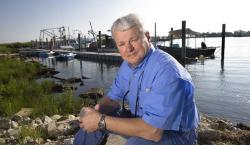
Harlon Pearce, Gulf Seafood Institute president

Harlon Pearce, Gulf Seafood Institute president

“I take great care to sell only seafood that was caught legally and sustainably, and I know my customers appreciate it,” said Harlon Pearce, Gulf Seafood Institute president. Photo: Ed Lallo/Newsroom Ink

The challenge for U.S. authorities is clear: clamp down on current illegal fishing and implement policies to better prevent it from occurring in the future.

According to Gulf Seafood Institute president Harlon Peace, if that doesn’t happen soon the Gulf seafood industry faces an uncertain future.

“I take great care to sell only seafood that was caught legally and sustainably, and I know my customers appreciate it,” said Pearce, who is also the owner of New Orleans Harlon’s LA Fish and Seafood. “I take great care to sell only seafood that was caught legally and sustainably, and I know my customers appreciate that. It is imperative that we as leaders in the Gulf Coast fishing and seafood industry work with our elected officials to ensure our fisheries are protected from illegal fishing.”

Are Blue Catfish An Invasive Species?

Chesapeake Task Force Looking for Ways to Control Invasive Blue Catfish

Today’s feature comes to us from Bay Journal editor Karl Blankenship; blue and flathead catfish, desirable species in the heartland, are causing issues on the Mid-Atlantic Coast these days.

Action needed to prevent irreversible harm to Bay’s ecosystem.

By Karl Blankenship, Bay Journal, www.bayjournal.com
from The Fishing Wire

People may not learn to love blue catfish in the Chesapeake Bay, but perhaps they will learn to love them on their plate.
Big blue cat

Big blue cat

Maryland DNR biologist Branson Williams has to use an extra ruler to measure a blue catfish too big for the standard measuring board. The fish, collected in the Potomac River near Fort Washington, MD, was 44 inches long. (Dave Harp)

A draft report from a task force that spent more than a year looking for ways to deal with the large, voracious – and rapidly expanding – blue catfish population acknowledges that the invasive species has likely become a permanent resident of the Bay, and says action is needed to prevent “irreversible” harm to the ecosystem.

Chief among its recommendations is an expanded commercial fishery that might control the population and create a new product for watermen.

The task force’s draft report recommends a range of actions, such as identifying sensitive areas, such as high-quality spawning grounds, where extra efforts against the predators might protect high priority species such as shad.

It questioned whether states should continue to promote catfish trophy fisheries, and said efforts should be ramped up to warn the public about the ecological impacts of invasive catfish and dissuade anglers from moving them into new areas.

The report was completed by the Invasive Catfish Task Force – a group of state, federal and university biologists assembled by the state-federal Bay Program’s Sustainable Fisheries Goal Implementation Team to identify actions to control blue and flathead catfish, neither of which are Bay watershed natives.

Most of the report’s focus is on blue catfish, which tolerate moderate salinities and are more numerous and widespread in tidal Bay tributaries. Flatheads are more restricted to freshwater areas.

Nonetheless, flatheads – which are already the most abundant predator in the Susquehanna River – are likely to get more management attention in the future, said Bruce Vogt, acting deputy director of the National Oceanic and Atmospheric Administration’s Chesapeake Bay Office, and task force chair. “There is already pretty significant concern about flatheads in Maryland and Pennsylvania,” Vogt said.

The report will likely be updated as new information is gained. The report and its recommendations are now under review by the Bay Program’s Scientific and Technical Advisory Committee, which could result in some changes later this year.

The report warns that if left unchecked, invasive catfish could cause substantial ecological and economic harm to the Bay.

Two Blue Cats

Two Blue Cats

Maryland DNR biologists Branson Williams, left, and Tim Groves handle two large blue catfish near the Woodrow Wilson bridge on the Potomac River. The fish were collected using an electroshocking rig. (Dave Harp)

Recent studies suggest that growing numbers of blue catfish could threaten efforts to restore species such as river herring and shad, and they may also eat substantial numbers of economically important blue crabs. They could also outcompete native white catfish in some areas, and threaten native mussel populations.

They have become so numerous in some places that they interfere with watermen targeting other species, such as striped bass.

“The expanding range and increasing populations, particularly of blue catfish, have resource managers concerned that without management intervention, the damage to Chesapeake Bay resources may be irreversible,” the task force report said.

Blue catfish were introduced into Virginia Bay tributaries by state biologists beginning in the early 1970s in an effort to boost the recreational freshwater fisheries – a common practice at the time.

Over the last decade, their population has increased dramatically and spread to most tributaries on the Western Shore. They have begun turning up in Eastern Shore rivers as well.

Although they generally avoid salinities higher than 14 parts per thousand, years with high river flows and reduced salinities allow them to enter new areas. In addition, biologists believe anglers have intentionally introduced blue catfish into some tributaries because they want more opportunities to catch large fish.

In parts of the James River, blue catfish are thought to be the most abundant fish, and their numbers are rapidly growing in other systems, such as the Potomac. They are top predators, and will eat most other fish – and shellfish – in the rivers. And, they can reach huge sizes – the Virginia tidal record is 102 pounds.

“In the aquatic system, there is nothing that gets bigger than them – unless it’s another blue catfish,” Vogt said. The task force report warns that blue catfish could double their current range in the Bay watershed.

It noted that eradication of an invasive species is “rarely feasible or cost-effective once a species has become widely dispersed in an open aquatic system like Chesapeake Bay.” As a result, the report focused its recommendations on actions that would help control the population and limit its expansion.

The primary control method it proposes is to promote a commercial blue catfish fishery that would give watermen a new product to market while removing invasive fish. While this is already under way, the report says it may require new investments, such as new or expanded processing facilities, to maximize harvest.

Promoting a fishery, though, tacitly acknowledges that the goal is not to rid the Bay of an invasive fish, but to manage it, especially if fishermen begin buying gear to target catfish, and seafood processors invest in new facilities to handle a wave of new fish.

“Once you open a fishery like that, you are probably in it for the long haul,” Vogt said. “Then the challenge is to come up with a framework that gets fishing pressure where we are reducing the ecological impact, but also sustains this new economy that has developed around the catfish. That’s a tough one.”

In fact, overfishing the population could cause problems. If the catfish were to become too hard to catch, fishing pressure would drop – and the population could mushroom again.

“If you are using a commercial fishery as a way to manage a thing like blue catfish, you don’t want the fishery to crash,” said Matt Ogburn, a researcher with the Smithsonian Environmental Research Center who works with blue catfish and is a member of the task force.

The bigger immediate issue, though, is whether a fishery can actually make a dent in the booming population. That will depend in large part on whether markets can be grown to increase demand. Fishery agencies have been promoting catfish, and a nonprofit group, the Wide Net Project, is also working to increase demand for the fish, including touting it as a healthy food to hunger-relief organizations.

While consumer demand is growing, Wendy Stuart, co-founder of Wide Net, said markets for blue catfish ultimately need to be developed beyond the Bay watershed to stimulate enough fishing demand to curb the population.

The group recently reached an agreement with a Boston-based processor to begin marketing blue catfish from the Bay. “Local food is good, but it doesn’t always solve the problem,” Stuart said.
Electroshocking Blue Cats

Electroshocking Blue Cats

Maryland DNR biologist Branson Williams brings in a blue catfish that was electroshocked during a survey of the Potomac River. (Dave Harp)

The Bay region isn’t alone in this approach. A fishery for lionfish is being promoted in the Gulf of Mexico to reduce impacts from that invasive fish. “Harvest pressure is making a difference in that fishery,” said Stephen Vilnit, fisheries marketing director with the Maryland Department of Natural Resources and a member of the task force.

“You may not be able to catch the last fish, but you might be able to knock them to a level where they’re not having the huge ecological impact they are currently having,” Vilnit said.

In addition to promoting a commercial fishery, the report suggests that states consider incentives that would increase harvests, such as allowing boat captains to use electrofishing gear that targets blue catfish, which are stunned by a specific frequency that doesn’t affect other fish. Electrofishing has proven to be a highly effective way to collect them. But more studies would be needed to assess the feasibility of commercial electrofishing and potential safety concerns.

The report also calls for states to identify areas with populations of native species that could be threatened by blue catfish and to target those areas for additional removal efforts, possibly by sending out crews with electrofishing gear.

Such areas might include spawning areas for shad, river herring and other anadromous fish species, as well as habitats for shellfish and species with important ecological value.

While blue catfish likely wouldn’t be eradicated from those areas, the goal would be to keep numbers low so they would not pose a substantial threat to native species.

Protecting targeted areas could prove challenging. Ogburn has been tracking blue catfish movements in the Patuxent River, and has found they are highly mobile and could quickly repopulate areas from which they are removed.

“If you want to remove blue catfish from Jug Bay, you would essentially have to remove blue catfish from the entire Patuxent River,” Ogburn said.

Vogt agreed that “it probably won’t work everywhere,” but said task force members did not want to write off all areas. “People thought it might make sense to try in a few places but we have to be smart about what places we choose,” he said.

In a possiby controversial recommendation, the task force said the benefits of removing dams should be weighed against the potential that such action could open the door for catfish to reach new areas. For instance, a new fishway at Bosher’s Dam outside Richmond allowed blue catfish to colonize the James River as far as Columbia, about 50 miles upstream.

Removing dams and building fish passages to reopen historic habitat used by shad, river herring and eels has been a major Bay Program priority.

In reality, Vogt said he was skeptical that concerns over blue catfish would halt any dam removals or new fish passages. “A lot of people told us that while we are looking at a dam as a barrier, it most likely is not – because people have likely already caught and moved catfish to places on the other side of the barrier,” he said.

The task force recommended that current state fishing policies and regulations be reviewed to identify those that may promote the persistence and expansion of invasive catfish populations, such as trophy fisheries, though the report said both Virginia and Maryland officials seemed to oppose that action in the James or Potomac rivers.

“Managers should discuss the risks associated with maintenance of trophy fisheries,” the report said. “This perpetuates the maintenance of large individuals in the environment for long periods of time.”

Finally, it said improved public education is needed to inform anglers and others about the risks blue catfish pose. That could help discourage anglers from moving fish into new areas, and highlight the concerns to the general public. The public is less informed about blue catfish than snakeheads – the headline grabbing “frankenfish” that invaded the Potomac River a decade ago – even though catfish likely pose a greater threat, Vogt said.

That’s starting to change, as Maryland, supported by the Bay Program, began posting warning signs about catfish earlier this year, and agencies are beginning to post more information on their websites. Still, Vogt said, “awareness is not at the level of the snakehead.”

Information about blue and flathead catfish is available at www.chesapeakebay.noaa.gov/fish-facts/invasive-catfish.

About Karl Blankenship

Karl Blankenship is editor of the Bay Journal and Executive Director of Chesapeake Media Service. He has served as editor of the Bay Journal since its inception in 1991.
What Does Ducks Unlimited Do In Georgia?

Last Saturday I met a couple at Lake Eufaula to get information for a Georgia Outdoor News article. One of the places we fished is a popular creek called “The Witches Ditch.” Near the mouth of the creek is a riprap levee with a diesel water pump on it.

The levee and pump are there to pump water out of a big area behind the levee. In the spring it is drained and food sources for waterfowl is planted. Then in the late summer the area is allowed to flood, offering ducks and geese perfect feeding areas.

This project is part of the National Wildlife Refuge located in Georgia and Alabama on Lake Eufaula. There are several other similar places around the lake where this is done the same way, with levees and pumps.

These wildlife areas benefit waterfowl and many other species of wildlife, from deer to alligators. Such improvements in natural areas are critical for survival of some species and help others thrive. Much of the work on these kinds of conservation projects is funded by Ducks, Unlimited.

Ducks, Unlimited is a worldwide organization of sportsmen and conversationalists that work to fund such projects. Almost all of them are hunters and they know waterfowl and wildlife needs special help since so much habitat is being destroyed.

The organization has completed over 20,000 projects involving more than 12 million acres. Each year many of these projects are in Georgia. Duck hunters here in Griffin benefit from these projects, but all wildlife and anyone valuing conservation of natural resources also benefit.

One of the levee and pump areas on Eufaula was funded by Ducks, Unlimited and the U.S. Fish and Wildlife Service and was completed in 1995. It restored 450 acres of moist soil habitat by installation of a 24 inch pump station and rehabilitation of existing levees. The goal of this project was to enhance habitat for mallards, wood ducks, gadwall and green winged teal. It also provides for hunting opportunities.

Closer to us, a project at Rum Creek Wildlife Management Area near Forsyth included the installation of a water control structure and dike around an area. The field is planted with millet and corn to provide winter food for wildlife. The project was in conjunction with the Georgia Department of Natural Resources.

At Lake Oconee 150 acres of habitat has been conserved with the installation of six water control structures and the renovation of some dikes there. This project is also managed by the Georgia Department of Natural Resources and provides forage for migrating waterfowl near Lake Oconee.

There are many other Georgia projects. Over the years more than 20,000 acres have been conserved through projects in Georgia. Since Georgia is part of the Atlantic Flyway, it provides winter habitat for waterfowl that migrates through the area and is very important for their survival.

Money for all these projects is raised through local banquets and other events. Members pay dues and volunteer their time, but the local events are critical for continuing to conserve the environment. And the money is used for projects, not administration of the organization. More than 80 precent of money raised goes to conservation projects, making Ducks, Unlimited number 115 on a list of almost one million non profit organizations in the US in terms of efficient use of money raised.

Young people are the future of hunting and conservation and Ducks, Unlimited works hard to educate them and help them become involved. Greenwing membership for $15 per year is available to those 17 years old or younger and includes four issues of Puddler Magazine, a magazine just for youth, as well as six annual issues of Ducks, Unlimited Magazine.

Adult membership is $35 per year and includes the Ducks, Unlimited magazine and members only web access. They are also offering a free gift to new members right now. Various levels of membership and sponsorship is also available for varying amounts.

If you value conservation and wildlife, and want to help, visit the Ducks, Unlimited website at www.ducks.org to find out more. Join an organization that works to further your goals of conservation, whether you are a hunter or not.

How Is A Florida Team Saving Dolphins Tangled In Fishing Line?

Florida Team Saves Dolphin from Tangled Fishing Gear
from The Fishing Line

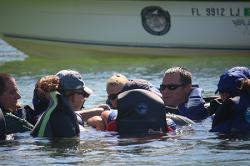
Dolphin Team

Dolphin Team

A team of 10 organizations, including Mote Marine Laboratory and the Sarasota Dolphin Research Program, helped to free a dolphin calf from fishing gear that was entangled around its tail. Without this help, the dolphin’s tail likely would have been severed.
Photo by Florida’s Fish and Wildlife Conservation Commission.

Today, an 11-month-old female bottlenose dolphin calf is swimming free and clear of fishing gear that could have severed her tail after 10 groups – including Mote Marine Laboratory – mounted a life-saving rescue in Little Marco Pass in Collier County.

The dolphin, a dependent calf nicknamed Skipper, was first spotted by members of the 10,000 Islands Dolphin Project, who documented the entanglement and reported it to state and federal authorities in August. After the dolphin was spotted several times over several weeks still entangled in fishing gear, NOAA’s National Marine Fisheries Service (NMFS) – which oversees the protection of marine mammals in the U.S. – asked the Sarasota Dolphin Research Program (SDRP), a partnership between Mote Marine Laboratory and the Chicago Zoological Society, to try to free the dolphin of the gear.

An initial effort by SDRP and Mote to remove the gear with a long-handled disentanglement tool on Aug. 28 was not successful.

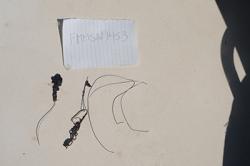
Dolphin Tangling Fishing Gear

Dolphin Tangling Fishing Gear

This is the gear that was tangled around the tail of “Skipper,” an 11-month-old bottlenose dolphin calf. Photo by the Chicago Zoological Society.

NMFS and SDRP contacted members of the Southeast Regional Marine Mammal Stranding Network to help with a rescue. The team included Florida’s Fish and Wildlife Conservation Commission (FWC) and FWC Law Enforcement, NMFS, the Chicago Zoological Society, Mote Marine Laboratory, Sea World, Clearwater Marine Aquarium, University of Florida, the Rookery Bay National Estuarine Research Reserve and 10,000 Islands Dolphin Project.

Early on Thursday, Sept. 4, 2014, a team of 39 people and six boats gathered at the Collier Boulevard boat ramp near Marco Island. Members of the 10,000 Islands Dolphin Project and a team from Clearwater Marine Aquarium had already been on the water looking for the calf and her mother, Halfway, and had found them.

The SDRP orchestrated the rescue: One boat set a net to encircle the dolphins, then the net corral was moved to shallower water and team members got into the water around the net and briefly restrained the animals. In the water, veterinarians found that about a foot of metal fishing leader, probably from a trolling rig, was wrapped around the base of Skipper’s tail peduncle and flukes. Left unchecked, the stiff metal wire would have cut deeper into the dolphin and eventually severed her tail.

“We are seeing situations like this all too often along Florida’s coasts,” said Dr. Randy Wells, director of the Sarasota Dolphin Research Program and the rescue’s coordinator. “This otherwise healthy dolphin calf likely would have died had we not been able to remove the gear. Her entanglement is a prime example of why we humans need to be careful with our fishing gear and watch out for wildlife that lives in our coastal waters.”

This year alone, Mote’s Stranding Investigations Program and animal hospitals have responded to more than 80 stranded sea turtles and 40 stranded marine mammals within Sarasota and Manatee counties and throughout the wider region covered by the Stranding Network.

Skipper is the 22nd live animal that Mote has helped to rescue this year, said Gretchen Lovewell, manager of Mote’s Stranding Investigations Program. The team also recently helped to rescue “Speedy,” a dolphin that was trapped in a lake in the Everglades in July. In addition to responding to stranded dolphins and sea turtles, Mote’s team also supports FWC’s response to stranded manatees in Southwest Florida.

“This rescue was really rewarding,” Lovewell said. “Not only was it a demonstration of how well the Stranding Network comes together to respond to animals in distress, but it was also an opportunity to give this individual dolphin a better chance at survival and to show what can be accomplished when all of us work together.”

Learn how you can help dolphins.

The rescue was possible in-part to grants from the John H. Prescott Marine Mammal Rescue Assistance Grant Program. This federal program supports the costs for teams to help dolphins and whales – like Skipper – that face life-threatening situations.

“This was a great team effort for a successful dolphin calf disentanglement,” said Denise Boyd, FWC Research Associate who coordinates stranding responses in Charlotte, Lee and Collier counties. “We hope that the dolphin will go on to lead a healthy life from here on in.”

Injured Dolphin Tail

Injured Dolphin Tail

This image shows the injury to Skipper’s tail. Photo by the Chicago Zoological Society.

Rescuing stranded marine mammals takes a group effort – from members of the public who report sick or injured animals and the management agencies that authorize such rescues to take place to the “boots-on-the-ground” teams at nonprofit institutions and organizations that conduct many such rescues. Nonprofit organizations rely on public donations to fund such work. Please consider making a donation to Mote Marine Laboratory or another participating agency to help. Online at mote.org/donate.