Category Archives: Conservation

Atlantic Salmon

Atlantic Salmon: A Species in Need of a Spotlight

NOAA Fisheries
from The Fishing Wire

Atlantic Salmon

Atlantic Salmon

“The coincidence, at least, in the erection of the dams, and the enormous diminution in the number of the Alewives, and the decadence of the inshore cod fishery, is certainly very remarkable. It is probable, also, that the mackerel fisheries have suffered in the same way, as these fish find in the young Menhaden and Alewives an attractive bait. The same remarks as to the agency of the Alewives in attracting the deep-sea fishes to the shores and especially near the mouths of rivers, apply in a proportional degree to the Shad and salmon.”

-Marshall McDonald, 1884.

Atlantic salmon are an iconic New England species. In addition to the ecosystem role these fish play, they have been an important indicator of economic health in our region. Atlantic salmon once supported lucrative commercial and recreational fisheries, as well as the small bait shops, gear stores, and amenities for fishermen that contributed to the economy. Before this, Atlantic salmon were important to Native American tribes for historical and cultural reasons. Tribes relied on watersheds and their natural abundance of sea-run fish, including Atlantic salmon, for physical and spiritual sustenance.

In the 1900s Atlantic salmon from Maine were so highly valued that for more than 80 years, the first one caught in the Penobscot River each spring was presented to the U.S. President. The last Presidential salmon was caught in May 1992 by Claude Westfall, who presented a 9.5 pound Atlantic salmon to President George H.W. Bush. Westfall’s was the last presidential salmon because there are now too few adult salmon to sacrifice one even for the President.

Because of significant declines in returning Atlantic salmon, the Atlantic salmon commercial fishery closed in 1948, and the recreational fishery closed in all Maine waters in 2008. In 2000, NOAA Fisheries and the U.S. Fish and Wildlife Service listed Gulf of Maine Atlantic salmon as “endangered” under the Endangered Species Act. The fish, which were historically native to almost every river north of the Hudson, had only remnant wild populations in 11 rivers, all of them in Maine. In the 15 years since their 2000 listing, Gulf of Maine Atlantic salmon have not shown signs of improvement.

To draw attention to this iconic species and our plan for saving it from extinction, NOAA Fisheries recently launched the “Species in the Spotlight—Survive to Thrive” initiative. Atlantic salmon are one of the eight highly at-risk species in the nation that we have identified as needing special attention. These endangered species have declining populations, but also have a high probability of survival if we can marshal the resources to turn their trajectories around.

As part of the Species in the Spotlight initiative, we developed a five-year roadmap to aid the recovery of Atlantic salmon. The plan, which will be released in early 2016, outlines specific actions to save this species and will involve our regional partners in conservation. The primary focus of the plan is to restore access and quality to river habitat in Maine and work to better understand and address threats in the marine environment.

SALMON IN RIVERS ARE LIKE CANARIES IN A COAL MINE

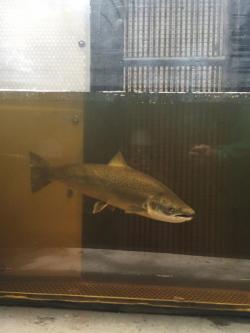
Atlantic Salmon at dam

Atlantic Salmon at dam


Atlantic salmon are anadromous fish which means they spend a portion of their lives in freshwater and a portion in the ocean. Anadromous fish are indicators that the links between freshwater, estuarine, and marine ecosystems are clean and well-connected. The connections within the ecosystem are so strong that many of the factors that are impacting salmon’s survival are also affecting other species such as American shad, alewives and even some marine fish stocks such as Atlantic cod. Healthy anadromous fish populations support important marine food webs, providing a forage base for commercially important species like striped bass, cod, and haddock. When river systems are blocked or are too polluted to support these fish populations, the effects are felt throughout the entire ecosystem. The return of Atlantic salmon, along with other anadromous fish, would indicate the return of a healthy and connected system.

FROM RIVER TO SEA: TOO MANY DAMS

“The principal decline in the New England salmon fishery considerably antedated 1880, however, and was coincident with the erection of dams or other barriers to the passage of fish” – C. Atkins (1894).

One complicating factor for Atlantic salmon is that they are anadromous fish. When they return from the seas between Northeastern Canada and Greenland to the rivers to spawn, hundreds of dams block or impair their ability to reach the critical freshwater habitats that are still capable of supporting spawning. As noted in the quote above, this problem was created over many, many years and so, it will take time to restore connectivity for this species.

Listing Atlantic salmon as endangered in 2000, and expanding the listing to include large rivers like the Penobscot and Kennebec in 2009, helped spur 35 fishway constructions and dam removal projects in Maine, including the removal of two major hydroelectic dams (Great Works and Veazie) as part of the Penobscot River Restoration Project. Since the Penobscot River is home to roughly 75 percent of the adult Atlantic salmon returns in the U.S., restoring access to this river is particularly important. In the Penobscot River basin alone, there are still more than 130 dams that block or impede access to approximately 90 percent of salmon’s historic spawning and nursery habitat. There is still much work to be done.

REMOVALS LEAD TO RETURNS

Dam removals can bring back fish to habitat that was previously inaccessible. After the removals of the Fort Halifax Dam (2008) and the Edwards Dam (1999) on the Kennebec River, alewife and blueback herring (collectively called river herring) returns increased from less than 100,000 in 2006 to more than 2,150,000 in 2015. Similarly, on the Penobscot River, after the Great Works (2012) and Veazie (2013) Dam removals, along with improved passage at other upstream dams, documented returns of river herring increased from 2,000 in 2011 to an estimated 585,000 in 2015. Roughly 1,800 American shad passed the Milford Dam (now the first dam on the Penobscot River) for the first time in 100 years. Additionally, in Fall 2015, researchers found three endangered shortnose sturgeon in habitat upstream of the Veazie Dam remnants for the first time in a century. In 2015, biologists counted 731 Atlantic salmon at the Milford fish lift. (See map of Penobscot River Restoration Project).

STEPS TO RECOVERY

Our five-year action plan outlines specific actions to stop the decline of this species and put it on a path towards recovery, including restoration of the ecological connections between the freshwater and marine environment and restoration of habitat quality. Among the pieces of the plan are to: review hydroelectric power plant dams up for licensing to ensure that they have effective fish passage; encourage removal of dams and other barriers to fish passage where possible; work with other countries to limit Atlantic salmon catch in the ocean; and, continue research and monitoring of Atlantic salmon.

You can help by encouraging or participating in programs to conserve and restore land and water resources that benefit migratory fish and promote abundant, suitable and accessible habitats for Atlantic salmon. This can include working with communities to remove or provide passage around blockages such as round culverts or dams that block or impair movement of Atlantic salmon, maintaining forested riparian areas around rivers and streams, and implementing land use practices that protect streams from pollution and excessive erosion.

For more information on this initiative and what you can do to help Atlantic salmon, please contact Kim Damon-Randall, Assistant Regional Administrator for Protected Resources at Kimberly.Damon-Randall@noaa.gov.

Red Snapper Management in the Gulf of Mexico

Thank You, Shelby, Graves and Scott

Editor’s Note: Today’s feature comes to us from Jeff Angers at the Center for Coastal Conservation.
from The Fishing Wire

Recreational anglers got an early Christmas present this year, and if you live in Alabama, Georgia or Louisiana, you have a Member of your state’s Congressional delegation to thank for it.

Alabama’s senior Senator, Richard T. Shelby and U.S. Representatives Garrett Graves (R-La.) and Austin Scott (R-Ga.) spearheaded a series of provisions in the year-end spending bill that are very important for red snapper management in the Gulf of Mexico.

Mindful of the federal government’s bungling of the fishery and obviously aware of the impact recreational anglers have on the economy of the Gulf coast, the provisions require the National Oceanic and Atmospheric Administration to fund and incorporate agency-independent stock assessments for Gulf reef fish, including the red snapper.

Unlike previous surveys, this one will actually include the many artificial reefs (including offshore oil-and-gas structures) where the red snapper actually are!

Best of all, recreational anglers will get an increased allocation from any increases in the red snapper population that are discovered in the new assessment.

The three legislators should also be congratulated for giving state fisheries managers a greater role in managing the fishery; the measure also includes an extension of the state fishery management boundaries from three to nine miles from shore in Louisiana, Mississippi and Alabama.

We all owe a debt of gratitude to these legislators, but if you live in Alabama, Georgia or Louisiana, please take a moment to personally thank Sen. Shelby, Rep. Scott or Rep. Graves.

Let them know their work is appreciated by recreational anglers like us – but also by hotels, restaurants, tackle shops and marine dealers all across the Gulf. They are the real winners whenever recreational anglers go out on the water.

Why Reclassify West Indian Manatee from Endangered to Threatened?

U.S. Fish and Wildlife Service to Reclassify West Indian Manatee from Endangered to Threatened

(Editor’s Note: Not to say “we told you so”, but here’s the latest on the status of the manatee, from the U.S. Fish & Wildlife Service)
from The Fishing Wire

Endangered Species Act Protections Helped Rescue Beloved Southeastern Sea Cow from Brink of Extinction; Service will Continue to Lead Conservation Actions to Increase Species Population, Reduce Threats & Improve Habitat Conditions

MIAMI, Fla. – As a result of significant improvements in its population and habitat conditions and reductions in direct threats, the U.S. Fish and Wildlife Service (Service) announced today that the West Indian manatee is proposed to be downlisted from endangered to threatened status under the Endangered Species Act (ESA). The proposal to downlist the manatee to threatened will not affect federal protections currently afforded by the ESA, and the Service remains committed to conservation actions to fully recover manatee populations.

The ESA defines an endangered species as one currently in danger of extinction throughout all or a significant portion of its range, and a threatened species as one that is likely to become endangered within the foreseeable future. Given its review of the best scientific and commercial data available, including analyses of threats and populations, the Service proposes that the West Indian manatee no longer falls within the ESA’s definition of endangered and should be reclassified as threatened. The Service will publish its proposal in the Federal Register tomorrow, beginning a 90-day comment period during which the public is invited to submit scientific or technical information that will aid the agency in reaching its final decision.

“The manatee is one of the most charismatic and instantly recognizable species,” said Michael Bean, Principal Deputy Assistant Secretary for Fish and Wildlife and Parks at the Department of the Interior. “It’s hard to imagine the waters of Florida without them, but that was the reality we were facing before manatees were listed under the Endangered Species Act. While there is still more work to be done to fully recover manatee populations, their numbers are climbing and the threats to the species’ survival are being reduced. Today’s proposal is a positive step that recognizes the progress citizens, conservation groups, the State of Florida, the Commonwealth of Puerto Rico, and our own Service employees have made working together.”

The manatee protection measures currently in place would remain in force if the species is downlisted from endangered to threatened. These measures by the Service, the Florida Fish and Wildlife Commission, the Commonwealth of Puerto Rico, other state and federal agencies, and industries resulted in the establishment of over 50 manatee protection areas and have played a key role in reversing the species’ decline. Retrofitted water control structures have resulted in significant decreases in manatee fatalities, and power companies are working cooperatively with federal and state conservation managers to address warm water outflows at wintering manatee congregation sites. Florida counties have made significant progress in developing and implementing manatee protection plans and siting boat facilities to reduce boater impacts on manatees.

The Service works with the Coast Guard to enforce manatee protection areas and minimize collisions with high-speed boats. Significant advances have also been made in reducing the threat from entanglement in fishing gear. Additionally, manatee rescue, rehabilitation and release organizations help save dozens of manatees yearly, with a majority successfully released back into the wild.

Today, the range-wide minimum known population is estimated to be at least 13,000 manatees, with more than 6,300 in Florida. When aerial surveys began in 1991, there were only an estimated 1,267 manatees in Florida, meaning that over the last 25 years there’s been a 500 percent increase in the species population in that state.

“The manatee’s recovery is incredibly encouraging and a great testament to the conservation actions of many,” said Cindy Dohner, the Service’s Southeast Regional Director, in conjunction with an event at the Miami Seaquarium to announce the Service’s proposal. “Today’s proposal is not only about recognizing this progress, but it’s also about recommitting ourselves to ensuring the manatee’s long-term success and recovery.

“As part of its balanced approach to the recovery of the manatee, the Service recognizes that even as it proposes to update the manatee’s status under the ESA with this proposal, it may at times need to strengthen protection for the species in specific local areas,” Dohner added. “For example, the Service is reviewing comments on a proposal to establish greater protection for manatees at Three Sisters Springs, which is part of the agency’s Crystal River National Wildlife Refuge north of Tampa, Florida.”

The manatee also remains protected under the Marine Mammal Protection Act.

Today’s action follows an extensive review of the threats the species faces, and the conservation actions put into place to help recover the manatee. The proposal relies on the most recent science and recommendations from a 2007 West Indian Manatee Five-Year Status Review. It also serves as a 12-month finding in response to a petition filed by the Pacific Legal Foundation and Save Crystal River, Inc. In its review, the Service considered the status of the West Indian manatee throughout its range. West Indian manatees are found in the southeastern United States, Puerto Rico, Mexico, Central America, South America, and Greater and Lesser Antilles.

The finding and additional information is available online at the Federal eRulemaking Portal: www.regulations.gov. In the Keyword box, enter Docket Number FWS-R4-ES-2015-0178. Background information on the Florida and Antillean sub-species is available at www.fws.gov/southeast/wildlife/mammal/manatee.

To ensure the Service’s review is complete and based on the best available scientific and commercial information, the Service is requesting information concerning the status of the West Indian manatee throughout its entire range (see range map). Specifically, the Service seeks information on the manatee’s biology, distribution, abundance, population trends, demographics and genetics; habitat conditions; the threat posed by climate change; past and ongoing conservation measures that have been implemented for the species, its habitat or both; threat status and trends within the geographical range; and a wide variety of other information.

Public comments on this proposal can be made until April 7, 2016. To learn more about how to submit comments as well as locations for future public hearings on the proposal, see Frequently Asked Questions.

The ESA plays a critical role in conserving and recovering our most at-risk wildlife, and has prevented the extinction of 99 percent of the species originally listed as threatened or endangered. Listing a species such as the manatee brings worldwide attention to its plight and drives coordinated conservation efforts across a range of potential partners. The ESA also provides crucial conservation funding for recovery efforts to reduce threats, protect and restore habitats, and increase populations.

The mission of the U.S. Fish and Wildlife Service is working with others to conserve, protect, and enhance fish, wildlife, plants, and their habitats for the continuing benefit of the American people. For more information on our work and the people who can make it happen, visit www.fws.gov.

Why Are Recreational Fishermen Being Pushed Out of Red Snapper Fishing?

Court ruling clears way for charter/for-hire privatization scheme
from The Fishing Wire

Gulf of Mexico red snapper anglers are out of options under federal management.

NEW ORLEANS, LA – A federal District Court judge has ruled that Amendment 40 to the Fishery Management Plan for the Reef Fish Resources of the Gulf of Mexico will be allowed to stand, clearing the way for a new charter/for-hire sector in red snapper fishing and reserving a significant percentage of the recreational quota exclusively for its use.

Coastal Conservation Association (CCA) filed the lawsuit against Amendment 40, also known as sector separation, on behalf of anglers who have seen their access to the red snapper fishery steadily diminish under federal management while both the commercial and charter/for-hire sectors are positioned to reap windfalls.

“The great risk in these kinds of cases is that the court will simply defer to the federal agency charged with managing public resources and, unfortunately, that is what the court chose to do in this case.” said Bill Bird, chairman of CCA’s National Government Relations Committee. “NOAA Fisheries is committed to privatizing public marine resources for the benefit of private businesses at the expense of recreational anglers. We are deeply disappointed that the judge missed an opportunity to correct this misguided federal management philosophy, but it is certainly not the end of our efforts to get this fishery managed properly, for the greatest benefit to our nation.”

The ruling makes it unlikely that recreational anglers fishing from their own boats will see an improvement from the 2015 red snapper season in which they had nine days to fish, compared to 44 for charter/for-hire operators and year-round for commercial vessels. Separating sectors, awarding private property rights to public resources to some and denying access to other is a dysfunctional management philosophy that sets the stage for a never-ending series of user conflicts under federal management.

“This is another frustrating development in a fishery that has been defined by failure and misguided policies for decades, but it does prove that state management is now the only viable avenue out of this mess,” said Bird. “We are more committed than ever to working with Congress to transfer responsibility for the red snapper fishery away from the federal government and let the Gulf States manage it.”

Congress is aware there are significant problems in the Gulf red snapper fishery and is moving to address it. Last month, language was inserted into the Fiscal Year 2016 appropriations bill by Sen. Richard Shelby (R-Ala.) that extended all Gulf state waters to 9 miles and sought to improve red snapper allocation and stock assessments. That bill was signed into law, and both Alabama and Louisiana announced immediately they will extend their boundaries from 3 to 9 miles, greatly increasing the potential areas for anglers to harvest red snappers. There has been no announcement from Mississippi thus far.

A bill introduced by Rep. Garret Graves (R-La.) H.R. 3094 – the Gulf States Red Snapper Management Authority Act – will grant legal recognition to a plan adopted by the Fish and Wildlife agencies of all five Gulf states to assume management of the Gulf red snapper in federal waters. The bill currently has 28 bi-partisan co-sponsors and has the support of a coalition of organizations representing the saltwater recreational fishing and boating community.

Cod

A coffin for cod? The downward spiral of the fish that built New England

While we don’t always see eye-to-eye with the Pew Foundation on fishery management, particularly where reef species or marine refuges are concerned, this column on the decline of New England cod is well worth reading. Editor
from The Fishing Wire

by Lee Crockett of The Pew Charitable Trusts

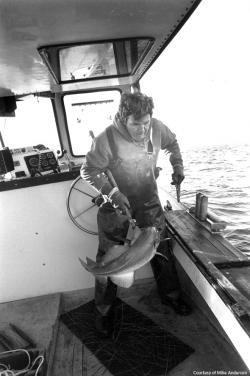
Landing a Cod

Landing a Cod

Mike Anderson lands a cod he caught in the early 1990s using hand-line gear in the nearshore waters off Cape Cod, Massachusetts.

When Mike Anderson arrived in Cape Cod in the 1960s as a young man with dreams of adventures at sea, many people shared the same warning: “You won’t get rich in the fishing business; it’s just a way of life.”

But Anderson, undeterred, embraced that lifestyle, fishing his way through decades of long, sometimes treacherous days at sea in the sun, wind, fog, and ice. His hands toughened like leather as he baited hooks late into the night in anticipation of the next day’s bounty. He relished the challenge of each day, the camaraderie among tough-as-nails fishermen, and the exhilarating adventure of it all.

Anderson, now 72, was part of the glory days of thriving New England fishing towns, when fishermen followed their fathers into the business and old-timers spoke, only half-jokingly, of cod so plentiful one could practically walk across the water on their backs. Back then, despite early signs of decline, people still thought the fish were limitless. Most people, that is, except for Anderson.

He believed trawlers that dragged nets along the ocean bottom, scooping up vast amounts of cod, were capturing too many fish and damaging the seafloor. He stubbornly stuck to hook-and-line fishing, even as nets started sweeping up cod in numbers he’d never seen before. In due time, his two-man crew—which once pulled in thousands of pounds of cod a day and regularly caught fish weighing 40 to 50 pounds—began to see both its catch and the size of the fish decline. By the 1990s, the cod were so sparse and small that Anderson gave up and moved on to other species.

Anderson feels he witnessed the decimation of one of the greatest concentrations of marine life on Earth.

Drying Cod

Drying Cod

A historic photo, likely from the early 1900s, shows cod laid out to dry—a once common sight in New England when the fish were more plentiful.

“The fish never really had a chance,” says Anderson, who still fishes every day, both for the joy of it and to make ends meet. “It was greed, shortsightedness, and naiveté. People misunderstood how many fish there were. The world is finite, and we haven’t got the right to diminish the world.”

A recent study determined that the 2014 cod population on Georges Bank, located off Cape Cod in the easternmost side of the Gulf of Maine, was the lowest ever recorded—roughly 1 percent of what scientists would consider a healthy population. That’s down from the 7 percent reported for 2011. In other waters off Cape Cod, the species is also in dire straits. For the fish that built New England, it’s been a long downward spiral.

Because other species in the region also are in decline, the U.S. Department of Commerce declared a fishery disaster in New England in September 2012, the second such declaration for the region in 20 years. As fish populations have plummeted, fishery managers have shown a consistent pattern of failing to heed warnings from scientists, sufficiently limit catch, promptly pursue corrective actions, and otherwise do what’s needed to help fish populations recover, including protecting the habitat and bait fish that cod rely upon.

It’s high time to finally get it right. We at Pew are urging the New England Fishery Management Council—which sets fishing policies in federal waters (from three to 200 miles offshore), from Maine to Connecticut—to address these critical issues:

First, the council must enact and enforce realistic science-based catch levels. Current methods of setting catch amounts are too permissive. It’s wrong to let people keep fishing for the average amounts they’ve caught in the past when fish numbers are dropping and other environmental factors, such as warming waters, may be putting the fish populations at risk of extinction.

School of Cod

School of Cod

The 2014 cod population on Georges Bank, located off Cape Cod in the easternmost side of the Gulf of Maine, was the lowest ever recorded—roughly 1 percent of what scientists say would be a healthy population.

Second, many cod die because they are caught incidentally as fishermen target other species. Fishery managers still don’t have a good handle on the extent of the problem. It’s hard to set safe catch amounts when it’s unclear how many fish are being taken from the water. Add to that the issues created when some fishermen misreport the areas from which they are taking fish or the size of the fish they take, or underreport their catch, and it’s nearly impossible to see the big picture. Fishery managers have been too slow to ramp up their force of at-sea observers and dockside inspectors to better monitor and resolve these problems.

Third, it’s unproductive for the council to consider lifting protections for important cod habitat when the fish need them most. Decades ago, in response to the fisheries crisis of the early 1990s, the federal government curtailed fishing in 8,887 square miles of New England waters where fish live and spawn, including 26 percent of Georges Bank.

But now, fishery managers propose reducing the protected areas substantially, including a drastic rollback of 81 percent of the protected parts of Georges Bank. Cod used to be spread throughout the Cape; but as the fish grew more scarce, scientists believed they took refuge in limited prime habitat areas within their former range. Fishermen in the past knew these spots and targeted them, further decimating the species. Why would anyone let that happen again?

Mike Anderson

Mike Anderson

Mike Anderson, seen here on the Chatham Fish Pier in 2014, helps educate the public about fishing and related issues as part of the Pier Program, run by the Cape Cod Commercial Fishermen’s Alliance. Millions of pounds of seafood are landed at the pier annually. (Photo via www.fishypictures.com)

Lastly, researchers know cod and other fish are much smaller today than they were decades ago. Although the cause is uncertain, scientists theorize that overfishing and warming waters are playing a role. Researchers are also baffled about what is happening to young fish. Experts know that eggs are hatching and fish are growing for several years, but then they are disappearing. These mysteries are worrisome and deserve more study.

This uncertainty makes it all the more urgent for officials to take a comprehensive view of the ecosystem when setting fishing policies—for example, by weighing habitat, food sources, warming waters, and other factors when making decisions about how to manage a species. Pew is advocating that this approach, called ecosystem-based fisheries management, be incorporated into federal law as Congress renews the Magnuson-Stevens Fishery Conservation and Management Act. You can read more about it in our blog series here.

As for Anderson, he isn’t involved or weighing in on these current-day debates. Rather, the philosopher’s son and English major is penning stories about his life at sea and telling cautionary tales on the fishing docks as part of efforts by the Cape Cod Commercial Fishermen’s Alliance to educate the public about the history and future of the Cape’s small boat fishing industry.

He wants current and future generations to learn from past mistakes. And he hopes New England’s legendary fishing towns can spawn new stories of adventure and plentiful catch, instead of just relying on the memories the old-timers leave behind.

What Is A Florida Manatee?

The Florida Manatee–A Conservation Success Story

By Frank Sargeant, Editor
from The Fishing Wire

The restoration of the Florida manatee is a remarkable conservation success story, though you wouldn’t know it from news reports that continue to bemoan the “disappearing manatee”.

Florida manatee

Florida manatee

The Florida manatee is a conservation success story, with numbers growing to at least 10 times today what they were in the 1970’s thanks to strong support for rules designed to protect them. (Photo Credit Florida FWCC)

From a population roughly-estimated at somewhere around 600 in the 1970’s, the numbers have rebounded to a robust 6,000 or more in 2015, a stunning turnaround. This is particularly so considering that in those years the Sunshine State grew from largely rural, with a population of only about 4 million humans, to almost 20 million in a largely urban environment today.

Close to a million boats ply the waters today, many times the number of the 1970’s, and yet there are at least 10 times the numbers of manatees today that there were 50 years ago.

Manatee conservation clubs, which depend on a disappearing manatee population for funding, pretty much turn themselves inside out to explain how the surveys conducted since the first in January 1991, when there were 1267 counted, to Feb. of 2015, when there were 6063, can be construed as showing anything other than a dramatic increase in populations on both coasts of the state.

Experience on the water bears out the increases–when I first moved to Florida in 1966, I spent nearly a year on the water before I saw my first manatee. Today, it’s difficult to go anywhere on inside waters in the southern half of the state without seeing a half dozen and sometimes many more. This is the experience of virtually all knowledgeable skippers who run in areas where manatees are common.

It’s clear evidence of the potential success of wise conservation policies and regulations, adequately enforced. Boaters and anglers have more than done their part in this restoration–admittedly after a fair amount of bitching and whining. Early on, many of us in the industry felt that laws were placing excessive burdens on the recreational boater and angler, with thousands of acres of water set aside in areas where manatees rarely or never were seen.

Sign

Sign

Signs like this now mark hundreds of areas where boaters are required to proceed at low speed, while many other areas are off limits to boaters completely. (Frank Sargeant photo)

Be that as it may, the broad strokes approach, combined with the persuasive power of Jimmy Buffet and throngs of Parrotheads worked. Thousands of acres of manatee slow speed zones and even no-entry zones are now enforced statewide, and manatee populations are booming. Boaters and anglers, with occasional prodding from the men in the gray suits, respect these zones and enjoy observing the giant “sea cows” more often and at closer range than the many ashore who frequently charge said mariners with being the source of the non-existent population decline.

However, there’s no question that more manatees are dying than need be, and boaters are responsible for a part of those deaths–about 18 to 21 percent in average years. The trend is headed downward, but it’s possible more can be done on our part to secure the gains.

I was fortunate to live for some 20 years on the aptly-named Little Manatee River, where I saw manatees, both little and big, pretty much every day. Some became more or less regular visitors to my dock, passing on the same phase of the tide daily for weeks at a time. One I called Sundown Sam often showed up just before dark, and shared many a philosophical conversation with me. He was a good listener, much cheaper than a psychiatrist, and did not expect tips like a barkeep. (I had suspicions he hung around more because of the leaky freshwater hose on the cleaning table than because of my scintillating speculations and cosmic whinings, but nonetheless he was there for me.)

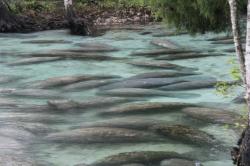
Manatee gatheringIn winter manatees gather by the dozens and sometimes by the hundreds in warm water refuges around the state. (Photo Credit Florida FWCC)

Manatees are not nearly so wild as most terrestrial animals because they have survived for generations without being hunted by humans–they tolerate us well. I watched them feed their young, fight for mating rights (surprisingly violent for the alleged “gentle giants” of the media) and die: from cold, red tide, old age–and yes, on rare occasions, from boat strikes. They are fascinating, improbable animals that seem like they should live in Africa or South America, yet right there they are in Ruskin surrounded by tourists and tomatoes, and all over the southern half of the state, a reminder from Florida’s past of what it was before it became what it is.

The percentage of manatees killed by boat strikes as a percent of the live population has declined steadily for the last 10 years, but the percent of the annual observed mortality, as counted by the FFWCC, has remained fairly flat.

In 2006, 92 of 417 deaths recorded by the FFWCC were the apparent result of boat or propeller strikes, about 22 percent. It was 23 percent in 2007, 27 percent in 2008, 23 percent in 2009.

The 2010 count was an anomaly because of a huge cold kill, with a total of 766 animals dying, so the percentage of boat strike deaths, 83, was artificially low at 11 percent.

In 2011 it was 88 of 451 for 19 percent, in 2012 82 or 392 for 21 percent.

2013 was another untypical year, with 830 animals dying, most from red tide and from pollution in Broward County waters, putting the boating toll of 73 at only 8 percent.

In 2014 the number was 69 of 371, the lowest in recent years, for 18 percent. This year the number has jumped again, as of Dec. 1, to 83 of 383, which if the average holds and there’s no ice storm or massive red tide invasion before year’s end, will be 23 percent. While the percentages are not changing much, manatee overall counts have been climbing steadily in those years, more than doubling. This would appear to mean that boaters are doing a much better job of avoiding collisions with far more abundant animals.

Breathing

Breathing

Though manatees are huge animals, it can sometimes be difficult to see them, particularly when only their nostrils are showing above the surface. (Photo Credit Florida FWCC)

Clearly boaters are no longer the major problem in manatee mortality–in fact, it’s not even close. And manatees are obviously not endangered–they are more likely approaching what biologists call the carrying capacity of their very limited habitat, the narrow grass flats, estuaries and coastal rivers of Florida. They aren’t making any more manatee pastures, but the manatees are definitely continuing to make more manatees.

While the rules of wildlife biology may somehow magically suspend in the case of manatees, in all other species there is a clear, definable limit to the populations–when they eat all the available food, fertility begins to fall, natural mortality increases and the numbers go down–sometimes precipitously if the animals have consumed all the available forage down to the point where re-growth is impossible or takes longer than a season.

Be that as it may, more can be done to lower our part in manatee mortality.

No one better knows where manatees roam than flats angler who spend a lot of time on the water. It’s my experience that the animals often lay up in water 3 to 4 feet deep when resting, and that they use these areas at certain hours nearly every day of a given season–if you know of one of these locations, make your local FWC officers aware of it–and stay clear.

Secondly, of course, learn to see them–for an animal that can weigh over a half-ton, they can be surprisingly invisible at times, particularly when resting. The greatest danger is on the edge of the grass flats, where the animals frequently settle on bottom to sleep. Unmoving, they look like another patch of dark grass in many water conditions and sun angles.

All the well-publicized cautions are also good prevention:

Slow down in areas where you know manatees reside or pass, even if they are not marked manatee zones.

Watch for the boiling swirl, the size of a bath tub, that marks where a manatee tail is powering one of them along bottom.

Keep an eye out for manatee noses ahead–often, they show only a patch of gray skin and nostrils the size of a teacup as they pop up to breath.

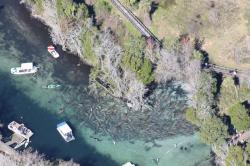
Migration massing

Migration massing

This incredible aerial shot shows the winter massing of several hundred manatees at Three Sisters Spring—there are numerous warm-water refuges like this around the state where the animals gather in cold weather, making counts easier. (Photo credit Florida FWCC)

Always wear polarized sunglasses when operating in manatee waters–they allow you to see through the glare and spot the animals well in advance.

Be aware of manatee movements by season–in winter, hundreds swarm into warm-water sanctuaries like spring outflows and power-plant cooling channels, but they come out daily to feed on nearby flats.

Stay at least 50 feet away from observable manatees. Be aware that there may be other manatees that you do not see close to those you do–operating the outboard can injure these animals.

NO MOTOR ZONES ARE GOOD–SOMETIMES

When Florida first started establishing no-motor zones to protect sea grasses and manatees, boaters and anglers howled (I was among them) because they felt it was restricting their access to thousands of acres of prime fishing. And in a few cases, they were right–the zones were too big, covering a lot of area where manatees were never present, and sometimes in the wrong place to do much good.

But, surprise, no motor zones have another very dramatic effect that benefits anglers–the trout, snook, reds, sheepshead and flounder that are often run off the flats by boats zipping by on plane in 1 to 3 feet of water settle in and become resident in areas where anglers have to enter slowly and quietly by pushpole, paddle or trolling motor.

And their habitat is not being torn up by churning props. The fish move in predictable patterns, they spawn more successfully and their young survive to grow up more frequently. It’s a win for fish, manatees, sea grass and for anglers–in the right places and within reasonable limits, no motor zones are good–very good.

AND FINALLY

In our quest to leave the planet a better place than we found it–one common goal I hope all of us can still agree to in this now sadly-divided country–the manatee restoration marks a milestone. Let’s not guilt ourselves into making it a disaster. Let’s proclaim victory–and not accept it when we hear media reports that begin “With only a few manatees remaining . . . .” or “The disappearing manatee population. . . .” We have done our part. Now let’s call on the media and everyone else to do theirs.

* If you hit a manatee while boating, notifying the FFWCC immediately may give the animal a chance to survive. Here are the contacts:

1-888-404-FWCC (3922)
Cellular phone *FWC or #FWC
http://www.myfwc.com/contact/wildlife-alert/

Should I Use Barbless Circle Hooks?

Catching Fishermen’s Attention with Barbless Circle Hooks

By Joseph Bennington-castro | NOAA Fisheries
from The Fishing Wire

In the summer of 2007, a Hawaiian monk seal got caught on a fishing hook off the coast of the Big Island of Hawai’i.

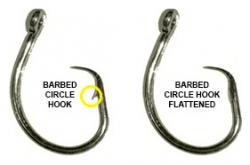
Barbed and barbless hooks

Barbed and barbless hooks

A barbed circle hook converted to a barbless circle hook using a crimping tool to flatten the hook’s barb.

The NOAA Fisheries Big Island monk seal response coordinator and his volunteers rushed out to aid the unfortunate animal, hoping to capture it and carefully remove the hook before the fishing gear could cause any serious damage. But before the volunteers could become rescuers, the monk seal shook its head, easily dislodging the hook in the process.

Was this, somehow, a defective hook?

No. It was a barbless circle hook, or a circle hook whose barb had been forcibly pressed down to reduce the severity of post-hooking injuries to endangered or protected species — such as Hawaiian monk seals and green sea turtles — that are accidentally hooked, and allow them to self-shed the hooks or be de-hooked easier.

This fateful event was a kind of vindication for the then-nascent NOAA Fisheries Barbless Circle Hook Project, which seeks to increase the awareness and use of barbless circle hooks among Hawai’i’s shoreline fishermen. Until this point, many NOAA researchers and fishermen alike questioned whether barbless hooks could really make any difference to protected species and fish that were accidentally hooked, says project manager Kurt Kawamoto, a direct yet welcoming man who tends to express his thoughts succinctly.

Though it seemed that the hooks would work in theory, “everybody was left hanging until that happened,” Kawamoto says. “And then it was like, ‘Okay, here it is. Here’s the proof.'”

The beginning

Aside from managing the Barbless Circle Hook Project, Kawamoto is a fisheries biologist for the NOAA Pacific Islands Fisheries Science Center (PIFSC). “My real job is fisheries monitoring,” says Kawamoto, who holds an undergraduate degree in zoology from the University of Hawai’i.

In this position, he manages the logbooks that fishermen must fill out while working in federal fisheries. These logbooks contain information on everything from the species of fish caught, to the fishing methods used, to the protected species disturbed during fishing practices. This data is available to PIFSC scientists who are conducting research on stock assessments and other things — the information is then used in fisheries-management decisions.

 Barbless Circle Hook Project

Barbless Circle Hook Project

Left to right: NOAA Fisheries’ Kimberly Maison, Mike Lamier and Kurt Kawamoto, along with DLNR’s Earl Miyamoto in front of the Barbless Circle Hook Project booth at a Lāna’i fishing tournament in 2009. Credit: NOAA Fisheries.

Before joining NOAA Fisheries 28 years ago, Kawamoto was a commercial fisherman himself. “I’m still a commercial fisherman,” he says. “But commercial fishing is very difficult and dangerous, and it’s hard to do when you get older.”

It was his background as a fisherman that may have ultimately allowed Kawamoto to develop the Barbless Circle Hook Project.

After a fisherman accidentally hooked a monk seal in the early 2000s, NOAA Fisheries held a meeting to discuss how to prevent this from happening again and help fishermen decrease their impact on protected species. Kawamoto was invited to this meeting because he’s a fisherman.

Before the meeting, switching to barbless circle hooks came to mind as a solution to the problem, Kawamoto says. “What else were we going to do? Shut down shoreline fishing?” Immediately after this meeting around 2005, he approached then-PIFSC director Sam Pooley with the idea of creating an outreach program to convince local fishermen to use these safer hooks, and sought financial support for at least 5 years.

“And he said, ‘OK.'” Kawamoto says. “That was it. And off I went.”

Getting off the ground

In Hawai’i, anglers predominately use circle hooks, particularly because they’re most suited for fishing the rugged near-shore areas around Hawai’i and for catch-and-release fishing, Kawamoto says.

Compared with the aptly named J-hooks, which can easily hook onto a fish’s innards and cause internal damage, circle hooks are self-setting and are designed to catch in the corner of the mouth as the fish swims away. What’s more, circle hooks are far less likely to get stuck on the bountiful reef and rocks along Hawai’i’s shoreline.

Ulua on circle hook

Ulua on circle hook

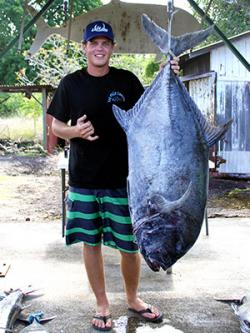
Ulua caught by Stephen Kilkenny with a barbless circle hook. Credit: Austin Kilkenny

Barbless circle hooks, however, are not manufactured or sold in the islands, so fishermen who want to switch to these hooks need to make their own — an easy, free process that only requires smashing down the barb (located near the tip of the hook) with a bench crimper or pliers.

A preliminary study presented at a conference in 2006 — shortly after the barbless project kicked off — suggested there is no difference between the effectiveness of barbed and barbless circle hooks in catching and landing various types of fish in Hawai’i. And in that same year, a local fisherman named Randall Elarco Jr. caught a 117-pound ulua (giant trevally) using a barbless circle hook — then-Mayor Mufi Hanneman later presented Elarco with the first “100-pounder” NOAA Barbless Circle Hook award.

“Just before that I was thinking, ‘What’s a milestone for the project?'” Kawamoto recalls. “And I would say to myself, ‘A 100-pounder would be really nice.’ The shoreline guys always want to catch a 100-pounder because it’s the equivalent of a troller catching a 1,000-pound marlin.”

Still, getting people to use the barbless circle hooks was an uphill battle from the get-go. Changing a person’s habits and perceptions is no simple matter, especially when that change appears risky. Fishing is the livelihood for many anglers, so the prospect of using a modified hook and not catching anything with it scares them, Kawamoto says.

Kawamoto, however, was up to the task, using a common-sense, honest approach to help win people over.

When he first started the project, Kawamoto made sure to exclusively use barbless circle hooks when he fished, allowing him to communicate his own experiences to fishermen. “It was very important to me, personally, to lead by example and to know what the fisherman might expect,” he says, adding that honesty and integrity were vital for getting fishermen’s cooperation. “Without that trust, I would have had nothing but words and theories.”

“He is so well known and respected by the fishermen,” says Earl Miyamoto, coordinator of the Marine Wildlife Program of the State of Hawai’i’s Department of Land and Natural Resources, who has successfully partnered with Kawamoto on the barbless project for nine years, helping to expand the crucial outreach efforts. “He would be a hard person to replace.”

And when clout and common sense isn’t enough, Kawamoto has persistence. In one early case, he spent four years trying to convince a fisherman to try out a barbless circle hook — he finally succeeded by jokingly questioning the fisherman’s courage.

“If I were to put my finger on it, I would say it’s the way he engages with people that convinces them,” Miyamoto says. “I think its Kurt’s directness and forwardness, and how he jokes a lot. He can come off as being serious, but he laughs a lot.”

Ever the modest person, Kawamoto stresses that “open-minded fishermen,” who are often part of the older generation of fishermen, also deserve credit for enacting change in the community. These people, he says, adopted the barbless circle hooks early on and even took to mentoring younger anglers.

“It’s not just me,” Kawamoto says. “I want to thank all of the anglers out there who have tried these hooks.”

Convincing the masses

To increase fishermen’s awareness of barbless circle hooks, Kawamoto is involved in various outreach activities. Grassroots help from many clubs, organizations, and individuals, including PIFSC volunteers, keep the project moving forward and enable the common-sense message to be integrated into public awareness.

For instance, Kawamoto and his collaborators attend events at numerous adult and keiki weekend fishing tournaments across the islands each year, and also work closely with the fishing clubs that often organize these tournaments.

“But we don’t go any place where we aren’t invited,” Kawamoto stresses. “Because you don’t want to go there and push your way in — that’s the quickest way to turn people off.”

Giving up weekends for these tournaments speaks volumes to the fisherman, Miyamoto says, adding that Kawamoto makes sure to come in “very local style,” arriving early and staying late to help setup and dismantle the tournament equipment. “It’s that approach and demeanor that’s contributed a lot of the success of the project,” he says.

100  Pound Ulua

100 Pound Ulua

Stephen Kilkenny with a 102.3 pound ulua, which he caught using a barbless circle hook in 2015. This catch is the third 100-pounder for the Barbless Circle Hook Project. Credit: Austin Kilkenny

Of course, the fact that the barbless circle hooks actually work also helps — fishermen using the hooks sometimes sweep the tournaments, taking the 1st-, 2nd-, and 3rd-place prizes in the top money-winning categories, Kawamoto notes. Furthermore, two additional 100-pounders have been caught with the hooks since the first one in 2006.

Aside from attending fishing tournaments, Kawamoto and his volunteers frequently show up at different ocean and fishing expos when they can. At these outreach events and tournaments, they hand out free barbless circle hooks, about 20,000 to 25,000 each year, Kawamoto says.

Kawamoto and Miyamoto attend established keiki events, during which Miyamoto takes the lead in holding a “Make It and Take It” activity. Here, they teach keiki how to make their own small barbless hooks using just pliers, and also give them take-home kits, which include fishing start-up information, protected species information and regulations, and a sampling of barbless hooks.

“That’s how we’re going to change people’s minds — with the kids,” Kawamoto says, adding that the kits are just as much for the keiki as they are for the parents.

At their various engagements, Kawamoto and his collaborators teach people about the benefits of going barbless. Over the years, the focus of this message has shifted from protected species to fish.

“Although we did focus a lot on the protected species problem at the start, the bigger thing that we keep telling the fishermen — and this is true — is that they interact with so much more fish than protected species,” he says. “After all, we’re fishermen and we want to catch fish.”

Sometimes fish get away because the line breaks, but they still have the hook in their mouths. If this circle hook is barbless, however, the fish can get it out sooner, allowing it to get back to eating quicker, improving its chance of surviving and getting caught again another day.

Additionally, many anglers target certain fish and release unwanted species that are accidentally caught — the barbless hooks allow them to de-hook the fish easier, resulting in less personal frustration and injury to the animal.

Kawamoto estimates that only a small percentage of fishermen use barbless circle hooks all the time, and that the lowest usage rates are among the general fishing public, who are not part of fishing clubs and tournaments. Still, he’s optimistic that barbless circle hooks will catch on with time. “We have made a lot of strides in getting people to use it,” he says.

Miyamoto is also hopeful about the project, and believes Kawamoto’s courteous nature — particularly how he sends out “thank you” emails after each event — will get them far.

“I don’t know if we’d be where we are were it not for that and him,” Miyamoto says. “He’s so unique to the program. It’s not just a job for him.”

What Is In Chesapeake Bay Predators’ Diets?

Little things turn out to be big deals in Chesapeake Bay predators’ diets

Today’s feature comes to us from Karl Blankenship, long-time editor of Bay Journal, detailing a topic that is beginning to be understood as critical to gamefish populations everywhere—the forage the fish eat.

Analysis finds invertebrates, tiny anchovies are critical in Chesapeake food web

By Karl Blankenship, Editor
Bay Journal; www.bayjournal.com.

Menhaden are caught in a purse seine net

Menhaden are caught in a purse seine net

Menhaden are caught in a purse seine net. An analysis of the diets of five major Bay predators found that menhaden was important for only one, striped bass, and even for them, the bay anchovy was more important. (Dave Harp)
t-studied estuary in the world, but a group of scientists attending a recent workshop were surprised about how little they knew about what predatory fish eat.

After all, menhaden — dubbed by some as the “most important fish in the sea” would also be the “most important” fish in the Bay, right?

Apparently not. That honor, were one species to be singled out, might belong to the tiny bay anchovy — a fish that rarely grows more than 3–4 inches in length and typically doesn’t live longer than a year.

“They’re the most abundant fish in the Bay,” said Ed Houde, a fisheries scientist with the University of Maryland Center for Environmental Science, who helped organize the workshop. “They’re really important in the Bay’s food web.”

An analysis of 12 years of Baywide diet information for five major predators prepared for the workshop found that bay anchovy was a significant portion of the diet for four of those species. Menhaden was important for only one, striped bass, and even for them, bay anchovy were more important.

“Menhaden came out not as high on the list as people thought it was going to be,” Houde said. “It was an important prey, but it certainly wasn’t in the top three or four.”

Even more significantly, the analysis showed that the Bay’s food web is less of a fish-eat-fish world than popularly thought, even among many scientists. A host of unheralded species, from worms to clams to crustaceans, are major food sources for the Chesapeake’s predatory fish.

Those were some of the findings that came out of the workshop conducted by the Bay Program’s Scientific and Technical Advisory Committee late last year. The workshop focused on the question of whether the Bay produces enough food, or “forage,” to adequately support its predator population. The workshop stemmed from a commitment in the 2014 Chesapeake Bay Watershed Agreement that called for assessing the “forage fish base.”

It’s a question conservation groups, scientists and fishery managers are increasingly asking for oceans and coastal areas around the globe: Are there enough herring, anchovies, menhaden and similar species to feed predatory fish, marine mammals, fish-eating birds and, in many cases, to support major fisheries?

It was once thought those small schooling fish were so abundant that they could not be overfished. Around the world, they account for about a third of all fish harvested, after which they are processed for oils, fish meal, livestock feed and other products. A 2012 report by the Lenfest Forage Fish Task Force, prepared by scientists around the world, including Houde, called for global harvests to be cut in half to protect both forage species and the many predators that depend upon them.

Similar questions about the forage base have been raised around the Bay. Anglers have complained for years that striped bass were underfed because of a lack of menhaden, and watermen have contended that large numbers of striped bass and other fish looking for food ate too many blue crabs.

Fishery management over the years has sought to maximize the production of predators like striped bass. Other predators have been introduced, sometimes accidentally, such as snakeheads, at other times deliberately, to give anglers new pursuits, such as blue catfish and flathead catfish.

Populations of many fish-eating birds, including bald eagles, osprey, great blue herons and cormorants are at or near record highs, at least compared with recent decades. Meanwhile, some prey thought to have been important historically, such as river herrings and American shad, are at historic lows.

Invertebrates ‘key’ food source

The forage workshop, which followed the new Bay agreement commitment by a few months, was aimed at reviewing what data were available about forage in the Bay and identifying new information that might be needed to guide future forage fish management — and to ensure high and sustainable production of their predators.

But along the way, workshop organizers began to realize that in the Chesapeake, the emphasis just on “forage fish” might be less important than it is for some other areas.

That stemmed from an analysis done for the workshop that examined the diets of five predators thought to be good indicators of predator food demand in different areas around the Bay. The predators in the analysis included striped bass, summer flounder, Atlantic croaker, clearnose skate and white perch.

The analysis drew on 12 years of data from the Chesapeake Bay Multispecies Monitoring and Assessment Program (ChesMMAP), conducted by the Virginia Institute of Marine Science, which collects fish at locations from the mouth of the Bay to near Baltimore five times a year.

Since 2002, the survey has captured 391,000 fish, and measured 285,000. Biologists have examined the stomach contents of more than 35,000 fish, representing 94 species, to determine what the fish had been eating.

A type of forage was considered “important” if it accounted for more than 5 percent of the food in any predator species in at least one survey. It was “key” if it accounted for 5 percent in more than one predator.

More than half of the 20 forage groups identified as “key” or “important” turned out to be invertebrates such as mollusks, worms and crustaceans.

For instance, mysids, a small shrimp-like crustacean, was the most common food consumed by summer flounder, measured by weight, the second most common consumed by striped bass, and the third most common prey of Atlantic croaker. Polychaete worms were the most common prey of Atlantic croaker and white perch, and the third most important for striped bass.

In other coastal areas, “the invertebrates are not the big issue — it is the small schooling herring and anchovies or what have you,” said Tom Ihde, an ecosystem modeler with the National Oceanic and Atmospheric Administration Chesapeake Bay Office, who helped organize the workshop.

Forage fish vs. forage base

Bay Anchovy

Bay Anchovy

In real life, the bay anchovy behind Ed Houde, a fisheries scientist with the University of Maryland Center for Environmental Science, only grows to be 3–4 inches long. (Dave Harp)

Ihde and Houde said much of the previous work concerning forage has focused on predators in ocean fisheries. Those fish are often larger, and primarily consume small fish. Also, much of that focus has been in places such as the West Coast, which lack large estuarine feeding grounds like the Chesapeake Bay.

In the Chesapeake, the predators are often smaller — the largest striped bass generally are here only a few weeks of the year to spawn — and much of the food of the smaller, resident striped bass consists of a variety of bottom-dwelling organisms. As a result, what started out as a discussion aimed at addressing forage fish turned into one focused on the entire forage base.

In fact, the importance of soft-bodied organisms like worms is likely understated when fish stomach contents are examined, Ihde said. “Some of these invertebrates are digested quickly and are probably even more important than our analysis would show because they very quickly turn into unidentifiable goo,” he said.

That said, workshop participants said in their recently released report that menhaden should still be considered a key forage species because the species is important to large striped bass for whom the Bay is a critical spawning area, even if they are only here part of the year. Menhaden are also considered important prey for larger individuals of other large predatory fish such as weakfish and bluefish. And menhaden are likely important for other species, such as fish-eating birds, workshop participants said.

“There’s a general perception that it is all about menhaden,” Ihde said. “They are important. But we can’t forget about all these other things that in some cases are more important to our current system.”

And those other things add to the complexity of understanding, and ultimately trying to manage, the Bay’s food web.

Some organisms not typically thought of as forage turned out to be important in the Bay, such as the young of croaker, weakfish and spot — adults of which are generally considered predators.

“It was a big surprise to me to see something like young-of-the-year weakfish show up as one of the more important prey in the diets of predators,” said Houde, who has participated in several forage fish studies in recent years.

Scant data for tributaries

But the total picture is far from complete. The ChesMMAP surveys only cover the mainstem of the Chesapeake. There is little information available about tidal tributaries.

Those areas are important nurseries for many fish — and are also home to a rapidly growing population of predatory blue catfish. Although some studies are under way to better understand the diet of blue catfish, much less is known about the forage base and food demand by predators in those areas.

Because of those limitations, workshop participants suggested the data from ChesMMAP may under-represent the importance of some forage species such as American shad, river herrings, mummichog, killifishes, gizzard shad, silversides and some small bivalves, which tend to be found in low-salinity areas.

Even less is known about shallow water of less than 2 meters, especially in habitats such as underwater grass beds and marshes, which biologists think may be particularly important for forage production, and where survey boats have a hard time operating.

And the ChesMMAP data have their own limitations. It is a trawl survey, so it collects fish mainly from the bottom, and collections from its gear under-represents both the largest and smallest fish.

The survey is being modified in coming years to collect more samples from higher in the water column and from the benthic invertebrate communities at its collection sites.

While that should refine its information, it is not likely to dramatically change overall conclusions, as other — albeit smaller — surveys examined in the workshop analysis found similar results.

“Our hope is it will lead to a much better understanding of the ecosystem,” said Chris Bonzek, the VIMS scientist who oversees the ChesMMAP survey and who prepared the forage analysis for the workshop. “But we are not going to all of a sudden see that bluefin tuna are the most important predator in the Bay.”

A more complete picture

Because predators are eating so many types of prey — many of which are poorly studied — it’s difficult to characterize the current status of the Bay’s forage base. But, with support from the Bay Program’s Sustainable Fisheries Goal Implementation Team, Houde and several colleagues are reviewing existing information to start piecing together a more complete picture of forage abundance and predator demand.

With information gleaned from the ChesMMAP analysis and other sources, they are assessing the relative abundance of different forage groups in regions of the Bay to see if there are trends in the overall amount and availability of prey, or in the relative abundance of the different types of forage.

In addition, they are looking at stomach content data from major predator fish species to begin to estimate the amount and kinds of forage they are consuming.

That information will start addressing the fundamental questions of how much forage is consumed by predators, what type of forage is most important in different regions of the Bay and how much change has taken place over the years. Ultimately, it will help answer the question of how much food is needed to support the Bay’s predators, both now, and in the future.

“While we are not close to getting that answer, it is the direction we are heading in,” Houde said. “Providing estimates of consumption and forage demand is something we would like to be able to deliver to managers in the next decade.”

A ‘balanced’ ecosystem

Figuring out how to use that information to maintain a “balanced” ecosystem will be a challenge for managers as populations of many forage species vary widely. For instance, the numbers of bay anchovy can fluctuate tenfold from year-to-year — they can live up to three years, but most are eaten by predators within a year — so the relative success of annual reproduction drives their overall abundance. Likewise, the numbers of young croaker, weakfish and spot available to be eaten depend on year-to-year reproduction success.

When the issue moves beyond fish to the broader forage base, the level of complexity increases. Many bottom-dwelling species can be sensitive to extended periods of low oxygen, so a large seasonal “dead zone” can reduce overall abundance, and even eliminate species, from some areas. “If it is a bad hypoxia year, the benthic invertebrates cannot get up and swim away like the fishes,” Ihde said.

The loss of underwater grass beds, coastal marshes and oyster reefs have reduced the amount of habitat available for many forage species. The hardening of shorelines, development of land adjacent to the Bay and its tributaries, sea-level rise and climate change will likely cause continued habitat losses, the workshop report said.

At the same time, predator populations are constantly changing — and not just the fish.

Around the Bay, the populations of fish-eating birds such as eagles, osprey and blue herons are large — and growing. The Bay’s population of double-crested cormorants, which was almost nonexistent four decades ago, is nearly 5,000 today. That’s enough cormorants to consume 300 tons of fish annually, according to the workshop report.

Overall, the fish demand of birds around the Bay is largely unknown, Houde said. Birds, though, could be one of the first indicators of stress if there were a problem with the Bay’s forage base. Houde noted that research in other areas has shown that when forage fish populations decline by a third of unfished levels, the populations of fish-eating birds may drop precipitously.

Protecting forage fish

Other than menhaden, most of the forage species in the Bay are not actively managed fishery species. Menhaden have been increasingly regulated in recent years by the Atlantic States Marine Fisheries Commission, which manages migratory fish along the coast. The commission is working to establish new harvest goals in the next several years that recognize the role of menhaden as prey for predators.

The abundance of other forage can be influenced by a range of actions aimed at improving environmental conditions and protecting habitat, the workshop report said.

For instance, reducing nutrient pollution could reduce the size and duration of dead zones — Bay water quality standards were written to promote a greater diversity of benthic creatures as well as larger, longer-lived species.

Other actions can help protect habitat important for forage species, the report said, such as limiting the use of bulkheads and other hardened shorelines that degrade local habitats, and controlling development near the shore, which is increasingly linked to the lost or reduced production of benthic species.

Forage could also be protected by reducing some predator fish populations, such as snakeheads or blue catfish, but managers have little control over other predators, such as birds.

But the emerging information could offer other opportunities for management. The recognition that the little bay anchovy plays a relatively big role in the Bay food chain could promote efforts to better understand it, Houde said.

“The anchovy is so tiny that most people have discounted it as the target of a directed fishery,” he said, “but there have been proposals for bay anchovy fisheries in other areas along the Atlantic coast.”

Although he said such a proposal is unlikely for the Bay, fishery managers might want to consider policies to prohibit a future fishery in recognition of the bay anchovy’s importance to other species.

“Sometimes,” he said, “in the case of a forage fish, it is easier to develop and implement management policies before there is a fishery.”

The workshop report, “Assessing the Chesapeake Bay Forage Base: Existing Data and Research Priorities,” is found at the Scientific and Technical Advisory Committee website, chesapeake.org/stac/; click on “publications.”

The Bay Program’s management strategy for its forage fish outcome is found at chesapeakebay.net/chesapeakebaywatershedagreement/goal/sustainable_fisheries.

What’s on the menu for Bay’s predators

Drawing on information from the Scientific and Technical Advisory Committee’s workshop report, the Management Strategy for the Chesapeake Bay Watershed Agreement’s Forage Fish outcome preliminarily identified these as the Bay’s key forage species and groups for a wide variety of predators:

Bay Anchovy
Polychaetes
Mysids
Amphipods
Isopods
Mantis Shrimp
Young Spot
Young Weakfish
Sand Shrimp
Young Atlantic Croaker
Razor Clams
Atlantic Menhaden

These species were recognized as potentially important forage groups or species, but were not identified as the top contributors to the diets of predatory fish by information presented at the workshop:

American Shad
River Herring
Atlantic Rock Crab
Atlantic Silverside
Blackcheek Tonguefish
Blue Crab
Flounders
Gizzard Shad
Kingfish
Lady Crab
Macoma Clams
Mud Crab
Mummichog
Killifishes
Small Bivalves

Carl Blankenship

Carl Blankenship

About Karl Blankenship
Karl Blankenship is editor of the Bay Journal and Executive Director of Chesapeake Media Service. He has served as editor of the Bay Journal since its inception in 1991.

Read more about Chesapeake Bay at www.bayjournal.com.

Snake Week!

The third week of September started out as snake week for me. On Sunday I came home from a tournament at West Point and backed my boat into the garage. After taking some things in the house I unhooked the boat and something just didn’t look right under the boat. When I looked closer there was a four foot long black snake slowly crawling across the floor.

Monday I was cutting the field at my farm and on one pass I noticed something white where I had cut on the last pass. It was a three foot long black snake that had gotten too close to the bush hog blade. Laying on its back, its white belly really stood out.

I hated to kill the one at the farm and did not bother the one in my garage. Snakes won’t bother you if you leave them alone and they eat mice and other vermin. I have always been interested in snakes and they don’t worry me much.

The two in September were both what we called “black runners” when I was growing up on the farm. We liked having them around the chicken houses since they ate the rats that ate the chicken feed, but they could be a problem since they would eat eggs, too.

My mom was terrified of snakes and dad would sometimes walk into the house with a king snake wrapped around his arm. We knew king snakes were good snakes since they ate rats and would kill poisonous snakes. He taught me how to identify dangerous snakes and how to catch the non-poisonous ones.

The church I attended had an old pond behind it. The concrete dam had a square overflow spillway and the water in it was about 15 feet down since the pond had been drained. We used to go out there and play after church.

One day when I was about 12 years old we went back there a water snake was trapped in the spillway. I went home and made a snake catcher, a long pole with a cord running down its side through staples and had a loop at the end. I rode my bicycle back to the church the next day, taking my snake catcher and an old metal minnow bucket, the kind with a top that had a clip to keep it closed, with me.

The snake was still there and I managed to catch it with the loop. It was not happy but I got it in the bucket and took it home. Mom was not happy with my new pet!

I tried to keep that water snake in a wooden box but the next day it was gone. I am pretty sure it got out on its own and my mom didn’t make dad release it. Snakes can get through a tiny hole, much smaller than you would think.

I don’t even kill poisonous snakes unless they are a problem. A couple of years ago I was fishing at my pond and noticed a snake head at my fish basket. I picked up a stick and shooed it away but it came right back. The second time I ran it off I saw it had a triangular head, the sign of a viper. It was a young cotton mouth.

The third time it came back I got my pistol out of the truck and shot it in the head, since I did not want to be worried about a poisonous snake at my feet while I fished. Since I like to eat anything I kill I skinned it, much easier than I expected after cutting off its head, gutted it and cut it into four inch long pieces.

It tasted pretty good after flouring it and frying the pieces, but since it was only about three feet long there was not much meat on it.

One snake almost gave me a heart attack. I came home from work one sunny early spring day back in the 1980s and decided to walk through the garden. As I took a step I realized I was about to put my foot on a huge black snake lying in the sun and did a one leg hop about three feet back.

That snake lived around my house for years and I saw it fairly often. One day my dog kept barking at something under the deck and when I looked it was coiled on one of the supports in the corner of the deck. And I would see it sunning on some days in the garden. I watched carefully where I stepped after the thrill of almost stepping on it.

One day I was working on my well pump, kneeled on the floor of my well house. I had been in and out several times getting tools but one time when I stood up, on a shelf at eye level, there was a snake skin on it. It had not been there when I had kneeled by the pump a few minutes earlier.

That big black snake had shed its skin right over my head. The skin was perfect, you could see the bumps on the head end where its eyes had been. That six foot, two inch skin was pinned on my wall for several years.

Snakes are good in many ways so don’t fear them, just respect them and what they do. Find out about them and realize they are just part of the natural world.

What Are Giant Grouper?

Times Changing for Giant Grouper

By Rodney Smith, www.rodneysmithmedia.com.

Landing a giant grouper

Landing a giant grouper

Handling Giant Grouper Carefully is a Mighty Task

It might as well have been the Loch Ness monster I stood over, except there was nothing either anecdotal or mystical about this giant sea monster; it was real! The rotting carcass of what was then called a jewfish, estimated to weigh over six-hundred pounds, lay before me in the wet Gulf of Mexico sands near the base of the Pier Kahiki, which was part of a Hawaiian-themed complex at Indian Rocks Beach. The high tide had dumped the decaying beast there after fishermen had caught it using a hand gaff-sized steel hook baited with a football-sized black drum. The hook was attached to a short 3/8″ steel chain, which was tied to a sturdy hemp rope they had secured to the pier’s railing.

Once I was up and on the pier’s deck, I overheard the crusty dock manager, Joe, chuckling and talking through the cigar permanently clenched in his broad, crooked mouth to a couple of tourists. “It took six of them men to pull it to shore” he was telling them. Later, when I asked Joe why they wasted such a giant fish, he followed his normal method of operation, spitting his words in my direction. “Boy, them big fish ain’t any good; anyway, they took the cheek meat with’em.”

It was the late Sixties, a time of ignorant bliss, well before most fishermen understood our oceans’ bounties were not finite. Less than a decade later, I believe it was the summer of 1975, during one of my first surfing trips to Sebastian Inlet State Park, I saw three Volkswagen Bug- sized grouper swimming along the bottom of the inlet’s main channel. Their size was amazing and unbelievable. This was the last time I saw any truly giant jewfish.

Looking back at how drastically fisheries management has changed, it might as well have been a hundred years ago. Today jewfish have been officially renamed goliath grouper. Since 1990, these remarkable fish have been fully protected in the U.S.A as a “no take” fish, and their numbers continue to grow. In fact, goliath grouper have rebounded to the point that segments of the angler population find them to be quite the nuisance.

Acting like protected California seals, goliath grouper hang out at places where they know they can steal angler’s catches. Their thieving habits alone have partially fueled a push to remove a couple of layers of Federal and State regulations protecting these endangered fish. Less restrictive rules could give fisheries managers several keen opportunities to raise research money and fisheries datum, or find ways to better protect habitat and build artificial reefs.

States like Florida could sell goliath grouper kill-tags, much like special hunting permits. They could open up a couple of goliath grouper short seasons and help the recreational sports fishing industry raise revenue. This strategy could pump major bucks into coastal fishing communities around the Sunshine State and help researchers and scientist collect valuable data. It could be a “win/win” for everybody!

However, there are serious obstacles standing in the way of this idea. Fisheries biologists understand the complexities of protecting the sustainability of these potentially huge, but slow- growing fish better than most of us. They will tell you we must protect the biggest goliath groupers or they will never return to their historical size and range.

There are two things I’ve learned about fisheries management as a member of the South Atlantic Fishery Management Council’s Snapper/Grouper Advisory Panel. Management of our fisheries and other marine resources is most often driven by money and greed, and secondly, I now understand why the following statement is true. Fisheries management isn’t rocket science, it’s worse!

To read more like this, visit www.rodneysmithmedia.com.