Category Archives: Conservation

Shark Facts


12 Shark Facts That May Surprise You
From NOAA Fisheries
from The Fishing Wire

1. Sharks do not have bones. Sharks use their gills to filter oxygen from the water. They are a special type of fish known “elasmobranch”, which translates into fish made of catilaginous tissues—the clear gristly stuff that your ears and nose tip are made of. This category also includes rays, sawfish, and skates. Their cartilaginous skeletons are much lighter than true bone and their large livers are full of low-density oils, both helping them to be buoyant. Even though sharks don’t have bones, they still can fossilize. As most sharks age, they deposit calcium salts in their skeletal cartilage to strengthen it. The dried jaws of a shark appear and feel heavy and solid; much like bone. These same minerals allow most shark skeletal systems to fossilize quite nicely. The teeth have enamel so they show up in the fossil record too.Scalloped hammerhead shark.

2. Most sharks have good eyesight. Most sharks can see well in dark lighted areas, have fantastic night vision, and can see colors. The back of sharks’ eyeballs have a reflective layer of tissue called a tapetum. This helps sharks see extremely well with little light.A night shark’s green eye.3. Sharks have special electroreceptor organs.Sharks have small black spots near the nose, eyes, and mouth. These spots are the ampullae of Lorenzini – special electroreceptor organs that allow the shark to sense electromagnetic fields and temperature shifts in the ocean.4. Shark skin feels similar to sandpaper.Shark skin feels exactly like sandpaper because it is made up of tiny teeth-like structures called placoid scales, also known as dermal denticles. These scales point towards the tail and help reduce friction from surrounding water when the shark swims.Sandbar shark skin.

5. Sharks can go into a trance.  When you flip a shark upside down they go into a trance like state called tonic immobility. This is the reason why you often see sawfish flipped over when our scientists are working on them in the water.Tagging smalltooth sawfish Florida Everglades6. Sharks have been around a very long time.Based on fossil scales found in Australia and the United States, scientists hypothesize sharks first appeared in the ocean around 455 million years ago.Grey reef shark.

7. Scientists age sharks by counting the rings on their vertebrae. Vertebrae contain concentric pairs of opaque and translucent bands. Band pairs are counted like rings on a tree and then scientists assign an age to the shark based on the count. Thus, if the vertebrae has 10 band pairs, it is assumed to be 10 years old. Recent studies, however, have shown that this assumption is not always correct. Researchers must therefore study each species and size class to determine how often the band pairs are deposited because the deposition rate may change over time. Determining the actual rate that the bands are deposited is called “validation”.

8. Blue sharks are really blue. The blue shark displays a brilliant blue color on the upper portion of its body and is normally snowy white beneath. The mako and porbeagle sharks also exhibit a blue coloration, but it is not nearly as brilliant as that of a blue shark. In life, most sharks are brown, olive, or grayish.Blue shark.

9. Each whale shark’s spot pattern is unique as a fingerprint.  Whale sharks are the biggest fish in the ocean. They can grow to 12.2 meters and weigh as much as 40 tons by some estimates! Basking sharks are the world’s second largest fish, growing as long as 32 feet and weighing more than five tons.Whale shark.

10. Some species of sharks have a spiracle that allows them to pull water into their respiratory system while at rest. Most sharks have to keep swimming to pump water over their gills.A shark’s spiracle is located just behind the eyes which supplies oxygen directly to the shark’s eyes and brain. Bottom dwelling sharks, like angel sharks and nurse sharks, use this extra respiratory organ to breathe while at rest on the seafloor. It is also used for respiration when the shark’s mouth is used for eating.Nurse shark.

11. Not all sharks have the same teeth. Mako sharks have very pointed teeth, while white sharks have triangular, serrated teeth. Each leave a unique, tell-tale mark on their prey. A sandbar shark will have around 35,000 teeth over the course of its lifetime! Shortfin mako shark.12. Different shark species reproduce in different ways. Sharks exhibit a great diversity in their reproductive modes. There are oviparous (egg-laying) species and viviparous (live-bearing) species. Oviparous species lay eggs that develop and hatch outside the mother’s body with no parental care after the eggs are laid.

Shortfin mako shark.

Over-harvest Causing Walleye Decline


U. of Wisconsin Study Says Hidden Over-harvest Causing Walleye Declines
A new study by UW–Madison Center for Limnology graduate student Holly Embke shows that the state’s walleye fishery is being overharvested at a rate ten times higher than fishery managers anticipated.
By Adam Hinterthuer, University of Wisconsin
from The Fishing Wire

A new study by UW–Madison Center for Limnology graduate student Holly Embke shows that the state’s walleye fishery is being overharvested at a rate ten times higher than fishery managers anticipated. Over the last few decades, walleye in Wisconsin have been on a downward trend. As lakes in the upper Midwest warm due to climate change, this cool-water species has found itself with less habitat in which to thrive. Add in factors like lakefront development and loss of shoreline habitat, and the iconic fishery isn’t what it used to be.

Despite this decline, the fish remains as popular as ever with anglers. Though they are catching fewer individual fish than before, the percentage of walleye that state and tribal resource managers allow to be harvested each year has stayed about the same.

Given the cultural and economic importance of this inland fishery, it’s time to reassess current regulations, says University of Wisconsin–Madison Center for Limnology graduate student, Holly Embke, lead author of a study published this week [Nov. 18, 2019] in the Proceedings of the National Academy of Sciences. It finds that “40 percent of walleye populations are overharvested, which is ten times higher than the estimates fisheries managers currently use,” she says.

A big reason for this “hidden overharvest,” says Embke, is that, for the last 30 years, resource managers have focused on fish abundance and not fishery productivity when calculating harvest limits.In the late 1980s, after a U.S. District Court judge ruled that federal treaties gave Ojibwe tribes the right to hunt and fish in their former territories, the Wisconsin Department of Natural Resources (DNR) and the Great Lakes Indian Fish and Wildlife Commission were tasked with working together to set sustainable harvest limits on walleye for both recreational and tribal fisheries.

These fisheries today consist of more than 1 million recreational anglers who account for about 90 percent of the total annual harvest on the state’s 900 “walleye lakes.” The other 10 percent comes from the 450 tribal members who spear walleye on roughly 175 lakes each spring.Using the best available science at the time, the agencies developed a management plan based on fish abundance. They used adult walleye population estimates to set regulations that ensured a maximum harvest amount of 35 percent of the adult walleye in any given lake. The average exploitation rate for walleye stocks is closer to 15 percent, so the agencies assumed these regulations were sufficiently conservative to be sustainable.

These regulations “worked for a long time,” says co-author Steve Carpenter, director emeritus of the Center for Limnology, “and then they stopped working. Over the last couple of decades, there began to be walleye recruitment failures scattered around the state.”In these last few decades, annual walleye production in many of the state’s lakes has declined by 35 percent. On top of that decline, walleye stocks now take one and a half times longer to replenish themselves than they did in 1990.

State fisheries managers responded by changing angler regulations to protect large female walleye, boosting walleye populations by stocking hatchery-raised fish in struggling lakes, and managing individual lakes according to their productive capacity, says Greg Sass, fisheries research team lead in the DNR’s Office of Applied Science. But these efforts didn’t reverse the broader walleye decline.

So, Embke and her colleagues set out to better understand other factors fisheries managers might consider when setting harvest rules. By focusing on production, they hoped to get a clearer picture of how well populations withstand fishing pressure and continue to reproduce and grow.“We wanted to take a more nuanced approach and ask not only how many fish are in a lake but also consider how fast they’re growing, how big they are, and how many are produced every year,” she says.

One way to think of it, Embke says, is in terms of a bank account. “Abundance tells you the money in the bank while production tells you the interest rate,” she says.In other words, if you start taking more money out of your account than the interest rate contributes each year, your savings shrink. Do this several years in a row, and those annual withdrawals begin to have an outsized impact on what little money is left in the bank.

Using data that state and tribal researchers had already collected, Embke and her colleagues calculated how walleye biomass had changed over a 28-year period in 179 lakes. Measuring biomass is akin to throwing all of the walleye in a lake on a scale and recording the overall weight. Production is a reading of how much biomass grows each year, an indication of a population’s ability to replenish its losses.

By comparing walleye production to the total fishery harvest in these study lakes, they found that overharvest is ten times higher than the 4 percent estimates generated when fisheries managers consider abundance alone.What’s more, Embke says, the study found great variation in walleye production from lake to lake. Some lakes remain walleye strongholds and can handle current fishing pressures, while others can’t sustain even current average harvest rates of 15 to 20 percent, much less the 35 percent harvest benchmark. By considering production, fisheries managers may be better equipped to set limits for individual lakes.

These results, the researchers write, “highlight the urgent need for improved governance, assessment, and regulation of recreational fisheries in the face of rapid environmental change.”“Nature has changed,” says Carpenter. “The climate now is different from what it was in the 1980s and it’s not going back. That means habitat is decreasing and, on average, walleye stocks can’t take the harvest levels they have seen.

”The good news, he says, is that the data fisheries managers already collect can be plugged in to Embke’s method for estimating production and help chart a way forward. By better understanding the resilience of Wisconsin walleye populations and by acknowledging the role that anglers play in reducing stocks, the future of this iconic fishery just may have a fighting chance.
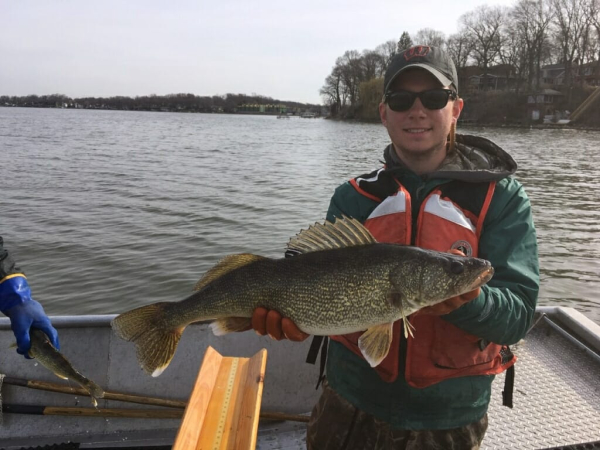
Alex Bentz, field technician at the the Wisconsin Department of Natural Resources holds a walleye. Photo by Adam Hinterthuer, UW–Madison Center for Limnology

Tagging Bonefish


Bonefish Tagging in the Florida Keys with Bonefish & Tarpon Trust
By Nick Roberts, BTT
from The Fishing Wire

A subtle, V-shaped wake appeared on a sun-drenched flat near Big Pine Key. As it approached the skiff, poled by Dr. Ross Boucek, Bonefish & Tarpon Trust’s Florida Keys Initiative Manager, its source was revealed: a pair of bonefish foraging on crustaceans hiding in the sand and seagrass. When the ghostly silhouettes came within range, I cast a couple feet ahead of them.

One of the fish tracked the spawning shrimp fly and suddenly pounced. I set the hook and the gray blur tore across the flat, peeling line from my reel as it headed for deeper water. Within seconds, I was down to my backing. The pressure to land the bonefish was much greater than usual; a pulled hook would mean losing not only a prized catch, but the opportunity for Dr. Boucek to tag the fish and collect important tracking data.Anglers from around the world have pursued bonefish in the Florida Keys, the birthplace of saltwater fly-fishing, since the 1940s and ‘50s, when legends like Joe Brooks and Ted Williams pioneered the sport in the now hallowed waters of Islamorada and Florida Bay.

In the sport’s early years and through its glory days of the 1960s to the mid-1980s, the Keys’ bonefish population seemed as boundless as the pristine flats and mangrove shorelines the fish inhabited. But in the late ‘80s, the population began to decline, prompting a group of concerned anglers to found Bonefish & Tarpon Trust (BTT), a science-based nonprofit organization, in 1998. Not only did BTT seek to determine the causes of the decline, it endeavored to fill in critical knowledge gaps; at that time, only a handful of research studies on bonefish existed, leaving many basic questions to be answered.

Since its founding, BTT has directed research on the life cycle of bonefish, their habitat use, movement patterns, and spawning behavior, and worked with the state of Florida to protect the species under catch-and-release regulations. BTT has also uncovered a number of causes of the decline, including: reduced water quality throughout the Everglades, Florida Bay, and the Florida Keys; habitat destruction (the number of Keys flats classified as “severely degraded” due to propeller scarring has increased 90% in the last 20 years); poor fish handling practices; and diminished numbers of bonefish larvae coming from spawning at “upstream” locations, such as Belize, Mexico, and southwest Cuba. Reduced spawning and reproduction within the severely reduced Keys’ bonefish population has also played a major role in the decline, and the record cold snap in January 2010 likely killed a substantial number of fish.

Dr. Boucek and Nick in search of bonefish in the Lower Keys.Yet there is good reason to be hopeful. Over the past few years, the population has begun to rebound, with guides and anglers reporting increasing numbers of sightings and catches.”There are a lot of bonefish around in three different sizes, all born a year apart from one another,” said Dr. Boucek. “Starting in 2014, a new wave of babies came in, followed by two more new generations in 2015 and 2016. The size classes are approximately 15 to 18 inches (2016 fish), 18 to 20 inches (2015 fish), and 22 to 25 inches (2014 fish).

”Although these new fish are encouraging, we don’t know where they came from, why they are doing so well after years of decline, or if more new fish will continue to enter the Keys population. So it is still critically important that we understand and address the causes of the historic decline, to ensure that a similar downturn does not occur in the future.“The Keys went about 20 years without a good new generation of bonefish coming into the population,” said Dr. Boucek. “That’s a sign of stress on the habitats and the fishery. When habitat gets degraded, fish reproduction is impacted, juvenile fish struggle to survive, and adults don’t grow as fast. And new generations of fish become fewer and farther between.

”Dr. Ross Boucek poles a flat.Among the most important habitats to protect are bonefish spawning sites. If bonefish cannot reproduce successfully, there will be no fishery. From its work in the Bahamas, BTT knows how bonefish reproduce. During full and new moon cycles from fall through early spring, fish from as far away as 70 miles instinctively gather at nearshore sites, where they prepare to spawn by porpoising at the surface and gulping air to fill their swim bladders. At night, they go offshore and dive hundreds of feet before surging back up to the surface. The sudden change in pressure makes their swim bladders expand, causing them to release their eggs and sperm. After fertilization takes places, the hatched larvae drift in the ocean’s currents for over a month before settling in shallow sand- or mud-bottom bays, where they develop into juvenile bonefish.With the help of guides and partners, BTT has identified spawning sites in the Bahamas and along the Belize-Mexico border, yet the locations of the spawning sites in the Florida Keys remain a mystery, one that must be solved if we are to ensure the future health of the Keys’ bonefish fishery and help it reclaim its former glory.“There are a couple possible reasons that might explain the lack of known spawning sites in the Keys,” said Dr. Boucek.

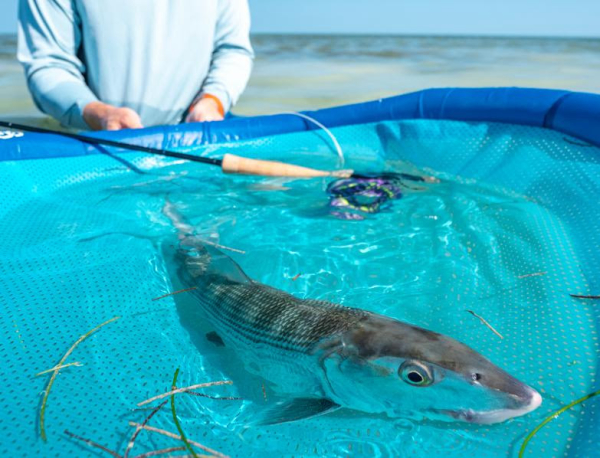
“First, nobody knew what bonefish spawning sites looked like until we discovered one in the Bahamas in 2011. Maybe by then the size of the spawning school in the Keys had shrunk to the point that it wasn’t noticeable to us. Or maybe the size of the Keys population became so small that the fish completely stopped spawning for a period of time. Fish won’t spawn if there aren’t a critical number of spawning fish.”Over the past couple years, several Keys guides have reported seeing schools of bonefish in nearshore waters. Now, Dr. Boucek is counting on the fish he tags to lead him to their spawning sites.As soon as I land the bonefish, Dr. Boucek places it in a submerged inflatable pen. While I hold the fish upside down in the water to keep it calm, he makes an incision in its abdomen. Right away, he notices that the fish is female—ovaries are evident and filled with developing eggs. He inserts a small acoustic transmitter into the abdominal cavity and skillfully stiches the incision closed. The transmitter emits an ultrasonic ping with a unique ID code every couple of minutes. Whenever this tagged bonefish swims past one of the several thousand acoustic receivers, belonging to BTT and other research groups, moored to the ocean floor throughout the Keys, the receiver records the date and time of the transmitter’s ping.

The tracking data will allow Dr. Boucek to chart the fish’s habitat use and, hopefully, locate its spawning site this winter.With the Nick’s assistance, Dr. Boucek (right) tags a bonefish with an acoustic transmitter.An acoustic transmitter.I release the bonefish and we watch as it glides away across the flat and vanishes into the glare.Dr. Boucek (left) and Nick celebrate the successful tagging of a Florida Keys bonefish.  

Nick Roberts is the Director of Marketing & Communications at Bonefish & Tarpon Trust (www.BTT.org) and the editor of the Bonefish & Tarpon Journal.

All photos by: Ian Wilson
Learn more about the work of Bonefish & Tarpon Trust at www.bonefishtarpontrust.org.
Tagging a bonefish

Ducks, Unlimited, A Conservation Organization for All

If there were no hunters, there would be no wild game animals in the United States. With no Ducks, Unlimited, there would be no wild ducks in the North America.

    Hunters are the original conservationists.  We prize natural areas and the wild animals and birds that inhabit them.  Ducks, Unlimited, founded in 1937 with the goal of preserving natural habitat that ducks require, started a movement of similar groups.

    Imitation is the sincerest form of flattery, and many organizations have followed Ducks, Unlimited’s lead.  All raise money to preserve habitat and study the habits and needs of their favorite game animal or bird, and all want to increase the habitat needed.

    Ducks, Unlimited holds banquets where money is raised to further those goals.  For the price of a ticket, a good meal is served and there are raffles and auctions of items mostly related to duck hunting. Locally, the Pike County Sportsman’s Night Out will be held Thursday, October 10 from 6:00 PM to 9:00 PM at the Strickland Building in Concord.

    It will be a fun night of fellowship with like minded sportsmen and conservationists, and you can go home with a full stomach, happy face and some great equipment.  Plan to attend, some tickets are still available by calling Roy Brooks at 678–858-6482 or Kel Brannon at 770-468-7871 and tickets will be available at the door.  Individual tickets are only $35 and couples are $60.

    Ducks, Unlimited looks at the big picture, working all over North America to accomplish its goal of wetland conservation. More than 14 million acres of waterfowl habitat in North America have been conserved across our continent since its founding, focusing its efforts and resources on habitats that are most beneficial to waterfowl. 

    But it pays attention to smaller details, too.  Here in Georgia, more then 27,000 acres of habitat have been conserved.  Georgia is part of the Atlantic Flyway and some waterfowl hatched in more northern areas of the US and Canada depend on Georgia wetlands for winter habitat.

    Our coastal wetlands provide necessary winter habitat for diving and puddle ducks, from lesser scaups to green wing teal and wigeon.  Interior parts of the state include river bottoms and beaver ponds where thousands of mallards and wood ducks survive the winter.  Reservoirs are important to ring-necked ducks, canvasbacks and wood ducks.  

    Last year in Georgia, 150 events raised 2.1 million dollars to help conserve 27,310 acres in our state. And 97 thousand dollars from our state were used for habitat in Canada, where many of our ducks are produced.  Without those nesting areas, our duck population would be greatly reduced.

    Some of the projects in Georgia include restoration of managed wetlands on the Altamaha Wildlife Management Area, a priority for our coastal area.

    Ducks, Unlimited works with the Georgia Department of Natural Resources on the coast and other places, like the Silver Lake Wildlife Management Area near Lake Seminole. There, an additional 2840 acres of mostly upland habitat that protects the wetlands, a necessary precaution, have been secured. And upland habitat benefits deer, turkey and small game.

    At the Cordele Fish Hatchery in Crisp County a Ducks, Unlimited project helped restore an existing 48-acre lake where the levee was damaged by heavy rains.  Vegetation control helped remove trees and bushes and allow the types of vegetation waterfowl need to grow. This area is a wildlife viewing area where you can see songbirds and ducks and the efforts will increase numbers as well as diversity of those species.

    At the Penholoway Swamp Wildlife Management Area high quality bottom land hardwood forest as well as nearby uplands have been enhanced.  This area has tidal swamp forest as well as other habitats in Wayne County, and is open to many kinds of public recreation as well as hunting.

    At the Blanton Creek Wildlife Management Area on Bartletts Ferry Lake, two water control structures were built near the Chattahoochee River to increase vegetation suitable for ducks and other water birds. It covers 50 acres and Ducks, Unlimited worked with the Georgia Department of Natural Resources as well as the

Georgia Power Company on it.

    In Colquitt County on the Mayhaw Wildlife Management Area 50 acres were restored through the installation of a water control structure and perimeter levees to provide suitable habitat for emergent marsh vegetation.  Some waterfowl foods were also planted there.

     Working with the University of Georgia and the Georgia Department of Natural Resources near Eatonton, Ducks, Unlimited helped construct a series of dikes and water control structures on Indian Creek to form a pond in hardwood habitat.

    Near Gay in Meriwether County, 50 acres of waterfowl habitat on the Joe Kurz Wildlife Management Area on the Flint River was restored with a water controls structure that will help wood ducks and mallards as well as others.

          These and many other projects in our state have already made a difference here and will continue to help wildlife in the future, thanks to Ducks, Unlimited and their partners.

          Ducks, Unlimited’s efforts benefit all wildlife, not just ducks, and provides recreation benefits to everyone to all who value nature.

    If you don’t want to attend a local banquet, join this conservation organization to help their efforts.  Right now, your $35 annual membership fee includes a nice fleece jacket.  Anyone that values natural habitat, from hunters and bird watchers to fishermen and hikers should be proud to be members.

    Go to https://www.ducks.org to join and find out more about this important conservation organization.

Fishing for Red Snapper


The Long Road to Recovery for Red Snapper


A new method for managing the fish will allow more flexible fishing seasons across the Gulf. 
Joe Richards, Seafavorites.com
from The Fishing Wire

A new method for managing red snapper fishing in the Gulf of Mexico is under way, capping off decades of fighting over one of the Gulf of Mexico’s most famous fish.The approach gives each Gulf state the authority to set red snapper fishing rules for anglers in federal waters—a system that provides flexibility but also requires states to shorten future seasons if the Gulf-wide catch limit is exceeded.

Federal authorities, who previously managed recreational red snapper fishing in federal waters and still regulate commercial and charter-boat fishing of the species, will work with state officials to monitor, study, and collect data on red snapper.The new system began two years ago as a pilot program, and federal officials must give final approval for it to become permanent.

The National Oceanic and Atmospheric Administration is taking public comments through Oct. 7 here. Reduced catch limits have helped the red snapper population steadily recover from decades of overfishing. Joe Richards, Seafavorites.comHere’s a look back at key moments in the Gulf of Mexico red snapper story and a glimpse of what’s to come.

1950-1980s: Commercial and recreational catch skyrockets, rapidly depleting the red snapper population.

Late 1980s: Fishery managers implement regulations, including bag and size limits, but these are not enough to help the species recover.

 1990: Gulf red snapper hit a dangerously low level—just 2 percent of the population’s spawning potential—due to decades of overfishing (removing fish faster than they can be replaced through reproduction) and unintended catch in shrimp trawls. Fishery managers set a target of at least 26 percent for a stable population.  

1997-1998: Fishery managers require shrimp fishermen to install devices in trawl nets to reduce incidental catch of juvenile red snapper. 

2005: A federal recovery plan for red snapper begins after conservation groups sue over lack of progress in rebuilding the population.

2006: Regulators begin setting science-based catch limits for Gulf red snapper as Congress works to strengthen its federal fishery law, the Magnuson-Stevens Fishery Conservation and Management Act.

2007-2008: Managers significantly reduce catch limits for commercial, charter, and recreational fishermen and implement a quota system that reserves a certain amount of red snapper for a limited number of commercial fishermen—a program that successfully keeps commercial catch at sustainable amounts.

2009: Federal fishery managers announce overfishing is projected to end and begin raising annual catch limits. However, the population still has not fully recovered, partly because there aren’t enough older fish, which are the most productive spawners. Scientists project full recovery will take until 2032.

2013: A new federal stock assessment of the red snapper population shows overfishing has ended.

Mid-to-late 2010s: As Gulf red snapper show signs of recovery—a population increase, expanded range, and larger, older individuals—debate heats up over how to divide still-limited catch among recreational, charter, and commercial fishermen. As a group, recreational fishermen exceed their quotas nearly every year.

2014: A court rules the recreational catch excesses must end. Federal regulators begin setting progressively shorter seasons to account for higher catches in state-controlled waters and associated overages. 

2015: As anger grows over catch allocation and to better control catch, fishery managers—in a contentious vote—adopt distinct catch limits for recreational anglers and charter captains, setting the stage to allow different types of management.  

2016: Managers approve revising the amount of red snapper allocated to the recreational and commercial fisheries. However, a lawsuit by the commercial fishermen overturns that change. “Re-allocation” continues to be a tense issue.

2017: Federal managers set a three-day red snapper season, saying longer state seasons are using up allowable Gulf quota. This infuriates and confuses fishermen. Ultimately, the U.S. Secretary of Commerce creates a 39-day federal season. Also, fishery managers vote to require charter captains to keep electronic logbooks documenting amounts of catch.

2018: Federal managers launch a pilot program granting states the right to set recreational seasons in U.S. waters but say states must continue to meet Magnuson-Stevens act requirements for science-based catch limits. States participate using their own data collection programs.  The Gulf of Mexico Fishery Management Council, after changing the threshold for Gulf red snapper and other reef fish, determines it is no longer overfished but keeps a rebuilding plan in place, with a goal of returning the population to full health by 2032.

The Future: Red snapper’s long history is rife with hard decisions and sacrifice, but this once-dwindling species is on the road to recovery. If the rebuilding plan stays on track, anglers can expect a healthier population, bigger fish, higher catch limits, and more fishing days. Managers and fishermen have overcome some of the most difficult hurdles and have ideas about how to resolve those that remain.

With each state using its own method to collect data, NOAA Fisheries will need to standardize information to monitor fishing rates and catch and to assess the population Gulf-wide. Fishery managers likely will continue to struggle with allocating catch between commercial and recreational fishermen.

And one major cause of red snapper mortality remains a problem: Even though anglers and commercial fishermen must release red snapper under certain conditions, the fish often don’t survive being brought to the surface from deeper than 100 feet. Descending tools can help alleviate this problem if used widely and properly.   It’s been a long saga for red snapper, but the future for fishing and this iconic species is promising.

Holly Binns directs The Pew Charitable Trusts’ efforts to protect ocean life in the Gulf of Mexico and the U.S. Caribbean
Catching red snapper

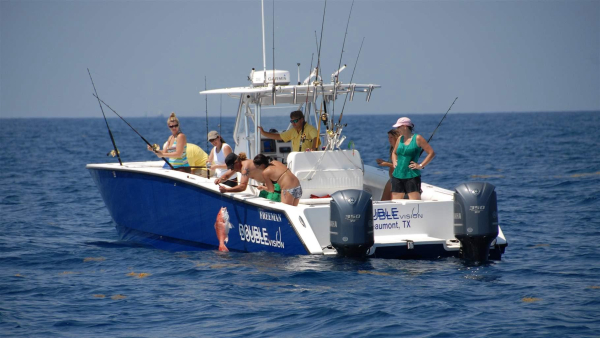
A group of recreational anglers fish for red snapper.

Combating Post-Release Mortality

Recreational Anglers Get Help Combating Post-Release Mortality from Partnership of Fishery Managers
from The Fishing Wire

Red drum with circle hook in lip.

Red drum with circle hook in lip. Photo courtesy of Capt. Spud Woodward.

NOAA Fisheries, the Atlantic States Marine Fisheries Commission, and Atlantic state agencies partner to make circle hooks, descending devices more accessible to anglers.

No one, especially recreational anglers, likes to see a fish float away or sink to the bottom dead. That’s why NOAA Fisheries Recreational Fishing Initiative, the Atlantic States Marine Fisheries Commission (ASMFC), and the Atlantic states are working together to help more fish survive when released by recreational anglers.

Fish mortality has historically been high in some of our most iconic fisheries. Advances in fishing gear technology have, in recent years, helped alleviate some of its leading causes. Two of the most effective tools are fish descending devices and circle hooks.

Descending devices help return fish to the depth—and pressure—where they were caught. This relieves problems caused by barotrauma, a condition resulting from rapid pressure changes. Barotrauma can make it hard for fish to swim and can cause swelling of their organs.

Circle hooks help anglers hook a fish in the lip or jaw, reducing damage from hooking fish in the gills, stomach, or other vital organs.

Many recreational anglers are embracing these technologies. Fishery managers see benefits when more anglers adopt catch and release best practices.

NOAA Fisheries recently worked with ASMFC to make these tools more easily available and keep our nation’s fishery resources healthy. With funds provided by NOAA Fisheries Recreational Fishing Initiative, the Commission distributed 61,000 circle hooks and more than 1,000 descending devices to state marine fishery agencies from Florida to New England. This project will help recreational anglers limit their impact on the resources they cherish. It has also strengthened the partnership between state and federal fishery managers.

Bob Beal, ASMFC Executive Director said “ASMFC and its member states are committed to working with our federal partners and stakeholders to reduce post-release mortality. Circle hooks and descending devices, in combination with angler education, can be important components of a fishery management program. Given the impact of using these tools are difficult to quantify and are largely dependent on angler experience, they should be used in concert with other management measures to maximize their conservation benefits to the resource.”

“Accounting for and reducing the impact of recreational discards in a stock assessment is an enormous fishery management challenge,” says Dr. Luiz Barbieri, Program Administrator, Marine Fisheries Research at Florida Fish and Wildlife Research Institute. “Anything that can help us reduce the uncertainty of recreational discards in a stock assessment and improve management decisions is a welcome tool in the toolbox. This partnership is an extremely valuable step in improving the management of our recreational fisheries.”

Russell Dunn, the National Policy Advisor for Recreational Fisheries at NOAA Fisheries continues, “It was a natural collaboration to address an issue important to anglers and managers that can have a real impact on maintaining healthy fish stocks and improving recreational fishing opportunities. We were glad to be able to contribute and appreciate their partnership.”

Catch and release fishing is not only an American pastime, but a great conservation strategy if done correctly. Actions anglers take before, during, and after a fish is caught can improve its chances of survival, keep fish stocks healthy, and keep anglers fishing.

Stocking Young Atlantic Salmon

Stocking Young Atlantic Salmon Downstream Means Higher Survival Success
From NOAA Fisheries
from The Fishing Wire

When it comes to recovering endangered Atlantic salmon, it makes a difference where smolt stocking takes place along a river. A new model can help by evaluating estimated survival of smolts released at different stocking locations.

Stocking salmon downstream

Stocking Green Lake National Fish Hatchery smolts in Maine’s Narraguagus River. Photo: NOAA Fisheries

Young Atlantic salmon smolt released at lower-river stocking sites on the Penobscot River are more likely to survive and enter the ocean than those released higher in the river system. They encounter fewer barriers such as man-made dams during their migration to the estuary, and their migration path is shorter. NOAA Fisheries scientists built a model that can help select release locations to improve survival of stocked smolt as they head for the ocean.

The 2018 Northeast Fisheries Science Center study, published in the Canadian Journal of Fisheries and Aquatic Sciences, highlights the continuing challenge to conserve this endangered species.

“This model is an important tool to support decision-making for the recovery of wild, self-sustaining Atlantic salmon populations,” said Justin Stevens, a fishery biologist at the Center’s Maine Field Station in Orono and lead author of the study. “Hatchery smolt stocking is a common strategy used in the program, and now we have a way to effectively evaluate its success.”

Using Historic Salmon Survival Rates to Improve Prospects for the Future

The researchers built a model to simulate historic survival of migrating Atlantic salmon smolt at different locations along the Penobscot River from 1970 through 2012, using existing studies of smolt survival. The model assessed the relative survival risks posed by three factors: dams, discharge into the river, and the length of the migration route.

By far, the number of dams encountered during downstream migration had the biggest effect on survival. The more dams the smolts encountered, the lower the survival rate.

A number of dams have been removed from the Penobscot River in the past few years. However, more than 100 man-made dams remain. Most are relative small and used for water storage or are remnants from 19th century industrial activities.

This study focused on 18 dams commissioned to generate hydroelectric power during the study period, for which hatchery records were also available. These dams are situated along primary salmon migration paths in the five sub-basins of the river.

Model Results Can Guide Management Decisions

“The information learned from this study can be used by state and federal managers to better inform future stocking practices and to work with the hydroelectric industry to minimize the impact of dams,” said Stevens.

This study provides a quantitative way to evaluate the effect of dams on smolt survival during downstream migration in the largest U.S. Atlantic salmon river.

The model calculates marine survival, from post-smolt to adult salmon. It accounts for losses during both freshwater and estuarine migration, and is an important new tool for making decisions about habitat improvement, fishery management, and Atlantic salmon recovery activities.

A Bit More About Endangered Atlantic Salmon

Atlantic salmon smolt migrate from freshwater river habitat downstream to the ocean. Many do not survive the journey past multiple dams or their time at sea.

If they do survive, as adults they need to migrate from their time in the ocean back to the river. Adults then swim upstream past dams to spawn and complete their life cycle. Making multiple trips during their lifetime further reduces the likelihood of repeat spawners, and that negatively affects population growth.

Historically, Atlantic salmon in the United States ranged from the Housatonic River of Long Island Sound to the Aroostook River in eastern Maine. There were an estimated 500,000 adult fish in precolonial days.

Today, U.S. Atlantic salmon are limited to eastern Maine and the population numbers fewer than 2,000 adult fish. The Penobscot River supports the largest population, aided by a hatchery-smolt stocking program that produces about 75 percent of the annual adult returns.

This year has been designated as International Year of the Salmon. It is the kickoff for an international effort though 2022 to bring countries together to share knowledge, raise public awareness, and take action to conserve and recover both Pacific and Atlantic salmon.

Journeys of One Atlantic Salmon

The Mind-Boggling Journeys of One Atlantic Salmon
By John Holyoke
from The Fishing Wire

Charlie swims along his journey


“Charlie” the Atlantic salmon (right) swims among other salmon in a pool of the Sandy River in western Maine. Charlie is a repeat spawner, and was captured twice at Waterville’s Lockwood Dam, exactly two years apart. Photo Casey Clarke/Maine Department of Marine Resources

Your morning commute to work might be hectic and harrowing, but before you start feeling sorry for yourself consider the journeys that Charlie — the name given to a soon-to-be-famous Atlantic salmon — has taken over the past few years.

Charlie recently was captured in a fish lift at the Lockwood Dam on the Kennebec River in Waterville. That on its own is not a surprise. The fact the adult salmon was actually what’s called a “repeat spawner” and had been captured at the same facility exactly two years (and thousands of miles) earlier was grounds for celebration.

“This is the only repeat spawner we have ever had [in the 13 years since the Lockwood facility has been operational],” said Paul Christman, a marine scientist for the Maine Department of Marine Resources.

Christman said that over the course of a year, all of Maine’s salmon rivers might see one repeat returnee, most of those counted on the state’s busiest salmon river, the Penobscot. This year, more than 1,000 salmon have returned to the Penobscot. Just 56 have been counted at Lockwood. Making Charlie particularly intriguing is the fact he’s either a naturally reared fish from eggs planted by fisheries personnel or a wild-spawned fish.

And the journeys that Charlie has made are mind-boggling, Christman said.

According to the U.S. Fish and Wildlife Service, young Atlantic salmon can travel more than 6,000 miles during their migration to and from the North Atlantic, where they will spend between one and three years before returning to their native rivers. That means Charlie might have 12,000 miles on his fins by now. He has surely earned a break, which he is currently taking.

Charlie was first caught on June 18, 2017, and had a radio tag and a “PIT” tag attached to him. The PIT tag allows scientists to identify him by a unique 16-digit number. The radio tag allowed them to track him until he regurgitated it at some point after he began his return to the Atlantic two years ago.

The crew’s radio tracked him to a pair of comfortable pools in the river where he spent the summer.

Then, after making his way back downriver (and over four hydroelectric dams), he headed back to sea where he flourished for two more years before swimming back to Lockwood Dam on the Kennebec.

An obliging crew then gave the salmon a ride back to the Sandy, and that’s where he remains, resting comfortably after his second grueling trip in two years.

“As of last Thursday, he was sitting in one of the pools that he sat in two years ago,” Christman said.

Christman said DMR personnel have snorkeled nearby and report that Charlie looks healthy — and big.

Jennifer Noll, another DMR fisheries scientist, reported that when Charlie was captured two years ago he was almost 29 inches long. Now, he measures nearly 34 inches from snout to tail.

Christman said many fish die in their natal rivers before even heading to sea once, and they face countless challenges while in the ocean. Upon their return to a river, they must overcome more obstacles and survive predators that would like to enjoy a salmon dinner.

The fact Charlie has made those grueling, life-threatening trips twice makes him a rare fish indeed.

“He has defied all the odds. He has actually survived an enormous amount of mortality,” Christman said. “He is at least two years older, three years older than all the other [salmon] in the Sandy River. This guy has seen it all and survived. It really is amazing.”

Christman thinks Charlie successfully spawned two years ago — spawning redds were found near where he was hanging out — and hopes he is able to do the same this year.

Passing along his genetics to future generations can’t hurt, after all.

“This guy really wins. I mean, he’s got it all,” Christman said. “It’s really amazing to see a fish that has been through it all and survived [all of those threats]. I just can’t fathom.”

View of Charlie’s River


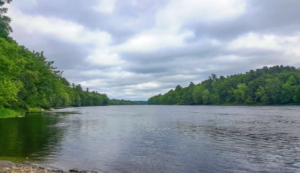
“Charlie” the Atlantic salmon would have made his way up this part of the Kennebec River to reach the Lockwood Dam, both in 2017 and in 2019. A marvellous tale of a charismatic species making the Kennebec River a home for spawning. Photo Maranda Nemeth.

What Are Estuaries?

Estuaries — Working for Anglers and All Americans
For Habitat Month 2019, NOAA is celebrating estuary habitat and how we work for you, from the Chesapeake Bay to the Oregon Coast.
from The Fishing Wire

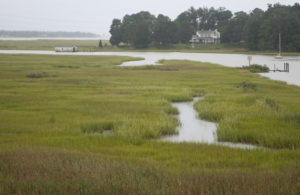
Chesapeake Bay estuary


Chesapeake Bay estuary

Estuaries, where rivers meet the sea, provide valuable habitat to an array of important plant and animal species. These transitional areas that straddle land and sea contain habitats needed by fish, shellfish, wildlife, and people. For humans, they provide homes, jobs, and value: estuaries generate an estimated $12 billion in revenue each year from tourism and local economies. Most fish and shellfish eaten in the United States, including salmon, herring, and oysters, spend at least part of their life in estuaries. NOAA works within several U.S. estuaries including, but not limited to, the following:

Puget Sound, Washington

Columbia River, Oregon

Kachemak Bay, Alaska

Narragansett Bay, Rhode Island

Delaware Bay Estuary, Delaware

Chesapeake Bay (DE, MD, NY, PA, VW, WV and DC)

Albemarle-Pamlico Sound, North Carolina

Tampa Bay, Florida

Galveston Bay, Texas

For Habitat Month, NOAA is celebrating estuary habitat and how we work for you, from the Chesapeake Bay to the Oregon Coast. Learn more about how NOAA is restoring and protecting some estuary habitat below.

Estuary Highlights

Oregon Coastal Habitat Project Restores Coho and Reduces Flooding
The Southern Flow Corridor project, which restored salmon habitat in Tillamook, Oregon, also provides flood protection for surrounding communities. Learn more about NOAA’s work with community partners restoring estuary habitat in Tillamook Bay

Juvenile coho salmon use estuaries to eat and grow before migrating to the ocean. Photo: USFWS/Roger Tabor
Skokomish River Estuary Restoration Helps Salmon and Steelhead Return Home
In the Puget Sound region, reopening abandoned agricultural land back to nature will allow young salmon, steelhead, and other fish species room to access their historical habitats. Learn more about the Skokomish River Estuary restoration project

NOAA works with our federal and state partners to recommend pollution control and cleanup strategies and develop and implement restoration projects, such as marsh creation and dam removals, to benefit fisheries, wildlife and the public.Learn more about the Hudson-Raritan Estuary

NOAA and the Chesapeake Bay Program

To identify and implement solutions for the Chesapeake Bay, the Chesapeake Bay Program was formed in 1983. The dozens of partners in the Chesapeake Bay Program include federal and state agencies, local governments, nonprofit organizations, and academic institutions. Each organization brings unique knowledge, capabilities, and perspectives to this tremendous partnership. NOAA is represented in the Chesapeake Bay Program by the NOAA Chesapeake Bay Office, a division of NOAA’s Office of Habitat Conservation. Learn more about the Chesapeake Bay Program

The Chesapeake Bay Program has set a goal to restore native oysters to 10 Chesapeake Bay tributaries by 2025.

Habitat Focus Areas

Between 2013 to 2015, NOAA selected 10 Habitat Focus Areas. These are places where multiple NOAA offices can effectively focus their resources to prioritize long-term habitat science and conservation efforts. In each of these areas, our science, service, and stewardship come together to improve habitat conditions for fisheries, coastal communities, and marine life, and to provide other economic, cultural, and environmental benefits our society needs and enjoys. Explore NOAA’s Habitat Focus Areas

Avoiding Barotrauma

Right Tools Mean Everything for Avoiding Barotrauma
From the Florida FWC
from the Fishing Wire

It’s that time of year when you might be fishing for snapper and grouper. Continue your role as a conservationist by looking out for fish with signs of barotrauma and being prepared to respond. Barotrauma is a condition seen in many fish caught in waters greater than 50 feet that is caused by expansion of gases in the swim bladder. Signs of barotrauma include the stomach coming out of the mouth, bulging eyes, bloated belly and distended intestines.

It’s important to know in advance what tools are available and how to use them to help fish return to the bottom and increase their chances of survival.

Descending devices can be used by anglers to take fish back down to depths where increased pressure from the water will recompress swim bladder gases. They fall into three categories: mouth clamps, inverted hooks and fish elevators. Learn more about descending devices and how to use them at MyFWC.com/SaltwaterFishing by clicking on the “Fish Handling” then “How-to Videos” or scrolling to “Barotrauma.”

Descending devices are used to return fish to a depth where expanded gases in the body cavity can recompress.

Venting tools are sharpened, hollow instruments that anglers can use to treat barotrauma by releasing expanded gas from the swim bladder, enabling the fish to swim back down to capture depth.

Please note, items such as fillet knives, ice picks, screwdrivers and gaffs are not venting tools and should never be used to vent a fish, because they are not hollow tubes that allow air to escape. Venting a fish incorrectly or with the wrong tool may cause more harm than good.

To properly vent, lay the fish on its side (on a cool, wet surface). Insert the venting tool at a 45-degree angle, under a scale 1-2 inches behind the base of the pectoral fin, just deep enough to release trapped gasses. Never insert venting tools into a fish’s belly, back or stomach that may be protruding from the mouth. Learn how to vent properly by visiting https://youtu.be/jhkzv1_2Bpc.

Venting tools should be inserted at a 45-degree angle, under a scale 1-2 inches behind the base of the pectoral fin, just deep enough to release trapped gasses.

Descending devices and venting tools should only be used when fish show one or more signs of barotrauma and cannot swim back down on their own. It is essential to work quickly when using these tools and return the fish to the water as soon as possible. Anglers should choose the device and method they are most comfortable with and that best fits the situation.

To learn more about catch-and-release techniques, visit MyFWC.com/Marine and click on “Recreational Regulations” and “Fish Handling.” To learn more about barotrauma, descending devices and venting tools, visit our YouTube channel at MyFWC.com/SaltwaterFishing. For answers to questions, contact 850-487-0554 or Marine@MyFWC.com.