Category Archives: Bass Fishing

Bass Fishing Information

Fishing Clark’s Hill

I can catch a bass!

I can catch a bass!

I had a two day club tournament at Clark’s Hill this past weekend and it was fun but frustrating, and several problems about drove me crazy to start.

Went over on Thursday afternoon and got to my place at Raysville Boat Club. Got unloaded and started to get dishes out of dishwasher – i usually start the dishwasher when I leave on the previous trip. It was full of dirty dishes from last summer! The pump had frozen up and tripped the circuit breaker.

Friday morning got up to go out and check some fishing spots and battery was dead in the van. Got my charger I had used the day before and hooked it up, and it had died. Got a battery out of the boat and tried to jump the van off but the van battery was too dead. Took me a couple of hours to do all that and finally get side post van battery out and top post battery from boat hooked up with vice grip pliers to get it started. Let it run an hour to charge the van battery. By then it was raining so didn’t even get out.

Al got to the lake late that afternoon and we got tackle ready. I was worried about the rain, daddy had put gravel down in front of the carport where I parked the boat but mud had washed in over it over the years and it was an uphill pull leaving. Sure enough, we got up the next morning and the van would not move. I had asked Al to bring a chain and we managed to get the van and boat out of the mud after a long scary pull that ended up throwing mud all over the boat.

We launched and made the 15 minute ride down to Mistletoe where the tournament started. We took off and ran to the bridge to see if shad were spawning – no activity. When running to our second stop my butt seat came apart, the seat hit the windshield and went into the lake. The post stayed in the boat, fortunately, and the seat floated. Got it and stopped on a wind blown gravel point.

The fishing story in the next post.

Do You Remember the First Fish You Caught?

First Fish Certificate Great Idea In West Virginia

Was your first fish this big?

Was your first fish this big?

BY Jim Shepherd

A first fish is a big deal. I don’t really remember the first fish I landed, but I do remember the first fish I “really” caught on my own. “On my own” meaning I rigged the hook, line, sinker and bobber, baited the hook and sealed the deal with a small bream that had already stolen two other crickets before he got so full he slowed up enough for me to catch him.

In those days, catch-and-release was not as popular as batter-and-fry, but I couldn’t bear to fry my first fish. I turned him loose and remember being so proud of myself I could hardly stand it – until my Dad asked me what I was doing putting back a fish.

Fortunately, he wasn’t really angry, we had more than enough bream for dinner that night, but it was my first full fishing experience. Cleaning the catch, fortunately, didn’t come for several years afterwards. Today, catch and release is popular with me because cleaning fish isn’t. Besides, my wife says I’ve caught the same fish so often that I should give them Velcro lips to save wear and tear on all parties.

About 140 words ago, I was going to give an attaboy to the States of West Virginia and Maryland their respective Divisions of Wildlife and Natural Resources. Last week, I got a release that told me that “Wild, Wonderful West Virginia” understood the importance of keeping generation -next involved in the outdoors.

To help, they’ve created a “First Fish” Certificate

The certificate, according to Frank Jezioro, Director of West Virginia DNR, is to “recognize that special catchy by young anglers”.

It’s a very cool little document – and you can fill it out online. In it, Jezioro says, you can include “the angler’s name, species of fish, and date and place of catch” – a very cool commemorative of a momentous occasion.

You can fill the certificate out online, then print it out on your color printer – also a very cool way to operate. No postal waste or time delays . Just fill out the form, hit print, and your little angler will have an award commensurate with that important first fish.

In Maryland, the programs nearly the same, except young anglers need to go to either a Maryland Sport Fishing Tournament Citation Center or use an online form. If you have a digital photo, it can be uploaded to their My 1st Fish Citation.

We support The Angler’s Legacy, and have already done our parts this year by introducing several people to fishing. Like the Angler’s Pledge, we think the First Fish Certificate – in any state -is a great idea.

You can check out West Virginia’s First Fish Certificate online at:

www.wvdnr.gov/Fishing/First_Fish.shtm ]www.wvdnr.gov/Fishing/First_Fish.shtm

and you can check out Maryland’s form at:

www.dnr.state.md.us/fisheries/recreational/ tournament/firstfishform.html]www.dnr.state.md.us/fisheries/recreational/ tournament/firstfishform.html

Good on you both.

Winter Structures To Target for Bass

Three Structures To Target for Bass This Winter
This bass was caught in the winter at Lake Guntersville

This bass was caught in the winter at Lake Guntersville

By Scott Suggs

If we’re going to be honest about it, fishing in the winter isn’t always the most pleasant activity. It can be cold, windy and sometimes getting the fish to cooperate can be frustrating. But just because the calendar has been flipped to December doesn’t mean that you should park the boat and resign yourself to hanging lights and watching football.

Catching fish in the winter requires some knowledge about the body of water that you are fishing and a decided amount of patience. Slowing down your presentations will go a long way towards ensuring you get more than a runny nose for your time on the lake. So before you head out for your next day of fishing, try focusing on these three types of structure.

Bluffs]
A lot of tournaments are won year round on rock bluffs. Big smallmouth and largemouth both like to hang on these bluff ledges during this time of year. But enticing strikes from finicky bass in winter can be a challenge. Fish each spot slowly and don’t limit yourself to just one lure or technique. In clear water, natural colored worms can be very effective for a smallmouth bite. A Berkley PowerBait Hand Pour Finesse Worm fished on a dropshot rig that is worked slowly on the ledges works extremely well.

But don’t forget that crayfish also inhabit these rock bluffs and a big jig tipped with a PowerBait Chigger Craw will also work. Just keep the retrieve slow. Lipless crankbaits like a Frenzy Rattl’r fished parallel to the bluffs is also can entice strikes, but be careful that your retrieve isn’t too fast. Also remember that shad and other baitfish swim these bluffs during winter so a Berkley Gulp! Jerk Shad Texas rigged with a wide-gap hook and swimmed through the desired depth can result in a lot of hook ups.

Main-lake points

Main-lake points hold bass pretty much year round. But during winter, when the lake is low, they really start to bunch up on these structures. Find a point that is just out of the swift, main lake current and there is likely to be a bunch of bass feeding on baitfish and crayfish. If there is deep water nearby, that deeper water is likely to hold bass, too.

These out-of-the current spots can hold huge schools of bass, bunched up, usually in one very small spot. This means either dragging bottom-bumping lures, or fan casting, Carolina-rigged lures like a PowerBait Power Lizard or a Gulp! Turtleback Worm and looking for that instinct strike. Wood cover along these spots always harbor the bigger largemouth’s in the area. Try laydowns, washed in debris, stumps and brush piles and go after them with a jig and trailer.

Humps
Smallmouth bass and a surprisingly good number of largemouths, can both be found around islands, submerged humps, sand bars and ridges, located throughout lakes. Because of low water levels in winter, many are now visible; others can be found by paying attention to your electronics. Smallmouth relate to the edge of the swift current, waiting for an easy meal. Largemouth tend to hug the bottom and hang out in the cover (stumps, ledges).

Fishing these areas can be tough when the weather is extremely cold, but slowly down and finesse are of the utmost importance whenever fishing these areas. Dropshotting small, straight-tailed finesse worms like the PowerBait Hand Pour Finesse Worm or Carolina rigging small, finesse lures, such as worms, lizards, grubs, jerkbaits and crayfish imitations, will entice more strikes in very cold water than baits with a larger profile. Lighter line also works better in these situations, so make sure your spinning reel is in good working order.

Don’t let a little cold keep you off the lake this winter. There’s a lot less boat traffic this time of year and still a lot of fish to be caught. Just make sure to slow down your presentation and downsize your line and focus your attention on these three wintertime hotspots and pretty soon everyone will want to go with you.

Bass Fishing After Cold Fronts

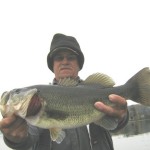
I caught this bass after a bad cold front

I caught this bass after a bad cold front

FISHING AFTER COLD FRONTS
by Scott Suggs

First, let me say that as an angler I understand that bass fishing after a cold front can be very frustrating. Especially if you fish in areas with Florida-strain largemouth bass, cold fronts can pretty much be the excuse you need to park the boat and head to a deer stand or sit in the house and watch football.

But cold fronts are just a fact of life for most of the country from about October through April. That’s a long period of time to simply give up on bass fishing. Those fish have to eat at some point during this six-month stretch; fish are going to be caught by someone somewhere. I figure that might as well be me. So learning to deal with the effects of cold fronts as it relates to bass fishing is the first step towards keeping my days on the water successful when everyone else has packed it in for the year, leaving you on the water with cold air temperatures and bluebird skies.

As the air temperature cools from a cold front, the surface temperature of the water will also begin to cool. This will force bass in shallow water to seek holding areas in deeper water where the temperature will be warmer. I use my electronics to find brush piles in deep water or deep-water ledges near channel swings or secondary points. Once I find them I do like to use a jig or a drop shot, something with a vertical presentation. A ¾-ounce football jig tipped with a Berkley PowerBait Chigger Craw and dragged slowly through these areas can be very effective. Drop shotting a Berkley Gulp! Sinking Minnow can be effective, too. Just shake the rod tip, trying not to move the bait too far.

Sometimes smaller baits can be they key, too. If you normally catch fish on a 10-inch Berkley PowerBait Power Worm, try a 6-inch worm; same goes for stick- and creature-style baits. Being cold blooded the body temperature of a bass is regulated by its environment. When the water cools, they become lethargic and their metabolism slows. Big meals aren’t needed, but a easy meal – one that won’t require much work to capture or consume – is always welcome.

Don’t overlook tight cover, either. Bushes, root balls, dock pilings, logs and rock can sometimes draw in large numbers of bass. They will huddle in these protected areas where the water temps are move stable. Trying pitching jigs or wacky rigged soft plastics like a PowerBait Fat Dover Crawler in these areas and let them sink. It might take some time, but you can catch these fish.

More than anything, fishing after a cold front requires anglers to slow down. The bass are going to be moving and reacting slowly, so your presentation should not be fast. Bait like Gulp! are ideal for slow presentations because the scent and flavor that are built into the baits works even better when fished slowly. The scent clouds will fill the area and actually draw in fish – even lethargic ones – in search of an easy meal.

Fishing after cold fronts isn’t ideal, but don’t let low air temperatures keep you off the water. This time of the year can yield some very big fish that have been gorging on the shad that spawn in the backs of coves. Plus, there won’t be much boat traffic. Just change your tactics a little and go catch some big bass while everyone else is sitting around the house.