Category Archives: Bass Fishing

Bass Fishing Information

Lake Guntersville July Tournament Details

Camping for five nights at Guntersville – $196.00. Gas for truck – 100.00 – Gas for boat – 50.00 – Food – 50.00 – Club tournament fee – 35.00 – Ice – 25.00.

Winning $25.00 for third place and $35.00 for big fish – priceless!!

Sitting by the lake after fishing, grilling dinner and relaxing is also priceless. I always camp on multiday fishing trips for several reasons. It is more relaxing than a motel and I can leave stuff in and on my boat without worrying about it getting stolen. I much prefer my cooking to eating out. And it is easier to go to bed at sundown and sleep better.

Although it was very hot at Guntersville, a fan in a screen dining tent helped a lot. Fortunately, my camper has an air conditioner, so I sleep comfortably. Both fan and AC felt great after a hot day on the lake.

In our July tournament at Guntersville last weekend, seven members of the Spalding County Sportsman Club fished for 15 hours to land 33 keeper bass, only four of them spots, weighing about 80 pounds. There was one five-bass limit and everyone caught at least one keeper.

Raymond English won with seven bass weighing 16.75 pounds and Jay Gerson had eight, including a limit the first day, weighing 16.08 pounds for second. My four weighing 11.65 pounds was third and my 4.55 pound largemouth was big fish. Fourth was Glenn
Anderson with four weighing 11.14 pounds.

I went to the lake on Wednesday and got my camper set up. Thursday morning I went out looking for something that might work for me. I checked the backs of several creeks, isolated places where I thought I could fish in peace, but got only two bites and lost both fish. That afternoon I rode and fished ledges and grass lines, the usual summer pattern there.

Friday I spent the morning looking at the same kinds of places on the main lake. I have never fished a tournament on that area of the lake. The area I usually fish and am more familiar with is about 20 miles by water down the lake and I was not willing to make that run.

I did have the advantage of many GPS waypoints from old articles on the lake. But many of them were from other seasons, not the hot summertime. But I did have many good spots marked on ledges.

That afternoon I had not had a bite so I decided to try something with which I am more familiar. I had seen a line of docks around a deep cove that looked good. When I went to them I caught two nice spotted bass. At least I had something to fall back on if the ledges didn’t work.

I noticed a mercury vapor light over the water at one dock was on during the middle of the day, so I figured it stayed on all night and attracted fish. I filed that away as something to remember at first light.

Saturday morning I decided to start on a grassline when we took off at 6:00 AM. I quickly caught one short bass, about 14.5 inches long. Largemouth and smallmouth at Guntersville have to be 15 inches long to keep, but any size spotted bass can be kept, so we could weigh in 12-inch spots based on club rules.

At 7:20 I hooked and landed a 15.5-inch keeper largemouth and knew I would not zero so I relaxed – maybe too much. I fished a second grassline where I had marked baitfish the day before and largemouth were schooling on top, but all I caught were too short.

When I headed to my third marked spot, there was another bass boat there and they were fishing it hard. Since it was almost noon and the sun was high, I headed to the docks where I had caught the two spots, but there were three boats already fishing them.

The rest of the day I tried several things but never caught another keeper. At weigh-in I was in seventh out of seven people!

Sunday morning I ran straight to the dock with the light – and it was not on. But the fish were there. I quickly caught a 15.5-inch keeper, and six other bass just shorter than 15 inches, all on a spinnerbait. I lost what looked like a 2.5-pound keeper that just pulled off my buzzbait. That was not good.

At 9:00, after fishing the docks without another bite, I want to the ledges. I headed to the one I had not been able to fish the day before, and no one was there. It was the perfect set-up – a long creek channel wound across a huge flat to dump into the old river channel in the middle of the lake.

I got my boat in position and caught a short fish. Then on my second bite I set the hook on a good fish. I guessed it weighted about four pounds when I put it in the livewell.

A few casts later I hooked and landed a largemouth a little bigger than the first. It was the big fish in the tournament. Then, I got a bite, set the hook and my rod bowed up just like on the first two four pounders and fought like them for a few seconds, then pulled off my hook.

I stayed in that area the rest of the day but got no more keepers.

At weigh in my three weighed 10.01 pounds, the heaviest of any for the two days, and moved me to third place.

Guntersville is famous for its bass fishing, ranked as the second-best bass lake in the US this year by
BASS. But with the 15-inch limit, it can be tough to fish, with thousands of acres of grass and lily pad fields, and many miles of ledges and grasslines on the main lake, and heavy fishing pressure on all of them.

Its only 4.5 hours away – give it a try.

Dave Precht to Retire

Dave Precht to Retire at B.A.S.S.
By Frank Sargeant, Editor
from The Fishing Wire

Dave Precht


Dave Precht, who has pretty much been the face of B.A.S.S. publications for the last 41 years, will retire at the end of July.

Dave Joined B.A.S.S. in 1979 as editor of Southern Outdoors Magazine after a stint as the outdoors writer at the Houston Post. In 1984, he replaced Bob Cobb as editor of Bassmaster, a role he’d maintain for nearly two decades.

During his 19 years as Bassmaster editor, the magazine grew to nearly 600,000 member/subscribers and was selected as one of the 10 “hottest properties” among magazines in America by Ad Age. Precht used the magazine to promote boating safety, conservation, sportfishing ethics and bass fishing as a family activity.

As B.A.S.S. evolved, Dave’s knowledge of the sport, company and industry helped move the organization forward with focus and perspective. He retires as Vice President of Publications and Communications as the most longstanding member of the B.A.S.S. organization.

B.A.S.S. CEO Bruce Akin had kind words for Precht in announcing his retirement.

“We obviously know the incredible impact Dave has had on B.A.S.S., but his positive influence on the bass fishing industry has been celebrated, as well. He was inducted into the Bass Fishing Hall of Fame in 2011. And in 2018, Dave was inducted into the Freshwater Fishing Hall of Fame, as well as the Legends of the Outdoors Hall of Fame. Dave came to B.A.S.S. because of his passion for bass fishing, and now he will have plenty of time to spend on the water. The rest of his time will likely be spent chasing grandchildren,” Akin said.

On a personal note, it’s been my pleasure to have maintained both a professional and personal relationship with Dave for pretty much all of the years he has been with B.A.S.S., starting when I was a fledgling writer for Southern Outdoorsand continuing for several decades at Bassmaster before I began to focus more on saltwater than on bass fishing.

Dave is an avid angler both for bass and for saltwater species, and when he goes on vacation, fishing is often on the agenda—he and a crew head to the marsh country of the Louisiana Delta each year for a go at the reds, trout and cobia. During my time in Florida, he joined me occasionally for snook trips on Tampa Bay and Charlotte Harbor, trout and reds at Apalachicola and once on an epic sojourn that started in Key West chasing snapper and wound up at Lake Okeechobee cranking in largemouths. Dave is a great angler as well as a great friend—he’s given to starting at daybreak and staying out until the last glimmer of daylight, often the mark of those who become very good on the water.

Precht and his wife Linda live in Birmingham, and will remain there during retirement. They raised a successful, loving family. I started to say that was the icing on the cake, but in fact that is the cake, isn’t it? Birmingham puts them in the middle between grandkids to the north and the south.

West Point Tournament and Guntersville Plans

Saturday, Jully 13, 24 Potato Creek Bassmasters members fished West Point from 5:30 AM to 2:00 PM in our July tournament. We started out wrong, arriving at Pyne
Park to find the boat ramp blocked for Dragon Boat races that afternoon. We quickly moved everyone to another nearby ramp.

In 8.5 hours of fishing, we landed 24 keeper bass weighing about 47 pounds. There were two five-bass limits, but 14 people did not have keeper.

Michael Cox won with four weighing 10.82 pounds and his 5.91 pound largemouth was big fish. It was very skinny and would have weighed over seven pounds in the spring, based on its head size.

Mitchell Cardell had four weighing 9.31 pounds for second, Lee Hancock placed third with five at 7.19 pounds and my five weighing 5.46 pounds was fourth. Trent Grainger had one weighing 4.62 pounds for fifth. It was another big headed skinny largemouth.

Again, I had a feeling I could catch some fish early in a certain place, but after fishing two places where I though they would feed shallow before the sun came up I had not gotten a bite. So, I started fishing deep brush, changing patterns completely.

I was on a 20-foot-deep brush pile at 9:00 and quickly caught three keeper spotted bass. I had fished it with a big crankbait and big worm, hoping for a good size largemouth since I had heard that was a good pattern, but got no bites.

My first cast to the brush with a smaller bait, a shaky head worm, produced a short spot then my next cast got my biggest of the day, a spot weighing a little over a pound. I landed several more short spots there, too, so I went to more deep brush.

At 11:00 I had not gotten another keeper, although I stuck with a shaky head and drop shot worm, small baits spots like. Then while looking for an old brush pile I saw a new one nearby on my depthfinder and caught my fourth keeper from it.

I kept trying deep brush without a bite. On some of them I could see fish suspended over them, the perfect set-up for a drop shot but could not get a bite on it. Then, with less that 30 minutes to fish, I caught my fifth keeper on the dropshot, my first bite on it all day.

Persistence pays off sometimes.

The Sportsman Club is fishing legendary Lake Guntersville this weekend. Although you hear about the fantastic catches there, based on the Alabama Bass Information Trail creel census reports from bass clubs, it is the most difficult lake in Alabama to catch a keeper bass in a club tournament.

Fishing at Guntersville is “combat fishing” in my experience. It seems folks go there based on its reputation, get frustrated by not catching fish, and lose all respect for others.

If you catch a bass there you can expect several more boats, anyone seeing you catch the fish, join you immediately. There is no consideration for others. A couple years ago I saw 17 boats fishing a small area. They were so close together some boats were bumping each other, and every one of them could have cast into every other boat.

I do not enjoy fishing like that and will be looking for a secluded area to fish. It may not produce a good catch, but I will enjoy it a lot more.

Lake Sinclair July Tournament Details

Summer’s hot days are tough times to catch big bass, or any other size many times. The hot water makes bass metabolism high, but it also makes then feed less and confines them to smaller areas of water. And they feed mostly at night, especially during a full moon.

Bass are skinny, too. Their high metabolism makes them burn energy fast and they don’t feed enough to regain body weight lost during the stress of the spawn.
A bass that might weigh seven pounds pre spawn in April might weigh only 5.5 pounds in July, with a big head but thin body.

But some can be caught, as the West Point results below show. But both it and Sinclair results show how tough fishing can be for club fishermen. Not only is it hot, boat traffic keeps you rocking from waves, and getting bites is a slow process.

At Sinclair weekend before last eight Flint River
Bass Club members faced all those things at our July tournament. In eight hours of fishing, we landed 15 keeper bass weighing about 20 pounds. There was one limit and three people did not have a fish.

Chuck Croft won with three weighing 5.50 pounds and had big fish with a 3.60 pound largemouth. Don Gober had the limit and placed second with 5.40 pounds, Doug Acree was third with three at 3.75 pounds and my two at 3.0 was fourth. Alex Gober had two weighing 2.0 pounds for fifth.

I had one of those good feelings that if I started on a certain seawall with topwater I would catch some fish. Sometimes those feelings work, but at after an hour and a half, I had not had a bite on anything.

Then I caught a keeper by a dock on a shaky head worm. It was about two feet deep. Going between docks a few minutes later I made what I thought was a useless cast right against a seawall with a weightless Senko. I could see the bottom and I just made the cast to be doing something, but my line moved to the side and I landed my second keeper.

That was it. I missed one more bite from a bass that hit on top in the shade and caught some warmouth on the Senko on other seawalls, but no more bass.

August Bass at Lake Juliette

August Bass at Lake Juliette

Ready for an August bass fishing trip where you can fish, not bounce around from wakes of off-shore ski boats and yachts? Where the sound of skidoos never irritate your ears? Want to fish a lake full of big bass, where five pounders are brought in regularly and ten pounders are not unusual? Then plan a trip to Lake Juliette.

Located about 15 miles east of I-75 near Forsyth, Juliette is a 3000 acre Georgia Power lake. It is on Rum Creek but that creek is so small water is pumped in from the nearby Ocmulgee River to keep the lake full. Since there is almost no run-off, the lake is extremely clear for middle Georgia.

Clear water means lots of underwater plant growth. Grass grows thick in most parts of Juliette and breaks the surface from ten feet down in many places. In early July there was a distinct grass line 21 feet deep in most of the lake, with a 2 to 3 foot line of grass growing that deep. Bass love that grass.

You are restricted to a maximum 25 horsepower motor on your boat, so you will need a smaller boat to get around. In August a depthfinder is invaluable and you need one that will clearly show the grass. You can put in your bass boat and use the trolling motor but Juliette is big enough that you can not fish much of it that way.

Two ramps give good access to Juliette. Dames Ferry near the dam has a double paved ramp, picnic area and campground. Holly Grove on the upper end of the lake does not have any camping. The upper end of the lake if full of standing timber at and just under the surface, and you must follow the channel to avoid stumps and trees. Since you are restricted in the size of your motor, choose the ramp closest to where you want to fish.

Kevin Whidby grew up fishing Lake Juliette. He lives in nearby Gray and started fishing the lake with his father and uncle as soon as it was opened. He has been fishing the monthly tournament there most months for the past 15 years, first with his father and uncle, then out of his own boat a few years ago.

Over the years Kevin has done well in the tournaments. His biggest bass ever out of Juliette is a 10 pound 11 ounce monster, and he caught a 10 pound 6 ounce hog in a tournament there. It was not big fish that day, another fisherman had one a few ounces heavier.

In the June tournament Kevin came in second place with four bass weighing 9 pounds 12 ounces and had one bass weighing right at 5 pounds. There were two other 5 pounders brought in that day by 21 teams. A few days later when he and I fished the lake for a few hours after work, he landed a 4.25 pound bass on a spinnerbait and I landed one around 3.5 pounds on a Texas rigged Mag 2 worm. Bass that size are caught on most trips.

Kevin keys on the grass in August. He looks for a shallow hump or long point near deep water where the grass on top comes to the surface. Early in the morning and on cloudy days he says the bass move up in this shallow grass to feed. He will throw a topwater plug, Trick worm and Fluke, and a spinnerbait to these shallow feeding fish.

As the sun gets up the bass back out into the deeper grass. Then is when Kevin rides with his depthfinder looking for bass holding along the grass edge. He is also looking for baitfish since the bass will not be far from them. When he finds bass holding near the bottom he will cast a Carolina rigged Finesse worm, Trick worm or lizard to them.

Since the bigger bass tend to suspend off the bottom, Kevin likes to use a light 1/4 ounce lead on his Carolina rig and a two foot leader. The lighter lead allows the bait to fall more slowly and give suspended bass a chance to hit it. It also comes through the grass better.

Since the bass tend to hold right on the edge of the grass, Kevin will start by getting his boat over the shallow part of the structure and casting out into deeper water. Bringing the bait to the grass edge works best if the bass are concentrated. If they are scattered, he tries to hold his boat right on the grass edge and make parallel casts to it, covering as much of it as possible on each cast.

When the bass are suspended off the bottom and won’t hit the falling Carolina rig, Kevin will make a long cast with a spinnerbait and allow it to fall to them before making a slow retrieve, keeping it at their level as long as possible.

Bass will position on different parts of the structure and may move every day. Some days they will be on the steep drop side, others they seem to favor the more sloping side of the structure. There is so much grass on all the bottom that they can find the edge on whatever kind of bottom they want.

The following ten spots are all good in August and Kevin fishes them. They will give you an idea of the kinds of structure you should fish at Juliette this time of year. There are lots more similar places on the lake to discover, too.

1. N 33 02.908 – W 83 46.199 – If you put in at Dames Ferry Ramp, come out of the cove to the main lake and head upstream toward the power plant. The first long point on your right runs way out and continues underwater. The upstream side drops off fast and the downstream side slopes into a flat on the cove side, offering bass different kinds of bottom contour. Both sides have lots of grass on them.

Start by keeping your boat out in deeper water and casting topwater, soft jerkbaits or a spinnerbait across the shallow grass. Work all the way around the point with these baits, covering all the grass from different angles. When your spinnerbait hits a clump of grass, jerk it free and continue the retrieve. Bass will often hit when the bait jumps forward after being pulled free.

Watch your depthfinder as you fish around this point, and then ride it after casting to it. Go over the edge of the grass looking for bass near the bottom. If you find a concentration, move up on top of the point and cast out past them to the clean bottom. Work your Carolina rig up to them and then into the edge of the grass for any holding there.

If the bass are scattered, get out and cast parallel to the drop in the grass, keeping your bait as close to the grass as possible. Also cast a spinnerbait and let it sink almost to the bottom, then slow roll it back for suspended bass.

2. N 32 02.377 – W 83 46.016 – The big cove upstream of you has a point in the middle with a visible roadbed running off it. The point is marked “Quail Head” on some maps. The road bed comes out into the cove and turns toward the downstream point you just fished. There is a shallow spot out in the middle of the cove on the roadbed, too.

Keep your boat off the road and cast to the grass on top of it. Watch for visible grass sticking out of the water, sometimes it is just visible, depending on the water level. Fish it all the way across then come back with your boat shallow, casting out to the edge of the grass and fishing it from shallow to deep.

On this spot as others you can find a 3 to 4 foot tall wall of grass down around 21 feet deep. This wall is where the bass hold. Keep your depthfinder on and learn how the grass grows to help you find the bass.

3. N 33 02.047 – N 83 46.254 – Run across to the opposite side of the lake, the left side running upstream away from the dam. You will see some big rocks on a island near the dam, Taylor’s Island on some maps, and you want to fish the second main lake point upstream of it. There is a small pole out on the point on the downstream side that will help you identify it.

Idle in toward this point slowly since it runs way out in a big flat. On the downstream side of the point there is a good drop on the channel side and a good grass line on the drop to fish. Fish it like the other spots, fishing shallow first then working out to the deeper fish.

4. N 32 02.373 – W 83 46.346 – Back across the lake just off the upstream point of Quail’s Head, a hump comes up shallow about 100 yards off the bank. The point on the bank is clay and white rock and the hump comes up to about 8 feet deep when the lake is full. Grass grows on it and bass hold there all summer long.

Watch out when looking for it, there are two big rocks on it that will eat a lower unit if the water is down any at all. You should be able to see the grass sticking out of the water on this hump and the bottom color will show if the sun is out.

5. N 33 02.675 – W 83 46.943 – Head on upstream and you will see a small island on the left with a long point running out across the channel. The island is just downstream of Persons Point and the shallow point runs way out off the bank. There is a small patch of standing timber in the cove upstream of the point and a small pole on the point to help identify it.

Kevin says he likes to start way out on the point out near the channel and work up it toward the bank. Bass will hold on both sides of this point as well as out in the deeper water on the end. Check it all out, and don’t forget to cast across the shallow grass with your spinnerbait and topwater baits.

6. N 33 03.234 – W 83 47.215 – Straight across the lake are two big bays. The one on the left headed in is Buzzards Bay and it has some white box-looking structures in it. You want to go into the cove to the right of it. There is a point running across this cove and you will be almost on top of it when the box structures disappear behind the trees on the point between the two bays.

Wind often blows into this cove and that makes it even better. Wind will make the bass move up more shallow to feed, and position them on the windy side. Stay out from the point and cast across it first, especially it the wind is blowing across the point. Then get up on the point and cast out toward the lake, into the wind, and bring your bait back to the grass edge with the wind.

7. N 33 02.695 – W 83 48.404 – Back across the lake, directly across from the power plant, a rocky point runs out and drops off, then comes back up into a rocky hump a few feet off the bank. The bare rocks are visible off the point, but there are many others underwater. This point and hump are right at the mouth of the first creek with standing timber.

The timber, rocks and two creek channels make this an excellent place to find August bass. Fish all around the point working the rocks and grass on it from all angles. Bass will hold on either side of the point so check it all out.

8. N 33 02.801 – W 83 48.542 – The upstream point on the right going up, the one on the cove for the power plant, holds a lot of bass this time of year. It is deep on both sides but comes up real shallow. The main lake point is excellent and the smaller secondary point going into the power plant cove also holds fish. There is a flat between them with grass on it.

Fish both points and the flat shallow first. Then work around the two points and the outside edge of the flat, fishing the grass line off them. This is right where the timber starts on this side so bass have a variety of places to hold, and can run in and out of the timber to feed.

9. N 33 03.066 – W 83 49.397 – Head up past the Settling Pond Dam but go slow, there is a lot of timber in this area. The point on the upstream side of the cove with the settling pond dam in it runs out to the middle of the cove and there is an old duck blind on it. This point runs way out into the timber and is very shallow.

Fish the point all the way to the end and watch toward the channel. You will see a hump coming up that breaks the surface if the water is down any. You can see the red colored bottom if the lake is up and there is a big stump on it. Work around this hump like you fished the point running out to it.

10 N 33 03.029 – W 83 49.928 – Ease out to the channel and head upstream to the roadbed crossing just upstream of a point. You can see it well defined on the right and can see where it comes out on the left bank, too. Fish the drops on both sides of the roadbed as well as the point where it comes out of the water.

Kevin told me he has caught two bass over eight pounds each off this roadbed. Fish it with a spinnerbait down deep as well as a Carolina rig. You can cast across it, working both sides, or sit on one lip and cast parallel to the drop, working one side then moving to the other.

Kevin catches a lot of bass off these ten spots, and there are many others similar to them. You can discover some by studying a good map, but to really learn the lake you have to do like Kevin, get out there in a boat with a good depthfinder and ride the lake. It will pay off in quality bass this August.

The tournament at Juliette is the last Sunday each month out of Dames Ferry. Their end of year tournament is in October and the trail starts over in November, so now it a great time to learn the lake and start fishing the tournaments in a couple of months.

Entry fee is $50 per team and that includes a $5 big fish pot. Payback is one place if five boats enter up to three places if enough boats enter, and $10 per boat is held back for the year end Classic, which is the top 15 boats from the year, by weight.

They fish from daylight to 3:00 PM and you can show up at the ramp 30 minutes before daylight to enter, or call Greg for more info at 478-471-1254.
Topwater Fishing Tips

Basic Topwater Fishing Tips
from The Fishing Wire

Editor’s Note: Late spring is prime time for topwater bass fishing across much of the nation: Here are a few quick tips from Georgia’s DNR.

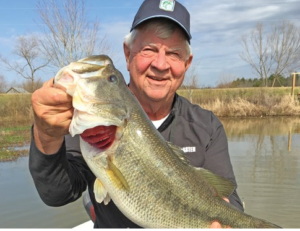
Pat Cullen with a 10.2 pound Largemouth Bass.

The late Pat Cullen with a 10.2 pound Largemouth Bass. Photo credit: Bert Deener

Topwater fishing provides anglers a top-notch fishing adventure. With the lure perched on the water’s surface, anglers can watch their fish zero in on its target, lurch out of the water, and snatch the bait. Whether you’re a seasoned topwater pro or a beginner, these tips are sure to help you enjoy a heart pounding adventure and kick off this year’s pursuit of the Georgia Bass Slam. Just make sure to grab your fishing license before heading to your favorite fishing hole.

1. The early morning and late afternoon anglers get the fish.

Bass are more likely to be in the shallow areas of a pond, lake, or river during the first and last few hours of daylight. With fish already near the top of the water, fishing in the early morning or late afternoon increases the chance of getting the fish’s attention. Pro tip: This tip works on both cloudy and sunny days on the water!

2. Check the weather and water temperature before you head out.

Beginning when water temperatures hit the low 60s, topwater fishing starts heating up! Also be sure to check the weekly forecast. If a front is headed your way and the barometer is falling, fish will feed on the surface just ahead of it.

3. Match the hatch.

Make sure your bait matches the prey bass are hunting for. Walking bait and poppers tend to get more bites in early spring. As waters warm, buzz bait becomes the favorite – especially of trophy sized bass. If you’re in an area with shad, use walking bait closely resembling the injured shad that bass are feeding on.

4. Choose the best lure for water conditions.

If fishing murky water, try using a bright, noisy buzz bait to make sure fish can easily see it. With a buzz bait, do not set the hook when the fish hits. Just keep reeling until you feel the fish, then sweep a hookset. As summer approaches and the water becomes clearer, make sure you mix in some clearer colors.

5. Adjust your fishing line to the lure.

Monofilament, 10-12-pound line is great for poppers and walking baits. For buzz baits, a heavier 14-17-pound line works best, and you can even mix in some braided line if fishing heavy vegetation.

6. Have a rod with the correct action.

A 7’ to 7’3” rod is ideal. You’ll want a medium-action rod with some give at the tip to provide more action as you work the lure – especially with walkers and poppers. Many folks actually prefer fiberglass rods for topwater fishing. The lighter tip will also let the fish inhale the lure and keep you from pulling the treble hooks out of the fish’s mouth as it is fighting. For buzz baits, a medium-heavy rod with a flexible tip will allow you to get a big fish out of cover.

Tallapoosa River Float Trip for Redeye Bass

Tallapoosa River Float Trip for Redeye Bass

By David Rainer
Alabama DCNR
from The Fishing Wire

The cast was about 2 inches too long, and the topwater fly plopped down gently on a chunk of flat rock underneath the blooming mountain laurels on the Tallapoosa River north of Lake Martin.

One slight twitch of the fly rod tip and the Ol’ Mr. Wiggly fly slid into the current. The fly didn’t have time to float downstream. It was immediately inhaled by one of the Alabama-specific species, the redeye bass.

I lifted the fly rod to set the hook, and the fish went airborne.

Guides Drew Morgan and Craig Godwin immediately pumped up the volume when they saw the fish.

“That’s a big one,” they both shouted. “Try to keep him out of the current. Keep the rod at about a 45-degree angle.”

After several runs near the three-man inflatable raft, Morgan finally stabbed the net in front of the fish to end its freedom – only momentarily, of course.

The tape measure hit 12 inches, and I was immediately eligible to be entered into the Alabama Wildlife and Freshwater Fisheries Division angler recognition program as a master angler. It also happened to be the first redeye bass of my long fishing career.

Horseshoe Bend was our origination point, and the river had settled down from recent rains to levels that would make the trip a breeze with no portage involved.

It didn’t take long for these aggressive, beautifully colored bass to make it a float trip that will never be forgotten. Although trips with Morgan, or any of his guides at East Alabama Fly Fishing, often result in hooking a variety of species of fish, including Alabama bass, striped bass, hybrid stripers, carp and numerous sunfish like bluegills and redbreasts, this outing produced a redeye bonanza.

Morgan, a history teacher at Auburn Junior High School, got into the guide business after gaining the necessary tool.

“I fished this river a lot with canoes and kayaks,” Morgan said. “I really enjoyed catching bass on a fly rod, but that’s hard to do out of a kayak or canoe. A guy I knew had this drift boat. He told me, ‘Take this out and start fishing with it.’”

The owner knew Morgan would fall in love with the diversity and comfort the drift boat afforded, and it wasn’t long before ownership of the vessel changed hands.

“I had to have the boat,” Morgan said. “I took the bait – hook, line and sinker. At the same time, I was thinking about starting a guide service. This stretch of river is big enough for guiding. I’m not moving people off their honey holes. It’s beautiful. The fish are predictable, and you can pattern them. I just needed the boat. Once I got the boat that was stable and was comfortable for clients, we opened the guide service.”

The drift boat gives Morgan and his passengers access to the whole river at decent water levels. It can float in 2 inches of water and slides over the slick rocks that crisscross the river in numerous places.

“We can go where other boats can’t,” he said. “And it’s stable so you can make casts to the best spots.”

Five years later, the business has grown to include three other guides – Godwin, John Agricola and Justin Wilson. Agricola and Wilson guide on the nearby Coosa River.

“Justin is really knowledgeable on spotted (Alabama bass), hybrid and striper fishing on a fly,” Morgan said. “And he has a power boat, so he can run all over the lakes. He fishes the tailwaters a lot on the Coosa.

“John has a flats boat, and his specialty is catching carp on a fly in the backwaters of the Coosa. That’s a really cool experience. You’re sight-fishing for carp. You try to drop that fly right in front of them. It’s kind of like fly fishing for tailing redfish or bonefish.”

Morgan limits his guide time to three days a week when school is out to spend time with his young family. During the school year, he’s limited to Saturdays.

“It was kind of a way to make a little extra income during the summer,” he said. “But I limit it to three trips a week. I want to continue to enjoy coming out here.

“Craig and I have been fishing together for a while, and he can guide during the week because he owns his own photography business.”

Our trip covered the middle section of the Tallapoosa from Horseshoe Bend National Military Park to Jaybird Creek boat launch at the north end of Lake Martin.

“That stretch is 6 miles and it’s mostly shoals the whole way,” Morgan said. “I find fish in this river like being in the shoals. The area we floated was Irwin Shoals. It’s very scenic. Even if it’s a tough bite, you get to float down the river and get to see things you normally don’t get to see.”

Morgan said the stretches of the smaller rivers are often overlooked by most recreational users.

“You don’t really feel like you’re in Alabama sometimes, but it is Alabama,” he said. “The lakes are really popular, for good reason. But people don’t realize there are beautiful rivers and streams you can float-fish too.”

Morgan mentioned scenic rivers in the Upper Piedmont area of Alabama that run from Fort Payne to the coastal plain, including Little River, Cahaba, upper Tallapoosa and upper Coosa.

“East and northeast Alabama have a lot of great places to fish, especially the redeye bass,” he said. “Redeye bass are endemic to Alabama, which means they don’t live anywhere else. These fish like current in cool Piedmont streams with a lot of flow. They like clean water. This river is so clean, and it has so much oxygen in the water that these fish live in the shoals on this big river.

“Redeye bass are our own version of trout fishing, but I think it’s cooler than that because the redeyes are native. They are colorful, very aggressive and eager to eat. I think this is something really special for Alabama to have in our waters.”

What fisheries biologists have recently discovered is that each river system may have variations in the black bass population that make them distinct to the rivers they inhabit.

“Presently the redeye bass of the Tallapoosa River are now called Tallapoosa Bass (Micropterus tallapoosae),” said Nick Nichols, Fisheries Chief with the Alabama Wildlife and Freshwater Fisheries Division. “We are conducting a research project in conjunction with researchers from Auburn University to better determine the status and genetic characteristics of these riverine black bass species in Alabama.”

When Morgan is targeting the Alabama (spotted) bass, he looks for water where the current slows from the upper reaches of the Tallapoosa.

“They can put a big bend on a five-weight rod,” he said. “A 2-pound spot that has lived in this moving water is a good fish on a fly rod. If you mix in bluegills and redbreasted sunfish, they’re a whole lot of fun to catch. It’s a fun day of fishing, especially during the summer when we’re catching everything on top. I don’t guarantee fish, but the fish in the summer are pretty eager to eat.

“What I do like about river fishing is I think it’s easier to find fish. You’re looking for ambush points and hiding places.”

Morgan and his guides will accommodate anglers of all skill levels.

“I have clients that are all over the board,” he said. “I think more people are getting into fly fishing. I hear this story all the time, ‘Yeah, granddaddy fly-fished all the time, but we started fishing the lakes and didn’t fly-fish as much. Now I want to get back into it again.’

“Then we have clients from all over the South who want to come catch a redeye. The word is getting out about this species. Fly anglers, especially, like to notch different species on their belt. And, I’ve got people who see this boat and want to fish in it to let the guide do the work so they can concentrate on fishing. You can’t do that in a kayak or canoe. There’s something for everybody in the Tallapoosa.”

Morgan also has other motivation to put a fishing rod of some kind in people’s hands.

“Mainly, I want to get people into the sport,” he said. “If they want to come with me, that’s fine. But I just want people to get on the water, buy a fishing license to support the state and appreciate what we have.”

How To Catch July Bass at Lake Seminole

July Bass at Lake Seminole
with Daryl Davis

Big bass in shallow grass, even in July. If that sounds like a good pattern to you, plan to head south to Seminole this month. The hydrilla has grown thick on river ledges and the bass move into it to feed. You can catch some bragging size stringers right now fishing the grass at Seminole.

Seminole is an impressive 37,500 acre lake right in the corner of Georgia, Florida and Alabama. This time of year half its surface can be covered with hydrilla, making it look like a fantastic place to catch bass. And it is, but if you go out casting to all the hydrilla you may never get bit. The bass hold in specific areas that you will have to learn.

Although the heat can be oppressive this time of year, and the hydrilla gnats will drive you crazy if there is no breeze, you can catch bass all day long out of the thick cover if you fish it right. Early mornings and late afternoons are still best, but big bass will hit in the middle of the day, too.

Daryl Davis lives in Ochlocknee, near Thomasville, where he runs a family owned grocery store and fishes with the Rose City Bassmasters. He has been with that club for about 12 years and they fish Seminole often. This year Daryl made the state team at the Top Six tournament on Eufaula.

For several years Daryl has fished the BFL trail, the Georgia/Florida Team trail and other local tournaments on Seminole. He has learned its secrets and knows where to go to catch bass every month. He agreed to show me his July patterns and some places where they work. We spent an afternoon on the lake on June 17 and landed several bass, including a 3.5 pounder I caught and a 5 pound fish he caught.

Hydrilla is the key but the bottom structure where it grows controls where the fish will be in it. Bass hold in deeper water this time of year, so hydrilla edges near channels are the best place to find them. They will move up ditches across hydrilla flats to feed, too, but you need some kind of bottom contour to attract them to an area.

First thing in the morning Daryl likes to start off with topwater baits for the early bite. He will throw a black or white skirted buzzbait and run it across the hydrilla edges and around clumps of the grass. A chrome and black Pop-R is also a good bait when the bass want something moving a little more slowly.

About an hour after the sun gets above the trees Daryl will try a 3/16 or 1/4 ounce double willowleaf white spinnerbait with chrome blades. This bait is run above the hydrilla and dropped into cuts and holes in the grass. The bass will often slam it as it flutters down past them.

A Carolina rigged Zoom Mag 2 or Ultravibe in Junebug red or green pumpkin is a good bait for some areas. If the grass is scattered enough to drag it effectively, Daryl will rig up with a half-ounce lead and cover flats around ditches with it. He also likes to cast it to brush piles in deeper water.

A Bandit crankbait works well when the hydrilla is thin enough to work it around clumps of grass or over it. Daryl will fish a crankbait along the edge of the hydrilla and over the flats when he can. That allows him to cover more water and find active fish.

Daryl’s go-to bait is a Texas rigged Baby Brush Hog or Mag 2 worm in Junebug red or green pumpkin. He uses a 3/16 to 5/16 Florida sinker ahead of the bait. These sinkers have a screw eye that will hold them to the worm so you don’t need to peg it. This bait is dropped into holes, cuts and points in the hydrilla to attract bass all day long.

Heavy equipment is needed to drag big bass out of the grass, and Daryl uses 17 to 20 pound clear Sensation or Silver Thread line. A stiff rod helps drag the bass and grass to the boat when the fish burrows down into it, and he often cranks down the drag on his bait casting reels till it won’t slip.

The following ten spots all hold bass and we caught fish on several of them two weeks ago. Check them out and then you will be able to find many more just like them.

1. N 30 47.356 – W 84 40.990 – Up the Flint River above Wingates near Faceville Landing you will go past an island on your right running upstream. It is just downstream of the place the channel goes to the right bank below Faceville. On the upstream end of the island is a red channel marker. A ledge runs from the island out past this channel marker, parallel to the channel.

There are some brush piles on the point around the marker in about 16 feet of water. This is a good place to cast a Carolina rig and probe the point and brush since July bass hold in and around it. Fish all around the marker, casting toward it from a big circle. You can also ride the point with a good depthfinder and mark the brush. When you locate the brush make repeated casts to it. Current running into the brush helps.

2. N 30 47.367 – W 84 42.011 – Downstream of the island Butler Creek enters on your left going downstream. The downstream point of it has a good hydrilla edge to fish. A flat runs out to the channel and you will see a group of 5 stumps and a sixth one a little away from them. Bass hold out on the channel and run in to the grass to feed.

Start fishing the hydrilla edge at the point of Butler Creek and work downstream. Early in the morning try topwater along the edges and give the spinnerbait a try. Then pitch or flip a Baby Brush Hog or Mag 2 worm to the edge of the grass. Concentrate on cuts, holes and points in the hydrilla. Bass will hold on any irregularity.

Try to make the bait enter the water without a ripple first. When the bass are holding shallow sometimes a loud splash will spook them. At other times Daryl says a loud splash seems to attract them, so try that if the quiet entry is not working. In either case, expect a hit on the fall. When your bait hits bottom, twitch it once or twice then pick it up to make another flip.

If the day is cloudy and early in the morning Daryl says the bass are more likely to be roaming the outside edge of the grass. When the sun gets on the water it tends to make them back up into the cover, holding inside the grass. That is when you must make your bait fall right beside the grass and pitching into holes back in the grass is more likely to pay off.

3. N 30 47.307 – W 84 42.831 – Head downstream and the channel will kick back to the left a little. Just before it goes into the sharp right bend, around the last green marker before the bend, start fishing the grass on your right. You will be across the channel from two tall sanding trees out in the water. This grass is just off the channel and the big flat behind it is full of stumps and thick grass.

The bass will hold along this grass edge, moving up out of the nearby channel to feed. Fish all along this edge, working all the way down to where the channel bends. Current moves parallel to the grass so any little point or pocket in the grass is a good holding place for bass to ambush food.

4. N 30 47.407 – W 84 43.169 – Head downstream and the channel makes a sharp sweeping turn all the way across the lake to the right bank. The outside bend of the channel drops off sharply and there is a huge grass flat running all the way past Wingates. Many bass move off this flat in the summer and hold on the outside bend.

Watch for a big stump on your left that sits right on the channel. It will be even with the green channel marker across the channel and about half-way between two red markers. There is a shallow ditch that runs across the flat at an angle, running to your right and downstream if you are facing downstream. You can see it as an opening in the grass and stumps. Start fishing near that stump.

Fish the main channel edge but also fish down the ditch, pitching to grass on both sides of it. The water in the ditch will be 7 to 9 feet deep and each end drops off into the channel. This is a big area to work since you have the outside edge of the river channel all the way around the bend and both sides of the ditch.

It was near the downstream end of this ditch, but back on the main river channel, that I caught a 3.5 pound bass on a green pumpkin Baby Brush Hog two weeks ago. The bass thumped the Brush Hog as it fell then headed straight to the boat with it. When you feel a bite, set the hook fast, the bass often run to deep water as soon as they hit. Daryl also caught a couple of bass in this area.

5. N 30 47.578 – W 84 43.363 – On the right going downstream where the river hits the bank a big cove full of cattails sits off the edge of the water. About 100 yards downstream is the entry to Ten Mile Still Landing. Look at the grass and you will see a point on it. This grass is on a sandbar that runs out toward the channel.

Fish the grass edges all around this point and also work the point with a Carolina rig and a crankbait. Bass will use the sandbar to move out of the channel to the grass to feed, and will feed on the sandbar, especially when there is current flowing across it.

6. N 30 45.721 – W 84 46.216 – Run down past Wingates to where the channel swings back to the left bank. You will see some docks on the bank and one has a green roof on it. Go in toward that dock and you will be crossing a big grass flat that runs from the channel to the bank. Upstream of this dock is a small creek that enters the lake and there is a lot of sand on the bottom in this area.

Start fishing out in front of the green roofed dock and fish the flat, working upstream. Daryl likes to cast a crankbait here, running it above the grass if it is still deep enough or around the clumps of grass growing here. Daryl got a keeper bass here when we fish together. The bass can be anywhere on this flat so you need to cover all of it. If you catch a bass on the crankbait, stop and fish slower with either a Carolina or Texas rig since there should be more nearby.

7. N 30 45.811 – W 84 50.156 – The next spot Daryl calls “Stinky Island” because of the birds roosting and nesting there. It is the last big island before the channel to Sealey Point. You can run down the marked channel to the Sealey channel then go upstream to the island, or you can cut across and run the right bank if you know how to avoid the stumps.

There is a huge grass bed off the bank of this island on the Flint River side. There is also a ridge of grass off the bank here. Fish both grassbeds, fishing all along the edge on the island and then the one out further that runs parallel to it. If you are here early in the morning try topwater and spinnerbaits. After the sun gets up fish the grass edges with plastic baits.

8. N 30 47.382 – W 84 55.679 – Sometimes the Chattahoochee River is better that the Flint, often because of current moving there. The next three spots are up the “Hooch” and a long run from Wingates, but convenient to Land’s End Marina. If you are coming upstream from the dam, you will enter the channel behind a long ridge of an island between the channel and the huge flat toward the Florida shoreline.

Watch for the first gap to your left running up the river. The downstream point is an excellent place to catch bass. There will be some hydrilla patches near the bank to fish and out on the point is some rock and brush. Daryl likes to fish the shallow grass then set up inside the cut and cast out onto the point if current is moving across it.

Work a Carolina rig on the point and probe for the cover on it. Fish all around the point if there is no current, but fish with the current if any if moving. Current really makes the bass bite better and Daryl says he has hung some big bass here.

9. N 30 47.716 – W 84 55.679 – Run on up almost to the cut to Land’s End and watch for a big opening on your right. The point on the downstream side of this cut runs out as a ledge parallel to the channel and has some stumps on it. Daryl fishes the grass around the point into the cut and then casts across the point with a Carolina rig. He says he lost one of the biggest bass he ever hooked here.

How To Flip from Denny Brauer

Flipping Fundamentals with Denny Brauer
from The Fishing Wire

Flipping with Denny Brauer


Legendary bass pro Denny Brauer shares his knowledge on one of bass fishing’s most deadly techniques

Louisville, KY – There are numerous must-know bass fishing techniques. And what’s at the top of the list? Flipping, which can put fish in the boat when just about everything else fails.

“Almost every lake has heavy cover, and where do the big bass like to live? They like to live in that heavy cover. Conventional casting techniques often cannot get your bait in there and if you can get your bait in there, your odds of getting the fish out are pretty slim. That’s where flipping comes into play,” says legendary bass pro Denny Brauer.

He continues: “If the water is dirty you can get a lot closer to the fish or if the cover is real uniform and heavy, think of how many more drops you can get into the fish’s home because you’re not spending all that time reeling. You’ve got a piece of line that you’re working with, the reel’s engaged, and you’re fishing close to the fish where you can feel the bites better, you can get a better hookset, and have a better chance of landing them. So, flipping can have a real advantage in dirty water and heavy cover.”

How to Flip

As far as the mechanics of flipping. Brauer explains that the first thing you want is to be working with is the right piece of line. Hold your arm straight out and make sure the bait is even with the reel. That way you’ve got a piece of line—about an arm’s length—that‘s very easy to work with. He then recommends that you swing the bait out but when you do, don’t just let go of the line or you’ll splash the bait into the cover, often spooking the fish.

“What you’re trying to do is let the line slide through your hand, bringing your hand back to the reel handle. Now you let your lure fall on just a little bit of slack line, that way the lure will fall straight down into the cover. When it hits bottom shake it a couple of times and now is the time to feel it—if it feels heavy or light you need to set the hook. If not, pull the bait out and flip it into the next good-looking spot and repeat the process. Let it fall straight to the bottom following it with the rod. Give it a couple of shakes, bring it out and flip it into the next spot.”

And that’s all there really is to it—and once you get the hang of it it’ll become second nature, just like making a cast.

Flipping Must-Haves

When it comes to flipping and pitching using the right equipment is incredibly important. A good baitcasting reel is crucial. For Brauer, that’s the Lew’s HyperMag Speed Spool SLS. Incredibly light and compact, it has a really strong 20-pound drag for strong hooksets and pulling fish out of cover. It also has a perforated spool so you can tie direct with braid without slippage issues. Along those lines, with many baitcasting reels, Brauer recommends spooling with a few yards of monofilament or fluorocarbon on first, tying directly to that to keep the braid from slipping on the spool.

“No matter what baitcasting reel you’re using, make sure you tighten that drag down as much as you can so you can get the hookset and get those fish out of heavy cover. It’s very important to have a reel that’s heavy duty because you’re going to be using a heavy rod and heavy line along with it and the reel needs to be able to hold up,” says Brauer.

When it comes to rods, Brauer also uses Lew’s sticks.

“The most popular length is a Team Lew’s Speed Stick 7’6” heavy-power Flipping rod. Plus, it’s got enough tip in it that it makes a great pitching rod. The bottom line is to find a rod that works for you. If you’re smaller in stature you might want to go with a slightly shorter rod but when you’re flipping and pitching to make sure the rod is at least 7 feet long so you can get the leverage and do the techniques correctly and go with heavy power.”

When it comes to flipping and pitching must-haves, Brauer considers line the most important.

“When it comes to flipping, line choice is where a lot of anglers get confused,” says Brauer. “That’s why I went to work with Seaguar to develop these FLIPPIN lines—in both braid and fluorocarbon—so anglers will have the correct line for the technique. Seaguar FLIPPIN braid is available in 50 and 65 pound. I love to fish the braid down through the heavy cover—matted grass, heavy vegetation, etc. because it’ll cut right through it, you get a great hookset, and there’s no stretch to it. So you get a really good hookset and you bury the hook really good.”

He continues: “Now, if the water is a bit more clear or you’re targeting isolated cover and targets I’ll choose Seaguar FLIPPIN fluorocarbon, which is available in 20-, 25- and 30-pound test and those are perfect weights. If it’s really clear water with isolated targets, you can get by with 20 pound. If the cover’s pretty dense, move up to 25—and if the water’s dirty, move up to 30 pound. You’re never going to have to worry about breaking off a fish. And that’s very, very important because the biggest mistakes that happen with flipping and pitching are involved with your line—either using the wrong line for the wrong situation, using too light of line, or not taking the time to re-tie.”

Where to Flip: Pattern Within the Pattern

“When it comes to flipping, you’re always hunting for some kind of cover,” says Brauer.

Of course, depending on the waters you fish, that cover can come in a variety of forms. Brauer’s advice is just to get out on the water, target some cover, and wait for that first bite, after which you can start getting analytical and work toward discovering what he calls the “pattern within the pattern.”

Often he starts his flipping routine working boat docks, a solid bet for flipping just about everywhere you can find them.

“When it comes to boat docks I’ll fish each pier, the walkway, and if it’s got anything unusual like a ladder or a rope, a boat lift, etc., I’ll fish it all. But when you get the bite, really pay attention: Where exactly did that bite come from? Don’t be in a hurry to get to the next dock. Sit and analyze the one where you just caught the fish. How deep of water are you sitting in? Is it a gravel bank or a mud bank? Is the dock on a point or back in a pocket? Those fish will tell you a lot if you pay attention. Was it on the shallow side of the dock? The deep corner? Was it on the windy side or the calm side? If you’re fishing a river, was it on the up current side or the down current side? The details you can pick up go on. And that’s what I call developing the pattern within the pattern that can be so critical.”

And when he’s flipping bushes, flooded buck brush, willow trees, cypress knees, etc., he’s constantly trying to figure out what side of the target fish are positioning on. Was the fish on the shady side or the sunny side? If he can figure out how they’re positioned he only has to make one flip to the target, a time-saver as a tournament angler, which gives him the opportunity to fish more targets than a competitor who hasn’t figured it out.

“Once I’ve narrowed it down to what side the fish will be on—windy, sunny, shady—I then take it one step further. When you flip it in there and get that bite, ask yourself did the fish hit it on the drop or after it was on the bottom and was I shaking it up and down? Because if a fish hits on the drop the fish is aggressive. Then you know how he’s positioned on the cover and how he’s biting. If he hit it on the drop and your bait hits bottom there’s no need to sit there and jig it up and down. Hit the next piece of cover,” says Brauer.

Conversely, there are times when you may need to flip your bait in and jig it repeatedly up and down, like after cold fronts or on heavily pressured waters. That may also be part of the “pattern within a pattern” that you discover.

“No matter what, spend some time analyzing the cover, use common sense, and number one—listen to the fish. When you get that bite, really analyze everything you can about that piece of cover, exactly how the fish hit the lure, and it will make you a more successful flipper,” says Brauer.

Boat Control

While there are several keys to successful flipping, Brauer cites boat control as one that many anglers could improve. First off, it’s important to operate your boat with your bow into the wind or current when flipping, operating your trolling motor to work targets efficiently.

“That way you can be going the speed you want to rather than the conditions pushing you too fast or slow,” says Brauer. “Also, working into the wind or currently allows your boat to fall back when you catch a fish, giving you a second chance to approach the spot where you caught the fish for another bite.”

Another reason boat control is important is it helps you reduce the presence of your shadow in potential fish-holding areas. “You never want to cast your shadow onto the cover before you flip it, because from the time bass are itty-bitty fry they’re conditioned to water birds and other critters so those shadows can spook them. So make sure when the sun is out that your shadow is not hitting the cover before you have a chance to flip it.”

Also monitor water clarity. Boat control in mind, if the water is a bit more clear you might want to back the boat off a bit and make pitches; if the water’s dirty, you can get closer.

“Be aware, big bass are very spooky so be as stealthy as you can. Don’t have your trolling motor on high; have it on a speed that’s conducive to the density of the cover you’re going through so you can be very thorough without being rammy while you’re moving through and you’re going to catch more big fish,” says Brauer.

Parting words

No matter where you fish bass, flipping can definitely up your odds for more and bigger fish. With fish pushed deep into cover, it can also produce fish when other techniques can’t seem to get the job done. Take a few tips from legendary bass pro and flipping expert Denny Brauer and we promise you’ll become more successful on the water.

For more information, call 502-883-6097, write Kureha America Inc., 4709 Allmond Ave., Suite 4C, Louisville, KY 40209, or visit us on the Web at www.seaguar.com or on Facebook.

How To Catch June Bass at Jackson Lake

Jackson Lake June Bass with Mike York

The bass at Jackson Lake are moving off their spawning areas and stacking up on summer time holes in June You can go to Jackson and catch a bunch of bass sitting on one hole when you find the right spot. They are hungry, hitting good and have not moved real deep yet.

Although Jackson is a fairly small lake it has very varied structure and cover. Fed by three main rivers and several creeks, it is full of main river and creek points that are magnets to bass after the spawn. Many have log jams, brush piles and rock cover that are perfect hiding spots for bass.

Recently the population of spotted bass at Jackson has exploded and those aggressive fish can be found in the same places as largemouth. Although the smaller spots may have replaced bigger largemouth, they seem to cooperate better with fishermen and give a great fight.

If there is a drawback at Jackson this time of year, it is the boat traffic. During the day it can be almost impossible to sit on a main lake point and fish. Skidoos will buzz you and bigger boats with skiers also ignore state law and will sometimes even run between you and the bank you are fishing. Go early in the morning or during the week if possible.

Mike York lives in Jackson and works for the Butts County Sheriff’s Department. Although he has been fishing all his life, he has been fishing with the Butts Bass Busters Bass Club for the past three years and made the state team last year at the Top Six. This year he finished 24 at the Top Six. He also qualified for the Stratos National Championships by finishing 24th in the state tournament.

This year Mike is also fishing the BFL and Everstart trails when possible. He catches a lot of bass and knows most Georgia lakes well, but knows Jackson better than others. He fishes a lot of the Berry’s Boat Dock night tournaments as well as their trail, and does well at Jackson, especially after the bass move out to the summer patterns.

Mike took me to Jackson in mid May to show me some patterns and places to fish for June bass. Due to the strange weather we have had this year, bass were still bedding in the middle of May and we saw many fresh beds. There were some bass on their summer holes already, and we caught about 8 or 9 fish off one spot that day.

This is Mike’s favorite time of year to fish for bass. They are settling down off their post spawn pattern and becoming more consistent in their behavior. For June fishing Mike looks for main lake points that drop into deep water. If they are on the outside bend of the creeks or rivers, they are even better. But the key is shallow feeding areas that drop fast into deep water.

He expects to find fish feeding in 12 to 16 feet of water in June, and concentrates on this range of depth. The bass will be a little more shallow the first of the month, moving deep as the water gets hotter.

Early each morning Mike will start with a top water plug like a Pop-R and a Zoom Fluke and fish it till the sun gets up. Topwater baits will catch fish that have been up feeding shallow at night, as well as bass that are still in a post spawn pattern. Not only can you move fast and cover a lot of water, getting bites on a top water plug is exciting.

Seawalls on points near deep water are good top water spots. Mike will cast right against the wall and fish the bait back out to the boat. Wood, riprap and concrete walls are all good. If you see bait fish flipping around them, they are even better. Seawalls in the area of the lake where Tussahaw Creek and the Alcovy River come together are the best.

After the sun is high, Mike moves out onto the points and throws crankbaits and Carolina rigs. He likes the Mann’s 15+ and Norman’s DD-22Ns with chartreuse sides and a blue back or the blue back with white or pearl sides.

On his Carolina rig Mike will stick with a half-ounce sinker if the wind and current will allow, going to a ¾ ounce only if necessary. Mike likes a lighter sinker and says he hardly ever fishes a one ounce sinker. He ties a 2 ½ to 3 ½ foot leader and uses a 1/0 or 2/0 hook in a Zoom Trick or Finesse worm. Junebug and green pumpkin are his favorite colors in both baits.
The following 11 places at Jackson are some of Mike’s favorite June holes. They will hold fish and give you an idea of the kinds of spots Mike looks for this month. You can check them out then use the information here to find many others like them.

1. This point was called “Snoopy’s Point” for many years because of the cutout of Snoopy on the bank. After you leave the island at Martin’s Marina, it is the upstream point of the third big cove on the right going upstream. The cove itself has two jug lines across its mouth, and the point has some big rocks on it.

Running off this point there is a ridge that runs out downstream and comes up to 17 feet deep on top well out from the bank. You want to locate this high spot and fish all around it, casting across it with both crankbait and Carolina rig from all directions.

There are big rocks under the water here and bass will hold on them. Start with your big crankbait since you can fish faster then come back with a Carolina rig. If there is any current or wind blowing across the point, make extra casts that move your bait with the current and wind since bass will relate to the moving water.

2. Straight across the lake you will see a small cove with a point on the upstream side. There are two big dead pines on the point and one leans to the left when you are facing the point. There is a wooden sea wall here with a small gap and beach on the upstream side of the point.

There are some rocks and stumps on this point. You can see some of the rocks up real shallow and more run out from them, as well as another group out from the edge of the beach. Stay out from this point and cast in toward it, fishing a crankbait and Carolina rig all around the rocks and stumps.

Then work up the bank toward the overhanging trees. There are more rocks under the water where the seawall dips in and trees hang over it. Fish them good. We caught our first keeper here and it was a spot. Mike says fish this place several times during the day since bass move in to feed at all times.

3. Head up the river and go into Tillman’s Cove, the creek that enters on the right just before the lake narrows down. The left bank will curve but have no pockets until you get about half way back. There are no houses or docks on it. Stop when you pass the first pocket. There are three points to fish here, the one on the upstream side of the first pocket, the one on the upstream side of the second pocket and the one directly across the creek from them.

Keep your boat out from the bank and cast toward the point. Bass hold in 10 to 12 feet of water on these points, especially early this month. Fish your crankbaits and Carolina rigs from the bank out to that depth, probing for stumps and brush.

4. Run up to where Tussahaw Creek splits off from the river and go the big point between them. On the creek side, look for a brown house with a stone chimney in the middle of the front of it. Out from the dock in front of that house a ridge runs out toward the creek channel. There are old logs and trash that has washed up on it and become waterlogged.

Stay well out from the ridge and cast across if from all directions. Work with the current or wind if there is any. This spot is just upstream of the hump where the old state brush pile is located. You can fish it, too, but don’t get the two confused. The ridge is in closer to the bank and the hump more out toward the middle of the creek on the big flat.

5. Just downstream of the old Kersey’s Marina site the main point between the cove at the marina site and the creek to the left is a round sand point. For years there was a sail boat tied to the dock on this point and it was called “Sailboat Point.” The sailboat is gone now but there is a white boat shed with a red door on the point.

A ridge runs off the point at the boathouse across the creek toward the cabin with the red roof on the other side of Tussahaw Creek. There is some trash on this point right where it drops on the downstream side. Keep your boat out on the downstream side and cast across the drop from deep water to shallow. You will be casting toward the old marina site.

Fish Carolina rigs and crankbaits across the ridge, working them down until you hit the trash. You want your crankbait to just tip the tops of the brush but you can work your Carolina rig through it. The crankbait will catch more active fish but you should follow it up with the slower moving Carolina rig.
6. Above the bridge in Tussahaw Creek, the creek makes a sharp turn to the right and straight ahead a smaller creek enters. As you go into the mouth of this creek a yellow cabin on the left sits on a flat bank on your left. A ridge runs off this bank straight across the cove toward the point between the small creek and the Tussahaw Creek channel. There are two rock piles on this ridge.

Line up the light pole in the yard of the yellow cabin with the right edge of the cabin and go straight out. When you are about even with the middle of the bridge, you are near one of the rock piles. You can idle back and forth across the areas to get a good idea of the way the ridge runs across the cove. It is a good idea to mark it with buoys.
Fish a Carolina rig across this ridge to locate the rock and any brush that has been put out here. Then cast a crankbait to the best areas. Fish with the wind if it is blowing across the ridge, but cover it from both sides if there is no wind.

7. Come out of Tussahaw Creek and head up the Alcovy River. There is a fairly narrow gap as you start up the river then it opens up. On the right bank of the wide area, just upstream of a swimming area and boat ramp for Turtle Cove, there is a small cove.

You will see light gray double dock with a balcony on top on the left side of the small cove. On the right side of this cove is a big three story light brown house with lots of windows and to the right of it is a big brick house. Just to the right of the house behind the gray dock you can just see and old road bed coming down to the point. It runs out across the flat point that the dock sits on.

This big flat point with the road bed is a good spot to fish. There is chunk rock and stumps on it and Mike says it is a good big fish hole. Stay way out from the point and cast up onto it with a crankbait, and then do the same with a Carolina rig. Fish all around this point with both baits.

8. Head into the mouth of the South River and go around the big point/island on the right. There will be a steep rocky bank on your right. Where the big rocks are right on the water, look to your left and start idling toward the two story house with a big deck on top. There is a flag pole in the yard behind the dock and if you line it up with the middle pole of the balcony on the house, and head toward it, you will come up on a flat in the middle of the river.

Keep your boat in 20 to 22 feet of water in the old river channel and cast toward the house. The flat comes up to 7 feet deep on top and drops off fast. Cast a crankbait up onto the flat and fish it back toward deeper water. Work up the drop all along this area then get your boat up on the flat and cast a Carolina rig out from the flat and work it up the drop, from deep to shallow.

9. Go around the bend up the South River and stay to the left, avoiding the big shallow flat out from Walker Harris Marina. When you pass the danger marker closest to the left bank, there will be a point on your left on the downstream side of a big cove. On the point is a dock with a pontoon tied to it and a For Sale sign in the yard.

The river channel swings in by this point and there is a big log jam under the water. Mike keeps his boat about 100 feet off the bank just downstream of the dock and casts upstream parallel to the bank. You can run a crankbait down this edge of the drop and cover it at several different depths, then follow it with a Carolina rig.

We caught 8 or 9 small bass here in May just after lunch. Mike says this is often a good mid-day hole because of all the cover under the water, and bigger fish will be on it by now. I caught three bass on three casts and hung up and broke my Carolina rig. Mike caught 4 while I was re-tying and then caught one or two more. He also hooked the biggest fish of the day here, a 2 pound plus fish that jumped and threw the hook.

10. Head up the Alcovy River and you will see some power lines crossing the river. There is a curving bar that runs out under these power lines fronm the left bank and there is an old state brush pile and some rocks on it.

Sit half way between the second and third balls on the line on the downstream side of the group of lines and cast up onto the point with both Carolina rigs and crankbaits. Mike says he always works this spot from the upstream side, casting up onto the bar and working his baits deeper. If you fish out until your are under the third ball you will be at the state brush pile and Mike says you will stay hung up there. Fish back toward the bank from it and you will catch bass without losing all your tackle.

11. Mike showed me one more spot that is a little hard to find. It is a ridge with a hump on it in the middle of the river above the power lines. If you head up the river you will see a point on the right bank that points upstream. All the way across the river is a light green cabin with a white dock in front of it.

This hump comes up to 12 feet deep in the best spot. If you line up the edge of the dock with the edge of the cabin, you will be in the right area. Sit on top of the hump and cast toward the bridge with your Carolina rig, fishing deep to shallow with it. Fish your crankbait in the opposite direction, working it from the top of the hump back toward deeper water to be more effective with it.

Give these 11 spots a try using Mike’s methods. They work great and you can take the things you learn and find other spots that are just as good. Jackson is a good lake this month if you can fish it for the pleasure boaters. The bass are there waiting on you.