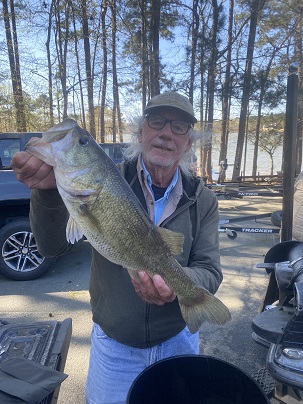
Last Sunday, March 20, 14 members of the Spalding County Sportsman Club fished our March tournament at Lake Oconee. After fishing from 7:30 AM to 3:30 PM we brought 37 keeper largemouth longer than 14 inches to the scales. There was one five fish limit and two fishermen didn’t weigh in a keeper.
My five at 12.68 pounds won and I had a 5.04 pound largemouth for big fish. Raymond English had four weighing 9.40 pounds for second, Wayne Teal placed third with four at 7.68 pounds, George Roberts had four at 7.22 pounds for fourth and Niles Murray placed fifth with four weighing 7.13 pounds.
Will Mclean fished with me and we started on a grassbed I had a feeling would produce a fish. It did, I caught a keeper and a short fish on a swim jig within a few casts. Then it got tough as the sun got on the water.
At about 10:00 Will cast beside a dock and got a bite but missed it. He got that fish to hit two more times, hooking a good keeper on the third bite.
My next fish hit my shaky head worm near the boat and when I set the hook it came flying out of the water and the hook came out of its mouth in the air. But it fell into the boat! Some fish are just meant to be caught.
At noon we had only those three in the livewell so we decided to change tactics. We went to a small main lake cove from the small but bigger creek where we had been fishing. It had deeper water and was closer to the main river. I hoped this would mean more fish had moved up from their winter homes.
On the point of the cove a deep brush pile produced my third keeper, one that just barely touched the 14-inch line on the keeper board. Then my fourth keeper hit my shaky head out from a small grass bed inside the point.
Will got his second keeper off the next grass bed then we both caught some throwbacks. Going into the cove I noticed a waypoint on my GPS and remembered there were some rock piles out in 12 to 15 feet of water. A few casts to them produced a couple of short fish then a two-pounder hit my shaky head. I had a limit at 1:00! But with the bare keeper I figured I had only about seven pounds.
I cranked up and went across the mouth of the cove to go around it again and saw another bass boat coming. Sure enough, Zane and JR pulled up on the point I had just left and started fishing! Will and I fished around the cove toward them and caught a couple more short fish.
When we met Zane and JR, with then on one dock and us on the next one, I cast my shaky head to the dock and a bass thumped it. When I set the hook I started yelling for the net, a big fish flashed in the water and tried to run under the dock.
A I fought it I flashed back three years to another tournament and a similar day. On another dock I hooked a big fish, pulled it away from the dock post three times and got it within a couple of feet of the net. Then my line went slack, it just came off. That fish was every bit of eight pounds.
As I pulled this fish to the top so Will could get the net under it, my hook popped out and flew over the boat. I felt sick for a second, then Will raised up the net – with the 5.04 pounder in it! Talk about a fish that was just meant to get caught.
Will said that fish was really his, so I gave it to him – right after weigh-in.
We fished the rest of the day and landed several more short fish, and I got two more keepers on a shaky head worm. I culled three times, including the first fish I caught that morning.
The fishing was as bad as expected. Twenty-five members of the club fished for nine hours on Saturday in the ridiculous, dangerous wind and seven more on Sunday, a much better day. But we caught only 29 bass weighing about 81 pounds. There were 13 zeros and only three limits.
As always someone catches them. Sam Smith won with ten weighing 30.65 pounds and had big fish with a 5.36 pound largemouth. His partner Carl Heidle had seven weighing 16.95 pounds for second, Raymond English had four weighing 7.83 pounds for third and David Martin had four at 7.79 pounds for fourth. My four at 6.82 pounds was good for fifth.
When we finally blasted off, I ran around to what I thought would be a protected area behind an island but the wind was so strong I could not fish. That made me go to the small creek hoping the wind would not be too bad in there, and there were a few areas I could fish without losing my cap to the wind.
I was pitching a jig and pig to the edge of grassbeds, letting it fall to the bottom in water a few inches to a few feet deep. At about 10:00 I got a bite but when I set the hook my line broke in the reel – a sure sign I had missed a bad place in it about 20 feet up when I checked then night before. To add “insult to injury,” the keeper fish jumped trying to get rid of my jig stuck in its jaw!
I finally got another bite at about 1:00 but the wind had my line bowed out and I missed the fish. Finally at 2:00 one hit my jig and I landed a 1.64 pounder, and was proud to have something to weigh in the first day.
Sunday as much colder but the wind did not blow. For the first hour or so I had to dip my rod in the water after every cast to melt the ice out of the guides. And it started just as bad, with no bites until about 11:00. Then a fish grabbed my jig and ran toward the boat but spit it out before I could set the hook.
At noon I finally landed one small keeper and about gave up since I was tired, there was three hours left to fish and I did not have much hope. But at 2:00 I went to the grassbed where I caught my keeper on Saturday and caught a decent keeper, then got a second one off a nearby dock on a shaky head worm. Then it was time to go in and face the results of two tough days!
Forestville, WI (February 9, 2022) – What defines a professional angler? Ask someone off the street and they’ll likely describe fancy boats, bright lights and big fish. Ask those who stand atop the leaderboard, however, and they’ll tell a different story – one of hard work, determination, and the efforts of many other industry pros who have helped them succeed.
“You can’t get to the top without others to lift you up,” says, Patrick Neu, president of the 1,400-member non-profit National Professional Anglers Association (NPAA). “Nobody reaches the pinnacle of professionalism in this industry without a lot of help. That’s exactly why the NPAA is inviting fishing industry workers of every type to join our ranks. Our purpose is to grow and protect sportfishing while providing our members the tools and association benefits needed to increase their professionalism and meet individualized goals.”
To be sure, professionalism in the fishing industry is wide ranging, a point not lost on the organization and its members. “Being a fishing industry ‘pro’ is a pretty loose term,” says NPAA member Chad Pipkens, a ten-year full-time veteran of the Bassmaster Elite Series and five-time Bassmaster Classic qualifier from Dewitt, Michigan, who spent several years prior honing his skills on a variety of smaller trails before acquiring the knowledge, money and flexibility of time needed to compete at the highest levels.
“Professional doctors diagnose and treat patients, teachers instruct students, pro golfers receive PGA cards, and electricians need a license to perform electrical work,” Pipkens says. “These are all well-defined fields of specialization. By comparison, the fishing world encompasses many different job opportunities. Sure, tournament anglers, captains and guides are fishing professionals, but so are the highly skilled mechanics that work on your engine as well as the folks who run the marina, design lures, sell fishing tackle, manage anglers and staff the tournament trails.
“To me,” Pipkens continued, “anyone making meaningful money or striving to earn a living in this industry should qualify as a pro. If you don’t want to be on the water day in and day out, but you still want to be in the industry, you can find the contacts amongst our membership to maybe make that happen.”
“Anyone making meaningful money or striving to earn a living in this industry should qualify as a pro.”
According to Pipkens, the NPAA does a great job of teaching aspiring pros how to run a fishing-related business through their seminars, annual conference and approachable members who have already achieved success. “NPAA membership can shorten your learning curve and raise your professionalism at any level,” he points out. “It’s a great organization for learning the ins and outs of running your own business; whether that’s tech stuff, accounting, how to network or get paid by more than one employer, it certainly can help shorten your learning curve.”
As a pro angler, Pipkens says his life is organized chaos; getting the boat ready, crisscrossing the country, and being on the road for five weeks at a time while never losing his family focus. He often practices on the water from sunrise to sunset. Despite the pressure to win, tournaments are actually the fun part of his routine. “Balancing all the rest,” he says, “is what really makes you a professional.”
For tournament pros, guides and charter captains in particular, there is a ton of preparation that takes place behind the scenes, notes John Campbell, an NPAA founding member and full-time guide. A Freshwater Fishing Hall of Fame member inducted in 2018, Campbell managed to win both the Pro Walleye Trail Detroit River and FLW Lake Ouachita championships. He also qualified for a major walleye championship every single year from 1989 to 2011 while on the pro tour. That’s 22 consecutive years, if you’re counting.
Like Pickens, Campbell agrees publicly visible aspects of being a tournament angler or guide help solidify your status as a professional, but the business end of things is vitally important. “Sure, you’ve got to pre-fish, choose your lures, maintain your gear, set up the boat and put in plenty of time on the road,” he notes, “but you also have to learn to book charters, carefully plan out your competition schedule, promote your sponsors and tend to family matters. Earning money and winning tournaments is vital, but also important is finding ways to help grow the sport through sharing knowledge and getting more kids involved.”
As a professional guide, Campbell is in the business of educating anglers. “To me, helping others learn the game is the sign of a true pro,” he states, adding that this is exactly the kind of people you’ll network and rub elbows with in the NPAA. “This organization supported over 100 Future Angler clinics in 2021 alone. With support from the Future Angler Foundation, it’s member volunteers also distributed over 4,000 NPAA Future Pro T-shirts and 3,000 rod/reel combos to kids at NPAA Future Angler education events. That, I believe, is professionalism at its finest.”
For information on joining the NPAA and exploring the many benefits membership provides, visit npaa.net.
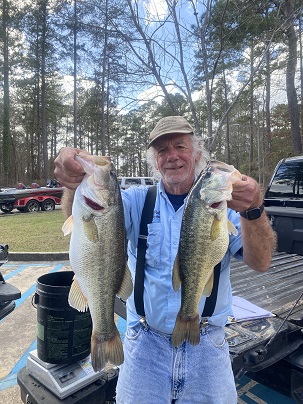
These two last-hour fish at Eufaula on the second day helped me to a fifth-place finish out of 25 people.
I usually enjoy the four seasons. Changing weather often makes fishing better and it is less boring. But going through all four seasons and worse last week at Lake Eufaula was a bit much.
I went down to Lake Point State Park last Tuesday and set up my slide in pickup camper. The weather was very warm when I went to bed and I knew storms were possible.
At 5:00 AM someone pounded on my camper and woke me. I thought they said the power was out, but my fan was still running so I turned over to go back to sleep. Then a car horn started blowing, making me look at my phone – there was a Tornado Warning for the campground on it I had not heard!
I joined all the other campers in the cement block bath house for the next hour!
The rest of Wednesday was decent, with some light showers but little wind. I was able to get out on the lake and look around some. I joined the 196 other bass boats on the water, a Fishers of Men National Championship tournament was scheduled for Thursday through Saturday. It was a big deal, first and second places in the tournament would win fully rigged bass boats worth either $80,000 or $60,000, depending on place.
Thursday was a nice spring like day, warm weather and sun. I again looked around, watching the many boats with teams fishing the first day of the tournament. Most were easing around the shoreline, casting various baits to grassbeds.
When I went to my favorite small creek I was happy to see just two boats in it fishing, but while I idled around about six other boats ran in, fished a few minutes, then left. I knew by the start of our tournament Saturday the poor fish would be beat to death, seeing every lure carried by Berry’s Sporting Goods and then some.
Friday the wind was up a little and the misty rain made me sit at my camper and watch the tournament fishermen go round and round in the creek out from the campground. Weather guessers were saying 20+ MPH winds for Saturday. Most lakes are dangerous with those kinds of winds, and Eufuala is one of the worse.
Fishers of Men announced they were canceling the third day of their tournament due to dangerous conditions. And the Bass Fisherman’s League canceled their big tournament on Oconee for the same reason.
Potato Creek did not cancel, but when Tom Tanner and I idled to the ramp for our set 7:00 blast off, we were told the executive committee delayed our start by 30 minutes. So for 30 minutes Tom and I sat in our boats as the cold wind got about five miles per hour stronger and the temperature dropped another two degrees while everybody else sat in their warm trucks in the parking lot.
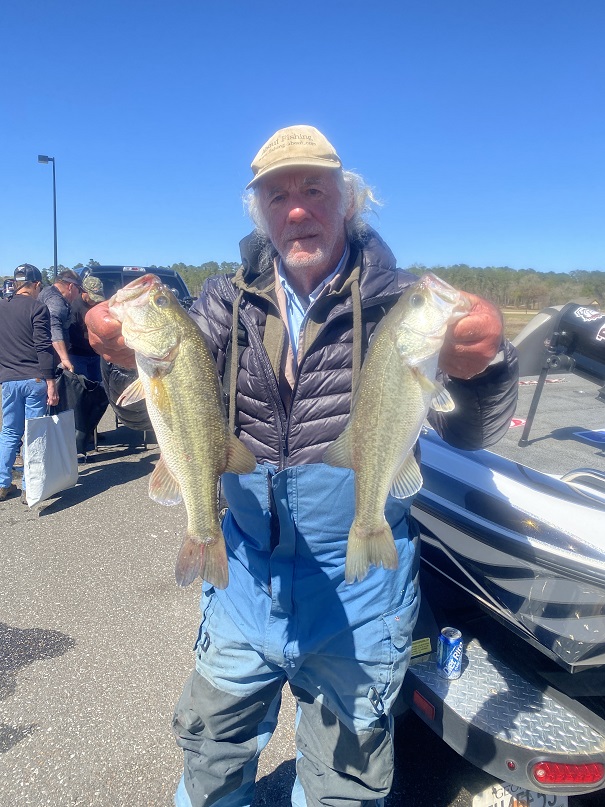
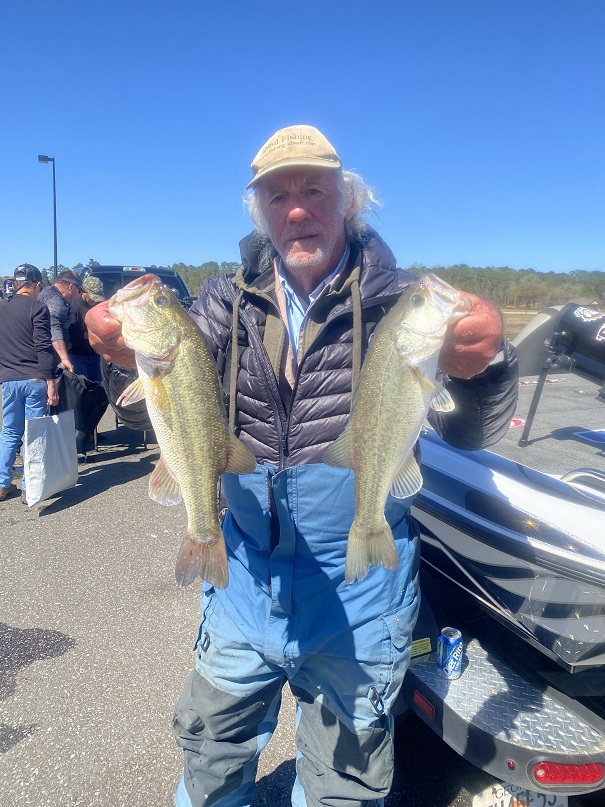
These two four pounders helped me win and get big fish at Lake Sinclair at the last minute!
Last Sunday, March 6, nine members of the Flint River Bass Club fished our March tournament at Lake Sinclair. The weather was beautiful for our casting from 7:00 AM to 3:00 PM but the bass didn’t seem to care. We weighed in 29 keeper bass weighing about 47 pounds and had three five-bass limits. No one zeroed.
My four at 10.63 won and I had as 4.19 pound largemouth for big fish. Chuck Croft placed second with five at 9.15 pounds, Don Gober had five at 9.02 pounds for third and Alex Gober, his grandson fishing with him, had five at 4.86 pounds for fourth.
Will Mclean fished with me and we headed to some grass beds near the dam where Ricky Layton, showing me around the same time of year two years ago for a GON article, caught five weighing 28 pounds. But after three hours and several different places, we both had two bites.
A good keeper bass hit my crankbait on a seawall and jumped and threw it. Then Will hooked and lost what looked like a keeper on a Texas rigged Senko. A little later Will caught a bass that just barely touched the 12-inch line, then I caught a similar one.
Club rules say a bass must be 12 inches long with its mouth closed on a keeper board to be weighed. I could make mine touch the 12-inch line, barely, but worried about it. Sometimes in the excitement of catching one I do not measure it correctly.
Around 10:30 I cast my bladed jig to a grassbed on a point and hooked a keeper out in front of it. At 11:30 Will cast to the middle of a shallow cove, said “I got one” and a huge fish swirled on top. He got it to the boat and I netted it, but it was a big blue catfish. Will’s new scales said it weighed ten pounds but it looked much bigger.
At 2:00, with about 45 minutes left to fish I was pretty disgusted. We went into one of my favorite small creeks. As we fished down a bank with a big grassbed on it, I told Will I had never caught a fish past the last small dock on it, it was very shallow. But Niles Murray caught a keeper back in it when we fished together a few years ago.
I cast my bladed jig back in it and my line started going sideways. When I set the hook the 4.19 pounder jumped, it was only a foot deep and it had nowhere to go but up! When I got it to the boat I let it go around the trolling motor but managed to pull the motor and bass up and Will got it in the net by lying down on the deck and reaching forward. That fish was just meant to get caught.
I caught another keeper on a shaky head on the next dock, then started around the other arm of the cove. Again I told Will I had never caught a bass way back in it, and he reminded me of what had just happened.
As luck would have it, way back in it I pitched my shaky head to a seawall about a foot of water and felt a tap and my line started moving out. When I set the hook a 4.13 pound largemouth fought hard but I managed to keep it away from the trolling motor and Will netted it.
We went back to the dock where I caught my keeper and Will got a 3.16 pounder off the seawall beside it, again about a foot deep. That was it, we had to go in.
I don’t know if it was time of day, location or what but I wish it had started earlier, or we had more time to fish before the time ended. This time of year fishing is often better late in the day after the sun warms the water some. It was 62 degrees in that creek at 2:00 and I am sure those fish were thinking about bedding.
While waiting for Will to back the trailer in, I checked my smallest fish and decide it had shrunk, so I just weighed in four.
Last Saturday 25 members of the Potato Creek Bassmasters fished our January tournament at Lake Sinclair. After eight hours of casting from 7:30 AM to 8:30 PM, we brought 73 12-inch keeper bass weighing about 112 pounds to the scales. There were eight limits and six zeros.
Robert Howell won with five weighting 9.04 pounds and Raymond English placed second with five at 8.67 pounds. Michael Cox came in third with five weighing 7.88 pounds and my four weighing 7.55 pounds was fourth. Stevie Wright had big fish with a 4.37 pound largemouth.
The water in Little River was very muddy but the Oconee River and creeks downstream of the mouth of Little River were a decent color. I just knew I could catch some fish on a crankbait in the 52-degree water in the clearer areas, but at 1:00 my two bites were a two-pound channel cat on a crankbait and a bream on a spoon, jigging it in brush 18 feet deep.
At 1:00 I met a boat going down the bank and they fished my favorite dock before I could get to it, then left. I started to leave, too, but noticed they threw just to the front post, not the back post. That dock has some rock behind it and is usually good for a keeper. I cast my shaky head behind the dock and sure enough it started moving out. But when I set the hook my line broke! That really disgusted me but I kept casting and managed to catch two keeper bass and a five pound flathead cat on a crankbait and two more keeper bass on my shaky head the last two hours of the tournament.
I was shocked but pleased to place but kept thinking if I had just landed that bass behind the dock and it weighed two pounds, I would have won! And if frogs had wings, they would not bump their butt every time they hopped!
Lake Burton and tidal Savannah River are about as different kinds of water you can fish in Georgia, but both hold bass. My retirement job took me to both in the past week.
Lake Burton is a beautiful 2775-acre Georgia Power Lake on the Tallulah River in north Georgia between Clayton and Cleveland. Its 62 miles of shoreline are lined with huge houses with big docks, and its steep banks are covered with rock. Views of mountains surrounding it are very pretty.
Crystal clear mountain water is the norm there unless heavy rains stain up some of the creeks. Moccasin Creek State Park is also the home of a fish hatchery where trout are raised, and many are released into the lake, both intentionally and accidentally.
Although it is a good trout fishery, its big spotted and largemouth bass are the main attraction there. It also produces many chain pickerel and crappie.
I fished on a cold cloudy Tuesday with Jeremy Eaton, a local tournament angler, and the fishing was tough. The January snows up in that area had melted and made the lake go up about five feet while dropping the water temperature more than five degrees. That combination gave the fish lockjaw.
I enjoyed the trip and could imagine easing around the backs of coves looking for big largemouth on the bed, especially around the full moon on April 16. And spotted bass will be bedding then, too, and easy to catch out on rocky points and humps. Jeremy marked ten good places to catch bass in April for my Georgia Outdoor News (subscription required) Map of the Month article.
The houses are amazing. Jeremy pointed out a huge house up on a high point at the mouth of Timpson Creek and said Nick Saban built it. He built it to see if he liked having a house on Lake Burton and he did, but rumor has it this one was too small, so he built a bigger one. Its only 9542 square feet with 7 full and two half-baths and the tax office appraised it at 2.6 million. And it is not the biggest on the lake, by far!
Go up to Lake Burton for a nice vacation and take your boat. Enjoy the lake and mountain scenery and catch some trout for dinner, and some big bass to stretch your string.
I fished the lower Savannah River last Sunday with Billy Robertson, a local club fisherman. The views were very different. No mountains in the background, just flatlands that extended forever. And cypress trees and live oaks with Spanish moss beards replaced the barren hardwoods of Lake Burton.
I am not used to fishing current, so when we fished on the river Billy kept the boat pointing upstream and ran his trolling motor on high to keep the boat slowly moving downstream I was surprised. I had to cast fast to hit eddies behind trees in the water and small pockets along the bank.
Back in the creeks where we spent most of our time the current was still strong from the outgoing tide. Although we were miles upstream, above the I-95 bridge most of the day, the tide still affected the river.
We did catch fish. Billy quickly hooked a four-pounder, and our best five of them weighed about 20 pounds. But they were bowfin, fun to catch but we were after bass.
We did catch about a dozen keeper bass that day by casting worms and small jigs to eddies in the creeks but they were small. Most were 12 to 14 inches long but they fought good in the current.
There are bigger bass in the river. A local tournament took off from the ramp we used and it took five weighing 14 pounds to win, 11 for second and 10 for third. Big fish was a four-pounder. But the rest of the folks had five weighing six or seven pounds, just like our catch.
A highlight of the trip was dinner at Loves Seafood and Steaks. Although very expensive, the gumbo was some of the best I have had and the fried scallops were tender and delicious.
Fishing the river is a fun change of pace for us lake fishermen. There are several ramps just north of Savannah in both Georgia and South Carolina. But one warning, if you get off the river itself and go back in creeks on the South Carolina side, you need a nonresident fishing license.
Details of my trip and how to catch bass on the Savannah River will be in the April issue of Georgia Outdoor News.
Go north or south for a fun change of pace for fishing this spring.
Fourteen members and guests fished our February tournament at West Point last Sunday. After fishing from 7:30 AM to 3:30 PM we brought 42 keeper bass weighing about 68 pounds to the scales. There was one zero and four people had five bass limits.
Lee Hancock won with five weighing 11.33 pounds and had a 4.46 pound largemouth for big fish. My five weighing 8.32 pounds was second and Jay Gerson had five weighing a close 8.23 pounds for third. Doug Acree came in fourth with five weighing 6.65 pound and my partner Will Mclean was fifth with four at 6.56 pounds.
I started out pretty good. Will and I stopped on a steep bank with blowdowns on it where I caught a good keeper last Saturday and started casting to the trees in the water. I looked down at my Panoptix and saw what looked like several fish on a small brush top ahead of the boat in 2 feet of water.
I cast a Carolina rigged Baby Brush Hog and watched the weight sink with the bait following it. When the lead hit bottom one of the fish went to the bait. When I tightened up my line a little I felt weight, set the hook and landed a two pound largemouth, my biggest fish of the day. I would not have made that cast and caught that fish without the Garmin Panoptix.
At our next stop on a long shallow point where I caught my biggest fish last Saturday a good keeper spot hit the same crankbait and I landed it. For the next few hours the only thing we caught was a largemouth that was not big enough to meet the 14 inch size limit.
At 11:00 I caught a barely legal 12-inch spot on my Carolina rig on one side of a rocky point then Will got his first keeper on a spinnerbait on the other side of the point. On our next stop Will got another keeper on his spinnerbait. Then he caught two more on his spinnerbait in the next two stops, giving him four to my three at 1:00! Made me wonder what I was doing wrong!
I caught one more keeper, this one on a shaky head worm, on our next stop. At 2:45 with just 45 minutes left to fish we went into a small creek with three rocky areas on one bank. I told Will we would finish up here since we were across from the ramp.
As we fished the first rocky spot a bass boat with two fishermen idled past me and started fishing a short distance ahead of me on the next rocky area. That made me mad but I learned long ago to just accept inconsiderate people and do something else.
Will and I ran to the bank where I caught my first keeper but Kwong was fishing it, so we stopped on a rocky point behind him. My first cast with a shaky head produced my fifth keeper. A short way down the bank I saw a brush pile in front of a dock, cast my shaky head to it and landed my sixth keeper, culling my smallest bass.
Time ran out before Will caught his fifth keeper. I really wish he had caught the little one I culled, but that would have given him a limit when I had only two. That might have messed up my mind even more!
Last Sunday 11 members of the Spalding County Sportsman Club fished our January tournament at Lake Sinclair. After eight hours we brought 21 keeper bass to the scales weighing about 27 pounds. There was one five-bass limit and two people didn’t have a keeper.
Jay Gerson had the limit and it weighed 7.11 pounds for first place and his 2.94 pound largemouth was big fish. Raymond English had four weighing 4.77 pounds for second and third was Robert Proctor with three weighing 3.28 pounds. Kwong Yu’s two weighing 2.86 pounds was fourth, beating my one at 2.52 pounds that gave me fifth place.
After catching four keepers the week before in the Potato Creek tournament I had some hope, but those four were on no pattern, just one here and there. Will Mcclean fished with me, joining this club as well as the Flint River club, and we started trying to hook a fish after a very cold run first thing that morning.
At 10:00 neither of use had a bite after fishing four or five different kinds of places trying to find some kind of pattern. We then made a cold ride to near the dam where I had caught my fish the week before.
After about 30 minutes the keeper I weighed in hit my spinnerbait near a grassbed in front of some rocks. I told Will I felt like you needed to catch at least three bass to establish any kind of pattern, but that one was all we had to go on.
For the rest of the day we fished similar places, making hundreds of casts around grass beds near rocks, but neither of us ever had another bite!
PARK FALLS, Wisc. – Any discussion of pre-spawn bass is bound to include the topic of crankbaits. Why? Put simply, of all the baits in the boat, cranks offer distinct advantages over most other lure types, especially in the springtime.
“Bass feed up in the early season before they spawn,” says Addison, Alabama MLF tournament competitor and St. Croix pro, Jesse Wiggins. “As water temps start to rise and baitfish get livelier, bass get used to chasing them.” That makes active presentations like crankbaits a favored springtime option in any angler’s arsenal.
Jesse’s brother, Jordan (aka Jordy) Wiggins, resides just 30-miles east of Jesse’s stomping grounds. The other half of the Wiggins Dynasty, Jordy – a BFL and Toyota Trail angler, St. Croix pro and 2021 Bassmaster Classic qualifier – agrees with his sibling rival’s assessment on spring bait choice. “I like cranks in the spring because they cover water and fish dingy water better than about anything else,” he says. Given spring conditions often involve rainy days and resulting runoff that creates the cloudy water Jordy refers to, cranks become a critical pre-spawn consideration.
Yet there’s more to spring cranking than ripping down the bank with big-billed wobble baits. The brothers Wiggins have some differing thoughts when it comes to the best approaches and effective details that contribute to a great springtime day in the boat. Much of the method to their madness is dictated by water bodies, clarity as already mentioned, but also cover and structure. They agree, however, that no matter the variables, anytime you’re throwing a crankbait come spring, you’re increasing your odds of contacting active fish.
The Approach
To be clear, the Wiggins boys don’t just huck hard baits with trebles because it’s an effective tournament tactic; they also do it because it’s fun. True, both anglers’ tournament successes have been heavily crankbait-centric; it’s a technique their dad – tournament angler, Craig Wiggins – taught them in their earliest days of fishing. “I just like actively cranking and feeling what the bait is doing the whole time,” says Jesse. “You feel exactly what that bottom or piece of structure is, and there’s no mistaking when the fish actually eats the bait. It’s a great way to get bit.” Jordy confirms, “If it’s spring, you’ll usually catch my brother Jesse throwing a square-bill whether close to shore or fishing off the bank a ways.”
Jordy continues, “I like to look for rocks and clay. As that water warms up faster, the crawfish are up in that clay especially.” Fishing near the bank then, becomes a matter of looking upslope and identifying likely lakeshore where clay and rock areas extend well underwater. “Bluff and sandy points aren’t as much in play for the lakes I fish,” Jordy adds. “It’s just not as productive as that clay is. The fish are where the forage are.”
Jesse takes a slightly different approach, biding his time away from the bank, at least at first. “I like outside channel swings,” he says. “Fish stop and concentrate here before they move up onto adjacent flats to spawn. If you think about it, it’s just another bank – but this one starts its break in a few feet of water and continues down to the bottom of the channel. I use the chart on my electronics and imagine a wall where that channel is. I fish down that wall on the deep side earlier in the spring, then focus on adjacent flats with stump fields as we get closer and closer to spawn.”
Both brothers feel strongly that there’s less chance to get bit in clean water; “clean” in terms of both turbidity and the amount of cover and structure present. “I need that lure to be banging into something. You simply have to come into contact with cover,” says Jesse. Jordan supports that statement, saying, “It just has to be hitting stumps, hard clay, rocks, laydowns, really anything.”
That contact and deflection off of cover is what makes squarebill crankbaits such an obvious choice in the spring, whether operating out from the bank, or nearly on it. “Squarebills just deflect so well,” says Jesse. “They’re pretty forgiving, and seem to ride through the thick stuff better, which is exactly when I expect to get hit.”
Jordy prefers running up and down the bank until he’s contacting the kinds of cover and structure he’s looking for or targeting main-lake points. “I’ll fish down the bank on that point, or across it, but some days I get more fish setting up on the point with a deeper diving bait,” Jordan says. “I’ll cast in deeper water out from the point, dragging it back up shallower and attacking the cover fish are in from different directions. Sometimes, the only way to extract more than one or two fish from a spot is to hit the same fish from a bunch of different angles.”
The Details
Both Wiggins brothers love squarebills during spring, with Jesse favoring a Jackyll Bling 55 for its distinctive deflective properties. “I just think it comes through cover better, and that’s all kinds of cover. Some baits work well in wood, but wedge in rocks, where this one seems to do well in a variety of cover types and has an erratic action that triggers strikes. Jordy throws the kitchen sink at spring fish, favoring a host of baits depending on the water body and depths he’s targeting. For deeper situations, a Rapala DT14, DT10, or Norman Little N gets the nod, where shallower waters call for a Strike King KVD Squarebill 1.5 in the bank-raider situations Jordy likes to target.
Color is a popular topic for any hardbait discussion, and the Wiggins both feel fish are highly selective based on the specific water body and its clarity. Crawfish in any hue is a big spring pattern which both brothers lean on heavily. “Fish definitely show a preference, and when they’re up shallow, it’s a lot of oranges and reds,” Jesse says. “Anything crawfish-looking and I’m throwing it.” But that changes as the water clears up, with Jesse opting for more natural colors at that point. “With clearer water I’m trying to imitate a shad,” says Jesse. “I just don’t go as bright or flashy and tend to stick to more whites and grays.”
Jordan notes a few exceptions, like Guntersville, where red craw patterns are in play even in clear water. “You get fish in grass systems and clear water and think that those bright colors may not work as well, but down there and a few other places they’re still the ticket,” says Jordy. “That tells you how important it is anywhere that bass are eating crawfish.” Whether fishing in heavy cover, or just near the bottom of the bank, both anglers agree that craw-patterned cranks are about as perfect as it gets come spring.
Jordy likes working the bank heavily, covering water as a matter of principle. “I like my trolling motor on 5 or 6, meaning I’m working harder to throw more baits to more water, while reeling faster to cover it,” he says. Older than Jesse by 18 months, Jordan utilizes a few extra weeks’ worth of wisdom to slow down once he does find pods of fish. Jesse likes covering water, too, albeit somewhat more methodically, and usually farther from the bank. “Those channel walls hold fish, and in deeper water you can usually see them well on the electronics. It’s just up to me to make the right choices that will get them to bite,” says Jesse.
Rigging Up Rods
With both brothers living so near one another, fishing the same lakes, and growing up fishing quite a bit in the same boat, it should come as no surprise that they rig up nearly the same. Each prefers baitcasting reels in the mid-to-upper speed ranges – somewhere between 6:1:1 and 6:8:1 – mostly on account of the speed required to keep up with a moving boat looking to cover water. Jesse feels he can more easily figure out a cadence with a faster reel, rather than fighting to keep the bait moving while on the hunt. “Sometimes, a small pause or faster pattern of reeling is what they want, and with a quicker retrieve I can still fish it slow, but I also have the option for quick burst,” he says.
The Wiggins boys are carbon copies when it comes to line choice also, opting to wind Seaguar AbrasX fluorocarbon in 12-pound test. Jordan offers, “I run fluoro because of less stretch and more sensitivity like other guys, but I also like how it keeps my baits at the deeper end of the dive chart.” Jesse adds that it’s important to re-tie often. “Because we’re throwing in cover and know to get bit we have to hit something most of the time, I’m a big fan of constantly retying knots. That, and pre-spawn fish get spunky as water temps climb, so you’re always rubbing rocks, stumps, and sticks when fighting fish. It’s a good habit to get into.” Both brothers tie fluorocarbon directly to the split ring of the crankbait. “I’ve gotten so quick at clipping line and retying that I think it’s as fast or faster than a snap,” Jesse says.
Of course, rod choice is important for a technique such as cranking, with Jesse outlining the basics. “All I’m looking for is sensitivity with forgiveness – the sensitivity to be able to feel what the bait is doing and what it’s coming into contact with down there and the forgiveness that’s needed to cushion the strike and keep the hooks in the fish’s mouth during the fight.” A demanding tournament angler like Jesse Wiggins knows what feels right, and in most cases that’s St. Croix’s 6’10” Legend Glass moderate action casting rod in medium-heavy power (LGC610MHM). While he appreciates the 7’2” and 7’4” Legend Glass models in certain situations, he prefers the nimbler 6’10” rod when beating the banks while traveling close and parallel to shore. “I’m casting under limbs and at targets with my rod right up against the bank,” says Jesse. “For back arm casts, and small flips, I can be more efficient and ultimately more productive with that slightly shorter rod.”
Brother Jordan prefers to wield the big stick, opting for the 7’4” (LGC74MHM) Legend Glass casting rod, noting the increased casting distance he can attain when out in the open. He concedes that the 6’10” (LGC610MHM) is about perfect for squarebills and other near-bank baits, while agreeing with Jesse on the power and action aspects of each of the Legend Glass rods. “I just love the extra power when fighting fish to lift them above stumps and laydowns,” says Jordy. “It’s tough to find that perfect balance of strength and sensitivity, feel and forgiveness, and these linear S-glass crankin’ rods deliver like no others.”
Honorable mention goes to the corresponding models in St. Croix’s Mojo Bass Glass series, as both brothers sing their praises. “You need a rod that won’t pull hooks, and all of the St. Croix Legend Glass and Mojo Bass Glass bass rods bow to the fish a bit with a parabolic, moderate action,” says Jordy. “Without that forgiveness you lose opportunities. Fish coming unbuttoned near the boat just can’t happen in a tournament situation, and we lose very few crankbait fish with these glass rods. Even skin-hooked fish we’ve got a good chance of landing with these rods.”
Jesse continues, “Once you use one of these rods – either the top-of-the-line Legend Glass or the more affordable but incredibly capable Mojo Bass Glass rods – you finally understand what a good crankbait rod is. Medium-heavy power to extract fish from cover, and truly moderate actions that don’t let fish throw hooks. Linear S-glass and continuous tapers from IPC construction deliver that ever-important feel that crankbait anglers need, too, while forming glass rods that feel surprisingly light, crisp and balanced in the hand. It’s so important with these smaller squarebills and tight-wobbling baits that you feel exactly what’s going on,” Jesse continues. “Not only to feel cover and strikes, but to make sure the bait is free and clear of debris, too. If that lure hangs on one tiny leaf, it’s not doing its job and that costs you bites that can be critical to winning a tournament. You just don’t get that sensitivity with other duller-feeling glass rods.”
Agree to Disagree
With both anglers putting down roots and spreading canopy over similar areas and disciplines, it might come as a surprise that they differ on certain important stuff. They actually disagree on the number-one presentation in the springtime. While both love crankin’ and say it’s a top-three springtime pattern, Jesse is all in on crankbaits, but Jordy is obsessed with chatterbaits. “If we’re in a boat together come spring, I’m almost always throwing a crank, and he’s probably throwing a chatterbait,” says Jesse. “That makes us fish well together when we do get out, each giving the fish a slightly different look.”
Jordy’s chatterbait fascination is the result of the distinctive lakes he fishes. “If I’m in eelgrass especially, I prefer a chatterbait over anything else,” he says. “Crankbaits can be good if you dial in the depth of dive perfectly, but I have more options to fish chatterbaits at varying depths in these waters, and they fish great in other systems too,” Jordy adds. Even Jesse concedes that chatterbaits and vegetation go together. “I throw them in some of the systems where weeds are the primary cover we’re fishing, for sure,” he says. It’s a keen observation for a technique that often involves letting that bait drop into grass before ripping it out, knowing that a strike can happen at any time.
Jordy says St. Croix makes his ideal chatterbait rod in both the Mojo Bass Glass (MGC72HM) and Legend Glass (LGC72HM) Series, the 7’2” heavy power, moderate action Rip-N-Chatter models. “That thing is a home run for throwing chatterbaits in grass,” says Jordy. “It’s got the heavy power I need to rip bladed jigs through the grass, but when a fish eats – just like with the crankbait models – that rod bows to it. I can put great hooks in fish without pulling them, yet still have the power to force them out of the grass. That’s hard to do in a single rod blank, but St. Croix got it done for me and every other chatterbait angler with these rods.”
Wrap-Up
For the Wiggins Dynasty, brotherly love often comes in the form of busting big bass on banks, together with crankbaits and chatterbaits, squarebills up against shore, or deeper diving cranks that hit those channel-swing walls. Remember, as springtime water temperatures climb, so does a fish’s ability and willingness to chase. That makes active presentations like crankbaits, chatterbaits and spinnerbaits key weapons in a bass angler’s arsenal. As fish draw nearer and nearer to the spawn, anglers find themselves adjacent to stump flats and spawning shelves, slinging squarebills and the like to hungry pre-spawn bass looking to eat as many crawfish as it takes to fill the tanks.
Specialized equipment is the salve for a technique-specific bite like crankin’, where a rod and its rigging need to master certain specialized tasks. The forgiveness of a moderate action will keep help keep fish hooked and is a good start, provided you can get them to strike. That requires sensitivity, not to feel the strike itself, but to provide the angler with feedback on how the bait is running and what it’s coming in contact with. Without the sensitivity portion of the equation, it’s impossible to feel if your lure is fouled, or more importantly, if you’re even contacting the cover necessary to trigger the bite to begin with.
Pairing a lightweight blank with heavyweight glass performance solves the equation. Strength meets sensitivity; forgiveness is served, but with responsiveness and power. Fast reels, fluorocarbon, and color-specific cranks that feature crawfish anything are the other constants that will help earn success. So, take this information and hit the lake this spring, cover some water and find ‘em.
And don’t forget to call your brother.
Cookie Consent
We use cookies to improve your experience on our site. By using our site, you consent to cookies.
ID used to identify users for 24 hours after last activity
24 hours
_gat
Used to monitor number of Google Analytics server requests when using Google Tag Manager
1 minute
__utma
ID used to identify users and sessions
2 years after last activity
__utmt
Used to monitor number of Google Analytics server requests
10 minutes
__utmb
Used to distinguish new sessions and visits. This cookie is set when the GA.js javascript library is loaded and there is no existing __utmb cookie. The cookie is updated every time data is sent to the Google Analytics server.
30 minutes after last activity
__utmc
Used only with old Urchin versions of Google Analytics and not with GA.js. Was used to distinguish between new sessions and visits at the end of a session.
End of session (browser)
__utmz
Contains information about the traffic source or campaign that directed user to the website. The cookie is set when the GA.js javascript is loaded and updated when data is sent to the Google Anaytics server
6 months after last activity
__utmv
Contains custom information set by the web developer via the _setCustomVar method in Google Analytics. This cookie is updated every time new data is sent to the Google Analytics server.
2 years after last activity
__utmx
Used to determine whether a user is included in an A / B or Multivariate test.
18 months
_ga
ID used to identify users
2 years
_gali
Used by Google Analytics to determine which links on a page are being clicked
30 seconds
_ga_
ID used to identify users
2 years
_gac_
Contains information related to marketing campaigns of the user. These are shared with Google AdWords / Google Ads when the Google Ads and Google Analytics accounts are linked together.