Category Archives: Bass Fishing

Bass Fishing Information

Some Tips for Catching Early Summer Smallmouth

Tips for Early-Summer Smallmouth Success
Experts share techniques for big brown bass bites
from St Croix Rods

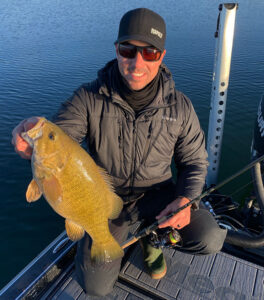
Smallmouth caught on St. Croix rod

PARK FALLS, Wisc. (May 16, 2022) – Increasingly, today’s bass anglers love to tell you which species they prefer, brown or green. But it’s the former that continues to spawn a cult-like following. Even a self-described largemouth nut or honest walleye angler will admit to enjoying a smallmouth outing now and again. And for good reason; smallmouth bass fight hard and are widely distributed. But don’t be fooled by the big bags of brown bass from famous fisheries that continuously fill our media screens and social media feeds; smallies aren’t always such an easy target – especially the larger individuals over four pounds.

Just in time for some of the best smallmouth fishing of the year, allow us to put forth some serious smallmouth strategy, elicited from a couple of the best brown-bass anglers from throughout the bronze belt. Their home waters and tournament experiences have taught them to look for and recognize changing smallmouth patterns, quickly adapt to current conditions, and develop repeatable, winning techniques that work in a variety of settings – not just unpressured northern waters.

Bob’s Bites

Bassmaster Elite Series angler, Bob Downey, is no stranger to the podium and has some serious tournament finishes to prove it. Hailing from Hudson, Wisconsin, the St. Croix pro is part river guy, part lake guy, and 100% smallmouth guy at heart. He lists the Mississippi River as his favorite place to fish but has more “home water” in both Minnesota and Wisconsin than most could imagine.

When targeting smallies in natural lakes, Downey says he looks for large, shallow flats with a good mix of cover and a varied bottom composition. Cover specifically meaning boulders or patches of grass, and bottom composition variety in the form of sand-to-gravel or sand-to-rock transitions. “It’s usually a shallow-water game,” says Downey, who supplies prowess to the power-fishing game while focusing on water less than ten feet deep. “I’d rather fish a flat that has lots of bottom transitions with contour changes, patches, and clumps of scattered cover versus a plain sand flat with not much going on. I’m looking for variety. Fish spend time here post-spawn, and I feel I can power-fish my way to finding them, even if I need to slow down a little to get them to eat.”

Of course, that can be the challenge given weather patterns and fish that don’t always cooperate, which is why Downey keeps it simple for post-spawn smallies. “I’ll throw a black marabou hair jig first and foremost, and always keep a ned rig handy too,” he says. “In early summer, smallies tend to be concentrated. They won’t be everywhere, but when you find them you’ll generally find a good bunch. Covering lots of water until you locate them is key, and my favorite way to do that is with a black marabou hair jig.”
Search with a hair jig? Downey dives deeper. “I put the trolling motor on a medium to high speed and start covering shallower flats with deep water nearby. If you catch a smallmouth or start to see them with your eyes or side-imaging, put on the breaks and start picking that area apart,” he advises. “During post-spawn they’ll roam those same spawning flats before migrating to their summer areas.” Downey offers simple advice on working a hair jig to perfection, which may surprise some anglers who preach complex retrieves and subtle jigging strokes with this bait that seems to “breathe” underwater. “Don’t overthink the hair jig,” he says. “Simply cast it out and reel it back in at a steady pace. Much like you’d fish a spinnerbait or small swimbait. The bait should just glide through the middle of the water column. You don’t need to impart any action yourself, although you certainly can… or fish it on the bottom… but I find more success with just a straight retrieve.” Downey describes the hair jig as a deadly little bait that excels in all phases of early summer on those hot, calm days where the fish are post-spawn. “There have been days where that’s the only bait I need in the spring or early summer,” he reports. “It couldn’t be any easier or more effective.”
Downey offers a few tips to help cast hair jigs farther. “Add a small chunk of an old plastic worm to the shank of the hook up under the hair. These jigs are generally 1/16-to-1/8 ounce, so a little added plastic will help with casting distance,” says Downey. “Use thin, six-to-eight-pound braided line on your spinning reel with a shorter three-foot fluorocarbon leader so the leader knot doesn’t have to pass through as many – or any – guides during casting.” Downey is a fan of the FG knot for connecting braid to fluoro, noting, “I know it can be a difficult knot to learn, but it’s superior to any other when throwing a hair jig.”

Downey selects the 7’6” MLXF (ES76MLXF) Legend Elite or 7’10” MLXF Legend Tournament Bass (LBTS710MLXF) rods from St. Croix to do damage marabou-style, and the 7’0’MF Legend Elite (ES70MF) for ned rigging.

“The length and action of a rod may be the most important component of throwing a hair jig,” he says. “It’s difficult to cast a light jig with a short, stiff rod. You need at least a 7’ medium or medium-light power and a fast or extra-fast tip. I prefer a 7’6″ to 7’10” rod in MLXF. It makes a difference. The medium-light power gives me a soft rod that absorbs the strike and the big head shakes during the fight, and ultimately allows me to land big smallmouth on a tiny bait. The extra length and extra-fast tip gives me the sharp ‘whip’ needed to snap that little jig way out away from the boat. There are some techniques in bass fishing where you could use a wide array of rods and get away with it, but the hair jig is not one of them.”
When asked what’s around the corner as early bites give way to mid and late summer, Downey says the fish start to split up, both shallow and deep. “Shallow areas can and will play all summer long depending on the weather conditions; sunny, flat, calm, hot days are best,” says Downey. “Shallow fish are super fun, but they can be less dependable at times. They move around a lot and are here today, gone tomorrow.” While that may make them his preferred fish to take a crack at for fun, it’s harder to cash tournament checks just throwing shallow.

That’s where deep-water strategies come in. “Fish that set up on deep structure tend to be a little more reliable,” advises Downey, who likes to target deep fish with a variety of presentations depending on the conditions. “I’ll chase deep smallies with ned rigs, drop shots, finesse jigs and reaction baits depending on the weather. There’s just so many ways you can catch them when they’re out deeper. Crankbaits, swimbaits, spybaits… that’s what makes summer so much fun when chasing smallmouth. And no matter what I’m doing, St. Croix makes an ideal rod for the presentation.”

Travis’ Take

Travis Manson is a familiar name to smallmouth anglers throughout the US. Both his guide service and popular YouTube channel are named “Smallmouth Crush” for good reason. A native of Northeastern Wisconsin, Manson honed his craft and love of smallmouth in the Northwoods but spread wings out east where he currently fishes more than 200 days a year on Lake Ontario, the St. Lawrence River, and even the Upper Chesapeake Bay. His experience on such varied smallmouth waters has accelerated his understanding of patterns and behaviors, ultimately helping his clients catch more fish along the way.
Although the smallmouth spawn can extend well into June – even early July – in some Great Lakes fisheries, early summer means post-spawn behavior in most of the areas Manson plies. “I’m generally targeting areas close to spawning bays and grounds, looking shallow but anticipating a deeper summer setup,” he reports. “Not every fish is going to be deep the rest of the year, as there’s always resident shallow-water fish.” Given the choice, he advises fishing a mixture of both, but starting shallow first. “I start in three feet of water down to 15, focusing heavily on that eight-to-12-foot zone, which I find key.”

Like any talented smallmouth angler, Manson makes moves based on the conditions of the day. “On high-sun and calm days I’m looking for cruisers,” says Manson. “I climb to the highest point of the boat, put the trolling motor on high and tend to throw reaction baits to cover water and visually locate them. It’s really about casting to an individual.” That can mean looking for individual boulders or structure too, not just fish. “If a fish isn’t on a good boulder, I’ll mark it and come back during different parts of the year,” he says. “Anything from something the size of a bowling ball all the way up to a truck-sized boulder, I’m marking it ‘rock’ on the graph and visiting it often.”
When he’s throwing at rocks or really any shallow structure, Manson prefers finesse swimbaits and other plastics. “I’m using swim-head designs with a screwlock, which helps me get more use out of my plastics. I can have some good days up shallow, meaning 30 or 40 fish an outing, so keeping those plastics from being thrown can be really useful when guiding,” says Manson. “For the most part I’m using three- and four-inch baits in natural colors to mimic live minnows, like whites, ghost, or smoke colors. On some systems where there’s perch, I’ll mix in those colors and chartreuse as well.”

Other finesse plastics like tubes or creature baits get the nod in systems dominated by gobies. “There, I’ll focus on bottom baits in green pumpkin, straight black, or classic goby colors, paired with a mushroom-head-type jig,” says Manson. “Even a Senko can be deadly here, just pitching visually towards cover or even active fish.” Manson uses swimbaits and finesse plastics in concert, as a one-two punch, often seeing the fish approach or hit the swimbait. “I get some follows at times where fish pull off near the boat and then just hover by bottom. I’ll swing the boat around, get in position, then throw that finesse bait back to them in those cases.”

Manson is a huge fan of St. Croix’s Victory Series in general for smallmouth, specifically, the Victory Crosshair rod (VTS710MLXF) for swimbaits. “It’s a great hair jig rod,” says Manson, “but it’s incredible for long-cast techniques on all light jig heads in general. While it’s nice to have the distance, with the way a fish bites swimbaits, it’s really critical to have that long rod and extra-fast action.” Manson appreciates the extra length on the Victory Crosshair rod for another reason, too. “These fish are so good at getting off,” he says. “A longer rod aids your ability to do battle and keep them buttoned up.”

For presenting soft-plastic finesse baits, Manson emphasizes the importance of sensitivity. “I won’t fish anything here but St. Croix Legend Xtreme rods in 6’10” (XFS610MLXF) or 7’3” (XFS73MLXF), both in medium light power and extra fast actions,” he says. “Finesse means feel, and feel is the everything of these rods. I can get the distance on many long rods, but to feel bites versus rocks or baitfish, these are the sticks.” Manson uses his Legend Xtremes specifically for working baits across bottom, where contact is key. “I feel where to throw the bait and prefer medium-light powers to run lighter jigs with so much control. I’ve got all the power I need for hook-setting and fighting, while still maintaining control of a small jig, which is tough for most rods.”

Come mid-summer, Manson shifts his focus to offshore structure like ledges, humps, and especially long points that extend into deep water. “That’s where you find the big schools,” says Manson, who spends a good amount of time watching side-imaging, but more importantly, standard 2D sonar to find these big pods of active, deep-water smallmouth. “These fish show up and stay for weeks at a time, and often do so year after year. Still, smallies are notorious for being here today and gone tomorrow, which is why I confirm everything on sonar before setting up to fish.”
There’s no denying that the late-spring and early-summer timeframes deliver some of the best opportunities of the season to score big smallmouth catches, especially if you follow the recommendations of our experts.

Their advice is as solid as the chunky bronzebacks they’re sticking on a regular basis.

BASS Founder Ray Scott Dead At 88 Years Old

RAY SCOTT DEAD AT 88

from The Fishing Wire

Ray Scott Dead at 88

Ray Scott, the man who founded Fishing Tackle Retailer (FTR) and the Bass Anglers Sportsman Society (BASS) and forged the modern sportfishing industry died in Montgomery, Alabama, Sunday night of natural causes. He was 88 years old.

Born in Montgomery in 1933, Scott’s legend is well known among bass anglers. He was an insurance salesman who dreamed of taking bass fishing to a wider audience. In 1967, while waiting out some bad weather on a fishing trip, Scott sat in his motel room and had an epiphany. He would create a bass tournament format that would be fair, honest, and compelling. He dreamed of a time when professional bass fishing would appear on television alongside traditional spectator sports.

“It all just came to me,” Scott said. “I knew it would work.”

In June of 1967, he organized and conducted the All-American bass fishing tournament on Beaver Lake in Arkansas — the first modern bass competition and the template for all that have followed. Six months later, he started BASS, one of the largest fishing membership organizations in history. In 1968, he published the first issue of Bassmaster Magazine. In 1984, he launched “The Bassmasters” television program. About that same time, Scott started Fishing Tackle Retailer magazine as a division of BASS. It was his foray into the larger tackle industry and created a platform through which he could speak to retailers and industry professionals across the country and across all angling demographics.

“He created an entire industry,” said FTR co-publisher Brian Thurston. “Ray was probably the most influential individual sportfishing has ever seen and one of the best promoters of all time.”

It would be almost impossible to overstate the importance of Scott in the bass fishing world specifically and in the sportfishing world generally.

While growing BASS — which peaked at about 750,000 members and still boasts over half a million — Scott impacted virtually every other aspect of modern sportfishing, from water quality to safety to catch-and-release. He was a visionary, a trailblazer, an evangelist, an igniter, a showman, a salesman, a marketer, an entrepreneur, a publisher, a conservationist, and a leader. Most of those who work in the bass fishing industry and many in the sportfishing industry owe their careers to him.

Scott sold BASS and FTR to a group of investors in 1986, but he stayed involved as an executive and as the face of BASS. In the 1990s, he created Ray Scott Outdoors, a communications and marketing firm for fishing industry products and companies. Throughout the ’90s, he was a fixture at industry trade and consumer shows.

But fishing was not Scott’s only interest or passion, he also founded the Whitetail Institute of North America, advancing nutrition and habitat efforts for America’s favorite big game animal. And Scott was involved in politics, supporting the presidential bids of George H.W. Bush in 1980, 1988, and 1992. For several decades, Scott dedicated much of his time and resources to supporting his church — Pintlala Baptist Church in Pintlala, Alabama.

He is survived by his wife, Susan, and four children. Funeral services have yet to be announced.

Flint River Bass Club May West Point Bass Tournament

Last Saturday nine members of the Flint River Bass Club fished our May tournament at West Point. We cast from 6:30 AM to 2:30 PM to land 21 keeper bass weighing about 30 pounds.  Three people had five bass limits and two members did not catch a fish.

Niles Murray won with five bass weighing 8.05 pounds and had a 2.99 pound largemouth for big fish.  Lee Hancock came in second with five weighing 6.19 pounds, my five at 5.88 pounds was third and Doug Acree placed fourth with four at 5.46 pounds.

I have a favorite shallow gravel point in the spring at West Point near the dam. Shad spawn on it and I have caught many fish on it in April and May in past tournaments.

In one tournament about ten years ago I got seven hits on my first seven casts with a topwater popper. I landed five, putting my limit in the live well in less than ten minutes.  They were 14-inch spots and I ended up culling all of them later but that was a fast, fun ten minutes!

Shad were spawning there Saturday morning and I caught two keeper spots and two hybrids in the few minutes before the sunlight hit the water.  Then it got tough.  I had only one bite, a small keeper fish that jumped and threw my buzzbait at about 9:00 AM. 

The wind got strong and it was surprisingly cold.   I headed up the lake to fish a protected creek at 11:00 AM and noticed a small secondary point that I like to fish in a cove. And it looked protected from the wind.

I pulled in there and caught three keepers, filling my limit in the next 30 minutes.  Although I fished hard I got only one more bite, a keeper that culled my smallest spot, at 2:00, just 30 minutes before weigh-in.

Two of my bass and both hybrids came on a topwater popper, two on a Carolina rig and one on a shaky head worm.

What Are the Top Five Bass Fishing Lakes In Tennessee?

__ ____ ______________
By David Lowrie
TWRA R3/Outreach Program Manager
from The Fishing Wire

What the top bodies of water are in Tennessee for bass fishing will always be a strong subject of debate among anglers. Interests in what type of bass an angler is searching for as well as overall performance of the lake from year to year will shift opinions.

Nevertheless, with the large numbers of bass fishermen throughout the state, you can always find plenty willing to rank the lakes and give opinions. Recently, I asked student anglers and captains involved with high school fishing in Tennessee what they thought the best lakes were. The top five are lakes many would recognize as successful tournament lakes over the last several years.

#5 Kentucky Lake – Located in Tennessee and Kentucky and part of the Tennessee River system, Kentucky Lake has over 160,000 acres of water with 2,064 miles of shoreline and has seen many great tournaments over the years in bass fishing. It is the only location the Bassmaster High School series has used for its National Championship since B.A.S.S. began its high school program.

Some may be surprised at the ranking due to the issues the lake has had with Asian carp, but tournament results continue to show quality bags can be caught on the lake tournament after tournament.

“Kentucky Lake is an awesome shallow water fishery if you know where to look. There’s great fishing there and plenty of water to fish,” said Jake Beihoffer, boat captain for the Soddy Daisy High School team.Soddy Daisy team member Logan Evans had a different perspective. “You can go deep and stack them up at Kentucky Lake,” said Evans.

#4 Dale Hollow – Completed in 1943 and located in the Tennessee counties of Clay, Pickett and Overton, Dale Hollow covers 27,700 acres of water in Tennessee and Kentucky. Dale Hollow’s biggest claim to fame is that it is still the record holder for the world’s largest smallmouth bass. On July 5, 1955, David Hayes caught an 11-pound, 15-ounce smallmouth that still stands as the world record, today. Anglers from all over the country travel to Dale Hollow, annually, to search for the next record.

“Dale Hollow has some of the most beautiful scenery you can see anywhere, and you’re likely to set the hook into a big smallmouth while you’re there, too,” said Jackson Holbert of the Riverside High School team and son of TWRA Commissioner Kurt Holbert.

Ryan Lehan of Chuckey Doak High School likes Dale Hollow because “it’s challenging, but there’s nothing more rewarding than a bag full of smallmouths.”

#3 Pickwick – We travel back to the Tennessee River for the third place lake of Pickwick. With water in Tennessee, Alabama and Mississippi, Pickwick draws anglers from all three states, as well as, from across the country. Pickwick holds tournaments from youth to the major professionals. There are 496 miles of shoreline holding 43,100 acres of water to fish. There are ample largemouth, smallmouth, and spotted bass to catch on any given day.

Nathan Reynolds of the Backwoods Bassin team in Davidson County says Pickwick is his favorite. “I love them all, but Pickwick really strikes me different than all the others. All in one day you can catch largemouth on a big flipping stick or run up and dropshot for big smallmouth. The biodiversity of the lake is what gets me,” said Reynolds.

Jackson Holbert is also fond of the lake. “There’s always a big bag of fish to be caught on Pickwick year-round. You’ve just got to beat some of the best fishermen in the country to them,” said Holbert.

#2 Douglas Lake – Located in Dandridge and part of the French Broad River, Douglas Lake also is a strong draw for bass anglers. There are 28,000 acres of water and with 513 miles of shoreline, there’s plenty of spots, cuts, and coves to fish. The Jefferson County Chamber of Commerce hosts tournaments on the lake weekend after weekend. The Tennessee BASS Nation High School state championship was held there in May 2019 and the directors weighed more fish and more limits of fish than any other state championship in the organization’s history.

Ethan Montgomery of Sullivan East High School likes Douglas because, “There’s a good number of big ones and you can use a variety of fishing styles there.”Ryan Lehan added, “It is one of the easiest lakes to catch a limit. It has a strong population of largemouth and smallmouth and sometimes they’re in the same place.”

#1 Chickamauga – It should come as no surprise that Chickamauga was ranked at the top by anglers. The lake has exploded in popularity over the last 10 years drawing national attention as a top tournament lake full of giant bass. The city of Dayton has become a top stop for tournaments and their Fish Dayton program promotes fishing the lake and visiting the city. During 2019, Fish Dayton recorded 110 bass catches of 10 pounds or more on Chickamauga and that’s just the catches reported to them.

Campbell County High School coach Gabe Keen broke the Tennessee State largemouth record on Chickamauga on Feb. 13, 2015, catching a 15-pound, 3-ounce monster while practicing for a tournament.

Will VanEtten, coach at Anderson County High, points out the popularity of the lake does increase its difficulty. “Chickamauga has always been hit or miss for me through winter and early spring. You have potential for a giant bag, but it is incredibly hard to find water that hasn’t already been fished by 8-10 other boats. However, once summer hits there are spots on the ledges that produce 30-plus fish days if they are pulling water,” said the coach.

A final perspective comes from Jake Davis who is a guide on several Tennessee waters, as well as being the State Conservation Director for Tennessee BASS Nation. Captain Jake says listing the top five lakes is not as simple as it sounds. “Everyone is going to say Chickamauga is the top lake followed by Dale Hollow, Kentucky Lake, Douglas, Old Hickory and so on, but when you really look at the entire state one can name several great fisheries in Tennessee. We just don’t talk about them much,” said Jake.

“I highly encourage anglers to look at the smaller management lakes such as Pin Oak, Williamsport, Browns Lake, Woods Reservoir, Melton Hill, Caney Fork River, South Holston, Reelfoot, Laurel Hill and Parksville Lake. All of those offer fantastic opportunities for anglers and are truly hidden gems,” added Captain Davis.

So, while a top 5 list of bass lakes in the state will always be subject to debate one thing is for sure; Tennessee has a lot of great bass fishing opportunities.

Potato Creek Club Classic At Lake Martin

Last Friday and Saturday 20 members of the Potato Creek Bassmasters fished our annual Club Classic at Lake Martin.  Each of us qualified by placing in the top eight in the points standings in 2021 or fishing at least eight of the 12 tournaments that year.  Martin was chosen as the site by a drawing held in December from all the lakes we fished last year.

    After fishing 9.5 hours Friday and seven hours on Saturday, we weighed in 198 bass weighing about 258 pounds.  There were 38 five bass limits weighed in, everybody but one person had five both days. Almost all the fish were spotted bass.

Caleb Delay had a good catch on Friday with 10.45 pounds, the best limit weighed in, and held on to win with ten bass weighing 17.38 pounds.  Jason Turner came in second with ten at 16.02 pounds and my ten at 15.70 pounds was third.  Kwong Yu had ten at 15.30 for fourth and Mike Cox placed fifth with ten at 14.76. He also had a 4.71 pound largemouth for big fish.

I went over Tuesday and camped at Wind Creek State Park. Wednesday, the first day of practice, I rode around checking some of my old favorite places and also looking for bedding bass. A big tournament was won by catching bedding bass the weekend before, but I saw none. I am not very good at spotting them, and even if I do see them I am not very good at catching them, but I just had to try.

I did find a brush pile full of fish and caught a two-pound largemouth on a jig in the back of a cove.  That really didn’t give me much to go on for the tournament.

On Thursday I spent more time watching my electronics and checking new areas.  I rode over a shoal and spotted a small brush pile, then a rock pile near it.  When I cast a Carolina rig to it I caught a 15 inch spot, a little better than the average size, so I had some hope for that area. I also found some brush in front of a dock with more way out from it in about 15 feet of water and marked it.

Friday morning I started on the brush pile I had found, it was also in front of a dock with a light on it, and caught a keeper on a crankbait.  Then I went to another lighted dock and caught my second keeper on a swimbait.  Two in the boat before daylight.

In the middle of the day I went to the shoal and caught two decent size keepers, culling some smaller fish in the livewell.  I landed about ten keepers that day but the best five weighed just 7.29 pounds, keeping me in the running.

Saturday I tried a couple lighted docks but got no hits.  At sunrise I went to the shoal and caught a 15-inch keeper and several more smaller fish.  Then in the cove with the brush I landed several 15 inch fish, giving me five fairly decent ones out of the 15 or so I caught that day.

With 20 minutes left to fish I headed to weigh-in.  I decided to stop in a place where I have caught some decent largemouth in the past. As I eased to the bank I wanted to fish, I cast my jig and pig to a sandbar, thinking “I have made dozens of casts there and never caught a fish,” but a thump made me set the hook and land my biggest fish of the trip, a 2.7-pound spot.

That fish culled a one pounder and gave me enough to move me into third place!  Never give up!!

Winning A Sportsman Club Tournament At Lake Oconee

This five pounder was big fish and helped me win.

Last Sunday, March 20, 14 members of the Spalding County Sportsman Club fished our March tournament at Lake Oconee. After fishing from 7:30 AM to 3:30 PM we brought 37 keeper largemouth longer than 14 inches to the scales. There was one five fish limit and two fishermen didn’t weigh in a keeper.

My five at 12.68 pounds won and I had a 5.04 pound largemouth for big fish.  Raymond English had four weighing 9.40 pounds for second, Wayne Teal placed third with four at 7.68 pounds, George Roberts had four at 7.22 pounds for fourth and Niles Murray placed fifth with four weighing 7.13 pounds.

Will Mclean fished with me and we started on a grassbed I had a feeling would produce a fish. It did, I caught a keeper and a short fish on a swim jig within a few casts. Then it got tough as the sun got on the water.

At about 10:00 Will cast beside a dock and got a bite but missed it. He got that fish to hit two more times, hooking a good keeper on the third bite. 

My next fish hit my shaky head worm near the boat and when I set the hook it came flying out of the water and the hook came out of its mouth in the air.  But it fell into the boat! Some fish are just meant to be caught.

At noon we had only those three in the livewell so we decided to change tactics. We went to a small main lake cove from the small but bigger creek where we had been fishing.  It had deeper water and was closer to the main river.  I hoped this would mean more fish had moved up from their winter homes.

On the point of the cove a deep brush pile produced my third keeper, one that just barely touched the 14-inch line on the keeper board.  Then my fourth keeper hit my shaky head out from a small grass bed inside the point.

Will got his second keeper off the next grass bed then we both caught some throwbacks.  Going into the cove I noticed a waypoint on my GPS and remembered there were some rock piles out in 12 to 15 feet of water. A few casts to them produced a couple of short fish then a two-pounder hit my shaky head. I had a limit at 1:00!  But with the bare keeper I figured I had only about seven pounds.

I cranked up and went across the mouth of the cove to go around it again and saw another bass boat coming. Sure enough, Zane and JR pulled up on the point I had just left and started fishing!  Will and I fished around the cove toward them and caught a couple more short fish.

When we met Zane and JR, with then on one dock and us on the next one, I cast my shaky head to the dock and a bass thumped it. When I set the hook I started yelling for the net, a big fish flashed in the water and tried to run under the dock.

A I fought it I flashed back three years to another tournament and a similar day. On another dock I hooked a big fish, pulled it away from the dock post three times and got it within a couple of feet of the net. Then my line went slack, it just came off. That fish was every bit of eight pounds.

As I pulled this fish to the top so Will could get the net under it, my hook popped out and flew over the boat. I felt sick for a second, then Will raised up the net – with the 5.04 pounder in it! Talk about a fish that was just meant to get caught.

    Will said that fish was really his, so I gave it to him – right after weigh-in.

We fished the rest of the day and landed several more short fish, and I got two more keepers on a shaky head worm.  I culled three times, including the first fish I caught that morning.

How I Fished A Windy Cold Tournament At Lake Eufaula

See the leadup and practice for this tournament here.

The fishing was as bad as expected. Twenty-five members of the club fished for nine hours on Saturday in the ridiculous, dangerous wind and seven more on Sunday, a much better day. But we caught only 29 bass weighing about 81 pounds. There were 13 zeros and only three limits.

As always someone catches them. Sam Smith won with ten weighing 30.65 pounds and had big fish with a 5.36 pound largemouth. His partner Carl Heidle had seven weighing 16.95 pounds for second, Raymond English had four weighing 7.83 pounds for third and David Martin had four at 7.79 pounds for fourth. My four at 6.82 pounds was good for fifth.

When we finally blasted off, I ran around to what I thought would be a protected area behind an island but the wind was so strong I could not fish. That made me go to the small creek hoping the wind would not be too bad in there, and there were a few areas I could fish without losing my cap to the wind.

I was pitching a jig and pig to the edge of grassbeds, letting it fall to the bottom in water a few inches to a few feet deep. At about 10:00 I got a bite but when I set the hook my line broke in the reel – a sure sign I had missed a bad place in it about 20 feet up when I checked then night before. To add “insult to injury,” the keeper fish jumped trying to get rid of my jig stuck in its jaw!

I finally got another bite at about 1:00 but the wind had my line bowed out and I missed the fish. Finally at 2:00 one hit my jig and I landed a 1.64 pounder, and was proud to have something to weigh in the first day.

Sunday as much colder but the wind did not blow.  For the first hour or so I had to dip my rod in the water after every cast to melt the ice out of the guides. And it started just as bad, with no bites until about 11:00. Then a fish grabbed my jig and ran toward the boat but spit it out before I could set the hook.

At noon I finally landed one small keeper and about gave up since I was tired, there was three hours left to fish and I did not have much hope. But at 2:00
I went to the grassbed where I caught my keeper on Saturday and caught a decent keeper, then got a second one off a nearby dock on a shaky head worm. Then it was time to go in and face the results of two tough days!

I hope the weather settles down soon!!

What Does It Mean To Be A Professional Bass Fisherman?

Pro bass fishermen at the Bassmasters Classic give young antlers advice on becoming a pro bass fisherman


WHAT IT MEANS TO BE A PRO

from The Fishing Wire

What It Means To Be A Pro

Forestville, WI (February 9, 2022) – What defines a professional angler? Ask someone off the street and they’ll likely describe fancy boats, bright lights and big fish. Ask those who stand atop the leaderboard, however, and they’ll tell a different story – one of hard work, determination, and the efforts of many other industry pros who have helped them succeed.

“You can’t get to the top without others to lift you up,” says, Patrick Neu, president of the 1,400-member non-profit National Professional Anglers Association (NPAA). “Nobody reaches the pinnacle of professionalism in this industry without a lot of help. That’s exactly why the NPAA is inviting fishing industry workers of every type to join our ranks. Our purpose is to grow and protect sportfishing while providing our members the tools and association benefits needed to increase their professionalism and meet individualized goals.”

To be sure, professionalism in the fishing industry is wide ranging, a point not lost on the organization and its members. “Being a fishing industry ‘pro’ is a pretty loose term,” says NPAA member Chad Pipkens, a ten-year full-time veteran of the Bassmaster Elite Series and five-time Bassmaster Classic qualifier from Dewitt, Michigan, who spent several years prior honing his skills on a variety of smaller trails before acquiring the knowledge, money and flexibility of time needed to compete at the highest levels.

“Professional doctors diagnose and treat patients, teachers instruct students, pro golfers receive PGA cards, and electricians need a license to perform electrical work,” Pipkens says. “These are all well-defined fields of specialization. By comparison, the fishing world encompasses many different job opportunities. Sure, tournament anglers, captains and guides are fishing professionals, but so are the highly skilled mechanics that work on your engine as well as the folks who run the marina, design lures, sell fishing tackle, manage anglers and staff the tournament trails.

“To me,” Pipkens continued, “anyone making meaningful money or striving to earn a living in this industry should qualify as a pro. If you don’t want to be on the water day in and day out, but you still want to be in the industry, you can find the contacts amongst our membership to maybe make that happen.”

“Anyone making meaningful money or striving to earn a living in this industry should qualify as a pro.”

According to Pipkens, the NPAA does a great job of teaching aspiring pros how to run a fishing-related business through their seminars, annual conference and approachable members who have already achieved success. “NPAA membership can shorten your learning curve and raise your professionalism at any level,” he points out. “It’s a great organization for learning the ins and outs of running your own business; whether that’s tech stuff, accounting, how to network or get paid by more than one employer, it certainly can help shorten your learning curve.”

As a pro angler, Pipkens says his life is organized chaos; getting the boat ready, crisscrossing the country, and being on the road for five weeks at a time while never losing his family focus. He often practices on the water from sunrise to sunset. Despite the pressure to win, tournaments are actually the fun part of his routine. “Balancing all the rest,” he says, “is what really makes you a professional.”

For tournament pros, guides and charter captains in particular, there is a ton of preparation that takes place behind the scenes, notes John Campbell, an NPAA founding member and full-time guide. A Freshwater Fishing Hall of Fame member inducted in 2018, Campbell managed to win both the Pro Walleye Trail Detroit River and FLW Lake Ouachita championships. He also qualified for a major walleye championship every single year from 1989 to 2011 while on the pro tour. That’s 22 consecutive years, if you’re counting.

Like Pickens, Campbell agrees publicly visible aspects of being a tournament angler or guide help solidify your status as a professional, but the business end of things is vitally important. “Sure, you’ve got to pre-fish, choose your lures, maintain your gear, set up the boat and put in plenty of time on the road,” he notes, “but you also have to learn to book charters, carefully plan out your competition schedule, promote your sponsors and tend to family matters. Earning money and winning tournaments is vital, but also important is finding ways to help grow the sport through sharing knowledge and getting more kids involved.”

As a professional guide, Campbell is in the business of educating anglers. “To me, helping others learn the game is the sign of a true pro,” he states, adding that this is exactly the kind of people you’ll network and rub elbows with in the NPAA. “This organization supported over 100 Future Angler clinics in 2021 alone. With support from the Future Angler Foundation, it’s member volunteers also distributed over 4,000 NPAA Future Pro T-shirts and 3,000 rod/reel combos to kids at NPAA Future Angler education events. That, I believe, is professionalism at its finest.”

For information on joining the NPAA and exploring the many benefits membership provides, visit npaa.net.

Windy Cold Tournament At Lake Eufaula

These two last-hour fish at Eufaula on the second day helped me to a fifth-place finish out of 25 people.

 I usually enjoy the four seasons. Changing weather often makes fishing better and it is less boring. But going through all four seasons and worse last week at Lake Eufaula was a bit much.

    I went down to Lake Point State Park last Tuesday and set up my slide in pickup camper.  The weather was very warm when I went to bed and I knew storms were possible.

    At 5:00 AM someone pounded on my camper and woke me. I thought they said the power was out, but my fan was still running so I turned over to go back to sleep. Then a car horn started blowing, making me look at my phone – there was a Tornado Warning for the campground on it I had not heard!

    I joined all the other campers in the cement block bath house for the next hour!

The rest of Wednesday was decent, with some light showers but little wind. I was able to get out on the lake and look around some. I joined the 196 other bass boats on the water, a Fishers of Men National Championship tournament was scheduled for Thursday through Saturday.  It was a big deal, first and second places in the tournament would win fully rigged bass boats worth either $80,000 or $60,000, depending on place.

Thursday was a nice spring like day, warm weather and sun.  I again looked around, watching the many boats with teams fishing the first day of the tournament.  Most were easing around the shoreline, casting various baits to grassbeds. 

When I went to my favorite small creek I was happy to see just two boats in it fishing, but while I idled around about six other boats ran in, fished a few minutes, then left.  I knew by the start of our tournament Saturday the poor fish would be beat to death, seeing every lure carried by Berry’s Sporting Goods and then some.

Friday the wind was up a little and the misty rain made me sit at my camper and watch the tournament fishermen go round and round in the creek out from the campground.  Weather guessers were saying 20+ MPH winds for Saturday. Most lakes are dangerous with those kinds of winds, and Eufuala is one of the worse.

Fishers of Men announced they were canceling the third day of their tournament due to dangerous conditions. And the Bass Fisherman’s League canceled their big tournament on Oconee for the same reason.

Potato Creek did not cancel, but when Tom Tanner and I idled to the ramp for our set 7:00 blast off, we were told the executive committee delayed our start by 30 minutes. So for 30 minutes Tom and I sat in our boats as the cold wind got about five miles per hour stronger and the temperature dropped another two degrees while everybody else sat in their warm trucks in the parking lot.

how the tournament went for two days

My Winning Pattern At Lake Sinclair In Early March

These two four pounders helped me win and get big fish at Lake Sinclair at the last minute!

Last Sunday, March 6, nine members of the Flint River Bass Club fished our March tournament at Lake Sinclair.  The weather was beautiful for our casting from 7:00 AM to 3:00 PM but the bass didn’t seem to care.  We weighed in 29 keeper bass weighing about 47 pounds and had three five-bass limits. No one zeroed.

    My four at 10.63 won and I had as 4.19 pound largemouth for big fish. Chuck Croft placed second with five at 9.15 pounds, Don Gober had five at 9.02 pounds for third and Alex Gober, his grandson fishing with him, had five at 4.86 pounds for fourth.

    Will Mclean fished with me and we headed to some grass beds near the dam where Ricky Layton, showing me around the same time of year two years ago for a GON article, caught five weighing 28 pounds.  But after three hours and several different places, we both had two bites.

    A good keeper bass hit my crankbait on a seawall and jumped and threw it. Then Will hooked and lost what looked like a keeper on a Texas rigged Senko.  A little later Will caught a bass that just barely touched the 12-inch line, then I caught a similar one.

Club rules say a bass must be 12 inches long with its mouth closed on a keeper board to be weighed.  I could make mine touch the 12-inch line, barely, but worried about it. Sometimes in the excitement of catching one I do not measure it correctly.

Around 10:30 I cast my bladed jig to a grassbed on a point and hooked a keeper out in front of it. At 11:30 Will cast to the middle of a shallow cove, said “I got one” and a huge fish swirled on top. He got it to the boat and I netted it, but it was a big blue catfish. Will’s new scales said it weighed ten pounds but it looked much bigger.

At 2:00, with about 45 minutes left to fish I was pretty disgusted. We went into one of my favorite small creeks. As we fished down a bank with a big grassbed on it, I told Will I had never caught a fish past the last small dock on it, it was very shallow. But Niles Murray caught a keeper back in it when we fished together a few years ago.

I cast my bladed jig back in it and my line started going sideways. When I set the hook the 4.19 pounder jumped, it was only a foot deep and it had nowhere to go but up!  When I got it to the boat I let it go around the trolling motor but managed to pull the motor and bass up and Will got it in the net by lying down on the deck and reaching forward. That fish was just meant to get caught.

I caught another keeper on a shaky head on the next dock, then started around the other arm of the cove. Again I told Will I had never caught a bass way back in it, and he reminded me of what had just happened.

As luck would have it, way back in it I pitched my shaky head to a seawall about a foot of water and felt a tap and my line started moving out. When I set the hook a 4.13 pound largemouth fought hard but I managed to keep it away from the trolling motor and Will netted it.

We went back to the dock where I caught my keeper and Will got a 3.16 pounder off the seawall beside it, again about a foot deep. That was it, we had to go in.

I don’t know if it was time of day, location or what but I wish it had started earlier, or we had more time to fish before the time ended. This time of year fishing is often better late in the day after the sun warms the water some. It was 62 degrees in that creek at 2:00 and I am sure those fish were thinking about bedding.

While waiting for Will to back the trailer in, I checked my smallest fish and decide it had shrunk, so I just weighed in four.