| from The Fishing Wire Randy Zellers LITTLE ROCK — In the face of a global pandemic, Arkansans rediscovered their bond with nature and enjoyed angling more than they have in the last few years. Thanks to a recently completed study by Louisiana State University, scientists may have a few more answers into how to keep the momentum going. The study, led by Stephen Midway, Ph.D. at LSU’s College of the Coast and Environment, evaluated the effect of the pandemic on fishing license holders. Jessica Feltz, a human dimensions biologist who works for the Arkansas Game and Fish Commission’s Fisheries Division, coordinated the Arkansas portion of the survey, gathering contact information for Arkansas anglers who purchased a license between March and May of this year. “That was the period the research is focused on, because it was during that initial COVID response when schools and businesses closed or went to virtual options,” Feltz said. “That was when we noticed much more activity on lakes and rivers in Arkansas, but this research is important to verify what we saw.”Nearly 1,600 participants who were randomly selected from the AGFC’s fishing license database completed surveys.“ Dr. Midway set a goal of 1,000 survey responses for each state, so we do feel confident in our results,” Feltz said.Not only did more anglers purchase licenses, but those who historically purchased fishing licenses went more often. A review of license sales indicates an increase of 19.6 percent in purchases from March to May 2020 as compared to the same period in 2019, and survey responses show that 32 percent of anglers said they fished more than they would in a typical year. The average number of fishing trips taken during the initial COVID-19 response was 10.9 trips per angler. This time period also falls during one of the peaks of fishing activity in Arkansas. While many states saw massive shutdowns of boating accesses, boat ramps in The Natural State remained largely open. The only boating access points closed during the initial COVID-19 response were those on the Buffalo National River and any smaller ramps that were part of a local park that had been closed in response to the virus. Army Corps of Engineers boat ramps remained open as well as state park ramps and AGFC-owned ramps. Campgrounds in many areas were closed, which may have curtailed some plans for extended fishing trips. Three-quarters of respondents said they saw no change in their ability to go fishing as a result of any access closures, but some did indicate the initial closure of some public parks, campgrounds and boat ramps as an obstacle they needed to overcome during their fishing excursions. The increase in fishing activity may have been the result of the perception that fishing, by and large, presents a low-risk to catching the coronavirus that causes COVID-19. “This perception was confirmed by the survey, which indicated that 98 percent of the respondents said they felt fishing was at least a somewhat safe activity during the pandemic,” Feltz said. “It’s nice to know people felt fishing was something they could still enjoy during this time.”Feltz says it’s too early to tell if the same increase will occur in hunting this fall, but she says the information gained through the survey will help the agency plan outreach and goals for next year. “We are just moving forward with discussions on how we can retain these new anglers and anglers who have rediscovered fishing,” Feltz said. “In addition to notices and reminders on how to renew their license, we are hoping to encourage them to expand their outdoor experiences. Maybe take up trout fishing or travel to a new fishing destination in Arkansas for a fresh adventure. We historically have spent a lot of effort getting people to make that first step to becoming lifelong anglers, now we need to switch gears to keep them on that path.” Randy Zellers Assistant Chief of Communications, Arkansas GFD |
Fishing and Birds
The laughing, haunting sound of a loon floating across the water at dusk was a sound I read about but did not think I would ever hear. Then, years ago at Christmas, I heard something I had never heard before while fishing at Clarks Hill and guessed it was a loon.
I tracked the sound down to a gray and black bird swimming low in the water. I watched as it dived, looking for dinner. I could not believe how long it could stay down and how far it would go on one dive.
Loons are common on area lakes in the winter now. As their populations increased, they migrated farther south looking for ice free water where they could feed. I still love hearing them while fishing, and often use them to locate schools of baitfish and bass.
Gulls and terns are also common on our lakes in the winter and can help find schools of fish. I have caught many bass, stripers and hybrids by running to an area where gulls and terns were diving from the air, feeding on injured herring and shad from fish feeding under the water.
Gulls and terns come to our lakes to escape rough weather on the coast. There are many more of them during the winter. Gulls are bigger and watching them is more consistent for finding fish since they usually don’t soar along watching for bait near the surface like terns will do.
I call terns “Judas terns” since following them is often frustrating. Unless they circle and concentrate on one spot, you can follow them a long way without finding any fish. But a circling group of either of the white and gray terns and gulls is a good sign to go fish there.
A few years ago in a January tournament at Oconee I saw a couple of big white birds diving to the water surface. I was surprised and had to get closer to confirm they were pelicans. I had never seen those birds on a lake. I guess they came inland to escape a storm. I have seen many pelicans, from one up close on a dock at Islamorada, Florida to watching them dive on schools of baitfish in the Sea of Cortez.
Travel has exposed me to many birds this country Georgia boy never expected to see. I have pictures of me squatting on the ice in Antarctica with penguins waddling by close enough to touch and have watched wild parrots in trees along the Amazon River in the rain forest. Watching an albatross soar behind a ship without flapping its wings for many minutes is amazing.
But local birds are my favorites. One year while driving home from Jekyll Island I saw a bird soaring over the surrounding pines that made me stop and pull to the side of the road. I watched it for several minutes, trying to figure out what it was.
I got out my bird book and found out it was a scissor tail swallow. Its long, forked tail feathers were very distinctive. They are native to the Southeast but rare. Their contrasting black and white markings on the bird makes them stand out, and they are a little bigger than a crow. They soar low over trees looking for food in the branches.
Canada geese don’t really migrate through Georgia and I had never seen wild ones here until the Georgia DNR started a stocking program. They brought in adult Canadas and clipped their wings so they could not fly.
Some big wire enclosures were built on coves on Clarks Hill and they were kept there.
As they raised young and increased in numbers, they were allowed to leave the pens. Nests were built on stilts to protect eggs from predators and numbers increased a lot. Since the young had not been taught to migrate, they stayed here year-round.
One night sitting on my deck at Clarks Hill on a moonlit night I heard the haunting honking of geese as they flew by. It gave me chill bumps since I associated that sound with northern wilderness areas. I had heard domestic geese honk but this was very different, hearing it out on the lake at night.
Geese have become so common now it is unusual when you don’t hear and see them. I now call them “pigs with wings” since their droppings leave a mess where they feed and I have seen some docks where they roost at night so covered with droppings you could not step on it without stepping in it.
Kildeers fascinated me when I was growing up. They were common in our big field but I could never get close enough to them to get a good look at them. Then one day I was able to sneak up on one and shoot it as it flew off the ground.
It was a beautiful bird with brown and white markings with gold highlights. I satisfied my curiosity and never tried to shoot another one.
Birds are amazing, especially when you learn amore about them. I used to carry several bird identification guides with me everywhere I went, but not all that information is available with a few taps on your phone!
Tips to Catch More Trout This Winter
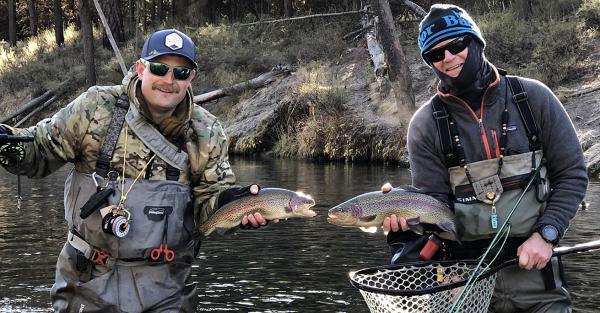 Dedicated fly-anglers don’t stop fishing in the winter. Instead they adjust their tactics to the colder conditions. Dedicated fly-anglers don’t stop fishing in the winter. Instead they adjust their tactics to the colder conditions.Popular trout rivers take on a different character in winter. The barren landscape reveals a different sort of beauty, the crowds diminish and the fishing becomes more challenging. For some, it may be enough “to just be there.” But if your plans include actually catching a fish, here are seven tips that may help improve your chances. 1. Go small and light. Clear, slow water, smaller insects and wary fish call for smaller flies and lighter tippet than you might use the rest of the year.Downsize your flies. A dominate food source for trout in the winter are teeny, tiny midges that are best mimicked by teeny, tiny flies – like size 16 and smaller.Lighten your tippet. If you normally fish 4X, switch to 5X. This will let the smaller flies move more naturally, and avoid spooking fish hanging out in slower waters – where they have more time to scrutinize your fly. 2. Hope for dry fly action but plan to nymph. Winter fly-fishing is a nymphing show. Consider a double-nymph rig with a smaller midge pattern on top and a weighted stonefly below, to help keep your flies near the bottom of the river. But also be prepared for the occasional hatch with a selection of Griffith’s gnats and small blue wing olives. 3. Look for trout in slower waters. Trout metabolism slows in the winter. They’re eating less and looking for ways to conserve energy, like getting out of the heavier currents into quieter waters. Back eddies, off-channel areas, and the inside of current seams can all be places to look for winter trout. 4. Cover the water thoroughly. A fish won’t move far to take a fly (slower metabolism and all that), so you’ll want to put your fly right in front of its nose. Cover the water methodically to increase your changes of hitting a fish. 5. Sleep in. There’s no need to hit the water at daylight when it comes to winter trout fishing. The best fishing will be during the warmest parts of the day – late morning to mid-afternoon. So follow your Mother’s advice and take time to eat a good breakfast before you go. 6. Follow these safety precautions: Travel safely. Travel in the winter can by dicey so be prepared for bad weather and bad roads. Let someone know where you’re going and when you’ll be back. And remember to check in when you get home. Consider using a wading staff. Snow and/or ice can make wading even trickier. And winter is not the time of year you want to be falling in the water. Beware of hypothermia. If you do fall in the water, and it happens, you’ll need to get warm and dry as quickly as possible. Carry a change of dry clothes and hot beverages, or a way to make them. 7. Lower….er, adjust your expectations. Winter trout fishing is about being outside, enjoying the solitude and challenging your fishing skills. It’s not about catching a lot of trout. You’ve got just a few good hours to chase finicky fish – learn to appreciate one- or two-fish days for what they are. Plenty of time to catch loads of fish later in the year. Some of your best bets for catching native redband trout this winter in Oregon include the lower Deschutes, Crooked, Metolius, Fall, Klamath, Blitzen and Owyhee rivers. For the latest fishing updates for these rivers, check out the weekly Recreation Report. From Oregon Department of Fish and Wildlife |
Shooting Deer At the Lake
Many of my Christmas trips to Clarks Hill involved shooting deer. I say shooting since no hunting was involved.
Back then, deer season was the month of November, with a bonus season from December 26 to January 1, with most of that week either sex days. I kept my Marlin lever action 30-30 in the boat, just in case I got a chance to shoot a deer for the freezer.
One year after eating Christmas dinner in town with my folks I went back to the lake, got in the boat and headed over to “Broken Rod Cove to fish until dark.
As I idled into the cove I saw a spike buck walk out of the woods and lie down in the warm sun.
It did not move and I got within 50 yards of it before turning off the motor. I got up front on the trolling motor and got within 50 feet of it, examining it with my scope. I didn’t shoot, season didn’t open until the next day. Although it was just a little over 12 hours away, I did not want to break the law.
I went back and fished around that cove every afternoon the rest of the week but never saw him again. But one afternoon, as I eased along casting a crankbait to a clay bank, I saw a doe standing 50 feet back in the woods looking at me.
Boats on the water were so unusual back then they really did not spook the deer. This one watched as I picked up my rifle, made sure the boat had stopped moving so I would not break the law by shooting from a boat under motor power, and shot it.
Another day as I fished into “Sunk Boat Cove” I saw a deer standing about 25 feet back in the trees. I picked up my rifle and shot and it dropped. I caught a flicker of white, saw another deer and shot it. Then I looked closely – there were five more deer still standing there looking at me!
I didn’t shoot again since I had my two deer limit.
The next day as I fished a long narrow point nearby, dogs started barking back in the woods. I heard splashing on the other side of the point and cranked up and went around there. Five deer were swimming across the creek, getting away from the dogs. I am sure they were the same five from the day before. I watched as they safely made it to the bank and ran off.
My Uncle Adron invited me to hunt with him one year. I didn’t see anything and got back to my trailer about 10:00 AM. While sitting on the picnic table drinking coffee, I saw two does across the cove, just standing there.
I guessed they were about 150 yards away, a long shot with my 30-30, but I had to try. I got it out of the van, braced against a tree, aimed at the top of the doe’s back to allow for bullet drop, and fired. The doe stumbled, got up and walked slowly back into the woods.
I quickly got in the boat and idled across the cove. When I got to the bank I saw the doe standing there looking at me. I shot again and she dropped. When I got to her, I could see my first shot hit her in the lower front leg.
A couple years late when the lake was very low and the cove almost dry, I stepped off the shot distance. It was 250 yards! No wonder I hit her in the lower leg on my first try. I have no idea why she didn’t run off rather than waiting on me to shoot her again.
The fifth and last deer I killed at the lake at Christmas was the most unusual. Linda, our dog Merlin and I were fishing the long narrow point where I had seen the five swim a few years earlier. That point is a long narrow island when the lake is full but in the winter it is connected to the land.
I saw several deer up in the woods about in the middle of the point. I cranked up and went to the clear gap between the main bank and island and got out. I told Linda to take the boat to the other end, get out and slowly walk toward me, hoping to drive the deer to me at a walk.
A few minutes later I heard noise and looked up to see five deer running toward me. I shot and one fell, then emptied my gun at another one but missed every shot. One of the deer almost ran over me in its rush.
Linda got there and said when she got near the bank
Merlin jumped out and took off toward me. She spooked the deer and they ran rather than walked my way, headed to the narrow gap and the main bank. My plan almost worked.
By the early 1980s I started seeing lots of people going hunting in boats. They would beach their boats and walk into the woods to hunt. That stopped my hunting up there, deer got very wary of boats and people around the lake. Now they are more likely to take off running as son as they see a boat rather than stand and look at it.
Things change with time, not always to my liking.
Clarks Hill Christmas Fishing Memories
Thursday, December 10, I drove to my place at Clarks Hill, got up Friday morning and drove up to Hartwell to get information for my January Georgia Outdoor News Map of the Month article. Back at Clarks Hill Saturday morning, I got my first cup of coffee and went out on the deck at my mobile home at Raysville Boat Club and looked at the lake.
Christmas is a time for reminiscing and sitting there took me back over many years of spending Thanksgiving and Christmas holidays at Clarks Hill. Memories flashed across my mind like the lights of a fireworks display on the Fourth of July.
Saturday morning was the kind of day I love, not a ripple disturbed the reflecting pool of the lake surface. The only sound was an occasional craw of a crow or the bark of a squirrel, disturbed in his search for breakfast. I was at peace with the world.
Weather always played an important of my trips. One of the best, about 30 years ago, an unusually warm winter found me fishing in jeans with no shirt or shoes. The water was 61 degrees and big fish were active. I caught six largemouth weighing more than five pounds each and five hybrids weighing six pounds each in three days on Shadraps.
The other extreme was one winter when my dog Merlin woke me at midnight jumping in bed with me in my small camper. That was unusual, she always slept on the floor. The next morning I found out why. Her water bowl on the floor was frozen solid. The small electric heater kept the air tolerable from a couple feet off the floor to the ceiling but could not keep up with the 5-degree low that night.
I called my neighbor back in Griffin and asked her to check to see if she heard water running under my house from burst pipes. She said she did not but the well pump was running. I came home fast and found the well had run dry from pumping water out of 11 holes in pipes. I learned to solder copper pipe that afternoon.
Another winter on Christmas Eve the wind was howling and it was sleeting. I tried to fish but it was bad, so I went behind an island to get out of the wind. I caught an eight- and one-half pound bass on a jig from a rockpile there. After landing it I figured I had had enough and went in to show it off.
Some foggy mornings I unhooked my boat battery charger, pushed off from the bank, put the trolling motor in the water and started fishing. As soon as I got a few feet from the bank everything disappeared in a white haze. Outlines of trees were the only indication anything was near.
I could image I was the only person in the world. The fog dampened even the sounds of crows and squirrels, and the only disturbance was the whirr of my reel and splash of the lure as I cast. Sometimes the sound of a jumping bass, barely seen in the fog, added to the excitement.
I loved being up there by myself. Back then nobody fished during the winter. I had the lake and boat club to myself. One year I went to the boat club Christmas afternoon after dinner in town with my family. For a week I slept when I was sleepy, ate when I was hungry and all the rest of the time I either fished or built brush piles.
That year I did not see another person for five days. The only reason I saw people the sixth day was a trip to town for boat gas.
I had never built brush piles but had heard how effective they can be for fishing. A bank I like to fish near my trailer was bare clay except for two stumps about 50 feet apart. I could usually get a bite by the stumps if they were in the water, but that year the lake was down seven feet and the water just touched the outside edge.
Up on the bank someone had cut down some big cedar trees, cut the trunk out for posts and left the big bushy tops. One afternoon I drug two to the edge of the water, tied the base of the trunk to the stump and flipped the top out into four or five feet of water.
The next morning I cast a crankbait to the tip of the trees and caught two pound largemouth from each.
An old roadbed crosses the creek, rising on a hump out in the middle. There are three-foot drops, from 12 to 15 feet deep, on each side of it where it was cut into the former hill. I pulled two of the cedar tops out there and finally got them to sink by tying 5-gallon buckets of cement to them. I put them right on the edge of the drops about 100 feet apart.
I caught fish out of them for years, including an eight and one quarter pound bass one winter. Three years ago, I won a club tournament fishing those same two trees, they are still there. Cedar does not rot when completely submerged under water.
I have many more fishing and hunting memories from this time of year at the lake, but those are for another time.
Reflections on the Passing of Ron Lindner
| By Ken Duke Editor, Fishing Tackle Retailer from The Fishing Wire  Legendary angler, educator, writer, publisher and entrepreneur Ron Lindner died November 30. He was 86 years old. Legendary angler, educator, writer, publisher and entrepreneur Ron Lindner died November 30. He was 86 years old.Born in Chicago in 1934, Ron and his brother Al built a fishing empire by educating others about our sport. He was a pioneer and leaves a void with his passing. I did not know Ron Lindner well, but I can tell you that he was an imposing figure in our industry. Larger than life, he seemed to burst at the seams with energy and ideas. On those occasions I spoke with Ron he was always excited about something — a new program, a new story, a new something that was going to be better and bigger and more effective than anything that had come before. I admired his enthusiasm and tenacity, his unyielding dedication to the sport. Most of our conversations were more or less one-way. He talked, he expounded, he explained. I tried to keep up. Sometimes you just have to let that kind of passion carry you away. I have admired the Lindners since the 1970s when I began to get serious about my fishing as a teen. What they were doing with In-Fisherman really fascinated me. Thinking about it now, it was the Lindners and Ray Scott who set me on the path that became my career. It was — obviously — a different time. Things were changing fast in the fishing world. In fact, I think changes were coming faster then that at any other time in our sport’s history. The “me and Joe” stories that dominated the Big Three for time immemorial were being replaced by practical how-to and scientific content in In-Fisherman and Fishing Facts and by species-specific publications like Bassmaster Magazine. The fishing world would never be the same, and Ron Lindner was one of the people leading the way. I still have almost every issue of In-Fisherman (I’m missing some of the early “Study Reports”) and look back at them often. They brought science and education to the fore like nothing else. Al was the editor and Ron was the publisher, but both were splashed all over the magazines and then the television shows. Both were bright, exuberant and full of helpful advice. I just had to cut through those Chicago accents so that I could “maximize my potential to put fish in the boat.”I bought all their books, too — well, all the bass books anyway. I was a Southern kid, and though I may have dreamed of catching a musky, it didn’t seem likely in the canals of Miami or farm ponds of South Carolina. Largemouth Bass Secrets, Largemouth Bass in the 1990s, The In-Fisherman Secret System and more have places of honor on my bookshelf. They’re still among the best titles ever published on the sport. They took fishing to a new level and showed us that there were skills to learn, habits to study, patterns to follow. It was not all about luck or the Farmer’s Almanac. As I reflect about Ron Lindner, I realize there’s almost nothing he didn’t do in the sportfishing industry. He was a guide, a publisher, a designer of gear, a television and video personality, a writer, a business person, a speaker and spokesperson and much, much more. But I will always think of him as an educator and as an ambassador for our sport and our lifestyle. He inspired me and still does. I am very fortunate to have known him, if only a little. As I get older and lose more and more friends in the fishing world, I try to focus on what they left behind rather than dwell on their passing. To do otherwise is just too sad. Too negative. Ron Lindner’s passing certainly leaves a void, but it should also leave us inspired to try to do as much for fishing as this giant. See a video of Ron’s life here: https://youtu.be/5b-3RfaQ24I |
Where and How to Catch February Lake Lanier Bass, with GPS Coordinates
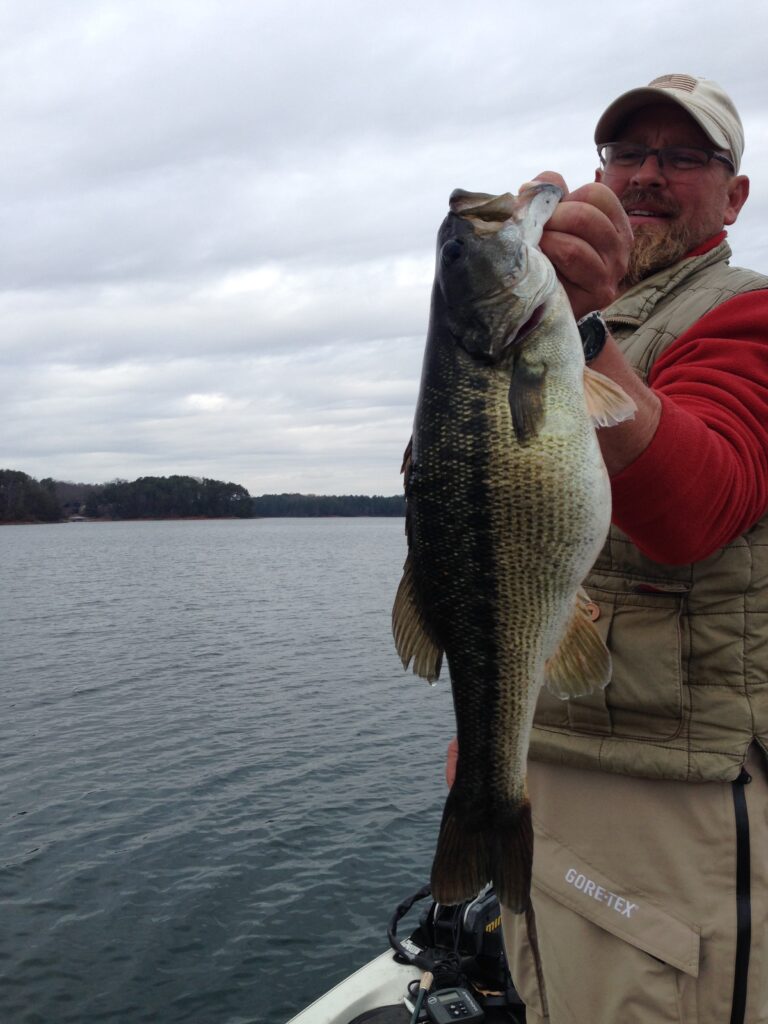
February Lake Lanier Bass
with Jim Farmer
Some of the biggest spots in Lake Lanier are already moving to staging areas on rocky points near spawning areas in early February. You can catch a personal best spot right now by fishing crankbaits on these points.
Lanier has developed a well-deserved reputation for producing magnum spots over the past few years. Four and five pounders are weighed in during most tournaments and bigger fish are caught all year long. Right now is one of the best times to catch one over five pounds.
With deep, clear water, standing timber and rocky shorelines, Lanier is perfect habitat for spots. The introduction of blueback herring gave the spots an excellent food source and this big baitfish has made them grow big and fat. All these combined to produce a trophy spot lake.
Jim Farmer lives a few miles from Bald Ridge Creek, has a lake house on that end of the lake and fishes Lanier a lot. He also paints crankbaits and other hard baits with custom colors specifically designed for the spots on Lanier. He guides on the lake, showing fishermen where and how to use his baits to catch big fish.
After retiring from the Navy Jim moved to Lanier and started making planner boards that were very popular with striper and cat fishermen. He fished for stripers a lot but got into bass fishing a few years ago and got hooked on them. He joined the Greater Atlanta Bass Club and fished with them until he started guiding.
Jim also fishes the Bulldog BFL trail statewide and Hammonds and charity tournaments on Lanier. This past December he and his partner won the UGA Fishing Team fund raiser North Georgia Fall Classic on Lanier with 19.6 Pounds and had big fish with a five-pound, twelve ounce spot.
“The biggest spots in the lake move in to spawn earlier than most fishermen realize,” Jim said. There are still a lot of fish deep and you can catch them, but Jim likes to catch big fish shallow. He uses a variety of baits but relies on his crankbaits most of the time.
For February fishing Jim will have a couple of crankbaits that run different depths, a jerkbait, a jig and pig, a shaky head and a spoon ready to cast. The spoon is for catching the deeper fish, but the other baits are all fished on rocky points near spawning areas.
Jim took me out in early January, the week after the first extremely cold week we had, to show me the following ten spots. We caught a few fish, but we were a little too early for them to be really good like they are now.
1. N 34 12.147 – W 84 05.019 – Going into the small creek off Baldridge Creek that has Baldridge Public Use area boat ramp, stop on the rocky point on your right. It is the first one upstream of the point with 6BR marker on it, and is a good example of one of the first places big spots stage.
As soon as the water starts to warm a little in early February, especially after two or three warm sunny days in a row, spots go to points like this one. This one provides a smorgasbord of food for them but they really like crayfish, a high protein food great for pre-spawn feeding.
Start on the upstream side of the point and fish around it to the smaller rocky point on the downstream side going into the cove. Jim says crawfish are active when the water is 50 to 58 degrees and his “Sand Key” color is designed to match their color this time of year. And it has rattles to mimic their sound on the rocks.
The rocks here provide ledges for the fish to hide under and ambush food. Fish around the points slowly, casting your crankbait to a couple of feet of water and bump the rocks out as deep as you can with it. Jim caught a small keeper spot here the day we fished.
2. N 34 11.874 – W 84 04.743 – Going down Baldridge Creek there is a small creek on the downstream side of channel marker 6BR on your left. The downstream point of this creek, across from the marked one, is another good staging area for big spots. It has smaller rocks but they are clean, without the “snot weed” that grows in some places and that the fish don’t like, according to Jim.
There are two points here to fish. Keep your boat out in 16 to 18 feet of water and use your crankbait. Jim uses his 1.5 squarebill or the deeper running Castaway Tackle Goto crankbait that runs eight to ten feet deep. Bump the rocks all around these two points.
Jim fishes his crankbaits on light line to get them down deeper. He says you have to have good line and uses Sunline Shooter fluorocarbon in six or eight-pound test. A smooth drag is important for fighting big spots and he checks his line on almost every cast for nicks from bumping rocks.
Crank the bait down and then work it slowly with rod pulls and twitches to make it rattle and dart. Try to imitate the movement of crayfish. When a fish hits, sweep the rod a little to hook them but don’t set the hook hard with the light line.
3. N 34 12.703 – W 84 03.794 – Go up Young Deer Creek past the small island on your right with 4YD marker on it. Across the creek a point runs way out to a shoal marker and there is construction work on the bank. Stop on the upstream point of the pocket going in downstream of the construction.
This pocket is a good spawning area and spots stage on this first rocky point. The point is not big but has rock and clay that crayfish live in, and shad and herring move across it, too. Fish a crankbait but also try a jerkbait and jig and pig. The jerkbait imitates baitfish while the jig and pig look like bream and crawfish, both good food sources for spots.
4. N 34 13.250 – W 84 03.750 – Going up Young Deer a big island is on the left with 5YD marker on it. On the right is a creek with Young Deer Access ramp in it. AS you go into that small creek, a shoal marker is on your right and a house with a US flag is on the bank. This hump is a long rocky point and it holds fish in February.
Stop on the end of this rock and clay point and fish the upstream side and end of it. The channel swings in on the upstream side and gives the fish quick access to deep water. Jim says here and other places a few warm days pulls spots up shallow, but they drop back after a cold front for a few days.
Bump the rocks with crankbaits and work a jerkbait over them. Also crawl a jig and pig down the drop. Work it slowly and out deeper, especially after a cold front. Even after a cold front bass will still hold here and feed, just a little deeper.
5. N 34 12.074 – W 84 02.319 – Back out on the main lake run up to the long point with Shadburn Ferry ramp on it. The ramp is in a ditch that holds fish all winter. Jim caught four of his five fish in the December UGA tournament here.
Fish the rocky point with the shoal marker on it with all your baits. Also check the ditch. A good winter pattern that started early this year is catching fish out of ditches like this one. Bass will hold in them out to 50 feet deep and you can see them on your electronics.
Early in the morning work the back of the ditch around the ramp with a jerkbait. Bass move to the back to feed shallower then go back out deep as the sun gets bright. Later in the day find the fish down deep and drop a spoon down to them. Jim likes the chrome three quarters ounce War Eagle jigging spoon.
Drop your spoon down to the bottom, pop it up a couple of feet and let it fall back on tight line. Be ready to set the hook as it falls, that is when most of the bites happen. You can often watch your spoon fall and see the fish follow it.
6. N 34 12.251 – W 84 02.434 – An island forms the side of the ditch opposite the ramp. Go around to the other side of it and the rocky point there is a good one to fish, especially later in the month. It is a little further back from the main lake so fish to move to it a little later.
Pick apart this point with all your baits, fishing all the way around it. Bump the rocks with crankbaits and a jig and pig. Jim likes a crawfish colored River Bend Custom Baits jig by Richie Westfelt in three eights to half ounce. His Castaway Tackle jerkbait is a 110-style medium diver that he paints in white or cold steel blue. Try different cadences on each cast until the fish tell you what they want that day.
7. N 34 15.657 – W 83 57.998 – Run up above Browns Bridge and go into the first creek on your left on the downstream side of Chestatee Bay. Islands divide the mouth of this creek from the main bay. Go into this creek that runs parallel to Browns Bridge Road point on the right with a big house on it. The point is on the upstream side of a ditch with a marker in it. This is where Jim caught the five-pound, 12-ounce spot in the UGA tournament and he caught a good keeper spot here the day we fished.
The point Jim calls “Big House Point” drops on both sides, into the ditch and creek channel. Bass spawn in the back of the ditch and stage on the point. Fish around it with all your baits, keeping your boat in about 40 feet of water and casting to the rocks.
8. N 34 16.711 – W 83 57.130 – Go to the north-west side of Chestatee Bay opposite and a little upstream of the islands on the south-east side going back to the Long Hollow ramp. There is a double point on your right with a small pocket between them. There are three small leaning pines grouped together on the downstream point. Start on the downstream side of the downstream point and fish all the way around it.
Start about 100 feet from the point and work around it to the big rocks on the upstream side. Fish stage and feed all along this bank and on the point. Try all your baits but Jim says this is a good shaky head point, with some brush piles and some other wood cover on it.
Jim uses three sixteenths to one quarter ounce Spotsticker Screwball jig head and puts a Mattingly Customs worm by Josh Mattingly on it. He says those worms come in some unique colors that give the heavily pressured Lanier spots a different look. Jim dips all his plastic baits in chartreuse JJs Magic to give them added color and smell that attracts spots.
This point, like the others, get a lot of sun, especially in the afternoon. Jim says that helps warm the water and make the fish more active. Work quickly with moving baits then slowly work the shaky head all around the point, probing for wood and rocks, shaking it as you move it along the bottom.
9. N 34 16.833 – W 83 57.050 – After fishing around the big rocks on the upstream side of the above point go across the cove to the other side where the line of blown down trees up on the bank come toward the water. Fish from that place out and around this point. It is flatter, with white rocks along a clay bank and is a good feeding area.
Fish all your baits, trying both faster moving and slower moving ones. Remember it is important to keep your crankbaits in contact with the bottom, making it dart, bump and rattle.
10. N 34 14.126 – W 84 02.810 – Back down the lake go up Six Mile Creek till you can see the bridge on your right. Keep straight ahead into the small double creek and stop on the point between the two arms of it.
There is riprap around it and a ridge of rocks coming out on the end of it.
Both arms of this creek are good spawning pockets and a lot of big spots stage on the point and feed. There is chunk rock on a clay bottom all around the point and those rocks are what you want to bump with your crankbait, jig and pig and shaky head. Fish all the way around it with all your baits.
All these places are holding fish right now and will get better as the days get longer and the water warms a little. Give them a try with Jim’s baits or fish your favorites. You may catch the spot of a lifetime.
You can follow Jim on Facebook at https://www.facebook.com/jfarm44 and see his baits and the spots he catches.
NOTE – not sure this is helping – really don’t get much response if you want to stop running it.
Do you find these Map of the Month articles helpful? If so visit https://fishing-about.com/keys-to-catching-georgia-bass-ebook-series/ – you can get an eBook or CD with an article for each month of the year on Clarks Hill and Lanier.
Chattooga River Conservation for Trout
| Text by Greg Lucas Photos by Taylor Main from The Fishing Wire 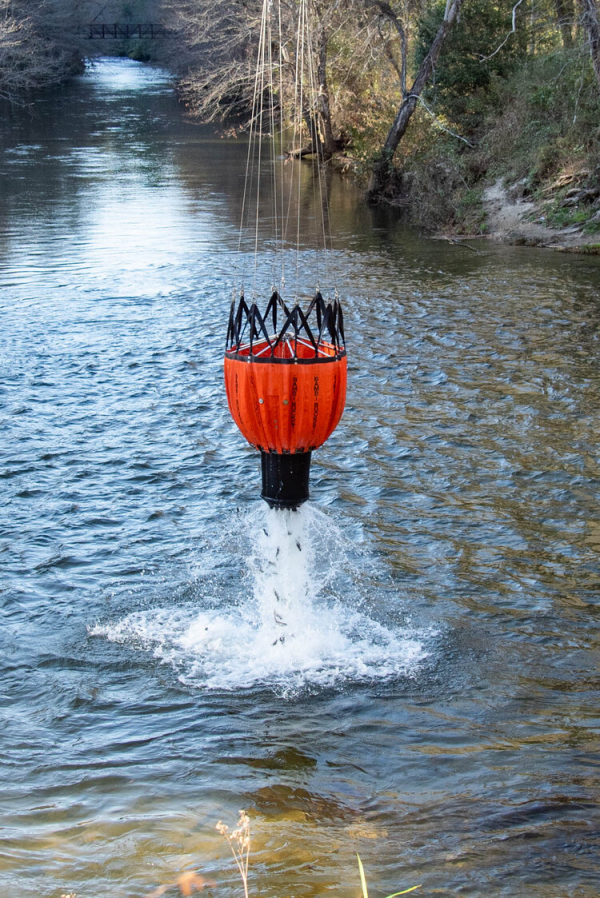 Watching an experienced team of fisheries biologists and volunteers work with a helicopter pilot to fill and drop brailer bags of trout in a remote river is a little bit like experiencing a ballet — lots of moving parts have to come together with just the right timing to make it all work. Watching an experienced team of fisheries biologists and volunteers work with a helicopter pilot to fill and drop brailer bags of trout in a remote river is a little bit like experiencing a ballet — lots of moving parts have to come together with just the right timing to make it all work.Chattooga, Wild and Scenic River. The very words conjure up all sorts of images. If you have done a bit of whitewater paddling in the region, the Chattooga’s roaring sound pouring over and around boulders is sweet music to your ears. It is one of the longest and most spectacular free-flowing mountain rivers in the Southeast, cascading some 50 miles from its headwaters in North Carolina to the state line between South Carolina and Georgia. But if you are a fly fisherman, or fisherwoman, or, heck, fly ANGLER, then you know the upper reaches of the Chattooga River as something special, particularly in the State of South Carolina, where we are not as blessed with trout waters as our neighboring states of Georgia and North Carolina. For it is a place where an angler can get lost in thought, lost in the music and rhythms of a river that is truly Wild and Scenic, like no other in the Palmetto State. And thanks to an amazing partnership between the South Carolina Department of Natural Resources (SCDNR), the Georgia Department of Natural Resources, the U.S. Forest Service, and Trout Unlimited, large numbers of rainbow, brook and brown trout are stocked in the upper portions of the Chattooga River once a year, a helicopter gently laying them in backcountry areas too remote to easily be reached by vehicle. On Nov. 2, an 11-mile backcountry reach of the Chattooga River was stocked. The Chattooga, which for a good distance forms the border between South Carolina and Georgia, was the United States’ first Wild and Scenic River, designated as such in 1974. The Wild and Scenic designation resulted in the closure of most of the access roads used for trout stocking in this 11-mile section, and that’s the reason the helicopter stocking effort started. The first helicopter trout stockings of this part of the Chattooga began about 50 years ago, and this program has been refined considerably over time. The Chauga River in Oconee was similarly stocked with trout by helicopter on the next day, Nov. 3. “We want trout anglers to have the experience of fishing in this remote and beautiful Wild and Scenic River,” said Dan Rankin, SCDNR Upstate regional fisheries biologist. “But we also want to give them a reasonable chance for success.” The trout fishery in this 11-mile segment of the Chattooga River is largely supported by stocking hatchery trout reared by SCDNR at Walhalla State Fish Hatchery, and by Georgia DNR at Burton State Hatchery. 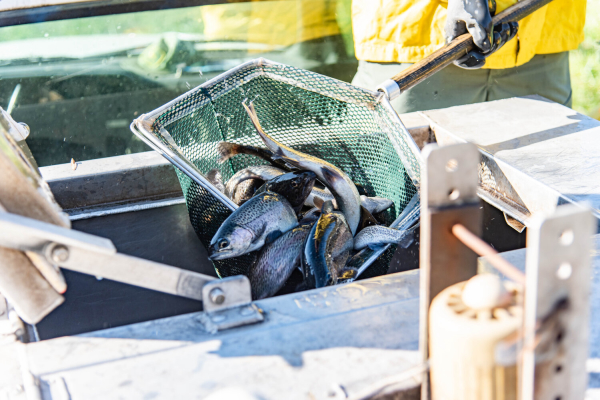 Trout begin their journey in an aerated truck, then are transferred to a helicopter “bucket” for stocking. Trout begin their journey in an aerated truck, then are transferred to a helicopter “bucket” for stocking.These partner agencies and organizations—SCDNR, U.S. Forest Service, Georgia DNR and Trout Unlimited–have worked together as the “Chattooga River Fisheries Coalition” since 1986 to improve the trout fishery. “We are stocking two different ‘management units’ of the Chattooga River by helicopter,” said Rankin. “One two-and-a-half-mile reach is the ‘Delayed Harvest’ area, and the eight-and-a-half-mile upper reach of the ‘Rock Gorge/Big Bend’ area has different regulations from the Delayed Harvest Area.” Delayed Harvest, according to Rankin, is a “fish-for-fun” reach where catch-and-release with single-hook artificial lures is required Nov. 1–May 14 of each year. This stretch reverts to general fishing regulations (5 trout daily limit, no tackle restrictions) from May 15-Oct. 31. The helicopter stocked about 2,500 adult trout (10-plus inches) of rainbow, brown, and brook trout in this section. The Rock Gorge section of the Chattooga River, which is considered a backcountry area, has no tackle restrictions and a 5-trout daily limit year-round. During the Nov. 2 helicopter stocking, SCDNR stocked 15,000 sub-adult (6-inch) brown trout and 1,000 adult brown trout (10-plus inch) in this segment. Georgia DNR will helicopter stock about 10,000 rainbow trout at a later date. “The idea,” Rankin said, “is that some of these smaller brown trout, and then later the rainbow trout from Georgia DNR, will survive next summer and grow out to a nice size for anglers.” Watching the gathering of equipment at Russell Bottoms, alongside SC 28 just before the bridge that leads to Georgia, is quite a spectacle. Dozens of trucks are lined up in a row, with people alternately running helter-skelter around the field (when the helicopter sets down the “Bambi Bucket,” to be filled with trout) and then standing around for long chunks of time while the chopper delivers its load to a remote section of the Chattooga River. Scenes like this are likely the genesis of the phrase “Hurry Up And Wait,” which is so appropriate for any gathering of government employees, whether it be fisheries biologists or infantry soldiers. Completing the scene is that everyone is wearing many articles of Personal Protective Equipment (PPE), which includes a hard hat, eye protection, face coverings/masks, closed-toe shoes (leather boots preferable), gloves, and green and yellow fire-resistant Nomex pants and shirts. The Forest Service is very diligent about PPE, not surprisingly, since being in close proximity to a helicopter is dangerous work. There is zero cell coverage at the site, which makes coordination a real challenge. 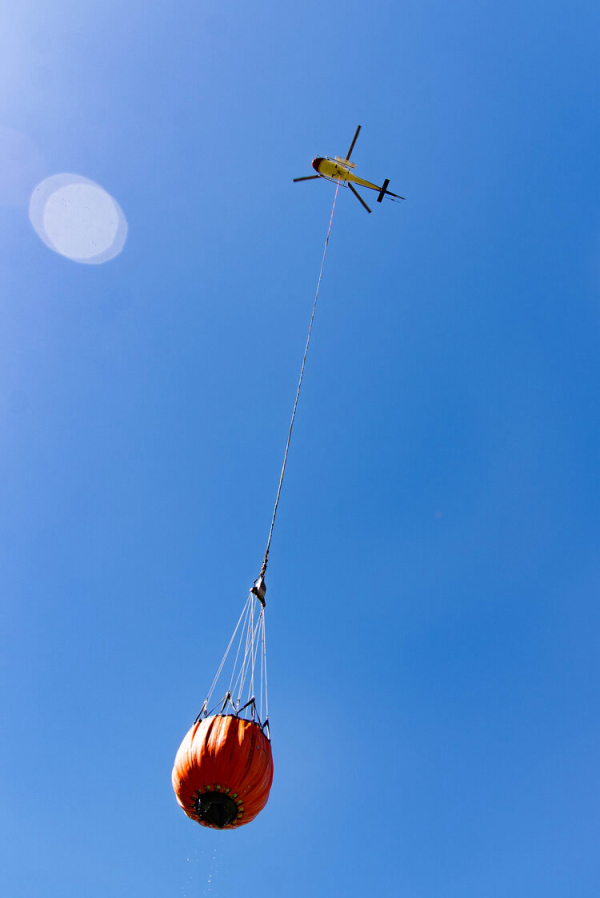 The helicopter makes quick work of ferrying the load of trout to the remote stretches of the river. The helicopter makes quick work of ferrying the load of trout to the remote stretches of the river.The helicopter was already on the scene when SCDNR videographer/photographer Taylor Main and I arrived around 8:20 a.m. Keith Whalen, Forest Service fisheries biologist, got Taylor suited up in all the appropriate PPE, and after the safety briefing (mandatory if you are going to get near the helicopter while the fish are being loaded), Taylor began what would be many hours of photography and videography. Over and over, she captured SCDNR Freshwater Fisheries staff netting trout from the hatchery truck into two 50-gallon plastic buckets, then carrying them to the helicopter’s “Bambi Bucket,” which was at the end of a 150-foot line. The bucket was already “watered,” and SCDNR staff poured the trout into the bucket, the chopper lifted off, and away it went. The trout are bound for the Wild and Scenic Chattooga River, the river that runs through South Carolina and Georgia, and the anglers who will pursue them. |
Sunline Fluorocarbon Line Review
Product Review
Sunline Fluorocarbon Line
Good
Sunline Fluorocarbon Line comes in 17 different types for different applications. Its entry level line, Super Fluorocarbon, is a good choice for general fishing. At the top end, Super FC Sniper, is for the tournament fisherman depending on every strike for his living.
Fluorocarbon is a very low visibility line with little stretch. It sinks, so it is not suitable for all lures, for example topwater lures do not work well with it.
A variety of the types of line are for specific situations. Dostrike FC is designed for fishing bladed jigs. Crank FC is made for fishing crankbaits. Both lines are designed with some stretch for those baits.
The Night line is made to be visible when using a black light at night. The Super FC Green Sniper has green color in it to help the fisherman see it above the water but is much more visible underwater to fish, too. Flipping Fluorocarbon has colors to be visible to the fisherman and is abrasion resistant.
I started using Sunline Fluorocarbon years ago after doing a Map of the Month article at Lake Lanier with Eric Aldrich. The first stop, he lowered a drop shot bait to the tip of a blowdown in 30 feet of water. When he set the hook, he sawed the fish back and forth several times in the limbs and landed a three-pound spot.
I said he must be using heavy line for dropshot but he responded it was five pound Sunline. I thought it was a fluke to land that fish, but later in the day he did the same thing in a 35-foot-deep brush pile, sawing back and forth then landing a 3.5-pound spot.
I figured if five-pound Sunline line would do that, I could tow my boat with 12-pound line.
I fish a jig and pig on 14 pound and a shaky head on 12-pound Super FC Sniper or Super Fluorocarbon. It holds its knot as well as any fluorocarbon and I have never been disappointed in it. I think I get more strikes with fluorocarbon than I would with other line when fishing slow moving baits.
Bad
Sunline Fluorocarbon Line is more expensive than many other fluorocarbon lines.
Fluorocarbon line does not stretch like monofilament. When I switched to 12-pound fluorocarbon, I broke my line several times on the hookset until I loosened the drag enough to slip a little on the hookset.
Fluorocarbon is also notorious for knot slippage. With Sunline and any other fluorocarbon, if you do not tie a good knot suitable for fluorocarbon you will lose fish.
Cost
Sunline fluorocarbon line lists for $19.99 to $39.99 for a 165 to 200-yard spool. Bulk spools are available at slightly less per yard for some types of it.
Industry-funded Research on Dorsal Spine Aging Shows Promise in Largemouth Bass Conservation
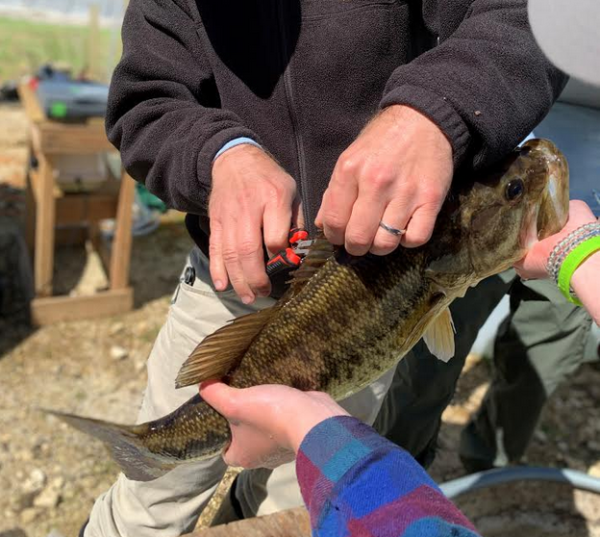 Craig Springer, USFWS – Wildlife and Sport Fish Restoration from The Fishing Wire There are “lumpers” and there are “splitters.” Some fisheries scientists think that largemouth bass and Florida bass should be split into two species. Others lump them together as one species as mere diverging strains or races. This much can be agreed upon: bass in southern climates grow big, and fishery managers are careful to conserve the trophy fish coveted by anglers at all experience levels. To that end, Summer Lindelien, a fish biologist with the Florida Fish and Wildlife Conservation Commission has endeavored the last four years to learn more about how Florida’s largemouth bass, Florida bass, and their hybrids grow over time. Excise taxes paid by fishing tackle manufacturers and on motor boat fuels fund her research in grants administered by the U.S. Fish and Wildlife Service’s Wildlife and Sport Fish Restoration Program. The research is bearing fruit that promises to yield better bass fishing in Florida—if not anywhere the 19 species and subspecies of the black bass family swim. More research is in the works and necessary to take further steps. Lindelien and her FWC colleagues are developing a new method to determine age and growth rates of trophy largemouth bass that would otherwise be missing in population assessments and ultimately, fishing regulations. Hard bony structures are best for determining a fish’s age, body parts such as scales and ear bones that put down rings at each year of growth. The latter is most reliable but there is a downside: it is 100 percent lethal. Dorsal spines may be the alternative. The method shows great promise as Lindelien learned while a graduate student at the University of Florida. She and her colleagues also completed a six-waterbody study to refine the efficacy of reading age rings on dorsal spines and are in the midst of evaluating how dorsal spine aging error affects population dynamic metrics. Lindelien and colleagues caught wild bass known to be hybrids of largemouth and Florida bass, 36 fish in all, varying size from 12 to 22 inches long. Six bass each were acclimated in six tanks and three from each tank where randomly picked to have three dorsal fin spines extracted with surgical scissors and snips cut flush with the bass’s back. The fish were monitored for injury and mortality for 35 days afterward. 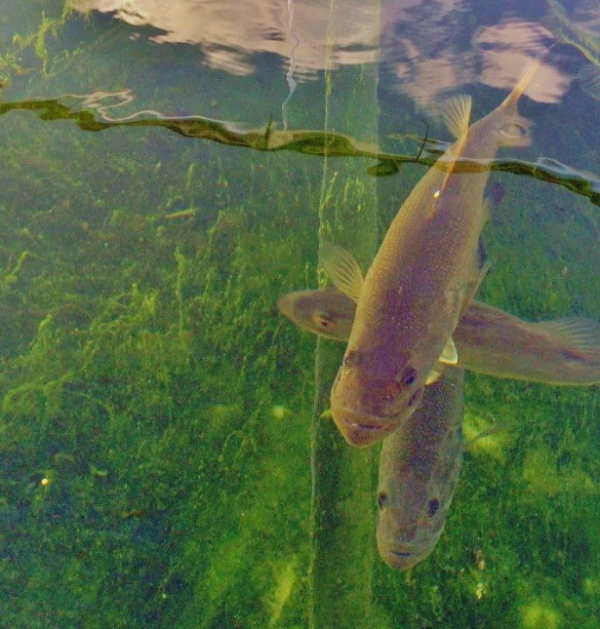 None of the bass with missing spines perished. Overall condition between fish with spines intact and those with spines removed did not vary to any great degree at the conclusion of the month-long study. In the end, the method shows much utility as a means for black bass fishery managers to gather more data on trophy fish without deleterious effects on the fish and the fish population. The method also holds promise down the road for citizen-scientists—anglers, that is—to weigh and measure and trim a spine before releasing trophy fish, thus greatly expanding the essential data scientists need. None of the bass with missing spines perished. Overall condition between fish with spines intact and those with spines removed did not vary to any great degree at the conclusion of the month-long study. In the end, the method shows much utility as a means for black bass fishery managers to gather more data on trophy fish without deleterious effects on the fish and the fish population. The method also holds promise down the road for citizen-scientists—anglers, that is—to weigh and measure and trim a spine before releasing trophy fish, thus greatly expanding the essential data scientists need.Lindelien is the first to confirm that removing dorsal spines is benign to largemouth bass. According to Lindelien, as the dorsal spine aging technique is refined it might be employed on other black basses, common and otherwise: Guadalupe bass in Texas, spotted bass in Kentucky, Neosho smallmouth bass of Oklahoma or the rarer Choctaw bass of Alabama and Florida where removing fish of any size is not an option. Lindelien and her colleagues published the results of the spine extraction research in the U.S. Fish and Wildlife Service’s Journal of Fish and Wildlife Management.– |