Frustrating End to Tournament Year

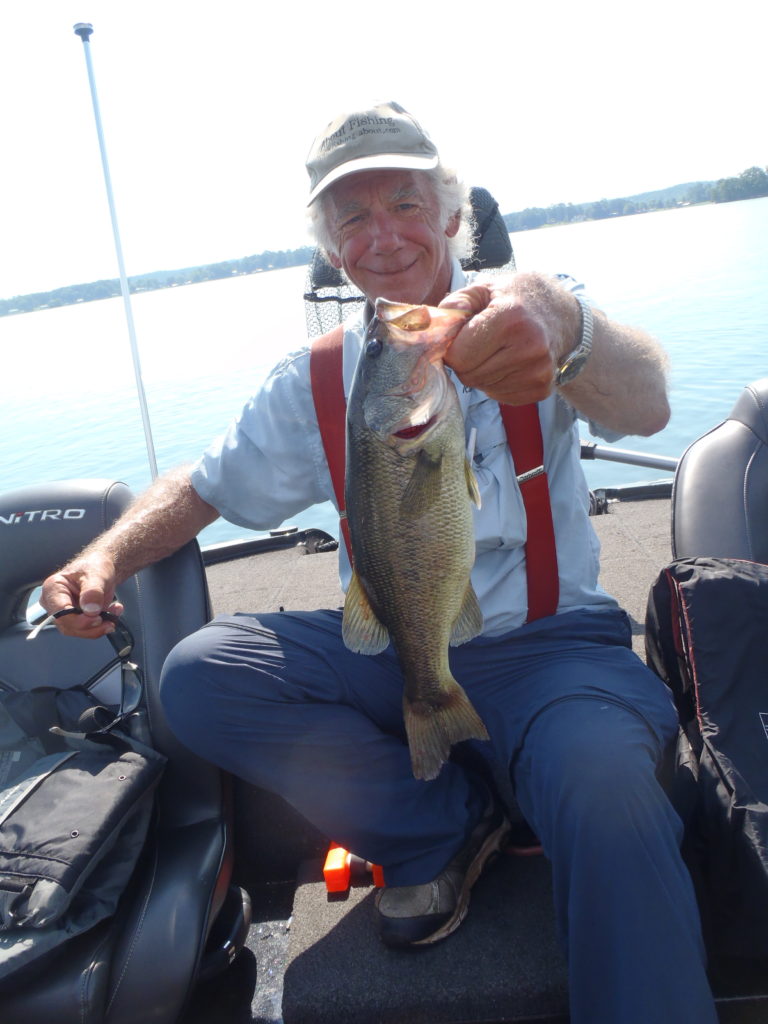
Largemouth I caught while fishing with Michael Ward

Well that didn’t go as planned and hoped!  All three bass clubs ended our tournament years at
Jackson last weekend.  The Potato Creek Bassmasters fished our December tournament on Saturday and the Spalding County Sportsman Club and Flint River Bass Club fished a two-club tournament on Sunday.

    On Saturday 20 of us fished for eight cold hours to land 30 bass weighing about 53 pounds. There were two five-bass limits and seven people didn’t catch a 12 inch keeper.

    Raymond English blew us all away again with a limit weighing 12.01 pounds and his 5.03 pound largemouth was big fish. Kwong Yu placed second with five bass weighing 7.60 pounds, third was Trent Granger with three bass weighing 6.49 pounds and Shay Smith came in fourth with for bass weighing 6.43 pounds.

    Raymond said he caught the big one on a crankbait and Kwong caught a limit in the first hour we fished.  Others said they caught fish on spinnerbaits, Carolina rigs and shaky heads.  It seems if you found a hungry fish and got a bait near it, it might hit anything that looked like food to it.

    I tried a little of everything, crankbaits, spinnerbaits, jigs and shaky heads. I could often see fish that acted like bass in their positions and movements on my Garmin Panoptix but could not get them to hit in the stained 55-degree water.  And I fished from shallow brush and rocks to deep brush and rocks and everything in between.

    At 10:20 AM I was fishing a deep point with rock piles on it and missed a hit on my jig. I picked up a shaky head and cast back to the same place and caught a 14-inch keeper spotted bass. Since I got two quick bites and could see other fish around the rocks, I stayed there an hour trying to make them bite everything I had tied on, but never got another bite.

    Finally at 2:15 I cast my shaky head to some shallow rocks on another point, got a hit and landed a three pound spot.  That was it, I had two weighing 4.35 pounds and placed fifth.  It was a very frustrating day!

    On Sunday 19 members of the two clubs fished eight hours to land 38 bass weighing about 41 pounds.  There were three five-fish limits and eight people zeroed. 

    Travis Weatherly won with five bass weighing 7.10 pounds and his 2.39 pounder was big fish.  Jay Gerson came in second with five weighing 6.66 pounds, Russell Prevatt was third with five at 6.07 pounds and Kwong Yu had three weighing 3.68 pounds for fourth.

    Jay said he caught his fish on a floating worm early. Others said they caught their fish on a variety of baits on a variety of types of cover and structure. Like the day before, it seemed you had to put your bait right in front of the right bass at the right time to get a bite.

    At blast off I went straight to the point where I caught my first keeper the day before. There were fish all over it with no sun on it yet, so I had high hopes. I could see what looked like bass suspended, some on the bottom and baitfish everywhere. It looked perfect. I never got a bite.

    After a frustrating hour of trying to make fish that I could see bite a variety of baits, I left that point.  For the next six hours I tried everything I could think of to catch a fish. I had one bite on a shaky head on a deep rocky point but missed it.  That really frustrated me.

    At 2:30, with one hour left to fish, I cast a shaky head to a shady seawall. I though I felt a tap but could not see my line.  I took off my sunglasses and saw my line was already back under the boat.  When I set the hook, a small keeper spot came over the side of the boat.

    That was the only fish I caught all day, a 12.5-inch spot weighing .85 pounds. I came in last place of the people that caught fish.

    All three clubs start our new year with tournaments in January.  That would be a good time to join us for a lot of fun, and maybe a little frustration. 

    The Flint River club meets the first Tuesday each month and fish our tournament the following Sunday.  Dues are $20 a year and tournament entry fee is $25, with optional big fish pots each tournament as well as two other optional annual pots.

    The Potato Creek club meets the Monday after the first Tuesday and fish our tournaments the following Saturday.  Dues are $50 and entry fee is $30, with optional big fish pots for each tournament and for the year.

    The Sportsman Club meets the third Tuesday each month and fish our monthly tournaments the following

Sunday. Dues are $50 and entry fee is $25 with optional big fish pots.

    All three clubs have or will have club classics that members qualify for by fishing at least eight tournaments a year or placing in the top eight for the year in the points standings.  All three clubs meet at Panda Bear restaurant.

    Think about joining one club, or all three! 

Ice Fishing, Beyond the Basics

Tips, tricks and gear that will make this a season to remember on the ice.

By Kent Sorenson
Assistant Habitat Manager
DWR Northern Region

from The Fishing Wire


It’s time to gear up for ice-fishing season! If you’re serious about ice fishing and want to catch more fish, this post is for you.

We’ll go beyond the basics with some tips and direction for those who demand more of themselves when it comes to hauling fish through a hole in the ice. (And maybe give you a few ideas for your Christmas list.) Let’s get started!

Tip #1 — Choose reliable ice-fishing gear
My first tip is to buy good, reliable gear. You’ll find that you usually get what you pay for. Investing a modest amount on quality tackle will make your days more productive and ensure that you don’t waste your trip wrangling problematic equipment.Ice-fishing gear doesn’t have to be complicated, but finding what works best for you may require a few trips and a willingness to experiment.I also recommend tailoring your gear to the size and behaviors of the fish you want to catch. For example, if you want to catch lake trout, you’ll need a rod, reel and line that are heavier than what you’d use for bluegill.

Rods and reels should also be matched to their assigned task. Even though you generally match your gear to a species, you actually match it more to the bait you intend to use rather than the species you plan to catch. For example, you can land a 10-pound fish on a noodle rod, but you can’t effectively work a 3/8-ounce lure with it.For most panfish (e.g., bluegill and yellow perch), you’ll rarely need to go heavier than 4-pound line. Possibly more important than the line weight, though, is its diameter and behavior in cold weather.

As you learn about the characteristics of various types of fishing line, you’ll find they all have strengths and weaknesses.We all have slight preferences that can be determined only through experience. I like monofilament line, other anglers like braids and some strictly use fluorocarbon. Rarely is one type of line best for all conditions.

Strive to find a line that is small in diameter and has low spool memory. This will have to be a try-it-and-see moment for most people.

Tip #2 — Make use of electronics
If possible, make use of electronics, particularly sonar. Nothing will build your confidence more than knowing there are fish below you. And nothing will make you a more successful angler than having that confidence.

There are many different sonar (fish finder) options available to ice anglers nowadays. I use a Vexilar, but other manufacturers make great sonar units too.Some are better than others, but any of them are better than not using one at all. Find one that suits your fishing style and fits within your budget, and you’ll wonder how you ever got along without it.Above all, don’t be intimidated by these units. Watch a YouTube video or two, practice with them for a couple of hours on the ice, and you’ll be completely competent in their use.Having a good sonar unit can really improve your ice-fishing success.Other electronic aids include Global Positioning Satellite systems and underwater cameras. Of the two, I find a handheld GPS more helpful, particularly when transferring information I learned while fishing in open water.

I have used an underwater camera, but I found myself watching fish more than fishing. (Now, I extend my trips by letting the kids use it — they’re so entertained, we end up staying longer!)

Smartphone apps have started to make themselves available as well, but I cannot personally comment on their usefulness (other than the weather apps). I would imagine we’ll see an increase in their use in the future.

Tip #3 — Learn more about Utah’s waterbodies and fish species
Become familiar with the different species you’ll likely encounter in the places you plan to fish, or conversely, determine where the species you plan to target are found. For example, if you want to catch yellow perch, it doesn’t make any sense to fish Lost Creek or Causey reservoirs, because neither water has yellow perch in it!Identify the fish you want to catch and choose your location accordingly. Also, familiarize yourself with the annual dynamics of those waters and the behaviors of the species you’ll target.Black crappie and yellow perch are a common catch through the ice at Pineview Reservoir. Visit the Fish Utah website to search for lakes and reservoirs by the species they hold.

There are some traditional and fairly reliable fisheries that can, for the most part, be counted on year after year. Take Pineview Reservoir, for example. You can generally count on it to produce a high catch rate for yellow perch. Some years the perch are small, some years they’re medium-sized and, occasionally, they’re pretty nice.

Other waters are wildly unpredictable. They tend to run in loose cycles and produce a strong year-class of naturally produced fish that dominates the fishery.The yellow perch fishery at Rockport Reservoir is a good example of this. It’s great when it happens, but a total waste of your time when it’s between peaks.

Tip #4 — Take advantage of technology
If you really want to dig into the waterbody you plan to fish, various technological tidbits available today can help a lot during the winter months:
Aerial views of waters
Water level fluctuations tracked over timeInflow and discharge of popular reservoirsGPS points you saved while fishing in the summerResources are readily available online: the Bureau of Reclamation has charts that track reservoir water levels, Google Earth has fabulous aerial photos in time series, commercial ventures (such as Navionics) have sample bathymetric maps for some local waters.With just a bit of looking, you can find some great tools to supplement the DWR’s online stocking and fishing reports.

Some additional tipsIce fishing is your ticket to catching some of Utah’s biggest fish! The ice allows you to access areas you’d need a boat for during the rest of the year.Be mobile. Don’t ever, ever, ever stay somewhere that is not producing fish. If I’m not getting bites in 15 to 30 minutes, I’m off to find a new spot.

Learn a bit (or more) about the behavior of the species you want to catch.Learn from slow days by keeping a journal and noting what did and didn’t work. If you tried a particular technique, for example, and it didn’t work, note the conditions that day. It’s possible the technique might work under different conditions. Also, note your ‘near misses’ (e.g., the day anglers around you hooked fish using a bait you didn’t have, or realizing you should have packed up and moved to a new spot sooner) and look for ways to improve. Keeping a journal is a great way to keep you from making the same mistakes on subsequent trips.

Don’t follow “hot bites” on the Internet. Find your own hotspots. There’s as much misinformation floating around message boards and fishing reports as good information.

Learn to fish by fishing with experienced ice anglers, not simply reading the message boards or fishing reports mentioned above. Don’t expect it to all happen at once: pay your dues, and earn a spot in a network of experienced anglers. Once it becomes obvious you can ‘walk the talk,’ experienced anglers will see value in what you have to share and will begin to share information with you more freely. Nobody starts out as a Jedi Master: you must be a Padawan first!

Have a basic understanding of what the bottom of the lake you want to fish looks like. Learn the depths at various locations and where the humps, ridges and changes in substrate are located. Pairing that information with the preferences and behaviors of the fish you want to catch can really increase your catch rate.Develop a basic understanding of limnology (the scientific study of fresh water, such as lakes and ponds, with reference to their physical, geographical, biological, and other features).

Kent SorensonKent Sorenson is the assistant habitat manager in the DWR’s Ogden office. His main tasks are improving habitat and public access to watersheds in northern Utah. When he’s not at work, there’s a good chance he’s fishing somewhere, looking for a spot far away from the crowds.

Where and How to Catch Lake Harding/Bartletts Ferry February Bass, with GPS Coordinates

    By now most bass fishermen have had enough sitting at home staying warm and want to venture out to defeat cabin fever.  Although there is hope for warming by the end of the month and bass do respond to the longer days, they are not easy to catch most days. Fortunately, lakes like Harding will have some feeding fish this time of year.

    For a February trip, a lake like Harding on the Chattahoochee River just downstream from West Point is a good choice. It has a variety of types of structure and cover to fish and is full of spotted bass. Spots seem to feed better in cold water and cold fronts affect them but don’t usually shut them down like it will largemouth.

    Chris Blair has been a bass fisherman all his life and his father instilled a love of competition in fishing in him. He often went with his father to club tournaments and fished from the bank until he could join the Clayton County Bass Club when he turned 16.  He does well in the club and made the Georgia BASS Federation Nation state team in 2008. 

    “Harding is one of my favorite lakes,” Chris said.  “It has some big spots in it and you can catch them in a variety of ways,” he continued. There are also some good largemouth in the lake. Although February is not the best month to be on Harding, you can catch fish there as well or better than any where else this time of year.

    The bass at Harding are holding on their winter patterns most of the month of February. They are near deep water and hiding in heavy cover.  A warm day or two will make them move a little more shallow and feed better, but they won’t venture far from the deep water sanctuary. 

    Wood and rock cover is what you want to look for, and it needs to drop into at least 15 feet of water to hold bass this time of year. If even deeper water is nearby it is even better.

    Chris will fish a three eights ounce Edge Hardhead mop jig and trailer in orange and brown in clear water and black and blue in stained water.  He likes a one half ounce Edge spinnerbait in chartreuse and white with a gold Colorado and a silver willowleaf blade.   A Hellrazor blade jig in white with a Shadee Shad trailer is good for fish that don’t want quite as much flash as the spinnerbait shows.

    A Luck Craft or Bandit crankbait in Tennessee Shad that will get down deep is a good choice for more active fish and Chris will go to a one eight ounce lead head with a six inch pumpkinseed Trick worm trailer for very inactive fish.  One of these baits will attract bites most days.

    The following ten spots show the kinds of cover and structure Chris catches Harding bass from this time of year.

    1.  N 32 42 755 – W 85 07.361 – Run down the river on the right side and go past the mouth of Osanippa Creek.  On your right will be a small point with a green pine in the water beside a dead pine in the water.  They are in front of gray roof house and there is a dock just downstream of them as you start into the pocket there.

    These blowdowns are on a steep drop and there is 15 feet of water just off them at full pool. They offer the typical kind of place Chris looks for this time of year, heavy cover dropping into deep water. 

    Start fishing on the upstream side of the green tree and work a jig and pig through the branches of it and then the dead one. Fish it carefully and slowly, winter bass are not aggressive. Give them time to hit.

    As you work away from the trees throw a crankbait and jig head worm around the docks just inside the pocket. As the water warms at the end of the month bass will move into this pocket and hold on cover around the docks.

    2.  N 32 41.843 – W 85 07.104 – Down the river past the Chattahoochee Valley Rec Park just downstream of the second small pocket there is a steep bluff bank starting at a small point with a gray house with a long walkway going down to the dock. There is raw clay on the outside of the point and some big rocks and wood cover is along this bank.  

    Start at the point and work a crankbait and spinnerbait through the cover. Slowroll the spinnerbait through the limbs of trees and bump the crankbait off the ends of them. A Hellraiser is good to work off the ends of the wood, too.

    Follow up with your jig and pig or jig head worm. Bump them slowly from limb to limb. If the water is warming, fish from the shallow end all the way out but if it is cold, especially early in the month, concentrate on the deeper parts of the cover.

    3.   N 32 41.053 – W 85 11.066 – Run to the third bridge going up Halawakee Creek. The Highway 279 Bridge is upstream of the old railroad bridge.  Bridges like this one on creeks make a squeeze point where bass often stack up as they start to move toward the backs of the creeks as the water warms and the days get longer.

    Fish the riprap and pilings from one side to the other, working a crankbait and spinnerbait bumping the rocks and along the pilings.  Also fish a jig and pig or jig head worm on the rocks and beside the pilings. Even early in the month the rocks and pilings will warm from the sun and draw baitfish and bass to them.

    You will find the water is usually a little clearer in this creek than out on the main river. This can be important in cold water. Clear cold water is better than muddy cold water most days.

    4. N 32 41.092 – W 85 08.936 – Going down the creek there is a big creek on your right just before you get to the Highway 379 Bridge.  A power line crosses the mouth of the creek, jumping from one long narrow point on the upstream side to the long narrow point on the downstream side.

    Start on the upstream point at the power line and fish the bank, casting to the clay bottom that changes to riprap.  Throw crankbaits, Hellrazor and spinnerbait.  When you get to the blowdown slow down and fish it carefully with a jig and pig and jig head worm.

    You will be in 15 feet of water a cast off the bank near the point but the old creek channel swings in near the blowdown and the tip of it is in water about 25 feet deep at full pool.  It is in a perfect location to hold bass all month. The water is deep enough for early in the month and bass moving into the creek as the days get longer will hold in the tree before moving further back.

    5. N 32 41.356 – W 85 08.098 – Go under the bridge and head downstream. Straight ahead the bank runs out from your right and the river makes a turn to the left.  On the right bank right where the turn starts is a point with some post along a wooden seawall on it. The posts have lights on them.

    Stop well off the point in 45 feet of water and east toward it. Off the tip and slightly downstream of it is a huge boulder sitting in about 15 feet of water and there is rubble around it. Bass, especially spots, like to hold around this rock.

    You can bump the top of the rock with a crankbait that runs six or seven feet deep then slow roll a spinnerbait on it. Work a jig and pig and jig head worm all around the rock, throwing up to the seawall and fishing back past the rock.  Bass will hold all around the rock and feed on shad, so seeing balls of shad here and on other spots like this really helps.

    6. N 32 42.034 – W 85 06.591 – Run out of Hawalakee Creek and go across the mouth of the river. You can run across above the island with the house on it near the creek and downstream of the island with the cross on it near the other bank. Locals call this “Church Island.”

    The right bank going up across from the island with the cross is steep and drops off into deep water.  There is a white house on the downstream side of this point and it flattens out and the bluff bank along the point has big boulders in it.

    Start fishing just upstream of the dock where the big rocks start and work upstream, all the way past the next dock.  Chris will get in close to the bank and parallel it with a big crankbait and also slow roll a spinnerbait along the bottom.

    This is also a good place to fish a jig and pig and jig head worm when the water is cold. Chris says he will throw right on the bank then “creepy crawl” either jig down the rocks, barely  moving it so it stays right on the bottom and falls only s few inches at a time. The bottom drops fast here so you have to move it very slowly.

    7.  N 32 42.406 – 85 06.891 – Go up the river past the next big round point and stop at the mouth of the narrow cove on your right. The upstream point of this cove is rock and drops off on the end into the channel. There is a ledge across the mouth of the cove and it is shallow going toward the downstream point but it drops off into the river on the outside of it, too.

    Fish the  upstream point early in the month and work into the cut as the days get longer and the water starts to warm. Bass hold on the point and feed on shad then work into the cut, holding and feeding around wood cover in it.  There are usually lots of shad around the mouth of this cove so check for them.

    Chris says there is lots of good brush as you go back into this cove and it is a good place to fish later in the month.  Fish your jigs around the point and you can fish a jig head or jig and pig vertically if you see fish under your boat. As you go into the cove fish all your baits around the brush and other wood cover.

    8.  N 32 42.946 – W 85 07.012 – The downstream point of the cove with Idlehour Ramp in it holds bass.  This shallow point is a good place to start if you put in here or end your day before you take out, or both.

    Stay well off the point and make long casts across it with all your baits. Work your spinnerbait and blade jig along the bottom and bump it with a crankbait. Then drag a jig and pig or jig head worm along the bottom.

    A lot of tournaments are held out of this ramp and bass released here often hold on this point.  There are usually shad on it so it is worth fishing carefully and at different angles. Work all the way around it, keeping your boat out as far as the no wake buoy on that side, while fan casting the point.

    9. N 32 44.041 – W 85 06.662 – Up the river just before it bends back to the left at Blanton Creek is a cove. It is the last one on the right before Blanton Creek going upstream and is very shallow. But the downstream point is rocky and drops off into the channel.

    Stop out from the point and work in. You will see a big pine blowdown but it is broken off at the water level. There is brush out in front of it to fish, though. Another smaller blowdown is closer inside the mouth of the cove. 

    You will also see a log lying on the bottom out from the bank, showing how shallow this pocket is.  You don’t want to fish into the pocket. Instead, work your jigs in the blowdowns and brush and also down the steep rocky bank going downstream of this spot.  Chris says this is a very good spot hole.

    10.  N 32 44.605 – W 85.07.901 – Run up past the bluff bank on your left to where the river turns to the right.  At the end of the bluff the bank levels out and a creek enters the river.  On the upstream point of the creek is a big “For Sale” sign.

    Out in front of this sign about 40 to 50 yards is a rock pile right on the lip of the old river channel. It is very rough and comes up out of 10 plus feet of water to top out at about five feet deep at full pool.  Bass hold and feed on these rocks, especially when current is moving down the river.

    Chris positions his boat downstream of the rocks and throws a crankbait up to work back with the current.  He wants to get it down to bump the rocks but be prepared; you will get hung up here.  Fan cast all over the top of the rocks.

    These ten spots hold bass right now and through the end of the month. Check them out and you can find many more similar places to catch February bass at Harding.

With Piers Closed, Angler Takes to Alabama’s Beautiful Beaches


By DAVID RAINER
Alabama Department of Conservation and Natural Resources

from The Fishing Wire

With a nickname like Pier Pounder, David Thornton of Mobile has seen his favorite pastime disappear with 2020’s double whammy of hurricanes. Hurricane Sally took the Gulf State Park Pier out of commission, and Hurricane Zeta destroyed Cedar Point Pier in Mobile County.

“I guess you can call me the Pier-less Pounder because the only pier open in the Mobile area is the Fairhope Pier, and it’s closed at night because they don’t have any lights,” Thornton said.

However, Thornton has a major backup plan, thanks to Alabama’s beautiful beaches and surf teeming with a variety of fish species.

Thornton said he’s been hooked on fishing in the surf since he was 12, and a trip to Gulf State Park Pier with his buddy, Tom Allenbach, sealed his loved for pier fishing.

“Tom was fishing a live alewife under a float,” Thornton said of the trip to Gulf State Park Pier. “He told me to hold his rod while he caught more bait. I asked him how I would know when I got a bite. He said, ‘You’ll know.’

About that time, I felt a tug and thought I was hung on somebody else’s line. Then the fish took off, stripping drag. It was about a 10 ½-pound king, and that was when I really got hooked on pier fishing.”

But for now, fishing from shore is where Thornton will be until a portion of Gulf State Park Pier is reopened sometime late this winter.

Before Thornton decides where to pursue fish in the surf, he gathers information about weather, water, wind and tide conditions.

“Know what the weather is going to be like with the marine forecast,” he said. “It’s not that I look for any certain conditions; it’s just that I want to know what to expect and adjust. I look at the tide tables. Then I’ll decide where I’m going and what I’m going to fish for based on the conditions.

“Ideal conditions would be 10-15 mph winds either onshore or sideshore with waves 1 to 3 feet. For shore fishing, it’s really better with a little chop on the water. I think it stimulates the fish to bite more readily. Also, you have current flow. If there is a current working over the sandbar, you want to pay special attention to the tide, especially if it’s close to a pass. If it’s too rough or too calm or with very little tidal movement, the fish don’t cooperate as well. If I’m going to fish a neap tide, I’m going to fish close to the pass.

”When Alabama’s tides come off a neap cycle, the tide swings will sometimes reach more than 2 feet from low tide to high tide. That’s when Thornton likes to be fishing the open beaches.

“That tide movement stimulates the bite,” he said. “When I go, I’m looking for a longshore sandbar. The longshore sandbar is usually 100 to 150 yards off the beach. But there are places where the longshore sandbar swings in closer to the shore. The best places are where the sandbar is within casting range. That creates a pinch point where the fish are going to be moving from one trough to the next. When the bar is closer, you can use lighter tackle and target a variety of fish.

“I’d much rather catch a big fish on light tackle and take a long time than catch a small fish on heavy tackle.”

Thornton casts to the inside edge of the sandbar to start the day and adjusts his casts according to the bite.

“The fish tend to feed along the edges,” he said. “They use the sandbars for protection from predatory fish. The area from the shore out to the first bar is where most of the fish live. That old adage is that 90 percent of the fish live in 10 percent of the water. It’s the same in the surf.

”Speaking of light tackle, Thornton truly goes as light as possible. Where some folks show up on the beaches with long rods with 20- to 30-pound line, Thornton fishes with line in a range from 4-pound-test to 15-pound-test. He uses his 10- to -12-foot rods with the 15-pound line for the long casts. He takes his 7-foot rods and light line for fishing closer to the shore. However, anything can bite any of his rigs.

“I’ve hooked 20-pound black drum within 10 feet of the shore, and I’ve caught whiting and pompano out by the sandbar,” he said. “The mistake I see most people make is they’ll cast out as far as they can, pop the rod in a rod holder, plop down in a chair and wait for a fish to bite. If they don’t catch anything, they say the fish weren’t biting that day. Odds are, they overcast the fish. With light tackle, I feel like I have just as much fun catching 14- to 16-inch whiting and an occasional pompano as somebody heaving this heavy tackle and waiting hours between bites.”

Thornton uses No. 4 Kahle hooks and a variety of sinkers from pyramid to no-roll egg-shaped. If he wants the bait to remain stationary, he sticks with the pyramids. If he doesn’t mind the bait moving a little, he’ll use the flattened egg sinkers or coin sinkers.

“If I’ve got a side wind that is creating current, I can also use that slow-moving bait to cover more ground,” he said. “That way, I’m not just throwing darts at the fish. If your bait is moving too fast, you may have to go to a pyramid.”

Thornton suggests forgoing the ready-made pompano rigs and sticking with lighter line.

“If you’re targeting one- to two-pound whiting and one- to three-pound pompano, even 20-pound line is overkill,” he said. “Light line allows the fish to give account of themselves. They’re really feisty for their size. When you match the tackle with the fish, you’re going to have a lot more fun, and I really think you get more bites. It seems like every time I step down in tackle size, the number of bites I get practically doubles. Whiting and pompano can be particularly line-shy at times.”

Thornton considers the Florida pompano as his target species, but he is happy as can be with what he calls the “byproduct” of pompano fishing, which is whiting, a silvery species with a black patch at the top of its tail. Known as Gulf kingfish elsewhere, whiting don’t get much larger than two pounds but are delicious table fare. Thornton said

Southern kingfish, known locally as ground mullet, are common in the surf at Dauphin Island.“Whiting, by far, is the most prevalent fish in the surf,” he said. “But you never really know what you’re going to catch.”

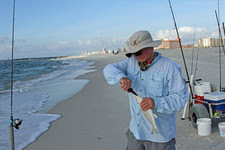
As far as bait, Thornton uses fresh dead shrimp with the heads and tails pinched off when he has run out of ghost shrimp, a crustacean that lives in the surf that is caught using a suction pump commonly called a slurp gun to extract the creatures from the sand. On our outing last week, the fish definitely showed a preference for ghost shrimp. Thornton also uses a product called Fish Bites, a product with different scents infused into the material.

Thornton said shore anglers will be able to catch whiting and a few pompano throughout the winter. When the water gets a little colder, sheepshead will show up around all the jetties. The pompano limit in Alabama is three fish with a minimum total length of 12 inches. The limits on sheepshead are 10 per person with a 12-inch fork length minimum. Whiting have no size or creel limit.

The best time all year to fish the surf is in the spring, according to Thornton, who keeps readers apprised of coastal fishing conditions with columns in Great Days Outdoors and the Mullet Wrapper.“Late March through April and possibly early May is the time to fish the beach, especially for pompano,” he said.

“With the lockdown this past spring, we didn’t get to fish for pompano until May. The Gulf State Park Pier was still open during that time, and the pompano catches were astounding.

”Thornton is definitely going to celebrate when the Gulf State Park Pier reopens a portion of the pier about 40 feet past the middle section with the restrooms.

“I’ll be ecstatic,” he said. “The cruelest irony of all was the pier had scheduled a grand reopening the day that Sally smashed it. I was supposed to give a little talk that day, and I was going to reminisce about walking out on the new pier after many people had been waiting five years for the pier to be rebuilt after Ivan. It took my breath away. I remember on the old pier, we would often say, ‘If it was just 100 yards longer.’

Then they built it 200 yards longer. The fishing was just outstanding.

“When I walked out on the pier before Sally I couldn’t help but think about all those people who helped me become a better fishermen, people like Harley Rogers and so many others. For most of the people who are regulars on the pier, they have the attitude of ‘pay it forward.’ When you see somebody struggling, you try to help them with their tackle or bait. Then you see their whole attitude change. You don’t see that everywhere. That’s one of the things that makes Gulf State Park Pier special.”

St Croix Rod Sale

Sale is LIVE!

St. Croix rods deliver distinct advantages on the water. This year, give the anglers on your list what they really want… St. Croix pride and handcrafted performance. Whether shopping for others or taking advantage of deep savings to add to your personal rod collection, St. Croix has anglers covered with our special two-week Holiday Sales Event, starting this Friday, December 4th and running through the 20th.

St. Croix’s Holiday Sales Event will run from 7:00 AM CDT on Friday, December 4th through 10:00 PM CDT Sunday, December 20th. Shoppers at www.stcroixrods.com/collections/rod-shopper can take 40% off select retired Avid Salmon & Steelhead and Wild River rods; 40% off select retired Sole fly rods; 30% off retired Mojo Inshore and retired Tidemaster rods; and 25% off retired Mojo Ice, Triumph,  Triumph Salmon & Steelhead, Triumph Surf, Triumph Travel and Reign rods and even some left over combo’s from the Black Friday sales event!
 
Start Shopping

Deer Camp Memories

 As I threw another log on the fire, my mind wandered over the past 40 years of deer camp here.  When I first joined, the “old” men mostly stayed in camp and didn’t hunt much.  For several years “Captain” was the old man in charge of the fire.  Now it is my “old man” job and I don’t leave camp much.

    After spending almost half my life in the club, memories are plentiful. Hundreds of nights sitting around the fire, eating parched or boiled peanuts and sharing stores, some of them mostly true, revive past experiences. And the same ones are told over and over, drawing amazed reactions from young members and smiles from us older ones.

    And we celebrate and morn lost members. Many of the young members fathers I watched grow up and become men over the years.  They pass on their traditions to their children, just as their fathers passed them on to them. The never-ending cycle of outdoor and hunting life.

    Many of the stories are funny and draw laughs every year.  Tales of cut shirt tails, stories of first blood, memories of members walking to their stand in a circle in the dark and ending back up at camp, all bring chuckles.

    One of mine is finding the perfect place for my climbing stand, easing up the tree in the dark then staring another club member in the eyes in a tree only 30 feet away.  Or the time I helped build a permanent stand with a friend, only to have him not be able to hunt it opening day. He doesn’t laugh much when I mention the big nine point I killed from that stand on opening day, but everybody else does.

    Four wheelers stuck in the creek are both funny and scary.  Turning a four-wheeler upside down on top of you in a creek is not funny until after you are safe.  It is funny now to remember the work of the six of us laboring for hours to get it out, but at the time it was only exhausting.

    Some of the scariest stories are the one or two about stands breaking and tumbling members to the ground. Fortunately, none ended up with serious injuries, just injured pride.

    Many of my memories revolve around a stand I have hunted for more than 30 years.  It is a simple stand, 2x4s nailed between two sweetgum trees about 24 inches apart 20 feet off the ground with a 16-inch piece of plywood nailed on top of them.  Spikes driven into the trees 30 years ago are sticking out barely enough for a boot hold now.

    The stand has been sweetened over the years. A small shelf is placed in the perfect position to hold my coffee cup.  Sticks cross the area above my head, placed just right for a black plastic bag to stretch over and protect me from rain.  And a nail holds my hanging rifle in position to raise it without excess movement.

    I found the place for the stand by accident.  I found a creek hillside that seemed to be perfect for a stand, near the very end of one of our roads.  I loaded materials to build it in the truck then headed to the end of the road.

    Before toting everything through the woods, I remembered hunting too close to the other club member so I walked around a little. Sure enough, there was another stand, hidden in an oak tree, looking over the same hillside.

    I went back to the truck disappointed and started driving slowly back out, watching the ground on either side of the road carefully.  When I spotted a trail crossing it, I stopped and followed the trail though some pines to where they stopped at the edge of hardwoods.  There was a slight opening along the edge from an old logging road.

    Careful inspection proved there were no other stands for at least 200 yards in any direction.  I built the stand with help from a fellow club member.  The first morning I hunted it I was shocked how close it was to Highway 18.  The bends in the road fooled me.  I could glimpse 18 wheelers traveling along the road, and their tire noise often make it hard to hear.

    Even with the noise problem I have killed more than 40 deer from that stand.

    Some of those kills I was very proud of, some not so much.  One day I glimpsed a deer facing me about 50 yards away at the very end of the old logging road.  Young pines hid part of it but I could clearly see its head and chest since it was facing me. I shot it with my 30-30 in the chest and it dropped.

    When I got to it, I was shocked how small it was.  Although it was doe day and I was hunting meat, I wanted a bigger deer since the limit was two a year back then. I was able to pick up the 40-pound yearling by its back legs and carry it over my shoulder, not drag it out.

    I quickly gutted and skinned it and took it home, since I did not want to take it back to camp and get kidded about its size. I quartered that deer, cut its backbone in half and froze it.  Each piece fit in a big crockpot!  But it was some of the most tender venison I have ever eaten!

    I was very proud of a big ten point I shot from that stand, but I really didn’t put any effort into finding it, it just happened to wander by me.  It fell near the camp road and I drove to it. As I drug it to the truck and started loading it, another member stopped on his way out of the woods and helped load it.

    He gave me a sour look and said “I have been hunting that deer all week!”

    Don’t miss a chance to make memories in a deer camp.

NMMA: Consumers Believe Current E15 Label Is Ineffective In Protecting Consumers


The results of a new national poll initiated by a group of organizations representing manufacturers, retailers, and consumers of non-road engine equipment and products reveals the vast majority of consumers find current E15 labeling at gas pumps to be ineffective in communicating the dangers of this type of fuel for usage in small engines like those in boats, off road vehicles, motorcycles, and lawn mowers.

Led by the National Marine Manufacturers Association (NMMA), the American Motorcyclist Association (AMA), and the Outdoor Power Equipment Institute (OPEI), the survey, conducted by Survey Monkey during the week of November 2, 2020, polled a nationally representative pool of 515 users aged 20 to 65 on their awareness of E15, a type of gasoline blended with 10.5-15% ethanol. The full results, which focused on consumer labeling of the fuel, can be found here.

Among the key findings:
A mere 18.25% of consumers think the current E15 label used at gas pumps across the country is very effective in showing that E15 is hazardous to certain types of engines.Consumers were more than four times as likely to prefer a prototype design with direct language and visual representations of the fuel’s risk, saying the improved label elements of the prototype more clearly serve as a warning than the current label.77.5% of respondents cited red as the best color of a label to convey warning, a contrast to the existing label color.

Over 80% of respondents found the use of icons and visuals to be more effective than text-only versions.Considering only the text on the labels, consumers were twice as likely to say that the prototype had more effective language in communicating the hazards and risks of E15 than the real label.Beyond the design and wording of the label, another concern for consumers is the inconsistent placement of the E15 label at gas pumps: Roughly 70% of consumers noted that inconsistent or hidden E15 label placement made the labels less effective overall.

This survey follows recent consideration by the U.S. Environmental Protection Agency (EPA) to change, or remove E15 labels altogether, to encourage greater use of the biofuel. While the EPA has not specified what form these changes might take, they would likely further limit consumer warning measures and further exacerbate the misfuelling crisis. As the survey results demonstrate, any E15 label decision that fails to prioritize consumer safeguards would likely result in significant safety and financial implications for millions of consumers of products banned for E15 use by EPA.

The results of this survey exemplify that the EPA should exercise a more robust label testing process to develop an improved label, expanding on the research put forth by NMMA and its partners. This solicitation of consumer label expert advice will ensure that the new label incorporates elements that are clear to the average person. For example, in the survey put forth by NMMA and its partners, consumers rated elements such as visual reinforcement, coloring, and the amount and type of language as the most effective to convey warning.

To improve E15 labeling and educate consumers, NMMA and its partners developed a prototype label incorporating elements that consumers rated as most effective, including visual reinforcement, coloring, and clear, unambiguous language. In fact, 91.26% of respondents thought the prototype was either somewhat effective or very effective in showing that the fuel is hazardous to certain types of engines, compared to just 55.34% for the current label. As the EPA looks toward new labeling regulations, industry and consumer organization partners have called on the Federal government to factor in these considerations and solicit expert advice and consumer label research to better protect and inform consumers.

“If there’s one thing apparent from the latest findings, it’s that we should be doing more to educate and warn consumers about the potential hazards of E15—not obscuring this information and increasing the likelihood that people will unknowingly incur costly damages,” said Nicole Vasilaros, Senior Vice President of Government and Legal Affairs at NMMA.

“As a representative of the recreational boating industry, making sure our boaters and the broader public have the proper information they need to make decisions at the gas pump has been a major focus of NMMA and it will continue to be in the days ahead.”

“This new polling confirms what our own surveys have shown for years – consumers need clearer labels at the fuel pump. There are more fuel blends and choices on the marketplace today, and consumers don’t always realize that what works in their car or truck, may damage their small engine equipment not designed, built or warranted for it,” said Kris Kiser, President & CEO of the Outdoor Power Equipment Institute and the TurfMutt Foundation.

“As the regulator of the fuels marketplace, the Federal government needs to improve pump labeling and educate consumers on the fuel blends available and how they should be used.”

“The E15 warning label has never adequately alerted motorcyclists to the dangers of using E15 fuel in their motorcycles. This survey shows how simple changes can go a long way to increase the effectiveness of the label, prevent inadvertent misfuelling and keep motorcyclists safer,” said Michael Sayre, AMA’s Director of Government Relations.

“The results of this survey couldn’t be clearer: the current warning label does not adequately educate consumers on the potential hazards of E15,” said Adam Fortier-Brown, Government Relations Manager for the Marine Retailers Association of the Americas.

“Updating this label to be more effective is long overdue. Doing so would provide a safer fueling experience for consumers so they do not unwittingly void their warranties and reduce the longevity and fuel efficiency of their engines. Our industry urges EPA to address this need by implementing a more effective label with standard placement on pumps to adequately educate consumers on current regulations.”

“This information highlights what many boaters already know: not enough is being done to protect us from the harmful effects of higher ethanol blends on boat engines and fuel systems. While many boaters prefer having an ethanol free option, they have learned to live with gasoline blended with up to 10 percent ethanol. It is vital the EPA act to protect boating consumers from the higher ethanol blends using tools such as clear, unambiguous labeling at the pump,” said David B. Kennedy, Government Affairs Manager, Boat Owners of the United States (BoatU.S.).

“The recently released E15 label survey results conducted by the National Marine Manufacturers Association are compelling and warrant consideration by policymakers,” said Mike Leonard, Vice President, American Sportfishing Association. “E15’s presence in the fuel supply is dangerous to recreational boaters and anglers, especially with a warning label that fails to sufficiently convey the problems it poses to motorboat engines. These results suggest that there are important changes to consider for the benefit and safety of America’s fuel consumers. We look forward to working with NMMA on holding the Environmental Protection Agency to a higher standard of fuel consumer safety and public education regarding E15 fuels.

”The overwhelming evidence from consumers suggests that policymakers should reevaluate the impacts of inconsistent E15 labeling, and look towards a renewed label testing process when putting forth alternatives. NMMA, AMA, and OPEI have long urged the Federal Government to gather consumer label research and reevaluate the ramifications of ambiguous E15 labels. Particularly at a time when many new consumers are entering the market, improving education and awareness on fuel blends and how they should be a top priority area for the EPA.

For more information, please contact NMMA director of federal government relations, Callie Hoyt at choyt@nmma.org.

Christmas Gifts for Fishermen

Black Friday has lost much of its hype with so many on-line sales and Black Friday sales in stores seeming to start after Valentine’s Day.  But if you are looking for Christmas gifts for that special fisherman, I have some suggestions – all are things I use every trip.

    If you have a really special fisherman in your life and want to be extravagant, consider a new Skeeter bass boat. You can get a fully rigged 20-foot Skeeter with a 250 Yamaha motor and most of the bells and whistles.  They are on sale for only $69,500 including sales tax.

    Somewhat more reasonable but still expensive, a Garmin Livescope depthfinder will show you in live action everything going on underwater around your boat. It is much like radar, showing fish movements and all cover.  A head unit and transducer will set you back about $2600, on sale.  They are amazing. I love and hate mine, watching fish follow my baits and not hit them, but at least I know I am casting to bass. And I enjoy watching schools of crappie suspended in treetops and how they move.

    I really like St. Croix rods.  Their Avid series medium heavy seven-foot rod is great for light worms and jigs and the medium action handles spinnerbaits, soft swim baits, crankbaits and more.  They run about $180 and the Avid series is mid-range – they have more expensive and cheaper series, too.

    Last year I bought a Lews American Hero rod at Berry’s Sporting Goods for heavy jigs and worms rigs.  I liked it so much I bought a second one, then purchased a combo with rod and reel.  The rods are about $60 and for that price they are great. Although I was skeptical of the reel that came with the combo for only $90 – a $30 reel is usually worth what you pay – so far it has worked great.

    Warm, water proof boots are a necessity this time of year for hunting and fishing.  I could not find any locally so I ordered a pair of Aleader boots for $50 and so far they are warm and comfortable.  I wish they had a removable liner, but the fur lining is nice. 

    I usually wear 10½ EEE boots but I ordered size 12, and they are a little tight.  If you order them get a bigger size than normal or you will probably have to return them.

    I have my favorite lines for different methods. For spinnerbaits, some crankbaits and topwater I like Trilene Mean Green in 12 to 14-pound test, less than $10 for 700 yards. For slow moving baits like jigs, shaky heads and worms that bass get a chance to look at closely, Sunline fluorocarbon is my choice in 10 to 16-pound test.  It runs $25 to $30 for a 200-yard spool, but it is invisible, tough and holds up well for me.

    Crankbaits, jerkbaits and spinnerbaits are good smaller gifts and run less than $10. I really like Rapala DT series crankbaits in a variety of colors and sizes.  The number tells what depth they run, hence the name “Dives To.” A DT 6 runs six feet deep on ten-pound line, a DT 16 runs 16 feet deep.

I caught my biggest bass on a Suddeth Boss Hog crankbait, a nine-pound, seven-ounce largemouth at Jackson in 1991. Suddeth makes a good line of crankbaits in a variety of sizes and colors. They cost around $7 each.

    The Hawg Hunter spinnerbaits work well for me and come in a variety of sizes and colors. And Rapala Jerkbaits work well for the price. There are more expensive jerkbaits, for example the Megabass and Lucky Craft Pointer series are about $15, and they may be worth it.

Professional bass fisherman Aaron Martens listed 25 things he must have in his tacklebox in an article in Bassmaster magazine. JJs Magic was one of them. I never throw a plastic bait that is not first dipped in chartreuse JJs Magic. It is about $7.50 a jar and comes in three colors and clear. The clear is just to add scent without changing color of baits.

    For stocking stuffers, hooks, leads, swivels and other terminal tackle ranges from less than $2 to several dollars.  Sinkers are hard to find right now, Berry’s bins are almost empty of popular sizes, but more will be in soon. And I like VMC, Gamakatsu and Owner hooks in a variety of sizes.

    The best gift of all would be to take family and friends fishing and hunting to make memories for a lifetime. They are both “essential activities” not only during Covid but year-round, every year. And they are priceless.

Two Tournaments in November

Two weeks ago 20 members of the Potato Creek Bassmasters fished our November tournament at Lanier.  We landed 50 14-inch keeper bass weighing about 99 pounds in eight hours of casting. There were five five-fish limits and two people didn’t catch a keeper.

    Sam Smith won with five bass weighing 11.80 pounds, Drew Narramore came in second with five weighing 11.19 pounds, Raymond English placed third with five at 9.89 pounds and Niles Murray was fourth with five at 9.47 pounds.  Kwong Yu had big fish with a 3.51 pounder.

    Last Sunday 11 members of the Spalding County Sportsman club fished our November tournament at West Point.  We landed 37 keepers weighing about 49 pounds in eight hours of fishing.  All but four were spotted bass.  There were three five-bass limits and no one zeroed.

    Kwong Yu won with five weighing 9.27 pounds and his 2.52 pound bass was big fish. My five at 8.28 pounds was second, Niles Murray placed third with five weighing 6.17 pounds and Russell Prevatt had three at 4.46 pounds for fourth. 

I Am Thankful for the Outdoors

Although 2020 has been a crazy year, I have much to be thankful for, even this year.  Thanksgiving brings back many great memories and makes me realize what a good life I have had for 70 years.

    Most of all I am thankful for a wonderful wife that has put up with me for 49 years.  Only one time in all those years has she complained about my hundreds of fishing and hunting trips as well as other things.

    One year at Thanksgiving my mama planned Thanksgiving dinner at our place at the lake.   Every year I headed to Clarks Hill Wednesday afternoon with my boat as soon as school was out for the holidays.  Most years I got up and fished a couple of hours
Thursday morning, then went into town for a big meal at lunch with my family.

    That year mama had dinner at the lake so I could fish more hours.  I went out early that morning with the warning “be in early enough for dinner” from mama. I told her I would come in early enough to get cleaned up for the extended family that was joining us.

    I will never forget weighing the 7.1-pound bass that hit a Shadrapap on my DeLiar scales, then looking at my watch and noting it was 12:01 PM.  I thought it was wonderful mama had planned dinner, not lunch, or I would have not caught it.

    When I went in at 5:00 to get cleaned up for dinner, mama and Linda were not happy.  Maybe it was a Freudian slip that made me forget mama always said dinner for noon day meals and supper for nighttime meals.   Everyone that had come for dinner had already left and I missed seeing my brother and his family, several uncles and aunts and some cousins.

    The only thing colder than the cold stares I got that afternoon from mama and Linda was the cold turkey sandwich I had for Thanksgiving “dinner.”

    I am thankful for growing up in a family with parents that were tough on me but loving.  Discipline was strict, but I was given a lot of freedom when all my chores were done.  I could go out early in the morning hunting or fishing with my friends and the only rules were get my farm work done first and to be in to eat supper with my family.

    I am thankful I leaned to love the outdoors, respecting nature and its awesome power and beauty.  I am thankful I never learned to love killing, but understood it is part of nature.  Every animal I have shot, from squirrels to deer, made me respect death and the fact those animals died so I could eat them.

    I am thankful that I grew up in a free country that did not restrict my right to own guns, hunt and fish.  Unfortunately, that is changing, and I do not know how much longer it will last. 

    I am thankful I grew up on a farm and learned the value of hard work and the rewards from it.  I have had a comfortable life, mainly due to Linda and me working hard, often at two jobs each, and enjoying the rewards of being frugal, saving and planning for the future.  That allowed me to do what I wanted, have a bass boat all my life and go fishing when I wanted to go, without spending on frivolous things just to impress others.

    I am thankful for learning to be good leader from my daddy and Laymon Hattaway.  Daddy was my principal in elementary school, and I taught school with Mr. Hattaway as my principal for seven years.  My career as a teacher, central office administrator and principal was strongly influenced by those two men, and I would not have been as successful without their influence.

    I am thankful Jim Berry gave me the opportunity to fill a lifetime dream of being a writer.  Berry’s Sporting Goods sponsoring my first articles in the Griffin Daily News in 1987 gave me a start on a fun, fulfilling second career.

    I am thankful Linda got a second job as a cruise travel writer, allowing me to see things this country boy never imagined seeing. From squatting on the ice in Antarctica with penguins waddling by close enough to touch to catching salmon on a fly rod in Alaska on my 60th birthday, her love of travel has made me go places I will never forget.

    I am very thankful for the advances in medicine that seems to have cured my cancer.  Daddy died from chemotherapy treatments from his cancer in 2000.  It destroyed his kidneys, causing him to need dialysis which he hated. 

    Although the seven months of chemotherapy and radiation I took two years ago had some rough times, I never missed a fishing trip, going at least five times a month the whole time.  I think my drive to go fishing helped me through it, giving me something to look forward to during the rough times.

    Most of all I am glad to still be alive after all these years, with the hope of more to come.  I hope to make even mor memories in the time I have left.