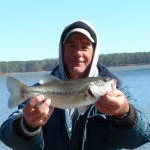
There Is A Balance In Nature

Nature’s Balance

By Frank Sargeant, Editor
from The Fishing Wire

It’s a common refrain anywhere anglers want to harvest more of a given species but the regulators won’t let them.’

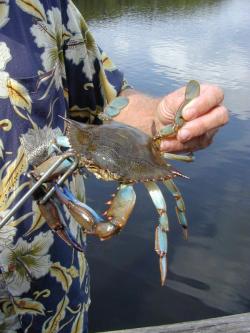
Blue crabs taste good - to people and fish

Blue crabs taste good – to people and fish

Biologists say blue crab populations go up and down depending on water quality and habitat conditions, rather than on predatory fish like stripers.

“There are too many of these (insert your favorite species) and they’re eating up all the crabs and shrimp-we’ve got to harvest more of them in the name of conservation.”

Yeah we do.

Saltwater anglers in Florida make the charge about Goliath grouper, which they say are eating up all the gags as well as spawning permit-despite the fact that there are now more big gags than there have been in decades and permit are also doing very, very well. Commercial fishermen used to say they had to cut down on redfish numbers or all the blue crabs would soon be consumed. Didn’t happen-today the state is loaded with reds, and crabs numbers come and go, as they always have.

Sharks . . . don’t even get me started.

And presently, Chesapeake Bay commercial fishers are saying that the striped bass are eating up all the blue crabs in soft-shell stage, and that they’d be happy to step in and knock back the numbers of those predatory stripes.

This train of logic has one great failing; it is that somehow, all these species survived in balance before man came along to “help” the predators stay in balance with the prey. The problem, researchers nearly always find, is that habitat issues-sometimes caused by Man but more often by natural variation in temperature, rainfall or other conditions-are depressing the species of concern.

Blue crabs are food for many species

Blue crabs are food for many species

Blues are a delicacy both in their hard-shell form, and as soft-shells eaten whole when moulting.

And that seems to be the issue in Chesapeake Bay with the crabs at present. Crabbers there are having a down year, and they say it’s because the striped bass, on a comeback thanks to tight harvest regulations, are eating up all the crabs. They want to see regs relaxed so the stripers can be harvested big, “saving” the crabs-for the crabbers.

But here’s what Brenda Davis, director of Maryland DNR’s blue crab program, says:

“There are no scientific data to support a supposition that striped bass predation is causing a significant depletion of the Chesapeake Bay blue crab population. In fact, studies performed in Maryland and Virginia to assess the diets of striped bass indicated that blue crabs make up a small percentage of the average striped bass diet. According to an intensive study in 2000, fish, particularly menhaden, account for 94 percent by weight of the striped bass diet.

“In fact, other studies have shown that cannibalism by large crabs was a major cause of juvenile crab mortality, accounting for 75 percent to 97 percent of the loss of juvenile crabs in certain locations. Juvenile crabs find protection in grass beds, which is also where striped bass and other predators find the best opportunities for catching them. Nonetheless, crab survival is best in vegetated habitats, where they can hide. Any effort to boost crab survival needs to look toward improving habitat and the protection of sea grass beds.

“There was a combination of environmental factors contributing to the high mortality of juvenile crabs in 2012 including Tropical Storm Sandy, abnormally warm and salty water, decreases in submerged aquatic vegetation coverage, a large influx of red drum into the Maryland portion of the bay, density-dependant mortality, and a large 2011 year class of striped bass.

Stripers do eat crab

Stripers do eat crab

Striped bass readily eat crabs, but food studies have shown by far the bulk of their diet is baitfish. (Photo Credit Yamaha Marine.)

“We don’t have a lot of data on impact of most of the factors on that list. However, we do have solid data that the Bay-wide harvest of spawning age female blue crabs has been at or below the 25.5 percent harvest target for five consecutive years. The ability to keep harvest in the safe range puts us in a much better position than we’ve been in the past (specifically 1992 and 1997) with similar abundance declines,” Davis said.

To be sure, there’s more than a little evidence that terrestrial prey species with a low reproduction rate and slow rates of reaching maturity can definitely be severely impacted by predators-that’s the reason that elk herds are declining in many areas where grey wolves have been reintroduced in recent years.

But for most saltwater fish, crustaceans and shellfish, where the survival strategy is to produce millions of young that grow up fast, biologists have thus far found it pretty much unheard of for a single type of predator to wipe out a prey species.

Bottom line is that if we do our best to maintain a healthy environment for all ocean species-and don’t overharvest any of them ourselves-nature will find a balance that creates a livable abundance for all.

Fires To Keep You Warm

There is nothing quite like warming up in front of a fire this time of year. No heaters provide the same kind of roasting warmth as you get from open flames. Inside by a fireplace or outside by a roaring barn fire on a freezing day, the flames will keep you warm. At least on one side.

As a kid we were taught not to play with fire but also were taught how to build fires and cook on them. Every camping trip from the time I was eight years old and sleeping within feet of the house in the back yard involved some kind of fire.

We managed to build them in all kinds of weather, from the middle of the summer when you didn’t want to get close, even to roast a marshmallow, to pouring rain where we had to build the fire under some kind of lean-to. In the winter we curled up near them in sleeping bags, rolling often to try to keep both sides warm. And the glow was very comforting when telling ghost stories around them, but the glow just didn’t go far enough!

Different kinds of wood burned in different ways but we usually just went by what we could find already dead. Our hatchets did chop down small dead trees but mostly we cut up fallen limbs too big to break. Pine straw made a good starter but we usually slipped in some newspaper, too.

Building the fire circle, a some-what round circle of rocks to keep the fire contained, was a tedious process. It took a long time to find enough rocks the right size. But then laying the wood out and getting the fire started was the challenging part. If not laid out just right it seemed we got a big flame for a few seconds when the paper and pine straw lit but then nothing. Wood too big, too damp or stacked wrong just would not light.

Matches were frowned on but we always had some. I tried many times to start a fire by striking flint on steel and even rubbing sticks together but matches always worked. And I always had to turn to them to get my fire started. At least I was prepared, with Strike Anywhere matches with their heads dipped in wax so they would light under wet conditions.

Cooking on the fire was always fun and most of the time the end results was somewhat edible. I loved marshmallows roasted on a straightened coat hanger or stick but always let mine catch on fire. No nicely toasted brown marshmallow with a hot center for me. I wanted mine burned black on the outside and melted on the inside. The hot melted marshmallow would burn your tongue every time but you hd to eat it fast before it dripped onto the ground!

I cooked hotdogs the same way. The only difference was they would not flame up like the marshmallows. But they would have a nice crispy black side with other sides not cooked much at all. But that mixture of textures and flavors just made them better, like a fine five course French meal.

My favorite fire cooked dinner of all time was what we called a “campfire dinner.” I learned it in my RA group at church. A big patty of ground meat was placed on a square of tin foil and sliced potatoes, carrots, onions and a chunk of butter were stacked on top. The tinfoil was folded around it making a sealed pack that was placed on hot coals. When opened you could eat it right from the tinfoil and its steamy goodness was very filling. And you didn’t have to wash dishes!

Breakfast was always a complex challenge, with toast burnt on the open fire, bacon burned on one end and almost raw on the other and eggs scrambled in the bacon grease until most of it was somewhat cooked. I don’t know how many times my friends and I cooked a breakfast like that and survived. The food police would have heart attacks now days seeing kids eat half cooked bacon and eggs – with everything from ashes to pieces of pine straw and egg shells mixed in!

None of the above would have been possible without our great fire building skills. Sometimes when I fire up my fireplace insert I remember those days. Even though I now use a chainsaw and gas powered wood splitter, I still love having a fire. And I still can’t get it started without plenty of newspaper! My central heat and air system just does not keep the house warm right. Not like the fire does.

From the forecast it looks like I will need a big fire the next week!

Using Charts and Markers To Find Your Way On the Water

How to Make Sense of Charts and Markers on the Fly
from The Fishing Wire

Even small children know what street signs mean. Stop, one-way and the like come easily. But boating traffic aids are different. First of all, the words “map” and “sign” aren’t even part of the lingo when it comes to nautical navigation. Rather, “charts” and “markers” serve as your guides, and it takes some savvy to know how to interpret them without pause.

A compass helps find your way

A compass helps find your way

A compass can be used to locate markers or structures on shore, helping to assure you of your position even without GPS

As long as you are within sight of land and have a chart, you have everything you need to understand your location. In addition to the buoys and such (called navaids in nautical parlance), charts also show significant shoreside structures. All you need to do is look across the top of your compass and read what the bearing (direction to) is to the structure you see on shore. Find the structure on your chart, and draw a line from it on your chart that reflects the bearing you saw. That line represents one leg of your position. Do this with several bits of structure and then plot those bearings on the chart as well, using the compass rose, parallel rules and a pencil. Where all the lines intersect is the point at which you are located. Then look at your depth sounder to see that the water depth matches the depth under the spot where the lines intersect.

You can also use your depth sounder as a navigation tool. Pick a depth contour in the distance offshore that you want to transit (for example 50 feet). If the number goes up, steer toward shore. If it goes down, steer toward the deep. With this simplistic navigation process, even a novice can stay on course. You can readily navigate according to depth contours by simply selecting a depth that more-or-less parallels your course while avoiding obstructions.

So what about using navigation markers? On the Intracoastal Waterways, generally red marks are on the mainland side of the channel. And of course, coming in from sea, it’s always Red/Right/Returning(in the U.S.). Perhaps the easiest way to remember what a mark means is to keep a navaid sticker next to your helm. These helpful stickers can be purchased inexpensively through most marine supply stores. They also give you all the right-
of-way whistle signals.

Watch for channel markers

Watch for channel markers

Channel markers help boaters stay out of trouble–but only if you know what they mean.

Don’t be afraid to alter your course and go right up to a marker to see what it is (at slow speed, of course). The absolute best proof of your exact position is to be right next to a marker with a number or letter. Make sure to always check that marker’s position against your chart as well.

Many may think that paper charts are not necessary due to the availability of electronic chart plotters with built-in GPS. But remember two crucial things:

If a device runs on electricity, it can suddenly stop working for numerous reasons no matter how inconvenient the situation. Electronic cartography still has not been deemed a legal means of navigation. If you ever get in an accident due to a navigational error and don’t have that “legal piece of paper” called a government-issued nautical chart, you could find yourself in a difficult situation

Many new boats don’t come equipped with navigation equipment. If you sea-trial a boat in areas where you have no local knowledge, it’s always a good idea to take along a handheld GPS. Alternatively, if you have a smartphone, make sure to download the award-winning Navionics + app. For fishing, try Navionics+ SonarCharts that provide incredible bathymetric charts within the normal chart plotter functions.

Have a nice day

Have a nice day

With a careful eye and a basic understanding of navigation, you’re ready for a pleasant day on the water.

Many states now require boaters to have a certificate proving that you have taken and passed a basic seamanship course. There are numerous such courses to be found online, some at a fee but many are offered free of charge. Boat-ed.com lists all the states that require boating safety certificates and provides links to each.

Finding boating safety courses in your chosen search engine will bring up pages worth of course opportunities. BoatUS® also offers an outstanding free course that can be tailored to various states where you might be boating.

Remember one other important fact: You may live in Virginia and have a certificate from there, but if you travel to Maryland, Delaware or North Carolina, you may need to get certificates from those places as well. Not all contiguous states enjoy boating safety course certification reciprocity. Check first to avoid potential fines.

Cold Front Bass Fishing Tactics

I caught this bass after a bad cold front

I caught this bass after a bad cold front

It never fails. All week the weather has been unusually warm for this time of year so you plan a trip to your favorite bass lake for Saturday. Everybody you talk to say the bass are tearing it up, hitting spinnerbaits, topwater lures and crankbaits in shallow water just about anywhere you want to fish.

Friday night the winds howl and the temperature drops. You are on the lake the next morning at daylight and the brightening sky shows completely clear with no haze or clouds at all. And it is cold, the coldest weather of the year so far. Water temperatures have dropped several degrees overnight.

Yep, the dreaded high pressure cold front has hit. Is it going to ruin your trip? You know bass seem to hate high pressure and dropping temperatures. So what do you do?

Bass respond to cold fronts in several ways. Why do they respond? There are a lot of theories, from higher pressure to brighter sunlight. But some of them just don’t hold up.

Even with a drastic increase in barometric pressure a bass has to move only a foot or so up or down to equal the pressure from the day before. Bass don’t seem to like bright sun but feed even on the brightest days. A change of a few degrees in temperature is more important in the spring than in the fall. And the wind that accompanies cold fronts can actually make them feed better.

No matter what the reasons, bass do change. We may never know exactly why. But there are some proven tactics that help you catch bass after a cold front blows through. Try them and catch some bass after a cold front.

In simple terms you go small, go tight, go slow, go deep, go to the wind or go to current. Go to the spotted bass if they are in the lake you fish. The baits you choose will probably change after a cold front and the places you fish varies some, but bass can still be caught if you plan to adapt.

Bass usually slow down after a cold front and won’t chase a fast moving bait. But the big exception to this is when the wind blows across a point or hits a steep bank. The wave action stirs up the baitfish, making them easier prey. The moving water pushes algae to the wind blown banks and baitfish follow, and so do the bass. And the bass can’t see your bait as well due to the broken water surface and more murky water from stirred up sediment.

One of the best ways to catch bass under these conditions is to fish the wind blown banks and points with a spinnerbait. As long as you can control your boat in the wind and waves you can find and catch bass. Find a point or steep bank where the channel swings near and fish it.

Depending on water color, a white spinnerbait with two silver willowleaf blades is best. If the water is stained try a skirt with some chartreuse in it and one or two gold blades. A heavier spinnerbait helps you cast in the wind and fish faster to cover water until you find the fish feeding. A half ounce bait works well. When you catch one you can usually catch a lot more from the same place.

Keep your boat a long cast off the bank and cast with the wind, working water from a foot deep right on the bank back to about ten feet deep. Run the spinnerbait about a foot under the surface like a confused baitfish trying to head back to deeper water.

If reeling your spinnerbait fast doesn’t work try slow rolling it a foot off the bottom, keeping it moving steadily with a slight pause every two or three feet to make the skirt flare. Don’t spend a lot of time on one place, make ten or so casts with a fast retrieve and the same number slow then move on if you don’t catch a fish. Bass school up and are concentrated on some structure but not others so keep looking until you find them.

If the wind is too strong to control your boat or you don’t find the fish or just don’t like fishing the wind, go small. Downsize your baits. If bass have been hitting a big crankbait or spinnerbait try a small one-quarter ounce bait. You have to fish the smaller spinnerbait more slowly and that is good. Slow down with the crankbait, too, if that is your choice of baits.

Also drop down to a three sixteenths ounce jig and pig or one eighth ounce jig head worm with a short finesse worm on it. These baits fall more slowly and you have to move them more slowly to keep contact with the bottom, and that is good, too. Fish around cover near where the bass have been feeding.

Work any cover you find carefully. Many bass won’t move far. If they have been feeding around stumps or rocks in six feet of water they may still be holding there and a little deeper. They may also move closer to deeper water.

Bass move often move very tight to cover after a cold front. They may still be in the exact same depths and locations but are harder to catch since they are buried in the thickest cover and won’t chase a bait very far. Take advantage of this.

Find a dock and fish it. Docks always hold bass if they have water deeper than a couple of feet under them in the fall, and they are even better if they are near deep water. But the bass get way back under them after a cold front.

One of the best ways to fish a dock after a cold front is to skip a bait as far back under it as possible. A weightless four inch Senko rigged whacky style on a weedless hook gives you small and slow and you can get them into places it is hard to get other baits.

Rig your Senko on a spinning rod with eight pound test fluorocarbon line. It takes a little practice but you can skip that bait on the lighter line all the way to the back of a dock sitting a few inches off the water. Let the bait settle to the bottom without moving your rod tip or reeling in your line.

A Senko or similar bait falls with a slow, enticing wiggling action rigged whacky style. When it hits bottom let it sit still for several seconds. Watch your line carefully for any small tick or movement. Set the hook fast and get the bass out from under the dock as quickly as possible.

Also try the posts and any brush under the dock with a small jig and pig. Pitch or skip a three-sixteenths ounce jig with a twin curly tail trailer right to the posts or to the middle of the brush. The light jig and the twin tails make the bait fall slowly and the bass often find this irresistible.

Fish other cover the same way. Find stumps and pitch a small jig and pig to them, letting the bait fall right beside them. Pitch your jig and pig into the thickest parts of a blowdown, paying careful attention to where limbs join the trunk of the fallen tree. Work all the way to the end of the tree top.

Brush piles hold bass but they bury down in the very middle of them after a cold front and not move out to feed. But a small jig and pig or Texas rigged worm dropped through the brush and jiggled in their face will get them to hit. Use heavy line, 15 to 20 pound test fluorocarbon, so you can get the fish out of the cover.

In all this cover don’t expect the bass to pick up the bait and move off. They often suck it in and not move at all. So watch for that tick when they eat your bait. Also raise your rod slowly when you move the bait. If your line is tight set the hook if there is any doubt if it is a fish.

No matter how you are fishing the cover, fish slowly. Using small baits helps but let them fall and sit as long as you can stand it. Jiggle them a little in one place as long as you can. You want to make a bass hit that is not really in a feeding mode.

Out of the wind, small spinnerbaits and crankbaits work if you move them as slowly as possible and bump them into the cover. With a spinnerbait if you hit a limb pull it up and let it fall back without coming over the limb. With a crankbait hit the cover and let it float up to drive the bass crazy.

Bass live deep and there are always deep bass but a cold front may push shallow bass deeper. Find deep structure with cover on it and the resident bass are there as well as any that have moved deeper. Small, slow moving baits work best after a cold front even in deep water.

A dropshot rig is one of the best outfits to get these bass to bite. Deep is relative on different lakes. On a clear highland type lake you may need to fish 30 plus feet of water. On more shallow lake with more stained water deep may mean 15 to 18 feet deep.

Good electronics are critical for this type fishing. Ride creek channels and drops watching for brush and stumps. When you find the cover examine it carefully for the telltale marks of fish holding in it. Even if you don’t see fish, try the deeper cover since they may be buried in the cover.

Baitfish near the cover makes it even better. If you see balls of baitfish find the closest cover and fish it hard. Shad tend to move deeper after a cold front and bass will be nearby, so take advantage of this bass attracting food.

Rig a finesse four inch worm about 18 inches above a sinker heavy enough to allow you to fish the worm in one place. If the wind is strong you may have to go to a fairly heavy drop shot weight.

Drop the rig to the bottom in the cover and tighten up your line, making the worm hover off the bottom. Barely twitch your rod tip to make the bait wiggle in place. Nose hooking the worm gives you more action but you may need to Texas rig it since you want to get the worm into thick cover.

A small jigging spoon works well, too. Try a silver one half ounce spoon if the water is clear or a gold spoon if it is stained. Spoons seem to work better if the water is fairly clear. Jig the spoon up and down in one place over and over, pulling it up a foot and letting it fall back in the same place.

With drop shot and spoons get the front of your boat right over the cover and fish and hold there, fishing both baits straight down. Sometimes you can see the bass suspended off the bottom. If you do, drop your bait down to the level they are holding and keep it in front of them.

One trick with a drop shot is to tie your hook as far above the sinker as the bass are holding off the bottom. If they are suspended five feet off the bottom, have your leader five feet long to keep the worm right in their face. This works no matter how far off the bottom they hold since you reel the fish in before getting to the lead, and it gives you exact control.

Bass in current are more active and have to feed more. Run up the river or feeder creeks in the lake until you find moving water. Rains often precede a cold front and runoff may make the current stronger, or power generation at the dam above or below the lake does the same thing.

Find eddies and pitch a small jig and pig or Texas rigged worm to those spots. Look for rocks, logs, brush and pockets where the current breaks. The bass usually hold in the lower current and feed as baitfish and other things they like, like worms or crayfish, wash to them.

Fish up the current. This gives you more boat control and allows you to fish your bait with the current in a natural movement. Pitch ahead of the boat and let your bait fall with the current into the eddy. And if you don’t like wind, you are more likely to find protected areas in the more narrow river than on the lake.

Spotted bass don’t seem to respond to cold fronts as badly as largemouth do. Florida strain largemouth that have been widely stocked out of their native range grow fast but are notorious for not feeding after a cold front. Northern and southern strain largemouth also get lock jaw after a cold front. But fish for spots and you are more likely to catch some bass.

Spots love rocks so fish rocky points and steep banks. Smaller baits are usually best for them even without a cold front, so try the same small crankbaits, spinnerbaits, worms and jig and pigs. Spots are more aggressive than largemouth all the time so you can usually fish faster, too.

For some reason spots are turned on by chartreuse. Try chartreuse spinnerbaits and crankbaits. Dip your plastic worm or jig trailer in a dip and dye like JJ’s Magic. Spots tear up a jig and pig with a curly twin tail trailer with the tips of the tails dipped to turn them chartreuse.

Don’t let a cold front get you down. Be prepared for it and catch some bass. Try these ideas and they should work for you. But no matter, it is better to go fishing than work around the house!

Tip

Dip and dye like JJ’s Magic works all the time when you are fishing, but the added colors and scent may make even more difference when fishing after a cold front. JJ’s has a strong garlic scent and comes in four colors to allow you to vary your bait color quickly, and to add highlights to your plastic baits.

Dip the tails of a green pumpkin curly tail worm or jig trailer into chartreuse JJ’s and it instantly changes color and smells strongly of garlic. The wiggling chartreuse tails look exactly like the fins of a bream and makes the bass more likely to eat it. That can make the difference between a bite and getting ignored after a cold front.

No Federal Fish Hatchery Closings for Now

FWS: No Hatchery Closing, For Now
from The Outdoor Wire
Etta Pettijohn

Since media reports revealed the U.S. Fish and Wildlife Service’s (FWS) plans to quietly shutter several federal fish hatcheries in 2014, the agency has backed off from those plans – but not from closing them in the future.

Tennessee Sen. Lamar Alexander expressed disappointment and concern after reviewing the agency’s “Strategic Hatchery and Workforce Planning Report,” and conversations with FWS Director Dan Ashe.

“It is fortunate that we have an ongoing three-year agreement between the Tennessee Valley Authority and state and federal wildlife agencies to keep Tennessee’s hatcheries open and producing fish, but the threat of closure still exists,” said Alexander, who has two federal hatcheries in his district.

Plans to eliminate mitigation hatcheries from the FWS mission began in the mid- 1990s, but media attention and political pressure blocked those moves. Beginning in 2011, the agency intensified its efforts, despite Congressional mandates, presidential decrees encouraging outdoor activity, and public support for the facilities.

In 2012 the FWS slashed funding for mitigation hatcheries from its FY 2013 budget, hoping to hand management and funding to other agencies. The FWS attempted it again in 2012, but Congress forced it to finance them that year, directing the agency to secure other federal funding before defunding of the nine then targeted for closure.

Despite all this, by all appearances, agency officials remain determined to close hatcheries and direct its funding and priorities in recovery of endangered and threatened species, restoration of tribal trust responsibilities, and other propagation programs for native species.

FWS officials cited budget cuts in 2012, although Rick Nehrling, a retired 38-year veteran of the FWS (19 spent overseeing southeastern hatcheries) asserts that budget documents clearly indicate Fisheries is the only resource program in the agency the Directorate proposed for reductions then, and planned closures in FY 2012 and FY 2013.

“The other five resource programs (National Wildlife Refuge System, Endangered Species, etc.) have all had substantial budget increases during the same time period,” Nehrling contended.

Now FWS is saying if sequestration continues into the 2014 fiscal year, the agency will have lost close to $6 million for hatchery operations since 2012.

“This report sounds the alarm on a hatchery system unable to meet its mission responsibilities in the current budget climate,” Director Ashe has stated.

It appears the new agency mantra is “sequestration will require the hatchery closures.”

Ashe said the 2012 “Strategic Hatchery and Workforce Planning Report,” found ongoing budget reductions due to sequestration and increasing costs for operations spurred the review of the 70 national hatcheries.

“This report sounds the alarm on a hatchery system unable to meet its mission and responsibilities in the current budget climate,” Ashe asserted. “In the coming months through the 2015 budget process, I have directed the Service to work with all of our partners to determine whether the options identified in the report, or others, are necessary and appropriate to put the system on a more sustainable financial footing.”

A working group trying to come up with answers includes the FWS, the TVA, and the Tennessee and Georgia state wildlife agencies. TVA signed an agreement with federal and state wildlife agencies in May to pay more than $900,000 per year for the next three years to replace fish killed by TVA dams, and keep Tennessee’s hatcheries producing fish while the working group develops a permanent solution, said Tennessee Sen. Lamar Alexander.

“I will help to find a long-term solution, because the nearly 900,000 Tennesseans and visitors who buy fishing licenses in our state depend upon these hatcheries, as they are the principal reason Tennessee has some of the best trout fishing in the country,” said Alexander, who in 2012 brokered a deal with the Tennessee Valley Authority (TVA) to provide some of the funding for the hatcheries there.

Meanwhile, insiders report the battle is merely delayed, and far from over, and that the agency has full intentions to end its century-old mission of mitigation stocking, an effort that many communities where these are located are dependent on for fishing license sales and sales tax revenue.

Fishing Smith Lake, Alabama In the Winter

Last year in early December I drove to Smith Lake in Alabama to get information for a Alabama Outdoor News article. Smith Lake is a beautiful highland lake north of Birmingham with very clear water, steep rocky banks, beautiful houses and big spotted bass. It as windy that day, too.

I fished with Craig Daniel, a local bass pro that fished the national trails from 1990 to 2000. He made the Bassmasters Classic twice, the FLW Championship twice and has won over $450,000 in tournaments. He has also won four bass boats and a truck. Craig is a very good fishermen!

We fished only a few hours. I drove 4 hours over there and it took four hours to dive back, so I was glad we didn’t stay too late. In that time we landed about a dozen spotted bass on jig head worms.

The pattern was fairly simple. Find cover of any kind, like brush, rocks or stumps, in about 20 feet of water and fish around it. It was interesting that the 14 inch spots we landed were not even keepers. There is a slot limit there and you have to let bass between 13 and 15 inches long go.

Craig says Smith will just get better and better during January and the big ones will hit, too. He has landed 11 spotted bass weighing over six pounds each, so he knows about big bass!

Give Smith Lake a try this winter.

Are Crankbaits the Best Baits For Fall Fishing?

These Two Pros Agree: Crankbaits Best for Late Fall

Try crankbaits for fall fishing

Try crankbaits for fall fishing

Elite Pro Dean Rojas says crankbaits, thought of as deepwater summer baits, are equally effective into fall and early winter in the right spots.

All bass tournament pros have their favorite lure choices for each season, and rarely do they agree with each other. The exception comes now, during the late autumn and early winter, when crankbaits seem to be everyone’s first choice.

“Crankbaits offer a number of advantages, such as letting you cover a lot of water,” points out Yamaha Pro Dean Rojas, “which is important because bass are moving a lot during this period. The different models of crankbaits allow you to cover water depths as shallow as four feet or as deep as 20 feet, too, which certainly helps when you’re looking for fish.”

“Crankbaits are also effective around different types of cover, such as rock, vegetation, or wood,” adds fellow Yamaha Pro Brandon Palaniuk, “which is unusual for a single lure type. They also draw both reflex as well as feeding strikes, because they imitate baitfish so well.”

Palaniuk grew up fishing Lake Coeur d’Alene in northern Idaho where crankbaits were practically the only lure he could use efficiently along the lake’s miles of rocky shoreline. Today, rocks remain his first choice when searching for late fall and early winter bass.

“The best places often seem to be transition zones where the type of rock changes, such as from small gravel to larger chunk rock,” he continues. “Bass everywhere like edges because they give them an ambush point, and larger rocks provide that edge. These transition zones are nearly always noticeable along the shoreline so you can easily visualize them extending out under the surface, and they frequently attract schools of bass, too. That’s why I’m always looking for them.”

“I like rock, but I also look for vegetation and brushpiles, laydowns, and other wood cover,” notes Rojas. “Both types of cover attract a lot of baitfish, and they’re also easy to fish with a crankbait.

Yamaha pro’s Brandon Palaniuk and Dean Rojas are both crankbait fans as water cools, though they might prefer different terrain to try the versatile lures.

“With vegetation, I like to reel my crankbait down to the very top of the vegetation, then either rip it out with a violent jerk, or if the water is colder, I’ll stop reeling and just drag the lure slowly over the vegetation with my rod. This type of erratic action, which is so easy to do with a crankbait, is normally what brings strikes.

“The colder the water, the better this dragging presentation works, because you can still vary your speed according to how the bass are reacting.”

Both Yamaha Pros advise early winter fishermen to look for steeper breaklines where the depth changes quickly. Creek and river channels that swing close to a shoreline are among the best places to look for bass now, because it means the fish don’t have to swim as far to reach shallow feeding areas. Instead of moving long distances horizontally, they can simply move up and down in the water column.

The right lure in the right terrain has been the secret to many of Brandon Palaniuk’s highly successful finishes this season.

“They come shallow to feed, so what I like to do with a crankbait is cast to the deeper water and retrieve into the shallow water,” explains Palaniuk, “because it forces a bass that may be following your lure to commit to a strike before the lure gets away. If you retrieve from shallow water to deep, the bass can just swim back down into deeper water and disappear.”

When he’s fishing deeper brushpiles, the Yamaha Pro will retrieve his crankbait into the brush and stop it momentarily, then slowly crawl it through the limbs and branches. This is completely different from summertime tactics, when he’s retrieving much faster and trying to deflect the lure for a reflex strike.

“This is just another example of how versatile crankbaits can be,” concludes Rojas, who fishes Lake Havasu and the Colorado River near his home in the winter months. “This time of year, bass are not only feeding heavily in preparation for the colder months ahead, they’re already becoming less active as water temperatures continue cooling.

“Rather than keep changing lures, all I have to do is change my retrieve. When I go fishing this time of year, I still have three or four rods on my boat deck, but they’re all rigged with crankbaits.”

What Is It Like To Be In A Deer Camp?

Deer Camp

Deer camp. Those two words can conjure up many different meanings for different people. You can really know what a deer camp is only if you have spent time in one. And not just a day or so, but days at a time, year after year for many years.

There are always a few workers that show up early and get things set up, clearing debris, cutting grass, stocking the cook tent and generally making things right for everyone. They are the ones you call on when you need something done because you know they are dependable and will do what needs to be done.

As the rest of the club members trickle in, there are time worn greetings, often repeated by the same people to the same people year after year. New members are greeted somewhat warily, with long-time members slowly testing them out to see how they fit in. It can be worse than a fraternity rush!

By mid-afternoon on opening day of camp there is a roaring fire going, a requirement of all deer camps. Never mind that it is 85 degrees and sunny, you gotta have a fire. And everyone sits around it, close if the weather is cool and way back if a typically hot Georgia weekend greets you.

One member of the club is responsible for the fire. Not an elected position, someone just assumes the job of stoking the fire and keeping it going. He will usually be one of the first ones up in the morning, adding firewood until a bright blaze greets the rest of the club. Sometime the job is formalized with a title, but usually it is just acknowledged by long standing habits.

The fireman’s job also involves keeping a kettle full of water boiling over the fire. Sometimes the hot water is used for washing dishes, but often it just boils way, only to be replenished to boil away again. Sometimes peanuts are added to the water for wonderful snacks for those sitting around the fire, but many times the boiling water is as useful as boiling water at a birth.

At some point the story telling starts. Members who have been in the club for years nod in anticipation of highlights because they have heard the same story every year. But everyone pays attention because something new is sometimes slipped in, but seldom will anyone argue a point, even if they were there and know the truth. Fishermen have nothing over hunters when it comes to tall tales about the size of the one that got away.

Good natured ribbing is always part of the conversation. Hunters shooting a small deer are repeatedly reminded of it by statements like “We searched and searched for that deer, and finally found it when we turned over a leaf” or “remember, he toted it out of the woods by the hind legs like a rabbit.” The object of the story always just grins and bears it, or the ribbing gets even worse.

Kids are an integral part of a good deer camp. After all, they are what it is all about. Without kids coming up to learn the traditions of the camp it will end at some point. Youngsters usually sit enthralled with the stories because they want to be like the adults and experience the excitement the story refreshes. And they haven’t heard the same story dozens of times.

Food is always fantastic in camp, partly because anything just tastes better when cooked and eaten out in the woods. But there is often one member of the club that is a good cook and takes care of the kitchen, making sure the roast is put on and taken off at the right times and bringing the chili to just the right temperature to cook and not burn.

Each member has his specialty for food, too. Everyone eagerly anticipates the unveiling of the carrot cake, a treat no one wants to miss. And the brownies are jealousy watched as they are passed around to make sure no one hoards them or gets more than his fair share.

Deer camp means tradition. It is the passing on of a way of life that people cherish and want to preserve, especially for their children. No matter how hectic and troubling the world gets, deer camp tradition means some sane part of what is important to you will always be there. It is a way to save what you value most.

How Can I Catch First Freeze Walleye?

First-Freeze Walleyes On Featureless Lakes

by Daniel Quade
from The Fishing Wire

A shout echoes unanswered across the barren icepack of Minnesota’s massive Upper Red Lake. It’s hardly a call for help, much less a greeting. It’s veteran walleye guide Jonny Petrowske, proving a point about getting away from the crowd to corral first-ice ‘eyes.

“If I yell at the top of my lungs and no one hears me, I’m far enough away from other anglers,” he grins.

Catch big walleye

Catch big walleye

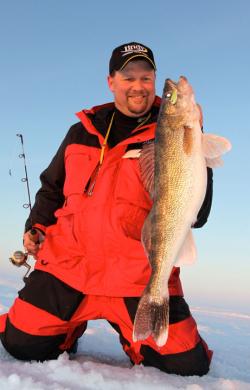
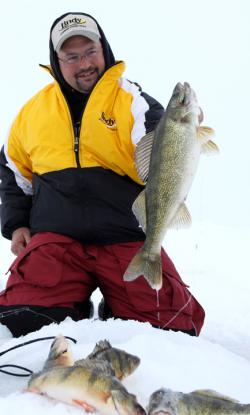
Guide Jonny Petrowske says the trick is to find the fish, then not spook them, to produce whoppers like this.

Petrowske says that even aggressive walleyes get skittish when clamorous hordes of winter warriors overrun the ice. Since the only reply to his thunderous vociferations was the raspy, disapproving cackle of a raven drifting overhead, it appears we’re good to go.

We’re targeting early winter walleyes shortly after the mighty lake’s surface has solidified. Shallow and relatively featureless, Upper Red is typical of many fisheries that are first to freeze, and first to offer a chance at hardwater walleyes.

“It’s largely devoid of structure,” Petrowske said, “so the walleyes are nomadic, wandering vast flats looking for food.”

Catching them calls for two things, he says, finding the fish, and then not spooking them once we do.

“Since there’s nothing tying them to small area, they won’t tolerate the sound of your feet shuffling around above their heads.”

With nearly 50,000 acres at our disposal on the state-managed section of Upper Red, we have an intimidating amount of territory to cover. Petrowske quickly narrows it down to forage-rich shallows within a mile of shore.

“Depending on the lake, such areas offer walleyes everything from emerald shiners and young-of-the-year yellow perch to frogs and other forage,” he says. “Water depths of 4- to 8-feet are ideal. On lakes with slow-tapering bottoms, the search area may stretch a mile or more from the bank.”

Beginning far from shore over the deepest part of our chosen hunting grounds, Petrowske punches a string of holes spaced at 1/8-mile intervals all the way back to the shallows. At each stop, he augers a pair of portals to the underwater world 6- to 7-feet apart to allow for fishing two presentations simultaneously. Since silence is golden, he drills all of the holes in one fell swoop, which gives all spots except the last drop zone time to quiet down.

After deftly skimming away the slush from our first hole, Petrowske pulls out a 28-inch ice rod spooled with 6-lb-test, high-visibility monofilament. A study in compromise, the blank is medium-action.

“If the rod is too stiff, your jigging motions can get herky-jerky,” he says. “If it’s too soft and you exert a lot of energy bending the rod, the bait barely moves.”

Use small lures for big walleye

Use small lures for big walleye

Lindy Darters and other small lures do the job on walleyes under the ice.

A small ant swivel links the mainline to an 18-inch, 6-lb fluorocarbon leader. The swivel fights twist, while the fluoro battles abrasion and is less visible to the fish. At the end of the line he ties a Lindy Darter, a hard-bodied rattler that’s raucous on the uptake and swims on the fall.

“Not all noise is bad,” admits Petrowske. “Walleyes are curious and often check out something that sounds like a meal. And, since we’re focused on scattered fish, the ability to call them in is key when fishing a vast, featureless lake like this.”

Although the fertile water is decidedly less than gin clear, he opts for natural lure colors that mimic the lake’s forage base. Natural Perch is his favorite, but Yellow Perch and various shiner patterns are good, too. On cloudy or snowy days, brighter patterns with a touch of chartreuse get the nod.

With a plop Petrowske’s Darter drops into the ice water and quickly swims to bottom on a slack line. After tightening the tether, he twitches the rodtip several times to tap-dance the bait on bottom, generating slight puffs of sediment. Next, he raises the lure 6 inches and pauses. He says that this pause often triggers a strike.

If it doesn’t, he begins phase two. Gently swim the lure up a foot, just fast enough to lightly engage the rattles, let it fall, then lift again.

If you’ve never fished a Darter before, he recommends practicing various lifts and drops within sight of the surface. Such swimming lessons are invaluable for learning how different jig-strokes affect the lure.

Petrowske’s final performance before pulling up stakes starts off wildly animated.

“I rip the heck out of it,” he laughs, explaining that the routine includes three or four sharp lifts of 12 to 18 inches, followed by a pause. “If that fails, but I think there are fish around, I slowly jiggle the lure upward until I can see it in the hole, then open the bail so it swims off to the side and crashes like a B-52.”

After the lure touches down, he reels slowly, crawling it along bottom.

“When it gets directly beneath the hole, I raise it 6 inches and pause,” he says. He credits this “reset” maneuver to fellow guide Jon Thelen, who developed it to turn watchful ‘eyes into biters. “If that doesn’t do it, I head to the next pair of holes.”

When Petrowske pinpoints a pod of active fish, he deploys a set-line in the second pre-drilled hole. The rig consists of a lively minnow tail-hooked on a jig or jigging spoon and suspended 8 to 12 inches off bottom beneath a bobber.

“Lindy’s Rattl’n Flyer Spoon, Frostee and Frostee Spoon are my favorite lures,” he says, noting that slip-floats with large metal grommets, such as members of Thill’s Pro Series lineup, limit ice buildup.

Strung with 4-pound Silver Thread Trout Line or AN40, the bobber rod tempts hungry ‘eyes that were lured in by Petrowske’s jigging theatrics, but not tempted enough to strike. It’s one more ploy in his bag of tricks for taking first-freeze walleyes in shallow, featureless lakes.

How Do Wild Animals Survive the Winter?

Its nice to be able to deal with the cold weather by building a big fire, curling up under a thick blanket or turning up the thermostat. But what do critters in the wild do? They deal with the cold in many different ways.

We all know bears hibernate, but they don’t, really. Bears sleep though the winter but they can wake up. Their heartbeat slows way down but nothing like true hibernation. A ground squirrel does hibernate. Their heartbeat is around 300 beats per minute in warm weather but it slows down to only one beat per minute while they are hibernating. You can not wake one up until you warm it up.

Bugs like wasps deal with the cold by finding a protected area to hide in. At my farm, where the heat does not stay on, they find a good place to hold up during the cold by coming into my room in the barn. If I turn on the heat they start moving around when it warms up. Those don’t survive the winter.

Hornets abandon their paper hives in trees and the female will find a hole in the ground or a hollow tree to spend the winter. Then when it warms up it starts a new hive, just like the female wasps that survive. As they build the nest and lay eggs their hive grows and gets bigger and bigger.

Most warm blooded animals and birds have to stay active and find food all winter long. Some birds migrate long distances to avoid the cold When I was growing up we read about robins being the sign of spring, but that seemed silly since robins were around all winter long. The reason is robins from northern states, where the ground stays frozen for long periods of time, have to fly south. It is real hard to find earthworms, robins’ favorite food, when the ground is frozen.

So here in middle Georgia we will see robins all winter long. They head back north with the spring and really are signs of spring up there, but not here.

For a while I could not understand why I saw so many blue herons in the winter, then I realized there is no way they could get fish from frozen lakes. So they fly south to find open water where they can feed during the winter. As lakes and ponds thaw further north they head back that way.

Geese, ducks and many other kinds of water birds also fly south for the winter, then head back north as it warms to nest and start the cycle over again. Some birds do stick around in the winter and find food the best they can. Wild turkey can’t fly long distances so they have to scratch in the snow to dig up food.

Squirrels are famous for burying acorns and they do it to have a food supply during the winter. They don’t remember where they bury their acorns, they find them by sniffing them out. So they may eat other squirrels acorns if they find them. That is one reason they are so territorial in the winter, trying to run others off.

Deer and other big game have to eat foods they ignore in better times. They will feed on honeysuckle, green briar and other evergreen plants during the winter. But they depend on their fat supply, too. Deer feed heavily on acorns in the fall and build up layers of fat to sustain them all winter long. That is the reason a good acorn crop is so critical to deer herds.

Cold blooded animals like fish just get real inactive. They go to deeper water and hold near the bottom, feeding rarely. They will eat an easy meal if one comes close but bass and bream don’t move around a lot in real cold water. Other species, like hybrids and stripers, are more adapted to cold water and feed all winter long.

Some species of trout, like steelhead, feed in very cold water. Steelhead are just rainbow trout that are hatched in streams but swim out to lakes or the ocean, live a grow a few years then go back into streams to spawn. They get big and fight hard, and live to spawn many times, unlike some species of salmon that die after spawning.

You may have noticed hawks on power lines along roads recently. This behavior happens each winter. You won’t see many until it gets cold. They move to roadsides to catch mice and birds that live along ditches since food in the woods gets scarce this time of year. Many get hit by cars as they swoop across roads to grab a mouse for lunch.

Critters have it much worse than we do. They have to adapt to the cold. We can just throw another log on the fire and be glad we don’t have to sleep outside!