I love Science Fiction, as you can see from my list. These are some of my favorite non outdoor books and movies.
How Is Shooting Pen Raised Quail Different from Hunting Wild Birds?
A few years ago I did something I had not done for 30 years. And unlike last April when I went horseback riding for the first time in 30 years – and fell off! – this experience did not hurt a bit.
I won a half-day quail hunt at Barksdale Bobwhite Plantation near Cochran. Although I had not shot at a quail since I was 16 years old, many of those old memories of quail hunts with my father are still strong. With great anticipation of the upcoming hunt, I drove to Barksdale Saturday morning. My day was to included a fried quail lunch, shooting my 10 quail limit, guide, trained dogs and field transportation.
When I was growing up my father always kept a couple of pointers. We hunted quail almost every Saturday during season. There were many acres of farms around ours we could hunt. Although I hardly ever killed anything with my .410, I enjoyed following the men around and watching the dogs.
The best hunt I ever had growing up was one afternoon after school. I got the 12 gauge, some shells and the dogs and went by myself. It was one of the first times I had been allowed to use the bigger gun. That afternoon I got up five coveys and killed one bird from each. I did not know what I was doing well enough to find any singles, but five birds was a lot for me!
Last Saturday, I killed 10 quail. I was worried that I would not be able to hit them after such a long time, but I shot only about 15 times. Pen raised quail are a lot easier to hit than wild birds. I should not have missed the four or five I did not hit.
My guide was Tony Taylor, a teacher in Dodge County. He brought his four English Setters along and we drove to a nearby open pine and field area. Soon after letting the dogs out, they locked up in the edge of some broom straw.
I was shocked to see two quail on the ground when we got to the dogs. I don’t ever remember seeing wild birds on the ground in front of dogs. One flushed and I hit it. After it was retrieved, we went back where one dog was still on point on the other bird. When it got up, it flew right in my face, over my head and right toward Linda where she was taking pictures. I could not shoot.
Tony said pen raised birds were unpredictable. Some get up in front of you, others you almost have to kick to make fly. You never know where they will go when they fly. It was very different from my hunts 30 years ago.
Birds had been put out in pairs in the area I was hunting. A couple of times we got up 4 to 6 where they had gotten together between hunts. By the time we found the third group I was into this kind of shooting, accepting it as different from what I remembered, but still very enjoyable.
Hunts like Barksdale are about the only kind of quail hunting left. If you have dogs, they have special prices for you to hunt your dog without a guide. Or, you can be like me and have everything done for you. Barksdale also has chukar and pheasants if you want to hunt them. Sporting clays, skeet and a five stand range are also available.
I really enjoyed my trip. You might want to check it out if you like quail hunting. And the meals were excellent!
Hunting and eating pen raised quail are both a lot different from hunting and eating the wild birds I grew up on. The pen raised birds stay on the ground longer, fly lower, slower and for a shorter distance, and are easier to hit. Their meat is not as white or quite as tasty as what I remember from my youth.
Quail always were white meat much like a chicken breast. Dove were darker, stronger meat. The pen raised quail I have eaten from Barksdale Bobwhite Plantation are not all dark meat but they are not as white and mild as I remember. I still have not turned one down when put on my plate, though!
Shooting quail at a resort is still a lot of fun even if different from the good old days. Although expensive, you should give it a try if you get a chance.
Political Jokes
These political jokes are funny, I don’t care who you are or who you support. Of course the names can be changed on any of them to your suiting!
The best description of Obamacare so far:
Remember when Nancy Pelosi said:
“We have to pass it, to find out what’s in it.”
A physician called into a radio show and said:
“That’s the definition of a stool sample”.
A lesson in irony:
The Food Stamp Program, administered by the U.S. Department of Agriculture, is proud to be
distributing the greatest amount of free meals and food stamps ever.
Meanwhile, the National Park Service, administered by the U.S.Department of the Interior,
asks us “Please Do Not Feed the Animals.”
Their stated reason for the policy is because the animals will grow dependent
on handouts and will not learn to take care of themselves.
This ends today’s lesson.
This email gently explains the difference in thinking between people with opposite outlooks.
A young woman was about to finish her first year of college.
Like so many others her age, she considered herself to be very liberal, and among other liberal ideals, was very much in favor of higher taxes to support more government programs, in other words redistribution of wealth.
She was deeply ashamed that her father was a rather staunch conservative, a feeling she openly expressed. Based on the lectures that she had participated in, and the occasional chat with a professor, she felt that her father had for years harbored an evil, selfish desire to keep what he thought should be his.
One day she was challenging her father on his opposition to higher taxes on the rich and the need for more government programs.
The self-professed objectivity proclaimed by her professors had to be the truth and she indicated so to her father. He responded by asking how she wasdoing in school.
Taken aback, she answered rather haughtily that she had a 4.0 GPA, and let him know that it was tough to maintain, insisting that she was taking a very difficult course load and was constantly studying, which left her no time to go out and party like other people she knew. She didn’t even have time for a boyfriend, and didn’t really have many college friends because she spent all her time studying.
Her father listened and then asked, “How is your friend Audrey doing?”
She replied, “Audrey is barely getting by. All she takes are easy classes, she never studies and she barely has a 2.0 GPA. She is so popular on campus; college for her is a blast. She’s always invited to all the parties and lots of times she doesn’t even show up for classes because she’s too hung over.”
Her wise father asked his daughter, “Why don’t you go to the Dean’s office and ask him to deduct 1.0 off your GPA and give it to your friend who only has a 2.0. That way you will both have a 3.0 GPA and certainly that would be a fair and equal distribution of GPA.”
The daughter, visibly shocked by her father’s suggestion, angrily fired back, “That’s a crazy idea, how would that be fair! I’ve worked really hard for my grades! I’ve invested a lot of time, and a lot of hard work! Audrey has done next to nothing toward her degree. She played while I worked mytail off!”
The father slowly smiled, winked and said gently, “Welcome to theconservative side of the fence.”
If you ever wondered what side of the fence you sit on, this is a great test!
If a conservative doesn’t like guns, he doesn’t buy one. If a liberal doesn’t like guns, he wants all guns outlawed.
If a conservative is a vegetarian, he doesn’t eat meat. If a liberal is a vegetarian, he wants all meat products banned for everyone.
If a conservative is down-and-out, he thinks about how to better his situation. A liberal wonders who is going to take care of him.
If a conservative doesn’t like a talk show host, he switches channels. Liberals demand that those they don’t like be shut down.
If a conservative is a non-believer, he doesn’t go to church. A liberal non-believer wants any mention of God and Jesus silenced.
If a conservative decides he needs health care, he goes about shopping for it, or may choose a job that provides it. A liberal demands that the rest ofus pay for his.
If a conservative reads this, he’ll forward it so his friends can have agood laugh. A liberal will delete it because he’s “offended.”
Well, I forwarded it to you!
Woman Shot in her own Driveway
Linda Burnett, 26, a resident of San Diego, was visiting her in-laws
and, while there, went to a nearby supermarket to pick up some
groceries.
Later, her husband noticed her sitting in her car in the driveway
with the windows rolled up and her eyes closed, with both hands behindthe back of her head.
He became concerned and walked over to the car. He noticed that
Linda’s eyes were now open and she looked very strange. He asked herif she was okay, and Linda replied that she had been shot in the backof the head and had been holding her brains in for over an hour.
The husband called the paramedics, who broke into the car because
the doors were locked and Linda refused to remove her hands from her
head.
When they finally got in, they found that Linda had a wad of bread
dough on the back of her head.
A Pillsbury biscuit canister had exploded from the heat, making a
loud noise that sounded like a gunshot, and the wad of dough hit her
in the back of her head.
When she reached back to find out what it was, she felt the dough
and thought it was her brains. She initially passed out, but quickly
recovered.
Linda is a blond, a Democrat, and an Obama supporter, but that
could all be a coincidence.
The defective biscuit canister was analyzed and the expiration date
was from 2008,so it was determined to be Bush’s fault.
So far, published Obamacare regs 8 times longer than the Bible. And they all add up to one commandment: “Thou better not get sick”. Fred Thompson
My Gun
Today I swung my front door wide open and placed my Remington 870 shotgun right in the doorway. I gave it 6 shells, then left it alone and went about my business.
While I was gone, the mailman delivered my mail, the neighbor boy across the street mowed the yard, a girl walked her dog down the street, and quite a few cars stopped at the stop sign right in front of our house.
After about an hour, I checked on the gun. It was still sitting there, right where I had left it. It hadn’t moved itself outside. It certainly hadn’t killed anyone, even with the numerous opportunities it had been presented to do so. In fact, it hadn’t even loaded itself.
Well you can imagine my surprise, with all the media hype about how dangerous guns are and how they kill people. Either the media is wrong, and it’s the misuse of guns by PEOPLE that kills people, or I’m in possession of the laziest gun in the world.
Alright, well I’m off to check on my spoons.
I hear they’re making people fat.
JEWISH QUARTERBACK
The coach had put together the perfect team for the Chicago Bears. The only thing that was missing was a good quarterback. He had scouted all the colleges and even the Canadian and European Leagues, but he couldn’t find a ringer who could ensure a Super Bowl win.
Then one night while watching CNN he saw a war-zone scene in the West Bank . In one corner of the background, he spotted a young Israeli soldier with a truly incredible arm. He threw a hand-grenade straight into a 15th story window 100 yards away. KABOOM!
He threw another hand-grenade 75 yards away, right into a chimney.
KA-BLOOEY!
Then he threw another at a passing car going 90 mph.
BULLS-EYE!
“I’ve got to get this guy!” Coach said to himself. “He has the perfect arm!”
So, he brings him to the States and teaches him the great game of football. And the Bears go on to win the Super Bowl.
The young man is hailed as the great hero of football, and when the coach asks him what he wants, all the young man wants is to call his mother.
“Mom,” he says into the phone, “I just won the Super Bowl!”
“I don’t want to talk to you, the old woman says.”You are not my son!”
“I don’t think you understand, Mother,” the young man pleads. “I’ve won the greatest sporting event in the world. I’m here among thousands of my adoring fans.”
“No! Let me tell you!” his mother retorts. “At this very moment, there are gunshots all around us. The neighborhood is a pile of rubble. Your two brothers were beaten within an inch of their lives last week, and I have to keep your sister in the house so she doesn’t get raped!” The old lady pauses, and then tearfully says,………
“I will never forgive you for making us move to Chicago !!
Preacher’s Son
An old country preacher had a teenage son, and it was
getting high time the boy gave some thought to choosing a
profession. Like many young men his age, the boy didn’t
really know what he wanted to do, and he didn’t seem too
concerned about it.
One day, while the boy was away at school, his father
decided to try an experiment. He went into the boy’s room
and placed on his study table four objects:
1. A Bible,
2. A silver dollar,
3. A bottle of whiskey,
4. And a Playboy magazine.
“I’ll just hide behind the door,” the old preacher said to
himself, “and when he comes home from school, I’ll see which
object he picks up. If it’s the Bible, he’s going to be a
preacher like me, and what a blessing that would be! If he
picks up the dollar, he’s going to be a business man, and
that would be okay, too. But if he picks up the bottle, he’s
going to be a no-good drunken bum, and Lord, what a shame
that would be. And worst of all, if he picks up that
magazine, he’s going to be a skirt-chasing womanizer.”
The old man waited anxiously and soon heard his son’s
footsteps as he entered the house whistling and headed for
his room. The boy tossed his books on the bed, and as he
turned to leave the room, he spotted the objects on the
table. He walked over to inspect them, looking at each for
several minutes. Finally, he picked up the Bible and placed
it under his arm. He picked up the silver dollar and dropped
into his pocket. He uncorked the bottle and took a big
drink, while he admired this month’s centerfold.
“Lord have mercy!” the old preacher prayed. “He’s going into
politics!!”
Detroit (that is a joke in one word!)
Police in Detroit announced the discovery of an arms cache of 200 semi-automatic rifles with 25,000
rounds of ammunition, 200 pounds of heroin, 5 million in forged US banknotes and 25 trafficked
Latino prostitutes — all in a semi-detached house behind the Public Library on Woodward Ave.
Local residents were stunned, and a community spokesman said:
“We’re all shocked; we never knew we had a library.”
Hospital Waiting Room
In the hospital the relatives gathered in the waiting room, where a family
member lay gravely ill. Finally, the doctor came in looking tired and somber.
“I’m afraid I’m the bearer of bad news, he said as he surveyed the worried
faces. The only hope left for your loved one at this time is a brain
transplant. It’s an experimental procedure, very risky, but it is the
only hope. Insurance will cover the procedure, but you will have to pay for
the BRAIN.”
The family members sat silent as they absorbed the news. After a time,
someone asked, ‘How much will a brain cost?
The doctor quickly responded, “$5,000 for a Democrat’s brain; $500 for a
Republican’s brain.”
The moment turned awkward. Some of the Democrats actually had to ‘try’ to
not smile, avoiding eye contact with the Republicans. A man unable to
control his curiosity, finally blurted out the question everyone wanted to ask, “Why is the Democrat’s brain so much more than a Republican’s brain?”
The doctor smiled at the childish innocence and explained to the entire
group, “It’s just standard pricing procedure. We have to price the
Republicans brains a lot lower because they’ve been USED.”
Will A Spinnerbait Wire Break If I Use It Too Long?
I almost lost the only bass I hooked in my last club tournament when the spinnerbait I was using broke. At weigh-in, Blake Thompson told a sad tale of losing a huge bass – at least 8 pounds – when it broke his line. All fishermen have bad luck like that at times. However, there are things you can do to lower your chances of bad luck.
On Saturday before the tournament two weeks ago, I fished with Jim Stutts and his 16 year old son Jay. I met Jim when we fished together in a tournament in 1986. The first place we stopped Jim asked if I remembered the big fish he lost in that tournament in a treetop when it broke his line. He said I taught him a lesson he would never forget – re-tie your line if you get hung up.
He reminded me I had re-tied my line as we idled across the river in that tournament. We had been dragging spinnerbaits over stumps and getting hung up a lot. He didn’t take the time to re-tie his and broke off the big fish right after we started casting again. He said he always re-tied after getting hung up now, and reminded Jay to do so throughout the day.
Blake had been fishing rocks in the tournament two weeks ago, bumping a spinnerbait on them. He did not re-tie his 12 pound test line, although bumping rocks is the easiest way I know to damage your line. He hooked the big fish, it jumped and then broke off.
I learned my lesson the hard way also. Jim Berry and I were fishing High Falls soon after I moved to Griffin in the early 1970’s. I had not had a strike all day, and had gotten too lazy to re-tie my line. I cast into a treetop and a got my first strike. A five pound bass jumped when I set the hook and then ran under the boat. It broke my line. When I checked the broken end, it was very frayed. You can feel the rough line where it is messed up by rocks, limbs, docks and even fishes’ teeth.
When fishing, check your line and re-tie it regularly. If it feels rough, re-tie. Even if it doesn’t feel rough, I often hold the hook and jerk it much harder than a fish could, just to see if it will break. Sometimes the knot is weakened and you can’t tell until too late unless you stress it like a big fish might.
The lighter your line, the more often you should check it and tie a new knot. Heavy line holds up better but still needs attention. When fishing a Carolina rig with three knots, check all three often. Don’t lose the fish of a lifetime when you have that one chance because you didn’t take the time to tie a knot.
With spinnerbaits, you can not tell when they are going to break. If fishing for fun, I might take a chance on using a $5.00 spinnerbait over and over. In a tournament, when a bass could be worth hundreds of dollars, I will retire a spinnerbait after catching no more than three fish on it. It is just not worth taking a chance that the wire has become weak and might break.Will
What Is Being Done To Restore the Gulf of Mexico
NOAA, Partners Announce Major Progress on Gulf of Mexico Restoration
from The Fishing Wire
More than $600 million in new projects will offset damage from Deepwater Horizon oil spill
NOAA and its fellow Natural Resource Damage Assessment trustees in the Deepwater Horizon oil spill have announced the signing of a formal Record of Decision to implement a Gulf restoration plan. The 44 projects, totaling an estimated $627 million, will restore barrier islands, shorelines, dunes, underwater grasses and oyster beds.
This announcement marks the largest suite of Gulf early restoration projects selected thus far in the wake of the 2010 oil spill. The projects aim to address a range of injuries to natural resources and the subsequent loss of recreational use.
“Preserving, protecting, and restoring natural resources is an integral part of our efforts to foster resilience in communities nationwide, including those affected by the Deepwater Horizon oil spill,” said Kathryn D. Sullivan, Ph.D., under secretary of commerce for oceans and atmosphere and NOAA administrator. “These projects reflect an earnest commitment to the Gulf and will enhance the region’s economic, social, and ecological resilience in the future.”
As outlined in the Final Programmatic and Phase III Early Restoration Plan and Early Restoration Programmatic Environmental Impact Statement, NOAA is supporting an overall Early Restoration plan that includes both ecological and human use projects. It is also fully supporting 44 specific projects to address injury across the Gulf. Of those, NOAA is directly involved in the implementation of four projects.
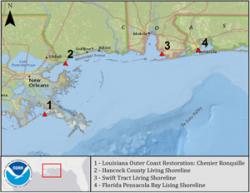
Map of Gulf of Mexico restoration
The largest NOAA project partnership will be with Louisiana to fund and execute restoration of beach, dune, and back-barrier marsh habitat on Chenier Ronquille, a barrier island off the state’s coast. Chenier Ronquille is one of four barrier islands proposed for restoration as part of the Louisiana Outer Coast Restoration Project that will be implemented by NOAA, the U.S. Department of Interior and Louisiana. The total cost to restore the four barrier islands is expected to be $318 million.
Alabama, Florida, Mississippi, and NOAA will partner to undertake three “living shorelines” projects. These projects involve a blend of restoration technologies used to stabilize shorelines and restore fish and wildlife habitat. The three projects are:
Alabama: NOAA will work with the state to fully implement the Swift Tract Living Shoreline Project. This project, costing $5 million, will construct approximately 1.6 miles of breakwaters covered with oyster shell to reduce shoreline erosion, protect salt marsh habitat, and restore ecosystem diversity and productivity in Mobile Bay. Restoration experts expect that over time, the breakwaters will develop into reefs, providing added reproductive and foraging habitat and shelter from predators. The 615-acre state-owned Swift Tract site is located in Bon Secour Bay and is part of the NOAA-supported Weeks Bay National Estuarine Research Reserve.
Florida: NOAA will partner with Florida for the Florida Pensacola Bay Living Shoreline Project to restore shoreline at two sites along the Pensacola waterfront. Project Greenshores Site II is located immediately west of Muscogee Wharf in downtown Pensacola. Restoration at PGS Site II has been planned in conjunction with the Sanders Beach site, three miles to the west. Both proposed sites feature breakwaters that will provide four acres of reef habitat and protect the 18.8 acres of salt marsh habitat that will be created through this project. The Pensacola project is expected to cost about $11 million.
Mississippi: NOAA will partner with the state to improve nearly six miles of shoreline as part of the proposed Hancock County Marsh Living Shoreline Project. The goal of the project is to reduce shoreline erosion by dampening wave energy and encouraging reestablishment of habitat in the region. The estimated cost is $50 million.
As the largest phase of early restoration efforts, Phase III sets a strategic approach for these and additional early restoration activities. The trustees received thousands of public comments that were instrumental in its development, and has issued a guide to the plan and projects.
These projects will be funded through the $1 billion provided to the trustees by BP, as part of the 2011 Framework Agreement on early restoration.
Ten early restoration projects already are in various stages of implementation as part of the first two phases of early restoration. Updates on these projects are available in an interactive atlas.
Early restoration provides an opportunity to implement restoration projects agreed upon by the trustees and BP prior to the completion of the full natural resource damage assessment and restoration plan. BP and other responsible parties are obligated to compensate the public for the full scope of the natural resource injury and lost use caused by the Deepwater Horizon oil spill, including the cost of assessing such injury and planning for restoration.
For more than 20 years, NOAA’s Damage Assessment, Remediation, and Restoration Program has worked cooperatively with federal and state agencies, tribes, industry, and communities to respond to oil spills, ship groundings, and toxic releases. During that period NOAA has protected natural resources at more than 500 waste sites and 160 oil spills, securing more than $2.3 billion from responsible parties.
NOAA’s mission is to understand and predict changes in the Earth’s environment, from the depths of the ocean to the surface of the sun, and to conserve and manage our coastal and marine resources. Join us on Twitter, Facebook, Instagram and our other social media channels.
Can I Lose A Bass By Changing the Angle I Am Fighting It?
The fish I lost in the tournament two weeks ago taught me some more lessons about getting fish in the boat. The one bass I hooked in the Oconee tournament hit a Shadrap in a brush pile. When I set the hook it came to the top and I could see the hook was just barely in its mouth.
The fish was running to my right, around the front of the boat. Rather then try to turn it, I told Jim I would let it go around the boat and bring it to the other side. I also told him to net it quick or it would be gone.
The reason I did not try to make the fish turn and come to the near side of the boat is past experience. When a fish is hooked on a crankbait, trying to make them turn often pulls the hooks out. I think the plug acts as a lever, and when the angle changes, the hook can no longer hold.
I have lost several fish like that. The biggest was a huge bass at Jackson. It came to the top and, when I tried to pull it toward the boat, it just came off. It floated there for what seemed like several seconds before sinking out of sight. I guessed it weighed over 10 pounds.
Linda lost a monster bass at Clark’s Hill many years ago in the same way. She fought it till it was tired and on top. Just like the one I lost, when it turned on its side, the angle of the hook changed and it pulled off. There is nothing you can do in a case like that.
At Oconee, my bass went under the boat after coming around the front. When I tried to pull it to the surface for Jim to net, I pulled the hook out of its mouth. Again, I was pulling in the opposite direction from the way it was hooked. There was no way Jim could have netted it, although I fussed at him for not doing so.
A few minutes later, Jim hooked a fish. It was running to the right also, and when he tried to turn it, it pulled off. We never saw the fish, and neither of us had a fish to weigh in that day. Some days, if you don’t have bad luck you don’t have any luck at all.
If you hook a good fish, keep in mind hooks often pull out if you reverse the pull from the way it was hooked. Often there is nothing you can do about it but if you can lead the fish around in a circle it might help you land it.
Can I Catch Spotted Bass In Kentucky?
Spotted Bass Time in Kentucky Waters
from The Fishing Wire
Kentucky spot
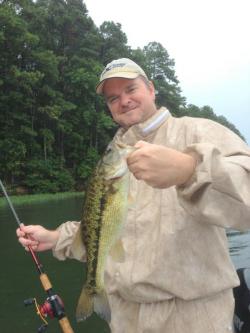
FRANKFORT, Ky. – They were not even recognized as a distinctive fish species until 1927. People for many years believed these fish only existed in Kentucky.
In 1956, the Kentucky legislature designated this species the “Kentucky bass” and made them the official state fish. Many anglers, especially in the south-central portion of the United States, still call the spotted bass a Kentucky bass.
They pale in reputation to their black bass cousins, the largemouth and smallmouth bass, but the spunk shown once hooked and their abundance should raise the profile of the overlooked spotted bass. They are also aggressive and readily strike lures.
It isn’t hard to tell when a spotted bass strikes. They shake their heads violently and dive bomb toward the bottom. The larger ones 15 inches and up usually grow a pronounced belly as they mature. Spotted bass use that girth along with a powerful tail against an angler while playing the fish, producing as good a fight as any comparable largemouth bass.
Medium-light spinning rods with reels spooled with 6-pound fluorocarbon line is all you need for catching spotted bass.
Once the fall winds blow, spotted bass begin to school up. They locate along rock bluffs or they suspend over points, submerged humps or channel drops.
“At this time of year, if you catch one spotted bass, keep fishing that same spot,” said Chad Miles, administrative director of the Kentucky Fish and Wildlife Foundation and dedicated spotted bass angler. “There might be 40 or 50 of them there. Spotted bass really school up in fall.”

Catch spots on topwater
John Williams, southeastern fisheries district program coordinator for the Kentucky Department of Fish and Wildlife Resources, reports Lake Cumberland holds a bountiful population of spotted bass with many fish in the 14- to 16-inch range. Spotted bass make up roughly half of the black bass found in the lake.
The main lake points from Harmon Creek down to Wolf Creek Dam hold spotted bass from fall through late spring. A 4-inch black finesse worm rigged on a 3/16-ounce Shakey head and slowly fished down those points is a deadly choice.
A hammered silver jigging spoon fished along the old Cumberland River bluffs in this section of the lake also produces spotted bass. Again, if you catch one spotted bass in fall, keep fishing the same area with the same technique. You might catch a dozen or more.
Large crappie minnows fished on size 1 circle hooks with two split shot lightly clamped on the line about 18 inches above the hook make a powerful choice for the large spotted bass in Laurel River Lake. The water of Laurel River Lake is as clear as the air and live bait works best.
The upper end of the Craigs Creek arm is a spotted bass hotspot on Laurel, as are the main lake points near the dam and in the lower section of Spruce Creek.
The mid-depth reservoirs in southern Kentucky hold excellent populations of larger spotted bass. Barren River Lake and Green River Lake hold some of the largest spotted bass in Kentucky.
The channel drops along the submerged Barren River adjacent to Barren River Lake State Park and the Narrows Access Area make excellent fall spots to try for spotted bass.
In Green River Lake, rock slides and points in the lower sections of the Robinson Creek arm and Green River arm are the best fall places. Green River Lake holds an impressive number of spotted bass longer than 15 inches.
Anglers fishing for largemouth bass in Kentucky Lake often stumble across a football-sized spotted bass. The secondary points in the major bays and creek arms in the middle section of the lake hold some impressive spotted bass in fall.
Smaller profile ¼-ounce football jigs in hues of green, brown and chartreuse attract these fish on Kentucky Lake.
Spotted bass make excellent table fare, by far the best tasting of the black bass species, similar to crappie in taste and texture. There is no minimum size limit on spotted bass statewide, but they still count toward the six fish aggregate black bass daily creel limit.
Hit the water and land some hard fighting and abundant spotted bass this fall. Keeping a few medium-sized spots for the table makes a delicious and nutritious meal.
Author Lee McClellan is a nationally award-winning associate editor for Kentucky Afield magazine, the official publication of the Kentucky Department of Fish and Wildlife Resources. He is a life-long hunter and angler, with a passion for smallmouth bass fishing.
Terminal Tackle – Hooks Sinkers and More – That I Use and Like

Weedless Hooks


Spinner Baits and Buzz Baits I Use and Like

What Is Yamaha Marine Doing To Improve?
Yamaha Moving on Many Fronts
Jim Shepherd
from The Fishing Wire
Spending 24 hours with the top officials at Yamaha’s Marine Group makes it easier to get enthusiastic about the immediate future of the boating industry. Arguably among the upper echelon of technical innovation, Yamaha continues their pursuit of improvement across virtually every element of their product categories.
Seven outboards
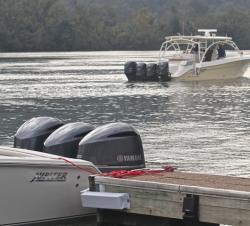
From their smallest 8 horsepower to massive quad engine arrays on their newest iteration of their Helm Master system for boats 40 feet and up in length, there are pushes that they believe will continue the gains the company has seen in the overall outboard market.
But it’s not just motors where they’re making big changes. Their propeller business is expected to crank out 50,000 + props this year- with new pitches across the line. Those varietals were added to the lines because with changes in some Yamaha engines -and additions of new ones- have changed what the believe are optimal prop/engine combos.
“We’re excited,” says Marine Group president Ben Speciale, “what we’re seeing since the great recession says good things.”
Those things include boating consumers are coming back into the market. And, Speciale says, when knowledgeable boaters come back, they “buy up” into boats that include improvements ranging from multi-screen fish-finding displays placed at each fishing position to better furnishings, higher quality seating and an overall ramp-up in performance in the pleasure and cruiser classes.
“Maybe the biggest mystery we see,” Speciale told the crowd of writers, “is the fact that in the new economy, one of the things fishermen have to have on their boats is a $2,000 anchor to hold their boat in six feet or less of water.”

Ranger and Yamaha
At low speed, it’s not so obvious (Above), but throttle up Ranger’s Model 620 FS deep-v boat when it’s equipped with Yamaha’s new 25-inch shaft model VF250XA engine and you’ll understand -immediately- the power and performance increase.
The line about the power pole type anchor was funny, but indicative of the fact that boaters don’t thing less is more. Today, they want more: more boat, more features, and, more importantly (if you’re Yamaha), more performance from their boats.
Research shared with media invited to their freshwater preview held at their testing center near Chattanooga, Tennessee included information showing a demand for more advanced technology. Technology, Speciale says, that is offered in the four-stroke engine, but not the “older” 2-stroke technology.
Two stroke engines, Speciale says, is a techology Yamaha is “out of” in the United States.
As part of their overall strategy, Yamaha officials say they’ll continue to follow their roadmap for success: offeri high-quality products with dependability that create a high customer value for those products, a customer-focused approach to sales and service to build longevity into their customers, and a continued focus on what Speciale says is their “core competency” – the premium positions of the marine industry.
Yamaha also took the occasion to roll out new initiatives in the political world. Having already held more than 100 meetings with members of Congress, Yamaha says it’s expanding their push for three goals they feel critical to the overall health of the recreational fishing and boating industries.
Reauthorization of the Magnuson Stevens Act with an emphasis on fair treatment for recreational fishermen when it comes to fishing quotas,
A permanent cap of ten percent (10%) on ethanol -and support of HR Bill 1462, and
Engine regulations that “make sense”.
Additionally, Yamaha has created an Annual Roundtable on a National Recreational fishing and is pushing those advocacy issues via its 1,000 dealers and partner boat builders.
We’ll be covering much more of the new Yamaha product lines in other stores, but the positive tone Fishing Wire editor Frank Sargeant and I heard at Yamaha last week is one that we’re hearing across the entire industry.
That’s definitely news worth reporting.
As always, we’ll keep you posted.