Fat Albert Twin Tail Grubs
I use these on my bigger jigs
Frogs


Tubes
Senkos

NetBait TMac
Zoom Trick Worm
Zoom Lizards
Zoom Baby Brush Hog

Zoom Creepy Crawler
Fat Albert Twin Tail Grubs
I use these on my bigger jigs
Frogs
Tubes
Senkos
NetBait TMac
Zoom Trick Worm
Zoom Lizards
Zoom Baby Brush Hog
Zoom Creepy Crawler
Sport, commercial fishermen differ over striped bass options
Decline in population raises concerns over how much and how quickly to reduce the harvest.
By Karl Blankenship, Editor
Bay Journal
www.bayjournal.com
from The Fishing Wire
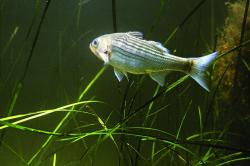
Striped Bass
For years, striped bass were a textbook example of successful fishery management.
After a dramatic population crash in the early 1980s, a painful harvest moratorium was put in place. As hoped, the population rebounded. By 1995, it was declared “recovered” – and even then the population continued to climb.
By the early 2000s, commercial fishermen and recreational anglers were seeing more large striped bass than at any time in recent memory.
Fast forward another decade, to 2014, and the picture is starkly different. The spawning population is at about the same level it was in 1995, when it was declared recovered, but instead of trending upward, it’s been declining for a decade.
It is expected to drop below the “recovered” threshold level next year.
The Atlantic States Marine Fisheries Commission, which regulates the management of migratory fish species and includes representatives from all East Coast states, is weighing options that range from a 25 percent harvest reduction next year to phasing in a smaller, 7 percent annual reduction over three years – or even doing nothing at all.
“This is the premier fisheries management success story,” said John M.âR. Bull, commissioner of the Virginia Marine Resources Commission. “I don’t think anybody wants to jeopardize that success.”
But, views about what the ASMFC should do to maintain that success when it meets in late October – and even the seriousness of the current situation – vary widely.
Some groups representing recreational anglers are leading the charge for aggressive, and quick, action.
Tony Friedrich, executive director of the Coastal Conservation Association in Maryland, said he supports a 25 percent reduction, but only because the ASMFC’s options don’t include a greater cut.
The fish “are in a lot of trouble,” he said, citing angler surveys showing that interactions with fish – basically how often they catch a striped bass – have fallen 75 percent since 2006.
“If you talk to a lot of people on the East Coast, they are up in arms,” Friedrich said. “They want to go a step beyond 25 percent.”
In comments to the ASMFC, the group Stripers Forever contends “the signs of diminishing abundance have been ignored for years.” It calls for a 25 percent harvest reduction effective next year, but said even that is “too little too late.”
On the other hand, Billy Rice, a commercial fisherman who has worked 46 years on the Potomac River and Maryland tributaries, said striped bass will soon become more abundant in the Bay as a result of a strong reproduction in 2011. Fish born that year will soon reach legal size in the Chesapeake, and shortly thereafter along the coast.
“We need to keep a close eye on it, but I wouldn’t even come close to calling it a crisis,” said Rice, who is a member of both the Potomac River Fishery Commission and an advisory panel to the Maryland Department of Natural Resources.
Absorbing a 25 percent reduction in a single year, he said, “would virtually cripple our commercial fishing industry.”
Rice contends that, given time, striped bass will bounce back, and that it’s not realistic to think that any stock can be consistently maintained at record-high levels. “Fish naturally go through cycles, no matter how well you manage them,” he said. “We are not going to stop the natural cycle that has been going on since the beginning of time.”
The different perspectives reflect, in part, longstanding tension between recreational and commercial interests, which compete for the same fish.
Commercial fishermen, equipped with large boats, nets and often decades of individual and community knowledge, are efficient. They typically can catch their given quota despite competition from recreational anglers, as long as the stock is at a healthy level.
Recreational fishermen do best when fish are very abundant. The fish are more easily found, and the commercial quota typically takes a smaller portion of the available population. As the population declines, recreational anglers with fishing lines are less efficient than watermen with nets, and have a harder time finding fish – even if the stock is still considered to be at a sustainable level.
“When abundance is down, the recreational anglers are the ones whose catch is going to go down the most,” said Bill Goldsborough, director of fisheries for the Chesapeake Bay Foundation. “By the same token, when abundance is up, their catch goes up the most. The recreational catch is tied very closely to abundance.”
That’s reflected in ASMFC figures which show spikes in recreational harvests when the striped bass population hit its peak in the early 2000s. In fact, the estimated dead discards from the recreational fishery along the coast – those fish that are caught and released, but die anyway (about 9 percent of the released fish) – exceeded the entire commercial catch as recently as 2006.
As abundance has declined, though, the commercial catch – which is based on a quota and therefore fluctuates less from year to year – has overtaken the recreational catch in the Bay and in some other states that have a commercial striped bass fishery.
So, for recreational fisheries, the situation can look bleak – but the stock itself is not in peril, Goldsborough said.
“From a biology standpoint, I think we are OK,” he said. “We do need to tighten the belt and ensure that we turn that trajectory back up for the spawning stock biomass. I don’t think it is a crisis, but there definitely is a need to act..”
The more difficult question, said Goldsborough, who is also a member of the ASMFC, is weighing management impacts on commercial and recreational sectors.
“It is really the age-old issue for fisheries management, and that is resolving the difference between managing for commercial fishing objectives and managing for recreational fishing objectives in a shared stock,” he said.
The reason for the decline in striped bass abundance over the last decade, scientists say, has been a series of years with poor reproduction.
In the 13-year span from 1993 through 2005, reproduction was at or above the long-term average 10 times, including the three best years on record in 1993, 1996 and 2001, as measured by the Maryland Department of Natural Resources Young-of-Year index. The Chesapeake Bay is where the vast majority of striped bass found along the East Coast are spawned.
But reproduction has been below average in six of eight years since then, including some of the poorest years since the 1980s.
Successful reproduction typically requires two things: lots of eggs produced by females and weather conditions that promote the survival of their young.
Because they can’t control the weather, fishery managers try to keep the abundance of adult female fish high with the hope that when the spawning fish mesh with the right conditions, they will produce a large “year class” of young fish. With striped bass, above-average year classes have been particularly important for overall abundance.
The spawning stock biomass peaked at around 170 million pounds a decade ago, and dropped to an estimated 128 million pounds last year, just 1 million pounds above the minimum threshold of 127 million pounds set by ASMFC. It is on a trajectory to fall below that threshold next year.
But the significance of crossing that threshold is less clear. In fishery management, such thresholds are typically a biologically established minimum. Falling below that number risks a stock crash.
In the case of striped bass, the spawning stock biomass is not set at a danger level. Rather, it is set at its 1995 level, when the stock was declared recovered by ASMFC. It is about 12 times higher than the population’s low point in the early 1980s.
“We don’t feel the population is at a biological risk,” said Tom O’Connell, fisheries director with the Maryland DNR. “Yes, it is lower than stakeholders want, and lower than managers want. But it is not at a biological risk.”
The higher threshold, fishery managers say, reflects the fact that striped bass are considered a marquee species both in the Bay and along the coast.
As a result, O’Connell and some other fishery managers say, the question is not whether something should be done, but rather how much – and how quickly.
While reproduction in most recent years has been low, the 2011 year class was the fourth strongest since Maryland’s Young-of-Year index began in 1956. Those fish will soon reach catchable size – 18 inches – in the Bay, and will shortly thereafter migrate to coastal waters where they typically need to be larger before they can be caught.
“If we did nothing, but we kept fishing mortality at the current level, we would probably see that population come back up, but it may take three, four, five, six years,” O’Connell said.
“We should react, because the management plan and the stakeholders prefer that this species be at a higher abundance level,” he said. But, he added, “we don’t have to react in one year.”
Some recreational anglers, like Friedrich, worry that delaying or spreading out cuts only delays the potential comeback. Friedrich also contended that managers are putting too much stock on the 2011 year class which, he said “are about to go into the meat grinder” as they hit legal catch sizes in the Bay and along the coast.
“That 2011 class is where all the fishing pressure is going to fall,” he said. “It may be the most pressured year class in history.”
But sharp, single-year cutbacks would hit the commercial fishery hard, particularly in the Bay: Maryland and Virginia have the highest commercial quotas of East Coast states.
“In one year, that would be devastating,” said Bull, the VMRC commissioner. “I believe that it is very important, for the commercial fishery here in Virginia, to phase in the impact.”
Fishery managers from the Bay states also contend that new regulations could unfairly hit the Chesapeake.
After spawning, the Bay serves as a nursery for striped bass before they migrate to the coast. Fishery managers say females – which make up the spawning stock – leave the Bay earlier than males, so most of the Bay catch consists of male fish. Sharply reducing the catch on those males does little to boost spawning stock biomass, they say.
For years, harvest levels for striped bass in the Chesapeake were set separately from those along the coast. That was reflected in 2013, fishery managers said, when catch limits in the Bay were 14 percent below those in 2012, reflecting a decline in larger fish in the Bay.
But after a recent stock assessment, the ASMFC failed to set a Bay specific target, citing a lack of adequate information, even as it acknowledged differences between the Bay and coastal stocks.
If the Chesapeake is subjected to the same across-the-board reduction as the rest of the coast, managers say, it will not only hurt the fishing industry, but provide little benefit to the spawning stock.
“It is really misleading to the public to think that this level of reduction in the Chesapeake Bay is going to rebuild the female spawning stock biomass, because our fishery is predominantly males outside the spring trophy season,” O’Connell said.

Karl Blankenship
Summertime fishing during my pre-teen years was always fantastic – whether I caught anything or not. From fishing for tiny cats and bream in the branch below my house to riding my bicycle to local farm ponds to try to catch bass, I fished almost every day.
Dearing branch provided some of my early learning experiences about fish behavior. When we were not damming it up or swimming in it, we fished. In a small branch you get up close and personal with the fish. I could watch how they used stumps, limbs in the water, current and other structure to hide and get food. Fish in big lakes act much the same way, just on a large scale. And hopefully, the fish are larger also!
I made my own “flies” for fishing the branch. It was quite a thrill the first time I got a six inch branch minnow to hit one of my creations of chicken feathers and sewing thread. I am sure the action of making it vibrate on the top of the water like a fallen insect was more important than the way it looked, but it worked. I thought I was really an artist, but found I needed bought lures to catch bass, my favorite.
To this day my bass boat is loaded with way more tackle than a dozen people could use in a week. One of my first tackle boxes – and I still have it – was a huge Old Pal box about two feet long. My folks got me a basket for my bicycle one Christmas and had to look all over Augusta to find one big enough to hold my tackle box.
With my tackle box in the basket and my rod and reel across the handlebars, I was ready to go to any pond within three or four miles. If I caught any fish they dangled on a stringer from one handlebar on the way home. I hardly ever went alone, my two friends and I traveled in a pack when we went fishing. That added to the fun.
I always had a few hooks, some line and a couple of sinkers and corks in a little box in my pocket. With my trusty – or maybe rusty – pocket knife I could cut a limb and be fishing in minutes. If there was a cane patch nearby I was in heaven with a real cane pole!
One summer my folks rented a cabin at Vogel State Park for a week. I could not wait to get to the clear mountain stream full of trout and try out my flies. I was eight years old and I knew those rainbows I had read about would just eat up my creation. How wrong I was!
After a couple of fruitless days of fishing the stream in front of the cabin and catching nothing, even with the live worms I had given in and tried, I decided the lake a mile or so downstream was where the fish were hiding. I also thought I needed to be there at the crack of dawn to catch them. I swear I told my folks I was going fishing early the next morning. I think they just didn’t remember with all the vacation excitement, but they were quite relieved when they found me mid-morning, sitting on a rental boat tied to the bank at the marina, catching tiny bream and bass on my earthworms and cut pole.
I had gotten up before anyone else and walked to the lake to fish. My parents found me when they asked a couple of teenage girls out walking around if they had seen a lost child. They told them of the “Huckleberry Finn” they had seen – barefoot but wearing a straw hat, sitting on the boat with a tree branch pole catching fish.
They didn’t get too mad. As a matter of fact, my mom told me years later that she didn’t worry about me as long as I was fishing. She thought a guardian angel watched over kids out trying to catch fish. They let me grow up pretty wild, and I thank them for it.
After Lake Champlain Fish Tournaments: Study Finds Where the Fish Go
from The Fishing Wire
Today’s feature, an interesting study on where bass go after being released at weigh-ins, comes to us from Lake Champlain International; www.mychamplain.net.
By Daniel Kelly

The Crew
Lake Champlain has been a popular bass fishing spot for some time, made so by its size, surrounding scenery and abundant fish habitat, especially in its northern end. The lake’s expansive tributaries also draw in anglers who like to rev up their fishing boats and make waves.
But with prized bass there getting more and more attention, scientists with the Lake Champlain Sea Grant wanted to know what impacts all the activity was having on the fishery.
“There are probably 75 tournaments on this lake each year,” said Mark Malchoff, aquatic resources specialist with the Sea Grant. “And about four to six of them are big ones with sometimes 100 boats.”
Malchoff, along with investigators from the Lake Champlain Research Institute at the State University of New York – Plattsburgh, wanted to quantify the impacts of catch-and-release policies at the competitions and how bass disperse after they’ve been released back into the water.
Their study began with tagging fish. Some were fitted with radio transmitters, but a vast majority were tagged with T-bars: tiny tags inserted between spines in dorsal fins. All of those had Malchoff’s phone number and email address on them.
“You sort of release them and hope someone finds one, but there’s no guarantee,” said Malchoff. “It’s a classic letter in a bottle.”

Inserting Tracklng Device
The approach was useful because two tag methods allowed researchers to find if one was more reliable for tracking and if there were any effects caused by the tags themselves. Malchoff says there was good agreement between the two, with both helping researchers track bass movement through Lake Champlain during and after tournaments.
Largemouth bass, researchers found, are especially affected during tournament time. They experience more stress than smallmouth, as judged by a series of indicators including bloody fins, hook wounds or fin damage. A lot of the stress comes from being housed in livewells, which takes its toll. They may also be targeted more as competition labors on.
“With tournaments – the big ones at least – by day three, only the Top 10 to 20 anglers are still fishing,” said Malchoff. “At that point, they’re targeting the biggest fish they can find.” And with live fish valued more at weigh-in time, fishermen try to keep fish swimming. “But the farther you move them (in livewells), the more likely it is they’ll get beat up,” said Malchoff.
A post-op tagged smallmouth (Credit: Lake Champlain Research Institute, SUNY Plattsburgh)
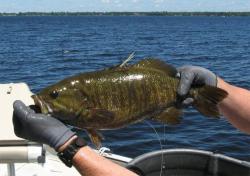
Released Smallmouth
All the findings boil down to a few things fishermen and tournament organizers can do to protect and conserve bass in Champlain. “Don’t transport them as far (in livewells), and lake temperature – in a lot of places, waters are warmest in late July or early August – avoid scheduling tournaments at those times if at all possible,” said Malchoff.
Researchers also provided evidence against a commonly held notion that many types of fish stress could be attributed to barotrauma, or damage caused to them by sudden pressure changes. Fish that don’t maintain equilibrium don’t always need to have their air bladders deflated, Malchoff says, something that tournament anglers often do.
“My real interest is looking at tournaments as a sustainable resource,” said Malchoff. “And like a lot of things, there’s always room for improvement.”
When you first realize you aren’t tucked in your own bed, your next waking sensation is the smell of canvas. Anyone who has ever camped in their back yard as a kid will never forget that smell. It meant adventure, freedom, fear and many other emotions all rolled into one. From the old army surplus pup tents to fancy Sears tents with floors, I spent many happy nights in them.
Camping out was one of the rites of summer while I was growing up. We organized our overnight stays as well as any expedition to climb Mt. Everest. Each of us had specific things to bring for the group, and each one of us also had their own private treasures. We brought so much stuff we could not have carried it further than our back yards.
Mess kits and matches were all we needed to cook our breakfast of bacon, eggs and toast over an open fire. The bacon was always half burned and half rubbery undercooked, but all delicious. Toast, as soon as it turned a perfect golden brown, was either dropped into the fire or left a little longer to blacken. Eggs stuck to the pan and had to be scraped off as they were eaten.
For supper, we discovered “hobo meals” at church camp. A hamburger patty was placed on a square of tin foil, sliced potatoes, carrots and onion stacked on top of it and all was topped with a hunk of butter. Sealed up and cooked on the campfire coals, it was moist and tender, I was told, if you didn’t stick a hole in the tinfoil while cooking it. I never had one cooked that way. Mine always managed to get stuck.
For desert we always had somemores. They were graham crackers with a Hershey bar and a toasted marshmallow on top. We go more on our hands and face than in our mouth, but they were still great, and you could lick for a long time and make the flavor last.
Sleeping was also an adventure. Each of us boys had our sleeping bags, which we placed directly on the ground for years. We got used to scrounging around until we got comfortable on the rocks and limbs we didn’t remove before spreading the bag out. Then one of us got an air mattress. What a joke. I do not remember even one that was still inflated shortly after blowing it up. We tried every time though.
Once we got the bright idea of sleeping on a lawn lounge chair. That worked if you didn’t mind the bar across your back all night long. And it was tough to roll over in your bag in the chair. We used them often, though. They were still better than the ground.
Something else I will never forget is the way your voice sounded when waking up early in a tent. Maybe it was the lack of sleep, maybe it was the tent itself, but we always sounded funny to each other and ourselves. We never camped more than one night during the weekend because we needed the other night to recover!
Sometimes I think I would like to do that kind of camping again. Then I remember how much I ache getting out of a nice soft bed in the morning and realize backyard camping is best left to the young!
Finding Fish In Transition
from The Fishing Wire
How experts use Humminbird technologies to put the bead on fall and winter fish
Eufaula, AL – Typically, as fall arrives, many of us head for the tree stand or blind, turning our attention to birds and bucks. Yet, what’s happening on the water this time of the year can be equally as awesome as what’s happening in the field.
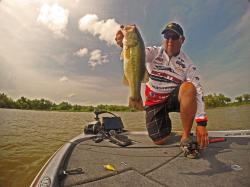
Electronics help catch bass
Here’s how a handful of fishing’s top experts find and pattern bass, walleyes and panfish during the fall and winter – and how you can do the same.
Open-Water Bass: Fall & Winter
Missouri-based tournament pro Doug Vahrenberg says his fall and winter bass game has never been better thanks to the trifecta of Humminbird’s LakeMaster mapping, Side Imaging and 360 Imaging.
“As the water cools and bass school up in the fall, they’ll begin to move from the main lake into creek arms. And you’ve got main lake fish on the flats adjacent to those creek arms. Both have one thing in common: they’re looking for lunch.”
Vahrenberg says it all comes down to surveying a lake quickly because fall bass can be here today, gone tomorrow. With two ONIX units at the dash – one set to full-screen Side Imaging, the other to Humminbird LakeMaster mapping – Vahrenberg is similarly on the prowl for baitfish and bass.
“I typically have my Side Imaging set to look 100 feet right and left. On a new lake I’ll increase that range to 130-150 feet until I find bait and ambush targets like trees, stumps, and submerged cover most anglers can’t see, especially in shallower stained water. Then I mark anything that looks like a good ambush site with a waypoint.”
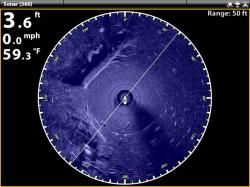
Hummingbird 360
He adds: “Seems like fall bass like flats close to a channel swing. They’ll move up from deeper water and push the bait into two-, three- or four feet of water and feed. With LakeMaster mapping you can find those spots where the channel swings in close to the bank. A lot of times your screen will be absolutely full of bait so I like to concentrate on those areas right before or after the giant wads of bait. Helps make the presence of your bait known.”
Once he’s located a channel swing, good cover, baitfish – even the bass themselves – Vahrenberg will jump from the console to the bow.
“As soon as I start pinging Bow 360 every waypoint will show up on my bow ONIX unit and I can motor right to ’em. Seems like if there’s a lot of cover, the fish tend to be isolated. Where there’s no cover, fish tend to group up in ‘wolf packs’. That’s where 360 Imaging really helps locating the stuff that you can’t see. The beauty is that it does all the work for you. You’re not controlling anything with your foot – all you have to do is look at the screen and think about where to cast next.”
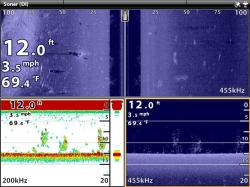
ONIX split-screen
From fall through winter, Vahrenberg breaks down his presentations into two preferred categories.
“I always have one stick rigged up with a creature or jig and craw combo to flip the isolated fish on cover. Those fish will position right behind the timber, waiting for lunch to swim by. On lakes with less cover I’m fishing fast search baits to connect with the wolf packs – square bills, spinnerbaits, buzzbaits, lipless cranks – and searching out aggression bites. A shad pattern is always good but if there’s an overabundance of forage, I’ll switch over to a bluegill pattern, which is often just different enough to get bit. Look at it this way, if you’re eating a chicken breast every day and somebody offers you pizza …”
During winter, Vahrenberg reverses his fall routine and starts at the back of creek arms, moving outward to the first or second channel swing – or from the edge of the ice back to the main lake. “Even more so in the winter, bass will associate to the channel swings – and deeper water – but look along the edges. Again, LakeMaster mapping and the imaging technologies can really help you find the right stuff.”
Pre-Fishing For Early Ice: Walleyes & Perch
In northern Minnesota, the open water season is typically over by Thanksgiving. Yet, by the time the turkey and cranberry are being passed around the table, ice fishing guide/tournament Brian “Bro” Brosdahl has much of his winter ice fishing strategy already mapped. Many years, he’s already fishing on hardwater by turkey day.
“Sure, I’ll drop waypoints on structures in the fall but what I really do is fast-forward my thinking to winter, knowing that walleyes and jumbo perch will associate to shoreline points, saddles, humps, and weed bed edges on flats during early ice,” says Brosdahl.
Like Vahrenberg’s Missouri bass, Brosdahl says the biggest reason early-ice fish associate to these areas – especially on larger bodies of water like Minnesota’s Mille Lacs, Winnibigoshish and Leech – is the presence of baitfish. “Walleyes and perch both gorge on shiners, although the bigger walleyes seem to prefer whitefish.”
Brosdahl says Humminbird Lakemaster mapping greatly reduces the time it takes him to “pre-fish” a lake in the fall for ice fishing in winter.

Yellow Perch
“But you can’t just motor around in the fall, mark bait and fish and drop waypoints. Most of the fall fish will have moved by first-ice. So, what I do is highlight depths with Lakemaster’s Depth Highlight feature – typically somewhere between 12 and 14 feet on bigger lakes – and then start dropping waypoints on those areas that will be their next move after fall.”
“You still have to look for inside turns, saddles and especially those steep breaks for walleyes. But remember: If there are walleyes in the area, they’ll push the perch up onto adjacent flats and the gradual breaks.”
Brosdahl was one walleye fishing’s earliest adopters of Side Imaging. “Same time as I’m watching my LakeMaster map, I’m watching Side Imaging for hard- and soft bottom edges. Both walleyes and perch will ride those edges all winter long. With Side Imaging these spots are unmistakable. Plus, as more of your ‘A list’ spots like rock piles and sunken islands get winter fishing traffic, I find myself fishing hard-to-soft bottom transitions in places easily overlooked.”
Once a surveyor for LakeMaster himself, Brosdahl says mapping waters with Humminbird’s new AutoChart Pro software has been a lot of fun. “Of course, this time around I don’t have to share my findings with anyone!”
“Kind of cool that I can go to a lake that doesn’t have HD one-foot contours and really dial in on spots for winter. Plus, AutoChart Pro gives me bottom hardness mapping so I those hard-to-soft spots really jump out. And there are some tiny lakes that have never been mapped. That’s where AutoChart really shines.”
One pass of Humminbird 360 reveals more than 10 manmade crappie cribs in a single pass. Range set to 120 feet in every direction.

manmade crappie cribs
Tournament Talk: Winter Panfish
Currently, Wisconsin-based Kevin Fassbind and Nick Smyers are in second place as they prepare to fish the NAIFC 2014 Series Ice Fishing Championship on Minnesota’s Mille Lacs Lake, December 20, 2014.
A big part of their ongoing strategy is open-water scouting tournament grounds, like Mille Lacs’ Isle and Waukon bays.
“We’ve found Humminbird Side Imaging helps us identify the best weeds and hard-bottom areas. We’ll idle back and forth through a bay, looking 120 feet off each side of the boat. When we see holes in weed beds, inside turns and good bottom, we simply drop waypoints for winter. The way the system works is pretty easy – just pop the SD card out of the Humminbird 999 on the boat and drop it into the Humminbird 688 ice combo. Then it’s all right there,” says Fassbind.
Beyond marking waypoints on open-water, the duo has also experimented with Side Imaging on the ice. Using a pole-mounted Side Imaging transducer spun manually around in a hole in the ice, Fassbind and Smyers have had some success using the technology in a way it wasn’t intended.
“When we were fishing the NAIFC event on Lake Maxinkuckee, Indiana, we found a 20′ x 20′ patch of weeds with some logs, and Kevin pointed me in the direction and told me to start drilling. Boom, drilled one hole and I was on it,” says Smyers. “But it was difficult to get the image we wanted. Yet, we could see how this kind of technology could give us a huge on-ice advantage for locating manmade structures like cribs, Christmas tree piles, even fish.”
Along those lines, the duo is planning on implementing Humminbird Bow 360 into their tournament arsenal this year.
“What we were trying to do with Side Imaging is something that 360 Imaging already does better. With a little bit of rigging for ice, I really think it’s going to help us locate structure and fish even faster, which could be huge for main-basin crappies and deep-water perch. Punch a waypoint on fish and then go drill it. Instead of drilling hundreds of holes, we’ll be drilling a precise few. Not sure how much grid scouting we’ll be doing any more,” says Smyers.

Kevin Fassbind
No matter where in the country you fish, the take-home message is clear: put in some time scouting with today’s technologies and you too can increase your odds for stellar fall and winter fishing.
For more information visit humminbird.com, contact Humminbird, 678 Humminbird Lane, Eufaula, AL 36027, or call 800-633-1468.
About Johnson Outdoors Marine Electronics, Inc.
Johnson Outdoors Marine Electronics, Inc. is a wholly owned subsidiary of Johnson Outdoors and consists of the Humminbird®, Minn Kota® and Cannon® brands. Humminbird® is a leading global innovator and manufacturer of marine electronics products including fishfinders, multifunction displays, autopilots, ice flashers, and premium cartography products. Minn Kota® is the world’s leading manufacturer of electric trolling motors, as well as offers a complete line of shallow water anchors, battery chargers and marine accessories. Cannon® is the leader in controlled-depth fishing and includes a full line of downrigger products and accessories.
Walter Gary called last week from Berry’s Sporting Goods to remind me this is an excellent time to scout for deer and get prepared for next season. That may seem strange since deer season just ended and won’t open again for almost ten months, but preparing now can help you get your deer, and insure it is a quality deer, next year.
The deer have had almost a month to calm down since season ended. They have returned to their normal patterns for this time of year. This weekend would be an excellent time to scout and find fresh signs after the rain in mid-week. If you feel foolish scouting for deer now, carry along a .22 and hunt squirrels while you look for deer signs.
Feeding areas will be different now from what they will be next fall, but bedding areas and travel routes can give you an idea of what the deer will be doing then. They will be eating winter browse like honeysuckle and greenbriar now, and looking for acorns next fall, but they will frequent the same areas. When looking for sign now, think how it will change with the changing seasons.
You can sweeten your chances next year by planting winter food for the deer and keeping it growing as the seasons change. Winter peas should still sprout during warm spells like we had last week, and you can follow up with hot weather peas later in the spring. Keep food growing where you want the deer to be next year when season opens. Insuring they have plenty of food now will help the does as their fawns develop in them, and will also help the bucks recover from the rut. All the deer may need help during a rough winter.
If you put out mineral blocks, now it a good time to get them out and let them be soaking into the ground. Although the deer will not lick them much until later in the spring, you can have them out when they get ready for them.
As a bonus, you might find shed antlers in the woods now. Bucks drop their antlers around the first of February and, if you are lucky, you might find one. Squirrels and other rodents eat the antlers for the calcium in them and they don’t last but a few days after being shed. You have to be in the right place at the right time.
Get out this weekend. You might find the woods hold more interest than the Super Bowl – if you know where to look.
The BP Windfall–Funds for Gulf Restoration
By Frank Sargeant, Editor
from
The Fishing Wire
In one of the more bizarre turns of events in environmental history, the calamitous BP oil disaster in the Gulf of Mexico may turn out to have been historically a good thing for many portions of the shores of this American sea.

Deep Water Horizon on fire
Those of us who have spent time around the Gulf oil rigs fishing know that they are not the demonic towers of environmental destruction that some folks seem to think they are: In fact, there are more fish per square foot around these towers than anywhere else in the Gulf, with both reef species like snapper and grouper and pelagics like kingfish and yellowfin tuna swarming around many. On the other hand, the BP disaster shows the potential for great harm that’s inherent in pulling industrial quantities of petroleum out of the sea floor anywhere in the world, and hopefully has taught the entire civilized world a lesson in the need for careful control of this harvest. And the huge fines resulting have hopefully taught a lesson to the companies extracting the oil, as well.
On July 6, 2012, President Obama signed the RESTORE Act into law, establishing a trust fund within the Treasury Department, with 80 percent of the civil penalties to be paid by parties responsible for the Deepwater Horizon oil spill under the Federal Water Pollution Control Act. To date, civil penalties and interest deposited into the trust fund exceed $653 million.
That could be a drop in the bucket. The Justice Department has found “gross negligence” against BP, which means penalties under the Clean Water Act will swell to $4,300 per barrel, making the determination of how many barrels were released critical in settling what the ultimate civil fine will total. The fine reportedly could have been as low as $1,100 a barrel had BP not cut so many corners in regards to the safety of its workers and the health of the Gulf. If BP’s estimate for barrels spilled is accurate, the fine will be about $10 billion for its gross negligence. That total could be in excess of $18 billion if the Justice Department is right. Either way, it’s an enormous amount of money.
A total of 35 percent of the Gulf Coast Restoration Trust Fund is divided equally among the five states for ecological and economic restoration. The states of Alabama, Louisiana, Mississippi, and Texas each receive a share for projects and programs they select. In Florida, the state’s allocation goes to 23 coastal counties for projects they choose. A second Interim Final Rule finalizes an additional allocation for 20 parishes in Louisiana.
Treasury will also provide grants for centers of excellence research programs using 2.5 percent of the trust fund, divided equally among the five Gulf Coast States.
On Sept. 15, Treasury posted the funding opportunity announcement for these grants as well. The centers of excellence will focus on science, technology, and monitoring. In addition to these grant programs, the Interim Final Rule published in August describes requirements for RESTORE Act programs administered by other federal agencies. Treasury is just one of several federal entities working to implement the RESTORE Act.
The Gulf Coast Ecosystem Restoration Council, a federal council composed of the five Gulf Coast States and six federal agencies, will use 30 percent of the trust fund for projects selected by the council, and administer grants to the states pursuant to council-approved state expenditure plans using an additional 30 percent.
The National Oceanic and Atmospheric Administration will use the remaining 2.5 percent of the trust fund for a program focused on advancements in monitoring, observation, and technology. For more information on the Gulf Coast Ecosystem Restoration Council, visit http://www.restorethegulf.gov/.
In short, it’s by far the greatest infusion of money into an environmental restoration project in U.S. or world history, an unimaginable windfall that if spent wisely should bring tremendous benefits to the Gulf estuarine and beach areas for decades to come–and some very nice added benefits to the anglers who chase the millions of fish that will be produced in these restored areas.
To be sure, the Gulf is likely to face issues in coming decades if sea level rise continues as many scientists predict–while wetlands, mangroves and marshes like wet feet, too much water can kill out these nursery areas, which are absolutely essential to preserving the chain of life that ultimately results in everything from gamefish to porpoises and whales.
The public has an opportunity for input on projects that need funding from this money. This Wednesday, Oct. 22, a public webinar will run from 6 to 8 p.m. EST.
Advance registration is required. Go here: https://www2.gotomeeting.com/register/338981370
To be sure, the road to full recovery of the Gulf from the BP incident is still somewhere in the future, but the restoration projects already underway and those planned for the future may well bring the resource to a level that is even better than before the disaster, for the fish and marine life, for anglers and boaters, and for the general public which enjoys this uniquely American resource.
This was written about GPS – Global Positioning System – hand held units in early 1997 – these units still do the same job, but they have come a long way since then.
I got an amazing toy for Christmas. It is a small device called a Global Positioning Satellite – GPS for short. My GPS is about the size of a TV remote control. It takes readings from satellites and tells you exactly where you are.
The GPS has a small screen where you can view different functions. You can record the location of different spots and the GPS will show you exactly how to get back to them. For example, you can mark a brush pile in the middle of a lake you don’t fish often. When you want to return, put in the name you gave it and the GPS will show you a direct line to it. It will tell you if you get off course. It will tell you how fast you are moving, how long before you get to it and other information.
If you mark a spot and then leave the GPS on as you go back to the dock or boat ramp, it will mark your exact course. You can then follow that track back, going around obstacles and avoiding problems. Most pro tournament fishermen have one mounted on their boat since they fish unfamiliar lakes often.
A GPS is also useful in the woods. You can mark a deer stand and the GPS will show you how to get back to it. If you have one, it is better than a compass, giving much more information.
New Year’s Day I was playing with my GPS while walking around the deer club. Maybe that is why I didn’t see any deer! I don’t think so since I only looked at it when stopped and after looking for deer. I had marked a deer stand and then walked out of the woods. I planned on following a small creek and then cutting across back to where I had parked.
As I walked down the creek, I saw the deer stand appear on the screen. Sure enough, I was within 50 feet of it. I thought I was at least 200 yards away. I did not realize the creek turned and came back to the stand. There were several other instances where the GPS made me realize what I thought I knew was not exactly right.
The GPS I got costs less than $200. It will record up to 250 different “waypoints,” or spots I mark on it. It is hard to believe what such an inexpensive device can do. Hooked to a depthfinder or computer, you can map your course or make your own maps. The GPS uses the same technology that guides missiles to their targets. Many airplanes have them so the pilots can find their way. They are amazing!
This Week’s Lead Candidate for the Darwin Award
By Frank Sargeant, Editor
from The Fishing Wire

You just know this is going to end badly
He made it all of 70 miles offshore of St. Augustine before requiring rescue.
The Coast Guard located him early in his mission, but after he refused to leave his device, the watchstanders monitored his movements until he activated a locator beacon Saturday morning due to fatigue. Coast Guard aircraft out of Clearwater began searching for him.
According to the Coast Guard news service, an aircrew arrived on scene and safely “hoisted Baluchi from his inflatable raft and transported him to Air Station Clearwater where emergency medical services evaluated him.”
Baluchi seems like the sort who might believe he actually could walk on water, but we must point out that the distance from St. Augustine to Bermuda is approximately 990 miles, and he appeared to be making about 1 to 2 mph per hour in his beach ball on the way to making the Arabs love the Israeli’s.
The trip would have taken him 20 to 40 days, if he was able to hold up day and night, which of course he could not have. His supplies were primarily several cans of Red Bull, water and some protein bars, from what we can ascertain.
So we have to conclude either that Baluchi is wacky, or that he knew from the get go he was going to have to be rescued by the U.S. Coast Guard at the expense of American taxpayers, and with the cameras rolling.
How much might it cost for his rescue? The Coast Guard is not saying, but it used an HC-130 airplane, which costs about $20,000 per operational hour, to locate him, and an MH-60 helicopter, which operates at an economical $14,000 per hour, to rescue him.
You can be sure he would not have tried this stunt off the coast of his native Iran or anywhere else outside the western world and put his faith in the local water patrol, but in our waters, he knew that he was reasonably safe after publicizing the event in advance, thanks to the remarkable capabilities of our life saving services.
This sort of incredibly stupid stuff is becoming epidemic with the wide-spread and immediate publicity available to publicity hounds of all flavors via YouTube, Facebook and other social media outlets, and it is starting to become a real issue in terms of taking away time and money from legitimate search and rescue efforts
It would seem reasonable to require all such stunts to be registered with the Coast Guard, and to require that a bond be posted if rescue is expected. That way, those who actually do want to take a serious run at whatever challenge they can dream up will still have the complete freedom to do so, but at their own risk–no bond, no rescue.
Otherwise, the publicity that Baluchi and others like him get, even when they fail, will continue to inspire more with a very limited understanding of what they are getting into to make these attempts–at our expense.
