First Bass Tournament of the New Year

Last Sunday was the first tournament of the year for the Flint River Bass Club. Only six members showed up at Sinclair on a cold, cloudy day. There was only one limit but everyone caught at least one keeper. The 18 bass we brought to the scales weighed about 29 pounds.

After fishing from 7:00 AM to 3:00 PM Lee Hancock won it all with a limit weighing 9.63 pounds and big fish with a 4.15 pound largemouth. My three keepers weighted 6.27 for second, Don Gober had four at 5.15 for third, and Jack “Zero” Ridgeway had three at 4.89 for fourth.
I started the day fishing a crankbait on a steep rocky bank. After an hour I was ready to leave but saw some brush sticking out of the water ahead of me and fished to it. I’m glad I did. A 3.7 pound bass hit by crankbait by the brush.

After fishing that area hard without any more bites I moved to a cove with docks in it. There is a rock pile between two docks where I have caught bass this time of year. The very first cast I made to it with a jig head worm I felt a tap and my line started moving back to the boat. When I set the hook my line broke.

After saying some choice words and trying to retie, my line broke every time I pulled it tight. Something was wrong with that line, I guess it had deteriorated on the reel. So I switched to another outfit and tied the jig head on it.

The next cast to the rocks produced another hit. My line started moving out, I set the hook hard and my rod bowed up on a heavy fish, and the hook came out of its mouth. That happened on four consecutive casts! I never hooked a fish there. I have no idea why I could not hook those fish unless there was a school of gar there and I could not get a hook in their bony snout.

After noon I ran down the lake to another place and caught my other two keepers by docks, then broke my line when I got a hit on some rocks. This time it was my fault, I had been fishing rocks and had not checked my line.

The Sportsman Club meets this Tuesday and our first tournament in this Sunday at Jackson. Time to join us!

How Can I Stay Warm While Ice Fishing?

Keep Warm On The Ice

by Bob Jensen
from The Fishing Wire

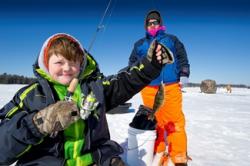
Ice Crappie

Ice Crappie

If you dress for the conditions when you’re on the ice you’ll enjoy ice-fishing even more, and you’ll also be more successful at catching fish through the ice.

It got cold again! That’s good and that’s bad. It’s good, because the ice is getting thicker and safer across most of the ice-fishing region. That means more anglers will be on the ice in the near future.

It also means that it’s easier for those ice-anglers to get cold, and usually getting cold is not a fun part of ice-fishing. However, it’s not necessary to get cold when you’re ice-fishing or doing anything outdoors this time of year. There is so much outstanding and affordable clothing that there really is no need to get cold outside unless you’re in unusually extreme cold. Here are some ideas for staying warm on the ice.

Remember, if you get too warm, you’re going to get cold. If you’re drilling a lot of holes in the ice, or walking from hole to hole a lot, you’re going to get warm. When we get warm, we sweat, and if that sweat gets trapped next to your skin, you will eventually get cold. We want to be wearing under-garments that will wick the sweat away from your body. Garments made from cotton are not the answer: Cotton traps the sweat. Cabela’s MTP and Polartec base layers are a great place to start.

My next layer is usually a hooded sweatshirt, and I then slip into water resistant bibs. I prefer the bib style because it offers more protection from the wind to areas that could be exposed, and I like the water resistant feature because there are times when I kneel next to the hole to land a fish. The water resistant feature keeps me dry, and therefore warmer and more comfortable.

Next goes on the outer layer: I like parka length because, again, it provides more protection to areas of skin that could be exposed to the elements. My favorite is Guidewear for both the bibs and parka. In fact, the same Guidewear that I keep in the boat for summer fishing works great for ice-fishing.

Round this out with a cap and boots. Wear a stocking cap or something of that nature. Heat escapes from an uncovered head. Set up your fishing position so your back is to the wind, and pull your hood up over your cap. If you’re facing into the wind and you pull your hood up, you get a swirling effect, and that can be not-so-pleasant.

If your feet get cold, you’re going to be cold and uncomfortable. Boots can be a personal thing: Some folks like big “pac” insulated boots that are very warm, but can also be heavy. They’re great for keeping warm, but they make walking around a lot of work.

There are lots of lighter weight boots available that do a great job of keeping your feet warm if you keep moving–several layers of wool socks can help a lot, but be sure to size your boots big enough that the layers don’t cramp your toes–cramped toes are cold toes.

And then, probably the best way to keep warm on the ice is to fish from a permanent shelter that has a heater inside. This year I’m spending quite a bit of time in an Ice Castle house. It’s warm, it’s comfortable, and it’s also very easy to move to follow the bite. Now, that’s really the way to go ice fishing.

To see the newest episodes of Fishing the Midwest television go to fishingthemidwest.com. Visit us at Facebook.com/fishingthemidwest

Lake Hartwell Is So Big It Offers Bassmasters Classic Challenges

As one of the largest lakes in the Southeast, Lake Hartwell has 56,000 surface acres and 962 miles of shoreline. This lake will prove to be a challenge for the 56-angler field competing in the 2015 GEICO Bassmaster Classic presented by GoPro.

Massive Lake Hartwell Presents Challenges, Opportunities For Classic Anglers
from BASS

BIRMINGHAM, Ala. – When talking with one of the 56 anglers taking part in the GEICO Bassmaster Classic presented by GoPro, Feb. 20-22 on Lake Hartwell, you can expect to hear the words “big” and “everything” a lot.

Serving as a border between Georgia and South Carolina, the lake has 56,000 surface acres and 962 miles of shoreline. That makes it one of the Southeast’s largest and most popular fishing destinations.

“It’s a lot bigger than I remember it being when we were there for the Classic that Alton Jones won (in 2008),” said Aaron Martens, who will be making his 16th career Classic appearance. “I don’t think I even saw half of the lake back then. It’s got a lot of acreage, and the amount of fishable water in that acreage is pretty large.”

The size of the lake combined with its diverse structure could make it hard for anglers to form a solid game plan that’s likely to withstand three days of the area’s often-erratic winter weather. The lake has everything from long, sloping points and underwater islands to standing timber, rocky banks, man-made brushpiles and deep underwater channels.

“There’s so much to look at – a little bit of everything, everywhere,” Martens said. “You can catch them shallow to deep. You have to be ready for it all, but that’s what we do. I think the fish will bite. But depending on the weather, it could be hard to present certain techniques to them.”

Along with diverse structure, Hartwell has two species of black bass that could both be helpful to anglers. First, there are the largemouth that have been the staple of most tournaments on Hartwell for decades. Then there’s the spotted bass that have steadily increased in size the past four or five years since making their way downstream from Lake Keowee, where they were introduced more than a decade ago.

Classic competitor Casey Ashley, who lives just 35 minutes from Lake Hartwell in Donalds, S.C., believes spots could play a major role in the outcome of the tournament.

“It could possibly be won off spots,” said Ashley, who won an FLW Tour event on Hartwell in March 2014. “The 3- to 5-pound spots are there, and there are a lot of them. I’ve just now gotten to where I’ll actually target spots. I wouldn’t in the past because for years, you just couldn’t win with spots. That’s just not the case anymore.”

Elite Series pro Stephen Browning of Arkansas, who will be appearing in his 10th Classic, isn’t sure the event can be won with spotted bass. But he believes they could make for an excellent “Plan B” if the largemouth prove too stubborn.

“Personally, with the exception of the Coosa River (in Alabama), I’ve never seen a lake where a guy can win a multiday tournament exclusively on spotted bass,” Browning said. “But mixing five or six of them in with largemouth may help you survive. I feel like if a guy gets to struggling, those will definitely be the fish to turn to.”

Those anglers and the rest of the field will be aiming to do more than survive — they’re gunning for the $300,000 winner’s prize and the almost instant fame and fortune that go with winning.

Weigh-ins will be held daily at the Bon Secours Wellness Center Arena in downtown Greenville, with the winner to be crowned there Sunday afternoon, Feb. 22.

Plenty of activities are available to fishing fans prior to the weigh-ins. For those willing to brave the morning chill, the Green Pond Landing at Anderson, S.C., provides a fan-friendly setting for watching the pros take off each morning. And one of the country’s largest consumer fishing shows, the Bassmaster Classic Outdoors Expo presented by Dick’s Sporting Goods, will be open all three competitions days. All three venues are free admission.

The local host for the 2015 GEICO Bassmaster Classic presented by GoPro are VisitGreenvileSC, Visit Anderson, Greenville County, Anderson County and the state of South Carolina.

About B.A.S.S.
B.A.S.S. is the worldwide authority on bass fishing and keeper of the culture of the sport. Headquartered in Birmingham, Ala., the 500,000-member organization’s fully integrated media platforms include the industry’s leading magazines (Bassmaster and B.A.S.S. Times), website (Bassmaster.com), television show (The Bassmasters on ESPN2), social media programs and events. For more than 45 years, B.A.S.S. has been dedicated to access, conservation and youth fishing.

The Bassmaster Tournament Trail includes the most prestigious events at each level of competition, including the Bassmaster Elite Series, Bass Pro Shops Bassmaster Open Series presented by Allstate, Old Milwaukee B.A.S.S. Nation events, Carhartt Bassmaster College Series, Bassmaster High School Series, Toyota Bonus Bucks Bassmaster Team Championship and the ultimate celebration of competitive fishing, the GEICO Bassmaster Classic presented by Diet Mountain Dew and GoPro.

Crankbaits and Jerkbaits I Like and Use

These crankbaits and jerkbaits work well for me:

Rapala DT Series Crankbaits

Rapala DT Dives-To Series Crankbaits

Bomber Deep Fat Free Shad Crankbaits

Bomber Deep Fat Free Shad Crankbaits

Dives up to 19Tourney-proven actionSlim baitfish profileRsonant rattleBrilliant, fish-attracting finishesA 19 dive on one cast? That’s right. The Deep Fat Free Shad gets down to where the biggest bass lurk, and its tourney-proven action and slim baitfish profile draws the strike every time! And with a resonant rattle and brilliant, fish-attracting finishes, your cranking success is assured. Length: 3. Weight: 3/4 oz.


Strike King KVD 1.5 Flat Side

SPRO McStick 110 Jerkbaits

Deer Processors Are Different

The only reason I deer hunt is for the venison. I try to kill three or four deer each season for the freezer, and have dozens of favorite ways to cook the meat. One of the most important things about good tasting venison is what you do after shooting the deer and the way it is processed.

I gut any deer I shoot immediately and wash it down carefully. Then I take it to a processor. I like for the deer to hang for a few days before being cut and packaged. Hanging in a cooler makes the meat more tender and flavorful.

For the past several years there was a very good processor, Done Rite, out near my farm. I was very well pleased with the way they handled my deer but they did not open this year. The three deer I shot this year were taken to three different processors with different results.

I shot a 115 pound doe opening day of season. I weigh each deer I kill and then weigh the meat I get back. I carefully gutted and skinned the deer and saved the heart and liver. Yes, I eat both and they are delicious! I also cut out the rib cages to cook.
This deer I took to a processor near my house that shall remain nameless. To be fair about the weight of meat I got back I asked if they cut out the meat from the ribs and they told me there was not enough to mess with.

I got the usual cuts, cube steak, ground meat, butterfly chops and a neck roast and the ground meat was packaged in tubes, something I like. But the rest was in the same kind of trays and wrap that you get from the grocery store. That kind of wrapping allows freezer burn too fast.

From a 115 pound deer I got 28 pounds of meat, only 25 percent of its live weight. And they charge $70 no matter what size the deer.

The second deer I shot was small, only 60 pounds live weight. I took it to Huckabys near Senoia since I had herd they charged by the size of the deer and did a very good job. They did. The meat was vacuumed packed, a very good way to protect it, and the ground meat was in tubes. I got 22 pounds of meat, over 33 percent of the live weight, and it cost me only $35.

Huckabys did not take any deer after Christmas and I shot a 110 pound buck on December 26, so I took it to York in Barnesville. They came highly recommended, too, and they did an excellent job. I got 49 pounds of meat back, almost 50 percent. And it was wrapped in butcher paper with plastic wrap on the outside, a good protection.

They charge $75 no matter what size the deer but they get every bit of the meat. And that included skinning the deer. They also told me they would rather gut it themselves, but most places charge a lot to gut a deer and I would not get the heart or liver.

Next year I will carry any small deer I shoot to Huckabys but, since York is closer to me, I will take bigger deer to them!

What Are Electronically Aided Collisions?

Electronically Aided Collisions

Editor’s Note: Today’s feature on the Electronically Aided Collision designation isn’t a joke. As pilots and long-distance truckers have long known, too-much attention to the electronics and too-little situational awareness can have horrible consequences.

by Frank Sargeant, Editor
from The Fishing Wire

Glass Cockpit

Glass Cockpit

A ‘glass cockpit’ like this one is a wonderful asset to offshore fishing and navigation, but boaters can sometimes be seduced into watching the screens more than they keep a lookout ahead.

“Electronically Aided Collisions”, EAC’s, sounds like a joke, but they’re an actual new designation of Coast Guard accident descriptors. USCG says so many accidents are occurring as a result of the electronics many of us now have aboard–ostensibly to help us avoid accidents–that it made sense to set up a category for it, and of course this being the Coast Guard, they gave it an acronym.

The issue is basically the same as for those ashore who are unable to restrain themselves from texting while driving a vehicle–distracted attention has unfortunate results when you are responsible for piloting several tons of moving mass.

Afloat, though, there is some reason for us to be playing with our electronics–they are usually our only means of navigation offshore, as well as our all-important fish-finding tool–absolutely critical in reef fishing, and very helpful too with pelagic species that often hang around major bottom breaks, sea mounts and other structure.

Radar

Radar

Radar makes it possible to operate safely after dark and in fog and rain, but a sharp eye ahead is always required when the boat is underway.

We depend on them for weather, for operation in low light and fog, to help us in locating aids to navigation (i.e. buoys), hazards and lots more–basically most offshore anglers would prefer to stay at the docks these days rather than attempt to fish or travel long distances without their electronic nav and sonar systems.

But in all this dependency, it’s easy to forget that the electronics are not a video game at home in the man-cave. A real-time lookout ahead every minute the boat is moving is a must to avoid consequences that range from just dumb–like running over a log and wiping out prop or lower unit–to catastrophic, like striking another boat or a fixed object.

The danger goes up exponentially with autopilots linked to the electronics. We quickly come to depend on them, in combination with the GPS, to drive the boat for us, avoiding the struggles with maintaining course that sometimes come in rough seas.

Radar and GPS

Radar and GPS

Radar overlaid on a GPS screen provides loads of information to the modern boater who can afford the full electronics package.

But, as an old skipper told me once, an autopilot has no brain, no eyes and no conscience–it will happily drive your boat right over a fleet of whale-watchers peacefully paddling their kayaks or a family pontoon boat out for a sight-seeking trip.

Don’t forget, too, that if you set the exact location of a marker as a waypoint, and then punch that waypoint into your autopilot and let the boat take you to it, the boat will very likely HIT the marker when you get there if you’re not alert.

Radar identifies ships and piers clearly, but may not mark–or may return a very dim echo–from a kayak–or a floating log.

Texting is less of an issue offshore where cell phones won’t work–but working to label a fishing site can also be an issue–best to simply “save” and then put in the descriptors when you’re safely shut down.

It’s also wise to remember that all electronics sooner or later break down. Constant exposure to the vibration, humidity and corrosion present around marine venues means they have a limited lifespan, and if you are depending on the unit to drive the boat at the moment when it gives up the ghost, you and your crew may be in big trouble.

Weather on Radar

Weather on Radar

Radar can also alert boaters to bad weather ahead, but there’s no substitute for eyes-on real-time information.

Sometimes, even when they’re working, they’re just plain wrong. My GPS invariably used to show me traveling right THROUGH a mile-long island when I drove down the Little Manatee River just off Tampa Bay.

They don’t keep track of their masters, either. Recently, former Miami Dolphins player Rob Konrad fell off his boat while fishing in South Florida. The boat was running on autopilot and promptly left Konrad behind. Fortunately, he was still a pretty athletic guy–he swam the 9 miles back to shore, arriving at 4 a.m.! The Coast Guard found his boat many miles away, still chugging along happily on autopilot.

Even far offshore, you can never take your eyes off the course ahead–boats show up out of nowhere. So do large chunks of floating debris, big enough to destroy your lower units.

Night operation is particularly hairy. I used to fish offshore occasionally with a great commercial reef fisherman who ran out there in a Cigarette type boat at 40 to 50 mph–at night! While he was perfectly happy to sit in the cabin and watch the radar at that speed, I was always a nervous wreck by the time we got to the ledges about dawn. (The decks would be littered with flying fish by the time we got there–they hit the cabin like baseballs as we sped along!)

Bottom line is that a “glass cockpit” is a wonderful thing, but our electronics are not yet even close to being set-and-forget; you are obligated, both morally and legally, to keep a lookout every moment your boat is underway, if you don’t want to become one of the Coast Guard’s EAC’s.

Terms Gun Ban Fanatics Use Proving They Are Irrational

The all out assault on guns, gun owners and the 2nd Amendment continues at an unbelievable pace. One of the main reasons it is almost impossible to have a rational discussion on guns and what needs to be done to actually make a difference in violence is this concentration on guns as the problem, and the misinformation and outright lies pushed constantly.

Assault weapon is a term you hear all the time. What is an assault weapon? I guess anything used to assault anyone, from pencils to a piece of rope can be called an assault weapon. The true definition of an assault weapon is an automatic weapon that will fire steadily with one pull of the trigger, or fire in three round bursts. All those guns are already tightly regulated and almost impossible for citizens to purchase or own.

The liberal media and gun ban groups seem to classify any semiautomatic gun as an assault weapon, since they usually say “military style assault weapons.” They usually mean a gun that looks ugly and holds more than ten rounds. That can include anything from my Remington .22 to the now famous Bushmaster AR 15. To ban “assault weapons” can mean ban any gun you don’t like.

High capacity clips are one of the biggest evils if you listen to the media. But many guns hold more than ten rounds. And even if bigger clips are banned, you can change clips in seconds, with little difference in the number of bullets you can shoot quickly between a smaller clip and a bigger one.

The National Rifle Association is demonized daily. The NRA is a gun rights organization that supports hunting and shooting. They also have many training segments, with over 1100 certified police officer trainers. The NRA offers safety training programs for schools and other groups, and insists on safe and legal use of guns.

The NRA has 4.3 million members. Yet the media claim they are a shill group for gun manufacturers and sellers because those businesses support them. Any group that supports an activity will be supported by businesses that sell to those kind of activities. The bass tournament trails are supported by fishing equipment manufacturers but they are certainly not shills for them, any more than the NRA is a shill for gun businesses.

More than 100,000 people have joined the NRA in the past six weeks. The biggest gun ban organization, the Brady Center to Prevent Gun Violence, has 28,000 members. That alone should tell you who citizens support, regardless of the claims by the media and gun ban organizations.

Cop killer bullets and hollow point bullets are another evil that gun ban organizations claim only the military need. But the military uses full metal jacketed bullets. Hollow point bullets and soft tip bullets are used for hunting. In fact, bullets that expand are required for big game hunting. So banning them bans hunting bullets. And cop killer bullets are usually defined as any bullet that will penetrate a bullet proof vest, which means any high power rifle bullet suitable for deer and other big game hunting.

Big bullets is a term many gun banners use to define the .223 round used in the Bushmaster and many other rifles. But the .223 is almost the smallest center fire bullet available, and just barely legal for deer hunting. My old 30-30 fires a round almost half again as big around as the .223, and is more powerful since it has more powder. All higher caliber big game rifles fire a much bigger and more powerful bullet.

You will hear about the number of kids killed by guns each year, but the huge majority of those are 18 to 21 year olds, not young kids, and many of them are gang bangers that shoot each other with illegal guns. Any kid killed is a tragedy but no gun ban or bullet ban will affect the number.

The misinformation goes on and on and only leads people like me to work harder to stop misguided laws that only affect law-abiding citizens like me.

Is Cliff Price Ready for the Classic?

Former Classic® Champion Pace Anxious for Competition to Begin
from The Fishing Wire

Cliff Price

Cliff Price

After Missing 2014 Season Due to Injury, Cliff Pace is Ready to Fish Again

With the Bassmaster Classic® world championship now less than eight weeks away, it’s pretty safe to say none of the 56 anglers who will be competing are looking forward to the event as much as 2013 Classic® winner Cliff Pace. That’s because the Yamaha Pro has fully healed from a severe leg injury that forced him to miss the entire 2014 Elite Series season and 2014 Classic,® and also because this year’s event will be on South Carolina’s Lake Hartwell, where Pace finished second in the 2008 championship.

“I don’t have any butterflies, yet,” smiled Pace, after returning from an early scouting trip to Hartwell. “I’m just glad to be fishing and getting involved again. Sitting out this past year was miserable for me. I missed the competition and being around my friends.

“It really doesn’t matter to me where the Classic® is being held, because I’m just thankful for the opportunity to compete again.”

A year ago, Pace broke both the fibula and tibula in his left leg when he fell 20 feet while climbing down from his tree stand while deer hunting. The accident also tore his ACL tendons. After being on crutches and unable to put any weight on his leg for three months, Pace literally had to learn to walk again.

Cliff Price Has Recovered

Cliff Price Has Recovered

“I went to physical therapy every other day, pushing myself as hard as I could,” remembers the Yamaha Pro, “and the doctors say I probably shortened my recovery time by six months or more. All I can say about the experience is that I don’t want to go through it again.”

Before he was off his crutches, however, Pace actually began bass fishing again, although not the way the Mississippi angler is accustomed to doing. Friends literally lifted him into his bass boat while still in the parking lot, then launched and slowly trolled him around small lakes near his home as Pace cast from the back deck seat.

“I just simply had to get outside, if only for a few hours,” he says. “Before the accident, I was either fishing or on my way to go fishing, practically every day of the year.”

By October, the Yamaha Pro had recovered well enough to compete in the final Bassmaster® Southern Open of the year on Lake Norman. Although he struggled in rough water the final day of that event, he still managed a 10th place finish. Since then, Pace has continued to fish as often as possible, and in late December spent a week on Hartwell before the lake went off-limits to Classic® contenders.

“These kinds of pre-tournament practice trips are all about guessing where bass might be in two months, and it is just a guess because it all depends on the weather conditions we have between now and the Classic,®” he emphasizes. “I did very little actual fishing, and one day I don’t think I even picked up a rod at all. Instead, I rode around and became familiar with the lake again. In fact, I didn’t even re-visit the places I fished in 2008.

“The lake is probably 10 to 12 feet higher now than it was during that Classic,® and I remember catching my fish then a different way each day. Typically, Hartwell sets up more as a ‘pattern lake’, which is what I like, so I looked for different places in each section of the lake and tried to determine which patterns might prevail when we’re there.”

Cliff Pace Getting Ready for Hartwell

Cliff Pace Getting Ready for Hartwell

Still, the Yamaha Pro knows conditions are likely to be different during the Feb. 20-22 tournament, because during his visit the water temperature registered an almost-balmy 55 degrees, which is surprisingly warm this late in the winter.

“Hartwell also has a much higher spotted bass population today than it did in 2008, so I’m sure that will also play a role in the outcome of the Classic,®” he concludes. “Essentially, I think it will be a completely different type of event.

“All I can say is that I’m honored, and very, very glad, to be able to fish it again.”

I Have A Drive To Fish and Hunt

Why are some people driven to fish and hunt while others don’t like either and some just go when convenient a few times a year? Some of us want to spend all out time in the woods or on the water. It is an obsession for many.

There are many kinds of hunters and fishermen. They range from dedicated deer hunters that spend all year planning, scouting and working to find their trophy buck. Most of those hunters seem to be solitary types that don’t really brag or show off their kills. They do it for the personal satisfaction.

At the other end of the group are the ones that don’t scout before season and don’t put much effort into planning. Some even bait deer illegally. They sometimes luck into a big buck that was in the wrong place at the wrong time. They seem to be more likely to put any big buck they kill on display, parading it around town showing off to anybody that will stop and look.

Many hunters just go for the meat. We are more likely to shoot any legal deer for the freezer and hunt only enough to fill the freezer each year. They are careful with the carcass, making sure the meat is the best it can be when processed.

Fisherman have the same range. Some go a few times a year and don’t put much effort into it. They may have the best equipment money can buy but they don’t really know how to use the electronics they spent thousands of dollars on, their reels are not cleaned and kept in good shape and they seldom change line on the reels.

If they are bass fishermen they might do well in a tournament and everyone around the weigh-in that will listen hear in great detail how they outsmarted every fish they caught. But more likely they are explaining how they could have won the tournament if they had just gotten one more bite or if the time didn’t run out by the time they figured out what the bass were doing that day. And they explain how they missed every fish they didn’t catch.

Some bass fishermen are very careful with their equipment and keep it in top condition. They study their electronics and know how to use it to its maximum. Bass habits and patterns are studied and a lot of time goes into planning every tournament. And when they do well, as is usually the case, they are understated at the weigh-in, saying they lucked into the fish they caught. But those that know them know it was not luck.

Many fishermen go just for the food, too. Those fishermen are happy catching any edible fish in the water and keep what they catch for the frying pan. They usually know many ways to cook fish and take care to keep them on ice and clean them quickly to preserve the fresh flavor.

Most hunters and fishermen respect their quarry, but some don’t. If they catch a bass too short to keep in a tournament they may throw it in an arch back into the water rather than easing it back into the water to make sure it survives to grow bigger. They get mad when they don’t catch much, blaming everything from other fishermen to the weather.

Slob hunters bait deer and don’t make much effort to find a deer they wound. A good hunter will spend hours trailing an injured deer but they are more likely to make a good killing shot in the first place. They make sure their gun is zeroed in before season and take time to make a good shot, and they know how to shoot accurately. The other kind of hunter never checks his rifle to make sure it is accurate, takes shots they should not and then blame the gun.

Most of us fall somewhere in between the extremes. We spend enough time to be in a good place during deer season and might kill a big deer. Little bragging is done since we know killing a trophy buck was more luck than skill. And doing well in a tournament is a combination of luck and some skill, but we don’t feel a good day makes us an expert.

Professional fishermen and guides are a whole different category. They work at their passion so others can do well in the case of guides, or they can get sponsors and win money in tournaments if a pro. Some are slobs on the tournament trails, getting mad when they don’t win a tournament to the extent of kicking equipment, blaming other fishermen for “stealing” their spots, and generally making fools of themselves. Those types don’t keep sponsors long and don’t gain respect of others on the tournament trails.

These types of people are not limited to hunters and fishermen. You can find them in any sport from golf to football. What kind are you?

Randy Howell Scouts Lake Hartwell for Bassmasters Classic

Defending the Classic crown: Randy Howell scouts Lake Hartwell in preparation for the Feb. 20-22 Bassmaster Classic

Today’s feature comes to us from 2014 Bassmaster Classic champion Randy Howell, offering a few thoughts on how he intends to fish in this year’s event.
from The Fishing Wire

I don’t really ever make resolutions for New Year’s – I prefer to set goals instead. Looking back at this same time last year, my number one competitive goal was to win the 2104 Bassmaster Classic.

“Check” on that one.

Randy Howell

Randy Howell

Randy Howell hoists the Classic trophy high after his big win last year on Lake Guntersville.

My biggest competitive goal as I head into 2015 is a big one: to be a back-to-back Classic winner. In order to accomplish that goal, I also have “sub-goals” jotted down in my iPhone notes, and the first sub-goal is simply “Work hard in practice in preparation for the Bassmaster Classic.”

So far so good on that one.

I just got back from a week of scouting for the 2015 Bassmaster Classic on Lake Hartwell in South Carolina, and I’m pretty encouraged by what I found there.

DECIPHERING LAKE HARTWELL

Right out of the gate, I knew I had some work to do, because I’d never fished Lake Hartwell before I scouted it just prior to New Year’s Day. The Classic was held there in 2008, but I didn’t qualify for that Classic, so I was pretty anxious to get on the water and start to break the fishery down a little.

My first impression of Hartwell is that I really didn’t realize how big it was. I looked at maps and knew that it had around 900 miles of shoreline, but once I got there and started scouting, I realized that Hartwell might be one of the most productive top-to-bottom fisheries I’ve ever seen. Typically, you can look at a reservoir that big and eliminate a lot of water that won’t be productive.

Not Hartwell.

It’s a lot like Lake Guntersville in that it has so much fishable, productive water with a lot of fish in all of it, from one end of the lake to the other. That really makes the Classic anybody’s ballgame, because there are several different patterns that could play big roles in winning that event.

Having a mixed bag of tricks and being versatile are going to be a big deal. If you’re able to fish multiple techniques well, it’ll really show out well at this Classic.

There are some fisheries where you just have to be hard-headed and stick with the jig or the swimbait and just grind on them for four days straight, but I think you’re going to have to mix it up with three of four different techniques to win at Hartwell.

THE CHAMP’S CHOICES: TOP FOUR BAITS

Crankbait Bass At Hartwell

Crankbait Bass At Hartwell

Howell was able to find crankbait fish on Lake Hartwell during a scouting expedition to the site of this year’s Classic. If the crankbait bite is on by Classic time, his chances will be good.
To be honest, I probably only fished for four or five hours total while I scouted Hartwell – I spent most of my time just driving around, making myself familiar with the layout of the lake – but what I found leads me to believe that the following Team Livingston baits are going to be big parts of my gameplan come the Classic:

Howeller DMC: The same bait I won the Classic last year with is going to be HUGE for me this year. The little I fished during scouting, I caught big fish on the Howeller DMC. Hartwell really sets up well for that 6- to 10-foot zone in February, which is perfect for the Howeller, and I caught a 5-plus-pounder on literally my second cast on the second point I stopped on during scouting.

I’m going to have some custom paint jobs done that mimic the look of the blueback herring in the reservoir, but I’m pretty sure the Howeller is going to be a go-to bait.

School Master: I’m really excited about this bait in general – I’ve been fishing a homemade version of it for awhile – but the School Master with EBS MultiTouch Technology™ could be a really good option at Hartwell. It’s a slow-falling bait that you can let fall into those schools of fish that suspend over deep trees, and a bait where the MultiTouch™ sound technology will really shine. If that pattern and depth are firing during the Classic, the School Master’s slow-fall action and multiple-sound options could be big players.

Howell At Classic

Howell At Classic

Howell caught many of his winning fish at last year’s Classic on a Livingston Lures crankbait since named the “Howeller” in his honor.

Howeller DMC SQ: If it warms up the week of the Classic and fish get shallow, the Howeller DMC SQ could be a big one. That bait vibrates really hard, it darts and digs well, and has a really great, erratic action to it. That bait will probably be my go-to for shallow bank-beating, and I’ll likely throw it in Guntersville Craw. Hartwell has a lot of red clay and crawfish, and the Guntersville Craw color family really seems to be a favorite in February and March for local anglers.

Deep Impact 18: The major difference that people will see in this Classic versus the 2008 Classic held on Hartwell is the role the spotted bass will play in the tournament. Hartwell’s spotted bass have done really well in recent years, and you’re going to have to catch them to be competitive. From what I saw during my scouting, Hartwell’s spotted bass really like the Deep Impact 18.

This bait isn’t erratic and fast like the Howeller SQ: it has a really smooth action, and a subtle, tight wobble. The action alone makes it a good cold-water bait, but if fish are keying on that 15- to 20-foot depth, the Deep Impact’s EBS MultiTouch™ sound attraction range is going to make a huge difference.

I’m really looking forward to getting back to Hartwell during Classic week and sort of “dialing in” during our official practice days. I feel like I’ve accomplished one of my sub-goals in preparing hard for the Classic, and am ready to take the next step in accomplishing my big goal for 2015: to raise the Classic trophy again!