Are You Dangerous If You Have A Gun Carry License?

Do you have an Alabama Carry Permit, allowing you to carry a concealed weapon? Could you pass the fingerprint background check and get one if you wanted to? If so, the Brady Campaign to Prevent Gun Violence considers you a dangerous person.

The silly anti-gun Brady Bunch sent out at least seven emails in the two weeks before the Vitter Amendment was voted on a few years ago. The Vitter Amendment was an amendment to the Department of Defense funding bill that would have allowed people with a gun license from one state to carry a gun in other states.

Right now you can drive in every state in the US with a driver’s license issued to you in your home state. You still have to obey local traffic laws, and the Vitter Amendment said you had to obey local gun laws when in other states. But the gun control fanatics went crazy opposing this amendment.

This is a quote from a July 9 Brady Bunch press release on the Vitter Amendment: “This legislation would force states, your state, to allow dangerous individuals to pack heat in public.” So they consider you a dangerous individual if you have a gun license! Here is more from a July 17 press release: “Very dangerous legislation that would force states, your state, to allow dangerous individuals to carry loaded guns in public could be voted on as early as Monday, July 20. And we must stop it!”

This amendment failed by a 58 to 39 vote in the US Senate. No, 58 US Senators voted in favor of your rights. Only in the US Senate is a 58 in favor to 39 against vote a defeat!

But the Brady Bunch was ecstatic! On July 22, after the Vitter Amendment lost although it got 58 yes voted out of 97 cast, the Brady Bunch crowed “You helped stop the gun lobby’s legislation that would have forced states to allow dangerous individuals to carry loaded guns in public.”

Yep, now law-abiding citizens like you and me who have gone through a fingerprint background check to get a concealed carry permit can’t cross a state line and be legal. No doubt someone planning on robbing a convenience store across the state line will stop and leave their illegal handgun in the car because this amendment failed.

It is not rational to limit law-abiding citizen’s rights thinking criminals will obey laws. By definition, criminals break laws. All gun control laws do is disarm law-abiding citizens and make them venerable to criminals.

Both Senator Shelby and Senator Sessions voted in favor of this amendment to protect your rights, as did all but two Republican US Senators. There were 37 Democrat votes against your rights.

Thank Senator Shelby and Senator Sessions for voting to protect your rights. And also thank Troy King, Alabama State Attorney General, for signing a letter to U.S. Attorney General Eric Holder expressing his opposition to reinstatement of the federal ban on semi-automatic firearms.

King is one of 23 state Attorneys General, the top law enforcement officers in each of their states, to sign this letter. That is amazing. The top law enforcement officers in almost half our states oppose renewing the assault weapons ban. Kinda makes claims that banning these guns will reduce crime look stupid, doesn’t it?

So far only US Attorney General Eric Holder is the only one talking about bringing back this useless ban. Most elected officials realize it is a useless law and will hurt them politically, but unfortunately there are unelected folks like Holder that can affect our gun rights.

Keep a watch on our elected officials but keep a closer watch on those unelected bureaucrats that control our lives.

How Good Is January Bass Fishing In Georgia?

Bass fishing was tough last month with the water temperatures in the 40s but it will start getting better this month when we have a few warm days in a row. But since bass clubs here fish 12 months of the year, we put up with the good and bad.

Three weeks ago the Flint River tournament at Sinclair was won with just over nine pounds but it took only 4.89 pounds for fourth place. The water got even colder by the next Saturday when the Potato Creek Bassmasters went to Sinclair.

In that tournament a week ago last Saturday 15 fishermen landed 35 keepers weighing 55 pounds. There were two limits. Raymond English had five weighing 7.57 pounds for first. William Scott placed second with four at 7.35 pounds, JJ Compton had five at 6.19 for third and Mike Cox, with just one fish, but the right one, was fourth and had big fish with a 5.18 pounder.

Last Sunday the Spalding County Sportsman Club fished Jackson for our February tournament. After fishing eight hours 13 members brought in 19 keepers weighing about 25 pounds. There was one limit and three fishermen didn’t have a keeper.

I won with five at 7.34 pounds, Chris Davies had two at 4.03 for second and his 2.54 pound spot was big fish, third was Sam Smith with three keepers weighing 3.03 pounds and Jordan McDonald had one weighing 1.74 for fourth.

This year has been Déjà vu all over again for me. Last year and this year in the first Flint River tournament at Sinclair I got second place and second biggest bass. Lee Hancock beat me for both first and big fish both years. Last year at Jackson I had the only limit and won, and had second biggest fish, just like this year. I hope I break that pattern since the Flint River club is fishing Bartletts Ferry next Sunday and last year I zeroed that tournament!

Jackson was tough. Linda and I had gone to Jackson on Wednesday and rode around, mostly looking for baitfish, a good sign bass are in an area. I fished a little and landed one keeper on a crawfish crankbait.

On Sunday Jordan and I started on one of my favorite rocky points but got no bites. After about an hour we headed to the creek where I won last year and there were six boats fishing the area. I will not pull in right ahead of another fisherman so I went to another place.

After working a few points and banks I cast a crawfish crankbait to a boathouse and ramp in front of it and thought I hooked a stick.

My line went a little sideways but I felt nothing. Then it pulled a little and I landed a keeper largemouth at 10:10 AM.

We started fishing places I fished years ago but had not tried for a long time. The reason I fished them was the shad I saw on my depthfinder in the areas on Wednesday. At 11:10 I hooked a spot off a seawall and rocky point and landed it, and on the other side of the point Jordan got hung on the rocks. As he pulled his crankbait loose his keeper hit it and he landed it.

At 12:10 I cast to another rocky point and landed my biggest fish, a two pound spot. Then I cast to a seawall and started reeling and again my line went sideways like I had hooked a stick. But I saw a flash in the water and landed my fourth keeper at 12:45.

After trying a few more places I went to where I had landed the keeper Wednesday and again my line went sideways coming off a seawall. It was another keeper largemouth and filled my limit at 2:15. After that I started fishing a big jig and pig hoping for a big fish and giving Jordan a chance to cast his plug to places first. I was trying to help him catch more keepers as well as trying to land a big fish myself, but it didn’t work for either of us.

The bass were very sluggish in the 45 degree water and I was surprised to land three largemouth. Spots usually bite better in cold water and there were only five largemouth brought to the scales out of 19 keepers in the tournament.

When the water is that cold I fish a crankbait very slowly. When it hits the water I turn my reel handle a couple of times to get it down to the bottom then move it as slowly as I can to keep it there. I told Jordan I thought he was fishing too fast. He was making two casts to my every one cast.

Until the water starts warming and gets above 50 degrees, fishing slowly and fishing for spots are your best bets. Some really big bass are caught this time of year. You may not get many bites, but they may be bragging size. Most of my biggest bass, including my first two eight pounders, my biggest ever, a nine pound five ounce largemouth and my last eight pounder, a eight pound thirteen ounce largemouth, were caught at Jackson in January and February. All but one hit crankbaits.

Don’t let the cold keep you home. You can catch bass this time of year.

Tips On Fishing for Bass In January

Tips for Bass Fishing in January from Denali Pro Michael Murphy
from The Fishing Wire
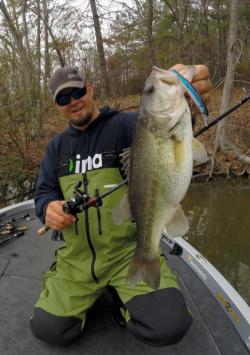
Catch bass like this in January

Catch bass like this in January

Unless you live in Florida or south Texas, the bass in your local lakes are likely swimming in some of the coldest water they see all year. Fishing for them can seem like an exercise in futility, not to mention a great way to expose yourself to some pretty unfriendly conditions.

As intimidating as the negatives of winter fishing can be, there are also some positives. The scenery can be amazing, there is little to no competition, and the fish you do catch are usually the right ones.

By focusing on those positives, FLW Tour veteran and Denali pro Michael Murphy has developed a healthy appreciation for winter bass fishing.

“We can talk all day about the cold, or how they don’t always bite well in the winter.” Murphy said. “But what I like to focus on is how refreshing it is to have the lake to yourself, see some beautiful scenery, and catch giant bass.”

Murphy has always been a jerkbait fisherman, a trait bred into anglers that fish the clear, blueback lakes around his Lexington, S.C. home.

“I spend a lot of time on lakes like Murray, Hartwell, Clarks Hill, and Wateree. All of them have clear water and have dynamite winter jerkbait bites. The bass are suspended in that cold, clear water. A jerkbait just hanging in their faces triggers strikes on even the worst weather days.”

Obviously, the first key to success with winter jerkbaits is to put on some cold weather gear and actually get out on the water. Once there, Murphy has the following tips to help you extend your bass catching season into the New Year.

1. Use the right rod

Murphy said that the number one thing anglers struggle with when fishing jerkbaits in cold water is getting the setup rod right. “Having a rod that is designed perfectly for your technique is more important in the winter than it is any other time of the year. It’s already cold, your hands may not work as well, and you’re likely wearing a bunch of gear. If you’re frustrated from fighting with backlashes or missing and losing fish (which are all things that happen with jerkbaits when you don’t have the right rod), you’re not going to be successful or have fun.”

Murphy uses the Denali Rosewood jerkbait rod (S802JBC) that he designed, and pairs it to a 6.4:1 Lews BB1 casting reel. As the primary designer of the rod, Murphy put a lot of time on the water testing to ensure that it has the absolute perfect flex and power for fishing jerkbaits in cold water.

“We built the Denali jerkbait rod as an alternative to the high dollar custom jerkbait rods lots of guys were using. We shortened the rod handle so it doesn’t get in the way of heavy clothes, gave it the right parabolic bend to keep fish hooked up, and kept a good tip for getting the proper action.”

Winter bass are lethargic and often just slash at jerkbaits, resulting in poorly hooked fish. If you’ve got a big bass hooked up with just a single hook or outside the mouth, having a parabolic action with some give is imperative to keep the hook buried.

In addition to the parabolic flex, Murphy also designed the rosewood jerkbait rod to have a fast tip to impart the perfect subtle flash required to draw strikes in cold water.

“A lot of crankbait rods have that good parabolic action we were after, but they are kind of dead in the tip which makes them less than ideal for jerkbaits. We kept the flex in the mid-section of our jerkbait rod but added a faster, more sensitive tip so that you don’t lose the ability to precisely control your bait.”

As far as baits go, Murphy has had experiences with a number of different baits over the years, and said that almost all of them can be successful if the conditions are right. The one he uses the most though is the Ima Flit, which he also had a hand in designing.

“I look at the Flit as one of the only jerkbaits out there that can be successful under any conditions.” Murphy said. “It dives 6-8 feet deep like a Lucky Craft Staysee , has the subtle darting action of a Megabass Vision 110, the high pitched bb sound of a Rogue, and lacks the internal weighting system like a Husky Jerk. It does it all and I have a ton of confidence that it will catch fish no matter what conditions you’re experiencing.”

2. Work slow, fast

This might sound confusing at first, but winter bass often group up and suspend over different types of structures, making it important to fish a variety of different locations in a day to locate bass.

“I have seen winter bass suspend around almost any type of steep cover available.” Murphy said. “Sometimes it’s bluff walls, other times chunk rock points or dock pilings. Whatever it is though, it’s important to hit a bunch of spots in a day to figure out where the bass are. That’s where the fast comes in. I like to hit a spot for 15-20 minutes tops, and if I don’t get a bite then I’m off to somewhere else.”

The slow part refers to the actual fishing, and Murphy doesn’t stray from convention. He recommended anglers move from a jerk to more of a slide as the water temperature drops, while increasing the length of pauses.

“In really cold water, I actually do more of a slide than a jerk. Baitfish don’t really dart in cold water, so you need to mute it down some. The important thing is to start with slack and end with slack, then experiment with your pauses depending on how the fish react.”

3. Listen to the fish

Remembering the circumstances surrounding a fish catch can be important at any time of the year, but Murphy said that it’s exceptionally important when throwing a jerkbait in the winter.

“Sometimes the bass will get really dialed in to a specific cadence or pause length. If you pay attention to what you were doing when a fish eats, you can often replicate it and score the rest of the trip. I’ve seen it before where they only eat a bait after a 5 second pause and won’t touch anything different.”

The same can be said for the type of cover or structure a bass is caught near. Even though winter bass are more lethargic, they will position on different structures depending on the weather, wind, or light penetration.

“You hear pros talk all the time about pattern fishing, and winter jerkbaiting is awesome pattern fishing.” Murphy said. “If I catch a couple off a 45 degree pea gravel point, there are likely to be bass on other 45 degree pea gravel points all around the lake. I can then focus on those the rest of the day.”

The Final Word

In addition to the pointers above, Murphy has one last one that he said may be the most important, and that’s to not let cold and winter stop you from getting on the water.

“I can’t believe how many fishermen put their rods and reels away when the calendar flips to January. It may be cold, but if you pick up a jerkbait and put some time on the water, you’re going to catch a lot more bass than you will from your couch.”

Are Gun Owners Our Own Worst Enemies?

The comic character Pogo famously said “We have met the enemy and he is us.” I often feel that way about Georgia groups that are supposed to support gun owners. We bicker among our selves over trivial matters and almost seen to support Brady Bunch like gun control groups rather than supporting our right to keep and bear arms.

This was what was happening seven years ago.

Right now the Georgia legislature is playing ping pong with HB 89 that removes some restrictions from Georgia gun owners. It has been referred to a House/Senate Conference Committee, a place bills often go to die. At least part of the reason a bill supporting gun owners is having a hard time passing is the disagreement of groups that are supposed to support gun owners’ rights.

Did you know you can not legally carry your gun in a state park, even if you have a carry permit? Did you know that you could be walking down the street with your legally concealed gun, walk up on a group protesting something, and suddenly break the law simply because you had your gun at a public gathering?

The argument over the wording of HB 89 seems silly. Why are law-abiding gun owners in Georgia restricted in so many ways? Why can I carry my pistol into a liquor store but not into a bar? Why can I carry my pistol to a bass club meeting but not to a church meeting? Why am I not trusted based on where I happen to be?

Vermont has no laws restricting gun owners there. Anyone can carry a gun anywhere. According to the Census Bureau Vermont ranked 48th in violent crime in 2004. Georgia has all kinds of restrictions on carrying a gun and we ranked 19th in violent crime in the same report. Law abiding citizens carrying guns are not the problem.

Why do Vermont politicians trust their citizens while Georgia politicians do not trust us? Why are we so restricted in our rights? What purpose do the mish-mash of Georgia gun laws serve, other than to trap law-abiding citizens that make an honest mistake. They certainly do not reduce crime.

The latest shooting on a college campus is a perfect example of the stupidity of gun laws. An insane murderer killed five innocent students at Illinois State University. He had a shotgun and four handguns in a “gun free zone” on campus. That rule did nothing but disarm law-abiding citizens and make them easy targets. We deserve the right to protect ourselves without running afoul of some state law or university rule.

On a more positive note,

Shooting wire 2/15/08
Thirty one state Attorneys General have weighed in on the case, signing an amicus brief that supports the decision of the U.S. Circuit Court of Appeals in striking down the District of Columbia’s thirty-plus year gun ban. Since I’m one who criticizes pretty easily, it seems only appropriate that I list the names of those Attorneys General: Troy King of Alabama, Talis Colberg of Alaska, Dustin McDaniel of Arkansas, John Suthers of Colorado, Bill McCollum of Florida, Thurbert Baker of Georgia,

And a final note: one “inquiring mind” called me this week to ask if I would consider assembling a list of those Senators and House of Representatives who didn’t sign the congressional amicus brief. I worked on it, but simply didn’t have the list together in time for today’s deadline. Instead, I’m going to list those who did sign the brief. If you don’t see your elected representative’s name on the list – they didn’t support your rights as a gun owner or individual.

Here’s a list deserving of a thank-you from each of us. And an extra thanks to Senator Kay Bailey Hutchison of Texas for leading the bi-partisan effort to let the Supreme Court know a majority of the legislative branch still supports individual rights and freedoms.

Vice President Richard B. Cheney in his capacity as President of the Senate

Georgia – signed
Sen. Saxby Chambliss
Sen. Johnny Isakson
Rep. Jack Kingston (GA-1)
Rep. Sanford Bishop (GA-2)
Rep. Lynn Westmoreland (GA-3)
Rep. Tom Price (GA-6)
Rep. John Linder (GA-7)
Rep. Jim Marshall (GA-8)
Rep. Nathan Deal (GA-9)
Rep. Paul Broun (GA-10)
Rep. Phil Gingrey (GA-11)
Rep. John Barrow (GA-12)

For the past few weeks, a battle’s been quietly raging between legitimate firearms dealers and two of the major companies that process credit card transactions. The companies, Citi Merchant Services and First Data Corp., have both refused to process any non face-to-face credit card transactions involving firearms. That refusal includes both business-to-business transactions between federally licensed firearms retailers, distributors, and manufacturers.

Yet the companies both continue to insist they’re neither anti-gun or anti-firearm industry.

Jan 16 shooting wire

BAD SIGN FROM THE NORTH
The 82,000 members and 655 member clubs of the Ontario Federation of Anglers and Hunters, is criticizing an announcement by the Ontario Chief Firearms Officers of a “pilot initiative” targeting owners of firearms in the City of Toronto who are over the age of 75 and possess more than ten firearms. The “initiative” would subject the citizens to a mandatory search of their premises by officials. The OFHA says such a program would remove Canada’s senior citizens from protection under the Canadian Charter of Rights and Freedoms. Subsequent to this announcement, the Mayor of Toronto and the Premier of Ontario Province have called for a total ban on hand guns across Canada.
Outdoor wire jan 17

Ice Fishing Is Fun and Provides Camaraderie

Get hooked on Fun, Camaraderie of Ice Fishing

Today’s feature, on what it takes to get started in ice fishing, comes to us from the Michigan Department of Natural Resources.
from The Fishing Wire

Kids love ice fishing

Kids love ice fishing

Fishing is a year-round activity and when the thermometer plunges below freezing for prolonged periods, most anglers have little choice but to hit the hard water. Ice fishing becomes the go-to activity until spring.

For beginning anglers, ice fishing offers one significant advantage: access. Boat-less anglers, who otherwise are limited to shorelines or fishing piers much of the year, can often access entire lakes. That inspires some anglers to proclaim that ice-fishing season is their favorite time of year.

Fortunately, ice fishing can be relatively simple. All that’s needed to start is a way to make a hole in the ice (an auger or spud), a way to clear the slush from it (an inexpensive scoop), and rudimentary equipment.

So how do you get started?

There’s a good opportunity coming soon. Feb.14-15 is Michigan’s annual Winter Free Fishing Weekend, when no license is needed to participate. There are hands-on educational events scheduled at a number of areas. In addition, the Carl T. Johnson Hunting and Fishing Center in Cadillac holds on-the-ice fishing events every Saturday at noon.

Novice anglers often can find assistance nearby. Tom Goniea, a fisheries biologist at the Department of Natural Resources, says finding a mentor helps shorten the learning curve.

“Ask around,” Goniea said. “Ask the guys at work or the folks at church. Ice fishermen make up a community that’s usually quite willing to introduce others to the sport.

“And most ice fishermen have enough equipment that they can get you started if you go with them so you can see what you need.”

DNR fisheries biologist Christian LeSage agrees.

“There’s a big social component to ice fishing,” he said. “When you get out on the ice people are usually friendly – they’re willing to tell you what they’re doing, what they’re using, and how they’re catching fish.”

Except for largemouth and smallmouth bass – bass season closes Jan. 1 and doesn’t completely reopen until the Saturday before Memorial Day – anglers who ice fish can pursue all species they target the rest of the year. Ice fishing can range from fishing for panfish on a farm pond to making miles-long sojourns on the Great Lakes in pursuit of walleyes, lake trout or other top-of-the-food-chain predators.

Groups make ice fishing more fun

Groups make ice fishing more fun

LeSage recommends people start with panfish. He likes bluegills.

“You can try it on a small pond in a park,” he said. “And you don’t need extravagant gear. If you go places where people have been fishing, you don’t even need an auger – you can reopen a hole with a hammer.

“Most veteran fishermen know that the best fishing is at dawn and dusk, but you can catch bluegills throughout the day. You can catch them in shallow water. You can catch a lot in a small area. And they’re delicious.”

What’s nicest about bluegills is that they can be found almost everywhere and, as fishing quarry, are relatively unsophisticated. All you need is a basic gear. Small fiberglass rods with simple, spring-tension spoons can be yours for less than $10 and you will see accomplished ice anglers using them. Add some light line, a few low-cost tear drops (small weighted hooks) and a container of insect larvae (wax worms or spikes, the early life stages of bee moths or flies, respectively) and you’re in business. Lower your bait to the bottom, begin slowly working it upward in the water column until you start getting bites, and then fish at that depth.

It can (and does) get much more complicated with expensive rods, sonar fish finders, and a plethora of other equipment. But many anglers never acquire all that gear and continue to enjoy productive bluegill fishing.

As you progress in the sport and explore other ice-fishing opportunities, the equation becomes decidedly more complex. Get addicted to walleye fishing and you’ll be into snowmobile or quad runners, insulated ice shanties, GPS, underwater cameras – the list is endless.

But some factors never change: The first rule of ice fishing is to be safe.

Good, strong ice can support a semi-truck, but every year there are tragedies that often involve recklessness. Make sure the ice is safe. Even arctic temperatures won’t guarantee it, especially if there’s an insulating layer of snow on top. You can get up-to-date info from bait shops around fishing locales, but always make sure yourself. Carry a spud to test the ice in front of you as you venture forth. Don’t approach ice that is discolored or has objects (such as vegetation or timber) protruding through it. Be especially careful of rivers (current can degrade ice quickly) or spring-fed lakes and ponds where warmer water can cause thin spots in an otherwise solid surface.

Always carry basic emergency gear, just in case. Ice picks (or homemade alternatives constructed of nails in dowels) will give you a way to get purchase on the ice should you break through. Carry a rope to toss to someone else who breaks through.

It’s better – some would say mandatory – not to go alone. You certainly don’t want to head miles off shore – at Saginaw Bay, say, or Little Bay de Noc – without a partner. Always make sure someone knows where you are going and when you plan to return. Carry your cell phone.

Sharing Ice Fishing Knowledge

Sharing Ice Fishing Knowledge

Make sure you dress for the weather. Dress in layers from head to toe – the best way to keep your feet warm is to keep your head warm – and a waterproof outer layer is advisable. Small luxuries – such as extra gloves and hand warmers – often pay large dividends.

Ice fishing isn’t for everybody. But if you look around in the winter and see the huge shanty towns that spring up on some of Michigan’s best fishing lakes, it’s obvious that a lot of people are having a lot of fun out there.

It isn’t that difficult to become one of them.

For more information on ice fishing, visit the DNR’s website at www.michigan.gov/fishing.

What Is Your Favorite Outdoor Memory?

What is your favorite outdoor memory? I have a lot of them, but I have had a lot of time to make them. If you spend time outdoors you will make both good and bad memories, often when least expected. And you will remember them the rest of your life.

My first bass will always stand out since it hooked me for life. Mom and I were fishing below Usury’s Pond dam and catching small bream and catfish. Our tackle was a cane pole, cork, hook and sinker. Live earth worms were our bait.

My cork went under and when I lifted my pole the fish took off and jumped several times. That bass was probably about ten inches long but I loved the way it ran and fought, very unlike the other fish we had been catching. I have loved catching bass since that day.

My first deer is also memorable to me. I had been hunting for about four years, since I was 14 years old. My first two years my parents would let me hunt only during archery season with my uncle Adron. But when I turned 16 I got a Marlin 30-30 lever action rifle and was allowed to hunt with it.

I was hunting on public land on Germany Creek near out boat club. I had seen a few does during the year from my first climbing stand Mr. Ed Henderson had made from a picture in a magazine. That mid-November morning I had been on the stand about two hours when I spotted a buck about 100 yards up the hill.

It is no excuse, but I this was before I had a scope on my rifle. I aimed at the shoulder, and I am sure I was shaking badly from buck fever. When I pulled the trigger the deer dropped, then got up and ran. I emptied my gun at it as it disappeared over a small hill.

Staying on the stand as long as I could stand it, probably just a few minutes that seemed like hours, I started down the tree. I was in such a hurry I jumped from the stand when it was still about eight feet off the ground. That jump would injure me now, but at 18 I hit the ground running while reloading.

I topped the hill and there lay an eight point buck. I could not have been more proud, although now I know it was a year-and-a-half old buck. Its rack was mall but perfectly formed, and my dad got it mounted. I think he was as proud as me. It is looking at me as I type this.

Camping and building huts in the woods are great memories. The best hut we ever built was a “log cabin.” We cut saplings and made walls between four nicely placed trees, and finally remembered we needed a door so we made one. The roof was saplings laid side by side and thatched with sweetgum limbs and leaves. It slowed the rain a little. That eight by eight foot hut was our castle.

Camping took many different forms, from sleeping in the back yard in lounge chairs to putting up an army surplus pup tent in the woods. Lounge chairs look like they would be comfortable, and they get you off the ground, but that bar across it where it folds guarantees there is no way to get comfortable for the night.

Pup tents worked little better. They were drier than the hut but the gaps around the ground allowed mosquitoes and other bugs in. But we spent many happy nights sleeping on the ground in them in sleeping bags. It is amazing how rocks pop out of the ground right under you all night long no matter how well you clear it before putting out your bag.

My first Top Six tournament when I made the state team will always be special. My first time was over 30 years ago and I have made the team five more times since then, but that one will always hold a special place in my mind. I placed fourth at West Point out of 540 fishermen. Without Kenneth Hattaway’s advice I would not have made the team, and many people have helped me over the years. Those are good memories, too.

Quail and dove hunting with dad was always special, but the first time he let me take the dogs and his short barrel 12 gauge out by myself was special. I found five coveys that afternoon, all by myself, and killed one bird from each covey. That was four more than I had ever killed in one day with my .410!

Dad never went squirrel hunting with me although I hunted several afternoons a week after school and all day on Saturday during most of the season. One day after school while I was getting ready dad said he would go with me. I got a limit that afternoon, killing ten tree rats, very unusual. Dad never fired a shot and I now realized he tried to help me kill every one we saw. He was always the one to walk around the tree to make the squirrel come around where I could see it.

All those and many more are special memories. Don’t miss a chance to make some of your own, especially with your kids.

Try Different Strokes When Ice Fishing

Different Strokes For Different Folks-Or Fish when Ice Fishing

By Bob Jensen
from The Fishing Wire

Yellow perch ice fishing

Yellow perch ice fishing

A lot of factors can determine how many fish we’ll catch through the ice. Color is important: So is lure size. How the bait is attached to your line can be a consideration. A small jig attached to your line with a big, bulky snap/swivel probably won’t be as effective as that same jig tied directly to a low-vis monofilament or fluorocarbon.

A very important consideration any time you’re ice-fishing, but especially when the fish are being finicky, is the action you’re putting on the lure. Just as in open water fishing, how you move the lure will have a direct influence on how many fish you catch.

Different lures have different actions. Consider the difference in action of two really good walleye baits for ice fishing, the Northland Buck-Shot Rattle Spoon and their Puppet Minnow. The spoon has a very straight up and down motion. When you lift it up then let it fall, it flutters a little bit, but falls pretty much straight back to the bottom.

Try different actions

Try different actions

Using the lure with the action that the fish want will help you put more fish on the ice.

The Puppet Minnow has a different design that gives it a different action. When it’s jigged, it falls back to the bottom in a semi-circle. It falls slower, which appeals to fish in some situations. It also covers a larger area as it falls. This action might appeal to fish that are out to the side of your hole that don’t want to come in to eat the spoon that’s being fished straight up and down. Both styles of baits are good, but there are times when the fish will show a preference.

By the same token, sometimes the fish will prefer these baits being worked fast, other times they’ll prefer a slower presentation. Watch your sonar and see how they respond to different actions, then give them the action they want.

Perch and panfish can be very selective about lure action. Sometimes they want the lure moving quickly, much of the time they prefer a quiver, and there are times when they want it motionless.

We were on a lake in South Dakota a while back that had a reputation for producing lots of big perch. When we got there a weather front had gone through that had the perch very unaggressive. We could see them on the sonar, and we tried everything we could to get them to eat our baits, but they just didn’t seem interested.

Finally, one of the anglers in our group sat down in the shelter, rested the elbow of his rod hand on his knee, and sat as still as he could. He jigged the bait softly every now and then, but when a perch came in and looked at this bait, he held the bait as still as possible. Eventually the perch ate the bait. Sometimes it would survey the bait for maybe twenty seconds before eating it. Pretty soon everyone in our group started employing the “elbow on the knee” technique, and we started catching more fish. We didn’t catch every perch that looked at the bait, but we caught a lot more than we had been.

Catch crappie using different lure action

Catch crappie using different lure action

Whether you’re fishing open water or through the ice, if you pay attention to the action you’re putting on the bait, you’re going to catch more fish.

To see the newest episodes of Fishing the Midwest television, go to www.fishingthemidwest.com If you do Facebook, check us out for a variety of fishing related things.

What Is the Proper Spooling of Spinning and Baitcasting Reels?

Kentucky Afield Outdoors: Proper spooling of spinning and baitcasting reels
from The Fishing Wire

FRANKFORT, Ky. – A family member bought you a nice spinning outfit for Christmas. Despite the cold, your desire to cast the new rod into water propels you to a local Fishing in Neighborhoods (FINs) lake to try to fool some winter rainbow trout.

Spooling Tool

Spooling Tool

A respooler like this one from Berkley makes line winding quick and trouble-free, but home systems, including a spool on a pencil, will also work with care.

Dutifully spooling on some fresh 4-pound test monofilament, you cast a red and silver in-line spinner a few times. As you move to a new spot and shoot a cast, you hear a sound similar to a flushing covey of quail and see a ball of spaghetti moving up the rod.

You now have a bird’s nest of epic proportions, requiring cutting off the mess, pulling out the loops and retying the lure. You curse the brand of line you bought.

In all likelihood, it isn’t the line’s fault. Properly loading fishing line onto a spinning or baitcasting reel is a skill many anglers take for granted, but often do incorrectly, greatly reducing the line’s performance. Incorrect line loading often causes tremendous line twist, the main culprit behind bird’s nests.

For spinning reels, first make sure the line you’ve selected matches the capacities of the reel. These capacities are always labeled on the side of the reel’s spool. Don’t load 10-pound test line onto a reel designed to accept lines from 2- to 6-pound test.

Begin by placing the filler spool onto a table or floor with the label facing up. Run the tag end of the line through the stripper guide – the largest guide closest to the reel – and to the reel. Open the reel’s bail and wrap the line twice around the middle of the reel spool, tie an overhand knot and tighten. Follow up with another overhand knot and clip the line about ¼-inch from the knot. Make sure to clip the tag line, not the main line leading back to the filler spool.

Reel some line onto the spool and stop. Lower the rod toward the filler spool. If the line begins to jump and twist, flip the filler spool over, placing the label down. Sometimes, the direction the line was spun on the filler spool at the factory and the direction the spinning reel places line on the spool are not in synchronization, which causes enormous line twist. Flipping the filler spool alleviates this problem.

If the line comes off the spool in big loose coils and doesn’t twist, keep reeling until you fill the spool to the thickness of a nickel from the spool lip.

Another way to load the spool involves a helper. Have the helper run a wooden pencil through the hole provided in the center of the filler spool housing. Run the line through the stripper guide and tie on to the reel spool. Ask the helper to hold the spool and pencil assembly perpendicular to the reel, similar to the way a wheel rotates on an axle, and apply gentle pressure to the filler spool with their fingers.

The line must come off the top of the filler spool toward the reel, not the bottom, or it incurs line twist.

Resist the temptation to overfill a spinning reel’s spool. If you’ve ever opened the bail on a spinning reel and line shot off it like a top, then you’ve witnessed the results of overfilling the spool. You can lose half a spool of line from twists, tangles and bird’s nests from overfilling a spinning reel.

Choices of Line

Choices of Line

There are lots of options in refilling a spool-just choose a line suited to the task, and respool frequently; good line is critical when the big one bites.

Manually closing the bail of a spinning reel with your hand after making a cast is one of the best ways to keep line twist at bay while fishing. Each time you close the bail by turning the reel handle, you apply twist to the line. Over a day of fishing, these twists add up and produce loops and tangles that eventually lead to a mess. After a few fishing trips, manually closing the bail becomes second nature.

To fill baitcasting reels, run the line from the filler spool through the guide closest to the reel and through the line guide of the baitcasting reel to the spool. You can simply run the line through the holes in the ported spools found on most baitcasting reels today and start reeling. Or, secure the line to the spool with an arbor knot. Both techniques work.

The pencil through spool with a helper technique works best on baitcasting reels. Again, make sure the line comes off the top of the filler spool, not the bottom. You can also do it by yourself by placing the filler spool on a table with the label up and checking for twist, but the pencil through the spool method works much better for baitcasters.

Fill the spool to within a 1/16-inch of the rim and, again, resist the impulse to overfill the reel.

Don’t let line problems stemming from improper loading ruin a day of fishing. Following these simple procedures will achieve the best casting distance for your spinning and baitcasting reels, keep tangles at bay, and extend the life of your line.

Author Lee McClellan is a nationally award-winning associate editor for Kentucky Afield magazine, the official publication of the Kentucky Department of Fish and Wildlife Resources. He is a life-long hunter and angler, with a passion for smallmouth bass fishing.

Why Should I Examine All Proposed Gun Laws?

Written several years ago, the idea you should examine all gun laws carefully apply even more today.

The reaction to shootings in public places has me shaking my head but I guess I am not really surprised. During the past several months there have been mass murders at Virginia Tech, malls and a church. At the New Life Church in Colorado an armed church member shot the murderer, stopping him and making him kill himself.

The reaction to these senseless killings? Many officials have promoted victim disarmament zones making it illegal for you to have a gun to protect yourself. It is unreal how those folk’s brains must malfunction. How do they think preventing law abiding citizens’ right to have a gun will stop insane murderers?

One of the most graphic examples of their foolishness was on MSNBC’s “Morning Joe” show by co-host Mika Brzezinski. Talking about the New Life shooting, host Joe Scarborough said “One person with a gun can make a big difference.” He seems to get it.

His co-host’s response? “Oh gosh, no! No, no, no. No, no, no, no, no.” Scarborough then said: “One person with a gun in the right place can make a big difference.” Brzezinski responded “You know, that is the most inane statement I have ever heard.”

Not only is she inane, she is insane. How can any rational person deny that the murderer at the New Life Church was stopped by a person in the right place with a gun? I guess the rational part is the key. She is not rational when it comes to guns.

Here in Georgia we have some of the same kinds of problems. Last year the Georgia Legislature refused to pass a bill that would allow employees to have guns in their vehicles in open parking lots. The Legislature said it was OK if employers told their workers could not have guns. This bill did not even apply to gated, secure parking lots, just parking lots anyone could enter.
The NRA supported a bill to make it illegal for employers to disarm their employees. The Georgia Sport Shooting Association, the NRA state affiliate, opposed the bill, somehow finding property rights involved in open parking lots with unrestricted access by the public.

This bill is being presented again this year with a few modifications. I have been told the GSSA will support it. I look forward to seeing the bill. It had not been pre-filed as of mid-December.
The Georgia Legislature this year may go even further in supporting gun owners. The Second Amendment Protection Act has not been pre-filed but I understand Representative Tim Bearden, R-Villa Rica, will introduce this bill this legislative session. This proposed bill is being supported by the GSSA. It sounds good but I would like to see a copy of it before saying it should be supported.

The group Georgiacarry.org is supporting legislation that removes restrictions on law abiding Georgia gun owners. It is unbelievable that a person in California with a state issued gun carry license is not as restricted as we are here in Georgia. In fact, Georgia is one of the most restrictive states in the nation when it comes to where carry permit holders are allowed to have their guns.
In Georgia it would have been illegal for the woman that shot the killer at New Life Church to have her gun with her, even though she had a carry permit. There may have been a way around it because she was considered on the security force at that church, but why is it illegal in Georgia for honest, law-abiding citizens with a carry permit to have their pistol at a church?

There are also other areas of the law that need to be changed. If you own a business and don’t have a carry permit you are still allowed to have a concealed gun on you in your home and at your business. But you can’t have it concealed in your car. So if you put a gun in a shoulder holster at home, drive to your store and go in, you have broken the law unless you took the gun out of the holster and put it in plain view or in a glove box.

That is strange. Citizens are trusted to carry a gun concealed unless in their car but they can still have the gun, it just must be visible or in the glove compartment. How in the world does that have anything to do with preventing a criminal from misusing a gun?

Watch the legislature as they start their session this month. Examine each bill carefully and make sure they support gun rights and don’t do things that further restrict law abiding gun owners.

Is There A Connection Between Climate and Fisheries?

Making the Connection Between Climate and Fisheries

There now seems to be no question as to whether Earth’s climate is warming, though whether it will continue long term and whether humans can do anything about it are still open for discussion in many quarters. But here’s an interesting take from marine scientist Jon Hare, director of the NOAA’s Northeast Fisheries Science Center Laboratory in Narragansett, Rhode Island, on how the warming is affecting many coastal species of fish-as reported by NOAA Fisheries Science Writer Rich Press.

An interview with NOAA Fisheries scientist Jon Hare

By Rich Press, NOAA Fisheries Science Writer
Follow Rich on Twitter: @Rich_NOAAFish
from The Fishing Wire

Jon Hare with a video plankton recorder-

Jon Hare with a video plankton recorder-

NOAA Fisheries scientist Jon Hare with a video plankton recorder-a device that scientists use to measure the distributional patterns of live plankton.

As the climate changes and the oceans warm, fish populations are moving in search of cooler waters. That is part of the reason why New England fishermen have been catching black sea bass and longfin squid in the Gulf of Maine in recent years, far north of the animals’ usual range. In other places, it’s the absence of a species that’s notable. Just ask lobstermen in the Long Island Sound, who have had little to catch since the range of this valuable species that once supported them shifted north in recent decades.

These changes present a number of challenges both to fishermen, who might need to adapt their business strategies, and to fishery managers, who need reliable information to set sustainable fishing levels.

Jon Hare is the director of the NOAA’s Northeast Fisheries Science Center Laboratory in Narragansett, Rhode Island, and he studies how physical conditions in the ocean affect fish populations. Hare is a fisheries oceanographer, and his work straddles two disciplines. “When I’m with fisheries people, I’m the oceanographer,” he says. “And when I’m with oceanographers, I’m the fisheries guy.”

In this interview, Hare discusses how fish are shifting their distributions in response to climate change and how those shifts ripple through the ecosystem. To adapt to these changes, Hare says, we need to increase our ability to forecast fish populations even as climate change drives them in unpredictable directions. That will require increased collaboration between fisheries biologists, oceanographers, and climate scientists.

You and your colleagues have been researching how fish respond to changing ocean temperatures. What have you found?

A number of scientists from NOAA and elsewhere have been looking at this problem, and multiple studies have found that about two-thirds of the fish populations on the Northeast U.S. continental shelf are moving northwards. Most of the earlier work was done on adult fish, but some more recent work has focused on the earliest life stages of fish, when they’re tiny larvae floating in the water column. We’ve found that in many cases larval distributions are also shifting northwards. So not only are fish populations shifting northward, but their spawning locations appear to be shifting northward as well. There are exceptions, but that’s the general trend.

Is the hypothesis that they’re heading north because they’re trying to stay within their preferred temperature range as the ocean warms up around them?

Yes, that’s the hypothesis, and it’s well supported by a study led by Malin Pinsky at Rutgers University. He looked at more than 350 species from all over North America and found that not only are fish moving, but that their movements track local temperatures very closely. Where temperatures have changed a lot, the movements on average have been greater, and visa versa. So at least some portion of the shifts are linked to temperature.

But we know from other studies that temperature isn’t the only factor. For instance, with summer flounder, a study led by Rich Bell at the NOAA Narragansett Laboratory found that changes in fishing pressure are also playing a role. In the 1990s, summer flounder populations were at low levels. Since then, a new management plan has been put in place that reduced fishing pressure, and today there are more older, larger fish out there. Those older, larger fish migrate further north, and so the range of the species has expanded north as the population has grown. In that case the northward shift is good news, and it shows that our efforts to reduce overfishing are paying off.

We’ve been speaking about the movement of individual fish species, but what does all this movement mean on an ecosystem level?

Each species responds somewhat differently to environmental changes. So as temperatures change, some species move out while others move in. Some are moving fast and some are moving more slowly. In any given location you’re shuffling the community of species in the ecosystem, and that creates a number of challenges both for fishermen and for managers.

For instance, many recreational and state-water commercial fisheries are managed spatially. In the case of black sea bass, to name just one, the total catch is divided among the states, with some states allocated more catch and some states allocated less. These allocations, however, are based on where the fish were in the late 80’s and early 90’s. But since then, the fish have moved north, and now New England fishermen are catching black sea bass in the Gulf of Maine. Those fishermen bump up against their catch limits very quickly, while fishermen from the Mid-Atlantic have to work much harder to catch their limit. That mismatch between the regulations and the distribution of the stock creates a lot of inefficiencies in the fishery.

When these regulations were designed, what happened? Did people not realize how variable things are?

We didn’t realize at the time how dynamic ecosystems are. People understood that ocean conditions varied from year to year, but not that things were trending in any particular direction. Today we understand that climate change and multidecadal variability is forcing the system in a particular direction, but those old assumptions are built into our management structure. So the question now is, how do we make our science and our management more adaptable to these changes that we know are happening.

If you look into the future for me, can you predict what our science and management will look like 20 years from now? What do you think is needed?

I don’t know what things are going to look like 20 years from now, but I can tell you what I think is needed. We need tools that will allow us to predict fish populations into the future under changing climate conditions. Climate scientists already have models that predict climate into the future. And fisheries scientists already have models that predict fish populations into the future without taking climate into account. We need to bring those two types of models together, and then use those coupled models when providing advice to managers. That’s going to require a lot more interaction between the traditional fisheries scientists, oceanographers, and the climate community.

What’s the cutting edge of research in this area?

On the climate side, the cutting edge involves scaling climate models down to the regional level. Today’s climate models predict future climate conditions over very large geographic areas, but fisheries are regional. What will ocean conditions be like in the Gulf of Maine, or on the Northeast U.S. Continental Shelf? Currently we don’t have what are called downscaled climate models for this ocean region.

We also need to models that provide climate information in the 10 to 20 year time frame. Most climate models predict conditions 50 or 100 years out, and that time horizon isn’t very useful for managing fisheries. There are a lot of efforts underway to make reliable predictions during a 10 or 20-year timeframe. That doesn’t help when setting catch levels, which require a 1 to 3 year forecast. But if a fisherman is deciding whether to buy a boat or to invest in a permit to fish for a given species, or if a town is deciding whether to invest in infrastructure for a fishery, having reliable projections on the 10 to 20-year time scale could be beneficial.

The other cutting edge is on the fisheries side. Rising temperatures affect fish populations, and we can analyze those effects statistically, but what are the mechanisms that actually drive those changes? In other words, what is the physiological response of fish to higher temperatures? What is the ecosystem response when predator populations increase or prey populations decrease?

Those are the connections between climate and fish populations in the real world. When we base our models on those biological mechanisms, as opposed to statistical relationships, that will be a big step forward. A lot of scientists-both climate scientists and fisheries scientists-are working on these problems.