Category Archives: Tournament Fishing

Ott Defoe On Using Electronics To Catch Bass

The View from Ott’s Boat

Advice from Bass Fishing’s ‘High-Tech Redneck’
from The Fishing Wire

Admit it. Our eyes are drawn to fancy, new-fangled objects. It’s all over pop culture: Pimp My Ride. The Bling Ring. Tricked Out TV. Every time we turn around, it seems, someone’s flashing another superficial doodad or device. In fishing, it’s a slightly different story.

Ott Defoe studies his electronis

Ott Defoe studies his electronis

“The high-tech redneck himself, Ott DeFoe angles from the helm of his tricked-out office.” (Courtesy of Ott DeFoe)

“Man, the front of your boat looks like an aircraft carrier!” quipped a Bassmaster fan, studying Elite Series angler Ott DeFoe’s ride at a recent event. Flashing his trademark grin, the affable bass pro nodded and casually replied “Yessir, I’m a high-tech redneck.”

DeFoe, who in a short span of four years has racked up some impressive credentials on the B.A.S.S. tournament trail, has also emerged as one of the more techno-savvy anglers on tour. In a game that’s increasingly driven by technology, however, competitive fishing for DeFoe is still mostly about dropping the trolling motor and zinging casts down the bank.

But even the trolling motor’s a techno-tool. Albeit after decades of routine use, the common bow-mounted device has become as synonymous with bass fishing as a plastic worm. Like a rod and reel, livewell or crankbait, the trolling motor serves a purpose; has a singular function that helps put more fish in the boat. So while DeFoe speaks with many folks each year who puzzle over his vast network of electronics, he’s comfortable saying that each and every device plays a critical role in his success on the water.

As one of the nation’s top bass anglers, DeFoe freely admits he’s in an enviable position that gives him access to all the sweetest stuff. (Admit it, you would too.) And if the ‘bling on his bow happens to carry a certain “cool” factor, that’s just fine with him.

“These days, no matter where I go, I probably get more questions from folks wondering about electronics than any other topic or piece of equipment,” says the Knoxville, Tennessee based angler. “Specifically, they want to know how electronics can help them catch more bass. That’s the main reason we spend the money and put ’em on our boat-trolling motors, Side-, Down- and 360 Imaging, Talons, GPS mapping and underwater cameras. If they don’t help us catch bass we’re not going to use ’em for very long.”

Shallow Water Scouting

For years, many anglers neglected their sonar-fish finder units. The reason was simple. Most bass anglers spent most of their time in shallow water, casting to visible cover along the bank, where sonar beams couldn’t “see.”

Last season, DeFoe and a few other anglers on tour began using a new sonar tool that unlocked the unseen shallows. Not only was it now possible to see structure below the boat, but the new 360 Imaging device also revealed the water in front of and on all sides around the boat-even in 10 feet of water and less.

A breakthrough occurred for Ott at the 2013 Elite Series event at Lake St. Clair. “On day one, there were three of us fishing this 8 foot point. Little wolf packs of big smallmouths were working all around it, but the point didn’t seem to have any cover to actually concentrate fish.” DeFoe and several others had taken numbers of 3 to 4 pounders off the point, but at day’s end, it seemed to have dried up.

On the second morning, after a few bites, the fish again appeared to vanish. “After the other boats left the area, I decided to hang around a little longer. I felt the fish were still close by, so I returned to my waypoints on the spot, and just moved along studying the screen of my Humminbird 360 Imaging unit.”

Finally, DeFoe spotted a single object on screen-a moderately sized boulder lying on the otherwise clean point. Set to search 100 feet all around the boat, the 360 unit allowed him to determine that the boulder was approximately 75 feet ahead of his position. “I picked up a tube,” said DeFoe, “cast toward the target and immediately got bit. As I fought the 3-1/2 pound smallmouth, I spotted a bunch of his buddies following him to the boat.

“DeFoe calls his underwater camera an ‘awesome time management tool,’ confirming fish species seen on sonar, as well as bass size and their position relative to cover.”

“In my head, a light switch went off. The bass hadn’t left at all but had simply moved away from the boat traffic and repositioned around this single insignificant boulder. Without 360, I would have never seen or caught this fish without spooking him first. Nor would have I stayed and caught several more good fish off the same rock on day 2 and day 3.”

Classic Conditions

At the 2013 Bassmaster Classic, DeFoe cashed a sweet 4th place check, riding the same 360 Imaging unit to success. “Worked awesome for identifying the sweet spots on offshore structure. I could quickly zero in on the stuff that looked good and fire casts right to targets that held bass.”

DeFoe indicated that ultimately, his specialized “full-circle” sonar guided him to key little ditches that cut across main river bars. “Fishing new water on Guntersville, the 360 showed me stuff all around the boat that I couldn’t have found in days or weeks of random casting. At the Classic, you don’t have time to scout. But if you can scout while you’re casting, that’s huge.”

“The coolest thing about 360 was that while I fished, it helped pick out targets-stumps, small patches of emerging grass-before my boat reached them and potentially spooked fish. It showed me these little low spots on the bar, where I eventually caught most of my fish. Got to where I could come pretty close to hitting on-screen targets on the first try. Often, I’d get bit right away.”

Camera Confirmations

Strategically placed among two giant 10-inch Humminbird LCDs, a Minn Kota-mounted 360 Imaging unit, and a HydroWave sound attractor, DeFoe’s boat also houses an Aqua-Vu Micro underwater camera. Underwater viewers, he says, help solve mysteries, yet can also be tremendous time management tools.

“In practice, we’re always trying to find active fish, but not necessarily catch too many of them before the tournament starts. Last year on the St. Lawrence River, which has really clear water, I pulled in to a spot, made a few casts and finally started catching them on a dropshot with a Berkley Gulp Fry. I was marking a few fish on my sonar, but it was hard to tell how many were there. I dropped the Aqua-Vu and immediately saw a nice looking rockpile and probably several dozen smallmouths cruising around. It gave me the confidence to leave the area alone, so it would be fresh come tournament day.”

At the recent Elite Series event on Table Rock Lake, DeFoe’s 2-D sonar identified a massive school of sizeable fish, suspended in timber 20 feet down over 35 feet of water. “It looked like the mother lode. So I spun around and threw a swimbait through the zone. Fished this way for 20 minutes without a bite. I could see fish on sonar, grouped so tightly they almost cluttered out the screen. Finally, I dropped the Aqua-Vu, and saw . . . Gar. Piles of ’em.

“For that reason alone-fish identification-I always keep the camera in the boat. Imagine how much time over the years we’ve spent fishing for the ‘wrong’ species, and wondered why they wouldn’t bite.”

A 360 Degree Sonar helps find fish and cover

A 360 Degree Sonar helps find fish and cover

“At the 2014 Classic, meticulous use of 360 Imaging sonar lead to a 4th place limit, anchored by Ott’s final day 8-pounder.” (Courtesy of Humminbird)

DeFoe adds that he often simply uses the camera to confirm or disprove what he’s seeing on sonar. “It’s awesome for showing bass that get lost in cover-grass, brushpiles or under docks. I like to watch how they’re relating to the cover; how they move around and alongside it. Fun to watch all this on screen. My kids love it. But it’s also a great learning tool that can help determine patterns or even indicate what type of presentation will work best.”

Whether your rig resembles a tricked-out tournament battleship or not, the game’s the same. Find bass. Catch a few. Look cool . . . well, who really cares? Just have fun. So says bass fishing’s high-tech redneck.

–Ted Pilgrim with Ott DeFoe

Fishing In March at Lake Oconee

March was certainly going out like a lion last week.

From very cold at night to wind that blew my boat and van all over the road, then rain Saturday and Sunday, the weather made fishing tough. But for the state Top Six at Lanier Monday and Tuesday the weather guessers said it would be nice. I will believe that when I see it.

Bass seem confused, moving shallow to get ready to bed then backing off when the temperature drops. But the crappie are biting good. Every report I got from West Point, Oconee, Clarks Hill, Jackson and Lanier was about big catches of good sized fish.

The wind makes crappie fishing tough, too, but you can troll or drift with the wind and catch them if the wind is not too strong. Thursday afternoon it was too strong, but by now it should be calm enough to catch your limit of those good tasting fish.

I always looked forward to this time of year when my parents were alive. We would go in our big ski boat daddy had set up for fishing, with a trolling motor on front, and tow our jon boat behind it. We would pick our favorite cove – Carp Cove, Beaver Cove, Turtle Cove or some other place we knew the crappie would be bedding, and fish all day.

Mom and dad would stay in the big boat, tied up in the bushes where the crappie were feeding, and I would get in the jon boat and fish all around the cove. They usually used shiner minnows but I tied a Hal Fly jig under a cork on my fly rod and dabbled it around button bushes. The cork seldom settled on the water surface long.

After getting three limits – 90 crappie – we would go in and set up a cleaning line. Mom and dad would scale the fish and I would gut them. I made a diagonal cut behind the head to the vent and pulled everything out with one motion. I could keep up with them.

I miss those days. It is just not the same without them.

Fishing was good for some at Oconee last Sunday. In our March tournament 21 members and guests of the Spalding County Sportsman Club brought in 72 bass weighing about 142 pounds. There were eight five-fish limits and only one member did not catch a keeper in the eight hours we fished.

Russell Prevatt had a good day, winning with five at 14.74 pounds and his 6.10 pound bass took daily and cumulative big fish honors. Raymond English also had a good day and placed second with five at 13.65 pounds, Sam Smith had a limit weighing 12.15 for third and fourth went to guest David Weitgrefe with five at 10.72 pounds.

Russell said he caught his bass on a jig and pig on rocks. Bass were also caught on spinner baits and crankbaits, mostly around rocks. The water was stained to muddy and from 57 to 64 degrees. It rained on us for about half the tournament.

I wish I had known the pattern before the tournament. I ran to Double Branches first thing, to an area where I have won a couple of tournaments in March the past few years. And within five minutes I caught a keeper on a chatter bait on a rocky point. I thought I was going to have a good day.

After an hour without a bite I was beginning to wonder.

Then a fish hit my jig and pig on a point, almost under the boat. I set the hook too hard with such a short line and broke it. That really made me feel bad.

I was fishing back in a cove and it was very quiet and peaceful. Then someone shot a turkey about 100 yards up in the woods from me. I almost jumped out of the boat! I was not in any danger but that shot was loud!

A few minutes later I had tied on another jig and pig and pitched it to some brush on a steep bank. The creek I was in was very narrow and I was only about ten feet from the bank. When my line jumped, indicating a strike, I set the hook as fast as I could, but it was not fast enough.

I got the terrible reaction of pulling loose line. The fish had run back under the boat and you can not set the hook on slack line,. I reeled as fast as I could and got the bass, a three pounder, to the top of the water right beside the boat, but it came off.

I fished a wide variety of baits in a lot of places in Double Branches until the end of the tournament but caught nothing but short bass after that. I wish I had tried different areas of the lake, but the water color and temperature were good in that creek and I have done well there in March. Also, I didn’t want to make a run in the rain.

As soon as I send this in I am headed to Lanier for the Top Six. I surely do hope I do better.

Maybe I should be going crappie fishing.+

Top Six Tournament at Lake Lanier

Don’t forget to renew your Georgia fishing license. Most of us have licenses that expire in early April each year since, for many years, annual licenses expired on April 1st. So when the law was changed to make them run for one year from the date of purchase, we bought them around April 1st since the old one expired then. Now we need to renew before they run out. Don’t get caught without one.
———————————————————–
The Georgia Bass Chapter Federation Top Six was last Monday and Tuesday at Lake Lanier. Both the Spalding County Sportsman Club and the Flint River Bass Club sent teams but we did not do well. We just do not fish Lanier very often and it is a tough lake to catch bass if you don’t fish it often.

The Marietta Bass Club sent two teams and they finished first and third. The top Marietta team won by almost 30 pounds above the second place team, and five of their six man team placed in the top 12. That is an incredible result but that club fishes Lanier a lot and most of them live near the lake.

The Sportsman Club finished 26th out of 36 teams and the Flint River Club was 33rd. The winning team had 54 keeper bass in two days weighing 140.57 pounds. The Sportsman Club team had 33 bass weighing 66.27 pounds and Flint River had 27 bass weighing 51.06 pounds.
The winner was a no boater, meaning he had to fish in someone else’s boat on another team, but he got to run the trolling motor and choose the fishing spots for half each day. He had 10 keepers, a limit each day, weighing 31.4 pounds. It took 10 weighing 24.53 pounds to make the state team in 12th place.

Chuck Croft fishing with Flint River had the best catch in either of those two clubs, with eight bass weighing 18.39 pounds for 53rd place. Mark Knight on the Sportsman Club team came in 82nd and I came in 98th with seven keepers weighing 12.90 pounds out of 216 fishermen in the tournament.

I went up to Lanier last Thursday and fished up the Chattahoochee River all day Friday in the rain. I caught some fish but not the size needed to do well in the tournament. The best place I fished was a small creek off the river where my partner and I caught 14 keepers weighing 33 pounds in the 1991 Top Six, so I knew it held the possibility of good fish but they would be largemouth, and we needed some warm, sunny days to make them bite.

On Saturday I again fished all day in the rain but stayed on the main lake, trying to figure out how to catch the big spotted bass there. I never had a bite! That was frustrating. I planned on trying something different on Sunday but when I woke up in the campground with my van shaking from the wind I went back to sleep. I never got on the water on that cold, windy day.

It was “fun” Saturday night trying to grill chicken and having stuff blow off the table if it was not nailed down. And it was getting colder fast. So when I went to bed Saturday night I knew Sunday would be a bad day. And that I was not going to get the kind of weather I wanted. Wind stirs up the deeper, colder water and I needed warming water to do well.

I drew a 16 year old partner for Monday and he had no idea what we should do, so we gambled and went to the small creek up the river. After catching just a couple of small bass in two hours I said we should go, then he caught a three pound largemouth, I caught a fish just under the 14 inch limit and he caught a 2.5 pound largemouth on three casts!

Those fish were on a rocky point leading to the back of the creek so I hoped the quality largemouth were moving in. The day was getting warm and the sun was warming the water. After another hour we were ready to leave again but we caught nine bass off one small spot on a channel bend near the back of the cove in a few minutes. Although only two were big enough to keep that was another sign they were moving in so we decided to stay the rest of the day.

I got one more keeper, then caught a three pound largemouth right in the back of the creek not long before we had to leave. The water there had warmed from 57 to 62 degrees during the day but it was too little too late.

My partner for the next day had no places he wanted to fish so we went back to the small creek on Tuesday. We had fun catching fish but they were mostly small. At the small creek bend we landed 11 bass in 30 minutes in the morning but only two kept. With an hour left to fish he had two and I had one. Then back at the creek bend I made three casts and caught three keepers, two of them 2.5 pound largemouth. Again, too little too late.

It was a fun but very tiring trip and the weather was beautiful Monday and Tuesday. I just wish it had warmed up on Sunday, not Monday.

Fish should be biting real good at West Point today for the Flint River March tournament, but only time will tell.

Fishing West Point and Oconee In the Spring

Don’t forget to renew your fishing license. Until last year new fishing licenses were always due on April 1st, but starting last year they are good for one year from the day you got them. So, if you renewed early last year, they will expire early this year. Don’t get caught fishing without a license.

Fishing is getting better with the nice spring weather like we had Friday. I fished at West Point and Oconee last week and the bass fishing was fair. Based on the number of boats on the lake fishing for crappie, that fishing must have been pretty good.

In a Spalding County Sportsman Club tournament last Sunday at West Point 18 members and guests fished for 9 hours to bring in 44 keepers weighing about 75 pounds. All but 7 of those keepers were spotted bass, the largemouth were much harder to find.

Butch Duerr won it all with a 5 bass limit weighing 14.62 pounds and had big fish with a 6.16 pound bass. He said he caught them on spinnerbaits in wind blown pockets. Although Butch had a great catch he was still disappointed since a much bigger bass had broken his line. Butch said the one that got away looked twice as big as the six pounder he landed. It jumped trying to throw his spinnerbait and he got a good look at it.

Gary Hattaway placed second with a limit weighing 9.54 pounds and he said he caught his fish on plastic baits. Gary also said he had lost a good bass, one around four pounds, when it pulled off from his hook. Billy Roberts placed 3rd with five bass weighing 7.59 pounds and I placed 4th with 3 bass weighing 6.59 pounds.

I started the morning by hooking and losing a bass that looked like it weighed about 4 pounds. It fought to the surface and then just pulled off. About an hour later I cast a different crankbait to a shallow point and something thumped it. When I set the hook it fought hard, running like a bass. Then my line went slack. I almost threw my rod and reel in the water.

When I reeled in my plug, it had a big scale stuck on one of the hooks. The scale had a definite red edge – I had hooked a carp. Fortunately for my mental attitude, I hooked and landed a largemouth weighing a little over 3 pounds a few minutes later. I have to admit, when the fish jumped, my heart stopped. I was afraid I would lose it.

On Wednesday Jim Berry and I went back to West Point. He started out by catching the first four or five bass to come in the boat, all on crankbaits, then I finally caught a spotted bass on a Carolina Rigged Baby Brush Hog. Jim caught a couple more bass then I had a streak of catching about five in a row. We ended the day with 14 keeper spotted bass and several largemouth.

On Friday I took Zane Lee and his son Andy to Oconee for a bass fishing trip. Zane had bought the fishing trip at the Friends of the NRA Banquet, and I hoped we would have a really good day. And it started out that way. Andy caught two small bass on a spinnerbait the first cove we fished.

At the second spot, I caught a small bass on a crankbait then Andy hooked the biggest bass of the day, a nice 3 pound fish. A few minutes later he hooked a bigger bass, one the looked to be about four pounds, but it came off the second time it jumped.

A little further down the bank Andy caught another keeper fish on his spinnerbait, then added a throwback. At the next place we stopped I caught a small keeper on a Carolina Rigged Baby Brush Hog but then we went for about an hour without a bite before I caught two more keepers on the Carolina rig. By now it was after lunch and the morning cloud cover had blown away.

Although we fished until 5:00 PM we did not hook another fish. I had lots of excuses, the clear skies made them stop biting, the crowds of jet skies and pleasure boaters made them quit biting, or I was wearing the wrong shirt. It must have been one of those things.

We had a beautiful, if somewhat frustrating day. On the way home Andy was making his plans for killing a turkey Saturday morning. If he hunted as well as he fished Friday morning, he should have gotten at least two gobblers!

Three Fishing Trips In Five Days

Getting up three days out of five at 4:45 AM to go fishing is almost too much of a good thing. A week ago Friday I drove over to Wedowee to fish with Rusty Mayfield for an Alabama Outdoor News article, then fished a Flint River tournament on Sunday at Lanier. Then I drove to Carters on Tuesday to meet Brian Drain for a Georgia Outdoor News article. All of those lakes are about two hours away.

Wedowee is beautiful and full of bass, and we caught about a dozen between daylight and 2:00 PM when I had to leave. Rusty went back out after taking me to the ramp and caught about 15 more. The bass hit crankbaits and a jig and pig on points and cover from the main lake about half way back into the coves. The spots and largemouth are staging to spawn and the fishing there will get better and better for the next month.

Wedowee has very clear water, as does Carters and Lanier, something I am not used to fishing much. I would go to Wedowee more but there are few good ramps on the lake and almost nowhere to camp, something I like to do when making a trip that far. I want to fish more than one day after dragging my boat 100 miles.

Rusty is a coach near Wedowdee and fishes it a lot, and knows the lake well. The fish are fairly easy to catch on Wedowee and you can catch a lot of keeper size spots to eat. Largemouth are not as common and you have to let all largemouth shorter than 12 inches long, and also release all between 13 and 16 inches long. It is fun catching a 15 inch largemouth but frustrating to have to let it go in a tournament!

Carters is also a beautiful lake with clear water and steep rocky banks rising up to the foothills of the mountains. There is no development on the shores so that makes it even prettier. And it has some huge spots in it. Brian landed pairs of five pounders in two tournaments there this time last year, and in another he had a huge 6.8 pound spot.

In four weekends in a row last February and March he had five fish limits between 19.75 pounds and 23 pounds. Those are quality catches. We didn’t catch any big fish and had motor trouble cutting our trip short, but we landed six keepers on the first and only place we fished.

Fish on Carters are moving in to spawn, too. The ones we caught were holding about twenty feet deep and Brian spotted them on his depth finder. We caught the six to pound fish in about 15 minutes by dropping a spoon down to them.

At Lanier 23 members and guests of the Flint River Bass Club fished from 8:00 AM to 4:00 PM and it was tough. There was only one five-fish limit and 12 people didn’t land a keeper. We weighed in 26 bass over 14 inches long, the size limit at Lanier, and they weighed about 57 pounds. Only four of the bass were largemouth.

William Scott fished as a guest and he won it all, with three bass weighing 10.23 pounds and had a huge 6.64 pound largemouth for big fish. JJ Polak, president of the club and owner of Jjs Magic, had the limit and 8.67 pounds for second. My four weighed 7.81 pounds for third and Travis Weatherly had three at 6.78 for fourth.

I always seem to have a tough time catching bass at Lanier but the pretty weather had me fired up to go. Jordan McDonald fished with me and we ran to a small creek first thing that morning. I just knew we could find the fish somewhere in that creek, but after fishing everything in it for 2.5 hours we never had a bite. We did see two keepers holding under a dock but they took off as soon as I skipped a Senko to them.
10.23 pounds and had a huge 6.64 pound largemouth for big fish. JJ Polak, president of the club and owner of Jjs Magic, had the limit and 8.67 pounds for second. My four weighed 7.81 pounds for third and Travis Weatherly had three at 6.78 for fourth.

I always seem to have a tough time catching bass at Lanier but the pretty weather had me fired up to go. Jordan McDonald fished with me and we ran to a small creek first thing that morning. I just knew we could find the fish somewhere in that creek, but after fishing everything in it for 2.5 hours we never had a bite. We did see two keepers holding under a dock but they took off as soon as I skipped a Senko to them.

Jordan wanted to fish the very back end of the Chestatee River so we headed that way, stopping on the way to fish a rocky point. A dock nearby looked good and I caught my biggest fish, a three pound spot, off it on a spinner bait. We wore docks out in that area with no more bites.

In the back of the river we started fishing docks and shoreline cover. On about the fifth dock we fished Jordan got hung at the back of the dock and I cast a crankbait out and ran it under the dock as we moved down beside it. A keeper largemouth hit and I landed it. After getting him loose we eased around to the other side of the dock and I caught a keeper spot on a jig and pig.

We fished that area until 3:00 without catching anything but two short bass. At 3:00 we headed back down the river toward the weigh-in and I stopped on the dock where I got the first fish, and caught another keeper spot on an Alabama Rig. That made four fish on four different baits, but all off just two docks.

We fished everything we could until we had to head in but had no more bites.

Fishing will be great on all three lakes for the next six weeks. This is a fantastic time to go fishing, if you don’t want to spend all your time turkey hunting.

Late February Bartletts Ferry Tournament

Last Sunday 18 members of the Spalding County Sportsman Club fished our February tournament at Bartlett’s Ferry. After eight hours of casting we brought in 53 keepers weighing about 78 pounds, much better than the Flint River club did two weeks ago there. The warming weather really made it better.

There were two five-fish limits brought in and only two people didn’t land a keeper. Most were spots, with only eight largemouth caught. We must be doing something wrong, though. A club weighed in just before we did and that tournament was won with an incredible five fish limit weighing over 19 pounds. That sounds like a Bassmasters Classic catch!

Sam Smith won with a limit weighing 7.1 pounds, Mark Knight was second with four at 6.85 pounds, Micky McHenry was third with four weighing 6.5 pounds and Gary Hattaway’s limit at 5.3 pounds was fourth. Niles Murray won the big fish pot with a 3.4 pound bass.

My day started wrong, as usual, with problems latching the trailer hitch on my trailer. I have got to figure out what is causing that problem. At least I didn’t follow the detour this time and made to the ramp on time.

Then, on the first place I fished, a bass hit my jig and pig by a dock but when I set the hook the line was around the concrete piling and broke. I caught my first keeper off that dock a few minutes later.

It took an hour to get another bite but I landed my second fish on a Texas rigged tube in about a foot of water on a seawall. Almost an hour later I saw a bass swirl at my crankbait right at the boat and saw others suspended off the bottom on that point. I threw a jerk bait to the area and caught my third keeper but no more hit.

Another hour passed then another bite. This one hit a Shadrap near a log. That made four. A few casts later I hooked a big, strong fish on the Shadrap and it fought hard, but I was worried. It stayed deep and did not fight like a bass. Sure enough, when I got it to the boat a five pound channel cat had my plug in its mouth. Good eating but I couldn’t weigh it in.

I landed no more fish. I did hook a good two pound keeper on a crankbait but it came off the second time it rolled on top. I was trying to keep it down but it would not stay underwater. I guess it knew it could get off by coming to the top.

Although we had a cold week this past week, everything is setting up for the bass to start feeding a lot in shallow water. The water early in the morning on the main lake at Bartlett’s Ferry was 49 degrees but that afternoon, back in a pocket, it was 57 degrees. Even though the sun was not bright it warmed the water a lot.

Get ready to catch some bass, they will be ready to hit soon. And the crappie are already eating jigs and minnows, and a catfish should eat some liver if that one hit my crankbait.

Lake Seminole Elite Series Tournament

Bassmaster Elite Series Preview – Lake Seminole

By David A. Brown
from The Fishing Wire

When the Bassmaster Elite Series opens its 2014 season March 13, it will do so on a lake blessed with abundant opportunity. Record-breaking potential lives here, but the treasure is guarded by some pretty formidable habitat.

Located in Georgia’s southwest corner, right at the Florida border, this U.S. Army Corps of Engineers reservoir was formed by the Jim Woodruff Lock and Dam, which impounds the confluence of the Chattahoochee and Flint rivers. BOOYAH pro Terry Scroggins said the tournament could find a couple of different scenarios playing out within the 37,500 surface acres and 376 miles of shoreline. If the weather is good, he suspects the sight-fishing game will be the prominent focus.

“The first day of the tournament is on a full moon, so they’re going to want to pull up as long as the weather’s straight,” Scroggins said. “If that’s the case, everything’s going to be sight fishing and throwing swim jigs and chatterbaits. If the weather’s bad, it’s going to be a flipping tournament.

With the latter, Scroggins said that targeting dead hyacinth mats, along with the creek channels and sloughs running into spawning grounds, will be the plan. He also believes that jerkbaits could play a key role in the Lake Seminole event, particularly if the weather does not deliver ideal sight-fishing conditions.

“The fish in Seminole love a jerkbait and you can bet I’ll have three or four of them tied on,” Scroggins said. “That’s going to be a really good technique for catching them there.”

Scroggins said his jerkbait of choice will be the Smithwick Perfect 10 Rogue. A modern version of the heralded jerkbait design, the Perfect 10 reaches an impressive depth and tempts bass holding lower in the water column.

“Seminole has some deep channels and deep grass, so that bait is really going to excel there,” Scroggins said. “Then, I’ll throw some other jerkbaits with a lot of erratic action that go 4- or 5-feet deep, depending on what water depth I’m targeting.”

Gerald Swindle says cleaner water on Seminole may mean a good jerkbait bite there-he likes the Smithwick Perfect 10 among others.

Alabama pro Gerald Swindle has a similar vision. He’s also planning on putting the Perfect 10 to work in that opening event. For him, the expected water clarity bodes well for such tactics.

“Seminole is a little bit cleaner than (Bassmaster Classic site) Lake Guntersville is right now, so anytime you get clear water, the Perfect 10 jerkbait will be a good idea.”

For any of his jerkbaits, Scroggins likes flashy, chrome finishes, but he notes that those with orange bellies are always a good bet for southern lakes like Seminole. Reason being, that belly mimics a common bluegill coloration.

Scroggins said he’ll specifically look for sand bars and other shallow hard bottom where big female bass will pull up for spawning. Lily pad fields, bulrush and reeds will also hold potential, he said.

For Swindle, Lake Seminole’s abundant hydrilla will get a lot of his attention. Offering ideal habitat for prespawners to hold in cover just outside their spawning grounds. This tangled mass of aquatic vegetation presents a potential-packed transitional zone along its edges. Here, Swindle hopes to trigger several big bites with a lipless crankbait.

“I think the Xcalibur XR50 and the XR75 will play a key role here,” he said. “We may not be on the red colors like we were at Guntersville, we may be more on the translucents like the Ghost Minnow or Pearl Melon color. But I think the rattling baits will be a factor.

“They’re either going to be in the grass, or they’ve going to be bedding. If they’re in the grass, you can’t beat that lipless bait. You want to throw it out there, let it sink down into the grass and then rip it out. It’s all a reaction bite.”

THE SKINNY

Stacking up the pros and cons for Lake Seminole, Scroggins and Swindle summarized Seminole as rewarding, but no cake walk.

“The biggest thing is that it fishes small,” Scroggins said. “Seminole only fishes about 10 miles long – through the Spring Creek area, up the Chattahoochee River a little bit and up the Flint. So everything is really confined and in three days of practice, you can pretty much look at everything you want to look at.”

Swindle adds this: “I think Seminole offers some of the best sight fishing opportunities. Guys can break records by sight fishing.”

Balancing the opportunities, Seminole also presents significant navigational concerns demanding awareness and abundant caution.

“Seminole has a lot of standing timber and it takes a little time to get around in it,” Scroggins said. “You really have to know how to run that lake because you can get in trouble in a hurry.”

Swindle concurs: “This is one of the most dangerous lakes we fish. A lot of equipment can get torn up there. Seminole is definitely a dangerous body of water to navigate. There’s stumps, stumps and more stumps.”

Nevertheless, Lake Seminole has a reputation for producing big sacks and a recent local event in which the winner sacked up a 39-pound limit, has Scroggins eager to see what the lake will offer the Elite field.

“The hadn’t even started spawning yet (during that event), so looking at that, I’ll say that it’s going to take big weights – probably 30 pounds a day to remain competitive.”

West Point and Bartletts Ferry Tournaments

A few years ago bass fishing in this area ranged from good to exceptional during the last two weeks in February. Two tournaments proved how good West Point can be when there are several warm days in February, and a club tournament at Bartlett’s Ferry, the next lake downstream of West Point proved fishing can still be a little tough for bigger bass.

Two weeks ago on Saturday the Potato Creek Bassmasters fished West Point for their February club tournament. Lee Hancock had a great catch, weighing in five keeper bass weighing 17.21 pounds. Keith Brown was second with five weighing 12.95, Mitchell Cardell placed 3rd with four bass weighing 9.96 pounds and Matt Corley was 4th with three bass at 7.37 pounds.

John R. Mitchell only had one bass, but he made it count by weighing in a 6.44 pound largemouth. That one fish was good for fifth place and big fish for the tournament. It also took the “over six pound” pot for the year.

Potato Creek had a total of 24 fishermen and they caught 44 keeper bass weighing 99.93 pounds.

Last Saturday there was a Fishers of Men trail tournament at West Point. This trail started a few years ago and is a Christian trail that has grown to cover 26 states. Many states, like Georgia, have several divisions. In the Georgia South division a couple of Griffin area anglers are competing.

Chris Davies and Terry Gauger won last Saturday with an incredible catch of five keeper bass weighing 25.64 pounds. Chris said he caught a 7 pounder that was big fish for the tournament and also had a five and a three pounder. Terry added two five pounders in this team tournament.

Chris and Terry landed their big bass on Terminator Spinnerbaits and Rat-L-Trap lipless crankbaits. They were surprised to find the fish feeding in muddy, cold water. Chris said the water temperature where they caught most of their limit was 49 degrees, the coldest water they fished all day.

The Fishers of Men trail encourages father/son teams to compete. It is an excellent organization and you can find tournament results as well as more information online at http://www.fishersofmenministries.com/

At Bartlett’s Ferry the Spalding County Sportsman Club did not have as good a catch in our February tournament. I was lucky in two ways. I ran into John R. Mitchell at the gas station on Saturday and he agreed to fish as my guest the next day. I won the tournament with five bass weighing 7.88 pounds, Javin English placed 2nd with five weighing 6.70 pounds and John had five weighing 6.53 pounds for third. Those were the only three limits caught.

Kwong Yu had four bass weighing 5.13 pounds for 4th place and Billy Roberts had four weighing 4.37 pounds for 5th. Alan Collum had one bass weighing 3.35 pounds and it was big fish for the tournament and also good for 6th place.

Our club had 18 members and guests brought in 40 bass weighing right at 52 pounds.

John and I stopped on a point I like to fish first thing and we landed two keepers each. Then we started fishing his spots and he beat me 9 to 7 for the day, but I was lucky enough to land largemouth which weigh more than the spots he was catching. We caught fish every place we stopped and they hit crankbaits, jig and pig, jerkbaits and Carolina rigged Zoom lizards.

There was a West Georgia Team Club trail the same place and time as our tournament and they had 54 teams. We came in after they did and saw most of their weigh-in. Most of those teams are local so I was surprised to see my individual weight would have placed 5th and John and I could have put our best five together and placed 3rd. It took five weighing 15 pounds to win that tournament.

A Frustrating March Tournament at Lake Oconee

I was really fired up heading to Oconee a few years ago on Sunday morning for the March Flint River Bass Club tournament. I had a good feeling about catching bass. It looked like it would be a beautiful day on the lake. It was, but the bass just did not cooperate with me.

I had talked with Al Bassett Saturday night and he told me he and his wife placed 13th in a Guys and Dolls tournament that day at Oconee with five bass weighing 12 pounds. Al told me it took five bass weighing 21 pounds to win their tournament before he had to hang up. I figured if they caught that many bass I could figure out something.

At the ramp my good feeling continued when fellow club member Tommy Reeves came over to my truck while I waited in line to launch. I was by myself and being along makes it harder to launch a boat. Tommy volunteered to back my boat in and help me, which made things much easier for me. It is great having thoughtful club members like Tommy around.

We started fishing at 7:30 and at 2:00 I had tried everything I could imagine over a big area of the lake and never got a bite. Finally at 2:00 I caught two 12 inch bass – non keepers at Oconee, but at least I got a bite. Then at 2:40, about 40 minutes before I had to stop fishing, I caught a 14.5 inch bass, a keeper!

Almost all members in the club had a tough day. Of the 23 fishermen, eight did not have a keeper. There were only 21 fish weighed in for a total weight of 57.51 pounds. Only four or five members had more than one bass.

Lee Handcock won with 9.34 pounds, Jack “Zero” Ridgeway was second with 6.89 pounds, Keith Brown placed third with 6.84 pounds and had a 4.62 pound bass for big fish, and Toney Roberts was 4th with 5.45 pounds.

My one little fish placed me 14th. To add insult to injury, I got a call from Al on the way home. A Berry’s Boat Dock tournament the same day at Oconee was won with a catch of five bass weighing 21 pounds. Second place went to Glen Rivers with four bass weighing 18 pounds.

I did an article in Georgia Outdoor News with Glen last year. He lives between Oconee and Sinclair and is an excellent fisherman on both lakes. He works part time for Suddeth Baits and his partner for the day was the Suddeth Baits owner’s son.

I called Glen when I got home and he told me he was fishing down a bank and passed a tree in the water. His partner threw a Suddeth crankbait into the tree and hooked a two pounder. Glen turned around, pitched his jig and pig into the tree and immediately hooked a five pounder.

As soon as the five pounder was in the livewell Glen pitched back into the same tree and landed a six pounder. Then he caught another five pounder out of the same tree. That one tree produced all those fish just after 11:00.

I wish I had found a tree like that!

Bassmasters Classic Won On Livingstone Lures

Classic 2014: Livingston LARGE

by Russ Bassdozer
from The Fishing Wire

Randy Howell and Classic Trophy

Randy Howell and Classic Trophy

Newly-crowned 2014 Bassmaster Classic champ Randy Howell had only 20 pounds on Day One and dropped to 18 pounds on Day Two but this Springville, Alabaman has seen so many huge stringers on Lake Guntersville in his life that he knew it was still possible to come from behind and win on Day Three. Indeed his third day catch of 29 pounds was the largest bag Howell’s ever weighed in his professional fishing career of 21 years. His was also the longest comeback ever in Classic history – from 11th place to 1st.

Most every Classic day, Howell caught a lot of fish on the Rapala DT-6 which is a great cold water bait made of wood. When a medium-runner is called for in cold water, the DT-6 is one lure that almost every bass pro uses (whether they are sponsored by Rapala or not). The DT-6 was in Ike’s Demon – a bright red crankbait color. He also caught a key 6-pounder on a Fizzle brand of bladed swim jig on Day Three.

History however will remember Randy Howell and Livingston Lures as the winners of the 2014 Classic.

On Day Three, Howell livewelled his first 20 lbs for the day on the Rapala DT-6 but as the day progressed, his fish moved deeper than could be reached with that crankbait. As the model number DT-6 implies, it dives to a maximum of 6 feet deep.

Howell had located the bass hanging around the riprap surrounding Guntersville’s Spring Creek bridge. He could see the arches of bass and tons of shad on his Lowrance SideScan about 15 feet deep hanging off and looking up at the 8 foot deep riprap rock line where he had been catching them earlier. He could see the streaks and noodles coming up and down from the deeper water to the rocks and back down.

Classic Winning LIvingstone Lures

Classic Winning LIvingstone Lures

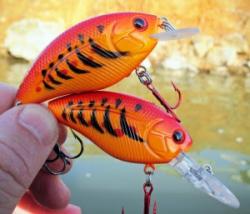
Randy got out a box of Livingston Lures prototypes he had been given only a few days earlier. He was looking for a deeper-runner in a bright crawfish orange/red color that’s perennially popular on Guntersville. The prototypes had been in his boat all week unused. When he tied on the one deep-runner in the box, he flipped it in the water alongside the boat to see what it looked like. It vibrated really hard, wobbled and rattled his rod tip. In that muddy water, Howell knew it was going to catch them. The bass were everywhere on his graph in the last few hours of the tournament. He landed 30 or 40 bass on the Livingston medium-runner which dives about 8-10 feet deep. The bass just choked it, that hard vibration and that bright color with that red and orange combined in that dirty, muddy water was just perfect. Howell culled every bass he had caught earlier on the DT-6 except one, ratcheting up to his 29 pound Classic-winning weight with the Livingston prototype.

At Livingston, the company and pro staff are prototyping a lot of new lures right now. Howell estimates there are maybe six different models although they may be testing up to several different configurations of each in order to determine which is best. Overall, the Livingston Lures pros had received up to 30 prototypes on the day before the Classic, mostly different configurations to test and give feedback to the company.

Howell said he felt like he did what he needed to do for Livingston Lures by pulling that bait out, having never used it before. The 2014 Classic champ believes Livingston is a great company and a great family of people that are trying to love our sport and really promote our sport. To win on their lure like that was the best feeling in the world for Howell because he wanted to put Livingston Lures on the map.

He has such a love for the people at Livingston because of their commitment to our sport and to Randy Howell and his family personally that he wanted to use their prototypes as a part of this Classic and the results exceeded even Howell’s expectations. The prototype diver fit exactly what he needed to come from behind to win the 2014 Classic.

As we said, he started the morning with the Rapala DT-6. At this time of year in February when the water is cold, a subtle wood bait can be good, especially up shallow. Then when they move out deeper, you need a little more vibration and sound – and that’s where the Livingston came into play.

Howell is a strong proponent of sound. He had his boat’s HydroWave electronic sound attraction unit turned up loud all day on 30 second intervals emitting feeding stimulation sounds in that dirty water.

Likewise, Howell feels the sound unit embodied within Livingston Lures is a huge attraction to fish. The croaking sound emitted by a Livingston Lure is the same decibel level recording as a natural baitfish sound that’s given off, said Howell. He’s watched fish in seminar demonstration tanks come to Livingston Lures solely due to the sound they emit, so he knows they hear the recording and are attracted to it, and in muddy water like on Guntersville during the Classic, that electronic sound is especially good said Howell.

As a media observer during the Classic, I had the chance to eyewitness the Livingston Lures prototypes in action catching bass on Guntersville. I saw up close how the medium-runner like Howell used swims. Obviously its action is good; no, make that great enough to win the Bassmaster Classic. There’s no higher accolade than that. However, the action of the Livingston Lures shallow-running squarebill prototype looks even better. Hefting the prototypes in my hand, at first I couldn’t tell and didn’t believe the sound-emitting electronic units were inside because the crankbaits were so lightweight. I had to dip them in the lake (water activates the sound system) in order to prove to myself that the new, lightweight electronic sound-emitting units really were inside these baits. Clearly these new prototypes, once tested and finalized, will prove to be a huge breakthrough for Livingston Lures and for savvy bass anglers worldwide.

A few months before this Classic in a conversation I enjoyed with Basil, one of the two Battah brothers that head up Livingston, Basil said he hoped to have the sport’s top professional anglers begin to recognize Livingston Lures technology-enhanced baits as the wave of the future – that these lures are not just gimmicks. Certainly Randy Howell just accomplished that. The lure company and its techno-marvels are suddenly and emphatically Livingston LARGE for the entire world to see.

Livingston lures really do work and are not a gimmick. They’re the real deal. Randy Howell’s 2014 Classic win will change any preconceived notions of any anglers that don’t yet believe that Livingston Lures represent the cutting edge and future of our sport.