Category Archives: Tournament Fishing

Clarks Hill Fishing Memories

On an April weekend members of the Spalding County Sportsman Club were fishing our April tournament at Clarks Hill. This is something of a tradition, we fish it almost every April and have missed very few years since I joined the club.

It is almost unbelievable to me that this is the 40th anniversary for me in the club. Jim berry and I fished the Sportsman Club April tournament at Clarks Hill in 1974. That was the first tournament I ever fished and I have been in the club every year since then and have missed very few club tournaments.

In 1975 I was elected Secretary/Treasurer of the club and have held that office most of the years since then. The first bulletin I sent out in 1975 had Vol. 11, no.1 at the top and I have kept that running since then. The April bulletin this year was Vol 50, No. 4. I assumed that meant the club had been in existence for l0 years when I joined but now think it was just the bulletin that has been around since 1964. I have been told the club started in the 1950s.

Gary Hattaway was in the club when I joined and is still in it, although he was not a member for a few years when he lived in Alabama. So, I am the only member left that has been in the club every year, and Gary is the only one left that was around way back then. I have made some great friends through the club but far too many of them are no longer around.

I moved to Griffin in 1972 and lived at Grandview Apartments while teaching at Atkinson Elementary. Each morning I drove College Street to 6th, turned right and went out to where it ends at Hill Street, then on to Atkinson. I reversed that in the afternoons which meant every afternoon I passed by Berry’s Sporting Goods that was located on 6th Street for many years.

Few afternoons passed that I didn’t stop and spend way too much of my princely teacher’s annual salary of $5600.00. But I got to be friends with Jim and we started fishing together some. He and Emmett Piland took me to the Flint River wading the first time, and we fished many local ponds, too.

In March, 1974 I bought my first bass boat and joined the Sportsman Club the next month. It was a big club back then, with about 75 members, and at the tournament we had 44 fishermen, many more than now. The Sportsman Club had just started fishing bass tournaments a few years before I joined and the club tournament rules still reflect that early start, with few rules and restrictions that most tournament have.

Back then there were two divisions in the club and newer fishermen went into “B” division since they were based on points from previous tournaments. We were more relaxed, with camping and fish fries more important than the actual tournament. There was a card game by the campfire most nights and we had a great time. I still do have a great time at tournaments, but it is a little more intense.

In that first tournament I just knew I would do well since I grew up on Clarks Hill and expected to catch a lot of fish. But that tournament taught me how different tournament fishing can be. Jim and I caught six keepers each day, far short of the ten fish limit back then. But many in the club had limits both days and I was surprised at the size of fish brought in.

That taught me real fast that someone would catch bass no matter what the conditions, and they could catch bigger bass than I thought possible. In that tournament Jim Goss had a bass weighing over six pounds and several five pounders were weighed in. My l2 in two days weighed about 14 pounds! But I still finished third in my division, but my catch would have been 15th in the other division.

Tackle, electronics, boats and expenses have come a long way in 40 years. My first boat was a 16 foot Arrowglass with a 70 horsepower Evenrude motor. And it was pretty top of the line, there was only one boat in the club with a bigger motor. My last boat costs over $30,000 used and the electronics I have on it cost more than my first boat!

I fished back then with two Mitchell 300 spinning reels, presents from my parents when I was 17, and an Ambassadeur 6000 casting reel, a present for my 21st birthday from Linda. Now I have 15 to 18 rods and reels on my deck in a tournament, with at least ten more in the rod locker. Line is much better as are plugs and plastic baits. And trolling motors and batteries are much stronger and last longer.

The biggest change is knowledge of what the bass do. Back then we pretty much fished shoreline cover and that still works, especially in April, but many bigger fish are caught from offshore structure like humps, and are caught much deeper than we used to think they lived.

Even with all the changes I still love it and it is great fun.

Fishing A Tournament At West Point in August

In 2004 Ronnie Gregory showed me around Lake Eufaula before the Top Six Tournament and the places and patterns he put me on helped me place 7th.

On a Friday in August the next year Ronnie and I went to West Point. He fishes there a lot, and he helped me get ready for a Flint River club tournament we were fishing on Sunday. Ronnie’s knowledge of the lake was impressive, and he took me to some spots that I never fished before, even though I have been fishing that lake since it was built.

In five hours of fishing from 6:30 AM until 11:30 AM we landed five keeper bass and several under the legal size. Ronnie started the day right with one weighing about 4.5 pounds and it was the only largemouth keeper. The others were all spotted bass.

Most of the fish hit in brush down about 12 feet deep and I hope that pattern holds up for the tournament today. We are fishing until 3:00 PM and Ronnie showed me some places he says the bass bite better after noon. We did not catch anything there but I will try them. That is detailed knowledge of a lake when you can predict what time the bass will probably hit.

Then on Sunday 20 members and guests fished the Flint River August tournament at West Point Lake. Fishing was very tough and there were only 28 keepers weighing 47.13 pounds brought to the scales. There were eight largemouth and 20 spotted bass weighed in.

Kwong Yu won the tournament with 3 bass weighing 7.23 pounds, Tom Tanner was second with 4.66 pounds, Roger Morrow placed third with 4.41 ponds and Tony Roberts came in fourth with 4.40 pounds. Bobby Ferris had big fish with a bass weighing 4.20 pounds and placed fifth.

After Ronnie Gregory showed me some brush piles on West Point before the tournament I was fairly confident about this tournament. Ronnie and I fished for five hours and landed five keeper bass weighing about 10 pounds. Those five would have easily won the tournament, but they hit too early.

The brush piles that produced keeper fish on Thursday morning had nothing but short bass in them during the tournament. I did manage to land one barely legal spot weighing right at a pound and placed 14th. Linda fished with me and although she caught more bass than I did, all her fish were too short to weigh in.

Sometimes it seems practice before a tournament hurts rather than helps!

Can I Catch Bass At Night?

on a Saturday night in July a few years ago 14 members of the Spalding County Sportsman Club fished our July tournament at Jackson. We fished from 7:00 PM until 2:00 AM trying to avoid some of the heat, and it was slightly cooler after the sun went down. Fishing was tough in the heavily stained water, with seven members not bringing in a keeper fish.

We landed 23 bass over the 12 inch minimum size and their total weight was about 35 pounds. I had the only limit and my five weighed 8.22 pounds for first place. James Pilgrim, Jr. had four weighing 7.99 pounds for second and his 4.04 pound largemouth was big fish for the tournament.

Butch Duerr had four keepers weighing 7.31 pounds for third, David Pilgrim had 3 weighing 4.54 for fourth and Jason Wheeler’s 3 weighing 3.09 pounds rounded out the top five. Of the 23 keepers brought to the scales, 13 were spotted bass and 10 were largemouth.

I was on some kind of strange schedule. For the first two hours I caught about four bass too small to keep, and a 3 pound catfish. Then I caught a keeper every hour, just about on the hour, from 9:00 PM until 1:00 AM. Each fish got a little bigger than the one before it, but I started with one just barely 12 inches long. The second one was 12.25 inches and the third just a tad bigger.

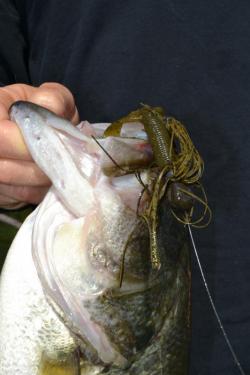
My last two fish were decent keepers, with a 2.5 pound spotted bass just after midnight and a 3.31 pound largemouth just after 1:00 AM. The first fish I caught hit a Zoom Mag 2 worm and the last four hit a Rattleback Jig with a Zoom Fat Albert twin tail trailer.

Night fishing is a lot more comfortable this time of year, and the bass do feed in the dark. Give it a try one of these warm summer nights. You might like it.

How Did Zell Rowland Weigh In 25.5 Pounds of Bass At Dardanelle?

How I Weighed In 25.5-Pounds At Dardanelle

By Zell Rowland
from The Fishing Wire

Zell Rowland

Zell Rowland

Zell Rowland didn’t manage to win at Dardanelle, but his 25.5 pound sack was the heaviest landed during the event thanks to his jigging expertise.

I didn’t win the B.A.S.S. Elite tournament on Arkansas’ Dardanelle May 16 through 19. I placed 17th in the final standings, which is disappointing, but I did bring in the biggest sack of the tournament on Day 2 – 25.5 pounds! Anytime you have a bag like that it’s worth talking about.

Conditions made fishing tough. Rain beat our butts every day on that Arkansas River impoundment, and conditions changed daily. Water levels shifted – up 4 or 5 inches one day, down 4 to 6 inches the next day – every day.

Drawing water or a water level change for any reason alters what the fish do daily, and sometimes even hour-by-hour. That made for tough fishing at times. Subtle changes in conditions could take place, and they weren’t always immediately evident. We had to make adjustments every day.

Heavy Booyah jig

Heavy Booyah jig

A heavy Booyah jig was a big part of Rowland’s secret at loading up on quality fish offshore.

I did much of my fishing on Lake Dardanelle flipping a Booyah jig and YUM Chunk trailer. I used two main colors, black-and-blue and green pumpkin. I fished black-and-blue much of the time in muddy water and green pumpkin in situations where there wasn’t so much stain.

During practice I’d found a good fish and knew it was still there, so that’s where I started on Day 2, hoping to improve on my 11-pound total from the first day. I pitched that jig to the laydown, and, sure enough, the fish was still there. But I lost him! As I stood there staring at the laydown, however, I noticed the water level was lower than it had been.

So I played a hunch. I moved to another spot with deeper water up along a rocky ledge. It didn’t have a laydown, but that didn’t matter. I caught a fish between 5 and 6 pounds right away.

Zell Rowland and Bass

Zell Rowland and Bass

Rowland chose a jig to score at Dardanelle, but he’s also well known for loading up with a variety of topwater lures.

The spot reminded me of another – a spot that hadn’t received much fishing pressure to my knowledge. I arrived there at 11:00 A.M. It took me two or three hours to fish the entire area, working up one side and down the other. Wherever I found the right scenario – where the water dropped – the fish would bite me. I didn’t get a lot of bites, but every one was a big one.

I could almost call my bites that day!

The fish were on wood and in front of boulders. But with the water falling, they had pulled to slightly deeper water than they had been for the past few days. The key to flipping the wood was to pitch to the middle of the tree and work it on out to deeper water instead of pitching all the way up to the bank.

Working the current was also a key factor. The fish that were holding near boulders were always positioned at the front of the boulder – not on the side, not behind it. They were right out front.

And they were extremely aggressive! You had no doubt when one bit. That made it a lot of fun. I would pitch in front of the rock and let the current flush the bait toward the boulder. The bass wouldn’t hesitate. They came up to get it. I would pick up the line and instead of the jig being up on that boulder, it would be 3 feet out front – with a fish on it!

My Booyah jig and YUM craw presented a large profile, and the dark silhouette was something the bass could see even with limited visibility. Determining how the fish were reacting to the changing water levels was equally important in pinpointing the fish.

It’s not often you get a sack of fish more than 25 pounds on Dardanelle – or anywhere else, for that matter.

Why Does Terry Scoggins Always Have A Big Worm Rigged and Ready?

Yamaha Pro Terry Scroggins Always Has Big Plastic Worms Ready
from The Fishing Wire

Bass May Hit These Lures When They Won’t Touch Anything Else

Catch big bass on big worms

Catch big bass on big worms

Elite pro Terry Scroggins always keeps several rods rigged with giant plastic worms, which he says produce big fish almost year around.

Terry Scroggins has a rod box on his boat filled with more than a dozen different styles of fishing rods, just like every other tournament angler, but what sets him apart is that several of his rods are always rigged with big, oversized plastic worms. The Yamaha Pro fishes 10-inch plastic worms year-round, something few of the other pros do.

“I’ve been fishing big worms like this my entire professional career, and I know there are times bass will hit a big worm when they won’t touch anything else,” notes Scroggins, whose single best day with the lure included five bass weighing 44 pounds, four ounces.

“I think the best way to fish big worms is to work them very slowly, which may be the reason bass hit them so well. It’s probably also the reason more pros don’t fish them, because it’s hard to make yourself fish slow in tournament competition.”

Scroggins does the majority of his worm fishing on offshore structure, often 20 to 25 feet deep, where he finds ridges, humps, and even rockpiles and brush. The day he caught the 44-4, he was targeting an underwater roadbed in 23 feet of water.

Scroggins likes a ribbon-tail type worm that floats, typically about 10 inches long.
“I rig my 10-inch worms Texas style to make them weedless,” explains the Yamaha Pro, “and use slip sinkers ranging from 5/16 to 1/2 ounce, depending on the water depth. There are a lot of 10-inch worms on the market, but I prefer a ribbon tail style that floats.

“When I make a cast and let the worm sink to the bottom, the tail will not only stand up, it will also sway and even swim in the current. It really looks alive, and I can easily imagine bass swimming up to look at it.”

On his initial cast, Scroggins crawls the worm up to the edge of the cover he’s fishing, and when he feels the sinker touch it, he stops reeling and just lets the worm sit there motionless for as long as 30 seconds. Then he pops his rod once to make the worm jump, then lets it sit motionless 10 more seconds before reeling in for another cast.

“On more than one occasion, I have caught more than a hundred bass a day doing this,” he explains. “During a Bassmaster® Elite tournament on Lake Wheeler in Alabama several years ago, I actually caught about a hundred bass a day on three of the four days using a 10-inch plastic worm. I started the event fishing a jig because I could fish it faster, but after the bass stopped hitting it, I changed to the big worm, and it was as if the bass had never seen a lure like that before.”

Big bass like this one have no problem eating a 10-inch worm, or even larger.
The Yamaha Pro also likes to fish big worms in current, always casting upstream above his target and slightly across the current so the water can wash the lure down naturally. What’s important here is keeping a semi-tight line to maintain better control over the lure.
In standing timber, Scroggins will start his retrieve before the worm falls completely to the bottom, slowly swimming the lure through the trees. When the worm hits a tree limb, he lets it sink several feet in hopes of generating a reflex strike before resuming his retrieve.

“Most of the time, I actually use a Carolina rig with a shorter six-inch plastic worm to find bass,” continues the Yamaha Pro, “because I can fish it so much faster and cover more water. If I get two or three strikes with it, then I’ll start using the larger worm and slow down.

“There is a lot of difference between a six-inch worm and a 10-inch worm. The larger worm naturally has a larger profile in the water, and when it is standing up on the bottom with its tail waving in the current, it certainly is much more attractive to bass, especially bigger fish.

“I’ve been fishing these 10-inch worms for more than a decade now, and I don’t hesitate to throw them in the spring, summer, and autumn. Honestly, I’ve never been to a largemouth bass lake where they didn’t catch fish.”

Does Practice Sometimes Hurt You In A Tournament?

Last Sunday members of the Flint River Bass Club had a tough tournament on Lake Oconee. Fishing from 6:00 AM until 2:00 PM the 19 members and guests landed 33 keeper bass weighing 56.94 pounds. There was only one five-fish limit and five members did not catch a keeper during the tournament.

Doug Kohn had the limit and his 7.94 pounds won the tournament. Lee Hancock had three bass weighing 7.17 pounds for second and his 4.30 pound bass won the big fish award. Bobby Ferris places third with 6.80 pounds and Jack Ridgway was fourth with 6.73 pounds.

Doug said he caught some of his fish on topwater plugs. Lee said the big bass hit a crankbait and his others were caught on a Texas rigged worm. Bobby said he caught his fish on a jig and pig. Fish were caught on a lot of different baits so no one pattern really worked better than others.

We lucked out on the weather. It was cloudy and windy all day, which usually makes fishing better. As I pulled out of the parking lot at 2:30 PM to head home a few drops of rain hit my windshield. By the time I got to the main road it was pouring and it rained hard all the way back to Griffin. I surely am glad the rain held off until the end of the tournament!

I had gone to Oconee on Saturday to check some deep water holes where I have caught fish this time of year in the past. I also wanted to try a pattern I was told was working there. I thought I had found something that would help me in the tournament but it may have actually hurt my fishing.

I rode over a point with some brush down in 20 feet of water and saw baitfish and bigger fish around the area. This was the brush where I caught a 7-7 bass and several other keepers in a July tournament a few years ago so I felt good about catching something there and did not even cast to them, not wanting to bother them the day before the tournament.

The second point I went to and checked I also saw brush with baitfish and bigger fish around it in 20 feet of water. I threw out a marker and cast a Carolina rig a few times, but nothing hit. I picked up a Mag 2 worm Texas rigged and the first cast produced a hit. When I set the hook the back half of the worm was torn off.

I quickly rigged another worm and cast back to the same place. When I felt a fish I set the hook and this time was rewarded with something pulling back. It was a 3.5 pound bass and I marked that spot to fish the next day.

For the next few hours I rode over points and found three more that looked just like where I had caught the bass. Brush, baitfish and bigger fish seen on a depthfinder is usually a good indication you can catching something this time of year so I planned on fishing those spots. I had caught one of my five keepers off one of the places two weeks before in the Spalding County Sportsman Club tournament so that also gave me confidence.

Brent Terry fished as my guest in the tournament and we stopped on a main lake bank with docks on it first thing Sunday morning. I started throwing a spinnerbait and Brent chose a buzzbait. On the first pass I hooked and lost a bass that looked like it would be a little short of 14 inches long, then caught three more short bass before we left.

Fishing similar places I finally landed a good keeper on the spinnerbait and then another one on a Texas rigged worm. After a couple more hours without a fish in the shallows I told Brent we should start hitting the deeper holes. I felt sure in the four hours we had left to fish we could catch some keepers.

That feeling was bolstered when Brent got a keeper on the first point we fished, the place I had landed a keeper two weeks before. Although we fished all the places that looked good the day before, and we caught some short fish, we did not catch a single keeper the rest of the day.

My two keepers weighed 3.76 pounds and put me in 9th place. That just goes to show the best laid fishing plans often go astray! Now I wonder if I had kept fishing shallow water if I would have done better. Sometimes practice for a tournament may be counterproductive. Who knows?

That’s why we call it fishing, not catching!

Fishing A June Tournament At Lake Oconee

Last Sunday 16 members and guests fished the Spalding County Sportsman Club June tournament at Oconee. We lucked out and it was a rainy, cooler than normal day for late June. Fishing from 6:00 AM until 3:00 PM we brought in 43 keeper bass weighing about 72 pounds. There were six 5 fish limits weighed in.

Mike Dalton brought in a limit weighing 12.25 pounds to win the tournament, and his 3.57 pound bass took the big fish pot. I had five weighing 10.35 pounds for second and my 3.54 pound fish, just 3 hundredths of a pound smaller than Mike’s big one, didn’t win anything!

James Pilgrim, Jr. had four bass weighing 7.66 pounds for third, Butch Duerr had five weighing 7.22 for fourth and Ben Puckett had 3 bass weighing 6.53 pounds for fifth.

Mike said he caught his fish on crankbaits. Butch said he caught his on buzzbaits. There were a good many fish caught on worms and spinnerbaits, too. The cloudy weather made the fish bite pretty good.

I used all my bass fishing skill to land my five keepers. I headed to a favorite point to start but there was a boat on it, so I went to a nearby point to wait and see if they left. My second cast with a spinnerbait to a dock there produced my biggest bass of the day. After the boat finally left I went to that point and caught a second keeper on the spinnerbait.

Linda fished with me and needed a break so at about 9:30 I went to a nearby marina. While she was inside I cast a Texas rigged worm to the gas dock and landed a 16 inch keeper. When I headed back to my favorite point there was a boat on it again, so I went to the other side of them and caught my second biggest bass of the day on a worm from a dock there.

My fifth keeper came on a Carolina rig on a point. So, of the five keepers I landed, three came from places I did not plan on fishing. Maybe I should plan where to fish then change my mind at the last minute from now on.

Linda and I caught a bunch of bass. We probably had 30 with many in the 13.5 to 13.9 inch range, just under the 14 inch minimum. Linda had one 16 inch keeper and placed 11th in the tournament. She also caught three channel cats of a crankbait. I have caught them on crankbaits before but never three in one day!

June Club Tournament at Lake Weiss

Lake Weiss proved to be an interesting lake for a club tournament in early June a few years ago for the Flint River Bass Club. Although the weather did not treat us very good, with rain all day Saturday and strong winds on Sunday, most of the members managed to catch some bass.

Bobby Ferris had an outstanding catch on Saturday bringing in a limit of 5 bass weighing 17.64 pounds. That is the kind of catch you see in pro tournaments. He had five more on Sunday and his ten keepers weighed 26.14 pounds and gave him first place. He also had big fish in the tournament with a 4.74 pound largemouth.

I thought I had a real good catch until I saw what Bobby had. My ten bass in the two days weighed 22.13 pounds and gave me second place. Gary Blackmon had limits both days and came in third with 15.95 pounds. Roger Morrow had 9 bass in the two days and placed fourth with 15.52 pounds.

The 17 fishermen brought in 76 bass weighing 135.98 pounds. Half of them were largemouth and half were spotted bass. There were nine 5 fish limits weighed in during the two days.

I went over on Thursday and met state fisheries biologist Kevin Dalmier at the lake. He has a cabin on the lake and not only studies fish, he loves to bass fish. We fished together in practice but a family illness kept him from fishing with me in the tournament.

On Thursday afternoon we fished the lower lake, about 20 miles by water from where the tournament launched. Kevin showed me some great places we planned on fishing in the tournament, including a hump near the dam. He told me as we approached it he had never seen another fisherman on it but had always caught bass there and we should catch some big spotted bass.

Sure enough, I hooked a 2.5 pound spotted bass almost as soon as we started fishing there. Mine got off but then Kevin hooked and landed a 3 pound spot, then a 2.5 pounder. I landed one about 2 pounds before we left the spot, and I was sure we would catch fish there in the tournament. Unfortunately, the wind and rain kept me from returning during the tournament.

While fishing Thursday Kevin at one point made the statement that “I am no expert but…” I stopped him, saying if he was not an expert on fish, who was? He explained just knowing fish biology was not a guarantee of catching them. That made me feel real inadequate – if he is not an expert after going to college and studying fish all his life, how could I ever hope to be one?

I did see how great fishermen are during my trip. On Saturday morning Bobby told me some lowlife had stolen the tail lights off his boat trailer while it was parked in the marina lot on Friday. I had not locked my trailer to my van that morning and was worried about it.

By 8:00 AM I had a limit of fish in the boat and decided to go to the ramp and lock my trailer. As I got out of my boat at the ramp a father and son idled up to leave. We talked as I walked toward my van, and when I reached under my rainsuit pants for my keys they were not in my pocket. I was afraid I had missed my pocket in the dark that morning and dropped them down the pants leg of my rainsuit.

The man I had just met helped me look for them, then took his boat out of the water and went to a nearby store to get the number of a locksmith for me. While he was gone I found my keys in the boat, I had dropped them when taking my cell phone out of my pocket.

He returned with the phone numbers and I thanked him. He went out of his way, in the rain, to help a stranger out.

On the way home I had a blowout on my van and pulled over to fix it. Club member Dan Riddle stopped behind me and helped me change it in the miserably hot sun. Without one of his tools I would not have been able to get my hubcap off. That is another good example of how great fellow fishermen are. Thanks, Dan!

During the tournament I made a dumb mistake and broke a club rule. I was fishing a buzzbait and a fish hit at it and missed it. I quickly threw a worm to where the fish hit and sure enough, as soon as it hit the water the fish grabbed it. I fought the three pound bass to the boat then got a sick feeling. I had not stopped and reeled in my buzzbait before casting the second bait.

A club rule says you can use only one rod at a time, so I broke the rule. It made me feel awful to let the bass go, but rules are rules even if I don’t like them. As it turned out that fish would not have helped my weight enough to catch Bobby, but I did not know that at the time.

May Fishing Tournaments At Lake Lanier

Tom Perdue and I fished Lanier on a Wednesday in early May a few years ago, trying to find some bass and a pattern for me to fish in the Spalding County Sportsman Club tournament that weekend. We had only three keepers so I am not sure we were successful.

Tom was determined to catch a fish on a jerkbait and he threw one a lot. He accomplished his goal when a pretty 2.5 pound spotted bass hit his jerkbait and he landed it. Several hours later we were near a dock and I cast a Trick worm under it when I saw a bass hanging there. It hit and I landed a 3.5 pound spot, one of my top four I have ever caught.

Although we caught a lot of bass shorter than the 14 inch limit, I landed only one more keeper just before we quit. It hit a tube bait near the bank and probably weighed about 2.5 pounds. I hope I catch two as big as the two I got Wednesday in the tournament today!

Lake Lanier was good to Donnie Willis the past few weeks that year. He won both the Potato Creek Bassmasters’ April tournament and the Flint River Bass Club’s May tournament there. Winning back to back tournaments in two clubs is hard to do, even on the same lake.

On April 16th 25 members of the Potato Creek club fished Lanier for nine hours. They brought in 48 bass weighing about 93 pounds. Lanier has a 14 inch minimum size limit on bass and a 14 inch keeper will usually weigh at least 1.5 pounds.

Donnie had a five fish limit weighing 13.34 pounds for first. Chris Corley had five weighing 12.21 for second and had big fish in the tournament with a 4.99 pound bass. Raymond English had five weighing 8.44 pounds for third and Brian Lee placed fourth with 4 bass weighing 7.94 pounds.

Two weeks later on May 1st the Flint River Bass Club fished Lanier and Donnie won with five bass weighing 9.35 pounds. Gary Morrow was second with 8.76 pounds, I placed third with five weighing 7.97 pounds and Tony Roberts was fourth with 7.95 pounds.

There were 16 fishermen in the Flint River tournament and we brought in 40 bass weighing 75.21 pounds. Donnie said he caught his fish on jerk baits and Carolina rigs. I did not have a bass at noon that day after fishing docks and shallow water all morning. At noon I decided to move to main lake points and caught my five in less than an hour on a spinnerbait.

Fishing In the Wind at Clarks Hill

It was windy the last weekend in April a few years ago. If you were on an area lake, like 19 members of the Spalding County Sportsman Club, you know what an understatement that is! The wind had Clark’s Hill white capping as far as the eye could see, and waves breaking on the riprap at Price’s Bridge threw spray up on the road.

Wind can make lakes dangerous, and there was a wind advisory for lakes in Georgia last weekend. Four times in my life I thought the waves might sink a boat I was driving, and two of them were at Clark’s Hill. One of the other one was at Eufaula in a Top Six tournament and the other was at Lake Lanier in a club tournament.

When I was a teenager my family had a 18 foot outdrive with a 120 hp motor. I ran all over Clark’s Hill in that boat, skiing, fishing and just having fun. We often ran from Raysville Boat Club down to the dam to meet friends and enjoy the lake.

When you come out of Germany Creek where Raysville Boat Club is located, you can look east and see Price’s Bridge about 13 miles away. That is a lot of water for the wind to blow across, and wind out of the west doesn’t have much to slow it down other than a few islands.

That weekend four of us had gone to the dam to a picnic and the wind got up. We headed back up the lake and the waves were awful. We would go down into the trough of one and not be able to see the banks the waves were so high. I was younger and dumber and didn’t really get scared, but looking back, if the motor had died I am sure the waves would have turned the boat over.

Years later Linda and I had run down to a cove we liked to fish in April, and stayed there most of the day. We knew the wind had gotten up, but did not realize how much until we came out across from Mistletoe and hit the waves coming down the lake. They were so big all I could do was keep the boat at a high idle and break through them.

We were in our brand new 17.5 foot Procraft bass boat with a 150 hp motor. I got really scared when I looked back and the waves we crashed through would come back together and almost cover the engine. I was afraid it would drown out and we would capsize. We finally got near a bank where it was more protected and made it back safely.

The waves were different this past weekend. They were shorter and more choppy, but even so while trying to fish in the wind and hold the boat, every few minutes a series of big waves would come along and make the front of my 20 foot Skeeter bass boat dip water. It was not real dangerous but it was hard to fish.

Gary Hattaway battled the wind and had a great catch Saturday. He brought in a 7.13 pound bass and had five weighing 17.69 pounds. He added two more keepers Sunday and got first place with 7 bass weighing 23.27 pounds, and his seven pounder was big fish for the tournament.

I got a limit each day and had 10 bass weighing 22.36 pounds for second. I did not catch a bass weighing over 3 pounds, I just could not find a kicker bass. I had a feeling I could catch a big fish off the riprap if I could fish it with the wind blowing into it, and I did. I landed an 11 pound channel cat on a crankbait. It gave me a great fight but I could not weigh it in.

Billy Roberts battled his brother George both days and managed to beat him, barely. Billy had 8 keepers weighing 14.52 pounds for third and George had 9 weighing 14.36 for fourth. Wayne Gibbs had 8 weighing 13.69 for fifth place.

The wind was so bad, and it was so cold Sunday morning that eight of the 19 fishermen didn’t show up for the second day’s fishing. There were 7 five fish limits on Saturday but only two on Sunday. We weighed in 89 bass during the two days.

I caught bass on Carolina rigged Baby Brush Hogs, crankbaits, spinnerbaits and Trick worms. Most of my fish hit on wind blown points and humps and my best bait there was the Carolina rig. With the full moon I thought bass would be bedding, but the cold and wind turned them off, I guess.

Water temperatures on Saturday ranged from 60 to 68 degrees but areas that were 68 degrees Saturday afternoon had dropped to 62 by Sunday morning. I could not believe I needed to wear a snowmobile suit on April 25 here in Georgia, but I kept it on all day and it felt good!