Category Archives: How To Fish

Two Tailwater Floats for Summer Smallmouth

Two Tailwater Floats for Summer Smallmouth Bass Fishing
from The Fishing Wire

Float for summer smallmouth


FRANKFORT, Ky. Anyone who loves floating streams for smallmouth bass out of a kayak, canoe or personal pontoon boat did not enjoy last year much at all. Many areas of Kentucky set annual rainfall records in 2018.

It seemed a 3-inch rain hit every third day from spring through fall. Streams flowed raucous and so muddy it seemed you could cut the water with a knife. These conditions are the absolute pits for fishing; you are better served catching up on yardwork.

After a rough start to this year, it seems weather conditions and rainfall levels are returning to normal patterns as we come into the warmer months, the best time of year to stream fish for smallmouth bass from a paddlecraft.

The pop-up thunderstorms common in summer may spike the flow on an average stream or free flowing river, but a tailwater such as the Green River below Green River Lake or the Barren River below Barren River Lake offer more predictable flows in summer.

“You have controlled flow in a tailwater with more stable water conditions,” said Mike Hardin, assistant director of Fisheries for the Kentucky Department of Fish and Wildlife Resources. “The long range forecast calls for a return to normal summer weather patterns.”

The Green River from Green River Lake Dam downstream to Greensburg holds many fat smallmouth bass and offers excellent access. The Barren River from Barren River Lake Dam downstream to Martinsville Ford is another productive stretch for smallmouth bass.

“Green River is still doing phenomenal for smallmouth bass,” said Jay Herrala, stream fisheries biologist for Kentucky Fish and Wildlife. “Green River and Barren River have good size structure in the smallmouth bass population and both rivers offer a chance to catch a 20-inch or longer smallmouth bass.”

Planning a float on either of these streams is simple. Log on to the Kentucky Fish and Wildlife website at www.fw.ky.gov and visit the Stream Fisheries page by typing “stream fisheries” into the search bar on the top right of the page.

On the Stream Fisheries page, the entry for “Lower Barren River” and “Green River, Pool 6” contain a great deal of information about the good smallmouth bass sections of these rivers, none more important than the link to the “Three Day Lake Release Forecast” from the Louisville District of the U.S. Army Corps of Engineers.

Water releases from their respective dams control the fishing on these rivers. The best release levels for fishing on the Green and Barren are under 300 cubic feet per second (cfs) with 100 to 200 cfs ideal.

The first float on the Barren River begins at the Barren River Tailwater Recreation Area and ends roughly 13 miles downstream at the Barren River VPA No. 3 access. Paddlers planning to fish this stretch should launch their boats at daybreak and plan to take out at dusk.

This stretch holds many flowing shoals rimmed with water willow, islands and stream drops. Since this is such a long float, choose lures you can work quickly such as a floating/diving Rapala style stick bait in chrome and black, small medium-diving crawfish-colored crankbaits and 1/8-ounce white spinnerbaits.

Work these lures along the willow edges of the flowing shoals and in the moving water above and below stream drops.

The next float begins at the Barren VPA No. 3 access and ends about four miles downstream at the Claypool Ramp on the south side of the Barren at Martinsville Ford.

This section of the Barren makes many subtle turns. Anglers should probe the rocky, flowing outside bends with 4-inch skirted double-tailed grubs in green pumpkin rigged on a 3/16-ounce Shakey head.

The Barren constricts between islands and gravel bars several places in this stretch, increasing the river’s flow. Tube jigs in green pumpkin rigged on 1/8-ounce heads draw strikes when slowly worked in the seam where fast current meets slower in these areas.

The Green River offers two manageable floats for smallmouth bass anglers: one about 6 1/2-miles that begins at Roachville Ford and ends at Russell Ford and another of about four miles that starts at Russell Ford and ends at the Greensburg Ramp.

Anglers should use the south side of Roachville Ford access via Thunder Road off KY 417 from Greensburg. The shuttle is much shorter than using the north side of Roachville Ford for access.

The flowing deep runs in this float hold fat smallmouth bass. A 4-inch Senko-style soft plastic stick bait in the green pumpkin magic color rigged on a 1/8-ounce leadhead is tough to beat on the Green in summer. Let the lure tumble in the current and watch the line intently. Green River smallmouths often strike subtly during the warm months.

Fly rod anglers can find great sport throwing bass-sized yellow and black cork poppers in the eddies behind boulders. This presentation also attracts hefty largemouth bass.

About halfway through this float, paddlers will notice a bluff rising in the distance when Meadow Creek meets the Green on the right. The mouth of Meadow Creek to the take-out at Russell Ford is the best smallmouth bass water on this float.

The next float is popular in summer with paddlers, but does not hurt the fishing. This section of the Green is more intimate and downsizing your lures to the Finesse TRD-style soft plastic stick baits often used for the Ned Rig presentation work fantastic in this stretch when rigged weedless on 1/8-ounce bullet-style leadheads. The best colors are green pumpkin goby and blue craw.

A rocky, deep flowing pool about half way between Russell Ford and the KY 417 bridge makes a fantastic place to fish, paddle back to the head of the pool and fish again. The flowing stretch just upstream of the U.S. 68/KY 61 bridge in Greensburg is another productive area for smallmouth bass on this float.

The take-out is on the right just after the U.S. 68/KY 61 bridge in Greensburg.

Paddlers may camp at Green River Lake State Park or stay at the lodge, cottage or camp at Barren River Lake State Resort Park. The Green River Paddle Trail offers cabins for rent at the Greensburg boat ramp in downtown Greensburg.

Enjoy floating two of the best smallmouth bass rivers in Kentucky this summer with more predictable flows than many in our state.

Author Lee McClellan is a nationally award-winning associate editor for Kentucky Afield magazine, the official publication of the Kentucky Department of Fish and Wildlife Resources. He is a life-long hunter and angler, with a passion for smallmouth bass fishing.

(Editors: Please email Lee.McClellan@ky.gov for photos.)

###

Kentucky Fish and Wildlife news releases are available online at fw.ky.gov

Lake Blackshear Fishing

Lake Blackshear is the most beautiful lake in Georgia. Of all the lakes I visit, I find it the most scenic and interesting. For a fisherman, miles of shallow shoreline with grass and lily pad beds with cypress trees everywhere make it look like heaven. Its tannic stained colored water looks like it holds bass everywhere.

For pleasure boaters, skiers and seadoo riders, the lower half of the lake has big open water. The upper lake, above the highway 280 bridge, is full of standing trees and stumps, protecting fishermen from all but the most foolish pleasure boaters and skiers.

Blackshear has something for everyone.

I spent Tuesday morning on Blackshear with Travis Branch, getting information for my July Map of the Month Georgia Outdoor News article. Travis owns Bucks Deer Processing and Taxidermy in Cuthbert and lives in Leesburg, not far from the lake. He loves to bass fish and knows Blackshear well.

As we rode up the lake before the sun came up, the lake was calm and beautiful, reminding me of why I love being on the water.

We started fishing a grass and lily pad bank at daylight above the bridge, running topwater baits like buzzbaits and poppers through the cover. He caught a nice bass and another one, even bigger, blew up on it but missed his buzzbait right at the boat.

As the sun came up, we stayed on shady banks fishing that pattern and caught some small bass. Then, as the sun got higher, we moved out and started pitching Texas rigged worms and wacky rigged Senkos to the base of the scattered cypress trees.

Those trees provide shade and a great ambush point for feeding bass. When the sun is at an angle, morning and afternoon, there is a fairly big shady area. But when the sun is high the fish move right to the base of the tree where the shade is just a small area.

Each tree has a root ball shaped like a donut around it, extending out about as far as the branches on the tree, and the bass find perfect cover and comfort. You have to cast very accurately, and make your bait enter the water quietly, to get them to bite. The water is usually two feet or less deep, so it is easy to spook them.

We caught several more bass fishing the trees but by 11:00 the sun was hot, so we headed to the ramp. On the way Travis showed me another good pattern. Many small creeks and coves are lined with hyacinth beds floating on top of the water.

Those thick mats offer bass a shady porch to sit under and watch for food. Punching them with a plastic bait behind a heavy sinker to get through them works well later in the summer when the water and sun is hotter.

Another good pattern is skipping a bait under the many docks around the lake. They, too, provide a nice shady place for bass to sit and wait on food. They are best when the sun is high.

If you like sausage, stopping at Striplings is a must. I always do and buy several pounds to bring home. There are two stores, one on highway 280 near Veterans State Park, and another on highway 300 near the lower lake. Both offer a wide variety of link and patty sausage, hot sausage and ham biscuits and other delectibles.

Blackshear is about two hours south of us between Cordele and Americus on the Flint River. You can go down I-75 or highway 19 to reach it. There are several boat ramps and Veterans Park has rooms, cabins, a marina and boat ramps. It is well worth the drive from here.

Bassing with Spinnerbaits

Tips for Bassing with Spinnerbaits
by Marc Marcantoni, Yakima Baits Pro Staff
from The Fishing Wire
Spinnerbait


A spinnerbait is one of the most reliable lures for catching bass anywhere they are found. New materials like tin bodies, high-tech UV finishes, and better manufacturing processes make spinnerbaits deadlier than ever. Anyone can catch fish on a spinnerbait, once you learn some basic principles.

You may wonder what in nature could possibly resemble this awkward looking contraption, and why would fish eat them? Look at a spinnerbait from a fish-eye perspective, below the surface, rather than from your perspective when holding one in your hand.

Bass eat bait fish, which a spinnerbait mimics so well with its vibration and flash. These features attract fish from a long distance. The flash of the spinning blades is visible from a distance and mimics the flash of a school of bait fish. In stained water flash is less visible, but the vibration produced by the blades is felt by the sensitive nerve endings in the bass’ lateral line. Fish hunt their food by sight, hearing and feel. When they home-in on the flash and vibration, the bait fish appearance of the spinnerbait body seals the deal, resulting in vicious strikes that do not require a sensitive rod to detect.

What makes a spinnerbait unique and particularly effective is how it can be fished in heavy cover without snagging. Spinnerbaits were designed with this objective and are virtually snagfree thanks to the upturned single hook that’s directly in line with the wire arms. This allows a spinnerbait to be pulled over the top of fallen tree branches and through submerged vegetation, where bass like to hunt for bait fish. Astute anglers cast spinnerbaits beyond every type of heavy cover, and swim the lure so it comes in contact with cover and structure.


Spinnerbaits are Fish Finders

Whether fishing unfamiliar waters or your local lake, spinnerbaits are ideal for hunting your quarry. They allow you to quickly learn where fish are located. Unlike fishing soft plastics, spinnerbaits are retrieved more quickly, allowing the searching angler to cover a lot of water efficiently. Probing both shallow and deep water can be accomplished with these unique safety-pin inspired lures, and in minimal time. There is no better lure made for quickly determining where bass are located. How they attack your spinnerbait will also expose their temperament.

When bass are aggressive and jumping on your spinnerbait, stick with it. If they follow but don’t strike, consider making a change in color, size, or style of blades. If the spinnerbait is ignored, you can bet the fish are telling you to slow down and try different lures and methods better suited for inactive fish.

Where and How to Use Them

The most successful retrieve in shallow water allows the spinning blades to bulge the surface, without causing them to break through the water. A fleeing bait fish provides the same disturbance to the calm surface water of a lake, river, or pond. Predatory fish use the surface of the water as a barrier, making it easier to capture their prey by preventing escape by swimming up higher.

Added attraction can be created by momentarily stopping the retrieve just long enough to cause the spinnerbait to stutter. The momentary change of blade speed, coupled with a drop of the lure during the brief pause, will often trigger a strike from a following fish. Pausing a spinnerbait next to cover can inspire a reaction strike from inactive fish. Even better, whenever possible swim your spinnerbait so that it crashes into stumps, dock pilings, branches, or any other cover. The sudden change of direction created by the contact with the cover triggers arm-jarring strikes.

A spinnerbait is also deadly in deep water. Bait fish follow their food, not only in shallow water but in deep water too. When schools of bait fish go deep, largemouth, smallmouth and spotted bass follow. This often happens where the water is calm and clear. In deep water, the key to success with a spinnerbait is to place your lure at the same depth used by the bait fish.

When the proper depth intersects with a piece of cover like a bridge piling, boulder, or deep weed edge, you want to place your spinnerbait in the same spot. Again, bump your spinnerbait into the cover, or otherwise twitch or pause the lure next to the deep cover. The change of direction is what triggers the strike.

Getting your spinnerbait to work in deep water requires understanding how to select the proper model, especially its weight, blade size and blade shape.

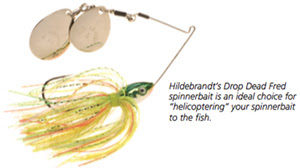
At times the most effective method of fishing a spinnerbait doesn’t rely on a retrieve. “Helicoptering” spinnerbaits involves pitching (a form of lobbing the spinnerbait) or casting to a target and allowing the spinnerbait to fall vertically along that target. Bass, as ambush predators, will charge out and grab it on the fall. You’ll likely see the bite before you feel it. Your line will jump or trail off one way or the other, when that happens…set the hook! The Drop Dead FredTM made by Hildebrandt® was expressly designed for this highly effective application. The design of this spinnerbait allows for a slow fall which keeps the bait working longer through the water column.


Wind is Your Friend

Many anglers find fishing in the wind to be uncomfortable, and because of that avoid it whenever possible. Wind and spinnerbaits go together better than peanut butter and jelly. Bass utilize wind to hunt more easily for bait fish that struggle in the waves. Because waves break up the light penetration, bait fish tend to locate near the surface. A quickly moving spinnerbait is the best tool to exploit wind conditions, and it is common to load the boat by fishing spinnerbaits in the wind and waves.

Current Can Also Help

Like wind, current collects bait fish and predatory fish, making current seams prime locations to fish a spinnerbait. Current seams create an edge, or barrier (like the surface or the bottom) that fish utilize to trap their prey. Study any river, tidal flat, or lake to locate current seams, and cast your spinnerbait so it runs where the moving water and calm water meet. Position yourself so that you cast up-current, and retrieve your spinnerbait in the same direction as the water flow. Predators expect bait fish to move with the current, and you will catch more bass by paying attention to this.

Selecting the Right Spinnerbait

The best spinnerbait is one that matches the conditions, and best imitates bait fish. Each component must be considered to match the water color and clarity, depth, type of cover, and activity level of your quarry. Spinnerbait models vary by the quality and thickness of the wire, the color, shape, and size of the blades, the body size and material used for the body (including the skirt), the length and size of the hook, and the quality of the swivel used. The number of possible combinations of components is endless, and no tackle box or budget can cover all the bases. The wise angler buys an assortment of models with changeable components, and then adjusts each spinnerbait to produce the flash, vibration, size and color that produces the best combination for the fishing conditions.

The most important component of a spinnerbait to consider is the blades. When selecting the proper blade, always start with a good quality blade that spins at a variety of speeds. Hildebrandt® is the industry leader in manufacturing top- quality blades. They are balanced and shaped perfectly, with precision thickness and taper. Hildebrandt® blades are matched with a genuine Sampo® ball-bearing swivel, to ensure the blades are free-spinning. The thick plate finish is polished.

To reflect maximum light, and the copper blades are lacquer coated to prevent tarnishing. The bottom line is when you purchase a Hildebrandt spinnerbait, or packages of Hildebrandt blades, you catch more fish!

Colorado blades are rounded, and produce the most vibration and lift. Because of these characteristics, they allow you to fish a spinnerbait more slowly than other blade shapes. They are the best choice for fishing in shallow, cold water, or when- ever bass are less aggressive and responding to slower presentations. The additional vibration is important when fishing stained water or low-light conditions where bass use their sense of feel to locate prey, more than their sense of sight.

Willow-leaf blades are shaped like their namesake, and produce more flash and less vibration. A spinnerbait with willow-leaf blades can be retrieved much faster, and much deeper. They are the blade of choice when fish are deep, since they do not cause your spinnerbait to lift when retrieved. They allow you to fish a spinnerbait at maximum speed, making them a great choice when water temperatures exceed 70 degrees and bass are aggressive. In clear water, a fast retrieve can trigger a bass to strike before it gets a good look at the lure. Willow-leaf blades produce the most flash, and when fished at high speeds they will produce great results in clear water.

Blade color can be silver, copper, gold, or painted. Silver is typically a good choice for clear water, and in bright, sunny conditions. Copper blades are best when fishing water that is generally clear, but with a tannic or dark stain. Gold or brass is preferable when the bait fish have yellow highlights, like golden shiners. Painted blades cover a variety of conditions. Chartreuse is used in muddy water, white in low light conditions with clear water, and combinations of both cover a variety of situations. Hildebrandt offers their Elite Pro SeriesTM spinnerbait in True LifeTM painted blades that add a striking bait fish appeal with UV finishes for maximum visibility under all light and water color conditions.

Experiment with blade color to find the color(s) that are most effective in the water you’re fishing.

Hildebrandt spinnerbaits have been purposely designed with this concept in mind. They feature an innovative, quick-change clevis so you can change your blade in seconds as you look for the most effective blade and color combination. Rather than purchasing and carrying dozens of spinnerbaits with different blades, Hildebrandt spinnerbaits allow you to carry several different weight or style spinnerbaits, all with the ability to add the desired blade shape or finish of your choice. Spare Hildebrandt blades in all sizes, shapes and finishes are available from full service tackle dealers around the country.

Skirts and trailers can also be changed, and are also readily available from your dealer.

The spinnerbait body serves several important functions. It assures your spinnerbait runs straight with the hook in the up position; it provides a life-like minnow profile to target; and also serves to hold skirts or soft plastic trailers for added enticement.

Spinnerbaits designed for largemouth bass generally have larger frames, heavier gauge wire, and larger blades. Hildebrandt spinnerbaits like the Tin RollerTM, the Okeechobee SpecialTM, and the new Drum RollerTM are popular choices and sport the quick-change blade feature. Largemouth bass spend much of their time in shallow water, especially around heavy cover so the beefier construction is critical.

When selecting the most appropriate spinnerbait, choose one that allows you to match the bait fish largemouth bass are eating. Identifying the best retrieve speed, amount of flash, and the amount of vibration necessary in triggering strikes will determine the amount of success you have. Speed and vibration are controlled by both the reel retrieve speed and by the style of blades on the spinnerbait. By changing the sizes and style (Willow-leaf or Colorado) of the blades, you can adjust the degree of flash and vibration to fine tune your presentation.

Smallmouth bass and spotted bass are frequently found in open water, and they forage on smaller bait fish, so a more compact design works better. The new Hildebrandt Double DeepTM is deadly for both species. Weighing in at one-ounce, and paired with Willow-leaf blades, allows you to achieve maximum depth and speed that isn’t possible with other designs. The overall size is more compact, and the smaller gauge stainless steel wire provides the perfect vibration, without sacrificing strength. Use a #3.5 blade when you need maximum speed and less ash. A #4.0 blade is the most commonly used size for most conditions, and a larger #4.5 blade can be used for slower speeds, more flash, and stronger vibration. Each blade size has a time and place, so carry all sizes and experiment until you dial-in the best for the day.

Give Them What They Want
When bass are aggressive and attack your spinnerbait, you’ve found the ideal combination of speed, size, and color. If they follow and turn-away instead of striking, they are telling you they are interested, but the color or size is wrong. In most cases a simple color change fixes the problem, and changing the rear blade will likely make the difference. A skirt change would be the next best choice, and finally a change in weight and retrieve speed should be considered.

Just under the surface, in and around structure, in deep water and all points in-between, spinnerbaits have earned their place as a primary bait in catching all species of bass. Apply this know-how of size, color, speed and depth, being mindful of how you approach your targets and fishing bass-holding water and you’ll find spinnerbaits will occupy a place of prominence in your fishing strategy too.

Marc Marcantonio is an accomplished tournament bass fishing professional with three IGFA world records to his name along with a long list of impressive tournament wins and credentials. Marc is also a member of the Yakima Bait pro-staff. Beyond Marc’s tournament activities he’s a frequent seminar speaker and writer.
Flint River Bass Club April Tournament West Point

Last Sunday seven members of the Flint River Bass Club fished our April tournament at West point. In eight hours, from 7:00 AM to 3:00 PM, we landed 18 keeper bass weighing about 26 pounds. There were two five-fish limits and no one zeroed.

Don Gober won with five weighing 8.43 pounds and had a 3.92 pound largemouth for big fish. I came in second with five at 7.57 pounds, Dan Phillips had three weighing 5.61 pounds and Jack ”Zero” Ridgeway placed fourth with two weighing 1.86 pounds.

I thought the fish would really bite good based on the time of year and weather, and I’m sure they did for some. But it was hit and miss, especially for bigger bass. I was happily surprised that we weighed in 12 largemouth and only six spots – that is a better ratio than usual. Maybe largemouth are coming back.

I started fishing a favorite spawning creek but after 45 minutes I had not had a bite. Then, going around a point to the next spawning pocket, I caught a short spot then finally got a keeper spot, both on a shaky head worm.

Back in the pocket I picked up as spinnerbait and caught a largemouth just under the 14-inch limit, then got one that was just over 14 inches long. That gave me hope, but I never got another bite on that bait.

Rounding a shallow secondary point I got a bite but when I set the hook a keeper spot jumped and threw my shaky head. The next cast I landed a short spot – I lost the wrong one.

On the back side of the point a log ran off the bank with the outer end in about two feet of water. I ran a spinnerbait along it on both sides but nothing hit. I picked up the shaky head and the first cast produced my biggest fish, a two-pound largemouth. The next cast to the end of the log produced another keeper largemouth, and the third I hooked and lost as short largemouth.

That convinced me the fish did not want a moving bait, but I tried a spinnerbait around the next shallow pocket anyway. Nothing hit it. I went back to the log and caught my fifth fish, another keeper largemouth, in the same place on the end of it.

I was happy to go from no fish at 7:45 to a limit at 8:40!

I continued to fish the small spawning creek but fishermen from the big West Georgia Bass Club tournament started coming into it to fish. As I started down a bank into a short pocket, about 50 yards wide and twice that long, two fishermen ran in and started fishing across from me.

I caught my sixth keeper, another two-pound largemouth, as they started fishing. By now my legs were hurting and I could not feel my feet, so I idled around, looking at some other places, but was not willing to get up and fish.

I was back at the ramp, resting in the truck amore than an hour before weigh-in!

Walleye Trolling

Walleye Trolling 101

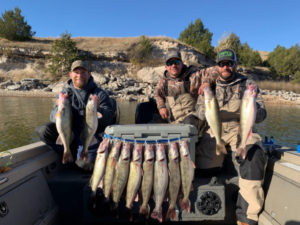
Keith Jadlowski (left), Brett Smith and Jake Jadlowski show off a stringer of walleye at Lake McConaughy.
Trolling crankbaits for walleye gets a lot more effective with modern technology
caption id=”attachment_8712″ align=”alignleft” width=”300″] Trolling walleye[/caption]

Story and Photos by Jade Jadlowski
from The Fishing Wire

Like most of us, I’ve fished for all kinds of fish in a whole bunch of different places. But regardless of species and location, most of the fishing I’ve done has been centered around my rod, my lure and me. Whether I’m flipping jigs for largemouth bass or bottom bouncing for walleye, most of my success or my failure is mine alone. Like golf, there is no guarantee that two guys using the same ball and driver will hit a tee shot that lands in the middle of the fairway. Likewise, there is no guarantee that two guys in the same boat, using the same lure and tactics, will catch the same amount of fish. I truly enjoy this individual element of fishing.

But I’ve also learned that there is a lot of fun to be had while fishing as a part of a team, and trolling crankbaits for walleye is the ultimate team sport. It takes a team to manage the chaos of running multiple lines, attaching planer boards, changing out lures, fixing giant tangles, switching motors, controlling the boat, fighting the fish, netting the fish, getting the boat back on course and redeploying all the lines. Success is shared, and it requires the contribution of everyone on board. When trolling crankbaits for walleyes, it doesn’t matter if you reeled it in. It feels like every fish is your fish, and it’s a blast.

Unfortunately, failure is also shared. And my team did a lot of that before we got smart and upgraded our equipment and developed a system that was efficient enough to occasionally fill up the livewell. Our first attempts at trolling resulted from a slow bottom-bouncing bite as we tried to cover more water in order to locate fish. This was fun. We found that the bite could be fast and furious. However, as we increased the amount of time we spent trolling, we quickly learned that our system was not good. Hand rods resulted in varying rod tip locations that altered the depth of our lures. There was no way to know how much line we had out. And even if we did, we didn’t know how much line to let out to achieve a desired depth. And even if we did, we had no idea how much to let out to get a specific lure to run at the depth we wanted. In short, we didn’t know what we were doing and even when we did catch fish, we didn’t know how to repeat it.

All good lessons are learned by errors. As we messed it up, we got smarter. So to keep you from making these same mistakes, here are a handful of essentials for anyone interested in getting out their box of crankbaits and teaming up with some buddies.

Rod Holders

In addition to being able to maintain and control your rod tip, these allow you to run more than one rod and they keep your hands free so that you can help a buddy get untangled or land a fish.

Rod holders maintain and control more than one rod when trolling while also allowing anglers a hands-free option. Photo by Jake Jadlowski.
Line Counters – Getting crankbaits to the target depth is a huge part of finding success while trolling. The depth that a given crankbait can run depends on the amount of line that you let out. The best way to consistently keep the lure in the target zone is to know exactly how much line has come off your spool. Swapping out a baitcasting reel for a line counting reel is a must.

Precision Trolling App – Line counters are awesome, but they don’t tell you the whole story. They simply tell you how much line has come off the spool. They don’t tell you how much line to let out to get a certain crankbait to run at the depth that you want. They don’t tell you how to adjust that number when you change to a different type of crankbait. And they don’t tell you how the particular brand of line, type of line, and pound test line on your spool alters the depth that a crankbait will run. But you can tap modern technology to keep track of all this. With the new Precision Trolling app you simply enter the line that you are using, the crankbait that you have tied on, and the depth that you want to achieve, and the app instantly tells you how much line to let out. Buy it in the App Store.

Quick Clips – Once you are armed with a line counter and the app, you’ve unlocked the mystery of your crankbait box. Tie on as many as you need to until the fish tell you want they want. Better yet, tie on a quick clip once and snap on cranks as fast as your heart desires.
Lastly, don’t forget your camera. In the event that you figure out the right depth, the right speed, and the right crankbait, you’re going to have a pretty cool photo opportunity. In fact, you may never want to tee it up by yourself again. ?

Trolling Tips

Before deploying or re-deploying your lines, make sure your crankbait is running true in order to prevent tangles and to ensure that your lure gets down into the strike zone.
Don’t be afraid to experiment with different crankbait types, sizes and colors. Eventually, the fish will tell you what they want.
Just because state fishing regulations may allow you to use more than one rod doesn’t mean you have to. Keep it simple until you figure out a system that works.
Crankbaits are manufactured to create irresistible action under the water. But don’t shy away from an occasional jerk of the rod tip to vary the action and give your lure some extra life.
Maintaining a trolling speed between 2 and 3 mph is a pretty good rule of thumb. But feel free to experiment with slight speed adjustments or abrupt changes in speed to entice strikes.
Just because a given crankbait is capable of reaching a maximum depth doesn’t mean the fish are at that maximum depth. Experiment with different depths within the water column to create strikes.

Fishing Jackson Lake With Mike York

Way back in 2004 during the first week of April I spent the day fishing Jackson Lake with Mike York, checking out the bass fishing for a June Georgia Outdoor News article. We fished all day and caught a lot of small bass, never hooking the bigger fish we hoped to catch.

Mike works for the Butts County Sheriff’s Department and fishes with the Butts Bass Busters bass club. He made the state team last year and finished 24th this year at the Top Six. There are several professional trails that he fishes, too, like the Everstart and BFL trails.

Fishing at Jackson was really enjoyable during the week. Missing were all the skiers, skidoos and cruisers that usually make you rock and roll while fishing there on the weekend. It was peaceful and calm most of the day. The water was unusually clear for this time of year and we watched many small bass come up and look at Trick worms and top water plugs early in the morning. A few of them hit.

Our best luck was fishing Carolina rigged Trick worms on main lake and river points. On one point in the South River I landed three bass on three casts, then broke off. While I was tying on a new Carolina rig, Mike landed four bass. That was our best spot by far.

We started out the morning looking for bedding bass, and saw some new beds but did not see any bass on them. The cloudy sky and low light made it difficult to see very deep, even in the clear water. Mike had gotten reports that a good many bass were bedding right now, unusually late this year.

I was impressed with Mike’s knowledge of Jackson Lake and bass fishing. He says bass fishing will get better for the next several weeks as bass move onto their summer holes and stack up on points. He likes to catch them on crankbaits and Carolina rigs, and summer is his favorite time of year for fishing that pattern. If you get a chance, head to Jackson and check out the points for bass.

White Bass Time Across Arkansas

White Bass Time Across Arkansas
Randy Zellers Assistant Chief of Communications
Arkansas Game and Fish Commission
from the Fishing Wire

LITTLE ROCK — Each spring, anglers across The Natural State start getting the fever for some fishing action. Sure, die-hard anglers and veteran bass fishermen have been on the water fishing for big fish for the last month or so, and many crappie anglers never put the boat away in winter, but by and large, the best angling action of the year is just around the corner. If there’s a kickoff to “fishing season,” it’s the fast and furious angling action brought on by the annual migration of white bass from large lakes and rivers upstream to their spawning areas each spring.

“The white bass spawn is fishing’s equivalent of the opening day of dove season,” said Chris Racey, deputy director of the Arkansas Game and Fish Commission. “You’ll start hearing people ask, ‘Are the white bass running yet?’ beginning in late February and early March every year.”

White bass typically start concentrating near the mouths of streams feeding lakes and rivers each year as the surface water temperature begins to reach 50 degrees. When the water warms to the mid-50s, the fish will move upstream as far as they are able and spawn on sand or gravel surfaces with flowing water that will aerate their eggs.

“White bass don’t tend and fan a nest like crappie, bream or largemouth bass,” Racey, who was a fisheries biologist for the AGFC for many years, said. “Instead, their eggs settle to the bottom and stick to rocks and gravel where the current keeps them aerated until they hatch.”

The fish actually don’t bite much when they are actively spawning, but feed heavily just before and afterward.

“It’s more a matter of fish being concentrated in an area and being easier to locate that makes the white bass run such a big deal for many anglers,” Racey said. “And this is one of the few times of the year that these fish, which normally spend their time in deep water, will be available for bank anglers.”

Keeping things light is a must for walk-in angling, and Racey has narrowed down his arsenal to some specific lures for people to carry in their pack.

“I have three baits in my white bass tackle box,” Racey said. “My go-to is a white 2-inch curly shad Bass Assassin grub on a 1/16-oz. jighead. Then I’ll bring a ?- or ¼-oz. White spinner with a silver blade and a small, blue over orange belly Rapala suspending jerk bait. You can throw all of them on light spinning tackle.”

Here’s a list of some of the most popular places to try your hand at fishing for white bass this spring, according to the biologists who work and fish on these waters. There’s even one location in this list that has no limit on white bass, so anglers looking to have a family fish fry can load the boat.

Magical Millwood
Typically one of the first locations in the state to start receiving reports about the annual white bass run is Millwood Lake in Little River County. This southwestern Arkansas reservoir is known as one of the best places in the state to chase memorable-sized largemouth bass because of an intense Florida-strain largemouth stocking program that has been in place for decades and its shallow-water habitat that is the key to the strain’s success. The river that feeds this giant reservoir also is home to some incredible action during the white bass spawn if anglers know where to look. According to AGFC Regional Fisheries Biologist Supervisor Eric Brinkman, many anglers enjoy fishing the river section of the lake by boat for fiesty white bass.

“Little River anywhere upstream of Yarborough Landing on Millwood is a good place to fish,” Brinkman said.

According to the AGFC Weekly Fishing Report, Millwood Lake Guide Service points out McGuire Oxbow and the entrance to Cemetery Slough as likely staging areas, but when the fish move upstream of the U.S. Highway 71 bridge, the spawn is in full force.

Other areas on Brinkman’s short list for the white bass spawn include Star of the West Recreation Area and Self Creek on Lake Greeson in Pike County and the Saline River upstream of Dierks Lake in Sevier County, although a boat is required for Self Creek and Dierks.

Bust ‘em at Beaver Lake
In the far northwestern corner of the state, Beaver Lake offers one of the best white bass runs for Arkansans. It also has the distinction of being one of the few places in the state where you may find a trophy-class striper working its way up the same tributaries as the white bass. Fisheries Supervisor Jon Stein says this year has already gotten off to an excellent start, with many anglers reporting 100-fish days. And keeping those white bass is no issue because Beaver Lake and its tributaries have no daily limit for white bass. The prolific nature of the species and relatively light pressure on the resource have made limits on the fish unnecessary in this corner of the state.

“The fish move into the river arms to spawn,” Stein said. “The best locations are out of the Highway 45 Access, called Twin Bridges, on the White River and War Eagle Creek below War Eagle Mill. You don’t have to get too technical with it, either. A Mister Twister Sassy Shad on a jighead works just fine for me to catch whites on the run.”

Find the flow at Lake Conway
White bass also make a spawning run around Lake Conway, but the hot bite may be in different locations depending on water flow. AGFC Regional Fisheries Supervisor Tom Bly and Fisheries Biologist Matt Schroeder both agree that the upstream end of Gold Creek beyond Wilhelmena Cove, a popular crappie-fishing location, in the northwest portion of the lake has a good run of white bass. Another place where anglers can look for some action is below the dam where the lake flows into Palarm Creek.

“We will get reports of white bass and some stripers from the Arkansas River running up to as far as the Conway Dam, but there won’t be much action unless the gates of the dam are open to maintain water levels during rain events,” Bly said. But you can catch them on white or shad-colored curly tailed grubs on jigheads, smaller crankbaits or shad imitations on a fly rod.”

Bly notes the weir on Palarm Creek at Cadron Settlement Park on the Arkansas River sees a similar migration of white bass where the fish moving from the river are concentrated into a small area.

Greers Ferry a good bet
Another good white bass run occurs in the river arms on the northern section of Greers Ferry Lake in Heber Springs. The lake is known as the site of the former world-record walleye, and that species also is known to make spawning runs within the Devil’s Fork, Middle Fork and South Fork of the Little Red River. Chasing white bass on this lake usually means having a boat, but one of the most popular destinations can be found at the Johnson Hole Access of the South Fork arm north of Clinton. Boaters can access the area from the lake or can launch at this access, but the creek has many shallow areas between the main lake and where the whites run, making it a better prospect for small boats, kayaks and walk-in access. According to Bly, many anglers will catch their limits in this section of the river during the annual spawning run.

Maumelle mainstay
It seems like every year, one location sees more attention than the rest in the state from white bass anglers. Perhaps it is because of its close proximity to Little Rock, or perhaps it is because the white bass run here is just that good. Either way, the upstream end of Lake Maumelle is so popular with white bass anglers and creek fishermen that the AGFC and Central Arkansas Water worked together to enhance access at the west end of the lake. Sleepy Hollow Access was enhanced with a campground, two boat ramps for boats with motors 25 horsepower and less and a courtesy dock. A parking area also was constructed for a special walk-in only area called Bringle Creek Access. Both of these access points can be found with a few miles of where Arkansas Highway 10 crosses the lake’s upstream end. You’d be hard pressed to find either of the parking lots of these areas empty from March through May each year as anglers tote their favorite spinning rod and curly-tailed grubs to fool the fish as they feed along the shoals before spawning. The stream is part of Lake Maumelle, so no wading is allowed, but there is plenty of shoreline to walk and fish.

Success During Late Ice

Increase Your Success During Late Ice
from The Fishing Wire

Late ice fishing is good


Photo courtesy of Aqua-Vu
Four Late-Winter Tips for Catching More Panfish

Seek, Drill and Stay Mobile for Late Ice Crappies. In smaller, shallower lakes, crappies are typically located and caught throughout much of the winter season over main-lake basins. In large, deep lakes, however, they tend to avoid the deepest areas and use flats, humps and basins ranging from 20 to 40 feet deep. But crappies are also notorious for suspending. Depending upon conditions, they can be found anywhere in the water column, creating an additional variable in the angling equation.

As the ice-fishing season nears its end, crappies transition from deep water wintering areas towards shallow bays, channels and river mouths in preparation for spawning. Depending on where and when you fish, concentrations of crappies will be present along a relatively straight line between these distinct areas.

During the late-ice period, take a stab at identifying some of these likely travel paths between wintering areas and spawning areas on the lake you plan to fish using the Fishidy app or map on your Sonar/GPS. Look for potential staging locations where cover, structure or current variations are present along those paths.
Once you’ve identified attractive areas, gas up the auger and get to work. Use your GPS to confirm your location on the ice, and pick a variety of sweet spots over the particular structure you plan to fish. A larger fishing party is beneficial because you can share the work of drilling holes and checking them for fish with sonar. Once you mark fish, take the time to drill more holes. It’ll save you time in the long run as you’ll waste less time fishing an unproductive hole when an entire school may be located just 10 or 15 feet away.

Once the crappies are located, hole hopping is the key to keeping busy catching them. Anglers willing to leave the comfort of their fish houses and use their electronics to fish from hole to hole are the ones who catch the most crappies. Keep moving if a hole doesn’t show a fish on your sonar. Keep drilling more holes if necessary until you get a sonar return. Then drop down, catch a fish or two and move on once the action slows.

Fish Fast for Late Ice Crappies. Crappies display a variety of moods, and their responsiveness to various presentations can change throughout the day – often rapidly. Late-ice crappie anglers should be prepared with a variety of offerings, from small tungsten jigs tipped with thin plastics to relatively large jigging spoons tipped with spikes, waxes or minnow parts. The key is being prepared and willing to show fish a variety of presentations and profiles to determine which one best matches their mood at that moment. Then it becomes a game of presenting the preferred bait to numbers of fish, which means moving on quickly from barren holes.

When a fish shows on sonar, try stopping the bait 4 to 5 feet above it and slowly working it down if necessary. You’ll often see the fish begin drifting up towards your bait immediately. If they do, slowly raise the bait while twitching it ever so slightly to make them chase it. Once you get them moving, they’ll usually charge it. If they refuse it, it’s time to try a different bait.

Fishing fast means fishing heavy. Getting down to a fish fast — hopefully before it leaves — is critical to maximizing opportunities. Tungsten jigs sink fast while retaining a delicate profile, and are the best choice when crappies show a preference for smaller offerings. Jigging spoons are great options anytime crappies are aggressive and eager to attack a larger profile. They easily punch through slushy holes and get back down to other fish quickly once one has been caught.

Turkey Baster Panfish?. One surefire strategy for determining the types of wintertime foods preferred by bluegills, perch and crappies is to take a living, breathing sample. Fly fishermen use a small stomach pump (resembles a miniature turkey baster) on stream trout in order to match the hatch. It works with panfish, too, and it’s completely harmless to fish, other than depriving them of recent eats.

Fill the pump with water with a quick squeeze, insert the tube into the fish’s mouth and a few inches down its pharynx, which leads directly to the stomach. Be gentle! Squirt the water into the stomach and release the pump, which vaccums up any recently ingested critters. Squirt said contents into your palm and have a looksee.

A fish’s recent meals reveal the anatomical details of each eaten bug, as well as plenty of the goo that represents zooplankton and other partially digested “whatnot.” You also learn potentially productive lure colors, and can quickly tie on something you know panfish will want to eat. Identifying specific prey items also suggests fruitful jigging cadences. Mayfly larva, for example, swim with undulating tail kicks that can be mimicked with various soft plastic baits.

The Strength of the Snell. While most ice anglers rely on one or two favorite knots, the truth is you can do a lot better than an improved clinch, Trilene or other customary line-to-jig connection. If you’ve never tried a snell knot, including versions such as the Marka knot or a Uni-Snell knot—you’re missing out on a ton of advantages for almost any jig presentation, particularly for panfish jigs and ultra-thin mono or fluorocarbon lines. Actually, the advantages of a well-tied snell overwhelm those of traditional knots.

One, a snell knot positions your jig at the ideal horizontal position—no need to reposition your knot, ever. Two, the knot is recessed and tied around the shank of the hook, so it rarely requires retying (you can often fish most of an 8-hour day with the same snell knot and jig.) Three, snell knots are almost bulletproof-strong. Finally, the knot itself acts as a form of soft plastics keeper, pinning the chosen bait tight to the jig collar. The plastic further protects the knot by sliding right over the top of it. Moreover, you can tie either version with traditional eyelet jigs, or Russian “through-head” jigs. Here’s a link to a few top ice jig knots (see #3, #6A and #6B).

About Fishidy:

Fishidy is a location-based fishing app and online community of over 1 million users that features interactive mapping technology, data-rich fishing maps, and social networking to help anglers identify the most productive water and head straight to the action. Users discover shared catches and local Fishing Hot Spots®, stay up-to-date with the latest fishing reports, and find detailed waterway information so that they are fully prepared for their next fishing trip. Learn more at fishidy.com.

Fishing and Grass

Fishing and Grass: Not as Controversial as You’d Think
By Mike Reading
Angler Action Foundation
from the Fishing Wire

Fish the grass


For most anglers grass means one thing: the long, skinny green stuff that grows in shallow waters. In fresh waters we often call it tape grass; in salt water we go with sea grass. In a healthy estuary, you are likely to encounter both if you are on the move.

One of the primary sources of habitat for estuarine fishing is grass. And Florida, to be sure, has lost scads of tape grass and seagrass around the state, from as far north as the Mosquito Lagoon to as far south as Florida Bay and the Everglades. When talking about all types of grasses, scientists refer to them as Submerged Aquatic Vegetation, or SAV.

And the loss of SAVis not just a Florida issue. It’s been estimated that we’re losing two football fields of SAV an hour world-wide, which equates to 7 percent a year.

Mountains of information have been written about the loss of habitat, who’s to blame and why. That debate will continue forever. But there’s one thing we can all agree upon. These grasses are important to fishermen and non-fishermen.
Here are a few reasons why:

Stability
Estuaries are vulnerable to erosion. Florida, if you recall, has been hit by two hurricanes during the past two years — Matthew in 2016 and Irma in 2017.

I got a first-hand introduction to both storms and the importance of how ecology works to benefit us. I lived on St. Augustine beach and the only thing that saved my house from Matthew’s flooding were the formidable dunes that were held together by sea oats. Not exactly submerged grass, I know, but the point about protection holds true.

A similar scenario evolved nearly a year later when Irma passed over North Florida. I currently live in High Springs, not far from the banks of the Santa Fe River, which has an abundance of grasses. The river sustained record flooding that washed away low-lying houses. However, the river bottom and surrounding remains largely intact, thanks to the meadows of eel and tape grass. After weeks of high water, the fishing returned to normal, proving that nature can indeed heal itself.

Habitat
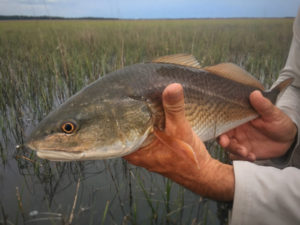
Remember that big fish you caught? Maybe it was a bass? Maybe it was a redfish? Or a seatrout? Chances are, that fish used seagrass as a nursery for a couple years. A female redfish produces millions of eggs. Those eggs will become larvae and only a fraction of the larvae live long enough to become juveniles and those fish lucky enough to reach that stage head for the sanctuary of the seagrass, where they will use every nook and cranny for food and protection.

The standard length or a year-old redfish is a foot. And a fish that size will feed on crabs and shrimp and maybe a few small forage fish. A three-year old can weigh 6-8 pounds. The diet remains largely the same, and guess where you can find crabs, shrimp and forage fish? In the seagrass.

Food
Fish aren’t the only ones that use seagrass for food. Manatees, geese and turtles and other grazers feed off underwater vegetation. One acre of seagrass can support thousands of fish and millions of invertebrates. All are looking for their next meal.

According to the Smithsonian, a green sea turtle can eat as much as 4.5 pounds of seagrass a day. Other grazers don’t eat the leaves directly but nevertheless feed off them. Snails and worms, for instance, clean the grass by eating the algae, which generates seagrass growth and it serves as a form of protection from local urban runoff, which often produces algae.

Water Clarity
Underwater grass cleans the water by capturing sediments and particles which, without the filtering effect of SAVs would make sight fishing darned near impossible. Let’s take Tampa Bay, example. Because of the abundance of turtle grass and shoal grass in the Bay area, you can sight fish for reds year round. On the other side of the clarity equation is the Treasure Coast. Try finding clear enough water for reds near Stuart and Jupiter. Chances are, you won’t. The reason: Very little seagrass these days — or oyster beds for that matter.

SAVs also contribute our quality of life above the water’s surface by oxygenating the water column and storing carbon. According to EurekAlert, global coastal wetlands can capture and store 200 metric tons of carbon each year; one acre of seagrass is capable of harboring 740 pounds of carbon, attributes that can provide balance in the atmosphere.

To Sum Up
The beauty of fishing is that there’s always something to learn. Nature is a great teacher. We all want to catch more fish, and the best thing that an angler can do to reach that goal is to study the fish’s habitat. Learn it. Cherish it. Protect it. The future of fishing depends on it.

Editor’s note: Mike’s story about SAVs is Part 1 of a series that will highlight the importance of grasses, and lead into information about SGF’s $1million dollar SAV restoration project which has started in the Caloosahatchee River, where we are working with Sea & Shoreline and Johnson Engineering. Stay tuned!
Photo credits: Redfish image courtesy of Tim Boothe. All other images courtesy of FWC.

To learn more about the Angler Action Foundation, visit www.angleractionfoundation.com.

Fishing Lake Hartwell with Matt Justice

A couple years ago, I met Matt Justice at Lake Hartwell to get information and pictures for my October 2016 Map of the Month article in Georgia Outdoor News. Between trips there I often forget it is only a little over two hours away, depending on traffic, and it is a beautiful lake with clear water and full of largemouth and spotted bass.

I left at 3:30 AM to meet Matt at 6:30 AM since I hate to be late. It was a good thing I did. I made it about 40 miles up I 85 north of Atlanta quickly since there was fairly light traffic that time of night. I was surprised at the number of vehicles headed north toward Atlanta, even at 4:00 AM. I guess they were trying to get to work ahead of traffic.

Suddenly I saw blue flashing lights and red tail lights a mile or so ahead of me. As I came to a stop traffic was trying to get to the right lane. When I got close enough a police officer had his car blocking the road and was routing traffic off the interstate.

I followed my GPS and some 18 wheelers through a couple of small towns to the next exit, about 10 miles north, where we got back on the interstate. That added over 30 minutes to my trip. I found out later there was a wreck with fatalities and the interstate was blocked for a long time. I am glad I was able to exit before the accident site.

I met Matt and we started fishing at daylight, casting topwater baits in a shallow cove. Matt caught a solid 2.5 pound largemouth on a topwater frog. The second place we stopped I caught 1.5 pound spot on a topwater plug back in a creek. Topwater fishing is fun and the strike is the most exciting one to me.

After fishing two more shallow areas to put on the map we started hitting main lake points, using topwater baits and drop shot worms to try to catch some spotted bass. Those points are usually good but there was no wind and no power was being generated, so there was no current. That made fishing tough!

On one of the holes, marked #3 on the map but actually the last one we fished, we both caught keeper spots on drop shot worms. But that was it for the day. I was in the car headed home by 10:30, which was great since it got me off the water before it got too hot.

The trip home was uneventful although the traffic was much heavier. But there were not wrecks so I was at home and napping shortly after 2:00PM.