Category Archives: How To Fish

How and Where to Catch June Lake Russell Bass, with GPS Coordinates To Ten Spots

June 2015 Russell Bass

with Carter McNeil

    June is finally here and its time for vacations and fishing. If you want to catch a lot of spotted bass on a beautiful lake with a natural shoreline and clear water, head to Lake Russell. And keep some of the small spotted bass for a fish fry!

    Russell is a Corps of Engineers lake on the Savannah River between Hartwell and Clarks Hill.  Shoreline development is restricted, so it is one of our prettiest lakes.  And it doesn’t get as crowded with pleasure boaters as most of our lakes.

    The lake has a lot of good rocky points and humps that spots love. And the channels are marked by poles where they drop off so it is easy to find them and fish. Brushpiles have been put out on many of them and there is standing timber all over the lake, giving bass ideal habitat.

    Spots were illegally introduced into Russell not long after it was filled and they have overcrowded the lake, as happens all too often on lakes where they are not native.  They are fun to catch and eat but they tend to harm the largemouth population and fill the lake with “rats,” spots around 12 inches long. Since there is no size limit on them you can keep ten a day to eat and actually help the lake.

    Carter McNeil lives near in Russell in Abbyvile South Carolina and fishes with the Abbyville Panthers High School team. He also fishes many pot and open tournaments on Russell and other area lakes.  His Grandfather Danny Whaley and uncle Trad Whaley brought him up fishing and taught him a lot about bass and he fished his first tournament when only ten years old.

    Their training has paid off. Carter is going to Bethel College this year on a fishing scholarship and will be on their fishing team. And he had an incredible honor this year when he BASS named him to their High School All American Bass Team, one of only 12 fishermen nationwide to get that recognition.

    In their press release on the All American Team, BASS says about Carter: “He and his partner won the B.A.S.S. Nation High School Southern Divisional on the Pee Dee River in April and took third place in the 2015 Costa Bassmaster High School Classic Exhibition. McNeil is the founder and president of his fishing team and a frequent volunteer for Corps of Engineers projects aimed at planting aquatic vegetation on South Carolina’s Lake Russell.”

    Carter likes fishing Russell and does well in tournaments there.  In June he says the bass will be set up on their summer holes, points and humps out from spawning creeks, and can be caught on a variety of baits. 

    “Shallow water that drops off fast into deep water is key this time of year,” Carter said.  Any hump or point that falls into the channel will hold fish, and the key depth to catch them is eight to 15 feet deep. So he wants his boat to be in at least 20 feet of water when casting to water eight feet deep.

    A variety of baits to cover those key depths is fairly simple. A Norman’s Deep Little N, a drop shot worm, a shaky head and a Pulse Jig all work well and are really all you need for a good day of fishing.  You will catch a lot of bass on those baits but for bigger fish he will have a big worm like a Zoom Old Monster Texas rigged to flip standing timber.

    The following ten spots are good right now and give you an example of the kinds of places you want to fish in June.

    1.  N 34 08.284 – W 82 41.570 – Go up the Savannah  River to Channel Markers 43 and 45 and stop about one third of the way across the river out from them.  There is a hump that comes up right by the channel and tops out about ten feet deep.  There is some brush piles on the hump and standing timber around it.  You will be at the tip of a triangle with the two channel markers on the bank as the base.

    When you find the hump stop off the river side of it with your boat in 30 feet of water and cast to the top in about ten feet.  Carter starts with a Deep Little N in a baitfish color like sexy shad or glimmer blue, with some chartreuse in it.  Cast past the top of the hump so the bait is hitting bottom on top in ten feed and fish it back to the boat. Carter got a keeper spot on the crankbait here the day we fished.

    Carter reels his crankbait fairly fast and sweeps his rod every few feet to make the bait dart forward. He says fish will often follow the bait and when it speeds up will eat it.  Fan cast all over the hump from the river side with a crankbait, then fish a jig head worm, drop shot and Pulse Jig around it, too.

    2.  N 34 08.039 – W 82 41.513 – Go in toward the small creek with the big island in the mouth of it just downstream of channel marker 43. Behind and downstream of that channel marker a ditch comes off the bank in the mouth of the spawning creek that is behind the island and bass move to it in June.  Stop in about 20 feet of water and cast to the top of the flat along the ditch.

    This is the kind of “feeding table,” a flat area that drops into deep water that Carter concentrates on in June.  Fish your crankbait over the top of the flat and ditch edge then try your other baits.  Remember that bass seem to feed best in eight to 15 feet of water so work that depth hard.

    Carter keeps a Robo morning dawn worm on a drop shot rig ready to drop down to fish he sees on his depthfinder.  He likes a fairly heavy lead to get to the bottom fast and stay there as he gently twitches his rod tip to make the worm jiggle in place. His leader is about a foot long.

    3.  N 34 07.677 – W 82 40.182 – Across the river and a little downstream a fairly big creek enters the lake between channel markers 42 and 44.  In the mouth of the creek, not far off the upstream point of it, you will see four shoal markers.  Out from the downstream point of the creek there is a hump that is good.  It is way off the red clay small bluff bank on the point. 

    This hump tops out about 15 feet deep and an old road bed crosses the deep side of it.  Sit out on the river side in 30 feet of water and cast across it. Carter will switch to a DD 22N on deeper places like this so he can bump the bottom.

    The bottom here is hard, a key since Carter says bass like hard bottoms.  Fish along this long hump downstream. It will drop off some on a more narrow area then come back up on the end of that section of it.  Fish that area where it comes back up shallower before leaving.

    4.  N 34 07.163 – W 82 40.277 – Back across the river and downstream channel marker 35 sits on the upstream side of a point where the channel hits it. On the back side the point drops off fast and there are some brush piles here and on almost all the other places, too.

    Stop in at least 20 feet of water on the back side of the marker and cast your crankbait and jig head up on it. Rocks here hold mostly spots and we got a couple of small ones when we fished it. Work from the end of the point toward the bank a short distance, keeping most of your cast in the area around the pole.

    Current moving across this point in both directions, from generating power and pumpback at the dam, make this and other places much better.  Baitfish move across the shallow water with the current and the bass wait on them to feed as they pass.

    5.  N 34 06.090 – W 82 39.937 – Downstream on the same side Indian Creek enters the lake between channel markers 29 and 31.  There is a small island on the downstream side and underwater timber signs warn that the creek is full of standing trees. You can see many of them sticking a little out of the water.  

    In tournaments or other times when bigger bass are the goal Carter will go to timber like this and flip it with a big worm.  He rigs a big worm or lizard Texas style behind a one quarter ounce sinker for a slow fall and flips it to the trees, letting it fall on the shady side of the trunk. The bigger the wood the better.  Fish will hold on these trees at different depths at different times of the day and the higher the sun the deeper they go.

    Carter will work through the trees, targeting the bigger ones, going into the creek. He lets his worm fall watching his line for a tick or if the worm stops falling before hit should.  That is the time to set the hook!  He seldom lets his worm go all the way to the bottom, expecting the fish to be suspended in the tree.

    6.  N 34 05.817 – W 82 39.543 – Further downstream on the same side of the river there is a big double cove between channel markers 27 and 29. The middle point of this cove is a good feeding flat table and it drops off into deeper water on the downstream side. Carter says many fishermen ride past places like this a little off the main points so they don’t get fished as hard as the spots marked by poles.

    Stay on the downstream side of the middle point out in 20 plus feet of water and cast up on the point to eight to ten feet of water with all your baits.  When fishing a Pulse Jig Carter puts a white or translucent Fluke on a half-ounce head and counts it down to the depth fish are holding. He then reels it back with a steady retrieve, keeping it at that depth.

    The Pulse Jig is a wobble head jig and is a more subtle bait than the crankbait, but you can fish it faster than a jig head or drop shot.  Keep it near the bottom and don’t set the hook when you feel a hit. Just keep reeling until your rod loads up then sweep it to bury the hook.

    7.  N 34 04.238 – W 82 39.332 – In the mouth of Beaverdam Creek, just upstream of Elbert Park, usually called the Highway 72 ramp, the first big cove on the left going upstream has three islands in the mouth of it. The downstream one has a shoal marker on a point running off it toward the channel.

    This big long point has some rocks on it and fish feed on it.  Stay out in about 20 feet of water and cast up on the top of the point to about eight feet and work your baits back.  Stay on the river side of the point. 

    “Wind is your aggravating friend,” Carter said.  Some wind blowing across these spots helps like the current does, making baitfish move across them.  It makes boat control and positioning more difficult but can help the fishing as long as it is not too strong to allow you to fish.  We caught a couple of small spots here, too, so fish were on it in mid-May.

    8.  N 34 04.909 – W 82 40.477 – Going into Beaverdam Creek channel marker 8 sits on a hump off the bank and there is a shoal marker between it and the point.  Carter says this is one of the biggest community holes on the lake and there is a race to it in tournaments since it holds so many fish.

    The water drops off on the downstream side of the channel marker and forms a ledge going toward the bank. Stay on the downstream side in deep water and cast up on the hump around the channel marker then work all the way to the point. There is a big flat that is an excellent feeding area and fish hold all over the edge of the drop so fish it carefully.

    9.  N 34 04.880 – W 82 41.725 – Further up Beaverdam Creek channel marker 9 sits on the creek side of a small island.  It marks a point coming off the island and dropping into the channel.  Carter says it is a real good rocky point and has some brush on it, too.

    Stop on the downstream side near the island and fish that side of the point out to and past the channel marker.  This is the deeper side and holds the most fish so Carter works it rather than the flatter upstream side.

    Fish all your baits.  With the shaky head Carter slides it along the bottom until he hits brush or rocks, then stops it and shakes it a little before moving it more. He uses a quarter ounce homemade head and likes a Zoom red bug Trick worm on it.

    10.  N 34 05.260 – W 82 42.390 – Going upstream Beaverdam Creek makes a fairly sharp bend around an island on the left side. On the right just off a point channel marker 18 shows where a good flat drops off into the channel.  The channel swings in right by it making it even better.

    Stay out in deep water and cast along the shallow flat that runs parallel to the channel around the marker. Here and other places keep a watch on your depthfinder for fish holding out in the deeper water. Carter got a spot here by dropping his drop shot worm down to fish he saw holding well off the flat.

    Check out these places, fish them the way Carter suggests and try his bait.  Once you get the pattern down you can find many similar places all over the lake and catch fish from them.
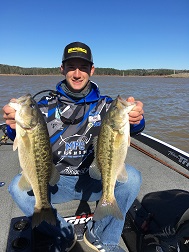
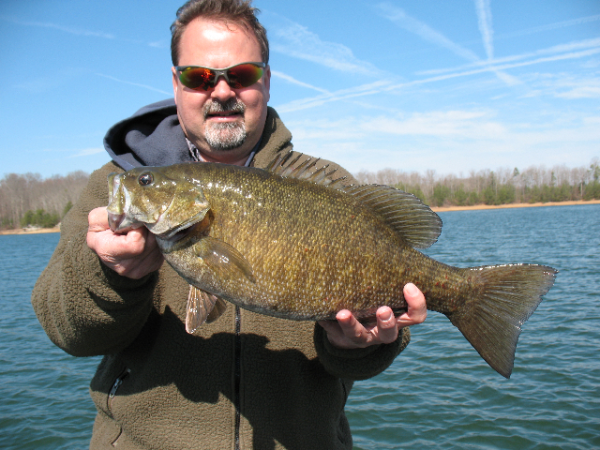
How and Where to Catch October Bass at Lake Allatoona, with GPS Coordinates

October Allatoona Bass

with Brian Cox

    October is a great month to go bass fishing anywhere in our state. But mention Lake Allatoona and most fishermen will give you a strange look and ask why go to the “Dead Sea.” That misconception about Allatoona keeps many from enjoying the great fishing there.

Allatoona gets crowded since it is just outside Atlanta.  On the weekends in the summer pleasure boaters make it hard to fish during the day. But right now the lake is not nearly as crowded and the spots are biting. Largemouth can be caught this month, too. 

Brian Cox grew up in Woodstock and his father and grandfather taught him to fish.  He got the bass fishing bug at 12 years old and started fishing Allatoona when he was 15.  He now lives near the lake, guides on Allatoona and fishes several tournament trails and pot tournaments on the lake.

Three years ago Brian was won the point standings for Angler of the Year in the ABA trail, winning about ten tournaments that year.  He also fishes the Bulldog BFL and AFT tournaments and does well in them.  For the past year he has taken some time off from tournament fishing to spend more time with his kids but is getting back into it now

Kids are important to Brian. He loves taking them out on trips and seeing their delight in catching fish. He hopes to start a fishing camp for kids, where they will go for a day camp or for a multi-day camp and learn about fishing.

“October is great on Allatoona,” Brian said.  The bass are moving more shallow and feeding, and you can catch them on a lot of patterns and baits.  Brian’s favorites include a buzzbait, Zara Spook, crankbait, Fluke, jig and pig and jig head worm. With those baits you can cover any condition any day in October.

Rocks, from pea gravel to chunk rocks are a key, and brush piles and blowdowns increase your odds that bass will be feeding on a spot.  Wind makes a big difference and it helps all kinds of places, but clay banks can also be good when the wind is blowing in on them. Points and banks in the mid lake area are where he concentrates his time.

    Brian took me to Allatoona in early September to show me the following ten spots and how he catches bass on them. The fish were just starting to hit on some of them but by now all will hold bass.

1.  N 34 08.088 – W 84 40.365 – Bass follow the shad and the shad move into creeks and cuts during October, especially later in the month. A good place to check for shallow bass is in the back of the creek just downstream of the Bartow-Carver Camp ramp. This creek goes back and splits into several fingers. Brian likes the one to the right going into the creek.

There are many trees in the water cut by the Alltaoona Tree Cutting Project and by fishermen back in this creek. Brian starts near the mouth of the fork and works all the way around it. He fishes an Albino Shad Zoom Fluke over the trees and along the bank in here.  You can keep your boat near the middle of the cut and fish all the wood in the water.

After working the wood with a Fluke, Brian will follow up with a shaky head worm. He likes a one quarter ounce head with a green pumpkin Finesse worm on it.  A jig and pig will also catch fish in the trees.  Dip the tails of the jig trailer and the Finesse worm in chartreuse JJ’s Magic to make the fish bite better. Spots seem to love a flash of chartreuse.

If you see shad on the surface or balls of them on your depthfinder fish the area slowly and carefully. Brian says this time of year find the shad and you will find the bass, so if baitfish are present the bass will be, too.

2.  34 08.415 – W 84 40.116 – Come out of the creek and stop on the downstream point of the second pocket below the ramp.  This bank is shady in the morning and Brian says it is a great place to throw a buzzbait.  He will start at the point and work all the way down the bank to the back of the pocket.

For some reason the fish here will put their nose right on the bank so Brian casts so his Strike King white one half ounce buzzbait hits on the bank. He pulls it off the bank without a splash and is ready for a bite as soon as it gets in the water. 

If wind is blowing in on this bank it is even better. Some chop on the water really helps the bite anywhere you are fishing on Allatoona. Also keep a watch or surface activity here and be ready to throw a Spook or Sammy to them.

3.  N 34 09.512 – W 84 39.881 – Another good bank for topwater and a jig and pig or jig head worm is in Illinois Creek. Go past the buoy at the bend and watch the right bank past it.  There are big rocks on this bank and it drops off fast, and bass hold on it and feed on passing shad.

There are some key spots along this bank where big boulders are under the water.  Keep your boat out in 30 feet of water and work the jig and pig or jig head worm from the edge all the way out to the  boat. When you see or hit the big rocks with your bait out in 15 to 20 feet of water fish that spot carefully.

Fish a topwater bait along this bank, too. With all your baits cast at an angle ahead of the boat. The bank is so steep you will be fairly close to the shore even in 30 feet of water so cast to the bank ahead of the boat and work your bait back at an angle to hit the big boulders.

4.  N 34 07.848 – W 84 39.712 – Run up to the Atlanta     Yacht Club and go into the creek on the downstream side of it.  Go all the way to the split in the back and fish the right side split of it.  Start near the point and keep your boat out in the middle of the cove and cast to the bank. There are stumps, brush and rocks back in here that hold the bass.

A jig or jig head worm works well but this is a good crankbait area, too.  Brian likes a chartreuse and brown crankbait that will hit the bottom when fishing this area. Fish all your baits all the way to the middle of the creek and make some casts ahead of the boat to cover the channel, too.

5.  N 34 08.431 – W 84 38.211 – Running up the river, channel maker 19.5 will be on a point on your left.  There are several pockets along this bank across from Gault’s Ferry ramp but Brian likes to fish the upstream point of the second one upstream of the channel marker. 

It is ideal, with deep water just off it and clay and rocks on the bank and a blowdown you can see half way into the cove. There are also some trees and brush out from the bank underwater that hold bass.

Start with a buzzbait or Spook casts to the bank and worked out, then go back over the area with your crankbait.  Fish over the tip of the blowdown you see and try to find the hidden brush.  You can also probe the brush with a jig and pig or jig head worm.

Brian says there are three kinds of rock that hold fish right now. Pea gravel is good, especially when wind is blowing on it. Chunk rocks the size of softballs are good as are boulders.  Banks like this one where there is a transition from one kind of rock to another is even better. Fish the edge of the rock change hard.

6.  N 34 07.595 – W 84 38.053 – Across the river and upstream is Harbor Town Marina. In a cove just upstream of it is a youth camp with a dock on the downstream side.  The point across from the dock is a good one, with clay, rock and a few boulders on it. There are also some blowdowns on the downstream bank..

Start on the point and fish topwater, crankbaits and jigs from the point about half way into the cove.  You will be fishing the bank across from the dock.  The transition areas are key places and you want to make sure shad are in the area. Also keep an eye out for surface activity.

Work the tips of the blowdowns, too.  Try topwater and crankbaits over them then probe them with jigs and jig head worms.  Try to hit the ends of the limbs and raise your bait up and let it fall back several times, and jiggle your rod tip to make the bait dance.

7. N 34 08.179 – W 84 38.146 – Just upstream from #5 the river makes a big bend and a huge flat runs out from the left bank going upstream.  The flat has small islands on it and some danger markers. If you idle parallel to the flat near the channel, out from the shoal marker near the willow tree on an island just underwater, you will cross a point running off the flat downstream.

This point has pea gravel and other rock on it. The point runs out 30 to 40 yards and drops off into very deep water. It is ideal since it comes out of deep water and leads to a good feeding flat.  And there is usually some wind here.

Keep your boat out in 25 to 30 feet of water and make long casts across the point with jigs and worms. Work the bait up one side, across the top and down the other side.  If this doesn’t work, cast your jig so it falls straight down on top of the point. Brian says those two methods, working your bait to and through cover or letting it fall straight down into it, are both good.

8.  N 34 08.412 – W 84 37.574 – Above the channel bend there is a huge flat off the left bank going upstream.  A key area on this flat is a ditch that comes out of a small cove near a danger marker on top of a hump way across the river from channel marker 22 E. The ditch runs out to the river and offers the bass a perfect path.

When wind is blowing across this flat Brian will fan cast it with a crankbait, staying out inabout 15 feet of water.  You can catch fish from the danger marker all the way back to #7 working it with a crankbait. Make long casts and try to hit bottom as much as you can with your bait.

Also keep a topwater ready. Brian says fish school up in this area a lot. If you have your Spook or Sammy ready and hit where they are breaking you will catch fish.  Some may be hybrids but bass school up here all over this flat.

9.  N 34 08.025 – W 84 37.323 – Across the river a big clay bluff point sits on the upstream side of Kellog Creek.  There are laydowns and boulders on it as well as clay.  Channel marker 22 E sits on the point and it is an excellent one to fish this time of year.

Brian keeps his boat in about 15 feet of water on the downstream side of the point and casts across it with a jig and pig.  Most of the boulders are on the upstream side of the point so casting past them and working back through them moves the bait in a natural way.  Also fish the blowdowns on the point.

10.  N 34 07.948 – W 84 36.843 – Go into Kellog Creek and watch for a big block rock seawall on your left past the first couple of coves.  It is just upstream of a house with a huge catfish replica on the roof of the garage. The seawall point holds a lot of big spots and Brian says he has caught several four pounders here.

Start with topwater here and fish all the way around the point to the next small cove. Work it carefully and give the big fish time to chase down your bait. You can also probe it with a jig and pig or jig head worm, or run a crankbait on it.

All these places are great right now throughout October.  Try Brian’s favorite baits and your own, and you can find similar places to fish these patterns, too.

To see first-hand how Brian fishes Alltoona call him at and check his website at 770-855-7388 http://www.metroatlantafishing.com/ for more info.

How and Where to Catch September Lake Lanier Bass with GPS Coordinates

September 2013 Lanier Bass

 with Rob Jordan

    Tired of summer doldrums fishing for bass in deep water and not catching much? There is light at the end of September, when water starts cooling and bass get more shallow and active on our lakes. But why wait several more weeks?  You can catch some big spots at Lanier right now.

    Lanier is a big lake at 40,000 acres and since it is just northeast of Atlanta it gets heavy pleasure boat traffic, especially on weekends. And it gets a lot of fishing pressure.  The lake is known for its big spotted bass that took advantage of the introduction of blueback herring.  Five pound spots are caught often and most tournaments are won on spotted bass, with five-fish limits weighing 15 pounds common.

    Rob Jordan grew up fishing Lanier and now lives in Swanee.  His cousin Jim Murray, Jr. got him started tournament fishing and taught him a lot about catching bass.  Rob also worked with Jim painting custom lures and Rob has a business making realistic looking baits.  He also guides on Lanier and fishes tournaments.  Next year Rob plans on fishing the FLW Everstart and BASS Opens.

    This year Rob fished the Savannah River BFL trail and is right on the qualifying point to fish the Regional at Lanier with one tournament to go.  He hopes to do well in the Regional on his home lake.

    Rob’s best five spots in a tournament on Lanier weighed 21.5 pounds. This summer he has had big fish in two night tournaments.  Two years ago he placed third in the Weekend Series on Lanier and was in the top ten in the BFL there that year.  He knows the lake and how to catch good spots.

    “Lanier is a fantastic lake but you have to understand the waters and when the bass bite to do well,” Rob said.  It is a unique lake and you won’t catch the big spots by fishing like you do on other lakes.

    “The biggest spots are hard to catch since they roam the lake, living in water 50 to 60 feet deep,” Rob told me.  Weather and moon phases are keys to figuring out the bite. And you have to fish in the right places to catch the quality spotted bass.

    September is a transition month for spots on Lanier and you can catch some really big fish, especially late in the month.  Last year Rob got a six pound, six ounce spot toward the end of September on a guide trip.  But you can catch quality fish starting right now.

      A wide variety of baits will catch spots on Lanier this month. Rob will have a drop shot worm and a shaky head worm ready for slower fishing.  When the bite is good he likes a swim bait or a top water plug. All these baits are fished in deep water, with his boat often sitting in 80 plus feet of water and fishing water that is 30 feet deep.

    Rob will try a variety of depths and lures until he finds where the bass are feeding, and that depth will usually be consistent all over the lower lake.  The key is a long point or hump that drops off into very deep water. Standing timber in the deep water and brush or rocks on the humps and points make those places much better.

    Rob took me to the following ten spots in early August and we caught fish on most of them.  They are good right now and will get even better as the month progresses.

    1.  N 34 10.029 – W 84 02.492 – Green channel marker 3SC in Shoal Creek sits on a rocky hump right by the channel.  There is also a danger marker on it and one small bush stuck out of the water when we were there.  The hump is right off an island, too.  It always holds bass, according to Rob, and it typical of the type place he fishes this month.

    There is brush all over and around it as well as the natural rocks to hold feeding fish. Rob says it is important to locate the brush piles and fish them, so ride it with your electronics and mark the brush. Good electronics will even show the fish in the brush and how they are setting up on it.

    Start on the upstream end and work the whole area, keeping your boat out in the channel.  Wind rippling the surface of the water is critical here and on other spots to make the fish active, and overcast days help, too.

    If there is some wind and some clouds try a big swim bait like the Bucca Bull Herring hard swim bait or a Zman Grass KickerZ over the brush. Topwater plugs like a big Spook or Sammy will draw the bass up to the top from the brush.

    If the water is slick or it is sunny Rob will fish a Zman StreakZ on a drop shot or a Big Bass Baits jig head with a worm on it in the brush.  It is important to get the baits right on the fish so work each brush pile carefully, especially if you see fish in or around it.

    2.  N 34 11.681 – W 83 03.607 – Run over to Young Deer Creek and right in the mouth of it on the left side going upstream marker 1YD sits on a hump with a danger marker and some bushes on top.  Again, it is right on the channel where deep water is very close to shallow water. 

    Your boat should be in about 100 feet of water and you want to fish brush around 30 feet deep. Rob says 30 foot deep water is usually a good depth in September but they may feed a little shallower later in the month. If you are not catching fish in the deeper brush, or if you see them in more shallow brush, try it.

    Rob says bass are caught here every day. There are a lot of brush piles and big rocks on the hump to cover.  Try all your baits around them.

    A big swim bait is Rob’s go-to bait if he wants quality fish. In a tournament where five bites from big fish is all you want, try the Bull Herring worked slowly over the brush.  Rob’s custom painted versions are best since the spots on Lanier see so many swim baits but all will catch bass.

    3.  N 34 11.766 – W 84 03.499 – Across the mouth of Young Deer Creek channel marker 2YD sits on a deep rocky point that is excellent.  Rob fishes the downstream end of the point where it runs out parallel to the channel.  You will be sitting in 70 to 100 feet of water when fishing the end of the point.

    First try the swimbaits and topwater. Always keep a topwater plug ready to cast immediately to surfacing fish.  We caught a couple the day we fished when they came up near us. They may not stay up long so be ready.  If the spots are consistently schooling on top but not staying long, Rob will stand in the front of the boat with a topwater bait ready to cast, waiting on them to come up again.

    4.  N 34 12.494 – W 84 01.432 – An island sits in the mouth of Six Mile Creek and marker 4SM sits just off it. The creek channel is on one side and the river channel on the other.  Rob says this is one of the best big spot holes on the lake and he caught a six pounder here. 

    There are stumps and brush piles on the point on the downstream side of the island where the big spots live. Rob says a big swim bait or topwater is the way to go here for the big ones.  Work both baits all around the point, concentrating on brush piles and stump beds you find with your electronics.

    Rob fishes both hard and soft swimbaits with a steady retrieve and keeps them near the surface is there is cloud cover or wind on the water.  When a fish hits he sets the hook with a sweep of his rod, not a hard set, and does not drop the rod tip. 

    If there is little wind or if the spots just don’t seem to eat the big bait, Rob will drop down to the smaller size Zman SwimmerZ soft swim bait.  He fishes the soft baits on a three sixteenths to three quarter ounce jig head depending on how the fish set up. The lighter head is better for running the bait shallow but the bigger head will allow you to fish it a little faster and deeper.

    5.  N 34 13.464 – W 84 01.406 – Further up Six Mile Creek it narrows way down right at channel marker 7SM.  There are several good humps and points in this area. The left side going upstream, between the last cove on that side to the point where the creek narrows way down, have the better ones.

    The danger marker on the left sits between two long points that are excellent. Sit out in 45 feet of water and cast up into 25 to 30 feet of water.  There are a couple of road beds, an old house foundation and brush piles on the points.  Fish them all.

    The pinch point where the creek narrows way down funnels fish into this area as they move up the creek in the fall. Rob says when the water temperature drops into the 70s it is like a switch turns on and the bass get into action chasing bait. Swim baits and topwater are even better when it cools down.

    6.  N 34 14.772 – W 83 56.843 – Run up the river to the mouth of Flat Creek. A big island sits in the mouth of it and red channel marker 26 is on a point where the river channel swings in toward it. Rob says bass live here year round and it is always good, but in September even more bass get on the point while moving into the creek.

  Sit out in 40 feet of water and cast up on the point with all your baits, starting shallow and working deeper. There are rocks and brush piles here that hold the fish. If you can’t find the brush with your electronics, drag a jig head worm along the bottom until you hit rocks or brush and work it.                 

    7.  N 34 13.602 – W 83 55.772 – For a change of pace run into Mud Creek all the way to the narrow creek channel in the back.  Rob fishes docks back in places like this. Spots and some big largemouth can be found back around docks in creeks as the water cools.  Fish all the docks from the ones on the left past the big rocky point where it narrows down all the way around the creek.

    Try a one eighth to three sixteenths ounce jig head with a Zman finesse worm on it.  Fish all of each dock, from the deepest water in front of it to the back under the walkway.  The bass may be feeding anywhere around the docks. 

    The bass will be on the outside deeper docks early in the month but move further back as the water cools. Since the weather this summer has been fairly cool and the rain and cool weather in the middle of August kept the water temperatures down, they may move further back sooner this year.

    8.  N 34 13.967 – W 83 56.271 – Going out of Mud Creek Old Federal day use park with a boat ramp is on your left.  Past it a long point runs out toward the main lake and there is an island off the bank, with danger markers between it and the main point. 

    Stop about even with the island in Mud Creek and idle over the ridge that runs out on that side toward the Mud Creek channel.  This ridge runs way out and has rock and brush on it, and bass stack up on it all summer long. Even more move to it as they follow shad back into the creek in the fall.

    Sit in about 40 feet of water and cast up on top of the ridge to 20 to 30 feet of water.  Try all your baits.  When using a drop shot in the brush Rob likes to pitch it ahead of the boat a little rather than fishing it straight under the boat. He will let the lead hit bottom, raise his rod tip to keep the bait up off the bottom and twitch it in one place, moving the lead very slowly as he works it around the brush.

    9.  N 34 13.447 – W 83 57.774 – Out off the end of the point with Old Federal Campground there is a big flat point with a danger marker off a small island with bushes on top.  There are brush piles all over it but Rob’s favorite area of this big point is downstream of the island and danger marker. 

    As in other places, start with topwater and swim baits over the brush piles you locate with your electronics, then try the dropshot and shaky head.  Rob likes a light one sidxteenths to one eight head, as light as conditions will allow, since the slow fall will often draw a strike.

    Rob lets the shaky head hit bottom then slowly drags it along with an occasional snap of the rod tip to make it wiggle and jump. Many people shake it in one place, as the name implies, but Rob moves it slowly along the bottom without constant shaking.

         10.  N 34 11.424 – W 83 58.442 – In Flowery Branch across from the Van Pugh ramp a long underwater point runs off the upstream side of the danger marker between the small island and the main point.  This point actually runs off Van Pugh park out to the island then on out toward the creek channel.

         Stay out on the creek end of the point and work it with all your baits.  Resident fish live here and more move in during the fall.  If you are fishing a tournament use big baits for a few quality bites. Use smaller topwater baits like the Sammy 100 early in the fall but go bigger later. For numbers the shaky head or drop shot will get more bites.

         All these places hold bass right now and will get better as the month progresses and the water gets cooler. Give them a try and you can find many more just like them.

         For a guide trip with Rod to see first hand how he fishes Lanier call him at 770-873-7135 and check his web site at http://robjordanfishing.com  Also check out his custom painted baits at http://www.xtremelurecreations.com

Fishing Lake Chickamauga

Chickamauga Bass with Jeremy York

Chickamauga has been the best bass lake in the Southeast, if not in the whole country, the past few months.  Many eight pound plus bass have been landed and in most tournaments you didn’t even need to weigh in if you had five bass weighing less than 25 pounds.

The bad news is the patterns producing those incredible stringers working the first three months this year are over. The good news is those bass are still there, hungry in May and can be caught on a variety of new patterns. 

Chickamauga is a TVA Lake just outside Chattanooga on the Tennessee River.  It runs 59 miles from the dam up to the Watts Barr Dam, with many big feeder creeks.  Although it is not in Georgia or Alabama, many fishermen in our state are less than three hours away and make the trip often. If you are not one of them you are missing out on some incredible bass fishing.

Jeremy York owns Angler’s Warehouse near Athens, Georgia.  Two years ago one of his pro staff invited him to sample the great bass fishing that was just being discovered on Chickamauga. He went up and caught some big bass and fell in love with the lake. He now makes the three hour drive several times a week in the winter and does some guiding on the lake, about 25 trips so far this year.

Jeremy is a tournament fisherman and fishes the pro trails as well as local and regional tournaments. In the BFL on Chickamauga in March he weighed in five bass weighing 30.25 pounds – and came in third!  In another tournament he had five weighing 27 pounds and came in 14 place.

In five guide trips in March he and his clients had their five best weighing 26, 39, 36, 30 and 32 pounds.  That is better than a six pound average for four of the five trips.

In five trips this year he and his clients have landed an eight pound plus fish in each.  One of his best trips was with a father and son. Within a few minutes of starting the father landed an 8.75 pound largemouth, he landed a 6.5 pounder and then the son landed an 8.68 pound fish, all within the first hour. 

Jeremy found a pattern that works great from the beginning of January through March.  When the water temperature hits 48 degrees the bass really turn on and 48 to 52 is the ideal water temperature.  It starts slowly as soon as the water reaches 45 degrees. The pattern holds until the water gets to about 58 degrees, usually around the first of April, and the bass head toward the bedding areas.

Although this pattern is over this year, it is worth remembering for next year.  Jeremy came up with the idea for the Extreme Bait Ball Rig that is sold by Picasso. It is an Alabama rig with teasers on the arms, so it looks even more like a school of baitfish. That is what he caught the big bass on from January through March.

He rigs it with one eighth ounce Buckeye Jewell heads on the hook arms and rigs them and the teaser attachments with either a 3.5 or 4.5 inch Shadalicious blue gizzard or Texas shad swimbaits. For bigger bass he runs the 4.5 inch bait on the hooks with smaller ones on the teasers, or runs the bigger size on all. 

The ideal rig for throwing this heavy bait is an I Rod Bama Rig Special Genesis II rod with a Revo SX reel spooled with 80 pound Power Pro braid. He tried several reels and all wore out in a few trips except the Revo. 

There are three things to remember when throwing this rig.  Lob it, don’t make a usual cast.  Keep reeling when you feel something until the bass almost jerks the rod out of your hand. You will hit stumps with it and if you set the hook you are unlikely to get the rig back. And finally, when you do hang up, keep your line tight as you go to it, go past the hangup and pop it loose with small pops of the rod tip.

Jeremy took me to Chickamauga the second week of April and warned me the great bite was probably over. Although he got a nice 4.5 pounder first thing that morning on the rig, fishing was slow. We went into the spawning pockets and they were full of bass just starting to fan beds. The fish were very spooky and we could not get them to hit, but we saw many in the six pound plus size starting to bed.

Adding to our problems that day the water rose almost two feet while we were there.  The lake is scheduled to be at full pool by April 15th each year and it was four feet low when we got there.  But it was filling fast.

When the water temperature is right Jeremy fishes transition areas like stump flats near the mouths of spawning areas.  There needs to be deep water nearby with a shelf or flat with stumps on it. A ditch or cut running across the flat is key. The bass feed on those types of places during the winter and pre spawn.

Other good types of cover are banks where big rocks transition to chunk rock to sand, often found at the mouths of feeder creeks and coves. Big largemouth and smallmouth both like this kind of area and will hit the rig fished there.  On one trip this year he got a six pound smallmouth and a six pound largemouth.

On the stump flats keep your boat out in deeper water near the cut or ditch and cast up to four or five feet of water. Work your rig back steadily, keeping it above the stumps but near the bottom. On the transition banks stay out a long cast from the bank and cast near it, fishing the rig back to cover water two to six feet deep.

File this information away for next year. But now for the good news. Those big bass are still in the lake and you can catch them right now. Fishing will be good from now through May and you can use a variety of baits to catch them.

Right now about half the bass, especially the bigger fish, are on the beds or have been in the last few days. You can sight fish for them or drag a Carolina rigged lizard through the bedding areas. If sight fishing, look for stumps, the favorite place for a bass to bed on Chickamauga.

Jeremy likes a Big Bite Baits Fighting Frog on a light Texas rig, a white swim bait with a weighed keel hook or a whacky rigged Senko rigged weightless for sight fishing.  He will cast well past the bed and pull the bait to it, letting it drop into the sweet spot.  Let it sit and shake it and the bass will usually eat it if they are hard on the bed.

Good areas for sight fishing are in Soddy Creek, which usually has the clearest water on the lake, and other creeks on the lower half of the lake.  The pockets up the river are full of spawning bass, too, but they are harder to see since the water is usually more stained there.

Another good area is Dallas Bay around Chester Frost Park. Jeremy says there have probably been 100 eight pound plus bass released there in tournaments this year and they will not leave the bay since the spawn is approaching. They will stay in the bay, feed until spawning and then gradually work back out to the river, feeding on post spawn areas.

The stump flats on both sides of the ramp are good spawning areas to check since they are littered with stumps.  Be careful, the flats run way out. Try to follow the ditches and cuts going back into them since the bass will follow them. Often the biggest bass will be bedding on stumps closest to the deeper water in the cuts.

Bass move into the spawning areas in waves and about half of them are there now the last week of April.  More will move in during the next few weeks, depending on water temperature and moon phase.  They will stay on the bed for about a week then move off and spend about a week recovering. They won’t feed much during that week but will start feeding heavily after that so there will be a lot of hungry fish all during the month of May.

To catch post spawn fish Jeremy will try a variety of baits. A Spook or similar walking bait worked over the stump flats will draw explosive strikes. Keep your boat in the cuts and cast ahead of you down the cut and fan cast the flats on both sides.  Cover a lot of water, fishing fast until you find feeding fish.

A swim jig worked over the same areas will also catch fish, especially if the fish are not real aggressive. Swim it in the same places you worked your topwater.  You can also work a spinnebait over those areas or try to bump the stumps with a square bill crankbait.

Toward the end of May there will still be a few bedding bass but the bream spawn comes into play. Bass will feed on the bream that are bedding in the same areas as the bass use, so fish a swim jig around the bedding bream to catch those bass feeding on bream.

Another big key in May is the shad spawn.  Chickamauga has two kinds of shad, both threadfin and gizzard shad, and golden shiners, all favorite foods of bass.  The shad will spawn on gravel and shell bed flats and rocky banks this month and the bass often go wild feeding on them. Jeremy says the shell beds on flats near the river channel are a huge key to the shad spawn so seek them out.

Look for the schools of shad running the banks early in the morning or working the flats.  Jeremy likes to see smaller areas of shad spawning. If there are shad spawning on 100 yards of bank there might be 20 bass feeding on them and they will be real scattered out. If there are shad on only about 20 feet of bank, those same 20 bass will be concentrated and easier to catch.

A spinnerbait, rattle bait or swim jig all work well on the shad spawn. Work them over the flats, running them right on the bottom.  On the banks, cast right to the bank, even up on the rocks and pulling your bait into the water.  The bass will be facing the bank so you want to cast as shallow as possible.

The shad usually spawn early, the first couple of hours of light on sunny days, but will stay shallow much longer on cloudy days.  If it is sunny and the shallow activity stops, back off and fish a little deeper to catch the bass following the shad out a little ways off the bank where they hold until the next morning.

Why is Chickamauga so hot with big bass right now? Jeremy says the stocking of Florida and Northern strain largemouth as produced a cross, an F1 hybrid that grows very fast and is very aggressive.  Tennessee DNR reports show they stocked both Florida and Northern strain largemouth as well as F1 hybrids in 2002.  Those fish have reached trophy size and their offspring are reaching bragging size every year.

Jeremy thinks the next two years are going to be fantastic, with some huge bass caught in Chickamauga each year. All those eight to ten pound bass will mostly still be around for a couple of years and could be two to three pounds heavier. And all those five and six pounders will also be two to three pounds heavier.

For the future, there are a lot of four and five pound bass coming along, too. There is a 15 inch size limit on largemouth and an 18 inch size limit on smallmouth on Chickamauga and those limits have contributed to the larger fish in the lake.  That size restriction also insures a good supply of quality fish for the future. So the fishing should stay really good for the foreseeable future. You definitely want to head to Chickamauga and get in on catching them.

A three day non resident Tennessee fishing license is $16 and can be bought on line before your trip.  A ten day license is $25 and an annual license, good until February 28, 2014, is $80.  You might want an annual license since you are sure to fall in love with fishing Chickamauga.

Where and How to Catch February Bass at Sinclair , with GPS Coordinates

February Bass at Sinclair 

with Todd Goade

NOTE – THIS WAS WRITTEN BEFORE THE POWER PLANT WAS CLOSED AND TORN DOWN.

Cold winter weather always puts a damper on bass fishing in February on most of our lakes.  Bass go deep and school up tight and don’t eat much. But Lake Sinclair is an exception to that rule.  The warmer waters from the steam plant make it the most popular lake for club and other tournaments this month.

There is a good reason so many tournaments are held on Sinclair in the winter. Bass are more active because the water is warmer and also because of the currents created by the steam plant intake and outflow as well as those generated by power generation and pump back at the Oconee dam.

Sinclair is a 15,330 acre Georgia Power lake on the Oconee River.  It was dammed in 1953 and the lake is ringed with cabins and docks.  Almost all docks are on posts and many have brush piles around them.  There is a lot of grass in the lake and it still attracts baitfish this time of year although it is brown now.  There are sandy pockets and banks, rocks and wood cover to fish. 

When Plant Harlee Branch, the coal fired steam plant, is taking in water to cool its boilers, current near the mouth of Little River around the bridge and intake moves upstream.  In Beaverdam Creek release of warmer water from the boilers not only heats the lake, it creates a strong current around the discharge, under the bridge and downstream.

When the power plant at the Oconee Dam is generating current a strong flow comes down the river.  When the turbines are reversed and water is being pumped back into Oconee there is a strong current going up the river.  This current also affects the creeks and will reverse the flow in Little River, too.  The strongest effects are from the mouth of Little River upstream.

Most of Lake Sinclair stays stained in February with Little River often the muddiest area.  Near the dam, Island and Rock Creek almost always remain clear.  Those creeks down the lake are also less affected by the warm water so are usually the coldest water on the lake.  So you can fish shallow relatively warm stained water or colder clearer water within a few miles.

Sinclair is usually one of the top three lakes in Georgia for numbers of tournaments reported in the Georgia Bass Chapter Federation Creek Census Report, with over 80 tournaments reported each year.  In recent years Sinclair has been one of the best lakes for numbers of bass with over 20 percent of anglers catching a five fish limit.  But the bass are small, with an average weight of about 1.5 pounds and an average tournament winning weight of about 10 pounds.

 Todd Goade remembers the first bass he ever caught and it turned him on to bass fishing. He was eight years old and caught a six pound bass on a topwater plug in Missouri. That would turn on any fisherman, especially a young fisherman.

Most of his life Todd lived in Tennessee where he fished with local clubs and the pot trails. When he moved to Georgia in 2002 he quit fishing for a few years but got back into it in 2005 and started fishing the BFL trail, the HD Marine Trail, Boating Atlanta and others. 

Over the past few years Todd has been very consistent in tournaments, placing in the money in many of them.  Last year he finished 3rd overall in the Bulldog BFL point standings and in 2006 was 7th in the HD Marine point standings.  Last February he finished in the top 20 at Sinclair in the BFL and needed just one kicker fish to finish much higher.

“There are always some shallow fish at Sinclair,” Todd told me.  He prefers to fish Sinclair shallow this time of year and likes to go after them with lighter tackle and smaller baits than most anglers use.  Finesse fishing will catch lots of bass on Sinclair most winter days and will often get you in the money in tournaments.

For fishing Sinclair this month Todd has a variety of baits rigged and ready. He will have a small jerkbait like a Pointer on a spinning rod with eight pound test line, a Texas rigged Zoom Finesse worm and another Finesse worm on a 3/16 Spot Remover jig head, both on eight pound line, a crankbait like a Bomber 7A or a Bandit Flat Maxx and a small spinnerbait on 10 to 12 pound line and a Carolina rigged Zoom Baby Brush Hog or six inch lizard. He will also keep a Flexit Spoon ready for deep jigging if he spots bass holding on deep structure.

Todd prefers to fish in eight feet of water or less and will often be sitting in 12 to 15 feet of water fan casting a point or working a bank.  Although the bass are shallow they will usually be on cover and structure with deep water nearby.  He likes main lake banks and points or banks near creek channels that drop off fast now.

Current will position bass on structure and sun will position them on cover, according to Todd.  He likes banks and points where the current is moving and will concentrate on brush, docks and rocks when the sun is bright. This time of year Todd says he does better on sunny days.

Todd and I fished Sinclair the second Sunday in January, a tough day for us and others, based on the weigh-in of three clubs at Little River that day.  He showed me the following places he likes to catch fish on Sinclair in February and they will hold fish you can catch, too.

1. N 33 11.211 – W 83 17.476 – The bank above the steam plant intake drops off fast has overhanging brush and rocks along parts of it and the pockets have grass in them.  Todd likes to fish along this bank and often catches a limit of keeper size bass here.

Start on the point above the mouth of the intake on the right and work upstream to the next main lake point.  The channel swings in near the big upstream point and the deep water is good. You will be sitting in 12 to 14 feet of water along most of this bank.  The water is usually stained in this area and is warmed by current coming up the river.  When water is being pulled into the steam plant current will run downstream.

Cast a Texas rigged Zoom Finesse worm under the overhanging brush to the rocks and also work it around any grass you see.  Todd likes a green pumpkin worm and will dye its tail chartreuse.  Work it with short hops and jiggles, trying to hit any cover along this bank.

If water is moving and the bass are more active, cast your jerkbait close to the bank and work it back in short jerks. Try several cadences until the bass show you what they like.  The colder the water the slower you should fish the bait with longer pauses between jerks.

2. N 33 11.351 – W 83 16.242 – Run down the lake past the mouth of the river and watch for the first cove on your left. There is a big mesh satellite dish on the point.  Go into the pocket downstream of this dish and start fishing before you get to the first dock that has a green metal roof and several PVC rod holders on it.

Fish down this bank with your Texas rigged and jig head worms, casting to the bank between docks and working under the docks and around the posts.  When you get to the third dock you will know you are in the right spot if you see a big UGA emblem on the dock and house and the walk going up from the dock has little UGA helmet lights and a sign that says “Dog Walk.”

Fish that dock and the grass just past it. You can run a spinner bait through the grass and work your worm rigs around it, too.  Todd likes a small white spinner bait with silver blades.  He fishes this cove to the dock with the US flag on it and stops since the water gets real shallow past it.

3. N 33 11.330 – W 83 15.679 – Across the river is an island and just downstream of it a marked hump. There are three danger buoys on the hump and three PVC poles, two side by side. Stop straight out from the PVC poles in about 25 feet of water and fan cast your crankbait as you ease in toward the poles. You can cast to the top of the hump and it is very rough here.  Try a worm along the bottom, too.

If you have a GPS on your boat you will see a point running out from this hump and that is where you want to stop and start fishing.  You can see the point on a good map, too.  The contour lines will be close together and that is a key Todd looks for this time of year. That shows a fast dropping bottom and the fish hold on those kinds of places.

4. N 33 09.806 – W 83 13.802 – Head down the lake to the big island just upstream of the mouth of Reedy Creek and the airport.  There is an old quarry under the water on the upstream side of the island and the bottom is hard clay.  Stop on the outside point of the island in about 20 feet of water and work around the point, casting a crankbait up shallow. Try to hit the bottom with it.

After working the crankbait back off a little and cast a Carolina rig or other worm rig here. There is a good brush pile in 12 to 14 feet of water that often holds bass. They will hold in the brush and run in to feed.  Probe the brush carefully with all your worm rigs.

5. N 33 09.752 – W 83 13.973 – Idle over to the center of the upstream side of the island. You will see three points, the one you just left and two more. Stop out from the center point and you will be in the quarry in very deep water.  Fish the center point here with your crankbait, then probe for brush in 16 feet of water.

Todd likes a half-ounce lead on his Carolina rig and usually has a 24 inch leader.  He will drag the green pumpkin lizard or Brush Hog with dyed tails around and through the brush, working it slowly and feeling for any resistance. The bass will be sluggish most days in the cold water.

6. N 33 11.106 – W 83 12.509 – Run toward the back of Island Creek and watch for a bright red barn on the left side before you get to the power lines.  Start on the point just upstream of the pocket with the red barn and work around the shallow pocket to the dock with a green slide on it. The bottom drops off fast and it is rocky, with docks and brush along it.

Fish your Texas rigged worm or jig head worm here, hitting rocks and wood cover on the bottom and also fishing around and under all the docks. Todd says this is a good place to find bass pulled up to feed this time of year.  He will hit this place and others several times during a fishing day since fish may move in to feed anytime during the day.  You just have to be there when they are feeding.

7. N 33 10.775 – W 83 12.444 – Running down the middle of Island Creek back toward the river, watch on your left for a flat point with a seawall around it. There is a house sitting way back from the water but nothing out on the point.  Across the creek you will see a big brown brick house and just upstream of it a green roof dock.

On a line between the point and green roof dock, out in the middle of the creek, is a hump that comes up to about 18 feet on top. There is brush on it.  Todd will stop here and jig a spoon on this hump, especially if he sees baitfish or fish near the bottom with his depth finder.  It is close to the creek channel and often holds a school of fish. He says he will not spend a lot of time here but does check it out.

8. N 33 09.568 – W 83 12.765 – Near the mouth of the creek on your left is a small island sitting close to the bank.  A long shallow point runs off it toward the middle of the creek.  Todd stops his boat just upstream of the island, lining up the trees on the upstream side of it with the red top dock on the bank behind the island.

Sitting in 15 feet of water he will cast a crankbait all over this point, covering it with fan casts.  He will also try his jerkbait here as well as worm rigs.  This long underwater point is typical of the kinds of places winter bass hold on Sinclair and the water is clear enough here they will come up for a jerkbait.

9. N 33 09.448 – W 83 12.700 – Downstream of the island a big cove runs from the island to the main lake point between Island Creek and the river.  About in the middle of this cove is a long shallow point running out to deep water.  It has a sharp drop off on the downstream side.

Look for and old high boat house roof with no sides and a gazebo on the bank near it. There are swift gourds on a pole near it.  Just downstream is a gray roof dock with a boat ramp just upstream of it.  The point runs out with the downstream sharp edge right at the ramp. You can see this point on your GPS or map, too.

Todd starts way out on this point and make long fan cast across it with crankbaits and jerkbaits.  Try to hit the drop from several angles. Then work your worm rigs across the point and down the drop for fish that are not very active.

10. N 33 08.296 – W 83 11.535 – Run down to the dam and start into Rocky Creek. On your right is a point between the river and the creek.  There is a Georgia Power park and pavilion on the bank here.  This point runs way out shallow and Todd starts way off the bank with his boat in 15 to 16 feet of water and casts his crankbaits up toward the point. You will be casting to water about eight feet deep.

Try to bump the bottom with your crankbaits. Todd likes a fire tiger coach dog pattern for his Bomber and will usually throw a pearl and chartreuse or blue back Flat Maxx. Those baits will dive deep enough to bump bottom in eight feet of water so you will cover the depth many bass will feed this time of year.

Check out Todd’s spots and try his methods on Sinclair this month. There are many other similar spots you can then find and fish.  You should catch a lot of keeper size bass.

Ten Holes To Catch February Bass on Lake Guntersville, with GPS Coordinates and Tips

February Bass at Guntersville 

with Randall Tharp

Say the word “Guntersville” and bass fishermen all over the US perk up their ears. The lake has an almost mystical reputation for big stringers of bass, especially in late winter.  This reputation has been built up over the years by the great catches there in tournaments and most of the national trails visit the lake each year.

From its dam near Guntersville in northeast Alabama the lake extends 76 miles up the Tennessee River into Tennessee. It is Alabama’s largest reservoir with waters covering 67,900 acres and 890 shoreline miles.  It stays very stable since the TVA requires a set depth in its channels. Water will seldom vary more than two feet in depth which is good since vast areas of the lake are very shallow flats.   

Built between 1936 and 1939, Guntersville has seen a lot of changes the bass population.  The lake is very fertile and full of hydrilla and milfoil but one of the main reasons the bass are so big now is the size limit.  On October 1, 1993 a 15-inch size limit was placed on bass.  That size limit now includes smallmouth and largemouth and it allows smaller, faster growing bass to reach quality size. 

According to the Alabama DCNR there are growing numbers of bass bigger than 15 inches in the lake each year and they are in good shape.  The numbers of bass 12 to 24 inches long has consistently increased each year since the size limit went into effect. In the BAIT survey Guntersville has the highest weight per bass and the shortest time to catch a bass over five pounds of all lakes reported.

All this does not mean Guntersville is a piece of cake when it comes to catching keeper bass.  The BAIT survey shows Guntersville ranking pretty far down the list in percent of angler success, number of bass per angler day and pounds of bass per angler day. If you don’t know the lake every acre of it looks like it holds bass and you can spend a lot of time with nothing but casting practice.

Randall Tharp knows the lake well.  Although he has been fishing all his life he got started tournament fishing with a club about seven years ago and really liked it.  He started fishing Guntersville in 2002 and now has a place on the lake.  He has learned its secrets and has had great success there. 

In 2007 Randall placed first in the point standings in both the Bama and Choo Choo Divisions of the BFL.  He came in third in the Bama BFL on Guntersville last February then placed first in that division in September and second there in the Choo Choo Division the same month.

The past few years reads like a dream come true in Randall’s resume on Guntersville.  In 2006 he placed second in the Bassmasters Series Crimison Divison in March and eighth in that series Volunteer Division the same month, won the seventh Annual Kickin’ Bass Coaches tournament there in June, got a fifth in the Bassmasters Series Crimsion Divison in September, and second in the Choo Choo BFL in September.

He also won the 2005 BITE Tournament on Guntersville in April and was second in the BITE Championship there in November.   Guntersville has played an important part in Randall’s tournament winnings and has helped him get Ranger Boats and Chattanooga Fish-N-Fun as sponsors.  He is planning on fishing the Stren Series and some other bigger trails like the BASS Opens if he can get in this year.

Randall gets excited when thinking about fishing Guntersville this time of year because he knows what lives in the lake.  He says from now to March is the best time of year to hook a monster bass here and expects to catch some of the biggest fish of the year. When asked what it would take to reach “monster” status he said a 10 pound bass would qualify and he expects to catch one that big.  He has seen bass in the low teens caught this time of year, too.

There are lots of ways to catch Guntersville bass from the end of January to March but Randall usually sticks with shallow water. He says the colder it gets the more shallow the big bass hold, and he seldom fishes deeper than 10 feet. You will be surprised at the numbers of big bass in less than three feet of water on the coldest days when the water is in the 30s, according to Randy.

Right now Randall will have a Rapala DT 6 or DT 10, a Cordell Spot or Rattletrap, a one quarter to three eights  ounce jig and pig to cast, a Texas rigged Paca Craw with a heavy weight to flip in any thick grass he finds and Pointer jerkbait read to try.  He likes shad colors in the crankbait and the red in the lipless baits.  Worms and craws are usually green pumpkin and he also casts a black and blue jig and pig.

Although the grass is not growing much right now there is still some “stubble” on the bottom that will hold bass. Randall looks for flats near a drop and it helps to have grass on the bottom.  He finds those kinds of places back in the creeks and out on the main lake but winter winds often make it impossible to fish open water.  He likes to have some protected areas as well as open water to fish.

Bass don’t have to move much on Guntersville, according to Randall. They live in the same areas year-round, not migrating long distances like they do on some lakes. They will follow baitfish some but the grass provides so many bluegill on Guntersville that Randy thinks they are the major food source for bass.

Bass are predictable this time of year and Randall finds them in similar places each year.  They move some but will usually be near a creek channel or ledge where there are good shallow water flats with grass stubble.  They may concentrate in one area then move a little but they won’t move from the main lake to the back of a creek in a day or so.  That helps when practicing for a tournament, but it also means many fishermen find the same fish.

No matter which bait you use it is important to fish as slowly as possible in the cold water.  When your crankbait gets stuck in grass pop it loose gently and let it float up. Do the same with a Spot or Trap, popping it a little and letting it flutter back down. The bass don’t seem to want to chase a bait far, especially if it is moving fast, but Randall says they still hit hard. This time of year, even with the water in the 30s, will provide bone-jarring strikes and it feels like the bass will rip the rod out of your hand.

Randall and I fished on Guntersville in December and the bass were real scattered in the remaining hydrilla although the beds were getting sparse.  Randy still landed about 20 bass that day and had two over five pounds. He could have weighed in five between 19 and 20 pounds, an excellent catch on most lakes but Randall was disappointed the big ones did not hit!

Check out the following ten spots.  They run from near the dam to far up the river.  Bass will hold on all of them this winter and there are other similar spots all over the lake. You just have to fish and find where the concentrations are to load the boat with big fish.

1. N 34 35.939 – W 86 33.106 – The long causeway crossing Brown’s Creek and the shallow humps downstream of it is one of the best places to catch a big bass this time of year.  He says if he had to pick one place to land a ten pound bass he would never leave Brown’s Creek.  Randy landed his best bass from Guntersville, 10 pound, 11 ounce hawg, from this area on a jerkbait.  You can find areas on the riprap that is also more protected from the wind than the main lake.

Work around the riprap, especially the downstream side, with a jerkbait and both kinds of crankbaits.  Also cast your a jig and pig on the rocks.  Some days the fish will be near the rocks and others they will be holding a little deeper, the rocks in some places run out 18 to 20 feet deep.  You can see on a good map there are points and drops near the riprap and hydrilla grows on the more shallow spots.

Downstream of the causeway but near it there are humps that rise to three or four feet deep and hydrilla forms mats on them in the summer. There will still be enough grass near the bottom to hold bass now.  You may have to fish around the area while watching your depthfinder to locate these shallow spots.

Throw a Spot or Trap across them and follow up with a crankbait. Fish them very slowly.  Once you locate some fish you can slow down and fish a jig and pig across these shallow areas.  You should feel the grass on the bottom and that will help you locate the best spots. These humps are exposed to the wind.

2. N 34 40.711 – W 86 20.501 – Run up to the mouth of Town Creek and stop at the ramp on your right going in. Start fishing that bank working a lipless crankbait over the hydrilla that remains in the area.  There is deep water near the point at the ramp and bass move up and down this bank feeding.

When you reach the back of the creek where Minky Creek splits to the left jump across and fish that creek, working it as you go in. You will see three big brick houses here and there are milfoil beds to fish. This creek is shallow and holds good fish this time of year.

Fish it all the way back in Minky Creek. Remember Randy says big bass are often in three feet of water or less this time of year and may be way back in the creek.  Fish Traps and Spots and crankbaits.  If you don’t get bites on them try a slower moving jig and pig or jerk bait.

3. N 34 42.026 – W 86 25.223 – Across the lake follow the channel markers going into Siebold Creek and stop when you get to the island on your left not far off the bank.  Start fishing the islands from there to your left toward the back of that arm.  There are humps, points and islands to fish along this side.

Fish are in this area now getting ready to stage for bedding. You can often catch several on a Trap or Spot from an area then work it with a black Enticer one-quarter ounce jig with a blue or black Zoom Chunk.  Cast and fish it in the grass stubble on the bottom. Work it as slowly as possible.

Randall says fish the Trap and Spot right on the bottom, crawling it along and getting it stuck in the grass. Then pop it gently loose and let it fall back to trigger a strike.  You will get many more hits if you fish it with an irregular action than if you just chunk and wind.

4. N 34 45.843 – W 86 19.364 – The bank downstream of Little Mountain Park has humps, grass and duck blinds.  Randy says get on this bank, put your trolling motor down and fish, there are always lots of big bass holding in this area.  Some of the humps come up to only a foot deep and there are cuts and holes that are nine to 10 feet deep.  

The shallows near those holes are usually the hot spots.  Some ditches cross the flat, making deeper holes. There is a grassline where the water drops deeper along here and the edge of the grass is the key.  Fish a crankbait along the drop when you can.  There is milfoil here and the breakline is always good.

You can work this whole area from the point at Meltonsville to the marina at Little Mountain.  Fish over the grass with Trap and Spot but be sure to cast a jig to the duck blinds, too. Just make sure no hunters are present!  By now that should not be a problem.

5. N 34 50.405 – W 86 17.087 – Pine Island is a huge grass island in the middle of the river out from Waterfront Grocery Fishing Tackle and Supplies.  This is Randall’s favorite spot on the river year round. The river channel splits and goes on both sides of the grass and drops off 35 feet deep but the top of the island is only three or four feet deep.  There is also a cut in the middle of the island that is more than 12 feet deep.

This area is so vast it is hard to fish. You can spend many hours here fishing what seem to be excellent grass lines and drops without catching anything, then hit a spot that is loaded with quality bass.  For some reason they will school up in one small spot that seems to us to be just like the rest.

Fish a Trap, Spot and crankbait along the breaklines and over the grass until you find the sweet spot. Once you locate a good school of fish they should hold there for a good while.  The head of the island creates a current break and the shallows near deep water make excellent structure for bass.

6. N 34 30.943 – W 86 09.017 – Run up to channel marker 372.2, a big marker on a pole.  The South Sauty Creek channel runs into the river channel just upstream of this marker and the channel edges and grass lines along it are good this time of year. Work all your baits along both creek channels looking for concentrations of bass.  Cuts and points on the old channels are good holding spots for the fish.

 If you start near the channel marker and fish upstream you can follow the river channel. The break for the creek channel is not far from the channel and if you look almost straight up the river but a little to your right you will see the creek channel markers.  It doe not run out straight from the creek but swings out then runs down parallel to the river for a long way.

Randall says you can start at the channel marker and fish up into the creek or stay on the river. You can fish the river ledge and grass stubble along it for seven miles going upstream and find schools of bass all along here. That gives you a good idea of the amount of water you have to cover to find schools of fish at times.

While fishing this spot and others Randall says to watch for any action on the water. Often a bass will chase a baitfish making it flick on top of the water giving away the position of a school of bass. It is always worth your time to go to any activity you see and fish around the area.

7. N 34 61.747 – W 86 11.057 – Run back into North Sauty Creek past the second bridge. Fish above the bridge around the lily pad stems, stumps and milfoil with lipless crankbaits and a light jig and pig.

This creek offers three causeways to fish and is more protected than the open river.  Randall says you can start at the second bridge and work the creek edges all the way past the first bridge and out to the river channel. The first bridge has some riprap to fish.  Also fish the bridge and riprap at Goose Pond on the side creek coming in.

The creek channel that winds across the flat downstream of Goose Pond Marina out to the main river channel is a good place to work carefully. There are a lot of tournaments at the marina and lots of fish are released there, restocking the area constantly.  The concentration of keeper size bass is good here from those that are released. Randy says lipless crankbaits, shallow running crankbaits and a light jig and pig will catch them here.

8. N 34 60.472 – W 86.00.655 – Run up the river to the power lines. Both the outside channel ledge and the inside channel ledge from here to BB Comer Bridge have good grass stubble on them and holds a lot of fish.  This time of year Randy likes to fish the back side of the ledge so work in behind the grass, too.

Keep your boat in 10 feet of water and cast out toward the river channel. You will be covering the ledge in about five or six feet of water.  Work Traps and Spots as well as a lipped crankbait across this area. As in other places, watch for any change like a cut or rise and slow down when you catch a fish.

9. N 34 64.971 – W 86 00.000 – Go into the mouth of Rosebury creek back to the ramp on your left.  Start fishing the bank across from the ramp working toward the back of the creek.  Keep your boat near the creek channel and cast to the edges, working your bait over them.  Fish all the way to the causeway in the back of the creek. There are stumps and milfoil to fish here.

This creek is where Randall has his camper and was his first stop in one of the BFL tournaments. He limited out here then went looking for bigger bass to cull. He often finds good numbers of bass back in this creek this time of year.

10. N 34 76.768 – W 85 90.325 – Go up to Mud Creek and in past the boat ramp. When the channel markers stop be careful but keep going to the second bridge and under it.  The big area where the creek splits into Owen Branch and Blue Springs Branch often holds big bass this time of year. Back in this area are huge stumps near the creek channel and you don’t want to hit them with your motor, but they are what attracts the bass.  There is also lots of shallow milfoil in this area. 

Keep your boat in the channel and follow it, casting to both sides to hit stumps and other cover along the drop.  You will be in about six feet of water and casting to very shallow water but Randall says this is where he found fish holding for several weeks   when the water was 36 degrees and his rods were freezing up.

These places show you the kinds of cover and structure Randall looks for this time of year. You can fish them to get an idea of what to look for then find some similar spots of your own. These are big areas but the fish can be anywhere in them so take some time to find where they are holding. Once you get on them it will help you find them in other spots.

Where and How to Catch December Bass At Miller’s Ferry, with GPS Coordinates

 December Bass at Millers Ferry 

with Skip Spurlin

     The Alabama River has some great bass lakes on it and Millers Ferry ranks high among them.  All the river lakes contain excellent populations of largemouth and spotted bass and this is a good time to catch both species on Millers Ferry.  As the water cools they follow patterns that you can take advantage of right now.

     Millers Ferry is officially known as William “Bill” Dannelly Reservoir and covers 105 miles of the Alabama River south of Selma.  It contains about 17,200 acres of water and over 500 shoreline miles.  A Corps of Engineers Lake that officially opened to the public in 1974, it has more than three million visitors each year.

     Skip Spurlin grew up near Millers Ferry and has fished it for a long as he can remember. It was the lake he fished in his youth with his Uncle Jerry Hollinghead, Grandfather J.C. Hollinghead and father Gordon Spurlin.  He has learned what the bass are doing there over the years with them and fishing on his own.  The patterns they follow each fall make finding and catching bass a good bet.

     Skip now lives in Opp and fishes several tournament trails including the BFL and Airport Marine tournaments.  He also fished some of the Fishers of Men tournaments and a lot of local pot tournaments and charity tournaments on Millers Ferry.  He is on the Airport Marine Ranger Pro Staff.

     Some of Skip’s best catches at Millers Ferry include a spot weighing a 5.5 poounds, a good fish anywhere, and a 7.5 pound largemouth.  His best tournament catch on the lake was a five fish limit weighing 22 pounds.  There are plenty of quality spots and largemouth in Millers Ferry.

     “Fall fishing is all about the shad,” Skip told me.  The shad move off the river into the pockets as the water cools in November and the bass follow them.  Then in late December the shad will head back out to the river and bass will say on them.  You can catch them on the points at the mouths of creeks and pockets coming and going.

     Skip and I were on Milers Ferry in late October, the first cold front of the year and the coldest day up until then, and the shad were already back in some of the creeks.  That seemed a little early but you need to follow them and not worry about why they are moving when they do, just stay on them like the bass do.  Find the shad and you will find the bass.  At times you can see them feeding on top and other times you will need to watch your depth finder to spot the balls of shad in deeper water.

     “When you catch a bass on a buzzbait it will be a fat one,” Skip said.  Each morning Skip will start with a white or black Lunker Lure buzzbait around wood cover in the mouths of pockets.  He will throw this bait on shady banks back in the creeks as long as the fish are hitting. 

If they don’t want a topwater bait he will try a silver blade white spinnerbait in the same areas.  He will also offer them a Trick worm or Senko around the shallow cover if they don’t seem very active, working the Trick worm by cover and dropping the Senko beside logs and letting it sink to the bottom.

     As the sun gets higher or if the bass are not hitting the  spinnerbait and buzzbait he will try a crankbait.  Skip likes to start shallow with a bait like a Rattle Trap and will throw it around the mouths of creeks and pockets.   He likes a one half ounce shad colored bait in clear water and a gold bait in stained water.

     After trying the Trap shallow work deeper with a Norman’s Deep Little N then a DD22 in the same colors. Probe for drops, cover and fish around shad in the mouths of creeks on points with these baits.  The point between the river channel and creek channel is often an excellent crankbait hole this time of year.

     If nothing else works Skip will go to a jig head, Carolina or Texas rigged worm, but they tend to catch smaller bass.  He likes a Zoom Speed worm for largemouth and a Zoom Trick worm for spotted bass.  On sunny days a green or green pumpkin color is best and on cloudy days he will switch to the same worms in Junebug or redbug colors.

     Skip likes the Gee’s Bend area this time of year.  He and I put in at Roland Cooper State Park and fished the following holes in late October. There were shad and bass on several of them but we had a tough bluebird sky/cold front day to fish.  Each will be even better now and you can catch bass on them on through December or even later. Just remember to find the shad to find the bass.

1. N 32 03.363 – W 87 15.031 – Going upstream from the opening at the ramps at the state park you will pass a long island on your right.  Watch to your right for an opening going back into a big area at the state park golf course. There is a small island in the middle of the opening and a green channel marker is lodged in some stumps on the downstream point.

     Start here early throwing a buzzbait and spinnerbait around the wood and grass cover on the point. Work back into the pocket behind the point and around behind the island.  Fish school up on shad in places like this and feed early around shallow cover.  Make several casts to the best looking spots.

     Later in the day or if nothing hits shallow work around the island with your crankbaits. Work deeper if you don’t get bit shallow.  The water drops off fairly fast on the river side of the island so work this areas back to the downstream point.  You can also fish a plastic bait around the cover here.

     2. N 32 04.194 – W 87 14.206 – Run up to the next cut on your right and go into it.  Be careful if you run in on plane, there are some stumps near the channel.  Go around the point on your left and head to the left.  Near the back of the creek you will see a concrete seawall and dock on a point on your right. Start fishing on this point.

There is a good grass bed to fish around this point and some wood cover. Work up this bank hitting grass beds and wood cover with buzzbaits and spinnerbaits. This bank stays shady for a good while so it will be better a little later in the morning. Fish all the way up to the last dock on that side. Just past it you will see a causeway coming across the small creek. 

If the fish don’t hit a buzzbait or spinnerbait work a plastic bait around the cover. A Trick worm or Senko can be good in the shallows if the bass don’t want to chase your faster moving lure.  If shad have worked this far back into the creek there should be bass feeding on them.

3. N 32 04.246 – W 87 14.629 – Back out at the main river stop on the upstream point of this creek. The point between the creek and river has a lot of visible brush off the bank on the river side and you will see a long cedar tree growing on the point. On the map this point is near mile marker 46.

Fish around the shallow cover with spinnerbaits and buzzbaits on the point between the two channels.  Also work a jig head worm or Texas rigged worm on it. Skip says the bottom is nasty here with lots of rocks that will eat your bait.  You can’t fish a crankbait here without getting hung up on every cast.

Current is critical on these points.  Bass will feed much better when there is some current moving. The current will move the shad across the points and position the bass.  You will catch some bass without current but not as many and not as big as when it is moving. This point is mostly a spot hole.

4. N 32 04.385 – W 87 14.770 – Across the river is an opening going back to flats of an old oxbow and Skip likes to fish the left bank going it. Start about even with the point on the island between the river and the oxbow and fish all visible cover.  The left bank going in is the side the old river channel was on and is deeper and better.

Fish from the area across from the river side island to a point where there is a deep pocket going further in. You will see a field across this pocket and that is as far as Skip usually fishes this spot.  The sun gets on the water early here so he likes to start here in the mornings.

This is a good area for pattern that works on some spots. Look for patches and pockets of water hyacinth and flip them with a heavy jig and pig. You need a half to three quarters ounce jig to get down under the mat. Skip says this pattern can be good all day since bass hold in the shade on sunny days.

5. N 32 04.687 – W 87 14.508 – Another good pattern on Millers Ferry is to flip and pitch to shoreline cover along outside bends in the river.  Back out on the main river head upstream and the river will start bending to your left a little.  Watch for a big oak tree leaning over the water on your right and start fishing there, working upstream.

Flip a jig and pig to all wood cover along the outside bend. The bottom drops off fast and there are lay down trees and logs as well as stumps along this bank.  Also watch for any change in the bottom like a ditch or the change from dirt to clay. Those things can concentrate the fish.

Skip likes to flip a three eights to one half ounce jig to the wood along the bank.  He chooses a black and blue Eakins or Lunker Lure jig with a Zoom sapphire blue Super Chunk.  Fish it on heavy line like 15 to 20 pound Seaguar fluorocarbon to pull bass out of the cover.

6. N 32 05.367 – W 87 14.905 – Up the river you will come to the mouth of Buzzard’s Bay on your right. You can see a lot of standing trees back in the bay and there is a red channel marker just off the upstream point.  The upstream point is where you want to fish.

Skip likes crankbaits and plastics on this point. There is a good break in eight feet of water and wood washes in and hangs up on it. Bass will hold in the cover and school up on the flat behind the break.  Start with your boat out in 15 feet of water and cast up shallow, covering the flat and drop. Then move on the shallow side of the break and work your plastic baits through the wood cover, fishing deep to shallow.  

Skip will throw a Carolina rigged Zoom Baby Brush Hog on this point.  He likes green pumpkin and dips the tails in JJs Magic chartreuse dye.  The Carolina rig is good for fishing the cover on the bottom. Moving water makes shad pull up on the flat on this point and bass will follow them, too.  Watch for surface activity while fishing the deeper water.

7. N 32 02.394 – W 87 16.671 – Run down the river past the state park and watch on your left for a line of tall post that run along the bank.  They were put there for a seawall or some other structure but stick up by themselves with some wood along their lower edges. 

Start fishing at the downstream side of these posts and work upstream.  This is another good outside bend area and working upstream helps you position your boat if there is any current. Current really makes the bass bite better so you want to be fishing it when the current is moving.

Skip says you can take a limit of spots weighing 15  pounds if the current is moving and everything is right. Flip a jig and pig to shoreline cover here like in hole number 5.  There are also riprap banks and docks along this area to fish. 

Fish upstream to the double dock with the workboat tied to it.  There was an American flag flying here the day we fished.  Skip says flip to all the post on this dock, that wood washes in and hangs up here and holds bass. Work this whole bank probing for wood cover as the water drops.

8. N 32 02.315 – W 87 16.920 – Just downstream of the posts on the same side is a cove that holds shad and bass this time of year.  There is a big gray house on the upstream point with a gazebo out on the point.  Across from that point they are clearing brush on the lot on the downstream side. That is the side Skip likes to fish.

Start fishing on the riverside of the lot they are clearing. There is wood and grass along that bank that holds bass as they move in and out of the pocket following the shad. Try all your baits along this bank, hitting visible grass and wood cover.

9. N 32 02.903 – W 87 18.535 – Further downstream on your left is the opening to go back to Ellis Ferry landing.  The downstream point of this creek has a two story white house behind and a little downstream of it.  This point has a bar that runs across and upstream of it and is an excellent place to find spots schooled up.

Fish a crankbait and jig head worm on this point, covering it from all angles. Watch your depth finder to see how the bar runs and work it out to deeper water.  A jig head worm is especially good fished along the bar out toward deeper water.

10. N 32 02.493 – W 87 18.493 – Go back into the creek until you see the ramp at Ellis Ferry ahead of you as you round a point on your right. Start at that point across from the boat ramp and work into the creek. Ahead of you there is a causeway that cuts off part of the bay. This is a good bank to start on if you put in here.

Shad will often hold along the grass beds on this bank and they were thick in there in late October.  Bass were schooling on them when we fished it and it will be even better now.  Fish this bank with buzzbait and spinnerbait early, then work a Trap a little later.  It is a shallow bank so stay way out and make long casts.

Fish the docks and grassbeds back until the water out from the bank where your boat is sitting is only two feet deep.  Watch for action on top and make casts to it. Also hit dock pilings and brush under the docks.  There are enough tournaments held from this ramp that the area is constantly restocked, adding to the fish that are moving in following the shad.

Try these ten spots Skip likes to fish and see what kind of structure and cover he is looking for. Check other areas of the lake that are similar and find the shad on them and you will catch bass.

Where and How to Catch February Allatoona Bass

Allatoona Bass with Carter Koza

Lots of spots and the occasional largemouth feeding on gravel flats and bluff banks. Tournament limits consistently weighing 13 pounds, with some taking 18 pounds to win.  Don’t call Allatoona “The Dead Sea.”

Allatoona is a 12,000-acre Corps of Engineer lake just north of Atlanta on the Etowah River.  It is a small lake with a big drainage area, so the water level is well known for big changes, especially from winter and spring rains.

It can be tough to fish, but the spots there have increased in numbers and size over the past few years.  For a long time it was hard to catch a keeper there, but three pound spots are common now, and most tournaments have multiple limits weighed in. At a January 6 Allatoona Team Trail tournament, it took 18.50 pounds for first. Their big fish was a 4.63 pound largemouth, so all their limit was quality fish.

Carter Koza is a sophomore at Mt. Parran Christian School in Kennesaw and on the fishing team.  He grew up fishing with his dad, Jamie, owner of The Dugout and has learned well.  He started fishing high school tournaments in the eighth grade and won the BASS Nation High School tournament at Eufaula in 2017. He has five top five finishes on that trail.

In 2017 he was Angler of the Year in the points standings on that trail and was runner up last year.  He teams with his sister, Lee Rose Koza and they qualified for the FLW High School National Championship. Fishing is in his DNA.

“In February bass at Allatoona are setting up in early pre-spawn, feeding on gravel flats and bluff banks leading into spawning areas,” Carter said.  He covers those areas looking for active feeding fish.  Stained water helps the bite a lot, and it is usually stained this time of year.  

Carter’s goto bait is a crankbait, but he will also have a Rat-L-Trap, a jig and pig ready to try.  Although he covers water, he does not do a lot of running around, spending time on each area to fish all the good cover carefully.

We fished the following spots in mid-January on the worst possible weather conditions, the first day of a hard cold front after several days of warm rain. But Carter caught nine keepers, including two three-pound spots and one largemouth, in half a day on the water.

1. N 34 08.053 – W 84 39.200 – Across the cove from the Galts Ferry ramp a big flat point has a danger marker way our on it.  This point is between two good spawning creeks and typical of the type flat Carter likes to fish in February.

Start at the pole, there is a lot of brush around it.  Stop a long cast from it and fish a crankbait all around it.  With the water low you will see the tops of many brush piles and they will hold fish even in very shallow water, so always cast to them.

Carter’s favorite crankbait is a Spro RKCrawler and he especially likes the new model 50 in the mudbug color.  It has some chartreuse in it to help the fish see it in stained water.  He cast it on 12 to 15-pound Segar High VizX fluorocarbon line and uses a St. Croix LGC61 medium heavy crankbait rod.

Fish around the pole then into the downstream side of it into the creek, past the Atlanta Yacht Club dock and boat ramp.  Make long casts, keeping your boat in about ten feet of water, and bump the bottom from two to eight feet deep.

Fish all the way into the creek until you are across from the danger marker about half way back on the other side. Then jump over to that side and fish around that marker, the private ramp on that bank and out about 50 yards.  Carter caught a couple of keeper spots on both sides of this creek and lost two or three more that pulled off.

If the weather has been warm and sunny for a few days, warming the water, fish further back on both sides.  Pay attention to the area you get bites in places like this, are the fish hitting out on the points or back in the creek and concentrate on those areas. Warming water will make the fish go further back into the creeks.

2. N 34 07.751 – W 84 37.752 – Run up to the mouth of Kellogg Creek and stop on the right just inside the creek past the first two small coves and the sign.  This bluff bank is a good example of the kinds of bluff banks that hold pre-spawn bass. 

Kellogg Creek is the best creek for finding big schools of baitfish this time of year, a critical factor in catching bass.  And it has many good spawning areas in it.  Fish along this bluff, keeping your boat in close and making angled casts ahead of you to bump the bottom from right on the bank out to eight feet deep or so.

Watch for any change in the rocks, bass like transition areas.  A change in the kind of rock, a small point or a change from big rocks to smaller ones all should be targets of your casts.

3.  N 34 07.749 – W 84 36.579 – A little farther back the creek splits into two arms. The point between them is another good bluff bank with big rocks dropping fast into deep water. Stop just inside this point on the main creek arm that goes to the right and work out and around it.

Carter says you can fish this one point and catch fish all day.  Angle your casts to keep your bait in water where it is bumping bottom most of the cast. Carter says it is critical to be bumping the bottom with your bait to catch fish. 

When you go over an area and catch some fish, go back over it.  Try slowing down with a jig and pig the next pass to catch less active bass. Carter likes a black and blue Chattahoochee Jig in dirty water but goes to a green jig in clearer water. Match your jig color with a Zoom Chunk or Rage Craw.

4. N 34 07.398 – W 84 36.896 – Go to the Kellogg Creek Road bridge back in the main creek. Bridges are always good this time of year, they are choke points for bass moving back and offer a good feeding area.  Carter caught a largemouth and one of his two biggest spots here, both on the RKCrawler, the day we fished.

Fish all the riprap on both sides, keeping your boat in close for angled casts.  The points on both sides, all four corners of them, are key points. Also make a few casts to the pilings when you go under it, running your bait right beside the concrete. 

A trap allows you to vary the depth you fish on them and in other places.  Carter casts a limon one in stained water and chrome in clearer water.  The loud buzz often triggers a bite as you reel it along.

On the upstream side of the bridge fish the boat ramp at Payne Day use area and the state brush pile around the pole in the middle of the creek arm. It gets very shallow fast around this brush with the water down but the brush will hold fish. 

5.  N 34 11.353 – W 84 35.286 – Up the river Sweetwater Creek is on the left just upstream of Little River.  It is another good spawning creek and has good bluff banks on both sides.  Fish both with all your baits, working the inside and outside area of the point and around it. Carter caught his biggest spot of the day on the upstream point when we fished.

Wind blowing across and along these bluff banks, as well as well as the gravel flats, helps the bite. Carter likes to work with the wind since it makes it easier to cast and lets him cover the water faster, as long as it does not move the boat too fast. 

You can go back into Sweetwater Creek and others and fish rocks and blowdowns for largemouth, but you won’t get a lot of bites. For a kicker largemouth, pick apart a blowdown with a jig and pig and bump rocks with it and your crankbait.

6.  N 34 10.440 – W 84 35.731 – The downstream point of Little River is another good bluff bank in February.  There is a good channel swing here where the Little River channel hits the bank.  Bass winter on it since they can move vertically and start feeding more as the days get longer, moving into the river to spawning areas.

Start on the small rock and clay point on the downstream end of the bluff where it opens up into the main Etowah River.  Fish into Little River, casting all three of your baits along the wall.  Bump the bottom with the RKCrawler and run a trap right along the rocks.

When fishing a jig, work it slowly to follow the rocks as they drop. Carter sometimes dips the tails of his trailer in chartreuse JJs Magic for more flash, and spots seem to love chartreuse.  Calm days may make the fish less likely to chase a moving bait so windless days are a good time to try a jig.

7.  N 34 09.814 – W 84 34.958 – Go up Little River to the no wake zone at the bridge.  Stop on the bluff on the right with 2L channel marker on it and fish up that rock wall to the bridge, then fish the bridge riprap.

Sun hitting the riprap here and in Kellogg Creek, and the natural rocks in other places, warms the rocks and raises the water temperature a little, something bass like.  But they may be holding on the shady side, too, so fish both shade and sun on these spots.

8.  N 34 09.107 – W 84 34.347 – On up Little River, Rose Creek enters on the right.  When you get to it, slow down if you don’t know the area well. Mud flats and wood are dangers here and you must follow the channel.

There is a big warning sign on the bank on the right. Just upstream of it, an outside bend of the river makes a good bluff wall. It is not as deep at the ones on the main lake but as the water drops bass move down the river to the deeper water on places like this and concentrates the fish.

Start on the downstream end of this bend and fish up it until it flattens out.  Big rocks are on the bank and under the water that offer the bass feeding and holding cover.  Fish it like the deeper bluff walls, working all three of your baits.  Carter caught a keeper spot here on his crankbait the day we fished.

There are other outside bends like this up the river. All will hold fish but be extremely careful if you go further up, especially if the water is seven feet low like it was when we fished.  If you try to run it and don’t know it, you will run aground.

9. N 34 10.436 – W 84 35.324 – Back out at the mouth of Little River the upstream point is flat with small pockets along it.  Inside the point is a bulkhead wall on the bank. Just downstream of that small wall is a point that has gravel and stumps on it. Other wood cover also washes in and sticks on it. Bass get more active in February on flats like this in the afternoon from the sun.

Start at the wall, keeping your boat in ten feet of water, and work out toward the end of the big point between Little and Etowah Rivers.  This big flat holds lots of pre-spawn bass roaming it feeding.  Make long casts toward the bank and bump the bottom with your crankbait. Work out to the orange sign near the point. When you catch a fish, go back over that area since the bass tend to roam in schools.

10.  N 34 10.064 – W 84 36.785 – Back down on the main lake channel marker 30E is on your left at the Boy Scout Camp.  There is a small ramp on the gravel point the marker is on and it is good one for pre-spawn bass.

Stay out in 10 top 12 feet of water and bump the bottom with your baits.  Be sure to make several casts to the ramp, they hold fish.  Carter got bites on almost every ramp we fished, landing several keepers and losing several more that pulled off.

Fish around this point and the next one, too. Both hold bass that are getting ready to spawn in the pockets between them. Both are typical of gravel flats that are good this time of year, the boat ramp makes it even better.

These places and similar ones all over the lake are holding feeding fish right now and will get better all during the month as the water warms.

You can follow Carter on Facebook at https://www.facebook.com/carter.koza.31 to see some of the fish he catches and how he caught them.

Do you find these Map of the Month articles helpful?  If so visit https://fishing-about.com/keys-to-catching-georgia-bass-ebook-series/ – you can get an eBook or CD with an article for each month of the year on Clarks Hill and Lanier.

Kentucky Reservoir Smallmouth Fishing


Reservoir Smallmouth Bass Season Around the Corner
By Lee McClellan, Kentucky DFW
from The Fishing Wire

Reservoir smallmouth anglers are a weird lot. They dangle tiny little hair jigs under bobbers in air so cold ice forms in the guides of their rods. They think the best late fall fishing days feature leaden, low skies, light rain and highs in the 40s–miserable for them, great for smallmouths.The record heat wave of early October is now a memory. The bracing morning air and cooler, longer nights signal to many bass anglers the fishing season is about done for the year. For reservoir smallmouth anglers, however, the season is just beginning on lakes such as Lake Cumberland, Laurel River Lake and the home of the world record smallmouth bass, Dale Hollow Lake.

Mid-October through late spring is the best time of year to catch large smallmouth bass in these reservoirs. The fish are in great body condition at this time of year and the smallmouth populations in these lakes are robust and stable. The smallmouth bass in Lake Cumberland, in particular, are in spectacular condition right now. They look like footballs, with nearly bursting bellies stuffed with threadfin shad and alewives.Water temperatures at these lakes are in the low 70s and soon will fall into the high 60s, the beginning of perfect temperatures for smallmouth bass.

“You can catch smallmouths right now, no matter what time of day,” said Chad Miles, host of the Kentucky Afield television show. “You have a good chance to catch them on topwaters, as well as jigs. We are still a little ahead of the peak for smallmouths, but it is on the way.”Miles is an expert smallmouth angler who fishes Dale Hollow Lake regularly from late fall through spring.On some early fall days, smallmouths herd baitfish against the surface of the lake and rip through them, a process called the “jumps” by anglers. The churn created by these feeding fish looks like the top of an old school coffee percolator.

A silver casting spoon is one of the best lures for jump fishing because you can cast it into the next county. Blade baits such as the Silver Buddy also work well in this situation. Cast these lures into the jump and let them flutter down. The smallmouths usually hit the lure immediately.

The Ned rig is one of the relatively new lure styles catching many reservoir smallmouth bass on these lakes. It consists of using a 5-inch Senko-style soft plastic stick bait cut in half or one of the 2.75-inch Finesse TRD baits designed specifically for the Ned rig.

Thread the fat end of these soft plastic lures toward the head of the mushroom-shaped lead heads designed for this technique with the hook exposed. Cast these on points or in the middle of small cuts along the main lake or major creek arm on these lakes. Allow the lure to settle to the bottom and let it sit there for a few seconds, a technique called “deadsticking.” Slowly crawl the lure on the bottom for a few feet and let it deadstick again.

This presentation drives reservoir smallmouth bass crazy and people with limited fishing experience can catch fat smallmouths on the Ned rig. Anglers on Lake Cumberland using the Ned rig have already been catching nice smallmouth and spotted bass for several weeks.

Curly-tailed grubs rigged on plain ball-shaped leadheads still work remarkably well for reservoir smallmouth bass. White, pumpkinseed, green pumpkin and black grubs all produce at this time of year.Jigs with smaller heads and shorter, less dense silicone skirts or 1/4-ounce hair jigs in combinations of green, brown and orange work well for smallmouth bass in these reservoirs. A smallmouth angler would rarely make a mistake by choosing a black jig.

Fish these lures across or along channel drops and down the sides of points in a rhythmic retrieve. Swimming jigs or curly-tailed grubs over submerged humps also fool reservoir smallmouth in fall.Jigs and grubs are good lure choices to fish these areas, but faster moving baits also score.

“I fish a tailspinner often in late October and early November on points,” Miles explained. A tailspinner is an old-school lure with a leadhead trailed by a single spinner blade and a dressed treble hook.Cast the lure beside the point and allow it to flutter down to the smallmouths staging on the point. They usually hit this lure on the fall, so watch the line intently for any unusual movement. If you see a jump in the line or it goes slack, set the hook.

Fluorocarbon lines in 6- to 8-pound test work really well for fall reservoir fishing when fished on medium-power spinning gear. These lakes possess some of the clearest water in Kentucky and the stealth offered by fluorocarbon line produces results. Fluorocarbon lines also stretch less, allowing for better hook sets, and their density increases sensitivity.

“When the water gets colder, I use heavy football jigs fished really slowly,” Miles said. He will use up to a ¾-ounce jig for this style of fishing and employs baitcasting equipment and 12-pound fluorocarbon line.Serenity, especially on weekdays, is an added benefit of fall and winter smallmouth fishing. You rarely see other boats on the water, making the experience all the better.

Author Lee McClellan is a nationally award-winning associate editor for Kentucky Afield magazine, the official publication of the Kentucky Department of Fish and Wildlife (This is the fourth installment of a series of articles titled “Fall Fishing Festival,” profiling the productive fishing on Kentucky’s lakes, rivers and streams in fall. Archived articles in this series are on the department’s website at www.fw.ky.gov.)
Catch big Kentucky Smallmouth right now

How and Where to Catch May Bass at Lake Seminole with GPS Coordinates

May Bass at Seminole with Jim Merritt and Brian Key

     May is a magical month at Lake Seminole. The grass beds are thick enough that you can see them and fish the edges easily. The weather has stabilized so you can fish the big water.  And the big bass have moved into their summer pattern, stacking up in places where you can find and catch them.

     Brian Key and Jim Merritt live in Bainbridge and fish team tournaments together. They have had great success on Seminole and May starts their favorite time to fish there. Their patterns and places pay off year after year in tournaments and will work for you.

     Jim moved to Bainbridge in 1979 and started fishing Seminole. He guided there for several years and learned the lake’s secrets.  Brian lived near him and they got to know each other. Fishing with the Bainbridge Bass Club, they paired up for a 24 hour tournament and found out they compliment each other well in tournaments, so they started fishing team tournaments together.

     Brian and Keith fish the R & R Team Trail as well as the Wingate Open and other team tournaments in the area like the Wingate Summer trail.  In 1999 they had a string of 3 wins in a row in R & R and other tournaments like the Wingate Open and the Memorial Day tournament, and did it again in 2001. After winning three in a row two years ago they had a poor tournament, then won a fourth that year at Seminole.

     Not only are the patterns Jim and Brian fish consistent, they produce big bass.  Jim has been in on three catches of 10 bass weighing over 50 pounds in tournaments. In 1990 he brought in 10 weighing 55 lbs. 13ozs. and he and Brian had ten fish weighing 57-3 in 1999 and 55 pounds even in a two day tournament in 2001.  Their best one day catch of 5 bass in a tournament weighed 37 pounds and they have won the big fish pot in Wingate’s tournaments three times. 

     Starting in May there are two basic patterns Jim and Brian fish to win tournaments.    Their primary target is grass beds on the river ledges, and they fish them a couple of different ways.  They will also fish the standing timber in Spring Creek if the ledges just don’t produce, something that seldom happens.

     The best grass beds are the ones that come to a point or have cuts in them and grow right on the ledge, dropping into 20 plus feet of water.  Current running across the grass and ledge helps. Jim says  you can be sitting on a ledge near the dam and hear the siren go off, warning of water release, and within a few minutes the bass will start biting.

     Before sunrise Brian and Jim hit grass points with spinnerbaits and top water. Jim tells a story of how he discovered his favorite spinnerbait. About 15 years ago some guide clients brought some spinnerbaits with big #7 willowleaf blades and he thought they were “tourist” spinnerbaits. When the sun came over the trees the clients had 7 bass to his 2.  The next day he was loaded up with spinnerbaits with #7 blades.

     Brian and Jim like to get near the grass ledges and keep the boat out in 20 feet of water. They cast the spinnerbaits up over the grass and bring it back to the edge. Bass usually hold right on the edge of the grass. A 1/2 ounce white spinnerbait with a big #7 silver blade and a smaller Colorado blade in either silver or copper is their choice.

     While one is working a spinnerbait the other might throw a Baby Torpedo top water plug. If the bass are not real active, they might try a Texas rigged worm with a 3/16 ounce sinker, worked down the edge of the grass. But Jim and Brian and looking for active fish and expect to “get rich” as Brian says, on a ledge with feeding bass.

     After the sun gets up they switch to their bread and butter tactic of catching bass.  Both will throw a Carolina rigged Hummer Hawg trick style worm in green pumpkin or a lizard in the same color. Hummer Hawg makes lizards and trick style worms using suggestions Brian and Jim have made so they really like their worms.

     The Carolina rig has a long leader, five or six feet, but the key is the lead.  Brian and Jim make a special 1 1/4 ounce lead that is long and has a pointed end. This lead comes through the grass better and they can pop it free, a technique that seems to turn on the big bass. They fish this rig from 6 inches of water to as deep as it gets.

     Jim and Brian use a long 7 foot rod and would like one 8 feet long for more leverage.  They found the perfect Carolina rig rod when Davy Hite showed them a Pflueger Trion 7 foot rod while they were fishing together. The rod has plenty of backbone but a light enough tip for the action they want. And best of all, I was able to order one from Berry’s Sporting Goods in Griffin for $44.95 retail.  You should be able to get one at a similar price.

     They like to team it up with a Pflueger Solar reel and Brian favors the PFLSOLARALP.  It has served him well in many tournaments and is affordable.  That combination works well for him.

     With the Carolina rig Jim and Brian throw the bait up into the grass and drag it to the edge, then pop it free and let it fall. They make long cast and work the bait to edge of the grass, then reel it in for another cast when they don’t fee the grass anymore.

     Both Brian and Jim warn to be careful when pulling through the grass. Fish, especially big bass, will grab the bait and hold on without moving. All too often you will pull your lead away from the grass only to realize you pulled your worm away from a fish. Be careful when you feel weight and make sure it is grass, not a bass, before pulling it free.

     The fall-back pattern is to go to standing timber and fish it with a Texas rigged worm.  They both like a 3/16s ounce sinker and use smoking blue, green pumpkin or grape with red fleck worms.  They drop a worm beside every piece of wood and let it fall until a fish hits.  The key to fishing the timber is to keep your boat in 20 feet of water and fish the deeper timber.

     Hydrilla used to grow in the timber in Spring Creek and you could follow the edge of it. Now, you just fish all the timber since bass might be anywhere.  There are no spots marked on the map for fishing timber, if you get into Spring Creek you can’t help but find it, it is everywhere.  And all of it can hold bass,  you just have to fish a lot of it.

     The following 8 holes are all good, and the lake is full of more just like them. Jim and Brian say they found these spots by getting out there and fishing. You can find more by getting on a ledge and following it, fishing all the grass you find until you find hotspots of your own.

     Note – the following number channel markers are numbered on the Atlantic Mapping Lake Seminole Map, but not all channel markers have numbers on them on the lake.

     1.  N 30 47.118 W 84 44.142 – One of Brian and Jim’s “get rich quick” spots is the bend of the river above Wingates near the island on the left side going upstream.  Head up the Flint to the island just downstream of the entrance to Ten Mile Still landing.  Just off black channel marker 10.2  you will see the end of a log sticking out of the water. Jim and Brian call this “leaning log hole” from that log.

     Look for the grassbed in this spot where it comes out to the river ledge and ends.  You will be sitting in 20 feet of water in the channel and throwing up on top of the grass. If you are here before sunrise start with topwater and spinnerbaits. Run the spinnerbait out to the edge of the grass and let it fall if they won’t hit it on a steady retrieve. Cast the topwater bait to the edge and work it slowly right on the edge of the grass as long as possible.

     2. N 30 46.397 W 84 45.351 – This is the spot where the old ferry used to dock and there is riprap on the edge of the old river channel. Grass grows right to the edge so you have rocks, a drop and grass all together. It is an excellent place to find fish. Look for red channel marker 11.2 and line it up with the little cut on the bank. That cut is the entrance to the slough upstream of Wingates. If you work from the channel marker toward the  mouth of the slough you will go right over the old riprap. 

     Sit in the river channel and work your spinnerbait and topwater along the grass. Follow up with a Carolina rig, but if the current is strong you will get hung in the rocks a lot.  You can work a lighter Texas rig along the rocks in the current by casting downstream and working it upstream along them.

     3. N 30 45.893 W 84 46.636 – Head down the Flint past Wingates to the green channel marker across from red channel marker 8.8.  The green buoy does not have a number on it. If you are heading downstream there is a grass point on the right of that channel marker a little upstream of it where there is an old wash out in the river ledge. You can see it on a map. The edge of that washout has a grass point on it that holds bass.

     If the sun is up, use your Carolina rig. If there is current running down the Flint bass will stack up here on the upstream side of the grass point, holding on the edge of it waiting on the current to bring baitfish to them.

     Keep your boat out in the channel and cast up into the grass. Let the heavy sinker go to the bottom, falling through the grass fast.  It will pull the worm down and then the worm will fall slower after the lead hits bottom.  Move the lead along, popping it through the grass when it hangs up. When the lead breaks free of the grass stop and let the worm follow it down right on the grass edge.  That is where you are mostly likely to get bit.

     4. N 30 45.954 W 84 49.496  – Going downstream, cut behind the line of standing timber near channel marker 7.3 and stay toward the bank to your right.  As you pass the islands and can see through to Spring Creek, stop and look for the grass line on your right.  You will see a big snag on your left with a osprey nest on it about six feet above the water when you are in the right area.

     This is really a triple shot hole. There are three excellent grass points on this grass bed within 1/4 mile.  The osprey nest is about even with the middle one. The first is back toward the big island upstream and the last one is downstream near the small island.

     Fish each of these grass points with spinnerbait and topwater early, then switch to your Carolina rig. The long leader is important in the grass since you will be throwing up into fairly shallow water.  The long leader lets the worm work better further away from the lead. The heavy lead will also stir up mud on the bottom and move grass, attracting the fish.

     5. N 30 44.250 W 84 53.133 – Run down to the main lake and go across to the Florida side to the entrance to Sneads Landing.   Near the green channel marker just upstream of the first two sets of poles going into Sneads, there is a good grass point on the river ledge on the Georgia side of the channel.

     You will be about 150 yards from the poles toward the island on the Georgia side. You can see the shallow river ledge on the map, and grass grows on it to the drop.  Fish it early with fast moving baits but slow down after the sun comes up and use the Carolina rig.

     6  N 30 44.024 W 84 53.121 – About 100 yards below the poles near the first green marker going downstream, look for a blowout on the river ledge on the Florida side of the channel. If you look upstream, you can make a triangle with the red and green markers and your boat – you want to be sitting at the peak of the triangle downstream of the two markers. The grass will form two points, one on each side of the drop where the current cut away the old ledges.  Both points hold bass.

     Fish both points on the grass bed, sitting in the channel and casting up onto the ledge. Current here running down the Chattahoochee River will make the bass feed, so listen for the siren at the dam and sick around if you hear it.

     7. N 30 43.504 W 84 51.694 – Run down to near the dam on the Georgia side, just downstream of the Chattahoochee Park swimming area. There is a long sand ridge running parallel to the river and bank, about 150 yards off the bank. There are two cuts through this ridge where the bass stack up.

     The first one is out from the second dock on the bank.  If you get straight out from this dock and ease along, you will see a dip in the sand ridge where a little channel cuts through it.  There are grass points on both sides of the cut, and bass hold on both of them.  Fish them just like the other grass beds.

     8.  N 30 43.079 W 84 51.591 – Ease down the ridge toward the Coast Guard station. Watch the radio tower behind the station and line it up with the first building if you are going toward the dam.  On this line is a hole that is a borrow pit made when they were building the dam. It is right on the sand ridge and grass grows on both sides of it, too.

     You will see the bottom drop from 12 feet on top of the ridge to 22 feet in the pit. Fish the grass on both ends of the ridge where it drops off. Here as in other places look for something a little different in the grass that the bass key on. A small point, a cut or a sudden drop in the grass will hold the fish and you should concentrate your casts to that spot.

     On the outside of the pit toward the channel there is an old road used in construction leading out of the pit. It forms a ridge on the channel side, and will have grass on it, too. Fish it as well as the points of grass on the bank side.

     These 8 holes are just a few of the spots on the river and creek ledges that hold bass in May at Seminole. And if you get tired of running the ridges, go to the timber in Spring creek for a different kind  of fishing. All of the timber and ridges may harbor a 10 bass, 50 plus pound catch for you like it does for Jim and Brian. Use their methods on spots you find for a fantastic catch of May bass at Seminole.

     Jim and Brian sell their Carolina rig 1 1/4 ounce sinkers for 25 cents each plus shipping. Call them at 229-246-6046 or 229-254-3884 to order some.