LADSON, SC – “I don’t think anyone knew how picky I was going to be when we got into designing these high-level bass jigs,” says veteran bass pro David Walker, with a friendly laugh. For the self-admitted jig-fishing junkie, the opportunity to brainstorm, build and customize an A-to-Z line of jigs felt like assembling a dream team of bass-catching baits. “A jig is the definitive fishing tool,” says Walker, who credits a skirted jig for the majority of his $1.9-million tournament winnings. “A jig isn’t a regional nor a seasonal bait, like so many others in your box. There’s not a body of water in which a skirted jig won’t catch bass. So, to finally have access to a year-around line-up of jigs—built to my own persnickety standards—that’s pretty cool. ”Recently, the easygoing Tennessee based angler unveiled the contents of his tournament jig box.Ace jig man David Walker flips where others fear. FLIPPING JIGS Walker’s pick: “My all-time go-to is a black/blue CrossEyeZ™Flipping Jig with a Z-Man BatwingZ™ trailer. I’ve made most of my money on a heavier 5/8-ounce jig, but I flip a ½-ouncer more often, as it’s a little more versatile. ”Where & when it shines: “Any time I’ve got any heavy cover at all—brush, grass, trees, docks—I’ll flip a jig in there. A jig is the best tool ever for reaching and appealing to big bass in dense cover. It’s an obvious choice in spring, but I fish this jig summer and fall, too—anytime bass are hunkered down in heavy cover.” Jig tech: “One key to the CrossEyeZ Flipping Jig is its head design, which slides it cleanly through cover, every time, without getting stuck. Most flipping jigs have weight-forward heads that hang-up on limbs and obstructions. The head on the CrossEyeZ is slightly flattened and tapered back so it slips right on through. Another sweet detail is the jig’s hand-tied skirt, pinned permanently in place with copper wire. The skirt lasts as long as the jig itself; you’ll never pull it out of your box with a broken rubber band and a pile of silicone strands. Trailer talk: “Buoyant ElaZtech is an awesome trailer material and the BatwingZ is so tough you can hook it once right through the body, just like we did with old-school pork-rind. Love the flattened, oversized claws that flap and wave actively. At rest, the claws float up, mimicking the defensive posture of a live crawfish.” The scoop: An ace shallow water angler, Walker flipped his way to a hefty 32-pound bag of bass at the 2019 Major League Fishing (MLF) Tour stage at Lake Jordan, NC, finishing atop the leaderboard during the Shotgun Round. Flipping jigs proved a dominant pattern a few weeks later, too, when Walker fished the willow bushes at Chickamauga Lake, TN. FOOTBALL JIGS Walker’s pick: “For heavyweight, ball-and-chain style fishing—casting and dragging— give me a ¾-ounce CrossEyeZ™ Football Jig with a 4-inch Turbo CrawZ all day long. Two hot colors are “Smoked It” and “Plumkin,” green pumpkin with a splash of bright purple. Where and when it shines: “I start fishing the football early in prespawn when bass are still in slightly deeper, winter type areas. During prespawn, I’ll go back to this killer combo, rolling the jig up and over ledges, points and gravel, often on offshore structure.” Jig tech: “The CrossEyeZ Football Jig is designed to pivot and roll as it slides across the substrate. I like the heavier ¾-ounce size for longer casts and solid bottom contact. The money presentation is a sideways pull of the rod; you don’t want to lift the jig. Just drag it along and let the pivoting jighead and long shank 5/0 hook activate the skirt and trailer. Trailer talk: “The Turbo CrawZ™ is a high-action crawfish bait that couples really nice with a football jig. The smallest rocking motion of the jig really get the claws waving and vibrating. The toughness of the ElaZtech material means you can often fish one bait all day long.”Walker designed the CrossEyeZ Swim Jig with a special keeper that locks ElaZtech trailers tight. SWIM JIGS Walker’s pick: “I’ll take a 3/8-ounce CrossEyeZ™ Snakehead Swim Jig in the color they call “Shad Spawn.” Pair it with a Turbo CrawZ or DieZel MinnowZ™.” Where and when it shines: “My favorite place to throw the Snakehead Swim Jig is around docks in marinas. You can skip this jig way up under docks, and it won’t hang up on cables, pilings or obstructions like other baits. The late spring shad spawn is a key time to fish this pattern, whether it’s around docks or shallow grass. I love fishing this jig because it’s often a shallow, visual thing, where you’re seeing bass before casting to them.” Jig tech: “We shaped this jig to mimic a snake’s head—the most adept animal at slithering silently through forests of cover. The jighead is animal-like, not geometric. Also has a flattened underside that helps the jig plane up on the retrieve, so you can use heavier weights for longer casts. On 30-or 40-pound braid, I can throw or skip a 3/8-ouncer a long way.” Trailer talk: “You want a trailer with a high-action tail that does all the work. The DieZel MinnowZ is an awesome shad imitator. The Turbo CrawZ gives me just a bit more movement in dirtier water. As they say, I like any color so long as its white.” FINESSE JIGS Walker’s pick: “In certain situations, a 3/8-ounce CrossEyeZ Power Finesse Jig and TRD CrawZ combo is a great substitute for a bigger flipping jig. Z-Man’s “Pond Scum” pattern is one that’s gotten me a lot of bites.” Where and when it shines: “Anytime I’m flipping in really clear water, the Power Finesse Jig can be the way to go. In clear water, fish get a great look at what you’re throwing and really respond to those artsy-style colors—combinations of dark and bright silicone, together. I also throw the finesse jig in winter, particularly along steep bluff banks. Cast right against the bank, and work down into 6, 8 and even 15 feet. Let the finesse jig freefall off rock ledges, but otherwise keep it on the bottom.” Jig tech: “The Power Finesse Jig has a golf-ball shaped head and a compact profile that appeals to less aggressive or pressured bass, or fish that might be overwhelmed by a big flipping jig in clear water. The jig has a short-shank 2/0 flippin’ hook. It’s not a light wire hook, so you can still pitch it into cover knowing it won’t open up on you. Like the other CrossEyeZ jigs, this one’s got hand-tied skirts and a lock-tight trailer keeper.” Trailer talk: “The little 2-1/2-inch TRD CrawZ™ is known as a Ned Rig bait, but it’s a perfect match for the Power Finesse Jig. Colors like Mudbug pair up well with that Pond Scum-pattern jig. The CrawZ has super buoyant pinchers that flap back and forth as you retrieve the jig, and then wave up of the bottom when you pause. Bass eat this thing like crazy.” |
Category Archives: How To Fish
Fish Small Waters For Success Using These Three Tips
THREE TIPS FOR SMALL WATER SUCCESS

Opportunity abounds as anglers pull boats storage, spool reels with fresh line, and hatch plans for their first bass trips of the new season. Many anglers will flock to supersized southern reservoirs to chase trophy largemouth, while others will head to the Great Lakes to land eye-popping smallmouth. However, smaller bodies of water – places where the big boats simply can’t go – are often the ideal places to build incredible fishing memories. This trifecta of tips will help you meet with early-season bass success on your favorite pond or small lake.
Simplify your tackle
When heading to your favorite small water, the last thing you need is a comprehensive library of rods and reels, complemented by overflowing bags of tackle and accessories. Kayaks, canoes, and smaller boats have limited storage space, and you don’t want to break one – or more – of your favorite rods or drop a case full of baits in the drink. Keep things simple across the board, from rods and reels to tackle and tools.

With bass on the agenda, consider two general approaches – power and finesse – and the basic equipment needed to succeed with each. Power fishing may equate to different lures as spring flows into summer and fall. However, during the early part of the fishing season, square-billed crankbaits are exceptionally productive. Shimano’s family of Macbeth crankbaits are excellent choices, providing finely-tuned wobbling actions that bass find irresistible. Present these lures using a well-balanced casting combo built around a 7’2”, Medium power, Moderate action Shimano Curado casting rod equipped with a low-profile Shimano Curado DC reel and spooled with 12 pound-test fluorocarbon or 30 pound-test PowerPro Super8Slick V2. That same combo will support bass power fishing with hard baits throughout the season, especially deep-diving cranks or jerkbaits as the water warms into early summer.

Finesse bass fishing is particularly productive in cold water or when stormy spring weather forces fish into neutral or negative moods. Few subtle bass techniques are more effective than presenting a Ned Rig. A 4” Z-Man Hula StickZ ElaZtech bait rigged on a 1/10 oz Z-Man Finesse ShroomZ jig is responsible for heart-stopping bass catches throughout the entire season – especially while the water remains cool. Spinning tackle is best suited for presenting Ned Rigs. Select a long, lightweight, sensitive rod, like the 6’8”, Medium-light power, Extra-fast action Shimano Curado spinning rod, paired with a 2500-series Shimano Vanford reel spooled with 10 pound-test PowerPro Super8Slick V2. A high-visibility line color, like PowerPro’s Hi-Vis Yellow option, will help you to visually detect light bites from finicky bass.

A small collection of essential fishing tools will help make every fishing trip on small waters successful. A small pair of line scissors will save your teeth when tying knots. Don’t forget a sturdy set of corrosion-resistant pliers to help remove lures from deeply hooked fish. Smith’s Consumer Products pairs both of those implements with a handy tool holder in their Lawaia Pliers and Scissors Combo. A Smith’s Hook and Knife Sharpener will keep your hooks honed to perfection and ensure that your fillet knife is ready for action should a fish fry be in your future. Add those three tools and your collection of essential lures to a small tackle bag, and your adventure is ready to begin.
Fish in all the right places
Locating bass on typical small waters is far easier than the challenges facing anglers on larger lakes or reservoirs. Let water temperature be your guide. When the shallows warm into the upper 50s to 60s, bass will be actively engaged in the spawning process. Largemouth bass prefer relatively firm substrate, like gravel, sand, or hard-packed mud for building nests, generally along the shoreline. Smallmouth bass will typically bed in shallow areas of rock or gravel, with nests often built adjacent to a larger rock or a fallen tree. Smallmouth will also bed on offshore rock reefs, as long as suitable substrate or cover is available. With reasonable water clarity, it is often possible for anglers to see the beds – and the bass guarding them – from above the surface, and to target individual fish they spot from afar. A quality pair of 100% polarized sunglasses, like those from Ocean Waves, are important for anglers sight fishing for bedding bass.

Choose a frame with a wrap-around design that prevents light from sneaking in the sides, like the Ocean Waves Jax Beach frame, and a set of backwater green mirror/glass amber lenses for optimized visibility and outstanding color contrast. As the spawn completes, bass will either move to deep weedlines or into the slop. A shallow bay with a thick surface canopy of lily pads, duckweed, and matted vegetation is a great place to throw a hollow-bodied topwater for summer largemouth. Deep weedlines will hold bass most of the summer months, as they graze on a buffet of small panfish and other baitfish. Here, a deep-diving crankbait or jerkbait, like the Shimano World Diver 99SP jerkbait, reigns supreme.
Control your boat the way you want to
Many of the best small waters to fish for bass prohibit the use of gasoline-powered motors. Here, electric trolling motors rule the roost. In this setting, however, anglers ask their electric motors to do two very different things: transport them to the hot spots as quickly as possible with propulsion from the transom, and then provide subtle boat positioning from the bow as soon as the casting begins.

The new Revolution trolling motors from Pro Controll are uniquely positioned to perform both tasks, easily transitioning from pushing the boat at the stern, to pulling the boat from the bow – and back again as often as needed. The control head of Revolution trolling motors easily rotates by 180 degrees. This allows the tiller handle to be opposite the propeller to power the boat from the transom, or to be aligned over the propeller to facilitate precise positioning and small, boat movements while fishing from the bow. Revolution trolling motors feature a unique mounting bracket that securely attaches to the boat’s gunwale at nearly any position – the transom, bow, or even along the sides – making it easy to move the motor to where it’s needed. A custom Pro Controll Trolling Motor Battery Harness allows anglers to move the Revolution from one mounting location to another without moving a heavy 12-volt battery. With help from the Pro Controll Revolution trolling motor, anglers finally have the freedom to control their boat the way they want to.
Now you’re all set to land your biggest bass of the year from your favorite small water. Load up the cooler, don’t forget the sunscreen, and enjoy early season success on a pond or small lake near you!

Post Spawn Bass On Herring Lakes
For years at Clarks Hill after the spawn bass hung around back in coves and pockets feeding where they had bedded. I remember daddy and two other men going around the back of a creek with Hula Popper and hooking big bass one morning.
They would not let us kids back there with them, we were too noisy! Four of us were in a bigger ski boat that we had pulled their jon boat to the creek from the boat ramp. We were near the mouth of the cove, trying to paddle it and fish.
I tried to make a long cast to a button bush in the water with my Devil’s Horse topwater plug but it went way off target. As I reeled it in as fast as I could turn the handle on my Mitchell 300 spinning reel, a huge bass attacked the plug.
Somehow we managed to land that seven pound largemouth. It was by far the biggest bass I had ever caught when I was 15 years old. For days we talked about that bass being crazy chasing down that lure skipping across the top of the water. Everybody knew you fished slowly for bass!
Now we know you can not reel a lure faster than a bass can chase it down, and often very fast moving lures will attract bites when nothing else will. Buzzbaits were invented for that kind of fishing. I just wish I had been smart enough to figure that out back then and invent them!
I caught many bass at Clarks Hill in the 1970s and early 1980s fishing back in coves and creeks in April. Then the blueback herring population exploded in the lake and changed everything.
Bass love the herring. They are big with an average size of about seven inches so they are a big meal to fill a bass fast. And they are very rich in oils and protein, perfect for bass recovering from the spawn.
Herring are an open water fish, living on the main lake where it is deep. When the herring spawn they go to shallow gravel and rock areas on the main lake and are easy for bass to catch and eat.
It seems all the bass have learned that and almost[RG1] all of them will head to open water as soon as they spawn in April to eat herring. It has changed the way I fish on herring lakes like Clarks Hill.
That is the pattern I was on last weekend, I often saw six to seven inch herring or gizzard shad following my lure back to the boat.
Some Tips for Catching Early Summer Smallmouth
Tips for Early-Summer Smallmouth Success
Experts share techniques for big brown bass bites
from St Croix Rods
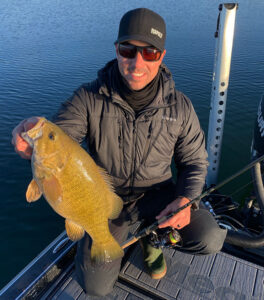
Smallmouth caught on St. Croix rod
PARK FALLS, Wisc. (May 16, 2022) – Increasingly, today’s bass anglers love to tell you which species they prefer, brown or green. But it’s the former that continues to spawn a cult-like following. Even a self-described largemouth nut or honest walleye angler will admit to enjoying a smallmouth outing now and again. And for good reason; smallmouth bass fight hard and are widely distributed. But don’t be fooled by the big bags of brown bass from famous fisheries that continuously fill our media screens and social media feeds; smallies aren’t always such an easy target – especially the larger individuals over four pounds.
Just in time for some of the best smallmouth fishing of the year, allow us to put forth some serious smallmouth strategy, elicited from a couple of the best brown-bass anglers from throughout the bronze belt. Their home waters and tournament experiences have taught them to look for and recognize changing smallmouth patterns, quickly adapt to current conditions, and develop repeatable, winning techniques that work in a variety of settings – not just unpressured northern waters.
Bob’s Bites
Bassmaster Elite Series angler, Bob Downey, is no stranger to the podium and has some serious tournament finishes to prove it. Hailing from Hudson, Wisconsin, the St. Croix pro is part river guy, part lake guy, and 100% smallmouth guy at heart. He lists the Mississippi River as his favorite place to fish but has more “home water” in both Minnesota and Wisconsin than most could imagine.
When targeting smallies in natural lakes, Downey says he looks for large, shallow flats with a good mix of cover and a varied bottom composition. Cover specifically meaning boulders or patches of grass, and bottom composition variety in the form of sand-to-gravel or sand-to-rock transitions. “It’s usually a shallow-water game,” says Downey, who supplies prowess to the power-fishing game while focusing on water less than ten feet deep. “I’d rather fish a flat that has lots of bottom transitions with contour changes, patches, and clumps of scattered cover versus a plain sand flat with not much going on. I’m looking for variety. Fish spend time here post-spawn, and I feel I can power-fish my way to finding them, even if I need to slow down a little to get them to eat.”
Of course, that can be the challenge given weather patterns and fish that don’t always cooperate, which is why Downey keeps it simple for post-spawn smallies. “I’ll throw a black marabou hair jig first and foremost, and always keep a ned rig handy too,” he says. “In early summer, smallies tend to be concentrated. They won’t be everywhere, but when you find them you’ll generally find a good bunch. Covering lots of water until you locate them is key, and my favorite way to do that is with a black marabou hair jig.”
Search with a hair jig? Downey dives deeper. “I put the trolling motor on a medium to high speed and start covering shallower flats with deep water nearby. If you catch a smallmouth or start to see them with your eyes or side-imaging, put on the breaks and start picking that area apart,” he advises. “During post-spawn they’ll roam those same spawning flats before migrating to their summer areas.” Downey offers simple advice on working a hair jig to perfection, which may surprise some anglers who preach complex retrieves and subtle jigging strokes with this bait that seems to “breathe” underwater. “Don’t overthink the hair jig,” he says. “Simply cast it out and reel it back in at a steady pace. Much like you’d fish a spinnerbait or small swimbait. The bait should just glide through the middle of the water column. You don’t need to impart any action yourself, although you certainly can… or fish it on the bottom… but I find more success with just a straight retrieve.” Downey describes the hair jig as a deadly little bait that excels in all phases of early summer on those hot, calm days where the fish are post-spawn. “There have been days where that’s the only bait I need in the spring or early summer,” he reports. “It couldn’t be any easier or more effective.”
Downey offers a few tips to help cast hair jigs farther. “Add a small chunk of an old plastic worm to the shank of the hook up under the hair. These jigs are generally 1/16-to-1/8 ounce, so a little added plastic will help with casting distance,” says Downey. “Use thin, six-to-eight-pound braided line on your spinning reel with a shorter three-foot fluorocarbon leader so the leader knot doesn’t have to pass through as many – or any – guides during casting.” Downey is a fan of the FG knot for connecting braid to fluoro, noting, “I know it can be a difficult knot to learn, but it’s superior to any other when throwing a hair jig.”
Downey selects the 7’6” MLXF (ES76MLXF) Legend Elite or 7’10” MLXF Legend Tournament Bass (LBTS710MLXF) rods from St. Croix to do damage marabou-style, and the 7’0’MF Legend Elite (ES70MF) for ned rigging.
“The length and action of a rod may be the most important component of throwing a hair jig,” he says. “It’s difficult to cast a light jig with a short, stiff rod. You need at least a 7’ medium or medium-light power and a fast or extra-fast tip. I prefer a 7’6″ to 7’10” rod in MLXF. It makes a difference. The medium-light power gives me a soft rod that absorbs the strike and the big head shakes during the fight, and ultimately allows me to land big smallmouth on a tiny bait. The extra length and extra-fast tip gives me the sharp ‘whip’ needed to snap that little jig way out away from the boat. There are some techniques in bass fishing where you could use a wide array of rods and get away with it, but the hair jig is not one of them.”
When asked what’s around the corner as early bites give way to mid and late summer, Downey says the fish start to split up, both shallow and deep. “Shallow areas can and will play all summer long depending on the weather conditions; sunny, flat, calm, hot days are best,” says Downey. “Shallow fish are super fun, but they can be less dependable at times. They move around a lot and are here today, gone tomorrow.” While that may make them his preferred fish to take a crack at for fun, it’s harder to cash tournament checks just throwing shallow.
That’s where deep-water strategies come in. “Fish that set up on deep structure tend to be a little more reliable,” advises Downey, who likes to target deep fish with a variety of presentations depending on the conditions. “I’ll chase deep smallies with ned rigs, drop shots, finesse jigs and reaction baits depending on the weather. There’s just so many ways you can catch them when they’re out deeper. Crankbaits, swimbaits, spybaits… that’s what makes summer so much fun when chasing smallmouth. And no matter what I’m doing, St. Croix makes an ideal rod for the presentation.”
Travis’ Take
Travis Manson is a familiar name to smallmouth anglers throughout the US. Both his guide service and popular YouTube channel are named “Smallmouth Crush” for good reason. A native of Northeastern Wisconsin, Manson honed his craft and love of smallmouth in the Northwoods but spread wings out east where he currently fishes more than 200 days a year on Lake Ontario, the St. Lawrence River, and even the Upper Chesapeake Bay. His experience on such varied smallmouth waters has accelerated his understanding of patterns and behaviors, ultimately helping his clients catch more fish along the way.
Although the smallmouth spawn can extend well into June – even early July – in some Great Lakes fisheries, early summer means post-spawn behavior in most of the areas Manson plies. “I’m generally targeting areas close to spawning bays and grounds, looking shallow but anticipating a deeper summer setup,” he reports. “Not every fish is going to be deep the rest of the year, as there’s always resident shallow-water fish.” Given the choice, he advises fishing a mixture of both, but starting shallow first. “I start in three feet of water down to 15, focusing heavily on that eight-to-12-foot zone, which I find key.”
Like any talented smallmouth angler, Manson makes moves based on the conditions of the day. “On high-sun and calm days I’m looking for cruisers,” says Manson. “I climb to the highest point of the boat, put the trolling motor on high and tend to throw reaction baits to cover water and visually locate them. It’s really about casting to an individual.” That can mean looking for individual boulders or structure too, not just fish. “If a fish isn’t on a good boulder, I’ll mark it and come back during different parts of the year,” he says. “Anything from something the size of a bowling ball all the way up to a truck-sized boulder, I’m marking it ‘rock’ on the graph and visiting it often.”
When he’s throwing at rocks or really any shallow structure, Manson prefers finesse swimbaits and other plastics. “I’m using swim-head designs with a screwlock, which helps me get more use out of my plastics. I can have some good days up shallow, meaning 30 or 40 fish an outing, so keeping those plastics from being thrown can be really useful when guiding,” says Manson. “For the most part I’m using three- and four-inch baits in natural colors to mimic live minnows, like whites, ghost, or smoke colors. On some systems where there’s perch, I’ll mix in those colors and chartreuse as well.”
Other finesse plastics like tubes or creature baits get the nod in systems dominated by gobies. “There, I’ll focus on bottom baits in green pumpkin, straight black, or classic goby colors, paired with a mushroom-head-type jig,” says Manson. “Even a Senko can be deadly here, just pitching visually towards cover or even active fish.” Manson uses swimbaits and finesse plastics in concert, as a one-two punch, often seeing the fish approach or hit the swimbait. “I get some follows at times where fish pull off near the boat and then just hover by bottom. I’ll swing the boat around, get in position, then throw that finesse bait back to them in those cases.”
Manson is a huge fan of St. Croix’s Victory Series in general for smallmouth, specifically, the Victory Crosshair rod (VTS710MLXF) for swimbaits. “It’s a great hair jig rod,” says Manson, “but it’s incredible for long-cast techniques on all light jig heads in general. While it’s nice to have the distance, with the way a fish bites swimbaits, it’s really critical to have that long rod and extra-fast action.” Manson appreciates the extra length on the Victory Crosshair rod for another reason, too. “These fish are so good at getting off,” he says. “A longer rod aids your ability to do battle and keep them buttoned up.”
For presenting soft-plastic finesse baits, Manson emphasizes the importance of sensitivity. “I won’t fish anything here but St. Croix Legend Xtreme rods in 6’10” (XFS610MLXF) or 7’3” (XFS73MLXF), both in medium light power and extra fast actions,” he says. “Finesse means feel, and feel is the everything of these rods. I can get the distance on many long rods, but to feel bites versus rocks or baitfish, these are the sticks.” Manson uses his Legend Xtremes specifically for working baits across bottom, where contact is key. “I feel where to throw the bait and prefer medium-light powers to run lighter jigs with so much control. I’ve got all the power I need for hook-setting and fighting, while still maintaining control of a small jig, which is tough for most rods.”
Come mid-summer, Manson shifts his focus to offshore structure like ledges, humps, and especially long points that extend into deep water. “That’s where you find the big schools,” says Manson, who spends a good amount of time watching side-imaging, but more importantly, standard 2D sonar to find these big pods of active, deep-water smallmouth. “These fish show up and stay for weeks at a time, and often do so year after year. Still, smallies are notorious for being here today and gone tomorrow, which is why I confirm everything on sonar before setting up to fish.”
There’s no denying that the late-spring and early-summer timeframes deliver some of the best opportunities of the season to score big smallmouth catches, especially if you follow the recommendations of our experts.
Their advice is as solid as the chunky bronzebacks they’re sticking on a regular basis.
How To Catch Walleye In the Weeds
WALLEYES IN THE WEEDS
from The Fishing Wire

Fishing aquatic vegetation is second nature to bass anglers, but the green stuff is just as crucial for walleye fishing. They use weedlines as travel routes and know that grass holds plenty of forage, making them the perfect place to search for their next meal.
A trio of Wisconsin guides, Josh Teigen, Troy Peterson, and Jeff Evans, search out weeds in the late spring and early summer months. They have different approaches to fishing them, but they all work and help them and their clients catch some of their biggest walleyes of the year.

Slip Bobbers on Weedlines
Iron River, Wisconsin’s, Jeff Evans guides clients on various lakes for walleye from the May opener through the entire fishing season. Many tactics work when targeting grass on inland lakes for Evans, but he says a slip bobber rig with a minnow or leech is hard to beat.
“After the walleye spawn, they recover in deep water and then head to the weeds,” says Evans. “As the new weed beds emerge, the walleye will follow the green, new growth and you can find these areas on your side imaging. They’ll follow the edge as new grass grows and later in the year it might be in 15 to 20-feet of water on clear lakes, but only 8 to 12-feet of water on more stained lakes.”

According to Evans, the bite typically lasts until the 4th of July, when many walleye switch gears to mud basins, reefs and points. “Some years, the bite can go all summer long and into the fall months,” he says. “My theory is that it has to do with water temperatures. If it gets into the 70s too early, they’ll get out deeper quicker, but they stick around if it’s a gradual rise.”
Evans likes to rig up his clients with a 7-foot medium-light spinning rod and a quality reel spooled with 30 lb Seaguar Smackdown Flash Green braid with a leader of 10 lb Gold Label fluorocarbon. On the business end, it’s generally a slip bobber set to the desired depth with a slip knot and a ¼-ounce egg sinker. He then rigs a barrel swivel with an 18-inch leader of Gold Label with either a #1 Octopus hook or 1/16-ounce jighead used to rig the leech or minnow.
“The medium-light rod is helpful because people tend to overset the hook with a slip bobber when they see it go down and you want a little flex,” he said. “I like the bobber set so that it barely floats in the water to detect light bites. Smackdown has been the perfect braided line because it holds the slip knot very well, where with some braids, it will slip. Gold Label has been excellent because it’s limp, strong, and invisible to walleye that are notoriously line shy.”

Teigen’s Ripping Approach
Josh Tiegen fishes many of the same waters as Evans, from inland lakes on the Eau Claire and Pike Lake chains to Chequamegon Bay on Lake Superior to the Hayward area lakes. He uses the same approach everywhere he goes for walleye in the weeds: rip the bait free from grass.
“I always tell my clients that if you are not getting grass on your bait once in a while, you are fishing it too fast or not around enough grass,” he says. “If you are getting grass on your bait every time, it’s moving too slowly. Ideally, it should be one out of every five casts that you come back with grass, the key is just to be ticking it and if you rip it free when you feel the grass, that’s where many of the bites occur.”
Teigen chooses hard jerkbaits, soft jerkbaits, and a spoon as his top weapons for walleye around vegetation.

“A 5-inch Kalin’s Jerk Minnow on a ¼-ounce darter head jig is great for fishing the weeds and the darter head does a good job coming through it,” says Teigen. “I also like a 3/8-ounce gold Acme Kastmaster spoon for fishing the edges and a Livingston Jerkmaster jerkbait for fishing along the edge or over top of the grass.”
For the Jerk Minnow and Kastmaster, he opts for a 7-foot medium-light spinning reel with a fast speed spinning reel, and for the jerkbait, he goes up to a medium-action rod. For all three, he fishes them with 20 lb Seaguar Smackdown Flash Green braid with a leader of 12 lb Gold Label.
“The high visibility green color is the way to go because we are ripping these baits free from the grass and you’ll see your line jump even when you don’t feel the bite with your rod,” he says. “Using braid is important because you need to make hard pops with the rod to free the bait from grass and you need the zero stretch. I’ll use a 3 to 4-foot leader of Gold Label and as spooky as these walleye can be, the invisibility of the line makes a big difference in getting more bites.”
Fishing for walleye this way is one of Teigen’s favorites, starting at the end of May and into the summer months; plus, it’s a way to fool some of the biggest walleye in the lake.
“Many walleye guys troll and it’s too hard for them to fish around grass effectively because you are always hanging up, so not as many people are fishing for them this way,” he says. “Plus, it seems like my biggest walleyes of the year always come from the weeds. I’ve seen that the bigger ones gravitate there instead of the rock and mud.”

Dippin’ for Walleye
Early in the year, guide and tournament angler, Troy Peterson, breaks out specialized gear for a unique way to target walleye, dipping emerging grass with leeches and nightcrawlers on a 1/16 or 3/32-ounce jighead. He likes the leeches for the movement they create on the jighead and nightcrawlers for the added scent, but they are both solid choices.

“It’s all about finding the greenest weeds you can find, whether they are cane beds or rice paddies that have been brown all winter and are just starting to turn green as they grow again,” says Peterson. “The new sprouts have fresh oxygen and gather minnows and the walleye are there for them in really shallow water, mostly 3 to 5-feet of water. It starts in mid-May and usually goes until the first week of June. Then when the carp start spawning and causing a commotion and stirring bottom in June, it’s the same bite in the same places as the walleye are there to feed on stirred up crustaceans.”
Stealth is key with this approach and Peterson uses his bow-mount trolling motor to slowly move along the grass line, dipping his bait into the holes and edges of the new grass. The rod of choice used by “dippers” is generally over 10-feet long, with custom 12 and 14-foot medium-light spinning rods a common choice.
“Some even use cane poles because there is no casting; you simply drop the bait in and let it fall to the bottom before moving to the next one,” he says. “It’s a highly visual technique and you wait until your line starts to move when one gets it. We use 10 lb Seaguar Smackdown Flash Green braid with a leader of 6 or 8 lb Gold Label fluorocarbon because they both have tiny diameters and the bright green braid helps you detect bites.”

Peterson uses this approach throughout the Winnebago Chain of Lakes and says it’s usually the way to win all of the early season walleye derbies there. “It’s a big fish technique, but the trick is to stay stealthy,” he says. “That’s why we use the long rods to stay away from the fish. It’s better than using a slip bobber because that can spook fish this shallow.”
You can fish for walleyes in vegetation with many approaches, but it’s apparent that it’s the place to be early in the year as new growth is just starting after a long cold winter. These three methods for targeting them have all proven to be excellent for early season walleye in the weeds.
Seaguar Smackdown braid is available in high visibility Flash Green and low visibility Stealth Gray. It is available in 150-yards spools in sizes ranging from 10 to 65 lb test.
Coming Soon — 300 yard spools of Smackdown braid
Seaguar Gold Label fluorocarbon leader is available in twenty five-yard spools in 2, 4, 6, 8, 10 & 12 lb test for fresh water use, complementing the 15, 20, 25, 30, 40 , 50 , 60 and 80 lb. test leaders available for saltwater. Coming Soon — 50 yard spools of Gold Label
How and Where to Catch Midwest Walleyes
| The walleye may be the Midwest’s most popular, albeit often hard-to-catch, game fish. It is known for not only having great-tasting fillets, but also for growing big and providing anglers a fishing challenge. Despite its reputation for being hard to catch, at certain times of the year walleyes can be taken by both boat and bank anglers with average skills. Joe Rydell, a fisheries biologist for the Nebraska Game and Parks Commission’s northwest district, said we are in the midst of one time to target walleyes. In April, Nebraska’s walleyes are spawning, or getting ready to, so the population becomes concentrated in shallow water.If you do not have success now, however, try it a little later. “The best month to catch them in is probably going to be toward the end of May and into June, when these fish are coming off of spawning. They’ve had ample time to rest and, at that time of year, they’re really concentrating on feeding,” Rydell said.Especially for anglers seeking big walleyes, fall also can be good fishing for the species.As with most fish and game, knowing what those toothy walleyes want lends clues to when and where you will find them. “They’re a predator fish. So, first of all, before you figure out what kind of habitat you’re going to search, you’ve got to figure out what they’re going to be eating in that water body,” Rydell said. “They’ll be hanging around that food source. In some lakes, that may entail a good rock bottom, or rock structures. In other lakes that are more vegetated, they may be along the weedline. In lakes that have a combination of both, it could be some woody debris or rock structures that are intermixed among those weed beds. At certain times of the year, even though they’re big fish, they may be concentrating on a bug hatch. ”Daryl Bauer, Game and Parks fisheries outreach manager, said a variety of artificial and live baits are effective.“Casting jigs and crankbaits, still-fishing or drifting live bait rigs, and trolling crankbaits or live-bait rigs can all be successful techniques for catching walleyes from Nebraska waters,” Bauer said. “However, I would tell you that more walleyes have been caught from Nebraska waters drifting or trolling a bottom-bouncer and live-bait rig of some type, usually a spinner and nightcrawler, than any other presentation. ”Anglers should consider the species’ name when choosing a time of day to fish. The walleye is so named for its pearlescent eye that features a reflective layer of pigment to seek prey in low light or murky water conditions.“Fishing more of the crepuscular period, your sunrise and sunset, are better times to catch them,” Rydell said. “Maybe even fishing in the dark a little bit.”Bauer said the time of day should dictate your approach. “Walleye anglers spend so much time trying to finesse walleyes, often small walleyes, into nibbling on some live-bait presentation because they are fishing for relatively inactive fish during bright midday conditions,” he said. “If you fish during low-light periods, early and late in the day, after dark, cloudy, gloomy days, or when the wind blows, you will find an entirely different fish — a fish that is the apex, top-of-the-food-chain predator that they really are. They have a mouth full of sharp teeth for a reason, and during prime times they are mobile, agile and hostile.”In Nebraska, serious walleye anglers often look to the west and central parts of the state. “The best habitats for walleyes are large bodies of water, large rivers, large natural lakes and large reservoirs,” Bauer said. “In Nebraska, that means our large reservoirs, primarily irrigation reservoirs in the central and western parts of the state, are our best walleye habitats. Walleyes are a cool-water fish, a predator, primarily an open-water predator. They thrive in those larger water bodies that have an abundance of open-water baitfish.” Rydell said surveys show Winters Creek Lake on the North Platte National Wildlife Refuge near Scottsbluff to have the highest density of walleyes in Game and Parks’ northwestern district with a substantial population of fish between 17-19 inches. Nearby Lake Minatare is down a little from previous years, but still has a sizable population of 17- to 20-inch fish.Those seeking big walleyes in the west, Rydell said, should look to Whitney Reservoir in Dawes County and Merritt Reservoir near Valentine.Box Butte Reservoir, another Dawes County destination, is also on Rydell’s list of solid opportunities.“Box Butte is kind of coming on with a nice walleye population,” he said. “We have a year-class that, last year, was about 13½ inches that should be about 15 this year. With pike numbers down in that lake, and that year class coming on, it will be one that should produce some nice walleye fishing in the future. ”Nebraska’s walleye population gets considerable help from the Game and Parks’ fisheries staff, who collect eggs and milt from walleyes early in the year at Merritt Reservoir, Sherman Reservoir and sometimes Lake McConaughy. Fertilized eggs are taken to Nebraska State Fish Hatcheries, usually Calamus and North Platte, for hatching and rearing. It’s a much more effective approach to growing walleye populations than what happens naturally. How long the fish stay in the hatchery depends on the habitat and other factors of their destination. They can be released as 4-day-old fry, fingerlings, or sometimes 8-inch advanced fingerlings.“Depending on the water body, all of those walleye stocking strategies have proven successful in Nebraska waters,” Bauer said. “In some waters fry stocking is successful and very inexpensive. In other waters fingerling stockings are most successful. The advanced fingerling stockings are most intensive and most expensive but have been relatively successful in smaller water bodies that are too small to be ideal walleye habitats. In those smaller water bodies the advanced fingerling stockings offer anglers an opportunity to catch a walleye or two from those waters once in a while. The minimum requirement for walleyes in Nebraska’s lakes is 15 inches and only one over 22 may be kept. Special regulations exist at Merritt, Sherman, Calamus, Elwood, Harlan County and Branched Oak.A walleye of 28 inches or 8 pounds qualifies for a Nebraska Master Angler award. The state’s walleye record is a 16-pound, 2-ounce specimen caught at Lake McConaughy by Herbert Cutshall of Ogallala in 1971. Records indicate he caught it on a Storm ThinFin crankbait.Whatever the approach, as long as anglers are mindful of regulations and recommendations regarding the coronavirus issue, it may be time to target Nebraska’s big tasty, toothy predator fish of the dark. From the Nebraska Game and Parks Commission |
SPRING’S ‘IN-BETWEEN’ FISHING SEASON
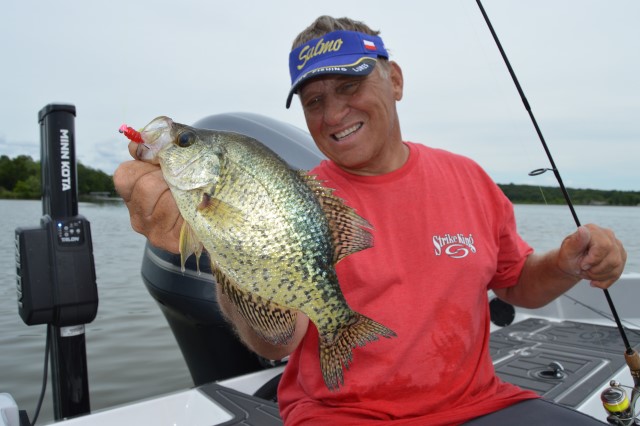
By Bob Jensen of fishingthemidwest.com
from The Fishing Wire
There are two in-between fishing seasons in the Midwest. There’s the open water to ice in-between, and then there is the ice to open water in-between. In the southern regions of the Midwest, it has become the open water season; in the northern areas there is still plenty of ice, but in the middle part of the Midwest, we’re definitely in between. An angler can drive an hour and be on open water, or that same angler can drive an hour in a different direction and be on the ice. This is a time of year when some anglers decide to go ice fishing, some hook up the boat and head for open water, but many anglers, me included, are putting the ice fishing gear into storage, and taking the open water equipment out. Following are some ideas on this in-between season.
First and way most important, don’t push the ice fishing too hard. If you’re not absolutely sure that the ice is safe, don’t go out. I’ve had the bad judgement to be on the ice twice late in the ice season when I shouldn’t have been, and both times we truly wondered how this adventure was going to end. When we hit the ice in the morning, it was safe. When we left in the afternoon, it wasn’t. We made it to shore safely, but the bottom of the truck was much wetter than it should have been. Make sure the ice is safe.
If you’re storing your ice gear, make sure there are no scraps of candy bars or sandwiches in your shelter. Mice will find them. Make sure the battery on your sonar unit is charged and that your baits are stored in a dry container to prevent rust.
If you’re preparing to get on open water, start the year with fresh line. So much of the time we neglect the line that we’re using only to remember that we should have changed it right after the big one breaks off.
For many Midwest anglers, our first open water trip will be for either walleyes or panfish, although bass are quickly gaining in popularity in many areas. When walleyes are the target, jigs tipped with plastic are catching more of them every year. That’s because more walleye anglers are using plastic, and that’s because walleye anglers have learned that walleyes will often be very willing to eat a jig that has plastic threaded on it. The traditional action tail grub is a walleye catcher. The Rage Grub comes in a four-inch size and has a good-sized body. In the stained river water that is so common in the spring a bright Rage Grub can be very productive. The big body and flapping tail help walleyes locate it better in the stained water. When clearer water is encountered, try a smaller Rage Swimmer. It has less tail action, and that’s usually better in the clear, cold water of spring.
In some states, panfish, especially crappies, are what most anglers chase early in the year. In some areas walleye season isn’t open yet, but even where it is, getting after crappies is a wonderful way to spend a warming spring afternoon. They’re willing biters, and if you’re interested in a couple of fish for the table, crappies are hard to beat. Find a bay that has warmer water than the surrounding area and some cover. Boat docks, trees laying in the water near deeper water, reeds, they’ll all attract crappies. Try a Mr. Crappie Tube on a sixteenth-ounce jig under a bobber. That will usually get them to bite, but if it doesn’t, replace it with a small minnow. If the bobber doesn’t go down within a few minutes, try a different spot: No one’s home.
A warm sun and birds chirping along the shoreline are enough reasons for many of us to get outside during the first warm days of spring, but the possibility of catching a few fish makes it an even harder temptation to pass up.
Winning A Sportsman Club Tournament At Lake Oconee
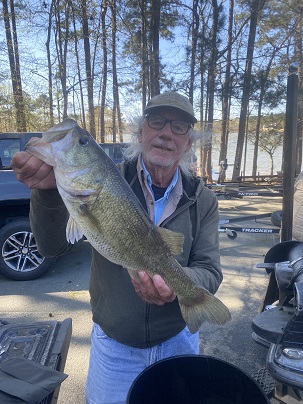
Last Sunday, March 20, 14 members of the Spalding County Sportsman Club fished our March tournament at Lake Oconee. After fishing from 7:30 AM to 3:30 PM we brought 37 keeper largemouth longer than 14 inches to the scales. There was one five fish limit and two fishermen didn’t weigh in a keeper.
My five at 12.68 pounds won and I had a 5.04 pound largemouth for big fish. Raymond English had four weighing 9.40 pounds for second, Wayne Teal placed third with four at 7.68 pounds, George Roberts had four at 7.22 pounds for fourth and Niles Murray placed fifth with four weighing 7.13 pounds.
Will Mclean fished with me and we started on a grassbed I had a feeling would produce a fish. It did, I caught a keeper and a short fish on a swim jig within a few casts. Then it got tough as the sun got on the water.
At about 10:00 Will cast beside a dock and got a bite but missed it. He got that fish to hit two more times, hooking a good keeper on the third bite.
My next fish hit my shaky head worm near the boat and when I set the hook it came flying out of the water and the hook came out of its mouth in the air. But it fell into the boat! Some fish are just meant to be caught.
At noon we had only those three in the livewell so we decided to change tactics. We went to a small main lake cove from the small but bigger creek where we had been fishing. It had deeper water and was closer to the main river. I hoped this would mean more fish had moved up from their winter homes.
On the point of the cove a deep brush pile produced my third keeper, one that just barely touched the 14-inch line on the keeper board. Then my fourth keeper hit my shaky head out from a small grass bed inside the point.
Will got his second keeper off the next grass bed then we both caught some throwbacks. Going into the cove I noticed a waypoint on my GPS and remembered there were some rock piles out in 12 to 15 feet of water. A few casts to them produced a couple of short fish then a two-pounder hit my shaky head. I had a limit at 1:00! But with the bare keeper I figured I had only about seven pounds.
I cranked up and went across the mouth of the cove to go around it again and saw another bass boat coming. Sure enough, Zane and JR pulled up on the point I had just left and started fishing! Will and I fished around the cove toward them and caught a couple more short fish.
When we met Zane and JR, with then on one dock and us on the next one, I cast my shaky head to the dock and a bass thumped it. When I set the hook I started yelling for the net, a big fish flashed in the water and tried to run under the dock.
A I fought it I flashed back three years to another tournament and a similar day. On another dock I hooked a big fish, pulled it away from the dock post three times and got it within a couple of feet of the net. Then my line went slack, it just came off. That fish was every bit of eight pounds.
As I pulled this fish to the top so Will could get the net under it, my hook popped out and flew over the boat. I felt sick for a second, then Will raised up the net – with the 5.04 pounder in it! Talk about a fish that was just meant to get caught.
Will said that fish was really his, so I gave it to him – right after weigh-in.
We fished the rest of the day and landed several more short fish, and I got two more keepers on a shaky head worm. I culled three times, including the first fish I caught that morning.
How To Follow the Spring Crappie Progression To Catch Them
THE SPRING CRAPPIE PROGRESSION
from the Fishing Wire

Many anglers, this one included, can’t wait for ice-out to head for their favorite crappie lake and wet a line in open water for the season’s first time. Those just-after-ice-out trips sometimes produce good fishing, but at other times the fish seem to be non-existent. The fact is that as the water warms and weather stabilizes during spring, the crappie bite gets better. Here are some tips to capitalize on what I call the crappies of “mid-spring.”
Most crappie anglers know that finding the warmest shallow water during spring up until the spawn is key. Warming waters, usually shallow waters, show the first signs of open-water life and draw hungry crappies. Shallow, dark-bottomed bays are classic early season spots, as are boat channels, marinas, and other shallow spots that warm quickly.
Just after ice-out, the crappies invade these areas looking to feed, particularly on warm, sunny days. The appearance of a spring cold front, however, often sends these fish scurrying off to deeper waters where the water temperature is more stable. As spring progresses and water temperatures continue to rise and the weather moderates, crappies spend more and more time feeding in the shallows.
Finding spring crappies involves staying on the move and searching various shallow spots. I often hit several spots during a fishing day, keeping an eye on the temperature gauge on my sonar unit in the boat when going from spot-to-spot. Shore anglers, though more limited in mobility, often do well this time of the year too as shallow areas that hold fish are often accessible from the bank.
Small panfish jigs tipped with crappie minnows and fished below bobbers produce fish, particularly when the fish are finicky. More aggressive fish, on the other hand, are often very susceptible to small jigs and plastics combos. I’ve become a big fan of the Mr. Crappie soft baits in recent years and prefer the Crappie Thunder and 2-inch Tubes during spring. Hungry crappies readily hit soft baits and usually several fish can be caught on the same bait without rebaiting. Regardless of whether tipping a jig with live bait or plastic, fishing the combination a couple feet below a bobber and casting near shallow cover like weeds, brush, and timber usually results in bites if fish are present.
Bobbers and jigs go hand in hand for spring crappies, however, a cast-and-retrieve approach can also yield good catches on some days and can be a good “search” presentation as well. For this method, I rig a Mr. Crappie ShadPole on a small jig, cast it out, and slowly retrieve it back.
Regardless of whether fishing a bobber or cast-and-retrieve fishing, using your tolling motor to quietly approach and work potential fishing spots is important now. Shallow, spring crappies are notorious for being spooky and avoiding excess noise that may easily scatter these wily fish will generally up your catch.
Spring and crappies go hand in hand, especially as the season progresses and the weather stabilizes. Following some of the tips just provided can, in fact, probably help you capitalize on the hot mid-spring crappie bite this season!
As always, good luck on the water and remember to include a youngster in your next outdoor adventure!
Mike Frisch hosts the popular Fishing the Midwest TV series. Visit www.fishingthemidwest to see more fishing tips and view recent TV episodes as well!
Lake Burton and Tidal Savannah River Offer Georgians Two Very Different Bass Fisheries
Lake Burton and tidal Savannah River are about as different kinds of water you can fish in Georgia, but both hold bass. My retirement job took me to both in the past week.
Lake Burton is a beautiful 2775-acre Georgia Power Lake on the Tallulah River in north Georgia between Clayton and Cleveland. Its 62 miles of shoreline are lined with huge houses with big docks, and its steep banks are covered with rock. Views of mountains surrounding it are very pretty.
Crystal clear mountain water is the norm there unless heavy rains stain up some of the creeks. Moccasin Creek State Park is also the home of a fish hatchery where trout are raised, and many are released into the lake, both intentionally and accidentally.
Although it is a good trout fishery, its big spotted and largemouth bass are the main attraction there. It also produces many chain pickerel and crappie.
I fished on a cold cloudy Tuesday with Jeremy Eaton, a local tournament angler, and the fishing was tough. The January snows up in that area had melted and made the lake go up about five feet while dropping the water temperature more than five degrees. That combination gave the fish lockjaw.
I enjoyed the trip and could imagine easing around the backs of coves looking for big largemouth on the bed, especially around the full moon on April 16. And spotted bass will be bedding then, too, and easy to catch out on rocky points and humps. Jeremy marked ten good places to catch bass in April for my Georgia Outdoor News (subscription required) Map of the Month article.
The houses are amazing. Jeremy pointed out a huge house up on a high point at the mouth of Timpson Creek and said Nick Saban built it. He built it to see if he liked having a house on Lake Burton and he did, but rumor has it this one was too small, so he built a bigger one. Its only 9542 square feet with 7 full and two half-baths and the tax office appraised it at 2.6 million. And it is not the biggest on the lake, by far!
Go up to Lake Burton for a nice vacation and take your boat. Enjoy the lake and mountain scenery and catch some trout for dinner, and some big bass to stretch your string.
I fished the lower Savannah River last Sunday with Billy Robertson, a local club fisherman. The views were very different. No mountains in the background, just flatlands that extended forever. And cypress trees and live oaks with Spanish moss beards replaced the barren hardwoods of Lake Burton.
I am not used to fishing current, so when we fished on the river Billy kept the boat pointing upstream and ran his trolling motor on high to keep the boat slowly moving downstream I was surprised. I had to cast fast to hit eddies behind trees in the water and small pockets along the bank.
Back in the creeks where we spent most of our time the current was still strong from the outgoing tide. Although we were miles upstream, above the I-95 bridge most of the day, the tide still affected the river.
We did catch fish. Billy quickly hooked a four-pounder, and our best five of them weighed about 20 pounds. But they were bowfin, fun to catch but we were after bass.
We did catch about a dozen keeper bass that day by casting worms and small jigs to eddies in the creeks but they were small. Most were 12 to 14 inches long but they fought good in the current.
There are bigger bass in the river. A local tournament took off from the ramp we used and it took five weighing 14 pounds to win, 11 for second and 10 for third. Big fish was a four-pounder. But the rest of the folks had five weighing six or seven pounds, just like our catch.
A highlight of the trip was dinner at Loves Seafood and Steaks. Although very expensive, the gumbo was some of the best I have had and the fried scallops were tender and delicious.
Fishing the river is a fun change of pace for us lake fishermen. There are several ramps just north of Savannah in both Georgia and South Carolina. But one warning, if you get off the river itself and go back in creeks on the South Carolina side, you need a nonresident fishing license.
Details of my trip and how to catch bass on the Savannah River will be in the April issue of Georgia Outdoor News.
Go north or south for a fun change of pace for fishing this spring.