Category Archives: Fishing Tackle

Rods and reels to live bait

What Are Some Ice Fishing Tip-up Trends?

Tip-Up Trends on Ice

Progressive ‘Trap’ Tactics Set to Fuel Your Best Season Ever
By Ted Pilgrim

There’s something satisfying about a well-planned network of tip-ups set across the white expanse of a frozen lake. Strategically placed fish “trap-lines,” each rigged with a big frisky baitfish, attract and literally snare freshwater predators like nothing else under ice. Get a bunch of dudes together, stack some ‘traps‘ into 5-gallon pails, and saturate the ice with baited flags.

When that first signal rises high above the icy horizon, heart rates soar as the rugged race ensues. The winner earns the right to set the hook and proudly hoist a hefty pike, walleye or any other freshwater prize that bites.

Catch big fish  under the ice

Catch big fish under the ice

Advanced trap-line tactics put big plenty of big fish on the ice. (Photo by Bill Lindner)

The smartest tip-up parties bait the big ‘uns on spacious open flats or along lengthy sections of a drop-off—places where fish consistently search for food. With six or more buds along, each empowered to run 2 or more lines apiece, you can put live bait in front of a lot of toothy grins. That’s trap-line fishing on ice in a nutshell, and it’s devastatingly effective.

On a long point or drop-off, a wise strategy places one group of anglers at each end of the trap-line, with additional fishermen spaced evenly between. If you’re going in cold turkey, searching a big area for the first time, perhaps you set one tip-up every 50 to 100 paces. Park a pickup truck or snowmobile every so often along your routes to serve as mobile basecamps. Better yet, set out a large pop-up style portable shelter, such as Frabill’s cavernous, aptly named Headquarters.

Setting out on foot, groups of trap-line anglers work best in pairs. First run through, one dude drills, while the other follows with a sonar, dipping the transducer in each new hole. Sonar guy keeps driller guy on target with depth, as he also checks for fish with a portable unit, such as a Humminbird 597ci HD Combo. When he sees something that looks like a good fish, sonar guy might also trace an “F” or “BF” (big fish) in the snow, which assures they’ll X-mark-the-spot with a tip-up next run through. In addition to sonar, the 597 ‘Bird also has a built-in GPS chartplotter with LakeMaster cartography, keeping you right on target with tip-up sets.

Modern tip-up

Modern tip-up

Frabill’s Calibrator system takes tip-up fishing to the next level of efficiency and high-level intel. (Photo courtesy of Frabill)

At the end of a bait set run, each fisherman grabs a bucket. If one of your buddies happens to be a tip-up pro the likes of Captain Pat Kalmerton, you’re in for a good day. “When we’re tip-up fishing for pike or walleyes,” says the ace ice guide, “we use a systematic approach. First, you’ve absolutely got to have good gear, and you’ve got to have a solid plan. For my guides and I, nothing works better than the ‘bucket system.’

“We can take a single Frabill bucket and fill it with at least six round Pro-Thermal tip-ups. The other bucket, a 1469 Aqua-Life Bait Station, gets used to house our tip-up ‘soldiers’—wild live suckers, big shiners or chubs. We want bait that really kicks; the critters that swim in huge arcs below the ice, pulling in predators like a lab working a field for pheasants. The Bait Station keeps minnows happy. It’s insulated and aerated. Water won’t freeze, and the micro-bubbler infuses the tank with energizing oxygen—like steroids for baitfish.”

Beyond robust bait, which drives his tip-up system, Kalmerton has recently taken his tip-up system to new heights. “’If it ain’t broke, don’t monkey with it,’” quips the Great Lakes captain. “Whoever penned this credo must have been referring to ice fishing. The sport’s the ultimate testing grounds for gear. It’s why I’ve relied on the same classic tip-ups for years. The contraptions perform a simple task—presenting bait and indicating strikes—and they do it reliably, day after day, winter after winter.

An underwater camera helps find fish under ice

An underwater camera helps find fish under ice

Like an underwater trail camera, coupling a tip-up with an Aqua-Vu adds fun and interactivity to the whole experience. (Photo by Bill Lindner)

“Truthfully, never thought I’d have a need to alter my traps, but I was wrong. When I tested Frabill’s Calibrator Tip-Up a few winters back, my fishing rose to a whole other level of precision and effectiveness. I can take any existing tip-up and instantly convert it into a digital line-counter system, which also provides additional fish-catching intel.”

Kalmerton says his Calibrator Line Counter kits and complete Calibrator tip-up systems allow him to drop baits to effective depths instantly, thanks to a digital LCD display. “Every good troller uses a line-counter reel, and I’ve now come to feel the same way about my tip-up fishing. Not only can I instantly measure how much line I have out, the Calibrator also tells me the precise amount of time that’s elapsed since a strike occurred, and how much line the fish has stripped from the spool—all displayed in pinpoint accuracy.”

Adding another layer of fun and efficiency, Kalmerton occasionally mounts a miniature underwater camera, such as an Aqua-Vu Micro 5, to his tip-up, providing a real-life view of what’s happening with his bait and any fish in the neighborhood. “Cameras add a dimension of interactivity to tip-up fishing that anglers are just starting to appreciate. Think of it as a real-time trail cam for fishing. And with new wireless technology, camera fishing is more convenient than ever.”

Whether your team’s tip-up program matches Kalmerton’s techno heights or remains a simpler affair, it’s always a race on ice to reach the flag first. Most of the time, especially with larger pike and walleyes, it isn’t necessary to let fish run for long. Rigged right, quick hooksets tag more fish, and certainly harm far fewer of them. In the meantime, it’s a game of waiting. Lean on a tailgate. Pour a cup of coffee. Talk a little smack. The winner’s always the first dude to the flag.

A good shelter helps

A good shelter helps

Large portable shelters serve as the strategic tip-up headquarters, while outside, flying flags signal big pike and other hungry predators. (Photo by Bill Lindner)

Global Positioning Systems – GPS – Has Come A Long Way!

This was written about GPS – Global Positioning System – hand held units in early 1997 – these units still do the same job, but they have come a long way since then.

I got an amazing toy for Christmas. It is a small device called a Global Positioning Satellite – GPS for short. My GPS is about the size of a TV remote control. It takes readings from satellites and tells you exactly where you are.

The GPS has a small screen where you can view different functions. You can record the location of different spots and the GPS will show you exactly how to get back to them. For example, you can mark a brush pile in the middle of a lake you don’t fish often. When you want to return, put in the name you gave it and the GPS will show you a direct line to it. It will tell you if you get off course. It will tell you how fast you are moving, how long before you get to it and other information.

If you mark a spot and then leave the GPS on as you go back to the dock or boat ramp, it will mark your exact course. You can then follow that track back, going around obstacles and avoiding problems. Most pro tournament fishermen have one mounted on their boat since they fish unfamiliar lakes often.

A GPS is also useful in the woods. You can mark a deer stand and the GPS will show you how to get back to it. If you have one, it is better than a compass, giving much more information.

New Year’s Day I was playing with my GPS while walking around the deer club. Maybe that is why I didn’t see any deer! I don’t think so since I only looked at it when stopped and after looking for deer. I had marked a deer stand and then walked out of the woods. I planned on following a small creek and then cutting across back to where I had parked.

As I walked down the creek, I saw the deer stand appear on the screen. Sure enough, I was within 50 feet of it. I thought I was at least 200 yards away. I did not realize the creek turned and came back to the stand. There were several other instances where the GPS made me realize what I thought I knew was not exactly right.

The GPS I got costs less than $200. It will record up to 250 different “waypoints,” or spots I mark on it. It is hard to believe what such an inexpensive device can do. Hooked to a depthfinder or computer, you can map your course or make your own maps. The GPS uses the same technology that guides missiles to their targets. Many airplanes have them so the pilots can find their way. They are amazing!

Will A Spinnerbait Wire Break If I Use It Too Long?

I almost lost the only bass I hooked in my last club tournament when the spinnerbait I was using broke. At weigh-in, Blake Thompson told a sad tale of losing a huge bass – at least 8 pounds – when it broke his line. All fishermen have bad luck like that at times. However, there are things you can do to lower your chances of bad luck.

On Saturday before the tournament two weeks ago, I fished with Jim Stutts and his 16 year old son Jay. I met Jim when we fished together in a tournament in 1986. The first place we stopped Jim asked if I remembered the big fish he lost in that tournament in a treetop when it broke his line. He said I taught him a lesson he would never forget – re-tie your line if you get hung up.

He reminded me I had re-tied my line as we idled across the river in that tournament. We had been dragging spinnerbaits over stumps and getting hung up a lot. He didn’t take the time to re-tie his and broke off the big fish right after we started casting again. He said he always re-tied after getting hung up now, and reminded Jay to do so throughout the day.

Blake had been fishing rocks in the tournament two weeks ago, bumping a spinnerbait on them. He did not re-tie his 12 pound test line, although bumping rocks is the easiest way I know to damage your line. He hooked the big fish, it jumped and then broke off.

I learned my lesson the hard way also. Jim Berry and I were fishing High Falls soon after I moved to Griffin in the early 1970’s. I had not had a strike all day, and had gotten too lazy to re-tie my line. I cast into a treetop and a got my first strike. A five pound bass jumped when I set the hook and then ran under the boat. It broke my line. When I checked the broken end, it was very frayed. You can feel the rough line where it is messed up by rocks, limbs, docks and even fishes’ teeth.

When fishing, check your line and re-tie it regularly. If it feels rough, re-tie. Even if it doesn’t feel rough, I often hold the hook and jerk it much harder than a fish could, just to see if it will break. Sometimes the knot is weakened and you can’t tell until too late unless you stress it like a big fish might.

The lighter your line, the more often you should check it and tie a new knot. Heavy line holds up better but still needs attention. When fishing a Carolina rig with three knots, check all three often. Don’t lose the fish of a lifetime when you have that one chance because you didn’t take the time to tie a knot.

With spinnerbaits, you can not tell when they are going to break. If fishing for fun, I might take a chance on using a $5.00 spinnerbait over and over. In a tournament, when a bass could be worth hundreds of dollars, I will retire a spinnerbait after catching no more than three fish on it. It is just not worth taking a chance that the wire has become weak and might break.Will

What Is Being Done To Restore the Gulf of Mexico

NOAA, Partners Announce Major Progress on Gulf of Mexico Restoration
from The Fishing Wire

More than $600 million in new projects will offset damage from Deepwater Horizon oil spill

NOAA and its fellow Natural Resource Damage Assessment trustees in the Deepwater Horizon oil spill have announced the signing of a formal Record of Decision to implement a Gulf restoration plan. The 44 projects, totaling an estimated $627 million, will restore barrier islands, shorelines, dunes, underwater grasses and oyster beds.

This announcement marks the largest suite of Gulf early restoration projects selected thus far in the wake of the 2010 oil spill. The projects aim to address a range of injuries to natural resources and the subsequent loss of recreational use.

“Preserving, protecting, and restoring natural resources is an integral part of our efforts to foster resilience in communities nationwide, including those affected by the Deepwater Horizon oil spill,” said Kathryn D. Sullivan, Ph.D., under secretary of commerce for oceans and atmosphere and NOAA administrator. “These projects reflect an earnest commitment to the Gulf and will enhance the region’s economic, social, and ecological resilience in the future.”

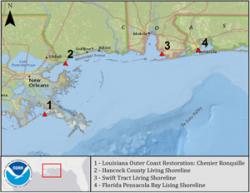
As outlined in the Final Programmatic and Phase III Early Restoration Plan and Early Restoration Programmatic Environmental Impact Statement, NOAA is supporting an overall Early Restoration plan that includes both ecological and human use projects. It is also fully supporting 44 specific projects to address injury across the Gulf. Of those, NOAA is directly involved in the implementation of four projects.

Map of Gulf of Mexico restoration

Map of Gulf of Mexico restoration

Locations of Phase III Deepwater Horizon early restoration projects in which NOAA is participating. (Photo: NOAA)

The largest NOAA project partnership will be with Louisiana to fund and execute restoration of beach, dune, and back-barrier marsh habitat on Chenier Ronquille, a barrier island off the state’s coast. Chenier Ronquille is one of four barrier islands proposed for restoration as part of the Louisiana Outer Coast Restoration Project that will be implemented by NOAA, the U.S. Department of Interior and Louisiana. The total cost to restore the four barrier islands is expected to be $318 million.

Alabama, Florida, Mississippi, and NOAA will partner to undertake three “living shorelines” projects. These projects involve a blend of restoration technologies used to stabilize shorelines and restore fish and wildlife habitat. The three projects are:

Alabama: NOAA will work with the state to fully implement the Swift Tract Living Shoreline Project. This project, costing $5 million, will construct approximately 1.6 miles of breakwaters covered with oyster shell to reduce shoreline erosion, protect salt marsh habitat, and restore ecosystem diversity and productivity in Mobile Bay. Restoration experts expect that over time, the breakwaters will develop into reefs, providing added reproductive and foraging habitat and shelter from predators. The 615-acre state-owned Swift Tract site is located in Bon Secour Bay and is part of the NOAA-supported Weeks Bay National Estuarine Research Reserve.

Florida: NOAA will partner with Florida for the Florida Pensacola Bay Living Shoreline Project to restore shoreline at two sites along the Pensacola waterfront. Project Greenshores Site II is located immediately west of Muscogee Wharf in downtown Pensacola. Restoration at PGS Site II has been planned in conjunction with the Sanders Beach site, three miles to the west. Both proposed sites feature breakwaters that will provide four acres of reef habitat and protect the 18.8 acres of salt marsh habitat that will be created through this project. The Pensacola project is expected to cost about $11 million.

Mississippi: NOAA will partner with the state to improve nearly six miles of shoreline as part of the proposed Hancock County Marsh Living Shoreline Project. The goal of the project is to reduce shoreline erosion by dampening wave energy and encouraging reestablishment of habitat in the region. The estimated cost is $50 million.

As the largest phase of early restoration efforts, Phase III sets a strategic approach for these and additional early restoration activities. The trustees received thousands of public comments that were instrumental in its development, and has issued a guide to the plan and projects.

These projects will be funded through the $1 billion provided to the trustees by BP, as part of the 2011 Framework Agreement on early restoration.

Ten early restoration projects already are in various stages of implementation as part of the first two phases of early restoration. Updates on these projects are available in an interactive atlas.

Early restoration provides an opportunity to implement restoration projects agreed upon by the trustees and BP prior to the completion of the full natural resource damage assessment and restoration plan. BP and other responsible parties are obligated to compensate the public for the full scope of the natural resource injury and lost use caused by the Deepwater Horizon oil spill, including the cost of assessing such injury and planning for restoration.

For more than 20 years, NOAA’s Damage Assessment, Remediation, and Restoration Program has worked cooperatively with federal and state agencies, tribes, industry, and communities to respond to oil spills, ship groundings, and toxic releases. During that period NOAA has protected natural resources at more than 500 waste sites and 160 oil spills, securing more than $2.3 billion from responsible parties.

NOAA’s mission is to understand and predict changes in the Earth’s environment, from the depths of the ocean to the surface of the sun, and to conserve and manage our coastal and marine resources. Join us on Twitter, Facebook, Instagram and our other social media channels.

Is the Smallmouth Bass Fishing Good On Bays de Noc In Michigan?

Bays de Noc Smallmouth Bass Fishery Shines on National Stage
from The Fishing Wire

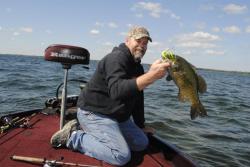
Big smallmouth

Big smallmouth

ESCANABA, Mich. – Mention Lake Michigan’s Bays de Noc to most anglers and they’ll immediately start talking about fishing for walleye.

But in the wake of September’s high-profile Bassmaster Angler of the Year Championship – which brought 50 of America’s top anglers to Escanaba to ply the waters of Big and Little Bays de Noc – what was once seemingly relegated to “also-ran” status is now national news: The Bays are loaded with trophy bass, too.

“The fishery has always been kind of walleye-centric,” said Department of Natural Resources fisheries biologist Darren Kramer. “Bass is kind of an up-and-coming, emerging fishery. Every year we see more and more bass boats, and more out of state anglers, taking advantage of the fishery. There’s a lot of traffic out on Big Bay de Noc after the bass opener. That fishery’s really taken off in the last five or six years.

“Our creel data indicates there’s increasing angler effort and we think that’s attributable to bass,” Kramer continued. “Bass harvest has stayed the same, but use of the resource is going up along with angler success, which implies we’re recruiting more catch-and-release bass anglers to the area.”

The Bassmaster Angler-of-the-Year Championship started with a bang: On the first day, 12 competitors brought in five-fish limits with a total weight in excess of 20 pounds.

Catching bass that weigh more than four pounds each isn’t often accomplished in tournaments, even on some of America’s best big-bass lakes.

Although the tournament hit a minor snag, with high winds causing delays that shortened the event to two days rather than three, the weather couldn’t dampen the enthusiasm of the competing pro anglers who described the fishery as “awesome,” “incredible,” “unbelievable” and “amazing.”

Paul Elias, a Laurel, Mississippi, resident who won the BASS Classic in 1982, was effusive in his praise.

“It’s as good as, or better than, any smallmouth fishery we fish,” he said. And Elias’ comments were echoed by virtually all the competitors.

Fayetteville, Tennessee, bass pro Brandon Lester, who brought in the biggest bass of the first day’s competition – a six-pound, four-ounce smallmouth, said, “I’ve never seen so many big smallmouths in my life. They’re not everywhere, but when you find one, you’ll find a group of them. When you get around them, you can light them up real quick.”

Said Skeet Reese, a top angler from Auburn, California, at the weigh-in: “That’s the best day of smallmouth fishing I’ve ever had in my life. This is an incredible fishery.”

While many of the anglers were surprised by the quality of the fishery, Kevin Short of Mayflower, Arkansas, said the results were just what he expected.

Short first fished the waters off Escanaba in 2008 when he recognized that the area would undoubtedly host a future tournament, and has come back every year since just to fish for fun.

“If there’s any place in the whole country we would move to for nine months of the year, this would be it,” Short said. “The first couple of trips we really didn’t catch that many, but once we figured it out, holy smokes. It’s a really special place. I’d drive 18 hours just to come up here and fish a few days.”

Bass anglers familiar with the fishery had predicted an outstanding tournament.

Scott Cormier, a 42-year-old recreational vehicle salesman and lifelong bass angler from Gladstone, said the tournament was “going to open up a lot of eyes” across the country.

“There’s a big deep-water fishery out there that nobody’s really fishing,” Cormier said. “There are fish out there in 40 feet of water that have never seen a lure before.”

Indeed, most of the anglers were fishing shallow water during the tournament, concentrating on the rocky shoals that were only a few feet deep on the top or on the weedy flats adjoining drop-offs.

Dan Anderson, a 48-year-old maintenance supervisor from Fond Du Lac, Wisconsin, who fishes Bays de Noc regularly and was on hand to take photographers out on the lake during the tournament, said the fishery is capable of yielding 100-bass days at any time.

“They’re biting good by opening day,” he said. “You can catch them by May 1st and fish right up to deer season.”

That such an outstanding bass fishery flew under the radar for so long is just a matter of the Upper Peninsula fishing culture, Kramer said.

“Many anglers in the U.P. are typically looking for panfish or walleye,” Kramer said. “A lot of the bass fishermen we see are from downstate or out of state. But I predict that might begin to change.”

Added Jessica Mistak, the DNR’s fisheries management supervisor for northern Lake Michigan: “We think this is a world-class fishery that’s really been overshadowed by the walleye fishery. Now that anglers see that there are fish to catch other than walleyes in the Bays, they’ll be eager to come here and try it.”

Although invasive species are typically talked about in a negative light, Mistak said water clarity changes – brought on by zebra and quagga mussels – and new prey species, such as gobies, may have helped the smallmouth population.

Certainly, the smallmouths are thriving, a fact that is not so secret any more.

“This place is unbelievable,” said Jacob Powroznik of Port Haywood, Virginia, who brought in a limit weighing 24-pounds and one-ounce, good for third place after the first day of competition. “I hope we come back real soon.”

Stanford Lures Cedar Shad Crankbait

In an earlier article I mentioned a plug bass pro Bobby Padgett uses to catch fish on the ledges at Eufaula. A company in Columbus, Stanford Lures, is making the Cedar Shad. They also make the Hog Caller spinnerbait you see in local stores sold by another company.

The Cedar Shad is carved out of Western Cedar, runs about 10 to 12 feet deep and has excellent colors. It is guaranteed to run true right out of the box. Most crankbaits need tuning before they will run right but the Cedar Shad doesn’t. I expect this company to sell a lot of quality lures that are made in our state.

Crankbaits are excellent lures year round. Bobby Padgett’s favorite time to use them is May through the fall when the bass are stacked up on ledges and deep structure. He says his type fishing is feast or famine, catching either dozens of good bass or nothing.

I really like crankbaits this time of year. I am usually looking to catch one or two fish, just to place in a club tournament. Crankbaits fished slowly around rock or wood cover in shallow water will usually pay off in a few strikes even on the worst days.

Its tough deciding whether to go fishing or hunting this weekend. Doe days are open in Spalding County and other counties toward Atlanta. Other counties do not have doe days until Thanksgiving, but bucks should still be moving. I need a couple of deer for the freezer, but catching bass sounds good, too. This is a great time of year!

Sixteen Baits I Have to Have in My Tacklebox

After 40 years of bass club fishing you would think I would have culled down my tackle to some essentials. I have not been one to go wild over new lures for many years. I don’t rush out to buy something just because a big tournament was won with it. But I do usually have 16 rods on my deck ready to use in a tournament since I don’t like to stop and re-tie. If it is on my deck ready to use I am more likely to pick it up and give it a try.

Still, I often use only three or four rods in an eight hour tournament. If something works early I stick with it. And if fishing is tough, like it usually is for me, I cast my confidence baits over and over.

If I had to limit myself to only a couple of rods and a tackle box with 16 items in it, the following list is what I would carry. I have distilled all my baits to this list and this is what I carry if I don’t go in my boat. And the 16 rods on my deck are usually rigged with each of them, ready to use.

1. JJs Magic – I always dip the tails of my worms and trailers in Chartruese but red and blue allow you to change colors or highlight plastic baits quickly and the clear and all the colors add a strong garlic scent.

2. Bitsy Bug jigs – I have a box full of three sixteenths and one quarter jigs in both green pumpkin, for clear water and black and blue for stained water.

3. Zoom Creepy Crawler trailers – Green pumpkin for the brown jigs, blue for the black and blue jigs. And I always dip the tails in chartreuse JJs Magic in both colors

4. Spinnerbait – I like a three eights ounce bait with a gold willow leaf and a silver Colorado blade, with white and chartreuse skirt for all around fishing. But I also carry heavier baits for fishing deeper.

5 Rico –My go-to topwater bait is the small Rico – I think it is the best popper on the market.

6. Buzzbait – I keep a variety of one eight to half ounce buzzbaits in various colors for fishing topwater, especially when cover keeps me from throwing the Rico

7. Zoom Mag 2 worms – I fish the redbug color both Texas and Carolina rigged, depending on cover and depth

8. Owner hooks – Sharp and tough the 3/0 is the size I use for Trick and Mag 2 worms, and have some 1/0 if I got to a smaller worm

9. Sinkers – a variety of weights, from my usual 3/16hs for Texas rig to half ounce for
Carolina rigs to lighter and heavier for different conditions and depths

10. Deep running crankbaits – I like the Norman Little N for medium depth and the DD22N for deep dredging. Shad colors for clearer water, chartreuse and blue for stained

11. Jig head – shaky heads – One of my go-to baits when fishing is tough. I use a 3/16ths ounce most of the time but will tie on a 1/8th for fishing rocks and a slower fall

12. Trick worm – A floating white trick worm with a 3/0 hook will draw strikes when the fish are shallow and want a subtle, slow falling bait.

13. Netbait T-Max worms – A Bamabug color is almost always on my shaky heads, but I will go to a watermelon red in clear water

14. JIgging spoon = Jigging spoons will catch fish year round, not just in the winter. I got a 7.6 pounder in a July tournament at Oconee several years ago. I like a gold Hopkins Shorty for most of my jigging

15. Spro Popping Frog – for fishing heavy grass, a frog colored bait allows you to fish the heaviest cover

16. Senkos – Nothing beats the wiggle of a weightless Senko falling under a dock or around cover. I rig it wacky style if cover allows, or Texas style with a 3/0 hook. They skip under docks great, too.

All these baits work for me. What are your favorites?

Who Was At ICast?

Who Were Those Guys at ICast?
from The Fishing Wire

Although it seems like ICAST was six months ago, it’s barely been three weeks ago the sportfishing industry gathered in Orlando for their annual event. And chatter may have been dissipated by distances, but one question remains that had absolutely nothing to do with the constant hassles of government regulation, access to public waters and the usual regulatory baloney that comes along with doing business in today’s climate.

ICast Booth

ICast Booth

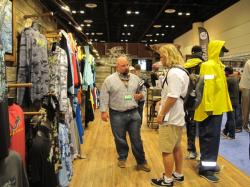
The Huk booth featured performance fishing attire (top). The obvious presence of the Spanish Fly boat and logos of the legendary saltwater angler Jose Wejebe (below) generated buzz, too, as did signing KVD. But the presence of other big names -like Skeet Reese (bottom) had ICAST attendees wondering if the new clothing company was out to move into fresh and saltwater fishing in a big way. Jim Shepherd/OWDN photos.

Boat At ICast

Boat At ICast

The question? “Who are those guys?” And like the iconic line from the classic Butch Cassidy & The Sundance Kid, everyone agreed with the follow up, too: “they’re very good.”

ICast Kevin VanDam

ICast Kevin VanDam

In this case, “those guys” were the guys from Huk Performance Fishing. They showed up at their first ICAST with a slick-looking booth that seemed to be a lure custom made for “name” anglers from professional bass fishing. And their announcement -made during ICAST – of signing Kevin VanDam to an apparel contract had more than a few attendees watching their booth to spot other “name” anglers looking at their very contemporary looking technical clothing.

At the start of ICAST, I was one of those people unable to tell you what the heck a “Huk” was. But tipster told me this “new” company was anything but new to the industry. Turns out, the company founders’ experience in sports and technical clothing was considered crucial to the success of another apparel company now a very major player in virtually all sports, including “the outdoor space”.

Yup, the same loosey-goosey guys joking about being friends since college were telling the truth- mostly. They just weren’t sharing was info that while they’re longtime friends, they’re proven corporate business veterans who left a company they felt was walking away from a great opportunity- fishing.

Another reason they seemed to be operating sub-rosa was the fact that Huk isn’t the company. That’s Marolina Outdoor, Inc. – a partnership of Ben Verner, Josh Reed and Jason Hart. They’re the longtime troika of friends with that “deep-seated expertise in technical apparel and intimate knowledge of the outdoor industry”.

Spending a few (disjointed) minutes talking with them at their booth, it quickly became obvious they’re playful in their demeanor, but when it comes to business, “they ain’t playin'”.

That’s the reason we’ll see KVD (and others) sporting a camo pattern on his fishing jerseys. It’s also why other names were checking out their goods. Marolina wasn’t started on a whim- or a shoestring. Seems the three founders are guided by a single position: if you’re going to play, be number one.

So, they came to ICAST with a full line of technical and casual clothing and a few surprises up their sleeves- like the KVD announcement. But they also had a business partner present in their booth whose name is iconic with saltwater anglers: Wejebe.

Krissy Wejebe, daughter of legendary saltwater angler and longtime “Spanish Fly” TV host Jose Wejebe was there, talking up a new Spanish Fly/Marolina partnership that will bring out a new line of “coastal lifestyle apparel” offering a fresh take on the classic.

A blend Krissy says is “truly unique, as was Jose.” Marolina’s Ben Verner calls the partnership a “dream come true” for the new company.

But there’s a deep-seated appreciation for the man who made “Spanish Fly” an angling standard, and that’s coming into play as well. Wejebe’s iconic -and re-outfitted- Spanish Fly boats were unmistakable at ICAST. But their presence wasn’t just to conjure up a nostalgic memory of Wejebe. They were there to foreshadow something I learned about during my visit with the Marolina crew: a resurrection and revamping of Wejebe’s now classic fishing shows.

No specific details on when we’ll be seeing the “new” Spanish Fly TV shows, but as always, we’ll keep you posted.