Category Archives: Fishing Tackle

Rods and reels to live bait

St Croix Rods At the Bassmasters Classic

Class of the Classic

Four top St. Croix Rod pros qualify for 2015 Bassmaster Classic
from St Croix Rods

Park Falls, WI (February 15, 2015) – To qualify is a big badge of honor. Winning? Well let’s just say the medals and commendations might require a caddy to carry and reinforcement of the fireplace mantle. The Classic trophy alone looks to exceed the maximum poundage for check-in luggage.

The Classic is a weighty matter, indeed. And there is a quartet of Elite anglers who will be throwing their weight and baits around under the flag of an all-American brand. Classic qualifiers James Niggemeyer, Stephen Browning, Scott Rook and Brian Snowden will have St. Croix Rod pinned to their chests and immaculately crafted rods in their hands.

South Carolina’s Lake Hartwell sets the battlefield for the 2015 campaign. The phrase “intimidating” might best describe the 56,000-acre reservoir and its 962 miles of shoreline. Rugged foothills and plummeting piedmont foretell what lies beneath the surface, as Hartwell’s waterscape is a pulmonary arrhythmia of structure.

True, for one, Niggemeyer is impressed by the scope and cragginess of Hartwell, but definitely not intimidated by the manmade lake. “Hartwell reminds me of some of the lakes I fished out west,” said the California native, now proud Texan. “Before Christmas, I went on a scouting trip to familiarize myself with the lake. I left feeling pretty comfortable.”

Pre-fishing is one thing, prognosticating another. Niggemeyer tested the waters in late December, but the dates of the Classic put him back on Hartwell in late February. So how does he expect the bite to play out?

“I predict that the bass will be in a late-winter pre-spawn mode, meaning both deep and shallow patterns will be in play,” said Niggemeyer, mentally preparing for basically everything. “I want to fish my strengths, and working a Strike King jig is one of them. It’s a powerful cold-water tool when fished around vertical structure and cover types both shallow and deep.”

Painting a waterscape with a precision jig necessitates the right brush, the perfect rod. “I’ll fish a St. Croix Legend Elite (LEC70MHF) 7-foot medium-heavy rod to get the job done. It’s extremely sensitive to soft bites from sluggish cold-water fish, but still has the action and backbone to maximize my potential to land each bite.”

Niggemeyer’s secondary approach involves raking crankbaits along fast-falling banks. “I have had a lot of success in late winter/early spring, fishing a variety of Strike King crankbaits to draw reaction strikes from fish that are otherwise reluctant to eat a slow-moving presentation.

“Pre-spawn bass tend to relate to 45-degree banks because they offer quick access to deep water. And using the right rod for crankbaiting is crucial, which is why I will reach for a 7-foot 4-inch St. Croix Mojo Bass Glass (MBGC74MM). The fiberglass rod gives me an edge anytime I fish crankbaits, but especially in this cold-water timeframe when fish have a tendency to swipe at baits, resulting in fish that are just barely hooked.”

Niggemeyer’s larger Classic prediction? “The tournament will most likely be won by the guy who consistently catches them day after day, as opposed to the one who has a monster day and hangs on for the win. With that in mind, a carefully thought out strategy with multiple options will be important.”

Similarity, not familiarity, is the battle cry echoed by St. Croix Rod pro and Bassmaster Classic qualifier, Brian Snowden. The Missourian is intimately acquainted with Table Rock Lake, which he says mimics South Carolina’s Lake Hartwell. “I have never fished a tournament on Lake Hartwell, but I did have the opportunity to spend an entire week on the water prior to off-limits. It fishes very similar to my home lake, Table Rock.”

In Snowden’s academic opinion, the calendar and cold water will have bass in a pre-spawn frame of mind. “The fish should be in a late winter or early pre-spawn pattern. For fish staging deeper than 10 feet, I plan on using a 1/2- to 3/4-ounce football jig. For this technique, my all-time favorite rod is the 7-foot medium-heavy St. Croix Legend Elite. The rod is very light and phenomenally sensitivity. Plus, the Legend Elite has a fast tip allowing for accurate casts, but with plenty of strength through the lower section of the rod.”

Snowden, like Niggemeyer, already has his fingers on the seams of a follow-up pitch. “My second prediction is that bass will be in major creeks, on channel swings and secondary points. One of the best techniques for catching them is running a crankbait. My choice for throwing smaller, lightweight crankbaits is the 7-foot 2-inch St. Croix Legend Tournament Bass (TBC72MM).”

There is a hardened Lake Hartwell expert in St. Croix’s ranks as well. “I fished the 2008 Bassmaster Classic on Hartwell,” said Arkansan Stephen Browning. “I didn’t fare well, but I really like the lake. I did spend some time before cutoff trying to familiarize myself with some areas that I didn’t fish during the 2008 Classic.” Seems that a winning formula for Browning will involve hybridizing 2008 intel with knowledge gained from more recent pre-fishing efforts.

“I’m going to hope for stable weather patterns leading up to the Classic,” said Browning, metaphorically pounding the Farmer’s Almanac with this fist. “This will help me analyze the winning pattern, or patterns, during the Classic. Nothing would suit me better than if there was substantial rainfall about a week out. That would move bass shallower, which would set up nicely for some shallow cranking.”

Again, akin to Niggemeyer, Browning snares a crankbait-specific St. Croix Rod off the front platform. “I’ve put the Mojo Target Cranker to the test the last two years with wins on the Red River in Shreveport, LA, and would love the opportunity to do the same at the Classic.”

Browning’s Plan B considers dryer conditions. “If we don’t see the rain and the fish are relating to deeper structure, a football jig on the end of a Legend Tournament Bass Carolina Rig rod will play a big role. This is one of my favorite ways to catch fish during the late-winter season.

“If I can find fish using either of these techniques, I should do very well. Confidence is a major player, especially at the Classic, and I know that there are no better rods that fit my styles of fishing than those that carry the St. Croix logo.”

Rounding out St. Croix’s fearsome foursome is veteran B.A.S.S. angler Scott Rook. The Arkansan is maybe best known for his adaptability; able to drive crankbaits with a burly baitcaster and effortlessly drop it to the deck and come back up with a finesse spinning outfit.

Matching Browning’s history with Lake Hartwell, Rook laced ‘em up at the 2008 Bassmaster Classic. And this time around, as he stated in a recent story written by David A. Brown for Arkansas Wild magazine, Rooks said deciphering prevailing weather conditions will be the key to the kingdom.

“In late February, if we have a warming spell, it will be shallow-water fishing; if we have a cold spell between now and then it will be more deep-water fishing,” he said. “More than likely, it will be won deep, but if it continues to warm, you can continue to fish shallow.

“The weather is going to be the biggest factor in what you can do. And you might have to mix it up some.”

St. Croix Rod, like its water-warriors, wears a badge of honor. And the symbol stands as the company’s pride in both its pros and the premium rods they’ll be fishing.
What Is the Proper Spooling of Spinning and Baitcasting Reels?

Kentucky Afield Outdoors: Proper spooling of spinning and baitcasting reels
from The Fishing Wire

FRANKFORT, Ky. – A family member bought you a nice spinning outfit for Christmas. Despite the cold, your desire to cast the new rod into water propels you to a local Fishing in Neighborhoods (FINs) lake to try to fool some winter rainbow trout.

Spooling Tool

Spooling Tool

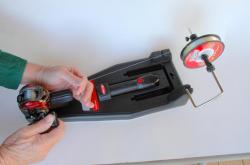
A respooler like this one from Berkley makes line winding quick and trouble-free, but home systems, including a spool on a pencil, will also work with care.

Dutifully spooling on some fresh 4-pound test monofilament, you cast a red and silver in-line spinner a few times. As you move to a new spot and shoot a cast, you hear a sound similar to a flushing covey of quail and see a ball of spaghetti moving up the rod.

You now have a bird’s nest of epic proportions, requiring cutting off the mess, pulling out the loops and retying the lure. You curse the brand of line you bought.

In all likelihood, it isn’t the line’s fault. Properly loading fishing line onto a spinning or baitcasting reel is a skill many anglers take for granted, but often do incorrectly, greatly reducing the line’s performance. Incorrect line loading often causes tremendous line twist, the main culprit behind bird’s nests.

For spinning reels, first make sure the line you’ve selected matches the capacities of the reel. These capacities are always labeled on the side of the reel’s spool. Don’t load 10-pound test line onto a reel designed to accept lines from 2- to 6-pound test.

Begin by placing the filler spool onto a table or floor with the label facing up. Run the tag end of the line through the stripper guide – the largest guide closest to the reel – and to the reel. Open the reel’s bail and wrap the line twice around the middle of the reel spool, tie an overhand knot and tighten. Follow up with another overhand knot and clip the line about ¼-inch from the knot. Make sure to clip the tag line, not the main line leading back to the filler spool.

Reel some line onto the spool and stop. Lower the rod toward the filler spool. If the line begins to jump and twist, flip the filler spool over, placing the label down. Sometimes, the direction the line was spun on the filler spool at the factory and the direction the spinning reel places line on the spool are not in synchronization, which causes enormous line twist. Flipping the filler spool alleviates this problem.

If the line comes off the spool in big loose coils and doesn’t twist, keep reeling until you fill the spool to the thickness of a nickel from the spool lip.

Another way to load the spool involves a helper. Have the helper run a wooden pencil through the hole provided in the center of the filler spool housing. Run the line through the stripper guide and tie on to the reel spool. Ask the helper to hold the spool and pencil assembly perpendicular to the reel, similar to the way a wheel rotates on an axle, and apply gentle pressure to the filler spool with their fingers.

The line must come off the top of the filler spool toward the reel, not the bottom, or it incurs line twist.

Resist the temptation to overfill a spinning reel’s spool. If you’ve ever opened the bail on a spinning reel and line shot off it like a top, then you’ve witnessed the results of overfilling the spool. You can lose half a spool of line from twists, tangles and bird’s nests from overfilling a spinning reel.

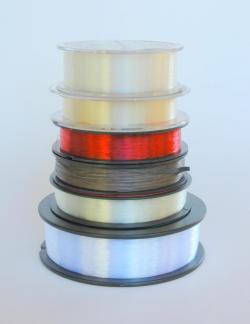
Choices of Line

Choices of Line

There are lots of options in refilling a spool-just choose a line suited to the task, and respool frequently; good line is critical when the big one bites.

Manually closing the bail of a spinning reel with your hand after making a cast is one of the best ways to keep line twist at bay while fishing. Each time you close the bail by turning the reel handle, you apply twist to the line. Over a day of fishing, these twists add up and produce loops and tangles that eventually lead to a mess. After a few fishing trips, manually closing the bail becomes second nature.

To fill baitcasting reels, run the line from the filler spool through the guide closest to the reel and through the line guide of the baitcasting reel to the spool. You can simply run the line through the holes in the ported spools found on most baitcasting reels today and start reeling. Or, secure the line to the spool with an arbor knot. Both techniques work.

The pencil through spool with a helper technique works best on baitcasting reels. Again, make sure the line comes off the top of the filler spool, not the bottom. You can also do it by yourself by placing the filler spool on a table with the label up and checking for twist, but the pencil through the spool method works much better for baitcasters.

Fill the spool to within a 1/16-inch of the rim and, again, resist the impulse to overfill the reel.

Don’t let line problems stemming from improper loading ruin a day of fishing. Following these simple procedures will achieve the best casting distance for your spinning and baitcasting reels, keep tangles at bay, and extend the life of your line.

Author Lee McClellan is a nationally award-winning associate editor for Kentucky Afield magazine, the official publication of the Kentucky Department of Fish and Wildlife Resources. He is a life-long hunter and angler, with a passion for smallmouth bass fishing.

First Bass Tournament of the New Year

Last Sunday was the first tournament of the year for the Flint River Bass Club. Only six members showed up at Sinclair on a cold, cloudy day. There was only one limit but everyone caught at least one keeper. The 18 bass we brought to the scales weighed about 29 pounds.

After fishing from 7:00 AM to 3:00 PM Lee Hancock won it all with a limit weighing 9.63 pounds and big fish with a 4.15 pound largemouth. My three keepers weighted 6.27 for second, Don Gober had four at 5.15 for third, and Jack “Zero” Ridgeway had three at 4.89 for fourth.
I started the day fishing a crankbait on a steep rocky bank. After an hour I was ready to leave but saw some brush sticking out of the water ahead of me and fished to it. I’m glad I did. A 3.7 pound bass hit by crankbait by the brush.

After fishing that area hard without any more bites I moved to a cove with docks in it. There is a rock pile between two docks where I have caught bass this time of year. The very first cast I made to it with a jig head worm I felt a tap and my line started moving back to the boat. When I set the hook my line broke.

After saying some choice words and trying to retie, my line broke every time I pulled it tight. Something was wrong with that line, I guess it had deteriorated on the reel. So I switched to another outfit and tied the jig head on it.

The next cast to the rocks produced another hit. My line started moving out, I set the hook hard and my rod bowed up on a heavy fish, and the hook came out of its mouth. That happened on four consecutive casts! I never hooked a fish there. I have no idea why I could not hook those fish unless there was a school of gar there and I could not get a hook in their bony snout.

After noon I ran down the lake to another place and caught my other two keepers by docks, then broke my line when I got a hit on some rocks. This time it was my fault, I had been fishing rocks and had not checked my line.

The Sportsman Club meets this Tuesday and our first tournament in this Sunday at Jackson. Time to join us!

What Is Swimbait Bassing?

Swimbait Bassing

By Frank Sargeant
from The Fishing Wire

There’s not much that better imitates a shad than a swimbait; many of them are nearly an exact imitation of the favorite food of bass in most of North America in shape, and their swimming tail closely resembles the movement of a free-swimming shad. Add to this that the soft plastic body feels edible, and the single hook is much less likely to catch weeds than the trebles of crankbaits and lipless lures and you get an idea why the swimbait is a favorite nearly everywhere in bass country.

Use swimbaits for bass

Use swimbaits for bass

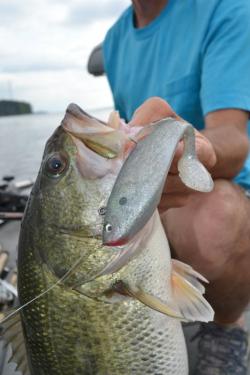
Big swimbaits often fool big fish, winter or summer, throughout shad country.

They can be particularly effective in early winter in the South and Southwest, where early freezes knock back the thickest weed stands, leaving tall but scattered springs of cover that’s prime country for swimbaiting.

Bass particularly like to prowl the scattered weed stands at the edge of deeper water; these are areas where shad congregate in winter, and anglers who motor these edges and watch their sonar will eventually find spots where there are lots of shad either on the edge or nearby. These are ideal areas to try swimbaits.

Swimbaits vary widely in size, from little 3/16 ounce models barely three inches long to big 8-inchers that would just about choke a striped bass. The best for all-around bassing are typically 4 to 6 inches long, in silver, white or steel gray colors.

Varying the weight of the jig head or the swimbait hook (some have sliding weights that pinch on the shaft) makes all the difference on the depth at which the lure runs and the speed at which you’ll want to fish it. With a light head, a big bait can only get deep if you fish it slowly, and many days in winter that’s exactly what the fish want.

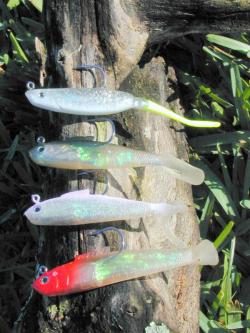
Swimbaits come in a variety of colors

Swimbaits come in a variety of colors

Molded swimbaits like these from Bimini Bay/Tsunami are more durable than those that are designed to be fished on a bare jig head.

At other times, though, the fish may be more active and you’ll do better with a slightly heavier head, allowing you to fish the bait faster and still get it down to where the fish are. At times, the best speed is dead slow, literally crawling it along bottom.

One of the nice things about these baits is that you can fish the same lure at a wide variety of depths, from just below the surface to right along the bottom, just by varying the retrieve speed.

Good swimbaits will tell you when you’re in the sweet spot for cranking speed–many of them actually cause the rod to throb as the tail wobbles back and forth. It’s a much less pronounced feel than you get with a crankbait, but it’s clearly there when you get the speed right.

Bass typically just swim up and inhale the swimbait–you’ll feel a strong bump, and that tells you it’s time to set the hook. Unlike with crankbaits, there’s less danger of pulling the hooks free with a quick hookset of the large, single hook.

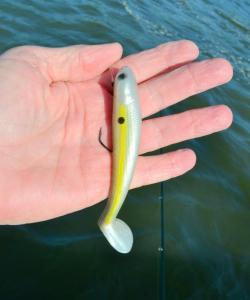
The Shadalicious from Strike King can be fished over a tube jig head, making the lead invisible.

Shadalicious from Strike King

Shadalicious from Strike King


While swimbaits often work best in scattered grass at this time of year, they can also be great open-water baits when anglers find bass suspended near shad schools over the main channel. This action often occurs near the upstream tips of shell bars, and blind casting in these areas with heavier swimbait heads sometimes connects, but the best bet is to ease along watching the sonar until you spot large schools of bait, then fish those areas hard.

In open water, the retrieve that works may be a bit more aggressive–a series of pull-and-drop actions can sometimes turn the fish on when they ignore a steady retrieve.

Storm, Strike King, YUM, Tsunami and many other companies make good swimbaits–buy a variety of colors and sizes, along with a good assortment of jig head weights, and you’ve got just about everything needed for successful winter angling through the month of December in much of largemouth bass country south of Mason-Dixon.

Fishing Tackle Suggestions for New Fishermen

I received the email below from Bob:

Good Morning,
I was on your website and thought that I would write to you for your suggestions and recommendations. It is the Christmas season so I am sure there are a lot of deals out there as well. If you have recommendations as to where to purchase for the best buy that would be an added plus.

I live on a small freshwater lake (Honeoye Lake) in upstate NY http://www.fishingnotes.com/lakeinfo.php?id=23327 and would like to get into fishing. I am a “novice” in the fishing department so that is why I am writing. Our lake is great for large/small mouth bass, walleye, perch and sunfish. What would be your recommendations as brand and models to purchase and why you recommend these:

· Fishing rod –
· Fishing reel –
· Specific Lures for fishing –

Thanks again for your help. Have a great day.

Bob

This is my response – What do you think?

Hi Bob

For someone just starting fishing and wanting to fish for a variety of species you mentioned I would get a mid-range priced spinning outfit. I like the Shimano Sedona reel. They are about $60 and I have four I have used for years and they have held up well. Team it with a medium action fast taper rod like the Browning Cherrywood rod for about $25. There are much more expensive rods and I really like St. Croix, but to start a cheaper rod will serve you and you can get a better idea of what you like.

I have both listed on my rod and reel page from Bass Pro Shops at

https://fishing-about.com/my-favorite-rod-and-reelfishing-products/

I use fluorocarbon line but for a beginner I would recommend a line like the Trilene XL in eight to ten pound test. Be careful putting it on and it it is twisted let it out behind a boat slowly moving and reel it in slowly or if you don’t have a boat you can untwist it by stretching it out on the ground and reeling it in slowly.

https://fishing-about.com/fishing-line-i-use-and-like/

For lures, keep it simple. A jig head worm and a weightless Senko and small jig and pig all catch smallmouth and largemouth.

https://fishing-about.com/soft-plastic-baits-i-use-and-like/

I would add a couple of small spinnerbaits and crankbaits, too. And a small top water popper like the Rico or Pop-R are good.

https://fishing-about.com/crankbaits-i-like-and-use/

For pan fish live bait is hard to beat and an outfit like this will let you rig a hook and small slit shot to fish them. You might want to drop down to six or even four pound line for them. And if your water is real clear and not much cover, I would fish for bass with six pound line, too.

Hope this helps – let me know if you have other questions.

Ronnie

Fishing Line I Use and Like

I use the following lines when fishing. Sometimes Bass Pro is cheaper, sometimes Amazon is – check both!

Berkley Trilene XL Smooth Casting Line - Filler Spools

Sunline Reaction FC Fluorocarbon Fishing Line - 200 Yards

Sunline Reaction FC Fluorocarbon Fishing Line – 200 Yards

100% Fluorocarbon developed specifically for reaction lures10% More stretch than FC Sniper Utilizes an FC material formulated for easy handling and reel performanceDouble resin processing for a slicker surface Dyed stealth gray colorHigh specific gravity allows crankbaits to reach max. depthsSunlines Reaction FC Fluorocarbon Fishing Line is designed specifically for reaction baits, such as spinnerbaits, crankbaits, rattle baits, and vibrating jigs. Made from a softer, high-strength fluorocarbon material, Reaction FC Fluorocarbon line is very flexible and stress free. Therefore, it handles better on a reel and casts farther than traditional fluorocarbon lines. Formulated to have more stretch than other Sunline fluorocarbons, Reaction FC is double-resin processed for outstanding slickness that delivers improved castability. Its stealth gray color increases its invisibility in water of any color. A high specific gravity allows crankbaits to reach maximum depths.


Sunline Super FC Sniper Fluorocarbon Line

Sunline Super FC Sniper Fluorocarbon Line

Proven reputation from whipping-up on big bass Thin, strong and highly sensitive Outstanding durability High specific gravity is ideal for fishing deep waters 200 yardsLow water absorption for minimal weakening underwaterSunline Super FC Sniper FC Fluorocarbon Line was born in Japan, but earned its reputation as an outstanding line by whipping-up on big bass stateside. Formulated with the stealthyness of a sniper, Super FC Sniper Fluorocarbon Line is nearly invisible and offers a high specific gravity which makes it ideal for picking off bass in deep water. Super FC Sniper Fluorocarbon Line offers outstanding durability, high strength to diameter ratio and low water absorption which minimizes line weakening underwater.


What Are Some Last Minute Fishing Christmas Gifts?

Last Minute Gifting Ideas for Fishing
from The Fishing Wire

Some great ideas for the fisherman, fisherwoman or fisher-kid on your gift list.

We’ve all been there. The final days of shopping before the Christmas mêlée have arrived, and here we sit with no gifts purchased. It is time to act. Is it possible that the angler in your life could live without a new rod or accessory, perhaps. Doesn’t your fishing buddy deserve something nice? After all the fish he’s boated and the stories he’s heard you tell over and over again, I think he has earned it, and that angler needs some new gear.

Here are a few selections to take the guesswork out of your next purchase.

Fishing Buddy Gift Idea

Spooling line can be an arduous task, but it doesn’t have to be. The new, compact design, the Berkley® Portable Line Spooling Station takes the pain out of spooling fishing reels. This is one of those gifts that can benefit you in the end. When your buddy gets really good at using the Portable Spooling Station slide over a few of your reels for a quick spool.

Holding up to a 300-yard spool, the spring-loaded spool arm provides spool tension for ease of use. The spinning reel spool attachment eliminates annoying line twist experienced while spooling using conventional methods.

Anglers can manually spool spinning reels or speed up the process using the integrated hex shaft with a drill. The compact design with hang tab makes storage easy for later use. MSRP for the Berkley Portable Line Spooling Station is $29.99.

Ladies Gift Idea

For those of us that have forgotten our female anglers this Christmas, rush out and grab one of the Shakespeare® Ladyfish combos. Purchasing one of these also benefits the American Breast Cancer Foundation (ABCF.) So really, you’ve purchased a great gift and donated a portion of your money to a great cause.

Each rod in the refreshed lineup features tapered, more comfortable grips with ladies’ smaller hands in mind. The expanded assortment also includes a variety of lengths and actions with EVA, Cork, and Hybrid-Tech Grips (HTG™). The Ladyfish lineup offers solutions for female anglers with varying skill levels and is available in a variety of price points starting at $19.99 to $39.99.

Youth Gift Idea

This is perhaps the most difficult purchase. Youth want to be indoors playing on a video game or rummaging through the mountain of toys in their closet. This Christmas ignite the outdoor adventure with one of the Shakespeare® Wild Series rods or combos.
The Shakespeare® Wild Series includes 16 specifically tailored combos for walleye, trout, panfish, salmon/steelhead, catfish and flyfishing.

Adding to the adventure-packed Wild Series’ lightweight, functional features, the reel has a durable aluminum spool and handle with soft-touch knob that performs under the most rigorous conditions.

Salmon/steelhead and catfish models offer a carbon-fiber drag system while other models have the reliable multi-disc drag system. Fly reels are prespooled with backing and weight-forward line.

If anglers aren’t in need of a combo, Shakespeare is offering 16 Wild Series rods that match what is offered with the combos. These one- and two-piece rods give anglers a wide range of sizes and actions. The Wild Series’ MSRP is $39.99 to $69.99.

Don’t get left behind this Christmas season. Give the gift of angling and the outdoors to those around you. It’s crunch time so get out there and finish the year strong.

Are the St Croix Triumph X Rod Cool Rods?

Just Call it the “Cool Tool”

Triumph X backs its sporty, confident looks with the performance you expect from St. Croix
from Traditions Media

St. Croix’s new Triumph X rod series

St. Croix’s new Triumph X rod series


Park Falls, WI (November 24, 2014) – Even in fishing, style sells. In a sport where product performance should be the ultimate measure – even the deciding factor in sealing the deal at the cash register – looks do matter. Regrettably, some rod makers prey on this premise by putting “lipstick on the pig.”

Fortunately, there are proud, legacy manufacturers like St. Croix Rod who embrace the coolness factor while never succumbing to cheapness.

While visually alluring, even radical in appearance, St. Croix’s new Triumph X rod series owns its price-range in quality and performance. But long before the vibrant, airbrushed colors visually distinguish Triumph X from surrounding rods on the rack, technology and decades of advanced St. Croix engineering underpin its stature.

Beneath the striking burnt-orange and purplish-black façade is an SCII graphite blank that begs to accompany a more expensive rod. But at a hundred bucks, Triumph X is a triumph in blank construction at a reasonable price.

Component wise, the Triumph X features an EVA split-grip handle – again, a feat for the dollars. Split-grip practitioners embrace the progressive design’s balanced casting, comfort and lessened overall weight. Triumph X users will appreciate said benefits, which were once reserved for more expensive rods.

Fuji® DPS or ECS reel seat with black hood(s) complement the blank cosmetics while providing all-day casting comfort. Hard aluminum-oxide guides set in distinctive black frames support casting distance while holding up to the rigors of the sport. And this while precision-wound thread-wraps are safely situated beneath two coats of Flex Coat slow-cure finish.

All 12 spinning and casting rods in the Triumph X series are cultured for outstanding strength, sensitivity and hook-setting power. And amongst those dozen members are select rods for targeting bass, walleyes, pike, panfish and whatever else swims across your path.

Backed by a 5-year warranty and St. Croix’s celebrated Superstar Service, your affordably priced Triumph X rod doubles as a capital investment.

The Triumph X series is designed and engineered in Park Falls, Wisconsin, and handcrafted in St. Croix’s advanced facility in Fresnillo, Mexico. They retail for $90 to $100.
Catch Fish with St Croix Rods
About St. Croix Rod

St. Croix Rod is a family-owned and managed manufacturer of high-performance fishing rods headquartered in Park Falls, Wisconsin with a 65-year heritage of USA manufacturing. Utilizing proprietary technologies, St. Croix controls every step of the rod-making process, from conception and design to manufacturing and inspection, in two company-owned facilities. The company offers a complete line of premium, American-made fly, spinning and casting rods under their Legend Elite®, Legend® Xtreme, Legend Tournament®, Avid Series®, Premier®, Wild River®, Tidemaster®, Imperial® and other trademarks through a global distribution network of full-service fishing tackle dealers. The company’s mid-priced Triumph®, Mojo Bass/Musky/Inshore/Surf, Eyecon® and Rio Santo series rods are designed and engineered in Park Falls, Wisconsin and built in a new, state-of-the-art manufacturing facility in Fresnillo, Mexico. Founded in 1948 to manufacture jointed bamboo fishing poles for a Minneapolis hardware store chain, St. Croix has grown to become the largest manufacturer of fishing rods in North America.

What Are Some Ice Fishing Tip-up Trends?

Tip-Up Trends on Ice

Progressive ‘Trap’ Tactics Set to Fuel Your Best Season Ever
By Ted Pilgrim

There’s something satisfying about a well-planned network of tip-ups set across the white expanse of a frozen lake. Strategically placed fish “trap-lines,” each rigged with a big frisky baitfish, attract and literally snare freshwater predators like nothing else under ice. Get a bunch of dudes together, stack some ‘traps‘ into 5-gallon pails, and saturate the ice with baited flags.

When that first signal rises high above the icy horizon, heart rates soar as the rugged race ensues. The winner earns the right to set the hook and proudly hoist a hefty pike, walleye or any other freshwater prize that bites.

Catch big fish  under the ice

Catch big fish under the ice

Advanced trap-line tactics put big plenty of big fish on the ice. (Photo by Bill Lindner)

The smartest tip-up parties bait the big ‘uns on spacious open flats or along lengthy sections of a drop-off—places where fish consistently search for food. With six or more buds along, each empowered to run 2 or more lines apiece, you can put live bait in front of a lot of toothy grins. That’s trap-line fishing on ice in a nutshell, and it’s devastatingly effective.

On a long point or drop-off, a wise strategy places one group of anglers at each end of the trap-line, with additional fishermen spaced evenly between. If you’re going in cold turkey, searching a big area for the first time, perhaps you set one tip-up every 50 to 100 paces. Park a pickup truck or snowmobile every so often along your routes to serve as mobile basecamps. Better yet, set out a large pop-up style portable shelter, such as Frabill’s cavernous, aptly named Headquarters.

Setting out on foot, groups of trap-line anglers work best in pairs. First run through, one dude drills, while the other follows with a sonar, dipping the transducer in each new hole. Sonar guy keeps driller guy on target with depth, as he also checks for fish with a portable unit, such as a Humminbird 597ci HD Combo. When he sees something that looks like a good fish, sonar guy might also trace an “F” or “BF” (big fish) in the snow, which assures they’ll X-mark-the-spot with a tip-up next run through. In addition to sonar, the 597 ‘Bird also has a built-in GPS chartplotter with LakeMaster cartography, keeping you right on target with tip-up sets.

Modern tip-up

Modern tip-up

Frabill’s Calibrator system takes tip-up fishing to the next level of efficiency and high-level intel. (Photo courtesy of Frabill)

At the end of a bait set run, each fisherman grabs a bucket. If one of your buddies happens to be a tip-up pro the likes of Captain Pat Kalmerton, you’re in for a good day. “When we’re tip-up fishing for pike or walleyes,” says the ace ice guide, “we use a systematic approach. First, you’ve absolutely got to have good gear, and you’ve got to have a solid plan. For my guides and I, nothing works better than the ‘bucket system.’

“We can take a single Frabill bucket and fill it with at least six round Pro-Thermal tip-ups. The other bucket, a 1469 Aqua-Life Bait Station, gets used to house our tip-up ‘soldiers’—wild live suckers, big shiners or chubs. We want bait that really kicks; the critters that swim in huge arcs below the ice, pulling in predators like a lab working a field for pheasants. The Bait Station keeps minnows happy. It’s insulated and aerated. Water won’t freeze, and the micro-bubbler infuses the tank with energizing oxygen—like steroids for baitfish.”

Beyond robust bait, which drives his tip-up system, Kalmerton has recently taken his tip-up system to new heights. “’If it ain’t broke, don’t monkey with it,’” quips the Great Lakes captain. “Whoever penned this credo must have been referring to ice fishing. The sport’s the ultimate testing grounds for gear. It’s why I’ve relied on the same classic tip-ups for years. The contraptions perform a simple task—presenting bait and indicating strikes—and they do it reliably, day after day, winter after winter.

An underwater camera helps find fish under ice

An underwater camera helps find fish under ice

Like an underwater trail camera, coupling a tip-up with an Aqua-Vu adds fun and interactivity to the whole experience. (Photo by Bill Lindner)

“Truthfully, never thought I’d have a need to alter my traps, but I was wrong. When I tested Frabill’s Calibrator Tip-Up a few winters back, my fishing rose to a whole other level of precision and effectiveness. I can take any existing tip-up and instantly convert it into a digital line-counter system, which also provides additional fish-catching intel.”

Kalmerton says his Calibrator Line Counter kits and complete Calibrator tip-up systems allow him to drop baits to effective depths instantly, thanks to a digital LCD display. “Every good troller uses a line-counter reel, and I’ve now come to feel the same way about my tip-up fishing. Not only can I instantly measure how much line I have out, the Calibrator also tells me the precise amount of time that’s elapsed since a strike occurred, and how much line the fish has stripped from the spool—all displayed in pinpoint accuracy.”

Adding another layer of fun and efficiency, Kalmerton occasionally mounts a miniature underwater camera, such as an Aqua-Vu Micro 5, to his tip-up, providing a real-life view of what’s happening with his bait and any fish in the neighborhood. “Cameras add a dimension of interactivity to tip-up fishing that anglers are just starting to appreciate. Think of it as a real-time trail cam for fishing. And with new wireless technology, camera fishing is more convenient than ever.”

Whether your team’s tip-up program matches Kalmerton’s techno heights or remains a simpler affair, it’s always a race on ice to reach the flag first. Most of the time, especially with larger pike and walleyes, it isn’t necessary to let fish run for long. Rigged right, quick hooksets tag more fish, and certainly harm far fewer of them. In the meantime, it’s a game of waiting. Lean on a tailgate. Pour a cup of coffee. Talk a little smack. The winner’s always the first dude to the flag.

A good shelter helps

A good shelter helps

Large portable shelters serve as the strategic tip-up headquarters, while outside, flying flags signal big pike and other hungry predators. (Photo by Bill Lindner)