Category Archives: Conservation

The Surprising Story of Swordfish

The Surprising Story of Swordfish You May Not Know
From NOAA Fisheries
from The Fishing Wire

Today’s North Atlantic swordfish stock is fully rebuilt and maintaining above-target population levels. But there’s work to be done to ensure management measures better support the fishing industry.

Swordfish in the depths


Swordfish. Credit: Shutterstock/Joe Flynn.
Today’s North Atlantic swordfish population is a great fishery rebuilding story.

Twenty years ago, this predatory fish was in trouble. Their population had dropped to 65 percent of the target level. This means there weren’t enough North Atlantic swordfish in the water to maintain their population in the face of fishing by the many countries who share the resource.

Fast forward to 2009 and the international commission that manages species like swordfish declared the Northern Atlantic stock fully rebuilt. That announcement came a year ahead of the 2010 target date set in the International Commission for the Conservation of Atlantic Tuna’s (ICCAT) 10-year rebuilding plan.

“If it’s U.S.-harvested swordfish, consumers can feel confident it’s a smart seafood choice,” said Rick Pearson, NOAA Fisheries fishery management specialist. “We should reward our sustainable stewardship practices at the seafood counter.”


Rebuilding an Important Population

Efforts to restore a dwindling population of North Atlantic swordfish date back to 1985 when NOAA Fisheries implemented the first U.S. Atlantic Swordfish Fishery Management Plan. This plan reduced the harvest of small swordfish, set permitting and monitoring requirements, and launched scientific research on the swordfish stock. Minimum size limits and enforcement processes came shortly after when ICCAT issued its first recommendation on swordfish in 1990.

Despite these and other management strategies implemented over the next eight years, the stock continued to suffer. By the late 1990s, the average weight of swordfish caught in U.S. waters had fallen to 90 pounds, a drop from the 250-pound average fishermen enjoyed in the 1960s. This was in part because the population decline meant fishermen were catching younger fish.

What ultimately reversed their downward course was the broad suite of actions built up by the beginning of the 21st century.

“There is no one measure that could have brought this population back from the decline,” said Pearson. “Sustainable fishery management requires a comprehensive science-based approach that considers the biological needs of the fish population, the health of fisheries, the fishing industry, and coastal communities.”

In the United States today:

A limited number of vessels can target swordfish commercially with longline gear.

All fishermen must abide by minimum size limits, and many must also abide by retention limits.

Closures prevent pelagic longline fishing in waters with historically high levels of bycatch species, including undersized swordfish.

Satellite tracking systems are mandatory on some vessels that target swordfish.

The use of circle hooks is required in commercial fisheries to increase the survival of sea turtles and other animals caught accidentally.

Commercial fishermen must attend workshops where they learn to properly handle and release bycatch, including undersized swordfish.

Observer programs provide fishery scientists and managers with needed data.

Leading the International Community
Some of these measures can be traced back to the ICCAT rebuilding plan, but many are the result of U.S.-led efforts to protect swordfish, reduce bycatch of other species, and sustainably manage fisheries that interact with swordfish.

Pearson and others also point to the key role the U.S. commercial fishing industry played in helping to establish these domestic efforts and supporting greater international collaboration.

“The United States led the charge internationally to adopt measures to recover North Atlantic swordfish,” said Christopher Rogers, director of International Fisheries. “We pressed our international partners to adopt measures U.S. fishermen were already practicing, such as catch limits, minimum sizes, recording and reducing dead discards, and appropriate observer coverage. Strong U.S. leadership helped ensure the international community shared the burden for rebuilding this iconic species.”

Support for a Valuable U.S. Fishery
In the decade since ICCAT first declared that North Atlantic swordfish are not being overfished, the United States has seen a fall in its total annual catch. In 2017, U.S. fishermen caught just 14 percent of the total swordfish catch reported to ICCAT.

There are several reasons for this decline, says Pearson, including rising fuel prices, an aging commercial fleet, and competition from often lower-quality imported frozen products.

To help more U.S. fishermen take advantage of our national ICCAT-allotted quota, NOAA Fisheries has made several changes in the last decade to commercial and recreational restrictions, such as:

Removing vessel size and horsepower restrictions on pelagic longline permits.

Increasing retention limits on some permits.

Launching a hand gear permit, allowing fishermen to participate in the fishery without spending more to buy a longline permit from another vessel.

Making it easier for fishermen to get and renew permits.

But there is more work to be done to ensure our regulatory program is effective in both maintaining swordfish populations and supporting the fishing industry. We are currently examiningwhether some area-based and gear management measures that affect swordfish fisheries could be modified in light of the success of a program that has reduced bluefin tuna bycatch.

“The U.S. fishery management process is a dynamic process,” said Pearson. “Protecting the North Atlantic swordfish population from overfishing while ensuring fishing opportunities for our recreational and commercial fishermen requires the best available science and responsive management.”

Mysteries of Pacific Salmon Survival

International Voyage Aims to Unravel Mysteries of Pacific Salmon Survival

Pacific Salmon Survival


Contributed by Michael Milstein, Northwest Fisheries Science Center
from The Fishing Wire

An international team of biologists is setting out into some of the roughest waters in the North Pacific Ocean in the middle of winter to try to solve the fundamental mystery of Pacific salmon: What determines whether they live or die?

Pursuing Answers in the Remote Ocean

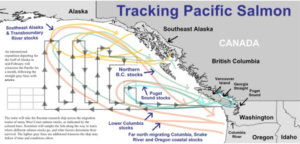
Perhaps the most critical, but least known, part of the salmon life cycle is the few years the fish spend on the high seas, gaining energy to return to their home rivers and spawn. This is where most of the salmon that stream out of Northwest and Alaska rivers each year disappear, most never to be seen again. Now the science team is headed into the remote Gulf of Alaska to try to find out which fish survive, and why.

“What we most need to know about salmon, we mostly don’t know,” said Richard “Dick” Beamish, a longtime salmon researcher in Canada who, with Russian colleagues, launched plans for the research expedition as a centerpiece of the International Year of the Salmon in 2019. He also raised about $1 million to fund the voyage. NOAA Fisheries contributed as well.

“Nothing like this has ever been done before to my knowledge, and I’ve been doing this for 50 years,” Beamish said. “I believe that we will make discoveries that will change the way we think of salmon and do salmon research.”

International Scientists Join Voyage

NOAA Fisheries has three scientists on board the survey, which includes top salmon researchers from Russia, Korea, Japan, and Canada. Scientists believe that Pacific Rim salmon, whether from Alaska, the west coast of the United States, or the east coast of Asia, all spend time in the Gulf of Alaska during their years at sea.

Fisheries biologist Laurie Weitkamp, who is based at the Northwest Fisheries Science Center’s Newport (Ore.) Research Station, will be the chief U.S. scientist for the trip. Weitkamp’s previous research has mainly focused on estuaries and coastal areas, she said, while the open ocean has largely remained a “black box” to scientists searching for better tools to predict salmon returns to west coast and Alaska rivers.

“This is not a place that is very easy to go and do science, especially in winter,” said Weitkamp, who recognizes she will likely get seasick in waves known to tower 50 feet or higher, but is O.K. with that. “To understand what is affecting these fish, you have to go where the fish are, and now we are finally about to do that.”

Fisheries biologists Charlie Waters and Gerard Foley from the Alaska Fisheries Science Center will be collecting samples for several studies to learn more about salmon condition and diet. In particular, they want to learn more about what pink salmon are eating and whether they are in competition with sockeye, Chinook, and coho for prey resources. All of these salmon species support important commercial, recreational, and subsistence fisheries in Alaska.

“We have a vested interest in knowing what’s going on during the winter months,” said Foley. “It is a critical, critical time in the life history of these fish.”

The science team will set out in mid-February 2019 from Vancouver, B.C., on a Russian research ship named Professor Kaganovskiy, backed by funding from the Canadian government, the Pacific Salmon Commission, the British Columbia Salmon Farmers Association, and others. The ship will spend a month crisscrossing the Gulf of Alaska with trawl nets and examining the salmon they catch with tools that range from microscopes to DNA fingerprinting.

Salmon’s Race for Survival

Scientists have long suspected that the fate of salmon migrating into the ocean is sealed during their first year at sea. The fish that grow large enough, fast enough to elude predators and make it through the first winter are the fish that will return to rivers to spawn–and to be caught in fishing nets. For the first time, the scientists aboard Professor Kaganovskiy will be able to test that theory, using clues like the tiny bones in the ears of fish, known as otoliths, that reflect each fish’s growth.

Roughly 99 of every 100 salmon that leave rivers for the ocean never return. The team wants to know what distinguishes those fish from the rare salmon that make it back alive.

“This is the time of year when we think most of the mortality is occurring, so this is when we want to be there to understand the fundamental mechanisms that regulate the production of salmon,” Beamish said. The better they understand the most influential factor affecting fish, he said, the closer they will be to providing more accurate forecasts of salmon returns to west coast rivers.

That, in turn, will help fisheries managers, fishermen, and others effectively manage salmon in a changing ecosystem, Beamish said.

Researchers also believe that different salmon stocks, such as those from rivers including the Snake and Columbia, migrate through certain parts of the Gulf of Alaska, capitalizing on the food available in different areas. The carrying capacity of those areas will also help determine how many fish return to the rivers.

“We’ve never been able to test that before,” Beamish said. “Now we have a chance to be there and see it happening in real time.”

FOR MORE INFORMATION:
Gulf of Alaska expedition
The next link/button will exit from NWFSC web site https://yearofthesalmon.org/gulf-of-alaska-expedition/

International Year of the Salmon
The next link/button will exit from NWFSC web site https://yearofthesalmon.org/

Ocean ecosystem indicators of salmon survival
https://www.nwfsc.noaa.gov/research/divisions/fe/estuarine/oeip/index.cfm

Florida’s Saltwater Fisheries Boundaries

How Florida’s Saltwater Fisheries Boundaries Came to Be
from The Fishing Wire

Florida’s Saltwater Fisheries Boundaries


When you are on a boat, it’s hard to imagine boundaries. The sea is the sea. Wave after wave, it all looks the same. Above-water landmarks are few and far between. There are no signs that say, “now entering federal waters.”

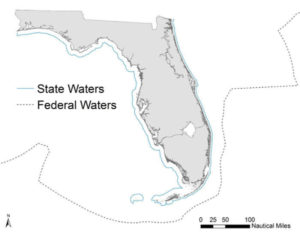
Regulatory boundaries are sometimes hard to fathom. In Florida, one of the biggest fishery management boundaries is that between state waters, where the Florida Fish and Wildlife Conservation Commission (FWC) makes the regulations, and federal waters, which are mostly managed by federal fishery councils and NOAA Fisheries with input from FWC. Sometimes regulations are the same in both state and federal waters, but not always, which is why it is important to know there is a line, and where that line is.

Florida is the only state where that boundary shifts depending on which coast you are on. State waters in the Atlantic extend out to 3 nautical miles, while in the Gulf they extend out to 9 nautical miles. But why, as many people ask? How did this come to be?

State boundaries in open waters of the United States first began to be defined in the 1940s, mainly due to concerns about rights for oil beneath submerged lands.

In a 1947 case, the U.S. Supreme Court ruled against California saying the federal government possessed rights in all submerged lands of the Pacific seaward of the low-water mark. The U.S. Supreme Court ruled similarly against Louisiana and Texas.

Congress reacted by creating the Submerged Lands Act of 1953.

This act declared that states owned the submerged lands, and the natural resources within, out to three geographic miles. The act included a provision that a state’s boundary could be extended if it was beyond three geographic miles from the coast prior to when statehood was achieved.

Florida immediately asserted their boundary went beyond 3 geographic miles before it achieved statehood in 1845 and that Congress approved its boundary when Florida was readmitted into the Union after the Civil War. The claim did not make it to the Supreme Court until 1960, where it was proven that Article I of Florida’s Constitution (1868), which was approved by Congress, described the boundary off Florida’s Gulf Coast as “three leagues from mainland.”

Florida’s Atlantic coast boundary was settled at 3 geographic miles from shore.

One nautical league is equal to 3 nautical miles, therefore the “three leagues from mainland” is equal to the 9 nautical miles we manage in the Gulf today. For fishery management purposes, federal waters extend from where state waters end out to about 200 nautical miles (less so in areas where our waters butt up against other country’s waters such as in the Caribbean). Federal waters are also known as the Exclusive Economic Zone or EEZ. For more on the history of this nation’s boundaries, visit NauticalCharts.NOAA.gov/data/us-maritime-limits-and-boundaries.html.

For those interested in measurements, while we use nautical miles today, you may have noted that the original language used geographic miles. There’s really not much of a difference between the two. A geographic mile ( 1 minute of arc along the Earth’s equator) is slightly longer than a nautical mile (a geographic mile is 6,087.08 feet and a nautical mile is 6.076.11549 feet), but the difference between 9 geographic miles and 9 nautical miles is less than 100 feet. (Note a geographic mile is also different than a standard English mile, 5,280 feet.)

Another interesting tidbit comes from the creation of the 3-mile limit itself, which sources say stems from how far a cannon ball could reach when fired from land. It is also said that, due to the earth’s curvature, 3 nautical miles is how far it is to the horizon.(Of course, this depends on how high your eyes are above the water.)

For fisheries management, we’ve created many additional boundaries throughout the years. We have species-specific management zones for fish such as red drum, and FWC manages some species in both state and federal waters. We take into account many different aspects when creating these boundaries, including differences in fish populations, fishing practices and stakeholder needs.

There may not be signage, but it’s always important to know where you are. State/federal boundary lines are marked as the natural resource line on NOAA nautical charts and these lines are also preloaded on most marine GPS units.

Need a map? Check out our maps page at MyFWC.com/Marine by clicking on “Recreational Regulations” and “Fisheries Maps.”

Have a question about marine fisheries regulations? Want to know more about catch and release? Send your questions, photos and fishing tales to Saltwater@MyFWC.com. Make sure your photo meets our photo requirements by visiting MyFWC.com/Fishing and clicking on “Saltwater” and “Submit a Photograph” under “Get Involved.” Don’t forget to record all of your catches on the iAngler phone app or at www.snookfoundation.org/data.html. And learn how to submit your catches and get rewarded through our Saltwater Angler Recognition Programs at CatchaFloridaMemory.com.

The quarterly Gone Coastal column is one of many ways that the Florida Fish and Wildlife Conservation Commission (FWC) Division of Marine Fisheries Management is helping recreational anglers understand complex saltwater regulations and learn more about saltwater fishing opportunities and issues in Florida. We are also available to answer questions by phone or email anytime, and we would love the opportunity to share information through in-person presentations with recreational or commercial fishing organizations. To contact the FWC’s Regulatory Outreach subsection, call 850-487-0554 or email Saltwater@MyFWC.com.

Apache Trout

Apache Trout
From near Extinction to EcoTourism
from The Fishing Wire

By Al Barrus, Public Affairs Specialist
U.S. Fish and Wildlife Service, Southwest Region
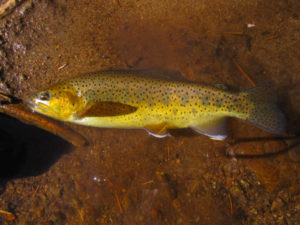
Male Apache Trout


After being stripped of its milt (fish semen) a male Apache trout swims among biologists in waders. The trout at Williams Creek National Fish Hatchery are farm raised, and spawned yearly.

For the uninitiated, Arizona may seem an unlikely fishing destination. When conjuring images of Arizona, the Grand Canyon and Saguaro cacti come to mind, not so much cold water brooks in alpine climes. However, as is the case with most things, Arizona isn’t so black and white. This state is home to many fishes. There is, in fact, one species here that can’t be found anywhere else in the world.

That is Arizona’s state fish: the Apache trout. Not normally occurring in large bodies of water, the Apache trout is native to the small, cool streams around the White Mountains of eastern Arizona. This species faced extinction due to competition from non-native trout, which were introduced for recreation.

Listed under the Endangered Species Act of 1973, the Apache trout is among those first species to gain federal protection. In 2000, the species was down-listed to threatened, opening the door to recreation. U.S. Fish and Wildlife Service Southwest Region fish biologists continue the work to restore this unique creature to its original habitat and to supply trout for recreation, as explains Zachary Jackson, the project coordinator and supervisory fish biologist for the Whiteriver station of the Service’s Arizona Fish and Wildlife Conservation Office.

“Several Service programs come together to further Apache trout conservation. The Ecological Services program works on threatened and endangered species issues. The Arizona Fish and Wildlife Conservation Office works to implement recovery actions working closely with our partners. The hatchery program also plays a role in sport fish production for Apache trout as well as producing an Apache trout stock that could be used for recovery purposes.

“Over the course of time, there were a number of threats to Apache trout. Maybe most significant there was probably some overfishing. They were very popular. Sport fish introduced into their range really constricted them to the headwaters of their native range. Those non-native trouts introduced for improved sport fishing opportunities have a few different interactions with Apache trout that negatively affect them.”

The Apache trout has very much become an underdog in it’s own neighborhood. Rainbow and brook trout were brought in: compete with Apache trout for food and space and interbreed with them. Complicating recovery further, rainbow, brook, and brown trout remain favorites for many recreational anglers. It can be difficult to convince outdoorsmen to give up a large game fish for a smaller trout that is listed as threatened.

“There’s hybridization that occurs that dilutes the Apache trout gene pool. There’s competition for food and space with Apache trout and that reduces their ability to increase in abundance and be robust, and then there’s direct predation by some of these non-native trout.”

With a coalition between federal, state, and tribal partners, recovery and conservation is moving forward. Hatcheries exist to not only ensure a strong gene pool for recovery of the trout, but also here at Williams Creek, fish are bred for the sole purpose of recreation.

Part of the recovery process involves removing the non-native trout from designated Apache trout habitat. A common way biologist remove unwanted species is through electrofishing, using voltage that attracts and temporarily stuns fish. They’re also using new technology to learn where to find those fish they need to remove.

“We’re coupling traditional or well-established fisheries techniques like barrier construction and maintenance to keep non-natives out of prime Apache trout habitat, and non-native removals using backpack electrofishing, with newer technologies like eDNA sampling.

“Environmental DNA sampling is a technique where we can collect a sample of water and filter out from that particles from tissue of different living organisms, and we can use DNA detections from specific location to target what we’re looking for. The way we use it is we look for non-native DNA in the water. And we take systematic sampling along a stream course that allows us to tell where brown trout are in a system and we usually don’t employ it until we think we’ve gotten the brown trout population really low. It allows us to find those few remaining individuals and target them for removal.”

While brown and rainbow trout are common game fishing staples throughout much of the U.S., Apache trout offer new opportunities for anglers the world over, who will come from far and wide to catch a fish that’s found only in the White Mountains of Arizona.

“Apache trout are important to the economy because there are a lot of folks who put a high value on capturing them, and so it brings in a lot of tourist dollars to the area which is very important for the White Mountain Apache Tribe. It also brings in tourist dollars to the surrounding area.”

“I think native trout enthusiasts are particularly interested in Apache trout because they’re very rare. They put the same value on them that we would put on diamonds, which are also extremely rare and beautiful.”

While the U.S. Fish and Wildlife Service is charged with recovering threatened and endangered species, and helping to provide recreational fishing opportunities is important to further conservation efforts, the Service’s role is very much a supportive one in the case of this unique trout.

“It’s critical for us to have a good strong relationship with the White Mountain Apache Tribe. They were the first stewards of Apache trout. They have been leading the conservation efforts since the beginning and our place here is in a supportive role. In everything thing that we do we’re coordinating very closely with them. With how and where we implement recovery actions we’re working with the tribe to constantly evaluate our wild populations and focus efforts where new threats arise. And without that partnership we wouldn’t be able to save the species.”

Williams Creek [NFH] hasn’t always been for the benefit of the Apache trout. Originally this hatchery was built to produce game trout for the tribe in the 1930s. The first year of operation attempted but failed to make Apache trout. It wasn’t until the 1980s that biologists were successful at breeding Apache trout at the hatchery.

Technology used at this hatchery is on the cutting edge. Williams Creek Fish Biologist Russell Wood explains some techniques they use to further the recovery of this fish.

“Apache trout are difficult to raise. They’re slower growing than the other species of trout due to a slower metabolism. They’re more susceptible to diseases which can make them difficult to raise.”

Today the hatchery staff manually spawned the trout. This process isn’t normally harmful for the fish, and they spawn yearly. An important part of keeping captive Apache trout is checking the ovarian fluid to check for disease. That comes out with the eggs. The males are also stripped of their sperm, which is called milt. The hatchery uses state-of-the art techniques to emulate a habitat that’s safe from predators and free of disease.

“This morning we were spawning Apache trout for production. Yesterday we sorted the female four-year-old Apache trout for ripeness. We had over a hundred ripe fish, so this morning we got in and we essentially knocked the fish out with a drug to make it safe to handle. Her eggs are hand stripped into a colander to drain the ovarian fluid off. They are then put into a bowl and the males are stripped of their milt for fertilization. And the eggs are water hardened for one hour, and then put away into the incubation stacks to incubate.”

The eggs and milt mix for a while, and then go on to become something greater than the sum of their parts: new Apache trout embryos. The hatchery is also using some newer techniques. They’re harvesting milt from wild Apache trout, and preserving in low temperatures, to enhance the stock that’s bred primarily for recreational fishing.

“This year for the first time we’re trying to introduced wild genetic material from the wild back into our hatchery population. Last year we went up into the mountains in the spring and spawned wild males, and we cryo preserved their milt. It’s a technology that’s been used for a lot of years in the livestock industry with cattle and horses. The milt was mixed with an extender and sucked up into small straws and essentially frozen on liquid nitrogen at minus 300 degrees fahrenheit. This fall we had the cryopreserved milt shipped back to us, and we’ve started utilizing it in our broodstock production by thawing this milt and fertilizing fish eggs with it in order to bring the wild genetics back into our population.”

Since Apache trout were so close to extinction, the gene pool is very limited. It’s difficult to match fish that aren’t closely related, and interbreeding makes the fish more susceptible to disease. To ensure healthy genetic pairing, they identify gene types and tag the fish with something similar to the electronic “PIT” tag that many people get for their pets, something about the size of a long grain of rice, that’s implanted under the skin.The Service has a sort of matchmaking service for Apache trout in Dexter, New Mexico.

“The genetics lab at the Southwestern Native Aquatic Resource and Recovery Center, their geneticists did a matrix for us. We took 50 of our females with passive integrated transponders (tags that have a 10 digit number similar to a social security number) and a fin clip and they did genetic work to match males to females that were not related, and some of our fish we are spawning this year for our brood stock replacement. We are utilizing this matrix which is mating a specific male to a specific female that are the most unrelated that we have for the purpose of the greatest genetic diversity to avoid inbreeding and breeding fish that are closely related to each other.”

While restoring a genetically robust Apache trout to its original habitat is the long-term goal of the Service, Russell Wood agrees that this fish is important for the local tribe and for anglers. And the fish could also become more popular with cooks and people who enjoy eating fish.

“The biggest importance to the tribe is people travel long distances just to catch an Apache trout, because they’re only found here. So it’s a revenue for the tribe to have people from out of state or out of town travel here spend money here to catch a fish they can only catch here. I need to eat one because I heard they’re delicious.”

“When we stock those fish in the Christmas Tree Lake here on the Reservation, the Tribe runs what’s called Trout Camp which is like a luxury camping trip with nice tents, catered by home cooked food and people pay money to spend a weekend fishing for these large Apache trout in Christmas Tree Lake and get taken care of by fishing guides and cooks.”

Russell has some tips for prospective Apache trout anglers.

“Catching Apache trout is going to be like catching any trout, and if you’re a fly fisherman use any of the flies that we have here. As for bait fisherman a good thing to use is a white powerbait. Use a small hook and very little weight and just let it drift in the current. When you see the white powerbait disappear it’s a fish’s mouth, and set the hook.

“Their native habitat is very small streams, high mountain streams that are crystal clear, cold, have lots of riffles, runs, and rapids. Some of them are not very wide. You can jump across them. It’s very pretty.”

Bradley Clarkson is a supervisory fish biologist at Williams Creek [NFH]. As both a U.S. Fish and Wildlife Service employee and a member of the White Mountain Apache Tribe, Bradley has a unique perspective in the conservation of the trout. He says the Apache people are proud to have this trout named for them.

“The Apache people in general, they like that. It represents them as an Apache tribal members. And they’re the ones that are protecting the land, so now at least we have 13 or 14 strains of this trout.”

Bradley says that the conservation of the Apache trout goes back centuries, to the time of Geronimo, who was a prominent leader of the Apache (Chiricahua) from the mid-19th to the early 20th century, and enforced conservation during the time of westward expansion.

“I think Geronimo too had something to do with that as well. He would keep people away, even us White Mountain Apache kept our distance, when he was around we were afraid of him as well. My grandmother mentioned one time, her mom said when Geronimo is coming they would want to go higher up in the mountains.

“They feared him. If we feared him I’m pretty sure other folks feared him more that’s how I believe he protected the land and the natural resources. The White Mountain Apache Tribe as well, when the trout became endangered, they made it a wilderness area where you can’t even take in a slingshot, much less a fishing pole without getting cited.”

There’s also a measured return in investment in the important conservation work that the Service and the Tribe do in working together to restore the trout.

“For every dollar gets put into to the hatchery, the nearby communities get $19 back. And the future looks good because right now as the staff here at Williams Creek we finally got to where we can go out into the White Mountains, and the tribe give us permission to go in there and collect wild genetics to bring back and put in our brood stock. We’re not going to see it the change this year, but maybe two or three years down the road because we are finally getting our genetics put back into our spawning.”

For Bradley, a major aspect of this work is passing the torch to future generations.

“When my supervisors send me to the Native American meetings with other tribes I suggest to bring some expertise to the hatchery and some training for our youth. The most important skill for them to learn is cryopreservation, because that’s what we’re doing. Maybe some of our Apache tribal members can learn to do in the field, and they could pick it up and introduce it to the hatchery education program at the school.

“That’s one of our goals, we’ve been trying to recruit Apache tribal members by going and tapping into their high school and going to their instructors and biology teachers and asking and looking for the best candidate? Who has the potential?’ That’s how I get help, by finding who are good students to pick from. We only have so many spots here, but we can interview them and get them ready, and find out who’s really going into this field.

“Because I’d really like to see some Apache tribal member continue the hatchery work and from where I’m at right now and be dedicated and have a passion for the Apache trout program.

“That’s the reason why I’m still here 25 years later, because I really like to contribute to the Apache trout program, and when I’m done I’d like to say to the Apache people ‘Hey I’m done now. Your turn. This is as far as I can go. Now I go rest, and maybe go fishing.”

-30-

Information about White Mountain Apache Tribe’s Trout Camp: https://www.wmatoutdoor.org/

Video – Watch Williams Creek Fish Biologist spawn Apache trout – https://www.facebook.com/USFWSSouthwest/videos/2094681363915423/

All photos by Al Barrus
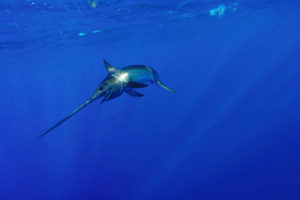
Sauger on Arkansas River

Biologists Track Sauger on Arkansas River
Randy Zellers, Assistant Chief of Communications, Arkansas Game and Fish Commission
from the Fishing Wire

RUSSELLVILLE — Researchers at Arkansas Tech University are working with the Arkansas Game and Fish Commission to learn more about the habits of sauger swimming in the Arkansas River.

If you just had a curious look on your face after reading the word “sauger,” you’re probably not alone.

The sauger is a species of fish that is a cousin of the walleye, which is known for its fantastic flavor. While sauger and walleye have followings as large as crappie and bass angling up North and in the Midwest, they are pursued by a relatively small group of anglers in the southern states they inhabit. The Arkansas River holds the largest population of sauger in the state, but few anglers know much about the species.

“I occasionally get photos from anglers asking what the fish was that a person caught in the river while fishing for crappie and bass,” says Frank Leone, fisheries supervisor at the AGFC’s Russellville regional office. “Most of the time, people will ask if it’s a snakehead, and I have to explain to them that it’s not only a native fish, but a good one at that.”

The comparison may be a fair assessment to people who have seen neither but only heard descriptions of the invasive snakehead. Both have a mottled brown and bronze coloration and both have teeth, but that’s where the similarity stops. Sauger are much more streamlined than snakeheads, have peg-like teeth instead of the snakehead’s sharper triangular teeth.

Perhaps the reason for the lack of the species’ popularity comes from the relatively short window when anglers are truly able to pursue them. Each winter, sauger move upstream in the Arkansas River to find rocky, shallow areas to spawn. The many dams along the river that keep navigation open for commercial and recreational traffic hinder their progress, forcing most to congregate and spawn along the rocks just below each lock and dam. Grizzled old-school anglers have learned this pattern, and will walk to these riprap-covered areas to cast crappie jigs, minnows and other offerings when the current is right to collect some sauger for a midwinter fish fry. But outside of the spawning cycle, no one really knows what happens to these mysterious fish on the Arkansas River.

That’s where Arkansas Tech Graduate Student Peter Leonard comes in. He has been working under John Jackson, Ph.D, head of the Department of Biological Sciences and professor of Fisheries Science at Arkansas Tech University to track Arkansas River sauger throughout the seasons to learn more about the species. Leonard has worked with Leone on two studies concerning the species to help fill in the voids regarding the species’ use of habitat throughout the year and angling effort directed at sauger.

“The exploitation study was conducted using tags on fish collected during the spawning run of 2017,” Leonard said. “We caught sauger when they were concentrated, placed reward tags on the fish and released them. Anglers who caught the fish later could call the phone number on the tag and receive a cash prize for their catch.”

Leone says tag/recapture studies are used fairly often in fisheries work to determine how many fish anglers catch and keep from a population.

“If you have a certain amount of tags on fish, and anglers turn in a certain percentage, then you can use that to figure the rate of fish being caught,” Leone said. “While they are on the phone, we ask a few questions about where it was caught, if they kept the fish and if they were targeting that species, in particular, to give us a better picture of what’s going on out on the water.”

According to Leonard, 340 tagged fish were released below the dam that separates Lake Dardanelle and Pool 9 of the Arkansas River and below Ozark dam at the upper end of Lake Dardanelle early last spring.

“We have had very few tag returns so far, telling us that the exploitation rate for sauger last year was very low,” Leonard said.

Leone added that although the last two years saw high flows that could have disrupted angling effort, the results of the tag returns reinforce much of the anecdotal evidence he has had over the years that recreational fishing pressure has very little impact on sauger populations in the river.

“Flow rates are just something you have to deal with any time you study an aspect of a river fishery,” Leone said. “It’s part of the natural world, so you have to be prepared for events that are outside of your control.”

One interesting finding during the tag returns was the extreme distance from the release point in which some anglers found tagged fish.

“Most of our tag returns have come from below Barling dam above the next pool upstream from Dardanelle,” Leonard said. “In some cases the fish moved through two lock and dam systems to get to that destination.”

The second part of Leonard’s research reinforced some of those findings. In addition to fish with reward tags, researchers implanted special acoustic transmitters into sauger caught below Ozark dam and tracked the signals throughout the year to keep an eye on where the fish spent their time outside of the spawn.

“You rarely hear about people targeting sauger, but never hear about it any time other than winter,” Leone said. “So we wanted to learn where these fish went during the rest of the year to see if there were any habitats they relied on that we needed to keep in mind for conservation work.”

The telemetry equipment used in the research is very similar to sonar, but keys in on a specific frequency unique to each transmitter.

“We tracked individual fish as they moved around in the system,” Leonard said. “Most would stay within about 15 miles of where they were released, but a few travelled more than 100 miles upstream during the course of the year.”

Leone and Leonard agreed that, for the most part, sauger remained in the open river habitat, relying on current breaks in deeper, fast-moving sections when they are not concentrated for the spawn, which explains why few anglers find them outside of that window.

“Bass, crappie and other species most anglers are targeting will move to areas out of the current, so most of our anglers aren’t fishing where the sauger live long enough to have an appreciable catch rate.”

Leonard still has some data to compile for the study, and hopes to complete his thesis work on the project soon.

“We will go back and analyze the findings to determine fine-scale habitat types to recreate and protect once the study is complete and has been reviewed,” Leone said.

Oregon Coastal Habitat Project Restores Coho

Oregon Coastal Habitat Project Restores Coho and Reduces Flooding
from The Fishing Wire

Juvenile coho salmon use estuaries

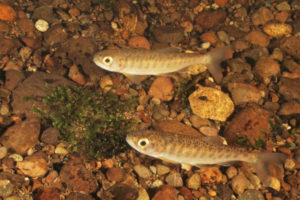
Juvenile coho salmon use estuaries to eat and grow before migrating to the ocean. Photo: USFWS/Roger Tabor
From NOAA Fisheries

The Southern Flow Corridor project, which restored salmon habitat in Tillamook, Oregon, also provides flood protection for surrounding communities.

NOAA’s work with community partners restoring estuary habitat in Tillamook Bay, Oregon is revitalizing tidal wetlands for threatened Oregon Coast coho salmon, and helping reduce flooding in the surrounding communities and farmlands.

The project’s benefits to fish were realized immediately—443 acres of different estuary habitats critical to juvenile salmon are now available, including mud flats, open water with vegetation, marsh and others. Often called “nurseries of the sea,” estuaries offer unique conditions, like slow moving water and tides that bring in nutrients, which keep fish safe and allow them to grow.

A recently published report also confirms the project’s flood reduction goals were achieved. Shortly after project completion, in October 2017, a flood occurred at the site. Our restoration work resulted in widespread reduction in flood levels and duration including along Highway 101, a key commercial and transportation corridor. In total, about 4,800 acres around the project site showed reductions in flood levels.

This project, like many others we work on, shows how restoring habitat back to its natural functions can help coastal communities be more resilient against severe weather. Nature-based approaches are being shown to provide these, and many other economic benefits, along both the the east and west coasts of the United States.

Almost 90 percent of the Tillamook Estuary’s historic tidal wetlands have been lost to development and agriculture. Like many other species relying on estuary and wetland habitats, loss of these areas is a primary contributor to the decline of Oregon Coast coho salmon.

Additionally, Oregon’s winters bring storm surges, heavy rainfall, and snow melt. Combined with high tides, this often causes flooding in the area. Flood losses in Tillamook County exceeded $60 million from 1996 – 2000.

To achieve the mutually beneficial project goals, old levees, fill, and tide gates were removed to create tidal estuary habitat. This functions as a “flow corridor,” allowing flood waters to move freely and quickly away from the town of Tillamook. Now, nearby properties and more than 500 structures are protected from flooding. It’s estimated that $9.2 million in economic benefits will accrue from avoided flood damages over the next 50 years.

The project reconnected hundreds of acres of marsh habitat and restored 13 miles of new tidal channels. This will significantly benefit Endangered Species Act-listed Oregon Coast coho salmon. Historically, more than 200,000 of these salmon would return to Tillamook Bay each year. That number was down to just 2,000 in 2012. This habitat is critical for juvenile salmon to feed and grow, and will help with the broader goal of species recovery along Oregon’s entire coast.

The Southern Flow Corridor Project is the result of tremendous community support and collaboration. NOAA Fisheries’ Restoration Center, within the Office of Habitat Conservation, and the West Coast Regional Office, worked with more than a dozen local, state, federal, tribal and private partners on this effort.

Key partners include the Port of Tillamook Bay, Tillamook Bay Habitat and Estuary Improvement District, Tillamook County, the State of Oregon, FEMA, U.S. Fish and Wildlife Service, the Institute for Applied Ecology, and the Tillamook Estuaries Partnership. We provided funding for the project through the Community-based Restoration Program and the Pacific Coastal Salmon Recovery Fund, and on-the-ground technical assistance.

Read more about NOAA Fisheries projects here:

Protect Sawfish

Sawfish Need a Hand from Anglers, Boaters and Waterfront Homeowners
by Tonya Wiley, Havenworth Coastal Conservation
from The Fishing Wire

Tangled Sawtooth needs help


Entanglement of marine species in lines, fishing gear, and other debris is a problem seen with unfortunate regularity in the southeastern United States. This includes Endangered Species Act-listed species such as North Atlantic right whales, giant manta rays, sturgeon, turtles, and smalltooth sawfish. Each species is susceptible to entanglement based on their physical attributes but none more so than sawfish.

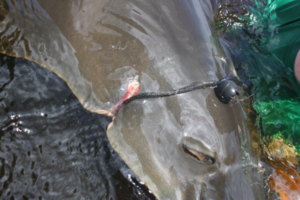
The toothed rostrum of the smalltooth sawfish could be considered one of the most unique morphological traits in any species. Yet this feature has also directly led to the species’ decline. Sawfish are rays that generally swim along the sediment surface where marine debris can accumulate. The toothy rostrum is easily entangled in any debris the sawfish encounters, which can lead to injury, deformation, or death by suffocation or starvation. Sawfish entangled in a variety of man-made items including dock lines, trap lines, nets (gill nets, cast nets, trawls, etc.), fishing lines, pvc pipes, coffee cans, dog toys, and elastic bands have been reported. While strides have been made in recent years to raise awareness about sawfish entanglement, this threat continues to affect the species.

Historically, a number of commercial fisheries incidentally captured smalltooth sawfish in the southeastern United States, though none more prominent than inshore gillnet fisheries. Because juvenile sawfish rely on shallow inshore waters as nursery habitat, gillnet fisheries for mullet in these same areas resulted in extensive incidental capture of sawfish. Once entangled, the toothed rostrum was difficult to remove from nets so often these fish were simply killed as bycatch. The 1995 gillnet ban in the state waters of Florida has been instrumental in reducing the number of sawfish killed by this gear. However, illegal use of gillnets still results in mortality of sawfish.

Recently two sawfish entanglements have been highlighted on social media. In late 2018, the National Park Service reported a sawfish entanglement in Biscayne Bay National Park (see https://www.fisheries.noaa.gov/feature-story/saving-endangered-sawfish). In this instance a sawfish was trailing lines from a lobster pot. Excessive entanglement can affect mobility, feeding, and thus overall fitness. If unattended, these entangled animals are likely to perish. Fortunately, park rangers were able to secure the lines, and remove them from the sawfish.

In a separate event, the National Park Service responded to a tip that an illegal gillnet was found in the waters of Everglades National Park near Chokoloskee, Florida. Upon retrieval of the net, law enforcement discovered a dead sawfish. This example illustrates just how deadly these nets can be to this endangered species. Law enforcement is still investigating this case and has requested that anyone with information to please contact 305-242-7741.

It is a shared responsibility of all outdoor enthusiasts to keep our waters free of trash and debris, which could result in entanglement. Next time you’re out on the water, do your part to pick up any trash or debris and if you ever encounter a sawfish please let us know by calling 1-844-4SAWFISH.

Tonya Wiley, President
Tonya@havenworth.org
941-201-2685
www.havenworth.org

Tax-deductible donations to help us continue our mission to promote the sustainable use and conservation of marine resources through research, outreach, and education can be made at https://www.oceanfdn.org/donate/havenworth-coastal-conservation

New Fisheries Management Plan for Greers Ferry

New Fisheries Management Plan for Greers Ferry Includes Angler Input
By Randy Zellers
Assistant Chief of Communications
from the Fishing Wire

HEBER SPRINGS — The Arkansas Game and Fish Commission has completed its new fishery management plan for Greers Ferry Lake thanks in part to the input of anglers through recent public meetings and surveys. The plan addresses steps the AGFC will take to improve the fishing experience for all anglers on this popular body of water during the next five years.

According to Matt Schroeder, regional fisheries biologist at the AGFC’s Mayflower Regional Office, there are many aspects of a fishery beyond the control and capability of the AGFC to manipulate. There are, however, some factors the AGFC can address to try to improve the fishery for anglers.

“The lake is owned and operated by the (U.S. Army) Corps of Engineers and its primary purpose is flood control, mandated by The Flood Control Act of 1938,” Schroeder said. “We have talked with them many times about changes to water management for fishery health, but they have to follow the plans handed to them for flood control as their primary purpose. That being said, they work within their mandate as much as they can to help recreation, and Greers is in the top 10 reservoirs in the country for recreational boating.”

Helping Habitat
Because of its primary purpose in flood control, the lake’s water level cannot be manipulated to promote the fishery by flooding shoreline cover during the spawn and lowering it after young-of-the-year fish have grown larger to establish next year’s shoreline vegetation. But that doesn’t mean biologists cannot do anything to improve the lake’s fish habitat.

“Since water level manipulation and seasonal flooding is out of our control, we can work to add as much habitat as we can in the aging reservoir to benefit both fish and anglers,” Schroeder said. “We already have conducted large-scale habitat projects on the lake to give different species year-round options for cover and likely areas for anglers to locate predatory fish such as largemouth bass and crappie. Our new plan will continue with these large-scale habitat projects.”

The new fishery plan also will continue to focus on establishing native aquatic vegetation on Greers Ferry where possible. Aquatic vegetation in a reservoir can add an exceptional amount of spawning and nursery habitat for fish, but it is extremely difficult to establish in reservoirs with highly fluctuating water levels. Efforts to establish aquatic plants in Greers Ferry, Bull Shoals, Greeson, and elsewhere have been largely unsuccessful so far because of massive annual water level changes, but biologists have not given up and are always looking for a better way. AGFC biologists meet regularly with biologists from surrounding states to discuss strategies that have worked elsewhere, but there are few examples of success in highland lakes.

“We will continue to identify suitable native plant species that will benefit the fishery without overtaking it,” Schroeder said. “Once those have been selected, we will conduct plantings of one or more of these species at different locations and depths and evaluate its effect on the fishery before adapting planting strategies for future establishment.”

Fish Food
A tried-and-true program initiated by AGFC biologists at Greers Ferry in the last few years is boosting the forage population of the lake through stockings of threadfin shad. The shad are stocked directly from hatchery trucks and from the lake’s nursery pond located at Mill Creek. Forage species stocked in Greers Ferry before this period consisted primarily of bluegill, which also serve as sport fish. In 2015, fisheries biologists evaluated the forage base and discovered that the lake’s threadfin shad population was depleted. Extremely harsh winters and an abundance of predatory fish likely had taken their toll.

Biologists immediately made plans to stock a crop of bluegill through the nursery and began researching the possibility of stocking threadfin shad the following year. In 2016, 36,500 adult-size and 563,856 fingerling-size threadfin shad were stocked into Greers Ferry. This was followed by an additional 10,000 adults and 1 million fingerlings stocked in 2017 to boost the population. Pre-spawn adult shad were stocked in the nursery pond and allowed to spawn. The shad were even more prolific than expected, and fingerling production was excellent.

“The new plan lays out the need for more focus on forage, calling for more threadfin shad stockings each spring and fall in all parts of the lake,” Schroeder said. “When shad are not available, we will shift to other forage species, such as fathead minnows and bluegill. We also have plans to try some new crayfish stockings once we do enough research to see if we can culture species native to Greers Ferry.”

Schroeder says many anglers present at the focus groups asked for increased stockings of sport fish, such as largemouth and smallmouth bass in addition to the forage, but the lake’s current situation is a lack of food, not predators.

“We would just be adding more mouths to feed into a fishery that already is pretty infertile,” Schroeder said. “And although Florida bass fingerlings have been stocked in the lake in the past, the lake has shown very poor characteristics for those genetics to thrive.”

Halting Hybrids
One management practice that has seen controversy over the last decade is the stocking of hybrid striped bass at Greers Ferry. A manmade cross between the native white bass and the non-native striped bass, the hybrid is a much-sought gamefish in some states and has seen popularity with Arkansas anglers at times. However, during recent creel surveys conducted at the lake, only 4 percent of anglers on Greers were targeting white bass or hybrids. Additionally, a follow-up mail-in survey of willing Greers Ferry creel survey participants conducted by AGFC biologists found that anglers opposed their stocking overall.

Ben Batten, chief of the AGFC’s Fisheries Division, says recent research also suggests hybrids at Greers Ferry could have adverse effects on forage at the rate they currently occur. Of particular interest is the hybrid’s ability to switch forage on Greers Ferry in the absence of open water shad populations.

“When shad populations decline, striped bass will suffer because they don’t readily adapt to different forage and habitat. This helps keep striped bass in check if the shad get scarce,” Batten said. “But recent studies have indicated hybrids may take after their white bass parents and switch to crayfish and other forage that bass, walleye and other gamefish use.”

The last time hybrid striped bass were stocked at Greers Ferry was in 2014. With the lack of angler interest and the concerns over the lake’s forage base, no more hybrids will be stocked for the foreseeable future.

One Foot Across the Black Bass Board
Bass anglers also will note the possibility of a regulation change regarding minimum length limits on largemouth, smallmouth and spotted bass derived from the meetings.

“In 2020, we will propose a straight 12-inch minimum length limit for all three black bass species in Greers Ferry that will be effective in 2021 if it passes Commission approval,” Schroeder said. “There’s currently a 15-inch minimum length limit on largemouth, but recent research has shown no biological need for it to be so high.”

Schroeder explains that minimum length limits are placed on lakes when there is an issue with poor or inconsistent recruitment or when the species sees high mortality rates from harvest. It also requires a good growth rate for fish to move up into harvestable size quickly enough that they don’t overpopulate.

“Recent research suggests that it takes four-and-a-half years for a largemouth to grow beyond the 15-inch minimum length limit, and that the annual rate of mortality from natural and catch-and-release angling combined only reaches 30 percent of the population in a given year,” Schroeder said. “And our game fish species are currently at or above the carrying capacity that the lake can support, so we need to increase harvest of some fish to enable faster growth rates.”

Schroeder says adding the minimum length limit on spotted bass was part of the AGFC’s current goal of keeping regulations simple. A standard 12-inch length limit will be easier for anglers to remember and won’t penalize any tournament anglers looking to bring fish to the weigh-in.

“No matter which species, if it’s a black bass it will have to be 12 inches long to keep if the regulation passes next year,” Schroeder said. “Anglers won’t have to worry about trying to identify a spotted bass from a largemouth.”

Helping Hands
The good turnout at both Greers Ferry public meetings as well as at the recent town hall meeting with Commissioners gives biologists and administrators hope a new resource can be used more effectively in the future — the anglers themselves. Many focus group attendees said they would be willing to volunteer their time to participate in future habitat projects and other initiatives to help the lake’s fishery. Schroeder says habitat projects are an ideal way anglers can contribute to be a part of the solution, and the amount of habitat that can be added can be greatly enhanced.

“Moving forward, we will try to reach out through media outlets and create a volunteer distribution list for help,” Schroeder said. “We’re anglers too, that’s why we wanted to be fisheries biologists in the first place. I think there are a lot of areas where we can all work together to help the Greers Ferry fishery.”

The complete Greers Ferry Fishery Management Plan and management plans for other lakes in the state are available at www.agfc.com/fishmanagement.

Juvenile Tarpon Habitat

Juvenile Tarpon Habitat Connectivity

By JoEllen Wilson
BTT Juvenile Tarpon Habitat Program Manager
from The Fishing Wire

Checking Juvenile Tarpon Habitat

photo:_JoEllen Wilson
Tarpon can undertake migrations that seasonally connect large geographic areas. But there’s another way that tarpon throughout the southeastern US, Gulf of Mexico, and Caribbean Sea are connected: larval mixing. In the spring or summer (depending on location), adult tarpon form large aggregations before they move offshore to spawn. Tarpon spawn by releasing the sperm and eggs into open water. The eggs fertilize outside the body—that’s where the mixing comes in. The larvae are transported by the currents and dispersed down the coastlines. Some larvae are able to find available habitat, but due to the massive amounts of coastal development, some are not.

When larvae survive and find viable habitat, they transform into juveniles. Juvenile tarpon inhabit coastal back bays and estuarine creeks that typically have calm waters, low dissolved oxygen, vegetative structure, and a mixture of deep and shallow water. Through BTT’s Juvenile Tarpon Habitat Mapping Project, we’ve found that 86% of reported nursery habitats have been degraded through coastal development, altered freshwater flows, or excess nutrients and contaminants entering the system. BTT studies show that juveniles in these types of habitats exhibit slow growth and move into the estuary at small sizes, which means their chance for survival is low. Tarpon are a long-lived species and reach maturity at about 10 years old. This means that by the time we see a decline in the number of adults resulting from too few juveniles surviving degraded habitats, it will be far too late to save the species.

Think of it this way: a Texas-born female and a male form South Carolina meet up in Boca Grande to spawn. Their larvae get carried inshore and end up in an estuarine creek in Tampa Bay, FL. Likewise, when that Tampa Bay juvenile becomes an adult, it can spawn in the Florida Keys and a tropical storm could transport its larvae to a Louisiana bayou. All of these habitats are connected and if we want to conserve our tarpon fishery, we must conserve nursery habitat. Anglers need to be concerned not only about what’s going on in their backyards, but also across the region.

Habitat loss is crippling nursery habitats throughout the geographic range of tarpon and our only options now are to protect what is left and restore what we can. Unfortunately, fisheries resource managers currently do not incorporate habitat into management plans. For a species like tarpon that is predominately catch and release, changing slot limits and seasonal closures won’t fix the problem of population decline. Anglers must be the voice for habitat. It is our duty to advocate for habitat protection by contacting our fisheries managers and legislators. We must also conserve habitat ourselves by being conscious of the pollutants that we put into our watersheds (fertilizers and litter), and not destroying shallow areas (seagrass beds and sand flats) when running our boats. These habitats and our fisheries are all connected and by banning together to conserve these critical habitats, we can conserve the fishery for generations to come.

Bald Eagles

When you see a bald eagle soaring overhead, floating on the air like it is weightless, you can see why it is a symbol of our nation. The bald eagle is an impressive bird, looking strong and in charge of everything in its world. The dark brown body and stark white head contrast vividly against the sky that holds it.

I will never forget the first time I saw a bald eagle. I was fishing at Lake Oconee and followed it for about 15 minutes as it soared over Double Branches. Several other boats stopped and also idled along, watching it as it hunted for fish in the lake.

While I was growing up there were no bald eagles in the east Georgia area around McDuffie County. I spotted a few like the one at Oconee while fishing area lakes in the late 1980s and they have gotten more numerous since then.

During the 1970s there were no active bald eagle nests in Georgia, according to the Georgia Department of Natural Resources. They have made a gradual comeback since 1979 when the DNR started “hacking” or releasing young captive birds on the coastal islands of Georgia. They have spread to the extent that last year nests were found in 35 different counties in the state.

During the 2003/04 nesting season the DNR found a total of 84 occupied eagle territories across Georgia and there were 67 successful nests in them. Those nests produced a total of 104 young eagles. That is an increase of 4 successful nests and 7 more young eagles than the year before.

Bald eagles are some of our biggest birds, reaching a huge size. They can be 40 inches tall and have a wingspread of 7.5 feet. They probably mate for life and produce only one or two young each year.

Eagle nests are amazing. They are usually built in tall dead trees on or near the water and eagles will use them year after year. Some eagle nests are huge, getting up to 5 feet wide, 12 feet tall and weigh up to 1000 pounds. They are made out of sticks and really stand out in a tree out on the lake.

Although eagles will eat waterfowl and carrion, their main food is fish they catch out of lakes, rivers and the ocean. It is amazing to watch one soar high about the water and suddenly swoop down with talons outstretched, plucking a fish out of the surface of the water. It is surprising how big a fish the eagle can grab and fly away with, heading to a perch to eat it at its leisure.

The most eagles I have ever seen at one time as on a trip to Pamlico Sound on the coast of North Carolina. We went into a big swampy area off a river and there were a lot of dead trees standing in it. Almost every tree had a eagle nest in it. There were probably 20 nests with pairs of eagles flying around, catching fish and taking them to their young.

Ospreys are often mistaken for eagles. They live in the same areas, build similar nests and fish for food. Ospreys are smaller than eagles and are lighter in color. They breasts are speckle white and brown, unlike the dark brown breast of eagles. They are more common that eagles and you are more likely to see them on area lakes. If you are looking at a big bird from below it, and it has a light colored breast, it is an osprey, not an eagle.

Eagles face a new threat. Last year several dead eagles were found around Clark’s Hill lake and it was determined they died from Avian Vacuolar Myelinopathy(AVM), a disease that attacks the nervous system of eagles and coots. Coots that are infected are sometimes eaten by eagles and they seem to get the disease from them. Not much is known about AVM and there is nothing that can be done about it at this time.

Eagles were sacred birds to Native Americans and there are a lot of myths and tall tales about eagles from our history. I hope their populations continue to grow and everyone has a chance to stand in awe as a bald eagle soars by.