Category Archives: Bass Fishing

Bass Fishing Information

FLW Cup On the Red River Starts This Week

Jacob Wheeler, winner of the 2012 FLW Cup

Jacob Wheeler, winner of the 2012 FLW Cup

Forrest Wood Cup Kicks off on Red River This Week
from The Fishing Wire

World’s best anglers eye prestigious title, $500,000 top prize

SHREVEPORT, La. – The Forrest Wood Cup, the world championship of bass fishing, will visit the Red River and Shreveport/Bossier City, La., Aug. 15-18 to crown bass fishing’s top angler of 2013. Hosted by the Shreveport/Bossier Sports Commission and LouisianaTravel.com, the tournament will feature 46 of the world’s best bass pros and co-anglers casting for the sport’s biggest award – $500,000 cash in the pro division and $50,000 cash in the co-angler division.

“Any time that you can win a half a million dollars for catching 20 bass, it’s pretty exciting,” said Walmart pro Mark Rose of West Memphis, Ark., who will be competing in his eighth Forrest Wood Cup. “It’s even more exciting knowing that it’s going to be a real tough tournament. If a guy can get two or three big bites over the course of those four days, that can make all of the difference in the world. Anything can happen.”

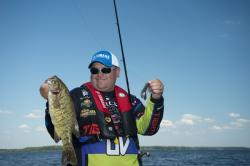
Walmart team pro Mark Rose of West Memphis, Ark., shows off his catch.Rose said that this tournament will be very different than the last time the FLW Tour visited the Red River, when John Cox of Debary, Fla., used an aluminum boat to access a backwater area via a seemingly impassible culvert.

“The last time that we visited the Red River, we were just coming off of a shad spawn and the fish were keying on those shad in the backwaters and the oxbows,” Rose said. “Now they’ll be more into their summertime patterns. The bass will be seeking out any shade that they can find. You’re going to see a lot of flipping in the hyacinth, lily pads and all of the wood cover that is available.”

Rose said that most of the tournament anglers would either be flipping, throwing topwater baits or shallow-water cranking. Anglers will have no shortage of areas to fish. Although they will launch each day out of Pool 5, Pools 4 and 3 are also viable options for many competitors.

“I think that 50 percent of the field will stay in Pool 5,” Rose continued. “Quite a few will lock down to Pool 4, and a few guys that are living on the edge will lock down to Pool 3. This tournament can be won on any of the three pools, though. We’re going to see a lot of nice 7- to 9-pound averages, but the winner will be the guy that can get over the hump a few days and get into the 13- or 14-pound class.”

Rose predicts that the winning angler will need to bring 50 pounds to the scales throughout the four tournament days to claim the title of Forrest Wood Cup Champion. The defending champion, 22-year-old Jacob Wheeler of Indianapolis, Ind., agrees with him and says that the Red River will produce despite the heat in the dog days of summer.

“I think that the winner is going to bring in a monster 16- or 17-pound bag on the first day and then back it up with solid 10- to 12-pound limits to win the tournament,” Wheeler said. “It really is like a chess match out there. There are so many different decisions and scenarios with the different pools and locks. I think somebody is going to have to utilize multiple pools in order to win the tournament.”

Wheeler became the youngest Forrest Wood Cup champion in history when he won last year at Lake Lanier in Duluth, Ga. Wheeler said that he is excited for another opportunity to make fishing history.

“The most exciting thing for me is having an opportunity to be the first angler to ever win two (championships),” Wheeler said. “Winning last year was just unbelievable and changed my life. To be the first angler to ever win twice would be a dream come true.

“Shreveport is really an optimal tournament site and will be a perfect host for the Forrest Wood Cup,” Wheeler went on to say. “The facilities are amazing. The Red River South Marina is great. There is plenty of parking for all of the anglers and fans. I can’t wait to get down there. It’s going to make for an amazing show and an awesome Forrest Wood Cup.”

Anglers will take off from Red River South Marina located at 250 Red River South Marina Road in Bossier City, La., at 7 a.m. each morning. Weigh-ins will be held at the CenturyLink Center located at 2000 CenturyLink Center Drive in Bossier City, La., beginning at 5 p.m. daily.

Fans will be treated to the FLW Expo at the Shreveport Convention Center located at 400 Caddo St. in Shreveport, La., on Friday, Saturday and Sunday from 10 a.m.-4:30 p.m. prior to the weigh-ins. The Expo includes Ranger boat simulators, the opportunity to interact with professional anglers, enjoy interactive games, activities and giveaways provided by sponsors, and fans can learn more about the sport of fishing and other outdoor activities. All activities are free and open to the public. On Saturday and Sunday, 500 free rods and reels will be given away each day to the first 500 children 14 years and under who are accompanied by an adult. The rod and reel giveaways are courtesy of 1130 AM The Tiger. Also on Sunday, one lucky fishing fan will win a Ranger Z520C with a Mercury outboard. The Ranger boat giveaway is courtesy of KSLA News 12 and is free to enter, but the winner must be present at the conclusion of Sunday’s final weigh-in to win.

Coverage of the Forrest Wood Cup, which is presented by Walmart, will be broadcast in high-definition (HD) on NBC when “FLW” airs Sept. 29 from 2:30-3:30 p.m. ET. The Emmy-nominated “FLW” television show is hosted by Jason Harper and is broadcast to more than 564 million households worldwide, making it the most widely distributed weekly outdoors-sports television show in the world.

For complete details and updated information visit FLWOutdoors.com. For regular updates, photos, tournament news and more, follow us on Facebook at Facebook.com/FLWFishing and on Twitter at Twitter.com/FLWFishing.

About FLW

FLW is the industry’s premier tournament-fishing organization, providing anglers of all skill levels the opportunity to compete for millions in prize money nationwide in 2013 over the course of 220 tournaments across five tournament circuits, four of which provide an avenue to the sport’s richest payday and most coveted championship trophy – the Forrest Wood Cup. FLW tournament fishing can be seen on the Emmy-nominated “FLW” television show and is broadcast to more than 564 million households worldwide, making it the most widely distributed weekly outdoors-sports television show in the world. FLW is committed to providing a lifestyle experience that is the “Best in Fishing, On and Off the Water.” For more information about FLW visit FLWOutdoors.com and look for FLW on Twitter, Facebook, Pinterest and YouTube.
Fishing Lay Lake with Chris Jackson

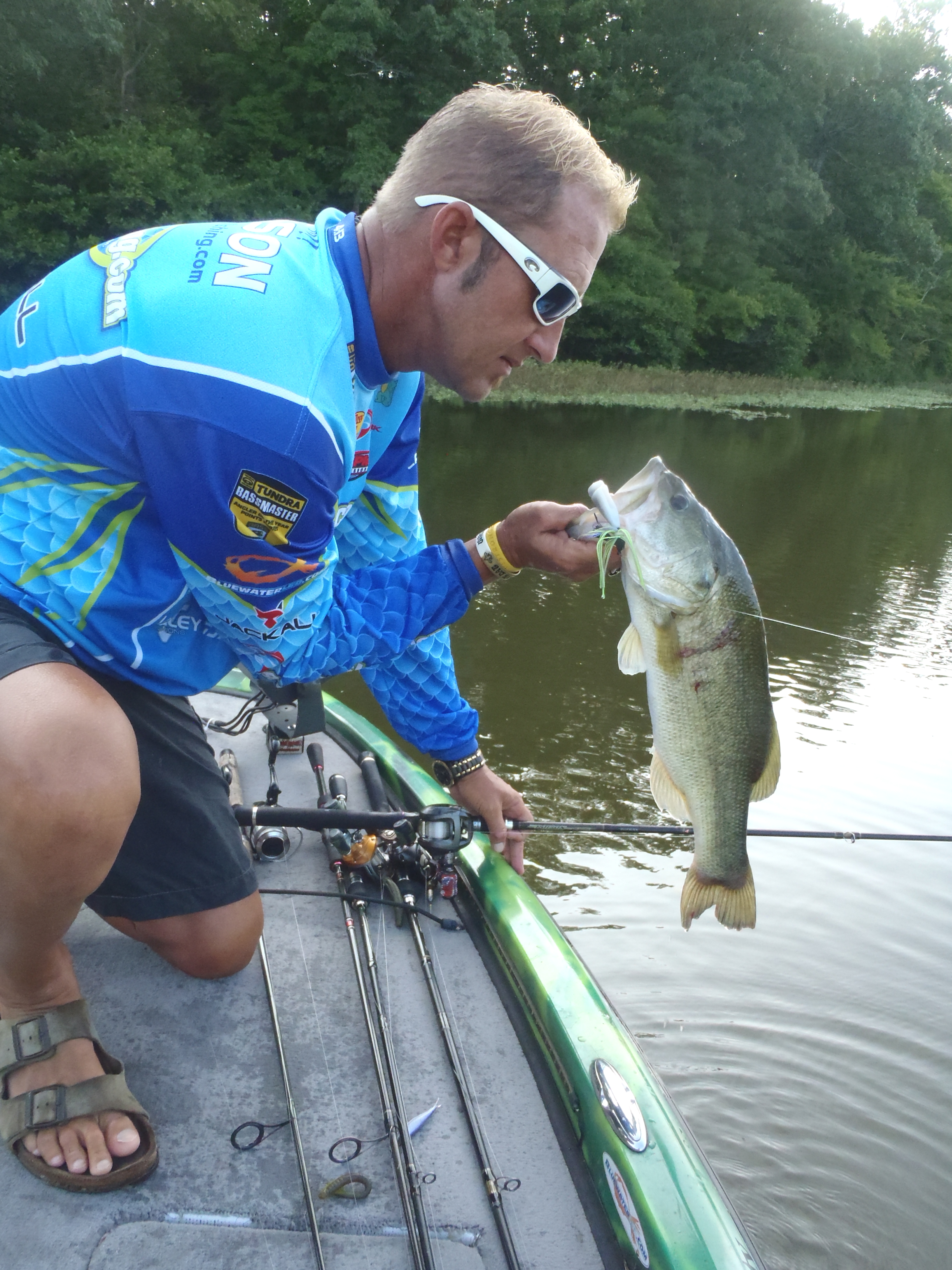
Gotta love those white Costa Del Mar sunglasses!

Gotta love those white Costa Del Mar sunglasses!

One morning last week I got up at 3:00 AM and drove four hours to Lay Lake to meet Chris Jackson to get information for an Alabama Outdoor News article. Chris guides on all the Tennessee River and Coosa River chain lakes and knows them well. He is also a professional bass fisherman and does well in many tournaments.

We started out fishing shallow grass beds with swim jigs and swim baits. Chris quickly caught a largemouth that weighed close to four pounds, even though it was very skinny. That made me think we were going to have a great day, but catching fish was tough after that.

We fished a lot of patterns, working grass beds early with swim baits and swim jigs, then flipping grass beds with a jig and pig or punch bait. We also tried jig head worms and big crankbaits in deeper water. After the sun got bright Chris fished a floating frog on scum mats and missed one good fish on that pattern.

I got a keeper largemouth on a jig and pig out of some grass and Chris got a spot a little bigger on a jig head worm. After checking out ten spots that will be good in September, when the article will come out, Chris caught a nice spot on a crankbait just before we headed in.

Although the sun was miserable hot and there was almost no breeze, it was a fun day. I love fishing shallow grass. There is something much better about pitching a bait to grass than throwing a big crankbait or heavy worm rig into deep structure and cover. And Lay is a beautiful Coosa River lake.

Lay Lake is a little south and east of Birmingham. All those Coosa River lakes are known for their big spotted bass and those fish are just mean, They fight extremely hard for their size. Chris said he thought just putting your boat in the water made them mad.

Chris has an interesting web site at ChrisJacksonfishing.com. There are some good articles on fishing and pictures that make you want to try those lakes. You can also contact him for a guide trip on any of the lakes he fishes. It would be well worth the money to see his methods and the places he goes to find bass.

Chris and I talked a lot about fishing information on the internet and using social media to contact fishermen. He is active on facebook and other social media – check him out through his web site.

How Should I Fish A Jig In the Summer?

Catch smallmouth like this on jigs in the summer

Catch smallmouth like this on jigs in the summer

Summer Jig Fishing Not the Same as in Winter

from The Fishing Wire

Summer or winter, pro-angler Bill Lowen prefers a jig for deep water fishing.

Jigs have long been acknowledged as some of the most effective lures for winter bass fishing, but Yamaha Pro Bill Lowen considers them just as effective during the hot summer months, too. The only thing Lowen changes is how he presents the lure.

“I believe the presentation you use is actually more important than your jig choice,” explains Lowen, “and the reason is because in winter you’re going after lethargic, inactive bass, while in summer those same bass are far more active and willing to chase a jig. In winter, you’re usually hoping for a feeding-type response, but now in July and August, you can also generate totally different reflex-type strikes.”

Thus, while his primary jig presentation in winter is slowly dragging the lure along the bottom, Lowen’s summer presentation also includes a lot of hopping and even a technique known as “stroking.”

Use a jig and trailer like this in the summer

Use a jig and trailer like this in the summer

A football jig with a creature trailer does the job for most of his tournaments, says Lowen.

“Stroking is a faster, stronger hopping presentation in which you literally rip the jig off the bottom with a hard upward sweep of your rod,” the Yamaha Pro explains. “The sudden change of direction and speed in the jig’s movement just triggers an instinctive strike. I may drag the jig on the bottom for a few feet, stroke it once and let it fall, then immediately rip it off the bottom again. I can do this three or four times during a single cast, too. It really depends on how the bass do react to it.

“During the summer, at least 75% of my jig bites come from hopping or stroking the lure like this.”

Lowen’s summer jig is the same as his winter one, a ½ or ¾-ounce football head style, and his preferred depth of 15 to 20 feet is also the same for both seasons. He also looks for breaklines where shallow water drops quickly to this depth.

“The major change for me in summer jig fishing is that I really want to have current consistently washing into that structure,” continues Lowen. “In the winter, I don’t want any current whatsoever, but it’s important this time of year. That water will be slightly cooler, it will have more oxygen, and it will be moving both forage and nutrients downstream with it.

Largemouth will hit a jig in the summer too

Largemouth will hit a jig in the summer too

Both largemouths and smallmouths like the “stroking” action that hops a jig off bottom in summer.

“The most productive places are often the outsides of channel bends, and frequently, these will also contain some type of logs and brush that current has washed in. In other lakes, rocks or shell beds may be present. If you can find anything different like this on that structure, that’s nearly always the spot that attracts bass.”

To find current, Lowen frequently motors to the upper end of a lake where more river-like conditions usually exist, or far up large tributary streams. Normally, however, he does not fish the actual tailrace waters immediately below dams, primarily because he doesn’t have to.

“Sometimes, if a lot of water is being released from an upstream dam, all you need to do is get behind an island or main lake point that breaks the main water flow and re-directs it, and you’ll be able to catch bass,” the Yamaha Pro adds.

“It’s always better to cast upstream and let the current wash your jig down naturally. As you guide the lure with your rod tip, you can add the hopping and stroking action you need. Current usually positions bass behind rocks, logs, and other obstructions, so it’s not difficult to determine just exactly where to guide your jig.

“The fun part of all this during the summer is that every place where the current does wash into the structure you can find one smaller spot along it that will be better than the rest. It might be an area just one or two feet long within the entire bend of the channel, or perhaps just a single stump along that bend, but whatever it is, more bass will be on that small spot than anywhere else.”

Fishing A Hydroglow Light At Lake Sinclair

Bob Williams caught this bass at Sinclair just before dark

Bob Williams caught this bass at Sinclair just before dark

On a Saturday night in July a few years ago 15 members and guests of the Spalding County Sportsman Club fished our July tournament at Lake Sinclair. Fishing from 6:00 PM to 2:00 AM we tried to beat the heat, but it didn’t work. I had sweat dripping from my nose even at midnight. But it was more comfortable that it would have been with the sun shining down.

After eight hours we brought in 19 keeper bass weighing about 32 pounds. There were two limits and seven people didn’t have a keeper to weigh.

Kwong Yu won it all with three bass weighing 9.91 pounds and his 7.14 pound lunker took the big fish pot. I had five at 7.28 pounds for second, Brent Terry came in third with five weighing 6.37 pounds and Russell Prevatte was fourth with two at 2.29 pounds. Kwong said he landed the big one on a jig head worm and eight pound test line.

I got lucky. After two hours of casting practice I went to a cove where there were some docks shaded from the setting sun. As I passed one dock I saw brush out in 12 feet of water on my depth finder and cast back to it, and landed a barely legal keeper. I noticed a strange blue and green glow under the dock and started fishing around it.

A man walked down to the dock and I expected him to turn off his lights. Instead, we started talking. Darrell Keith owned the cabin and he makes and sells Hydro Glow fishing lights. They were what was making the glow under the water. He said he tested his lights there and they brought in bass every night. As we talked it got darker and I could see shad starting to circle the light.

He went back to his cabin, saying a lot of fish would move in when it got real dark. At about 9:00 PM, at full dark, he came back out and I landed a keeper bass on a jig head worm almost immediately. He said he could see a bass swimming around and I got my third keeper on a crankbait. He left again and at 10:00 I landed my fourth keeper on the worm.

I kept fishing the dock and landed a fifth small keeper at 11:20 then one that culled the first fish I caught at midnight. Although I stayed there until 1:30 I did not get another fish.

If I had a dock or fished at night, I would definitely have one of those lights. There were shad around it the whole night but lights 100 feet on either side, one big bright street light type on the end of a dock and one dim light right on the water, never had a shad around them when I fished them.

The web site for Hydro Glow fishing lights is www.hydroglow.com. They are expensive but worth the price, I think!

Canadian Bass Championship

Winners with nice smallmouth

Winners with nice smallmouth

Kenora’s Jeff Gustafson and Bemidji, Minnesota’s John Peterson Take First Place at Fort Frances Canadian Bass Championship

from The Fishing Wire
By Jim Edlund

Jeff “Gussy” Gustafson and John Peterson quadruple-fist Rainy Lake bronze. The team finished with impressive 55.42 pounds over the three-day tournament.
Like the weather-beaten parchment of some maritime legend, the map of Rainy Lake should read “Here Be Dragons.” Straddling the border between Minnesota and Ontario, Rainy is a multi-species playground teeming with monsters: fat walleyes, giant crappies, big pike and linebacker smallmouth bass. With an expansive 220,000 acres of world-class fishing, it should be on every angler’s bucket list.

It’s also home to one of the most prestigious open team bass tournaments in North America, the Fort Frances Canadian Bass Championship (FFCBC), an annual three-day event that draws the continent’s best bass anglers in a veritable treasure hunt for the lake’s biggest bronzebacks.

Held this past weekend, July 25-27, the weather was as fierce as the competition. A hundred teams plied calm waters on Day One but rode out Day Two and Three in cold-front conditions, culminating in a more than ten degree drop in water temperature and northerly gusts reaching 40 mph. Not typically the kind of conditions for filling bags with big bass; yet, for many competitors the bite was excellent.

Case in point, 2013 FFCBC champs Jeff “Gussy” Gustafson and John Peterson, who weighed an impressive 55.42 pounds over the three-day tournament, finished first after five consecutive years in the top ten, including three third place spots.

“Rainy is one of my faves-lots of water and big fish,” said Gustafson.

We’ve been close to first place a number of times since JP and I teamed up in 2007, but like any big water tournament a lot of things have to go your way to win it.”

Northland Tackle’s John Peterson agreed. “Seems like the stars have to line up to win the FFCBC. But this year, on Day One we had nearly 20 pounds and Gussy boated a 4.72-the biggest fish of Day One- that really anchored us.”

Ultimately, though, it’s the result of a lot of hard work by the multi-generational team, who’ve spent the past ten years scrutinizing Rainy Lake’s smallmouth bass habitat.

“It’s not just about finding and catching the right fish, it’s about traversing a giant body of water and getting back home in adverse conditions. Rainy can beat the snot out of you. We’ve been adding to our game plan every year, which is a big confidence factor,” said Peterson.

For Gussy and JP that confidence boost is partly due to stringing together a trap line of high-probability waypoints, many in the southern part of the lake, where they’ve taken to hunting larger, lone wolf fish on isolated structure.

“The new LakeMaster Version 4 Woods/Rainy card has a lot more detail than Version 3, which really paid off for us. Helped me find nearly a dozen little humps and shoals that held fish I never even knew were there, even though I’d fished the area seven or eight years,” said Gustafson.

Once high-probability spots were identified during pre-fishing, Gustafson used Side Imaging to find the hard bottom corners with surrounding weeds. He’d then create waypoints to allow casting to the structure from a distance to avoid blowing out the fish.

“Especially for this year’s shallow-water game, the Humminbird 958 on my bow was set to full-screen GPS. Once the tournament started, we were fishing solely to what we saw on the map,” Gustafson reported.

Yet, rather than burn waypoints right away, they spent their time finding new fish the first two days of the tournament, still relying almost entirely on the lake map to locate new spots.

Gustafson says the detail on the new LakeMaster Version 4 Woods/Rainy card helped them locate fish-holding structure he didn’t even know was there, like the small hump in the image above.
“We found a couple new areas that ended up being pretty key in the tournament. By 8:30 am on Day One we had 18 pounds without touching any of our high-profile spots, almost every fish on a Jackall popper.”

At the end of Day One, Gussy and JP climbed into first with an impressive 19.17 pounds.

DAY TWO

Although they hoped for a repeat of Day One, Day Two greeted competitors with increasing north winds and falling temps. “The conditions were definitely more challenging. By 11 am we only had three fish. We pulled into an area and caught three pretty good fish on ½-ounce white and yellow Northland Reed Runner spinnerbaits – and ended up getting a few more upgrades, but it was difficult. We finished at 15.90 pounds, which dropped us into fourth place.”

DAY THREE

The weather only worsened on Day Three, furrowing the brows of competitors, particularly Gussy and JP, who had leaderboard space to climb.

“My buddies Jay Samsal and Troy Norman were in first going into Day Three, but only by a pound and change. Still, we were a little bit worried with the falling water temps and severe winds. So we planned to start dialing in our saved waypoints on the Humminbird.”

Gussy and JP could almost see the whites of their competitors’ eyes as they began Day 3 fishing a mere 300 yards from Samsal and Norman.

“We started on a point where we caught some of the better fish on Day Two and discovered pretty quick that this was no normal cold front situation. Although it was super windy, we ended up catching four big fish and a two-and-a-half pounder in the first half hour and then started upgrading the rest of the day.”

Added Peterson: “We found a school of big ones, which isn’t always easy. Normally, we’re picking one fish off a sweet spot here, a sweet spot there. Bass holding on an inside turn, a weedy area with boulders in a bay or a wind-blown shore or an isolated hump with the same stuff.”

“But we got into got into this little area where the fish were really hot for spinnerbaits. Just proves that you can have all the preconceived notions you want but the fish will bite where and what they want, we just needed to capitalize on it. My twin Minn Kota Talon shallow-water anchors kept us right on target, even in the extreme winds, so we could keep our baits right in the strike zone,” said Gustafson.

Their money spot was just one of 40 or 50 waypoints on the Gustafson’s Humminbird 1198, many of which were just the right combination of weeds and rock in water less than 10 feet with deeper water nearby.

With 19 pounds in the livewell that quickly, Peterson says Day Three was a thrilling final chapter to “a day from heaven and the day from hell.”

“It was blowing so bad you couldn’t distinguish bites on jigs or tubes, so we had to resort to power fishing spinnerbaits. Given the cold front conditions, we weren’t sure if it’d work, but it did. I think the water was so warm earlier this season that the drop from the high 70s to mid 60s actually helped the bite.”

Following relatively calm conditions on Day One, the bite soon changed from poppers and finesse baits to pure power fishing in the form of ½-ounce Northland Reed Runner spinnerbaits on heavy braid. Photo by Bill Lindner Photography

Peterson says normally the FFCBD is won with finesse baits, but this year was all about power fishing. “It’s just what the fish wanted. We covered a lot of water looking for biters-and the fish that hit spinnerbaits just about tore your arm off. We didn’t have to baby any of them.”

Peterson laughs when he says the first two days of the tournament neither of them lost a fish. It wasn’t until looking for those final upgrades on Day 3 that Murphy’s Law took effect.

“To be honest, while we were looking for a kicker we lost six big fish in a row. Of course, then doubt sets in-that you lose big fish in a tournament and you don’t win. But we had a bunch of wild jumpers that came unbuttoned and spit the hook. Likewise, we lost a fish close to 5 pounds a foot from the net. And we had problems with fluoro breaking. I’m convinced if we could have upgraded with half of those we lost, we would’ve come in with 22 pounds. It was probably the best day of smallmouth fishing I’ve ever had-all in the middle of a cold front.”

Along the way, Gustafson switched rods from a stiffer 7’2″ to a 7’6″ with a softer tip, and also substituted his Shimano Chronarch reel’s fluoro for 30-pound PowerPro braid.

“The longer crankbait rod allowed me to make longer casts and it’s softer tip made it possible to fish the heavy braid without ripping the hooks out of potential upgrades,” said Gustafson.

All said and done-Murphy’s Law defeated-the Kenora/Bemidji duo ended up with a 20.35-pound bag, enough to raise their confidence to where they thought they might have a shot at first place once back at the weigh-in.

Gustafson: “Anybody who’s been on Rainy knows that it’s big water with a lot of open stretches. Day Three made it uncomfortable for a lot of guys out there. But we were fortunate that we had a pretty good bag and didn’t have to run home at the last minute.”

Also the first pro bass competitor in recent memory to fish the FLW pro bass circuit in an aluminum V-hull boat, Gustafson says the FFCBC is a good example of how the hull of his Lund Predator 2010 eliminates one of the greatest stresses of big-water tournaments.

“We made it home without any problems – the boat isn’t real heavy and the hull design makes it possible to ride pretty high on big waves. Plus, fish were healthy in that big livewell. For guys who fish the Great Lakes it’s a dream smallmouth boat in big water. It’s not a big tank, rides comfortable, and gets the job done.”

Finishing a pound and three quarters above the second place team of Ryan Hyatt and Karl Wolff, Jeff Gustafson and John Peterson left Fort Frances with the rewards of a decade’s worth of hard work. Sure, they made a little money, but the team says the gorgeous trophy and respect from their peers far outweighs any monetary sum.

Night Tournament At Lake Sinclair

This bass hit a Zoom Mag 2 worm

This bass hit a Zoom Mag 2 worm

A couple of weeks ago 10 members of the Spalding County Sportsman Club fished our July tournament at Lake Sinclair from 5:00 PM to 1:00 AM. Or some of us stayed in the rain the whole time. Three people had gone home to bed by weigh-in time.

We had two five-fish limits brought in and the three that left early zeroed. We had 19 keeper bass weighing about 35 pounds and there were two bass weighing over four pounds each weighed in.

Al Rosser won with four weighing 8.39 pounds and his 4.41 pound largemouth was big fish. Raymond English was second with a limit weighing 7.70 pounds, I placed third with five at 7.19 pounds and Russell Prevatt had two at 6.55 pounds for fourth. Russell had the other four pounder.

Al fished with me and it started out tough. At 9:00 I had caught two keepers, both off boat docks. We tried a deep point first and bass and baitfish showed up on the depthfinder but we could not get them to hit. After an hour of trying we ran to one of Al’s favorite docks. Nothing hit there so we started working down the bank hitting docks.

I cast in front of the next dock with a jig head worm and realized my bait never hit bottom. My line was moving off and I set the hook and landed a good keeper bass. After fishing several more docks I skipped a Zoom Mag 2 worm under a dock and felt a thump. By the time I set the hook the fish was almost out to the boat but I still managed to land it.

At dark we went to a bank with a lighted boat dock but didn’t get any hits on it. Further down the bank, at an unlighted boat dock with no lights but some brush piles around it, Al go the big fish almost as soon as we started casting to it.

We stayed there for almost three hours and I got four keepers, all on the Mag 2 worm and Al got two more off it, after “borrowing” some of my worms. Then at midnight we ran back closer to the weigh-in ramp and fished a rocky bank. Al got his fourth keeper on a spinner bait and I got another one on a chatter bait.

I like night fishing, even in the rain. Sure is a lot cooler than during the day, and the bass bite!

World Record Bass Caught In Japan in 2010

Its official – we have a new world record bass. A 22 pound, 4.95 ounce bass caught in Japan in July 2010 was certified by the International Game Fish Association (IGFA) as a tie for the world record.

Way back in 1932 a Georgia boy fishing in a small oxbow lake off the Ocmulgee River landed a huge bass. He took it to the post office in Helena, Georgia and weighted it, then entered it in the Field and Stream big fish contest. That fish weighing 22 pounds, 4 ounces held the world record status for 77 years.

The reason the new bass is considered a tie is the IGFA requires a new record to beat the old record by at two ounces. There are several reasons for this, including the fact that new scales are more accurate then older scales. Also, a spring loaded scale will usually show only pounds and ounces, not pounds and tenths and hundredths of ounces, that the new ones show.

When George Perry landed the big bass in south Georgia, bass fishing was a simple sport and was more for food than sport. Rods and reels were primitive by today’s standards, as were line, hooks and lures. And bass fishermen could not even dream of depth finders, you stuck your rod tip into the water to see how deep it was.

Even when I started bass fishing in the 1950s, 25 years after Perry landed his fish, most of our time was spent in a wooden rowboat sculling with a paddle to move around. We fished with a knuckle busting casting reel that had no free spool or level wind, or one of the new fangled spinning reels. Line was a form of braid since monofilament line was just hitting the markets.

Manabu Kurita, the young Japanese fisherman that now holds the record, was using some of the best rods and reels available and casting a swim bait on high tech line. The swim bait is a very new type bait that has been on the market just a few years.

It took the IGFA months to review the application and make sure all rules were met. They even required the fisherman to take a lie detector test to verify he caught the fish legally and was not fishing in an off limits area as some gossip claimed. And the scales were carefully tested to make sure they were accurate.

The reason for all the care in certifying the record is the fact it will probably be worth millions of dollars to the fisherman. All that endorsement money has caused many false claims of world record bass, none of which have been verified.

A few years ago a bass weighing 25 pounds was caught in California and pictures were taken of it. But the fish was released and no application was made for the record because the fisherman snagged the bass in the side. While trying to get it to hit while on the bed he hooked it in the side and the rules of the IGFA require the fish be caught in a sporting manner.

Is there a bigger bass out there? Maybe. And this record may be beat at any time. But it may stand up for 75 more years, just like Perry’s record.

How Can I Catch Offshore Kentucky Bass?

Kentucky DFWR Biologist Suggests Targeting Offshore Largemouths
from The Fishing Wire

Fish offshore for post-spawn largemouth bass

Catch bass offshore on crankbaits in Kentucky

Catch bass offshore on crankbaits in Kentucky

Crankbaits are a favorite once bass go deep on big lake chains like those of the TVA system in Kentucky.

Frankfort, KY. – Chris Hickey, black bass research biologist for the Kentucky Department of Fish and Wildlife Resources, said the cool weather this spring delayed the largemouth bass spawn a couple of weeks, but now everything is on schedule as we head into the heat of summer.

He said anglers report largemouth bass gathering on the channel ledges on Kentucky and Barkley lakes.

Summer fishing for largemouth bass frustrates many anglers, although anglers themselves are usually the source of the problem. The anglers often don’t change the presentation or places they fish from the spring season, although their summer catch often consists of a few small male “buck” bass.

Forget fishing the visible cover along the bank and instead concentrate on off-shore structures such as channel ledges, submerged islands, humps and long points to catch bass during the day in July and August. Studying a map of the underwater features reveals these fish-holding structures. Anglers should plan on probing several during a day of fishing.

“I look for three things for deep ledge fishing,” said Ryan Oster, federal aid coordinator for the fisheries division of Kentucky Fish and Wildlife. “The first is the presence of bait, second is stumps and third is current. Mussel beds on the ledge are also a big help.”

Depthfinders are a great help in finding offshore Kentucky bass

Depthfinders are a great help in finding offshore Kentucky bass

Big-screen sonar is a huge help in locating summer bass on channel ledges and humps.

Oster, formerly western fisheries district biologist who helped manage Kentucky and Barkley lakes, prefers deep running crankbaits, 7- to 10-inch straight-tailed worms rigged on Shakey heads and heavy football jig and trailer combinations to fish ledges from 12 to 25 feet deep in these lakes.

“I like the Sexy Shad color for clear water and the chartreuse Sexy Shad for stained water in my deep crankbaits,” Oster said. “Typically, bass want it raking across the bottom. On some days, the fish want a slow and steady retrieve and on others, they want it fast. Mix it up until they hit.”

Boat positioning is important to keep these lures crawling on the bottom and across those underwater ledges and humps. Some anglers use marker buoys to visualize the ledge or hump.

Slowly crawl a Shakey head rig along the bottom, stop it every few feet and shake the rod tip to wiggle the worm and entice bass. Anglers fishing jigs may also work the bottom, but many “stroke” a heavy football jig by ripping it off the bottom with their rod tip and letting the lure fall on a slack line. Trophy largemouths often hit the jig on the fall.

Use a swimbait to catch Kentucky bass offshore

Use a swimbait to catch Kentucky bass offshore

Swimbaits can also produce when the head weight is keyed to the depth where the fish are holding.

Use at least 1/2-ounce of weight to get down on the deep structure. Many opt for 3/4-ounce or 1-ounce jigs. Shakey worms in green pumpkin, black or purple work well in deep water. Black jigs in combination with blue, purple, brown or chartreuse produce deep bass.

During the hottest times of the year, largemouth bass suspend over the ledge or hump and ignore lures worked on bottom. A swimbait works well for suspended bass.

Pearl-colored swimbaits with shades of gray, blue and light purple work well. Fish the swimbait just above bottom rigged on a 1/4-ounce or 3/8-ounce head as heavier heads deadens the lure’s action. Oster prefers 5-inch swimbaits.

Points that extend well out into the lake are high percentage spots for summer largemouth bass. Jigs slowly crawled across the point in water 15 to 25 feet deep draws strikes. Points with stumps or chunk rock on them hold the most fish.

The best ledge fishing is on Kentucky Lake, Lake Barkley and Barren River Lake. Most lakes across Kentucky have long extended points and many have underwater humps.

Get off the bank and catch huge bass on the hottest days.

Author Lee McClellan is an award-winning associate editor for Kentucky Afield magazine, the official publication of the Kentucky Department of Fish and Wildlife Resources. He is a life-long hunter and angler, with a passion for smallmouth bass fishing.

Media Contact: Lee McClellan 1-800-858-1549, ext. 4443

Fishing Demopolis Lake In Alabama

Sambo caught these two nice bass at Demopolis Lake

Sambo caught these two nice bass at Demopolis Lake

Wednesday I drove to Birmingham and met a young professional fisherman, Sambo Fish, to get information for an Alabama Outdoor News article. We pulled his boat to Demopolis Lake about 70 miles east of Birmingham. I am constantly amazed at the excellent fishing on so many Alabama lakes, even those not well known.

We started fishing shallow grassbeds and caught a few small fish and missed a lot more that hit a jig and pig flipped into the thickest part of the grass. That is fun fishing and you can catch some big fish.

We then went to a river ledge near the mouth of a creek and caught bass after bass on crankbaits, Carolina rigs and other baits. They were all about 14 inches long and fun to catch, but not the big bass we were looking for.

After checking out several more spots we stopped on another river ledge and the bass bit there, too, and were bigger. We caught several in the two to three pound range and he landed a four pound plus bass. Since it was getting later in the day and I had a five hour drive home, we left the fish feeding.

I wanted a picture of a spotted bass for the article and there are some big ones in the lake. We had caught a half dozen in the 13 inch range but they were not nearly as big as the largemouth. So he said he would take me to his “spot” hole where he always caught spots and caught some big ones.

As luck would have it we did catch a few small spots, but he caught seven or eight nice largemouth close to three pounds each. They hit a crankbait out from the rocks where he usually caught spotted bass. I told him he would have to change the name of this hole!

Demopolis is where the Tombigbee and Warrior Rivers come together. Like most river lakes in Alabama, it is narrow with coves and creeks filled with grass beds and wood cover. The river itself has ledges, the tops of the old river channel banks, that are now under water. Bass love both kinds of places.

Current on these lakes moves almost all day and that makes the bass feed better. When the lock at the dam was opened to let in a barge the current increased and the bass bit even better. It is an incredible kind of fishing.

Demopolis has some very nice campgrounds. There are many similar lakes, like Lay and Logan Martin. If you want to experience some great summer fishing, plan a trip to one of them.

Bedding Bass and Bluegill, and Stupid Skidoo Drivers

This spot was caught at Bartletts Ferry

This spot was caught at Bartletts Ferry

On a Wednesday in May I spent most of the day at Bartlett’s Ferry Lake trying to figure out some patterns for a Spalding County Sportsman Club tournament. I didn’t for me but I did for my partner!

Although there was a strong current coming down the Chattahoochee River and I figured muddy water was on the way, the river was still only lightly stained and the bigger creeks were clear. So clear I could see the bottom about four feet down and I looked for bass on the bed. It is late for bass to be bedding but the cool weather this year had delayed the spawn on many lakes.

Not Bartlett’s Ferry, it seems. The water temperature was about 79 degrees and I didn’t see any bass beds, but I did see a lot of bream beds with fish on them. And I saw a lot of balls of bass fry with adult bass guarding them. Those fry looked to be a couple of weeks old so I guess a lot of bass went on the bed there on the last full moon.

When the water temperature and length of daylight is right, usually on the full moon in April around here, male bass find a shallow hard bottom and fan out a bed. The beds look like saucers on the bottom, since they are usually lighter than the surrounding area. The females will come in, find a bed or several beds to their liking, and lay eggs in them. Then they leave, not sticking around to help raise the babies.

The male will fertilize the eggs and stay with the nest, guarding it against bluegill and other water critters that want an easy egg meal. And he has a lot to guard. A female will lay 2000 – 7000 eggs per pound of her body weight! He won’t eat while guarding the nest but will chase off bream and other predators by biting at them. That often makes him easy to catch.

After the eggs hatch in two to five days the male will continue to guard them for a week or two, not eating the whole time. He is usually easy to catch during this time, too, since he is so aggressive. Then, after a couple of weeks, he gets hungry and will eat his own offspring!

I was surprised I could not get the males guarding fry to hit any of my baits. They would run at it but not take it.

I did catch a good many smaller bass, from 10 to 14 inches long, on baits fished around docks. Several times I would be reeling in a jig and pig or worm after fishing a dock and see the bass run out and grab it. That was exciting in the clear water.

When I got ready to head home and got back to the cove with the ramp in it I noticed a good current coming across it. That point is a big “community hole,” a place everybody knows holds bass and a lot of people fish there. With current running across it, bringing schools of shad down the river, I figured bass would be waiting to feed on them, and they were.

I quickly caught three on my new Pflueger Purist rod and reel, giving it a good test. I had spooled the reel with 12 pound Trilene Green line and was casting a #8 Shadrap. The outfit handled the 13 and 14 inch spots easily but I am a little worried the medium action rod is too light for big bass. But it casts well and is comfortable to fish with.

I also caught a few bass on a Carolina rigged lizard and a jig and pig. But I got a bit upset at what happened while fishing there. I had noticed two skidoos being launched at the ramp. Two teen-age girls got on one and their parents got on another. The girls came out first and went at a fast idle speed between me and the bank.

I was fishing about 50 feet from the bank. So the girls broke state law, did something very inconsiderate and were stupid. I let them know what I thought as they passed within 30 feet of my boat. The parents came by a few minutes later and seemed oblivious to what the kids did, but at least they didn’t come too close to my boat.

Stupid actions like that are why kids get hurt on skidoos. They come way too close to the bank, boat docks and boats running on plane and get hit or hit something. If you have kids, teach them the laws, safety rules and some common courtesy.

I expect a lot more such stupid stuff this weekend since it is Memorial Day weekend and there will be a lot of people on the lake that should not be there.