RECORD MUSKIE LANDED IN WEST VIRGINIA

from The Fishing Wire

Record Muskie Landed in West Virginia

On Saturday, March 19, West Virginia angler Luke King landed a 55-plus-inch muskie below the dam at Burnsville Lake that bests the current state-record fish by an incredible 11 pounds. It’s the third time the state-record mark has been topped in the last 5 years.

It’s almost as if the muskies in West Virginia are getting bigger and bigger each year. Last year, muskie fishing guide Chase Gibson caught a monster at Burnsville Lake on his day off from guiding. Aaron Yeager, an assistant district fisheries biologist for the West Virginia Division of Natural Resources, drove over to verify that catch, and Gibson claimed a new state record at 54 inches long and 39.6 pounds. Joe Wilfong had pulled the previous record from the Little Kanawha River in 2017. That fish was 53.5 inches long and 34.6-pounds, so Gibson had smashed the old record by 5 pounds and 14 percent.

But King has blown that fish out of the water. Weighed on certified scales, his fish went a whopping 51 pounds, more than 11 pounds heavier than the previous record and 16 pounds heavier than the one before it. That’s 29 percent heavier than Gibson’s record haul of last year and 47 percent heavier than Wilfong’s fish in 2017. King stated on his Facebook page that none other than Aaron Yeager, who did the honors the year before with Gibson, made the official measurements.

Continue reading at fieldandstream.com.

Potato Creek Club Classic At Lake Martin

Last Friday and Saturday 20 members of the Potato Creek Bassmasters fished our annual Club Classic at Lake Martin.  Each of us qualified by placing in the top eight in the points standings in 2021 or fishing at least eight of the 12 tournaments that year.  Martin was chosen as the site by a drawing held in December from all the lakes we fished last year.

    After fishing 9.5 hours Friday and seven hours on Saturday, we weighed in 198 bass weighing about 258 pounds.  There were 38 five bass limits weighed in, everybody but one person had five both days. Almost all the fish were spotted bass.

Caleb Delay had a good catch on Friday with 10.45 pounds, the best limit weighed in, and held on to win with ten bass weighing 17.38 pounds.  Jason Turner came in second with ten at 16.02 pounds and my ten at 15.70 pounds was third.  Kwong Yu had ten at 15.30 for fourth and Mike Cox placed fifth with ten at 14.76. He also had a 4.71 pound largemouth for big fish.

I went over Tuesday and camped at Wind Creek State Park. Wednesday, the first day of practice, I rode around checking some of my old favorite places and also looking for bedding bass. A big tournament was won by catching bedding bass the weekend before, but I saw none. I am not very good at spotting them, and even if I do see them I am not very good at catching them, but I just had to try.

I did find a brush pile full of fish and caught a two-pound largemouth on a jig in the back of a cove.  That really didn’t give me much to go on for the tournament.

On Thursday I spent more time watching my electronics and checking new areas.  I rode over a shoal and spotted a small brush pile, then a rock pile near it.  When I cast a Carolina rig to it I caught a 15 inch spot, a little better than the average size, so I had some hope for that area. I also found some brush in front of a dock with more way out from it in about 15 feet of water and marked it.

Friday morning I started on the brush pile I had found, it was also in front of a dock with a light on it, and caught a keeper on a crankbait.  Then I went to another lighted dock and caught my second keeper on a swimbait.  Two in the boat before daylight.

In the middle of the day I went to the shoal and caught two decent size keepers, culling some smaller fish in the livewell.  I landed about ten keepers that day but the best five weighed just 7.29 pounds, keeping me in the running.

Saturday I tried a couple lighted docks but got no hits.  At sunrise I went to the shoal and caught a 15-inch keeper and several more smaller fish.  Then in the cove with the brush I landed several 15 inch fish, giving me five fairly decent ones out of the 15 or so I caught that day.

With 20 minutes left to fish I headed to weigh-in.  I decided to stop in a place where I have caught some decent largemouth in the past. As I eased to the bank I wanted to fish, I cast my jig and pig to a sandbar, thinking “I have made dozens of casts there and never caught a fish,” but a thump made me set the hook and land my biggest fish of the trip, a 2.7-pound spot.

That fish culled a one pounder and gave me enough to move me into third place!  Never give up!!

SPRING’S ‘IN-BETWEEN’ FISHING SEASON

In-between crappie

By Bob Jensen of fishingthemidwest.com

from The Fishing Wire

There are two in-between fishing seasons in the Midwest. There’s the open water to ice in-between, and then there is the ice to open water in-between. In the southern regions of the Midwest, it has become the open water season; in the northern areas there is still plenty of ice, but in the middle part of the Midwest, we’re definitely in between. An angler can drive an hour and be on open water, or that same angler can drive an hour in a different direction and be on the ice. This is a time of year when some anglers decide to go ice fishing, some hook up the boat and head for open water, but many anglers, me included, are putting the ice fishing gear into storage, and taking the open water equipment out. Following are some ideas on this in-between season.

First and way most important, don’t push the ice fishing too hard. If you’re not absolutely sure that the ice is safe, don’t go out. I’ve had the bad judgement to be on the ice twice late in the ice season when I shouldn’t have been, and both times we truly wondered how this adventure was going to end. When we hit the ice in the morning, it was safe. When we left in the afternoon, it wasn’t. We made it to shore safely, but the bottom of the truck was much wetter than it should have been. Make sure the ice is safe.

If you’re storing your ice gear, make sure there are no scraps of candy bars or sandwiches in your shelter. Mice will find them. Make sure the battery on your sonar unit is charged and that your baits are stored in a dry container to prevent rust.

If you’re preparing to get on open water, start the year with fresh line. So much of the time we neglect the line that we’re using only to remember that we should have changed it right after the big one breaks off.

For many Midwest anglers, our first open water trip will be for either walleyes or panfish, although bass are quickly gaining in popularity in many areas. When walleyes are the target, jigs tipped with plastic are catching more of them every year. That’s because more walleye anglers are using plastic, and that’s because walleye anglers have learned that walleyes will often be very willing to eat a jig that has plastic threaded on it. The traditional action tail grub is a walleye catcher. The Rage Grub comes in a four-inch size and has a good-sized body. In the stained river water that is so common in the spring a bright Rage Grub can be very productive. The big body and flapping tail help walleyes locate it better in the stained water. When clearer water is encountered, try a smaller Rage Swimmer. It has less tail action, and that’s usually better in the clear, cold water of spring.

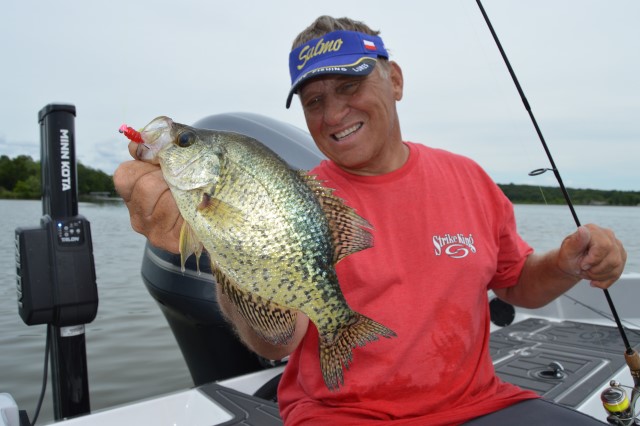
In some states, panfish, especially crappies, are what most anglers chase early in the year. In some areas walleye season isn’t open yet, but even where it is, getting after crappies is a wonderful way to spend a warming spring afternoon. They’re willing biters, and if you’re interested in a couple of fish for the table, crappies are hard to beat. Find a bay that has warmer water than the surrounding area and some cover. Boat docks, trees laying in the water near deeper water, reeds, they’ll all attract crappies. Try a Mr. Crappie Tube on a sixteenth-ounce jig under a bobber. That will usually get them to bite, but if it doesn’t, replace it with a small minnow. If the bobber doesn’t go down within a few minutes, try a different spot: No one’s home.

A warm sun and birds chirping along the shoreline are enough reasons for many of us to get outside during the first warm days of spring, but the possibility of catching a few fish makes it an even harder temptation to pass up.

Winning A Sportsman Club Tournament At Lake Oconee

This five pounder was big fish and helped me win.

Last Sunday, March 20, 14 members of the Spalding County Sportsman Club fished our March tournament at Lake Oconee. After fishing from 7:30 AM to 3:30 PM we brought 37 keeper largemouth longer than 14 inches to the scales. There was one five fish limit and two fishermen didn’t weigh in a keeper.

My five at 12.68 pounds won and I had a 5.04 pound largemouth for big fish.  Raymond English had four weighing 9.40 pounds for second, Wayne Teal placed third with four at 7.68 pounds, George Roberts had four at 7.22 pounds for fourth and Niles Murray placed fifth with four weighing 7.13 pounds.

Will Mclean fished with me and we started on a grassbed I had a feeling would produce a fish. It did, I caught a keeper and a short fish on a swim jig within a few casts. Then it got tough as the sun got on the water.

At about 10:00 Will cast beside a dock and got a bite but missed it. He got that fish to hit two more times, hooking a good keeper on the third bite. 

My next fish hit my shaky head worm near the boat and when I set the hook it came flying out of the water and the hook came out of its mouth in the air.  But it fell into the boat! Some fish are just meant to be caught.

At noon we had only those three in the livewell so we decided to change tactics. We went to a small main lake cove from the small but bigger creek where we had been fishing.  It had deeper water and was closer to the main river.  I hoped this would mean more fish had moved up from their winter homes.

On the point of the cove a deep brush pile produced my third keeper, one that just barely touched the 14-inch line on the keeper board.  Then my fourth keeper hit my shaky head out from a small grass bed inside the point.

Will got his second keeper off the next grass bed then we both caught some throwbacks.  Going into the cove I noticed a waypoint on my GPS and remembered there were some rock piles out in 12 to 15 feet of water. A few casts to them produced a couple of short fish then a two-pounder hit my shaky head. I had a limit at 1:00!  But with the bare keeper I figured I had only about seven pounds.

I cranked up and went across the mouth of the cove to go around it again and saw another bass boat coming. Sure enough, Zane and JR pulled up on the point I had just left and started fishing!  Will and I fished around the cove toward them and caught a couple more short fish.

When we met Zane and JR, with then on one dock and us on the next one, I cast my shaky head to the dock and a bass thumped it. When I set the hook I started yelling for the net, a big fish flashed in the water and tried to run under the dock.

A I fought it I flashed back three years to another tournament and a similar day. On another dock I hooked a big fish, pulled it away from the dock post three times and got it within a couple of feet of the net. Then my line went slack, it just came off. That fish was every bit of eight pounds.

As I pulled this fish to the top so Will could get the net under it, my hook popped out and flew over the boat. I felt sick for a second, then Will raised up the net – with the 5.04 pounder in it! Talk about a fish that was just meant to get caught.

    Will said that fish was really his, so I gave it to him – right after weigh-in.

We fished the rest of the day and landed several more short fish, and I got two more keepers on a shaky head worm.  I culled three times, including the first fish I caught that morning.

How I Fished A Windy Cold Tournament At Lake Eufaula

See the leadup and practice for this tournament here.

The fishing was as bad as expected. Twenty-five members of the club fished for nine hours on Saturday in the ridiculous, dangerous wind and seven more on Sunday, a much better day. But we caught only 29 bass weighing about 81 pounds. There were 13 zeros and only three limits.

As always someone catches them. Sam Smith won with ten weighing 30.65 pounds and had big fish with a 5.36 pound largemouth. His partner Carl Heidle had seven weighing 16.95 pounds for second, Raymond English had four weighing 7.83 pounds for third and David Martin had four at 7.79 pounds for fourth. My four at 6.82 pounds was good for fifth.

When we finally blasted off, I ran around to what I thought would be a protected area behind an island but the wind was so strong I could not fish. That made me go to the small creek hoping the wind would not be too bad in there, and there were a few areas I could fish without losing my cap to the wind.

I was pitching a jig and pig to the edge of grassbeds, letting it fall to the bottom in water a few inches to a few feet deep. At about 10:00 I got a bite but when I set the hook my line broke in the reel – a sure sign I had missed a bad place in it about 20 feet up when I checked then night before. To add “insult to injury,” the keeper fish jumped trying to get rid of my jig stuck in its jaw!

I finally got another bite at about 1:00 but the wind had my line bowed out and I missed the fish. Finally at 2:00 one hit my jig and I landed a 1.64 pounder, and was proud to have something to weigh in the first day.

Sunday as much colder but the wind did not blow.  For the first hour or so I had to dip my rod in the water after every cast to melt the ice out of the guides. And it started just as bad, with no bites until about 11:00. Then a fish grabbed my jig and ran toward the boat but spit it out before I could set the hook.

At noon I finally landed one small keeper and about gave up since I was tired, there was three hours left to fish and I did not have much hope. But at 2:00
I went to the grassbed where I caught my keeper on Saturday and caught a decent keeper, then got a second one off a nearby dock on a shaky head worm. Then it was time to go in and face the results of two tough days!

I hope the weather settles down soon!!

What Does It Mean To Be A Professional Bass Fisherman?

Pro bass fishermen at the Bassmasters Classic give young antlers advice on becoming a pro bass fisherman


WHAT IT MEANS TO BE A PRO

from The Fishing Wire

What It Means To Be A Pro

Forestville, WI (February 9, 2022) – What defines a professional angler? Ask someone off the street and they’ll likely describe fancy boats, bright lights and big fish. Ask those who stand atop the leaderboard, however, and they’ll tell a different story – one of hard work, determination, and the efforts of many other industry pros who have helped them succeed.

“You can’t get to the top without others to lift you up,” says, Patrick Neu, president of the 1,400-member non-profit National Professional Anglers Association (NPAA). “Nobody reaches the pinnacle of professionalism in this industry without a lot of help. That’s exactly why the NPAA is inviting fishing industry workers of every type to join our ranks. Our purpose is to grow and protect sportfishing while providing our members the tools and association benefits needed to increase their professionalism and meet individualized goals.”

To be sure, professionalism in the fishing industry is wide ranging, a point not lost on the organization and its members. “Being a fishing industry ‘pro’ is a pretty loose term,” says NPAA member Chad Pipkens, a ten-year full-time veteran of the Bassmaster Elite Series and five-time Bassmaster Classic qualifier from Dewitt, Michigan, who spent several years prior honing his skills on a variety of smaller trails before acquiring the knowledge, money and flexibility of time needed to compete at the highest levels.

“Professional doctors diagnose and treat patients, teachers instruct students, pro golfers receive PGA cards, and electricians need a license to perform electrical work,” Pipkens says. “These are all well-defined fields of specialization. By comparison, the fishing world encompasses many different job opportunities. Sure, tournament anglers, captains and guides are fishing professionals, but so are the highly skilled mechanics that work on your engine as well as the folks who run the marina, design lures, sell fishing tackle, manage anglers and staff the tournament trails.

“To me,” Pipkens continued, “anyone making meaningful money or striving to earn a living in this industry should qualify as a pro. If you don’t want to be on the water day in and day out, but you still want to be in the industry, you can find the contacts amongst our membership to maybe make that happen.”

“Anyone making meaningful money or striving to earn a living in this industry should qualify as a pro.”

According to Pipkens, the NPAA does a great job of teaching aspiring pros how to run a fishing-related business through their seminars, annual conference and approachable members who have already achieved success. “NPAA membership can shorten your learning curve and raise your professionalism at any level,” he points out. “It’s a great organization for learning the ins and outs of running your own business; whether that’s tech stuff, accounting, how to network or get paid by more than one employer, it certainly can help shorten your learning curve.”

As a pro angler, Pipkens says his life is organized chaos; getting the boat ready, crisscrossing the country, and being on the road for five weeks at a time while never losing his family focus. He often practices on the water from sunrise to sunset. Despite the pressure to win, tournaments are actually the fun part of his routine. “Balancing all the rest,” he says, “is what really makes you a professional.”

For tournament pros, guides and charter captains in particular, there is a ton of preparation that takes place behind the scenes, notes John Campbell, an NPAA founding member and full-time guide. A Freshwater Fishing Hall of Fame member inducted in 2018, Campbell managed to win both the Pro Walleye Trail Detroit River and FLW Lake Ouachita championships. He also qualified for a major walleye championship every single year from 1989 to 2011 while on the pro tour. That’s 22 consecutive years, if you’re counting.

Like Pickens, Campbell agrees publicly visible aspects of being a tournament angler or guide help solidify your status as a professional, but the business end of things is vitally important. “Sure, you’ve got to pre-fish, choose your lures, maintain your gear, set up the boat and put in plenty of time on the road,” he notes, “but you also have to learn to book charters, carefully plan out your competition schedule, promote your sponsors and tend to family matters. Earning money and winning tournaments is vital, but also important is finding ways to help grow the sport through sharing knowledge and getting more kids involved.”

As a professional guide, Campbell is in the business of educating anglers. “To me, helping others learn the game is the sign of a true pro,” he states, adding that this is exactly the kind of people you’ll network and rub elbows with in the NPAA. “This organization supported over 100 Future Angler clinics in 2021 alone. With support from the Future Angler Foundation, it’s member volunteers also distributed over 4,000 NPAA Future Pro T-shirts and 3,000 rod/reel combos to kids at NPAA Future Angler education events. That, I believe, is professionalism at its finest.”

For information on joining the NPAA and exploring the many benefits membership provides, visit npaa.net.

Windy Cold Tournament At Lake Eufaula

These two last-hour fish at Eufaula on the second day helped me to a fifth-place finish out of 25 people.

 I usually enjoy the four seasons. Changing weather often makes fishing better and it is less boring. But going through all four seasons and worse last week at Lake Eufaula was a bit much.

    I went down to Lake Point State Park last Tuesday and set up my slide in pickup camper.  The weather was very warm when I went to bed and I knew storms were possible.

    At 5:00 AM someone pounded on my camper and woke me. I thought they said the power was out, but my fan was still running so I turned over to go back to sleep. Then a car horn started blowing, making me look at my phone – there was a Tornado Warning for the campground on it I had not heard!

    I joined all the other campers in the cement block bath house for the next hour!

The rest of Wednesday was decent, with some light showers but little wind. I was able to get out on the lake and look around some. I joined the 196 other bass boats on the water, a Fishers of Men National Championship tournament was scheduled for Thursday through Saturday.  It was a big deal, first and second places in the tournament would win fully rigged bass boats worth either $80,000 or $60,000, depending on place.

Thursday was a nice spring like day, warm weather and sun.  I again looked around, watching the many boats with teams fishing the first day of the tournament.  Most were easing around the shoreline, casting various baits to grassbeds. 

When I went to my favorite small creek I was happy to see just two boats in it fishing, but while I idled around about six other boats ran in, fished a few minutes, then left.  I knew by the start of our tournament Saturday the poor fish would be beat to death, seeing every lure carried by Berry’s Sporting Goods and then some.

Friday the wind was up a little and the misty rain made me sit at my camper and watch the tournament fishermen go round and round in the creek out from the campground.  Weather guessers were saying 20+ MPH winds for Saturday. Most lakes are dangerous with those kinds of winds, and Eufuala is one of the worse.

Fishers of Men announced they were canceling the third day of their tournament due to dangerous conditions. And the Bass Fisherman’s League canceled their big tournament on Oconee for the same reason.

Potato Creek did not cancel, but when Tom Tanner and I idled to the ramp for our set 7:00 blast off, we were told the executive committee delayed our start by 30 minutes. So for 30 minutes Tom and I sat in our boats as the cold wind got about five miles per hour stronger and the temperature dropped another two degrees while everybody else sat in their warm trucks in the parking lot.

how the tournament went for two days

How To Follow the Spring Crappie Progression To Catch Them


THE SPRING CRAPPIE PROGRESSION

from the Fishing Wire

The Spring Crappie Progression

Many anglers, this one included, can’t wait for ice-out to head for their favorite crappie lake and wet a line in open water for the season’s first time. Those just-after-ice-out trips sometimes produce good fishing, but at other times the fish seem to be non-existent. The fact is that as the water warms and weather stabilizes during spring, the crappie bite gets better. Here are some tips to capitalize on what I call the crappies of “mid-spring.”

Most crappie anglers know that finding the warmest shallow water during spring up until the spawn is key. Warming waters, usually shallow waters, show the first signs of open-water life and draw hungry crappies. Shallow, dark-bottomed bays are classic early season spots, as are boat channels, marinas, and other shallow spots that warm quickly.

Just after ice-out, the crappies invade these areas looking to feed, particularly on warm, sunny days. The appearance of a spring cold front, however, often sends these fish scurrying off to deeper waters where the water temperature is more stable. As spring progresses and water temperatures continue to rise and the weather moderates, crappies spend more and more time feeding in the shallows.

Finding spring crappies involves staying on the move and searching various shallow spots. I often hit several spots during a fishing day, keeping an eye on the temperature gauge on my sonar unit in the boat when going from spot-to-spot. Shore anglers, though more limited in mobility, often do well this time of the year too as shallow areas that hold fish are often accessible from the bank.

Small panfish jigs tipped with crappie minnows and fished below bobbers produce fish, particularly when the fish are finicky. More aggressive fish, on the other hand, are often very susceptible to small jigs and plastics combos. I’ve become a big fan of the Mr. Crappie soft baits in recent years and prefer the Crappie Thunder and 2-inch Tubes during spring. Hungry crappies readily hit soft baits and usually several fish can be caught on the same bait without rebaiting. Regardless of whether tipping a jig with live bait or plastic, fishing the combination a couple feet below a bobber and casting near shallow cover like weeds, brush, and timber usually results in bites if fish are present.

Bobbers and jigs go hand in hand for spring crappies, however, a cast-and-retrieve approach can also yield good catches on some days and can be a good “search” presentation as well. For this method, I rig a Mr. Crappie ShadPole on a small jig, cast it out, and slowly retrieve it back.

Regardless of whether fishing a bobber or cast-and-retrieve fishing, using your tolling motor to quietly approach and work potential fishing spots is important now. Shallow, spring crappies are notorious for being spooky and avoiding excess noise that may easily scatter these wily fish will generally up your catch.

Spring and crappies go hand in hand, especially as the season progresses and the weather stabilizes. Following some of the tips just provided can, in fact, probably help you capitalize on the hot mid-spring crappie bite this season!

As always, good luck on the water and remember to include a youngster in your next outdoor adventure!

Mike Frisch hosts the popular Fishing the Midwest TV series.  Visit www.fishingthemidwest  to see more fishing tips and view recent TV episodes as well!

My Winning Pattern At Lake Sinclair In Early March

These two four pounders helped me win and get big fish at Lake Sinclair at the last minute!

Last Sunday, March 6, nine members of the Flint River Bass Club fished our March tournament at Lake Sinclair.  The weather was beautiful for our casting from 7:00 AM to 3:00 PM but the bass didn’t seem to care.  We weighed in 29 keeper bass weighing about 47 pounds and had three five-bass limits. No one zeroed.

    My four at 10.63 won and I had as 4.19 pound largemouth for big fish. Chuck Croft placed second with five at 9.15 pounds, Don Gober had five at 9.02 pounds for third and Alex Gober, his grandson fishing with him, had five at 4.86 pounds for fourth.

    Will Mclean fished with me and we headed to some grass beds near the dam where Ricky Layton, showing me around the same time of year two years ago for a GON article, caught five weighing 28 pounds.  But after three hours and several different places, we both had two bites.

    A good keeper bass hit my crankbait on a seawall and jumped and threw it. Then Will hooked and lost what looked like a keeper on a Texas rigged Senko.  A little later Will caught a bass that just barely touched the 12-inch line, then I caught a similar one.

Club rules say a bass must be 12 inches long with its mouth closed on a keeper board to be weighed.  I could make mine touch the 12-inch line, barely, but worried about it. Sometimes in the excitement of catching one I do not measure it correctly.

Around 10:30 I cast my bladed jig to a grassbed on a point and hooked a keeper out in front of it. At 11:30 Will cast to the middle of a shallow cove, said “I got one” and a huge fish swirled on top. He got it to the boat and I netted it, but it was a big blue catfish. Will’s new scales said it weighed ten pounds but it looked much bigger.

At 2:00, with about 45 minutes left to fish I was pretty disgusted. We went into one of my favorite small creeks. As we fished down a bank with a big grassbed on it, I told Will I had never caught a fish past the last small dock on it, it was very shallow. But Niles Murray caught a keeper back in it when we fished together a few years ago.

I cast my bladed jig back in it and my line started going sideways. When I set the hook the 4.19 pounder jumped, it was only a foot deep and it had nowhere to go but up!  When I got it to the boat I let it go around the trolling motor but managed to pull the motor and bass up and Will got it in the net by lying down on the deck and reaching forward. That fish was just meant to get caught.

I caught another keeper on a shaky head on the next dock, then started around the other arm of the cove. Again I told Will I had never caught a bass way back in it, and he reminded me of what had just happened.

As luck would have it, way back in it I pitched my shaky head to a seawall about a foot of water and felt a tap and my line started moving out. When I set the hook a 4.13 pound largemouth fought hard but I managed to keep it away from the trolling motor and Will netted it.

We went back to the dock where I caught my keeper and Will got a 3.16 pounder off the seawall beside it, again about a foot deep. That was it, we had to go in.

I don’t know if it was time of day, location or what but I wish it had started earlier, or we had more time to fish before the time ended. This time of year fishing is often better late in the day after the sun warms the water some. It was 62 degrees in that creek at 2:00 and I am sure those fish were thinking about bedding.

While waiting for Will to back the trailer in, I checked my smallest fish and decide it had shrunk, so I just weighed in four.

Great Backyard Bird Count

 The song “I’m A Girl Watcher” by the O’Kaysions hit the charts in 1968, the year I graduated from high school.  It may have been appropriate way back then but I am sure it is politically incorrect now. But it really doesn’t matter.  All my life I have been a bird watcher, too, and now that is even more appropriate.

    I have always had bird feeders in my yard and have several books on bird identification. Pictures by John James Audubon draw my attention as does his information about different species. I think one reason I really like him is I found out he shot the birds he painted so he could get a better look at them!

    One of my most unusual sightings was a Swallow-tailed Kite. Linda and I were driving back roads home from Jekyll Island a few years ago and I saw it soaring above a clear cut. Luckily there was no traffic because I slammed on brakes and got off the road to look at it!

    A couple weeks ago, on February 18 – 21, the Great Backyard Bird Count was held. This year folks all over the world set records for the numbers of birds seen and submitted on a database.  This information helps learn about bird populations and how they change over time. 

    You can find more information about the count at https://www.birdcount.org/

Great Backyard Bird Count – Join us February 18–21, 2022. Each year people from around the world come together to watch, learn about, count, and celebrate birds.Each year people from around the world come together to watch, learn about, count, and celebrate birds. Join us in February!www.birdcount.org

– if you like birds and bird watching, check them out.