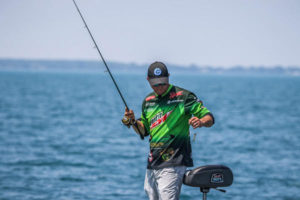
Where and How To Catch June Lay Lake Bass with GPS Coordinates for Ten Spots

with Ryan Branch

Big largemouth feeding in the grass.  Coosa spots gorging on points in current.  Both species are easy to pattern and catch this month on Lay Lake.

    Lay is a 12,000-acre Alabama Power reservoir on the Coosa River south of I-20, running from its dam to the Logan Martin Dam.  Its shoreline is lined with a variety of grass and lily pads, and docks are on most banks.  Many creeks and sloughs enter it on both sides.

    Ryan Branch grew up near Birmingham in Destadia Hills where he fished on the local high school team and now fishes with the West Alabama College team.  Although his parents didn’t fish, local angler Bill Bonner took him under his wing, acting as boat captain and getting him into tournament fishing in the Anglers for Kids group.

    Ryan credits much of his skills to reading magazines and the internet.  He said he would pick a lure, watch and read all he could about fishing it, then go to local ponds to hone what he had learned.  He took it step by step to reach his current skill level.

    Lay is Ryan’s favorite lake and he fishes it often.  He has learned to catch both largemouth and spots on the lake, and June is a great month to catch both. 

    “I like to cover water all day, looking for feeding fish on a couple different pattern,” Ryan said.  His favorite way of catching them is flipping grass but he catches fish on a variety of patterns and baits.

    For June, Ryan ties on a frog, swim jig, and flipping bait for the grass.  He also rigs a shaky head, swim bait and drop shot for fishing current for spots. He has a few other baits to cast in specific situations, too.  Largemouth win most tournaments but it is easier to catch numbers of spots.

    We fished Lay in early May and caught fish on most of the following ten spots.  Although Ryan said the bass were in a post spawn “funk’” not feeding much for about a week, we still caught fish all day and had some quality fish.  These spots will be much better now and for the rest of the month.

    1. N 33 10.631 – W 86 31.629 – If you put in at Beeswax Ramp, go under the bridge. The creek splits and a big grass bed is in the mouth of the right fork.  Bass released at the ramp constantly restock this area, so it has a high concentration of fish.

    There is a channel running down the right bank as you face up the right channel, and another channel runs down the middle. There are points with grass on them on both sides of the channels.

    Ryan starts on the point on the right closest to the bank and fish a bluegill colored Spro Popping Frog early in the morning, and other low light conditions. He switches to a black frog when the sun is up, working the frog through the grass and across the points in it.

   
    Watch and listen for activity in the grass. If you see any movement, grass moving, swirls or splashes, cast to it. Also hit any openings back in the grass. If you hear bream “popping,” indicating they are feeding in the grass, the bass are likely to be feeding on them.

    When the sun is bright on the grass, drop a punch bait through the grass. Be sure to hit the thickest spots and any isolated clumps out from the main grass bed, too.

    2.  N 33 11.680 – W 86 30.238 – Run up the river and go into Bulley Creek. There is a small island about half way back and the channel runs between it and the right bank.  Stop at the house with the cut yard running down to the water and start fishing upstream along the right bank.

    Fish your frog in the water willow grass here. This bank stays shady for a while in the morning so it can be better for the frog later than places that get early sun.  After fishing up the right bank to across from the upper end of the island, go across to the island and fish it, too. Work the channel side around the downstream point and up the opposite side until it gets very shallow.

    Try a swim jig in this grass and all other grass.  Ryan casts a white Super Cotton three eights ounce jig with a matching Zoom Z Craw when the bass are eating shad but switches to a March Madness black and blue jig and trailer with the main food is bluegill. Also punch the thicker mats.

    3.  N 33 11.410 – W 86 29.932 – Back out at the mouth of Bulley Creek, the downstream point is flat and shallow but slopes out and drops into the river channel.  The creek channel swings in by the point, too.  Spots group up on the point and feed, especially when current is moving.

    Stop out on the river side of the point with your boat in about seven feet of water and fan cast the point, toward the bank as well as toward both channels.  Ryan fishes both a shaky head worm and drop shot here. He rigs a morning dawn color Reaction Innovation Flirt worm 10 to 12 inches above a one quarter to three eights ounce sinker, using the heavier weight in stronger current.

    Work around the whole point and check the upstream point at the green channel marker 43.  Drag the drops shot slowly, twitching the rod tip to make the worm wiggle.  Bump the bottom with a shaky head worm the same way. Ryan caught a good keeper spot here when we fished.

    4. N 33 14.567 – W 86 27.455 – Up the river the discharges from the power plant produces current that attracts spots and largemouth.  Its on the outside bend of the river and the water is 25 feet deep just off the bank.  The current is so strong it can be hard to fish, but worth it.

    Ryan stops about 20 yards off the bank about 50 yards downstream of the lower discharge and casts a green pumpkin three quarters ounce Buckeye Ballin Out jig with a matching Zoom Z Craw trailer close to the bank.  Cast upstream and work it back to the boat with the current, keeping it on the rocks, working down them to 20 feet deep.  He says you will get hung but can catch some good fish doing this. Work your jig all the way up past the upstream discharge.

    Also throw a Tennessee Shad Kitech 4.3 swim bait on a half-ounce Dirty Jigs jig head.  Cast it to the seams and eddies in the current and swim it back with the current in a natural movement.  Be ready to set the hook fast, the current pulling your line lets the fish know to spit it out fast. I lost a 3.5-pound spot that hit my swim bait and jumped and threw it because I didn’t get a good hookset.

    5.  N 33 14.617 – W 86 26.820 – On up the river, Yellowleaf Creek enters the river on your left.  The
downstream point is another good place to find spots and the occasional largemouth schooled up feeding in the current.

    Stop out on the point in about 20 feet of water and idle over it, looking for brush and fish.  Wood washes in and hangs on the point but it changes often with the current changes, so you need to find it. When you locate either, back off and cast drop shot, shaky head and jig and pig to it, working all around the area holding fish.

    Ryan rigs a green pumpkin or Junebug Trick worm on a one quarter to one half ounce Davis head.  Use the heavier head in current but the lighter head will get hung less if the current allows you to work it. Current does help the bite here and similar places.

    Ryan says he catches about 95 percent spots here, but some largemouth do user the area.  He added you can catch 30 fish here on a June day with current moving, and he landed a couple nice spots the day we fish, although it was early for them to be on this pattern.

    6.  N 33 12.037 – W 86 28.994 – Going back down the lake Dry Branch is on your right. Across from it and a little downstream, a small pocket has a downstream grassy point running out across the mouth of it. It is very shallow but creates a good ledge where it runs out and drops into the river channel.

    Keep your boat in the channel in 20 feet of water and cast your drop shot, jig and pig and shaky head toward the grassy point. Work those baits from three to 15 feet deep, keeping in contact with the bottom.  Angle your casts upstream to move your bait in a natural motion with the current. 

    Fish from the dock on the river just down the from the point up to the middle of the cove where the grass on the point ends.  Work slowly and probe for any wood cove hung on the bottom.  When you hit it make several casts to it with different baits.

    7.  N 33 08.560 – W 86 28.980 – Going down the river past Beeswax Creek, Kelly Creek enters on your right where the river makes a bend to the left. The point turns into a bluff bank going downstream.  There are rocks and brush on the point, and current is concentrated by the outside bend.

    Stop out even with the point in about 20 feet of water and cast to the point, working shaky head, drop shot and jig and pig down the slope.  Fish from the end of the point in the mouth of the creek about 200 yards down the bluff bank.  This place holds mostly spots with the rock and current.

    When fishing a drop shot, Ryan keeps his sinker on the bottom and slides it along slowly, shaking his rod tip constantly to make the worm dance. With the shaky head, he starts with aggressive shakes and moves it fast, but he will slow down dragging it along with little action if he does not get bit. Try different actions until the bass show him the action they want.

    8.  N 33 09.237 – W 86 26.803 – The Cedar Creek Road Bridge is a good concentration area for bass this month. Late spawners are joining earlier ones that stopped to feed on the bridge, and shad have been spawning here in May, so many bass are still holding around the riprap, especially early in the month.

    Ryan fishes the long, left side riprap and says the downstream side is best.  Some current coming under the bridge will concentrate them on the corners, but they feed all along the rocks.

    Try your shaky head worm, but Ryan will also fish a white and chartreuse chatterbait and shad colored squarebill here.  Try to bump the rocks with both those baits then follow up with your shaky head in any area you get bites on the faster moving baits.

    9.  N 33 16.634 – W 86 29.553 – Down the river around the bend to right, as the channel turns left, a small double creek with Okomo Marina in the back enters on your right.  It is lined with docks and has some grass in it.

    Start at the downstream point and work the docks inside the cove.  Ryan fishes them with a green pumpkin three eights ounce Ballin Jig with matching trailer and a Texas rigged green pumpkin Baby Brush Hog behind a three eights ounce sinker.  In muddy water, go to black and blue on both baits.

    Also skip your baits into shady areas along the seawall here. Pay attention to where you get bites and look for a pattern on the docks and in the shade. Bass tend to set up in the same places on docks all down the bank, so concentrate your pitches to those places when you get the pattern.

    When you get to the back, punch the mats with your punch bait. Ryan rigs a black and blue Sweet Beaver behind a one-ounce tungsten bait to punch them. He caught our best bass of the day here, a largemouth pushing five pounds.  It hit in a small mat out from the main bed.

    10.  N 33 04.974 – W 86 30.874 – A little further downstream, a big island sits in the mouth of Spring Creek.  The river side of it drops off fast with a clay bank back off the water. It has a good grass bed running from the point where there is a danger marker for stumps down the outside bank. 

    Ryan says there is usually a lot of baitfish in this area, concentrating the bass. Fish your frog and swim jig in this grass.  If you see a thick patch, punch it.  Work this area slowly and carefully if you get bit since schools of bass often hold over deep water and run in to the grass to feed.

    Try these places with Ryan’s bait choices or yours, find the pattern and use it on other places for Lay bass this month.

Ryan is on Facebook at https://www.facebook.com/ryan.branch.3511

WOMEN WHO FISH HAVE GREATER GRIT AND SELF-ESTEEM ACCORDING TO NEW RESEARCH

from The Fishing Wire

0

Women Who Fish Have Greater Grit and Self-Esteem According to New Research

ALEXANDRIA, VA – The Recreational Boating & Fishing Foundation (RBFF) today announced new research that shows fishing provides positive psychological benefits for women. Conducted in partnership with global market-research firm, Ipsos, the research reveals female anglers were more likely to have a positive outlook on life, higher levels of perseverance and a greater self-worth. These insights come after the 2022 Special Report on Fishing revealed women now compose 37% of all anglers, the largest share on record.

“While we’ve known being near the water provides mental health benefits, this study demonstrated the significant, rewarding effects of fishing specifically for women,” said RBFF Senior Director of Marketing, Rachel Piacenza. “Their experiences on the water foster confidence, patience and determination that they can rely on in other areas of life.”

The research shows active female anglers demonstrate greater perseverance and grit, meaning they’re better able to face setbacks and handle adversity. It also reveals women continue to face adversity and under-representation in the fishing community. Almost half of female anglers do not feel respected by the angling community, and 77% do not feel represented in advertising for fishing gear and apparel.

“Understanding both the advantages and problems for women who fish can help the industry better recruit and retain female anglers,” explained Stephanie Vatalaro, RBFF’s Senior Vice President of Marketing and Communications. “As we fight to plug ‘the leaky bucket’ of participation loss, these insights are the first step to creating a more appealing and supportive environment for women who represent a significant opportunity for increasing participation overall.”

Additional results from the study will be released January 11 during an industry-wide webinar where RBFF and partners will dive deeper into these insights and provide recommendations on how the fishing and boating community can continue to recruit, retain, and reactivate female anglers of all ages. The webinar will cover:

  • Why women start, continue, and stop fishing
  • How fishing contributes to female anglers’ mental wellness and quality of life
  • What hurdles female anglers face on the water and in stores
  • How the industry can improve women’s fishing and boating experiences and foster a sense of community

Reserve your spot for the webinar here.

For further information: Bruna Carincotte, bcarincotte@rbff.org, 202-743-9894.

How and Where To Catch April Alabama River Bass with GPS Coordinates

with Sean Murphy

Alabama River spots spawning on main river sandbars and rocks.  Largemouth spawning in sloughs and creeks.  This is a great time to catch both during prespawn, post spawn and bedding.

The Alabama River runs from the junction of the Coosa and Tallapoosa Rivers near Montgomery 105 miles southeast in twisting, turning loops.  It is well known for big spots but has a good population of quality largemouth, too.

Sean Murphy is a senior at Auburn on the fishing team.  He grew up in Lutz, Florida near Tampa and got started fishing at a very young age, but the first bass he caught in a pond near home hooked him on bass.  He chose Auburn mainly for its Aviation program but the bass fishing team there helped him make his decision.

“Team members took me under their wing and taught me a lot about catching bass,” Sean said.  Fishing Alabama lakes and rivers is very different from Florida waters and he had to learn to adapt to new methods to catch bass.  He has learned well.

“Both species of bass on the River are in the spawning mood in April,” Sean said.  The spots don’t like to move far from the river current to spawn, but largemouth will go back shallow in sloughs and creeks.  Spots will bed on sandbars and rocks near the river, but largemouth look for hard bottoms a long way from the current.

For the two different methods of fishing Sean will have two groups of baits ready.  For largemouth, a bladed jig, jig and pig, Carolina rig and spinnerbait cover the bedding areas around grass and pads. When trying for spots he uses a rattlebait and medium diving crankbait. The jig and pig and Carolina rig work for them, too.

We got on the river in early March when it was running eight feet high and the current was so strong it was almost impossible to fish on the river.  If those conditions persist, fishing for largemouth will probably be your best bet but you can catch spots even under those conditions if you work at it.

1. N 33 26.346 – W 86 23.445 – Cooters Pond near Prattsville is a good central ramp for these spots. It is near the mouth of a big slough and a creek enters in the back at the golf cart bridge.  There is standing timber and stumps all through it where largemouth stage, then move to the shallows to feed.

Idle toward the bridge, it is very shallow and dangerous if you don’t know it.  From the timber patch on the left facing the bridge to it and down the other side is a big lily pad field.  Lily pads indicate a hard bottom where bass like to spawn.

Cast a bladed jig and jig and pig around the timber for both pre and post spawn largemouth.  If a cold front pushes the fish back from the bedding areas, they will move to the trees until conditions get better, too.  Sean likes a three eights ounce black and blue bait in stained water and a green pumpkin jig in clearer water, with a matching three-inch swim bait trailer.  He will also pitch a jig to a visible tree, let it sink beside it then work it back to the boat, hitting hidden wood.

Run your bladed jig through lily pad fields, too. Early in the month stems may be all you see, but they indicate places to cast just like the pads do.  Fish all around the bridge on both sides and watch for the small channel coming under it.

2.  N 32 25.838 – W 86 23.914 – The canal going out to the river from the Cooter Pond ramp offers a highway for largemouth moving in and out to feed.  Across from the downstream end of the old docks there is a hole near the opposite bank where the channel runs right by it. It was 20 feet deep the day we fished, so at normal pool it is about 12 feet deep.

Bass stack up in this hole and it, like hole 1, is constantly restocked with released bass.  Sean gets in close to the wood on this bank and flips a jig and pig to all the cover. There are limbs right on top and many deeper ones you can’t see. Work them all.

Sean flips a custom made Spotsticker  green pumpkin and blue three eights to three quarter ounce jig, depending on current, and puts a three-inch swim bait trailer on it. If the water is heavily stained, he goes with black and blue.  He wants to get his jig right in the bass’s face, so he covers the water thoroughly and carefully.

3.   N 32 25.759 – W 86 23.496 – Go out to the river and go upstream past the island where the canal comes out.  Cooters Pond opens up here and there is a good sandbar off the upstream point.  Spots bed on the sandbar and sandy bottom along it to the point of the island back in the slough a short distance. 

Idle in even with the upstream point and fish from it to the end of the island.  Spots stage here both pre and post spawn, and bed on the sand, so it is good all month.  There are scattered stumps on it, too, that are key places for them.

This is a good place to bump the bottom with a crankbait and drag a Carolina rig all over it. Sean rigs a dark colored lizard about six inches above a three quarters ounce sinker and covers the whole area with it. Fish from two feet deep back to the boat.

4.  N 32 24.675 – W 86 24.094 – Run down the river until you see the highway 31 bridge.  On your left a small creek enters the river and is a holding and spawning area for both spots and largemouth.  Spots will be on the upstream point largemouth will be there, too, as they move in and out. 

Fish both crankbait and Carolina rig on the point, bumping bottom from all angles.  Sean fishes a shad or chartreuse with black back colored bait that runs six feet deep. Drag a lizard all over it, too.

For bedding largemouth, work into the creek as far as you can go, depending on water level. Pitch your jig and pig to all the wood cover on both sides. Try to get it right on the bank under overhanging limbs and drag it along the bottom.  Run a bladed bait through any grass.  Here and other places you may see fish on the bed if the water is clear, and you can sight fish for them.

5.  N 32 24.684 – W 86 24.261 – Spots love to hold on offshore rocks and there is a good ledge just downstream of hole 4.  If you idle downstream toward the bridge about 50 feet off the left bank and watch a side scan sonar, you can see the rocks as they come off the bank and drop down.  There is a wooden structure that looks like a box deer stand and the rocks are just upstream of it.

When you find them, sit downstream of them and cast a jig and pig upstream far enough to get it down to the rocks.   If the current is running strong, you need to go to a heavier jig, up to three quarters an ounce.  Fish it slowly, keeping it right on the rocks and it comes down current with a natural action.

6. N 32 24.098 – W 86 26.637 – Go under the highway 31 bridge. There is an open pasture along the right bank. Where it stops at the end of a small bluff bank a small creek enters the river.  The downstream point of this creek runs upstream and has stumps on it.  It is a good holding area for both species and spots bed on it, too.

Stop just downstream of the ditch and cast a crankbait and Carolina rig upstream, working them back with the current.  In places like this Shawn will also fish a rattlebait like a gold with black back Rat-L-Trap over the point for both species.  Probe with your Carolina rig for stumps and stop it when you hit one. Both species will hold on the downstream eddy of them and spots will be there, too.

Then work into the ditch, fishing the wood cover on the upstream side as well as on both sides of it. Sean says he moves more and covers water with bladed bait and spinnerbait when looking for largemouth in most places but sits in one place more and covers specific areas for spots since they tend to stack up more in one place

A spinnerbait works better here and other places with lots of wood cover since you can bump it without getting hung up as easily.  Sean chooses a three eights ounce white Spotsticker spinnerbait with silver willowleaf blades around all wood cover as well as pads and other grass.

7.  N 32 24.923 – W 86 22.071 – Go back up the river past Cooters Pond. In the long straight section past the bend, power lines cross the river. On the right side the base of the tower is in the water near the bank.  There is gravel and rocks around the bottom of it and wood is usually hung up on it from the top of the water down to the bottom.

Spots hold here and will spawn around it, too, and Sean says he can almost always catch a fish on it.  The key area is the outside corner. He will position his boat downstream of it and cast rattlebait or crankbait up past the wood and concrete pilings and work them with the current along them.  Fish both baits through the eddies formed by wood and pilings, too.

8.  N 32 24.495 – W 86 22.028 – A little further upstream the river opens up a little as it swings to the left.  There is a round point on the right where it opens up that drops fast and has rocks on it. Spots hold on this deep point, they like a place where they can change depth quickly. Work your jig and pig from the edge of the water down ten feet or deeper.

As you round the point going upstream, the water is shallower near the bank.  Largemouth hold on wood and any grass all along this bank and Sean will fish upstream all the way to the house several hundred yards away. Cast spinnerbait, bladed jig and jig and pig to all the wood cover and grass along this bank.

9.  N 32 23.904 – W 86 21.278 – A little way upstream the river narrows back down some and a big slough is off to the right behind an island.  The opening to has a smaller island in it.  It is sandy and spots bed here, and both species stage on the point of the small island.  

Fish the point with all your baits, using crankbait, spinnerbait, rattlebait, crankbait and Carolina rig on the sand. Then fish back into the slough with your largemouth baits. Work all the wood cover and watch for bedding fish if the water is clear enough to see them.

If the water is stained but warm enough for them to be bedding, a Carolina rigged lizard or jig and pig dragged slowly along the bottom will get bedding fish you can’t see to hit.  Fish fast if you think they have not gone on the bed yet, but slow down it the water is warm enough for them to be on the beds, especially around the full moon this month.

10.  N 32 23.787 – W 86 21.120 – Going upstream, a golf course runs along the bank. There is a small wooden deck right on the water and the bank on both sides of it is riprap.  There is natural rock along the bank, too.

Fish all the rocks with crankbait, spinnerbait and jig.  Watch for a drain pipe on the bank, it is a key place for bass to hold. Work all this bank carefully, spots and some largemouth stack up on it in April.

Just upstream of this bank an island sits not far off it. The area behind the island is shallow and is a good spawning area. Work it for largemouth bedding on the sandy bottom.

All these places are good right now and will be all month long.  Give them a try, look at the kinds of places Sean fishes, and you can find many more on the river.

You can see some of Sean’s catches on his Facebook page at https://www.facebook.com/sean.murphy.3781

Where and How To Catch February Millers Ferry Bass with Ten GPS Coordinates

February Millers Ferry Bass with Billy Black

Spots schooling up on creek and slough mouths withh largemouth moving into shallows to feed.  Pre-spawn is a great time to fish Millers Ferry, it is getting started now and is stronger all this month.

Millers Ferry, also known as William B. Dannely Reservoir, is on the Alabama River south of Selma.  It is mostly a river run lake with many acres of shallow sloughs, backouts and creeks.  The shallows are full of wood and grass cover where largemouth live.  Alabama spots prefer to live on or near them main river.

Billy Black lives in Monroeville where he is fire chief.  He fished the river for anything that would bite when younger but got into bass fishing in the late 1980s.  In 1991 he helped form the Monroeville County Bass Anglers and they fish several tournaments each year on the river. 

He fishes the Alabama BASS Federation Tournaments and Fishers of Men trails most years, and has fished the Alabama Bass Trail tournaments as well as area charity and pot tournaments. He knows Millers well.  

“In late January both spots and largemouth start getting the urge to spawn,” Billy said.  Spots set up on river points at the mouths of sloughs and creeks, staying near current and deeper water. Largemouth move further back into the shallows, feeding around wood and grass cover to get ready for bedding.

    Billy is prepared to fish both patterns this time of year. In a tournament he usually tries to catch a limit of spots then go looking for bigger largemouth to cull up.  You can catch more spots but the largemouth, although providing fewer bites, will be bigger.

    “The problem with Millers, like other river lakes, is rain upstream can blow them out and mess up fishing for a few days,” Billy said. That has been a problem since December, when heavy rains made the river rise and get muddy repeatedly.

    For spots, Billy rigs a crankbait, Carolina Rig and jig and pig, for fishing points and deeper water.  For shallow largemouth he likes a squarebill crankbait, bladed jig, swim jig spinnerbait, jig and pig and punch bait for covering the different kinds of cover.

    We fished the day after Christmas.  Billy warned me the river was full and stained, but much more rain was predicted over the next two weeks, making it worse. We put in at Ellis Ferry and the water was at the top of the ramp, but the dock was above water. The next week the dock was covered, and water came half way up in the parking lot.

    The following places are good right now and get better all month for both species.

    1.  N 32 03.308 – W 87 18.710 – The upstream point at the mouth of Gee’s Bend has a marker buoy where the ferry crosses it.  The river channel swings in on the outside and the creek channel is on the back side of this long point, offering good access to deeper water both ways.  Largemouth stop and feed here on their way into the flats and spots hold on it all the time.

    This point has a clay bottom with scattered shell beds, and there is usually some brush that has washed in and hung up on it.  Current coming down the river makes the bite, especially for spots, much better.

    Stop near the buoy and try a crankbait and Carolina rig on it.  Billy uses a chartreuse with black or blue back Strike King 5 or 6 XD or Bomber to bump the bottom.  Start out in deeper water, keeping your boat well off the point and cast across it, bumping the top.  Watch your electronics for brush on the bottom and mark it when you see it.

    Fish all the way around the point, covering both sides and the end.  Then drag your Carolina Rig all over the point, too.  Concentrate on brush and shell beds you find. Also try a jig and pig in the brush here.

    You can spend all day here and catch fish as they move up and feed or hit it several times during the day hoping to be there at the right time.  Billy said a six-pound, four-ounce bass here in his last tournament so it offers the possibility of big fish as well as numbers.

    2.  N 32 02.771 – W 87 15.963 – Upstream around the bend Bridgeport Landing is on your right.  A line of small islands goes across the mouth of the big slough here and the river channel runs right along the outside bank of the downstream one.  The water comes up fast and the point is very shallow out on the point.

    Stop out from the point in the river and fish crankbait and Carolina rig from the shallows down the drop. Billy will rig a Junebug Fluke or Baby Brush Hog on a 12 to 18-inch leader with a one-ounce sinker.  Fish it so it stays on the bottom on the steep drop.

    Work up toward the end of the point with grass on it, then cast upstream parallel to the bank.  There is always wood cover on the bottom and fish hold on it.  Switch to a jig and pig to more effectively fish the brush with fewer hang-ups. Try to bump through all the wood you can hit, moving your bait with the current.

    3.  N 32 03.329 – W 87 15.500 – Across the river a little upstream, Gold Mine Slough is on your left.  The first small entrance to it between two islands is another example of the kind of places bass use, with current hitting it and a ditch dumping into deep water with shallow points and a drop.

    The mouth of the ditch is only about two feet deep, but the channel is about 20 feet deep. Keep your boat in the deep water and cast crankbait and Carolina Rig into the ditch, bumping the bottom down the drop out to 12 feet deep. Cover both points on the ditch.

     After fishing across the drop, move in near the downstream point and cast upstream, running both crankbait and Carolina Rig across the ditch mouth, moving them with the current. There is some key wood here to hit.  Then work on up across the ditch upstream, casting to the wood and grass on the bank with a bladed jig and jig and pig.  Some fish move in to it to feed.

    4.  N 32 03.431 – W 87 15.432 – Across the river upstream there is an entrance to Ladell’s Slough in front of the campground at Roland Cooper Sate Park.  There is a small island in the middle of it and there was a big log jam off the downstream point just inside the slough when we fished. The water drops fast from four to 25 feet deep across the mouth of the entrance.

    Fish across it like the others, working from the downstream point upstream.  Make a few casts to the log jam with a jig and pig but concentrate on the drop.    Fish across it as well as parallel to it with crankbait and Carolina Rig.  Billy says it is important to keep your crankbait bumping the bottom as much as possible.

    5. N. 32 04.954 – W 87 14.221 – At the upstream point water several feet deep runs along the left bank if you go into it but it runs a long way parallel to the river. We went into the slough behind the upstream point and fished the grass and wood along the bank to see if fish were here, then idled through the shallows and stump fields to the highway 43 Bridge back in the slough.  When you get to the bride start in the pocket on the downstream side to the left facing upstream. Work the wood and brush out to the bridge, then fish all around the bridge, hitting riprap and pilings.  

    You will catch mostly largemouth back in here as they move in to spawn.  The bridge is a pinch point that concentrates them and offers them as good feeding place. 

    Billy uses a Strike King 1.5 or 2.5 squarebill and a chatterbait around the rocks, pilings and wood here He likes a Jackhammer chartreuse and white bait with a matching trailer in stained water but switches to a green pumpkin bait with matching trailer in clearer water.

    Hit both sides of the bridge and try upstream of it around the grass and stumps. This slough is full of stumps above the bridge so be careful. 

    6. N 32 04.240 – W 87 14.592 – Go back out to the main mouth of Ladell’s Slough just past the standing timber downstream of the bridge.  It drops deeper in the middle without a ledge across the mouth but the points on both sides are good.  The bottom is sandy with some hard clay spots in it.

    Go back to crankbait and Carolina Rig to bump and drag the mostly clean bottom.  Fish the upstream point from the middle of the ditch, fan casting all over it from the inside to the outside.  Billy drags he rig along the bottom letting the current move his bait.

    Try that angle on the downstream point, too, but current will set the bass up to be facing upstream.  Work out to the river side of that point and cast to the middle of the ditch, moving it up the slope. 
You will catch both spots and largemouth here since it opens up to vast spawning areas.

    7. N 32 05.590 – W 87 15.607 – Foster Creek is the next creek upstream on the left.  After going through the narrow opening it opens up and the channel is to the right after going around a shallow point on that side.  The bank just past the first little pocket on the right side drops off into ten feet of water, has lots of wood and grass, and the water is usually clearer in here than on the river.

    Billy says the biggest Miller’s Ferry bass ever weighed in his club came from here, an eight pounder. This bank faces south so it warms faster than some other areas, and this draws the largemouth to it.

    Billy keeps his boat in ten feet of water and fishes up the bank, working into the creek.  He starts with a spinnerbait and chatterbait, covering water.  A white War Eagle spinnerbait with silver blades is his choice.  Run both all around wood cover and along grass edges.

    If the bass don’t seem to be chasing a faster bait, Billy slows down with a swim jig, fishing it all through the cover.  If that is too fast, he will go to a punch bait, a Junebug Baby Brush Hog behind a one to one- and one-half ounce sinker, and drops it through the thick mats of grass.  Fish up the bank until the water near it gets shallow near the next pocket on the right.

    8. N 32 08.902 – W 87 15.775 – Chilatchee Creek further up the river on the left has Chilatchee State Park on the left as you go into the creek. Billy was able to follow the channel around to the left but be very careful until you learn it.  The water is very shallow in some areas.

    Go around the big island in on the right side and stop about even with the little one out in the middle of the creek. The channel makes a sharp bend near the right bank here and the is a lot of wood cover and grass along it.  About half way up the point this bank is on, a big tree with root ball and limbs sticking out of the water was lying out off the bank.

     Work the shallow cover here like in Foster Creek, covering water with spinnerbait, chatterbait and swim jig.  There is a lot of hyacinth covering the edge of the bank and is an excellent place to punch your Brush Hog through it.  It gets a lot of afternoon sun and warm fast.

    Fish from one end to the other on the big round point.  The water is deeper along the point and bass hold here rather than moving back into the very shallow pockets on both sides. Billy caught a solid keeper largemouth here on his punch bait.

    9.  N 32 03.145 – W 87 15.103 – Go back down the river to Roland Cooper State Park into the creek between it and Bridgeport Landing.  There is a small campground ramp on the left with rental boats on it, but the main ramp is on back in the creek. Stop downstream of the small ramp where there is a grass yard leading up to the bathrooms.

    A lot of tournaments are held here and restock the area often.  The bank from downstream of the ramp up just past it has six feet of water near it, deep enough to hold fish, and there is a lot of hyacinth along the edge, wood cover and some rocks just upstream of the ramp.

    Fish it like all shallows, covering water with faster moving baits first. If you catch a fish or two on them it is worth going back over it, picking it apart with a punch bait or jig and pig.  Billy fishes a black and blue jig with a matching trailer in the thinner grass and other cover, but the punch bait is needed for the hyacinth.

    10.  N 32 03.363 – W 87 17.857 – Go into Gee’s Bend past the ferry landing on the left.  The bank past it has a line of docks that are good staging areas for largemouth.  Billy says you won’t get a lot of bites, but they are usually quality fish.

    Run a squarebill along the post, bumping them and making it deflect.  Then probe for brush in front of the docks and under them with a jig and pig.  There is about six feet of water on the ends of them. Work the whole line of docks but be careful, dock owners have run a rope along and between the front of most of them.

    Give these places on Millers Ferry a try for both spots and largemouth. You will catch both, and there are many similar places to fish.

FIND REDFISH FUN ON SHALLOW GRASS FLATS WITH LIVETAREGET AND MUSTAD

from The Fishing Wire

Find Redfish Fun On Shallow Grass Flats With LIVETAREGET and Mustad

Redfish are not a complicated lot; they love to eat, and with seasonal spawning aggregations intensifying their schooling nature, fall presents one of the best times to find these hardy fish in great numbers. Habitat options are many, but from the pristine flats of Florida’s Gulf Coast to the vast expanses of Texas’ Laguna Madre waters, shallow fields of swaying seagrass offer tremendous opportunities. These shallow pastures offer prime grazing opportunities for a fish that’s perfectly designed for nosing through bottom cover to root out meals. During low tide, the fish slip into adjacent depths of channels and cuts, while higher stages find them moving progressively higher onto the flat.

Find the Fish

Singles and small groups of redfish can be surprisingly stealthy, but when you pack several dozen or more reds into a feeding school, it’s hard to miss their rumbling, water-rippling movement. On clear days, over a mottled bottom of sand and grass, the herd will cast an auburn hue in the water, so keep watch for such masses and the waking convoys.

Also, take note of shrimp or baitfish flipping from the water. These forage species are much happier below the surface, so take their acrobatics as a clear sign of predation. Likewise, spotting a glossy sheen on the water’s surface typically indicates a recent feed in which predators left a slick of baitfish oils in their passing. This could be any number of predators, from jacks to mackerel – but on fall grass flats, it’s often redfish.

Mullet Moments

While the sardines, crabs, shrimp and pinfish packing the grass flats won’t go unnoticed by redfish, the vegetarian mullet couldn’t care less? So what’s the connection? It’s pure opportunistic feeding. The less energy a predator expends to intake calories, the more they retain. For redfish, that means mingling with mullet often rewards them with a finfish or crustacean meal that they didn’t have to work for. Mullet schools displace these meals while churning across the shallow grass flats and savvy reds are quick to pick off the freebies. For anglers on the lookout, locating a mullet school, either by spotting their wake or seeing their characteristic leaps, is a great way to connect with opportunistic reds.

Best Baits

Lead head jigs, like the Mustad Inshore Darter in the 1/8- to 3/16-ounce range with paddletails or shrimp bodies are one of the most common redfish baits for targeted casts. For a bottom-hopping look, try the LIVETARGET Fleeing Shrimp. Another highly effective option is a popping or clacking cork with a LIVETARGET Rigged Shrimp below. Chugging the cork creates a commotion that resembles feeding fish, and the vulnerable bait is an easy sell.

For searching, weedless spoons are considered one of the top redfish baits, as they cast like a bullet – even on windy days – and easily traverse a range of shallow habitats from grass to oyster shells. Tip: Spoons are given to spinning on the retrieve, but adding a Mustad Nickel Round Split Ring and a Mustad Barrel Swivel minimizes line twist.

And don’t overlook topwater baits. With their subterminal mouths, reds are definitely built for bottom feeding; however, their inherent feeding aggression won’t allow a surface bait to pass without interception. A little awkward, not always pretty and far less efficient than, say, a speckled trout’s topwater attack, a redfish is a persistent creature and theirs is one of the most aggressive surface assaults you’ll ever see. It’s kind of a surging, crashing bite, but once a red locks onto a topwater target, it’s nearly a guaranteed hook up.

A little tip for greater topwater efficiency over shallow grass: Replace stock treble hooks with Mustad Kaiju Inline Single Hooks. Face the front hook forward and the rear hook backward. You’ll give up the number of hook points, but once a big red gets the bait, that’s a caught fish.

About Mustad

Mustad has led the global hook market since 1877. Mustad’s mission is to create a comprehensive multi-brand company that leads the fishing tackle industry, while focusing on innovation, employee and customer satisfaction, and sustainability. With the addition of TUF-LINE and LIVETARGET, Mustad continues to solidify its position as a complete sports fishing brand family.

Winter Stripers On the Run How To Catch Winter Stripers

Stripers On The Run

Cold weather means good striper fishing and there are a variety of ways to catch them in the winter.  These tips will point you in the right direction where you fish.

    After Santee Cooper Lake was dammed in the 1940s, stripers trapped upstream of the dam became landlocked.  From that, biologists discovered striped bass could survive and even thrive in freshwater.  Since then, they have been stocked in most suitable lakes.

    Stripers grow big and fight hard. They are fun to catch but it takes skills to hook them consistently.  On lakes through-out the nation, fishermen and especially striper guides have developed specific techniques for catching fish.  Winter is a good time to use these methods to catch them.

Planer Boards

    Jim Farmer (http://castawaybaits.com) developed a planer board that met his needs and sells it.  He wanted a board that did not interfere with the fight when a fish was hooked, was reversible so it could be changed to either side of the boat and was highly visible.

    “Planer boards allow you to get bait out from the boat in a controlled method,“ Jim said.  You can put up to ten boards trailing baits out to cover an area over 100 feet wide as you troll.  This allows you to cover a lot of water.

    You can troll live bait or artificials.  Jim says he sets the bait to follow the board from three feet behind it to the length behind the board that is almost as deep as the water you are trolling. If the line is longer than the depth of the water, you are more likely to get hung up while trolling.

    Artificials that work best are lures that do not pull a lot on the boat and possibly trip it.  Bucktails and shallow running plugs like jerkbaits work well.  If you need to get your bait down deep, other methods work better.

    When you get a bite the board trips and slides easily on the line, much like a slip bobber. A stopper placed a couple feet above the hook stops the board from interfering with the hook and fish.

    When trolling shorelines of rivers and lakes put a couple of boards on the bank side of the boat. One should be running a bait in just a couple of feet of water, another a little further out.  When you get to the end of a section of bank holding fish you can turn the boat, reverse the boards and go back down the productive area.

    Planer boards also allow you to troll very slowly, important with live bait.  Moving at one mile per hour will keep the boards at their maximum spread and not kill the bait like moving faster will.

Shallow Trolling

Captain Dave Willard (http://crockettrocketstriperfishing.com/) has guided for stripers for many years.  He says big stripers love cold water and often get right on the bank in a couple feet of water this time of year.  He uses either planer boards or flat lines live bait to reach those fish without spooking them.

    Good electronics are critical for finding stripers year-round. In the winter Dave constantly watches his electronics. If he is finding all the fish deep he fishes for them. But if fish, especially big one, are not showing up deep he goes to points and banks and trolls.

    With his boat in eight to ten feet of water, he flatlines a lively baitfish and maneuvers the boat around points and along banks so the bait trails in the shallows.  A planer board will let you keep your boat further from the bank, especially important on a gently sloping bank, but may spook very shallow fish.

    When in eight to ten feet of water he likes to flatline a live bait behind the boat, too, especially when fish are showing up under the boat.  Nose hooking the bait and trolling it slowly with your trolling motor lets the bait move around and does not kill it.

    The old saying “big baits for big fish” usually applies to striper fishing but there are exceptions. He does have a big baitfish native to the waters he is fishing behind the boat. Big bait like blueback herring, gizzard shad, skipjack herring and others all work. But he will also try a small bait like a live threadfin shad to see if the big fish want a small bite to eat.  He tries to “match the hatch” and offer the fish the size food they are eating.

    Shallow trolling also works when the stripers are suspended over deep water.  This time of year it is not unusual to see the fish suspended down a few feet from the surface even when the bottom is 100 feet deep. Freelining a live bait with no weight or a very small sinker to get it down a few feet deeper works on these fish.

    Captain Dave says you may have to cover a lot of water to find feeding fish, but when you do you can catch several.  When you catch one go back over the same area until you don’t get any bites.

Deep Trolling

    When stripers are deep it can be hard to get a bait down to them and present it in a way to get them to hit.  You can sit on top of them and jig a spoon or drop a live bait to them, but you may spook them, and you don’t cover much water doing this to find stripers that are open water, nomadic fish.

    Captain Mack Farr (http://www.captmacks.com) likes deep trolling for them.  Two methods let you get your bait down to the level they are holding and allows you to cover a lot of water.  Leadcore line on your reel requires less equipment and is simpler, but downriggers also work.

    Spool up a heavy saltwater reel with leadcore line. It comes in 15, 18, 27, 36 and 45-pound test.  For striper fishing in lakes and rivers, 27 pound is a good choice.  The line is nylon coated for strength and the lead core makes it go down deep. 

    Leadcore line is color coded, with a change of color every 30 feet, so you can know exactly how much line you have out. Captain Mack ties a 30-foot 15-pound test fluorocarbon leader to the leadcore. A lighter leader will break if you get hung, keeping you from losing the more expensive leadcore, and is less likely to spook the fish.   

    You must find the depth the bait and stripers are holding with your electronics. You need to troll your bait just over the fish since stripers will come up a little to take a bait but seldom go down to it.

    A depth of 30 feet is fairly common this time of year, and balls of baitfish are critical. Watch for loons diving on bait to find the right area then use your electronics to locate the specific area and depth.      You can experiment with different weights of line and baits to find the depth your rig runs.  Captain Mack says a good rule of thumb is letting out 300 feet of line, nine colors plus your leader, with a one-ounce bucktail tipped with a baitfish, will get the bait down about 30 feet when trolled at two miles per hour.

    A big bucktail with a live or dead five to six-inch baitfish is Captain Mack’s choice of baits.  You can troll crankbaits, too, and they will dive a little deeper, or a jerkbait type plug to run a little less deep but with more flash and action.

    Downriggers are heavy weighs that are lowered on a cable. The weight has clip to hold your line and releases when fish hits.  You can troll a variety of baits behind the downrigger ball and it will keep them at an exact depth.

    Electric wenches on downriggers help you get the cable up quickly while fighting a fish but they are more expensive than hand cranked ones. If you have several downriggers out you take a chance on the striper tangling in the cables while fighting it, even with electric wenches.

Casting

    Bill Carey (http://www.striperexpress.com/) guides for stripers but uses only artificial baits, and casting them is his preferred method of fishing. His go-to bait is a chartreuse or white one half to one-ounce Road Runner underspin with a nine-inch white worm trailer. He says this is his big fish bait. Bill also casts 5.5-inch Zoom Flukes and four-inch Sassy Shad plastics on one half to one-ounce jig heads.

    He runs structure like ditches, creek channels, humps and main lake points.  The best ones are shallow areas that drop quickly into deep water. Stripers will push baitfish up on these kinds of places and hem them up to feed.

    Find that kind of structure and make long casts across it, keeping your boat out in deep water and casting up to the shallow areas. Reel at different speeds to control the depth your bait is running.  Stripers may want your bait just under the surface all the way down to the bottom, to try all different depths until they show you what they want.

    Bill says big stripers are much like big bucks, they are loners. Big ones might run in a small group of two or three, but they are not usually in big schools. When you catch one big one, make repeated casts to the same area.

    Always watch for birds diving and surface activity.  Even in the winter, keep a big pencil popper tied on and     cast it to any activity you see. Also try it over the structure, even if you don’t see active fish.

    These methods will help you catch stripers this time of year.

Sidebar:

When the water warms stripers tend to go deep, holding just above the thermocline under baitfish where there is enough oxygen and the water is cool. You need good electronics to locate the bait and stripers.  Trolling bucktails a few feet above the depth the fish are holding will get them to hit. Trolling faster in warmer water is more likely to get bites.

    Getting a bait down deep and trolling it fast means either leadcore line or downriggers.  Both allow you to troll faster without losing depth control.  The fish are likely to be holding over deep humps and creek channels in hot weather so concentrate on those areas and find bait and stripers on your electronics.

    Line twist is a problem when you troll fast. A good barrel swivel in front of your bait will help prevent it. Also make sure your bait is not twirling in the water by dropping it over the side at the speed you are trolling and watching it.

    Tipping your bucktail with a live or dead baitfish always helps get bites but can cause more trouble with line twist. Nose hook the baitfish and be careful to put it on straight, so it does not twist.  


CHRISTMAS TREE CRAPPIES

No, not decorating with them, catching them from Christmas Tree brush piles

from The Fishing Wire

Christmas Tree Crappies

Ladson, SC – Sparkling like fresh lit Christmas bulbs, they dance and glow among the evergreen branches. Dozens, maybe hundreds of big crappies encircle the sunken brushpile, lively little orbs doing their best impression of holiday cheer. You see it happening right on sonar, screen shimmering with star-like bogeys. One cast, and you’re already imagining full livewells–and soon, golden brown fillets decorating your dinner plate.

Late fall through winter, crappies really do enjoy the company of a good balsam fir, though some anglers claim planted hardwoods last longer underwater and ultimately attract a few more fish. Surely, they find solace in the columns and complexes of aquatic cover.

Crappies come here to chew, too. Yet whether you find them huddled around submerged shrubs, tucked into fields of green foliage or suspended in the abyss, catching Christmastime crappies isn’t a guarantee. Especially so as plummeting water temps and declining metabolic rates induce sluggish, unwilling-to-chase attitudes.

In short, dropping a rapidly sinking lure past crappie snouts is a no-no.

https://youtube.com/watch?v=2Olnet9uIpU%3Fstart%3D1%26feature%3Doembed%26wmode%3Dopaque

A Fresh Panfish Approach

A season of bigtime bass tournaments behind him and back on his favorite crappie lake, Major League Fishing star David Walker understands the situation all too well. It’s Walker’s favorite time to pursue crappies, white bass and other intriguing panfish, after all. This season, though, he’s even more excited than usual, given some interesting new arrivals to his crappie bag of tricks.

“I can’t believe more anglers haven’t discovered the magical properties of these baits for crappies,” remarks Walker, launching his boat near home at Douglas Lake, Tennessee. “But they will. And when they do, every crappie angler out there is going to catch a lot of fish.”

On Douglas and numerous other reservoirs around the country, winter means cooling water and receding lake levels. Dropping water, Walker knows, can consolidate crappies around remaining woodcover, docks, submerged vegetation or suspended in openwater. “When the water falls and a lot of my favorite cover is left high and dry, I’ll chase crappies like I’m bass fishing on a smaller scale,” Walker explains.

“I’ll target ends of points or go right down the middle of pockets in creek arms, looking for bait and groups of crappies on sonar. With live sonar, I’m also sniffing out isolated pieces of cover—sometimes, a single rock or log is enough to hold some fish. What’s also cool is that crappies school by size, and often, you’ll catch the biggest fish in the school first. But I always release those bigger 14- to 16-inchers in favor of 11s and 12s, which taste so much better in crappie tacos.”

Micro Finesse baits like the Shad FryZ, Micro TRD and Tiny TicklerZ exhibit some rare in-water traits.

Micro Swimbaits

“My new favorite crappie bait—a Z-Man Shad FryZ™ swimbait—is orders of magnitude smaller than bass-sized offerings. But its subtle, lively action, buoyancy and durability put it right at the top of my crappie lure depth-chart. I’ve been catching a ton of crappies on this little paddletail lately, part of the remarkable new Micro Finesse system.

“What’s cool is I can rig the Shad FryZ on a slightly heavier 1/10-ounce Micro Finesse ShroomZ™ jighead and retain plenty of weight for casting distance. Meanwhile, the bait’s buoyant ElaZtech® material slows its rate of fall. So, in terms of drop-speed, the lure flutters and fishes more like a 1/16-ouncer; it’s got that nice little tail-kick on the fall that attracts a lot of crappies.

“As veteran anglers know, crappies primarily feed up,” he continues. “So keeping your lure at or a few feet above their eye level is of utmost importance, especially in colder water.”

Z-Man bass pro David Walker says coldwater crappies respond best to baits with a reduced rate of fall.

Unlike traditional PVC soft plastics, which sink like rocks, Walker notes that ElaZtech baits float, slowing the drop-speed of the jighead. “That’s something you simply can’t do with other crappie baits, because traditional plastisol baits sink fast—often, shooting right through the active strike zones of coldwater panfish.”

To further tweak rate of fall, Walker spools with “straight 6- or 8-pound test braided line and no leader,” he suggests. “After trying those micro-thin 2-, 3- and 4-pound test braids, I realized thicker diameter braid, which floats, slows the lure’s rate of fall a bit more.”

While most anglers target shallow water fish, Walker prefers to pursue bigger, less pressured crappies in 15 to 25 feet of water. “Simply count the lure down to the right depth and begin a slow, steady retrieve. The hover can also be key to triggering reluctant fish. While retrieving, I’ll pause every 5- to 10-seconds. Let the bait stop and hang momentarily. That hesitation or hover—when the bait isn’t darting away—often makes a fish that’s been following commit; opens its big pouting jaw and gulps the bait down.”

Durable, buoyant and super soft, the easy-swimming Shad FryZ swimbait catches crappies all year long.

Crappie TRDs

“Man, I love feeling that thump of a big crappie inhaling my Shad FryZ swimbait. It’s an awesome pattern through at least the first of the New Year. After that, when fishing gets tougher and crappies don’t want excessive bait movement, I’ll trade the swimbait for a Micro TRD™, Tiny TicklerZ™ or LarvaZ™.

“If you’re a fan of the traditional TRD or TicklerZ for bass, all I can say is, the micro sized versions live up to their reputations for crappies and panfish, too.

“And in extra clear water, the LarvaZ shows fish a creepy-crawly bug imitation; perfect for vertical presentations—either right below the boat on a jighead or beneath a bobber. What’s really cool about these Micro Finesse baits is their durability. Especially for perch, bluegills and fish that nip tails and tear other baits to shreds, durable ElaZtech is the answer we’ve all been waiting for.

“As a bass angler familiar with the toughness of ElaZtech, I spent years trying to slice and customize bigger worms into panfish-sized offerings. They worked, but the Micro Finesse baits give me panfish profiles and actions I’m after, no knife needed. When it comes to small shapes and bait action, traditional plastics are simply too stiff; aren’t soft or pliable enough to move like living things—the exact opposite of natural, lively ElaZtech.

“As more and more crappie anglers discover these advantages—buoyant, super soft and easy to activate and surprisingly durable—we’ll all be sitting down for a lot more crappie dinners.”

About Z-Man Fishing Products

A dynamic Charleston, South Carolina based company, Z-Man Fishing Products has melded leading edge fishing tackle with technology for nearly three decades. Z-Man has long been among the industry’s largest suppliers of silicone skirt material used in jigs, spinnerbaits and other lures. Creator of the Original ChatterBait®, Z-Man is also the renowned innovators of 10X Tough ElaZtech softbaits, fast becoming the most coveted baits in fresh- and saltwater. Z-Man is one of the fastest-growing lure brands worldwide.

There Are Many April Bass Patterns: Fishing Docks Is A Great One

April Bass Patterns: Docks & More

Here’s how to fish the cover bass hold on in the spring

    Bass fishermen look forward to April all year.  It is arguably the best month to catch bass since they are moving to shallow water to spawn, then back to deeper water.  If you go out and just cast to random places you will catch some bass, but keying on prime cover can greatly increase your catch.

    As soon as days start getting significantly longer in February, bass get the urge to spawn.  They start slowly moving toward bedding areas, no matter how cold the water.  When the water warms consistently into the 50s they move faster.  This movement is the pre-spawn.

    The spawn starts in colder water than many realize, with some bass spawning when the water is in the upper 50s, but the majority spawn when the water is in the upper 60s and low 70s.

    As soon as the females drop their eggs they head to structure and cover a little deeper near the spawning flats and don’t feed much, resting and recovering.  Meanwhile, males are guarding beds and protecting fry for a few days.

    A week or so after the spawn both males and females feed actively during the post spawn before moving deeper to their summer holes.  During all three stages of the spawn bass can be caught on a variety of baits.

    But where do you fish? If you are familiar with good spawning areas on your lake you know where to start. If not, studying a good map to locate pockets and small creeks, especially on the north side of the lake since they get more sun during the day, will head you in the right direction.

    A ditch or old channel leading into the spawning flats in the back of the pockets make them a lot better.  Bass use these channels as highways to follow to spawn, pausing along them to feed going both ways.  Stumps, brush, laydown trees, rocks and docks in the pocket give bass specific cover to feed and bed on.

    This is the time of year to cover water with faster moving baits until you find a concentration of fish or find the areas of creeks and coves they are using.  Both pre-spawn and post spawn have scattered, moving fish.  Locating them is crucial to consistent catches.

    Start at the mouth of the pocket and fish to the back with crankbaits, topwater and spinnerbaits. When you start catching fish, note the area of the pocket. Bass are likely to be in the same kinds of areas in other pockets.

     To catch bigger fish, stop and pick apart cover you find on the way into the pockets.  If you catch some fish near it, more and bigger fish are probably holding in the cover.  Docks offer a variety of things bass like, and they can be key.

    Many docks lining a bank going into the spawning pocket may look good, and you can catch fish by working them, but it can be a slow process.  The fish will be scattered among the docks.  A single dock along a bank concentrates the fish and is much easier to fish.

    Docks offer shade, cover and a good feeding area.  (for bass and crappie) Floating docks give shade, their floats will warm from the sun and warm the water around them a little, often making a big difference.  Cables for the floating docks are used as feeding cover for bass.

    Docks with posts are even better, with the shade, but the post offer vertical cover from the bottom to the top.  And the posts are sometimes set in concrete, so the bottom around the post will be hard, often uneven, and attract baitfish and crawfish.  The posts will have algae growing on them and baitfish feed on it, so they are a great feeding place.

    Many docks have the added advantage of brush piles under and around them.

Here are some thoughts from GMAN ON EARNING A LIVING IN THE FISHING INDUSTRY

GMAN ON EARNING A LIVING IN THE FISHING INDUSTRY

from The Fishing Wire

GMAN on Earning a Living in the Fishing Industry

Forestville, WI – The National Professional Anglers Association (NPAA) 2023 Annual Conference kicks off in Fort Myers, Florida, January 6 through 8, and headline speaker Gerald Swindle can’t wait to get started.

“I hope you’ll be there to hear me because I plan to really bring it,” says Swindle. “This is not just a meeting for professional anglers, it’s for anyone making a living in the recreational fishing industry – and you don’t even have to be an NPAA member to attend because everybody’s welcome. This meeting is going to be a conference where we’re talking about how to make money.”

That’s something Swindle says other industry pros don’t generally discuss but it’s going to get full attention at this event, the focus of which is “Controlling Your Destiny!” With this conference NPAA is providing a first-class ticket to meet, network, speak with and glimpse the psyche of top professional anglers, industry representatives and sport fishing leaders across the country.

“This is your chance to see, hear and learn how top professionals do business,” points out the legendary bass pro from Guntersville, AL, who has appeared in 20 Bassmaster Classics, twice been named Bassmaster’s Angler of the Year, broken the magical 100-pound tournament limit twice, and earned roughly $2.5 million in prize money in the process.

NPAA president, Patrick Neu couldn’t be more thrilled than to have Swindle lined up for the event. “He’s the right guy to headline our speakers,” said Neu. “He’s an NPAA member, a social media icon, and a no-nonsense motivational speaker that knows this industry inside and out. He’s true to himself in every aspect of our sport and not afraid to speak his mind. In short, when the G-Man speaks, everybody listens.”

Swindle has plenty to say, of course, but we’ll let him speak for himself in the video link above. Just know that attendance is limited to 200 and tickets are selling fast – so, don’t wait to sign-up, meet, network, speak with and glimpse the psyche of top professional anglers, industry representatives and sport fishing leaders across the country.

The NPAA Annual Conference features business-related educational seminars, networking opportunities, and partner booths in a fun but professional format. It is a key component of the NPAA platform, which exists to help members grow their professional angling careers and run successful industry businesses. The event will also host a Benefit Banquet for the Future Angler Foundation (FAF), which introduces millions of potential new anglers and boaters each year to the thrill and fun of sportfishing and boating.

Additional seminar speakers will include Jason and Jay Przekurat, MLF Redcrest Champion Bobby Lane, Louisiana guide and Redfish Lodge owner, Mike Frenette, plus a myriad of other angling professionals from top guides to industry veterans, all sharing their knowledge freely in sessions throughout the weekend. Event central is the 5-Star rated Holiday Inn Fort Myers Airport – Town Center, which is 5 minutes from the SW Florida Regional Airport (RSW) and just off I75 in Fort Myers.

The NPAA 2023 Annual Conference registration fees include all activities, meals, and a ticket for the FAF Banquet. More information on registration can be found on the NPAA Conference Page(Note: Non-members who pre-register for the Conference and opt to join the association prior to the end of the Conference will receive a $50 rebate on their Conference Registration Fee.)

For more information on joining the NPAA, attending the Annual Conference, and exploring the many benefits membership provides, visit www.npaa.net.

What Are Some DEVELOPMENTS IN THE WORLD OF FISHING SONAR Over the Years?

DEVELOPMENTS IN THE WORLD OF FISHING SONAR

from The Fishing Wire

Developments In the World of Fishing Sonar

The 2022 version of the open water fishing season was an interesting one on several levels. Some of the events/developments of the fishing season were good, some not so good. One of the developments that has really caught on in the past few months is the ongoing popularization of forward-facing sonar (FFS). First, a little bit of history regarding sonar.

My first exposure to fish-finders, depth-finders, sonar, fish locators, whatever they were called, was a Lowrance Green Box. It was an amazing experience for a young, curious angler. Instead of just seeing the surface of the lake, we could now see what was on the bottom of the lake. By today’s standards it was a very antiquated look at the bottom of the lake, but back then it was groundbreaking. We could see how deep the water was directly below the boat, we could see gradual and abrupt changes in the bottom structure, and we could see where the bottom changed from sand to mud. Every now and then we even saw what we thought might be a fish. Remarkably interesting times, and truly an era of learning more about fish and fishing. Some people were worried that with this new technology, fish populations would be in jeopardy. Due to the efforts of fishery managers, they weren’t.

Later, paper graphs hit the market. They drew an outstanding picture of the bottom of the lake and showed the history of the path of the boat. An angler could see what they were going over and what they had gone over. And you could definitively see if fish were in the area. But the paper had to be changed often, and when the wind was blowing or it was raining, that was an inconvenience. Paper graphs weren’t around for exceptionally long.

The next technology was liquid crystal graphs. The early versions of LCG’s were crude by today’s standards, but a huge improvement in what we were accustomed to using. No paper changing and exceptionally good displays. I recall a day on Rainy Lake when I was just learning about LCG units. We would see on the screen in water 20 feet deep what we thought was a fish, then we would catch a fish. Those really were the fish that we were seeing! Another very interesting time and era of learning more about fish and fishing. Some people were again worried about the impact of this new technology, and again, the fisheries people prevented over-harvest.

A few years later, side-imaging came into play. This technology enabled an angler to see what was going on off to the side of the boat. More learning and more interesting discoveries about what goes on in the fish’s world.

Most recently, forward facing sonar entered the picture. It has really impacted the fishing world. It shows what is in front of the boat, and when mounted to do so, will show what is all around the boat. Fishing guide and expert angler Mike Frisch says that he has learned more about fish and fishing while using FFS this past summer than he did in the previous 10 years combined. Mike has the transducer of his FFS unit mounted to a Rite-Hite Turret mount that enables him to scan all around the boat. The Rite-Hite Turret is a slick deal. He says that when he sees a group of bass to the side or in front of his boat, he can put an Ocho Worm exactly where it needs to be, and much of the time he can see how the bass reacts. If they look but don’t eat, he knows that a different presentation is needed. And the folks in charge of our fisheries will make sure that this new technology doesn’t negatively affect fish populations.

The wonderful thing about fishing is that we make it whatever we want to make it. Some enjoy the technology, others, like me and the young anglers that I take fishing, sometimes enjoy dipping a jig along a dock with a Lew’s Bream Buster rod: A long rod with no reel and 6 feet of line tied to the tip of the rod. Extremely basic but highly effective. However you like to fish, there is a way for you to enjoy doing so.

– Bob Jensen of fishingthemidwest.com.