Growing Up In A Small Town In Georgia

I was getting my every-other-Saturday haircut from Mr. Ralph one fall when the conversation turned to squirrel hunting. One of the old men sitting around the checker board said he wanted a dog that would tree squirrels. I said Hal had one and Mr. Ralph said “I didn’t know Tippy would tree squirrels.”

That is what I love about growing up in a small town and why I am so thankful for my childhood there. Not only did the local barber know which friend I was talking about by his first name, he knew his dog’s name, too.

I grew up in Dearing, GA on Highway 78 near Augusta. We had a caution light on the main highway and there were six stores in the town. You could buy everything you needed in each one, including gas, fresh meat, clothes, guns, fishing tackle and canned goods. They were typical country stores of the 1950s and the owners knew everyone that came through the door.

My house was a half mile from the center of town, right on the “city” limits. The sign was right in front of my house on Iron Hill Road and we had 15 acres. On it were seven chicken houses with 11,000 laying hens, a hog house with sows and nearby a pen to raise out the young pigs, and fields with ponies and cows.

One property line had a branch running near it and where I swam and caught fish. We also tried to dam it up every summer, working like beavers but not nearly a good at dam building as they are. I also explored that branch from end to end and knew every hole and stump in it, and could tell you where a fish would hit my home-made chicken feather flies.

That was a simpler time. There were no video games and TV was black and white with two channels available to us. Kids spent their free time outside when not in school or doing chores. We hunted, fished, shot guns, build forts and tree houses, dammed creeks and roamed the woods and fields.

No one was surprised to see a kid with a gun. Many days I would hit the woods at the creek below my house on Saturday morning and hunt up the creek with my .22 or .410. The creek crossed Highway 78 just outside of town and I would get there at lunch time. Then it was time to pick a store, go in and lean my rifle or shotgun in the corner and get a cold drink from the ice box and a can of sardines, Vienna Sausage or potted meat and have lunch. A box of saltines were always open and available to anyone buying something to go with them.

After lunch I would sometimes hunt back down the creek or hit the road and head home. Walking down Iron Hill Road with a rifle did not draw a second glance, but everyone would wave. I could stop at Harold’s house on the way. He was the only other boy in town my age. We started kindergarten together and graduated from the University of Georgia together 17 years later. Hal was two years older than me.

My father was principal of Dearing Elementary School and my class had 27 students in it. We had basically the same group from first through eight grade but then went to High School in Thomson eight miles away. Thomson High was huge after Dearing Elementary. My class there had just over 150 in it and grades nine through 12 had over 500 students!

All the kids went to church at least three days a week. Sunday mornings we were in Sunday School then church and evenings found us in Training Union and then church. Prayer meeting was every Wednesday and RA’s for boys and GA’s for girls met on Monday nights. We boys talked a lot about hunting and fishing and the highlight every summer was a camping trip or two with all the boys and three or four of the men.

I am very thankful for my youth and wish every kid could have the kind of experiences I had back then. I think there would be a lot less crime and drug use. We didn’t have time for such foolishness. The outdoors tends to do that to you, and you learn respect for others and nature when you are spending time in the woods.

Kids still have opportunities to hunt and fish but almost always have to be accompanied by an adult in today’s crazy world. Try to help them go hunting and fishing any time you can.

Are There Any Sturgeon In the Chesapeake Bay?

Look Who’s Back: Sturgeon are Spawning Again in the Chesapeake Bay
from The Fishing Wire

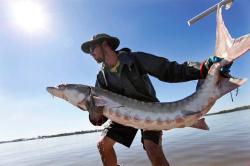
Matt Balazik with Sturgeon

Matt Balazik with Sturgeon

Matt Balazik, the sturgeon surgeon. Photo courtesy of Matt Balazik

Atlantic sturgeon are spawning again in the Chesapeake Bay. But they’ve been gone so long that we’ve forgotten the basic life history information that scientists need to boost their recovery. A species recovery grant from NOAA Fisheries should help.

In 1997, Dave Secor was a young fisheries biologist just starting his career at the University of Maryland. Like almost everyone else, he believed that Atlantic sturgeon, a species that has survived since the age of the dinosaurs, had been long gone from the Chesapeake Bay. But that year a small number of juvenile sturgeon turned up, and they were too small to have immigrated from elsewhere.

“That was a major surprise,” Secor said.

Though sightings were rare back then and still are today, the population of sturgeon that spawn in the Chesapeake Bay has grown. In 2012 that population was added to the endangered species list. Usually a listing is bad news, but in this case it was cause for celebration.

Now scientists are racing to find out what’s driving the recovery so they can reinforce it. Their efforts recently got a big boost when NOAA Fisheries awarded a three-year, $1.75 million species recovery grant to the Maryland Department of Natural Resources and the Virginia Department of Game and Inland Fisheries.

Atlantic sturgeon were prized for their flesh and for the caviar made from their roe. But fishing for them in the Chesapeake peaked in the 1890’s, and no one alive today has seen a healthy run of sturgeon in the Bay. Even basic information about their life history was forgotten long ago, and this is a problem for the scientists working to protect them.

“We need to find out where they’re spawning so we can protect that habitat,” Secor said. Scientists also hope to locate their nursery grounds and to identify the biggest threats to their recovery. Ship strikes and poor water quality are among the top suspects.

“This recovery may be part of a cycle,” said Secor. “If we don’t pursue this now, we may not see it again for another 20 or 30 years.”

A Fish That’s Hard to Follow

But finding their spawning grounds is difficult, not least because there are so few of them out there. To solve that problem, scientists will use the new funding to tag about 240 sturgeon with acoustic transmitters. That will allow scientists to track their movements in the Bay.

Atlantic sturgeon spend most of their time at sea, travelling up and down the shelf break where they plow the bottom with their snouts, eating worms and crustaceans. Like salmon, they return to their natal streams to spawn.

Unlike most salmon, however, which spawn once and die, sturgeon make the spawning run repeatedly. They can live up to 60 years and can grow up to 14 feet (4.3 meters) and 800 pounds (370 kg).

Matt Balazik, a postdoc at Virginia Commonwealth University, is doing most of the tagging. The acoustic tag, about the size of a Sharpie marker, is inserted into the belly of the fish through a small incision. The minor surgery takes less than five minutes, and the unharmed fish are quickly sent on their way.

The tag emits a coded sound roughly once a minute, a signal that’s recorded whenever the fish passes within range of a receiver. Each tag has a unique acoustic signature, allowing scientists to track individual fish.

“You can think of the tag as like an EZPass,” said Matt Balazik, referring to the device that motorists in the Northeast attach to their windshields, “and of the receivers as toll booths.”

An acoustic signal is used because sound waves travel well underwater. Radio waves would dissipate quickly in the murky Bay.

Collaboration is Key

Scientists have tagged sturgeon all along the Eastern seaboard, but the Chesapeake is uniquely difficult because it’s a meta-estuary-an estuary comprised of many smaller estuaries-and it’s the largest one in the nation.

“In the Hudson it’s a piece of cake,” said Dave Secor. “A few receivers bank to bank and you’ve got the river covered at that point.” The mouth of the Chesapeake, on the other hand, is 20 miles wide.

But the tagging project got a big boost from the Navy, which recently installed an array of 58 receivers, most attached to Coast Guard buoys, throughout the mouth of the Chesapeake Bay.

The Naval Base at Norfolk, Virginia is the largest in the nation, and it’s one of several naval installations in the lower Chesapeake Bay. As a federal agency, the Navy is required to minimize interactions with endangered species.

“We want to know where and when sturgeon are utilizing the Bay,” said Carter Watterson, a Navy biologist. “Once we know that, we can work to minimize any impact we have on the species.”

The Navy will benefit from the tags that Maryland and Virginia researchers deploy because they increase the value of the receiver array. And the state researchers will benefit every time Watterson sends them tracking data on their fish.

The buoys the receivers are attached to also record environmental data, allowing scientists to correlate sturgeon activity with ocean conditions. This will be key to understanding how those conditions affect the fish, and in particular how sensitive the fish are to the low oxygen levels that plague the Bay every summer.

A Living Fossil

Sturgeon have existed in pretty much the same form for at least 85 million years. A living fossil, they survived the meteors that killed off the dinosaurs and many other catastrophes since. “They’re designed to handle anything,” Matt Balazik said. “Except humans.”

But don’t write them off just yet. “The fact that they’re still hanging in there makes me a bit more optimistic than I was earlier in my career,” said Dave Secor, the biologist who was surprised to see juvenile sturgeon in the Chesapeake Bay in 1997.

“What sturgeon have taught me as a scientist,” he said, “is that sometimes it can be delightful when you’re wrong.”

Top Six Tournament at Lake Oconee

Several years ago six members of the Flint River Bass Club fished the Georgia BASS Federation Nation Top Six tournament at Lake Oconee. There were 13 clubs competing for top club in the tournament and the individuals were trying to finish in one of the top 12 places and advance to the Southern Regional.

In a very unpleasant surprise a cold front came through on Friday and brought record setting cold weather. The bass seemed to go into shock and the fishing was extremely tough. After fishing two days it took only a little over nine pounds to make the state team.

Five members of our team camped and it was all the heater in my little motor home could do to keep it “almost” comfortable at night. Jordan McDonald was my partner and we slept under several blankets. During the days fishing we wore all the clothes we had trying to stay warm.

On Thursday Jordan and I fished hard all day but neither of us caught a keeper bass. We did watch another fisherman catch some fish near us. On Friday it was much colder and the wind was awful. I managed to catch one keeper jigging a spoon in 22 feet of water.

Friday night I drew as a partner for Saturday the guy we had seen catching fish on Thursday. We made our plans for Saturday based on his thoughts we could catch fish on his pattern after lunch.

Saturday dawned extremely cold. We fished hard all day, hitting docks I like to fish until about 11:00 then going to his pattern for the rest of the day. Neither of us caught a keeper.

During the night one of our team members got sick and could not fish. I agreed to leave my boat on the bank and fish with Mike Morris, our sick team members partner for the day. It was a good decision. Mike is an excellent fisherman and had weighed in eight pounds on Saturday. We fished the same areas the same ways I had fished on Saturday but Mike got a limit weighing 9.5 pounds and ended up second overall.

I managed to catch four keepers weighing a little over 7 pounds and came in 22nd overall. To my great disgust I lost a big bass that just pulled off for no apparent reason. That fish would have put me on the team if I had landed it.

To add insult to injury, my partner on Saturday fished with Flint River team member JJ Polak on Sunday. They fished the same places he and I had fished on Saturday but he landed four bass weighing 10.5 pounds and made the team.

It always amazes me how different fishing can be one day to the next and how it changes for me. I will never understand how I can work hard one day and not catch a fish and do the same thing the next day and have a good catch. I guess that is why we call it fishing, not catching!

Do Many Gulf Fish Species Rely On Decommissioned Oil Rigs?

Research Finds More than 50 Fish Species in Gulf Rely on Decommissioned Rigs
Species include fish that are key to fisheries economy
from The Fishing Wire

School of fish around a rig

School of fish around a rig

Divers capture a school of amberjack and red snapper above MI-A-7, a cut-off oil and gas platform located approximately 50 miles east of Port Aransas, Texas.(Credit: Dr. Matt Ajemian)

CORPUS CHRISTI, Texas – Early research from Texas A&M University-Corpus Christi’s artificial reefs monitoring program shows that decommissioned oil and gas structures converted to artificial reefs are supporting a high abundance and diverse fish assemblages within the Gulf of Mexico.

The new data from the western Gulf shows a high abundance of red snapper living around these structures for years at a time. Researchers in the Harte Research Institute for Gulf of Mexico Studies (HRI) at Texas A&M-Corpus Christi say 52 fish species from 18 families have been identified at 13 surveyed sites near Port O’Connor, Port Aransas, and Port Mansfield, Texas (http://tamucc.edu/news/2013/10/images/artreef_allsitemap.jpg).

“There’s a lot of evidence that the red snapper populations we see today wouldn’t be here if we didn’t have all of these converted oil and gas platforms,” said Dr. Greg Stunz, Director of the Center for Sportfish Science and Conservation. “Red snapper is the most economically important fish in the Gulf of Mexico.”

Stunz, who is the Principal Investigator for a recently awarded grant, says that in addition to supporting a variety of fish populations, artificial reefs lure commercial fishermen, recreational fishermen, and divers; benefiting many Gulf Coast economies.

Fish around an oil rig

Fish around an oil rig

Schools of gray and red snapper congregate around the deck of a toppled oil and gas platform. This is a structure located 70 miles southeast of Port Aransas. (Credit: Schmidt Ocean Institute).

This new evidence is the reason the HRI’s newly-formed Center for Sportish Science and Conservation was recently awarded $600,000 by Texas Parks and Wildlife and $50,000 from the Fondren Foundation to expand their studies on artificial reefs. Researchers will monitor sites around the western Gulf and log the amount and types of marine life that create homes around the reefs. They will use these data to determine how to sustain these new “fish homes” including finding what characteristics are best suited to become habitats for each type of fish and to find the long-term effects of keeping rigs in the Gulf after they stop functioning.

“There are about 4,000 of these rigs in the Gulf of Mexico,” said Stunz. “About 75 percent of those will be gone in the next 20 years, so we are very concerned that we get these rigs into reef programs so that they continue producing fish.”

Data collected as part of the HRI’s “South Texas Artificial Reef Monitoring – Fish Community Assessment along the Coastal Bend” grant over the next four years will help maximize the benefits from artificial reef structures and assist scientists in better understanding how to continue sustaining fisheries for generations to come.

Red Snapper caught around an oil rig

Red Snapper caught around an oil rig

A scientist removes large red snapper captured from vertical longline gear set on an artificial reef, and collects tissue samples from the red snapper.

“Up until now, there has been very little evidence for what’s happening on artificial reefs on this side of the Gulf,” said Dr. Matt Ajemian, Assistant Research Scientist and Co-Principal Investigator. “One of our major upcoming projects will be to set up an array of acoustic receivers at different artificial reefs and track fish movements among them to determine the types of reefs these animals prefer to live on.”

The “South Texas Artificial Reef Monitoring” program works to enhance the effectiveness of current conservation and management initiatives in Texas, which has one of the largest rigs-to-reef programs, and throughout the Gulf of Mexico. The project is also set to serve as an educational tool, providing research experience for students at Texas A&M-Corpus Christi.

About the HRI: The Harte Research Institute, an endowed research component of Texas A&M University-Corpus Christi, is dedicated to advancing the long-term sustainable use and conservation of the Gulf of Mexico. Expertise at the Harte Research Institute (HRI) includes the consequences and long-term effects of the Deepwater Horizon oil spill. The Harte Research Institute is made possible by an endowment from the Ed Harte family. For more information, go to http://www.harteresearchinstitute.org/.

About Texas A&M University-Corpus Christi: Offering more than 60 of the most popular degree programs in the state, Texas A&M-Corpus Christi has proudly provided a solid academic reputation, renowned faculty, and highly-rated degree programs since 1947. The Island University has earned its spot as a premier doctoral-granting institution, supporting two research institutes and 10 research centers and labs. Discover your island at www.tamucc.edu.

November Tournaments and Fishing Trip

A few years ago on a Monday I met Bobby Ferris at Jackson Lake to get information for a December Georgia Outdoor News article. For this “Map of the Month” article Bobby discusses patterns for catching bass at Jackson in December and the baits he would use. We then marked 10 spots on a map of the lake where you can use those patterns and baits to catch bass.

I met Bobby several years ago when he worked for Central Georgia EMC and lived near Jackson. Since then he has transferred to Southern Rivers EMC and moved to Lamar County. We have fished together a good bit over the past few years and Bobby joined the Flint River Bass Club. Last year in that club he won 7 of the 12 tournaments and this year he has won two of the seven he has fished.

Bobby and partner Donnie Schafer fish the Highland Marina Tournament Trail on West Point and they finished 8th overall this year, quite an accomplishment when fishing against teams that fish West Point almost every day.

Two weeks ago Bobby and Donnie fished the Potato Creek Bassmasters Buddy tournament at Lake Sinclair and won it with five bass weighing over 18 pounds. That is a fantastic catch in any tournament. They also had big bass in that tournament.

Monday Bobby caught two largemouth at Jackson, one weighing about 4 pounds and the other about 5 pounds. He also had several spotted bass weighing around 2.5 pounds each. His best five that day would have weighed about 16 to 17 pounds if he had been fishing a tournament. Those bass hit topwater plugs.

Unfortunately, that pattern is probably over for this year after the cold front came through this week. Bass will be on the rocky point pattern we discussed in the article and it should work for most of the month. Last year on New Year’s Eve Bobby caught a 9.5 pound bass at Jackson and had five weighing about 24 pounds that day, and the patterns he caught those fish on are in the article.

Bobby is on Team Triton, qualifying for this honor through his bass fishing. The Sports Center in Perry is his sponsor and he gets his boats through them. Bobby really likes Triton bass boats and says they perform good and are excellent fishing platforms.

Check out this article and give Jackson a try in December. It should be excellent for spotted and largemouth bass.

The next weekend the Potato Creek Bassmasters fished their November tournament at Lake Sinclair. Lee Hancock had the only limit and his five bass weighed 7.66 pounds, giving him first place. He also had big bass with a 2.08 pound fish. Wade Crawford had four weighing 4.67 for second, Don Schafer had four weighing 4.27 pounds for third and Todd Stoerkel had two weighing 1.70 for fourth.

There were 15 members of the club in this tournament and they caught 21 keepers weighing about 26 pounds. Five members did not catch a keeper bass in this eight hour tournament.

The Spalding County Sportsman Club also fished our November tournament that weekend and we were at West Point. Kwong Yu had a five fish limit weighing 8.64 pounds and won. Brent Terry also had a limit and his 8.02 pounds gave him second place. He had a 3.97 pound bass that was big fish. Jason Wheeler was third with two bass weighing 2.42 pounds and Butch Duerr had 2 weighing 2.30 for fourth.

Only seven members of the club fished this tournament and we weighed in 18 bass weighing about 26 pounds. There were no zeros but two of us had only one fish each. There were only 4 largemouth weighed in, all the rest were spots.

I came in dead last in this tournament with one small spotted bass. The fishing was very tough for me and I got only three bites from bass all day, catching the one keeper and two spots about 11 inches long. Several people caught bass on topwater baits that morning. I had one bite on top and it was a nice crappie.

Most of the keepers came on crankbaits, jigs and worms. There was no one strong pattern but shad were everywhere.

Fishing should have been much better this time of year at Sinclair and West Point. Maybe the unusually warm weather was the problem. If so, the cold this week should help!

Rockfish Poachers Indicted After Two-Year Investigation

Suspected Rockfish Poachers Indicted After Two-Year Investigation

by kking
Maryland Natural Resources Department
from The Fishing Wire

Poachers gill net

Poachers gill net

AV Sandusky pulls up a massive, old gill net found at Bloody Point from the poaching operation.

Conservationists, watermen and anglers are applauding efforts by the Maryland Natural Resources Police and its federal law enforcement partners in obtaining indictments of four Talbot County watermen accused of running a striped bass poaching ring that spanned four years and was worth nearly a half million dollars on the wholesale market.

The 26-count indictment handed down Thursday provides the link between the actions of the four men and the discovery of illegal gill nets filled with fish found off Kent Island in February 2011. The incident triggered a massive police enforcement effort, generated a series of tough laws from the General Assembly and closed the commercial striped bass season three weeks early to prevent overfishing.

“Marylanders can be proud of these officers, whose hard work, long nights and nonstop investigative efforts have paid off,” said Governor Martin O’Malley. “Poachers steal from honest anglers, watermen, and all of us who responsibly enjoy our State’s natural riches and respect the livelihoods of the hardworking men and women who rely on this fishery.”

The indictments by a federal grand jury in Baltimore came after a more than two-year joint investigation by NRP officers, the U.S. Fish and Wildlife Service and the Justice Department, who painstakingly shifted through thousands of documents and reports to construct a paper trail of the crimes.

“We hope that Maryland citizens are beginning to realize that these are crimes against the State,” said Tony Friedrich, executive director of Coastal Conservation Association Maryland. “All of our best science is based on reliable catch reports. By falsifying data and poaching Maryland’s State fish, they are not only putting the entire stock at risk but making a mockery of our combined efforts to conserve the striped bass population.”

Beginning in January 2007, Michael D. Hayden, Jr. and William J. Lednum, both of Tilghman Island, and unnamed others conspired to overharvest striped bass and falsify records submitted to the Maryland Department of Natural Resources. Their illegal catch was sold to wholesalers in Maryland, New York, Delaware and Pennsylvania.

In addition, the grand jury found that in 2011, Hayden, Lednum and two other watermen – Kent Sadler, of Tilghman Island, and Lawrence “Daniel” Murphy, of St. Michaels – attempted to catch about 20,000 pounds of striped bass before the start of the 2011 commercial season using gill nets illegally set and left unattended in the Chesapeake Bay.

Hayden also was indicted on one count of witness retaliation and two counts of witness tampering in connection with the grand jury probe.

Billy Rice, chairman of the Tidal Fisheries Advisory Commission, expressed his gratitude on behalf of the commercial fishing industry for law enforcement efforts.

Illegally caught rockfish in gill net

Illegally caught rockfish in gill net

Officers discover illegal attempts to harvest fish using a gill net as part of this poaching ring.

“Poaching does not reflect a majority of our industry,” Rice said. “It hurts our livelihood and our image. We hope these indictments send a strong message.”

Bill Goldsborough, chairman of the Sport Fisheries Advisory Commission, praised the State and federal partnership that led to the indictments.

“Egregious fishing violations are major challenges for fisheries management,” said Goldsborough, also a senior scientist with the Chesapeake Bay Foundation. “Effective enforcement like this is essential to healthy fisheries.”

As part of any sentence should the watermen be convicted, the federal government will seek to seize Hayden’s 38-foot work boat, his 2009 pick-up truck and all his fishing gear and Lednum’s 46-foot work boat and his fishing gear.

If these watermen are found guilty they could permanently lose their Maryland commercial fishing privileges.

As part of its continued effort to better protect Maryland’s public fishery, DNR most recently introduced the Maritime Law Enforcement Information Network – MLEIN, a network of radar units and cameras that scans the Chesapeake Bay for law breakers.

Thanksgiving Fishing

Most people are thinking hunting, not fishing, this time of year but fishing can be excellent right now. For many years I spent Thanksgiving Holidays at Clark’s Hill fishing for bass, hybrids and crappie. I often had the lake to myself.

Now fishing is more popular in the colder parts of the year but the lakes are much less crowded. There are almost no skiers and skidooers and far fewer fishermen are on the water since many are in the woods. But the weather is often beautiful and fish sometimes cooperate.

Friday before last I went to Bartlett’s Ferry to get information for a Georgia Outdoor News article. I met Tommy Gunn there and he showed me some of his favorite ways to catch December bass on the lake. We fished some of the ten spots that will be on the map in the article. Bass were already starting to feed on them.

Tommy lives just over the Alabama line in Cusseta and makes Jawbreaker Jigs to use and sell. One of his patterns in the winter is to flip and pitch a jig and pig to shallow water cover like docks and he caught a four and a half pound largemouth bass on that pattern.

We also fished points and drops with jig head worms and caught several spotted bass. None of the spots weighed over about two pounds, typical of lakes where the spot population has exploded. You can catch a lot of spots but they just don’t get very big compared to largemouth.

That trip gave me confidence in a jig and pig. The Flint River Bass Club fished Jackson Lake last Sunday for a November tournament. Al Bassett called me Saturday afternoon and told me his club had a tournament at Jackson that day and it was won on spinner baits, so I made sure I had one tied on, but I also tied on a jig and pig.

Al said they caught fish on wind blown points and it was real windy Saturday. Sunday dawned cold and calm and we never did get much wind. I started with a top water bait then tried crank baits and spinner baits but did not get any hits. At 9:00 I got a bite on a jig and pig and landed a 14 inch spotted bass, my first of the day.

That got me throwing the jig and pig a lot and a few minutes later I made a long cast down the bank across where an old dock used to be. There were still two posts in the water and I threw between them and the bank and got a hit. When I set the hook a nice bass came to the top but went back down. I pulled it up and down several times, thinking I was hung in brush.

About that time I remembered there is an old concrete and rock pier under the water there. I had thrown across it and the fish hit on the other side. I was pulling the fish to the top then it would go back down.

I finally got the fish over the pier and it came to the boat fairly easily. I guess I had knocked it against the rocks too many times and took the fight out of it. The fish was a 3.71 pound spot, a big one and they usually fight hard. I was lucky I was using 20 pound P-Line Fluorocarbon line. It was frayed for about eight feet but it held up.

A few casts later I got another keeper spot then cast onto the apron of concrete coming out of a boat house. When my jig fell off the end into about a foot of water I saw a fish swim off and thought I had spooked it. Then I realized it had my jig. I was lucky to land a three pound largemouth. That was my fourth bass by 10:00, in one hour.

The rest of the day was slower and I caught three more keeper bass, two of them spots and one largemouth. The rest of the club had a pretty tough day, too. Many said they had been catching fish on spinner baits up until Sunday but they did not hit them during the tournament.

We had ten fishermen in the tournament. My five fish limit weighed between 11 and 12 pounds and I placed first. The 3.71 pound spot was big fish. Tommy Reeves also threw a jig and pig and had a limit weighing between eight and nine pounds for second. I can’t remember who came in third but Tony Evans placed fourth.

If you get a chance, go fishing this winter. You might be surprised at what you can catch.

Thanksgiving Memories

This holiday season always brings bittersweet memories. I am very thankful for my mother and will forever remember the wonderful things she did for me and that we did together. But she died Thanksgiving week 13 years ago so all the memories are tinged with sorrow.

One of my favorite memories happened at our place at Clark’s Hill. It was the middle of a warm June day and I was taking a break after lunch. When I left our camper and walked up the hill to the bath house I saw mom fishing under the dock by herself.

A few minutes later walking back down the hill I saw mom fighting a fish. I got close enough to hear her talking, coaching herself, saying things like “Play him slow” and “Keep the rod tip up.” I stood by a pine tree for several minutes enjoying the scene before going to the dock and helping her land a nine pound carp.

Mom was totally happy fishing. She would fish anywhere there was water and didn’t mind fishing alone or with others. She and another lady neighbor used to take our truck and 12 foot jon boat to the local Public Fishing Area. Both of them were in their sixties but they would go out and fish all day. Dad fixed up a winch system so they could load the boat by themselves. I have a mounted 2 pound, six ounce shellcracker she caught in 1982 on one of those trips.

Another great memory also involves the Public Fishing Area we called the “state ponds.” Mom and I had fished for several hours, me casting for bass and her fishing with live worms for anything that would bite. We took the boat out of the pond and I walked out on the dam. In the spillway below the pond I could see bream in the pool of water.

Mom and I got our rods and reels and her bait and crawled down the dam to the pool of water. For the next couple of hours we caught bream after bream. We had contests to see who could catch the most on one piece of bait and who could catch the smallest fish. That was a tough contest since none of the little bluegill were over three inches long.

That was one of the many times I totally lost track of time while fishing with her.

Mom was deathly afraid of snakes but loved fishing even more. One day as we walked down to my bass boat tied up under the dock at Clark’s Hill we saw a snake slither off the dock, onto the boat and into the hole at the transom where the controls came out. I told mom there was no way I could get the snake out.

After thinking about it for a few minutes mom gingerly got into the boat. We fished all afternoon but I don’t think she ever completely relaxed. I knew the snake was happy in its dark hole and would not come out, especially with us moving around and talking, but I don’t think mom’s feet ever rested on the deck of the boat in one place very long that afternoon.

Many nights mom went out with me to check trotlines and bank hooks. She was happy holding the light or helping bait hooks. Several times we would bait up our lines, get out on the bank, build a fire and fish with rods and reels for several hours while waiting on catfish to find our set hooks. I remember sitting by the fire with her and talking about anything and everything, but don’t remember whether we caught anything or now.

One summer I found out I could go out with a spotlight at night, find carp in the shallows and gig them. Although I thought it was legal to kill a carp any way you could I found out later gigging them, especially at night with a spotlight, was not legal. We still had lots of fun.

I would gig a carp then raise it out of the water. Mom would sit on the back casting chair and would open the live well as I swung the carp over the side. I would put the gig over the lip of the live well and she would drop the lid, letting me pull the gig out while leaving the carp inside.

One night when mom opened the live well my dog Merlin jumped as I brought a crap over the side. She jumped right in the live well. Mom and I laughed till we cried at the sight of Merlin’s head sticking out of the live well, with a look at said “get me out of here!”

I am glad I have such good memories.

Why Tag Bonefish?

Collecting bonefish for tagging

Collecting bonefish for tagging

BTT Bonefish Tagging Efforts Expand to South Andros

by Zack Jud
Bonefish & Tarpon Trust
from The Fishing Wire

Last month, Bonefish and Tarpon Trust’s Bahamas Initiative waded into the fabled waters of South Andros. While a handful of bonefish had previously been tagged by guides in South Andros, this was the first large-scale tagging effort on the island. As most anglers probably know, catching a tagged bonefish (or any tagged fish for that matter!) is a once in a lifetime experience. From a research perspective, the more fish we have tagged in a given locale, the more likely we are to get valuable data from recaptures – data that we will use to identify growth rates, movement patterns, habitat use, and overall health of the area’s bonefish population.

Bonefish being tagged

Bonefish being tagged

Despite a lingering cold front and 25 knot winds, the BTT-led research team managed to tag more than 650 bonefish in four long days on the water. To even their odds in the face of ugly weather, the team reluctantly set down their fly rods (well, for the most part), and instead relied on a 250′ long soft mesh seine net to capture bonefish for tagging. Working closely with guides from Deneki’s Andros South Lodge, the researchers used the net to quietly encircle large, and oftentimes fast-moving, schools of bonefish. Unfortunately, herding bonefish into a net is a bit like herding cats…they rarely go where you want them to. All too often, a school will make a last-minute U-turn, slipping right back out of the closing net. To put the odds in their favor, the BTT team asked the guides to try to find the largest schools of bonefish possible, figuring that with enough fish in the water, they’d be bound to get a few to swim into the net. Well, the guides clearly know their fishery intimately, putting the researchers onto many huge schools of bonefish, some containing more than 1,000 fish. Worries about catching enough fish during the trip were quickly replaced by worries about running out of tags!

In the first day of tagging, a single net haul resulted in the capture of more than 400 fish (not counting several hundred more fish that managed to stay out of the net as the big school split in half). On day two, in the midst of a raging lightning storm, the team again managed to capture a huge school of bonefish, probably numbering close to 500 fish. Facing fading light and a long, rainy run back to the dock, the crew made the tough decision to call it a day before they had tagged the entire school. They ended up releasing several hundred untagged fish so they could make it home before dark. There’s just that many bonefish in South Andros! Rapidly deteriorating weather reduced the number of fish caught on the last two days of the trip, but the crew still managed to tag fish in all of the popular South Andros fishing spots – Grassy and Little Creeks, the west side, and the southern cays. We don’t want to tell a fish story, but there are some awfully big fish swimming around South Andros wearing a new piece of numbered jewelry, courtesy of BTT.

On BTT research trips, the work doesn’t stop when the boats are parked and the nets are out of the water. An important part of these trips is explaining BTT’s conservation efforts to local guides and lodge owners. Without the continued support of these folks, our work wouldn’t be possible. I am happy to report that our efforts to protect Andros’ bonefish into the future were very well received, and all of the guides and lodges in South Andros seem eager to report recaptures back to BTT. With the busy season cranking up, it’s only a matter of time before clients begin catching our tagged fish. Despite the economic value of the bonefish fishery on Andros, we still have many unanswered questions about the fish that call the island home. How big of an area do these fish use during their life? How quickly do they grow? Where do they spawn? What habitats are most important for the conservation of the species? What do we need to do to assure that the incredible South Andros fishery is protected for years to come? Although it will still be some time before significant numbers of recaptures start rolling in, the work we began last month is the first step in coming up with answers to these important conservation questions. To become a member or support our efforts in the Bahamas or support any of our other great projects, visit: www.bonefishtarpontrust.org

Getting Your Fishing Equipment Ready For Winter

Is your fishing equipment ready for winter weather?

A sign at my lawnmower shop reads “Man who leaves lawnmower outside all winter will not mow grass in the spring.” That not so subtle hint should be a warning to fishermen, too. If you don’t prepare your equipment for winter storage, you won’t be a happy fisherman when the weather gets right for that first trip next spring.

Make a checklist so you are sure you take care of all the important things you need to do. These will cover most of them but you should add any others that work for you.

Where you store your boat for the winter is important. If you can store it inside you will be far ahead of game. If not there are many more things you must attend to for the coming harsh weather.

Your motor is the most likely problem after sitting up all winter. Gas deteriorates with time and can foul your engine. The newer blends of gas with Ethanol in them are bad for outboard motors, too. If possible, buy gas with no Ethanol added the last two times you fill up each season so no alcohol is left in the system. It is best to store your boat with a full tank of gas, too.

Lower your motor till it is straight up and down and store in that position so water runs out and does not collect in it. Add a gas stabilizer like Sea Foam to your last two tanks of gas so it works through the motor as you run your boat. It will clean your motor and you are ready to store after the last use.

You can also disconnect your gas line and let the motor run until all the gas in the system is burned up, but this also removes the oil. Once the motor is running stabilized gas, or after it stops if you run it dry, spray an engine fogging oil into the air intake until the motor stops running. If it is already stopped keep turning the motor over until you see the fog coming from the exhaust port.

Remove spark plugs and spray more fogging oil into the cylinders. Turn the flywheel to spread the oil inside. Have a new set of spark plugs ready for the spring, but it is best to wait to install them until you can run your motor one time to burn off the fogging oil. New plugs installed now will be fouled by that first trip.

Drain your lower unit oil and refill with new oil. If you see water in the oil or if there are metal filings in it, you will need to have it checked for new seals or repair work. Put in a new water pump. Water pumps in outboard motors wear quickly and it is a good idea to replace them often.

Spray all linkages and connectors in your motor with a good oil spray like WD-40. Disconnect manual steering cables and make sure no water is in them, and force grease into them if they don’t have a grease fitting. Grease all fittings for steering and motor mount bearings. Put a light coating of grease on the starter bendix and shaft.

Park your boat and raise the front. Pull the drain plug and leave it out. This lets all water drain from it and will keep water from collecting in it during the winter. Disconnect your batteries, make sure they are filled with water, clean the terminals and connectors and put a light coating of grease on them, and charge the batteries. Keep a trickle charge on them or check often to keep fully charged all winter long.

Take all equipment out of the boat and disconnect and store all electronics inside after cleaning them. Spray all connectors with an oil spray. Clean and store life jackets where vermin won’t chew on them. Check and store expendable equipment like fire extinguishers and flares, making sure they are still good. Put fishing equipment aside for later work.

Take off your prop and grease the prop shaft. Check for damage to the prop and get it serviced if necessary. Be sure to use the correct kind of cotter pin to hold your prop nut on if it requires one. Replace prop and tighten to specifications for your motor.

Check trolling motor bolts and fittings and tighten. Remove the prop and make sure no line is under it, and the seal is still good. Grease all moving parts of the mounting system and the cable.

Wash and wax your boat and trailer, including the motor cover. This removes dirt and stains that may set over the winter and be almost impossible to remove later, and the wax protects the finish.

If you have power steering on your boat, check the fluid level. Check the fluid level in your power trim. Disconnect the speedometer tube and blow the water out of it. Check all cleats and other fittings and tighten all bolts and screws, especially on seats. Spray all seats and other similar surfaces with a good vinyl spray to protect them.

When the boat is clean and dry, put a cover on it if it stays outside. Make sure the cover keeps rain, snow and ice out of the boat but has some air circulation so moisture won’t build up inside from condensation. Secure and support the cover so it won’t blow off and ice and snow won’t collapse it.

Jack up your trailer and block it so the tires are off the ground, and leave it that way. Pump up tires to recommended inflation, and if you can store tires inside, do so. Repack wheel bearings and check surge brakes for wear. Check tires for uneven wear and get them balanced or aligned as needed. Cover your tires to protect them from the sun if they are outside. Grease your tongue jack and hitch connector, and spray oil spray into both male and female light connectors.

Make sure all lights are working and sealed, with no water inside. If you see water inside, take the cover off, dry them out and spray with a oil spray. Replace bad bulbs and cracked lenses, and secure all wires to the trailer that may have worked loose.

This is a good time to sort all your tackle, making a list of what you need to replace. Sharpen hooks, replace rusty hooks, repair any damaged plugs and replace stiff spinnerbait skirts. Store plastic worms in bags that will not deteriorate. Clean tackle boxes and refill with your favorite baits.

Rods should be wiped down with a oil spray and the reel seat cleaned and oiled. Check all guides for rough spots. Visually inspect them but a cotton Q-Tip or piece of woman’s hose run through them will show tiny cracks that can cut your line.

Reels should be taken apart, cleaned and oiled, reassembled and stored. This is a good time to send a reel off to a good repair shop. Many will clean your reels for a small fee and replace damaged or worn parts for an additional fee.

Remove all monofilament type lines. They don’t hold up well during the winter, so wait until spring to fill your spools with new line. Put a small sticker on your reel to remind you of the type and test line if you need to. Check braided lines for wear and replace as needed.

Some of us are fortunate and can fish all winter, using our boat and tackle often enough to keep it in good working order. But even for those fishing year round, an annual “winter cleaning” will keep everything in top condition. Do it on those days you really don’t want to be on the water even if you can, so you will be ready for the good days when they come.

Two products will make winterizing your boat easier and take care of many problems. An oil spray like WD-40 will clean surfaces, protect against rust and dry moisture when sprayed into couplings, moving parts and sockets. A light coating will protect all winter long and not cause problems in the spring.

Adding a gas stabilizer and engine cleaner like Sea Foam to your fuel on a regular basis will help keep your engine running smooth and keep gas from gumming up your engine over the winter. Most important, it helps control the build up of moisture in your fuel tank and motor, a major problem since most brands of gas now contain Ethanol. Sea Foam is available gallon cans to keep cost down.