What Is Castable Sonar?

Castable Sonar

By Frank Sargeant, Editor
from The Fishing Wire

Sonar you can cast

Sonar you can cast

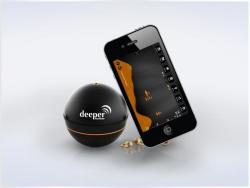
We get an remarkable assortment of information on amazing new goodies to make your fishing better, sometimes dozens in a day, but one that caught our eye recently was the “Deeper” castable sonar-a tennis-ball sized depth-finder you can carry with you anywhere, reading the data on your smartphone or tablet. The rig has some interesting possibilities.

The “Deeper” transducer is encased in a composite ball and weighs 100 grams-3.5 ounces. Where ever the Deeper sonar unit lands or drifts, it reads water depth and temperature, and also marks fish suspended off bottom as well as structure.

Spokesman Rolandas Sereika says the unit includes both narrow and wide beam– the narrow beam returns fish, structure, detail and bottom profile, while the wide beam provides broader search area for fish, baitfish and structure.

It sends this via Bluetooth wireless to your properly-equipped Apple or Android phone or tablet with the free downloadable app which also gives moon phases, air temp, solunar “best times”, Internet sharing of fish photos and other useful tools and info.

It reads to depths of 130 feet and has a Bluetooth range of about 150 feet. It has three line-ties so that you can cast it, troll it or lower it straight down from a dock, bridge or pier.

For kayak and canoe anglers, wade fishermen, shore anglers and bridge and pier anglers, the “Deeper” could be a big help. If you can drift your bait down that break line on every cast, it gives a huge advantage in many areas. You could also use them to avoid brushy snags. Plus, you don’t need a hookup to a 12-volt power source.

You can also probe the depth around a weedbed or dock without actually running your boat close to it and spooking the fish.

And there are some neat new mounts from RAM (www.rammount.com) and other companies for both cell phones and tablets used on kayaks and other small boats.

The Deeper system runs on a rechargeable lithium battery that functions for about 6 hours straight between recharges. The housing is watertight to 1 meter and shock-resistant. The system works with most phones and tablets, but be sure to see their website for compatibility. Price is $229. For details, visit www.buydeeper.com.

Fishing A Winter Tournament At Lake Sinclair

Last Sunday 18 members of the Flint River Bass Club fished an 8 hour tournament at Lake Sinclair. The water was cold and the breeze off it kept us cool all day, and the fish were hard to find. Ten of the members had keeper bass and there was a total of 20 bass weighing 44.02 pounds.

Bobby Ferris won with 11.17 pounds. He said he caught his bass fishing crankbaits around docks and weedbeds. David Grace had 6.41 pounds and his 4.09 pound bass was good for big fish in the tournament.

Donnie Willis and Tom Perdue fished together and finished 3rd and 4th. Donnie had 5.01 pounds and Tom had 4.45 pounds. I had two bass weighing 4.13 pounds for fifth and Roger Morrow, fresh from driving back from Seminole, placed sixth with 3.36 pounds.

I started out the day pretty good, landing a 3 pound bass on a spinnerbait near a grassbed the first place I stopped. Although I fished that area for over an hour with everything from spinnerbaits, crankbaits, worms, jig and pig and spoons, I never had another hit there.

Then about an hour later I landed my second keeper jigging a spoon under a school of shad back in a creek across the lake from where the first one hit. There were shad and fish all in that small creek, but I fished there for two hours without another bite. After the second one hit just after 9:00 AM I could not catch another fish even though several people said they caught bass in the middle of the day.

Congratulations to Bobby for winning this club tournament.

Are Anglers Satisfied with New Red Snapper Allocations?

Anglers applaud progress of red snapper reallocation

Today’s feature comes to us from Ted Venker of the CCA. It reviews progress on dividing the Gulf red snapper fishery equitably between recreational and commercial anglers–as always both sides would like a bigger slice of the pie. Fortunately, there’s a whole lot bigger pie to work with these days as snapper stocks have come roaring back–hopefully both sides will go away winners. –Frank Sargeant
from The Fishing Wire

Gulf Council moves forward with amendment to modernize allocation

By Ted Venker, Coastal Conservation Association

A nice red snapper

A nice red snapper

During its recent meeting in Houston, the Gulf of Mexico Fishery Management Council approved moving ahead with an amendment to update the allocation of Gulf red snapper between the commercial and recreational sectors, a welcome development hailed by the Coastal Conservation Association as long overdue. The Council approved the action by a vote of 9-6, with the representatives of all five of the Gulf state fishery management agencies voting for the measure to proceed.

“The current allocation of 51 percent commercial, 49 percent recreational was set using data from when Ronald Reagan was president. There is a strong case for reallocation based simply on the tremendous changes that have taken place along the Gulf Coast since then,” said Richen Brame, CCA’s Regional Fisheries Director. “Nonetheless, allocation decisions are always contentious and we applaud the Council for continuing its efforts to set the allocation based on modern criteria.”

The Gulf Council voted to send Amendment 28 – Red Snapper Reallocation out to a series of public hearings in the Gulf states and set a special meeting for May in New Orleans to take final action. Amendment 28 contains seven alternatives for reallocating red snapper that range from status quo to shifting up to 10 percent to the recreational sector. The Council selected Alternative 5, which directs 75 percent of any quota over 9.12 million pounds to the recreational sector and 25 percent to the commercial sector, as its preferred alternative. With the current Gulf-wide quota set at 11 million pounds, Alternative 5 would shift roughly 1.4 million pounds to the recreational sector in time for the 2014 season if approved.

“When the original allocation was set red snapper stocks were in far worse condition, and there are questions about the quality of harvest data even today, which makes the accuracy of an allocation set in the mid-1980s extremely suspect. It is quite possible that the allocation of this fishery has never been correct and that may explain some of the issues anglers are grappling with today,” said Brame. “We know that this is not a cure for all the problems in recreational management, but if Alternative 5 is approved it will do a lot to fix the foundation of this fishery and give us something solid on which to build. We would strongly encourage that the allocation be reviewed regularly from now on.”

Efforts to keep Amendment 28 on track were aided greatly by Sen. David Vitter (R-La.), who highlighted the issue during the nomination process for Dr. Kathryn Sullivan to be the Undersecretary for Oceans and Atmosphere, and Administrator of the U.S. National Oceanic and Atmospheric Administration (NOAA).

“This is huge news for Gulf Coast recreational anglers. After months of urging NOAA and the Gulf of Mexico Fishery Management Council to take action on Amendment 28, they have finally started moving on it,” said Sen. Vitter. “We intend to follow it through to completion. Proactively managing Gulf fisheries based on the best science and economics should always be the ultimate goal, and this is a positive step in the meantime that could lead to an economic boost for Gulf economies, something we can all support.”

Visit www.joincca.org for more information.

Are You Thinking About A Career In the Outdoors?

This is mostly for young people thinking about their future.

Ever thought about working outdoors? Would you like to have a job that would let you stay outside, working in the woods and on the water? There are many that allow that, and you can probably get one if you really want it – if you are young enough to plan for it!

I almost became a game warden in 1974. Back then a college degree was about all that was required, and a good family friend was head of enforcement. Also back then a lot depended on who you knew, and he told my dad if I wanted a job as a game warden I would have one.

In my second year of teaching, working outdoors seemed like a wonderful change! Then I really compared things. As a teacher I worked 190 days a year and made about $7000 per year. Game wardens worked at least 250 days a year and were on call 365 days each year. They often worked nights, weekends and any time they were needed, in all kinds of weather. And they made about $9000 to start.

In teaching, my time off was mine, except for the time I spent working on higher degrees. And I had every weekend off. When on the lake or in the woods I decided I wanted to be able to hunt game and catch fish, not try to hunt game violators and catch people breaking the fishing laws!

I stuck with education. I often wonder how my life would be different if I had become a game warden, though!

If you are still in school and want to work with the state, either as a game warden, fisheries biologists or technician, stay in school. Go to college and major in a field related to what you want – biology if you want that kind of job or something related to law if you want to become a game warden!

I have some suggestions for kids if you want to be a professional fisherman, too. Stay in school! Get a college degree, preferably one that will help you learn about fish – fisheries biology would be good.

Learn all you can about fish. Read all you can about fish and fishing. Read magazines, books and the Internet to learn what others know. Go fishing every chance you get and go to learn. Keep up with every fish you catch, noting all you can about catching it.

Start out fishing with clubs as soon as you can. Go to learn. Try to fish with good fishermen and learn from them. And think while fishing. Exercise regularly so you will have the stamina to stand on one foot in a rocking boat for 8 hours a day, day after day.

Mainly, have rich parents that can support you, or get a good job with lots of time off. That way you can support an expensive hobby. Most pro fishermen just barely make enough money to pay expenses.

I fished with a man from South Carolina a few years ago while working on a magazine article. He had to quit the pro circuits. He had dedicated two years to fishing the pro circuit and in 1998 he won 41,000, but had expenses of 40,000 above what sponsors paid. “Take home” pay of $1000 a year is not enough, even if you do get to fish every day!

Not long after that trip I fished with a pro fisherman from Alabama. He told me he won $60,000 during the year but said his contracting business is what kept him going. He could not win enough or get enough sponsors to really make it worthwhile, even winning that much in one year!

Trying to be a professional fisherman is tough – as tough as being a professional ball player – maybe even tougher. Being a game warden is not quite as tough, but those jobs are very competitive. You need to get a degree and make good grades. Talk to local game wardens and find how they go their jobs. Contact some of your fishing heroes and see what they suggest. If you want either of these kinds of careers, go for it. But be prepared for hard work, lots of study, and a long time getting to where you want to be!

‘Positive Visualization’ Helps Palaniuk Prepare for Tournament Events

‘Positive Visualization’ Helps Palaniuk Prepare for Tournament Events
from The Fishing Wire

Yamaha Pro Credits Technique with His Two Elite Wins

Brandon Palaniuk

Brandon Palaniuk

Brandon Palaniuk knows the mental part of professional tournament bass fishing can be as important as the physical part, so he relies on a technique known as ‘positive visualization’ to carry him through the tough days of competition. It’s something the Yamaha Pro learned as a high school wrestler, and he simply continued when he began fishing professionally in 2010.

“I actually started before high school, when I was about eight years old,” remembers Palaniuk. “I was wrestling then in school, but didn’t really know what positive visualization was. I just did it because the coaches told us to.

“Then in high school, it became an important part of our practices. We would lie on the wrestling mats with the lights out, and the coach would walk us through every part of a match, from warm-ups to a take-down to winning and having the referee raise our hand in victory at the end of the match. It always ended in success, so it wasn’t hard to apply that process to bass fishing.”

The Yamaha Pro credits his two previous Bassmaster® Elite wins, in which he led from start to finish in each, as well as his runnerup finish in the 2013 Bassmaster Classic® to his positive visualization process. He has also learned that this technique is a major part of the training cycle for Olympic athletes in all disciplines. The key is always having the thought process end in success.

During his initial Elite Series win at Bull Shoals in 2012, Palaniuk caught his fish in deep water offshore, so he was casting only to a GPS point. He could see bass on his electronics, so as he lay in bed at night he imagined how the fish related to the structure he couldn’t see, how he needed to position his boat, and how he would make each cast. He continued the visualization process all the way through receiving the winner’s trophy.

“During the St. Lawrence tournament this past season, I also lay awake each night visualizing every detail of the 100-mile boat ride to my fishing spot in Lake Ontario,” he explains. “I would continue that thought process during the ride itself the next morning, visualizing how I would see the bass on my electronics, dropping a lure to them, and then landing them. I would go through this with every single fish, and then I would visualize the 100-mile ride back to the weigh-in, and holding up fish as the tournament leader.

“I would try to be as detailed as possible in my visualization, but at the end I always visualized myself winning.”

Prior to the 2013 Classic,® Palaniuk visited Grand Lake in February 2012, a full year in advance, and found the pattern he actually used during the event itself. Thus, he was able to spend 12 months visualizing very precisely how he would fish the tournament. He finished second by just over three pounds to fellow Yamaha Pro Cliff Pace.

“Sometimes my visualization process takes only about five minutes, and other times perhaps as long as 15 minutes,” he continues. “There are times, of course, when things don’t work out the way I would like them to, and when that happens, I visualize myself making a change in techniques, moving to a new location, and certainly making better decisions on the water. I try to turn that day into something positive I can do the following day.”

As the 2014 Classic® nears, Palaniuk admits he is using positive visualization nearly every day, often during early morning exercise runs through the Idaho countryside near his home. Throughout each entire run, he visualizes himself catching bass at Lake Guntersville, always making good decisions and adapting successfully to different situations.

“It’s difficult for someone who has never tried positive visualization to understand how valuable it is,” concludes the Yamaha Pro, “but it allows me to be more focused on what I’m doing, and it certainly helps me make the decisions I need to make. I really do believe it’s been the difference between winning and not winning for me.”

Why Stop Stocking Hybrids In Some Georgia Lakes?

The Georgia DNR announced in 2005 plans to stop stocking hybrids in Oconee, Sinclair, Jackson, and High Falls. That is the bad news. The good news is that stripers will be stocked in those lakes instead of hybrids.

Hybrids are a cross between a striped bass and a white bass. Stripers live in the ocean and run up rivers to spawn. White bass live in freshwater all their lives. Stripers get big – the all tackle record is 78 pounds, 8 ounces. White bass are much smaller, the record for them is 6 pounds, 13 ounces. The hybrid record is 27 pounds, 5 ounces.

Natural populations of striped bass live in the Atlantic Ocean and run up Georgia’s bigger rivers to spawn. Stripers need many miles of moving water for their eggs to survive, so rivers must flow freely with no dams on them. Some of our rivers, like the Savannah and the Altamaha with its tributaries the Oconee and Ocmulgee, support stripers.

Due to many factors the natural populations of stripers in the Atlantic that spawn in our rivers are threatened. One problem is hybrid bass that are stocked in lakes make their way through the dams and populate rivers below them. When in the rivers, they compete with the native stripers running upstream to spawn.

To lower this competition hybrids will no longer be stocked in lakes that feed the Ocmulgee and Oconee Rivers. Instead, striper will be stocked. Stripers can survive in lakes as landlocked fish but they generally can’t spawn since there is not enough free flowing water above the dams to allow their eggs to survive.

Stripers living in lakes get big though. The record landlocked striper weighed 67 pounds, 8 ounces. In some lakes both stripers and hybrids have been stocked since hybrids are usually easier to catch and have a short life span but stripers live longer and get much bigger. From now on only stripers will be stocked in those lakes.

If you fish those lakes you will have a better chance to catch a huge fish weighing over 20 pounds. Unfortunately, they will be harder to catch than the hybrids. On trips to one of those lakes right now you might expect to catch a dozen or more hybrids averaging about three pounds but in the future you will be fishing all day hoping to catch one or two big stripers.

At public hearings held by the DNR, most fishermen making comments were in favor of this change. Only time will tell if it will change your fishing.

There is a good striper fishery on the lower Savannah River when they run in to spawn every spring. Since 1988 it has been illegal to keep any stripers caught there since the population was in serious decline. In 1990 the DNR started stocking stripers in the river trying to build up the populations.

Stocking has worked well, and they are considering allowing fishermen to keep some stripers now. They are planning a two fish daily limit with a 27-inch minimum length on the Savannah River downstream of the Clark’s Hill Dam beginning in October 2005.

Hopefully, lowering competition from hybrids up the Oconee and Ocmulgee Rivers will allow the stripers that spawn in those rivers to thrive and establish a healthy population. Stripers are like salmon in that they return to the same river they were hatched in to spawn.

Stripers that live in the Gulf of Mexico are a separate subspecies and they run up rivers like the Flint and Chattahoochee to spawn. Currently there is no plans to change the stocking of hybrids in lakes that are on those rivers.

There has been a good fishery for landlocked stripers in Lake Lanier for many years. They are so numerous and big that trout can’t be stocked in the lake, stripers like them better then I like ice cream. It is probably our best striper lake.

If you fish for stripers at Lanier, watch for orange tags in the fish you catch. The DNR is tagging 500 stripers this month and offering you $5 to return the tag to them. Returned tags will help DNR fisheries biologists know how the striper populations are doing.

Kevin VanDam At the Bassmasters Classic

KVD Prepared To Deliver A KO In This Week’s Bassmaster Classic

Kevin VanDam

Kevin VanDam

BIRMINGHAM, Ala. — Watch him: Kevin VanDam says he is better prepared for the Feb. 21-23 GEICO Bassmaster Classic presented by Diet Mountain Dew and GoPro than he’s been for any of his other 23 Classic competitions.

And that also goes for the four Classics that KVD has won, said the seven-time Toyota Bassmaster Angler of the Year and 20-time Bassmaster event winner.

“Most Classics I’m scrambling right down to the wire trying to get ready. For this one, I feel prepared on all levels,” said VanDam, as he was hauling his bass rig Feb. 13 from his home in Kalamazoo, Mich., to Lake Guntersville, the 2014 Classic fishery, to arrive in time for the practice period.

“My tackle prep is done, my equipment is ready — and I feel prepared mentally,” he said.

VanDam prepared in a way he has not for any of his recent Classic appearances: He scouted Lake Guntersville.

“It was a very meaningful trip for me,” he said, “Lakes that have a lot of grass change from year to year. I’m hoping that seeing it last fall will help me.”

VanDam already knows Guntersville well. In his Bassmaster career alone, he’s been in 13 competitions on Guntersville. For the most part, those tournaments produced keeper memories. He won the 2007 Bassmaster Elite Series event on Guntersville. He had a ninth-place Elite finish on Guntersville in 2010. Pepper in a second, three thirds and one fourth-place finish over the years, and the confidence factor working for VanDam builds quickly.

Backed by such a history, he’s prepared to take chances to go after Guntersville’s largest bass. That’s what it will take to win this one, he said.

“It’s all or nothing. You have to be prepared to fail, have the guts to risk coming across the stage with nothing,” he said.

Guntersville’s huge bass population is a positive for all 55 competitors, VanDam said. The choices of where to fish along the sprawling Tennessee River impoundment are almost endless. But having so many choices can flip around to become a negative.

“It’s a ton of water to manage,” he said. “That’s going to be the biggest thing for me to overcome because I know so much of the lake. I’ll have to narrow it down based on the conditions. And it’s easy to get caught up catching fish in a certain area (during practice), then come Classic time, something might happen to make that area not as good as another.”

Not to mention that on Guntersville, there’s little water that can easily be eliminated from a game plan, he added.

There’s a new wild card in this Classic, too. It’s the frigid weather Guntersville experienced in January and so far in February.

“I’m not sure any of us really know the impact of that,” he said. “It’s unprecedented. Fishing’s going to be a lot tougher than a lot of people think. In the overall field, some will struggle. The few people who find the right area and patterns are going to make it look easy.”

At least one of those anglers will beat the five-fish-limit, three-day Classic weight record, VanDam said. The record, 69-11 in the 2011 Classic on the Louisiana Delta, will fall, he said. (And he’s the one who owns that record.)

“Everybody in the bass fishing world knows just how good the Tennessee River chain is,” he said. “I say Guntersville is the crown jewel of that chain. We’re about to showcase it to the world in a way that’s never been done before.”

Fans can catch the Classic in Birmingham at the Birmingham-Jefferson Convention Complex. Arena doors will open Friday, Saturday and Sunday at 3 p.m. for the weigh-ins. There’s no admission charge. Bassmaster.com will cover the weigh-ins live, and all online access is free.

To see the Classic competition on ESPN2, fans can tune into The Bassmasters on Saturday, March 1, at 10 a.m. ET for the first hour of five centered on the Classic. The Classic finale show will air in prime time — 8 p.m. to 10 p.m. ET — Sunday, March 2.

2014 Bassmaster Classic Title Sponsor: GEICO

2014 Bassmaster Classic Presenting Sponsors: Diet Mountain Dew, GoPro

2014 Bassmaster Classic Official Sponsors: Toyota, Bass Pro Shops, Berkley, Evan Williams Bourbon, Humminbird, Mercury, Minn Kota, Nitro Boats, Skeeter Boats, Triton Boats, Yamaha

2014 Bassmaster Classic Outdoors Expo Presenting Sponsor: Dick’s Sporting Goods

2014 Bassmaster Classic Official Apparel Sponsor: Carhartt

About B.A.S.S.
For more than 45 years, B.A.S.S. has served as the authority on bass fishing. The organization advances the sport through advocacy, outreach and an expansive tournament structure while connecting directly with the passionate community of bass anglers through its Bassmaster media vehicles.

The Bassmaster brand and its multimedia platforms are guided by a mission to serve all fishing fans. Through its industry-leading publications — Bassmaster Magazine and B.A.S.S. Times — comprehensive website Bassmaster.com and ESPN2 and Outdoor Channel television programming, Bassmaster provides rich, leading-edge content true to the lifestyle.

The Bassmaster Tournament Trail includes the Bassmaster Elite Series, Bass Pro Shops Bassmaster Open Series, B.A.S.S. Nation events, Carhartt Bassmaster College Series, Bassmaster High School Series, Bassmaster Team Championship and the ultimate celebration of competitive fishing, the Bassmaster Classic.

B.A.S.S. offers an array of services to its more than 500,000 members and remains focused on issues related to conservation and water access. The organization is headquartered in Birmingham, Ala.

Castaway Rod Pros At the Bassmasters Classic

CastAway Rods BASS Elite Series Pro Staffers Faircloth and Lowen Confident Heading into this Year’s Bassmaster Classic

BASS Elite Series anglers Todd Faircloth and Bill Lowen have quite a few things in common. Todd and Bill are two of the best anglers in the world, they both use CastAway Rods exclusively, and they’re both fishing in the upcoming 2014 Bassmaster Classic. That’s where the similarities end, however: Faircloth thinks he’s got a good shot at winning on Guntersville, while Lowen likes his chances of walking away with the coveted trophy.

While the two veteran pros have differing opinions on who is going to take the title, they do agree on what it will take to win. With weather conditions and water temps trending unusually cold, both Faircloth and Lowen are confident that finishing atop the leaderboard will require not only superior angling skills, but also versatility and adaptability.

“Right now, it looks like we’re in for an unusually cold Classic, said Faircloth. “But you never know, things could start to warm up right before the tournament begins. Those anglers that are able to make quick adjustments according to the conditions will have an edge over the rest of the field.”

Lowen shares Faircloth’s assessment. “This event brings together the best bass anglers in the world, so every competitor out there has the ability to win this thing,” noted Lowen. “It’ll come down to reading the conditions and the bass correctly, making the right calls at the right time, and being able to adapt quickly to challenging situations.”

While both Lowen and Faircloth expect the bass to be relating to Guntersville’s abundant grass, they plan on employing different techniques to locate and entice the fish. Lowen plans on doing plenty of flipping, while Faircloth intends on using football jigs, lipless crankbaits and chatterbaits to cover water and find some quality bass.

“It’ll depend upon the conditions come tournament time, of course, but I think I’ll be using my 7’ 6” CastAway Skeleton SKXFP76 flipping rod a good percentage of the time, concentrating on shallower water and targeting fish in the grass, Lowen said. “I consider myself a ‘finesse power fisherman,’ meaning I like to flip with smaller, lighter baits to increase the number of bites I get. While some people think that downsizing lures results in more action but smaller fish, I haven’t found that to be the case. I’ve caught some monster fish flipping ¼-ounce jigs.”

Lowen will be taking full advantage of the combined sensitivity and strength of his Skeleton flipping stick to put bass in the boat. “This rod’s graphite construction allows me to detect subtle bites and flip all day long without fatigue, yet it also provides the backbone I need for positive hook-sets and pulling big fish from heavy cover,” he said.

Faircloth says he’ll be relying on his CastAway Todd Faircloth signature rods to work shallow-running cranks, football jigs and swimbaits in anywhere from 3 to 10 feet of water,” he said. “I expect the fish to be in the grass waiting to ambush prey, so I’ll be using my signature 7’ 2” SKX-TFSC shallow crankbait rod to run everything from a Strike King Red Eye Shad to a Strike King Series 5 through the vegetation. This rod’s soft tip and parabolic action makes it perfect for casting and working these lures, plus it also gives me the backbone I need to rip baits free from the grass and overpower big fish.”

Faircloth also intends on using his versatile signature 7’3” Big T’s Triple Threat Rod on Guntersville to throw jigs, swimbaits and chatterbaits.

Both Lowen and Faircloth credit the quality and performance of their CastAway rods for helping them reach the Classic. “These rods provide the best of all worlds – they’re lightweight and sensitive, but no so light that I have to worry about strength when I slam the hook home or apply heavy pressure on a fish,” explained Faircloth.

Although both seasoned anglers have plenty of talent on their side, neither Lowen or Faircloth has a ton of experience on Guntersville. Lowen, who spent most of his time on the Ohio River, has fished Guntersville only six times, while Faircloth, a Texas native who grew up frequenting Sam Rayburn Lake and Toledo Bend, has fished Guntersville less than 20 times. That doesn’t seem to faze either angler, however. Lowen even believes that the supposed “home water” advantage can actually work against an angler.” If you’ve fished a lake your whole life, sometimes you end up concentrating on old spots where you’ve had success in the past, instead of being ‘in the moment’ and considering the current situation, conditions and opportunities. There’s also a lot more pressure on you to win if you’re a local favorite, and in an event like the Classic where there’s already a ton of pressure, that’s the last thing you need.”

Lowen and Faircloth are definitely capable of winning the upcoming Classic on Guntersville. Both anglers have fished the big show before (this will be Lowen’s sixth Classic and Faircloth’s 12th), they’ve earned the right to compete again in this year, and they have the skills, determination and quality tackle needed to come out on top.

To learn more about CastAway’s pro staffers, including Bill Lowen and Todd Faircloth, or for more information on the complete line of tournament-quality CastAway graphite rods, visit www.castawayrods.com.

Are Whitefish Making A Comeback In Green Bay?

Whitefish Resurgence on Green Bay
from The Fishing Wire

Oddly enough, Wisconsin DNR researchers speculate that the abundance of invasive gobies are providing a food source and drawing the whitefish to Green Bay.

Water quality and habitat improvements lead to whitefish resurgence on Green Bay

GREEN BAY – With the deep freeze thawing this weekend, ice fishing pressure for lake whitefish is expected to pick up again as anglers enjoy a resurgent fishery made possible in part by cleanups that have improved water quality and habitat.

Whitefish can be caught through the ice

Whitefish can be caught through the ice

Winter creel data for Green Bay shows a growing number of anglers fishing for lake whitefish and a significant increase in the number they caught and harvested.
WDNR Photo.
“We have some fairly strong year classes of younger fish on the doorstep, and documentation of spawning populations in the tributaries on the western shore, so the future looks good for the lake whitefish fishery in Green Bay,” says Scott Hansen, Department of Natural Resources fisheries biologist stationed in Sturgeon Bay.

For the first time in decades, DNR fisheries crews in November 2013 documented spawning condition whitefish in the Fox, Peshtigo, and Oconto rivers. Until now, they had only been documented in the Menominee River.

“These recently emerging west shore tributary spawning populations are probably contributing a lot to the fishery and we are just beginning to understand their life histories.,” Hansen says. “We’re hopeful they’ll sustain the bay ice fishery for a long time.”

The whitefish sport fishery came on quickly; harvest rates in 2007 were one-one hundredth of what they were in 2013. Hansen says it’s difficult to point to a clear cause to explain the growing fishery, but that a couple theories exist and they may be synergistic.

First, there has been a re-colonization of the Menominee River population of whitefish, more than a century after huge runs of the fish dried up. “The river is a cleaner place than when lake whitefish were extirpated back in the late 1800s and the fishing is regulated so overfishing isn’t an issue,” Hansen says. “Fish populations in general have responded to those beneficial changes.”

Whitefish

Whitefish

The lake whitefish is typically caught at 1 to 2 pounds, but some strains can reach weights to 12 pounds. (Wiki Commons)

Federal Clean Water Act regulations that limited pollutants allowed in discharges into the bay and its tributaries have helped improve waters since the 1970s, and in more recent years, efforts by federal, state and local governments working with citizen groups and businesses to remove contaminated sediments and improve habitats in the Menominee River are paying off, as recounted in “Healing the Lower Menominee River” in the August issue of Wisconsin Natural Resources magazine.

Also, because whitefish as a whole on Lake Michigan have been in a rebuilding phase over the last 10 to15 years, this population probably originated from whitefish straying from adjacent stocks during the November spawning period– the Big Bay de Noc stock (Upper Michigan) or North Moonlight Bay stock (east of Door County). Some genetic analysis that’s been done by University of Wisconsin-Stevens Point has supported this to a certain extent though the data demonstrated a mixture of several whitefish stocks contributing to the Menominee River population, Hansen says.

Back in the mid-1990s a few whitefish were discovered in the river in fall brown trout surveys. By the mid-2000s the run had grown substantially and tagging efforts indicate these fish are contributing to the winter sport fishery; 2003 looks to have been a big year class for whitefish recruiting from the Menominee River.

Green Bay Whitefish harvest leaped in 2011, and was again near a modern peak in 2013
The strength of the Green Bay lake whitefish fishery also may reflect the species’ search for new sources of food as the levels of Diporeia, the preferred food of lake whitefish, have declined dramatically throughout Lake Michigan. Whitefish size-at-age has declined significantly over the past 10- 15 years as a result of this lost food source and is compounded by their increased abundance.

“The preponderance of whitefish in Green Bay in the winter may in part be a result of the fish looking for food. The decreased body condition reflects the diminished preferred food source and therefore hungrier fish may simply be more apt to bite on hook and line,” Hansen says. “It appears a primary food source, among available forage fish in Green Bay, is round gobies, although we don’t know that the gobies are necessarily more abundant in Green Bay than other parts of Lake Michigan.”

This phenomenon somewhat contradicts lake whitefish foraging habits as they are not known to be a primarily piscivorous (fish eating) species. Furthermore, DNR’s tagging study suggests that lake whitefish from the Menominee River do not migrate out of Green Bay so these fish may just be taking advantage of food that is most available to them in their home range.

Round gobies are an invasive, bottom dwelling fish that is an aggressive, voracious feeder and has taken over prime spawning sites traditionally used by some native fish species.

Hansen says that documentation of the emerging west shore tributary spawning populations helps increase the likelihood that the whitefish fishery will continue, even as the Lake Michigan and Green Bay ecosystems continue to change.

“These emerging spawning populations are probably contributing a lot to the fishery and we are just beginning to understand what those fish do,” he says. “Perhaps they’ll sustain the Bay ice and commercial fisheries for a long time. Let’s hope so.”

Russ Lane Prepares for Classic with Castaway Rods

CastAway Rods Pro Russ Lane Scores Top 10 Finishes at Toho, Okeechobee
from The Fishing Wire

Russ Lane

Russ Lane

MONTGOMERY, Texas, – CastAway Rods BASS Elite Series Pro Staffer Russ Lane tallied top-10 finishes in the last two Bassmaster tournaments he competed in – the Jan. 23-25, 2014 Bass Pro Shops Bassmaster Southern Open on Lake Tohopekaliga and the Dec. 5-7, 2013 Bassmaster Classic Wild Card event on Lake Okeechobee – fueling the veteran angler’s confidence heading into the 2014 season.

On Lake Toho, Lane finished eighth among more than 200 anglers, landing a total of 37.12 pounds of bass despite extremely challenging conditions. That followed an impressive performance in December on Okeechobee, where he finished fourth with 59.2 pounds against an equally talented field. Lane credits these back-to-back top-10 finishes to his flipping talents, his ability to adapt to tough fishing situations, and the quality and performance of his tackle.

According to Lane, the weather was cold and Toho’s bass were tight-lipped during the Southern Open. “One cold front came in just a few days before tournament started, and another front arrived during the second day of the event,” Lane noted. “Water temps were in the low 50s and bites were few and far between.”

Lane was able to capitalize, however, on a small window of opportunity each day on Toho. “The fish were only willing to cooperate for a couple hours in the late afternoon, so I had to make the most of things during those brief periods,” explained Lane. “Flipping was working for me, so I stuck with that technique and my CastAway Invicta INV-FP76 extra-heavy action flipping stick the whole time. It was the first time in my competitive career that I used just one rod over the course of an entire tournament.”

Lane paired his CastAway Invicta flipping stick with a Shimano Curado baitcaster spooled with 60-pound Sunline FX-2 braid, enticing the finicky Toho bass with a black and blue Big Bite Real Deal Craw weighted with a 1½- ounce tungsten sinker. “I worked hard during practice and found a couple of areas that had matted grass, clear water and a lot of fish,” said Lane. “Whenever you get these cold front conditions in Florida, however, the fish bite very softly. You need a rod that’s sensitive enough to feel those subtle bites, but has enough power to get the fish out of the thick vegetation. The CastAway Invicta flipping stick provides the perfect balance of sensitivity and strength required under those extreme conditions.”

Lane pointed out that the lightweight, yet super strong, graphite construction of his Invicta INV-FP76 rod allowed him to flip for long hours without any fatigue. “That’s the beauty of this flipping stick, and all of CastAway’s rods – for as strong and durable as they are, they’re surprisingly light.” He also appreciates the golf club style grips. “They allow for a super comfortable, secure hold even when wet, without interfering with the sensitivity of the blank. I can feel the vibration of a hit transmit from the rod tip all the way to the handle.”

While Lane’s Invicta INV-FP76 flipping stick saw plenty of action on both Toho and Okeechobee, he also uses other CastAway rods to put fish in the livewell. Lane relies on six models with different lengths and actions specialized for handling various fishing techniques. “Along with my flipping stick, I use CastAway Invicta Series rods made for cranking, topwater, casting jigs, working big worms and finesse fishing,” he said. “Those are my ‘go-to’ rods. Each one is light, strong, durable, and perfectly designed for its intended application.”

With plenty of confidence in his abilities and his tackle coming off back-to-back top-10 finishes in two high-profile tournaments, “Big Daddy” has momentum on his side with the new season just around the corner.

To learn more about the complete lineup of tournament-quality CastAway Graphite Rods, visit www.castawayrods.com or call (936) 582-1677.936-582

About CastAway Rods

For more than 30 years, anglers have come to rely upon Texas-based CastAway Rods handcrafted American-made fishing rods for every condition on the water. The evolution of fishing is in the palm of your hand and you’ll feel the difference every time you pick up a CastAway Rod. Rod performance is a combination of great design, quality components and superior technology. It’s the reason that CastAway Rods are the choice of professional anglers.
– See more at: http://www.thefishingwire.com/story/311233#sthash.do8mgpIE.dpuf