Bassmaster Elite Series Anglers Unveil Secrets For Spring Bass Success

Bassmaster Elite Series Anglers Secrets For Spring Success

Rapala® Pro-staffers Share Tips On Go-to Baits, Tactics And More
from The Fishing Wire

MINNETONKA, Minn.- Anyone serious about fishing knows each season brings unique challenges. But only the best will take advantage of new opportunities this spring as waters warm and the spawning season kicks into high gear.

As mainstays of the Bassmaster Elite Series tournament circuit, Rapala® pro-staffers Ott DeFoe, Bernie Schultz and Mike “Ike” Iaconelli know what it takes to land monster fish year-round.

Now, DeFoe, Schultz and Ike have joined forces to unveil their tips to help anglers make the most out of the spring fishing season and catch more bass than ever before.

Ott DeFoe’s Go-to Spring Bait

Ott DeFoe

Ott DeFoe

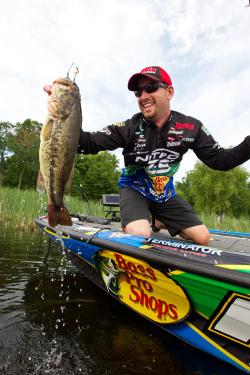
Elite Pro Ott DeFoe likes a Terminator T-1 Original Titanium spinnerbait slow-rolled in early spring.

For Ott DeFoe, 2011 Bassmaster Rookie of the Year, spring means you’ll find him fishing the shallows, throwing Terminator® T-1 Original Titanium Spinnerbaits, a bait that helped him catch his biggest five-bass tournament limit to date – 30 pounds, 15 ounces – on Texas’ Lake Falcon in 2013.

“This time of year fish are more than likely going to be moving into the shallows near some type of cover off of points, and there’s no better tool for targeting these areas than spinnerbaits,” says DeFoe. “I almost always have a T-1 tied on during the spring. The key is to make sure you fish them at the right pace.”

Coming out of the colder months, a fish’s metabolism will still be slow, which means a moderate pace is best for triggering strikes, explains DeFoe.

“If you’re working spinners, take your time and don’t burn them,” advises DeFoe. “Try slowly rolling the bait around trees and rocks, making light contact. Keep it moving steady and don’t linger in one area too long. I usually make one or two casts to a piece of cover then go on to the next one to cover more water.”

In terms of presentation, he recommends a 1/2-ounce Terminator T-1 Spinnerbait with a small silver Colorado blade to add a little extra thump to the bait. Choose a skirt in a color pattern that matches the local hatch and the hawgs won’t know what hit ’em.

Schultz’s Secret for Fishing the Grass

Bernie Schutz

Bernie Schutz

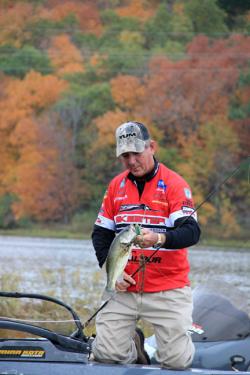
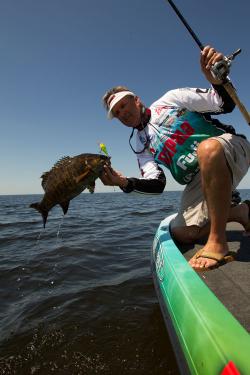
Florida pro Bernie Schultz shows he knows how to catch ’em up north, too, with this whopper smallmouth.

All the greats know that when it comes to spring fishing, location is everything. In fact, it’s often the difference between a successful day on the water and going home empty handed.

Bernie Schultz, an eight-time Bassmaster Classic participant, honed his skills fishing the grass-heavy lakes in his home state of Florida. However, he’s a firm believer that the Sunshine State isn’t the only place where anglers can find monster fish lurking in the green stuff.

“If you’re looking for the perfect spring Bass spot, it doesn’t get much better than finding a thick grass bed near a busy spawning area,” says Schultz. “You can typically find fish gathered in shallow pockets with easy access to sunlight where they’ll stage in or above the vegetation.”

Schultz recommends casting lipless crankbaits like the Rapala Rippin’ Rap® or Clackin’ Rap® into the grass and ripping them out to trigger reactive bites.

“The key with these lures is to make irregular contact with strands of grass and then rip the bait free,” Schultz explains. “When you snag a strand for just a moment, that slight pause, combined with the lures’ loud rattle are sure to grab fish’s attention.”

Practice Patience in Cold Waters

Although novice anglers may look for the hot new spring fishing tactic each year, the best strategy is to not overthink things. By the peak of the season, the urge for fish to spawn will be irresistible, meaning anglers can usually turn to a tried-and-true approach that has produced for them in the past.

However, according to Schultz, in rare cases when the water is still very cold following a harsh winter – like the most recent one – anglers need to adjust their mind-set more than their bait selection to find elusive lunkers.

“Patience is absolutely a virtue with cold-water fishing. To have success you need to work slow and take time to detail where fish are settling in. Non-reflective jerkbaits will be some of the best tools in your tacklebox,” says Schultz. “The Rapala X-Rap® or new Scattter Rap® Minnow are two of my favorite lures for frigid days on the water. No matter which technique you use, you’ve got to be thorough and deliberate. The fish are there – you just need to make them bite!”

How Ike Finds Finicky Fish

Mike “Ike” Iaconelli, 2006 Bass Angler of the Year and 2003 Bassmaster Classic Champion, also says spring is one of his favorite seasons for catching trophy Bass. But as anglers look to spend more time outdoors after a long winter, the season can also bring the year’s most crowded waters.

According to Ike, anglers can set themselves apart from the crowd by targeting fish located on cover and structure that is not visible to the naked eye. Using a depth finder, Ike locates hard-to-find cover and subtle depth changes, then ties on baits that he can use to feel along the bottom, like the quick-diving cranks from the Rapala DT® (Dives-To) Series.

“I also like to use more finesse presentations in the springtime,” Ike says. “Sometimes baits with an in-your-face action don’t do the trick. If the fish just don’t seem to be interested, it’s time for a change. That’s when I switch to a silent, tight-crankin’ lure like the Rapala Shad Rap® to offer up what looks like an easier meal for finicky fish.”

With these tips from some of the world’s most successful Pro Bass Anglers, even the most inexperienced anglers can fish like the pros this spring. For more helpful tips for on-the-water success, connect with Rapala online at www.Facebook.com/RapalaUSA.

About Rapala – The Most Trusted Name in Fishing

Rapala was unofficially founded in 1936 when Lauri Rapala invented the Rapala fishing lure. Rapala has grown from humble beginnings to become a market leader in the fishing tackle industry. The brand’s functionality and high quality are known by fishermen worldwide. Rapala maintains its strict standards of craftsmanship while delivering its fishing products to anglers in more than 130 countries. For more information on Rapala, please visit www.rapala.com

Global Warming and Poor Fishing

I have heard claims that the early hurricanes and tropical storms this year are because of global warming. That has caused a lot more rain, and all our lakes are full. Seems I remember during our drought when all our lakes were low that the drought was cause by global warming, too.

In January, 2005 Linda and I went on a cruise in Antarctica. We met the ship in what is called “The Last City On Earth,” Ushuaia, Argentina, right on the tip of South America. While touring that city we noticed a hillside covered in grass and the tour guide told us it was their ski area. Since we were there in the middle of their summer we were not surprised it was not covered with snow, although most of the surrounding mountains were snow capped.

The tour guide explained that they were not getting as much snow as normal because of global warming and did not get to ski much, even in the winter. Then a couple of days later while on the ship in the Drake Passage it was snowing on us. One of the guides on the ship said snow was unusual there in the middle of summer, but because of global warming they got a lot more snow than they used to.

So, it is dryer and wetter here because of global warming. It snows more and less in South America because of global warming. That seems to be a great catch all to blame weather problems on.

I bet the reason I didn’t catch many fish in the Lanier tournament in May was due to global warming. From now on, if the fish don’t bite I have something to blame it on, global warming. I used to say it was too hot or too cold or too windy or too calm or too cloudy or too sunny when I could not catch bass. Now I can simplify things. No matter what is going on, I can blame not catching fish on global warming.

That should work for hunting, too. Not seeing deer today? Global warming. Doves not flying? Global warming. Doesn’t matter that other guys in the hunting club are killing deer and shooting doves on their fields, that is a great excuse.

Good luck fishing this weekend. Hope global warming doesn’t get you and ruin your trip!

Cuba Tarpon Fishing Report

Fishing Report for Cuba Tarpon Fly Fishing On the Run

Catch tarpon like this fly fishing in Cuba

Catch tarpon like this fly fishing in Cuba

Fishing Report, Cuba Tarpon 5/22/14

TWO HEAVENS IN ONE PLACE
Tarpon-Cuba

For all the fly fisher globetrotters is a quest every year to choose the right place and the exact moment. We are always looking for tides, moon phases, fish run and operations that can meet the expectation of a highly anticipated week, that we could schedule between family holidays, birthdays and others obligations. Finally we have the clue between high-end exclusive services and tarpon fishing that can blow your head off.

During the last week of April and the first days of May 2014 we booked the very first operation week with fishermen of the impressive Avalon 2 Yacht, that fish out from Jucaro Port, 350 miles south from Habana in Cuba to Gardens of the Queen. There, you’ll find a live aboard where you could stay days, weeks or months, with all the ammenities you could imagine, from the skyline jacuzzi in the last floor to the freestyle slide of the second floor. So, having the right place to stay inside an amazing marine park like Gardens of the Queen, we only have to peak the fishing zone of the area and the season.

After been working for several years at Cuba, we heard about the new fishing area at the end of the Gardens, near fifty marine miles south from Tortuga, yes sir, that far south. The Gardens are huge and you could fish a month without repeat the same area. Just two years ago they start fishing this southernmost point, where the tarpon run appears during the first full moon of April in an amazing run of “sabalos”, if you have already fished “boca grande” in the Gardens, this is even better, so well, just imagine. Been there, I can only say that this is one of the few places left in the world where you could fish schools of tarpon from one or two to hundreds of them, in sizes from 20 pounds to over 120 pounds and it is not uncommon to see female tarpons with ten males around her daisy chain, in strings or just moving in a spawning ritual. Just 1 mile away from these channels flats, you have runs of big size tarpon rolling just like Holbox and also other places in deep waters, but that´s another story. Just to give you a “screenshot”, one day our 5 skiffs where “in line” waiting for the daily “run”, moment after a big string of more that 60 tarpon roll in front of us, right away we were all jumping or hooking on tarpons, it was really awesome and I couldn’t believe it. You could see long strings at other locations but this tarpon eat flies with madness, in the same cast you could jump two or three tarpons just keep retrieving the line and you will see.

Long story short “Two Heavens in One Place”, this new area in Gardens of the Queen is a tarpon madness and Avalon 2 yacht is beyond any expectations, just try to be there in the exact moment, we can help you to be in ” heaven”, you´ll not be disappointed. If you want to come with us on 2015 Hosted Trips, send us a email BOOKING HERE or visit us on WWW.FLYFISHINGTHERUN.COM

Fly Fishing Chile
Season 2014-2015
Like you know, our agency is based in Santiago de Chile, so we can say with total confidence, that this are our home waters. If we constructed a worldwide network of the best destinations for travel and angling round the globe, imagine what to expect from our Country. So, if your looking for your next Patagonian Retreat, please drop us line. We´ll be here waiting for you with Pisco Sour and Chilean wine, once you arrive.

FLY FISHING THE RUN
Travel & Angling
Profesor Porter #8 OF. 201, Santiago Centro
Santiago, Chile
PRO OUTDOORS SPA

“The right place, at the exact moment”

Great Lakes Cold Water Smallmouth

Icewater Bronze – Great Lakes Smallmouth

Great Lakes bite off to chilly start

By Dan Johnson
from The Fishing Wire

STURGEON BAY, WI–Lake Michigan’s Sturgeon Bay offers bass fans some of the finest smallmouth fishing on the planet. Routinely producing behemoths topping 6 pounds, the bay’s storied waters rank high-even atop-more than a few top fisheries lists.

Ice floes still dot sections of Sturgeon Bay.

The Great Lakes are still col

The Great Lakes are still col

But even paradise has a downside. And on Sturgeon Bay, that just might be the first few days of the open-water season. Anglers prepping to compete in a pair of high-profile early season tournaments are finding slow going, as a late spring and frigid water temps have the fish in a funk.

As of Wednesday, May 7, the main bay was a chilly 38 to 40 degrees, with surface temps in the backs of coves barely pushing into the upper 40s. Overcast skies and 45-degree air temps were doing little to warm the water.

“Everything is a little behind schedule this season,” said Scott Bonnema, a veteran competitor from Zimmerman, Minnesota, who is signed up to fish the Cabela’s North American Bass Circuit’s qualifier May 10, and the Sturgeon Bay Open May 16-18.

Dodging the occasional ice floe with his Ranger, Bonnema was on the hunt for the warmest water he could find. “The fishing is really slow,” he said. “The main thing is not to get frustrated and panic, but to keep your head down and focus on finding areas that have fish now, as well as spots that will hold fish once the water warms up.”

For Bonnema, that means scouting hard-bottom shallows featuring rocks averaging a foot in diameter. The backs of coves are prime targets, but he’s also checking the outer edges of points leading into such hot zones, knowing that inbound smallies will funnel along this structure first.

Once waters warm, smallies in Sturgeon Bay and elsewhere will hit a variety of presentations.

Big Smallmouth from Cold Water

Big Smallmouth from Cold Water

A few bass have already moved shallow, but they’re sluggish and playing hard to catch. “I’ve seen a few fish in three feet of water, but they’re really lethargic,” he noted. “I’m fishing a downsized 2½-inch tube on an 1/8-ounce jighead, dragging it s-l-o-w-l-y across the bottom. Bites are mushy, so I’m using low-stretch Sufix 832 superbraid for sensitivity.”

Given the bay’s gin-clear waters, which enable anglers to see the bottom in 25 feet of water, Bonnema said a 7-pound Sufix Invisiline fluorocarbon leader is critical to keep the fish from seeing the line.

Looking ahead, Bonnema predicted that Sturgeon Bay’s smallies wouldn’t stay dormant for long. “We’re supposed to get warmer weather this week, so more fish should move in and the bite should pick up,” he said. “Before you know it, everyone will be catching them.”

As the bite picks up, he expects reaction lures like Rapala X-Rap jerkbaits and Alabama rigs to come into play. “Even then, the fish will be pressured and spooky in the clear, shallow water,” he said, noting that he uses a Humminbird 1199ci HD SI sonar-chartplotter combo unit to locate and return to prime structure. “The 1-foot contours on its LakeMaster mapping program also make it easier to dial in specific depths everywhere in the system,” he added. “It also helps me keep the boat far enough from the fish so I don’t spook them.”

Once Bonnema finds a key area, he says a great strategy is locking the boat in place with a shallow-water anchor like the Minn Kota Talon and waiting for other boats to push fish to you. “It’s almost like deer hunting,” he laughed.

When the bay’s bass fishing does catch fire, it’s not unheard of for tournament anglers to weigh in 30 pounds with five bass. But such epic catches are still a few days or more away. For now, Bonnema’s biding his time, playing the finesse card as he patiently prepares for the upcoming NABC and Sturgeon Bay Open events.

Does Practice Sometimes Hurt You In A Tournament?

Last Sunday members of the Flint River Bass Club had a tough tournament on Lake Oconee. Fishing from 6:00 AM until 2:00 PM the 19 members and guests landed 33 keeper bass weighing 56.94 pounds. There was only one five-fish limit and five members did not catch a keeper during the tournament.

Doug Kohn had the limit and his 7.94 pounds won the tournament. Lee Hancock had three bass weighing 7.17 pounds for second and his 4.30 pound bass won the big fish award. Bobby Ferris places third with 6.80 pounds and Jack Ridgway was fourth with 6.73 pounds.

Doug said he caught some of his fish on topwater plugs. Lee said the big bass hit a crankbait and his others were caught on a Texas rigged worm. Bobby said he caught his fish on a jig and pig. Fish were caught on a lot of different baits so no one pattern really worked better than others.

We lucked out on the weather. It was cloudy and windy all day, which usually makes fishing better. As I pulled out of the parking lot at 2:30 PM to head home a few drops of rain hit my windshield. By the time I got to the main road it was pouring and it rained hard all the way back to Griffin. I surely am glad the rain held off until the end of the tournament!

I had gone to Oconee on Saturday to check some deep water holes where I have caught fish this time of year in the past. I also wanted to try a pattern I was told was working there. I thought I had found something that would help me in the tournament but it may have actually hurt my fishing.

I rode over a point with some brush down in 20 feet of water and saw baitfish and bigger fish around the area. This was the brush where I caught a 7-7 bass and several other keepers in a July tournament a few years ago so I felt good about catching something there and did not even cast to them, not wanting to bother them the day before the tournament.

The second point I went to and checked I also saw brush with baitfish and bigger fish around it in 20 feet of water. I threw out a marker and cast a Carolina rig a few times, but nothing hit. I picked up a Mag 2 worm Texas rigged and the first cast produced a hit. When I set the hook the back half of the worm was torn off.

I quickly rigged another worm and cast back to the same place. When I felt a fish I set the hook and this time was rewarded with something pulling back. It was a 3.5 pound bass and I marked that spot to fish the next day.

For the next few hours I rode over points and found three more that looked just like where I had caught the bass. Brush, baitfish and bigger fish seen on a depthfinder is usually a good indication you can catching something this time of year so I planned on fishing those spots. I had caught one of my five keepers off one of the places two weeks before in the Spalding County Sportsman Club tournament so that also gave me confidence.

Brent Terry fished as my guest in the tournament and we stopped on a main lake bank with docks on it first thing Sunday morning. I started throwing a spinnerbait and Brent chose a buzzbait. On the first pass I hooked and lost a bass that looked like it would be a little short of 14 inches long, then caught three more short bass before we left.

Fishing similar places I finally landed a good keeper on the spinnerbait and then another one on a Texas rigged worm. After a couple more hours without a fish in the shallows I told Brent we should start hitting the deeper holes. I felt sure in the four hours we had left to fish we could catch some keepers.

That feeling was bolstered when Brent got a keeper on the first point we fished, the place I had landed a keeper two weeks before. Although we fished all the places that looked good the day before, and we caught some short fish, we did not catch a single keeper the rest of the day.

My two keepers weighed 3.76 pounds and put me in 9th place. That just goes to show the best laid fishing plans often go astray! Now I wonder if I had kept fishing shallow water if I would have done better. Sometimes practice for a tournament may be counterproductive. Who knows?

That’s why we call it fishing, not catching!

Tips for Keeping Your Pontoon Boat Safe and Shipshape

How to keep your pontoon boat safe and shipshape
from The Fishing Wire

Pontoons offer lots of space to swing a rod, lots of comfort and a shallow draft that lets them work around weedbeds easily. (Photo Credit Manitou Pontoons)

Fishing from a pontoon

Fishing from a pontoon

Pontoon boats are among the most trouble-free of watercraft; they’re simple, WYSIWYG rigs that don’t require much maintenance and don’t cause many problems. But BoatU.S., which maintains insurance claim files on all sorts of watercraft, reports there are ten recurring items and incidents that most often lead to trouble on these family friendly boats.

1. Anode awareness: Galvanic corrosion, which occurs when dissimilar metals are in contact with an electrolyte such as salt water, can quickly destroy aluminum. And unfortunately, most insurance policies don’t cover this damage. In salty, brackish and even freshwater, aluminum sacrificial anodes are best as they outlast other alloys. Outboard engine zincs also need replacement if they have deteriorated to less than half their original size.

2. Get Wired: In order to protect the boat and engine, the pontoon needs to be electrically connected to the pontoon’s engine via a ground wire. If not, galvanic corrosion can set in.

3. Avoid the “pits”: Pontoon logs that sit on muddy lake bottoms during low water can become pitted with corrosion. This occurs because the mud prevents dissolved oxygen in the water from making contact with the aluminum, which relies on an oxidized layer or “skin” for corrosion protection. Consider pulling or moving the boat if water levels drop.

Up to four anglers at a time can fish from most pontoons-and there’s also room for Fido. (Photo Credit Tracker Marine)

Lots of room to fish in a pontoon boat

Lots of room to fish in a pontoon boat

4. Don’t “plow” ahead: When seas build, pontoons have a tendency to plow into waves, which can lead to a significant amount of water over the deck. Pontoons are also challenging to handle in following seas. If you can’t avoid rough weather, slow way down and trim weight aft.

5. Passenger injuries: One big difference with pontoon boats is that they don’t bank in turns, which can lead to injuries when passengers are thrown to the deck or even overboard in a hard turn. Large wakes from passing vessels can nearly stop a pontoon if taken improperly. Passengers should always remain seated while underway.

6. Watch out for windage: Another reason to slow way down in heavy weather is the increased windage from a pontoon’s large bimini top. Never trailer a pontoon without removing the bimini. The boats also tend to “kite” in the wind when you’re trying to dock them or put them on a trailer.

7. Don’t Under-size-me: The normally benign wind conditions on many small lakes and rivers can also lull pontoon owners into using undersized dock lines and too few fenders. Since many pontoon boats don’t have rub rails, damage can occur quickly during summer thunderstorms.

Small four strokes like the Yamaha F70 offer plenty of power for most pontoons, plus low fuel consumption and very low noise levels. (Photo Credit Yamaha Marine)

you don't need a huge motor for a pontoon boat

you don’t need a huge motor for a pontoon boat


8. Swimmers take care: Because they make great swim platforms, pontoons are involved in a fair share of swimming injuries, often diving related. If you’re going swimming, it’s safest to enter the water via a ladder – not head first.

9. Grand theft pontoon: No, it’s not a new video game. Because it’s difficult to hide or secure expensive gear on a pontoon, things like chartplotters, fishing tackle and iPods should be removed at the end of the day.

10. Four-legged vandals: Raccoons, muskrats and their furry brethren enjoy upholstery and wiring like a vegetarian at a salad bar. There’s no simple solution to keeping critters off the boat, but reducing fish or food smells by washing it down, or using commercially available repellants such as fox urine, have been known to help. (Unfortunately, the repellants may repel humans, too–use with discretion!)

BoatU.S. – Boat Owners Association of The United States – is the nation’s leading advocate for recreational boaters. See more at www.boatus.com.

How Do I Catch Marinated Catfish

Juicy New “Meat” Methods Reinvigorate Bait for Catfish

By Ted Pilgrim
from The Fishing Wirw

Mar • i • nate (v) – to put meat or fish in a sauce for a period of time to add flavor or to make the meat or fish more juicy and flavorful.
___________________________

Which steak would you take? An unseasoned slab of meat, or the same steak slathered with juicy flavors just before slapping it onto a sizzling grill?

On this point, it appears, catfish and humans agree. Among those whiskery Ictalurids, scent and taste are powerful enticements. So it stands to reason why catfish often prefer their meals pre- seasoned and spiced, as opposed to bites of bland and flavorless flesh.

Monster Catfish

Monster Catfish

Whopper catfish like this one are easier to come by if you add “seasoning” like Scent Trail, which puts an added chum slick in the water.

At the recent Cabela’s King Kat national catfish tournament on the Missouri River near Jefferson City, elite catmen John Jamison and Mark Thompson registered a winning weight of blue catfish, employing creative bait methods not unlike those of master chefs.

The theory and practice of adding scent to baits is, of course, nearly as old as fishing itself. In the early days, anglers doused lures with such oddities as anise oil, Preparation-H and WD-40, plus volumes of fishy formulas meant to play on a gamefish’s olfactory abilities.

If you think bass, panfish and trout can smell well, consider catfish, the aquatic equivalent of a truffle-sniffing pig. For fish, the difference lies in “olfactory folds,” the mechanism used to detect underwater aromas. While a big adult largemouth has just thirteen of these structures, a small 2-pound catfish has 142.

Playing on this powerful sense, Jamison-a legendary figure on the national catfish tournament trail-has during the past year made some keen discoveries regarding the scent and taste preferences of goliath blues. “I’m not quite ready to discuss some of our findings,” Jamison admitted following his tournament win. “What I can tell you is at this last King Kat event, marinated baits worked almost like magic. Cutbaits soaked in Scent Trail were the only things we found that consistently triggered bites during the tough tournament conditions.”

At the major one-day event, Jamison and Thompson employed a variety of different baits, including filleted carp, shad and skipjack herring. But bait species itself, Jamison said, proved “almost irrelevant.”

Rather, to induce reluctant cats to grab their baits, the Kansas-based anglers placed pre-filleted fresh or fresh vacuum-sealed baitfish into Keep Kool bait containers and doused them with large volumes of Scent Trail attractant, effectually marinating them for an hour or more.

Spray Catfish Bait

Spray Catfish Bait

The spray bottle is an easy way to freshen baits that may be starting to wash out and loose their attractiveness.

Jamison added that local weather conditions turned what had been a torrid bite in prefishing into a test of patience during the event. “For years, we’ve sort of kept the scent-marinating deal under our hats. It’s pretty amazing how Scent Trail can invigorate and re-energize baits when catfish get fussy and hesitant about biting. Plenty of folks have seen us do it now in these tournaments, so we just figured it was time to share the secret with folks out there who fish for catfish in everyday situations. It’s going to help add lots of catfish to your stringer.”

A super-concentrated bait additive, Scent Trail has been manufactured by boutique catfish company Rippin Lips for the past several years. “The stuff is nothing but omega-3-rich natural fish oils, blood and amino acids,” Jamison notes. “These are the actual scent and taste compounds catfish hone in on to hunt food and eat; that’s it, no fancy fillers or extra ingredients.

“We use the product to recharge baits on our hooks. Every time we reel in, we’ll give our baits a few squirts of formula, which restores the bait’s natural juices.

“In tournaments, we’ll fillet a bunch of bait-size chunks ahead of time and stash them in the Keep Kool. If things get tough, we’ll sometimes pour in an entire bottle of Scent Trail. Really let the stuff soak in. Put one of these baits in the water and you’re setting up a mini chum line of flavor. You can’t believe how much difference this can make in a tough bite.

“It’s like setting the table at dinnertime. Put a bunch of delicious food out and let the aromas work their magic. Pretty soon, you’ve got people from all over the house gathered around the table, mouths watering. Now imagine if people had the powerful sniffers of catfish. You’d have flocks of folks arriving at your table from all across the neighborhood, ready to gobble up the food on your plate.”

Fishing A June Tournament At Lake Oconee

Last Sunday 16 members and guests fished the Spalding County Sportsman Club June tournament at Oconee. We lucked out and it was a rainy, cooler than normal day for late June. Fishing from 6:00 AM until 3:00 PM we brought in 43 keeper bass weighing about 72 pounds. There were six 5 fish limits weighed in.

Mike Dalton brought in a limit weighing 12.25 pounds to win the tournament, and his 3.57 pound bass took the big fish pot. I had five weighing 10.35 pounds for second and my 3.54 pound fish, just 3 hundredths of a pound smaller than Mike’s big one, didn’t win anything!

James Pilgrim, Jr. had four bass weighing 7.66 pounds for third, Butch Duerr had five weighing 7.22 for fourth and Ben Puckett had 3 bass weighing 6.53 pounds for fifth.

Mike said he caught his fish on crankbaits. Butch said he caught his on buzzbaits. There were a good many fish caught on worms and spinnerbaits, too. The cloudy weather made the fish bite pretty good.

I used all my bass fishing skill to land my five keepers. I headed to a favorite point to start but there was a boat on it, so I went to a nearby point to wait and see if they left. My second cast with a spinnerbait to a dock there produced my biggest bass of the day. After the boat finally left I went to that point and caught a second keeper on the spinnerbait.

Linda fished with me and needed a break so at about 9:30 I went to a nearby marina. While she was inside I cast a Texas rigged worm to the gas dock and landed a 16 inch keeper. When I headed back to my favorite point there was a boat on it again, so I went to the other side of them and caught my second biggest bass of the day on a worm from a dock there.

My fifth keeper came on a Carolina rig on a point. So, of the five keepers I landed, three came from places I did not plan on fishing. Maybe I should plan where to fish then change my mind at the last minute from now on.

Linda and I caught a bunch of bass. We probably had 30 with many in the 13.5 to 13.9 inch range, just under the 14 inch minimum. Linda had one 16 inch keeper and placed 11th in the tournament. She also caught three channel cats of a crankbait. I have caught them on crankbaits before but never three in one day!

Noodling for Catfish in Georgia

On Friday, July 1, 2004 it became legal to noodle for catfish in Georgia. So if you have an overwhelming desire to go down to the river or a pond and stick your hands under logs and into holes trying to find a catfish, you can do so legally now. Noodling season in Georgia runs from March 1 – July 15 so you have a couple of months left to give it a try this year.

Noodling it a tradition in the south and it is now legal in six states. I have never tried it, but have watched it on TV. That is probably as close as I will get to the real thing. There are way too many critters with teeth, fangs and beaks that like holes in the water for me to want to stick my hands in one.

Can you imagine wading waist deep in water in a creek or river and sticking your hand up into a hole in the bank under the water. You might find a catfish. If you do you grab it in the gills and pull it out for supper. If you find a snapping turtle or snake I guess you ease your hand out slowly and hope your fingers don’t become supper.

Give noodling a try if you want to – but you might want to wear gloves!

What Is the Down and Out Technique for Walleye?

Down and Out Technique catcches walleye

Skarlis and Lahr give up their tournament-winning methods for finding “hidden” walleye

Press Release
By Mitch Eeagan

Nice tournament walleye

Nice tournament walleye

Professional fishing tournament twosome Tommy Skarlis and Jeff Lahr are no strangers to catching walleyes from fast-flowing waters, including the Mississippi River in Hastings, Minnesota. In fact, it was in this area—within the fish-laden Pools 2 and 3—that the band from Iowa took top honors at the Cabela’s Masters Walleye Circuit’s “Artificial Challenge” May 2-3, 2014.

But the bite did not come easy.

The fact was their 35-pound 8-ounce total two-day sack consisted of only six fish; with only two landed the second day.

Had it not been for the duo using high-quality electronics to locate specific-spots where the post-spawn females were laying, figuring out fish wanted lures pulled one way and one only, as well as using rods that aided in identify bites that would normally gone undetected, the tournament teammates would never have taken the podium.

Think outside the cone

Unable to pre-fish much before the derby, Skarlis and Lahr were depending on two choice areas where they had found fish a few years before with an Aqua-Vu underwater camera.

“After spawning, big hen walleyes tend to belly up to bottom right on the steep drop-offs leading to the main river channel. Unfortunately, it’s this type of area that a one-dimensional sonar’s “ping” often misses the mark (fish on bottom on sharp banks being just outside the cone-shaped signal),” says Skarlis. “Without an Aqua-Vu underwater camera, or Humminbird with two-dimensional Side Imaging, anglers would never realize those fish were there.”

Use a good depthfinder to find walleye

Use a good depthfinder to find walleye

On this particular trip, Skarlis and Lahr were able to verify the walleyes were still there with Humminbird Side Imaging; the fish lying tight to bottom showing up clearly on the 1199’s unit’s large screen.

But confirming the location of the fish wasn’t enough; the lethargic post-spawners were still not willing to eat, but rather had to be coaxed into biting.

Slowly I pulled…

The pair discovered they had to employ very specific procedures to produce strikes. And then after all that, the bites were so subtle they could’ve been easily be missed.

The winning way? Pulling 7- to 12-MM long, slender-shaped stickbaits upstream at a crawl. However, only when the lures were swimming down the bank and out towards the main river bed, not up the break or along it, did walleyes respond.

Not wanting to waste time, Skarlis used his bow-mounted Minn Kota Fortrex to quickly pull the 3-ounce bottom-bouncer rigs with stickbaits up the steep breaks in 16- to 22-feet of water, and then reduce their speed to a creep at one-half-mile-per-hour. The slower speed was necessary to get the walleyes to commit.

Humminbird electronics are responsible for divulging the whereabouts of countless walleyes for tournament pros, guides and the everday angler. Photo by Bill Lindner Photography

A secondary technique took fish when the stickbait bite slowed. When the cranks quit, Skarlis and Lahr vertical jigged down and out along the same sharp breaks with 1/2-ounce jigs tipped with soft plastics.

“While most anglers use the lightest jigs they can get away with, Lahr and I often use heavier jigs, up to 3/4 ounce, as they displace more water and the fish are able to pick up the vibration through their lateral lines. Using larger jigs is doubly important in such stained water,” notes Skarlis.

Jig tied up and deployed, the anglers found the best technique was employing no action all, literally just holding the bait up off bottom a few inches and working it down the bank.

Feeling odd

No matter the technique, there were never any arm-jarring strikes. In fact, the bite was quite the contrary.

“Most anglers feel the spit, not the hit, and by that time it’s too late to set the hook,” states Skarlis.

“St. Croix’s LegendXtreme rods were one of the biggest factors in the win. The fish would bite light and swim along with the lure. If anything felt “odd”, anything at all, we’d set the hook and sure enough there was a fish.

Both anglers used St. Croix’s 7-foot medium, fast-action Legend Xtreme rods for jigging, and the medium-heavy, fast-action model for pulling stickbaits. However, when the technique called for heavier applications yet, the 7’1” medium-heavy, fast, Legend Tournament Bass rods were pulled from the rod locker.

“There are three reasons the Legend Xtreme is a superior rod,” claims Skarlis. “The blank is ultra-sensitive, of course, as well as light, so there’s no arm fatigue when fishing it all day. And the rods micro guides cut down on wind drag, keeping the tip from blowing around, creating even greater sensitivity. And because of its perfect backbone, they have the ability to hold fish on the hook once stuck.”

Down and out

Looking to land more post-spawn walleyes from rivers? Heed the down-and-out technique Skarlis and Lahr used to land a winning weight from the Mississippi. Use the newest electronics to locate fish hidden from standard sonar, and no matter the method employed, use sticks that telegraph even slight bites.

St Croix walleye rods

St Croix walleye rods

St. Croix Rod’s Legend Tournament Walleye (pictured) and Legend Tournament Bass are staple sticks in the boats of many professional anglers and guides.

Mitch Eeagan is an outdoor writer who lives and survives off the land within Michigan’s Upper Peninsula’s cedar swamps.