Alabama Red Snapper Season

Red Snapper Season–Short but Sweet

America’s favorite snapper is again legal as of June 1-but the season will be a scant 9 days long.

By Frank Sargeant

Greast Red Snapper Catch

Great Red Snapper Catch

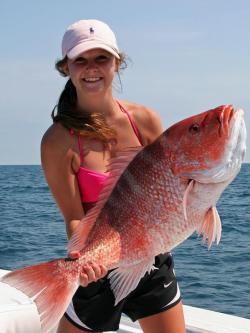
If there’s a shortage of red snapper in the Gulf, you can’t prove it by talking to anglers from Florida to Texas-these Alabama anglers loaded up. (Photo Credit David Rainer, ADCNR)

Don’t blink or you’ll miss the red snapper season in federal waters of the Gulf of Mexico this year. It opens June 1, slams shut again just nine days later on June 10 thanks to a Byzantine federal management system that tightens the regulations ever more as the fishery gets better and better. (If we get a tropical storm on or about June 1, say goodbye to the entire season.)

Federal regulators say the rules are for the good of the fish-and ultimately of the fishermen.

But in fact, most experienced reef anglers say red snapper fishing is now better than it has been in at least 40 years thanks to an extended period of tight harvest regulations, and also perhaps due to the success of fish excluder devices on shrimp nets, allowing millions of juvenile snapper to escape these days when in the past they would have wound up as by-catch, dead on the deck.

The snapper are both much larger than they have been in decades, and much more numerous, according to hundreds of reports from fishermen all around the northern Gulf. It’s universal: anglers in Florida, Alabama, Mississippi, Louisiana and Texas all report booming snapper populations.

So why don’t the feds want to pony up longer seasons and more generous bag limits? Because of a bizarre twist in the way they calculate the harvest-they measure it in pounds, and when their best estimate of a conservation-smart harvest is achieved, they call for closure. Snapper grow fast and live a long time, and consequently anglers are now catching tons of whoppers-which means that they can catch a lot fewer before they reach those limits set by the feds.

To be sure, these restrictions are not arbitrarily contrived by the fish managers–they are mandated by the Magnuson-Stevens act, and more recently by a court decision–but the triggers on both these directives are based on badly-designed harvest surveys, which are the direct responsibility of the federal scientists.

Red Snapper On Jig

Red Snapper On Jig

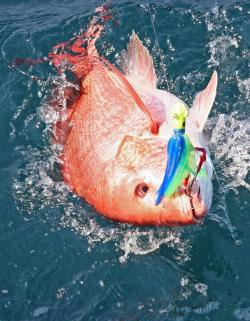
Snapper take a variety of cut baits, live baits and sometimes heavy jigs, typically at depths of 60 feet and greater. (Photo Credit David Rainer, ADCNR)

It is much like the paradoxical Catch 22, and it’s causing a furious reaction among fishermen and state fishery managers from Florida to Texas–most Gulf states are now moving rapidly toward putting their own harvest surveys in place for the species, tapping the capabilities of smart phones so that anglers can record their catches conveniently the minute they hit the docks.

In an unprecedented rebellion against the federal management system, all five Gulf states have all but quit cooperating with the NOAA system on this species. These days, state management is really starting to make sense, while it didn’t 30 years back. In the bad old days, only commercial fishermen had lobbyists and power to control the rules, and many fisheries suffered as a result.

But these days, the checks and balances of local recreational anglers and conservationists weigh in for keeping the maximum number of quality-sized fish in the water-and even the saltiest old commercial harvesters have finally come to realize that it just simply makes sense to guard the resource, so that they can not only make money fishing today, but also tomorrow, next month and next year. It should be noted that thanks goes to not only state agencies but also federal biologists for much of the research on offshore species that has made this awakening happen.

Florida has set a much longer red snapper season in state waters, up to 9 nautical miles offshore, extending from May 25 to July 14 this year, and other Gulf states are extending their seasons similarly and also working toward expanding the limit of state waters. How this all plays out remains to be seen–hopefully, better fishery stock analysis will put an end to the foolishness and restore some measure of cooperation between state and federal management agencies. In the meantime, whether you fish state or federal waters, here are some tactics that consistently produce results on red snapper.

HOW TO GET EM

Anglers who regularly target red snapper say they are not exactly “bottom fish”, even though they are nearly always found around hard structure. They’re usually found over structure, but not as often down in the structure like grouper.

Experts seek out what they call a snapper “Christmas tree” show on their sonar screens before dropping a line. The pyramid or “tree” is the shape made by a school of snapper, with most deep, fewer at the top. In 200 feet of water the stack may extend as much as 50 feet off bottom.

Big Red Snapper

Big Red Snapper

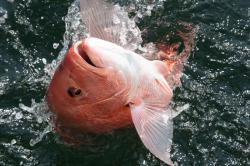
Many of the red snapper being caught these days are whoppers, the result of tight regulations including short seasons-but many anglers say there are enough fish now to loosen the reins a bit. (Photo Credit David Rainer, ADCNR)

Gulf red snapper are typically found in 60 foot depths and more, on out to the edge of the continental shelf at around 250 to 280 feet-beyond this zone, the bottom drops away to a mile deep and more, and common reef fish are not found in those depths.

The Panhandle has a unique fishery in that there are hundreds and perhaps thousands of “private” reefs, that is junk that skippers have dropped on otherwise barren sand bottom to attract snapper-old washing machines, steel drums, all sorts of bulky trash. It’s not legal any more, but there are still many of these reefs around, and smart skippers have dozens of them in their GPS machines-all very carefully protected from other skippers who might want to pirate “their” fish.

There are also numerous legally-placed artificial reefs, including tugboats, barges and ships as well as demolition rubble, which attract lots of fish; these can be found on any good offshore chart. Most states also list them on their marine fisheries websites.

In general, the procedure is for the skipper to head for his favorite GPS number, drop anchor uptide when he gets there, and then let the anglers lower an assortment of frozen threadfins, cigar minnows or squid down on 60-pound-tackle. Using braided line makes it easier to feel the bite and get a good hookset, but you’ll need at least five feet of 60 to 80-pound-test mono leader to fool the fish and keep their teeth clear of the braid. (In extremely clear water or where the fish are being fished hard, it’s sometimes necessary to go to lighter tackle to fool snapper–you lose many but you get bit more often.)

Weights of 4 ounces and more are needed to get the bait deep, and hook sizes are typically 6/0 and larger circle hooks, extra-strong. (Circle hooks are required by law, as are hook removers, both aimed at improving survival of released reef fish. Venting devices, required formerly, are no longer on the must have list.)

The angler drops the bait to bottom, then takes up several turns of the reel to suspend the bait in the snapper zone–keeping an eye on the sonar will help you put the bait where the fish are. The snappers take it from there. When you feel a bite, you reel like mad and hopefully the circle hook digs in. Jerking on the rod to set the hook rarely works when using circle hooks; just keep tension on the line and reel very fast and the fish will usually set the hook itself.

Red snapper these days typically average 5 to 8 pounds, but there are many, many of 10 pounds and more, and 20-pounders are not unheard of. The limit is two per angler per day, minimum size 16 inches. Red snapper are among the tastiest of all fish, and are great broiled, fried or baked.

RELEASING SNAPPER

Fish caught from deep water frequently have issues with the rapid pressure change as they are brought aboard–they blow up like a balloon, and are unable to swim when put back over the side. Since the limit on red snapper is just two fish daily, it’s common for anglers to release much of their catch these days, and improving survival of these fish makes good conservation sense–as well as being required by state and federal law.

Improving survival depends on several steps.

1. Use circle hooks so that the hook is unlikely to be swallowed.
2. Get the hooks out promptly with an efficient hook-removing tool or long-nose pliers.
3. Don’t let the fish fall on the deck.
4. If you want a photo, make it quickly.
5. Use either a deflating tool or a deep-release “descender” device like the Seaqualizer (www.seaqualizer.com) to help the fish get back down to bottom safely. Descender devices include large weights to which the fish is hooked and lowered back to a comfortable depth, then released.
6. Which ever device you use, do it promptly–minutes out of water are the biggest enemy to survival.

Can I Catch Bass At Night?

on a Saturday night in July a few years ago 14 members of the Spalding County Sportsman Club fished our July tournament at Jackson. We fished from 7:00 PM until 2:00 AM trying to avoid some of the heat, and it was slightly cooler after the sun went down. Fishing was tough in the heavily stained water, with seven members not bringing in a keeper fish.

We landed 23 bass over the 12 inch minimum size and their total weight was about 35 pounds. I had the only limit and my five weighed 8.22 pounds for first place. James Pilgrim, Jr. had four weighing 7.99 pounds for second and his 4.04 pound largemouth was big fish for the tournament.

Butch Duerr had four keepers weighing 7.31 pounds for third, David Pilgrim had 3 weighing 4.54 for fourth and Jason Wheeler’s 3 weighing 3.09 pounds rounded out the top five. Of the 23 keepers brought to the scales, 13 were spotted bass and 10 were largemouth.

I was on some kind of strange schedule. For the first two hours I caught about four bass too small to keep, and a 3 pound catfish. Then I caught a keeper every hour, just about on the hour, from 9:00 PM until 1:00 AM. Each fish got a little bigger than the one before it, but I started with one just barely 12 inches long. The second one was 12.25 inches and the third just a tad bigger.

My last two fish were decent keepers, with a 2.5 pound spotted bass just after midnight and a 3.31 pound largemouth just after 1:00 AM. The first fish I caught hit a Zoom Mag 2 worm and the last four hit a Rattleback Jig with a Zoom Fat Albert twin tail trailer.

Night fishing is a lot more comfortable this time of year, and the bass do feed in the dark. Give it a try one of these warm summer nights. You might like it.

How Did Zell Rowland Weigh In 25.5 Pounds of Bass At Dardanelle?

How I Weighed In 25.5-Pounds At Dardanelle

By Zell Rowland
from The Fishing Wire

Zell Rowland

Zell Rowland

Zell Rowland didn’t manage to win at Dardanelle, but his 25.5 pound sack was the heaviest landed during the event thanks to his jigging expertise.

I didn’t win the B.A.S.S. Elite tournament on Arkansas’ Dardanelle May 16 through 19. I placed 17th in the final standings, which is disappointing, but I did bring in the biggest sack of the tournament on Day 2 – 25.5 pounds! Anytime you have a bag like that it’s worth talking about.

Conditions made fishing tough. Rain beat our butts every day on that Arkansas River impoundment, and conditions changed daily. Water levels shifted – up 4 or 5 inches one day, down 4 to 6 inches the next day – every day.

Drawing water or a water level change for any reason alters what the fish do daily, and sometimes even hour-by-hour. That made for tough fishing at times. Subtle changes in conditions could take place, and they weren’t always immediately evident. We had to make adjustments every day.

Heavy Booyah jig

Heavy Booyah jig

A heavy Booyah jig was a big part of Rowland’s secret at loading up on quality fish offshore.

I did much of my fishing on Lake Dardanelle flipping a Booyah jig and YUM Chunk trailer. I used two main colors, black-and-blue and green pumpkin. I fished black-and-blue much of the time in muddy water and green pumpkin in situations where there wasn’t so much stain.

During practice I’d found a good fish and knew it was still there, so that’s where I started on Day 2, hoping to improve on my 11-pound total from the first day. I pitched that jig to the laydown, and, sure enough, the fish was still there. But I lost him! As I stood there staring at the laydown, however, I noticed the water level was lower than it had been.

So I played a hunch. I moved to another spot with deeper water up along a rocky ledge. It didn’t have a laydown, but that didn’t matter. I caught a fish between 5 and 6 pounds right away.

Zell Rowland and Bass

Zell Rowland and Bass

Rowland chose a jig to score at Dardanelle, but he’s also well known for loading up with a variety of topwater lures.

The spot reminded me of another – a spot that hadn’t received much fishing pressure to my knowledge. I arrived there at 11:00 A.M. It took me two or three hours to fish the entire area, working up one side and down the other. Wherever I found the right scenario – where the water dropped – the fish would bite me. I didn’t get a lot of bites, but every one was a big one.

I could almost call my bites that day!

The fish were on wood and in front of boulders. But with the water falling, they had pulled to slightly deeper water than they had been for the past few days. The key to flipping the wood was to pitch to the middle of the tree and work it on out to deeper water instead of pitching all the way up to the bank.

Working the current was also a key factor. The fish that were holding near boulders were always positioned at the front of the boulder – not on the side, not behind it. They were right out front.

And they were extremely aggressive! You had no doubt when one bit. That made it a lot of fun. I would pitch in front of the rock and let the current flush the bait toward the boulder. The bass wouldn’t hesitate. They came up to get it. I would pick up the line and instead of the jig being up on that boulder, it would be 3 feet out front – with a fish on it!

My Booyah jig and YUM craw presented a large profile, and the dark silhouette was something the bass could see even with limited visibility. Determining how the fish were reacting to the changing water levels was equally important in pinpointing the fish.

It’s not often you get a sack of fish more than 25 pounds on Dardanelle – or anywhere else, for that matter.

Are Clams Good Bait for Spring Stripers?

Big Apple Stripers and the Manhattan Cup

New York City. Just the name conjures up images of the Empire State Building, Lincoln Center, Central Park, the Statue of Liberty– and great fishing for striped bass. Well, maybe the fishing reference is a little strange to some. The Big Apple might be the city that never sleeps, but it is also surrounded by water that comprises one of the major spawning and nursery areas for the equally iconic Atlantic striped bass. The Hudson River, East River, Harlem River, Western Long Island Sound, Raritan Bay, Jamaica Bay and the New York Bight make up a lot of water, and no one knows it better than Capt. Frank Crescitelli of Finchaser Charters, based out of Mansion Marina on Staten Island. We caught up with Crescitelli for a little early-season striped bass fishing in Raritan Bay aboard his Yamaha-powered 32-foot Regulator® in late April.

Menhaden

Menhaden

Menhaden are a favorite baitfish for New York stripers throughout warm weather, but this year exceptionally cold water has slowed the baitfish bite and made clams a better offering.

“It’s been a long, cold winter,” Crescitelli commented, “and the bay waters are still a bit cold so we’re going to be ready to do whatever it takes to catch a few bass. I’ve got fresh clams, and there are pods of menhaden right here in Great Kills Harbor. We’ll stop and catch some live bait before we go looking for stripers.”

In a more typical year, stripers would have already been in residence in big numbers because they come to this area to stage for a 75-mile run up the Hudson River to spawn in fresh water. Unfortunately, this has been anything but a typical year. The winter was very cold with lots of snow, and March and April have been much cooler and wetter than usual. Once the water temperature rises into the mid-50s, the bite will be on with good striper fishing straight through the end of June.

In the meantime, Crescitelli demonstrated some techniques that work well in the spring, and promised to share a little about the Fisherman’s Conservation Association, an organization he helped found and now helps run. He also told us about his pride and joy, the Manhattan Cup, a prestigious charity striper tournament now entering its sixteenth year.

We left Great Kills Harbor and headed west back toward the headwaters of Raritan Bay. “When the water is cold, shallow areas with dark mud bottom warm up quicker,” Crescitelli advised. “That’s if the sun decides to make an appearance. When you get a little outgoing tide after a sunny day and the water temperature jumps a degree or two, the fish turn on.”

He worked flats adjacent to channel edges where the tide creates rips, and also fished around some rock structure using the live menhaden as bait. He marked a few fish and had a couple of run offs on the big baitfish, but it became apparent the cold water had the fish playing with the bait, but not eating it.

“There’s a fine line between bass slurping down a live menhaden or just picking it up, running a little, maybe scaling it, and then dropping it,” Crescitelli said. “The deciding factor is usually water temperature. If it’s just a couple degrees too cold, you may want to take a shot with clams.”

Striper caught on a clam  bait

Striper caught on a clam bait

This striper grabbed a clam bait fished on bottom in the Raritan Reach area.

He moved to a different flat near the edge of Raritan Reach Channel and settled back on the anchor. Crescitelli recommended light outfits rigged with fish-finder rigs, sinkers and smaller circle hooks. We baited them with whole, fresh-shucked surf clams. He also started chumming, tossing cut up clams into the water to get a good scent trail going to lead the bass in to the baits. He said serious clam fishermen will put a bunch of broken up clams, shell and all, in a large chum pot and suspend it under the boat.

“Clam fishing isn’t my favorite,” he said. “I’d rather fish with live baits, plugs or fly rods, but sometimes you have to do what you have to do to catch fish and when the water is cold, bass eat clams when pretty much all else fails.”

While we waited for the bass to make an appearance, Frank told us about the FCA (Fishermen’s Conservation Association), an organization he helped to start. It’s a 501(c) 3 non-profit organization whose mission is to promote the “Conservation Triad” access, habitat, and smart fisheries management. Financial support provided by FCA directly benefits the marine waters of New York, New Jersey and Connecticut, with a special emphasis on introducing inner city kids to fishing through a program called “Hooked for a Lifetime.” FCA is also working to attain gamefish status for striped bass in New York State waters.

22 pound Spring Striper

22 pound Spring Striper

This spring bass went about 22 pounds-and soon went back over the side to head for the spawning areas upriver.

“The FCA was started by a small group of former CCA members who wanted an organization that could take on local projects without having to deal with the national bureaucracy,” Crescitelli said. “The kind of stuff we could point at and say, ‘we did that.’ Besides purely conservation and fisheries-based initiatives, we take great pride in our ‘Hooked for a Lifetime’ program. Last year we took 200 kids out for a day of fishing. Each one was given a rod, reel and tackle box, plus a basic fishing instruction manual at the end of the day. We took them to local fishing piers that they can return to on their own, and hopefully instilled in them the wonder we have for the sport and the environment. Last year there were two groups, one comprised of low-income inner city kids. The other group was all kids with autism who have a harder time getting involved in sports that require a lot of interaction with other people. Fishing is something they can learn and enjoy in small groups or individually, and it seems to be quite beneficial for many of them.”

“FISH ON!” Crescitelli shouted as one of the rods bent over under the pull of a nice striper. His friend Tom was on it in a flash working the fish expertly as it took off a good bit of line on the first run. A few minutes later, Crescitelli was netting a fat 22-pound bass. He removed the circle hook from the corner of its mouth, held it up for a few quick pictures, held it in the water to revive, and away it swam. No doubt it would be heading up the Hudson in a few short weeks to spawn.

Misinformation About Guns

The all out assault on guns, gun owners and the 2nd Amendment continues at an unbelievable pace. One of the main reasons it is almost impossible to have a rational discussion on guns and what needs to be done to actually make a difference in violence is this concentration on guns as the problem, and the misinformation and outright lies pushed constantly.

Assault weapon is a term you hear all the time. What is an assault weapon? I guess anything used to assault anyone, from pencils to a piece of rope can be called an assault weapon. The true definition of an assault weapon is an automatic weapon that will fire steadily with one pull of the trigger, or fire in three round bursts. All those guns are already tightly regulated and almost impossible for citizens to purchase or own.

The liberal media and gun ban groups seem to classify any semiautomatic gun as an assault weapon, since they usually say “military style assault weapons.” They usually mean a gun that looks ugly and holds more than ten rounds. That can include anything from my Remington .22 to the now famous Bushmaster AR 15. To ban “assault weapons” can mean ban any gun you don’t like.

High capacity clips are one of the biggest evils if you listen to the media. But many guns hold more than ten rounds. And even if bigger clips are banned, you can change clips in seconds, with little difference in the number of bullets you can shoot quickly between a smaller clip and a bigger one.
The National Rifle Association is demonized daily. The NRA is a gun rights organization that supports hunting and shooting. They also have many training segments, with over 1100 certified police officer trainers. The NRA offers safety training programs for schools and other groups, and insists on safe and legal use of guns.

The NRA has 4.3 million members. Yet the media claim they are a shill group for gun manufacturers and sellers because those businesses support them. Any group that supports an activity will be supported by businesses that sell to those kind of activities. The bass tournament trails are supported by fishing equipment manufacturers but they are certainly not shills for them, any more than the NRA is a shill for gun businesses.

More than 100,000 people have joined the NRA in the past six weeks. The biggest gun ban organization, the Brady Center to Prevent Gun Violence, has 28,000 members. That alone should tell you who citizens support, regardless of the claims by the media and gun ban organizations.

Cop killer bullets and hollow point bullets are another evil that gun ban organizations claim only the military need. But the military uses full metal jacketed bullets. Hollow point bullets and soft tip bullets are used for hunting. In fact, bullets that expand are required for big game hunting. So banning them bans hunting bullets. And cop killer bullets are usually defined as any bullet that will penetrate a bullet proof vest, which means any high power rifle bullet suitable for deer and other big game hunting.

Big bullets is a term many gun banners use to define the .223 round used in the Bushmaster and many other rifles. But the .223 is almost the smallest center fire bullet available, and just barely legal for deer hunting. My old 30-30 fires a round almost half again as big around as the .223, and is more powerful since it has more powder. All higher caliber big game rifles fire a much bigger and more powerful bullet.

You will hear about the number of kids killed by guns each year, but the huge majority of those are 18 to 21 year olds, not young kids, and many of them are gang bangers that shoot each other with illegal guns. Any kid killed is a tragedy but no gun ban or bullet ban will affect the number.

The misinformation goes on and on and only leads people like me to work harder to stop misguided laws that only affect law-abiding citizens like me.

Does Plano Make A Solution for Tangled Spinnerbaits?

New Solution for Tangled Spinnerbaits
from The Fishing Wire

Plano, IL – If you read today’s fishing magazines, you’d think the spinnerbait was dead. Yet, while everybody’s throwing swim jigs in lieu of the old standby, blades are looking pretty new again to conditioned fish. Just ask KVD. He still carries dozens for running and gunning, burning over and through cover and commanding big aggression strikes.

And if bass anglers across the country were honest, they’d tell you the same thing: spinnerbaits rock.

The Plano 3505 Hydro-Flo is a great solution for storing spinnerbaits without tangling, keeping them rust free and easy to locate by size and color.
But storing them and other baits sporting treble hooks – crankbaits, chatterbaits and the like? Not so much.

Truth be known, the ubiquitous A-rig was actually inspired by a neglected chandelier of spinnerbaits found in the bottom of a flea market tackle box.

Sure, binders are an option but they’re a pain to access in the heat of the moment and also have a tendency to fatigue wire frames. And while most hard boxes designed for spinnerbait storage succeed at simple consolidation, they can’t vent moisture, resulting in rust and skirt damage.

Addressing these issues and more-Plano introduces the 3505 Hydro-Flo™ Hanging Bait StowAway, a storage solution that’s 100% easy access and common sense. For starters, you won’t find any fancy gadgetry for orienting heads, hooks and blade arms; instead, baits are easily placed and retrieved from generously spaced grooves that prevent baits from tangling. Plus, wire blade arms are kept in proper shape so that bait’s guaranteed to fish like it’s supposed to. And you’ll have plenty to choose from-the 3505 features three adjustable bait racks that will hold a maximum 72 baits at full occupancy! Group baits together by color, blade type, size or weight for easy visual assessments.

Spinnerbaits have long been a favorite tool among pro anglers for extracting big bass from difficult cover.
Originally concepted to manage spinnerbaits, the Hydro-Flo Hanging Bait StowAway effectively houses and keeps untangled casting and trolling spoons, chatterbaits, crankbaits, buzzbaits, in-line spinners and bucktails.

And now, for the first time ever in hanging bait organization history, Hydro-Flo™ ports allow wet baits to dry naturally, virtually eliminating rust and extending the life of synthetic skirt materials. That means no discovering at the worst possible moment-like when a school of bass bust bait off the bow-that your favorite bait is a lifeless heap of mangled, stuck-together rubber.

At roughly 10 inches wide by 8 inches deep and 6 inches high, the 3505’s footprint will store in larger boxes and bags, as well as nestling into various boat compartments. Plus, when it’s time to boogie with your collection of bug-out bag baits, a swivel carry handle makes transport easy. All that and construction that promises set-it-and-forget-it, like secure Plano’s renown Pro-Latch closure that promises your baits are tucked in and tidy … no chandeliers at the bottom of the box.

What Is Some Fishing Terminology?

Every sport seems to have its own terms and often someone not familiar will be lost when listening to two or more fanatics about the sport talking. Fishing is like that. A lot of the terms may have more than one meaning and not be related to real life.

When you hear someone say they lost the big one or the big one got away, they are talking about losing a big fish. In bass fishing it is common to hear something like “It woulda weighed at least eight pounds but it got off before I saw it.

What that means is they hooked a fish, no matter how briefly, and it pulled. If they say they saw it or it got off at the boat and still say it weighed eight pounds it probably was a bigger bass, and might have weighed three pounds. The big one always gets away!

If a fisherman says he hooked a big bass but it wrapped him up and broke him off it means a his lure hit a stump, he set the hook and thought the stump was pulling back, then realized he was hung. But he is sure it was a big bass.

Bragging about the speed of a bass boat is common. GPS devices have cut out some of that. In the past boat speedometers were notoriously inaccurate. I have passed boats and was told I was flying – the guy I passed says he was running 75 mph. But my GPS showed 55 when I went by him.

If someone tells you they brought home 100 crappie, they may have. But they were breaking the law if they did, and cleaning 20 crappie often seems like you cleaned 100.

Pictures never lie but they can be very misleading. If someone shows you a picture of a bass and says it weighed five pounds, look at their arm. If it is extended away from the body it makes the fish look much bigger. Perspective is an amazing thing. And check out their thumb in the mouth of the fish. If the thumb fills up the mouth of the fish either they are the Jolly Green Giant or the fish didn’t come close to the five pound mark.

I often hear the comment “remember that tournament when I got the ten pounder but three other people beat me for big fish,” or “I remember weighing in five bass weighing 22 pounds at Oconee back in 75.

Problem is, I have all the club tournament records going back to the early 1970s. Lake Oconee was not built in 1975. But in 1985 he had his best catch ever, ten bass weighing 12 pounds. And all those ten pounders turn into five pounders when I look back at the results. Written records are a such a downer.

One time my partner broke his rod setting the hook. He went on and on about a factory defect. But I had just seen him crack the rod against the side of the boat when working a topwater bait, and it broke exactly where his rod hit the boat.

In one tournament I was told the fisherman ran 70 miles up Little River to fish a hotspot. Problem is, Little River is only 30 miles from the dam to the upper end. Maybe he got lost and went in circles!

Bass get on “patterns” and if you can figure out what they are feeding on, the depth they are holding and the type cover they are on that day you can usually catch more doing the same thing. But I am always amazed when someone tells me, after catching one 11 inch bass, that they are all 10 feet deep on stumps feeding on morning glory colored worms.

Look at this rod I got at a yard sale for only $100 – what a deal. I had to bargain for it for 15 minutes. Its a $300 rod! OK, that company does make a $300 rod, but that series sells new for $80. Yep, a real steal.

Fishermen are always looking for an excuse. If one person in the boat is catching bass on a color of worm and his partner doesn’t have that exact color, he wants one. And often still doesn’t catch fish.

He didn’t notice the one catching the fish was using eight pound line while he was using 20, his sinker is three times as heavy as the one catching fish, and his cast are hitting 30 feet to the right of the brush pile. And the one catching fish is jiggling his rod tip to make the worm dance in one spot while the one not getting bites is dragging his worm, the same color sure, but moving it two feet with every pull.

But the worm color is what is different!

The comment “This line is no good, it broke again” is heard all too often. And some line seems to break too easily and does deteriorate over time. But if the fisherman says he hasn’t changed his line in two years, that is the problem, not the line.
All too often I look at the “broken” line and there is a little curl on the end. Guess what? Your knot slipped and camee out. The line didn’t break, it was operator error!

Take everything a fisherman says with a grain of salt. Or maybe a 50 pound bag of salt. We do tend to get carried away with what we think we know, even if the other person knows what we are talking about!

Why Does Terry Scoggins Always Have A Big Worm Rigged and Ready?

Yamaha Pro Terry Scroggins Always Has Big Plastic Worms Ready
from The Fishing Wire

Bass May Hit These Lures When They Won’t Touch Anything Else

Catch big bass on big worms

Catch big bass on big worms

Elite pro Terry Scroggins always keeps several rods rigged with giant plastic worms, which he says produce big fish almost year around.

Terry Scroggins has a rod box on his boat filled with more than a dozen different styles of fishing rods, just like every other tournament angler, but what sets him apart is that several of his rods are always rigged with big, oversized plastic worms. The Yamaha Pro fishes 10-inch plastic worms year-round, something few of the other pros do.

“I’ve been fishing big worms like this my entire professional career, and I know there are times bass will hit a big worm when they won’t touch anything else,” notes Scroggins, whose single best day with the lure included five bass weighing 44 pounds, four ounces.

“I think the best way to fish big worms is to work them very slowly, which may be the reason bass hit them so well. It’s probably also the reason more pros don’t fish them, because it’s hard to make yourself fish slow in tournament competition.”

Scroggins does the majority of his worm fishing on offshore structure, often 20 to 25 feet deep, where he finds ridges, humps, and even rockpiles and brush. The day he caught the 44-4, he was targeting an underwater roadbed in 23 feet of water.

Scroggins likes a ribbon-tail type worm that floats, typically about 10 inches long.
“I rig my 10-inch worms Texas style to make them weedless,” explains the Yamaha Pro, “and use slip sinkers ranging from 5/16 to 1/2 ounce, depending on the water depth. There are a lot of 10-inch worms on the market, but I prefer a ribbon tail style that floats.

“When I make a cast and let the worm sink to the bottom, the tail will not only stand up, it will also sway and even swim in the current. It really looks alive, and I can easily imagine bass swimming up to look at it.”

On his initial cast, Scroggins crawls the worm up to the edge of the cover he’s fishing, and when he feels the sinker touch it, he stops reeling and just lets the worm sit there motionless for as long as 30 seconds. Then he pops his rod once to make the worm jump, then lets it sit motionless 10 more seconds before reeling in for another cast.

“On more than one occasion, I have caught more than a hundred bass a day doing this,” he explains. “During a Bassmaster® Elite tournament on Lake Wheeler in Alabama several years ago, I actually caught about a hundred bass a day on three of the four days using a 10-inch plastic worm. I started the event fishing a jig because I could fish it faster, but after the bass stopped hitting it, I changed to the big worm, and it was as if the bass had never seen a lure like that before.”

Big bass like this one have no problem eating a 10-inch worm, or even larger.
The Yamaha Pro also likes to fish big worms in current, always casting upstream above his target and slightly across the current so the water can wash the lure down naturally. What’s important here is keeping a semi-tight line to maintain better control over the lure.
In standing timber, Scroggins will start his retrieve before the worm falls completely to the bottom, slowly swimming the lure through the trees. When the worm hits a tree limb, he lets it sink several feet in hopes of generating a reflex strike before resuming his retrieve.

“Most of the time, I actually use a Carolina rig with a shorter six-inch plastic worm to find bass,” continues the Yamaha Pro, “because I can fish it so much faster and cover more water. If I get two or three strikes with it, then I’ll start using the larger worm and slow down.

“There is a lot of difference between a six-inch worm and a 10-inch worm. The larger worm naturally has a larger profile in the water, and when it is standing up on the bottom with its tail waving in the current, it certainly is much more attractive to bass, especially bigger fish.

“I’ve been fishing these 10-inch worms for more than a decade now, and I don’t hesitate to throw them in the spring, summer, and autumn. Honestly, I’ve never been to a largemouth bass lake where they didn’t catch fish.”

Why Do So Many Hate Gun Owners Like Me?

Hate is an ugly thing. I have never hated anyone so much I wanted to kill them. But many seem to hate me so much they want to kill me, simply because I am a member of the National Rifle Association and support the 2nd Amendment.

Gun ban fanatics have come unhinged in the past month or so, with many calling for the murder of NRA leaders and members. A Texas state democrat party official, John Cobarruvias, labeled the NRA a “domestic terrorist organization” and called for the killing of NRA leaders and supporters with the twit ”can we now shoot the NRA and everyone who defends them?” That includes me.

Author Joyce Carol Oats twited “Another NRA sponsored massacre.” She accused politicians supporting the NRA of “felony homicide” and asked “If sizable numbers of NRA members become gun victims themselves, maybe hope for legislation of firearms?” Sounds like she wants me shot. In response, actress Marg Helgenberger twited “One can only hope, but sadly I don’t think anything would change.” So she hopes I will be shot?

A talking head on a big “news” cable channel has become so livid and anti gun he has had a petition sent to the White House asking he be deported back to his native England. He comes to the US, calls gun owners like me idiots, and demands we change our laws to suit him, and he is not even a citizen of our country. And he hires armed bodyguards. But such stupid behavior is expected of him, he was fired from his job as a judge on one of those competition shows on TV. He was so abrasive on that show he was fired.

Examples of such hate speech go on and on. From politicians and actors, it seems many hate me. There is even one silly ad running on TV that shows a bunch of actors demanding we get rid of guns. Strange thing, as a funny response shows, most of them make millions each year on very violent movies, showing them using guns to kill people. And all of them have armed guards. They want to be protected but demand laws that remove self protection from the little people like me.

The claims about guns have ranged from the stupid to outright lies. I don’t know whether the commentators are too dumb to find out facts or are lying on purpose. For example, all semiautomatic guns are called “assault weapons.” Their definition includes the Remington .22 I was given for Christmas when I was 12 years old since it is a semiautomatic and holds more than ten rounds. I have killed many squirrels with that gun and still shoot it at targets and varmints. But they want it banned.

It is a given liberal newspapers like the New York Times and the Atlanta Constitution are going to demand guns be banned. But an editorial in the Griffin Daily News by Gene Lyons caught my eye. He claims we “need” only some guns and justifies banning all weapons that are similar to military guns. His justification? He says the 2nd Amendment calls for a well regulated militia and that is the reason citizens gun rights “shall not be infringed,” then says citizens don’t need military styled weapons since they serve no legitimate civilian uses.”

OK, so the 2nd Amendment says citizens need to have guns since we are the militia, a military group, but he says we don’t need military style guns. Strange.
In another editorial in the Griffin Daily News, Cokie and Steve Roberts call for gun bans and claim police know the need for banning guns. But they quote big city police chiefs, politicians rather than real police, in their opinion piece. They include a call for banning guns by the Chicago police Superintendent. Interesting. Chicago has the highest murder rate of any place in the US and the strongest gun laws. That proves gun laws don‘t work, but this guy calls for more. I guess that is a lot easier than facing the real problems in his city.

None of the local police I have talked with think gun control laws work and many police nationwide are members of the NRA, supporting gun rights. I guess they don‘t count, although they are the ones facing the problem, not sitting in some big office telling others how to solve our problems.

You will see claims that no one is calling for banning all guns, just the ugly ones. Yet Bob Beckel, a talking head on TV and a democrat party operative, is honest. He is calling for banning the manufacture and sale of new handguns, and the confiscation of all existing handguns.

The governor of New York has admitted he wants to ban some kinds of guns and confiscate all similar guns that were bought legally by citizens in the US. So he wants the government to confiscate my private property that I purchased legally.

I wish I had a solution. The head of the NRA called for armed guards in schools and was condemned for it, especially by democrats that supported the same idea when Bill Clinton called for hiring 1000 new police officers and putting many of them in schools.

Many hate guns and NRA members so much they are not rational. Don’t take what I say, or what they say, as truth. Check it out! Find out facts before making up your mind.

Bassmaster Elite Series Anglers Unveil Secrets For Spring Bass Success

Bassmaster Elite Series Anglers Secrets For Spring Success

Rapala® Pro-staffers Share Tips On Go-to Baits, Tactics And More
from The Fishing Wire

MINNETONKA, Minn.- Anyone serious about fishing knows each season brings unique challenges. But only the best will take advantage of new opportunities this spring as waters warm and the spawning season kicks into high gear.

As mainstays of the Bassmaster Elite Series tournament circuit, Rapala® pro-staffers Ott DeFoe, Bernie Schultz and Mike “Ike” Iaconelli know what it takes to land monster fish year-round.

Now, DeFoe, Schultz and Ike have joined forces to unveil their tips to help anglers make the most out of the spring fishing season and catch more bass than ever before.

Ott DeFoe’s Go-to Spring Bait

Ott DeFoe

Ott DeFoe

Elite Pro Ott DeFoe likes a Terminator T-1 Original Titanium spinnerbait slow-rolled in early spring.

For Ott DeFoe, 2011 Bassmaster Rookie of the Year, spring means you’ll find him fishing the shallows, throwing Terminator® T-1 Original Titanium Spinnerbaits, a bait that helped him catch his biggest five-bass tournament limit to date – 30 pounds, 15 ounces – on Texas’ Lake Falcon in 2013.

“This time of year fish are more than likely going to be moving into the shallows near some type of cover off of points, and there’s no better tool for targeting these areas than spinnerbaits,” says DeFoe. “I almost always have a T-1 tied on during the spring. The key is to make sure you fish them at the right pace.”

Coming out of the colder months, a fish’s metabolism will still be slow, which means a moderate pace is best for triggering strikes, explains DeFoe.

“If you’re working spinners, take your time and don’t burn them,” advises DeFoe. “Try slowly rolling the bait around trees and rocks, making light contact. Keep it moving steady and don’t linger in one area too long. I usually make one or two casts to a piece of cover then go on to the next one to cover more water.”

In terms of presentation, he recommends a 1/2-ounce Terminator T-1 Spinnerbait with a small silver Colorado blade to add a little extra thump to the bait. Choose a skirt in a color pattern that matches the local hatch and the hawgs won’t know what hit ’em.

Schultz’s Secret for Fishing the Grass

Bernie Schutz

Bernie Schutz

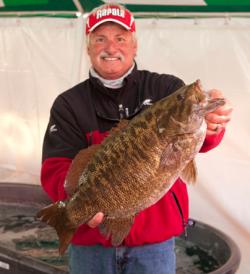
Florida pro Bernie Schultz shows he knows how to catch ’em up north, too, with this whopper smallmouth.

All the greats know that when it comes to spring fishing, location is everything. In fact, it’s often the difference between a successful day on the water and going home empty handed.

Bernie Schultz, an eight-time Bassmaster Classic participant, honed his skills fishing the grass-heavy lakes in his home state of Florida. However, he’s a firm believer that the Sunshine State isn’t the only place where anglers can find monster fish lurking in the green stuff.

“If you’re looking for the perfect spring Bass spot, it doesn’t get much better than finding a thick grass bed near a busy spawning area,” says Schultz. “You can typically find fish gathered in shallow pockets with easy access to sunlight where they’ll stage in or above the vegetation.”

Schultz recommends casting lipless crankbaits like the Rapala Rippin’ Rap® or Clackin’ Rap® into the grass and ripping them out to trigger reactive bites.

“The key with these lures is to make irregular contact with strands of grass and then rip the bait free,” Schultz explains. “When you snag a strand for just a moment, that slight pause, combined with the lures’ loud rattle are sure to grab fish’s attention.”

Practice Patience in Cold Waters

Although novice anglers may look for the hot new spring fishing tactic each year, the best strategy is to not overthink things. By the peak of the season, the urge for fish to spawn will be irresistible, meaning anglers can usually turn to a tried-and-true approach that has produced for them in the past.

However, according to Schultz, in rare cases when the water is still very cold following a harsh winter – like the most recent one – anglers need to adjust their mind-set more than their bait selection to find elusive lunkers.

“Patience is absolutely a virtue with cold-water fishing. To have success you need to work slow and take time to detail where fish are settling in. Non-reflective jerkbaits will be some of the best tools in your tacklebox,” says Schultz. “The Rapala X-Rap® or new Scattter Rap® Minnow are two of my favorite lures for frigid days on the water. No matter which technique you use, you’ve got to be thorough and deliberate. The fish are there – you just need to make them bite!”

How Ike Finds Finicky Fish

Mike “Ike” Iaconelli, 2006 Bass Angler of the Year and 2003 Bassmaster Classic Champion, also says spring is one of his favorite seasons for catching trophy Bass. But as anglers look to spend more time outdoors after a long winter, the season can also bring the year’s most crowded waters.

According to Ike, anglers can set themselves apart from the crowd by targeting fish located on cover and structure that is not visible to the naked eye. Using a depth finder, Ike locates hard-to-find cover and subtle depth changes, then ties on baits that he can use to feel along the bottom, like the quick-diving cranks from the Rapala DT® (Dives-To) Series.

“I also like to use more finesse presentations in the springtime,” Ike says. “Sometimes baits with an in-your-face action don’t do the trick. If the fish just don’t seem to be interested, it’s time for a change. That’s when I switch to a silent, tight-crankin’ lure like the Rapala Shad Rap® to offer up what looks like an easier meal for finicky fish.”

With these tips from some of the world’s most successful Pro Bass Anglers, even the most inexperienced anglers can fish like the pros this spring. For more helpful tips for on-the-water success, connect with Rapala online at www.Facebook.com/RapalaUSA.

About Rapala – The Most Trusted Name in Fishing

Rapala was unofficially founded in 1936 when Lauri Rapala invented the Rapala fishing lure. Rapala has grown from humble beginnings to become a market leader in the fishing tackle industry. The brand’s functionality and high quality are known by fishermen worldwide. Rapala maintains its strict standards of craftsmanship while delivering its fishing products to anglers in more than 130 countries. For more information on Rapala, please visit www.rapala.com