Fishing Lake Eufaula with Bobby Padgett

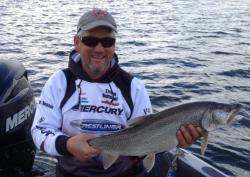
I had the chance to fish Lake Eufaula a few years ago with Bobby Padgett. He knows the lake well since he grew up in Columbus and still lives there, fishing Eufaula about twice a week. He won a BASS tournament there in May, 1996, bringing 15 bass weighing 77 pounds, 9 ounces to the scales. That weight set a new record for a three day, five fish limit tournament.

My trip with Bobby was to mark ten places to fish for bass in December for a Georgia Outdoor News article. It was unbelievable the way he found fish. We could be riding down the lake and he would slow down, circle an area, throw out a marker and say cast there. We would be so far from the bank you could not have hit it with a rifle shot! Sure enough, we would catch fish.

Bobby fishes the ledges on Eufaula with Mann’s 20 Plus crankbaits and Cedar Shad crankbaits. We were fishing ledges that were shallow even though in the middle of the lake or its major creeks. When we cranked the plug down and hit bottom in about 12 to 15 feet of water, and then bumped a stump or brush, a bass would often grab the plug.

Although we did not catch any bass over 5 pounds and Bobby said it was a bad day, I was amazed. Fishing only half a day, we probably caught 30 bass, and had about ten 16 inch keepers. Several of them weighed better than three pounds.

According to Bobby, there are more 16 and 17 inch bass in Eufaula than he has ever seen before. He had been catching at least 25 keepers each trip, and had several over five pounds each time before I went with him. I can bring bad luck to anyone! He was nice enough to blame it on the cloudy weather rather than me.

You can catch bass like that at Eufaula now. Find shallow ledges on a lake map and crank a plug down to hit them. Concentrate on brush if you find any. The bass will also hit worms and jigs, but a crankbait allows you to cover more area quickly.

There were big bass there last week. As I said, if it wasn’t for bad luck, I wouldn’t have any luck at all. Late in the afternoon, I cranked my 20 Plus down and hit brush. A bass grabbed it and, when I set the hook, it pulled my rod tip to the water. I had just caught a three pounder that did not pull my rod tip down at all. Bobby said I had a grown one. About the time I agreed, the fish pulled off.

A little later I was cranking a Mann’s Loudmouth on a more shallow hump. It stopped like it hit a stump and when I set the hook, a bass almost pulled the rod out of my hand. It also pulled off after a few seconds. I was using heavy equipment with 20 pound line, and Bobby said I was tearing the hooks out of the mouth of the big bass. He uses 12 pound Stren Easy Cast line on all his reels. I guess I should have changed to lighter line after losing the first one.

In the BASS tournament, Bobby landed one weighing 10-1 for big fish. He caught it on a deer hair jig. He caught a couple on that jig while I was with him. He showed me a way to fish jigs that I will have to learn. It is different from the way I fish now but it definitely works.

Bobby finds a fairly smooth point or ledge, casts the jig out and lets it sink on a tight line. When it hits bottom, he holds his rod tip at about a 10:00 angle and cranks the reel handle two or three times to swim it off the bottom, then lets the jig sink back on a tight line. The rod is at the right angle to set the hook if a bass hits. He does not pump the rod tip.

The jig looks like a shad swimming up and then darting down to the bass holding off the bottom. You have to set the hook hard and fast when one hits. This method also works with a Mann’s George-N-Shad. Bobby gave me one to use, showed me how and I quickly missed several strikes. I do plan to learn this new method!

Illegal Fishing In Gulf Make Fishermen Call for More Enforcement

Fishermen Call for Stronger Policies and Enforcement As Illegal Fishing in Gulf Grows

Today’s feature, on the growing issue with Mexican poachers in U.S. waters off Texas, comes to us from Chad Wilbanks with the Gulf Coast Leadership Conference.

by Chad Wilbanks, Gulf Coast Leadership Conference
from The Fishing Wire

350 dead sharks

350 dead sharks

Approximate 350 dead sharks lay on the ground outside of Coast Guard Station South Padre Island after their boat crew located a 5-mile-long gill net floating 4 miles offshore. Photo: U.S. Coast Guard

It seems every week brings another story of U.S. Coast Guard or other Gulf Coast maritime law enforcement giving chase to foreign fishermen sneaking into U.S. waters to fish illegally. Foreign illegal fishing in the Gulf, mostly by Mexican crew in boats called lanchas, is a persistent and alarming problem according to authorities from Gulf Coast states, as well as the federal government.

At a recent leadership summit at the Texas A&M University in Galveston campus, the urgency of the issue brought together a diverse group of stakeholders; commercial and recreational fishermen, state and federal fisheries enforcers and elected officials. Participants focused on how best to combat illegal fishing, and was hosted by the Gulf Coast Leadership Conference.

Randy Weber

Randy Weber

“Foreign illegal fishing in the Gulf “is an extremely important topic,” said U.S. Representative Randy Weber. Photo: Facebook

“Foreign illegal fishing in the Gulf “is an extremely important topic,” said U.S. Representative Randy Weber (R-TX). “Those who don’t play by the rules take advantage of our fishing industry.” Weber added that more can, and should be done to “level that playing field and shut down all illegal activities.”

Both commercial and recreational fisheries are an economic engine in the Gulf of Mexico driving jobs, tourism, state revenue and sustainable seafood.

According to the National Marine Fisheries Service, the Gulf of Mexico’s commercial and recreational fishing industries support more than 168,000 jobs and contribute $13.7 billion annually to the region’s economy. That significant economic lift reverberates far inland.

A $23.5 Billion Industry

Illegal and unreported fishing accounts for up to $23.5 billion worth of wild-caught marine fish globally, or around one-in-five fish harvested worldwide. That equates to up to 1,800 pounds of fish stolen every second.

Seized Fish

Seized Fish

The Coast Guard Cutter Zephyr seized an estimated 400 pounds of fish from a suspected illegal fishing vessel. Photo: U.S. Coast Guard

Aside from the theft of the fish, so-called pirate fishers show stark disregard for the marine environment. Often they sets miles of nets or lines that indiscriminately kill marine life, including endangered turtles and other imperiled species.

“I have visited extensively with business owners, recreational and commercial fisherman, and concerned citizens in Florida, Alabama, Mississippi, Louisiana, and Texas,” said Will Ward, CEO of Captain’s Finest Seafood in Clearwater, Fla., and a member of the Board of Directors for the Gulf Fishermen’s Association. “Everyone that I have spoken to is deeply troubled by the ongoing and chronic problem of foreign vessels engaging in illegal fishing. It is hard to grasp the impact this has had on our communities and our economy in the Gulf, unless you’ve lived it.”

Comprehensive statistics on illegal fishing in the Gulf are scarce, but according to Lt. Les Casterline with Texas Parks and Wildlife Department Fisheries Enforcement, just one of his wardens in fiscal year 2012 recovered 130,080 feet of illegal long line and 53,840 feet of gill net. “That gear alone held more than 6,000 sharks, 300 red snapper and an uncountable number of Spanish mackerel,” Casterline said.

Legislation Needed to Solve Problems

A key tool to solving illegal fishing is federal legislation that will tighten the net on illegal fishing operations. In April the U.S. Senate voted unanimously to approve the Port State Measures Agreement, which would strengthen and harmonize port inspection standards for foreign flagged fishing vessels. The agreement cannot take effect however until House of Representatives passes legislation to implement the pact.

Julio Fuentes

Julio Fuentes

Julio Fuentes, President and CEO of the Florida State Hispanic Chamber of Commerce, urged citizens to “tell Congress that it’s time to take a stand against foreign illegal fishing in the Gulf.” Photo: FHCC

Julio Fuentes, President and CEO of the Florida State Hispanic Chamber of Commerce, urged citizens to “tell Congress that it’s time to take a stand against foreign illegal fishing in the Gulf.”

“Illegal fishing could pose a serious economic, environmental, and human rights threat to Florida and the Gulf region,” said Fuentes. He cited numerous recent media stories on how illegal fishers around the world enslave workers, often keeping them at sea for years in deplorable working conditions that often result in the murder of dissenters.

The United Nations Office on Drugs and Crime has also linked pirate-fishing fleets to drug and migrant smuggling around the world.

Fleeing capture by Gulf law enforcement, outlaw crews have shot at officers hoping to create enough of a head start so that they can live to fish another day. Those caught face relatively light consequences: confiscation of their boat and repatriation to Mexico. Experts say this fails to deter offenders, with some illegal fishermen getting caught as many as eight times.

Harms Commercial and Recreational Sectors

Foreign illegal fishing is “the number one topic” among South Texas charter fishermen, according to Scott Hickman, a board advisor with the Charter Fishermen’s Association. “Illegal fishers are taking the ability from the charter industry to make a living. Our members see it every day. We need somebody guarding the fence,” he said.

Harlon Pearce, Gulf Seafood Institute president

Harlon Pearce, Gulf Seafood Institute president

“I take great care to sell only seafood that was caught legally and sustainably, and I know my customers appreciate it,” said Harlon Pearce, Gulf Seafood Institute president. Photo: Ed Lallo/Newsroom Ink

The challenge for U.S. authorities is clear: clamp down on current illegal fishing and implement policies to better prevent it from occurring in the future.

According to Gulf Seafood Institute president Harlon Peace, if that doesn’t happen soon the Gulf seafood industry faces an uncertain future.

“I take great care to sell only seafood that was caught legally and sustainably, and I know my customers appreciate it,” said Pearce, who is also the owner of New Orleans Harlon’s LA Fish and Seafood. “I take great care to sell only seafood that was caught legally and sustainably, and I know my customers appreciate that. It is imperative that we as leaders in the Gulf Coast fishing and seafood industry work with our elected officials to ensure our fisheries are protected from illegal fishing.”

Fall Fishing At Its Best

Fishing West Point with Ed Sheppard a few years ago reminded me again why fall fishing can’t be beat. We had a beautiful day with bright sun, clear calm water, bank trees beginning to show some color and air temperatures in the upper 70’s. To make it even better, we didn’t see a dozen other boats on the lake.

Although Ed was showing me some holes for a Georgia Outdoor News article, we stumbled on something that might interest you. While in the back of Turkey Creek above the boat ramp, a big school of hybrids surfaced around a small island. They stayed on top for almost an hour, feeding on the schools of shad that were everywhere.

Ed caught a couple on a Rat-L-Trap while I stubbornly casted a spinnerbait and bumped it on the bottom, trying to find a big largemouth feeding under the hybrids. I didn’t have any light equipment and I needed a big largemouth for a picture. I didn’t get one.

If you go to West Point, carry an ultralight and tie on a quarter ounce jig. White or yellow should be good. You probably can catch hybrid after hybrid weighing a pound to a pound and a half. They will give you a super fight on light tackle.

Shad were on top everywhere we fished late in the afternoon. Check backs of creeks as well as open water. Watch for schools on top the last couple of hours of light. They are easy to spot if there is no wind. With or without wind, keep your gas motor off and listen. You can often get the direction of a school by hearing them when the hybrids start hitting. When you find a school, ease up to them and don’t spook them. If they go down, wait a while and they will probably return.

We also enjoyed watching a couple of osprey diving and picking up shad off the top. They would fly back to a tree, eat the shad and return for another. These majestic brown and white birds are firmly re-established in our state. When I was growing up, there were not any to watch. They add to a day’s fishing.

How To Make A New England Style Fish Stew

I tried a new fish stew recipe last weekend that is mighty good on these cold, rainy fall days. If you like New England style chowder, you will like this fish stew.

Brown a couple of strips of bacon in a pot. Remove the bacon and cook a large chopped onion in the grease until clear. Add three cups of chopped potatoes and the crumbled up bacon, cover with water and cook for about 15 minutes. Add two pounds of bass or crappie filets cut into chunks, half a stick of butter, salt and pepper and cook until the fish and potatoes are done. Add 16 ounces of evaporated milk and stir until hot.

Like all fish and stew, this is even better fixed ahead and warmed back up. Add a chopped stick of celery and a carrot for more flavor. Since I am allergic to milk, I used rice milk rather than evaporated milk. It is not as rich and good, but I like the added sweetness and rice flavor. You can use frozen hash browns for the chopped potatoes.

If you catch some hybrids, they will be too strong for this mild chowder. Bass or crappie are much better. Strong oily fish like hybrids are better in tomato based stews.

Can I Catch Bass On An Ice Fishing Jig In the Summer?

Ice-Fishing Bait Helps Palaniuk To Top-10 Finish In Bassmaster Tourney
from The Fishing Wire

Brandon Palaniuk

Brandon Palaniuk

After grabbing an early lead in a Bassmaster tournament last month, Brandon Palaniuk told the media he was keeping details of his tackle and tactics “locked down for now.” It’s time to bust out the key and set his secret free. In the heat of the summer he caught ’em on an ice-fishing bait – a Rapala Jigging Rap®.

“It’s a little trick up my sleeve that I’ve kept secret for a long time,” says Palaniuk, the only Bassmaster Elite Series pro from Idaho. “Before I made the Elites, I had thrown them a little at home. I’ve caught open-water fish on them all the way down to 70, 80 feet.”

When fished through the ice as they were designed for, Jigging Raps work best with a vertical pump-and-swim action. A successful open-water presentation, however, requires aggressive rod snaps throughout a horizontal retrieve.

“When you snap the rod, it will dart a foot or two off to the right, and then it falls super fast,” Palaniuk explains. “And then you snap it again and it might dart two feet back over to the left – or forwards, or backwards. It’s a constant change of direction.”

After weighing a 20-pound-plus five-fish limit to lead the first day of the Bassmaster Elite Series tournament on New York’s Lake Cayuga in late August, Palaniuk told Bassmaster.com he was fishing a pattern he had all to himself. It’s likely those Empire State bass hadn’t seen anything like a Jigging Rap before – at least not in the summer.

Lead weighted and balanced to perfection, Jigging Raps inimitably simulate the erratic characteristics of a wounded baitfish. “The big thing is how erratic it is,” Palaniuk says. “For fish that are in a negative, inactive mood, it triggers a feeding response.”

The Jigging Rap’s unmistakable minnow profile features single reversed hooks on the nose and rear – so regardless of how a fish attacks, it’s running smack-dab into a hook. A center treble hook – hung from a belly eyelet – further increases your hook-up ratio.

Fishing much deeper than most other competitors on Cayuga, Palaniuk saw only one other angler during the tournament. Targeting smallmouth, he ended up catching both brown and green bass off of two small rock piles in about 25 feet of water. A shell bed extended from the rock pile area down to about 40 feet. “The fish would stay anywhere from that 25-foot to that 40-foot zone,” he says.

Palaniuk found fish in those spots in the two-and-a-half days of practice before the four-day tournament began. Despite being able to see them clearly on his depthfinder, however, he couldn’t get them to bite at first.

“There were schools of these fish, so I’d drop on them with a drop shot and they’d follow it down,” he recalls. “But I wouldn’t be able to get them to eat.”

But on the last day of practice, inspiration struck.

“I pulled out the Jigging Rap to try to get a reaction strike,” he says. “The first drop with it, I had one eat it.”

It was a No. 7 size Jigging Rap in the Glow color pattern – white with a chartreuse head. He threw it on a 7-foot, medium-action spinning rod spooled up with 8-pound-test braided line attached to an 8-foot, 8-pound-test fluorocarbon leader.

“That first drop of the Jigging Rap, a couple followed it down, and the first few snaps of the rod, I got one to eat it,” Palaniuk says. “So then I kind of got excited. I was like, ‘Man, I’ve got something figured out that they’re going to eat!”

After dropping the Jigging Rap a few more times and shaking off a few more bites, he determined he’d found a school of 4-pounders.

“So, I just always had one tied up and on the deck throughout the tournament,” he says. “And when I would see fish on my electronics I would drop on them. If there were two or more fish, I’d drop on them like that and see if I could get bit.”

Ultimately, the Jigging Rap bite did not yield enough big fish for Palaniuk to win the tournament – he ended up placing eighth – but it did account for several of the fish he weighed and helped clue him into a couple other ways to get bites. Based on the way bass had been biting the Jigging Rap in practice, Palaniuk decided on the first day of the tournament to stroke a 1-ounce Terminator Football Jig, rather than crawl it across the bottom, a more traditional presentation. That decision led to a 20-pound, 1-ounce limit and the Day 1 lead.

“The reason I started stroking it was because of the fact that I got on the Jigging Rap bite,” he explains. “I just started ripping it off the bottom, like you would a Jigging Rap, and that’s pretty much how I caught 20 pounds pretty quick.”

Most of the bass Palaniuk caught on the Terminator Football Jig hit on the fall immediately after a vertical stroke. “You’d rip it up and I think you’d catch their attention, and they’d follow it up, and then instantly, if you’d let off at all, they ate it,” Palaniuk explains. “It’s almost like you’re fishing a spoon. Once you rip it up off the bottom, they eat it as soon as it changes direction – starts to fall.”

Although many believed, going into the tournament, that shallow-grass largemouth would be the ticket to success on Cayuga, Palaniuk – true to form – opted to target deep-weedline smallies.

“I always like doing something different,” he explains. “I feel like that’s how you put yourself in contention to win and how you can separate yourself from everyone else – if you can find the quality fish doing something different, that not every else is doing. The reason I found those fish is because I was looking for smallmouth.”

As it turned out, however, he caught both smallmouth and largemouth from his deep spots. Brown and green bass were “pretty evenly mixed in the school,” he says.

Lightning and Fishing

I admit it, I am scared to death of lightening. When I was about eight years old some friends and I were “camping out” on the screened in back porch of my house. A bad thunderstorm hit in the middle of the night and I just knew I would be hit by a bolt of electricity. Since that night I get nervous when I hear thunder, even if far away.

Over the years I have had many bad experiences with thunderstorms while I was fishing. Once summer while fishing way up the river at Bartletts Ferry a powerful storm suddenly popped over the surrounding hills. The rain was torrential and lightening started cracking all around us.

There was little cover so I pulled the boat into a small creek where the overhanging trees should give me some protection. I sat there in the boat, using the trolling motor to keep the wind from blowing me back out in open water. After a few minutes I realized the boat was not being affected by the wind. The heavy rain had put so much water in the boat it was sitting on the bottom.

That storm lasted over two hours. When it finally stopped it took a long time for the bilge pump to get enough water out of the boat to make it float again.

One August I was at Jackson Lake practicing for a night tournament. The afternoon had been very hot and muggy, with thick clouds overhead but no thunder, rain or wind. Just as it got dark I was fishing beside the dam when suddenly wind started gusting over the dam and a crack of lightening direct overhead was the first sign of a storm.

Back then there was no barrel line at the dam so I pulled my boat up against the solid concrete wall. There was a metal rail on top of the dam, about 20 feet over my head, so I felt I had a lightening rod protecting me.

For over an hour I sat in the drivers seat of the boat with my head on my arms. The lightening flashes were so bright I could see the light even though my eyes were tightly shut and my arms covered them. My dog Merlin got under the console of the boat hiding from the downpour and loud cracks of lightening.

Those experiences and others make me now head for some kind of cover if the thunder is anywhere near me. And I have an app on my phone that shows weather radar, giving me a good idea how close the storm is to me.

Last Sunday at a tournament at Oconee thunder made me head for cover. I left a place in open water where I had just seen on my depth finder a brush pile covered with fish. I would not stop and fish it, it was way too far from cover.

In the Flint River Bass Club tournament last Sunday at Oconee, 13 members and guests fished our September tournament from 6:00 AM to 3:00 PM. We brought in 16 bass over the 14 inch size limit weighing about 29 pounds. There were no limits and six people didn’t have a keeper after nine hours of casting.

Niles Murray won with four bass weighing 7.66 pounds, Chuck Croft was second with three at 6.08 pounds and his 3.38 pounder was big fish, Mindy Burns had three weighing 5.19 for third and my three weighing 4.62 gave me fourth place.

I knew fishing would be tough, but not that tough. I started fishing a spinner bait on seawalls, usually a good pattern before it gets very light this time of year, and caught a three pound channel cat at about 6:15. It gave me a good fight but it was not what I was hoping for.

At 6:30 I switched to a crankbait and caught a keeper bass off a seawall. That fired me up but after almost an hour of trying the crankbait, spinner bait, buzz bait and Pop-R I had not gotten another bite. Then I got an explosive hit on the Pop-R right on the seawall. The fish fought like a big one but it was another 15 inch largemouth. Two in the live well at 7:30.

From then to noon I tried everything I could think to fish. I kept throwing the topowater baits until the sun got on the water but never got another bite. Crankbaits and spinner baits didn’t work either, and the only hit I got on worms was a ten inch bass by a dock.

At noon thunder started rumbling off in the distance so I got nervous and kept looking at the clouds. At 1:00 I was fishing a point and the thunder was getting closer, so I decided to head near the ramp so I could get to the van quickly. As I left the point I saw a GPS waypoint way off the bank on the point and rode over it. That is when I saw the brush with fish on it but I would not stay out there and fish in the open water.

At 2:00 the thunder was still distant so I went back to the brush pile I had seen and quickly caught my biggest keeper at 2:15. Although I fished the brush until I had to go in that was it for me.

What Are Gator Sea Trout In Alabama?

Year of the Gator Sea Trout in Alabama

Oddly enough, some anglers think the oil spill allowed more trout to reach jumbo sizes.

By David Rainer
Alabama Department of Conservation and Natural Resources
from The Fishing Wire

Big Alabama sea trout

Big Alabama sea trout

One gator has dominated the outdoors coverage this summer and rightfully so. Mandy Stokes’ world record American alligator at 15-feet, 9-inches is famous worldwide.

However, a gator of another sort has surfaced along the Alabama Gulf Coast that has inshore fishermen excited. It’s called a gator trout. Conjecture is that when the speckled trout (spotted seatrout for you purists) reaches 25 inches or larger, its tooth-filled mouth begins to resemble that toothy, giant reptile.

Highlighted by the Alabama Deep Sea Fishing Rodeo record trout of 8.88 pounds caught by Trenny Woodham in Theodore Industrial Canal, 2014 has been a banner year for gator trout.

Chris Blankenship, Director of the Alabama Marine Resources Division, said there is no research to pinpoint why some years are better for monster trout.

“The big fish we’re catching now are 8 or 9 years old,” Blankenship said. “Sometimes we have these spells where we catch a lot of big fish. That trout brought in at the rodeo was impressive.”

Inshore guide Jay Gunn, who spends most of his time in the Fort Morgan area, said there’s usually no warning that a gator trout is on the prowl until it takes the bait.

Based on his anecdotal evidence, Gunn thinks the 2010 oil spill may have impacted the trout fishery by reducing the harvest of specks for most of the spawning season.

“My theory is that most of those trout didn’t get caught and were able to spawn,” Gunn said. “That helped with recruitment the next year. That meant there were a lot of three-pound trout in the fishery. When they get that big, they start splitting away from the group and don’t run with the school anymore.

“Because those fish didn’t get caught, instead of seeing a lot of fish between five and seven pounds, we’re seeing a number of fish between eight and nine pounds. There are some not weighed and turned loose that could be even bigger.”

Gunn’s largest trout of 2014 measured 30 1/2 inches, which he estimated at 9-plus pounds. Like most big fish he’s caught during his career, he had no idea the fish was in the area.

“You kind of catch them out of nowhere,” he said. “All of sudden it happens. You don’t get many of those bites. It almost never happens when you’re catching other fish.”

When it comes to gator trout, it’s hard to beat live bait, according to Gunn, although he did catch a 29-incher on a DOA shrimp earlier this year.

“I’ll probably catch 50 trophy trout on croakers or menhaden for every one I catch on artificial,” he said. “I always use a Kahle hook with live bait, and almost every time the fish will be hooked in the corner of the mouth. If you hook one on a lure, your chance of landing that fish goes down with the size of the bait. If you’re fishing with a MirrOlure or Zara Spook, that trout is going to make a long run and then come to the top and shake his head. Then he’s going to make a shorter run and come to the top and shake his head. The weight of the lure can make it easier for the trout to throw the bait.

“The fish I catch on croakers seldom jump at all. They usually run and run and run.”

Inshore guide Bobby Abruscato, who has been on the winning team in three straight redfish tournaments, said the biggest trout he has seen all year was boated by his friend Bruce Howle Jr., who caught a 30-incher that Abruscato estimated at 10 pounds. Howell released the fish after photos were taken.

Abruscato said he seconds Gunn’s assessment that the oil spill likely kept a good many large trout from being thrown into anglers’ ice chests.

Gator trout

Gator trout

“I certainly think the oil spill was one of the factors,” Abruscato said. “The two summers after that were some of the best years I’ve had for trout. It’s still good, but not as good as that. I think what happened is with those fish in the population, it allowed some of those fish to grow and get to be that trophy size.

“When you start talking about catching a seven-plus fish, you’re just going to have to be real lucky. There are some guys who cut down on the luck, but with the super-big trout we’re seeing this year, it’s just luck. You have to be in the right place and have something on the end of the line that they want to eat.”

Abruscato says larger trout tend to be in or near deeper water, like the mouth of Dog River, Theodore Industrial and Mobile River, especially during the fall and winter.

“I just think those bigger fish like to stay in those areas where the salinity is more stable,” he said. “But that doesn’t mean they won’t move up in the shallows to feed. The biggest fish I ever caught in my life was in a foot of water. I was wade-fishing in May. The fish was 30 inches and hit a Catch 2000 MirrOlure. That fish knocked some mullet almost up on the beach. I threw over there and he nailed it.”

Both Abruscato and Gunn think the fall fishing in the Mobile Delta and other estuaries could be excellent this year, barring some sort of tropical weather.

“We haven’t had much rain lately,” Abruscato said. “With the salinity, the fish have pushed up the bay.”

Gunn added, “I think there are a good number of fish 15 to 17 inches, and they should be easy to catch. As little rain as we’ve had, they should be moving into the upper ends of the bays. It should be a good year in the Delta if we don’t get a storm to wash the shrimp out.”

But back to Woodham’s rodeo record trout. Will Patterson of Dauphin Island Sea Lab has headed a project to collect otoliths (ear bones) from speckled trout during the rodeo for the past two years. Like tree rings, the otolith reveals the age of the trout. The rodeo-record trout was a 7-year-old female.

Patterson said there is not enough evidence to conclude the oil spill had an effect on the number of gator trout seen in 2014. He said there could be several factors involved.

“A lot of fish in that genus are cannibalistic, so the bigger fish eat the smaller fish,” Patterson said. “When I was in college and working at a marina in Virginia, there’s a cousin to the speckled trout called the weakfish. I was cleaning a 14-pound weakfish and pulled a four-pound weakfish out of its stomach.”

Patterson said the otolith study will allow marine scientists to gather significantly more information on speckled trout.

You can age fish by their otoliths

You can age fish by their otoliths

“An increase in size and age will be recorded in the otoliths,” he said. “We’ve got two years of data now, and we’re going to keep this going. There is a wealth of information to be gathered in rodeo samples.”

Blankenship said the proof of the great fishing off Alabama is in the number of state records broken in the last few years. He said 39 saltwater records have been broken since 2011.

“It’s encouraging to see all these big fish,” Blankenship said. “Our inshore artificial reef program and other habitat protections we’ve done have helped. We closed some areas in north Mobile Bay to shrimping, and Grand Bay is closed to trawling. I think things like that really give those smaller fish sanctuary and help with the shrimp production. That allows those fish to have plenty to eat and facilitates great growth.

“I get excited about seeing big fish. I get to see the applications for state-record fish before they go out to the committee. I’m proud when I see the size of the fish being caught off Alabama. This is just more confirmation of what a great fishery we have.”

PHOTOS: Jay Gunn holds a gator trout caught this summer near Fort Morgan that measured 30 1/2 inches. Bruce Howle Jr. landed a 30-inch gator trout near Dauphin Island that was at estimated at 10 pounds. Graduate student Brian Klimek, working with Will Patterson from the Dauphin Island Sea Lab, dissected the otolith (ear bone) of the Alabama Deep Sea Fishing Rodeo record trout caught by Trenny Woodham this year and determined the trout was 7 years old by counting the growth rings.

Sixteen Baits I Have to Have in My Tacklebox

After 40 years of bass club fishing you would think I would have culled down my tackle to some essentials. I have not been one to go wild over new lures for many years. I don’t rush out to buy something just because a big tournament was won with it. But I do usually have 16 rods on my deck ready to use in a tournament since I don’t like to stop and re-tie. If it is on my deck ready to use I am more likely to pick it up and give it a try.

Still, I often use only three or four rods in an eight hour tournament. If something works early I stick with it. And if fishing is tough, like it usually is for me, I cast my confidence baits over and over.

If I had to limit myself to only a couple of rods and a tackle box with 16 items in it, the following list is what I would carry. I have distilled all my baits to this list and this is what I carry if I don’t go in my boat. And the 16 rods on my deck are usually rigged with each of them, ready to use.

1. JJs Magic – I always dip the tails of my worms and trailers in Chartruese but red and blue allow you to change colors or highlight plastic baits quickly and the clear and all the colors add a strong garlic scent.

2. Bitsy Bug jigs – I have a box full of three sixteenths and one quarter jigs in both green pumpkin, for clear water and black and blue for stained water.

3. Zoom Creepy Crawler trailers – Green pumpkin for the brown jigs, blue for the black and blue jigs. And I always dip the tails in chartreuse JJs Magic in both colors

4. Spinnerbait – I like a three eights ounce bait with a gold willow leaf and a silver Colorado blade, with white and chartreuse skirt for all around fishing. But I also carry heavier baits for fishing deeper.

5 Rico –My go-to topwater bait is the small Rico – I think it is the best popper on the market.

6. Buzzbait – I keep a variety of one eight to half ounce buzzbaits in various colors for fishing topwater, especially when cover keeps me from throwing the Rico

7. Zoom Mag 2 worms – I fish the redbug color both Texas and Carolina rigged, depending on cover and depth

8. Owner hooks – Sharp and tough the 3/0 is the size I use for Trick and Mag 2 worms, and have some 1/0 if I got to a smaller worm

9. Sinkers – a variety of weights, from my usual 3/16hs for Texas rig to half ounce for
Carolina rigs to lighter and heavier for different conditions and depths

10. Deep running crankbaits – I like the Norman Little N for medium depth and the DD22N for deep dredging. Shad colors for clearer water, chartreuse and blue for stained

11. Jig head – shaky heads – One of my go-to baits when fishing is tough. I use a 3/16ths ounce most of the time but will tie on a 1/8th for fishing rocks and a slower fall

12. Trick worm – A floating white trick worm with a 3/0 hook will draw strikes when the fish are shallow and want a subtle, slow falling bait.

13. Netbait T-Max worms – A Bamabug color is almost always on my shaky heads, but I will go to a watermelon red in clear water

14. JIgging spoon = Jigging spoons will catch fish year round, not just in the winter. I got a 7.6 pounder in a July tournament at Oconee several years ago. I like a gold Hopkins Shorty for most of my jigging

15. Spro Popping Frog – for fishing heavy grass, a frog colored bait allows you to fish the heaviest cover

16. Senkos – Nothing beats the wiggle of a weightless Senko falling under a dock or around cover. I rig it wacky style if cover allows, or Texas style with a 3/0 hook. They skip under docks great, too.

All these baits work for me. What are your favorites?

Are Blue Catfish An Invasive Species?

Chesapeake Task Force Looking for Ways to Control Invasive Blue Catfish

Today’s feature comes to us from Bay Journal editor Karl Blankenship; blue and flathead catfish, desirable species in the heartland, are causing issues on the Mid-Atlantic Coast these days.

Action needed to prevent irreversible harm to Bay’s ecosystem.

By Karl Blankenship, Bay Journal, www.bayjournal.com
from The Fishing Wire

People may not learn to love blue catfish in the Chesapeake Bay, but perhaps they will learn to love them on their plate.

Big blue cat

Big blue cat

Maryland DNR biologist Branson Williams has to use an extra ruler to measure a blue catfish too big for the standard measuring board. The fish, collected in the Potomac River near Fort Washington, MD, was 44 inches long. (Dave Harp)

A draft report from a task force that spent more than a year looking for ways to deal with the large, voracious – and rapidly expanding – blue catfish population acknowledges that the invasive species has likely become a permanent resident of the Bay, and says action is needed to prevent “irreversible” harm to the ecosystem.

Chief among its recommendations is an expanded commercial fishery that might control the population and create a new product for watermen.

The task force’s draft report recommends a range of actions, such as identifying sensitive areas, such as high-quality spawning grounds, where extra efforts against the predators might protect high priority species such as shad.

It questioned whether states should continue to promote catfish trophy fisheries, and said efforts should be ramped up to warn the public about the ecological impacts of invasive catfish and dissuade anglers from moving them into new areas.

The report was completed by the Invasive Catfish Task Force – a group of state, federal and university biologists assembled by the state-federal Bay Program’s Sustainable Fisheries Goal Implementation Team to identify actions to control blue and flathead catfish, neither of which are Bay watershed natives.

Most of the report’s focus is on blue catfish, which tolerate moderate salinities and are more numerous and widespread in tidal Bay tributaries. Flatheads are more restricted to freshwater areas.

Nonetheless, flatheads – which are already the most abundant predator in the Susquehanna River – are likely to get more management attention in the future, said Bruce Vogt, acting deputy director of the National Oceanic and Atmospheric Administration’s Chesapeake Bay Office, and task force chair. “There is already pretty significant concern about flatheads in Maryland and Pennsylvania,” Vogt said.

The report will likely be updated as new information is gained. The report and its recommendations are now under review by the Bay Program’s Scientific and Technical Advisory Committee, which could result in some changes later this year.

The report warns that if left unchecked, invasive catfish could cause substantial ecological and economic harm to the Bay.

Two Blue Cats

Two Blue Cats

Maryland DNR biologists Branson Williams, left, and Tim Groves handle two large blue catfish near the Woodrow Wilson bridge on the Potomac River. The fish were collected using an electroshocking rig. (Dave Harp)

Recent studies suggest that growing numbers of blue catfish could threaten efforts to restore species such as river herring and shad, and they may also eat substantial numbers of economically important blue crabs. They could also outcompete native white catfish in some areas, and threaten native mussel populations.

They have become so numerous in some places that they interfere with watermen targeting other species, such as striped bass.

“The expanding range and increasing populations, particularly of blue catfish, have resource managers concerned that without management intervention, the damage to Chesapeake Bay resources may be irreversible,” the task force report said.

Blue catfish were introduced into Virginia Bay tributaries by state biologists beginning in the early 1970s in an effort to boost the recreational freshwater fisheries – a common practice at the time.

Over the last decade, their population has increased dramatically and spread to most tributaries on the Western Shore. They have begun turning up in Eastern Shore rivers as well.

Although they generally avoid salinities higher than 14 parts per thousand, years with high river flows and reduced salinities allow them to enter new areas. In addition, biologists believe anglers have intentionally introduced blue catfish into some tributaries because they want more opportunities to catch large fish.

In parts of the James River, blue catfish are thought to be the most abundant fish, and their numbers are rapidly growing in other systems, such as the Potomac. They are top predators, and will eat most other fish – and shellfish – in the rivers. And, they can reach huge sizes – the Virginia tidal record is 102 pounds.

“In the aquatic system, there is nothing that gets bigger than them – unless it’s another blue catfish,” Vogt said. The task force report warns that blue catfish could double their current range in the Bay watershed.

It noted that eradication of an invasive species is “rarely feasible or cost-effective once a species has become widely dispersed in an open aquatic system like Chesapeake Bay.” As a result, the report focused its recommendations on actions that would help control the population and limit its expansion.

The primary control method it proposes is to promote a commercial blue catfish fishery that would give watermen a new product to market while removing invasive fish. While this is already under way, the report says it may require new investments, such as new or expanded processing facilities, to maximize harvest.

Promoting a fishery, though, tacitly acknowledges that the goal is not to rid the Bay of an invasive fish, but to manage it, especially if fishermen begin buying gear to target catfish, and seafood processors invest in new facilities to handle a wave of new fish.

“Once you open a fishery like that, you are probably in it for the long haul,” Vogt said. “Then the challenge is to come up with a framework that gets fishing pressure where we are reducing the ecological impact, but also sustains this new economy that has developed around the catfish. That’s a tough one.”

In fact, overfishing the population could cause problems. If the catfish were to become too hard to catch, fishing pressure would drop – and the population could mushroom again.

“If you are using a commercial fishery as a way to manage a thing like blue catfish, you don’t want the fishery to crash,” said Matt Ogburn, a researcher with the Smithsonian Environmental Research Center who works with blue catfish and is a member of the task force.

The bigger immediate issue, though, is whether a fishery can actually make a dent in the booming population. That will depend in large part on whether markets can be grown to increase demand. Fishery agencies have been promoting catfish, and a nonprofit group, the Wide Net Project, is also working to increase demand for the fish, including touting it as a healthy food to hunger-relief organizations.

While consumer demand is growing, Wendy Stuart, co-founder of Wide Net, said markets for blue catfish ultimately need to be developed beyond the Bay watershed to stimulate enough fishing demand to curb the population.

The group recently reached an agreement with a Boston-based processor to begin marketing blue catfish from the Bay. “Local food is good, but it doesn’t always solve the problem,” Stuart said.

Electroshocking Blue Cats

Electroshocking Blue Cats

Maryland DNR biologist Branson Williams brings in a blue catfish that was electroshocked during a survey of the Potomac River. (Dave Harp)

The Bay region isn’t alone in this approach. A fishery for lionfish is being promoted in the Gulf of Mexico to reduce impacts from that invasive fish. “Harvest pressure is making a difference in that fishery,” said Stephen Vilnit, fisheries marketing director with the Maryland Department of Natural Resources and a member of the task force.

“You may not be able to catch the last fish, but you might be able to knock them to a level where they’re not having the huge ecological impact they are currently having,” Vilnit said.

In addition to promoting a commercial fishery, the report suggests that states consider incentives that would increase harvests, such as allowing boat captains to use electrofishing gear that targets blue catfish, which are stunned by a specific frequency that doesn’t affect other fish. Electrofishing has proven to be a highly effective way to collect them. But more studies would be needed to assess the feasibility of commercial electrofishing and potential safety concerns.

The report also calls for states to identify areas with populations of native species that could be threatened by blue catfish and to target those areas for additional removal efforts, possibly by sending out crews with electrofishing gear.

Such areas might include spawning areas for shad, river herring and other anadromous fish species, as well as habitats for shellfish and species with important ecological value.

While blue catfish likely wouldn’t be eradicated from those areas, the goal would be to keep numbers low so they would not pose a substantial threat to native species.

Protecting targeted areas could prove challenging. Ogburn has been tracking blue catfish movements in the Patuxent River, and has found they are highly mobile and could quickly repopulate areas from which they are removed.

“If you want to remove blue catfish from Jug Bay, you would essentially have to remove blue catfish from the entire Patuxent River,” Ogburn said.

Vogt agreed that “it probably won’t work everywhere,” but said task force members did not want to write off all areas. “People thought it might make sense to try in a few places but we have to be smart about what places we choose,” he said.

In a possiby controversial recommendation, the task force said the benefits of removing dams should be weighed against the potential that such action could open the door for catfish to reach new areas. For instance, a new fishway at Bosher’s Dam outside Richmond allowed blue catfish to colonize the James River as far as Columbia, about 50 miles upstream.

Removing dams and building fish passages to reopen historic habitat used by shad, river herring and eels has been a major Bay Program priority.

In reality, Vogt said he was skeptical that concerns over blue catfish would halt any dam removals or new fish passages. “A lot of people told us that while we are looking at a dam as a barrier, it most likely is not – because people have likely already caught and moved catfish to places on the other side of the barrier,” he said.

The task force recommended that current state fishing policies and regulations be reviewed to identify those that may promote the persistence and expansion of invasive catfish populations, such as trophy fisheries, though the report said both Virginia and Maryland officials seemed to oppose that action in the James or Potomac rivers.

“Managers should discuss the risks associated with maintenance of trophy fisheries,” the report said. “This perpetuates the maintenance of large individuals in the environment for long periods of time.”

Finally, it said improved public education is needed to inform anglers and others about the risks blue catfish pose. That could help discourage anglers from moving fish into new areas, and highlight the concerns to the general public. The public is less informed about blue catfish than snakeheads – the headline grabbing “frankenfish” that invaded the Potomac River a decade ago – even though catfish likely pose a greater threat, Vogt said.

That’s starting to change, as Maryland, supported by the Bay Program, began posting warning signs about catfish earlier this year, and agencies are beginning to post more information on their websites. Still, Vogt said, “awareness is not at the level of the snakehead.”

Information about blue and flathead catfish is available at www.chesapeakebay.noaa.gov/fish-facts/invasive-catfish.

About Karl Blankenship

Karl Blankenship is editor of the Bay Journal and Executive Director of Chesapeake Media Service. He has served as editor of the Bay Journal since its inception in 1991.

What Does Ducks Unlimited Do In Georgia?

Last Saturday I met a couple at Lake Eufaula to get information for a Georgia Outdoor News article. One of the places we fished is a popular creek called “The Witches Ditch.” Near the mouth of the creek is a riprap levee with a diesel water pump on it.

The levee and pump are there to pump water out of a big area behind the levee. In the spring it is drained and food sources for waterfowl is planted. Then in the late summer the area is allowed to flood, offering ducks and geese perfect feeding areas.

This project is part of the National Wildlife Refuge located in Georgia and Alabama on Lake Eufaula. There are several other similar places around the lake where this is done the same way, with levees and pumps.

These wildlife areas benefit waterfowl and many other species of wildlife, from deer to alligators. Such improvements in natural areas are critical for survival of some species and help others thrive. Much of the work on these kinds of conservation projects is funded by Ducks, Unlimited.

Ducks, Unlimited is a worldwide organization of sportsmen and conversationalists that work to fund such projects. Almost all of them are hunters and they know waterfowl and wildlife needs special help since so much habitat is being destroyed.

The organization has completed over 20,000 projects involving more than 12 million acres. Each year many of these projects are in Georgia. Duck hunters here in Griffin benefit from these projects, but all wildlife and anyone valuing conservation of natural resources also benefit.

One of the levee and pump areas on Eufaula was funded by Ducks, Unlimited and the U.S. Fish and Wildlife Service and was completed in 1995. It restored 450 acres of moist soil habitat by installation of a 24 inch pump station and rehabilitation of existing levees. The goal of this project was to enhance habitat for mallards, wood ducks, gadwall and green winged teal. It also provides for hunting opportunities.

Closer to us, a project at Rum Creek Wildlife Management Area near Forsyth included the installation of a water control structure and dike around an area. The field is planted with millet and corn to provide winter food for wildlife. The project was in conjunction with the Georgia Department of Natural Resources.

At Lake Oconee 150 acres of habitat has been conserved with the installation of six water control structures and the renovation of some dikes there. This project is also managed by the Georgia Department of Natural Resources and provides forage for migrating waterfowl near Lake Oconee.

There are many other Georgia projects. Over the years more than 20,000 acres have been conserved through projects in Georgia. Since Georgia is part of the Atlantic Flyway, it provides winter habitat for waterfowl that migrates through the area and is very important for their survival.

Money for all these projects is raised through local banquets and other events. Members pay dues and volunteer their time, but the local events are critical for continuing to conserve the environment. And the money is used for projects, not administration of the organization. More than 80 precent of money raised goes to conservation projects, making Ducks, Unlimited number 115 on a list of almost one million non profit organizations in the US in terms of efficient use of money raised.

Young people are the future of hunting and conservation and Ducks, Unlimited works hard to educate them and help them become involved. Greenwing membership for $15 per year is available to those 17 years old or younger and includes four issues of Puddler Magazine, a magazine just for youth, as well as six annual issues of Ducks, Unlimited Magazine.

Adult membership is $35 per year and includes the Ducks, Unlimited magazine and members only web access. They are also offering a free gift to new members right now. Various levels of membership and sponsorship is also available for varying amounts.

If you value conservation and wildlife, and want to help, visit the Ducks, Unlimited website at www.ducks.org to find out more. Join an organization that works to further your goals of conservation, whether you are a hunter or not.