Is the Smallmouth Bass Fishing Good On Bays de Noc In Michigan?

Bays de Noc Smallmouth Bass Fishery Shines on National Stage
from The Fishing Wire

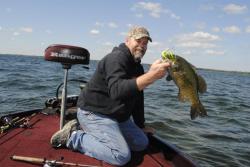
Big smallmouth

Big smallmouth

ESCANABA, Mich. – Mention Lake Michigan’s Bays de Noc to most anglers and they’ll immediately start talking about fishing for walleye.

But in the wake of September’s high-profile Bassmaster Angler of the Year Championship – which brought 50 of America’s top anglers to Escanaba to ply the waters of Big and Little Bays de Noc – what was once seemingly relegated to “also-ran” status is now national news: The Bays are loaded with trophy bass, too.

“The fishery has always been kind of walleye-centric,” said Department of Natural Resources fisheries biologist Darren Kramer. “Bass is kind of an up-and-coming, emerging fishery. Every year we see more and more bass boats, and more out of state anglers, taking advantage of the fishery. There’s a lot of traffic out on Big Bay de Noc after the bass opener. That fishery’s really taken off in the last five or six years.

“Our creel data indicates there’s increasing angler effort and we think that’s attributable to bass,” Kramer continued. “Bass harvest has stayed the same, but use of the resource is going up along with angler success, which implies we’re recruiting more catch-and-release bass anglers to the area.”

The Bassmaster Angler-of-the-Year Championship started with a bang: On the first day, 12 competitors brought in five-fish limits with a total weight in excess of 20 pounds.

Catching bass that weigh more than four pounds each isn’t often accomplished in tournaments, even on some of America’s best big-bass lakes.

Although the tournament hit a minor snag, with high winds causing delays that shortened the event to two days rather than three, the weather couldn’t dampen the enthusiasm of the competing pro anglers who described the fishery as “awesome,” “incredible,” “unbelievable” and “amazing.”

Paul Elias, a Laurel, Mississippi, resident who won the BASS Classic in 1982, was effusive in his praise.

“It’s as good as, or better than, any smallmouth fishery we fish,” he said. And Elias’ comments were echoed by virtually all the competitors.

Fayetteville, Tennessee, bass pro Brandon Lester, who brought in the biggest bass of the first day’s competition – a six-pound, four-ounce smallmouth, said, “I’ve never seen so many big smallmouths in my life. They’re not everywhere, but when you find one, you’ll find a group of them. When you get around them, you can light them up real quick.”

Said Skeet Reese, a top angler from Auburn, California, at the weigh-in: “That’s the best day of smallmouth fishing I’ve ever had in my life. This is an incredible fishery.”

While many of the anglers were surprised by the quality of the fishery, Kevin Short of Mayflower, Arkansas, said the results were just what he expected.

Short first fished the waters off Escanaba in 2008 when he recognized that the area would undoubtedly host a future tournament, and has come back every year since just to fish for fun.

“If there’s any place in the whole country we would move to for nine months of the year, this would be it,” Short said. “The first couple of trips we really didn’t catch that many, but once we figured it out, holy smokes. It’s a really special place. I’d drive 18 hours just to come up here and fish a few days.”

Bass anglers familiar with the fishery had predicted an outstanding tournament.

Scott Cormier, a 42-year-old recreational vehicle salesman and lifelong bass angler from Gladstone, said the tournament was “going to open up a lot of eyes” across the country.

“There’s a big deep-water fishery out there that nobody’s really fishing,” Cormier said. “There are fish out there in 40 feet of water that have never seen a lure before.”

Indeed, most of the anglers were fishing shallow water during the tournament, concentrating on the rocky shoals that were only a few feet deep on the top or on the weedy flats adjoining drop-offs.

Dan Anderson, a 48-year-old maintenance supervisor from Fond Du Lac, Wisconsin, who fishes Bays de Noc regularly and was on hand to take photographers out on the lake during the tournament, said the fishery is capable of yielding 100-bass days at any time.

“They’re biting good by opening day,” he said. “You can catch them by May 1st and fish right up to deer season.”

That such an outstanding bass fishery flew under the radar for so long is just a matter of the Upper Peninsula fishing culture, Kramer said.

“Many anglers in the U.P. are typically looking for panfish or walleye,” Kramer said. “A lot of the bass fishermen we see are from downstate or out of state. But I predict that might begin to change.”

Added Jessica Mistak, the DNR’s fisheries management supervisor for northern Lake Michigan: “We think this is a world-class fishery that’s really been overshadowed by the walleye fishery. Now that anglers see that there are fish to catch other than walleyes in the Bays, they’ll be eager to come here and try it.”

Although invasive species are typically talked about in a negative light, Mistak said water clarity changes – brought on by zebra and quagga mussels – and new prey species, such as gobies, may have helped the smallmouth population.

Certainly, the smallmouths are thriving, a fact that is not so secret any more.

“This place is unbelievable,” said Jacob Powroznik of Port Haywood, Virginia, who brought in a limit weighing 24-pounds and one-ounce, good for third place after the first day of competition. “I hope we come back real soon.”

A Saturday Kids-Buddy Tournament and A Sunday Club Tournament At Bartletts Ferry

There is nothing quite like seeing the excitement on a kid’s face when they catch a fish. They light up and almost vibrate they are so happy. Last Saturday at the Spalding County Sportsman Club Youth/Buddy tournament at Bartletts Ferry three kids showed us that joy.

We were disappointed there were only three youth in the tournament, but it was well worth the effort to put on the tournament. Raymond English brought his grandson Preston and he won the youth side with three keepers weighing 3.39 pounds. Russell Prevatt’s grandson Bryson had two weighing 1.52 pounds for second and Zane Fleck’s grandson Dakota had three weighing 1.22 pounds for third.

I am glad they all caught fish. The fishing was tough but they worked hard for seven hours to land fish on a tough day. I will long remember watching Bryson, the youngest angler in the tournament at seven years old, bring a bag of fish up to the scales.

The weigh-in bag looked almost as big as he is and with water and fish in it, it was very heavy. Although he struggled with it, he wanted no help! He was so excited he couldn’t stop talking. It was great.

Kids win prizes rather than money and I was disappointed I didn’t have the tackle bags ready. I am trying to get some donations and will present the prizes at the next club meeting. Unfortunately, I have used up all the tackle I had collected for prizes.

In the Buddy side of the tournament Raymond and Preston won with five fish weighing 9.63 pounds. The way the tournament works is kids weigh in the fish, up to five 12 inch largemouth and any size spots since there is no legal limit on them, and the adult and kid combine their best five for the team weight. Spots have to be 12 inches long in the buddy tournament due to club rules.

A father and son were supposed to fish with me but due to a last minute problem they couldn’t make it, so I fished as a “team” by myself. I had three keepers weighing 6.49 pounds for second and my 3.70 pound largemouth was good for big fish. Russell and Bryson had four weighing 3.13 for third and Zane and Dakota had four weighing 2.25 for fourth.

Fish hit a little bit of everything, from Trick worms to spinner baits. I caught one at daylight on a spinner bait, one at 11:00 on a Texas rigged Mag 2 worm and the big fish hit a jig head worm at noon. The fish were scattered on the cloudy, cool day and there was not much of a pattern. I caught fish from one foot deep to 22 feet deep.

During the buddy tournament I decided to look for new places to fish and it worked. The first two hit on places I had never fished before, and the third one hit on a point that has always looked great but I have never caught a fish before, so I had quit fishing it years ago.

On Sunday ten members of the Sportsman Club fished our September tournament on Bartletts. After eight hours of casting we brought in 26 keepers weighing about 33 pounds. There were three five-fish limits and two people didn’t catch a keeper. We had six largemouth, 18 spots and two shoal bass weighed in.

I won with five weighing 6.98 pounds and had a 3.16 pound largemouth for big fish. Sam Smith had four weighing 5.41 pounds for second, Niles Murray had a limit weighing 4.87 pounds for third and his partner Raymond English had five weighing 4.57 pounds for fourth.

I started out where I had caught my first fish the day before but got no bites. Then I ran to where I caught my second fish and again got no bites. By 7:45 I was where I had landed the big one the day before and quickly caught a barely 12 inch long spot, then a largemouth the same size.

At noon I had fished a lot of places and still had just two keepers. In desperation I went out on a point and saw fish near the bottom, and used a drop shot worm to catch three keeper spots and several throwbacks. That gave me my limit with an hour left to fish, but they were all small.

For the last hour I decided to go to the point where I had never fished before Saturday but had caught a keeper that day. There were fish on the bottom and I missed some bites on the drop shot worm, and thought they must be bream. Then, with five minutes left to fish, the big fish hit. I didn’t think I would ever land it but managed to net it after a long fight.

This is my favorite time of year to fish. The weather is beautiful and fish tend to bite better. And boat traffic is supposed to be lower, since Labor Day is supposed to be the end of boating season, but it was not that way Sunday. The beautiful weather had a lot of pleasure boaters on the lake and I rocked and I rocked and rolled all day from their wakes.

How Long Should I Use A Spinnerbait Before It May Break On A Fish?

Fishing was fantastic one weekend several years ago – if you could find water that was clearer than a dirt road. I fished at Eufaula on Saturday and Bartlett’s Ferry on Sunday. The results were very different.

At Eufaula, the creeks upriver were clearing and bass and crappie were feeding. Bass were hitting spinnerbaits on shallow grass and wood cover. Hybrids were running in the river. I saw a fishermen in a boat anchored in the mouth of Uchee Creek reeling in a hybrid as I went out at 9:30 am. When I returned at 4:45, someone in that same boat was reeling in another one.

Bartlett’s was tougher. I could not find any decent water anywhere. The lake was muddy and the creeks too stained to fish. Fifteen Flint River Bass Club members practiced casting for 8 1/2 hours and managed to bring in 16 bass weighing 21 pounds.

New member Shane Graham, in his second tournament, won with three bass weighing 3-10. He caught them on worms. I got desperate after lunch since I had not caught a fish and started throwing a spinnerbait at everything I could see. I had one strike and caught a 3-6 bass that won second and big fish. Ricky Skipper, another new member, caught three at 3-4 for third and old member Tom Perdue caught 2 at 2-5 for fourth.

I was fishing by myself and when I got my fish to the boat, the net was tangled in another rod. Rather than waste time, I lifted the fish over the side with the rod. As it cleared the water, it fell, hitting the side of the boat and going into the boat. When I got it, my spinnerbait had broken just above the hook.

A professional fisherman who makes his own spinnerbaits once told me to quit using a spinnerbait after catching three bass on it. I think I will remember his advice from now on. If my bass had gone back into the lake, I would have been sick!

How Much Training Do Conservation Officers Receive?

New conservation officers put to the test with 18-week field training
from The Fishing Wire

Editor’s Note: We often underestimate the education and training officers that enforce fish and wildlife laws across the country receive. That’s why we thought you’d enjoy this look at a portion of the 18 week field training portion of Conservation Officers in Michigan- after they graduate from the law enforcement academy.

Standing high on a bluff overlooking the Muskegon River in late August, Michigan Department of Natural Resources conservation officers Jeff Ginn and Saykham Keophalychanh spotted an angler on the river below. Without saying a word, Keophalychanh immediately began making his way down the path to the river bank, hoping to make contact with the angler.New officer Keo with his field training officer Ginn

Natural Resources Conservation Officers Jeff Ginn and Saykham Keophalychanh

Natural Resources Conservation Officers Jeff Ginn and Saykham Keophalychanh

One of 23 graduates from the Department of Natural Resources’ most recent law enforcement academy, Keophalychanh is currently working under the supervision of Ginn, his field training officer (FTO). Like his classmates, Keophalychanh will spend 18 weeks afield with veteran conservation officers to learn the ropes before reporting to his assigned county.

“I want him to have a lot of contacts during the field training,” said Ginn, a CO in Newaygo County. “The more people he talks to that aren’t suspicious, the more someone who is suspicious will stand out to him.”

Keophalychanh, who is halfway through his second of three six-week sessions with an FTO, said he’s already learned 10 times as much about the job as he did at the academy.

“It’s kind of like doing lab work in a science class, to use an analogy,” Keophalychanh said. “Sometimes five minutes in the lab can teach you as much as five hours with a book. What we learned in the academy is 20 miles wide, but only an inch deep. The FTO process fine-tunes you, reinforces what you learned in the academy.”

Ginn, an eight-year veteran of the DNR’s Law Enforcement Division, said his job as a FTO is to make sure Keophalychanh understands what’s expected of him and to teach by example.

“The academy provides a great foundation for our officers,” he said, “but when they get in the field, that’s when they put their skills to the test.”

Keophalychanh said Ginn has really helped him learn what he should focus on in the field.

“I was a clean slate coming in,” Keophalychanh said. “It’s good to have direction. Just being able to see how it’s done is a good experience for me.”

Getting these 23 new officers through the training is crucial to the DNR’s mission to protect, manage and conserve Michigan’s natural resources. Prior to the academy this year, the DNR’s Law Enforcement Division was operating at an all-time low for the number of conservation officers in the field, with some counties not having the full-time presence of a CO.

The field training portion of a new officer’s overall training is an integral part of what prepares the officer for the job, said Sgt. Jay Person, commander of the DNR’s conservation officer recruit school.

“The field training is segmented so that the new officer moves from an observational role to an active role over the course of 18 weeks,” Person said. “When completed, the new officer has a very good idea what the job is really like, and pairing them with different FTOs throughout the field training maximizes their exposure to highly trained, experienced conservation officers who have a lot of knowledge to share about the job and the area where the new officer is assigned.”

First Aid from Conservation Officers

First Aid from Conservation Officers

During the first six weeks of field training, the new officers were paired with a more experienced officer in or near their assigned county. In the second six-week segment, the new officers were moved to another region of Michigan, sometimes to an area completely different than their assigned county, allowing the new officers to be exposed to different areas of the state and the different activities encountered – an officer assigned to a more rural county may spend the next six weeks in a more urban area and vice versa.

In between the first and second sessions, there was a one-week training session at the DNR’s Ralph A. MacMullan Conference Center at Higgins Lake that focused on marine operations, boat handling and tribal awareness.

After the second six-week segment, another one-week training period focusing on waterfowl training and enforcement will be held just prior to the opening of most waterfowl hunting seasons in Michigan.

In the first six weeks, the new officers spend more time observing the more experienced officer handling contacts or assignments. In the second week, the new officers take the lead more on contacts. In the final segment, the new officers fully take the lead on contacts and investigations.

“The field training gradually ramps up as it moves along,” said Person. “At the end, the new officers will be completely ready to perform their duties as assigned.”

Keophalychanh’s view of the field training experience is echoed by his classmates.

“It’s an awesome way to learn,” said Tim Rosochacki, a 26-year-old former DNR park ranger who is a newly minted CO. “They’ve got a lot of tips and tricks that they’ve learned and they know what a fresh officer is going through.

“My training officers have been great – they’ve let me learn on my own, but they’ve also added to it. They’ll tell you their own experiences and that gives you a better mental picture of the routes or avenues you can take. Now you’re getting to put all the stuff you learned in the academy to use. You’re getting to see firsthand how it all fits together.

“They get you thinking one way and then you get out in the field and you begin to see why you were trained that way.”

As Ginn and Keophalychanh continue their patrol, they cruise past a launch ramp on Hardy Pond and spot another angler fishing in a boat not far from shore. Keophalychanh asks Ginn if they should wave him in to check him. Ginn’s response?

“Let’s talk about that a minute,” Ginn said. “Let’s say we see him catching fish hand-over-fist and then when you contact him, he just motors off. What are we going to do? What options are available to us?”

Keophalychanh said the first thing he would do is look for the boat’s registration numbers. He puts his field glasses to his eyes, notes the vessel’s MC numbers, and gets on the radio. Minutes later, he learns the boat is registered to someone who has a senior citizens’ fishing license. That seems to jibe with what Keophalychanh has seen.

As Ginn put it, the pair found out what they needed to know without disrupting the angler’s recreation.

“There are countless ways to do this job,” Ginn said. “It doesn’t matter which approach you take if you get the right outcome. After we have an interaction, we often talk about how we might have done it differently. I like to tell him about things I think I’ve done wrong. There are times when I say, ‘I should have done it this way …'”

Richard Cardenas, a 26-year-old recent academy graduate from Ionia County said working with an established CO has really helped him understand how to interact with the public.

“You’re working with a fellow officer who helps you get in your groove and develop your own style,” Cardenas said. “Each community is different and the academy can’t teach you that – how to interact with different cultures, different age groups, different types of sportsmen. The scenarios they give you at the academy are just that – scenarios. This is real life.”

Cardenas, who spent his first six-week session with an officer in Livingston County, said he spent a lot of time at Belle Isle, a far different atmosphere than rural Ionia County. He’s found a supportive community in Detroit.

“Most of the people we encounter are very happy we’re there,” he said. “They support what we’re doing and are enjoying the new atmosphere at Belle Isle.”

The new COs will begin their third six-week session of field training shortly. Then they’ll be hitting the ground on their own just when things really get busy for conservation officers – right before the firearms deer season. By all accounts, the officers can hardly wait.

“The job is what I thought it would be and then some,” Rosochacki said. “Every day I’m amazed at what I get to do and what I experience. You’re on the lake one day and the next day you’re out in the woods. The dynamics of the job and the variety are awesome.”

Ginn said his stint as an FTO has been a learning experience for him, too.

“I’ve learned things from Keo,” he said. “We’re both in the same boat. I’ve been in his shoes and I’m falling back on my experiences to learn what kind of an FTO I want to be. This is a new chapter in my career, too.”

For his part, Keophalychanh is looking forward to getting out on his own.

“It’s a point of pride to earn your badge and begin putting everything you’ve learned into action,” he said. “It’s exciting to know that day is just around the corner.”

Learn more about Michigan DNR’s conservation officer academy and the recruitment process at: www.michigan.gov/conservationofficers.

Global Warming and Fishing

Remember the Polar Vortex last winter that produced record cold weather around here and all over the US and the northern hemisphere? The extremely cold days and nights that lasted several days each time it hit? It was produced by a change in wind patterns that brought artic cold further south than normal. The terrible cold made hunting and fishing miserable.

A team of scientists from the US and Korea have come up with the reason, and I guess their conclusions should come as no surprise even if they don’t make sense. The reason? Global warming, of course.

You gotta wonder how scientists can “prove” or even theorize that warming produces record cold. That just shows you can “prove” anything you want to. Right now there is big money behind any efforts to prove global warming exists, and researchers know they won’t get funded unless they produce the desired results.

The whole theory of colder winters due to global warming is based on the Artic ice cap getting smaller. Strangely enough, the data does not show a shrinking ice cap for the past few years. Instead, according to the “National Snow and Ice Data Center,” the Artic ice melt this year has been lower than last year, and the extent of the ice cap size will set a record this winter and will continue to increase.

Some believe in global warming based on their past experiences. They might say this summer was the hottest they can remember, without looking at temperature records. Or for a while winters were claimed to be warmer, again not looking at temperature records.

My experiences make me think we have weather, not climate change. For years I spent Christmas holidays at Clarks Hill. One year, two days before Christmas, I had been fishing barefoot and shirtless for several days. But other years I had to wear a snowmobile suit during the same time period.

When I was working on my first Masters Degree in the mid 1970e at West Georgia College I had to write a report on the coming ice age. I used information from Time magazine the month the cover proclaimed scientists predicted a new ice age within 20 years or so, and articles explained how we would suffer from the extreme cold in coming years.

There is a lot at stake for us on how this debate turns out. One claimed way to lessen global warming is to reduce coal use. But even if we reduce it in the US, and we have been doing that for years with no new coal fired power plants approved for a long time, what other effects will it have?

Almost all of our electricity around here comes from coal even though we have a lot of hydroelectric power dams in Georgia. The coal fired plant in Forsyth is the biggest in the US, and uses an incredible amount of coal each day. If such plants are shut down expect your power rates to get much, much higher and less reliability of power supply.

I hate it when the power goes out, or even when it is reduced in a brown out due to storms. Electrical motors and appliances do not work right. Expect that to be the rule, rather than the exception, if we shut down coal fired power plants.

Georgia Power is already working on closing the coal fired power plant on Lake Sinclair. It has been reduced to one working boiler if my information is correct. Why are they shutting this plant? Because new EPA rules require them to make upgrades that cost so much it is not economically feasible to do them.

One effect of shutting that plant down will be no more warm water released into Beaverdam Creek. That warm water keeps most of the lake downstream a little warmer than other lakes around here. The warmer water makes bass bite better. Almost every bass club in middle Georgia schedule winter tournaments there for that reason.

The effect on fish and wildlife is another claim the true believers in global warming make is something else I find hard to take for true. Computer models predict about a four degree warming in the next one hundred years. Even though the computer models have been far off in their predictions for the past 20 years, assume they are right.

Game and fish undergo changes in water and air temperature of many degrees each day. For wildlife, last week is a good example. In the mornings we had temperatures in the low sixties that climbed into the eighties each afternoon. That is over 20 degree in a few hours. So how is a change of four degrees in one hundred years going to make a difference?

In August the surface water temperature on area lakes was in the upper eighties. By late October they will be in the seventies, and by February in the low forties. That is a fifty degree change in six months. So four degrees in one hundred years is going to kill off all our fish?

When global warming claims make more sense I will believe them.

Can Anglers Help Recover Puget Sound Rockfish?

Working with anglers to recover threatened Puget Sound rockfish
from The Fishing Wire

Today’s feature, on Pacific rockfish that live 75 to 100 years, comes to us from NOAA Fisheries.

Written by Ed Quimby with contributions by Kelly Andrews and Jennifer Sawchuck

Rockfish don’t put up a fight like Chinook salmon (Oncorhynchus tshawytscha), so what’s the allure of catching them? Quite simply, they’re tasty. Randy Jones, a charter boat captain from Bremerton, remembers being about 10-years old when his dad was a commercial fisherman off Westport on the Washington coast, where the catch included yelloweye rockfish.

“They taste really good,” he said. “I’d take a rockfish over salmon any day of the week.”;

For Ray Frederick, a recreational fisherman near Silverdale with more than 70 years of experience, rockfish were an incidental catch decades ago. “I considered myself lucky if I caught a rockfish and brought it home, because they’re really good eating,” he said. “I prefer salmon, but my wife likes rockfish better.”

A dramatic decline

But these tasty populations have been in decline in Puget Sound for decades, in large part due to the species’ late maturation. Yelloweye rockfish (Sebastes ruberrimus)-aka red snapper or rockco-can live for more than 100 years and canary rockfish (Sebastes pinniger) for more than 75 years. Both species take more than a decade to mature and reproduce. This means that mature individuals taken by fishermen reduce reproductive potential and juveniles don’t mature fast enough to replace them.

After decades of commercial and recreational fishing on these species, decreases in catch were observed in the 1980s and the state began to impose catch limits. Some species, however, continued a dramatic decline in numbers, and in 2010 Puget Sound/Georgia Basin yelloweye and canary rockfish were listed as threatened under the U.S. Endangered Species Act (ESA).

Scientists team up with anglers

Captain Jay Field  and NOAA biologist Kelly Andrews

Captain Jay Field and NOAA biologist Kelly Andrews

Captain Jay Field of Dash One Charters and NOAA biologist Kelly Andrews prepare to release a 37 cm subadult yelloweye rockfish in the San Juan Islands.

Now that these depleted populations are protected, NOAA is working to restore them. An important goal for managing recovery is to identify genetic differences between these rockfish populations in Puget Sound and those on the outer coast to better define the boundaries of the distinct population segment (DPS), which is the smallest division of a species that can be listed under the Endangered Species Act.

That task fell to biologist Kelly Andrews and fellow researchers at NOAA Fisheries’ Northwest Fisheries Science Center (NWFSC). They decided to partner with experienced recreational charter boat captains and expert anglers who used to catch these elusive bottomfish. Even if it won’t happen in their lifetime, many of these anglers want a sustainable fishery for their children, the next generation of anglers. That’s how the rockfish research voyages of several charter boat captains, including Randy Jones and anglers such as Ray Frederick, were born.

As Andrews explained, “The low abundance of these two rockfish species makes cooperation with experienced local anglers the key to successful sample collection. Teaming up with them allows us to fish historical hotspots with methods and gear that were successful in the past.”

Andrews believes this research will be of great interest to anglers, because genetic information can inform fisheries management and the recovery of the species over time, which can impact economic activities related to charter and recreational fishing. The sampling could also point to the key answers about the populations themselves. Genetic diversity is one of the keys of healthy populations, and understanding how closely related these fish are could help determine that.

Searching for rockfish

Fishing for Rockfish

Fishing for Rockfish

After obtaining NOAA research permits to catch members of a protected species, and several spring shake-down cruises off the San Juan Islands and Whidbey Island to test methods, the team is sampling selected locations this summer. “We have six to eight captains available for fishing days,” Andrews said. Most of the charter boats are in the 25 to 30 foot range and can hold six passengers, but he said most captains want three or four anglers fishing at a time. They are fishing mostly below 150 feet for adults of these species. Canary depth ranges vary, but yelloweye are typically deep, with most being caught below 250 feet.

Jay Field, a charter operator from Anacortes and an experienced fisherman, also signed up his boat to be part of the research. As captain, he enjoys “putting the puzzle together, looking for certain structure and depths, a certain period in the tide” at a given hotspot. “Rockfish need a softer tide set,” he observed. “Too much current doesn’t work.”

Kelly Andrews

Kelly Andrews

Kelly Andrews with a 56 cm yelloweye rockfish.

But he also couldn’t resist the chance to do a little “rockfishing” again when the opportunity arose. “I’m a tried and true Chinook salmon fisherman,” Field said, “but I caught plenty of rockfish in the past.” He said the bottom is “snaggy and grabby,” which runs the risk of losing some expensive gear, “but if you’re not fishing at the bottom, you’re not fishing where they live.” He also noted that “Everybody does things a bit different. I fish more bait than hardware.” Evidently his technique works for him, as he caught several yelloweye, one about 17 pounds, over two feet long, and potentially 100 years old.

“Reeling in” barotrauma

The sampling is designed to be nonlethal. Scientists note the gender, measure total length and weight, cut a small piece of caudal fin for a genetic sample, then release the fish. While fishing at these depths can cause physical stress due to rapid changes in barometric pressure while being reeled to the surface, rapid recompression to captured depths may alleviate external signs of barotrauma.

Rockfish with Popeye

Rockfish with Popeye

Bottom-dwelling rockfish are susceptible to barotrauma when they are quickly brought to the surface, with symptoms including “pop-eye” as shown here.

Immediately after data collection, the researchers clip the mouth of the fish to a pressure-activated descending device called a SeaQualizer, which quickly takes the specimen down to the appropriate depth for release. However, more research is currently being conducted to determine long-term survival after decompression. Even if fish do not resurface they may have injuries that later lead to death.

“The rockfish’s swim bladder expands like a balloon on the way up,” Andrews explained, “and it doesn’t have the strength to get back down. Bottomfish can’t adjust to pressure changes as quickly as fish that spend a lot of time going up and down, but as the individual goes down on the SeaQualizer, the air compresses again in its swim bladder. Once down at the depth of capture, the rockfish can self-regulate again.”

Collecting genetic data

The caudal fin samples are collected from the fish and sent to the NWFSC laboratory in Seattle for genetic analysis. By comparing the genetic profiles of rockfish caught in Puget Sound with those on the outer coast, we can better understand the level of difference between these populations. By collecting samples from several regions of Puget Sound and the surrounding areas, we can identify geographically where differences in these populations occur. Answers to these questions will better inform spatial management boundaries and recovery actions for these species.

Biologists record GPS location and depth of catch, length, weight and gender of fish, snip a small piece of the tail fin for a genetic sample on every fish collected and attach a Floy tag into listed rockfish. Each fish is on board for approximately one minute andthen released back to the water, either on their own or using a descending device. Approximately 30 – 50 fish are sampled per angling trip.

Toward rockfish recovery

While the NWFSC scientists and their community partners are out on the water, and the geneticists are running DNA sequences, Jennifer Sawchuk, a marine ecologist in the NOAA Fisheries Protected Resources Division, is working with an team of experts from various organizations to draft the rockfish recovery plan for canary and yelloweye rockfish, and a third ESA-listed species, bocaccio (S. paucispinis). Just as the scientists have been working with the recreational fishing community, such partnerships are integral to her recovery planning efforts.

Previously as a University of Washington graduate student she interviewed more than 500 anglers in Puget Sound to gain an understanding of their knowledge about rockfish, perceptions of threats to rockfish, fishing practices, and preferences for recovery measures. The results of her study have informed NOAA’s outreach and education efforts around rockfish, as well as understanding how to better utilize angler’s knowledge about marine resources.

“We’ve done several projects over the years that involve experts and the public in recovering yelloweye, canary, and bocaccio, and much of that work has been with the regional fishing community,” Sawchuk said.

“We recognize that fishers can offer a lot of experience and expertise, and their support is important. To recover threatened and endangered species, it’s just as important to understand stakeholders as it is to understand the species themselves. Our hope is to continue working with anglers and other groups in the future – recovering these rockfish species will take the dedication of a lot of people from all over Puget Sound and we need their help.”

After internal review, co-manager and scientific peer review, and subsequent public review, a final recovery plan for these species in Puget Sound is targeted for release in 2015.

Northwest Fisheries Science Center

2725 Montlake Boulevard East
Seattle, WA 98112

(206) 860-3200
nwfsc.info@noaa.gov

How Can I Catch Early Fall Trout?

Early Fall Trout
from The Fishing Wire

Catch fall trout like this one

Catch fall trout like this one

Opportunities abound for fast autumn action

Across the spectrum of hunting, fishing and other outdoor pursuits, autumn is truly a time of plenty. And one of the more overlooked opportunities involves the early fall trout bite.

The action often gets lost in the shuffle of activities. But the fact remains, September produces fine fishing afoot and afloat for anglers who understand a bit about fall trout behavior.

“In early fall, trout are either roaming deep water or buried in the weeds,” says veteran guide and avowed salmonid stalker Bernie Keefe. “After the first few hard freezes, though, much of the action shifts shallow.”

All three scenarios hold potential for string-stretching excitement, not to mention the reward of fine dining on fresh trout. To help you make this your best fall ever, Keefe offers the following tips to capitalize on each situation.

Green Power

In Keefe’s stomping grounds around the high-country paradise of Granby, Colorado, early to mid-September sees a smorgasbord of rainbows, browns, cutthroats and cuttbows relating to near-shore weedbeds.

“Ideally, you have three to four feet of open water between the weed tops and the surface,” he says. “Which makes it easier to fish lures just over the vegetation.” Because trout often prowl open pockets in the salad, Keefe keeps an eye out for such clearings, and religiously fishes baits in and around them.

His go-to rig in the greenery is a 1/16- to 1/8-ounce black Eagle Claw jig head tipped with a 2 ½-inch, smelt-pattern Berkley Gulp! Minnow, suspended beneath a small clear casting bubble or float.

Autumn Trout

Autumn Trout

Autumn is a great time for catching all types of trout, from sag-belly lakers to ‘bows, browns and more.

Six- to 8-pound-test Berkley FireLine fuels long casts, while a low-vis leader of Trilene 100 Percent Fluorocarbon boosts the stealth factor. “Tie the knot tight to the jighead, so the bait rides horizontally,” he notes. “You’re trying to fool wary trout, so it has to look natural.”

Keefe casts beyond the area he wants to target, then lets the commotion subside before beginning his retrieve, which is a combination of slow reeling and frequent pauses. “You can try twitching the bait, too, but anytime you’re over a fish-holding pocket or travel lane, deadstick,” he says. “Don’t be afraid to let it sit for up to three minutes at a time.”

Strikes are often light. “Stick bobbers often just tip over, while bubbles betray bites by rocking and sliding across the surface,” he says.

When trout are on a tear, Keefe favors more aggressive tactics. “Small, metallic-finish spoons like the Lindy Viking are great for active trout,” he says. “Though I do replace the treble with a single hook, which makes the spoon a little more weedless.” He favors fast-paced retrieves laced with rips, flutters and twitches, but cautions to always keep the spoon above the salad. “Lift-drops are dynamite for rainbows and browns in the weeds,” he adds.

As autumn progresses and vegetation dies back, trout often frequent languishing weedbeds. Rocky shorelines and points can also be productive. “Anywhere the bottom changes on a point, giving crayfish and minnows a place to hide, can be hot,” he says. A variety of presentations hold water here, including tube jigs dragged on bottom, a leadhead and Gulp! Minnow combo fished slightly higher, and a number of slender minnowbaits, spoons and spinners. While close proximity to deep water is a plus, Keefe says it’s not mandatory.

Kokanee Salmon

Kokanee Salmon

Besides offering fine fall fishing, kokanee salmon often hold the key to lake trout location.

Late in the day, another pattern often emerges. “In the afternoons and evenings, trout often rise in the back-ends of bays, in 4 to 5 feet of water,” he says. “Wait until a fish rises, then fire a small spoon into to the spot as fast as you can. Trout often strike it immediately, but if not, let it flutter a foot or two and start your retrieve.”

On the lake trout front, Keefe follows migratory lakers toward their autumn spawning grounds. “In early fall, though, it’s more a matter of tracking trout that are feeding on kokanee salmon,” he notes. “Inlets and the mouths of large bays often attract prespawn salmon, and lakers follow.” When he spots trout harassing a kokanee congregation, Keefe plies a variety of presentations, including tube jigs, spoons and hair jigs.

While autumn’s many opportunities may distract fair-weather trout fans, the season holds options for solid action. Follow Keefe’s guide-tested tips and make this your best fall ever.

CONTACT INFORMATION
For more information or to book a trip with Keefe, visit: fishingwithbernie.com or call (970) 531-2318.

Catching Spotted Bass On Lake Lanier In November

Lake Lanier was the site for the November Spalding County Sportsman Club tournament a few years ago. Nine of us fished for eight hours and caught 19 bass weighing 31 pounds,15 ounces. That is a good average size for any lake and it is even better if you know most of the bass we caught were spotted bass. They tend to be smaller and lighter than largemouth.

James Pilgrim, Jr. had a limit of 5 keepers that weighed 9-2 for first. He had one of the prettiest spots I have ever seen, a 4 pound, 4 ounce fish that took big fish honors. Kwong Yu also had a limit and his 7-7 weight was good for second place. David Pilgrim had 4 keepers weighing 6-0 for third.

I caught only two spots but they weighed 5-8 and that was good for fourth place. I caught one on a jig and pig at 8:00 am and the other on the same bait at 2:00 pm. Both were on rocky points. My big one weighing 3-8 was the biggest spotted bass I have ever caught, but it wasn’t quite big enough!

James, David and Kwong said they caught their fish on worms in fairly deep water. They were fishing brush piles 20 to 30 feet deep. I am always amazed how deep the fish hold at Lanier. The shad I saw on my depthfinder were all 35 to 40 feet deep and other fish were holding under them. I caught a couple of little hybrids jigging a spoon in 40 feet of water.

I never fish that deep on other lakes. I guess it is the clear water at Lanier. If you try Lanier anytime soon, plan of fishing deep water. Jigging spoons are a good way to fish that deep.

The pro fishermen found similar conditions at Lake Russell that year. They also caught fish deep. The winner jigged spoons and slow rolled a spinnerbait through standing timber in 30 feet of water. Russell also has very clear water. Remember, the clearer the water, the deeper the bass will usually hold.

Stanford Lures Cedar Shad Crankbait

In an earlier article I mentioned a plug bass pro Bobby Padgett uses to catch fish on the ledges at Eufaula. A company in Columbus, Stanford Lures, is making the Cedar Shad. They also make the Hog Caller spinnerbait you see in local stores sold by another company.

The Cedar Shad is carved out of Western Cedar, runs about 10 to 12 feet deep and has excellent colors. It is guaranteed to run true right out of the box. Most crankbaits need tuning before they will run right but the Cedar Shad doesn’t. I expect this company to sell a lot of quality lures that are made in our state.

Crankbaits are excellent lures year round. Bobby Padgett’s favorite time to use them is May through the fall when the bass are stacked up on ledges and deep structure. He says his type fishing is feast or famine, catching either dozens of good bass or nothing.

I really like crankbaits this time of year. I am usually looking to catch one or two fish, just to place in a club tournament. Crankbaits fished slowly around rock or wood cover in shallow water will usually pay off in a few strikes even on the worst days.

Its tough deciding whether to go fishing or hunting this weekend. Doe days are open in Spalding County and other counties toward Atlanta. Other counties do not have doe days until Thanksgiving, but bucks should still be moving. I need a couple of deer for the freezer, but catching bass sounds good, too. This is a great time of year!

What Is A Ripe Sturgeon?

Biologists Net ‘Ripe’ Sturgeon Pair on Nanticoke Tributary

By Karl Blankenship
from The Fishing Wire

Atlantic sturgeon

Atlantic sturgeon

Atlantic sturgeon (Dave Harp)

When a crew of biologists from the Maryland Department of Natural Resources hauled a gill net out of the Marshyhope Creek in late August, what they hauled in was more than the catch of the day: It may have been the catch of their careers.

One of the nets contained two “ripe” – ready to spawn – Atlantic sturgeon. One was a 7-foot 3-inch, 154-pound female. The other was a 5-foot 2-inch, 70-pound male. The female was filled with black eggs, and the male was leaking sperm.

“That was probably the most exciting and rewarding day in my career,” said Chuck Stence, head of the anadromous fish restoration unit of the DNR Fisheries Service, who was leading the survey crew. “We’re out there fishing – you’re not expecting to catch anything – and then all of sudden two fish like that get dropped into your lap.”

The recent catch ended more than two years of frustration for the biologists. Fishermen have reported seeing sturgeon jumping in the Marshyhope for several years. Last fall, one landed in the boat of two anglers.

But crews from the DNR and the U.S. Fish and Wildlife Service had – until Aug. 28 – failed to net any sturgeon. The previous week, in fact, Stence and his crew saw one jump only about 40 feet from their boat, but they were unable to net it.

“It’s so frustrating when you see them jumping right in front of the boat, and you still can’t catch them,” he said.

That frustration ended as they were pulling in the last of four 100-yard gill nets that had been deployed on the 28th.

“We got maybe a third of the way through the net, and all of a sudden the net started pulling back,” Stence said. “And the closer we got, you could see the big shadow in the water. It’s amazing how the adrenaline kicks in when you go out there for three years and catch nothing, and all of a sudden you can see a big one in the net – and then having another one right behind it.”

Atlantic sturgeon are the largest fish native to the Bay, where they historically reached lengths of up to 14 feet. Once common, they suffered from overfishing, habitat destruction and pollution, resulting is a dramatic population drop in the last century. Two years ago, the National Marine Fisheries Service listed them as an endangered species.

Like other anadromous fish, sturgeon live most of their lives in the ocean, but return to their native rivers to spawn. The James River is the only Bay tributary known to still have a spawning population.

But the catch by DNR biologists could change that. “I can’t imagine a fish that big going up in there for any other reason other than to spawn,” Stence said.
Still, he added, catching the fish is “just the first little piece of the puzzle.”

Actual proof of spawning would require finding recently spawned “young of year” fish in the river. Right now, Stence said, no surveys exist in the vicinity of the Marshyhope that would catch young of year sturgeon. Now, with evidence that suggests potential spawning activity, the fishery service will consider starting one, he said.

It’s also unknown where the sturgeon came from. They could be remnants of a native Maryland population that has gone undetected for decades. It is possible, some have suggested, that they are James River fish that have wandered up the Bay. Another possibility is that they stem from a small batch of juvenile Hudson River fish that were released in the Nanticoke in 1996.

Those questions could be answered in coming weeks. The biologists took DNA samples of both sturgeon for analysis.

Biologists would like to know what habitats the fish are using. So the captured sturgeon were briefly anesthetized and the biologists made minor incisions to insert a small transmitter and a tag so they can monitor the strugeons’ movements and identify them in the future.

After that procedure, the biologists jumped into the chest-deep water and cradled the fish, “like babies,” Stence said. After about 10 minutes, the sturgeon recovered and swam away.
But Stence said, the biologists are optimistic that they have not seen the last of sturgeon on the Marshyhope.

“We’re definitely optimistic that we will see some more up there,” he said. “I’m anxious to get back out there and see if there are any more out there. At least we know where to go now.”

Indeed. Last Friday, they caught another 97-pound male.

About Karl Blankenship
Karl Blankenship is editor of the Bay Journal and Executive Director of Chesapeake Media Service. He has served as editor of the Bay Journal since its inception in 1991.