How Is A Florida Team Saving Dolphins Tangled In Fishing Line?

Florida Team Saves Dolphin from Tangled Fishing Gear
from The Fishing Line

Dolphin Team

Dolphin Team

A team of 10 organizations, including Mote Marine Laboratory and the Sarasota Dolphin Research Program, helped to free a dolphin calf from fishing gear that was entangled around its tail. Without this help, the dolphin’s tail likely would have been severed.
Photo by Florida’s Fish and Wildlife Conservation Commission.

Today, an 11-month-old female bottlenose dolphin calf is swimming free and clear of fishing gear that could have severed her tail after 10 groups – including Mote Marine Laboratory – mounted a life-saving rescue in Little Marco Pass in Collier County.

The dolphin, a dependent calf nicknamed Skipper, was first spotted by members of the 10,000 Islands Dolphin Project, who documented the entanglement and reported it to state and federal authorities in August. After the dolphin was spotted several times over several weeks still entangled in fishing gear, NOAA’s National Marine Fisheries Service (NMFS) – which oversees the protection of marine mammals in the U.S. – asked the Sarasota Dolphin Research Program (SDRP), a partnership between Mote Marine Laboratory and the Chicago Zoological Society, to try to free the dolphin of the gear.

An initial effort by SDRP and Mote to remove the gear with a long-handled disentanglement tool on Aug. 28 was not successful.

Dolphin Tangling Fishing Gear

Dolphin Tangling Fishing Gear

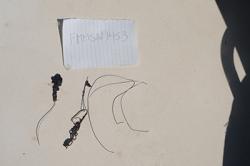
This is the gear that was tangled around the tail of “Skipper,” an 11-month-old bottlenose dolphin calf. Photo by the Chicago Zoological Society.

NMFS and SDRP contacted members of the Southeast Regional Marine Mammal Stranding Network to help with a rescue. The team included Florida’s Fish and Wildlife Conservation Commission (FWC) and FWC Law Enforcement, NMFS, the Chicago Zoological Society, Mote Marine Laboratory, Sea World, Clearwater Marine Aquarium, University of Florida, the Rookery Bay National Estuarine Research Reserve and 10,000 Islands Dolphin Project.

Early on Thursday, Sept. 4, 2014, a team of 39 people and six boats gathered at the Collier Boulevard boat ramp near Marco Island. Members of the 10,000 Islands Dolphin Project and a team from Clearwater Marine Aquarium had already been on the water looking for the calf and her mother, Halfway, and had found them.

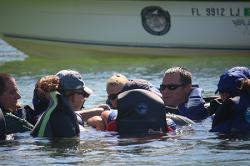
The SDRP orchestrated the rescue: One boat set a net to encircle the dolphins, then the net corral was moved to shallower water and team members got into the water around the net and briefly restrained the animals. In the water, veterinarians found that about a foot of metal fishing leader, probably from a trolling rig, was wrapped around the base of Skipper’s tail peduncle and flukes. Left unchecked, the stiff metal wire would have cut deeper into the dolphin and eventually severed her tail.

“We are seeing situations like this all too often along Florida’s coasts,” said Dr. Randy Wells, director of the Sarasota Dolphin Research Program and the rescue’s coordinator. “This otherwise healthy dolphin calf likely would have died had we not been able to remove the gear. Her entanglement is a prime example of why we humans need to be careful with our fishing gear and watch out for wildlife that lives in our coastal waters.”

This year alone, Mote’s Stranding Investigations Program and animal hospitals have responded to more than 80 stranded sea turtles and 40 stranded marine mammals within Sarasota and Manatee counties and throughout the wider region covered by the Stranding Network.

Skipper is the 22nd live animal that Mote has helped to rescue this year, said Gretchen Lovewell, manager of Mote’s Stranding Investigations Program. The team also recently helped to rescue “Speedy,” a dolphin that was trapped in a lake in the Everglades in July. In addition to responding to stranded dolphins and sea turtles, Mote’s team also supports FWC’s response to stranded manatees in Southwest Florida.

“This rescue was really rewarding,” Lovewell said. “Not only was it a demonstration of how well the Stranding Network comes together to respond to animals in distress, but it was also an opportunity to give this individual dolphin a better chance at survival and to show what can be accomplished when all of us work together.”

Learn how you can help dolphins.

The rescue was possible in-part to grants from the John H. Prescott Marine Mammal Rescue Assistance Grant Program. This federal program supports the costs for teams to help dolphins and whales – like Skipper – that face life-threatening situations.

“This was a great team effort for a successful dolphin calf disentanglement,” said Denise Boyd, FWC Research Associate who coordinates stranding responses in Charlotte, Lee and Collier counties. “We hope that the dolphin will go on to lead a healthy life from here on in.”

Injured Dolphin Tail

Injured Dolphin Tail

This image shows the injury to Skipper’s tail. Photo by the Chicago Zoological Society.

Rescuing stranded marine mammals takes a group effort – from members of the public who report sick or injured animals and the management agencies that authorize such rescues to take place to the “boots-on-the-ground” teams at nonprofit institutions and organizations that conduct many such rescues. Nonprofit organizations rely on public donations to fund such work. Please consider making a donation to Mote Marine Laboratory or another participating agency to help. Online at mote.org/donate.

Using A Tragedy To Push the Gun Control Agenda

Last Monday, August 25, 2014, a nine year old girl was at a gun range near Las Vegas being taught to shoot a Uzi gun by an instructor. She lost control of the gun and the instructor was shot in the head, killing him.

This tragedy was immediately grabbed by the gun control fanatics and all kinds of claims were made. The girl’s parents took her to the range as a present, and the instructor had been trained in teaching firearms use. I am sure the girl is traumatized and all involved would do anything to have kept it from happening.

Many have blamed the girl’s family, claiming they should never have allowed her to shoot, and the gun range for allowing young shooters to fire guns. Demands range from banning guns to not allowing kids to shoot guns to closing gun ranges.

Regardless of what you think about families making decisions for their children, and what you thing about guns, tragedies happen. Not just with guns, but with everything in life. There is no way to stop them but gun tragedies are treated differently by those that hate guns.
In 2011, the last year I could find information, the National Highway Traffic Safety Administration reports 677 people killed on bicycles in the US, and about 65 of them were 14 years old or younger. That is more than one child killed each week. Yet there are no calls for banning bicycles, not allowing kids to ride them or closing bicycle shops.

Some claim guns are not needed by anyone in the US. Neither are bicycles. Some claim guns are only made for killing people. Go to the Griffin Gun Club during one of our many shoots and you will see hundreds of folks using guns, and none of them are using them to kill people.

This is the first time something like this tragedy has ever happened. Many claim thousands of children are killed each year by guns, In 2010 1544 “children” eighteen years old or younger were killed by guns. No report on how many 17 and18 year old gang banners were in that number. And no mention of the number of kids killed by drive by shootings where bullets are fired at houses by gang members with illegal guns.

Life is dangerous. There is no way to remove all dangers. But don’t single out guns just because you fear or don’t like them.

Fishing A Tough August Night Tournament At West Point Lake

Last Saturday, night time was not necessarily the right time to catch bass at West Point. In the August Spalding County Sportsman Club tournament eight members fished for eight hours to land 14 bass weighing about 22 pounds. There were no five fish limits and two people didn’t catch a keeper.

Kwong Yu won with two bass weighing 6.55 pounds and his 3.51 pound largemouth was big fish. I was second with four spotted bass weighing 5.33 pounds, Raymond English had three at 3.76 pounds for third and Harvey Pilkenton had two weighing 2.67 for fourth,.

Kwong said just after dark, around 9:30 PM, he pulled up on a brush pile and caught his two fish on back to back casts. Both were nice largemouth, the only two weighed in. Fishing was that tough.

I started on a rock pile in about 12 feet of water where I have caught fish this summer and after about an hour I caught a barely 12 inch long spot and two short fish. I stayed there for another hour but got no more keepers.

I went and fished a couple more places without getting a bite then went back to the rock pile at dark and caught one more barely 12 inch keeper spot. After over an hour of fruitless casting I decided to head back closer to the ramp and stopped on a long point.

One of my first casts to it produced a skinny spot about 14 inches long. Then a little later I felt a tap, set the hook and a fish took off stripping drag. It rolled on the surface in the dark and from the sound I was sure I had a ten pounder, especially when it took of stripping more drag.

When I got it to the boat I was shocked to net a 2.57 pound spot. I just knew it was much bigger. All my fish hit a Mag 2 worm Texas rigged. Kwong said his two hit a jig and pig.

At least it was a little cooler when the sun set, so night time was the right time to be fishing, even if it was not necessarily the right time to be catching.
——-

Goodbye To Summer

Goodbye to Summer? Nah.
by Jim Shepherd
from The Fishing Wire

As I was battling putting the cover on the boat yesterday morning, I still managed to admire gorgeous summertime weather. And I was thinking about this “official end to summer” thing that’s supposed to be the ultimate meaning of Labor Day.

It’s not.

Heck, it’s not the official last hurrah for kids before school starts back either. Kids have been back in school for a couple of weeks here, and in some places they don’t really have a summer vacation. When you hear someone shrieking at you that this weekend is “the official back to school shopping weekend” ignore them, too.

Ditto the big “Sell A Thons” that are in every commercial break on every TV and cable station right now. Bogus “events” too.

End of Summer?

End of Summer?

This was what I saw as I was covering the boat yesterday morning. Does this look like the end of summer to you? Me neither. Jim Shepherd/OWDN photo.

Labor Day weekend is the weekend we’re supposed to appreciate the work of the American worker . OK, the work might not always be as up to snuff as it once was, but the reasoning hasn’t changed: this long weekend is to give workers across the country the thank you they deserve for the rest of the year’s efforts.

Unfortunately, the same people who work most of the other holidays will be working this weekend, too. And we should take time to thank them for their efforts as they wait our tables, pick up and deliver our packages, cook our restaurant meals or service our cars today so we can get on the road to relaxation.

I’m not going to beat this one to death because that’s a waste of my effort and your time. Instead, I’m simply going to thank you for continuing to accept our work in your eMail boxes all year long.

There are days we don’t think anyone notices, and those days when we hope no one’s looking because we made a bonehead error. And there are also those days when we seem to slip up and hit a nerve that brings “nastygrams” from people who seem to be waiting for any opportunity to hammer someone else’s work.

It all goes with the job- just like the occasional banged knuckle goes with working with your hands. Not that either is fun. They’re just part of the job of the job each of us does.

If you’re off this weekend, I hope you have a great time and are back with us next week when we’ll again show up in your inbox.

If you’re working this weekend, thanks. All of us appreciate it-whether we remember to tell you or not.
We’re not working over the entire weekend- but some of us will be working a large part of it. Not necessarily because we want to be working when most people aren’t, but because of a promise I made to you nearly thirteen years ago.

So…as always, we’ll keep you posted.

Can I Catch Trout In Alabama?

Cold Water Trout Thrive in a Warm Water State-Alabama
from The Fishing Wire

There is one spot in Alabama that can support rainbow trout – the Lewis Smith Dam tailrace, where water from the bottom of the clear-water lake remains in the 60s during the summer heat.

By David Rainer
Alabama Department of Conservation and Natural Resources

Alabama Trout

Alabama Trout

About 1,800 rainbow trout, including this 1.5-pounder, were recently stocked in the tailrace below Lewis Smith Dam near Jasper. (Photo by David Rainer, ADCNR)

The rainbow trout are biting in north Alabama. What’d you say? There are no rainbow trout in Alabama because there’s no water cold enough for rainbow trout, right?

Wrong. There is one spot in Alabama that can support rainbow trout – the Lewis Smith Dam tailrace, where water from the bottom of the clear-water lake remains in the 60s during the summer heat.

Although rainbow trout can live in that stretch of water below the dam known as the Sipsey Fork of the Black Warrior River, it isn’t sufficient to support a spawning population of trout. Therefore, the tailrace must be stocked on a regular basis.

Such a stocking took place last week when 1,800 rainbow trout were released in the tailrace at Alabama Power Company’s Lewis Smith Dam, which was a perfect site for an update on the enhancements that have been made to benefit those who pursue the tailrace trout.

Stocking Trout

Stocking Trout

The trout were sent down a plastic pipe and into the tailrace. (Photo by David Rainer, ADCNR

Jason Carlee, Environmental Affairs Supervisor with Alabama Power, said the Smith Dam, which is about 300 feet tall and 2,200 feet long, was completed in 1961.

“It didn’t take long to realize there was the potential for a cold-water fishery right here in the tailrace,” Carlee said. “Fish (rainbow trout) were stocked in the lake in the late 1960s, but the fishing success was not there. So they began looking at the tailrace. They began stocking trout in the tailrace around 1974. It’s been stocked since that time.”

In 2005, Alabama Power applied for a renewal of its hydroelectric license. During that licensing process, public input was accepted, and one of the top subjects was how to improve public access and the trout fishery in the tailrace, Carlee said. After input from the Alabama Wildlife and Freshwater Fisheries Division, U.S. Fish and Wildlife Service, Alabama Power and other stakeholder groups, a plan to make those improvements was finalized.

“The plan was developed to improve access to the tailrace, provide habitat enhancements to improve the fishery and the fishing in the tailrace, and it also developed a minimum flow system in the tailrace that would provide a 50-cubic-feet-per-second flow at all times,” Carlee said.

Metal staircases and walkways were erected to create much better access to the tailrace. The staircases are distributed from just below the dam to just north of the Highway 69 Bridge. One of those access points is a barrier-free location to accommodate those with physical disabilities.

Tailrace Walkway

Tailrace Walkway

Alabama Power Company has enhanced the stretch of tailrace just below the dam in terms of fish habitat and angler access. Metal staircases and walkways were erected in strategic spots below the dam. (Photo by David Rainer, ADCNR)

“Before the access points were installed in 2010, really the only way to get to the tailrace was through narrow, muddy footpaths,” Carlee said. “It was really difficult to get into and out of the tailrace. Now there are seven sets of steel staircases that have been anchored into the bedrock.”

Chris Metcalf of Coastal Hydrology out of Florida was hired to design and implement habitat improvements to the tailrace.

“They redesigned over 2,000 feet of river channel,” Carlee said. “They installed log banks and boulders to provide refuge for the trout. They also installed other woody debris and rock crevices. There are a few areas that Chris refers to as ‘lunker holes’ where he undercut banks as much as 6 to 8 feet. This provides excellent habitat for fish during generation. They can get in those areas and get out of the full flow.”

Carlee said the third aspect of the improvements involved a minimum flow from the dam during times when hydroelectric generation was not needed.

“This allows the fish to stay in their preferred habitat even when the units aren’t generating,” he said. “There are valves installed in each of those units to bring air into the flow to ensure ample water quality for those fish to grow.”

That minimum flow has improved the experience for the tailrace anglers, according to Brandon Jackson of the Riverside Fly Shop, located just a few miles from the dam.

“Before the minimum flow, there would be times when all we would have were pools of water,” Jackson said. “Now, there is a flow all the time. This brings the food to the fish instead of the fish having to roam around in search of food. It’s improved the fishing significantly. Instead of just a pool here and there, we have whole runs where you can expect to find fish now.”

Jay Haffner, fisheries biologist with the Alabama Wildlife and Freshwater Fisheries Division (WFF), said the only other area east of the Mississippi River at Smith Dam’s latitude that offers trout fishing is the tailrace at Lake Lanier in Georgia.

“We’ve got a lot to showcase,” Haffner said. “Today we’re showcasing an extraordinarily unique resource in the Deep South where you can take family and friends and catch trout on the warmest day of the year.”

Haffner said that anybody who ventures into the tailrace waters will soon discover just how cold it can be for people who do not wear insulated waders. However, that cold water is exactly what rainbow trout need to survive and thrive.

“With (Wildlife and Freshwater Fisheries’) many partners – Alabama Power, U.S. Fish and Wildlife Service, Dale Hollow National Fish Hatchery – we stock this stretch of river every month of the year,” Haffner said. “We stock about 35,000 trout annually.”

Haffner said since 2011 Alabama Power has provided $26,000 annually for the restocking efforts as part of the licensing agreement. Trout are purchased from Westover Farms in Missouri for five stockings, while Dale Hollow National Fish Hatchery provides the bulk of the fish for stocking, about 25,000 “catchable size” trout. Funding also comes from the Sport Fish Restoration Act, which collects excise taxes on fishing equipment.

Guide Brandon Jackson

Guide Brandon Jackson

Guides like Brandon Jackson of Riverside Fly Shop can help anglers experience the only trout fishery in Alabama. (Photo by David Rainer, ADCNR)

Haffner and summer intern Kimberly Hurt started a data collection program this summer to interview anglers in the Smith Dam tailrace. Although the data has not been finalized, Haffner said some preliminary information is available.

“One out of every four trout that is stocked winds up in an angler’s creel, gets harvested by an angler,” Haffner said. “Anglers are an interesting lot of people. I’ve been studying fish and fishermen for more than 30 years. To some people, a successful fishing trip is catching your limit of fish, whether that’s five trout in the tailrace or 10 bass on the lake. Now there are a lot of people in the world who have far more stressful jobs than studying fish. For those people, they just want to get out of the office for 3.75 hours a day to fish for trout and not have to drive over 200 miles to do it.

“Many of these fish are being caught and released, primarily by anglers who are using flies.”

Haffner said Hurt’s preliminary data from 160 angler interviews indicates about 60 percent of the tailrace anglers are using fly tackle, while the remainder are using some type of bait. About 25 percent of the tailrace anglers are from the local areas of Walker and Cullman counties. So, three of every four anglers are driving to fish the tailrace. And they’re driving more than 70 miles. Haffner also said anglers who hire guides typically catch twice as many trout as those who fly-fish unguided. Hurt’s data also showed an average of 16 anglers on the 2.5-mile stretch of river below the dam per day during the week and 21 anglers per day on the weekend.

“This is a unique opportunity to provide diversity in the fishery,” Haffner said. “Can we provide every species of trout that all anglers in Alabama want to catch? No. We’re trying to make this the best rainbow trout fishery that we can right now.”

Sounds of Summer

A recent article in the Griffin Daily News about the sounds of summer while growing up, written by a guy that grew up in a suburb, brought back many memories. Although he had some of the same memories as me, there were many unfamiliar to this country boy, and he did not mention many that were important to me.

He told of the different ways parents had of getting their kids home in time for supper. My parents blew the car horn three times. From our house on top of a hill I could hear that distinctive sound for a very long way. And I knew I better high-tail it home since my parents insisted the whole family sit down together every night for dinner.

I was too far from any neighbors to ever here them talking, or even yelling inside their houses no matter if the windows were open or not. But at night I did hear crickets, spring peepers, the sound of distance thunder that seemed to be present every summer night, and the clucking of chickens. Since we had 11,000 laying hens and kept lights on all night to encourage laying more eggs, that sound lasted all night.

Car sounds were very unusual after dark, and not very common during the day. Before I was school age the main road that ran in front of my house was dirt. Sometime around the time I started school the county put down tar and gravel. That made for a better road, but not much. The gravel was put down in a thick layer and gravel sprayed on it. The tar kinda kept the rocks in place.

The sounds of passing cars changed from a soft grinding in the sand to a crunching as the tires ran over the rocks, and an occasional clank when a piece of gravel was thrown up into the fender well.

It was not unusual for me to come in during the summer with tar on my feet. I wore shoes only on Sunday during summer vacation from school, and walking on the road after the sun heated the tar was guaranteed to get it on my bare feet. So the sounds of me fussing about mom scrubbing my feet with turpentine to get it off was pretty common, too.

We had something else in common, that city boy and me. Apparently he lived on the edge of the suburbs since he talked about damming creeks, building tree houses and camping out. I did all that, so the sounds of hammering and sawing were pretty common, as were the sounds a shovel of sand makes hitting the pile for the dam or being poured into croaker sacks.

I will never forget the sound a butcher knife makes slicing into a cold watermelon, then the crack as it is split apart. We ate watermelon at least once a week during the summer. Since we had a walk in cooler for the eggs we always had six or eight in there ready to eat.

The sound of bacon sizzling, eggs frying and the toaster popping up were daily indoor sounds. But the bacon and eggs cooking outside while we camped out sounded different, and better, somehow.

Another sound of the summer was the whoosh of daddy’s fish fryer under the carport. It was sometimes frying fish, but much more often it was boiling water to blanch corn, string beans, okra and other vegetables from our garden that mom was freezing. His fish cooker was home made out of an old wheel rim, with a pipe in the middle that the gas line hooked to. It put out a flame thrower like column of fire that heated things up fast.

One of the most important sounds of summer to me was the plop of a cork hitting the water, or the gurgle of a Jitterbug wobbling its way across the surface of a pond. Fishing was one of my favorite activities, even back then, and I went several times each week. It didn’t matter if we were fishing red wigglers dug behind the chicken house for bream or casting plugs for bass. I love it all, as I do now.

The sounds our bicycles made on the gravel and dirt roads, and the change to a whine when hitting asphalt ones, will always remind me of the fishing trips we made. My friends and I would ride our bicycles for several miles to farm ponds and spend a cool afternoon wading and catching supper.

I hope kids made some good memories of the sounds of summer this year.

Who Was At ICast?

Who Were Those Guys at ICast?
from The Fishing Wire

Although it seems like ICAST was six months ago, it’s barely been three weeks ago the sportfishing industry gathered in Orlando for their annual event. And chatter may have been dissipated by distances, but one question remains that had absolutely nothing to do with the constant hassles of government regulation, access to public waters and the usual regulatory baloney that comes along with doing business in today’s climate.

ICast Booth

ICast Booth

The Huk booth featured performance fishing attire (top). The obvious presence of the Spanish Fly boat and logos of the legendary saltwater angler Jose Wejebe (below) generated buzz, too, as did signing KVD. But the presence of other big names -like Skeet Reese (bottom) had ICAST attendees wondering if the new clothing company was out to move into fresh and saltwater fishing in a big way. Jim Shepherd/OWDN photos.

Boat At ICast

Boat At ICast

The question? “Who are those guys?” And like the iconic line from the classic Butch Cassidy & The Sundance Kid, everyone agreed with the follow up, too: “they’re very good.”

ICast Kevin VanDam

ICast Kevin VanDam

In this case, “those guys” were the guys from Huk Performance Fishing. They showed up at their first ICAST with a slick-looking booth that seemed to be a lure custom made for “name” anglers from professional bass fishing. And their announcement -made during ICAST – of signing Kevin VanDam to an apparel contract had more than a few attendees watching their booth to spot other “name” anglers looking at their very contemporary looking technical clothing.

At the start of ICAST, I was one of those people unable to tell you what the heck a “Huk” was. But tipster told me this “new” company was anything but new to the industry. Turns out, the company founders’ experience in sports and technical clothing was considered crucial to the success of another apparel company now a very major player in virtually all sports, including “the outdoor space”.

Yup, the same loosey-goosey guys joking about being friends since college were telling the truth- mostly. They just weren’t sharing was info that while they’re longtime friends, they’re proven corporate business veterans who left a company they felt was walking away from a great opportunity- fishing.

Another reason they seemed to be operating sub-rosa was the fact that Huk isn’t the company. That’s Marolina Outdoor, Inc. – a partnership of Ben Verner, Josh Reed and Jason Hart. They’re the longtime troika of friends with that “deep-seated expertise in technical apparel and intimate knowledge of the outdoor industry”.

Spending a few (disjointed) minutes talking with them at their booth, it quickly became obvious they’re playful in their demeanor, but when it comes to business, “they ain’t playin'”.

That’s the reason we’ll see KVD (and others) sporting a camo pattern on his fishing jerseys. It’s also why other names were checking out their goods. Marolina wasn’t started on a whim- or a shoestring. Seems the three founders are guided by a single position: if you’re going to play, be number one.

So, they came to ICAST with a full line of technical and casual clothing and a few surprises up their sleeves- like the KVD announcement. But they also had a business partner present in their booth whose name is iconic with saltwater anglers: Wejebe.

Krissy Wejebe, daughter of legendary saltwater angler and longtime “Spanish Fly” TV host Jose Wejebe was there, talking up a new Spanish Fly/Marolina partnership that will bring out a new line of “coastal lifestyle apparel” offering a fresh take on the classic.

A blend Krissy says is “truly unique, as was Jose.” Marolina’s Ben Verner calls the partnership a “dream come true” for the new company.

But there’s a deep-seated appreciation for the man who made “Spanish Fly” an angling standard, and that’s coming into play as well. Wejebe’s iconic -and re-outfitted- Spanish Fly boats were unmistakable at ICAST. But their presence wasn’t just to conjure up a nostalgic memory of Wejebe. They were there to foreshadow something I learned about during my visit with the Marolina crew: a resurrection and revamping of Wejebe’s now classic fishing shows.

No specific details on when we’ll be seeing the “new” Spanish Fly TV shows, but as always, we’ll keep you posted.

Writing A Fishing Book

During the summer of 2003 I was working with a literary agent in Iowa and Adams Media about writing a book on fishing. The agent had seen my web site and contacted me about a proposed book, The Everything Fishing Book. I agreed to write it and signed a contract.

I started on the book on Memorial day and from then until August 18 I spend many hours each week researching and writing. My deadline for 85,000 words was August 18th and I met it. There were days that I did not want to look at a computer screen and keyboard ever again, I just wanted to go fishing. But I finished the book on time.

Adams Media publishes a series of books with the Everything title. There are over 100 different books in this series and they have very specific guidelines on what they want. That really helped me and guided me as I wrote the chapters of the book.

It was quite a thrill to see the book listed at all the big internet book stores like Amazon and Borders. I received some copies and have given them to folks that helped me with the book. Jim Berry has a few copies at his store for sale.

One of the nice things about the contract with Adams is that I was paid up front. I get no more money whether the book sells zero copies or a bunch. So I have no vested interest in it as far as money goes, just my pride.

The book is a guide for adult beginning fishermen. I was told to write it for someone who never fished but decides to start fishing as an adult. It has a lot of basics, like explanations of the different kinds of reels, how to find a place to fish, different kinds of bait and even a glossary of different kinds of fish.

One chapter of the book is on tying good knots, another chapter discusses different kinds of line and which work better in different situations and another chapter is on cleaning and cooking your catch. Most of the information in the book comes from personal experience. All the mistakes I have made gave me good ideas of what to warn people not to do!

Looking back the writing does not seem so bad, now that it is over. And contrary to what some people told me, I do know that many words! Someday I may try it again, when the memory of those long days sitting at a computer when I could be fishing fade a little more.

Does Florida Relesing Hatchery Raised Snook Help Me Catch Fish?

Florida’s Snook Population Gets a Boost from Release of Hatchery Fish

On Friday, Aug. 15, scientists with Mote Marine Laboratory and Florida’s Fish and Wildlife Conservation Commission released hatchery-reared juvenile snook into the wild as part of an ongoing program designed to find the most effective methods to replenish and enhance wild snook populations.

Stocking Snook

Stocking Snook

Scientists net snook raised in Mote’s hatchery facility near Sarasota, Florida, for stocking in area waters. (Photo Credit Mote Marine)

The species is one of Florida’s most popular sport fish and plays an important role in drawing recreational anglers to the state. According to the American Sportfishing Association, Florida is the top-ranked state in economic output from recreational fishing, which draws $8.6 billion to the economy annually. Saltwater fishing alone generates 80 percent – $6.8 billion – of that income.

Snook, along with red drum, are the main test species for restocking efforts statewide. This project – which involves tagging and then releasing more than 2,200 snook into Sarasota Bay during over three days – is designed to determine whether snook that have been conditioned for release at Mote have better growth and survival rates in the wild.

This event is a key example of Mote’s efforts to develop and support public-private partnerships for the conservation and sustainable use of our marine resources. The snook release is possible now thanks to a private donation to Mote and from funding provided by FWC. For more than 25 years, Mote and FWC scientists have partnered on studies designed to increase the effectiveness of stock enhancement in Florida; their work on the topic is followed globally.

Snook In Hatchery

Snook In Hatchery

Snook are Florida’s premiere inshore gamefish, but have proven a challenge to grow in hatcheries in numbers large enough to affect wild populations in past efforts. (Photo Credit Mote Marine)

Past Mote and FWC research conducted through pilot snook releases that took place between 1997 and 2006 has shown that hatchery-reared fish released into the wild can indeed contribute to the local fishery with the fish growing to adulthood. And, in fact, tag data recovered following these small-scale pilot release experiments showed that using the knowledge we gained, we were able to improve the survival rate of stocked fish by more than 200 percent.

“We’ve found over time that we can improve the survival of hatchery snook released into the wild by 10 times just by choosing the right habitat,” said Dr. Kenneth Leber, Associate Vice President for Mote’s Directorate for Fisheries and Aquaculture. “We also know that there are limits on how many fish you can put in each habitat before you start to lose hatchery snook. These pilot studies we’re doing now are further defining the best methods for snook stock enhancement.”

Fingerling Snooki

Fingerling Snooki

This baby snook must survive predators, anglers, cold weather and red tide for at least four years before it will become a spawning adult. (Photo Credit Mote Marine)

Such findings are key to developing large-scale stocking techniques that are financially and environmentally feasible that can help rapidly boost populations of species affected by overfishing or natural phenomenon like the 2010 winter cold spell that resulted in the deaths of millions of snook and the closure of the fishery. Snook populations have only recently rebounded on the Gulf Coast from that event enough that FWC was able to reopen the fishery earlier this year.

This latest experiment will look at the survival in the wild of 2,000 juvenile snook that were born and raised at Mote Aquaculture Park in eastern Sarasota County. The Park is Mote’s aquaculture research and development test-bed where we are developing new methods for spawning, hatching and rearing marine species for restocking purposes and for human consumption. Many of these studies are conducted in partnership with FWC biologists.

“FWC and Mote Marine Lab have worked together since 1985 to advance marine stock enhancement in Florida,” said Chris Young, Director of FWC’s Stock Enhancement Program. “We’re excited to continue our partnership with Mote Marine Lab in support of these snook releases.”

Releasing Snook

Releasing Snook

Scientists have discovered that releasing snook in remote backwaters with lots of mangroves gives them the best chance of survival. (Photo credit Mote Marine)

For this release, FWC and Mote biologists inserted PIT tags – passive integrated transponder tags – in the juvenile snook before release. These small, 23 mm-long tags are about the size of a pencil eraser and each one transmits a unique identifying number. The transmissions will be picked up by underwater antennae placed by scientists near the release site in the wild. These antennae will listen for the released snook as they swim by and each time a tagged snook passes through the array, a receiver will record the movement.

Scientists will also use seine nets to periodically gather snook and evaluate growth rates, compare performance between wild and hatchery snook and determine whether the released fish are contributing to overall snook abundances.

One key to the study is the conditioning that some of the snook have undergone prior to release, Leber said. “We have a control group of fish that have been raised in traditional aquaculture manner – in bare tanks using artificial feed. We also have a group of conditioned fish that have been fed live prey for three days prior to their release. We’ve also placed structures into their tanks, which mimics the structure fish will have in the wild. We think these two factors will help hatchery-reared snook be more prepared for life in the wild – with a better ability to hide from predators and ready to hunt for prey of their own.”

What Are Robofish?

“Robot fish” engage angling community near Payson

Editor’s Note: Today’s feature comes to us courtesy of the Arizona Game and Fish Department.
from The Fishing Wire

Local anglers buzzing about Arizona Game and Fish Department project aimed at determining movement and fate of hatchery-raised rainbow trout

PAYSON, Ariz. — Call them robot fish, mechanical fish, even Frankenfish.

In the tiny Payson community of Beaver Valley, hatchery-raised rainbow trout hover in pools of the East Verde River, or perhaps enjoy the shade of a shoreline undercut. Then there’s a different sort of rainbow trout in these waters – ones that mill around with a pair of protruding, lightweight tags.

Robo Fish

Robo Fish

These fish have undergone surgery.

Since April, Arizona Game and Fish Department biologists at the Tonto Creek Hatchery have begun implanting the lightweight wire tags into a small portion of rainbow trout to determine the fate and movement of stocked hatchery trout.

Now far removed from surgery, recovery room-like buckets of water, and finally their hatchery runways, many tagged rainbows are wild and healthy in the East Verde. A tiny tag protrudes from the back, another from the belly.

The community is abuzz about these high-tech fish.

Ask the Kreimeyers. Also near the banks of the East Verde in Beaver Valley lives Roger and Linda Kreimeyer, married 49 years. They’re at the heart of a community engaged by the Game and Fish research project.

“I get phone calls all the time: ‘Did you see the stocking truck today?'” Linda Kreimeyer said. “It’s a fun event for families here. Everyone is curious about tagged fish. They want to see these mechanical fish.”

She laughs, then gazes down toward the tributary of the Verde River that begins at the Mogollon Rim near Washington Park, then flows mostly southwest through Gila County and the Tonto National Forest.

Game and Fish biologists are still asking anglers who catch a tagged fish to return the tags. The Department in April issued a news release asking anglers who catch a tagged trout to call the number on the colored tag (623-236-7538) with the location of the caught trout, identification number on the colored external tag, and date the fish was caught.

After all, future generations of anglers depend on such conservation efforts.

Those in Beaver Valley have taken notice of the project. It might be a stocking truck pulling up to the tiny creek, even a Department biologist or volunteer pointing a large antenna at the river to detect the position – and, in turn, fate or movement — of a tagged trout, part of the technology of telemetry. Sometimes, an angler will catch one of these “robot fish,” which Game and Fish biologists say are safe to eat.

Also, see an Arizona Game and Fish Department video of underwater. tagged trout. (https://www.youtube.com/watch?v=T-VJD80ZK3Q&feature=youtu.be)

Catching A Robo Fish

Catching A Robo Fish

It’s one of the more unique and lengthy projects anglers might witness.

“We’re getting phenomenal results,” said Arizona Game and Fish Department Fisheries Research Biologist Jessica Gwinn. “And we’re very excited that the angling public is interested in our project and participating with us.”

Game and Fish biologists will survey the East Verde River from 2014-2015, and then perform the same research methods in the East Fork of the Black River from 2015-2016.

As for the project on the East Verde River, conclusions are likely to form in 2017 or 2018.

“We want to follow the trout through several seasons,” Gwinn said. “”Early project results indicate a great return on the tags.”

Around Beaver Valley, anglers seem to understand their role in conservation, showing their passion for wildlife in part by engaging in the heritage-rich sport of fishing.

“Fishermen are really taking ownership of this project,” Gwinn said. “They live here, so they do have ownership of this stream.”